Research abounds showing the relationship between linguistically rich experiences in early childhood and later academic success and language growth (Barnes, Dickinson, & Grifenhagen, Reference Barnes, Dickinson and Grifenhagen2017: Dickinson & Porche, Reference Dickinson and Porche2011; Wasik, Bond, & Hindman, Reference Wasik, Bond and Hindman2006). Much is known regarding the relationship between parent input and child language growth, but much remains to be learned regarding teachers’ language input and children's language outcomes. Classroom-based research is needed, given that studies show differences in effects between teacher and parent input in relation to children's language growth (Hoff, Reference Hoff2006; Huttenlocher, Vasilyeva, Cymerman, & Levine, Reference Huttenlocher, Vasilyeva, Cymerman and Levine2002). An emerging body of research demonstrates relations among teachers’ language use and children's vocabulary development, with many of these studies focusing on book reading interactions (Barnes et al., Reference Barnes, Dickinson and Grifenhagen2017; Wasik et al., Reference Wasik, Bond and Hindman2006), but less attention paid to other classroom settings. Attempts to change teachers’ language practices through large-scale intervention programs have yielded limited success (Darrow, Reference Darrow2010), possibly because we have relatively little understanding of teachers’ language practices across early childhood settings. There is a need to explore language interactions across settings in pre-kindergarten classrooms, and how these interactions may be related to children's language development (Dickinson, Freiberg, & Barnes, Reference Dickinson, Freiberg, Barnes, Neuman and Dickinson2011).
The present study investigates a hybrid space, mealtimes in Head Start pre-kindergarten classrooms, which contains elements of home and school linguistic registers. We analyze data of 44 Head Start preschool mealtime conversations in classrooms servicing a population of children with below-the-mean scores on standardized measures of vocabulary, which may indicate the children's need for support with academic language. First, we examine lexical and discourse levels of talk for the presence of features of academic language. Next, we employ cluster analyses to distinguish four typologies of mealtime registers, analyzing academic vocabulary use and topic of conversation. As studies of teachers’ talk reveal relationships with children's vocabulary growth (Dickinson & Porche, Reference Dickinson and Porche2011; Dickinson & Smith, Reference Dickinson and Smith1994), we hypothesized variations in mealtime registers profiles would be associated with children's end-of-preschool receptive and expressive vocabulary measures. We addressed our hypotheses through analyzing multilevel models investigating the relationships among classroom discourse profiles and students’ end-of-year receptive and expressive vocabulary scores.
Theoretical foundations
Apprenticeship into classroom language
A usage-based theory of language acquisition acknowledges the influence of linguistic input on children's language development (Tomasello, Reference Tomasello2000). Sufficient doses of complex language must be present in order for children to produce similarly complex speech. Children are first exposed to their home registers, which may vary in degree of similarity with the academic registers they will encounter in classrooms in terms of involvement and content (Watson, Reference Watson, Reeder, Shapiro, Watson and Goelman1996). A home register, similar to van Kleeck's (Reference van Kleeck, DeBruin-Parecki, Kleeck and Gear2015) conceptualization of casual talk, emphasizes interpersonal relationships, discussions pertaining to tasks at hand, and a high degree of familiarity among speakers. This may differ substantially from an academic register, or classroom language, which privileges the transmission of academic knowledge, distance among the speakers, and reliance on lexical features for promoting clarity and precision (Nagy & Townsend, Reference Nagy and Townsend2012; van Kleeck, Reference van Kleeck, DeBruin-Parecki, Kleeck and Gear2015).
At the lexical level, academic language contains academic vocabulary, terms used within specific disciplines (hypotenuse, filibuster, personification), or across academic disciplines (argument, rationale, justify) (Nagy & Townsend, Reference Nagy and Townsend2012). Academic vocabulary is rarely used in casual conversation, but found in abundance in academic texts. Children who are exposed to greater amounts of academic or sophisticated vocabulary tend to have larger funds of academic vocabulary knowledge (Barnes & Dickinson, Reference Barnes and Dickinson2017; Weizman & Snow, Reference Weizman and Snow2001). At the discourse level, the content or topic of talk associated with an academic register typically focuses on the transmission of disciplinary content knowledge such as mathematics, science, language arts, and social studies (Schleppegrell, Reference Schleppegrell2004).
Children may be proficient in their home register upon school entry, but may have varied familiarity with a classroom register due to prior experience (Heath, Reference Heath2012). Quantitative and ethnographic studies report children from low-income homes may have less experience with academic registers and academic vocabulary specifically (e.g., Schleppegrell, Reference Schleppegrell2004). Academic language proficiency is associated with greater academic success, specifically in its relation to reading comprehension (Townsend, Filippini, Collins, & Biancarosa, Reference Townsend, Filippini, Collins and Biancarosa2012), therefore those children arriving at school with greater familiarity of a classroom register may have an advantage in comprehending classroom talk and texts.
Scollon and Scollon (Reference Scollon and Scollon1981) argue for continuity between home and school registers to promote smooth transitions for young children into the academic language of the classroom. This continuity may be accomplished in part through the act of food sharing, or commensality, which is an activity that promotes group membership (Karrebaek, Reference Karrebaek2012). Teachers may use the hybridity of mealtimes to gradually acclimate students to a classroom register while also drawing on their existing knowledge of a home register.
Hybridity and the development of third spaces
Pre-kindergarten classrooms are composed of various spaces and activities that are polycontextual in nature. In contrast to the more formalized structures and spaces of elementary school classrooms characterized by desks, whiteboards, and reading tables, pre-kindergarten classrooms may be more fluid in composition including spaces for play, reading, eating, and napping. These spaces and activities may each promote different linguistic registers (Dickinson, Hofer, Barnes, & Grifenhagen, Reference Dickinson, Hofer, Barnes and Grifenhagen2014), as well as social practices and learning objectives.
One unique space in many Head Start classrooms is the dining table or eating area. Head Start programs frequently provide meals served in a ‘family style’ within the confines of the classroom. Teachers and their students sit around tables at breakfast and lunch to eat meals together. Food is passed around in dishes, and teachers help students to serve themselves. These practices are promoted by Head Start policy, which requires supplying two nutritious meals a day and provides guidance suggesting the family-style meal structure (Administration for Children and Families; ACF, 2007). This space is unique in that it serves to bridge home–school practices, and may be considered as a third or hybrid space (Gutierrez, Baquedano-Lopez, & Tejada, Reference Gutierrez, Baquedano-Lopez and Tejada1999; Moll & Greenberg, Reference Moll, Greenberg and Moll1990). Hybrid or third spaces contain elements of both home and school practices in terms of activities, registers, and social norms (Gutierrez et al., Reference Gutierrez, Baquedano-Lopez and Tejada1999). Third spaces may fall within children's zones of proximal development as they utilize familiar home practices to engage in meal routines and conversations within the less familiar classroom setting. This hybridity may facilitate language development as the mealtime talk serves to scaffold children into a classroom register. In this space, children and teachers may use knowledge of the discourse patterns of their homes and communities to discuss and develop academic knowledge and language privileged in classroom settings.
Family mealtimes
Several studies have established predictive relationships between family mealtime conversations and children's expressive and receptive vocabulary growth (Beals, Reference Beals1997; Weizman & Snow, Reference Weizman and Snow2001). Family mealtime is a culturally derived construct that varies in the type, content, and nature of talk across ethnicities, social classes, and race (Blum-Kulka, Reference Blum-Kulka1993; Hall, Nagy, & Linn, Reference Hall, Nagy and Linn1984). Conversations during mealtimes serve a variety of purposes: discussions of current events, catching up on family activities, problem solving, event planning, and establishment of etiquette or politeness (Beals, Reference Beals1993). Many of these purposes are served through extended discourse containing narratives and explanations (Snow & Beals, Reference Snow and Beals2006). Adults’ use of extended discourse with young children has been related to children's vocabulary gains, as longer conversations may include more in-depth exploration of topics and include academic or sophisticated vocabulary (Dickinson & Smith, Reference Dickinson and Smith1994). Additionally, extended discussions may explore non-present topics including decontextualized language (Rowe, Reference Rowe2013). Narratives shared during mealtimes may involve complex language that sequences events, establishes different participants, and considers hypotheticals (Blum-Kulka, Reference Blum-Kulka1993; Snow & Beals, Reference Snow and Beals2006).
Mealtimes in classrooms
Less is known regarding conversations during mealtimes in early childhood classrooms. The relatively scant research indicates that mealtimes offer opportunities for meaningful linguistic interactions between teachers and children (Cabell, Justice, Logan, & Konold, Reference Cabell, Justice, Logan and Konold2013; Cote, Reference Cote, Dickinson and Tabors2001; Gest, Holland-Coviello, Welsh, Eicher-Catt, & Gill, Reference Gest, Holland-Coviello, Welsh, Eicher-Catt and Gill2006). Mealtimes account for approximately 7–14% of the preschool day (Chien et al., Reference Chien, Howes, Burchinal, Pianta, Ritchie, Bryant and Barbarin2010). Teachers may be stationed at a table eating with their students, thereby creating opportunities for extended conversations with multiple turns (Cote, Reference Cote, Dickinson and Tabors2001; Dickinson et al., Reference Dickinson, Freiberg, Barnes, Neuman and Dickinson2011). Mealtimes differ from other classroom settings in that teachers typically do not present formal, targeted instruction and therefore may naturally engage children in reciprocal conversations (Cote, Reference Cote, Dickinson and Tabors2001; Early et al., Reference Early, Iruka, Ritchie, Barbarin, Winn and Crawford2010). Providing children with more opportunities to engage in meaningful conversations has been associated with vocabulary growth (e.g., Harris, Golinkoff, & Hirsh-Pasek, Reference Harris, Golinkoff, Hirsh-Pasek, Neuman and Dickinson2011). As compared to other preschool classroom activities, some research indicates mealtimes include more decontextualized talk, which has been associated with improved word learning (Gest et al., Reference Gest, Holland-Coviello, Welsh, Eicher-Catt and Gill2006). When teachers are stationary at a single table throughout the mealtime, as compared to circulating during mealtime, children are more likely to engage in decontextualized talk (Cote, Reference Cote, Dickinson and Tabors2001). Moreover, language-modeling interactions have been found to be at least as frequent during mealtimes as during large-group or free-choice time (Cabell et al., Reference Cabell, Justice, Logan and Konold2013). Therefore, identifying potentially useful linguistic behaviors during mealtimes is merited.
Present study
Given the unique linguistic affordances of mealtimes and the relationships among mealtime discourse and children's language outcomes, it stands to reason that children who experience linguistically rich preschool mealtimes may have academic advantages. Mealtimes have the potential to bridge between home and classroom registers, and classrooms may utilize the potential of this setting in various ways. Linguistically rich mealtime experiences in preschool may allow children to experience discourse that gives them a much-needed academic edge. The present study sought to examine the manner in which Head Start pre-K teachers in the United States apprentice children into the language of the classroom through investigating the usage of academic vocabulary and content during mealtime discussion. We sought to address the following research questions:
1. How much academic vocabulary do teachers and children use during mealtimes? What topics are discussed?
2. What patterns or systematic differences exist in interaction styles during Head Start mealtime conversations? Are there distinct mealtime profiles?
3. If there are distinct patterns in interaction styles, to what extent do they predict children's receptive and expressive vocabulary scores after one year of Head Start pre-kindergarten?
Previous research indicates that teachers take on distinct registers (Dickinson et al., Reference Dickinson, Hofer, Barnes and Grifenhagen2014), or styles (Dickinson & Smith, Reference Dickinson and Smith1994), and differences in these styles are associated with vocabulary growth in pre-kindergarten. Therefore, we hypothesized that multiple core profiles would emerge across our teachers and children, reflecting different orientations toward mealtime discussions. Additionally, we hypothesized that these profiles would be related to children's vocabulary scores at the end of one year of Head Start pre-kindergarten, such that children engaged in mealtimes featuring an academic register would make greater growth in vocabulary scores than those engaged in mealtime discussions with fewer elements of a classroom register.
Method
Teachers and children were video-recorded during a typical lunchtime meal. In these classrooms, teachers ate lunch with the children in a family style where all participants were seated at a table and shared serving dishes of food. Most tables seated four to eight people. Classroom teachers helped to serve the children their meals as needed (dishing out servings). Forty-four classroom meals were recorded and analyzed.
Sample
Forty-four classrooms were included in the study, each containing one lead teacher and at least one aide. Of the classrooms in our sample, 40 of the mealtime conversations involved the lead teacher, while four involved the aide. All teachers and aides were female, and 93.3% self-identified as African American (6.7% European American). The analyzed sample averaged 10.7 years of experience teaching or working in Head Start (SD = 6.9). All lead teachers were qualified to teach Head Start, with 93.3% having earned a Child Development Certificate (CDA). Highest levels of education for the sample ranged from an Associate's degree (71.1%) to a Bachelor's degree (17.8%). Lead teachers and classroom aides were remarkably similar in terms of educational attainment, experience in Head Start classrooms, and reported demographics. Additionally, the aides involved in our study received all professional development provided to the teachers and were heavily involved in day-to-day instruction in the classrooms. Children were just as likely to experience mealtime discussions with an aide as a lead teacher as part of their daily classroom experience over the course of the year. Therefore, we decided to analyze teachers and aides as a group, given the similarities.
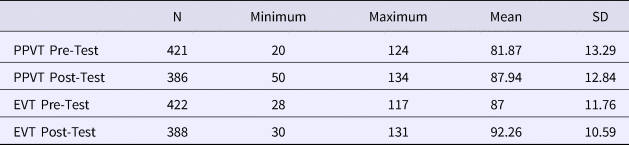
Children of varying language abilities from the 44 classrooms were selected to participate in the study to create a sample similar to the population of Head Start classrooms in general. On average, children were 4.5 (SD = 0.3) years old at the time of pre-test. The child sample is largely parent-identified as African American (98.1% African American, 1.6% White, 0.2% Hispanic), with girls composing 45.3% of the sample. Our analyzed sample included only children whose primary language was English, as children for whom English was not their native language were excluded from the sample. Children were pre-tested on standardized measures of receptive and expressive vocabulary prior to the onset of the school year (see Table 1). Post-tests were conducted with the same measures in the spring. On average, children's receptive and expressive vocabulary scores were below the national mean for the assessments; however, these scores are similar to those of the Head Start population at large (Zill et al., Reference Zill, Resnick, Kim, O'Donnell, Sorongon, McKey and D'Elio2003).
Children's standardized receptive and expressive vocabulary scores

Notes. PPVT = Peabody Picture Vocabulary Test; EVT = Expressive Vocabulary Test.
Video capture
Videos were captured in the fall of the school year. Video-recording began with the arrival of the food to the classroom and concluded with the end of the meal when participants had cleared the table and moved on to another activity. Ten consecutive minutes of these videos were transcribed in the CHAT format for analysis in the CLAN program (MacWhinney, Reference MacWhinney2000). Previous studies have found ten-minute segments for analyzing teachers’ conversations as adequate for examining patterns of talk and relationships with children's outcomes (Girolametto & Weitzman, Reference Girolametto and Weitzman2002; Justice, Jiang, & Strasser, Reference Justice, Jiang and Strasser2018). The ten minutes were selected based on the teacher's proximity to the table (preference for when teachers were sitting at the table or standing adjacent to the table). Typically, transcripts began when the teacher sat down at the table at the beginning of the meal. Speech was parsed into utterances using phrase-final intonation. Speakers were identified as teacher or child, with aides being coded as teacher. All children were coded simply as child, as individual child voices could not be discerned as only the teacher wore a lapel microphone.
Transcript analysis
Transcripts were first analyzed at the word level using the CLAN program from the CHILDES suite of language software (MacWhinney, Reference MacWhinney2000). The program calculated word types (number of different words) and tokens (number of instances of each word) for each speaker in the transcript. These variables were used to calculate a child to teacher talk ratio (total child tokens to total teacher tokens). Second, the CHAT conventions were removed from the transcripts for analysis with the Words and Phrases tool (https://www.wordandphrase.info/). This tool searched each transcript for words listed on the Corpus of Contemporary English (COCA; Davies, Reference Davies2009). The COCA consists of over 450 million words culled from oral and written language representing a broad swath of language, and includes a subcorpus of 120 million academic vocabulary words. Words are parsed into three categories: 500 most common (Range 1), 501–3000 (Range 2), and beyond 3001 (Range 3). A previous study investigating vocabulary input to preschool-aged children found the COCA to be a reasonable measure (Christ, Wang, & Chu, Reference Christ, Wang and Chu2011). Type and token counts were calculated for the different tiers of each list, with Range 3 terms being considered to represent sophisticated or academic vocabulary for pre-kindergarten-aged children in the present study.
Content coding
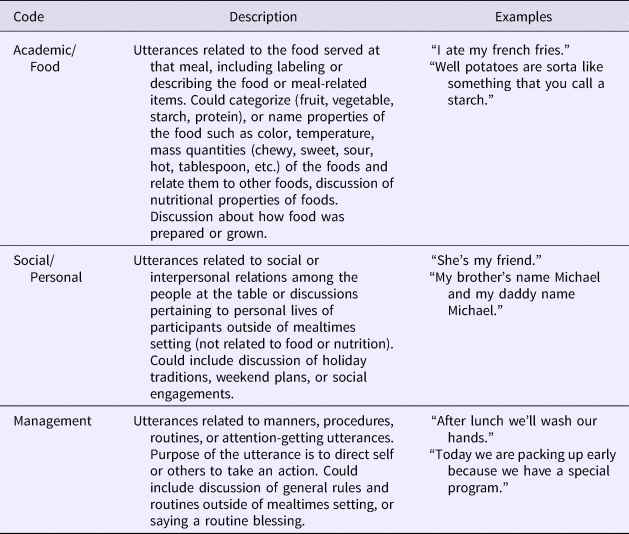
Transcripts were coded for the content of talk using time sampling at one-minute intervals for both teachers and children. The content of each minute was inclusively coded to indicate the presence of the following topics of interest: academic content/food and nutrition, social or personal talk, and managerial talk. The initial coding scheme included a larger range of topics, but given the limited presence of other topics (such as academic talk about books or mathematics), these topics were not included in the analyses. The code of no talk was inserted if no talk occurred during an entire minute. Examples of each topic are provided in Table 2. As we were interested in the overall conversation for this study, rather than the distinct contributions for teacher or child, the codes were collapsed across speakers. Therefore, each topic could range from 0–40. All scores were standardized into z-scores for analyses.
Definitions and examples of content codes

Reliability
Transcripts were double-coded by the first and second authors until an acceptable degree of reliability was achieved (ICC > .85). Transcripts were then numbered, and using a random number generator, 20% of the transcripts were selected to be coded for reliability at evenly spaced intervals to avoid coder drift. Any disagreements were resolved through discussion until consensus was met. The average reliability across all double-coded transcripts was .959, with reliability of all double-coded transcripts exceeding an ICC of .890.
Vocabulary assessments
Children's receptive and expressive vocabularies were assessed in the fall (pre-test) and spring (post-test) of the preschool year. The Peabody Picture Vocabulary Test (PPVT; Dunn, Williams, Wang, & Booklets, Reference Dunn, Williams, Wang and Booklets1997) measured receptive vocabulary. The assessment asks the participant to point to one of four provided pictures when verbally prompted with the stimulus word. Test developers report reliability for the PPVT to range from .91 to .94, with a Cronbach's alpha of .95 (Dunn et al., Reference Dunn, Williams, Wang and Booklets1997). The Expressive Vocabulary Test (EVT; Williams, Reference Williams1997) asks children to verbally identify illustrations with appropriate vocabulary terms. Test–retest reliabilities range from .77 to .90. The PPVT and EVT yield raw and standardized scores when scored in a conventional manner, with standardized scores being utilized in the present study to control for differences in children's ages.
Results
Preliminary analyses
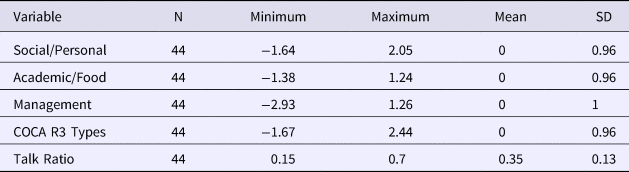
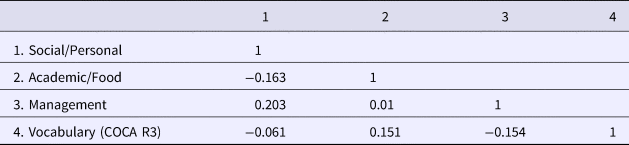
Means and standard deviations in z-scores for the entire sample are provided in Table 3. Correlations among variables are provided in Table 4. No significant correlations among the variables were found.
Descriptive statistics for full sample presented as z-scores

Notes. COCA Range 3 types; child–teacher talk ratio in word tokens.
Correlations among standardized variables

Cluster analysis
We sought to identify patterns of talk among participants during mealtime conversations to create a person-centered rather than variable-centered approach for statistical analyses (Hoff & Laursen, Reference Hoff and Laursen2006; Lanza & Cooper, Reference Lanza and Cooper2016). The ways in which speakers engage in mealtime conversations may vary systematically, such that speakers weave together a variety of topics and lexical choices that vary from one classroom to the next. Given this heterogeneity, a person-centered approach allows for the detection of patterns of subgroups that differ across multiple variables describing discourse features (Magnuson, Reference Magnuson2003), allowing for a more holistic description of children's linguistic experiences. Statistically speaking, person-centered approaches work from the assumption that distinctions and differences in patterns shape how the predictor is linked to the outcome (Ansari & Purtell, Reference Ansari and Purtell2017; Lanza & Cooper, Reference Lanza and Cooper2016). Recent studies in early childhood classrooms reveal the usefulness of this methodological approach for describing children's experiences in different activity settings, and how the heterogeneity of these patterns is associated with children's outcomes (Ansari & Purtell, Reference Ansari and Purtell2017; Chien et al., Reference Chien, Howes, Burchinal, Pianta, Ritchie, Bryant and Barbarin2010).
We incorporated a cluster analysis approach including Ward's method and squared Euclidean distances utilizing standardized z-scores (as suggested by Aldenderfer & Blashfield, Reference Aldenderfer and Blashfield1984). Standardized scores allow for easier comparison across variables and across clusters. All variables in Table 4 were included in the analysis. We selected squared Euclidean distances as a distance measure of similarity to highlight distinctions in profile and magnitude on the variables used in the hierarchical agglomerative cluster analysis. Ward's analysis was selected as previous studies demonstrate it to be a reliable method for consistently identifying distinct clusters (Breckenridge, Reference Breckenridge2000). We then employed K-means iterative partitioning passes to permit shifting of cases among clusters to achieve tighter solutions (Aldenderfer & Blashfield, Reference Aldenderfer and Blashfield1984). Clustering was performed on standardized variables using SPSS.
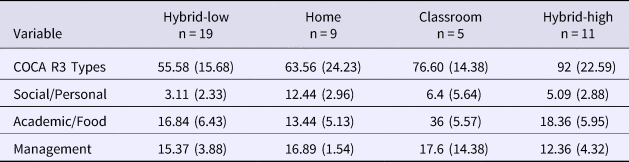
This methodology yielded a four-cluster solution. The four profiles demonstrate the natural variation in the topic and amount of academic vocabulary use of the mealtime participants. One-way analyses of variance indicated all variables yielded significant mean differences from the other cluster groups, per expectation. Examination of the cluster profiles of the raw (Table 5) and standardized data (Figure 1) reflect each classroom's approach to mealtime conversations and led to naming them as home, classroom, hybrid-high, and hybrid-low. The clusters appear to be relatively distinct from one another upon visual analysis of the data as represented in Figure 1.
Mealtimes discourse profiles expressed in z-scores.

Final cluster center means and standard deviations

The hybrid-low cluster represented approximately 43% of the sample (n = 19) and was characterized by having relatively low averages of each variable in respect to the other four clusters. This does not necessarily indicate a lack of rich language, but rather fewer instances of each type of talk relative to the other three clusters. The hybrid-low cluster had limited amounts of discussion pertaining to social/personal or academic/food-related topics. Teachers and children used approximately 56 academic vocabulary words per mealtime conversation, indicating children were exposed to about 5.6 academic vocabulary terms per minute. Only managerial talk had a positive z-score for this cluster. Talk was relatively sparse in these clusters as teachers and children averaged 825 words across ten minutes (roughly 83 total words per minute).
The home cluster represented 20% of the sample (n = 9) and was characterized by extensive talk about social/personal topics, with the highest average of social/personal talk among all four clusters. This cluster also discussed academic/food topics; however, this cluster included the least amount of such talk in comparison to the other three clusters. This cluster had the second lowest academic vocabulary use, averaging 6.4 academic vocabulary terms per minute. Additionally, there were moderately large amounts of managerial talk, with this cluster possessing the second highest average. On average, teachers and children produced 1087 total words across ten minutes (approximately 109 words per minute).
The classroom cluster represented 11% of the sample (n = 5). This cluster was characterized by large amounts of academic/food-related talk, with the mean of 36 nearly double that of the cluster with the second highest average (hybrid-high). Additionally, this cluster contained the largest amount of managerial talk of the four clusters. This cluster also had relatively large amounts of social/personal talk, ranking second across the four clusters. On average, conversations in this cluster had 76.6 academic vocabulary terms, indicating children were exposed to approximately 7.7 academic vocabulary words per minute. Notably, all z-scores for this cluster were positive. This was the most talkative cluster, averaging 1134 total words (113 words per minute on average).
The final cluster, hybrid-high, was composed of 11 classrooms (25% of the sample). This cluster was named based on the relatively high means across three of the four variables, indicating no particular type of discourse was privileged in comparison to the others. This cluster had the highest average of academic vocabulary terms, with children hearing or saying 9.2 words per minute on average. Additionally, the conversations were rich with academic/food and social/personal talk, with the cluster having the second highest means for these categories across the four clusters. The cluster had the lowest mean for managerial talk. On average, teachers and children produced 909 total words (91 words per minute on average).
Having established and named the clusters, they were then compared on the child–teacher talk ratio variable excluded from the analyses. As demonstrated in Table 3, all clusters had similar means for the talk ratio variable, with the hybrid-low cluster having the lowest mean of .28 and the classroom cluster possessing the highest of .44. The classroom and home clusters showed remarkable similarity in the talk ratio variable with the means differing by only .01 (.43 and .44, respectively). We also investigated the location of aides across the four profiles, as well as the number of children seated at each table per group. The four classroom aides were distributed across the clusters. Number of children per table was relatively stable across the four clusters, with means ranging from 5.4 (cluster 3) to 6.125 children per table (clusters 1 and 2).
Multilevel models
The final phase of our analysis tested the relationship among the different clusters and children's end-of-year receptive and expressive vocabulary scores as measured by standardized assessments of academic vocabulary. Multilevel models were built using SPSS version 24 to account for the nested nature of the data (children nested in classrooms). Data were checked for normality prior to analysis with no outliers present. Some attrition of sample was experienced across the year of Head Start pre-kindergarten as this population of children tends to be more mobile than other preschool population (Zill et al., Reference Zill, Resnick, Kim, O'Donnell, Sorongon, McKey and D'Elio2003), with missing data being typical in educational research. Missing data ranged from 8–9% for children's fall and spring language measures due to student mobility. Therefore, we assumed missing data to be missing at random. If data were missing from either spring or fall assessments for a student, then the case was eliminated list-wise from the dataset. We utilized full information maximum likelihood (FIML) to incorporate all available information at each step of the analysis.
Baseline models for post-test receptive and expressive vocabulary were developed and first tested as intercept-only models. Pre-test scores were then added and assessed for significance. Intra-class correlation coefficients (ICCs) were calculated for each unconditional model. Significant variation was found at the classroom level (ICC = .28 for the PPVT, ICC = .02 for the EVT), therefore a two-level model was employed. At the child level, fall pre-test (EVT or PPVT) was added as a covariate. At the teacher level, child–teacher talk ratio was added as a covariate.
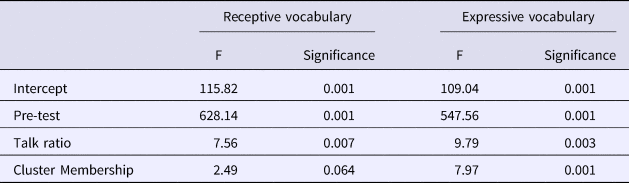
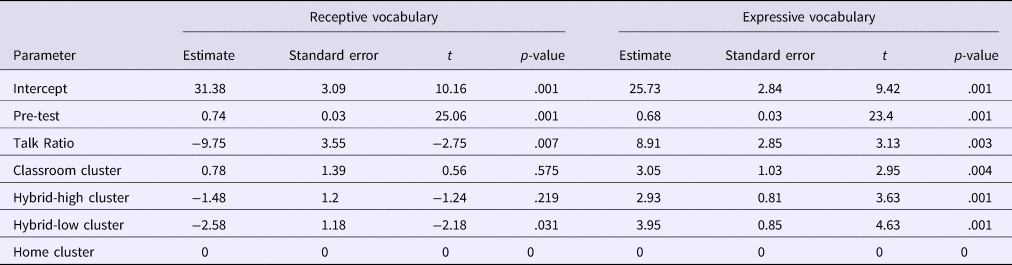
Model results are presented in ANOVA format as cluster membership was entered as a categorical predictor. No significant relationships were found among the four clusters and children's receptive vocabulary scores at the end of one year of Head Start pre-kindergarten (see Table 6). Cluster membership did approach significance as a predictor (F = 0.249, p = .064), but did not significantly account for variance in end-of-year receptive vocabulary scores. In contrast, cluster membership was a significant predictor of expressive vocabulary scores (see Table 6) as measured by the EVT (F = 7.97, p = .001), controlling for child–teacher talk ratio. Using the home cluster as the comparison group, parameter estimates indicate significant differences among the cluster types, with hybrid-high, hybrid-low, and classroom profiles predicting greater growth on our expressive vocabulary measure than the home cluster (see Table 7). We selected the home cluster as the comparison group given our theoretical orientation toward apprenticing children into academic language with the expectation that all children would arrive at school possessing well-established home registers. Children in the hybrid-low cluster had z-scores 3.95 points higher than those in the home cluster, which represents the greatest difference among the groups. Children in the classroom cluster had z-scores 3.05 points higher than children in the home cluster, while those in the hybrid-high cluster had z-scores 2.93 points higher. Child–teacher talk ratio also contributed to variance in the end-of-year expressive vocabulary scores (B = 8.91, p = .001), such that children in classrooms where higher ratios of child to teacher talk were present had higher end-of-year expressive vocabulary scores.
Tests of fixed effects for receptive and expressive vocabulary

Notes. Pre-test receptive vocabulary as measured by PPVT, expressive vocabulary as measured by EVT.
Estimating relations among membership cluster and end-of-year vocabulary

Note. Receptive vocabulary as measured by PPVT, expressive vocabulary as measured by EVT.
Discussion
Children have the opportunity to develop interpersonal and linguistic skills through mealtime conversations (Ochs, Pontecorvo, & Fasulo, Reference Ochs, Pontecorvo and Fasulo1996; Paugh & Izquierdo, Reference Paugh and Izquierdo2009) that promote group membership through a shared linguistic register. They may develop understandings of culturally appropriate means for sharing food, appropriate topics of conversation, and nutritional or scientific content (understandings about healthy or unhealthy food), as well as be exposed to rich linguistic input at the word and discourse levels. Adults explicitly and implicitly teach children about culture through mealtime (Ochs et al., Reference Ochs, Pontecorvo and Fasulo1996), with teachers helping children understand the distinct linguistic culture of a classroom. Relatively few studies have investigated how teachers and students interact during preschool mealtimes in spite of the potential for revealing discourse features positively associated with young children's vocabulary gains.
We sought to address this gap through first describing teacher–child discourse during mealtimes to reveal the heterogeneity among patterns of discourse and then through detecting relations among these patterns and children's vocabulary outcomes at the end of one year of Head Start preschool. Our study revealed four distinct conversational profiles composed of varied features of academic and home language: hybrid-high, hybrid-low, home, and classroom. Most mealtime conversations were categorized as hybrid-low (43%), followed by hybrid-high (25%), home (20.6%), and classroom (11.4%). Variation among these registers is associated with children's end-of-year expressive, but not receptive, vocabulary. The four typologies of discourse were differentially associated with expressive vocabulary, such that children displayed the largest gains in hybrid-low classrooms, and the smallest gains in classrooms displaying home registers.
These distinct profiles indicate that mealtimes in Head Start classrooms may be hybrid spaces as they contain elements of home and classroom registers, which may apprentice children into the academic language of the classroom. Individual classroom communities, likely lead by the adults’ facilitation style, variably shape mealtimes as a discourse setting with different features and foci. Caregivers may prioritize particular domains in this space, including language and cognitive development (academic language and content), social-emotional development (social/personal skills), or self-help and physical development (nutrition and self-feeding) (Mita, Gray, & Goodell, Reference Mita, Gray and Goodell2015). Likewise, caregivers often seek to bridge the home and school settings by connecting the preschool mealtime to family mealtimes and experiences, and home register to the classroom register by introducing academic language and classroom discourse topics.
Child–teacher talk ratios indicate that mealtimes are conversational settings that contain relatively large amounts of child talk. Comparing our findings with a previous study (Dickinson et al., Reference Dickinson, Freiberg, Barnes, Neuman and Dickinson2011) of this sample across different instructional contexts (book-reading, small group instruction, centers, etc.) reveals that children are provided with more opportunities to talk during mealtimes than other settings, which may contribute to increases on expressive vocabulary measures. A conversational style during mealtimes may allow adults to be more responsive and scaffold children's linguistic needs, which may be of particular importance in group settings given the diversity among children (Justice et al., Reference Justice, Jiang and Strasser2018). Responsive adult behaviors follow the child's lead and interests or create joint attention focusing on the food at hand to help children to develop understandings regarding the “intentional and communicative nature of language” (Justice et al., Reference Justice, Jiang and Strasser2018, p. 89). Communication-facilitating behaviors have been associated with the development of socio-cognitive skills critical for language development (Tamis-LeMonda, Kuchirko, & Song, Reference Tamis-LeMonda, Kuchirko and Song2014).
The four clusters showed evidence of including academic vocabulary on a consistent basis, ranging from 5.6 words per minute (hybrid-low cluster) to 9.2 words per minute (hybrid-high cluster). Another study involving this same dataset explored teachers’ use of sophisticated vocabulary as measured by the Dale–Chall list (Chall & Dale, Reference Chall and Dale1995) revealed that, across book-reading, small group, and large group instruction, teachers averaged 0.75 sophisticated vocabulary words per minute (Dickinson et al., Reference Dickinson, Hofer, Barnes and Grifenhagen2014). This average is substantially lower than our averages during mealtimes; however, our study used a different measure of academic vocabulary (COCA Range 3) and included academic words spoken by the teacher and children. Nonetheless, the substantial inclusion of academic vocabulary during mealtimes suggests that it is a naturalistic, supportive setting that may promote vocabulary growth. However, our findings also indicate great heterogeneity among mealtime conversations, such that particular profiles offered more exposure to academic vocabulary.
Relations with vocabulary outcomes
Social/personal discourse
Children in classrooms characterized by an emphasis on social/personal talk (home cluster) experienced less expressive vocabulary growth than children in the classrooms of teachers categorized by the remaining three profiles, but nonetheless still received benefits from this discourse profile in terms of expressive vocabulary growth. The emphasis on social/personal talk may build bridges between home and school registers by tapping into children's funds of knowledge (Moll, Amanti, Neff, & Gonzalez, Reference Moll, Amanti, Neff and Gonzalez1992), while linking these topics to the language of school which privileges decontextualized language. Head Start advocates for reaching out to families to learn about their cultures, such that teachers may bring this knowledge to the classrooms to promote rich conversations (ACF, 2007), associated with children's vocabulary growth (Dickinson & Porche, Reference Dickinson and Porche2011). Within the context of mealtimes, teachers may use this shared knowledge to ask children about their home cultures or experiences, prompting extended discussions of decontextualized topics associated with children's vocabulary growth (Dickinson & Porche, Reference Dickinson and Porche2011; De Temple & Beals, Reference DeTemple and Beals1991).
An examination of the following transcript exemplifies the potential of including decontextualized social/personal talk into an extended discussion. In the following child-initiated topic of conversation the teacher genuinely attempted to learn about the child's family.
child: Everybody was sick.
teacher: Who was sick?
child: My granny and my poppa momma.
teacher: What's wrong with granny?
child: She had to get a shot.
teacher: She ok? What's wrong with momma granny?
child: Mm, she had surgery.
teacher: She did? She in the hospital?
child: Yes.
This conversation spanned multiple turns between the child and teacher, thus promoting a bout of extended discourse such as is associated with vocabulary growth (Dickinson & Porche, Reference Dickinson and Porche2011). The discussion includes some academic vocabulary, hospital and surgery, and contains a decontextualized topic that requires the child to provide clarifying details to further the teacher's understanding, both of which are associated with improved vocabulary outcomes (Dickinson & Smith, Reference Dickinson and Smith1994; Dickinson & Porche, Reference Dickinson and Porche2011; Rowe, 2013; Weizman & Snow, Reference Weizman and Snow2001). The teacher uses open-ended questions (e.g., What's wrong with granny?) to scaffold the child's narrative such that the child is prompted to add critical details that include academic vocabulary (e.g., surgery), thus pushing the child to shift into an academic register (Cazden, Reference Cazden1988; Michaels, Reference Michaels1981). Indeed, this form of explanatory talk allows for the introduction of sophisticated topics with potential for learning about the world and words (Beals, Reference Beals1993). Using personal details from the child's life to construct narratives reminiscent of classroom discourse illuminates the hybridity of the mealtime context as elements of school and home registers meld together.
Classroom discourse
The classroom register was positively related to children's end-of-year expressive vocabulary scores, and was significantly different from the home register in relation to this association. Our classroom register included large amounts of talk pertaining to food and nutrition, with the conversations taking on an academic tone in terms of amount of academic vocabulary. Talk about food may include a variety of scientific disciplines such as biology, chemistry, agriculture, ecology, and technology. Indeed, food-based discussions can serve as the basis for conceptual knowledge development (Calabrese-Barton, Koch, Contento, & Hagiwara, Reference Calabrese-Barton, Koch, Contento and Hagiwara2005). Discussions about food in pre-kindergarten settings may position children for future success in elementary classroom, given that many standards make mention of food and nutrition (NGSS Lead States, 2013), with pre-kindergarten standards and Head Start programs placing emphasis on healthy eating, nutrition, and food (ACF, 2007). These discussions may be of particular importance for children from culturally diverse backgrounds as studies show food-based science instruction is related to enhancements in students’ attitudes and performances in science (Fraser-Abder, Doria, Yang, & De Jesus, Reference Fraser-Abder, Doria, Yang and De Jesus2010).
Discussions that begin by naming and discussing foods present on the table may help children develop or activate conceptual knowledge which is associated with vocabulary knowledge (Neuman, Reference Neuman2010). A common theme across discussions in this cluster involved the teacher prompting children to name foods on the table and then moving into a discussion of the properties and/or categorizations of the foods, as exemplified in the following discussion.
teacher: Do we have a vegetable today?
child: yeah.
teacher: What kinda vegetable do we have on our plates?
child: Banana!
teacher: Umm. Banana's a fruit. What kinda vegetable do we have?
child: Broccoli!
teacher: Broccoli and potatoes. Well potatoes are sorta like something that you call a starch.
Here, the teacher builds on a principle of word learning, categorical scope, which indicates that words are extended based on category membership (concept) rather than perceptual similarity (Golinkoff, Mervis, & Hirsh-Pasek, Reference Golinkoff, Mervis and Hirsh-Pasek1994). The teacher asks the children about which foods fall into the vegetable category, and then provides corrective feedback when a child incorrectly names a fruit. She further builds on the concept of vegetable by linking the response provided by the children (broccoli) with an additional example of a vegetable, potato, both of which are relatively sophisticated terms for children in pre-kindergarten classrooms. The teacher also introduces the academic vocabulary term starch. While she does not provide a definition of the term, she does provide potato as an example. Simply introducing the word to young children may be a stepping stone toward later acquisition and deeper understanding.
Hybrid discourse styles
Two profiles revealed relative balances across topics, with no topic taking center stage. These profiles were named hybrid-high and hybrid-low to demonstrate this balance, while also acknowledging that the high category contained relatively large amounts of talk and academic vocabulary, while the hybrid-low category included less talk and academic vocabulary. Both profiles showed elements of home and classroom discourse registers, indicating a hybridity of talk. The relative balance across topics may have allowed children access to different types of linguistic interactions and opportunities. Classrooms that allow multiple entry points into conversations based on children's interests may promote engagement, which in turn may foster vocabulary growth (Girolametto & Weitzman, Reference Girolametto and Weitzman2002). Both profiles had greater associations with children's expressive vocabulary gains over the pre-kindergarten year than children in classrooms that emphasized a home register during mealtimes.
Interestingly, the hybrid-low profile had the largest relationship with children's end-of-year expressive vocabulary scores as measured by the EVT. The emphasis on rules, expectations, and routines may have contributed to a positive mealtime environment contributing to positive short- and long-term outcomes for children including a good day overall and healthy eating habits (Mita et al., Reference Mita, Gray and Goodell2015). Additionally, teachers in this profile may have assisted children with developing self-regulation through focusing their attention on the task-at-hand. Dickinson and Porche (Reference Dickinson and Porche2011) found that brief, behaviorally focused comments help children to maintain focus during academic tasks. Helping children to develop executive functioning skills may positively impact children's language acquisition as they may be better able to tune in and focus on conversations or the language at hand (Dickinson & Porche, Reference Dickinson and Porche2011). Mealtimes may serve to apprentice children into appropriate discourse moves, such as staying on topic, determining the appropriateness of the topic, how to give appropriate amounts of information, and socially acceptable forms of communication (Beals, Reference Beals1993). This type of discourse may be squarely in the children's zones of proximal development as it provided the just right amount of academic vocabulary and variety of topics. Other profiles containing greater amounts of academic talk may have been just beyond the reach of this sample of students, given the differences in end-of-year expressive vocabulary scores. While children benefit from exposure to academic vocabulary and language, the amount of input should still be within the zone of proximal development (ZPD) in order for maximum vocabulary growth to occur.
Person-centered studies
Our reported findings highlight the advantages of person-centered approaches to statistical analysis of data involving heterogeneous groups of children for educational research. By using person-centered methods, rather than a variable-centered approach, we were able to examine the heterogeneity of variation in discourse clusters (Ansari & Purtell, Reference Ansari and Purtell2017; Lanza & Cooper, Reference Lanza and Cooper2016). This is critical for future research as our results indicate variation in the discourse within Head Start classrooms that serve children from low-income homes. Frequently, this population of children is treated as a homogeneous group; hence our findings are of importance as they highlight relative differences across patterns of discourse. Analyzing discourse patterns is particularly useful as language elements (words, tone, topic, etc.) do not exist in isolation, but rather work together in registers specific to groups of people (Schleppegrell, Reference Schleppegrell2004). Identifying how specific variables are related to vocabulary growth is one step in the process of promoting language growth for young children, but identifying how a constellation of variables work together in a naturalistic setting allows for a more comprehensive and nuanced view of language learning opportunities (Barnes & Dickinson, Reference Barnes and Dickinson2017). Our clusters identify distinct linguistic registers, each of which is differentially associated with children's end-of-year expressive vocabulary scores. A person-centered approach allowed for the descriptions of discourse clusters, some of which were composed of elements of an academic register.
Limitations, implications, and conclusions
Some caution should be employed when applying our results to other more heterogeneous samples. Our sample was relatively small (44 adults and 384 students) and housed in relatively homogeneous classrooms in terms of self-reported ethnicity and socio-economic status. Additionally, our sample of children had relatively low means for the standardized language assessments, which may indicate that our sample is distinct from the general population that includes a greater range of child language scores. The small sample size is also a limitation in terms of cluster analysis, as our profiles contained as few five units. While there are no clear guidelines regarding appropriate sample sizes for cluster analysis, larger samples increase the stability and validity of the analyses (Schweizer, Reference Schweizer1994). We were able to use ANOVAs to demonstrate the statistical differences among clusters, but were not able to perform other discriminant functions with half-samples. Nonetheless, as our analyses are exploratory in nature, they remain an important first step toward analyzing variability in this understudied space.
Our video capture was limited to a single ten-minute mealtime. While teachers reported that the meal was typical for their classroom, it is possible that participants shift their conversational styles over time, particularly as children become apprenticed into the language of the classroom and share more common experiences. Future studies may wish to investigate the consistency or variability in mealtime conversations over time or across longer spans of conversation. The group size was relatively stable in our study, hence we were unable to determine if a relationship among the size of the group and discourse patterns exists. Teachers and children may adjust their conversations based on the present participants. Additionally, our time sampling is a measure of the frequency of talk across one-minute intervals. While this does accurately account for the presence or absence of certain topics of talk, it may miss important distinctions among the overall number of topics. For example, one managerial comment per minute would be scored the same as six managerial comments per minute. Even with these time intervals, distinct differences among mealtime orientations were observed. Importantly, our findings should only be taken as exploratory as we were trying to understand differences in orientations to mealtime conversations rather than intentionally manipulate conversational profiles. Additional studies should investigate how teachers support language growth across the day to determine how each setting may contribute to children's overall language development in unique ways.
In spite of the above limitations, the described study has important implications. Large-scale interventions addressing preschool classrooms broadly have met with limited success (Darrow, Reference Darrow2010), which may be due to a global approach to training rather leveraging the affordances of different settings (Dickinson et al., Reference Dickinson, Freiberg, Barnes, Neuman and Dickinson2011). Identifying existing linguistic practices in specific settings associated with children's language development may allow for more targeted intervention or professional development that builds on teachers’ existing strengths. For example, a teacher who excels at social/personal talk should be encouraged to continue with this practice, but should also be provided with supports for enhancing her use of academic vocabulary or exploration of academic topics. Such targeted training may result in enhanced uptake by teachers (Cabell et al., Reference Cabell, Justice, Logan and Konold2013), thereby potentially providing improved linguistic models.
Additionally, examining a pre-kindergarten activity not typically devoted to academic instruction merits further examination, as indicated by our findings demonstrating relationships among mealtime talk clusters and children's end-of-year expressive vocabulary scores. These settings provide unique opportunities for children to engage in conversation with their peers and teachers to explore topics of interest and learn about the language of the classroom. Spaces such as mealtimes that allow for hybrid discourse may be of particular importance for children from diverse backgrounds as they may provide a range of supports (e.g., discussing food visibly present, using prior knowledge to spark conversations) to apprentice young children into the language of the classroom. Our findings support the notion of differences in linguistic registers across and within different pre-kindergarten settings (Dickinson et al., Reference Dickinson, Hofer, Barnes and Grifenhagen2014).
Acknowledgements
This research was funded by grant #R324E060088A from the US Department of Education awarded to Ann Kaiser and the second author, and Vanderbilt's Experimental Education Research Training Grant from the Institute of Education Sciences (IES; Grant No. R324E060088) and the Department of Teaching and Learning at Peabody College.