In 1909, the Colonial Economic Committee, one of the leading colonial societies in Wilhelmine Germany, published a report entitled Unsere Kolonialwirtschaft in ihrer Bedeutung für Industrie und Arbeiterschaft. The report aimed to inform its readers about the significant increase in trade with the colonies and the importance of tropical raw materials for industrial manufacture, highlighting the economic interdependence between colonial trade and domestic labour conditions. The seven chapters following the introduction deal with the most important raw materials and are arranged in descending order of importance, thus reflecting the significance of each commodity for Wilhelmine industry, its economy and trade. The first chapter is dedicated to cotton. During the nineteenth century, cotton fabrics became more accessible to broader consumer groups, following the mechanisation of production processes, cotton spinning and weaving. Soon after the unification of Germany in 1871, the cotton textile industry expanded significantly. Prior to that, spinning and weaving were essentially cottage industries, producing mostly wool and linen. By 1909, Germany’s cotton industry was the largest on the European continent and the third largest in the world. The value of its output was the most sizeable of all domestic industries and constituted the nation’s most important export product.
Rubber, the second most significant commodity, also became an indispensable raw material during the nineteenth century. It was only after the discovery of the vulcanisation process in the 1830s, by which rubber is cured through the addition of sulphur and the exertion of pressure and heat, that the manufacture of durable rubber-goods was made possible. As a result, the demand for this raw material grew enormously. Here too, Germany played a key role, as its rubber industry had become the third largest in the world by the 1890s.
Oil palm fruits and kernels are discussed in the third chapter of Unsere Kolonialwirtschaft. Palm oil had been used by the nations of West Africa for centuries, but European interest in this vegetable fat source was only aroused during the nineteenth century, following the progressive shortfall of other, traditional, resources: tallow and whale oil. As a consequence of the Crimean War (1853–1856), the supply of Russian tallow imported to Western Europe for soap making was interrupted and ultimately ceased altogether. Concurrently, declining whaling quotas and the subsequent difficulties in the industry from the 1850s onwards encouraged the search for substitutes. In these circumstances, palm oil and later palm kernel oil were adopted as alternatives by various industrial sectors. By the 1890s, more than one third of all palm kernels imported to Europe were processed in the oil mills of Hamburg’s neighbouring city Harburg. The oil obtained was then processed into soap, lubricants, margarine, explosives, etc. The remaining four chapters of Unsere Kolonialwirtschaft deal with tropical timber and tanning agents, mineral resources, animal products, and colonial edibles and stimulants. 1
Even though the report invites the retracing of the commodity chains of various raw materials, this paper focuses only on rubber and palm oil/kernels. While cotton has been examined extensively, most recently in Sven Beckert’s Empire of Cotton (2014),Reference Beckert 2 and Andrew Zimmerman’s Alabama in Africa (2010),Reference Zimmerman 3 rubber and palm oil/kernels have not received the same in-depth attention, particularly regarding their connection with the German colonial venture. Following the commodity chain approach, by which producers, intermediaries and consumers are included in the analysis, this paper shows the influence of Hanseatic merchant families (e.g. O’Swald, Schramm, or Woermann) in shaping and ordering the terms by which African and South American regions engaged in the emerging world economy of the later nineteenth century. The commercial activities of the Hanseatic merchants in question not only linked the port city of Hamburg with production areas, but actively helped in defining and launching the colonial policy of Wilhelmine Germany.
When considering the geographic distribution of the respective harvesting sites, the global character of the rubber and palm oil/kernel chain becomes visible. While the oil palm (Elaeis guineensis) is indigenous to equatorial Africa, rubber can be found in a broad variety of different plants all over the globe. However, the quality and quantity obtained from one variety of tree native to the Amazon rainforest (Hevea brasiliensis) surpassed all the others, making it the most expensive and sought after. Today both plants have spread globally within the equatorial belt. However, in the time period examined by this paper, the main collection sites were concentrated on the continents of origin. 4 In addition, the hinterlands of both Africa and South America were made accessible to foreign trade during the nineteenth century. Hence, retracing the commodity chains of rubber and palm oil kernels in the years between the 1850s and the first decades of the twentieth century requires that we take into account the major political and spatial transformations of that period – the abolition of the Trans-Atlantic Slave Trade, the independence of former British, French and Iberian colonies in the Americas with the resulting implosion of trade monopolies, the Napoleonic Era, and the Scramble for Africa (Berlin Conference) – as these turning points delineated the reorientation of Hanseatic merchants’ engagement in world trade.
Industrialisation in Hamburg and in its neighbouring city Harburg, a port city of the Kingdom of Hanover until 1866, was grounded and relied primarily on processing rubber, palm oil, and later palm kernel oil into multiple factory-made goods: soaps, margarine, detergents, combs, tyres, telegraph cables, etc. Multiple rubber manufacturers were set up in both cities, some of which are still in business today, such as the Harburger Gummiwarenfabrik (today: Phoenix AG) and the New-York Hamburger Gummi-Waaren Compagnie (today: NYH AG). The same applies to industrial oil milling in Harburg, where Noblee & Thörl (today: ADM Hamburg) continues to produce vegetable oils for the food industry. But, how were these raw materials acquired and what role did Hamburg merchants play in securing access to them?
Following the abolition of the Trans-Atlantic Slave Trade (1807) and the challenges of its enforcement – between 1807 and the 1860s approximately one million Africans were enslaved despite the proscription and decrease of the trade – European merchants sought alternative commodities that would help maintain existing commercial relations with West Africa or would help establish new ones. In this quest for legitimate commerce, the fruits of the oil palm and its kernels, then rubber, and subsequently other cash crops, became sought after alternatives. As pointed out by Robin Law, Suzanne Schwarz, and Silke Stickroft,Reference Law, Schwarz and Stickroft 5 contemporaries defined legitimate commerce as trade in anything other than slaves, including non-agricultural commodities such as gold and ivory. Together with slaves, these commodities had a long trading history. To date, this fact is still visible on maps depicting the Gulf of Guinea, where the Grain, Gold, Ivory, and Slave Coasts lie, reflecting the major trade that took place on that particular stretch of coastline. However, over time, legitimate commerce developed to primarily denote the commercialisation of products obtained from commercial agriculture. Furthermore, contemporaries even conceived that West Africa could take the place of the Americas as the main supplier of tropical products to Europe, with African labour retained and employed locally. Missionary societies took up this idea and began implementing it in their stations, thereby enforcing a rather Marxist system of religious conversion, ‘in which change in the ideological sphere depended upon transformation of the economic base’ (Ref. Reference Law, Schwarz and Stickroft5, p. Reference Law, Schwarz and Stickroft5). Thus, the idea of civilising the peoples of sub-Saharan Africa, either through religious conversion or later on by formal colonial rule, was linked to the idea of incorporating these peoples into the world economy as exporters of raw materials obtained from the exploitation of either mono-culture plantations or of naturally available cash crops growing in the wild. However, such projects did not stand uncontested. As shown by Zimmerman and Becket, the Ewe in Togo effectively contested the reform-agenda imposed by German colonial rule. It sought to dismantle local textile production centres and to displace their cotton-growing patterns, which were embedded in traditional practices of self-sufficient farming. The envisaged goal was to encourage the Ewe, first through persuasion and later on by force, to solely grow cotton for export to Germany. In turn, German merchants and industry would provide the required food, clothing, and other necessary consumer goods. Sengulo Albert Msellemu reminds us that protest, non-compliance, passive resistance, and even armed upheavals of Africans against European rule dominated throughout the continent.Reference Msellemu 6 Thus it is not surprising that the Ewe’s resistance was not a single isolated incident. In fact, German colonial rule and policy was contested throughout its colonial realm.Reference van Laak 7 Despite resistance, a broad variety of crops – sisal, kapok, cocoa, rubber, etc. – were introduced to Africa, and, like local plants such as the oil palm, coffee, kola trees, etc., cultivated in large estates for export. Even though not every attempt was successful, plantations in Africa supplied large amounts of staple goods for consumption and processing in Europe.
Merchants from the port-city of Hamburg had established and maintained trade relations with West Africa long before the abolition of the slave trade. They were, as research has shown, actively involved in the Slave Trade from the mid-seventeenth century. Although not directly involved, they invested in Dutch and Danish Slave Trading companies, provided ships, or sailed on slavers under foreign flags.Reference Möhle 8 However, at the beginning of the nineteenth century only a few merchants and ships from Hamburg were directly engaged in trade with this region. They exchanged weaponry, spirits, tobacco, textiles, glass beads, household effects, and cowries for various African commodities. In the 1840s, Adolph Jacob Hertz (1800–1866), a Hamburg-based merchant and ship owner, began trading cowries for palm oil around the Niger and Volta river basins. Cowries are spiral-shaped mollusc shells found in the waters of the Indian Ocean, which were recognised as legal tender (shell money) and exchanged for sought-after commodities by the peoples of West Africa. Instead of trans-shipping the shells from the Maldives (money cowrie), Hertz began to exploit similar, blue-tinged cowries native to the coasts of Zanzibar (gold ring cowrie), which were also accepted as currency but were less valuable than the money cowrie. By doing so, Hertz was able to reduce procurement costs and increase trade revenues. Other Hanseatic merchant companies such as Wm. O’Swald & Co., Spies, Galles & Co., and Hansin & Co. became interested in the trade and actively engaged in the so-called cowrie–palm oil run, establishing factories and other trading posts along the West African coastline, where they competed with merchants from other European nations. Even though their numbers were small by comparison, Hanseats succeeded in securing their share of the local market and enforcing their commercial interests in the region. Yet, due to the increase in trade and the influx of cowries, the local African markets became unstable, collapsing several times. As a result, recurring struggles and conflicts broke out between local suppliers for access to European merchants and commerce. During these struggles palm oil supply and trade faltered, ultimately disrupting exports. As a result, European merchants sought to dispose of the middlemen with whom they had been trading staple goods from the hinterlands in order to gain control over the supply chain. Due to the resistance of local tribes and tropical diseases such as malaria, direct access to the African hinterlands had not been feasible for Europeans for centuries. Now, by the mid-nineteenth century, these obstacles seemed conquerable, as medicine (quinine) and modern industry (steam navigation, railways, telegraphs, etc.) provided the necessary tools for the seizure of the land, the tools of Empire.Reference Headrick 9
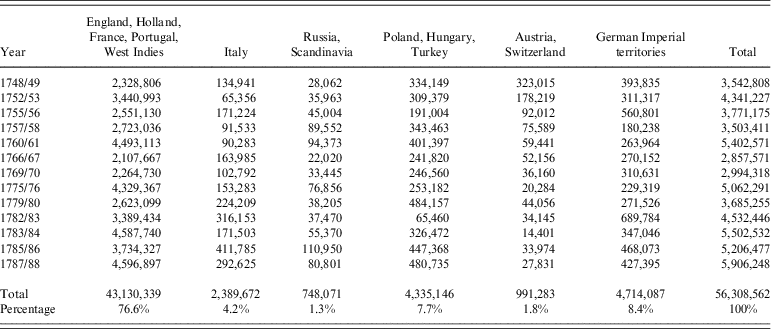
On the other side of the Atlantic, in the Spanish and Portuguese Americas, Hanseatic merchants were only able to do business indirectly, relying on long-standing trade networks with merchants based in port-cities such as Lisbon and Cádiz. Even though some Germans had managed to operate their own ships and call at Spanish-American ports as early as the eighteenth century, unrestricted and direct trade networks were only established after the American wars of Independence. Through the export of metal-ware, glass, cloth (generally linen), spirits, and even cuckoo clocks via Hamburg, various German manufacturing regions developed close commercial ties with colonial America and in time became economically interlinked with Transatlantic Trade. This trade not only provided them with gold and silver from Spain, but also with sought-after colonial staple goods such as sugar, cacao, dyestuffs (cochineal, indigo), tobacco and cinchona bark. Prussian Silesia provides one compelling example of this linkage. This region exported, as shown in Table 1, on average approximately 50 to 75% of its annual linen production to colonial Empires such as Spain, Holland, Portugal or England. The local Silesian and the transatlantic Spanish American economies were linked so closely that in the 1790s local Silesian authorities considered introducing the Spanish silver Peso as the official currency.Reference Weber 10 Hence, after the Napoleonic Wars and the Wars for Independence in Spanish America, Silesia and other German regions fell into economic depression, having the basis of their economy slashed away in only two decades.
Officially controlled linen exports from Silesia, including destinations, 1748–1788. Currency: Taler.Reference Weber 11

In order to alleviate this situation, the Prussian Seehandlungsgesellschaft – established in 1772 as a joint stock company with King Frederick the Great (1712–1786) as the major shareholder – sent the Berlin born C.H. Wilhelm Oswald (1798–1859) to South America in 1822; more specifically, to the newly constituted Republic of Chile, seeking to open up market opportunities for the struggling Silesian linen manufacturers. After returning to Prussia in 1824, and due to the economic success of his first journey, Oswald was once again sent to South America in 1825, when he visited Brazil, Chile, Peru and Colombia, returning once more via China and Cape Town in 1829. His example marks a pattern followed by many German merchants after the Wars of Independence: to quickly negotiate trade treaties with the newly formed governments in order to sustain market shares for German export industries, and to guarantee the influx of tropical raw materials and staple goods needed for manufacture or consumption in the German territories. The first trade agreement was signed in 1827 between the emperor of Brazil and the Hanseatic delegation representing Hamburg, Bremen and Lübeck. Soon other treaties followed: with the United States in 1827, Venezuela (1837), Mexico (1841), Texas (1844), Guatemala (1847), Costa Rica (1848) and New-Granada (1854).Reference Prüser 12
As stated earlier, German industry and the buying public required staple goods and stimulants that were only available through imports, such as cotton, sugar, coffee, palm oil/kernels, and rubber. The Brazilian treaty strengthened Hamburg’s role as the leading coffee and sugar market on the continent, while Britain dominated the rubber trade from Manaus and Pará to Liverpool. Thus, Hanseatic merchants could obtain palm oil/kernels through direct trade with Africa, while they had to rely on trade with Britain for the provision of high-grade rubber. This dependency on imports from other nations, which was true for many other raw materials and foodstuffs as well, became unsettling for businessmen, merchants and investors interested or engaged in Wilhelmine industry. One solution was seen in the acquisition of colonies, which could provide the necessary resources and space for overcoming this dependency and, in the future, achieving autarchy. Hanseatic merchants played a key role in this undertaking, as they were not only crucial in the process of defining the expanding commercial networks of Hamburg’s business and shipping in Africa and South America, but they also exerted great influence in configuring the policies Wilhelmine Germany adopted regarding the appropriation of colonial territories in Africa and the South Pacific. Even before the unification of Wilhelmine Germany in 1871, a small but influential group of merchants began speaking out in favour of a Prussian-led national navy capable of defending overseas commercial interests. As already mentioned above, Hanseatic commercial involvement in Africa was contested by other European powers and local populations. As a result, the Hamburg Senate, where many merchant patricians acted as political representatives of the city, argued that the only feasible long-term solution to these problems was to follow the example of other European nations: to dispatch warships to the unstable areas to secure trade interests, and to be able to punish local communities for attacks on their citizens’ lives or property. This petition was rejected by Bismarck time and again, until the merchant and ship owner Adolph Woermann, head of the family business since 1880, gained the chancellor’s trust and became his advisor regarding German commercial influence in Africa. The Woermann company had been founded by Carl Woermann in 1837, after moving from Bielefeld to Hamburg. In Bielefeld, the Woermanns were involved in linen production, and their textiles were exported to Spanish-America via Hamburg, where Carl completed an apprenticeship in his uncle’s overseas trading business. Like his uncle, Carl Woermann began exporting Westphalian linen to Central and South America, but in the 1840s he decided to expand his commercial activities to Africa and Asia. In the 1860s the company enlarged the business that had begun in Liberia by moving to Cameroon, where it sought to establish a trade monopoly by buying out European competitors and, later on, during the colonial period, through the elimination of competition by African middlemen when dealing with the hinterland nations.Reference Bavendamm, Jantzen, Sendler, Woermann and Zwernemann 13 It was because of Woermann’s counselling and influence, and also because of the support he received from other leading Hanseatic merchants and shipping companies, that Bismarck’s position was shifted in favour of the goals envisioned by Hanseatic merchants, colonial pressure groups such as the Colonial Economic Committee, the German Colonial Society or the Pan-German League. Hence, following Bradley Naranch’s argument, it is accurate to state that
the German turn towards colonial empire in the 1880s could not have taken place without the willing participation of Hanseatic merchants and shippers who drew upon their ties to nationalist networks in order to secure state protection for their private assets in emerging tropical markets.Reference Naranch 14
It is in the light of commercial interests that the Berlin Conference (1884–1885) has to be considered. The objectives were clear: first and foremost to specify and delineate the respective geographic extent of territorial claims made by European nations; second, to determine territorial sovereignty over the Congo basin; and, finally, to stipulate the conditions by which all parties were to engage in and guarantee free trade on the continent. For Wilhelmine Germany, the conference brought about two significant changes. For one, its colonial claims were accepted, putting an end to territorial rivalries with France and Britain. Also, it was able to demonstrate its parity with other important colonial powers of the time: Britain, France and the Netherlands.
Colonial pressure groups such as the Colonial Economic Committee were focused on and promoted the commercial exploitation of the newly acquired colonial dominions. In order to fulfil this goal, an array of scientific expeditions and fortune-seekers prospected the lands, interested in finding, classifying and cataloguing new cash crops or introducing already known ones, promising to yield great profit. This groundwork was largely funded by industrialists, the chambers of commerce of various German cities, corporations and two colonial societies: the aforementioned Colonial Economic Committee and the German Colonial Society. These associations were founded in the years 1887 and 1897 respectively. They had managed to gather around them important individuals and corporations from German society, politics, industry and commerce, such as the Deutsche Bank, the industrialist Friedrich Alfred Krupp, and the merchant and ship owner Adolph Woermann. The membership records published in 1914 included 61 municipalities, 41 banking houses, approximately 150 business, industrial, scientific and technical institutes, the chambers of commerce of major German cities, a large number of colonial companies and nine missionary societies. Furthermore, many leading German scientists, businessmen, merchants, bankers, engineers, industrialists and lawyers belonged to the board of directors of the Committee. Their main objective was to advance the economic and scientific development of the colonies, thereby focusing on the cultivation of useful tropical plants needed for industrial processing, primarily cotton, cocoa and rubber, and later on also oil palms, coffee, kapok, sisal, etc. To this end they stimulated and encouraged the establishment of plantations in the colonies. They believed that tropical raw materials could be grown and gathered in great quantities, enough to satisfy industrial demand and thus break Germany’s dependency on imports from Britain, the Netherlands, the United States, Brazil, etc. In order to achieve this goal, a network of institutions, experimental stations and qualified personnel was needed, which were responsible for the maintenance of infrastructure, for the production and circulation of knowledge, and the transfer and allocation of plants. Here, the Colonial Economic Committee could rely on assistance from the botanical garden in Berlin, the Botanisches Museum und Botanisches Laboratorium für Warenkunde (Botanical Museum and Botanical Laboratory for Merchandise Knowledge), the Botanische Zentralstelle für die deutschen Kolonien (Botanical Research Centre for the German Colonies) and the Versuchsstationen in den Kolonien (Research Gardens in the colonies). The projects, activities and prospects of the Colonial Economic Committee were published in its own journal Der Tropenpflanzer, Zeitschrift für Tropische Landwirtschaft (Tropical Planter, Periodical for Tropical Farming). As outlined above, manufacturers and industrialists were increasingly concerned with their dependency on imports for the supply of raw materials. Thus, they turned to the Colonial Economic Committee and to the tropical botanist Otto Warburg and the agronomist Ferdinand Wohltmann, editors of the Tropenpflanzer and promoters of colonial botany and agriculture, to foster the development of plantations in the colonial realms. As a result, rubber and oil palm plantations were established in the colonies of Cameroon, Togo, East-Africa, Samoa and Kaiser-Wilhelmsland. The produce obtained from the colonial realms was brought to Hamburg for the most part in ships belonging to the Woermann steamship company, which had been founded in 1885. It soon became the leading carrier company to Africa, until the Woermann-Linie was bought by the Deutsche-Ost-Afrika Linie in 1916.
Still, despite all the efforts made and fortunes invested, the project to achieve autarchy failed. This did not solely occur due to the loss of colonial territories following the First World War, but because the venture lagged behind those of other European colonial powers in many respects. In the case of rubber, almost all the plantations cultivating this cash-crop in Africa and the South-Pacific concentrated their activity on fast-growing, medium-class rubber varieties, such as Kickxia elastica or Manihot glaziovii trees. Additionally, the cultivation of Castilloa elastica trees had to be suspended due to the negative impact of the life-cycle of an endemic beetle (Phryneta (Inesida) leprosa F.): the larvae of the Castilloa borer make wide galleries under the bark before entering the sapwood, so if the infestation is severe, the host plant can be severely damaged. The ruin of Castilloa elastica plantations due to the impact of the borer occurred throughout the African continent in all the colonies. Likewise, the systematic cultivation of Hevea brasiliensis trees was neglected by German planters for many years, even though its rubber was the most valuable and in demand by the industry. In the German colonies its cultivation was only promoted after it became clear that Britain had established large plantations of this rubber-bearing tree in its South East Asian colonies. So, when large quantities of rubber from these plantations flooded the market in 1913, the price for natural rubber fell dramatically, rendering German rubber plantations unprofitable. This also came about because of the high procurement costs of the German rubber exploitation venture. Almost all the rubber had to be transported on foot by carriers. Railways were built, but not at a sufficient pace and extent as to be able to compete with other colonial powers. In addition, because most workers were assigned to the plantations for a few months at a time, planters were not able to properly train their workforce. This lack of training frequently led to the trees’ cambium being severely damaged during the harvest, which often resulted in the trees perishing, which led to shortfalls in production. Nevertheless, in the 20 to 25 years of German colonial rule, approximately 20% of its annual rubber demand was supplied through yields obtained in plantations or by exploiting rubber bearing plants, mainly Landolphia liana and Kickxia elastica trees, in the forest hinterlands. In the case of oil palms, plantation culture did not begin before 1909. As mentioned in the report published by the Colonial Economic Committee, oil palms were taken into ‘rational cultivation’ (Ref. 1, p. 69) in all colonial territories in that year. Concurrently, a handbook commissioned by the Committee and authored by Selig Eugen Soskin was published in a supplement of Der Tropenpflanzer, informing and instructing its readers on the cultivation of oil palms.Reference Soskin 15 However, the exploitation of wild oil palms and of those cultivated by the local African population delivered approximately 37% of Wilhelmine’s industrial demand for vegetable fats and close to 70% of its specific demand for palm oil. The rest was satisfied through the import of palm kernels from Britain. There, the industry concentrated on the use of palm oil, while the kernels were not considered necessary and were thus sold to Germany. After losing its colonial territories, German industry and industrialists made great efforts and advancements in the field of chemistry, developing substitutes for different raw materials. A prominent and well-known example is BUNA (styrene-butadiene rubber), developed in 1926 by the chemists Walter Bock and Eduard Tschunkur at I.G. Farben in Leverkusen. The development of synthetic surrogates increased noticeably during the NS-Period, when the goal of autarchy gained importance once more. As for the Hanseatic merchants, the First and Second World Wars led to significant financial losses, for example for C. Woermann. Due to the confiscation and liquidation of trading posts in Africa, it lost its entire foreign assets twice in only a quarter of a century. Therefore, the company had to reorient its trade once more. Other Hanseatic merchants did not recover from the losses of the wars, or had already been taken over by larger competitors in the years before.Reference Kresse 16
Samuel Eleazar Wendt is a PhD Candidate at the Europa-Universität Viadrina in Frankfurt (Oder), Germany. His MA thesis in European Cultural History (2013) analysed the history of tropical botany and rubber usage in Wilhelmine Germany. His most recent publication is ‘Securing resources for the industries of Wilhelmine Germany: tropical agriculture and phytopathology in the colonies Cameroon and Togo, 1884-1914’. In B. Bennett and U. Kirchberger (eds), Environments of Empire. Networks and Agents of Ecological Change (University of North Carolina Press, in preparation).