Introduction
Social media use is ubiquitous in adolescents and increasingly is an important, albeit poorly understood, aspect of contemporary adolescent development and psychiatric morbidity. 1–3 Recent work estimates that up to 95% of adolescents own or have access to smartphones, approximately 45% relate maintaining near-continuous use of the internet, and 50% fear they have an addiction to their smartphones. 4–8 Social media applications such as Snapchat and Instagram are typically the focus of adolescent internet use.Reference Reid Chassiakos, Radesky, Christakis, Moreno and Cross 4 Research suggests that adolescents typically maintain a portfolio made up of multiple social media accounts.Reference Reid Chassiakos, Radesky, Christakis, Moreno and Cross 4 , Reference Oberst, Wegmann, Stodt, Brand and Chamarro 9 These conduits provide opportunities for new virtual identities, rapid social relatedness with others, and complex social networks. Although recent research efforts have focused on social media use and links to psychiatric morbidity in youth, there are many knowledge gaps.Reference Shafi, Romanowicz and Croarkin 3 , Reference Oberst, Wegmann, Stodt, Brand and Chamarro 9 , Reference O’Keeffe 10 The risks and positive aspects of communication on social media during adolescence are most likely complex and remain poorly understood.Reference Reid Chassiakos, Radesky, Christakis, Moreno and Cross 4 , 11–13
Previous research suggests that social media use may be linked to impulsivity, risk-taking behaviors, self-injurious behavior, and suicidality. However, these relationships are multifaceted and incompletely understood.Reference Brown, Fischer, Goldwich, Keller, Young and Plener 14 , Reference Sueki 15 A recent systematic review examined the intersections of social media use, self-injurious behavior, and suicidal behaviors in adolescents.Reference Marchant, Hawton and Stewart 16 The majority of studies were rated as low quality. Most studies suggested that social media use may negatively affect adolescents in terms of self-injurious behavior and suicidal crises. 16–19 For example, adolescents were noted to have an increase in the use of social media to communicate distress to peers in the midst of psychiatric crises.Reference Belfort, Mezzacappa and Ginnis 19 Other work noted that self-harm groups on FacebookReference Zdanow and Wright 17 and Instagram appeared to venerate and rationalize self-harm.Reference Moreno, Ton, Selkie and Evans 20 Another study noted that having a Twitter account or high tweeting frequency did not correlate with suicidal ideation or behavior.Reference Sueki 15 The authors of a systematic review presented a nuanced view by noting the potential impact of social media on the risk of self-harm and suicidal ideation in adolescents while pondering the potential protective benefits of social media, which could show enhancement on further study.Reference Marchant, Hawton and Stewart 16
Systematic studies of social media use in the context of psychiatric hospitalization are even more limited. McDougall et al showed a positive correlation between hours spent on social media by adult psychiatric inpatients and depressive symptom severity, as assessed with the Beck Depression Inventory-II.Reference McDougall, Walsh and Wattier 21 Saffran et al. showed that among adult inpatients with eating disorders, more comparison with peers correlated with increased eating disorder symptoms and functional impairment.Reference Saffran, Fitzsimmons-Craft, Kass, Wilfley, Taylor and Trockel 22 One recent pilot study that provided internet and social media access to adolescent psychiatric inpatients showed that internet access presented fewer problems than expected and provided a framework for engaging adolescent patients about their internet habits.Reference Stanton, Drake af Hagelsrum and Stasiak 23 Otherwise, there is a paucity of research regarding social media use and the risk of self-injurious behavior and suicidality among adolescents with a psychiatric hospitalization.Reference Carson, Gansner and Khang 2 , Reference Marchant, Hawton and Stewart 16 Thus, the aim of this study was to examine documented social media use and its possible relationship with suicidality and self-injurious behaviors in adolescents at the time of psychiatric hospitalization. We hypothesized that documented social media use would be associated with suicidality and self-injurious behaviors.
Methods
Participants
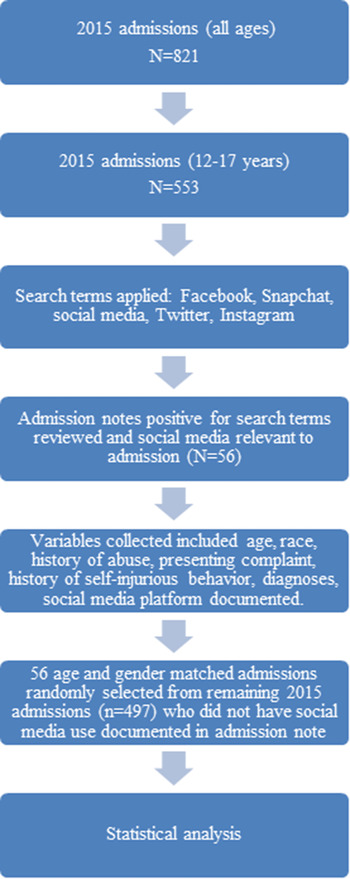
The patient sample was drawn from all adolescents (aged 12-17 years) who had been hospitalized at an 18-bed inpatient psychiatric unit at our institution in 2015 (Figure 1). Patients were admitted for acute psychiatric issues that were clinically assessed to warrant urgent care. The research team developed the study design for this case-control study and outcome variables in 2017. Data extraction and abstraction was completed in 7 months during 2017 to 2018. Data were collected by retrospective chart review. The Advanced Cohort Explorer platform was used to identify inpatients with documented social media use in the medical record with the search terms “Facebook,” “SnapChat,” “Twitter,” and “Social Media.” An age- and sex-matched control group of documented non-social media users was also generated with probability sampling (using randomizer.org to allocate adolescents with no reported social media use). Demographics, the Patient Health Questionnaire-9 (PHQ-9), which is a depression severity scale,Reference Richardson, Ludman and McCauley 24 the Suicide Status Form-II (SSF-II),Reference Romanowicz, O’Connor, Schak, Swintak and Lineberry 25 the presence of self-injurious behaviors, and additional clinical variables were collected by the research team. Data collection and consensus review of discrepancies were supervised by two board-certified child and adolescent psychiatrists (M.R. and P.E.C.). Our institutional review board approved all procedures before any data collection or analyses. All patients and their parents had provided consent for medical record usage. The Strengthening the Reporting of Observational Studies in Epidemiology (STROBE) statement checklist was addressed in the design, conduct, and reporting of this study.Reference Vandenbroucke, Elm and Altman 26
Flow chart of patient selection. All inpatient child and adolescent psychiatry admissions from 2015 were screened and filtered to yield a sample of adolescents who had documented social media use in admission. All admission notes were reviewed to establish that documented social media use was pertinent to the admission. A random sample of age and gender matched adolescents with no documentation of social media use was then generated.

Outcome variable
The primary outcomes, which were measured at the time of admission to the inpatient psychiatry unit were self-injurious behaviors, suicidal ideation, and suicide risk. Self-injurious behavior was operationalized as a binary outcome—present (yes) vs absent (no). Suicidal ideation was measured using the single suicidal ideation item (item 9) on the self-report PHQ-9.Reference Richardson, Ludman and McCauley 24 Item 9 (“Thoughts that you would be better off dead or of hurting yourself”) was treated as an ordinal scale that ranged from 0 (“not at all”) to 3 (“nearly every day”). A score of 0 indicated that the participant did not endorse suicidal ideation at the time of admission and higher item 9 subscale scores reflected a greater intensity of suicidal ideation. Suicide risk was measured using the single suicide risk item (item 6) on the self-report SSF-II. Item 6 (“rate overall risk of suicide”) was treated, for the purpose of this study, as an ordinal scale that ranged from 1 (“extremely low risk”) to 5 (“extremely high risk”). A score of 1 indicated that the participant did not endorse a risk of “killing oneself,” and higher item 6 scores reflected a greater risk of suicide.Reference Romanowicz, O’Connor, Schak, Swintak and Lineberry 25
Independent variable and covariates
The main independent variable, which was measured at the time of admission, was a documented use of social media. Social media use was operationalized as either “used social media” or “did not use social media.” The covariates, which were selected a priori and measured at the time of admission, included age, sex, number of previous psychiatric hospitalizations, Child Protection Report filed in Minnesota for abuse/neglect within the past 3 years at time of admission (yes/no), depression severity (measured via PHQ-9), and formal diagnosis of depression at the time of admission (yes/no). These variables were included as covariates in the models to bolster precision in the evaluation of the main effect of social media use on the outcomes.
Multiple imputation for missing values
Missing values, which were observed only for the PHQ-9 and SSF-II and occurring in no more than 25% of the sample, were imputed.Reference Madley-Dowd, Hughes, Tilling and Heron 27 Missing values (with an assumed arbitrary missing pattern) for the classification variables and for the continuous variables were imputed via 500 burn-in iterations (samples) using fully conditional specification along with the discriminant method (for the classification variables) and the predictive mean matching method (for continuous variables) of the PROC MI procedures in SAS software, version 9.4.Reference van Buuren 28
Statistical analysis
Demographic and clinical characteristics for the whole cohort were described using the sample mean and SD for continuous variables and frequency and percentage for categorical variables. To identify differences in these characteristics between those who did vs did not use social media, we implemented the two independent samples t test with the Satterthwaite method for unequal variances (for continuous variables) and Fisher exact test (for categorical variables).
Multiple binary logistic regression, with penalized maximum likelihood estimation along with Firth’s bias correction, was implemented to estimate the odds (or probability) of the patient engaging in self-injurious behaviors given social media use vs no social media use, while controlling for age, sex, previous hospitalizations, abuse/neglect, and depression severity (measured by PHQ-9). Finally, ordinal logistic regression was performed to investigate the effect of social media use (use vs no use) on suicidal ideation and on suicide risk while controlling for age, sex, previous hospitalizations, abuse/neglect, and depression status (yes/no). The cumulative probabilities were modeled over the higher-ordered suicidal ideation and suicide risk scale scores (more suicidal ideation and greater suicide risk). Adjusted odds ratios (ORs) and 95% confidence intervals (CIs) were reported.
Statistical analyses were performed using SAS software, version 9.4 (SAS Institute, Inc.). The level of significance was set at α = 0.05 (two-tailed), and we implemented the false discovery rate (FDR) procedure to control for false-positives over the multiple tests.Reference Benjamini and Hochberg 29
Results
Participant characteristics
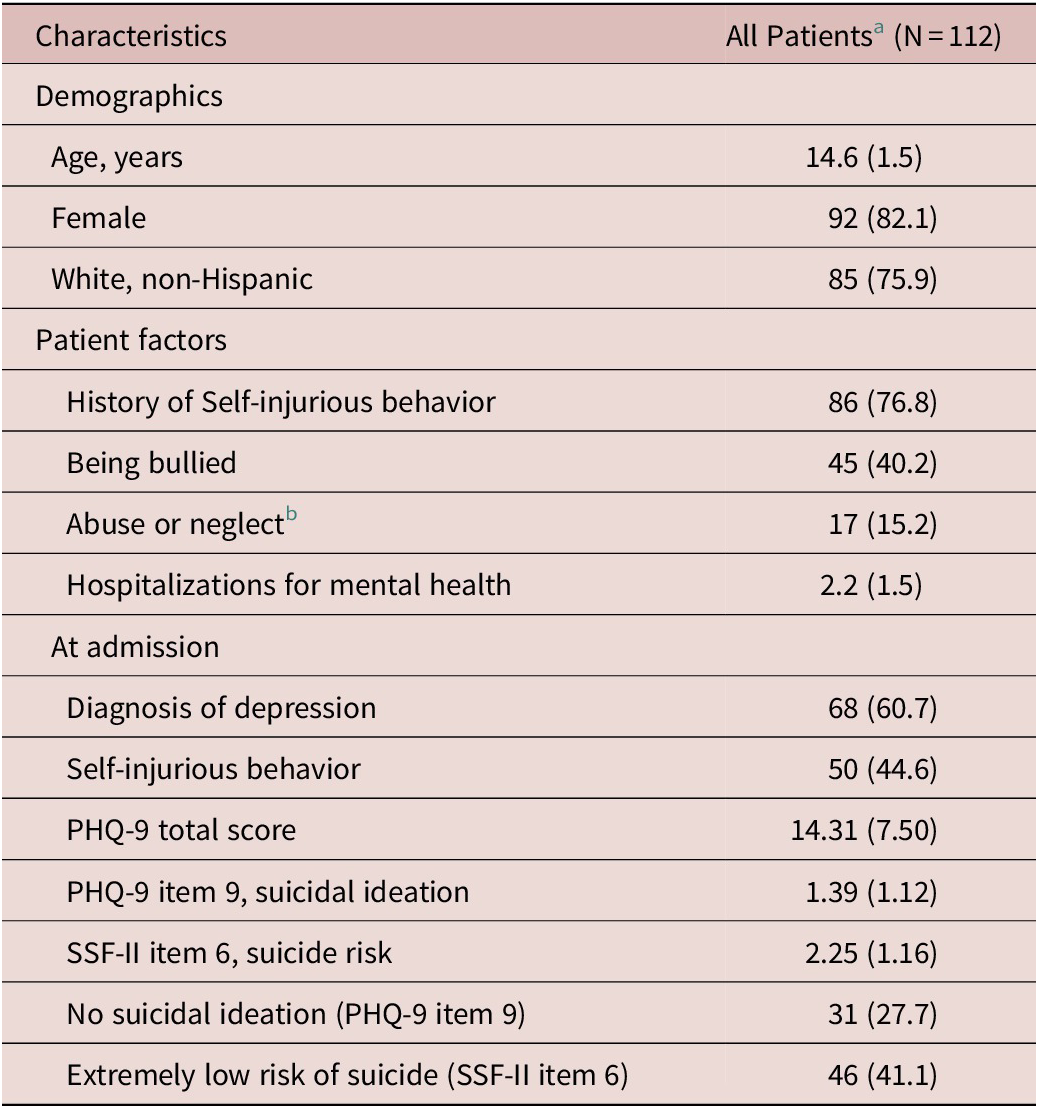
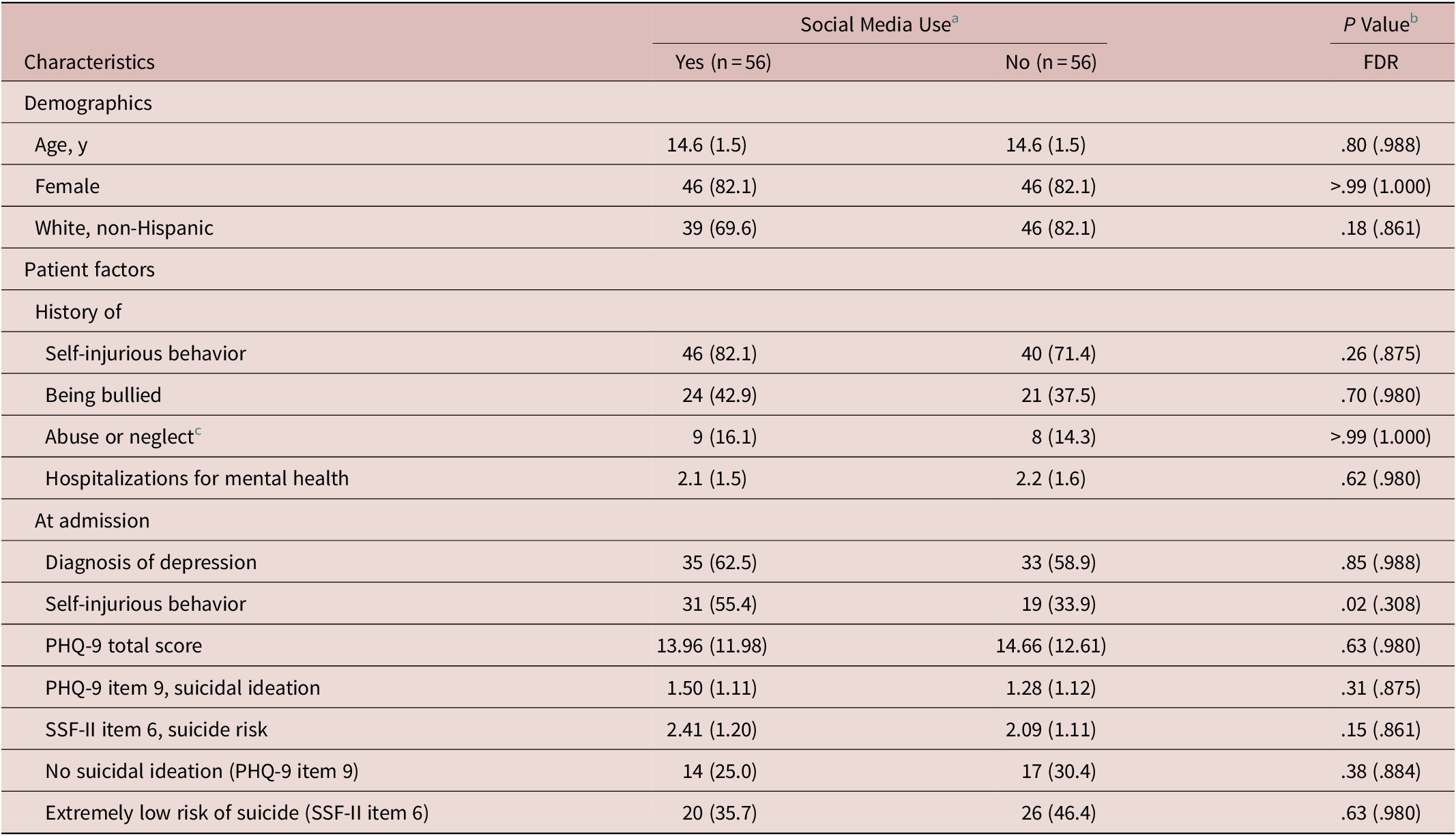
Our search identified 56 patients who were reported social media users and met the inclusion criteria, along with 56 matched patients who were not social media users (control group). Of these 112 youth, 82.1% were female, 75.9% were non-Hispanic white, and the mean (SD) age was 14.6 (1.5) years (Table 1). About 77% had a history of self-injurious behaviors, 40.2% had a history of being bullied, and 60.7% had a diagnosis of depression at the time of admission. Mean total PHQ-9 score at admission was 14.3 (7.5). According to the PHQ-9 item 9 and the SSF-II item 6 at admission, 27.7% reported having no suicidal ideation, and 41.1% had extremely low suicide risk. The mean number of previous hospitalizations for mental health was 2.2 (1.5) (range 1-7). On comparison by use of social media, the groups were statistically similar in all factors, except the social media group had a higher incidence of self-injurious behavior at admission than the nonsocial media group (55.4% vs 33.9%; P = .02) (Table 2).
Demographic and Clinical Characteristics.

Abbreviations: PHQ-9, Patient Health Questionnaire-9; SSF-II, Suicide Status Form-II.
a Values are mean (SD) or number of patients (%).
b Child Protection Report filed in Minnesota for abuse/neglect within the past 3 years at time of admission.
Demographic and Clinical Characteristics by Use of Social Media.

Abbreviations: FDR, false discovery rate; PHQ-9, Patient Health Questionnaire-9; SSF-II, Suicide Status Form-II.
a Values are mean (SD) or number of patients (%).
b P value (two-tailed) associated with the test of group differences (social media vs no social media).
c Child Protection Report filed in Minnesota for abuse/neglect within the past 3 years at time of admission.
Social media use and self-injurious behavior and suicidality
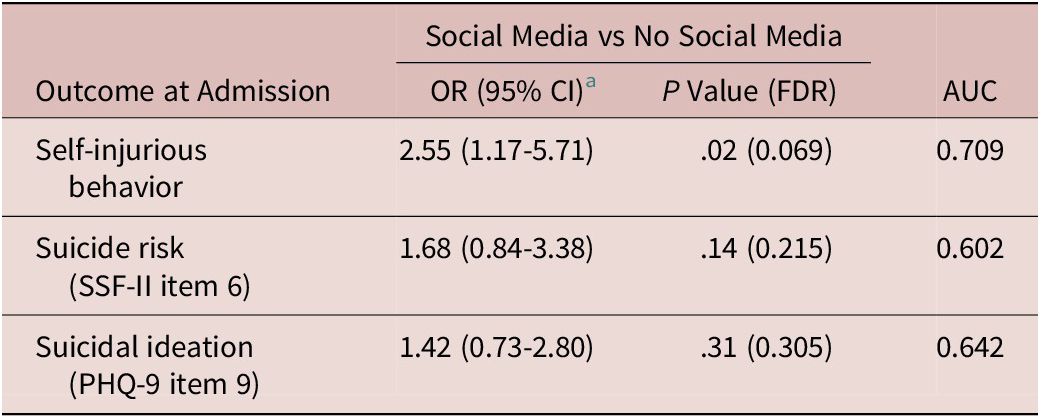
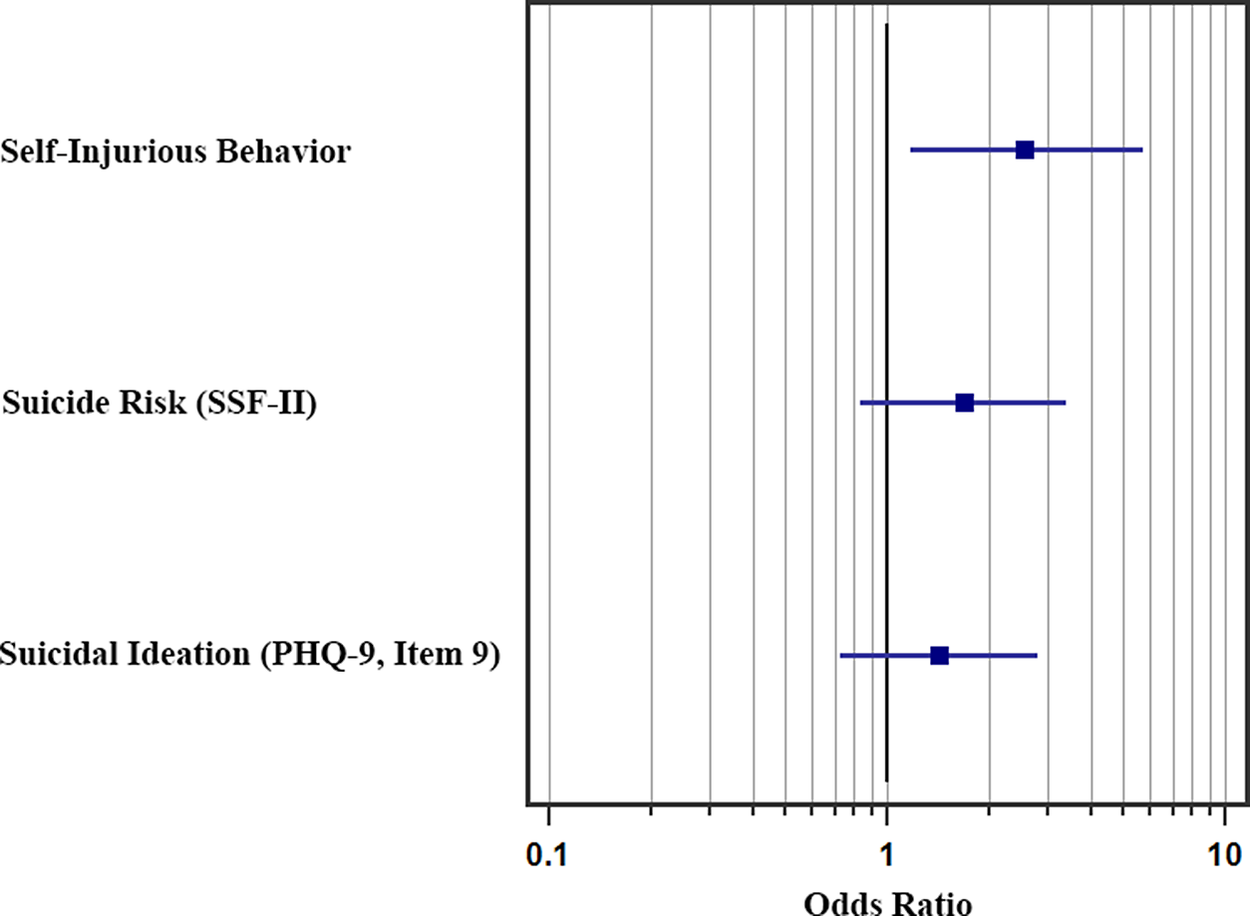
The multiple binary logistic regression showed that youth who reported using social media had significantly greater predicted odds of self-injurious behaviors at the time of admission (OR, 2.55; 95% CI, 1.17-5.71; P = .02) than youth who reported no use of social media, given fixed values of all other variables in the model (Table 3, Figure 2). The ordinal logistic regression, although not statistically significant, showed that youth who reported using social media had greater predicted odds of increased suicidal ideation (OR, 1.42; 95% CI, 0.73-2.80; P = .31) and suicide risk (OR, 1.68; 95% CI, 0.84-3.38; P = .14) than youth who reported no use of social media, given fixed values of all other variables in the model (Table 3, Figure 2).
Relationship Between Social Media Use and Self-Injurious Behavior, Suicide Risk, and Suicidal Ideation at Admission.

Abbreviations: AUC, area under the receiver operating characteristic curve; FDR, false discovery rate; OR, odds ratio; PHQ-9, Patient Health Questionnaire-9; SSF-II, Suicide Status Form-II.
a A binary logistic regression was implemented to estimate the odds of the patient engaging in self-injurious behavior given social media use vs no social media use. A separate ordinal logistic regression model was performed to investigate the effect of social media use (use vs no use) on suicide risk and on suicidal ideation. ORs were adjusted for age, sex, previous hospitalizations, abuse/neglect, and depression status/severity.
Forest plot from the binary logistic regression (self-injurious behavior) and ordinal logistic regression (suicide risk and suicidal ideation). Graph shows the predicted odds (95% CI) associated with social media use (vs no use). Odds ratios were adjusted for age, sex, previous hospitalizations, abuse/neglect, and depression status/severity. Abbreviations: PHQ-9, Patient Health Questionnaire-9; SSF-II, Suicide Status Form-II.

Discussion
This retrospective study suggests that adolescents with documented social media use at the time of psychiatric hospitalization have an increased risk of concurrent self-injurious behavior compared with those with no documented social media use. Although not statistically significant, social media use may have an association with an increased risk of suicidality. These conclusions are preliminary, and the current results should be interpreted with caution.
Nesi et al. also recently examined social media use among psychiatrically hospitalized adolescents. Notably, the majority described social media as a positive support for coping, distraction, and encouragement from friends. Conversely, 37.4% of youth in this sample related adverse emotional experiences and isolation in relation to social media use. These negative experiences were more common in girls than boys. Some youth in this sample also related using social media to access materials glorifying suicide and self-injurious behaviors.Reference Nesi, Wolff and Hunt 30 These findings may relate to the current work and highlight the complexity of social media use in adolescents. Future work could inform understanding on individual differences in use and the vulnerabilities of adolescents with psychiatric illnesses.
The findings of our study are an important foundation for further thought and research because social media use is most likely an important clinical dimension in the practice of adolescent psychiatry. Experts have recently advocated for the incorporation of reliable and systematic evaluations of social media use and habits in the course of standard adolescent psychiatric assessments.Reference Carson, Gansner and Khang 2 , Reference Shafi, Romanowicz and Croarkin 3 Authors have pondered weaving the assessment of digital media habits into the context of standard screening questions (eg, chief concern, history of present illness, and past psychiatric history) or as a discrete portion of a psychiatric evaluation, as substance use or social history would be examined.Reference Carson, Gansner and Khang 2 The optimal framework is undetermined, but our results highlight that further research and clinical experience could identify scenarios in which the presence, frequency, or duration of social media use represents a marker for risk of self-injurious behavior and suicidality in adolescents.Reference Carson, Gansner and Khang 2
From a neuroscience perspective, adolescent social media use may represent a new opportunity to develop objective behavioral measures to understand brain function.Reference Meshi, Tamir and Heekeren 31 Mentalizing (involving the dorsomedial prefrontal cortex, temporoparietal junction, anterior temporal lobe, inferior frontal gyrus, and posterior cingulate cortex), 31–33 self-referential (involving the medial prefrontal cortex and posterior cingulate),Reference Meshi, Tamir and Heekeren 31 , Reference Tamir and Mitchell 34 , Reference Fareri, Chang and Delgado 35 and reward (ventromedial prefrontal cortex, ventral striatum, and ventral tegmental area) networksReference Meshi, Tamir and Heekeren 31 , Reference Tamir and Mitchell 34 , Reference Fareri and Delgado 36 , Reference Ruff and Fehr 37 have recently been proposed to have key roles in social media use.Reference Meshi, Tamir and Heekeren 31 In the context of research domain criteria studies, measures of social media use represent an important new direction for behavior unit-of-analysis measures in negative valence, positive valence, and social processes constructs.Reference Casey, Oliveri and Insel 38 , Reference Westlund Schreiner, Klimes-Dougan, Begnel and Cullen 39
Limitations
There are a few study limitations to consider. This was a retrospective study from one academic medical center, with a modest sample size. The independent variable (social media use or no social media use) was not quantified in a systematic manner; rather, it was based on what clinicians had documented in the medical record. However, documentation of social media could indicate that it was clinically meaningful use related to the hospitalization. Alternatively, some other important biases may be involved because some clinicians may have queried and documented social media use to a greater extent than others. It was not possible to systematically quantify the extent and frequency of social media use. The study also was not formally powered to examine self-injurious behaviors and suicidality; rather, we included all inpatient adolescents with documentation of social media use at the date of admission and then matched them against controls. The primary findings were not significant after correcting for multiple comparisons but are important clues in hypothesis-generating for future, definitive studies. Although previous work suggests that the SSF-II is a valid and reliable tool for assessing suicidal risk in adolescent psychiatric hospitalizations,Reference Romanowicz, O’Connor, Schak, Swintak and Lineberry 25 the validity and reliability of the PHQ-9 for monitoring suicidal ideation and depressive symptom severity in adolescents is less well defined.Reference Na, Yaramala and Kim 40 , Reference Nandakumar, Vande Voort and Nakonezny 41 Notably, the present findings do not suggest causality. There are also other explanations for our conclusions. Adolescents who self-harm may be more likely to have smartphones or disclose social media use.
Conclusions
Social media use may be associated with self-injurious behaviors and may be an underappreciated marker of risk. The results add to the increasing body of research indicating social media use is a clinically relevant parameter as well as further supporting the incorporation of a social media assessment within a psychiatric history. Important elements to consider in this assessment include platform preferences, daily screen time, online preferences, cyberbullying, supportive contacts online, and the degree of parental supervision of social media use.Reference Carson, Gansner and Khang 2 , Reference Shafi, Romanowicz and Croarkin 3
Further work is needed to clarify this relationship via a prospective trial with a larger sample size. Potential mediating factors could also be examined in future work. Prospective studies could establish new clinical tools and behavioral measures regarding social media use for neuroscience research. Additional study and clarification is necessary to inform clinicians on optimal assessment practices regarding social media use during adolescent psychiatric evaluations.
Funding
This publication was made possible by the Mayo Clinic Clinical Translational Science Award (CTSA) through grant number UL1TR002377 from the National Center for Advancing Translational Sciences (NCATS), a component of the National Institutes of Health (NIH). Research reported in this publication was also supported by the NIH under award R01 MH113700. The content of this publication is solely the responsibility of the authors and does not necessarily represent the official views of the NIH. The supporters had no role in the design, analysis, interpretation, or publication of the study.
Disclosures
P.E.C. has received research grant support from Pfizer, Inc.; equipment support from Neuronetics, Inc.; and received supplies and genotyping services from Assurex Health, Inc. for investigator-initiated studies. He is the primary investigator for a multicenter study funded by Neuronetics, Inc. and a site primary investigator for a study funded by NeoSync, Inc. P.E.C. is a consultant for Procter & Gamble Company and Myriad Neuroscience. The other authors have no disclosures or potential conflicts of interest to declare.