Introduction
Deep brain stimulation (DBS) is a treatment by which specific brain areas are electrically stimulated to modulate activity in surrounding brain tissue (Brocker & Grill, Reference Brocker and Grill2013). In the past 10 years, DBS has been experimentally applied as a treatment for treatment-resistant depression (TRD) (Schlaepfer & Bewernick, Reference Schlaepfer and Bewernick2013). DBS results in a clinically relevant reduction of symptoms in approximately 40–60% of TRD patients, using the subcallosal cingulate gyrus (SCG) (Lozano et al. Reference Lozano, Mayberg, Giacobbe, Hamani, Craddock and Kennedy2008, Reference Lozano, Giacobbe, Hamani, Rizvi, Kennedy, Kolivakis, Debonnel, Sadikot, Lam, Howard, Ilcewicz-Klimek, Honey and Mayberg2012; Holtzheimer et al. Reference Holtzheimer, Kelley, Gross, Filkowski, Garlow, Barrocas, Wint, Craighead, Kozarsky, Chismar, Moreines, Mewes, Posse, Gutman and Mayberg2012; Puigdemont et al. Reference Puigdemont, Pérez-Egea, Portella, Molet, de Diego-Adeliño, Gironell, Radua, Gómez-Anson, Rodríguez, Serra, de Quintana, Artigas, Álvarez and Pérez2012, Reference Puigdemont, Portella, Pérez-Egea, Molet, Gironell, de Diego-Adeliño, Martín, Rodríguez, Àlvarez, Artigas and Pérez2015), the nucleus accumbens (NAc) (Bewernick et al. Reference Bewernick, Kayser, Sturm and Schlaepfer2012), the ventral capsule/ventral striatum (VC/VS) (Malone et al. Reference Malone, Dougherty, Rezai, Carpenter, Friehs, Eskandar, Rauch, Rasmussen, Machado, Kubu, Tyrka, Price, Stypulkowski, Giftakis, Rise, Malloy, Salloway and Greenberg2009; Dougherty et al. Reference Dougherty, Rezai, Carpenter, Howland, Bhati, O'Reardon, Eskandar, Baltuch, Machado, Kondziolka, Cusin, Evans, Price, Jacobs, Pandya, Denko, Tyrka, Brelje, Deckersbach, Kubu and Malone2015) and the medial forebrain bundle (Schlaepfer et al. Reference Schlaepfer, Bewernick, Kayser, Mädler and Coenen2013) as targets for stimulation. Recently, our group has shown DBS of the ventral anterior limb of the internal capsule (vALIC) to reduce depressive symptoms in TRD, which cannot be attributed to placebo effects (Bergfeld et al. Reference Bergfeld, Mantione, Hoogendoorn, Ruhé, Notten, van Laarhoven, Visser, Figee, de Kwaasteniet, Horst, Schene, van den Munckhof, Beute, Schuurman and Denys2016).
Although results on efficacy in TRD are promising, data on the impact of DBS regarding cognitive functioning in TRD patients are scarce. Preliminary studies did not find detrimental effects on cognitive functions in TRD patients following DBS irrespective of target (Bergfeld et al. Reference Bergfeld, Mantione, Hoogendoorn and Denys2013). More specifically, NAc DBS was associated with improvements on tests of verbal and visuospatial memory, attention and visuospatial functioning in 11 TRD patients (Grubert et al. Reference Grubert, Hurlemann, Bewernick, Kayser, Hadrysiewicz, Axmacher, Sturm and Schlaepfer2011). In addition, a combined sample of 10 obsessive–compulsive disorder patients and 11 major depressive disorder (MDD) patients showed improvements on tests of verbal memory and visuospatial organization following VC/VS DBS (Kubu et al. Reference Kubu, Malone, Chelune, Malloy, Rezai, Frazier, MacHado, Rasmussen, Friehs and Greenberg2013). Both studies did not find a correlation between symptom decrease and cognitive improvement, suggesting that DBS might have a positive impact on cognitive functioning independent of symptomatic improvement. However, no control groups were included in these studies (Grubert et al. Reference Grubert, Hurlemann, Bewernick, Kayser, Hadrysiewicz, Axmacher, Sturm and Schlaepfer2011; Kubu et al. Reference Kubu, Malone, Chelune, Malloy, Rezai, Frazier, MacHado, Rasmussen, Friehs and Greenberg2013) and effects of DBS on cognitive functions have never been directly compared between active and sham stimulation. These limitations hamper interpretation of results since discriminating practice effects from stimulation effects is impossible.
To control for practice effects, we compared cognitive functions of TRD patients treated with vALIC DBS with a matched healthy control (HC) group. In addition, TRD patients were tested in a double-blind, randomized active/sham phase to test effects of stimulation directly. With this study we aimed to test the impact of DBS on cognitive functions of TRD patients. In addition, we investigated the relationship between symptom improvement and cognitive change.
Method
Participants
We included 25 TRD patients, who were recruited from referrals to the out-patient clinics of the Academic Medical Center (Amsterdam) and the St Elisabeth Hospital (Tilburg), the Netherlands, between March 2010 and May 2014. In addition, we included 21 HCs matched on age, gender and educational level. HCs were recruited with advertisements in the Academic Medical Center and received a financial compensation for participation (€25 per test session). The Medical Ethical Board of the Academic Medical Center approved the study and all participants gave their written informed consent. This study was an addition to a clinical trial registered in the Dutch Trial Register (http://www.trialregister.nl/, no. 2118).
Inclusion criteria for TRD patients were: (1) aged between 18 and 65 years; (2) a primary diagnosis of MDD which was treatment resistant. Treatment resistance was defined as a failure of at least the following antidepressant therapies in adequate dosage and duration: two distinctly different classes of second-generation antidepressants (e.g. selective serotonin reuptake inhibitor, selective norepinephrine reuptake inhibitor) and one trial of a tricylic antidepressant (TCA) and one trial of TCA with lithium addition and one trial of a monoamine oxidase inhibitor and six or more sessions of bilateral electroconvulsive therapy (ECT). Patients who fulfilled the above criteria and were kept stable with maintenance ECT, but relapsed after discontinuation of maintenance ECT were also eligible; (3) a Hamilton Depression Rating Scale – 17 items (HAM-D-17) score of at least 18; (4) a Global Assessment of Function score of a maximum of 45, which was persistent for at least 2 years.
Exclusion criteria for TRD patients were: (1) the presence of a bipolar disorder or a (history of) psychosis; (2) substance abuse in the past 6 months; (3) co-morbid neurological disorders; (4) an unstable physical condition; and (5) pregnancy or general contra-indications for DBS surgery.
HCs were matched with DBS patients on gender, age and level of education. HCs were excluded if they or their first-degree relatives had a history of a psychiatric disorder.
DBS surgery and optimization
DBS surgery and optimization have been described in detail previously (Bergfeld et al. Reference Bergfeld, Mantione, Hoogendoorn, Ruhé, Notten, van Laarhoven, Visser, Figee, de Kwaasteniet, Horst, Schene, van den Munckhof, Beute, Schuurman and Denys2016). In summary, a neurosurgeon implanted bilateral four-contact electrodes (model 3389, Medtronic, USA) following a trajectory through the anterior limb of the internal capsule with the deepest contact point in the NAc and the three upper contact points in the ventral part of the capsule. The electrodes were connected to an Activa PC (Medtronic, USA) stimulator. Following a 3-week recovery period after surgery, a standardized, open-label DBS parameter optimization period of maximally 52 weeks started. A psychologist or psychiatrist tested combinations of active contacts, voltage, pulse width and frequency for optimal efficacy. We strived to keep medication stable during the open-label phase, but psychiatrists were allowed to change medication on clinical indication (see online Supplementary Table S1 in the Supplementary material for medication use of patients at different sessions).
After the open phase, patients entered the randomized, double-blind crossover phase consisting of two blocks of 6 weeks during which the DBS stimulator was on (active stimulation) or off (sham stimulation). The phases were terminated if the treating psychiatrist or research team deemed it clinically indicated and the HAM-D-17 ⩾ 15, or if the patient requested discontinuation. In these cases, patients crossed over to the next phase while blinding was maintained. Medication and DBS settings (except for stimulation ‘on’ or ‘off’) were kept stable during the crossover phase.
Study design
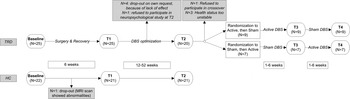
Trained psychologists assessed symptom severity and cognitive functions of patients and controls at five time points (see Fig. 1): 3 weeks before DBS surgery (baseline), 3 weeks after surgery with stimulation still inactive (T1), after the optimization of DBS settings (T2), and after the first (T3) and second crossover block (T4). Patients and raters were blinded for the stimulation setting at T3 and T4. HCs were assessed at inclusion (baseline), 6 weeks after baseline (T1) and 16–20 weeks after baseline (T2).
Study overview and drop-outs. TRD, Treatment-resistant depression; HC, healthy controls; MRI, magnetic resonance imaging; DBS, deep brain stimulation.

Outcome measures
Symptom severity was assessed with the investigator-rated HAM-D-17 (range 0–52) (Hamilton, Reference Hamilton1960). Response was defined as ⩾50% reduction of HAM-D-17 at T2 compared with baseline. In case of drop-out before T2 the last HAM-D-17 score in the optimization phase was used to define response.
The neuropsychological test battery consisted of the Dutch version of the National Adult Reading Test to estimate intelligence quotient (IQ, measured at baseline only) and subtests of the Cambridge Neuropsychological Test Automated Battery. These subtests have been frequently used to compare cognitive functions of HCs and depressed patients (Rock et al. Reference Rock, Roiser, Riedel and Blackwell2014). Administration of the test battery took approximately 60–75 min. Extensive descriptions of all subtests can be found on the manufacturer's website (http://www.cambridgecognition.com/academic/cantabsuite/tests) and are summarized below in order of presentation to subjects.
Verbal recognition memory – immediate (VRMi)
VRMi measures immediate verbal memory, and has two outcomes. The first is free recall (VRMi-FR), in which participants have to recall as many of 18 presented words (range 0–18 correct). The second is recognition (VRMi-Rec), in which participants have to recognize as many of the 18 words out of a list of 36 (range 0–36 errors). Parallel tests were used at different sessions.
Rapid visual processing (RVP)
RVP measures attention. In the centre of a screen numbers are presented one at a time. Participants have to push a button as quickly as possible when one of three specific combinations of three numbers (3–5–7, 2–4–6, 4–6–8) is shown in sequence. The outcome measure is A-prime (A’, range 0–1). A higher score indicates more sensitivity to the target, regardless of response tendency.
Intra/extradimensional shift (IED)
IED measures cognitive flexibility. Two patterns are shown on a screen in every trial, one of which is correct. Participants need to learn a rule to identify the correct pattern. The test consists of nine stages, each of which contains a different rule. The test is terminated if the participant fails to learn the rule of a stage within 50 trials. The outcome measure is the number of errors, adjusted for premature ending of the test by adding 25 errors for each unattempted stage. Parallel tests were used at different sessions.
Reaction time (RTI)
RTI measures psychomotor speed and has two subtests: simple (RTI-Sim) and five choices (RTI-5C). Participants have to release a button and touch either the centre (RTI-Sim) or one of five spots on the screen (RTI-5C) as quickly as possible when a yellow dot flashes on the screen. For each subtest the time to release the button in milliseconds is analysed.
Verbal recognition memory – delayed (VRMd)
VRMd measures delayed verbal memory. This is a repetition of the VRMi after a delay of approximately 30 min and also consists of a free recall (VRMd-FR, 0–18 correct) and recognition (VRMd-Rec, range 0–36 correct) outcome measure.
Stockings of Cambridge (SOC)
SOC measures planning ability and is a computerized version of the Tower of London test. Subjects have to reproduce a specific configuration of three coloured balls by moving the three balls in as few moves as possible. The outcome measure is the number of moves exceeding the minimum needed to solve the exercises (range 0–68).
Paired associates learning (PAL)
PAL measures visuospatial memory. Participants have to memorize the locations and designs of up to eight patterns. The outcome measure is the total number of errors made (range 0–190). Parallel tests were used at different sessions.
Graded Naming Test (GNT)
The GNT measures object naming. Patients have to name 30 pictures correctly. The outcome measure is the number of objects named incorrectly or not recognized (range 0–30 errors).
Statistical analysis
DBS effects on depressive symptoms were analysed and reported previously (Bergfeld et al. Reference Bergfeld, Mantione, Hoogendoorn, Ruhé, Notten, van Laarhoven, Visser, Figee, de Kwaasteniet, Horst, Schene, van den Munckhof, Beute, Schuurman and Denys2016) and results of these analyses are summarized here for completeness. We used Statistical Package for the Social Sciences (SPSS, version 22; IBM Corp., 2013) to analyse the data. Differences in descriptive variables between TRD patients and HCs were tested with χ2 and Mann–Whitney U tests. To analyse cognitive outcome between baseline and T2, eight generalized estimating equations (GEE) were used for the count data (VRMi-FR, VRMi-Rec, IED, VRMd-FR, VRMd-Rec, SOC, PAL, GNT), and three linear mixed models for the continuous data (RVP, RTI-Sim, RTI-5C). GEE and linear mixed models contained the different outcome measures as dependent variable and condition (TRD, HC), session (baseline, T1, T2) and the interaction condition x session as independent variables. To test differences between TRD patients and HCs at baseline, we inspected estimates at baseline from these models. To test for changes from baseline to T2, we inspected the session and session x condition interaction of the models. Post-hoc, we explored differences between responders and non-responders from baseline to T2 by repeating the same models with responder status (responder, non-responder), session and responder status x session interaction as predictors. In case of significant interactions, we corrected for benzodiazepine use by including equivalent benzodiazepine dosage as a covariate (using The Ashton Manual; Ashton, Reference Ashton2002).
To test possible differences between active and sham stimulation, we executed eight GEE for the count data and three linear mixed models. Cognitive outcome measures were included as dependent variables. Period (T3, T4) and stimulation setting (active, sham) were included as independent variables and the period x stimulation setting interaction was included to test for carry-over effects. Score at the start of the crossover phase of the relevant dependent variable (i.e. score at T2) was included as covariate. Post-hoc, we explored differences between responders and non-responders during active compared with sham stimulation, in which responder status, stimulation setting and responder status x stimulation setting interaction were included as predictors.
For the primary analyses, we considered p ⩽ 0.01 significant to account for multiple testing. p Values between 0.01 and 0.05 are reported as trends. For the post-hoc analyses we considered p ⩽ 0.05 significant and 0.05 < p < 0.1 as trends, given the smaller sample size and the exploratory nature of these analyses.
Ethical standards
All procedures contributing to this work comply with the ethical standards of the relevant national and institutional committees on human experimentation and with the Helsinki Declaration of 1975, as revised in 2008.
Results
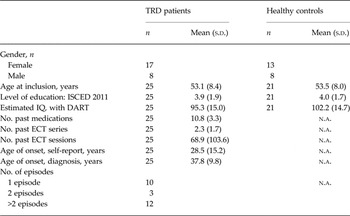
Table 1 shows demographic variables of TRD patients and HCs. No differences between patients and HCs were found on gender, age, level of education or estimated IQ (all p > 0.05). Fig. 1 depicts the drop-outs during the study: of the 25 TRD patients who started the study, we tested 20 at T2, and 16 at T3 and T4. We tested all 21 HCs at T1 and T2. Due to hardware failures, some of the data were lost (see Tables 2 and 3 for actual number of participants with available data). The average follow-up duration between baseline and T1 was shorter in TRD patients (36.1 days, s.d. 13.4) compared with HCs (46.7 days, s.d. 11.1). However, the follow-up duration between baseline and T2 was considerably longer in TRD patients (mean 457.9 days, s.d. 209.3) than HCs (155.0 days, s.d. 20.0). The average durations of the first (21.13 days, s.d. 11.14) and second crossover phase (18.56 days, s.d. 13.14) were similar. However, patients remained longer in the active (25.3 days, s.d. 11.3) than in the sham phase (14.4 days, s.d. 10.5), irrespective of whether the active phase came first or second. DBS optimization resulted in a significant decrease of HAM-D score in an intent-to-treat analysis (F 1,640 = 10.3, p = 0.001). Following DBS treatment, 10 TRD patients (40%) were classified as responders and 15 patients (60%) as non-responders. Of the 20 patients tested at T2, nine were responders (45%) and 11 were non-responders (55%). Of the 16 patients tested in the crossover phase (T3 and T4), nine were responders (56%) and seven were non-responders (44%). No differences on any descriptive variables were found between patients who dropped out before and those who participated in the crossover phase, except for the ratio of non-responders/responders (Fisher's p = 0.04). In the double-blind crossover phase, patients had an average HAM-D score of 13.6 (s.d. 7.8) following the active and 23.1 (s.d. 5.1) following the sham phase. After correction for carryover effects, period and depression score at T2 the mixed models showed a significantly lower HAM-D-17 score in the active stimulation phase compared with the sham stimulation phase (F 1,13 = 23.5, p < 0.001).
Descriptive variables of TRD patients and healthy controls

TRD, Treatment-resistant depression; s.d., standard deviation; ISCED, International Standardized Classification of Education (United Nations Educational, Scientific and Cultural Organization, 2011); IQ, intelligence quotient; DART, Dutch version of the National Adult Reading Test; n.a., not applicable; ECT, electroconvulsive therapy.
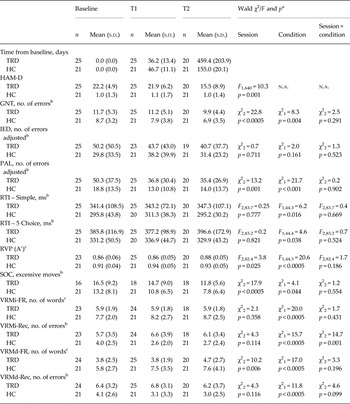
Neuropsychological test scores at baseline, T1 and T2 for TRD patients and HCs

TRD, Treatment-resistant depression; HC, healthy control; s.d., standard deviation; HAM-D, Hamilton Depression Rating Scale; n.a., not applicable; GNT, Graded Naming Test; IED, intra/extra dimensional shift; PAL, paired associates learning; RTI, reaction time; RVP, rapid visual processing; SOC, Stockings of Cambridge; VRMi-FR, verbal recognition memory immediate, free recall; VRMi-Rec, verbal recognition memory immediate, recognition; VRMd-FR, verbal recognition memory delayed, free recall; VRMd-Rec, verbal recognition memory delayed, recognition.
a p Values concern the estimated effects in the generalized estimating equation and linear mixed models.
b Lower scores reflect better performance.
c Higher scores reflect better performance.
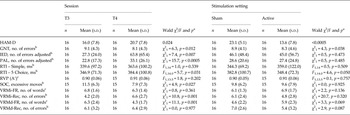
Neuropsychological test scores during the crossover phase of TRD patients

TRD, Treatment-resistant depression; s.d., standard deviation; HAM-D, Hamilton Depression Rating Scale; GNT, Graded Naming Test; IED, intra/extra dimensional shift; PAL, paired associates learning; RTI, reaction time; RVP, rapid visual processing; SOC, Stockings of Cambridge; VRMi-FR, verbal recognition memory immediate, free recall; VRMi-Rec, verbal recognition memory immediate, recognition; VRMd-FR, verbal recognition memory delayed, free recall; VRMd-Rec, verbal recognition memory delayed, recognition.
a p Values concern the estimated effects in the generalized estimating equation and linear mixed models.
b Lower scores reflect better performance.
c Higher scores reflect better performance.
Baseline
Table 2 lists the test scores at baseline, T1 and T2 for all patients and HCs. At baseline TRD patients scored significantly worse than HCs on tests of immediate and delayed verbal memory (VRMi-FR: Wald χ2 1 = 9.2, p = 0.002; VRMd-FR: Wald χ2 1 = 7.0, p = 0.008; VRMd-Rec: Wald χ2 1 = 6.7, p = 0.010), visuospatial memory (PAL: Wald χ2 1 = 21.7, p < 0.001), attention (RVP: t 75.5 = 3.4, p = 0.001) and object naming (GNT: Wald χ2 1 = 6.6, p = 0.010). A trend towards a significant worse performance of TRD patients compared with HCs was found on tests of simple reaction time (RTI-Sim: t 99.3 = 2.4, p = 0.021) and choice reaction time (RTI-5C: t 78.1 = 2.3, p = 0.023). No significant differences were found on tests of immediate verbal recognition (VRMi-Rec: Wald χ2 1 = 3.2, p = 0.071), cognitive flexibility (IED: Wald χ2 1 = 2.8, p = 0.092) and planning (SOC: Wald χ2 1 = 1.1, p = 0.286).
Effects of DBS treatment
A significant interaction effect of session × condition was found on immediate verbal recognition (VRMi-Rec, session × condition: Wald χ2 2 = 14.7, p = 0.001). Post-hoc inspection of the data revealed that the average performance of TRD patients did not change between baseline and T1 (after surgery with stimulation off), whereas HCs improved from baseline to T1. No significant interaction effects were found on any of the other tests (all p > 0.05).
A significant improvement over sessions irrespective of condition was found on tests measuring delayed verbal recall (Wald χ2 2 = 10.2, VRMd-FR, p = 0.006), visuospatial memory (PAL: Wald χ2 2 = 13.2, p = 0.001), planning (Wald χ2 2 = 17.9, SOC, p < 0.001) and object naming (GNT: Wald χ2 2 = 22.8, p < 0.001). A trend to improvement over sessions was found on a test of attention (RVP: F 2,82.4 = 3.8, p = 0.025).
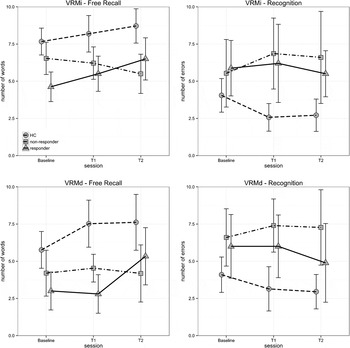
Post-hoc, we explored whether cognitive test results differed between responders and non-responders (see Fig. 2). A significant response status × session interaction was found on immediate verbal recall (VRMi-FR: Wald χ2 2 = 19.8, p < 0.001) and on delayed verbal recall (VRMd-FR: Wald χ2 2 = 6.1, p = 0.048). Responders improved more than non-responders over the course of the optimization phase on both tests. To correct for changes in benzodiazepine use over time, we added this as a covariate in the analyses of these two outcome measures. The interaction effect responder status × session remained significant for VRMi-FR (Wald χ2 2 = 14.3, p = 0.001), but not for delayed verbal recall (VRMd-FR: Wald χ2 2 = 4.5, p = 0.103), although benzodiazepine use was not a significant predictor in both analyses (VRMi-FR: Wald χ2 1 = 1.4, p = 0.243, VRMd-FR: Wald χ2 1 = 1.7, p = 0.188). Although responders improved more than non-responders on these tests, their performance was still worse than HCs at T2 on immediate recall (responders: mean 6.5 words, s.d. 1.7; non-responders: 5.5 words, s.d. 1.8; HCs: mean 8.7 words, s.d. 2.5), as well as delayed recall (responders: mean: 5.3 words, s.d. 2.5; non-responders: 4.2 words, s.d. 2.9; HCs: mean: 7.6 words, s.d. 4.1).
Verbal recognition memory immediate (VRMi) and VRM delayed (VRMd) in healthy controls (HC), responders and non-responders. Performance on VRM on baseline, T1 [after surgery with deep brain stimulation (DBS) off in patients, after 6 weeks in healthy controls] and T2 (after optimization of DBS settings in patients, after 18 weeks in healthy controls). Values are means, with 95% confidence intervals represented by vertical bars.

Active/sham phase
Nine patients were randomized to ‘active–sham’, seven patients to ‘sham–active’. Table 3 lists the test scores during the crossover phases of TRD patients. We found no carry-over effects on any of the tests, so these interaction terms were removed from all models. No significant differences between active and sham stimulation were found on any of the tests. However, we did find trends towards better functioning on tests of object naming (GNT: Wald χ2 1 = 4.3, p = 0.038) and choice reaction time (RTI-5C: F 1,14.0 = 4.6, p = 0.050) in active compared with sham stimulation.
Irrespective of stimulation setting, patients performed significantly worse on T4 than T3 on tests of immediate and delayed verbal memory (VRMi-Rec: Wald χ2 1 = 10.8, p = 0.001; VRMd-FR: Wald χ2 1 = 11.1, p = 0.001), visuospatial memory (PAL: Wald χ2 1 = 15.7, p < 0.001) and cognitive flexibility (IED: Wald χ2 1 = 7.4, p = 0.007). In addition, trends towards a better performance at T4 than at T3 were found on tests of object naming (GNT: Wald χ2 1 = 6.3, p = 0.012), choice reaction time (RTI-5C: F 1,14.0 = 5.7, p = 0.031) and planning (SOC: Wald χ2 1 = 4.9, p = 0.027).
Post-hoc, we tested differences between responders and non-responders on cognitive measures in active and sham stimulation. An interaction between response status and stimulation setting was found on verbal memory tests. Responders performed significantly better during active than sham stimulation compared with an absence of such a difference in non-responders on tests of delayed verbal recall and recognition (VRMd-FR: Wald χ2 1 = 6.2, p = 0.013; VRMd-Rec: Wald χ2 1 = 12.0, p = 0.001) and a trend in the same direction on immediate verbal recall (VRMi-FR: Wald χ2 1 = 3.8, p = 0.052).
Discussion
The aims of this study were to assess whether cognitive functions of TRD patients change following DBS and whether these changes are related to treatment response. TRD patients show impaired verbal and visuospatial memory, attention and object naming compared with HCs. DBS surgery may have a (temporary) adverse effect on immediate verbal memory. DBS did not affect cognitive functioning in TRD patients, neither during optimization of DBS parameters, nor active nor sham stimulation. Verbal memory of responders did, however, improve compared with non-responders.
Most findings are in line with the literature. Impairment of TRD patients compared with HCs in a wide range of cognitive domains is in line with meta-analyses of cognitive functioning of depressed patients (Veiel, Reference Veiel1997; Rock et al. Reference Rock, Roiser, Riedel and Blackwell2014). Furthermore, vALIC DBS does not result in cognitive decline in TRD patients as seen in previous DBS studies targeted at the striatum (Grubert et al. Reference Grubert, Hurlemann, Bewernick, Kayser, Hadrysiewicz, Axmacher, Sturm and Schlaepfer2011), internal capsule (Kubu et al. Reference Kubu, Malone, Chelune, Malloy, Rezai, Frazier, MacHado, Rasmussen, Friehs and Greenberg2013) or SCG (McNeely et al. Reference McNeely, Mayberg, Lozano and Kennedy2008; Bogod et al. Reference Bogod, Sinden, Woo, Defreitas, Torres, Howard, Ilcewicz-Klimek, Honey, Yatham and Lam2014; Moreines et al. Reference Moreines, McClintock, Kelley, Holtzheimer and Mayberg2014; Serra-Blasco et al. Reference Serra-Blasco, de Vita, Rodriguez, de Diego-Adelino, Puigdemont, Martin-Blanco, Perez-Egea, Molet, Alvarez, Perez, Portella, Rodríguez, de Diego-Adeliño, Puigdemont, Martín-Blanco, Pérez-Egea, Molet, Álvarez, Pérez and Portella2015).
Some authors have suggested a cognitive-enhancing effect of DBS (Grubert et al. Reference Grubert, Hurlemann, Bewernick, Kayser, Hadrysiewicz, Axmacher, Sturm and Schlaepfer2011; Kubu et al. Reference Kubu, Malone, Chelune, Malloy, Rezai, Frazier, MacHado, Rasmussen, Friehs and Greenberg2013), mainly because the cognitive improvement was uncorrelated with symptom improvement. However, practice effects could not be discriminated from stimulation effects in these studies, since they did not follow HC groups longitudinally (Grubert et al. Reference Grubert, Hurlemann, Bewernick, Kayser, Hadrysiewicz, Axmacher, Sturm and Schlaepfer2011; Kubu et al. Reference Kubu, Malone, Chelune, Malloy, Rezai, Frazier, MacHado, Rasmussen, Friehs and Greenberg2013). In our study, cognitive functioning of TRD patients improved at the same rate as HCs, suggesting that this reflects practice rather than cognitive enhancement. Furthermore, cognitive performance did not change during sham stimulation despite a rapid reinstatement of symptoms, indicating that DBS does not directly affect cognitive functioning. Possibly, a lack of power prevented detecting cognitive enhancement. However, the sample of 25 patients followed here is larger than previously studied samples and we also did not find any trends in the data to suggest we would have established cognitive improvements beyond practice effects with a larger sample.
Our exploratory analysis showed that verbal memory functions of responders improved more than non-responders, which is in contrast with aforementioned studies (Grubert et al. Reference Grubert, Hurlemann, Bewernick, Kayser, Hadrysiewicz, Axmacher, Sturm and Schlaepfer2011; Kubu et al. Reference Kubu, Malone, Chelune, Malloy, Rezai, Frazier, MacHado, Rasmussen, Friehs and Greenberg2013). In further support of the relationship between response and memory improvement, responders performed better on verbal memory tasks during active than sham DBS, whereas non-responders performed equally during active and sham stimulation. Improvement of verbal memory functions appears to depend on treatment response and might reflect a ‘state’ deficit. This is consistent with literature on verbal memory improvement alongside response to other antidepressant treatment modalities (Douglas & Porter, Reference Douglas and Porter2009).
Unexpectedly, we found a decline on tests of verbal and visuospatial memory, and cognitive flexibility from the first to second crossover phase in patients. Speculatively, this could be due to reduced motivation after performing the cognitive battery three times in an 8-week period, or the parallel tests were coincidentally more difficult at T4 than at T3.
It is somewhat surprising that DBS does not affect cognitive functions, considering that vALIC DBS probably modulates frontostriatal pathways (Lehman et al. Reference Lehman, Greenberg, McIntyre, Rasmussen and Haber2011; Figee et al. Reference Figee, Luigjes, Smolders, Valencia-Alfonso, van Wingen, de Kwaasteniet, Mantione, Ooms, de Koning, Vulink, Levar, Droge, van den Munckhof, Schuurman, Nederveen, van den Brink, Mazaheri, Vink and Denys2013). Depressed patients show abnormal neural functioning in these pathways, which also have been implicated in reward and affective processing (Eshel & Roiser, Reference Eshel and Roiser2010; Russo & Nestler, Reference Russo and Nestler2013). However, affective and reward processing are not explicit components of the neuropsychological tests used in this study. In future studies it would be interesting to include tasks which do take this into account, such as affective go/no-go, reward processing or gambling tasks.
A limitation of this study is the shorter follow-up duration from baseline to T2 in HCs compared with patients. This might have resulted in smaller practice effects in patients than controls and, consequently, an underestimation of the cognitive improvement. However, based on a meta-analysis of factors contributing to practice effects, we estimate these to be small at T2 given the use of parallel tests and the follow-up time of at least several months in a participant group of this age (Calamia et al. Reference Calamia, Markon and Tranel2012). In addition, the lack of differences in the crossover phase does not point towards a direct effect of DBS on cognition. A second limitation is the tapering off of antidepressants and benzodiazepines in some responders during the study, which could partly explain the memory improvement. However, antidepressants most probably do not impact or only have a small positive effect on cognitive functioning (Baune & Renger, Reference Baune and Renger2014; Rosenblat et al. Reference Rosenblat, Kakar and McIntyre2015). The literature shows that benzodiazepines do have a clear negative impact on memory and attention (Tannenbaum et al. Reference Tannenbaum, Paquette, Hilmer, Holroyd-Leduc and Carnahan2012), but explained only a small amount of memory performance in this study. Third, only 16 of the 25 patients participated in the crossover phase. The group of participating patients consisted of relatively more responders than those who dropped out, which could have biased the results towards better performance in the active compared with the sham phase. Despite this possible bias, we did not find any differences between active and sham stimulation with essentially equal scores in both phases. Therefore, this possible bias most probably did not majorly have an impact on the results.
To conclude, vALIC DBS does not result in cognitive decline in TRD patients, lending further support for DBS as a safe treatment regarding cognitive functioning. In addition, we do not find support for a possible cognitive-enhancing effect of vALIC DBS.
Supplementary material
The supplementary material for this article can be found at https://doi.org/10.1017/S0033291717000113
Acknowledgements
This DBS intervention was supported by an unrestricted investigator-initiated research grant by Medtronic Inc. to D.D. and P.R.S., which provided the DBS devices used. In addition, the project was sponsored by a VEMI grant (Early Evaluation of Medical Innovations) of ZonMw (no. 171201008) to D.D., P.R.S., H.G.R. and I.O.B. The sponsors had no involvement in the design and conduct of the study; collection, management, analysis and interpretation of the data; and preparation, review or approval of the manuscript. This study could not have been carried out without the co-operation of all participating patients and healthy volunteers, for which we would like to express our utmost gratitude. The authors also thank Lumara van Diermen, M.Sc., Mariska Dijkstra, M.Sc., Carolien Gielstra, M.Sc., Anne Peters, M.Sc. and Florine Hibbel, M.Sc., for their help in the data collection. In addition, we thank Judy Luigjes, Ph.D. and Ruud Smolders, M.Sc., for randomizing patients in the crossover phase.
Declaration of Interest
D.D. is a member of the advisory board of Lundbeck. D.D. and P.R.S. receive occasional fees from Medtronic for educational purposes. All other authors declare no conflicts of interests.