Introduction
The United States produces a plethora of small fruit sold either as a fresh market product or processed for jam, jelly, or juice. Blueberries and blackberries can commonly be found at local farmers markets and pick-your-own farms. In the United States, more than 41,000 hectares of blueberries were harvested in 2019, yielding more than 321,085,000 kg of fruit valued at $815,908,000 (USDA-NASS 2020). In 2019, Georgia growers harvested more than 8,700 hectares, producing more than 43,500,000 kg of southern highbush (Vaccinium corymbosum L.) and rabbiteye (Vaccinium ashei Reade) blueberries, valued at $133,058,000. Two-thirds of Georgia blueberries are sold as fresh market produce with the remainder used in food processing (USDA-NASS 2020). Blackberry production in Georgia occurred on 500 hectares in 2017 (USDA-NASS 2020), with most of the production consisting of erect thornless varieties.
Weed control in blueberry and blackberry is commonly accomplished through chemical techniques, but the number of herbicides and modes of action on these crops are limited compared to other crop production systems. Producers often use combinations of PRE and POST herbicides to provide season-long control, but the herbicide selection is minimal. For perennial small fruit crops, registered PRE herbicides include flumioxazin, mesotrione, and oryzalin, with POST options of fluazifop-p-butyl, terbacil, and paraquat (Czarnota et al. Reference Czarnota, Mitchem, Hudson, Acebes, Brock, Brenneman and Grey2020). It has been noted that some POST herbicides such as glufosinate-ammonium, carfentrazone-ethyl, and paraquat plus diquat can cause injury on blueberry bushes, providing infection sites for numerous pathogens such as bacterial blight (Pseudomonas syringae) or stem blight (Neofusicoccum ribis; Tennakoon et al. Reference Tennakoon, Jaspers, Ridgway and Jones2015). Thus, having an alternative residual herbicide that can provide season-long weed control could offer a new mode of action for perennial small fruit, potentially reducing herbicide applications and use of injurious herbicides while improving fruit yield and quality.
Indaziflam is now registered for use in blueberry and blackberry production in Georgia (Czarnota et al. Reference Czarnota, Mitchem, Hudson, Acebes, Brock, Brenneman and Grey2020). Indaziflam is a Weed Science Society of America (WSSA) Group 29 cellulose biosynthesis-inhibitor herbicide belonging to the alkylazine family (Brabham et al. Reference Brabham, Lei, Gu, Stork, Barrett and DeBolt2014). As a PRE herbicide, it is used in numerous crop settings and has shown to be safe to perennial crops including grapes (Vitis vinifera L.; Basinger et al. Reference Basinger, Jennings, Monks and Mitchem2019), olive (Olea europaea L.; Grey et al. Reference Grey, Rucker, Webster and Luo2016), pecan (Carya Illinoinensis Wangenh.; Grey et al. Reference Grey, Rucker, Wells and Luo2018), bermudagrass forage (Cynodon dactylon L.; Hurdle et al. Reference Hurdle, Grey, McCullough, Shilling and Belcher2019), turf (McCullough et al. Reference McCullough, Yu and de Barreda2013), and citrus (Jhala et al. Reference Jhala, Ramirez and Singh2013). These studies indicate that indaziflam is safe to use in numerous crop settings, but minimal information exists for its use on blueberry and blackberry. Indaziflam affects growing weeds by potentially increasing the density of cellulose synthase complexes and reducing the velocity of the cellulose synthase particles, therefore slowing the microfibril formation (Brabham et al. Reference Brabham, Lei, Gu, Stork, Barrett and DeBolt2014), a factor that makes it an excellent residual herbicide.
Indaziflam provides an extended period of weed control in these systems due to a half-life that is greater than 150 d, allowing for season-long weed control (Shaner Reference Shaner2014). Grey et al. (Reference Grey, Rucker, Webster and Luo2016, Reference Grey, Rucker, Wells and Luo2018) reported that rates of indaziflam up to 150 g ai ha−1 did not cause injury when applied to olive and pecan trees, when up to five applications were made over 3 yr (respectively). It was also reported that indaziflam applied at 234 g ai ha−1 in a bermudagrass forage setting had minimal chlorosis and no effect on yield compared with nontreated controls (Hurdle et al. Reference Hurdle, Grey, McCullough, Shilling and Belcher2019). However, some reports of chlorosis and other injury have been reported in pecan (González-Delgado et al. Reference González-Delgado, Shukla and Schutte2017) and turf (Jeffries et al. Reference Jeffries, Gannon and Ou2016).
Indaziflam offers Georgia fresh-market berry producers an effective weed management option by providing a new mode of action, with long residual grass and broadleaf weed control. Common blueberry and blackberry weeds include Italian ryegrass [Lolium perenne L. subsp. multiflorum (Lam.) Husnot], Amaranthus, Digitaria, and Ipomoea species, and cutleaf evening primrose (Oenothera laciniata Hill; Czarnota et al. Reference Czarnota, Mitchem, Hudson, Acebes, Brock, Brenneman and Grey2020). As a nonselective cellulose biosynthesis inhibitor, it has low mobility in the sandy soils of Georgia, where these crops are commonly grown (Jhala and Singh Reference Jhala and Singh2012).
Because fresh-market and processed small fruit production represents an important economic commodity in the southeastern United States, providing growers with multiple residual herbicide options can improve weed control, reduce weed selection pressure that could lead to resistance, and potentially increase profitability. However, there is limited information about the use of indaziflam on small fruit crops such as blueberry and blackberry in this region. Therefore, the objective of this research was to evaluate the effects on growth of blackberry and rabbiteye and highbush blueberry after multiple applications of indaziflam at varying rates over time.
Materials and Methods
Blueberry
Field studies were conducted in 2-yr-old ‘Alapaha’ rabbiteye and established ‘Palmetto’ highbush blueberry in Lanier and Clinch counties in Georgia from 2012 to 2014. Soil samples were collected in each study area and analyzed by the Soil, Plant, and Water Laboratory of the University of Georgia (2400 College Station, Rd., Athens, GA). Two-year-old rabbiteye blueberries in Lanier County were planted in Mascotte sand soil (sandy, siliceous, thermic Ultic Alaquods); pH 3.7; and 87.9%, 8%, 4.1%, and 2.2% sand, silt, clay, and organic matter, respectively. The established highbush site in Lanier County was a Leefield loamy sand (loamy, siliceous, thermic Arenic Plinthic Paleaquults); pH 3.7; and 81.9%, 14%, 4.1%, and 3.8% sand, silt, clay, and organic matter, respectively. In Clinch County the soil was a Olustee loamy fine sand (sandy, siliceous, thermic Ultic Alaquods); pH 4.5; and 81.9%, 12%, 6.1%, and 8.4% sand, silt, clay, and organic matter, respectively. The crop was maintained using standard growing practices determined by each respective grower for the duration of the study.
The experimental design consisted of a randomized complete block with four treatments and two application dates, one in March and September each year, with four replications. Treatments consisted of glufosinate alone at 1,130 g ai ha−1, and in combination with indaziflam at 35, 75, and 145 g ai ha−1. Treatments were applied using a CO2-pressurized backpack sprayer at 140 L ha−1 with 145 kPa of pressure, using TeeJet AIXR11002 nozzles (Teejet Technologies LLC, Springfield, IL). Applications were made to either side of the plot with a 1.8-m boom with four nozzles on the vegetation-free strip. Glufosinate was used due to it not being translocated within the plant (Shaner Reference Shaner2014), should the spray contact crop foliage.
Plots were 4 to 5 m long and 3.6 m wide for the different locations, and each plot contained at least five bushes, with data collected from all bushes. Lateral stem diameters with green leaves for each plant were selected and marked with a white paint marker approximately 30 cm above soil level each year with the first herbicide application in March-April (Table 1). Because blueberry growers routinely prune old growth each year, the stem diameters measured each season were eventually removed in autumn after the final herbicide application in August-September (Table 1). Each season, new lateral stems with green leaves were selected for subsequent measurements and data collection. Data collected included measures of stem diameter using calipers during the season from March-April to August-September, four to six times per year for pre- and post-harvest intervals. Stem diameter data were collected at the 1-m height mark on a branching stem. Visual chlorosis estimates of plant leaves were based on a 0% to 100% scale, with a rating of 0% having no chlorosis, and 100% being leaf death, and conducted every 3 or 4 wk for each study. Plots were maintained weed free during the test by hand weeding when necessary.
Test information for evaluation of indaziflam in blueberry and thornless blackberry in Lanier and Clinch counties in Georgia, 2012 to 2014.

a Application dates.
Blackberry
Field studies were performed from 2012 to 2014 in Lanier County on erect, ‘Apache’ thornless blackberries. The soil was an Irvington loamy sand (fine-loamy, siliceous thermic Plinthaquic Paledults); pH 5.4; and 80%, 11.9%, 8.1%, and 2% sand, silt, clay, and organic matter, respectively. Blackberries were maintained under standard growing practices for irrigation, harvest timing, and floricane pruning. The experimental design was arranged as a randomized complete block with four treatments and four replications. Treatments were applied in March and September using a CO2-pressurized backpack sprayer at 140 L ha−1 with 145 kPa of pressure, using TeeJet AIXR11002 nozzles, and included glufosinate at 1,130 g ai ha−1 alone, and in combination with indaziflam at 35, 75, and 145 g ai ha−1. Data collected included stem diameters measured by calipers of four primocanes per plot each year below a painted area marked at approximately 30 cm above the soil level at the initiation of the study. Visual chlorosis estimates of plant leaves were based on a 0% to 100% scale, with a rating of 0% having no chlorosis, and 100% being plant death, and conducted multiple times for each study. Plots were maintained weed free during the test by hand weeding when necessary (once each year).
Weather Data
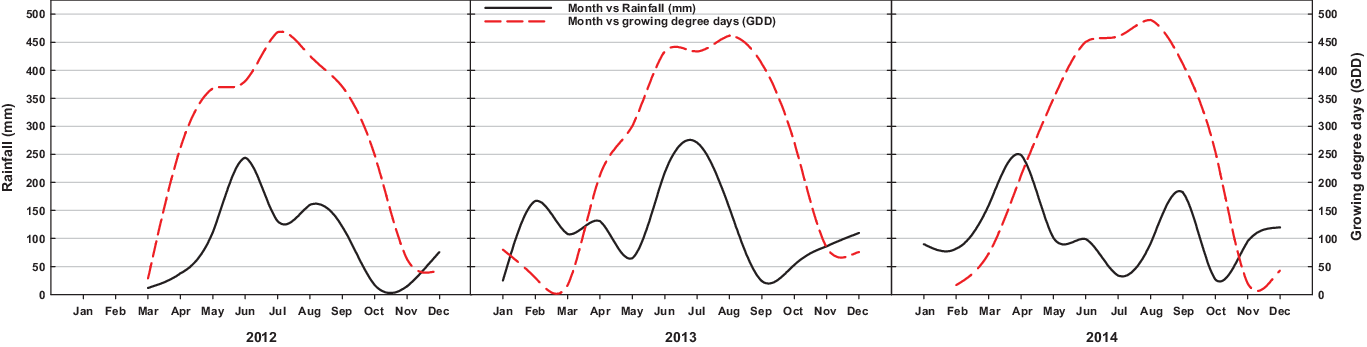
Weather data for all experiments including precipitation, solar radiation, and temperature were collected. Temperature was used to calculate growing degree day (GDD), where GDD = [(Tmax + Tmin)/2 – Tbase], base = 10 C. Information was collected off-site at the Georgia Weather Monitoring Network (Knox 2020) stations located near the experiment sites (Figure 1).
Rainfall and growing degree days (GDD) by month for evaluation of indaziflam in blueberry and blackberry in 2012, 2013, and 2014 in Georgia.

Data Analysis
Data were combined for analysis according to the berry type, evaluating herbicide treatment by GDD interactions. Visual ratings of injury and stem diameter data were analyzed with the MIXED procedure in SAS software (version 9.4, SAS Institute Inc., Cary, NC). Replication was considered a random effect for analyses. Percentage data were arcsine square root transformed to improve normality before analysis and presented. Means were separated using LS-means at the P < 0.05 level.
Results and Discussion
There were differences in rainfall and GDD over the course of 3 yr in each experiment (Figure 1). However, all experiments were conducted at times when herbicide applications could potentially occur in Georgia perennial berry production and are thus representative of producer practices.
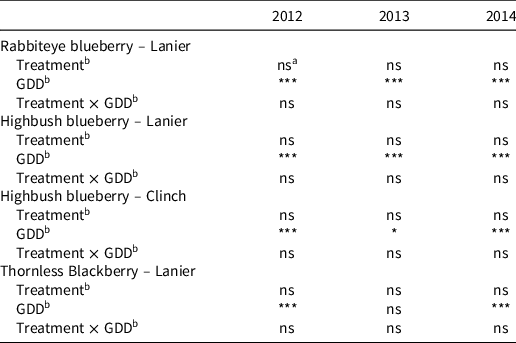
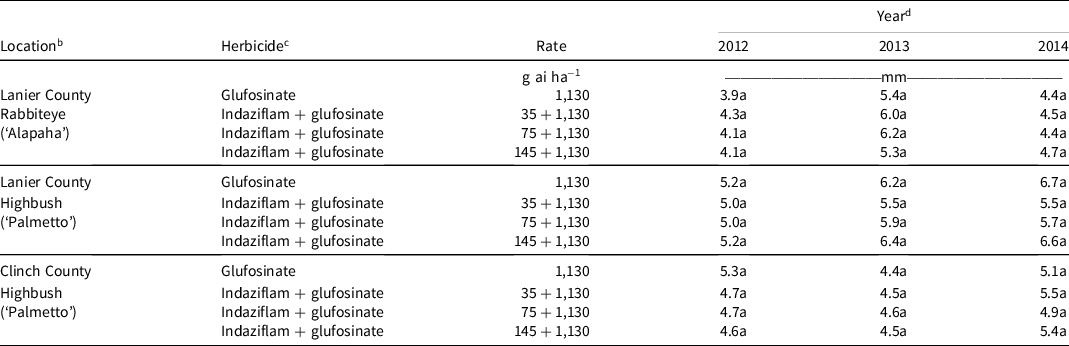
For analysis of herbicide treatment by GDD interactions, there were no differences for stem diameter for blueberry and blackberry during the 3 yr of the experiments (Table 2). Data were therefore combined over GDD and are presented by treatments for blueberry (Table 3) and blackberry (Table 4). Significant differences in growth were noted over time as measured by GDD, as was expected, given the stem diameter measurements were taken over the course of 6 mo of growth each year (data not shown).
Effects of indaziflam treatment, growing degree day, and interaction on rabbiteye (‘Alapaha’), highbush blueberry (‘Palmetto’), and thornless blackberry (‘Apache’), stem diameter in Lanier and Clinch counties, Georgia.c

a Statistical significance indicated as: ns, not significant (P > 0.05); *P = 0.05 to 0.01; **P = 0.01 to 0.001; ***P ≤ 0.001.
b ANOVA using the MIXED procedure in SAS, Type 3 Tests of Fixed Effects (SAS Institute, Cary, NC).
c Abbreviation: GDD, growing degree days.
Effects of repeated indaziflam treatments on rabbiteyea and highbush blueberry stem diameter in Lanier and Clinch counties, Georgia, 2012 to 2014.

a See Table 1 for application dates. All treatments were applied five times in total over 3 yr.
b Plots maintained weed free by hand during test.
c All data were subject to a MIXED procedure in SAS with model effects set as treatment, growing degree days (GDD), and the interactions (Table 2). Because the interaction of GDD by treatment was not significant for any variable, data for treatment by GDD were combined over GDD and presented by treatment.
d Values for each rate for stem diameter within a column, for a given location, followed by the same letter are not significantly different at P < 0.05 probability level.
Effects of repeated indaziflam treatmentsa on thornless blackberry (‘Apache’) primocane stem diameter in Lanier County, Georgia, 2012 to 2014.

a See Table 1 for application dates. All treatments were applied five times in total over 3 yr.
b Plots maintained weed free by hand weed during test.
c All data were subject to a MIXED procedure in SAS with model effects set as treatment, growing degree days (GDD), and the interactions (Table 2). Because the interaction of GDD by treatment was not significant for any variable, data for treatment by GDD was combined over GDD and presented by treatment.
d Values for each rate for stem diameter within a column, for a given location, followed by the same letter are not significantly different at P < 0.05 probability level.
Blueberry
There were no differences in visual injury symptoms for all rates of glufosinate plus indaziflam as compared to glufosinate alone for any of the studies (data not shown). ‘Alapaha’ and ‘Palmetto’ blueberry cultivars exhibited minor leaf chlorosis (<10%) within 30 d after spring applications for all treatments. This was always transient and no longer noted 8 wk after treatment. Many reports of little to no visual injury have been made for indaziflam applied to perennial crops (Basinger et al. Reference Basinger, Jennings, Monks and Mitchem2019; González-Delgado et al. Reference González-Delgado, Shukla and Schutte2017; Grey et al. Reference Grey, Rucker, Wells and Luo2018, Reference Grey, Rucker, Webster and Luo2016; Hurdle et al. Reference Hurdle, Grey, McCullough, Shilling and Belcher2019).
Blueberry stem diameter in terms of measures combined over the entire growing season varied by locations (3) and years (3), ranging from 3.9 to 6.7 mm (Table 3). However, blueberry stem diameters within each experiment had little variation with less than 0.6 mm diameter differences across most herbicide treatments for each test. Caliper diameter measure data combined over GDD indicated that indaziflam applied multiple times in the spring and autumn of each year did not negatively affect blueberry growth (Table 3). When indaziflam was applied at 35, 75, or 145 g ai ha−1 five times over 30 mo, blueberry growth was equal to the glufosinate-alone treatment (no residual herbicide). By the final measures taken in October 2014, the total applications of indaziflam amounted to 175, 375, and 725 g ai ha−1 cumulatively over 30 mo. Blueberry stem diameters did show a gradual increase in girth over the course of the experiment, indicating that indaziflam did not stunt or inhibit stem diameter growth. Similar trends were noted in the growth of Lanier County highbush blueberries, and there were no differences noted in blueberry stem diameter at the Clinch County location. These data indicate that indaziflam at the currently labeled rate did not affect very young blueberry stem diameter growth in Georgia soils. The bushes were only 2 yr old at the first applications, and sustained no growth reduction or inhibition. Turf weed control with indaziflam was noted for up to 28 wk (McCullough et al. Reference McCullough, Yu and de Barreda2013), and at least 6 mo of weed control noted in pistachio (Pistacia vera L.), pome fruit, stone fruit, and citrus (Allen Reference Allen2011). Total seasonal rates for perennial crops can range from 50 to 150 g ai ha−1.
Blackberry
There were no differences in visual injury symptoms for all rates of glufosinate plus indaziflam as compared to glufosinate alone for any of the studies (data not shown). Blackberry primocanes and floricanes exhibited no visual injury to any herbicide treatment (data not shown). As previously noted, there are many reports of little to no visual injury for indaziflam applied to perennial crops (Basinger et al. Reference Basinger, Jennings, Monks and Mitchem2019; González-Delgado et al. Reference González-Delgado, Shukla and Schutte2017; Grey et al. Reference Grey, Rucker, Wells and Luo2018, Reference Grey, Rucker, Webster and Luo2016; Hurdle et al. Reference Hurdle, Grey, McCullough, Shilling and Belcher2019).
Primocane stem diameters on erect thornless blackberries exhibited similar trends in response to indaziflam treatments as blueberries (Table 4). Blackberry primocane stem diameters did not show any differences in girth, indicating that indaziflam did not stunt or inhibit stem diameter growth over the course of the season. The high rate of indaziflam did not differ from the treatment without indaziflam, indicating the safety of using indaziflam on blackberry in Georgia soils.
Previous reports of injury on perennial crops have been noted. Injury to pecan in the western U.S. production region was attributed to a variety of soil factors and production practices that resulted in indaziflam being more soil mobile under flood irrigation conditions and 15 cm of simulated rainfall (González-Delgado et al. Reference González-Delgado, Ashigh, Shukla and Perkins2015; Jhala and Singh Reference Jhala and Singh2012). Blueberry and blackberry production regions in the southeastern U.S. typically have acidic soils (pH 3.6 to 5.5) and use overhead or drip irrigation, therefore reducing potential indaziflam mobility. This was also noted by Basinger et al. (Reference Basinger, Jennings, Monks and Mitchem2019), who noted no crop injury on grape and muscadine varieties up to and exceeding labeled rates in single and sequential applications. It was also noted that yield and yield components (berries per cluster, berry weight, cluster number per meter cordon) were not different than weed-free controls.
Growing degree day affected stem diameter in blueberry and thornless blackberry at all locations except Lanier in 2013 (Table 2). Years with greater GDD have been correlated with greater stem diameter (Cocozza et al. Reference Cocozza, Giovannelli, Lasserre, Cantini, Lombardi and Tognetti2012). However, interactions between GDD and herbicide treatments did not affect stem diameter in either crop across all locations. Using indaziflam mixed with a burndown herbicide can provide season-long residual weed control (Brunharo et al. Reference Brunharo, Watkins and Hanson2020; Jhala et al. Reference Jhala, Ramirez and Singh2013) without the need for additional applications until the dormant season of the crop. Indaziflam spring and autumn applications could provide season-long weed control, eliminating the need for additional burndown treatments, providing optimal growing conditions for blueberry and blackberry production. Herbicides in WSSA groups 2, 3, 9, 10, 14, 27, and 29 can be used in blueberry and blackberry production regimes to prevent or slow herbicide resistance development (Czarnota et al. Reference Czarnota, Mitchem, Hudson, Acebes, Brock, Brenneman and Grey2020). These findings indicate that blueberry and blackberry grown in Georgia soils are tolerant to repeated applications of indaziflam over time.
Acknowledgments
We thank the University of Georgia College of Agriculture and Bayer Crop Science for partial funding, technical support by Sidney Cromer and Owen Kimbrell, and statistical support by Xuelin Luo. No conflicts of interest have been declared.