

Introduction
When in 1999 Europe's Economic and Monetary Union (EMU) came into formal existence, many commentators saw the launch of the euro as the most important event in global monetary affairs since the end of World War II. The establishment of EMU gave rise to the question whether Europe would be able to project power in the global monetary system in the same way as European trade integration and the formation of a European trade policy had buttressed European power in the global trading system. In this context, the key question scholars have raised is whether the euro will be able to challenge the pre-eminence of the US dollar in the future. Many prominent analysts were very optimistic in this respect. Nobel Laureate Robert Mundell, for instance, envisaged that the euro would ‘challenge the dollar and alter the power configuration of the system’.Footnote 1 More than ten years after its birth, scholars are more pessimistic about the euro's capability to challenge the dominance of the US dollar. Although some economists have predicted that the euro will defy the US dollar as an international reserve currency in 15 years,Footnote 2 from an International Political Economy (IPE) perspective most scholars believe various institutional deficiencies of EMU remain a major constraint.Footnote 3
The sovereign debt crisis that has been afflicting the Eurozone since 2010 is casting even more doubt on the prospects of the euro as a global currency. In this context, it seems more relevant to address the question whether Europe has really increased its monetary power since the establishment of EMU – irrespective of the currency struggle between the US dollar and the euro. As scholarship on monetary power suggests, this question refers to the extent Europe has been able to increase its macroeconomic autonomy in the global monetary system – particularly in the context of balance-of-payments constraints.Footnote 4 Surprisingly, however, systematic analyses of the impact of EMU on the monetary power of its member states are in short supply in the IPE literature. For those IPE scholars that have paid attention to this issue, the prevailing understanding seems to be that EMU member states have more or less equally benefitted from the creation of the euro in terms of monetary power. This understanding is based on the notion that the EMU regime is by definition a symmetric system of European monetary cooperation, entailing two empowering mechanisms that would support the macroeconomic autonomy of its member states to an equal degree. First, the EMU would diminish the external exchange rate vulnerability of its member states, thereby improving the capacity of region to autonomously determine its macroeconomic policy. Second, the elimination of intra-regional exchange rate volatility and the promotion of European financial market integration would improve the capacity of its member states to finance current account imbalances and increase their macroeconomic flexibility.
Taking into consideration diverging domestic economic institutions and external constraints among the Eurozone's national political economies, it was always questionable whether these two empowering mechanisms were truly symmetric in their effects on member states' monetary power. Indeed, contrary to the prevailing understanding in IPE, I will show that EMU's macroeconomic governance regime has generated an uneven distribution of monetary power; drawing on a comparative capitalism perspective on monetary power, I will argue that the Eurozone's coordinated market economies (CME) – Germany in particular – have benefitted more from EMU's two empowering mechanisms than its mixed market economies (MMEs) and liberal market economy (LME) in terms of monetary power. The main reason why EMU has strengthened the macroeconomic autonomy of the CMEs more than that of the MMEs and LME is related to their distinctive coordinated labour market institutions, which have given these countries a significant adjustment advantage under the single currency by being highly responsive to developments in international competitiveness and supporting their export-led growth. Taking into consideration that participation in EMU prevents national central banks from resorting to monetary policy and exchange rate realignments to correct a decline in international competitiveness or neutralise price inflation, I argue that the availability of such responsive labour market institutions is essential for a member state to take full advantage of the euro's empowering effects. While it is possible to extend my argument to the smaller CMEs (Austria, Belgium, Finland, and the Netherlands), the main focus of this article will be on Germany – which is the Eurozone's largest economy as well as the most emblematic representation of the CME.
My argument will be based on an examination of the diverging impact of two key dimensions of EMU's macroeconomic governance regime on these different models. First, EMU's exchange rate regime is demonstrated to have an appreciation bias that harms the MMEs much more than the CMEs. While MMEs such as France and Italy have frequently criticised the ECB's control over the euro exchange rate and its appreciation bias for undermining their export competitiveness, Germany's labour market institutions have been favourable to the production of high value-added and quality-differentiated goods and the negotiation of wage restraint, thus offsetting the effects of euro appreciation on its export competitiveness. Second, I show that EMU's regime for balance-of-payments has created a structural current account distinction between the CMEs as surplus countries and the MMEs and LME as deficit countries. The euro allowed Germany to pursue real exchange rate depreciation through the exertion wage restraint and facilitated the recycling of its export surpluses, thereby creating incentives for unbalanced consumption-led growth in the MMEs and LME. While EMU temporarily decreased the borrowing costs of its MMEs and LME and enhanced their capacity to finance external deficits, EMU's orthodox macroeconomic governance regime allowed the CMEs to deflect the burden of adjustment onto the deficit member states when internal imbalances became unsustainable.
This article will proceed as follows. The first section formulates a critique of the monetary power literature on European monetary integration by drawing on a comparative capitalism perspective and outlines the different capitalist models in the Eurozone as well as the argument why EMU's macroeconomic governance regime displays asymmetrical effects on these diverse models. The second section provides an analysis of EMU's exchange rate regime and its appreciation bias and shows that member states' diverging domestic institutions and economic structures have given rise to diverging exchange rate vulnerabilities. The third section discusses the escalation of intra-regional current account imbalances and shows that EMU's regime for the management of balance-of-payment has generated asymmetric adjustment pressures among its member states. The final section concludes by discussing the implications of the institutional reform package – negotiated in the context of the Eurozone sovereign debt crisis – for the future of EMU and the monetary power of its member states.
Monetary power and EMU
In this section, I advance the thesis that the introduction of the euro has generated an uneven distribution of monetary power within the Eurozone. The elaboration of this thesis requires first and foremost an exanimation of the meaning of monetary power. Seminal research – bundled in a 2006 volume edited by David M. Andrews – has pointed out that the problem of adjustment to balance-of-payments disequilibria is central to any discussion of monetary power.Footnote 5 Because the costs of external adjustment are generally distributed asymmetrically across countries, the main function of monetary power is to avoid as many of these costs as possible. This can be achieved by, on the one hand, delaying the continuing costs of adjustment by financing the external imbalance or, on the other, by deflecting the transitional costs of adjustment onto other states. Thus, as Benjamin Cohen argues, the ultimate foundation of monetary power is macroeconomic autonomy. Excessive imbalances generate mutual pressures to adjust, representing a persistent threat to the realisation of key domestic macroeconomic preferences. Monetary power consists of the capacity to avoid the ‘burden of adjustment’ to payments imbalances in order to realise these key preferences.Footnote 6
The monetary power literature on European monetary integration has taken both internal and external monetary developments into account. Internally, it has been argued that the need to create a regional system of exchange rate stabilisation turned Germany into the key monetary power of Europe.Footnote 7 Because Germany was the region's low inflation leader and its economy produced the largest current account surpluses, the Deutschmark became the exchange rate anchor of the European Monetary System (EMS) in the 1980s. As a result, while the other EMS members stabilised their exchange rates against the Deutschmark through internal monetary and/or external exchange rate adjustment, Germany was the only country that did not surrender its monetary autonomy.Footnote 8 Unsurprisingly, ‘this asymmetry of the EMS has brought charges of German hegemony and has been the source of considerable resentment among other [EMS] countries’.Footnote 9 Weaker currency countries – France in particular – therefore hoped to counter German monetary dominance by the creation of a common currency, effectively securing a seat on the board of the new European central bank and sharing control over its monetary policies.Footnote 10 Importantly, European monetary unification could enable these countries to pursue a more expansionary monetary policy than had been possible under the dominance of the Bundesbank.
External monetary developments, however, increasingly undermined German monetary autonomy as well. Even the German Bundesbank had to neutralise the growing volatility of the floating Deutschmark in the context of rising capital mobility on a regular basis by adjusting its monetary policies. Exchange rate volatility increased especially in the face of destabilising macroeconomic policies of the US government, which on a regular basis used the US dollar exchange rate weapon to force macroeconomic adjustment onto surplus countries such as Germany. The pursuit of dollar depreciation by the US government often compelled Germany to pursue expansive policies in order to offset its loss in export competitiveness and frequently destabilised the EMS. As Michael Webb recalls, for instance, ‘The sharp decline in the dollar's value in the summer of 1992 helped to trigger the EMS crisis by encouraging capital inflows into Germany, thus thriving up the mark against the dollar and other European currencies.’Footnote 11 Accordingly, Germany developed interest in European monetary unification as well, which would reduce the asymmetry in exchange rate vulnerability by spreading the effects of currency appreciation over a larger monetary area.Footnote 12
Thus, the creation of a European currency would shield all Eurozone member states against the vagaries of the global monetary system, leading to a ‘zone of monetary stability’ as well as reconsolidating their weakened policy autonomy on a European level. Germany and the other EMS countries were therefore willing to surrender their ‘nominal’ monetary autonomy in order to attain a real measure of collective and therefore ‘effective’ autonomy within the global monetary system.Footnote 13 As such, the prevailing interpretation seem to be that European centralisation of monetary policy has made EMU by definition a symmetric system that has benefitted its member states equally in terms of monetary power.Footnote 14 This understanding is based on the detection of two key mechanisms that are considered to bolster the macroeconomic autonomy of the EMU member states to a more or less equal degree. First, the intra-regional nature of most European trade would allow the ECB to pursue domestic policy objectives without regard to the extra-regional exchange rate of the euro. The creation of a large monetary constellation such as the Eurozone would therefore diminish the region's exchange vulnerability and render EMU countries ‘less susceptible to pressures from the US for policy change and to fluctuations in the US dollar’.Footnote 15 Second, monetary unification would grant individual member states the benefits of global capital market integration while minimising the risks. EMU would ‘preserve the macroeconomic flexibility afforded by capital market integration while at the same time making it possible to ignore substantial institutional differences between the member states’.Footnote 16 Monetary unification would maximise the benefits of increased access to international capital market liquidity – relaxation of current account constraints on its member states and therefore the improvement their macroeconomic policy flexibility – while minimising the costs – exchange rate volatility.
Drawing on a comparative capitalism perspective on monetary power, however, this article argues that the establishment of EMU has reproduced and even reinforced the asymmetrical power structure of the EMS by questioning the viability of these mechanisms in a context of intra-regional capitalist variety. The state-centric approach of the existing monetary power literature neglects the domestic politico-economic and institutional context in which macroeconomic autonomy is embedded, thus lacking an understanding of the domestic purpose of monetary power. By accounting for the existing institutional diversity among national political economies, the comparative capitalism literature – such as the Varieties of Capitalism approachFootnote 17 or the Regulation schoolFootnote 18 – can address this theoretical lacuna; from a CC perspective, it can be argued that the ultimate function of a nation's monetary power is the consolidation of its distinctive model of capitalism and growth regime. In this respect, it is important to note that the creation of a single European monetary policy has not eliminated the diversity in national models of capitalism within the Eurozone, where the following three models of capitalism can be distinguished: (1) the coordinated market economy (CME) in which powerful professional associations and networks form the principal coordinating nexus – a model that is adopted by Germany, Austria, the Netherlands, Belgium, and Finland; (2) mixed market economies (MME) in which the government plays a central guiding role in coordinating economic activity – a model that is connected to France and the Mediterranean countries; and (3) the liberal market economy (LME) in which the market plays the decisive role with regard to coordinating economic activity – a model that is associated with Ireland.
The continuing existence of capitalist variety within the Eurozone raises the question of whether the euro has fortified these different national models to the same degree. The central claim of this article is that the current EMU regime has shielded the CMEs more from external monetary forces than other national models. This claim supports the view that the design and operation of the European macroeconomic governance regime ‘reflects an asymmetry of power, in which “debtor states”, especially chronic debtors, have less negotiating weight than creditors’.Footnote 19 One key illustration is that the orthodox preferences of Germany as the most powerful CME of the EMS became projected into EMU's macroeconomic governance regime: the ECB became the world's most independent central bank with a sole mandate and strict priority to keep inflation below but near two per cent, while the Stability and Growth Pact (SGP) obliges EMU member states to keep their budget deficits below 3 per cent of GDP and their public debt levels below 60 per cent of GDP. Nevertheless, a comparative capitalism approach is necessary to identify how: (1) Germany's creditor strength is embedded in its domestic CME and associated export-led growth regime; and (2) EMU's orthodox macroeconomic governance regime exhibits structural asymmetries between its CMEs on the one hand and its MMEs and LME on the other.
Domestic institutions can clarify why the CMEs prove to be the region's structural surplus countries. A focus on Germany is essential because it is the Eurozone's largest economy and remains the best representation of the CME. Scholars have generally attributed Germany's structural surplus status to its orthodox macroeconomic policy regime – consisting of both monetary conservatism (delivered in the pre-EMU period by the Bundesbank) and non-accommodating fiscal policymaking – and its success in maintaining price stability. However, ‘hidden behind the centrality of price stability, the trade surplus became the central target of German policy’.Footnote 20 Keeping domestic inflation lower than foreign competitors is indeed an indirect way of gaining competitiveness and stimulating exports. Here, not only Germany's macroeconomic conservatism but also its institutional arrangements for coordinated wage bargaining become of central importance: large unions from the externally exposed manufacturing industries internalise the costs of wage inflation in the context of non-accommodating macroeconomic policymaking and traditionally accept wage restraint to maintain employment in and boost the competitiveness of the export sectors.Footnote 21 In addition, Germany's coordinated system of vocational supports – its renowned dual apprentice system – has supported the creation of firm- and industry-specific skills that have encouraged ‘diversified quality production’ by enabling manufacturing firms to pursue quality-competitiveness through strategic upgrading and customisation of products.Footnote 22 As such, Germany's domestic political economy is embedded in a growth model that is geared towards strengthening external competitiveness and increasing exports. The other CMEs share labour market institutions that are capable of responding efficiently to developments in international competitiveness and maintaining export-led growth.Footnote 23
The key institutional dimension that distinguishes the Eurozone's MMEs is the role of the state in mediating economic relations and safeguarding international competitiveness. As Bob Hancké notes, MMEs ‘can perhaps best be understood in a two-tiered framework, in which firms attempt to negotiate the production of collective goods among themselves, but are forced to rely on the state the compensate for the gaps in the institutional framework which precludes them to deliver autonomously’.Footnote 24 MMEs lack domestic labour market institutions such as well-developed training systems and coordinated and consensual wage bargaining institutions responsive to changes in external competitiveness; labour unions are usually much weaker and industrial relations more conflictive than in CMEs, giving the state a key mediating role in national wage setting and labour market regulation.Footnote 25 Accordingly, most MMEs needed to resort to social pacts between employers, unions, and governments in order to reduce inflation rates and public deficits necessary for meeting the convergence criteria for EMU membership.Footnote 26 In addition, MMEs ‘are characterized by the relative weakness of their educational and training systems and a real difficulty in implementing industrial strategies designed to encourage the development of high value-added products’.Footnote 27 So despite many institutional dissimilarities, the Eurozone's MMEs share – to differing degrees – labour market institutions that are less able than those of CMEs to achieve cost and quality competitiveness. As a result, these countries have more need for discretionary macroeconomic policymaking – such currency devaluation and/or budgetary accommodation – in order to compensate for weak competitiveness and export growth. Ireland's LME, by contrast, has a strong export sector – based on the attraction of massive foreign direct investment via is lox corporate tax regime – but financial deregulation has moved the country increasingly towards finance-led growth over the past two decades.
It is against the background of these diverging domestic institutional contexts that the issue of macroeconomic autonomy needs to be examined. Looked at from this perspective, it can be argued that EMU's two empowering symmetric mechanisms actually display significant macroeconomic asymmetries between its CMEs on the one hand and its MMEs and LME on the other. Indeed, as I will argue in the following sections, EMU's orthodox macroeconomic policy framework has given rise to an exchange rate regime and a regime for the management of balance-of-payments that are more beneficial for the Eurozone's CMEs than its MMEs and LME. While the main focus of my analysis will be on Germany as the largest economy of EMU and its key beneficiary in terms of monetary power, it will become clear that the euro has also strengthened the macroeconomic autonomy of the smaller CMEs, which mirror German orthodox macroeconomic preferences for price stability and the preservation of export competitiveness by controlling wage developments.Footnote 28 The asymmetries behind the two dimensions of EMU's macroeconomic governance regime can be summed up as follows:
(1) ECB's one-dimensional focus on maintaining price stability has generated an exchange rate policy for the euro that is biased towards appreciation. While the labour market institutions of the CMEs – Germany in particular – have counteracted the effects of nominal exchange rate appreciation on their export competitiveness, MMEs are much less well-adjusted to excessive euro appreciation. More particularly, coordinated vocational training and wage bargaining systems have decreased the exchange rate vulnerability of Germany by allowing an industrial strategy based on diversified quality production and wage restraint. Because MMEs lack these coordination mechanisms, their export structures tend to be dominated by standardised production – the export demand for which is highly sensitive to exchange rate fluctuations – and their labour market institutions are less appropriate to exert wage restraint in order to mitigate the effect of nominal exchange rate appreciation. As a result, EMU's exchange rate regime produces asymmetrical effects and reveals important distributional implications.
(2) The EMU regime consolidated a distinction between its CMEs as surplus countries and its MMEs and LME by allowing the CMEs – above all Germany – to pursue real exchange rate depreciation through the exertion of wage restraint at the same time as facilitating the recycling of their export surpluses and creating incentives for very unbalanced growth in the MMEs and LME. While EMU decreased the borrowing costs of its MMEs and LME and temporarily enhanced their capacity to finance external deficits, EMU's orthodox macroeconomic governance regime allowed the CMEs to deflect the burden of adjustment onto the deficit member states when internal imbalances became unsustainable. As deficit countries are unable to use exchange rate devaluation for external adjustment purposes, they can only resort to internal deflation. As such, the management of balance-of-payments within EMU operates not only asymmetrically but also much more painfully for these countries than under the EMS.
EMU's exchange rate regime
Exchange rate policymaking is the first dimension of EMU's macroeconomic governance regime that reflects the asymmetrical distribution of monetary power within the Eurozone. As the rules of EMU stipulate that the Eurogroup may ‘conclude formal agreements on an exchange rate system for the euro’ and ‘formulate general orientations for exchange rate policy’,Footnote 29 it appears that ‘the exchange rate policy of the euro is ultimately in hands of politicians rather than the ECB’.Footnote 30 Gerard Strange therefore argues that ‘the common exchange rate is the most important and powerful macroeconomic instrument made available to the Eurozone as a direct consequence of currency union’ which ‘could in principle underpin a sustainable expansion of demand in the Eurozone’.Footnote 31 Nevertheless, as the Eurogroup needs to reach consensus and its exchange rate instructions are not allowed to undermine the ECB's anti-inflation mandate, the ECB has de facto control over the exchange rate policymaking. This means that the exchange rate of the euro is subordinated to the price stability objective of the ECB, whose exchange rate preferences are solely determined by inflation considerations.Footnote 32 An important corollary is that the ECB will only pursue an activist exchange rate policy in order to reverse an inflationary depreciation of the euro, while accepting an excessive euro appreciation because of its tempering effects on domestic inflation. As such, the exchange rate regime of EMU is characterised by an appreciation bias.
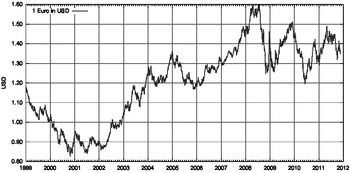
The management of the euro exchange rate since the establishment of EMU arguably reflects this appreciation bias (see Figure 1). Since the birth of the euro the ECB only intervened in the foreign exchange markets during September and November 2000 in order to reverse the depreciation of the euro against the US dollar.Footnote 33 By contrast, it has persistently refused to counter several rounds of excessive appreciation. Although a strong euro was first considered as an expression of financial market confidence in the European economy, monetary policymakers started to become apprehensive when the euro did not stop rising. When in March 2008 the euro reached a new high of almost US $1.60, Jean-Claude Trichet admitted to be ‘concerned about excessive exchange-rate moves’.Footnote 34 However, despite mounting criticism of European economists and politicians, the ECB did not resort to any exchange rate policy measures – exchange market intervention or monetary policy adjustment – that might have averted excessive appreciation of the euro.Footnote 35 It is emblematic, in this respect, that the ECB increased its interest rate in April 2011 in the face of unwarranted euro appreciation.
Euro-US dollar exchange rate

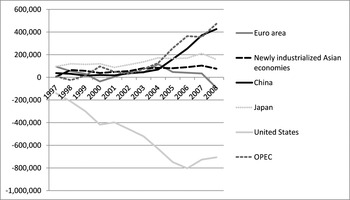
Unsustainable US macroeconomic policies have contributed to the persistent appreciation of the euro. By 2006–7 it became clear that the euro had become the ultimate ‘adjustment variable’ in the unwinding of the global current account imbalances between the US and East Asia.Footnote 36 While escalating deficits in the US current account put downward pressures on the US dollar, East Asian export-led economies – China in particular – strongly intervened in the foreign exchange markets in order to avert appreciation against the US dollar. As a result, the euro appreciated against most East Asian currencies as well over this period – despite the Eurozone's more or less balanced current account position over this period (see Figure 2). The rapid deterioration of Europe's bilateral trade deficit with China led European monetary policymakers to believe that China's mercantilist reluctance to appreciate the renminbi was the ultimate culprit of the euro's excessive rise.Footnote 37 Even though the sovereign debt crisis has produced downward pressures on the euro, it is important to note that the exchange rate of the euro tends to become the ultimate adjustment variable in the so-called global currency wars as well: the euro risks becoming squeezed between the Federal Reserve's expansionary policies – which cause downward pressures on the US dollar – and the strong predilection of emerging market economies to counter any excessive currency appreciation by means of exchange rate intervention.Footnote 38
Current account balances of selected countries and regions (in billion US dollar)

Given that US macroeconomic policies are partly responsible for the euro's appreciation, it might be possible to argue that the refusal of the ECB to adjust its monetary policies reveals the incapacity of the US government to deflect the burden of adjustment onto the Eurozone through the exchange rate weapon.Footnote 39 Strange, for instance, argues that ‘the arrival of the euro, by arming the Eurozone with its own collective exchange rate weapon, has made the active projection of monetary power, including a challenge to “dollar hegemony”, possible, where once there existed only relatively small European states structurally subordinate in the monetary domain to the US’.Footnote 40 This argument can be countered from two interrelated perspectives, however. First, the euro's exchange rate protection has not been employed to pursue an exchange rate depreciation but to shield Germany's macroeconomic orthodoxy from external monetary destabilisation: because global monetary turmoil would have pushed the Deutschmark under the EMS as a relatively smaller safe haven currency up much more strongly than the euro, EMU enabled Germany to resist calls from the US government for more fiscal expansion in the aftermath of the global financial crisis.Footnote 41 As such, the benefits of exchange rate protection in terms of strengthened macroeconomic autonomy are not distributed evenly among EMU member states. Second, and more importantly, the ECB's appreciation bias has significant asymmetric effects among EMU member states. Indeed, it can be argued that the exchange rate regime for the euro corresponds more with the macroeconomic preferences of Germany and other CMEs and less with those of MMEs – especially large MMEs such as France and Italy, which have been the most outspoken opponents of the ECB's appreciation bias.Footnote 42
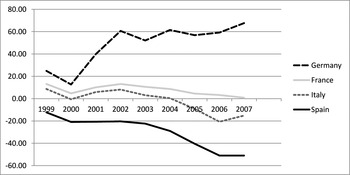
France and Italy appear to show higher vulnerability to nominal exchange rate appreciation – as reflected by their deteriorating extra-EU trade balance since the introduction of the euro. While in 1998 France and Italy registered an extra-EU trade surplus of €15.4 billion and €16.2 billion respectively, by 2007 France's surplus had shrunk to €0.8 billion whereas Italy recorded a deficit of €15.2 billion.Footnote 43 Interestingly, the breakdown of these two countries' overall trade balance between intra- and extra-EU trade reveals that France's extra-EU trade surplus traditionally serves to fund its intra-EU trade deficit whereas Italy's declining overall trade balance was almost entirely caused by its sharply deteriorating extra-EU trade balance. Germany's extra-EU trade surplus, by contrast, rose from €31 billion to €67.7 billion over the same period (see Figure 3). In general, the extra-EU trade balances of the MMEs have responded much more negatively to the appreciation of the euro than those of the CMEs: the deficit of Spain, Portugal and Greece rose from €7.35 billion, €3.48 billion and €5.13 billion in 1998 to €51.03 billion, €5.27 billion, and €17.43 billion in 2007 respectively, whereas the Austrian and Finnish surplus rose from €2.43 billion and €4.48 billion to €8.13 billion and 6.93 billion over the same period.Footnote 44
Extra-EU trade balance of selected EMU countries (in billion euro)

The divergent nominal exchange rate vulnerabilities and preferences between the large MMEs and Germany arose from the divergent institutional and economic structures of their national political economies. First, in MMEs such as France and Italy responsibility for the exchange rate was traditionally shared between the Ministry of Finance and central bank during the pre-EMU era, whereas in CMEs such as Germany the central bank retained ultimate control over the exchange rate.Footnote 45 Such a different distribution of authority over exchange rate policymaking derived from distinct views on the independence and price stability orientation of central banks: while MMEs traditionally hope to rebalance the power between the finance ministry and the central bank by claiming political control over the exchange rate, the German CME considers central bank independence as an indisputable institution that needs to be protected from political interfering exchange rate instructions. As a result, MMEs are more inclined than CMEs to use exchange rate policy as an instrument to force the central bank to pursue exchange rate depreciation by lowering interest rates. It is this desire of MMEs to compensate for the independence of the ECB that has informed policy discussions over the formal rules of EMU. Indeed, as David Howarth has shown, the French Treasury ‘argued in favour of giving the ministers of economics and finance control over exchange rate policy’ in order to ‘limit the European bank's margin of manoeuvre as much as possible’.Footnote 46
The EMU Treaty appears to comply with the desire of MMEs by giving the Eurogroup authority over exchange rate policymaking, yet the need for unanimity effectively secures a German veto over this issue. When in September 2007, for instance, the French Minister of Finance Christine Lagarde urged the ECB to take ‘action’ to rebalance the rising euro, German Chancellor Angela Merkel emphasised the need to ‘resist any attempt to challenge the central bank's independence’.Footnote 47 As such, the appreciation bias of EMU's exchange rate regime is sustained by the difficulty and even impossibility of reaching consensus in the Eurogroup.Footnote 48 The question remains, however, why countries such as France are more apt to criticise the ECB's exchange rate policy than other countries. The interpretation that France's Republican tradition of dirigisme urged it to seek as much political control over European monetary policy as possible – with the Eurogroup operating as EMU's ‘gouvernement économique’ – can only be a partial explanation.Footnote 49 Indeed, the sharply deteriorating extra EU-trade balance of the large MMEs suggests that the minimisation of their exchange rate vulnerability is at least an underlying motivation behind their desire to maximise political control over European monetary policy. But why are highly export-dependent CMEs such as Germany less vulnerable to nominal exchange rate appreciation than large MMEs such as France and Italy?
A comparative capitalism analysis can provide an answer to this question. As Jeffrey Frieden notes, ‘Producers of standardized goods are probably most sensitive to exchange rate movements: they compete on price alone, and small movements in currency values can mean the difference between profitability and bankruptcy.’Footnote 50 In this respect, divergent exchange rate vulnerabilities can be explained by the fact that the export structures of MMEs primarily contain producers of standardised goods while those of CMEs tend to be dominated by producers of product-differentiated high-quality manufactured goods. Manufacturing firms in CMEs tend to adopt higher value-added product market strategies: centralised wage-setting systems set wage targets in terms of aggregate instead of firm-level productivity, thus operating as a ‘productivity whip’ by forcing underperforming firms ‘up’ or ‘out’ the market.Footnote 51 In addition, as noted above, Germany has been able to upgrade its export structure in terms of product quality on the basis of its highly developed system of vocational training: strong private sector training within the context of a uniform national system of vocational education have supported industry-specific skills and firm strategies based on diversified quality production.Footnote 52 In this way, German exporting firms have not only reduced their nominal exchange vulnerability but also took full advantage of emerging markets' booming incomes and demand for quality-differentiated products.Footnote 53 Because the Eurozone's MMEs have less centralised wage bargaining institutions and lack the German system of vocational training, they tend to be more specialised in the production of lower-value added standardised goods.Footnote 54
Several empirical studies confirm the importance of national export structures for understanding MMEs' and CMEs' divergent exchange rate vulnerability and export competitiveness. Due to the dominance of manufactured capital goods with low price-elasticity in Germany's production structure (with machines, equipment, and vehicles amounting to approximately 40 per cent of its total exports in 2007), the exchange rate ‘pain threshold’ for German exports is estimated to be around US $1.55 per euro – much higher than for MMEs.Footnote 55 According to another study, price elasticities of extra-Eurozone exports are three times higher for France than for Germany, while the income elasticities for German exports are double those of France.Footnote 56 Likewise, research by the Bank of Italy has found that exchange rate overvaluation has negatively affected Italy's exports and economic growth since the adoption of the euro.Footnote 57 Other studies have linked MMEs' weak export performance to the relatively low technology intensity of their export structures. Economists of the ECB have shown that MMEs have experienced higher market share losses than CMEs because of their relatively lower specialisation in higher value-added and quality goods.Footnote 58 While observing that MMEs have moved up the technology ladder (though relatively less than CMEs and Ireland), an IMF working paper concluded that ‘product quality has not shown a marked improvement over the last decade’.Footnote 59 This has undermined their capacity to redirect their exports to China and other emerging countries, making them more vulnerable against exchange rate appreciation – in contrast to Germany. Several studies indeed found that German exports strongly benefitted from China's booming growth – despite euro overvaluation – because of its complementary trade structure.Footnote 60
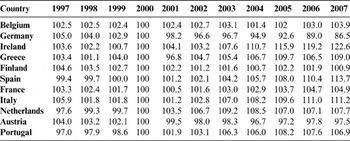
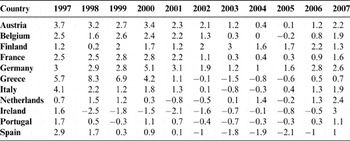
Nominal exchange rate vulnerabilities are not only rooted in national export structures, however. Most CMEs – with Germany in the lead – have strengthened their international cost competitiveness by pursuing wage restraint, generating real effective exchange rate depreciation vis-à-vis most MMEs. While nominal exchange rate changes between member states no longer occur under EMU, real exchange rates are still prone to change when wage and/or productivity trends diverge within the union (see Table 1). In this respect, Germany has been able to mitigate the harmful effects of euro appreciation on its international cost competitiveness by exercising wage deflation in both its export-oriented manufacturing sectors and (non-exposed) private and public service sectors versus the other EMU countries – especially against the MMEs and Ireland. The latter countries, by contrast, experienced much higher wage inflation in the non-traded and public service sectors (and in some countries such as Italy, Greece, and Portugal in the export sectors as well), amplifying the nominal appreciation of the euro in real terms.Footnote 61 Due to the non-existence of wage setting coordination between the exposed and non-exposed sectors, wage inflation in the public, and non-traded sectors produced ‘an inflationary squeeze on the export sector’ in these countries.Footnote 62 As such, whether wage developments have mitigated or amplified nominal exchange rate appreciation in terms of cost competitiveness depends on the dominance of respectively the export or public sector in national wage bargaining institutions and on the degree of coordination between these sectors. This is again an institutional feature that tends to distinguish the Eurozone's CMEs, especially Germany, from its MMEs and LME.Footnote 63
Real effective exchange rate of EMU member states

In sum, EMU's exchange rate regime has affected the MMEs much more than the CMEs, which are much better adapted to deal with the ECB's appreciation bias by being much better equipped for the competition in high-quality products with little price competition and for the coordinated adjustment of wages to developments in international price competitiveness. As such, it is clear that EMU's first empowering mechanism – the capacity to pursue a domestic-oriented monetary policy without regard to the exchange rate of the euro – has important asymmetrical distributional implications. In this respect, it should be noted that under the EMS the large MMEs could deal with an excessive appreciation of the deutschmark by realigning their currency; the introduction of the euro implied a key trend break in the development of their long-term nominal exchange rate: the nominal exchange of the franc and the lira depreciated on average by 1.8 and 4.9 per cent per year between 1970 and 1992.Footnote 64 While ‘the fact that governments no longer have devaluation as an option in trying to remain competitive in international markets focuses attention on wages as an element of competitiveness and factors related to productivity’, the labour market institutions of the MMEs are comparatively less appropriate for EMU's exchange rate regime than those of the CMEs.Footnote 65
Diverging wage developments and bargaining institutions within the Eurozone did not only generate divergent vulnerabilities to the appreciation bias of EMU's exchange rate regime but also played a role in the rise of current account imbalances between MMEs and CMEs. I turn to these imbalances in the following section.
EMU's regime for balance-of-payments management
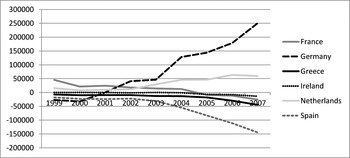
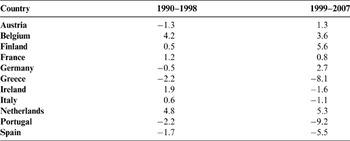
In this section, I will question the validity of the notion that EMU has increased the macroeconomic autonomy of all its member states by loosening their current account constraint – EMU's second empowering mechanism. My argument will be based on an explanation of the growth of internal current account imbalances within the Eurozone and the distribution of the burden of adjustment among EMU member states. As depicted by Figure 4, internal imbalances have grown substantially since the introduction of the euro in 1999. While countries as Greece and Spain have been running current account deficits of respectively 14 per cent and 10 per cent of Gross Domestic Product (GDP), Germany's surplus has sharply risen to almost 8 per cent of GDP in 2007. Although France had a small external surplus during the first five years of EMU, it experienced a modest but rising deficit since 2005. In general, it is particularly noticeable that the Eurozone's CMEs have been running surpluses over the past decade, while its MMEs and LME have been running increasing deficits. Moreover, Table 2 shows that between the nine years preceding and those following the introduction of the euro there has been a striking change in the average current account performance of the CMEs, MMEs, and LME. I argue that the embeddedness of diverse national political economies within EMU's orthodox macroeconomic governance framework has played a key role in the emergence of the intra-regional current account imbalances as well as in the asymmetrical distribution of adjustment costs between the CMEs as surplus countries and the MMEs and LME as deficit countries.
Current account balance of selected EMU member states (in billion US dollar)

Average current account balance in percentage of GDP

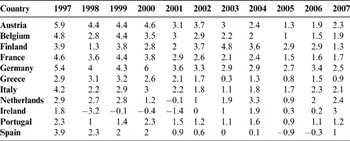
It should be noted, first, that the establishment of EMU was meant to dilute the problem of diverging current account performance through promoting the integration of European financial markets and facilitating the financial intermediation between surplus and deficit member states. There is indeed ample evidence that EMU deepened financial integration and lowered long term borrowing costs across the Eurozone – particularly in traditionally higher inflation countries (see Table 3), allowing its member states to delay adjustment in a way that might not have been possible without currency union.Footnote 66 It is disputable, however, that improved access to cheaper finance should be equated with an increase of macroeconomic autonomy. First, the establishment of EMU appears to have consolidated a distinction between its CMEs as surplus countries and its MMEs and LME as deficit countries; the Mediterranean countries and Ireland were compelled to run deficits as EMU's institutional framework allowed the consolidation of export-led growth and surpluses in the CMEs. Second, EMU's orthodox macroeconomic governance regime allows the CMEs to deflect the burden of adjustment to the deficit countries whenever imbalances become unsustainable. I will elaborate this argument by focusing on Germany as the principle surplus country and the first ‘victims’ of the Eurozone sovereign debt crisis – Greece, Ireland, Portugal, and Spain (together referred to as the ‘GIPS’).
Real long-term interest rates EMU member states (in percentage)

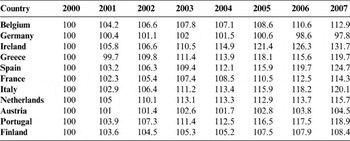
As noted above, Germany's export-led growth is based on maintaining domestic inflation levels that are lower than its main competitors. This proved very difficult during the years after unification, during which Germany suffered from an extraordinary pay hike in the aftermath of the unification boom and an overvalued exchange rate in the EMS – leading to a persistent current account deficit throughout the 1990s. Between 1994 and 2009, however, the German economy regained competitiveness by devaluing its unit labour costs to its European competitors (see Table 4). In one respect, ‘an extraordinary acceleration of productivity’ allowed German export-oriented firms to reduce their labour costs.Footnote 67 Most scholars seem to agree, however, that a combination of wage restraint and labour market policy changes contributed to the bulk of real unit labour cost devaluation.Footnote 68 As Fritz Scharpf points out, ‘Germany's large industrial unions from the export sectors decided to protect existing jobs through wage restraint – a supply-side strategy that allowed employers to capture most of the productivity gains in the hope of stabilizing employment by improving the profitability of domestic production and the competitiveness of German industries in international markets.’Footnote 69 Wage restraint was further encouraged by several supply-side reforms – particularly the Hartz welfare reforms – that reinforced jobseekers willingness to take up even low paid jobs.Footnote 70 Meanwhile, the German government was not willing to neutralise the depressing impact of these labour market adjustments on domestic demand through accommodating fiscal policymaking. Indeed, as Wendy Carlin and David Soskice explain, ‘by abandoning discretionary fiscal policy and therefore removing this possibility’, the government even sharpened ‘the incentives for wage restraint’.Footnote 71
Nominal unit labour costs EMU member states (2000=100)

The combination of wage restraint in the manufacturing sector and the supply-side reforms of the German government – which contributed to wage decline in the service sector – proved very fruitful in terms of boosting Germany's export sectors. Germany's exports increased from €452.3 billion in 1997 to €983.3 billion in 2008; particularly noticeable is that a significant part of this export growth was realised within the EU, where its exports increased from €251.2 billion in 1997 to €622.7 billion in 2008.Footnote 72 The boost in German exports meant a boost in profitability of German manufacturing firms as well: the profit share of non-financial corporations increased from 36.1 per cent in 1997 to 41.4 per cent in 2007 – one of the highest increases (only second to Austria) of the Eurozone.Footnote 73
Importantly, the introduction of the euro provided in several ways key support for Germany's export-led growth. First, EMU eliminated the possibility of periodic nominal devaluation as a strategy by other EMU member states to regain competitiveness, supporting Germany's ‘ability to reverse [an overvalued exchange rate] and move to an undervalued real exchange rate over the course of the Eurozone's first decade’ via ‘the presence of wage-setting institutions quite different from those in the southern part of the Eurozone’.Footnote 74 Second, EMU and the ensuing deepening of European financial integration have facilitated the recycling of German export surpluses to the rest of the Eurozone, radically improving its net international investment position over the past decade (from 0.4 per cent of GDP in 1998 to 25.3 per cent of GDP in 2008) – a large part of which was realised within the Eurozone.Footnote 75 Third, the ECB's ‘one size fits all’ interest rate depressed domestic demand in relatively low inflation countries such as Germany – increasing their growth dependency on exports – at the same time as boosting demand in relatively high inflation countries such as the GIPS. Several estimations even suggest that the monetary policy of the ECB was relatively more fitted to the needs of Germany than to those of the GIPS, implying that its single interest rate boosted GIPS' domestic demand and imports relatively more than it depressed German domestic demand.Footnote 76
Real short-term interest rates EMU member states (in percentage)

The escalation of external deficits in the GIPS countries can be clarified through the reverse of these mechanisms. The ECB's monetary policy was much too low for these higher inflation countries, which experienced extremely low and sometimes even negative real short-term interest rates as a result (see Table 4). As the ECB continued to cut interest rates in reaction to weak domestic demand in Germany, the GIPS countries became further indulged with cheap short-term credit. In addition, capital flows from surplus countries combined with a sharp decline in the exchange rate and liquidity risk premium on GIPS public debt linked to EMU membership depressed long-term real interest rates in these countries as well (see Table 3), reducing their borrowing costs and fuelling asset bubbles and credit-financed domestic demand. As the GIPS countries lack national wage-setting institutions responsive to changes in international competitiveness, booming domestic demand was translated into wage inflation in the traded and/or non-traded sectors, generating real exchange rate appreciation (see Table 1) and rising current account deficits (see Figure 4). While the GIPS countries have more ore less all experienced these broad dynamics, an analysis of their models of capitalism and growth regimes can shed light on the distinctive way domestic imbalances and external vulnerabilities emerged.
Greece and Portugal are the only countries were the public sector bears the main responsibility for the rise of domestic imbalances. Especially Greece is infamous for its weak fiscal management capacity and deteriorating public finances. The Greece state is known to have relatively low government effectiveness; state spending is relatively high but skewed towards prevailing political interest while very high tax evasion has made it difficult for the state administration to maintain an appropriate revenue base.Footnote 77 Subsequent governments have aimed to implement macroeconomic policies that were ‘mainly based on inducing the income of the average Greek household via extensive borrowing from markets’.Footnote 78 However, a large part of this was related to ‘inelastic expenditures of the public sector wage bill where governments face strong union resistance to cutbacks’.Footnote 79 The decline in borrowing costs and the surge in capital flows following EMU entry have temporarily improved the capacity of the Greek state to fund its growing deficits while Greek households gained access to bank credit and significantly raised their debt consumption levels.Footnote 80 In this macroeconomic context, and against the background of collective bargaining institutions gradually moving away from coordinated wage setting, real compensation per employee growth rates in Greece relative to the euro area increased in 1999–2006 to 2.6 per cent compared to 1.9 per cent in 1993–9.Footnote 81 While Portugal's public sector and corporatist model is less clientistic as Greece's, it has similarly experienced declining public finances and competitiveness since the introduction of the euro.Footnote 82
One of the key differences that separates Spain from the other Mediterranean countries is the fact that it consistently ran budget surpluses almost all through the first decade of EMU. By contrast, the sharp decline in nominal and real interest rates associated with EMU membership have fostered unsustainable imbalances in the Spanish private sector. While Spain experienced one of the longest cycles of economic expansion in modern history, its economic success over the past ten years was ‘largely a “miracle” based on bricks and mortar’.Footnote 83 Spanish growth was mainly based the build-up of excesses in the construction sector, where housing prices have risen by 150 per cent from 1998 to 2007. Household indebtedness increased due to declining borrowing costs and rising housing prices, reaching a record of 115 per cent of disposable income in 2006.Footnote 84 At the same time, thriving domestic demand and growth were an opportunity for Spanish trade unions to negotiate higher wages despite declining productivity growth and deteriorating competitiveness – also as a result of their tradition to index wage increases to domestic inflation rather than the ECB's target: wage restraint in the exposed manufacturing sector decreased since the introduction of the euro, whereas wages in the sheltered sectors increased markedly as a result of the construction boom, giving rise to overall rising unit labour costs and a real exchange rate appreciation.Footnote 85
Ireland's growth model since EMU entry was also based on a real estate bubble – housing prices even increased by 185 per cent between 1997 and 2005 – but has several important distinguishing features. One of the long-established pillars of the Irish growth model is the commitment to a low corporation tax regime as a strategy to attract foreign direct investment, leading to a strong export-oriented but largely foreign-owned manufacturing sector concentrated in a few high-tech and high-productivity sectors.Footnote 86 Nevertheless, EMU membership coincided with a shift in the relative performance of the domestic versus the export-oriented sector. Indeed, ‘inward capital flows were not directed to the most efficient investment opportunities, but rushed into the most readily available domestic sector, which was construction activity’.Footnote 87 One key factor facilitating the emergence of an asset bubble in Ireland was the light-touch regulation of its banking system, leading to fierce competition between mortgage lenders and a surge in Irish banks' external borrowing.Footnote 88 While the Irish state consistently ran budget surpluses over this period, public revenues were overly dependent on proc-cyclical taxes associated with its asset bubble. Meanwhile, Irelands' liberal corporatist labour market institutions – which traditionally legitimise wage restraint in return for cuts in income tax – have not been able to prevent wage costs in the non-exposed sectors from driving up overall unit labour costs in the economy.Footnote 89
While the analysis of the GIPS' growth models might lead one to conclude that the euro gave these countries enough macroeconomic autonomy to pursue unsustainable policies, it rather shows that EMU's institutional design supported CMEs' export-led growth at the same as creating incentives for very uneven growth, asset price inflation, and unsustainable credit expansion in the GIPS. Whereas CMEs' distinctive national wage-setting systems were generally able to generate real exchange rate depreciation by containing wage inflation, EMU primarily brought about a sharp reduction in real interest rates and an increase in debt-financed consumption in those countries that lack these wage bargaining institutions, further reducing their export competiveness by causing rising asset-price-fuelled inflation and real exchange rate appreciation.Footnote 90 Greece's and Portugal's problems were of course compounded by their fiscal laxity, yet the magnitude of the credit boom in Spain and Ireland clearly shows how difficult it was to contain the asset price inflation by means of contra-cyclical fiscal policy. Indeed, only monetary restraint and/or exchange rate devaluation could have avoided credit-financed overheating in these economies.Footnote 91 Moreover, as I will argue in the rest of this section, an examination of EMU's asymmetric structure for the distribution of the burden of adjustment further disproves the claim that EMU increased the GIPS' autonomy by loosening their current account constraints.
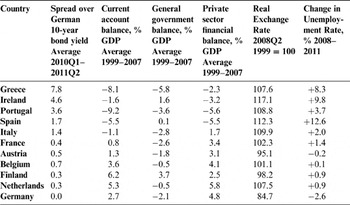
The global financial crisis and its devastating impact on the Eurozone indeed uncovered the unsustainability of the internal imbalances, turning the Eurozone into a site of struggle over the distribution of the burden of adjustment. EMU's regime effectively allowed its surplus CMEs to deflect the adjustment burden onto the MMEs and LME. First, massive private capital inflows to the GIPS have swiftly turned into capital outflows, exposing the pro-cyclicality of external financing within EMU and their vulnerability to balance-of-payment crisis.Footnote 92 Second, the deleveraging of the private sector in the GIPS economies and weak growth prospects due to real exchange rate appreciation have given rise to escalating government deficits and sovereign debt spreads (see Table 6).Footnote 93 This shows that the decline in government borrowing costs associated with EMU membership was merely a boom phenomenon that dramatically reversed during the current bust. Third, and most importantly, the loss of monetary sovereignty deprived member states of crucial policy instruments to deal with sudden stops of capital inflows, making their sovereign bond markets very vulnerable to movements in financial markets sentiment and creating a vicious cycle between rising capital outflows and sovereign debt spreads. As they have lost their capacity to issue debt in a currency over which they have full control, countries with unsustainable current account and budgetary deficits can thus be forced into default and find it impossible use budgetary policies to stabilise their economies.Footnote 94 This is, of course, particularly a problem for the Eurozone's MMEs and LME, which have been condemned to deficit status since the introduction of the euro.
Overview of macroeconomic indicators EMU member states

EMU has therefore caused unsustainable current account deficits to escalate into balance-of-payments and sovereign debt crises. The bail-out plans and the establishment of a European Financial Stability Facility – through which the governments of Greece, Ireland, and Portugal were rescued from default after financial markets demanded penalty rates for the refinancing of their debt – has provided EMU's surplus CMEs with the most blatant instrument to deflect the burden of adjustment: conditionality. The European approach – which Fritz Scharpf aptly depicts as a ‘rescue-cum-retrenchment program’ – is to provide crisis countries emergency loans conditional on the implementation of stringent fiscal austerity programmes.Footnote 95 The endorsement of this approach by the ECB, European Commission, and ultimately the whole European Council should not overlook the fact that ‘it was Germany who largely set the tone for how to resolve the crisis’.Footnote 96 While the ability to determine loan conditionality is a rather unsurprising manifestation of the asymmetry of power between creditor and debtor member states, the analysis above shows how the financial vulnerability of the GIP(S) and their resulting dependency on sovereign bailout funds in fact proves to be a built-in institutional feature of EMU. At the same time, CMEs have not shown any willingness to increase domestic demand in order to rebalance the Eurozone economy and to support the GIPS' repayment capacity by improving their external competiveness.Footnote 97
The asymmetric adjustment pressure goes beyond CMEs' ability to determine loan conditionality and directly follows from EMU's macroeconomic governance regime, affecting the capacity of the larger MMEs to delay or deflect the burden of adjustment as well. It is noticeable the French minister of finance urged CMEs to boost domestic demand by pursuing fiscal expansion and/or wage increases in order to ease the adjustment pains of the deficit countries.Footnote 98 Conversely, one German ECB official claimed that ‘to reduce the competitiveness of one of the most successful exporters in world markets … would look like a bad joke’Footnote 99 while another noted that ‘it is inevitable that most of the burden of adjustment will fall on the deficit countries’.Footnote 100 While EMU's deficit countries were indeed forced to accept domestic deflation, Germany has been able to avoid an adjustment of its growth model through a reflation of domestic demand. Despite its capacity for more fiscal expansion, Germany was the first EMU member state to introduce a constitutional debt break – requiring the government to move its structural balance back to zero by 2016. In addition, over the period 2008–10 Germany recorded the second lowest compounded growth rate in nominal labour cost (4.5 per cent) of the Eurozone – only after Ireland (1.5 per cent).Footnote 101 Persistent low wage growth in CMEs can certainly not be explained by weak labour market performance in the aftermath of the global and Eurozone crisis: the MMEs and Ireland have experienced a much sharper increase in unemployment than in the CMEs, while in Austria and Germany the unemployment rate even decreased (see Table 6).Footnote 102
The ECB has played an important role in forcing deflationary adjustment onto deficit countries. Its ‘one-size-fits-all’ orthodox monetary policy has been much more in line with the macroeconomic conditions of the surplus countries than to those of the deficit countries since the global financial crisis. This is especially problematic for the Eurozone's periphery, which at this time faces short-term interest rates that are well above the rates required for domestic stabilisation.Footnote 103 It is, in this respect, revealing that the ECB raised its interest rate twice when the Eurozone core was recovering from the crisis in an effort to curb rising regional average inflation.Footnote 104 In addition, the ECB has persistently refused to act as a lender of last resort for deficit member state governments by intervening much more firmly in their sovereign bond markets.Footnote 105 At the time of this writing (April 2012), the ECB has bought only €207.5 billion worth of sovereign debt in an effort to curb borrowing costs of distressed EMU governments – a very low amount compared to the Federal Reserve, which has expanded its balance-sheet by more than $2.3 trillion in order to stabilise the US economy. Even though the governments from deficit countries were confronted with escalating bond spreads, the ECB has only been willing to provide unlimited liquidity to the Eurozone's private banks.Footnote 106 The reluctance of the ECB to buy more sovereign debt of deficit member governments has exerted more pressure on them to pursue more fiscal retrenchment while its meagre support has been made conditional on restrictive measures in the countries concerned. Indeed, as one ECB official recognised, the resumption of new purchases of Spanish and Italian sovereign bonds only took place ‘after the announcement of new fiscal and structural policy measures by the Italian and Spanish governments.’Footnote 107
The absence of European-level balance-of-payments support – via more activist monetary policymaking and/or higher domestic demand in CMEs – means that the MMEs and LME have been forced to accept the burden of adjustment. The only strategy left available for these countries is ‘competitive disinflation’: ‘a period of sustained high unemployment until competitiveness has been re-established, the current account deficit and unemployment are reduced’.Footnote 108 Given the impossibility of nominal external devaluation within EMU, external debt can only be reduced by stimulating net exports through an internal devaluation: in addition to fiscal retrenchment, this means decreasing unit labour costs to regain external competitiveness. Thus, macroeconomic adjustment for these countries is much more painfully under EMU than under the EMS: ‘Adjustments during periods of recession tend to be depressed in time-length and enormous sacrifices are suddenly demanded from workers. In other words, economic instability grows while the upward and downward phases of the cycle become more pronounced.’Footnote 109 Moreover, the capability of deficit countries to improve their competitiveness against low benchmark wages and prices in CMEs will depend on the presence of appropriate labour market institutions. LMEs such as Ireland appear in this context better placed for accomplishing competitive disinflation. As Aidan Regan argues, ‘The political conditions in this economy make it easier to implement orthodox economic policies as the institutional complementarities governing labour market, fiscal and wage policy fit the neoliberal design of the EMU.’Footnote 110 Taking into consideration the more inclusive yet antagonistic bargaining structures of MMEs, the unilateral imposition of labour cost reductions in these countries will indeed be met with much more social and political contestation. It is therefore still unclear whether the problem of internal imbalances and the Eurozone debt crisis can be resolved through the asymmetric imposition of the burden of adjustment on these countries.
Monetary power and the future of EMU
In this article, I have disputed the notion that EMU has equally increased the monetary power of its member states by arguing that some models of capitalism – the CMEs and Germany in particular – have gained more macroeconomic autonomy to the detriment of other models. I have done so by exposing the asymmetric structure behind EMU's two monetary empowering mechanisms. First, the ECB's orthodox monetary policy and its de facto control over exchange rate policymaking implies that the exchange rate regime of EMU suffers from an appreciation bias that harms its MMEs much more than its CMEs. Diverging labour market institutions and economic structures have given rise to diverging exchange rate vulnerabilities, meaning that EMU's exchange rate regime tends to operate as an endogenous asymmetric shock. Second, EMU's regime for the management of balance-of-payments has fragmented the Eurozone between CMEs as surplus countries and MMEs and LME as deficit countries at the same time as giving the CMEs the capacity to deflect the burden of adjustment onto the MMEs and LME in times of balance-of-payments crisis. The fact that these latter countries are forced to achieve major cost reductions in order to regain export competitiveness does not fit well with the appreciation bias of EMU's exchange rate regime.Footnote 111 Therefore, EMU's macroeconomic governance regime has to contend with a clear inconsistency that is particularly troublesome for its MMEs.
The uneven distribution of monetary power within the Eurozone raises the question of whether EMU's governance structure can continue to exist in its current asymmetrical form. The Eurozone sovereign debt crisis indeed revealed the need for far-reaching institutional reforms for the euro to survive in the longer term. It appears, however, that the surplus CMEs have used their creditor power to dominate the debates about EMU reform as well. The negotiated new EMU regime can be summarised as follows. First, the EFSF is to be replaced in 2013 by the European Stability Mechanism (ESM) as a permanent crisis management facility, the financial assistance of which will be ‘subject to very strict macroeconomic policy conditionality’ and therefore will ‘not act as a fiscal transfer, but only as a liquidity bridge that allows euro area countries in distress to buy time to take the necessary measures to restore fiscal sustainability and competitiveness in the medium term’.Footnote 112 In order to minimise the burden on the ESM, the Euro-Plus Pact commits EMU member states to more coordination of national economic policies in order to promote European competitiveness and convergence by improving fiscal discipline and avoiding excessive imbalances. Fiscal discipline will be enforced through a new GSP with much more stringent budgetary surveillance and reinforced penalties. EU member states (the UK excluded) have also agreed to introduce budgetary rules in national binding provisions ‘of a constitutional or equivalent nature’.Footnote 113 Unsustainable current account imbalances will be addressed by the Excessive Imbalance Procedure (EIP), which forces member states to take corrective measures when imbalances are found to become excessive.Footnote 114
A closer reading of the pact shows that economic coordination actually boils down to imposing structural adjustment onto deficit member states. As John Grahl rightly notes, the pact ‘threatens to subject economically weaker member states – and those alone – to a comprehensive tutelage involving every aspect of public policy’.Footnote 115 The EIP will focus merely on not allowing the development of unit labour costs, real effective exchange rates, and public/private indebtedness to undermine the competitiveness of its member states; increasing demand in CMEs through fiscal expansion and/or decreasing their external competitiveness by means of wage increases and real exchange rate appreciation is anything but the purpose of the procedure. Deficit countries are directed to push through far-reaching labour market reforms – such as changing ‘the degree of centralization’ of wage bargaining settings, abolishing ‘the indexation mechanisms’, and ensuring that ‘wages settlements in the public sector support the competitiveness efforts in the private sector’.Footnote 116 The negotiated reforms will strongly affect the domestic institutions of the Eurozone's deficit member states by encroaching upon their fiscal, tax, wage, and social policies and seem to aim at the structural adjustment of their models of capitalism. Thus, as Fritz Scharpf points out, it can be concluded that the infringement of EMU on these countries' macroeconomic autonomy is much more pronounced than under the EMS: ‘Though politically committed to pegged exchange rates, [under the EMS] their governments had retained autonomous control over all instruments of macroeconomic policy – which they were able to employ with a view to their own economy, its external environment, and their own political priorities and constraints. At the same time, however, the governments of these member states remained fully accountable to their own constituents for all failures of macroeconomic management.’Footnote 117
The extensive erosion of macroeconomic autonomy reflected in the negotiated EMU regime makes its remarkable that France has supported Germany in the creation of what looks like an ‘austerity union’.Footnote 118 As David Howarth argues, France's approach towards EMU has always involved managing its ‘paradoxical’ interests in pursuing competitive disinflation as a strategy to attain a neo-mercantilistic competitive advantage on the one hand and counterbalancing EMU's macroeconomic orthodoxy and the power of the ECB by strengthening European ‘gouvernement économique’ on the other.Footnote 119 The fact that France was the only MME with subdued growth in unit labour costs over the past decade might explain its enthusiasm for launching the Euro-plus pact. A the same time, however, France has unsuccessfully argued for the creation of Eurobonds – as a strategy to solve the Eurozone sovereign debt crisis as well as to support the euro's global role – and for an activist role of the ECB in the government bond markets. Strong opposition by Germany and the other CMEs to these unorthodox demands highlights the difficulty of creating a more symmetric macroeconomic governance regime for EMU.Footnote 120 The provision of financial support to distressed member states is thus far the only compromise to its monetary power the German government has been willing to accept; macroeconomic adjustment of its growth model or the creation of a more symmetric EMU regime have effectively been vetoed.Footnote 121 Considering that excessively deflecting the burden of adjustment can prove to be a self-defeating strategy for export-dependent surplus countries, it remains to be seen whether Germany will continue to able to exploit its monetary power in this way.Footnote 122
It is indeed questionable that the negotiated EMU regime is a viable macroeconomic strategy for the Eurozone. It will take time before labour market restructuring in deficit countries will produce the longed-for decrease in unit labour costs and real exchange rate depreciation that is deemed necessary for the improvement of their price competitiveness; whether these countries will be able to bear the short-term social and political costs in order to capture uncertain longer-term economic benefits remains unclear. In addition, as the above analysis of Germany's export strength has shown, there is more to competitiveness than cost competitiveness alone. Indeed, as Jesus Felipe and Utsav Kumar have recently argued, the low competitiveness of the peripheral Eurozone countries is at least as much about the need to upgrade their export structure to higher productivity and higher technology sectors as it is about the need for lower wage costs.Footnote 123 Without significantly lifting the productivity, technology, and quality levels of their export sectors, internal cost devaluation will most likely depress domestic demand in these countries much more than it will boost net exports. Taking into consideration the positive influence of centralised and coordinated wage bargaining institutions can have on boosting manufacturing productivity and upgrading product quality, the current approach of labour market flexibilisation does not bode well for their potential export performance.Footnote 124 Moreover, to the extent that the negotiated reforms will prevent the southern Eurozone countries from moving their export structure towards the production of higher quality manufacturing goods, their unfitness to EMU's exchange rate regime will be intensified. While more fiscal activism might be needed for the purpose of macroeconomic stabilisation, the budgetary rigidity of the negotiated EMU regime will make this difficult if not impossible.
Moreover, it is very doubtful whether global macroeconomic conditions will be favourable to the economic success of the negotiated EMU regime. The asymmetric distribution of adjustment costs embodied in the reform package implies that the prevailing European strategy is to create an extra-regional export surplus in order to replace weakening intra-regional demand. However, this strategy falls into the ‘fallacy of composition’ of export-led growth, the success of which is conditional upon the sufficiency of global demand.Footnote 125 In this respect, it is important to note that the current constellation of unwinding global current account imbalances makes the prospect of sufficient global demand to absorb the Eurozone's net export surplus highly unlikely. The world's key deficit country and prime engine of global demand – the US – is currently undergoing a necessary deleveraging process as a result of the crisis while East Asian emerging markets stick to their export-led growth regimes in order to accumulate reserves as a way protect their economies against the instabilities of global financial markets. Although this might not prove overly problematic for Germany – whose export structure is complementary to those of the emerging markets – it certainly will be for the Eurozone's periphery.
Finally, the European approach does neither meet the hope that the Eurozone will be a more constructive player in the game of global rebalancing by playing a greater role in world demand. Over the past decade, the Eurozone has declined from being ‘world demand generator’, which would have required ‘exploiting the monetary power it has acquired with respect to the discontinued national currencies’ to pursue ‘the missing goal of euro policies, namely domestic demand growth’.Footnote 126 As my analysis suggest, only the Eurozone's CMEs, which have exploited the monetary power ensuing from the euro in order to pursue export-led growth, can be held responsible for this. Therefore, by further allowing these CMEs to deflect the burden of adjustment on the MMEs and LME, the negotiated EMU regime will most likely contribute to the shortage in global demand and intensify deflationary pressures in the global monetary system.