Significant Outcomes
• Delirium represents a not negligible finding in a large cohort of hospital admissions to medical units (1–2%).
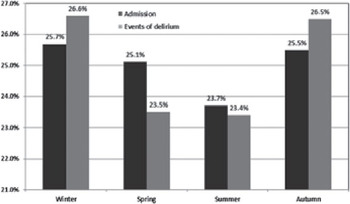
• Autumn and winter months show a higher frequency peak of delirium events (26.6 and 26.5%, respectively) compared with spring and summer months (23.5 and 23.4%, respectively).
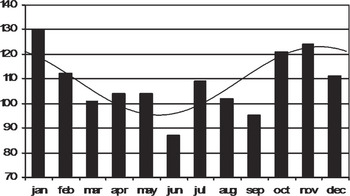
• Chronobiological analysis yielded a significant cyclical variability of delirium events, characterised by a significant peak in January, both for total number of cases and percent of admissions.
Limitations
• As this study is performed on hospitalised patients and is based on International Classification of Diseases, Ninth Revision, Clinical Modification discharge codes, it is exposed to underestimation risk.
• As this study is limited to patients admitted into medical units, these findings cannot be generalised to general population nor to the overall population admitted to a general hospital.
Introduction
The syndrome of delirium is characterised by an acute onset of disturbances of consciousness, attention and global changes in cognition. It is a common neuropsychiatric syndrome in the elderly, characterised by concurrent impairments in cognition and behaviours. The aetiologies for delirium are often multifactorial and secondary to underlying medical illnesses and/or due to medication effect. The diagnosis of delirium is often missed in elderly patients, and this condition may be labelled as depression or dementia. If untreated, delirium may have devastating consequences, with high rates of morbidity and mortality Reference McCusker, Cole, Abrahamowicz, Primeau and Belzile1, Reference Lundström, Edlund, Karlsson, Brännström, Bucht and Gustafson2, Reference Siddiqi, House and Holmes3, Reference Yang, Marcantonio and Inouye4, Reference Saxena and Lawley5, Reference Mittal, Muralee and Williamson6.
Available evidence indicates that early detection, reduction of risk factors and better management of this condition can decrease its morbidity rates. On one hand, the multifactoriality of causes potentially generating delirium, and on the other, the observation that general morbidity of elderly people varies according to seasonal factors, may suggest the possible existence of seasonal differences regarding the occurrence of delirium syndrome Reference Balan, Leibovitz and Freedman7.
This study aimed to determine whether a seasonal variation exists in the occurrence of delirium in patients admitted to hospital medical units.
Methods
This study was conducted with the approval of the local institutional committees for human research.
The analysis included the data record of all consecutive admissions to the medical units of the Hospital of Ferrara, Emilia‐Romagna region of Italy, between 1 January 2002 and 31 December 2010. Each hospital discharge form contains information of each subject: surname and name, sex, date of birth, date and department of hospital admission and discharge, main and up to 15 accessory discharge diagnoses and most important diagnostic procedures, based on the International Classification of Diseases, Ninth Revision, Clinical Modification (ICD‐9‐CM). We considered the ICD‐9‐CM codes used to identify patients with delirium, either as principal or accessory diagnosis, and in particular: presenile dementia with delirium (code 290.11), senile dementia with delirium (code 290.3), vascular dementia with delirium (code 290.41), acute delirium (code: 293.0) and subacute delirium (code 293.1). The following codes have been excluded from the analysis: alcohol withdrawal delirium (code: 291.0), alcohol‐induced psychotic disorder with hallucinations (code 291.3), alcohol withdrawal (code 291.81) and drug‐induced delirium (code 292.81).
The total sample was divided into subgroups by gender, age (<60, 60–74 and ≥75 years), most frequently found associated risk conditions for delirium (urinary tract infections, Escherichia coli infections, volume depletion, Alzheimer disease and senile brain degeneration, cerebral atherosclerosis, heart failure, injury and trauma) and patients' hard outcomes (dead during hospitalisation or discharged alive).
On the basis of date of admission, all cases have been analysed for seasonal and monthly variation. For seasonal analysis, total cases were categorised into four intervals by seasons (spring: 21 March–20 June, summer: 21 June–20 September, autumn: 21 September–20 December and winter: 21 December–20 March), and the distribution of admissions was tested for uniformity by the chi‐squared goodness of fit test. Furthermore, to explore the possible presence of cyclical repetitivity, an inferential analysis was performed by applying partial Fourier series on monthly data with an internationally validated Chronolab software Reference Mojòn, Fernàndez and Hermida8. This method selects the harmonic, or combination of harmonics (cosine waveforms), that best explains the temporal variance of the data. The percentage of the overall variance attributable to the approximated cosine function (percent of rhythm) serves as the estimate of the goodness of fit, with the F‐test statistic applied to the variance accounted by the single or multiple cosine curve approximation versus straight‐line approximation of the time series data to accomplish a test of the null hypothesis – zero amplitude. The parameters calculated for the chosen period (τ) cosine approximation of the time series data were as follows: the Midline Estimated Statistic of Rhythm (the rhythm‐adjusted mean for the time period analysed), amplitude (one‐half the difference between the absolute maximum and minimum of the fitted approximation) and peak (acrophase) and trough (bathyphase) time referenced to 00:00 h, 31 December. Significance levels were assumed for p < 0.05. Finally, raw data of monthly admissions were adjusted for the different number of days of the month, using the average number of admissions per month. This analysis is available using the method by Barnett and Dobson, Analysing Seasonal Health Data, Springer, 2010 (free download at: http://cran.r-project.org/web/packages/season/season.pdf).
Results
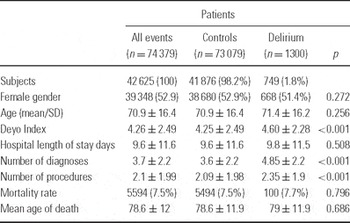
During the analysed period, the hospital database contained 74 379 admissions to medical units (39 348 or 52.9% females) referring to 42 625 different subjects (22 476 females, 52.7%). The main characteristics of the sample population are summarised in Table 1. Delirium diagnoses were 1300 (1.7% of total sample), 668 of whom in females (51.4%) and 632 in males (48.6%). Of the 1300 delirium events, 260 of 15 210 (20% of total) were observed in patients aged <60 years, 364 of 20 572 (28%) in patients aged 60–74 years and 676 of 38 607 (52%) in patients aged ≥75 years (χ2 = 0.158, p = 0.924).
Main characteristics of a sample of 42 625 consecutive subjects hospitalised to medical units, of whom 749 with diagnosis of delirium, according (by ICD‐9‐CM) to the discharge records

During the observation period, 5594 deaths (7.5% of total) occurred in patients with no delirium diagnosis, whereas 100 deaths occurred in patients presenting a delirium diagnosis (7.7%, χ2 = 0.056, p = 0.0427).
The raw yearly number of delirium diagnoses was not significantly different during the analysed period, with the highest percentage (1.9%) in 2002 and 2009, and the lowest (1.5%) in 2007 (χ2 = 9.253, p = 0.321).
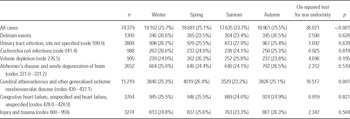
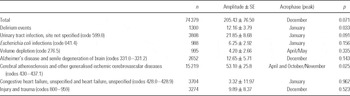
As for season, hospital admissions were most frequent in winter (19 102, 25.7%) and least so in summer (17 635, 23.7%). Events of delirium were 346 (26.6%) in winter, 305 (23.5%) in spring, 304 (23.4%) in summer and 345 (26.5%) in autumn (Fig. 1). Pattern of delirium events is not statistically different from that of total admissions (χ2 = 2.518, p = 0.644), even when considering seasonality (χ2 = 2.598, p = 0.626). Again, although in the presence of a general trend for a summer low (with the only exclusion of volume depletion – code 276.5), no statistically significant differences in seasonal pattern were found for the considered subgroups admissions (Table 2). Chronobiological analysis yielded a significant peak of delirium events in winter (Fig. 2, Table 3) and particularly in January.
Seasonal distribution of delirium syndrome admission or in‐hospital events (Ferrara Hospital, years 2002–2010).

Seasonal distribution of hospital admissions for delirium syndrome (total subjects and higher frequency subgroups)

Monthly distribution of delirium syndrome total events. Superimposed is the best fitting curve.

Chronobiologic analysis of monthly frequency of delirium syndrome admission or in‐hospital events (total cases and subgroups)

Amplitude: one‐half the difference between the absolute maximum and minimum of the fitted curve, expressed in degrees; acrophase (peak): the absolute maximum value during the observed period, expressed in months (see text for details).
Discussion
Many and different aetiological factors may be potentially responsible of the genesis of delirium, for example, the higher frequency of traumas during colder periods, i.e. hip fractures, viral and other infectious diseases, cardiovascular and cerebrovascular diseases and any change in occurrence and in the balance of all the underlying factors may play a potential triggering role in the delirium syndrome generation. Our study seems to indicate a higher rate of occurrence of delirium in winter among patients hospitalised in medical units, which is higher than expected from the seasonal increase in general morbidity. These results agree with the only available study in literature Reference Balan, Leibovitz and Freedman7, which retrospectively analysed medical records of 5218 old patients hospitalised in medical wards between 1991 and 1997, and found in 312 patients with delirium at admission, and 234 that developed delirium during their hospitalisation, a seasonal variation, with higher rates in winter than in summer months (12 vs. 4%, p < 0.001).
On one hand, it is known that elderly people have a higher sensitivity to the seasonal light‐dark cycle changes, possibly as a result of the age‐related deterioration in the circadian time‐keeping system. Most of the delirium symptoms, wandering, confusion, disorientation, hyperactivity, restlessness and aggression, worsen in the late afternoon/evening time (sundowning syndrome) and are often seen in patients with cognitive impairment Reference Mittal, Muralee and Williamson6, Reference Bachman and Rabins9. In northern Italy, winter months are characterised by shorter days and longer nights, and this may play an influencing factor in the occurrence of delirium in elderly people. However, a further subanalysis of our total sample into dichotomised categories by light‐dark cycle (spring‐summer, with ≥12 day‐light hours vs. autumn‐winter, with ≤12 day‐light hours) did not show any significant difference.
On the other hand, patient's medical comorbidities could play an additional role. Acute medical diseases, i.e. community‐acquired pneumonia Reference Dodek, Norena, Keenan, Teja and Wong10, exacerbations of chronic obstructive pulmonary diseases Reference Donaldson, Goldring and Wedzicha11, acute myocardial infarction (MI) Reference Manfredini, Manfredini and Boari12, heart failure Reference Barnett, de Looper and Fraser13, Reference Gallerani, Boari, Manfredini and Manfredini14, pulmonary embolism Reference Gallerani, Boari and Smolensky15, cerebrovascular accidents and stroke Reference Manfredini, Manfredini and Boari16, Reference Gallerani, Manfredini and Ricci17, are all characterised by peaks in winter. It has been observed, for example, that approximately 53% more cases of MI were reported in winter Reference Spencer, Goldberg, Becker and Gore18, heart failure deaths were 20% above average in January Reference Boulay, Berthier, Sisteron, Gendreike and Gibelin19 and the relative risk of venous thromboembolism was 14% more in winter and 19% more in January Reference Dentali, Ageno and Rancan20. Urinary infections deserve a brief consideration apart: seasonal peaks in summer have been reported Reference Anderson21, Reference Freeman, Anderson and Sexton22, but high consumption of antibiotics is significantly higher in winter Reference Chazan, Colodner, Edelstein and Raz23.
Our study has some limitations. First, it refers only to hospitalised patients, and in particular in those admitted to medical units, and is based on discharge codes, with a high underestimation risk. It is known that delirium is consistently underdiagnosed in clinical practise Reference Mittal, Muralee and Williamson6, and about one‐third to two‐thirds of delirium goes unrecognised Reference Siddiqi, House and Holmes3, Reference Saxena and Lawley5, Reference Mittal, Muralee and Williamson6. In particular, hypoactive delirium subtypes are frequently undiagnosed Reference Yang, Marcantonio and Inouye4. Reasons for underdiagnosis include the lack of awareness of the clinical features of delirium and its fluctuating nature, the overlap with dementia, the lack of formal cognitive assessment as a routine and the failure to consider either the possibility of the condition or its consequences Reference Saxena and Lawley5, Reference Mittal, Muralee and Williamson6. Thus, this could help to explain why the observed incidence rate of delirium is definitely lower than that effectively present according to literature data Reference Inouye24. However, in studies based on Diagnosis‐Related Groups (DRG), delirium was coded in 0.8% of the cohort Reference Lin, Heacock, Bhargave and Fogel25, which is significantly lower than our results. Economic considerations underlying the DRG codification (and not only professional skills) play a pivotal role when planning ICD‐9‐based studies. Even in this study, the number of diagnoses reported in the discharge sheets is lower than that found in other epidemiologic studies. However, this bias is supposed to be equally distributed during the entire year and not in certain seasons only, and it is unlikely that this may interfere with the results. Moreover, a choice was made to limit the study to the patients admitted to medical units only, which represent our peculiar professional expertise also in the view of ICD‐9 codification. This represents a strength of our study, but at the same time a significant limitation, because the findings cannot be generalised to general population nor to the overall population admitted to a general hospital. Further studies are needed to investigate the role and temporal seasonal influence of possible favouring or triggering factors, to try to better understand this syndrome and to improve prevention strategies.
Acknowledgements
The authors thank Nicola Napoli and Franco Guerzoni, Centre for Health Statistics, Hospital of Ferrara, Italy, for their precious and valuable collaboration. This study is supported, in part, by a scientific grant from the University of Ferrara (FAR – Fondo Ateneo Ricerca).