In The Right to Vote: The Contested History of Democracy in the United States Alexander Keyssar notes that “history rarely moves in simple, straight lines, and the history of suffrage is no exception.”Footnote 1 The trajectory of voting rights and electoral access in the US is rightly seen as a story of the progressive extension of the franchise. However, often obscured by such broad narratives is the reality that electoral reforms have worked to both expand and restrict the franchise for particular categories of voters over time.Footnote 2 Exclusionary reforms are nearly universally enacted for partisan advantage, a temptation enabled by state responsibility for the administration and regulation of elections.Footnote 3 The struggle to shape access to the vote has intensified once again as the volume of legislation impacting electoral access has increased in recent years. We focus here on the increasing proposal and passage of state laws that place new restrictions on various aspects of both the voter registration process and the opportunity to actually cast a ballot. Required photo identification or proof of citizenship to vote, more stringent regulation of groups or individuals who aim to register new voters, shortened early voting periods, repeal of same-day voter registration, and increased restrictions on voting by felons exemplify the different types of policies that have been proposed and adopted in various states since the mid-2000s.Footnote 4Figure 1 illustrates the rise in the volume of proposed restrictive changes since 2006 and the dramatic increase in restrictive legislation that actually passed in 2011. These policies stand in sharp contrast to trends in the late 1990s and early 2000s where many states expanded voting by mail and early voting—usually under the assumption that these policies would increase voter participation.Footnote 5
Total count of restrictive voter provisions within state legislation, 2006–2011

Figure 2 illustrates which states have been the most active in proposing restrictive voter access policies. The geographic distribution of this activity is widespread and does not concentrate overwhelmingly in battleground states or any particular region. And while more restrictions were proposed in the South due to a couple of particularly active states, Southern states vary significantly in their rates of proposal. In short, the regional distribution of proposed bills makes clear that restrictive voter-access legislation was proposed with frequency nationwide from 2006 to 2011, but provides little insight into why.
Total count of proposed restrictive voter provisions: 2006–2011

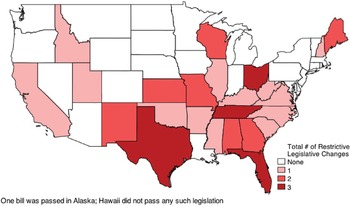
Figure 3 presents the number of restrictive legislative changes that were actually passed by state legislatures between 2006–2011. Consistent with the policy process,Footnote 6 restrictive voter access policies are passed at rates far lower than they are proposed. In contrast to legislative proposals, the geographic distribution of passed legislation is more suggestive of the conditions driving policy adoption in this arena. It is clearly the case that legislation passed more frequently in the South and in battleground states like Ohio and Florida.
Total count of restrictive voter provisions passed: 2006–2011

Collectively, these figures show that the proposal of restrictive voter-access legislation occurred in nearly every state between 2006–2011 and that at least one restrictive change passed in half of all states. Policy diffusion at such a significant rate and reach is significant given the complexities and peculiarities of state-level policy making.Footnote 7 The popular press has taken note of these activities surrounding restrictive voter-access policies, but the explanations provided for such developments rely nearly exclusively on partisan accounts.Footnote 8 In what follows, we provide a comprehensive analysis of these legislative developments by examining the state-level partisan, electoral, demographic, and racial factors most strongly associated with more frequent proposal and passage of these voter restrictions within states. We draw upon both current political discourse and social science research for explanations as to why states have been more likely to consider and adopt these new restrictions and offer each to empirical test. With findings from sound social science as our vehicle, our analysis moves well beyond the trading of partisan barbs and allows us to demonstrate the deficiencies in these conventional takes for understanding recent legislative developments.
Beyond the partisan debate, our research offers an enrichment of theoretical conversations concerning the roles played by political parties in American democracy, voter suppression, race and policymaking, and even the broader literature on democratization. For example, the classical view that political parties enhance democratic incorporation under tight election margins is not borne out by the recent history of U.S. politics. Rather, we argue that the Republican Party has engaged in strategic demobilization efforts in response to changing demographics, shifting electoral fortunes, and an internal rightward ideological drift among the party faithful. We situate the most recent round of electoral reforms—far from historically unique—among other measures trumpeted as protecting electoral legitimacy while intended to exclude the marginalized for a particular political party's advantage. In doing so, our research bolsters and adds contemporary nuance to our understanding of the political conditions that incentivize parties to engage in voter suppression.
Our finding that legislative developments in this policy area remain heavily shaped by racial considerations is strongly resonant with the historical relationships between race, voter restrictions, and federalism often viewed as hallmarks of American political development.Footnote 9 Further, we suggest that useful conceptual links may be drawn between contemporary voter restrictions and recent developments in criminal justice and social welfare policy. In all three of these policy areas racial threat and myths are particularly salient, and the character of state-level legislation is particularly responsive to the racial composition of states. As modern poverty governance and criminal justice policies are increasingly understood through an analytic frame that emphasizes discriminatory and disempowering impacts,Footnote 10 we view restrictive voter-access legislation as an additional layer of barriers reducing electoral access for minority and lower income voters. While we will focus most intensely on voter restrictions, we also highlight a broader suite of exclusionary policy developments occurring across multiple policy arenas that have produced significant, and increasing, variation in state-level access to the vote.
Theoretical links to the larger democratization literature are also in play here. At first blush, connections between our findings and this literature may seem a stretch because of the stability of U.S. democracy and absence of authoritarian traditions or contexts.Footnote 11 The processes that result from contemporary democratic transitions certainly differ in magnitude from those involved in recent changes to American electoral policies. Nonetheless, we find it striking that our findings expose elements of American electioneering reminiscent of how actors in competitive authoritarian regimes manipulate election practices so that voters are drawn almost exclusively from their own supporters.Footnote 12 We thus compliment the work of Desmond King and colleagues by showing how one advanced democracy, the US, is actually changing voting procedures in a racialized and restraining fashion in the modern era—“de-democratization” along racial lines.Footnote 13 That this is true for the American case reinforces the incompleteness of most American narratives regarding citizenship and political development. Deeply racialized, exclusionary ideologies and corresponding practices have always accompanied the more readily acknowledged reality of liberal incorporation.Footnote 14 We find the exclusionary American tradition well represented today,Footnote 15 a tendency bolstered, yet again, by the power and flexibility federalism grants to the states. Last, for advocates of electoral reform the developments examined here provide a cautionary reminder of the seemingly endless variation and creativity evidenced in efforts to repurpose electoral reforms and institutions to exclude voters and shape electoral outcomes.
Partisan and Academic Perspectives
Those on the political left and political right have not been reticent to proffer accounts, or to level accusations, for why restrictive voter-access legislation has been proposed and adopted. On the left these policies are typically vilified as thinly-veiled attempts by Republicans to depress turnout among constituencies deemed favorable to the Democratic Party: minorities, new immigrants, the elderly, the disabled, and the young.Footnote 16 Ari Berman summarizes this well in reference to the 2012 presidential election:
Republican officials have launched an unprecedented, centrally coordinated campaign to suppress the elements of the Democratic vote that elected Barack Obama in 2008. Just as Dixiecrats once used poll taxes and literacy tests to bar black Southerners from voting, a new crop of GOP governors and state legislators has passed a series of seemingly disconnected measures that could prevent millions of students, minorities, immigrants, ex-convicts and the elderly from casting ballots.Footnote 17
Left-leaning media echo this line of reasoning, as do prominent interest groups like the AARP and the National Association for the Advancement of Colored People.Footnote 18 Such perceptions are only reinforced by instances such as that of a Pennsylvania Republican state house majority leader who infamously stated that the passage of the state's 2012 voter identification law would “allow Governor Romney to win the state of Pennsylvania.”Footnote 19
The Senate Judiciary Subcommittee on Constitutional, Civil Rights and Human Rights, led by Democrats, held hearings on restrictive legislation under the title “New State Voting Laws: Barriers to the Ballot?”.Footnote 20 The Congressional Black Caucus, Congressional Hispanic Caucus, and Congressional Asian Pacific American Caucus joined forces in federal testimony and activism against the voter access policies' alleged discriminatory intent.Footnote 21 The Department of Justice under the Obama Administration, citing Section 5 of the Voting Rights Act, worked to nullify or stay voter access legislation in Florida, Texas, and South Carolina, arguing that the legislation would “deny or abridge … the right to vote on the basis of race, color, or membership in a language minority group.”Footnote 22 It is clear that for Democrats, restrictive voter-access policies are viewed as Republican efforts to purposely depress turnout amongst Democratic core constituents.
Meanwhile, many Republican politicians and their allies assert that restrictive voter-access legislation is intended to prevent or curtail rampant electoral fraud to preserve the legitimacy and integrity of the electoral process.Footnote 23 Such discussions often emphasize the possibilities or invitation for fraud in voting rolls that include deceased individuals, “fraud friendly” registration laws like the Motor Voter Bill, and absentee ballots as a “tool of choice” for those attempting voter fraud.Footnote 24 Further, some accuse Democrats of committing electoral high jinks with more frequency because their core constituents are more likely to commit fraud due to their economic insecurity.Footnote 25 As Larry Sabato and Glenn Simpson explain the right's logic, “Republican base voters are middle-class and not easily induced to commit fraud, while ‘the pools of people who appear to be available and more vulnerable to an invitation to participate in vote fraud tend to lean Democratic…. A poor person has more incentive to sell his vote than an upper class suburbanite’.”Footnote 26 From this perspective, Democrats who oppose voter-access regulations are working to continue their unfair and fraudulent advantages at the ballot box at the expense of democratic legitimacy. Kenneth Blackwell, former Attorney General of Ohio and current Republican operative, conveyed this while speaking on voter identification proposals:
What more than 30 states have tried to do is put in place a common-sense measure of voter ID so that people are assured that voters are who they purport to be, and voter IDs are commonplace in our culture. You need [an ID] for a driver's license, for boarding an airplane, receiving a passport, purchasing alcohol or checking out a library book. So to use it to safeguard the integrity of the voting process at the voting station is pretty noneventful…. We all know the horror stories of ACORN in 2008 and 2010. So there is enough evidence to suggest that we need to put things in place to protect this from going crazy. This is a reasonable safeguard to protect against voter fraud and ballot box stuffing when we have sufficient enough evidence that there are some people who would do just that if given the opportunity.Footnote 27
Right-leaning prestige media and blogs add further heat to this line of argument by pushing back on the ascription of racial motivations by many on the left. As the National Review's Dennis Prager penned in 2011, and Fund and von Spakovsky similarly referenced in 2012, “it is hard to imagine a more demeaning statement about black America than labeling demands that all voters show a photo ID anti-black”.
Rhetorically then partisans on both the right and left provide distinct explanations for the recent increase in restrictive voter access legislation.Footnote 28 On the right, they are a necessary response to rampant electoral fraud perpetrated by Democrats and allied organizations. On the left, restrictive-access legislation is seen as a strategic attempt to reduce turnout amongst Democratic-leaning voters. Thankfully, there is a large body of academic research that allows us to operationalize and empirically examine both these claims while situating current developments within the larger context of American electioneering, extending the franchise, and voter suppression.
Many who view recent restrictive efforts as attempts at voter suppression often draw parallels to the long history of suppression and demobilization of certain categories of voters. Such connections are not difficult to make as voter suppression is viewed by many researchers familiar with the history of American elections as a pervasive and consistent feature of U.S. political practice and institutions.Footnote 29 Suppression and demobilization tactics range from the legal to illegal, the local to the national, and have been adapted consistently to accommodate new legal, demographic, and strategic realities over the years. The wide range of tactics employed include violence and intimidation, misinformation and deceptive practices, voter “caging” and challenging voters, and suppressive administration by partisan election officials.Footnote 30 In this context the types of restrictive changes to electoral access we examine here represent a softer, legal form of voter suppression. In fact, some scholarsFootnote 31 argue that in response to a changing legal environment modern suppression efforts have increasingly taken the form of changes to state election laws. That is, the legal regime that emerged following the passage of the Twenty-fourth Amendment and the Voting Rights Act has made it more difficult to engage in the blunter forms of voter suppression utilized in the past. From this perspective, the recent policy changes examined here are analogous to the restrictive laws and practices in the Jim Crow era designed to achieve discriminatory impacts without violating the Fifteenth Amendment. Lorraine Minnite contends:
Today, vote-suppression strategies are pursued through subtle forms of intimidation and obstruction that take on the mantle of law and order. The strategy involves exaggerating the fraud threat to justify the complexity of the electoral system, a complexity created and compounded by the layering of more and more rules to deter fraud… Administrative complexities justified as race-neutral necessities for deterring voter fraud are also opportunities for administrative error that have come to replace opportunities for vote suppression by other means. This is the context for the proliferation of unsupported fraud allegations today. The allegations shrewdly veil a political strategy for winning elections by tamping down turnout amongst socially subordinate groups. It is the most vulnerable voters, those with the least education or the least experience in operating the machinery of the electoral process, that are the most in need of the simplest rules and the easiest access. Thus, it is these voters who stand in for the criminal voters conjured up by the spurious voter fraud allegations and imagined by the U.S. cultural myth of voter fraud.Footnote 32
In the modern era, frontal attack on the right to vote is not politically acceptable, but targeting voter registration and access policies under the auspices of “ballot security” continues to be quite viable.Footnote 33
This academic work outlines the conditions under which parties are more likely to engage in suppression and demobilization. Frances Fox Piven and her colleagues remind us of the simple reality that “election contests can be won by bringing more voters to the polls or by deterring the voters who support the opposition from casting their ballots. In other words, by voter mobilization or by voter suppression.”Footnote 34 Consequently, a principal expectation is that political parties may mobilize or demobilize as is electorally efficacious.Footnote 35 This perspective contrasts with a classical view that suggests that competition drives political parties to mobilize new constituencies in pursuit of untapped resources that may shape electoral outcomes.Footnote 36 Due to their comparatively low turnout rates over time, the poor, African Americans, ethnic minorities, and immigrants are argued to become particularly attractive for mobilization. The demobilization view counters by highlighting the historical tensions between the legal expansion of the franchise for these groups and the actual practices surrounding its access.Footnote 37 Further, political parties are argued to have heightened incentives, under certain conditions, to engage in the suppression of their opponents' supporters. Suppression becomes especially attractive when a political party determines that rallying new voters to their cause is potentially disruptive to the existing base, costly, and wrought with unpredictable long-term ramificationsFootnote 38 In particular, appeals and policy positions aimed at lower income voters may conflict with political precedents and the interests of more well-heeled supporters.Footnote 39 Given such constraints, suppressing the competition is incentivized, particularly when election margins are tight.Footnote 40
The take-away is that in a two-party system both parties have faced incentives to selectively suppress the vote, and both have done so. In the nineteenth century and the first half of the twentieth century, the Democratic Party engaged in multiple interlocking layers of suppression efforts to disenfranchise African Americans in the South, while in the North Republicans, albeit to a much lesser extent, made efforts to suppress Democratic-leaning low-income and immigrant voters.Footnote 41 Since the 1960s, however, political conditions have aligned in a manner intensifying these incentives for the Republican Party. The civil rights movement and the Voting Rights Act transformed the racial character of party affiliation such that African-American voters came to overwhelming support Democratic candidates. Being perceived as African American then became a reliable marker for partisan preferences and an efficient guide for targeting suppression efforts. Lower-income voters, of any race, have been similarly targeted as they disproportionately vote Democratic.Footnote 42 In response to a changing electoral environment, the GOP has become the central driver of restrictive changes to election laws and the primary perpetrator of a wide range of suppression efforts.Footnote 43 In short, this literature is explicit about which political party is more likely to engage in suppression in the current era, the groups likely to be targeted by such efforts, and the likelihood that voter demobilization will be “accomplished by legal and administrative subterfuge, with justifications that proclaim the rules and practices to be essential in safeguarding American democracy.”Footnote 44
An Empirical Approach
These partisan and academic accounts ascribe vastly different motivations for the recent rise in the proposal and passage of restrictive legislation. The following analyses offer a unique empirical perspective in which we systematically examine which political, electoral, and contextual factors are associated with whether states proposed or passed restrictive voter-access policies between 2006 and 2011.Footnote 45 Ours is not a treatment then that weighs in empirically on what the effect of passing and implementing such legislation has been or will be. Rather, we identify a constellation of conditions that may shape the policy-making process in this area and subject them to empirical test. Restrictive legislation may be a response to strategic political calculation,Footnote 46 rational determination of a problem,Footnote 47 evidence of symbolic politics and fear,Footnote 48 interplay between the structural, partisan, and cultural confines of policymaking,Footnote 49 or all of the above. These forces may be differentially relevant depending on whether proposal or passage is under examination. Passing legislation, for example, is more constrained by the specific political context within state legislatures than is a lawmaker's ability to propose legislation. Bills that are proposed but are likely or expected to fail may be motivated by a genuine effort by policymakers to achieve legislative change or by an interest in engaging in symbolic politics. Considering both provides multiple angles from which to build inferences as to what has motivated the pursuit of restrictive voter-access policies. In doing so, we make a contemporary, empirical contribution to the larger body of work examining the conditions and historical moments in which parties engage in voter suppression efforts, and press the normatively important question of what role political parties play in securing access to the ballot. Further, we provide empirical footing for evaluating partisan claims regarding the motives driving contemporary restrictive-access legislation. Today's widespread accusatory rhetoric is long on dramatic flair but short on evidence. We fill this much-needed evidentiary gap.
Independent and Control Variables
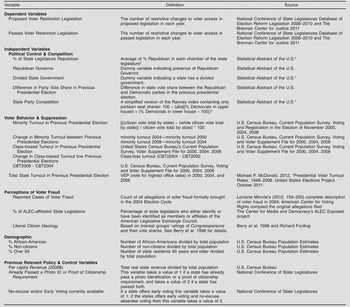
Popular discourse, research on voter suppression, and general research on the policymaking process suggest a wide range of state-level factors that may increase or decrease the likelihood that states adopt or consider restrictive voter-access legislation. We identify the primary variables included in our analyses. Data sources and details of operationalization for all variables are available in Appendix A.
This first set of variables center around partisan control and electoral competition. It is widely acknowledged that in modern era electoral politics, “vote fraud is traditionally the type of election irregularity that Republicans focus on, while vote theft is often cited by Democrats.”Footnote 50 Further, empirical research consistently suggests that restrictive legislation of the kind considered here will disproportionately deplete turnout among potential low-income voters and minorities, two groups that skew heavily towards the Democratic Party.Footnote 51 Given this, and the fact that party lines are influential in determining policy outcomes,Footnote 52 we expect that restrictive voter-access policies will be considered and passed more often where Republican officials exercise more control. To examine the influence of Republican party control we include multiple factors that should capture the relative ease or difficulty Republicans have in getting their policy proposals adopted: Republican legislative strength, the presence of a Republican Governor, and whether or not the state has a divided government.
As discussed above, the voter suppression literature suggests that parties have more incentive to engage in suppression in the context of tight elections. We expect the difference in the party vote share in the previous presidential election to impact the likelihood of a state to propose and pass restrictive voter-access legislation. If a state has a smaller value on this measure, meaning the state was more competitive in the Electoral College, the potential payoff for suppression efforts increases dramatically. However, the incentives for suppression are not symmetrical for the two major parties. In the context of highly competitive elections, Democratic legislators are presumably less inclined to pursue or enact changes that are likely to depress turnout among their own supporters. This suggests that the impact of competitiveness may be conditional, a possibility we explore below with interaction effects.
We also examine the role of local interparty competition, understanding that state legislators may be motivated more by local partisan concerns rather than national electoral outcomes. State legislators in chambers closely divided along party lines may seek the passage of such legislation in the hopes of advantaging their own party. However, we also expect it may be more difficult to pass such controversial legislation in the context of smaller majorities. The variable is a simplified version of the Ranney indexFootnote 53 so that higher values indicate more competitive scenarios (more evenly divided parties in each house) and total party control (100 percent of seats) would produce a value of 0.Footnote 54
Registering to vote, maintaining registration after a move, and the logistics involved in actually casting a ballot are more cumbersome in the United States than in other advanced democracies.Footnote 55 It is well known that these hurdles are more burdensome for those of lower socio-economic status, individuals of color, new citizens, and the elderly.Footnote 56 For those concerned about voter suppression, recent legislative developments introducing new requirements are but the modern continuation of purposeful efforts to selectively suppress the vote via procedural means.Footnote 57 If this is the case, all else being equal, we should see restrictive voter-access legislation considered and adopted in states where historically vulnerable Democratic constituencies turn out at higher rates, have increased their levels of turnout in recent elections, or both.
We examine whether states with higher rates of minority turnout, and those that saw increases in minority turnout between the 2000 and 2004 and the 2004 and 2008 presidential elections, experienced an increase in the frequency of proposal or passage of restrictive legislation.Footnote 58 Similarly, if legislators are sensitive to the level of turnout among the less-affluent in ways consistent with targeted voter suppression, states where low-income individuals turn out at rates that more closely approximate that of wealthier voters should see restrictive voter legislation proposed and passed with increased frequency. This is especially apt as levels of upper class turnout bias have decreased between the presidential election years examined here. Our variable replicates James Avery and Mark Peffley'sFootnote 59 ratio of affluent voter turnout (over 75K) to that of lower income (under federal poverty line) for years 2000, 2004, and 2008 respectively. Larger values mean greater upper-class bias. The class bias change variable is the difference in the turnout ratio between the previous two presidential elections. Positive values on this measure indicate that class bias has decreased.
We also explore the possibility that restrictive legislative activity may be a response to overall turnout. Gains in voter turnout at the federal level are usually drawn disproportionately from lower-income individuals who are disproportionately people of color.Footnote 60 Aggregate gains in turnout are often read as increases among constituencies favorable to Democrats. Reliable and valid real-time voting/polling data for all 50 states is notoriously difficult to gather, let alone data on specific subgroups of voters. Consequently, political professionals and elected officials who aim to strategically deplete turnout amongst Democratic constituencies may reasonably rely on aggregate turnout as a proxy for electoral shifts unfavorable to them. To explore this, we include a measure of overall turnout in the previous Presidential election.
Proposing and passing restrictive voter-access legislation in response to minority and lower-income electoral participation is a retrospective response—one that may involve initial electoral setbacks. Strategic politicians may then support restrictive policies prior to election season relying on purely demographic indicators deemed troubling for their re-election or party. We test for this motivation behind restrictive voter access legislation with the inclusion of the percentage of African-Americans, non-citizens, and the elderly within states. The logic is simple in each case. Of all racial and ethnic groups, the battle for the franchise is most interwoven with the African American experience in the US. Historically, the larger the percentage of African Americans in a state the more difficult it is for African Americans to realize the right to vote.Footnote 61 If the proposal or passage of restrictive legislation is associated with state racial composition, this is supportive of a voter suppression narrative. The same pattern may hold for states with larger numbers of non-citizen residents. Many in this population will eventually acquire citizenship and new immigrants are more likely to vote Democratic—especially given the increasingly harsh immigration rhetoric in the Grand Old Party.Footnote 62 Last, if targeted demobilization drives restrictive legislation, the opposite expectation holds for the percentage of elderly in a state. The elderly go to the polls at higher rates than other age groups and, increasingly since the 2008 election, disproportionately support Republican candidates.Footnote 63 As many of the restrictive policies examined here may also suppress participation by elderly voters, we expect these policies may be pursued with less vigor in states with larger proportions of elderly residents.
Republicans typically contend that voter IDs, proof of citizenship to vote, and similar policies are necessary to curtail election fraud in the wake of reforms that have made it easier to vote.Footnote 64 Examples cited as representative and uncontested include phantom voters registered under “Motor Voter Laws”, non-citizen voting, and the disenfranchisement of military voters. In addition, myths abound alleging massive voter fraud in Florida during the 2000 election and similar accusations involving ACORN in more recent elections.Footnote 65 A historical perspective certainly provides colorful examples of fraudulent electoral activities.Footnote 66 Today, however, the largely uncontested conclusion within social science circles is that deliberate, systematic electoral fraud is extremely infrequent.Footnote 67 Nonetheless, reports of actual voter fraud may predict the consideration and adoption of restrictive voter access policies. Our measure of fraud comes from the American Center for Voting RightsFootnote 68 and Lorraine Minnite'sFootnote 69 exhaustive accounting of all fraud allegations in the 2004 election cycle.
Interest group mobilization is also central to understanding agenda setting and policy outcomes. The American Legislative Exchange Council (ALEC) is one such interest group uniquely active in creating and disseminating model voter identification legislation. This organization coordinates task forces charged with drafting model legislation, and such legislation for voter identification provisions has been promoted by ALEC.Footnote 70 Given the purported influence of ALEC, and its work at the state level, we expect that state delegations who have higher percentages of ALEC-affiliated members may be more likely to pass restrictive voter-access legislation.Footnote 71
Our third attempt to tap into perceptions of electoral fraud is a measure of political culture among a state's citizens. If liberals see fraud as infrequent and diversionary, and conservatives view fraud as frequent and threatening to democracy, then it follows that states with more liberal political cultures should be less interested in considering and adopting restrictive voter-access legislation. We use updates of William Berry, Evan Ringquist, Richard Fording, and Russell Hanson'sFootnote 72 measure of citizen ideology to empirically characterize this dimension of state political culture.
We also examine the contribution of policy diffusion. Simply put, states tend to adopt the policies that their neighboring states do.Footnote 73 The processes by which this occurs remains contested but there is little doubt that policy diffusion happens between U.S. states and that it occurs with neighboring states most frequently. Consequently, states may be more likely to consider and adopt restrictive voter-access legislation as surrounding states do so.
Last, all of our analyses below contain a number of control variables. First, if a state has already passed a photo identification or proof of citizenship requirement then we would expect there to be less proposal and certainly less passage of such legislation. Second, we control for whether a state currently makes available either early or no-excuse absentee voting or both. If voter suppression motivates the proposal and passage of voter access legislation, we expect states with more accessible election practices may be more likely to pass restrictive legislation. Finally, states with fewer economic resources may be less likely to create new regulations, restrictions, or procedures, as such innovations may be perceived as too costly.Footnote 74 This factor is included in the form of real state revenue per capita.
Measuring Restrictive Voter Legislation
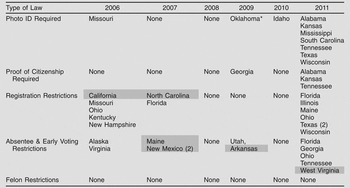
Our dependent variables take the form of the annual count of restrictive changes to voter access proposed or passed within state legislatures between 2006 and 2011.Footnote 75 As noted, we focus on five different types of legislation: photo identification requirements, proof of citizenship requirements, laws that introduce restrictions on voter registration, restrictions on absentee and early voting, and restrictions on participation by felons. Table 1 provides a breakdown of which states have passed these different types of laws and in which year. For the years 2006–2010 these data are drawn from the National Conference of State Legislatures' Database of Election Reform Legislation.Footnote 76 For 2011, we draw upon an exhaustive report from the Brennan Center for Justice, Voting Law Changes in 2012, which details legislative developments in these categories of laws in 2011.Footnote 77
States passing voter restriction laws, 2006–2011

** Indicates states where the Democratic Party held a majority of seats in the state legislature in that year.
* Oklahoma voters may present a voter identification card (without a photo) in lieu of a photo id. This is the only exception and most voters present photo id in practice.
The passed legislation in table 1 all have the potential to reduce voter access at various points in the registration and voting process. Perhaps most well known are new laws requiring photo identification to cast a ballot and proof of citizenship in order to register to vote. The category of registration restrictions includes policies that impact both voters directly and third-party organizations involved in registering voters. The former include reductions in the window for registration, such as eliminating Election Day registration, or increasing state residency requirements. Restrictions on voter registration drives vary, but most commonly involve requiring registration groups to register with the state, mandatory training for anyone registering voters, special disclosure procedures, and short deadlines for the submission of voter registration forms. Failure to comply is often paired with newly established fines or criminal penalties. Restrictions on absentee voting include reducing the time during which absentee ballots can be applied for or accepted and restrictions preventing civic or political organizations from delivering absentee ballots. Last, early-voting restrictions primarily involve reducing the number of days or hours during which early voting is available.
In addition, we examine proposed legislation that would restrict voter access. This includes all proposed legislation along the lines described above, but also legislation that increases requirements or restrictions on either registration or the voting process relative to existing state law. For example, in a state with no voter identification requirements a bill to introduce identification requirements, even if these requirements do not require a photograph, is considered a restrictive proposal.Footnote 78 Similarly, bills to increase the requirements for registration or the receipt of absentee ballots are considered restrictive. Last, while no state passed new legislation related to the voting rights of felons in the period under examination, it was proposed in many states.Footnote 79 Most common was legislation banning felons (or those convicted of particular categories of felony offenses) from voting for life. Other such bills included increasing the criminal penalty for registering to vote if one is an ineligible felon, extending a felon's period of ineligibility to include parole or probation if state laws does not already prevent this, or requiring that all fines imposed by sentence and court costs must be paid before the restoration of voting rights.
Determinants of Proposal and Passage
In our analyses, we use specialized regression techniques that allow assessments of the relative strength and significance of each explanation for passing and proposing restrictive-access legislation between 2006 and 2011 while controlling for other independent variables. These approaches follow the logic of classic multiple regression while accommodating the particular structure of, and specific issues within, our data.Footnote 80 Below we briefly introduce the reasons for selecting each modeling approach before discussing the results of each set of models. All models were run using Stata version 11.2.
Proposed Legislation: GMM Analyses
First, we examine which state-level factors are associated with a higher annual count of proposed restrictive voter-access legislation between 2006 and 2011. The cross-sectional nature of our dataset and the fact that the dependent variable is a count (the number of restrictive legislative changes proposed in a state each year) would normally lead to the use of a pooled Poisson modeling approach. Unfortunately, one of our central variables of interest violates an assumption required for the use of a pooled Poisson approach. The “percentage of the state legislature Republican” variable is related to the error term in the model which can bias estimates.Footnote 81 This problem, referred to as endogeneity, requires that accommodations be made in order to address the presence of such endogenous variables.Footnote 82 We use a generalized methods of moments (GMM) modeling approach because it allows one to directly address the presence of endogenous variables through the use of instrumental variables.Footnote 83 An instrument variable, a variable that stands in for an endogenous factor, must be correlated with the variable they are replacing but not with the error term. Three variables in our analyses meet these criteria: our ALEC variable, the Republican governor variable, and the citizen ideology measure. For the following GMM analyses, these three variables are included in place of the problematic percentage of the state legislature Republican variable.
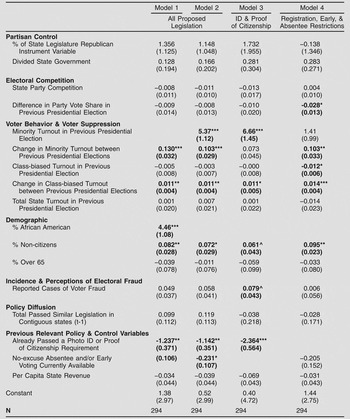
Table 2 contains the results of 4 GMM models examining the state-level factors associated with higher annual counts of proposed voter restriction legislation.Footnote 84 Models 1 and 2 examine the factors associated with the proposal of all types of restrictive legislative changes identified earlier. The measures of minority turnout in the previous presidential election and state percent African American are highly correlated and either variable is highly significant in the absence of the other. Models 1 and 2 therefore introduce each of these variables individually. Both larger proportions of African American residents and higher levels of minority turnout in the previous presidential election are significantly associated with more proposed legislation. While such results make it difficult to adjudicate precisely between the contributions of these correlated but distinct factors, it is clear that the racial composition of a state is strongly related to the proposal of changes that would restrict voter access. The minority turnout variable suggests that concern about the electoral consequences of minority, and especially African-American, turnout is a primary driver of the broader effect of state racial composition. Reinforcing this interpretation is that fact that in both Models 1 and 2 larger increases in minority turnout between the previous two presidential elections are associated with greater frequency of proposed legislation. All of this is consistent with minority voter suppression and electoral considerations being central motives for the proposal of voter restrictions.
GMM analysis of total annual proposed state voter restrictions, 2006–2011

^ p < .1
* p < .05
** p < .01
*** p < .001
Only two additional factors are found to increase the proposal of restrictive legislation. First, larger increases in class-biased turnout, indicating higher turnout among lower income voters relative to wealthy voters, is significantly associated with a larger volume of proposed legislative changes. Low-income individuals vote less frequently than the affluent in every state, but where this gap has been closing in recent years, restrictive-access legislation is more apt to be proposed. Second, states with larger proportions of non-citizens also saw restrictive legislation proposed more frequently. In sum, where African-Americans and poor people vote more frequently, and there are larger numbers of non-citizens, restrictive-access legislation is more likely to be proposed.
It is noteworthy that within Models 1 and 2 none of our measures of partisan control or electoral competition are significant. In particular, a larger proportion of Republicans in the state legislature is not associated with a higher frequency of proposed bills. This could be due to multiple factors. A legislator does not need to be in the majority party to propose legislation. Further, multiple bills that have little chance of passing may be proposed by Republicans in the minority for partisan or symbolic reasons. For example, a number of (disproportionately Republican) legislators in Massachusetts have introduced dozens of restrictive bills, none of which have passed during this period. On the other hand, a legislature that is dominated by Republicans may be able to pass a larger proportion of a smaller number of proposed bills. Further, it is possible that Republican legislators in solidly Republican states may have less electoral incentive to pursue such restrictive legislation at all. All of these considerations may complicate a simple linear relationship between the percentage of Republican legislators and the proposal of restrictive legislation.
In order to explore whether the forces driving the proposal of identification and proof of citizenship requirements differ from the proposal of registration, absentee, and early voting restrictions, Models 3 and 4 examine the count of these proposed legislative changes separately. The factors associated with more frequent proposal of these different types of restrictions are largely the same, appearing to be primarily a response to either levels of or change in minority turnout, levels or change in class-biased turnout, and the proportion of non-citizens.
From all this a striking story emerges: the proposal of restrictive voter-access legislation has been substantially more likely to occur where African-Americans are concentrated and both minorities and low-income individuals have begun turning out at the polls more frequently. Given that we are examining the years 2006–2011, we can specifically attribute these developments to the significant increases in voter turnout among these groups in the 2008 election. States where these developments were felt more intensely were correspondingly more likely to propose legislation. While we can only infer motivation, these results strongly suggest that the proposal of these policies has been driven by electoral concerns differentially attuned to demobilizing African-American and lower-income Americans. Such patterns of association are strongly consistent with the expectations derived from the literature on voter suppression.
Passed Legislation: Pooled Poisson Analyses
In this second set of analyses we turn our attention to the actual passage of legislative changes that reduce voter access. As in our analysis of proposed legislation, a pooled Poisson approach is appropriate, but we again have a problem with the presence of endogenous variables. However, in this case it is not possible to use the GMM estimation technique for these analyses primarily because the new outcome of interest, passed legislation, occurs too infrequently. A fixed effects modeling approach is a commonly used technique to address this specific issue—the presence of endogenous factors—but this approach is not without some costs. Fixed-effects approaches only utilize within-group, in our case within-state, variation over time. This significantly impacts both the cases involved in the analyses and the interpretation of the results. First, only cases that exhibit variation on the dependent variable and only variables that exhibit variation over time can be included in such analyses. Consequently, only states that actually passed a piece of legislation during our 2006–2011 time period are included, resulting in a total of 150 state-year observations. Time-invariant variables, citizen ideology, and voter fraud cases are unavoidably dropped from all models. Second, it is important to stress that these analyses reveal only the within-state developments associated with the increased likelihood of passage of legislation.Footnote 85
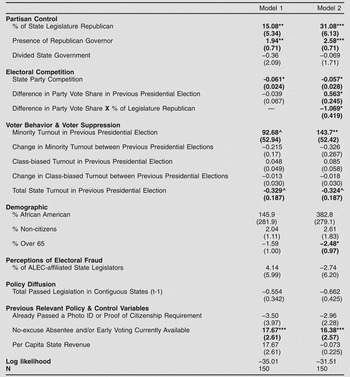
Table 3 contains the results of two pooled-Poisson fixed-effects models examining state-level factors associated with the annual count of restrictive changes to voter access passed in each state. Beginning with the impact of the balance of partisan power within state governments, the proportion of the legislature Republican, the presence of a Republican governor, and the degree of competitiveness between the parties within state legislatures are all significantly associated with the passage of restrictive changes. In the context of a fixed-effects framework, these results indicate that within states over time a larger proportion of Republicans in the legislature and the presence of a Republican governor are associated with a higher annual count of passed legislation. These effects are most likely driven by the substantial increase in restrictive changes passed following the Republican “wave” election of 2010 where the GOP picked up 11 governorships and gained control of 57 state legislative chambers (up from 36 in 2009). Of the 41 adopted voter restrictions considered here, 34 restrictive changes (83 percent) passed in Republican-controlled state legislatures. Further, of the bills requiring either photo ID or proof of citizenship (the policies that are the most unambiguously expected to disproportionately burden likely Democratic voters), all were passed in legislatures under Republican control (refer to table 1). Given that the reductions in voter participation and access potentially resulting from these policies would overwhelmingly benefit Republicans, we are not surprised to see such a strong influence of party control on passage. The effect of the simplified Ranney index is negative, indicating that states where the partisan balance of power has become more evenly divided are less likely to pass restrictive legislation. This likely reflects the reality that passing controversial legislation with obvious partisan consequences is more difficult to accomplish in the context of more closely divided legislatures.
Pooled fixed effects poisson analysis of total annual passed state voter restrictions, 2006–2011

^ p < .1
* p < .05
** p < .01
*** p < .001
Our second measure of electoral competition captures a state's degree of competitiveness in national political contests: the difference in the party vote share in the previous presidential election. This variable is insignificant in Model 1. However, in Model 2 it becomes significant upon the inclusion of an interaction effect testing whether the effect of a state's competitiveness on the passage of restrictive legislation depends upon the degree of party control exercised by state Republicans. This significant interaction effect indicates that increases in competitiveness within presidential contests translates into more restrictive changes in states with larger Republican majorities and fewer restrictive laws in states with larger Democratic majorities. Considerations of national electoral outcomes, especially the presidency, appear central to passing restrictive changes—especially in states where both the motivation and means converge.
After accounting for the variation in passage explained by party control and electoral competition, only three additional factors emerge as significant in Model 2. Consistent with our findings for proposed legislation, states where minority turnout has increased since the previous presidential election were more likely to pass restrictive legislation. Second, the variable capturing the proportion of the state population over 65 years old is negative and significant, indicating that states where the elderly population is growing are less likely to pass restrictive changes. Last, these results suggest that states where election accessibility has increased through the introduction of early or no-excuse absentee voting were more likely to pass restrictive legislation. We do not want to overemphasize this last finding, though, as the number of states that experienced such increased accessibility during this time period is extremely small.
Passed Legislation: 2011 Poisson Analyses
As stated, fixed-effects approaches only make use of within-state variation, but what of the effects of stable state characteristics that do not vary much within states over time, but do vary substantially between states? For example, a demographic factor like the percentage of a state's population that is African-American will not fluctuate dramatically year-to-year, and we are not looking for an effect of such changes. Rather, we are primarily interested in whether states with larger numbers of African-American residents are more likely to pass such legislation. In order to explore the impact of such cross-state differences, our last set of models present the results of multiple (traditional) Poisson regressions examining the determinants of the total count of restrictive changes to voter access passed in 2011. In 2011, state legislatures passed 22 provisions restricting voter access. The highest national count in the previous five years was eight restrictive changes passed in 2006. Legislative activity in 2011 dramatically increased in this issue area and we suspect this is a consequence of a confluence of conditions and pressures that are unique to the post-2008 (and pre-2012) election years.
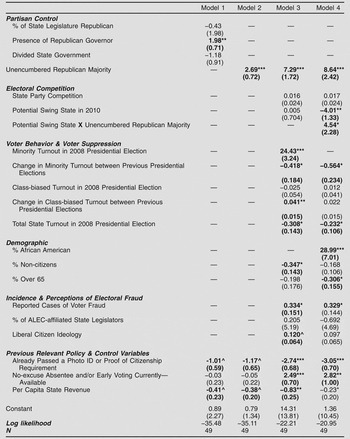
Table 4 presents the results of four Poisson analyses examining state-level determinants of the count of restrictive changes to voter access passed in 2011. Model 1 presents the results of a reduced model containing only our measures of partisan control. It indicates that states with Republican governors were more likely to pass such legislation, but the percent of the legislature Republican is insignificant and even bears a negative sign. This indicates that simply holding a majority of seats does not guarantee that the majority party can actually pass this controversial legislation. The presence of a Democratic governor's veto will reduce the chance of a voter restriction bill becoming law even if passed by a Republican-controlled state legislature. Additionally, in the context of divided government, an opposition party—in this case usually the Democratic party—may check the passage of legislation even if that party holds a strong majority of seats in one chamber. These combinations of conditions likely modify the direct effect of the percentage of Republican legislators on the count of restrictions passed. To examine this conjunctural effect more directly, we constructed a variable indicating the presence and strength of an unencumbered Republican majority in the state legislature.Footnote 86 This variable simply takes the value of the percent of Republican legislators unless the Republicans are in the minority, the state has a divided government, or a Democratic governor. Under these conditions, the variable takes a value of zero. Models 2–4 include this new variable and the variables that comprise it are dropped from the models. This variable is both highly significant and is an extremely influential factor in these analyses, indicating that the presence and size of an unencumbered Republican majority are positively associated with a larger volume of passed restrictive changes in 2011.
Poisson analysis of count state voter restrictions passed in 2011

^ p < .1
* p < .05
** p < .01
*** p < .001
In these models we do not use the difference in party vote share variable in the previous presidential election, our measure of the competitiveness of the state in presidential elections used previously. Rather, we created a dummy variable for states that were identified in journalism published in 2010 as potential swing states in the 2012 election. For this list we drew primarily on outlets specializing in political reporting (e.g., Roll Call and POLITICO). Ten states were the most frequently discussed: Colorado, Florida, Iowa, New Hampshire, Nevada, North Carolina, Ohio, Pennsylvania, Virginia, and Wisconsin. Whether these states were actually considered highly competitive swing states in the actual run-up to the 2012 election is not as important as the perception among lawmakers in 2011 that their state could play a decisive role in the upcoming presidential election. This potential swing state variable is insignificant in Model 3, but becomes significant when interacted with the unencumbered Republican majority variable in Model 4. The negative direct effect of being a potential swing state indicates that it is more difficult on average to pass such restrictive changes in potential swing states than in non-swing states, presumably due to heightened political consequences making such changes more hard fought. The significant interaction effect captures the fact that potential swing states with an unencumbered majority Republican were more likely to pass restrictive changes in 2011. However, in the absence of an unencumbered Republican majority, potential swing states were significantly less likely to enact such legislation. In other words, Democrats appear to have been extra vigilant in 2011 to prevent the passage of such changes in potential swing states.
The second most influential individual factor in these analyses is a state's racial composition as captured by either the percentage of the state population that is African American or minority turnout in the 2008 election. Both factors are associated with a larger number of passed restrictive changes and are highly significant in the absence of one another. Model 3 includes minority turnout in 2008 and omits the percent African American variable; Model 4 provides the converse. As was the case in both previous analyses of proposed and passed changes, and controlling for a wide range of factors states with larger proportions of minority voters and African American residents were more likely to pass restrictive voter legislation in 2011.
In the remainder of our discussion we will focus on the results produced by Model 4, which takes into account both the highly influential impact of state racial composition and the swing state interaction effect just discussed. A number of additional factors emerge as significant. In contrast to our findings in the analyses of proposed changes, it appears that states with larger increases in minority turnout between 2004 and 2008 are less likely to pass restrictive changes in 2011. So states where minorities make up a larger proportion of those casting a ballot are more likely to pass restrictive legislation, but if that state experienced a surge in minority turnout in 2008, the likelihood of passage of such legislation is reduced. This could be indicative of a different political calculus confronting legislators in the context of states with larger shares of mobilized minority voters. Specifically, the possibility of public anger, attention, or backlash might undermine or even reverse any electoral benefits of actually passing restrictive legislation. Indeed, numerous journalistic reports have suggested the passage of restrictive voter legislation in a few states galvanized minorities and especially African American voters to participate in the 2012 election.Footnote 87 Concerns about such a backlash strikes us a plausible explanation for the negative influence of increased minority turnout in 2008 on the passage of restrictive legislation in 2011.
Second, it also appears that states with larger levels of overall turnout in 2008 were less likely to pass restrictive legislation in 2011, but this is true only when controls for state racial composition or minority turnout are in place. Once the fact that states with more African-American voters and residents are more likely to pass restrictive legislation is accounted for, this variable captures the corresponding reality that higher levels of white turnout are associated with a reduced likelihood of the passage of such legislation. This simply underlines the centrality of racial considerations to the passage of restrictive voter legislation. Third, we find that states with larger proportions of elderly residents are less likely to enact restrictive changes. We interpret this as potentially reflective of a strategic, partisan recognition that restrictive policies likely to suppress lower-income and minority voters may also impede participation by elderly—and Republican-leaning—voters as well. Fourth, our measures characterizing the previous state of election accessibility indicate that states that have already passed a photo identification or proof of citizenship law passed a smaller number of changes in 2011. On the other hand, states with highly accessible elections, as indicated by the presence of both no-excuse absentee and early voting, were more likely to pass restrictive changes in 2011. All of these findings are consistent with a voter suppression narrative.
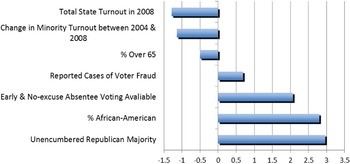
Lastly, the number of reported cases of voter fraud is significantly associated with higher rates of passage of legislation in 2011. We are skeptical that this variable represents any true measure of actual voter fraud and find it more reasonable to consider it an indicator of selective, and in some cases explicitly partisan, efforts to raise concerns about voter fraud. That said, some may read this as evidence that restrictive legislation has passed, in part, in response to actual fraud. While it is not possible to adjudicate between these two interpretations here, it is important to stress that in the big picture the impact of this factor is minor compared to the influences of the partisan, electoral, and racial factors identified in these analyses. Figure 4 attempts to provide exactly this; a sense of the respective impacts of the central factors identified as significant in these analyses. It displays the change in the predicted count of restrictive provisions passed in 2011, given a one-standard-deviation increase in each factor while holding all other variables at their mean values. For example, a hypothetical state with a proportion of African American residents one standard deviation above the mean and average values on all other variables would be expected to pass over 2.5 more restrictive provisions in 2011 than a state with average values on all variables (including percent African American). As this figure makes clear, partisan control and state racial composition are overwhelmingly the two most influential factors associated with the passage of restrictive legislation in this year.
Effect of a one standard deviation increase on the predicted count of restrictive changes passed in 2011

In sum, these findings suggest that over the 2006–2011 period, states that increased their share of Republican legislators, elected a Republican governor, or became more competitive in the electoral college in the presence of a Republican majority in the state house were more likely to pass restrictive voter legislation. States experiencing increasing minority turnout were also more likely to pass restrictive legislation. Focusing on legislation passed in 2011, we find that more restrictive changes passed in states with unencumbered Republican majorities, larger proportions of minority voters or African American residents, more reported cases of voter fraud, and more accessible election systems.
Voter Restrictions as Strategic Voter Suppression
Zooming out, a straightforward picture emerges. Our analyses identify a very substantial and significant association between the racial composition of a state's residents or active electorate and both the proposal and passage of voter restriction legislation. This association is robust across multiple modeling approaches and controlling for a wide variety of relevant factors. Further, these findings demonstrate that the emergence and passage of restrictive voter access legislation is unambiguously a highly partisan affair, influenced by the intensity of electoral competition. The fact that in the context of heightened competition Republican control increases while Democratic control reduces, the rate of restrictions passed underlines the highly strategic nature of these efforts. It also appears that demobilization efforts are not a blunt practice. Passing restrictive voter legislation (in noteworthy contrast to proposing restrictive voter legislation) is shaped by an apparent sensitivity to the net impact of restrictive policies. That is, the electoral benefits of reforms with disproportionate suppression effects appear to be weighed against the risks of galvanizing turnout among groups targeted for demobilization or of accidentally suppressing supporters. In combination, these findings are strongly consistent with a scenario in which minority voter suppression is a central driver of recent legislative developments restricting voter access.Footnote 88 Indeed, we find that the best available measure of actual voter fraud is not associated with the proposal of legislation and is only a minor contributing factor to the passage of restrictive changes in 2011. This is not a particularly surprising finding as serious empirical attempts to quantify the extent of voter fraud have consistently found such fraud to be exceedingly rare in modern U.S. elections.Footnote 89 These findings are relevant to current partisan and legal debates regarding voter restrictions, our understanding of the conditions that incentivize suppression efforts, and broader developments across multiple policy arenas that have reduced electoral access among the socially marginalized.
The 2012 Election and Beyond
A typical cable news night surrounding election 2012 featured barely civil exchanges between Democratic operatives decrying how restrictive legislation aims to keep their constituents from the polls and Republican pundits scoffing at the allegation, making their own case that such legislation protects the legitimacy of the electoral process by combating fraud. Our findings confirm that Democrats are justified in their concern that restrictive voter legislation takes aim along racial lines with strategic partisan intent. But if that is the case, how do we interpret President Obama's decisive victory in 2012? Some may read this as clear evidence that either reforms have not suppressed voters or that voter suppression efforts did not work. This narrow focus on the outcome in the presidential race both obscures the impacts of these policies and misreads the extent to which the 2012 election represented a true test of the effects of these laws.
Most importantly, many of the most onerous restrictive changes were not in effect for the 2012 election.Footnote 90 While we have focused on the proposal and passage of restrictive legislation, these developments have provoked a wide-ranging pushback in defense of voter access. In 11 states laws were blocked, weakened, or postponed by courts or the Department of Justice and in two states, Maine and Ohio, restrictive laws were repealed by citizens.Footnote 91 Further, the effects of some of these laws can be subtle, difficult to discern, and most influential at the margins. For example, the results of a wide range of studies indicate that most registered voters do possess the forms of identification required by voter ID laws.Footnote 92 Consequently, such laws may do little to suppress routine voters, but may serve to reduce participation among the eligible unregistered population who are much more likely to lack basic forms of required identification. It has been suggested that “the real value of restrictive voter ID may be in what we might call ‘surge protection’ against the kind of mobilization of new, first-time voters who very likely handed Obama his election [in 2008].”Footnote 93 Such effects may be consequential, but are difficult to measure empirically.
That said, the impacts of other restrictive changes have been much less subtle. Most infamously in Florida, one study estimates that roughly 200,000 voters were discouraged from voting in the 2012 election due to long linesFootnote 94 and another study found that racial and ethnic minorities as well as Democrats were more likely to experience significantly longer waits.Footnote 95 These long lines were, in part, a direct result of a reduction in the number of early voting days passed by the Florida legislature in 2011. The estimates from these studies in Florida alone underline the sobering reality of the potential impact of these laws in the context of a tight election. Since the 2012 election, thus far restrictive laws have been passed or proposed by Republicans in Arkansas, Missouri, Montana, and Virginia. Republicans appear undeterred in their pursuit of these restrictive policies and this most recent presidential defeat may only serve to galvanize suppression efforts.
In addition, the Supreme Court recently decided to consider a constitutional challenge to Section 5 of the Voting Rights Act. Section 5 requires that states and localities determined to have a history of undermining the franchise get preclearance from the Department of Justice or the U.S. District Court in the District of Columbia before enacting electoral changes to ensure that these alterations do not have an adverse effect on racial or linguistic minorities. This is what allowed the Department of Justice to block or weaken restrictive-access legislation in states like Florida, Texas, and South Carolina in the run-up to the 2012 election. Currently in jurisdictions covered by Section 5, the burden of proof lies on state or local governments to demonstrate that electoral changes do not have a discriminatory or retrogressive impact on minorities before legislation goes into effect. If overturned, challenges may still be brought but these suits will be a response to new laws after they have been adopted and the burden of proof will lie with those bringing the challenge. Further, final rulings could come after relevant elections. A central argument made against the constitutionality of Section 5 is that it is outdated—covered states no longer intend to discriminate or do so. Our findings call such assertions into question and, more broadly, suggest that challenges to the implementation and passage of restrictive access legislation are merited on the grounds of racial bias.
Why the Recent Intensification of Suppression Efforts?
Overall, we find strong empirical support for the position that recent legislative efforts to restrict voter access are usefully conceptualized as yet another wave of election reforms in a long history for such reforms, pursued in order to demobilize and suppress particular categories of voters for partisan gain. But what is it about the current political moment that has lead to the recent increase in the proposal and passage of legislation? A widely-acknowledged broad contextual factor is certainly the competitiveness of presidential elections and the tight balance of congressional power in recent decades. Tighter election margins incentivize not just voter suppression efforts, but a wide range of tactics, including redistricting and legal challenges intended to shape election outcomes.Footnote 96 In the context of somewhat long-standing pressures to demobilize Democratic opponents, why the efforts to reduce electoral access in the mid to late 2000s? The marriage of our findings and the voter suppression literature suggest Republicans may have done so for a number of reasons: changing demographics; recent Republican electoral losses; an unforgiving internal shift within the party to the ideological right; and the party faithful's response to vote fraud mythology.
Immediately following the 2012 election, a specific narrative emerged highlighting the manner in which the changing demographic composition of the United States and the heavy skew of minority groups towards the Democrats both provided an advantage for President Obama and potentially spelled trouble for the future prospects of the GOP. Our findings regarding the influence of race and minority turnout suggest that many Republicans were not unaware of these realities in the years preceding the 2012 election. This is understandable as the 2008 election was a particularly instructive experience in this specific regard. The historic magnitude of Republican losses in the 2008 election are hard to overstate.Footnote 97 Minority turnout and Democratic vote margins among minority voters increased substantially in 2008 and this boost is widely viewed as critical to Obama's election.Footnote 98 Republican upsets at the presidential level in the South, (Florida, North Carolina, and Virginia) were particularly painful and alarming to many Republicans. “These three southern victories can be ascribed to two factors: unified bloc voting by black voters combined with some crossover support by a minority of whites … the Obama-Biden ticket received almost unanimous support from black voters.”Footnote 99
Given these realities, it has been argued that the accelerated proposal and passage of restrictive election reforms represent a backlash against both the broader demographic changes widely viewed as troublesome for Republicans and strong minority turnout and support for the first non-white major party presidential nominee. Our findings are entirely consistent with such a backlash narrative or even that of a strategic elite-driven “frontlash” in response to political setbacks as conceptualized by Velsa Weaver.Footnote 100 Weaver describes a “frontlash” as
the process by which losers in a conflict become the architects of a new program, manipulating the issue space and altering the dimension of conflict in an effort to regain their command of the agenda. Frontlash hinges on the presence of winners and losers of a recent political conflict…. The dissatisfied parties seek openings to mobilize a new issue, alter the dimensions of the conflict, or, in the terminology of social movement theorists, “shift the locus of attack.Footnote 101
In contrast to a traditional conception of a political backlash, exemplified perhaps in a process where resentment among white voters with racial progress shapes electoral outcomes, “frontlash is preemptive, innovative, proactive, and, above all, strategic.”Footnote 102 Further, while the political momentum in backlash narratives are often a bottom-up account focused on the behavior and preferences of dissatisfied voters, a frontlash is conceptualized as an elite countermovement in response to some type of political defeat. We consider this a useful conceptual frame for understanding the rise of restrictive voter legislation, given the elite-driven nature of increased attention and policy responses to the issue of voter fraud, and both the timing and strategic pattern of these legislative efforts.
Also potentially at play in the recent GOP pursuit of restrictive legislation are the unintended ramifications of the declining proportion and influence of moderates within the party. As we have detailed, a voter-suppression perspective argues that parties have an incentive to suppress their opponents, as opposed to mobilizing new voters, when these new voters bring demands or positions that conflict with their existing base of supporters. In recent decades the Republican Party has both become more conservative on average and more ideologically homogenous.Footnote 103 As Republicans in recent election cycles have found themselves needing to increasingly move to the political right to win their primaries, they have increasingly alienated particular groups of voters such as Latinos and women. We suspect that when a party's platform or rhetoric reduces the possibility of building electoral coalitions and bringing in new voters, while representing the interests of a demographically shrinking base, this alone increases the incentive to engage in voter suppression. In a two-party system, when mobilizing supporters is insufficient, demobilizing opponents may provide the only route to victory. The increasing effort put into voter suppression by the GOP in recent years may then be a reflection, in part, of these internal ideological and practical constraints on mobilizing new voters.
Finally, the steady amplification of voter fraud mythology since the 2008 election has undoubtedly contributed to the increased rate of restrictive legislative activity. The historical deployment of fraud charges reminds us that doing so is often a valuable political tool for both explaining electoral losses and mobilizing supporters. Minnite goes so far as to argue that the voter fraud myth has come to represent a “new Southern strategy” in which the Republican base is “energized by the tarring of Democrats as cheaters and the association of Democrats with a racialized crime-prone underclass.”Footnote 104 For many conservatives, fraud is now genuinely believed to play an influential role in American political life. We find this unfortunate as such outsized concern will undoubtedly serve to both justify and prompt continuing pressure for restrictive reforms while obscuring attention to the very real problems that riddle our electoral institutions and practices.
Cumulative Voter Exclusion: Felon Disenfranchisement, Modern Poverty Governance, and Restrictive-Access Legislation
Our findings are deeply troubling in their own right. This is compounded by the fact that we view this legislation as yet an additional layer of exclusionary policy practices that work to reduce political participation and electoral access by the socially marginalized. The manner in which these restrictions have unfolded bear a number of similarities with modern developments in other policy arenas, especially criminal justice policy and poverty governance.Footnote 105 First, they are race, gender, and class neutral on paper, but have disparate political impacts in practice. Second, much of this exclusionary policy action has occurred at the state level where policymakers are less encumbered by federal oversight. Third, the resulting variation in the accessibility to rights and benefits across states is strongly shaped by considerations of race and social control. The net effect of these policy regimes is to reduce, to varying degrees, full political incorporation among the socially marginalized.
We have described recent legislative efforts to reduce electoral access, efforts that have been pursued more aggressively in states with more minority voters. These developments rest on top of and interact with institutions and policies shaped by previous struggles over who deserves access to the full benefits and rights of citizenship. Massive increases in incarceration since the 1970s have combined with state-level variation in felon disenfranchisement laws so that 1 in 13 African American men were ineligible to vote in 2010—compared to 1 in 40 of all Americans.Footnote 106 Differences in state disenfranchisement laws produce a situation where disenfranchisement rates are the highest in seven Southern states and most potent in Florida, Kentucky, and Virginia where one in five African Americans legally cannot vote.Footnote 107 Felon disenfranchisement laws are an enduring legacy of previous suppression efforts shaped directly by considerations of racial impacts and social control. The increased punitiveness of the American criminal justice system has dramatically increased the proportion of Americans currently disenfranchised by this legacy, with African Americans, Hispanics, and the economically insecure disproportionately affected. This is the most direct of exclusionary policies regarding access to the vote: legally limiting who is eligible to vote along racial and class lines.
Electoral participation is also impacted by access to basic economic security and support.Footnote 108 Since the mid-1990s Republicans have successfully led the charge, often with Democratic complicacy, to dramatically reduce the receipt of means-tested social welfare support while subjecting those who continue to receive support to harsh, supervisory, and paternalistic policies.Footnote 109 The centrality of states in crafting their poverty policies under relatively weak federal guidelines has allowed for racial considerations and social control to continue to define this new poverty governance.Footnote 110 African Americans are more likely to live in states and localities that provide less generous benefits and are more likely to be punitively sanctioned than their white counterparts in the same state.Footnote 111 These disempowering policy experiences deplete political efficacy and participation beyond the already lowered participatory expectations stemming from low socio-economic status.Footnote 112 For our purposes, the negative impact on voting is most important. Felony disenfranchisement means one cannot vote. For the socially marginalized who can vote, existing poverty governance may undermine for many the political efficacy to do so through direct policy learning in punitive programs and by often failing to alleviate economic insecurity. As Joe Soss, Richard Fording, and Sanford Schram argue, current poverty governance “deepens the political marginality of the poor, channeling them into positions of civic inferiority and isolation.”Footnote 113
Viewed in the context of these intersecting policy developments, recent restrictive voter-access policies introduce still more hurdles to those that already exist for minorities and lower-income citizens. In their current practice, felony disenfranchisement, means-tested social welfare programs, and restrictive-access legislation make having the franchise, a welcoming path to accessing it, and the desire to use it less likely for the poor and minorities in the United States. From this perspective, recent passage of restrictive voter policies is an important prong in a broader suite of policies expanding a form of conditional and exclusionary American citizenship.Footnote 114 In silent concert these policies work to undermine democratic voice for the most vulnerable.
The news then is not good for the inclusiveness of American democracy, but the trend we have examined does not represent a foregone conclusion. The recent wave of restrictive-access legislation is rooted in long-standing racial and classist motivations revived for modern deployment. While we consider our findings consistent with this historical perspective on these developments, we also recognize the discursive and political power of the voter-fraud narrative and the effectiveness of those who have vigorously purveyed this narrative. Simultaneously, the multifaceted political and legal pushback that has emerged to counter recent efforts to reduce voter access underlines that it is not only the advocates of restriction that have been exercising their political agency, but also the supporters of inclusive voting rights.Footnote 115 As a result, the issue is currently a matter of serious contestation. Supporters of voting rights can also take heart from the fact that the Democratic party as an enduring political institution (as opposed to a social movement) has a strong and consistent electoral incentive to fight and attempt to reverse recently enacted restrictive policies. On the other hand, given the internal dynamics of the GOP and the current political landscape facing that party, we expect the incentives to engage in suppression and other electoral manipulations to remain heightened and to pose a continuing and significant threat to full electoral participation in the years to come.Footnote 116 The future of voting rights in the US will be determined by the ongoing political contest between the Republican and Democratic parties. At the same time, the contest itself will be influenced by the continuing political and legal struggles over access to the ballot.
Appendix A
Definitions and data sources