INTRODUCTION
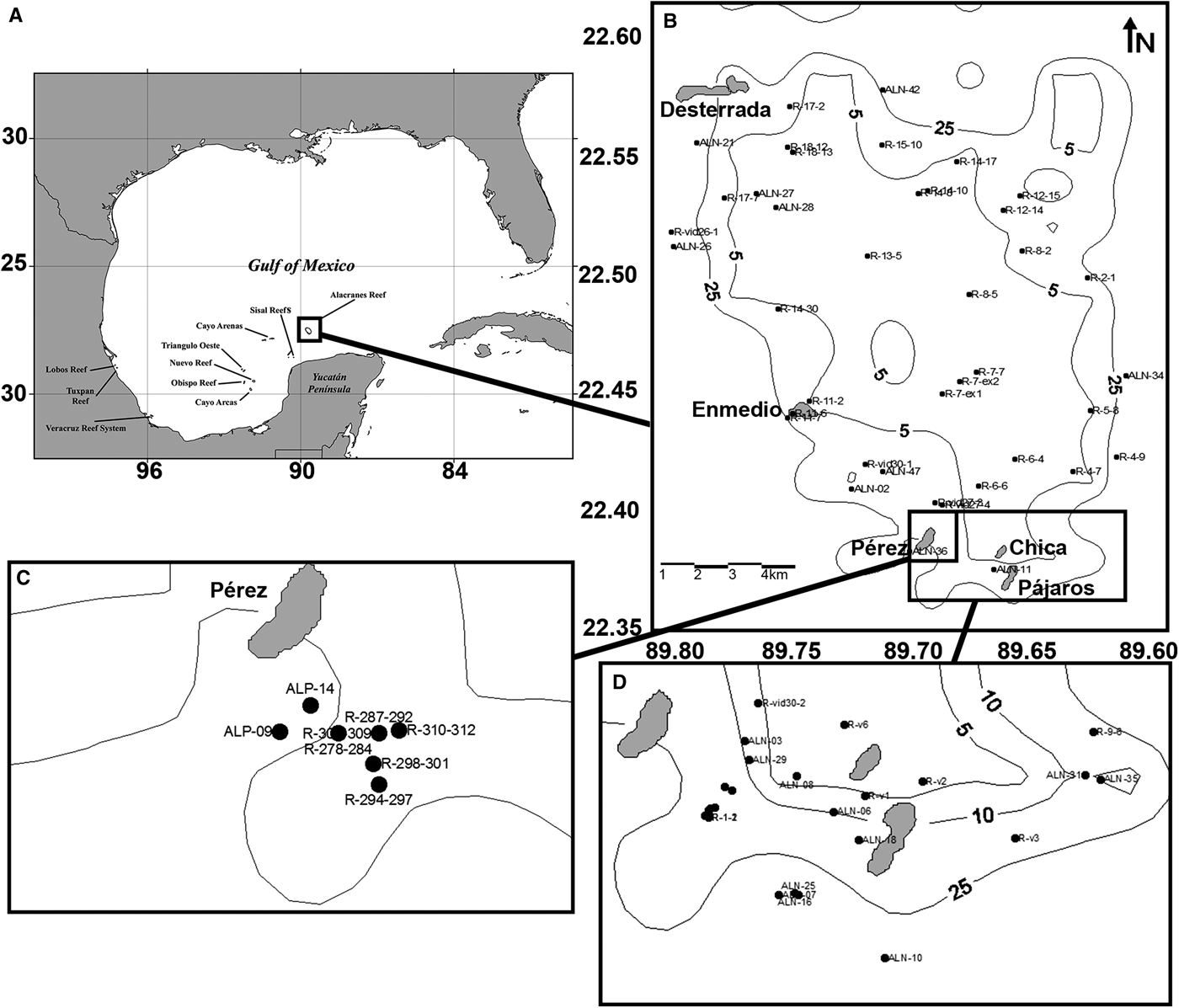
The Campeche Bank, located in the southern area of the Gulf of Mexico, is composed of an extensive, hard, shallow carbonate platform with several relatively small, submerged reefs such as Triángulos, Obispo, Pera, Ingleses, Nuevo, Sisal, Madagascar and Serpiente (Jordán-Dahlgren & Rodríguez-Martínez, Reference Jordán-Dahlgren, Rodríguez-Martínez and Cortés2003; Tunnell, Reference Tunnell, Tunnell, Chávez and Withers2007; Zarco-Perelló et al., Reference Zarco-Perelló, Mascaró, Garza-Pérez and Simões2013). The three emerged reefs in this region include Cayo Arcas, Cayo Arenas and the largest coral reef system of the Gulf of Mexico, Arrecife Alacranes, a National Park with an atoll-like shape that covers 3337 km2 and is located 137 km north of Progreso Harbour (Figure 1) (Tunnell, Reference Tunnell, Tunnell, Chávez and Withers2007). It has a deep lagoon (5 to 40 m depth), fragmented by an intricate network of inner reefs (Jordán-Dahlgren & Rodríguez-Martínez, Reference Jordán-Dahlgren, Rodríguez-Martínez and Cortés2003). One of the first multidisciplinary studies at Alacranes reef was conducted by Kornicker et al. (Reference Kornicker, Bonet, Cann and Hoskin1959). Other malacological studies, specifically made at Alacranes reef, were mainly focused on bivalves and shelled gastropods (Rice & Kornicker, Reference Rice and Kornicker1962; Hicks et al., Reference Hicks, Barrera and Tunell2001), and on the queen conch Lobatus gigas (Linnaeus, 1758) (e.g. Ríos-Lara et al., Reference Ríos-Lara, Cervera-Cervera, Espinoza-Méndez, Zetina-Moguel and Chablé-Ek2000; Aldana-Aranda & Perez-Perez, Reference Aldana-Aranda and Perez-Perez2007). The only studies focused exclusively on the heterobranch sea slug fauna of Alacranes reef are the recent contributions by Sanvicente-Añorve et al. (Reference Sanvicente-Añorve, Hermoso-Salazar, Ortigosa, Solís-Weiss and Lemus-Santana2012a, Reference Sanvicente-Añorve, Solís-Weiss, Ortigosa, Hermoso-Salazar and Lemus-Santanab). Up to now, there are 50 species of heterobranch sea slugs recorded for the Parque Nacional Arrecife Alacranes (PNAA) (Rice & Kornicker, Reference Rice and Kornicker1962, Reference Rice and Kornicker1965; Vokes & Vokes, Reference Vokes and Vokes1983; Hicks et al., Reference Hicks, Barrera and Tunell2001; Valdés et al., Reference Valdés, Hamann, Behrens and DuPont2006; Sanvicente-Añorve et al., Reference Sanvicente-Añorve, Hermoso-Salazar, Ortigosa, Solís-Weiss and Lemus-Santana2012a, Reference Sanvicente-Añorve, Solís-Weiss, Ortigosa, Hermoso-Salazar and Lemus-Santanab). The present work aims at contributing to the southern Gulf of Mexico heterobranch sea slugs species diversity knowledge based on two surveys at the marine protected area Alacranes reef.
(A) Location of the National Marine Park Arrecife Alacranes; (B–D) Collecting sites.

MATERIALS AND METHODS
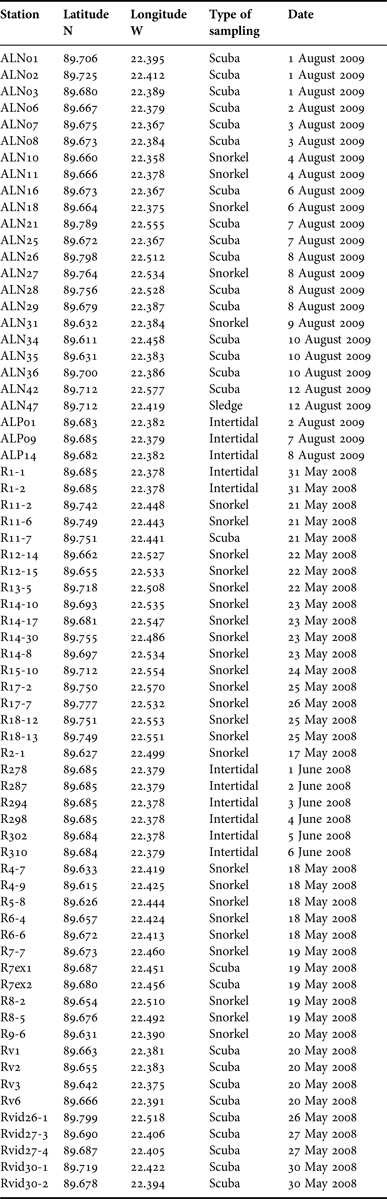
Samples were obtained during two surveys (May–June 2008 and July–August 2009), in the lagoon of the PNAA, at the Campeche Bank (Figure 1, Table 1). The specimens were collected in the intertidal shore of Isla Pérez, and in different areas of the lagoon, such as exposed front and back reef, protected reef walls, seagrass beds and rocky bottoms by snorkel and SCUBA, using direct (collection by hand) and indirect sampling techniques such as brushing (over algae, sponges and boundaries), suction pump (over algae) and pushing a sledge (in seagrass beds of Thalassia testudinum Banks ex Köning). Samples of algae and sponges were also taken for later revision.
Collecting sites along the National Marine Park Arrecife Alacranes.
Details of the living specimens were observed using a dissecting microscope. All species collected were photographed before relaxing with clove oil or cooling (not freezing) in a freezer, and then preserved in 70–100% ethanol. Identifications were made based on field guides (e.g. Valdés et al., Reference Valdés, Hamann, Behrens and DuPont2006) and corroborated with the original description or experts on this kind of fauna. The diagnosis of the new records for the PNAA is included. Most of the material collected was deposited and vouchered at the Colección Nacional de Moluscos (CNMO), Instituto de Biología, UNAM. General classification follows Bouchet et al. (Reference Bouchet, Rocroi, Frýda, Hausdorf, Ponder, Valdés and Warén2005) and Gosliner et al. (Reference Gosliner, Behrens and Valdés2008). For the Chromodorididae we followed Johnson & Gosliner (Reference Johnson and Gosliner2012). Species within the genera are arranged by chronological year of description. Data for each species include: material examined; length (ML, maximum length and L, length of only one specimen) and distribution within the east coast of the Americas. Here, we specified only the western Atlantic distribution (including the Gulf of Mexico and Caribbean) of the species considered to have a wide geographical range; abbreviations used for each state of the United States were: FL, Florida; GA, Georgia; LA, Louisiana; MA, Massachusetts; NC, North Carolina; TX, Texas; for Mexico: CAMP, Campeche; QROO, Quintana Roo; TAB, Tabasco; TAMS, Tamaulipas; VER, Veracruz; YUC, Yucatan.
RESULTS
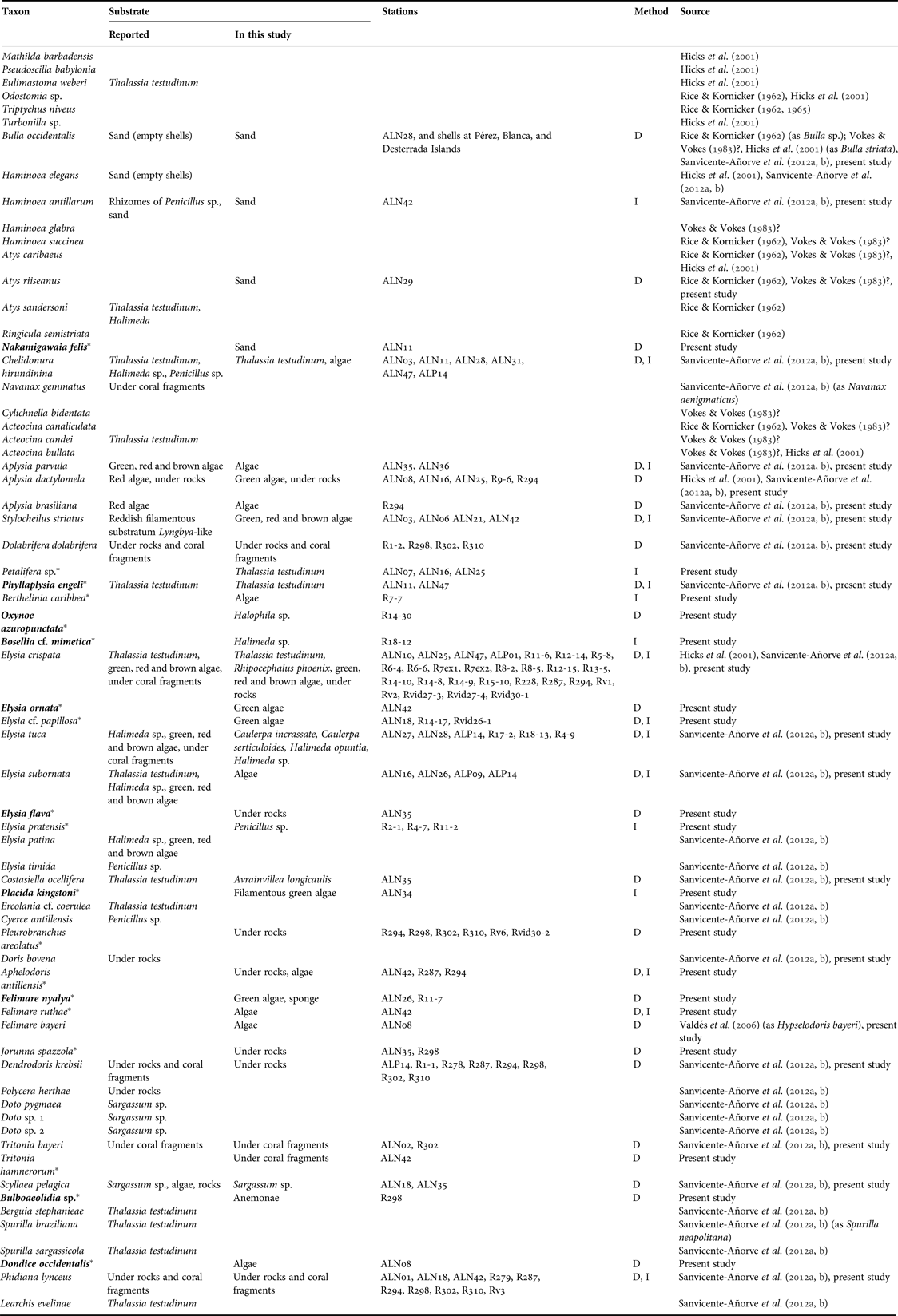
Thirty-seven species from six different orders were found: Cephalaspidea P. Fischer, 1883 (five spp.), Anaspidea Fischer, 1883 (seven spp.), Sacoglossa Ihering, 1876 (12 spp.), Pleurobranchomorpha Gray, 1827 (one sp.) and Nudibranchia Cuvier, 1817 (12 spp.). Nine of these species represent new records from the Atlantic coast of Mexico (including the Gulf of Mexico and the Caribbean Sea): Nakamigawaia felis Er. Marcus & Ev. Marcus, 1970, Petalifera sp. Gray, 1847, Oxynoe cf. azuropunctata Jensen, Reference Jensen1980, Bosellia cf. mimetica Trinchese, 1891, Elysia ornata (Swaison, 1840), Elysia flava Verrill, 1901, Placida kingstoni Thompson, 1977, Felimare nyalya (Ev. Marcus & Er. Marcus, 1967) and Bulboaeolidia sp. Carmona et al., Reference Carmona, Pola, Gosliner and Cervera2013. Ten species were sampled in both surveys: Aplysia parvula Mörch, 1863, Aplysia dactylomela Rang, 1828, Dolabrifera dolabrifera (Cuvier, 1817), Elysia crispata Mörch, 1863, Elysia cf. Verrill, 1901, Elysia tuca Ev. Marcus & Er. Marcus, 1967, Elysia subornata Verrill, 1901, Felimare nyalya (Ev. Marcus & Er. Marcus, 1967), Dendrodoris krebsii (Mörch, 1863) and Phidiana lynceus Bergh, 1867. At present, there are 67 species of heterobranch sea slugs recorded for the PNAA (Table 2).
Inventory of the entire heterobranch fauna from the Alacranes reef.
D, direct method; I, indirect method; ?, no information at PNAA.
(*) are new records for the PNAA. Species in bold are new records for the Atlantic coast of Mexico (including Gulf of Mexico and Caribbean).
SYSTEMATICS
Subclass HETEROBRANCHIA Gray, 1840
Order CEPHALASPIDEA P. Fischer, 1883
Family BULLIDAE Gray, 1827
Genus Bulla Linnaeus, 1758
Bulla occidentalis A. Adams, 1850
(Figure 2A)
Some species found during this study. (A) Bulla occidentalis; (B) Haminoea antillarum; (C) Atys riiseanus; (D) Nakamigawaia felis; (E) Chelidonura hirundinina; (F) Aplysia parvula; (G) Aplysia dactylomela; (H) Stylocheilus striatus; (I) Dolabrifera dolabrifera; (J) Petalifera sp.; (K) Phyllaplysia engeli; (L) Bosellia cf. mimetica (scale bars = 10 mm).
MATERIAL EXAMINED
Fifty-five empty shells (ML = 25 mm), collected in the shore of Isla Pérez. One specimen alive (L = 8 mm).
DISTRIBUTION
United States (NC, FL, LA, TX), Mexico (VER, TAB, YUC, QROO), Belize, Honduras, Costa Rica, Panama, Colombia, Venezuela, Surinam, Brazil, Uruguay, Bermuda, Bahamas, Cuba, Jamaica, Puerto Rico, Virgin Islands, St. Martin, Antigua, Barbuda, Guadeloupe, Dominique, Martinique, St. Lucia, St. Vincent and the Grenadines, Barbados, Curaçao, Grenada (Valdés et al., Reference Valdés, Hamann, Behrens and DuPont2006; Malaquias & Reid, Reference Malaquias and Reid2007; Rosenberg et al., Reference Rosenberg, Moretzsohn, García, Felder and Camp2009; Sanvicente-Añorve et al., Reference Sanvicente-Añorve, Hermoso-Salazar, Ortigosa, Solís-Weiss and Lemus-Santana2012a, Reference Sanvicente-Añorve, Solís-Weiss, Ortigosa, Hermoso-Salazar and Lemus-Santanab; Ortigosa et al., Reference Ortigosa, Simões and Calado2013; Redfern, Reference Redfern2013).
REMARKS
According to Malaquias & Reid (Reference Malaquias and Reid2007), the species previously recorded as Bulla striata Bruguière, 1792 in the Atlantic was misidentified and should be named as Bulla occidentalis. The specimens found by Sanvicente-Añorve et al. (Reference Sanvicente-Añorve, Hermoso-Salazar, Ortigosa, Solís-Weiss and Lemus-Santana2012a, Reference Sanvicente-Añorve, Solís-Weiss, Ortigosa, Hermoso-Salazar and Lemus-Santanab) and those of the present study were all empty shells with the sole exception of one single live organism we collected alive.
Family HAMINOEIDAE Pilsbry, 1895
Genus Haminoea Turton & Kingston, 1830 in Carrington, 1830
Haminoea antillarum (d'Orbigny 1841)
(Figure 2B)
MATERIAL EXAMINED
Ten specimens (ML = 10 mm).
WESTERN ATLANTIC DISTRIBUTION
United States (FL, TX), Mexico (VER, YUC, QROO), Honduras, Panama, Colombia, Venezuela, Brazil, Bermuda, Bahamas, Cuba, Cayman Islands, Jamaica, Puerto Rico, Virgin Islands, Guadeloupe (Moore, Reference Moore1958; García-Cubas, Reference García-Cubas1971; Ekdale, Reference Ekdale1974; Vokes & Vokes, Reference Vokes and Vokes1983; Valdés et al., Reference Valdés, Hamann, Behrens and DuPont2006; Vicencio-de la Cruz & González-Gándara, Reference Vicencio-de la Cruz and González-Gándara2006; Rosenberg et al., Reference Rosenberg, Moretzsohn, García, Felder and Camp2009; Sanvicente-Añorve et al., Reference Sanvicente-Añorve, Hermoso-Salazar, Ortigosa, Solís-Weiss and Lemus-Santana2012a, Reference Sanvicente-Añorve, Solís-Weiss, Ortigosa, Hermoso-Salazar and Lemus-Santanab; Zamora-Silva & Ortigosa, Reference Zamora-Silva and Ortigosa2012; Ortigosa et al., Reference Ortigosa, Simões and Calado2013; Redfern, Reference Redfern2013).
REMARKS
This species has been previously reported in the sand and on rhizomes of Penicillus sp., and on sand at the PNAA (Sanvicente-Añorve et al., Reference Sanvicente-Añorve, Hermoso-Salazar, Ortigosa, Solís-Weiss and Lemus-Santana2012a, Reference Sanvicente-Añorve, Solís-Weiss, Ortigosa, Hermoso-Salazar and Lemus-Santanab). It has also been reported from eastern Atlantic waters (García & Bertsch, Reference García and Bertsch2009).
Genus Atys Montfort, 1810
Atys riiseanus Mörch, 1875
(Figure 2C)
MATERIAL EXAMINED
One specimen (L = 10 mm).
DISTRIBUTION
United States (FL), Mexico (VER, YUC, QROO), Costa Rica, Panama, Colombia, Brazil, Bahamas, Cuba, Dominican Republic, Puerto Rico, Virgin Islands, Anguilla, St. Martin, Guadeloupe, Curaçao, Trinidad and Tobago (Vokes & Vokes, Reference Vokes and Vokes1983; Valdés et al., Reference Valdés, Hamann, Behrens and DuPont2006; Vicencio-de la Cruz & González-Gándara, Reference Vicencio-de la Cruz and González-Gándara2006; Rosenberg et al., Reference Rosenberg, Moretzsohn, García, Felder and Camp2009).
Family AGLAJIDAE Pilsbry, 1895
Genus Nakamigawaia Kuroda & Habe, 1961
Nakamigawaia felis (Er. Marcus & Ev. Marcus, 1970)
(Figure 2D)
MATERIAL EXAMINED
One specimen (L = 10 mm).
DISTRIBUTION
Belize, Honduras, Colombia, Bahamas, Cayman Islands, Jamaica, Puerto Rico (Valdés et al., Reference Valdés, Hamann, Behrens and DuPont2006; Redfern, Reference Redfern2013).
DIAGNOSIS
Body colour black. Some specimens with white lines and patches on the dorsum. Two symmetrical rounded lobes at the posterior end of the body (Valdés et al., Reference Valdés, Hamann, Behrens and DuPont2006).
REMARKS
Reported to be common in shallow sandy areas, where it buries (Valdés et al., Reference Valdés, Hamann, Behrens and DuPont2006). We found the unique specimen crawling over a sandy spot in the middle of a Thalassia testudinum meadow. The genus Nakamigawaia was recovered recently by Camacho-García et al. (Reference Camacho-García, Ornelas-Gatdula, Gosliner and Valdés2014), using specimens from Papua New Guinea, Philippines and Bahamas, and a potential new species from Australia.
Genus Chelidonura A. Adams, 1850
Chelidonura hirundinina (Quoy & Gaimard, 1833)
(Figure 2E)
MATERIAL EXAMINED
Eight specimens (ML = 28 mm).
WESTERN ATLANTIC DISTRIBUTION
United States (FL), Mexico (YUC), Belize, Colombia, Bahamas, Cayman Islands, Jamaica, Puerto Rico, Guadeloupe, St. Vincent and the Grenadines, Curaçao, Grenada (Valdés et al., Reference Valdés, Hamann, Behrens and DuPont2006; Rosenberg et al., Reference Rosenberg, Moretzsohn, García, Felder and Camp2009; Sanvicente-Añorve et al., Reference Sanvicente-Añorve, Hermoso-Salazar, Ortigosa, Solís-Weiss and Lemus-Santana2012a, Reference Sanvicente-Añorve, Solís-Weiss, Ortigosa, Hermoso-Salazar and Lemus-Santanab; Ortigosa et al., Reference Ortigosa, Simões and Calado2013; Redfern, Reference Redfern2013).
REMARKS
This species has been reported on Thalassia testudinum, Halimeda sp., Halimeda incrassate (Ellis) Lamouroux, Penicillus sp. at the PNAA (Sanvicente-Añorve et al., Reference Sanvicente-Añorve, Hermoso-Salazar, Ortigosa, Solís-Weiss and Lemus-Santana2012a, Reference Sanvicente-Añorve, Solís-Weiss, Ortigosa, Hermoso-Salazar and Lemus-Santanab). Gosliner (Reference Gosliner2011) has shown that some specimens identified as Chelidonura hirundinina from the Hawaiian Islands were misidentified with Chelidonura alisonae Gosliner, Reference Gosliner2011, due to the similar colour pattern, but both morphological and molecular data support the differences of these two species. Chelidonura hirundinina species shows a highly variable colour within the western Atlantic (Valdés et al., Reference Valdés, Hamann, Behrens and DuPont2006). Present specimens match the Bahamian, Azorean and Caribbean colour (Valdés et al., Reference Valdés, Hamann, Behrens and DuPont2006; Malaquias, Reference Malaquias2014). It has been reported in the Western Indian Ocean (Gosliner et al., Reference Gosliner, Behrens and Valdés2008), but not in the eastern Atlantic (García & Bertsch, Reference García and Bertsch2009).
Order ANASPIDEA Fischer, 1883
Family APLYSIIDAE Lamarck, 1809
Genus Aplysia Linnaeus, 1767
Aplysia parvula Guilding in Mörch, 1863
(Figure 2F)
MATERIAL EXAMINED
Two specimens (ML = 20 mm).
WESTERN ATLANTIC DISTRIBUTION
United States (FL), Mexico (VER, YUC, QROO), Belize, Honduras, Costa Rica, Brazil, Bermuda, Bahamas, Cayman Islands, Jamaica, Puerto Rico, Virgin Islands, Guadeloupe, Martinique, St. Lucia, St. Vincent and the Grenadines, Barbados, Aruba, Curaçao, Bonaire, Trinidad and Tobago, Ascension Island (Valdés et al., Reference Valdés, Hamann, Behrens and DuPont2006; Vicencio-de la Cruz & González-Gándara, Reference Vicencio-de la Cruz and González-Gándara2006; Rosenberg et al., Reference Rosenberg, Moretzsohn, García, Felder and Camp2009; Sanvicente-Añorve et al., Reference Sanvicente-Añorve, Hermoso-Salazar, Ortigosa, Solís-Weiss and Lemus-Santana2012a, Reference Sanvicente-Añorve, Solís-Weiss, Ortigosa, Hermoso-Salazar and Lemus-Santanab; Redfern, Reference Redfern2013).
REMARKS
This species has been reported on green, brown and red algae, Laurencia sp., at the PNAA (Sanvicente-Añorve et al., Reference Sanvicente-Añorve, Hermoso-Salazar, Ortigosa, Solís-Weiss and Lemus-Santana2012a, Reference Sanvicente-Añorve, Solís-Weiss, Ortigosa, Hermoso-Salazar and Lemus-Santanab). This is the smallest species of the genus and it is easy to identify due to the blue navy colour in the edge of the mantle and in the tip of the rhinophores. It is quite common on rocks with algae assemblages (Malaquias et al., Reference Malaquias, Calado, Padula, Villani and Cervera2009). This species is considered to have a circumtropical global distribution by Sanvicente-Añorve et al. (Reference Sanvicente-Añorve, Solís-Weiss, Ortigosa, Hermoso-Salazar and Lemus-Santana2012b) and Padula et al. (Reference Padula, Wirtz and Schrödl2014), and the locations where it has been confirmed include the western and eastern Atlantic Ocean (García & Bertsch, Reference García and Bertsch2009), the eastern Pacific (Behrens & Hermosillo, Reference Behrens and Hermosillo2005) and the Indo-Pacific (Gosliner et al., Reference Gosliner, Behrens and Valdés2008).
Aplysia dactylomela Rang, 1828 (Figure 2G).
MATERIAL EXAMINED
Ten specimens (ML = 50 mm).
WESTERN ATLANTIC DISTRIBUTION
United States (FL, TX), Mexico (VER, CAMP, YUC, QROO), Belize, Honduras, Costa Rica, Panama, Colombia, Venezuela, Brazil, Bermuda, Bahamas, Cayman Islands, Jamaica, Puerto Rico, Virgin Islands, St. Martin, Guadeloupe, Martinique, St. Lucia, St. Vincent and the Grenadines, Barbados, Aruba, Curaçao, Bonaire, Grenada, Trinidad and Tobago (Moore, Reference Moore1958; Andrews, Reference Andrews1971; Strenth & Blankenship, Reference Strenth and Blankenship1977; Wiley et al., Reference Wiley, Circé and Tunell1982; Quintana y Molina, Reference Quintana y Molina1991; García-Cubas et al., Reference García-Cubas, Reguero and Jácome1994; Vicencio-de la Cruz & González-Gándara, Reference Vicencio-de la Cruz and González-Gándara2006; Valdés et al., Reference Valdés, Hamann, Behrens and DuPont2006; Zamora-Silva & Naranjo-García, Reference Zamora-Silva and Naranjo-García2008; Rosenberg et al., Reference Rosenberg, Moretzsohn, García, Felder and Camp2009; Sanvicente-Añorve et al., Reference Sanvicente-Añorve, Hermoso-Salazar, Ortigosa, Solís-Weiss and Lemus-Santana2012a, Reference Sanvicente-Añorve, Solís-Weiss, Ortigosa, Hermoso-Salazar and Lemus-Santanab; Zamora-Silva & Ortigosa, Reference Zamora-Silva and Ortigosa2012; Ortigosa et al., Reference Ortigosa, Simões and Calado2013; Redfern, Reference Redfern2013).
REMARKS
This appeared to be a species with a broad distribution within tropical warm waters, reported from the eastern Atlantic (Europe, including the Mediterranean and Africa) (García & Bertsch, Reference García and Bertsch2009), the eastern Pacific (Behrens & Hermosillo, Reference Behrens and Hermosillo2005) and the Indo-Pacific (Gosliner et al., Reference Gosliner, Behrens and Valdés2008). Nevertheless, morphological and molecular data from the Indo-Pacific specimens of Aplysia dactylomela shows differences between Atlantic specimens (Alexander & Valdés, Reference Alexander and Valdés2013). According to this, the Indo-Pacific species previously identified as Aplysia dactylomela should be named as Aplysia argus Rüppell & Leuckart, 1828, and so the circumtropical range of this species should be tested using morphological and molecular analysis. Aplysia dactylomela has been reported on red algae at the PNAA (Sanvicente-Añorve et al., Reference Sanvicente-Añorve, Hermoso-Salazar, Ortigosa, Solís-Weiss and Lemus-Santana2012a, Reference Sanvicente-Añorve, Solís-Weiss, Ortigosa, Hermoso-Salazar and Lemus-Santanab).
Aplysia brasiliana Rang, 1828.
MATERIAL EXAMINED
One specimen (L = 50 mm).
WESTERN ATLANTIC DISTRIBUTION
United States (NC, FL, TX), Mexico (VER, CAMP, YUC), Costa Rica, Colombia, Venezuela, Brazil, Uruguay, Bermuda, Guadeloupe, Aruba (Strenth & Blankenship, Reference Strenth and Blankenship1977; Wiley et al., Reference Wiley, Circé and Tunell1982; Valdés et al., Reference Valdés, Hamann, Behrens and DuPont2006; Vicencio-de la Cruz & González-Gándara, Reference Vicencio-de la Cruz and González-Gándara2006; Zamora-Silva & Naranjo-García, Reference Zamora-Silva and Naranjo-García2008; Rosenberg et al., Reference Rosenberg, Moretzsohn, García, Felder and Camp2009; Zamora-Silva & Ortigosa, Reference Zamora-Silva and Ortigosa2012; Sanvicente-Añorve et al., Reference Sanvicente-Añorve, Hermoso-Salazar, Ortigosa, Solís-Weiss and Lemus-Santana2012a, Reference Sanvicente-Añorve, Solís-Weiss, Ortigosa, Hermoso-Salazar and Lemus-Santanab; Ortea et al., Reference Ortea, Espinosa, Buske and Caballer2013; Ortigosa et al., Reference Ortigosa, Simões and Calado2013).
REMARKS
This species has been reported in algae at the PNAA (Sanvicente-Añorve et al., Reference Sanvicente-Añorve, Hermoso-Salazar, Ortigosa, Solís-Weiss and Lemus-Santana2012a, Reference Sanvicente-Añorve, Solís-Weiss, Ortigosa, Hermoso-Salazar and Lemus-Santanab). Aplysia brasiliana could be a junior synonym of Aplysia fasciata Poiret, 1789 (Medina et al., Reference Medina, Collins and Walsh2005), but more studies have to be made in order to confirm this status. This is an amphiatlantic species, reported in Atlantic African waters (García & Bertsch, Reference García and Bertsch2009).
Genus Stylocheilus Gould, 1852
Stylocheilus striatus (Quoy & Gaimard, 1832)
(Figure 2H)
MATERIAL EXAMINED
Seven specimens (ML = 15 mm).
WESTERN ATLANTIC DISTRIBUTION
United States (FL), Mexico (VER, YUC), Belize, Colombia, Venezuela, Brazil, Bermuda, Bahamas, Cayman Islands, Jamaica, Puerto Rico, Virgin Islands, Martinique, St. Vincent and the Grenadines, Barbados, Aruba, Curaçao, Bonaire, Grenada (Valdés et al., Reference Valdés, Hamann, Behrens and DuPont2006; Rosenberg et al., Reference Rosenberg, Moretzsohn, García, Felder and Camp2009; Sanvicente-Añorve et al., Reference Sanvicente-Añorve, Hermoso-Salazar, Ortigosa, Solís-Weiss and Lemus-Santana2012a, Reference Sanvicente-Añorve, Solís-Weiss, Ortigosa, Hermoso-Salazar and Lemus-Santanab; Zamora-Silva & Ortigosa, Reference Zamora-Silva and Ortigosa2012; Ortigosa et al., Reference Ortigosa, Simões and Calado2013; Redfern, Reference Redfern2013).
REMARKS
This species has been reported on reddish filamentous substratum, at the PNAA (Sanvicente-Añorve et al., Reference Sanvicente-Añorve, Hermoso-Salazar, Ortigosa, Solís-Weiss and Lemus-Santana2012a, Reference Sanvicente-Añorve, Solís-Weiss, Ortigosa, Hermoso-Salazar and Lemus-Santanab). Yonow (Reference Yonow2012) synonymizes Stylocheilus striatus with Stylocheilus longicauda (Quoy & Gaimard, 1824) and specified that there is only one Stylocheilus species with two forms, a benthic (Stylocheilus striatus) and a pelagic (Stylocheilus longicauda). Due to the lack of molecular evidence to confirm this hypothesis, we named as Stylocheilus striatus the ‘benthic striated form’, according to other authors (e.g. Valdés et al., Reference Valdés, Hamann, Behrens and DuPont2006; Gosliner et al., Reference Gosliner, Behrens and Valdés2008). This is a species with a wide range distribution; it has been reported in the Indo-Pacific and South Africa (Gosliner et al., Reference Gosliner, Behrens and Valdés2008), the eastern Pacific (Beherens & Hermosillo, Reference Behrens and Hermosillo2005) and the western Atlantic (García & Bertsch, Reference García and Bertsch2009).
Genus Dolabrifera Gray, 1847
Dolabrifera dolabrifera (Cuvier, 1817)
(Figure 2I)
MATERIAL EXAMINED
Thirty-four specimens (ML = 50 mm).
WESTERN ATLANTIC DISTRIBUTION
United States (FL), Mexico (VER, YUC), Costa Rica, Colombia, Venezuela, Brazil, Bermuda, Bahamas, Cayman Islands, Jamaica, Puerto Rico, Virgin Islands, Saba, Antigua, Martinique, St. Lucia, St. Vincent and the Grenadines, Barbados, Aruba, Curaçao, Bonaire, Grenada, Ascencion Island (Valdés et al., Reference Valdés, Hamann, Behrens and DuPont2006; Rosenberg et al., Reference Rosenberg, Moretzsohn, García, Felder and Camp2009; Sanvicente-Añorve et al., Reference Sanvicente-Añorve, Hermoso-Salazar, Ortigosa, Solís-Weiss and Lemus-Santana2012a, Reference Sanvicente-Añorve, Solís-Weiss, Ortigosa, Hermoso-Salazar and Lemus-Santanab; Zamora-Silva & Ortigosa, Reference Zamora-Silva and Ortigosa2012; Redfern, Reference Redfern2013).
REMARKS
This species has been reported on intertidal rocks of Isla Perez at the PNAA (Sanvicente-Añorve et al., Reference Sanvicente-Añorve, Hermoso-Salazar, Ortigosa, Solís-Weiss and Lemus-Santana2012a, Reference Sanvicente-Añorve, Solís-Weiss, Ortigosa, Hermoso-Salazar and Lemus-Santanab). It was abundant in this area, as established by Valdés et al. (Reference Valdés, Hamann, Behrens and DuPont2006). As other species of the family, this species have a wide range distribution; it has been reported in the Indo-Pacific (Gosliner et al., Reference Gosliner, Behrens and Valdés2008), the Indian Ocean, the eastern tropical Pacific (Bertsch, Reference Bertsch1970), the European Atlantic portion (including the Mediterranean) and western Africa (García & Bertsch, Reference García and Bertsch2009). Some authors consider this species as circumglobal (Padula et al., Reference Padula, Wirtz and Schrödl2014).
Genus Petalifera Gray, 1847
Petalifera sp.
(Figure 2J)
MATERIAL EXAMINED
Four specimens (ML = 15 mm).
DISTRIBUTION
To date, this is the first record.
DIAGNOSIS
Body colour green to brown, with light pink or cream spots on the dorsum. The anterior edge of the parapodia with a dark margin. Rhinophores with white papillae, oral tentacles dark brown and with some white papillae. The parapodia joined, leaving two open regions, one in the middle of the body and the other at the posterior end of the parapodia.
REMARKS
The specimens were found on the brown algae Lobophora sp. These specimens of heterobranch sea slugs resemble other species of Petalifera, but differ in the colour patterns; Petalifera petalifera (Rang, 1828) has a green body with brown lines or spots all over the dorsum. The distribution of Petalifera petalifera was restricted to the Mediterranean, but has been recorded in both sides of the Atlantic Ocean (García & Bertsch, Reference García and Bertsch2009). Petalifera ramosa Baba, 1959 has a wide distribution, including the western Atlantic coast and the Indo-Pacific, but this species has elongated branched papillae at the top of conical tubercles scattered over the body, sometimes inside of a pink or white ring.
Genus Phyllaplysia P. Fischer, 1872
Phyllaplysia engeli Er. Marcus, 1955
(Figure 2K)
MATERIAL EXAMINED
Twelve specimens (ML = 18 mm).
DISTRIBUTION
United States (FL), Mexico (YUC, QROO), Costa Rica, Colombia, Brazil, Bahamas, Jamaica, Puerto Rico, St. Martin, Barbados, Curaçao (Valdés et al., Reference Valdés, Hamann, Behrens and DuPont2006; Rosenberg et al., Reference Rosenberg, Moretzsohn, García, Felder and Camp2009; Sanvicente-Añorve et al., Reference Sanvicente-Añorve, Hermoso-Salazar, Ortigosa, Solís-Weiss and Lemus-Santana2012a, Reference Sanvicente-Añorve, Solís-Weiss, Ortigosa, Hermoso-Salazar and Lemus-Santanab; Ortigosa et al., Reference Ortigosa, Simões and Calado2013; Redfern, Reference Redfern2013).
REMARKS
This species has been reported on Thalassia testudinum both from the south-west area of Yucatan and at the PNAA (Sanvicente-Añorve et al., Reference Sanvicente-Añorve, Hermoso-Salazar, Ortigosa, Solís-Weiss and Lemus-Santana2012a, Reference Sanvicente-Añorve, Solís-Weiss, Ortigosa, Hermoso-Salazar and Lemus-Santanab; Ortigosa et al., Reference Ortigosa, Simões and Calado2013), but it has been also reported on Halodule spp.
Order SACOGLOSSA Ihering, 1876
Family JULIIDAE E.A. Smith, 1885
Genus Berthelinia Crosse, 1875
Berthelinia caribbea Edmunds, 1963
MATERIAL EXAMINED
One specimen (L = 5 mm).
DISTRIBUTION
United States (FL), Mexico (YUC, QROO), Belize, Costa Rica, Panama, Brazil, Bahamas, Jamaica, Puerto Rico (Valdés et al., Reference Valdés, Hamann, Behrens and DuPont2006; Rosenberg et al., Reference Rosenberg, Moretzsohn, García, Felder and Camp2009; Ortigosa et al., Reference Ortigosa, Simões and Calado2013; Redfern, Reference Redfern2013).
DIAGNOSIS
Body colour green with white patches on the head and neck. Some specimens with white lines and patches on the dorsum. Two characteristic valves, where the body could retract entirely into. The shell is visible beneath the mantle. Mantle with dark brown line and scattered white patches (Valdés et al., Reference Valdés, Hamann, Behrens and DuPont2006).
Family OXYNOIDAE Stoliczka, 1868
Genus Oxynoe Rafinesque, 1814
Oxynoe cf. azuropunctata Jensen, Reference Jensen1980
MATERIAL EXAMINED
One specimen (L = 5 mm).
DISTRIBUTION
United States (FL), Belize, Bahamas, Puerto Rico, Virgin Islands (Valdés et al., Reference Valdés, Hamann, Behrens and DuPont2006; Rosenberg et al., Reference Rosenberg, Moretzsohn, García, Felder and Camp2009; Redfern, Reference Redfern2013).
DIAGNOSIS
Body elongate, colour green, covered with blue spots and white papillae. Large white patches around the eyes. Fragile external shell, were the animal could not retract entirely. Rhinophores rolled, sometimes also covered with blue spots and white papillae (Valdés et al., Reference Valdés, Hamann, Behrens and DuPont2006; Redfern, Reference Redfern2013).
REMARKS
Feeds on Caulerpa sp. (Valdés et al., Reference Valdés, Hamann, Behrens and DuPont2006). It has been found in Halophila sp. The specimen of PNAA has blue spots, been the uniformly green one characteristic the Caribbean species Oxynoe antillarum Mörch, 1873 (Jensen, Reference Jensen1980).
Family BOSELLIDAE Ev. Marcus, 1982
Genus Bosellia Trinchese, 1891
Bosellia cf. mimetica Trinchese, 1891
(Figure 2L)
MATERIAL EXAMINED
One specimen (L = 18 mm).
DISTRIBUTION
United States (FL), Belize, Costa Rica, Brazil, Bermuda, Bahamas, Puerto Rico, Curaçao (Valdés et al., Reference Valdés, Hamann, Behrens and DuPont2006; Rosenberg et al., Reference Rosenberg, Moretzsohn, García, Felder and Camp2009).
DIAGNOSIS
Body colour green to dark green, with irregularly arranged white spots, more dense at the head. Eyes located behind the base of the rhinophores. Some darker veins are visible on the dorsum. Short rhinophores (Valdés et al., Reference Valdés, Hamann, Behrens and DuPont2006; Redfern, Reference Redfern2013).
REMARKS
Species of this family are very different from other species of the sacoglossan group. For the moment, there are six species described for the Bosellia genus. All of them have been found on Halimeda algae, and their external appearance and colour are very similar to that of a segment of the algae (Jensen, Reference Jensen1980). Animals remain immobile for long periods of time (Valdés et al., Reference Valdés, Hamann, Behrens and DuPont2006), being more cryptic on the algae where they live. This species was originally described from the Mediterranean and, until now, accepted as an amphiatlantic species (García & Bertsch, Reference García and Bertsch2009). Nevertheless, molecular studies carried out by Carmona et al. (Reference Carmona, Malaquias, Gosliner, Pola and Cervera2011) identified two species of Bosellia, one with a western Atlantic distribution (Bosellia mimetica) and the other with an eastern Atlantic distribution (Bosellia marcusi Ev. Marcus 1972), restricting the distribution of Bosellia mimetica to the eastern side of the Atlantic Ocean.
Family PLAKOBRANCHIDAE Gray 1840
Genus Elysia Risso, 1818
Elysia crispata Mörch, 1863
(Figure 3A)
Some species found during this study. (A) Elysia crispata; (B) Elysia ornata; (C, D) Elysia cf. papillosa; (E) Elysia tuca; (F) Elysia subornata; (G) Elysia flava; (H) Costasiella ocellifera; (I) Placida kingstoni; (J) Pleurobranchus areolatus; (K) Aphelodoris antillensis (scale bars = 10 mm).
MATERIAL EXAMINED
Fifty-one specimens (L = 60 mm).
DISTRIBUTION
United States (FL), Mexico (VER, YUC, QROO), Belize, Honduras, Costa Rica, Panama, Colombia, Venezuela, Bermuda, Bahamas, Cayman Islands, Jamaica, Haiti, Puerto Rico, Virgin Islands, St. Martin, Antigua, Guadeloupe, Martinique, St. Lucia, St. Vincent and the Grenadines, Barbados, Aruba, Curaçao, Bonaire, Trinidad and Tobago (Valdés et al., Reference Valdés, Hamann, Behrens and DuPont2006; Vicencio-de la Cruz & González-Gándara, Reference Vicencio-de la Cruz and González-Gándara2006; Zamora-Silva & Naranjo-García, Reference Zamora-Silva and Naranjo-García2008; Rosenberg et al., Reference Rosenberg, Moretzsohn, García, Felder and Camp2009; Sanvicente-Añorve et al., Reference Sanvicente-Añorve, Hermoso-Salazar, Ortigosa, Solís-Weiss and Lemus-Santana2012a, Reference Sanvicente-Añorve, Solís-Weiss, Ortigosa, Hermoso-Salazar and Lemus-Santanab; Zamora-Silva & Ortigosa, Reference Zamora-Silva and Ortigosa2012; Redfern, Reference Redfern2013).
REMARKS
This Elysia is the most common species at the PNAA and it has been observed in miscellaneous habitats, such as seagrass beds (mostly Thalassia testudinum), on non-specified green, red and brown algae, and under coral. Within the park, the colour is variable; blue, cream and green parapodia are present.
Elysia ornata (Swaison, 1840), (Figure 3B).
MATERIAL EXAMINED
One specimen (L = 15 mm).
WESTERN ATLANTIC DISTRIBUTION
United States (FL), Belize, Honduras, Costa Rica, Colombia, Venezuela, Brazil, Bermuda, Bahamas, Turks and Caicos Islands, Jamaica, Puerto Rico, Virgin Islands, Martinique, St. Vincent and the Grenadines, Barbados, Curaçao, Trinidad and Tobago (Valdés et al., Reference Valdés, Hamann, Behrens and DuPont2006; Rosenberg et al., Reference Rosenberg, Moretzsohn, García, Felder and Camp2009; Redfern, Reference Redfern2013).
DIAGNOSIS
Body colour green with a characteristic black margin with a submarginal yellow to orange band. Black and white small dots all over the body. Rhinophores rolled, with black tip and a band of the same colour of the submarginal band.
REMARKS
Found under a rock. Here we considered only the distribution of the western Atlantic according to Krug et al. (Reference Krug, Vendetti, Rodriguez, Retana, Hirano and Trowbridge2013), who considered Elysia ornata as a widespread species, but absent in the Eastern Pacific (Jensen, Reference Jensen2007). In accordance with Krug et al. (Reference Krug, Vendetti, Rodriguez, Retana, Hirano and Trowbridge2013), this species should be separated in at least five candidate species, one from the Caribbean Sea (E. ornata) (type locality West Indies) and four from the Indo-Pacific.
Elysia cf. papillosa Verrill, 1901 (Figure 3C, D).
MATERIAL EXAMINED
Eleven specimens (ML = 10 mm).
WESTERN ATLANTIC DISTRIBUTION
United States (FL), Mexico (YUC, QROO), Belize, Honduras, Costa Rica, Panama, Venezuela, Bermuda, Bahamas, Cuba, Cayman Islands, Guadeloupe, Martinique, St. Lucia, Curaçao, Grenada, Trinidad and Tobago (Rios, Reference Rios1994; Valdés et al., Reference Valdés, Hamann, Behrens and DuPont2006; Rosenberg et al., Reference Rosenberg, Moretzsohn, García, Felder and Camp2009; Carmona et al., Reference Carmona, Malaquias, Gosliner, Pola and Cervera2011; Ortigosa et al., Reference Ortigosa, Simões and Calado2013; Redfern, Reference Redfern2013).
DIAGNOSIS
Body colour pale green to green-grey. Whitish papillae along the head, rhinophores and parapodia. Patches of white parapodia towards the parapodial margin. Long rhinophores, also with white papillae (Valdés et al., Reference Valdés, Hamann, Behrens and DuPont2006; Redfern, Reference Redfern2013).
REMARKS
Feeds on green algae of the genera Halimeda, Penicillus and Udotea (Valdés et al., Reference Valdés, Hamann, Behrens and DuPont2006). As the above species, this Elysia could also be composed of more than one species. At present, this is considered as an amphiatlantic species, recorded in the Caribbean Sea and in the Mauritanian zoogeographic area (sensu García & Bertsch, Reference García and Bertsch2009).
Elysia tuca Ev. Marcus & Er. Marcus, 1967 (Figure 3E).
MATERIAL EXAMINED
Nineteen specimens (ML = 18 mm).
DISTRIBUTION
United States (FL), Mexico (YUC, QROO), Honduras, Costa Rica, Panama, Colombia, Brazil, Bermuda, Bahamas, Cayman Islands, Jamaica, Puerto Rico, Virgin Islands, St. Martin, St. Lucia, St. Vincent and the Grenadines, Barbados, Curaçao, Grenada (Valdés et al., Reference Valdés, Hamann, Behrens and DuPont2006; Padula et al., Reference Padula, Bahia, Dorigo Correia and Sovierzoski2012; Sanvicente-Añorve et al., Reference Sanvicente-Añorve, Hermoso-Salazar, Ortigosa, Solís-Weiss and Lemus-Santana2012a, Reference Sanvicente-Añorve, Solís-Weiss, Ortigosa, Hermoso-Salazar and Lemus-Santanab; Ortigosa et al., Reference Ortigosa, Simões and Calado2013; Redfern, Reference Redfern2013).
REMARKS
This species has been reported on Halimeda sp., green, red and brown algae, and under coral fragments at the PNAA (Sanvicente-Añorve et al., Reference Sanvicente-Añorve, Hermoso-Salazar, Ortigosa, Solís-Weiss and Lemus-Santana2012a, Reference Sanvicente-Añorve, Solís-Weiss, Ortigosa, Hermoso-Salazar and Lemus-Santanab). It is one of the most abundant and widely distributed species of this order in the Caribbean Sea (Clark, Reference Clark1994).
Elysia subornata Verrill, 1901 (Figure 3F).
MATERIAL EXAMINED
Six specimens (ML = 10 mm).
DISTRIBUTION
United States (FL), Mexico (VER, YUC, QROO), Belize, Brazil, Bermuda, Bahamas, Cayman Islands, Jamaica, Puerto Rico, Virgin Islands, Martinique, Aruba, Grenada, Tobago (Valdés et al., Reference Valdés, Hamann, Behrens and DuPont2006; Vicencio-de la Cruz & González-Gándara, Reference Vicencio-de la Cruz and González-Gándara2006; Rosenberg et al., Reference Rosenberg, Moretzsohn, García, Felder and Camp2009; Padula et al., Reference Padula, Bahia, Dorigo Correia and Sovierzoski2012; Sanvicente-Añorve et al., Reference Sanvicente-Añorve, Hermoso-Salazar, Ortigosa, Solís-Weiss and Lemus-Santana2012a, Reference Sanvicente-Añorve, Solís-Weiss, Ortigosa, Hermoso-Salazar and Lemus-Santanab; Zamora-Silva & Ortigosa, Reference Zamora-Silva and Ortigosa2012; Ortigosa et al., Reference Ortigosa, Simões and Calado2013; Redfern, Reference Redfern2013).
REMARKS
This species has been reported on Penicillus dumetosus and Udotea flabellum and Caulerpa sp. (Valdés et al., Reference Valdés, Hamann, Behrens and DuPont2006) and on Thalassia testudinum, Halimeda sp., and green, red and brown algae at the PNAA (Sanvicente-Añorve et al., Reference Sanvicente-Añorve, Hermoso-Salazar, Ortigosa, Solís-Weiss and Lemus-Santana2012a, Reference Sanvicente-Añorve, Solís-Weiss, Ortigosa, Hermoso-Salazar and Lemus-Santanab). This is an amphiatlantic species (García & Bertsch, Reference García and Bertsch2009).
Elysia flava Verrill, 1901 (Figure 3G).
MATERIAL EXAMINED
One specimen (L = 8 mm).
WESTERN ATLANTIC DISTRIBUTION
Honduras, Costa Rica, Panama, Venezuela, Brazil, Bermuda, Bahamas, Jamaica, Puerto Rico, Guadeloupe, St. Lucia, St. Vincent and the Grenadines, Grenada (Valdés et al., Reference Valdés, Hamann, Behrens and DuPont2006).
DIAGNOSIS
Body colour green. Parapodia yellow to light green, with white papillae. White spots on the tip of the rhinophores and near the eyes.
REMARKS
The single specimen was found under a rock. This is considered as an amphiatlantic species (García & Bertsch, Reference García and Bertsch2009).
Elysia pratensis Ortea & Espinosa, Reference Ortea and Espinosa1996.
MATERIAL EXAMINED
Two specimens (L = 18 mm).
DISTRIBUTION
United States (FL), Mexico (QROO), Belize, Honduras, Bahamas (Valdés et al., Reference Valdés, Hamann, Behrens and DuPont2006; Redfern, Reference Redfern2013).
DIAGNOSIS
Body colour green to greenish yellow. Parapodia with a characteristic black margin. White longitudinal lines all over the parapodia, sometimes with white papillae. Rhinophores rolled, with light green tip (Valdés et al., Reference Valdés, Hamann, Behrens and DuPont2006; Redfern, Reference Redfern2013).
REMARKS
This species was described from samples of Thalassia testudinum meadows, and in the PNAA it was found on Penicillus sp., as reported for other areas (Ortea & Espinosa, Reference Ortea and Espinosa1996, Valdés et al., Reference Valdés, Hamann, Behrens and DuPont2006).
Family LIMAPONTIIDAE Gray, 1847
Genus Costasiella Pruvot-Fol, 1951
Costasiella ocellifera (Simroth, 1895)
(Figure 3H)
MATERIAL EXAMINED
Five specimens (ML = 10 mm).
WESTERN ATLANTIC DISTRIBUTION
United States (FL), Mexico (YUC, QROO), Belize, Honduras, Costa Rica, Brazil, Bermuda, Bahamas, Cayman Islands, Jamaica, Puerto Rico, Virgin Islands, St. Martin, Martinique, St. Lucia, St. Vincent and the Grenadines, Grenada (Valdés et al., Reference Valdés, Hamann, Behrens and DuPont2006; Rosenberg et al., Reference Rosenberg, Moretzsohn, García, Felder and Camp2009; Sanvicente-Añorve et al., Reference Sanvicente-Añorve, Hermoso-Salazar, Ortigosa, Solís-Weiss and Lemus-Santana2012a, Reference Sanvicente-Añorve, Solís-Weiss, Ortigosa, Hermoso-Salazar and Lemus-Santanab; Ortigosa et al., Reference Ortigosa, Simões and Calado2013; Redfern, Reference Redfern2013).
REMARKS
This species has been reported on Thalassia testudinum by Sanvicente-Añorve et al. (Reference Sanvicente-Añorve, Hermoso-Salazar, Ortigosa, Solís-Weiss and Lemus-Santana2012a, Reference Sanvicente-Añorve, Solís-Weiss, Ortigosa, Hermoso-Salazar and Lemus-Santanab), but it has also been found on Avrainvillea longicaulis at the PNAA and on the south-west reefs of Yucatan (Ortigosa et al., Reference Ortigosa, Simões and Calado2013).
Genus Placida Trinchese, 1876
Placida kingstoni Thompson, 1977
(Figure 3I)
MATERIAL EXAMINED
One specimen (L = 8 mm).
DISTRIBUTION
United States (FL), Costa Rica, Bermuda, Jamaica, Martinique (Valdés et al., Reference Valdés, Hamann, Behrens and DuPont2006; Rosenberg et al., Reference Rosenberg, Moretzsohn, García, Felder and Camp2009).
DIAGNOSIS
Body colour translucent. The digestive gland could be seen through the body, including the cerata and rhinophores. Cerata only on the sides, very elongated and narrow, not of the same length (Valdés et al., Reference Valdés, Hamann, Behrens and DuPont2006).
REMARKS
This species lives on filamentous algae, where it hides very well (Valdés et al., Reference Valdés, Hamann, Behrens and DuPont2006).
Order PLEUROBRANCHACEA Férussac, 1822
Family PLEUROBRANCHIDAE Gray, 1827
Genus Pleurobranchus Cuvier, 1804
Pleurobranchus areolatus Mörch, 1863
(Figure 3J)
MATERIAL EXAMINED
Six specimens (ML = 50 mm).
DISTRIBUTION
Mexico, Panama, Costa Rica, Venezuela, Brazil, Bermuda, Bahamas, Puerto Rico, Jamaica, St. Thomas, St. Martin Aruba (Goodheart et al., Reference Goodheart, Camacho-García, Padula, Schrödl, Cervera, Gosliner and Valdés2015).
DIAGNOSIS
Body colour light brown to purple, with white pigment on some tubercles dark brown to red. Polygonal tubercles all over the dorsum, sometimes similar in size. Oral veil and rhinophores the same colour as the body. Rhinophores with horizontal striations from the base to the tip. Foot semi-transparent with greyish-brown, small, irregular spots (Goodheart et al., Reference Goodheart, Camacho-García, Padula, Schrödl, Cervera, Gosliner and Valdés2015).
REMARKS
This species has been often misidentified as Pleurobranchus crossei Vayssière, 1896 and Pleurobranchus evelinae Thompson, 1977, but recently Goodheart et al. (Reference Goodheart, Camacho-García, Padula, Schrödl, Cervera, Gosliner and Valdés2015) shows that both are synonyms of Pleurobranchus areolatus.
Order NUDIBRANCHIA Cuvier, 1817
Family DORIDIDAE Rafinesque, 1815
Genus Aphelodoris Bergh, 1879
Aphelodoris antillensis Bergh, 1879
(Figure 3K)
MATERIAL EXAMINED
Three specimens (ML = 25 mm).
DISTRIBUTION
United States (FL), Mexico (QROO), Costa Rica, Panama, Venezuela, Bermuda, Bahamas, Cayman Islands, Jamaica, Dominican Republic, Puerto Rico, Virgin Islands, St. Martin, Antigua, Guadeloupe, Martinique, St. Lucia, St. Vincent and the Grenadines, Barbados, Aruba, Curaçao, Grenada (Valdés et al., Reference Valdés, Hamann, Behrens and DuPont2006; Rosenberg et al., Reference Rosenberg, Moretzsohn, García, Felder and Camp2009; Redfern, Reference Redfern2013).
DIAGNOSIS
Body colour yellow-cream with variable brown and black pigmentation all over the body. Margin of the mantle light yellow. Some white dots over the rhinophores, gill and the dorsum (Valdés et al., Reference Valdés, Hamann, Behrens and DuPont2006; Redfern, Reference Redfern2013).
Family CHROMODORIDIDAE Bergh, 1891
Genus Felimare Ev. Marcus & Er. Marcus, 1967
Felimare nyalya (Ev. Marcus & Er. Marcus, 1967)
(Figure 4A)
Some species found during this study. (A) Felimare nyalya; (B) Felimare ruthae; (C) Felimare bayeri; (D) Jorunna spazzola; (E, F) Dendrodoris krebsii; (G) Tritonia bayeri; (H) Tritonia hamnerorum; (I) Scyllaea pelagica; (J) Bulboaeolidia sp.; (K) Dondice occidentalis; (L) Phidiana lynceus (scale bars = 10 mm).
MATERIAL EXAMINED
Four specimens (ML = 15 mm).
DISTRIBUTION
United States (FL), Bahamas, Cuba, Martinique (Valdés et al., Reference Valdés, Hamann, Behrens and DuPont2006; Rosenberg et al., Reference Rosenberg, Moretzsohn, García, Felder and Camp2009; Redfern, Reference Redfern2013).
DIAGNOSIS
Body colour whitish blue with a red to orange margin band. Rhinophores and branchial leaves the same colour as the body. Broad tail (Valdés et al., Reference Valdés, Hamann, Behrens and DuPont2006; Redfern, Reference Redfern2013).
REMARKS
This species was originally ascribed to the genus Chromodoris Alder & Hancock, 1855, then was transferred to the genus Risbecia Odhner, 1934 by Ortea et al. (Reference Ortea, Valdés and García Gómez1996) and Johnson & Gosliner (Reference Johnson and Gosliner2012) did not assign any genus status. On the basis of molecular phylogenetic studies (data not shown), we considered as a potential member of Felimare.
Felimare ruthae (Ev. Marcus & Er. Marcus, 1967) (Figure 4B).
MATERIAL EXAMINED
Three specimens (ML = 15 mm).
DISTRIBUTION
Mexico (YUC, QROO), Costa Rica, Venezuela, Bahamas, Cuba, Jamaica, Puerto Rico, Virgin Islands, St. Martin, Antigua, Guadeloupe, Martinique, St. Lucia, Barbados, Aruba, Curaçao, Grenada (Ortea et al., Reference Ortea, Valdés and García Gómez1996; Valdés et al., Reference Valdés, Hamann, Behrens and DuPont2006; Rosenberg et al., Reference Rosenberg, Moretzsohn, García, Felder and Camp2009; Ortigosa et al., Reference Ortigosa, Simões and Calado2013; Redfern, Reference Redfern2013).
DIAGNOSIS
Body colour dark blue with a yellow margin band surrounding a broad white band, both interrupted in the middle of the body. Some longitudinal yellow lines, from the rhinophores to the branchial leaves, increasing number with the size of the specimen. Rhinophores blue. Branchial leaves white with blue rachis. (Valdés et al., Reference Valdés, Hamann, Behrens and DuPont2006).
Felimare bayeri Ev. Marcus & Er. Marcus, 1967 (Figure 4C).
MATERIAL EXAMINED
One specimen (L = 40 mm).
DISTRIBUTION
United States (FL), Mexico (YUC), Belize, Panama, Cuba (Valdés et al., Reference Valdés, Hamann, Behrens and DuPont2006; Rosenberg et al., Reference Rosenberg, Moretzsohn, García, Felder and Camp2009).
REMARKS
This is the type species of the genus Felimare Ev. Marcus & Er. Marcus, 1967, formerly known as a junior synonym of Hypselodoris Stimpson by Rudman (1984), but reinstated by Johnson & Gosliner (Reference Johnson and Gosliner2012) on the basis of molecular phylogenetic studies.
Family DISCODORIDIDAE Bergh, 1891
Genus Jorunna Bergh, 1876
Jorunna spazzola (Er. Marcus, 1955)
(Figure 4D)
MATERIAL EXAMINED
Two specimens (ML = 20 mm).
DISTRIBUTION
United States (FL), Mexico (YUC, QROO), Honduras, Brazil, Cuba, Virgin Islands, Barbados, Curaçao (Valdés et al., Reference Valdés, Hamann, Behrens and DuPont2006; Camacho-García & Gosliner, Reference Camacho-García and Gosliner2008; Rosenberg et al., Reference Rosenberg, Moretzsohn, García, Felder and Camp2009; Ortigosa et al., Reference Ortigosa, Simões and Calado2013).
DIAGNOSIS
Body colour grey with small dark patches all over the dorsum. Dorsum covered with small caryophyllidia. Mantle margin with small white glands. Rhinophores lamellated. Short branchial branches. Rhinophores and branchia the same colour as the body (Valdés et al., Reference Valdés, Hamann, Behrens and DuPont2006).
REMARKS
The colour of the species is white and usually changes to grey when collected (Valdés et al., Reference Valdés, Hamann, Behrens and DuPont2006).
Family DENDRODORIDIDAE O'Donoghue, 1814
Genus Dendrodoris Ehrenberg, 1831
Dendrodoris krebsii (Mörch, 1863)
(Figure 4E, F)
MATERIAL EXAMINED
Thirty-five specimens (ML = 45 mm).
WESTERN ATLANTIC DISTRIBUTION
United States (GA, FL), Mexico (YUC, QROO), Belize, Honduras, Costa Rica, Panama, Colombia, Venezuela, Brazil, Bahamas, Cuba, Cayman Islands, Jamaica, Dominican Republic, Virgin Islands, St. Martin, Antigua, Guadeloupe, Martinique, St. Lucia, St. Vincent and the Grenadines, Barbados, Aruba, Curaçao, Bonaire, Grenada (Valdés et al., Reference Valdés, Hamann, Behrens and DuPont2006; Rosenberg et al., Reference Rosenberg, Moretzsohn, García, Felder and Camp2009; Sanvicente-Añorve et al., Reference Sanvicente-Añorve, Hermoso-Salazar, Ortigosa, Solís-Weiss and Lemus-Santana2012a, Reference Sanvicente-Añorve, Solís-Weiss, Ortigosa, Hermoso-Salazar and Lemus-Santanab; Ortigosa et al., Reference Ortigosa, Simões and Calado2013; Redfern, Reference Redfern2013).
REMARKS
This is one of the most common nudibranchs in the PNAA, as in other areas of the Caribbean (Valdés et al., Reference Valdés, Hamann, Behrens and DuPont2006). The colour variation observed was white, pale pink, orange, red and black. It has been found under rocks and fragments of dead corals, as reported by Sanvicente-Añorve et al. (Reference Sanvicente-Añorve, Hermoso-Salazar, Ortigosa, Solís-Weiss and Lemus-Santana2012a, Reference Sanvicente-Añorve, Solís-Weiss, Ortigosa, Hermoso-Salazar and Lemus-Santanab). It has also been recorded on the western coast of Africa (García & Bertsch, Reference García and Bertsch2009).
Family TRITONIIDAE Lamarck, 1809
Genus Tritonia Cuvier, 1798
Tritonia bayeri Ev. Marcus & Er. Marcus, 1967
(Figure 4G)
MATERIAL EXAMINED
Two specimens (ML = 12 mm).
DISTRIBUTION
United States (GA, FL), Mexico (YUC), Belize, Honduras, Cayman Islands, Virgin Islands, Guadeloupe, Barbados (Valdés et al., Reference Valdés, Hamann, Behrens and DuPont2006; Rosenberg et al., Reference Rosenberg, Moretzsohn, García, Felder and Camp2009; Sanvicente-Añorve et al., Reference Sanvicente-Añorve, Hermoso-Salazar, Ortigosa, Solís-Weiss and Lemus-Santana2012a, Reference Sanvicente-Añorve, Solís-Weiss, Ortigosa, Hermoso-Salazar and Lemus-Santanab).
REMARKS
This species has been reported under coral fragments in the subtidal zone at the PNAA (Sanvicente-Añorve et al., Reference Sanvicente-Añorve, Hermoso-Salazar, Ortigosa, Solís-Weiss and Lemus-Santana2012a, Reference Sanvicente-Añorve, Solís-Weiss, Ortigosa, Hermoso-Salazar and Lemus-Santanab).
Tritonia hamnerorum Gosliner & Ghiselin, 1987 (Figure 4H).
MATERIAL EXAMINED
One specimen (L = 9 mm).
DISTRIBUTION
United States (FL), Mexico (QROO), Belize, Bermuda, Bahamas, Cayman Islands (Valdés et al., Reference Valdés, Hamann, Behrens and DuPont2006; Rosenberg et al., Reference Rosenberg, Moretzsohn, García, Felder and Camp2009; Redfern, Reference Redfern2013).
DIAGNOSIS
Body colour grey with irregular broken longitudinal white lines over the dorsum, from the head to the tail. Cerata short and branched. Rhinophoral sheaths white (Valdés et al., Reference Valdés, Hamann, Behrens and DuPont2006; Redfern, Reference Redfern2013).
REMARKS
Like Tritonia bayeri, this species feeds on gorgonians (Valdés et al., Reference Valdés, Hamann, Behrens and DuPont2006), but the present specimen was found on dead corals.
Family SCYLLAEIDAE Alder & Hancock, 1855
Genus Scyllaea Linnaeus, 1758
Scyllaea pelagica Linnaeus, 1758
(Figure 4I)
MATERIAL EXAMINED
Two specimens (ML = 33 mm).
WESTERN ATLANTIC DISTRIBUTION
United States (MA, NC, GA, FL, TX), Mexico (YUC), Costa Rica, Bermuda, Bahamas, Bonaire (Valdés et al., Reference Valdés, Hamann, Behrens and DuPont2006; Sanvicente-Añorve et al., Reference Sanvicente-Añorve, Hermoso-Salazar, Ortigosa, Solís-Weiss and Lemus-Santana2012a, Reference Sanvicente-Añorve, Solís-Weiss, Ortigosa, Hermoso-Salazar and Lemus-Santanab; Ortigosa et al., Reference Ortigosa, Simões and Calado2013).
REMARKS
At the PNAA, this species has been reported in Sargassum sp. (Sanvicente-Añorve et al., Reference Sanvicente-Añorve, Hermoso-Salazar, Ortigosa, Solís-Weiss and Lemus-Santana2012a, Reference Sanvicente-Añorve, Solís-Weiss, Ortigosa, Hermoso-Salazar and Lemus-Santanab), the usual substract where it is normally found (Valdés et al., Reference Valdés, Hamann, Behrens and DuPont2006). Most of the authors believed in the wide geographic range of this species and it has been considered as cosmopolitan (Sanvicente-Añorve et al., Reference Sanvicente-Añorve, Solís-Weiss, Ortigosa, Hermoso-Salazar and Lemus-Santana2012b), but Pola et al. (Reference Pola, Camacho-García and Gosliner2012) resurrected Scyllaea fulva Quoy & Gaimard, 1824 for the Indo-Pacific and retained Scyllaea pelagica for the Atlantic Ocean specimens, where it has been widely recorded (García & Bertsch, Reference García and Bertsch2009).
Family AEOLIDIIDAE Gray, 1827
Genus Bulbaeolidia Carmona et al., Reference Carmona, Pola, Gosliner and Cervera2013
Bulbaeolidia sp.
(Figure 4J)
MATERIAL EXAMINED
One specimen (L = 10 mm).
DISTRIBUTION
To date, this is the first record.
DIAGNOSIS
Body moderately broad and elongate, opaque white. Rhinophores with two bulbous swellings. Red spot between the rhinophores. Club-shaped cerata, the same colour as the body. Oral tentacles constricted at the midpoint.
REMARKS
The external morphology and characteristics of our specimen are the same as those of the Brazilian specimens identified as Bulbaeolidia alba (formerly Aeolidiella) in Padula & Santos (Reference Padula and Santos2006), with a red spot between the rhinophores, instead of the red line surrounded the rhinophores presented in the Camacho-García et al. (Reference Camacho-García, Gosliner and Valdés2005) specimen. The specimen also displays a rhythmic movement of the rhinophores, as previously reported (Camacho-García et al., Reference Camacho-García, Gosliner and Valdés2005). According to Carmona et al. (Reference Carmona, Pola, Gosliner and Cervera2013), this new genus comprises four species: Bulbaeolidia alba, Bulbaeolidia japonica (Eliot, 1913) and two non-identified species, one from Brazil (previously identified as Bulbaeolidia alba but genetically distinct) and one from Hawaii. Due to the external similarity of the specimens and the lack of molecular studies, we identified our specimen as Bulbaeolidia sp.
Family FACELINIDAE Bergh 1889
Genus Dondice Er. Marcus, 1958
Dondice occidentalis (Engel, 1925)
(Figure 4K)
MATERIAL EXAMINED
One specimen (L = 20 mm).
WESTERN ATLANTIC DISTRIBUTION
United States (FL), Mexico (VER, QROO), Belize, Costa Rica, Colombia, Venezuela, Brazil, Bermuda, Bahamas, Cayman Islands, Turks and Caicos Islands, Jamaica, St. Martin, Martinique, Curaçao, Bonaire, Grenada, Trinidad (Valdés et al., Reference Valdés, Hamann, Behrens and DuPont2006; Rosenberg et al., Reference Rosenberg, Moretzsohn, García, Felder and Camp2009; Zamora-Silva & Ortigosa, Reference Zamora-Silva and Ortigosa2012; Redfern, Reference Redfern2013).
DIAGNOSIS
Body colour grey. Narrow yellow to red line in the middle of the head, from the base of each tentacle to the rhinophores, and one line on each side of the body. Oral tentacles very long. Ceratas with a blue or white broad band covering two thirds. Annulate rhinophores.
REMARKS
This species is widely distributed in the Caribbean and varies in coloration, but consistently presents annulate rhinophores and very large orange tentacles (Valdés et al., Reference Valdés, Hamann, Behrens and DuPont2006). Also recorded on the western coast of Africa (García & Bertsch, Reference García and Bertsch2009).
Genus Phidiana Gray, 1850
Phidiana lynceus Bergh, 1867
(Figure 4L)
MATERIAL EXAMINED
Sixteen specimens (ML = 18 mm).
WESTERN ATLANTIC DISTRIBUTION
Western Atlantic: United States (FL), Mexico (VER, YUC, QROO), Costa Rica, Panama, Colombia, Venezuela, Brazil, Bahamas, Jamaica, Virgin Islands, St. Martin, Guadeloupe, Martinique, St. Lucia, St. Vincent and the Grenadines, Barbados, Aruba, Curaçao, Bonaire (Valdés et al., Reference Valdés, Hamann, Behrens and DuPont2006; Sanvicente-Añorve et al., Reference Sanvicente-Añorve, Hermoso-Salazar, Ortigosa, Solís-Weiss and Lemus-Santana2012a, Reference Sanvicente-Añorve, Solís-Weiss, Ortigosa, Hermoso-Salazar and Lemus-Santanab; Vital et al., Reference Vital, Álvarez and Ortigosa2015).
REMARKS
This species has been reported under rocks and coral fragments, at the PNAA (Sanvicente-Añorve et al., Reference Sanvicente-Añorve, Solís-Weiss, Ortigosa, Hermoso-Salazar and Lemus-Santana2012b), at the intertidal and subtidal zones (Sanvicente-Añorve et al., Reference Sanvicente-Añorve, Hermoso-Salazar, Ortigosa, Solís-Weiss and Lemus-Santana2012a). This species is considered as circumtropical (Sanvicente-Añorve et al., Reference Sanvicente-Añorve, Solís-Weiss, Ortigosa, Hermoso-Salazar and Lemus-Santana2012b) and has been recorded in the Mauritanian and Senegalese region (García & Bertsch, Reference García and Bertsch2009).
DISCUSSIONS
This study updates the diversity of Alacranes reef mollusc fauna, considered for several years as one of the most well-known reefs of the Gulf of Mexico (Tunnell, Reference Tunnell, Tunnell, Chávez and Withers2007). The actual species richness of heterobranch sea slug fauna at the Alacranes reef is 67 (Table 2). The present paper includes the first record of 18 species of heterobranch sea slugs for the Alacranes reef: Nakamigawaia felis, Petalifera sp., Berthelinia caribbea, Oxynoe azuropunctata, Bosellia cf. mimetica, Elysia ornata, Elysia cf. papillosa, Elysia flava, Elysia pratensis, Placida kingstoni, Pleurobranchus areolatus, Aphelodoris antillensis, Felimare nyalya, Felimare ruthae, Jorunna spazzola, Tritonia hamnerorum, Bulbaeolidia sp. and Dondice occidentalis. From those, the five species N. felis, Petalifera sp., Elysia flava, Elysia pratensis and Bulbaeolidia sp. are reported in the Gulf of Mexico for the first time. The geographical range extension of the following five species is extended westward: O. azuropunctata, Elysia ornata, Placida kingstoni, Aphelodoris antillensis and T. hamnerorum; while the range extensions of Elysia flava, Pleurobranchus areolatus and Felimare ruthae are extended northward and westward.
Some previous reports from the Campeche Bank were obtained from sampling efforts by fishing vessels; however, the exact localities were not specified (Rice & Kornicker, Reference Rice and Kornicker1965; Pérez-Rodríguez, Reference Pérez-Rodríguez1997). In a similar manner, PNAA records from Vokes & Vokes (Reference Vokes and Vokes1983) are geographically ambiguous, as part of a broad category of records that include reefs and cays near the Yucatan peninsula (Gulf of Mexico and Caribbean Sea included).
Large and relatively conspicuous species such as Bulla occidentalis, Aplysia dactylomela, Aplysia brasiliana and Elysia crispata were already recorded from the Campeche Bank reefs (Rice & Kornicker, Reference Rice and Kornicker1962; Pérez-Rodríguez, Reference Pérez-Rodríguez1997; Hicks et al., Reference Hicks, Barrera and Tunell2001; Rosenberg et al., Reference Rosenberg, Moretzsohn, García, Felder and Camp2009), whereas, small, more cryptic and shell less species have been traditionally overlooked and under-sampled, even at specialized molluscan contributions (Zamora-Silva & Ortigosa, Reference Zamora-Silva and Ortigosa2012). These records may not represent the species being either more abundant or widely distributed, but instead, they imply that the appropriate collection methods have not been used to find some species.
Aplysia dactylomela, Elysia crispata, Elysia tuca and Phidiana lynceus were present in most of the sampling carried out from May to December (Sanvicente-Añorve et al., Reference Sanvicente-Añorve, Hermoso-Salazar, Ortigosa, Solís-Weiss and Lemus-Santana2012a, Reference Sanvicente-Añorve, Solís-Weiss, Ortigosa, Hermoso-Salazar and Lemus-Santanab; present study), suggesting that these species are common in the PNAA (Sanvicente-Añorve et al., Reference Sanvicente-Añorve, Hermoso-Salazar, Ortigosa, Solís-Weiss and Lemus-Santana2012a, Reference Sanvicente-Añorve, Solís-Weiss, Ortigosa, Hermoso-Salazar and Lemus-Santanab), as in other Caribbean areas (Valdés et al., Reference Valdés, Hamann, Behrens and DuPont2006).
Species with a distribution range outside the Atlantic Ocean, and some amphiatlantic species, should be taken with caution due the actual identification of several complex species in recent years (e.g. Ornelas-Gatdula et al., Reference Ornelas-Gatdula, Camacho-García, Schrödl, Padula, Hooker, Gosliner and Valdés2012; Carmona et al., Reference Carmona, Pola, Gosliner and Cervera2013; Krug et al., Reference Krug, Vendetti, Rodriguez, Retana, Hirano and Trowbridge2013).
Due to the extension and heterogeneity of the Alacranes Marine Park, future sampling in other areas of the reef and adjacent areas will surely add more heterobranch sea slugs species to the species list reported herein.
ACKNOWLEDGEMENTS
This work was funded partially by PAPIME-UNAM PE207210, CONACyT-SEMARNAT 108285 and the Programa de Biodiversidad Marina de Yucatan (BDMY). The Ecology Research Group of UMDI-Sisal, UNAM helped during the fieldwork, especially R. Garza, Q. Hernandez and P. Westendarp. We thank the personnel of SEMAR for transport to and from Pérez Island, CONANP and SCT personal for the housing and electricity; Á. Valdés (California State Polytechnic University), G. Calado (Universidade Lusófona), P. Krug (California State University), J.L. Cervera and L. Carmona (University of Cadiz) for support in identifying the specimens and comments. M. Reguero (UNAM) for bibliography assistance and laboratory space. The comments by H. Bertsh and one anonymous reviewer greatly improved this manuscript. The samples were collected under the license numbers DGPA/04966/140508.1175 and DGPA/05808/040609.1684.