When policy innovations diffuse across the states, each state has the choice of adopting the policy in the same form as previously adopting states or, more commonly, making adjustments to the diffusing policy to fit their own unique needs. For example, Washington and Colorado’s voters approved the recreational use of marijuana in 2012, setting off a wave of legalisation across the states. When Illinois became the first state to legalise recreational use through its legislature instead of a ballot measure in 2019, it did not simply adopt the same policy as early innovator states. Instead, Illinois’ law added incentives for minority-owned marijuana dispensaries and tied taxes to the product’s THC concentration. States make these changes, big and small, in a process known as policy reinvention (Glick and Hays Reference Glick and Hays1991; Hays Reference Hays1996a; Mooney and Lee Reference Mooney and Lee1995).
While scholars have identified a variety of political and economic factors that shape the reinvention process (Carley et al. Reference Carley, Nicholson-Crotty and Miller2017; Hays Reference Hays1996b; Jansa et al. Reference Jansa, Hansen and Gray2019), less attention has been paid to how the characteristics of the policies themselves shape lawmakers’ willingness to reinvent them. In particular, the complexity of a diffusing policy should influence its reinvention (Taylor et al. Reference Taylor, Lewis, Jacobsmeier and DiSarro2012). However, it remains unclear how. On the one hand, lawmakers may spend more time and effort reinventing complex policies because a number of issues internal to the policy demand their attention. On the other hand, lawmakers with limited time and resources may simply outsource the many details of complex policies to previous adopters and instead allocate their resources to reinventing simpler policies. Do states copy or reinvent complex policies, and does this depend on the resources available to the legislature?
We develop and test a theory of how complexity and resources interact to shape the content of diffusing policies. Lawmakers have incentives to write sound public policy, whether due to intrinsic motivation or because writing poor public policy can invite unwanted social and political consequences. Simple policies that carry language that lawmakers easily understand may diffuse with few changes in wording. In contrast, more complex policies should require more changes as lawmakers understand the potential consequences of the policy differently and see a need to adapt the diffusing policy based on the political needs, the available funds and the structure of implementing agencies in their states. As a result, lawmakers will borrow less language from complex bills in previously adopting states.
However, the amount of language borrowed from complex bills depends on the resources available to lawmakers, particularly in the form of legislative staff. States with fewer resources to employ staff may have less capacity to reinvent diffusing policies, even when those policies are complex, and consequently rely upon existing policy language from other jurisdictions. We expect that as policies grow more complex, high-resource legislatures will reinvent language more (in other words, borrow less) than their low-resource peer institutions.
To test the theory, we replicate and extend an analysis conducted by Jansa et al. (Reference Jansa, Hansen and Gray2019). Adding six more policy cases to their original sample of 12 policies, we model the diffusion of policy language across the 50 states between 1983 and 2014. We generate cosine similarity scores, a measure of language similarity, for pairs of state policies to measure the extent of text borrowing as policies diffuse. We regress these scores in a Heckman selection model to account first for the factors that lead a state to adopt a policy before estimating the relationship between complexity, resources and borrowing in the text of adopted bills.
In line with expectations, we find that legislatures reinvent complex policies more than simple policies and that high-resource legislatures reinvent bills more than low-resource legislatures. Contrary to expectations, we find that low-resource legislatures reinvent more as policies grow more complex, but we find no relationship between reinvention and complexity in high-resource legislatures. The results point to the conclusion that high-resource legislatures reinvent both simple and complex policies, while low-resource legislatures tend to copy simple policies while reinventing complex policies.
These results have implications for the study of policy reinvention as well as for policymakers. For scholars, this work encourages further research on the characteristics of policies themselves in the diffusion process, a line of inquiry hampered by researchers’ tendency to focus on single policies (Makse and Volden Reference Makse and Volden2011). It also suggests scholars investigate how legislative capacity interacts with other factors associated with policy diffusion or reinvention and suggests an alternative measure of complexity to be adopted in future quantitative studies.
Looking beyond scholarship to the world of political practice, the results provide some reassurance that even legislatures with limited resources can work to adapt complex diffusing policies. Yet, they nonetheless point to the fact that resources constrain the type of policy discussions legislatures can engage in. While legislatures seem to be allocating scarce resources to more complex policies, the result may be a shortage of attention paid to simple, yet nonetheless important, policies.
Policy reinvention or policy plagiarism?
As state governments seek to address social and economic challenges, lawmakers turn to peer states for policy ideas. Scholars have sought to understand why some policy ideas gain traction and diffuse across the states while others do not. Policy ideas may diffuse as states learn from one another’s successes and failures in a process of social learning (Volden Reference Volden2006), seek to emulate peer states for political purposes (Grossback et al. Reference Grossback, Nicholson-Crotty and Peterson2004), or to try to compete economically with neighboring states (W. D. Berry and Baybeck Reference Berry and Baybeck2005). Other scholars seek to understand how policy ideas are communicated, whether through interest groups, policy entrepreneurs, or interstate professional organisations (Mintrom Reference Mintrom1997).
Scholars working in this area mostly focus on the transmission of broad policy ideas more so than the policy contents (Karch Reference Karch2007). One consequence of a focus on ideas is that, for the purposes of analysis, policies are boiled down to their main, overarching conceit. As a result, a good deal of variation in the contents of diffusing policies is obscured. In reality, policies are often lengthy and multifaceted. Sometimes lawmakers rewrite diffusing policies, and other times lawmakers adopt a diffusing policy in the same form as its predecessors, copying and pasting legal language whole cloth from other jurisdictions.
This latter type of legislative behaviour tends to draw attention from journalists, such as when several states copied Florida’s Stand Your Ground law nearly word-for-word, which was especially significant given the law’s central role in the notorious trial of George Zimmerman for the shooting of Trayvon Martin (Sibley Reference Sibley2012). Recently, the Center for Public Integrity, the Arizona Republic and USA Today published the results of a two-year investigation into the tendency for states to copy from model bills provided by organised interests finding that copying ideas and phrases “driv[es] agendas in every statehouse and touch[es] nearly every area of public policy” (O’Dell and Penzenstadler. Reference O’Dell and Penzenstadler2019).
This plagiaristic tendency, though, seems to be far from the norm (Callaghan et al. Reference Callaghan, Karch and Kroeger2020). Instead, states tend to make content changes to policies as they diffuse across the states. Scholars refer to the content changes as a process of policy reinvention (Glick and Hays Reference Glick and Hays1991). Some parts of a given piece of legislation may diffuse across states, while other parts are abandoned by new adopters. Newly adopting states might also choose to append their innovations onto an existing piece of legislation. States may adopt policies that adhere to a broad concept or even share a similar name, but vary sharply in content. For example, Jansa et al. (Reference Jansa, Hansen and Gray2019) show that Oklahoma’s version of Stand Your Ground expanded on the scope of previous adopters to include people using deadly force for self-protection at work, an extremely important difference since it broadened the boundaries of who may face legal jeopardy for using deadly force.
The extent of reinvention can be assessed by conceptualising the content of a diffusing policy as falling along a spectrum of similarity to a previously adopted policy. On one extreme of the spectrum, a state may reinvent by relying on the core of an idea from existing policy and substantially altering the specifics (though not so substantially that the new product can be classified as a separate policy idea). On the other extreme of the spectrum, a state may borrow not only the core idea of a policy, but also the same language from a previous bill.
A number of factors could be related to lawmakers’ decision to reinvent or to adopt a policy in the same form as a previous adopter. Carley et al. (Reference Carley, Nicholson-Crotty and Miller2017) characterise those factors as either internal or external to a state. Internal factors comprise the political and economic characteristics of the state considering reinventing a diffusing bill. Party control of the government and the fiscal resources available to a state will weigh in lawmakers’ decisions. Lawmakers must also consider which state agencies will implement the provisions of a bill.
One key internal factor is the amount of time and resources available to state lawmakers themselves (Hertel-Fernandez Reference Hertel-Fernandez2014; Jansa et al. Reference Jansa, Hansen and Gray2019). State legislatures vary in the length of their sessions, the salaries given to lawmakers, and the money allocated to hiring staff (Bowen and Greene Reference Bowen and Greene2014; Squire Reference Squire1992). These resources, particularly staff expenditures, make it possible for lawmakers to dedicate time and labour necessary to reinvent diffusing legislation (Jansa et al. Reference Jansa, Hansen and Gray2019). Staff attention to the details of legislation creates opportunities for language revision. Lawmakers who lack the staff to work on legislation may rely more heavily on the language already approved in other states. Alternatively, low-resource state legislatures may have the capacity to reinvent a small number of important policies in the course of a session but rely on the previous language for all additional diffusing policies. We assume that lawmakers are risk-averse in reinventing policies given the high stakes in legislative policymaking. Following this assumption, lawmakers would be hesitant to add untested or experimental language without expending available resources to obtain the necessary information to justify such a reinvention.
External factors, such as the characteristics of the innovating state, the passage of time and national conditions, may also play a role. In the same way that states are less likely to adopt policies pioneered in more ideologically distinct states (Grossback et al. Reference Grossback, Nicholson-Crotty and Peterson2004), states may be inclined to reinvent those policies if they borrow the idea at all. Lawmakers may want to update policies adopted long ago in innovating states or adapt them to political and economic changes that have occurred nationwide since their initial adoption.
Interest groups also play a role in this process. Interest groups commonly lobby lawmakers to adopt a certain policy reform by providing them with model legislation that, if passed, will achieve the interest group’s policy aim. The American Legislative Exchange Council, a conservative coalition of businesses, activists and lawmakers, is the most famous contemporary example of a group that successfully shops around model legislation (Garrett and Jansa Reference Garrett and Jansa2015; Hertel-Fernandez Reference Hertel-Fernandez2014), though other partisan and nonpartisan organisations also provide model legislation directly to lawmakers and even post it to public websites.
The role of policy complexity in the reinvention process
While political, economic and institutional considerations structure lawmakers’ decisions, the characteristics of policy language itself should also shape lawmakers’ decisions to borrow or reinvent language (Makse and Volden Reference Makse and Volden2011). In particular, we focus on the complexity of a policy. We use complexity to refer to how easy or difficult the contents of a bill are to understand. In our understanding, a bill could be complex if it uses specialised language or jargon, contains technical details or deals with subjects more often discussed among policy experts than among average citizens. We view our definition as akin to those provided in a number of previous studies, which generally define complexity as the difficulty for nonexperts to read and understand the content (Makse and Volden Reference Makse and Volden2011; Mallinson Reference Mallinson2019; Nicholson-Crotty Reference Nicholson-Crotty2009; Rogers Reference Rogers1983). This definition of the complexity of a bill is distinct from a definition of complexity used to refer to a policy with a number of different components (Taylor et al. Reference Taylor, Lewis, Jacobsmeier and DiSarro2012). Bills that are complex by containing multiple components may still be fairly simple for lawmakers to understand, particularly for more accessible issues like morality policies (see Kreitzer Reference Kreitzer2015).
We are interested solely in complexity meaning difficulty to understand because the intricacy of language or concepts contained in the bill has implications for the language that lawmakers choose to include, exclude or revise in a new bill as a policy diffuses. Greater complexity makes it more difficult for lawmakers to observe and learn from the outcomes of previous adopters (Makse and Volden Reference Makse and Volden2011) and slows down the rate of a policy’s diffusion (Nicholson-Crotty Reference Nicholson-Crotty2009). However, it is unknown what the exact ramifications of complexity are for the amount of language borrowing that occurs. On one hand, more complex policies may be altered more as they diffuse. The complexity of a bill increases the opportunity for reinvention and amendment, as any number of lawmakers might seek to tinker with the minutia of the bill. Complex legislation will likely require greater revision in order to achieve lawmakers’ policy and political goals. On the policy side, lawmakers will need to pay attention to details like funding mechanisms, agency capacity to implement a policy and long-term impacts of a bill on state resources. On the political side, lawmakers must consider the impact of a policy on their constituencies and stakeholders, and make amendments to ensure that a majority of lawmakers in the body can support the bill. Simple policy language, in contrast, provides few opportunities for adjustment and encourages all-or-nothing votes on adoption.
On the other hand, it is possible that more complex policies are altered less than simple policies as they diffuse. Lawmakers with limited policy expertise may trust that earlier adopters carefully vetted the language and be fearful of tampering or experimenting with the text. More cynically, it could be the case that lawmakers with busy schedules and little political incentive to haggle over minute policy details neglect to carefully inspect the contents of especially complex legislation. Though there are some incentives to shirk responsibility, we expect that lawmakers will more carefully vet more complex policies. Lawmakers (particularly the bill sponsors, cosponsors or members of the committee with jurisdiction) and staff have incentives to ensure that policy language is adjusted correctly to fit their states. Provisions inserted hastily without careful consideration can result in confusion in the implementation process, pushback from bureaucratic agencies or courts, or adverse social outcomes. For example, a drafting error describing which individuals on federally run health exchanges qualified for tax credits spurred a legal challenge to the Affordable Care Act, eventually decided by the Supreme Court in 2015 in the case King v. Burwell. Such errors can undermine the very policy outcomes lawmakers were trying to achieve in proposing the legislation.
Failure to vet policy language may also carry political consequences. Media scrutiny of poorly written policy could embarrass the sponsors or supporters of a bill. Such scrutiny is unlikely to reach average voters in most cases, but it could undermine lawmakers’ political support among colleagues, lobbyists, donors or other important and attentive political actors. For high-salience issues, such as the Affordable Care Act example above, errors could be significant enough to damage a party’s image among voters. Finally, a lack of care may cost lawmakers opportunities to make other political achievements. For example, one Louisiana bill had to be reconsidered in the waning hours of the legislative session due to typos regarding the new sales tax rate (Litten Reference Litten2016). The legislature was forced to spend some of its limited-time revising the bill before its constitutionally required adjournment, time that might have been spent debating other bills.
In a desire to make good public policy and to avoid undesirable consequences, we expect lawmakers will scrutinise more complex policies and be more likely to reinvent them as necessary. Formally, we test the hypothesis:
Hypothesis 1: As the complexity of a diffusing policy increases, text borrowing decreases.
The resources available to a legislature likely moderate the relationship between complexity and text borrowing. Writing legislation is a time- and labour-intensive process. As a result, legislatures with greater institutional resources—particularly in the form of staff spending—have a greater capacity to reinvent legislation (Jansa et al. Reference Jansa, Hansen and Gray2019). The relative complexity of a policy can further exacerbate existing inequalities incapacity for reinvention.
When it comes to simple legislation, legislative capacity should make little difference to the amount of language borrowing. Regardless of their staff assistance, legislators should be able to read and interpret simple language on their own and debate the policy. But when it comes to more complex legislation, legislatures with greater resources to hire staff should be better able to bear the costs of reinventing relatively more complex policies. In employing larger and more professionalised staff, legislatures are better able to allocate time to researching, parsing, correcting and rewriting language in complex bills. However, when legislatures do not possess the resources to put staff time and energy behind vetting and amending the contents of diffusing legislation, they may be more willing to rely upon language used in previous versions. Formally, we test the hypotheses:
Hypothesis 2: As staff expenditures increase, text borrowing decreases.
Hypothesis 3: As staff expenditures increase, the association between complexity and text borrowing grows increasingly negative.
Data and methods
Our analysis replicates and extends the analysis originally conducted by Jansa et al. (Reference Jansa, Hansen and Gray2019). The authors track the diffusion of policy language for 12 policies that spread between 1983 and 2014: anti-bullying laws, asbestos lawsuit transparency rules, Stand Your Ground laws, electronic transactions regulations, E-cigarette bans, electronic waste recycling, three-strikes laws, I’m Sorry laws, Safe Haven laws, guaranteed health insurance renewal policies, school vouchers and employment nondiscrimination provisions for lesbian, gay, bisexual, and transgender (LGBT) Americans. The authors created a quota sample of policies that varied by ideological direction of the policy, type of issue (social or economic), basis in interest-group sponsored model legislation, rate of diffusion and the number of adopting states.
We build upon the original data and by adding six additional policies. We expand the data set for two principal reasons. First, we assume that adding more policies to the data set (particularly policies that vary in key characteristics) moves the sample towards being more representative of all state policies, if only marginally. Footnote 1 Secondly, expanding the data set would also test whether the findings in Jansa et al. (Reference Jansa, Hansen and Gray2019) replicate outside their original sample of policies.
Table 1 describes the 18 policies in our sample, noting the policies novel to this analysis. The new policies we add are Anatomical Gift Acts, universal background checks for gun purchases, public breastfeeding regulations, in-state tuition for undocumented immigrants, state expansions to the Family and Medical Leave Act (FMLA) and Religious Freedom Restoration Acts. Like the original sample, these new policies were chosen via quota sampling to represent variation in ideology, the use of interest group model legislation, rate and breadth of diffusion and economic versus social issues. To reiterate, neither the original sample nor our expanded sample can be claimed as a representative sample of all state policies, in part because the population of state policies remains undefined. Our expanded sample of 18 policies represents an improvement over single-policy diffusion studies and attempts to leverage variation in policy types to make more generalisable inferences about the reinvention process.
Policy descriptions

Note: indicates policies originally included in the analysis in Jansa et al. (Reference Jansa, Hansen and Gray2019). ALEC = American Legislative Exchange Council; GLSEN = Gay, Lesbian and Straight Education Network; NCCUSL = National Conference of Commissioners on Uniform State Laws. SiX = State Innovation Exchange.
Following Jansa et al. (Reference Jansa, Hansen and Gray2019), we organised the data in the style of an event history analysis. For each policy, we include one observation of every state-year from the year of the first adoption until the year a state adopts the policy, at which point observations for the state end.
We model the process using a Heckman selection model for theoretical reasons. Karch (Reference Karch2007) describes the decision to adopt a diffusing innovation as preceding the final decisions on the content and details of the policy. He argues that external factors—like learning and competition—likely dominate the decision to adopt but internal factors—like party politics and legislative professionalism—dominate decisions on policy content, including the actual text of the bill (see also Carley et al. Reference Carley, Nicholson-Crotty and Miller2017). Moreover, observations of adopted policy language are censored on the passage of the bill by the legislature. The selection model is necessary in order to account for the diffusion of policy ideas across states in the first stage and for states’ decisions to reinvent the bill by adopting more or less similar policy language in the second stage.
In the first stage, we model whether the state adopted a policy or not in the observed state-year. The binary dependent variable is Adopted Policy. We regress the outcome variable on a number of factors found in the policy diffusion literature to be associated with an increased likelihood of adoption. Those factors are whether or not a state shares a Border Footnote 2 with earlier adopters, to account for regional diffusion networks and policies adopted to enhance economic competition in spatially close markets (W. D. Berry and Baybeck Reference Berry and Baybeck2005); the Government Ideology for the observed state-year and the Ideological Distance Footnote 3 between earlier adopters and the observed state, to account for the increased likelihood of diffusion among ideologically similar states (Grossback et al. Reference Grossback, Nicholson-Crotty and Peterson2004); the wealth of a state measured by Per Capita Income, Footnote 4 to account for wealthier states being more likely to innovate (Boehmke Reference Boehmke2009); an indicator for policies based on Model Legislation, to account for the influence of interest group lobbying campaigns (Hertel-Fernandez Reference Hertel-Fernandez2014) and Time, a count of years passed between the observed state-year and the original adoption, along with its squared value, Time 2 (Boushey Reference Boushey2010). These latter variables account for the increased likelihood of diffusion in the near term after a policy innovation, but a decreasing likelihood as more and more time passes. Descriptive statistics for all variables used in the analysis are presented in Table A.1 in the appendix.
In the second stage, we predict the amount of text in the newly adopted bill borrowed from previous adopters. We use cosine similarity scores, a technique that compares the frequencies of word usages in two texts (Potthast, Stein, Eiselt, Barron-Cedeno, and Rosso Reference Potthast, Stein, Eiselt, Barron-Cedeno, Rosso, Petras and Clough2011). We choose this measure due to its ease of interpretation and use in prior research (Garrett and Jansa Reference Garrett and Jansa2015; Jansa et al. Reference Jansa, Hansen and Gray2019). The output is a Similarity Score ranging from 0 to 1, which we rescale to 0 to 100, with higher values indicating more similarity between bills. For each observed adoption, we calculated the similarity scores between the present bill and all previous adopters’ bills. Initial adopters of the bill were assigned a value of 0. Because we do not know precisely which previous bill an adopting state referred to (if any), we recorded the highest similarity score between the observed adoption and all previous adoptions as the observed value, as this would indicate the most likely scenario of copying. We note that this method does not guarantee that only copied bills are observed in the second stage. The value of our dependent variable in the second stage ranges from 0 to 99.22, with a mean value of 62.74 and a standard deviation of 21.82, meaning that while some bills were very similar to previously adopted bills, many others were not very similar at all. In Section 2 of the appendix, we demonstrate the performance of cosine similarity in detecting new provisions in diffusing bills, check its reliability against human coders, and present examples of how cosine similarity corresponds with actual bill texts in three versions of I’m Sorry laws. Below, we replicate our results with an alternative measure of textual similarity, Smith–Waterman alignment scores (e.g. Linder et al. Reference Linder, Desmarais, Burgess and Giraudy2020), and arrive at similar conclusions.
Our independent variable of interest in the second stage is a policy’s Complexity. As a measure, we use the mean Flesch Reading Ease (FRE) value for all observed bills under the same policy label (Flesch Reference Flesch1948). FRE calculates the readability of a document based on the average length of sentences and an average number of syllables per word on a scale. Political scientists have used FRE to measure complexity in Supreme Court decisions (Owens and Wedeking Reference Owens and Wedeking2011), elite speech (Spirling Reference Spirling2016) and journal articles (Cann et al. Reference Cann, Goelzhauser and Johnson2014). Footnote 5 In addition, several US federal agencies suggest using FRE scores to assess the ease of comprehension of public documents. Footnote 6 Previous reinvention studies have operationalised policy complexity by labeling energy, environmental, health care, tax, trade and regulation issues as more complex than other types of policies (Mallinson Reference Mallinson2019; Nicholson-Crotty Reference Nicholson-Crotty2009). We do not adopt this measure because we doubt that all policies in these areas are uniformly complex, and that all policies in other areas are very simple. For example, the school vouchers policies that are in our sample contain up to 34 provisions and wrap in tax and regulatory policies into an ostensibly “simple” education policy.
Our measure of complexity is not without its shortcomings. One possibility is that FRE could fail to detect complexity in difficult, technical policies if those policies were written in plain language. Given the mechanics of the FRE measure, it would be possible to miss complexity if even technical language were delivered using short words and terse sentences. However, we expect that such misses would be rare. It would be exceedingly challenging to write energy regulation policy, for instance, without some use of difficult language or jargon. Moreover, the legalistic language found in legislation is rarely written in a plain manner, even for the simplest of policies. This leads us to another potential shortcoming, which is that all legislative language is relatively complex, meaning that the variation in the complexity of bills is constrained at the high end of the scale. The descriptive statistics in Table A.1 of the appendix show some evidence that this dynamic is at work, but nonetheless we find variation in complexity among bills (see Figure A.6 of the appendix for a substantive example of varying levels of complexity in Safe Haven laws.) From our reading of the bill texts in our sample, we see little evidence of plain language on the one hand or uniformly complex language on the other. However, we acknowledge the measure remains vulnerable to these criticisms. Minimally, we think readability serves as a useful proxy in measuring how difficult a bill is to understand, one that can translate across policy areas.
We take the average complexity across all bills in a given policy area as our measure. Footnote 7 We do this to establish the average level of complexity in the policy area, since it is unknown precisely which version of a bill a state might be copying and, therefore, what the relevant reference point for complexity is on an individual bill level. We then subtract the calculated FRE score for each policy area from 121 (the highest and “easiest” possible FRE score; 0 is the lowest and “hardest”) so that high scores in our variable indicate more challenging bill texts. We refer to this variable as Complexity. In Section 3 of the appendix, we present results from validation tests of our measure against another automated measure of complexity (Herdan’s C) and human coding. We also present a replication of our results below using the other automated measure.
To test the second and third hypotheses related to staff expenditures, we draw upon data collected by Bowen and Greene (Reference Bowen and Greene2014). We measure Staff Expenditures as the amount spent on staff in hundreds of thousands of dollars. We also control for the two other components of an index of legislative professionalism developed by Squire (Reference Squire1992). Salary is the base salary paid to lawmakers in thousands of dollars and Session Length is the number of days the legislature spent in session. All observations are measured by state-year.
We include five control variables in the second stage. Word Count is a measure of the average number of words per bill per policy area. This is included to control for the possibility of more reinvention in longer bills because there is simply more text to tinker with. Specifically, we use a logged number of words to account for the wide variation in text length. Term Limits is an indicator of whether legislative term limits were in effect in the year of observation. Term limits may prevent legislators from accruing the type of policy expertise needed to reinvent policy and increase incentives to borrow from peer states (Kousser Reference Kousser2005). Model Legislation is an indicator of whether interest groups propagated model language for the policy at hand (Hertel-Fernandez Reference Hertel-Fernandez2014). The availability of model legislation has the potential to increase text similarity, though it is unlikely to be adopted verbatim in all cases. Time is a count of years passed between the first adoption and the observed adoption, accounting for the possibility that text is more likely to be altered over time. Finally, Order is a count of how many states have previously adopted the bill in question, to account for learning and possible convergence in policy language as more states adopt a bill (Glick and Hays Reference Glick and Hays1991).
Results
Our results are presented in Table 2. Footnote 8 The models are estimated using full information maximum likelihood (FIML) with robust clustered standard errors. Footnote 9 Before moving to the explicit tests of the hypotheses in the second stage of the model, we survey the results in the first stage, located in the bottom panel of Table 2. The first stage results help us to account for the factors that lead states to adopt policies before they decide how many language to borrow from previous adopters. However, they do not constitute concrete tests of our hypotheses. Therefore, we briefly summarise the first stage results before dwelling on the second stage findings at greater length.
Selection model of policy language diffusion

Note: p ≤ .05. Robust clustered standard errors are in parentheses. Significance tests are two-tailed.
The first stage results fall largely in line with previous findings from the diffusion literature. The positive and significant coefficient estimate for the Border variable indicates that policies are more likely to diffuse to states with which a prior adopter shares a border. The negative and significant coefficient estimate for Ideological Distance indicates that policies are more likely to diffuse across states whose citizens are ideologically similar. A similar result for the Government Ideology variable shows that states whose governments are controlled by ideologically similar elected officials are more likely to adopt one another’s policies. The availability of interest group Model Legislation and a higher Per Capita Income are also positively associated with a higher likelihood of adoption. Finally, the likelihood of a bill being adopted is found to have a curvilinear relationship with time, such that the likelihood of adoption decreases as more time passes, but the decreased likelihood gradually levels off as more time passes. The time trend in our model suggests that states most likely to adopt other states’ policies will do so quickly after the initial adoption.
For tests of our hypotheses, we move to the second stage results, located in the top panel of Table 2. Our first hypothesis predicts that text borrowing will decrease as complexity increases. If this were true, we should expect to see a negative and significant coefficient estimate for the Complexity in the second stage of the model. In the first model, we obtain a negative coefficient estimate for the variable, providing support for the first hypothesis. In other words, states are more likely to reinvent (i.e. borrow less language) as policies become more complex. This result cannot be attributed to the fact that complex policies tend to be long texts. As bills become longer, legislators actually borrow more from previous adopters as evidenced by the positive and significant estimate for Word Count.
The second hypothesis holds that greater staff expenditures should lead to less borrowing. If this were true, we should expect to see a negative coefficient estimate for the Staff Expenditures variable. This hypothesis is supported by the results. The coefficient estimate for staff expenditures in the second stage is negative and significant in both models. It is worth noting that this relationship does not hold for other components of legislative professionalism. There is no statistically distinguishable relationship between legislator salary and text similarity, nor session length and text similarity. Greater staff resources lead to more reinvention, even controlling for the other dimensions of legislative professionalism and the complexity of the diffusing policy.
The third hypothesis predicts that the negative relationship between text borrowing and complexity will grow increasingly negative as staff expenditures increase. That is, high-resource legislatures will reinvent complex policies even more so than low-resource legislatures. If this were true, we would expect to see a negative and significant coefficient estimate on an interaction term between complexity and staff expenditures. In Model 2 of Table 2, we replicate Model 1 but add the interaction term.
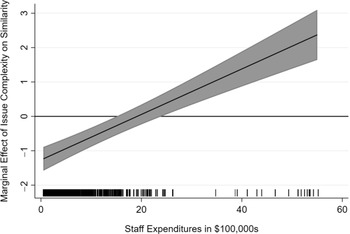
Contrary to expectations, the results show a positive coefficient estimate for the interaction term. Because interaction term coefficients are often difficult to interpret on their own, we present the marginal effect of complexity given staff expenditures in Figure 1. The figure shows that the marginal effect of complexity on similarity is negative at low levels of staff expenditures. This means less professionalised legislatures borrow less as complexity increases. There is a null relationship for in the mid to high range of staff expenditures. High resources legislatures seem to borrow more as complexity increases.
Marginal effect of issue complexity on similarity scores given expenditures.

One way to read these results is that low-expenditure states reinvent complex policies while high-expenditure states copy complex policies. However, we want to caution against the latter of these two conclusions. First, the data are fairly sparse in the right-hand side of the expenditures distribution in Figure 1, meaning that the conclusion could be driven by a small number of cases. Secondly, we find evidence that high-expenditure states innovate more on both simple and complex policies.
To illustrate this dynamic graphically, we present the predicted values of similarity from the second model of Table 2. The left panel displays bill similarity in a state at the 25 th percentile of staff expenditures. Moving from the minimum to the maximum value of complexity, the predicted similarity of a bill to any previous bill decreases from 75.4 to 59.0 The right panel displays bill similarity in a state at the 95 th percentile of staff expenditures. Moving from the minimum to maximum value of complexity, the predicted similarity of a bill to any previous bill stays flat, only slightly increasing from 62.2 to 63.3.
Though it seems at first blush from the initial results that high-expenditure states borrow relatively more language from complex than simple policies, Figure 2 demonstrates that high-expenditure states exhibit a low level of borrowing for both complex and simple policies in an absolute sense. That is not the case for low-expenditure states. The results here suggest that legislatures with lower staff resources are especially likely to borrow language on relatively simple policies. Instead, they commit their limited resources to reinvent complex policies. In these states, language borrowing is lower for complex policies in an absolute sense, while it is higher for simple policies in an absolute sense.
Predicted values of similarity.

Because these findings are rather abstract, we illustrate the relationship with two concrete examples from the data. First, consider the relatively simple policy of in-state tuition for undocumented immigrants. On average, tuition policies passed by states had a complexity score of 94, which is the third-lowest of the 18 policies we explore. Footnote 10 The policy was originally adopted by Texas and California in 2001. New York, a highly professional legislature, adopted a similar policy in 2002 and Minnesota, a state that spends less than average on legislative staff, also passed a similar policy in 2013. Minnesota’s legislation borrows word-for-word from California’s, requiring “high school attendance” in the state for “three years or more” and documentation “that the student has filed an application to obtain lawful immigration status” in order to receive in-state tuition benefits. Minnesota differs slightly in that it requires documentation of selective service registration. The similarity between these bills is 0.73. New York’s statute (similarity score of 0.46), which exhibits much more reinvention, requires only two years of attendance and appends numerous implementation instructions to the board of trustees for treating undocumented students enrolled at state universities. This example illustrates our the empirical finding that low-expenditure states are more likely to eschew reinvention and borrow significantly from previous adopters for simple policies.
Secondly, consider the example of a more complex policy in our data, public breastfeeding laws, pioneered by North Carolina in 1993. This policy had the highest average complexity of the 18 policies in our sample. The original bill simply exempted breastfeeding women from prosecution under public exposure laws in the state. As policies allowing for public breastfeeding diffused, states reinvented the policy quite widely, resulting in a low average similarity score regardless of resources. The cases of Illinois, which has a very professional state legislature, and its neighbor Iowa, which has a less professional state legislature, are illustrative. The states adopted public breastfeeding laws in 2001 and 2002, respectively. Illinois’ bill is fairly dissimilar to the most similar previous adopter, with a similarity score of 0.49. Illinois’ laws contain a number of wide-ranging provisions by legalising breastfeeding in public places, maintaining the right of religious groups to disallow breastfeeding in places of worship, specifying legal recourse for women not permitted to breastfeed in public places, and enjoining employers to permit women unpaid breaks to breastfeed. Iowa also has a fairly unique bill, with a similarity score of 0.42. Iowa’s bill legalises public breastfeeding, but its only other provision is to excuse breastfeeding women from jury service if they are not “regularly employed at a location other than the person’s household.” This example illustrates that states, regardless of staff expenditures, are likely to reinvent more complex policies.
Returning briefly to Table 2 for findings on the control variables, the coefficient estimate for the term limits indicator is positive and significant in both models, meaning states with term limits tend to borrow more, and reinvent less, than other states. The results also show that there is significantly more borrowing on policies with interest group model legislation. Coefficient estimates for the border, ideological distance, government ideology, per capita income, time and order variables were all significant and in the expected direction. The exception was for the time variable in the second stage of the first model, which was in the expected direction but not statistically significant.
We also note that the Inverse Mills Ratio (IMR) near the bottom of Table 2 indicates that the selection effects for our 18 policy samples are statistically significant, though the correlation between the error terms of both equations (ρ) is relatively small. The Heckman model matches our theory, data structure, and helps to correct for selection bias even though the correlation is not strong. In the following section, we show that our results are robust under an alternative hierarchical model specification.
Alternative model specification
Given the selection effects in the models presented in Table 2 were significant though not large, we also present the results from an alternative model specification. Similar results from both models can bolster our confidence that the results are not due to model choice. Given our data is hierarchically structured in state-policy-years, we model similarity using a multilevel mixed-effects GLS model with policy fixed effects and state and year random effects. Footnote 11 We calculate standard errors using an unstructured covariance matrix in order to account for multiple random effects in the model.
We compare the coefficient estimates from the second stage of the Heckman models presented in the paper to the coefficients from the MLM in Figure 3. The results for our key independent variables—staff expenditures, issue complexity and its interaction—are of the same direction and level of significance. The parameter estimates on our other estimates match as well, with the exception of model legislation. This is perhaps because model legislation was included in both stages of the Heckman model.
Comparing coefficient estimates from the Heckman model to mixed-effects multilevel model.

Alternative measurement strategy
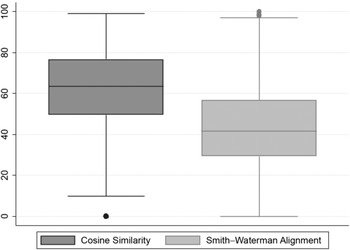
We have employed cosine similarity as our measure of text similarity. Recent advances by Wilkerson et al. (Reference Wilkerson, Smith and Stramp2015) and Linder et al. (Reference Linder, Desmarais, Burgess and Giraudy2020) demonstrate the advantages of using Smith–Waterman alignment scores for measuring similarity. The Smith–Waterman algorithm finds the optimal alignment between two texts and awards a score by rewarding matched words and penalising mismatched words and gaps between matches. Wilkerson et al. (Reference Wilkerson, Smith and Stramp2015) and Linder et al. (Reference Linder, Desmarais, Burgess and Giraudy2020) use Smith–Waterman alignment scores to find possible matches in corpuses of thousands of bills, whereas we are attempting to detect similarity in defined policy areas. Nonetheless, there could be an advantage for our application of defined policy areas since the Smith–Waterman algorithm takes word order into account while cosine similarity does not. Thus, we calculate the optimal Smith–Waterman alignment score for the bill text of each adopting state and previous adopters of the policy. Footnote 12 Due to some extreme outlier alignment scores on bills that were very similar to previous adopters and lengthy, we also take the natural log of the alignment score and scale the scores from 0 to 100 for ease of comparison with the cosine similarity scores.
The box plot in Figure 4 shows how the two variables compare central values and range. The two are comparable, though the Smith–Waterman algorithm scored the bills as less similar, on average, than the cosine method. The two measures are Pearson correlated at r = 0.83 and have a similar rank order with a Spearman correlation of 0.81.
Box plot of similarity scores and alignment scores.

We further reestimate the models in Table 2 using alignment scores as our dependent variable. The results are presented in Table A.3 in the appendix. We find similar substantive results as the models presented above. In results not reported, we obtain the same results even if we do not log the variable or scale it from 0 to 100.
Additional robustness checks
To further assess the robustness of our results to alternate measurement and specifications strategies, we estimate a series of models presented in Table 3. First, we checked for the possibility of a curvilinear relationship between resources and text borrowing, with the expectation that text borrowing decreases at a faster rate as resources increase. We included a squared term for staff expenditures, as well as the squared term’s interaction with complexity. The results are presented in the first column of Table 3. Neither coefficient estimate for the squared term for staff expenditures or its interaction with complexity is statistically significant, and so we find no evidence of a curvilinear relationship.
Alternative specifications for selection model of policy language diffusion

Note: p ≤ .05. Robust clustered standard errors are in parentheses. Significance tests are two-tailed. Constant omitted for space.
Secondly, the models in Table 2 use a measure of complexity as the average value of the FRE scores of all bills within a given policy area. In doing so, we assume that bills within a policy are equally complex and do not allow for variation in the complexity of individual bills within policies. To make sure our results are robust if we relax that assumption, we observe Individual Complexity using FRE scores for each observed bill. The results are reported in the second column of Table 3. The coefficient estimate for the Individual Complexity variable remains negative and statistically significant, and the coefficient estimate for its interaction with staff expenditures remains positive and statistically significant. In both cases, the size of the estimate is substantively smaller, suggesting that the relationship between complexity and text borrowing is weaker when complexity is measured at the bill level. However, we can draw similar conclusions about the direction and significance of the relationship using both measurement strategies.
Thirdly, Makse and Volden (Reference Makse and Volden2011) find that greater policy complexity slows the rate of policy adoption as a policy diffuses (see also Nicholson-Crotty Reference Nicholson-Crotty2009). This finding suggests that complexity might play a role not only in the second stage of our model, in which we model text borrowing, but also in the first stage, in which we model adoption. This could pose a challenge to our conclusions if the failure to include complexity in the first stage changes the estimates obtained in the second stage. We estimate a third alternative model including complexity among the first stage variables and report the results in the third column of Table 3. Here we find no relationship between policy complexity and policy adoption in the first stage, nor do we see much in terms of substantive changes to the results obtained in the second stage compared with the original results.
Fourthly, we consider whether the results obtained in the original model hinge on the inclusion of the Word Count control. Because we expect longer texts to be more complex, it could be that including the control drives our results and removing the control gives a better picture of the relationship between complexity and text borrowing. Before proceeding, we should note that the correlation between complexity and the word count in our data is actually negative (r = −0.12), contrary to our expectations. We present a full model in the fourth column of Table 3 excluding the control. We find little in terms of substantive changes to the results when it is excluded. Finally, the results for random effects for policy in both stages are presented in the fifth and sixth columns of Table 3. The only structural difference in the model was that salary and session length were dropped, and the ideological distance was simplified so that it only measured the distance between the observed state and the initial adopter. These choices were made in order to achieve model convergence as the models were estimated using the cmp package in Stata which is sensitive to variables that are moderately correlated with others in the model (in this case, salary and session length with staff expenditures, and ideological distance with government ideology). Again, we find little change in the statistical or substantive significance of the principal variables, though there are some differences with the estimates for control variables.
Does complexity increase through the diffusion process?
Finally, we explore whether the copying legislature makes the bill itself more or less complex. In specifying our principal models, we assume that the complexity is a fixed characteristic of a policy as it diffuses by measuring complexity as the average FRE score of all iterations of that policy. However, previous research on policy reinvention suggests that policies become more comprehensive as they diffuse (Glick Hays Reference Glick and Hays1991; Mooney and Lee Reference Mooney and Lee1995). Growing comprehensiveness might indicate growing complexity over time as new and perhaps esoteric provisions are added with each new adoption of the policy. We explore this possibility here to justify our assumption of fixed complexity in the models.
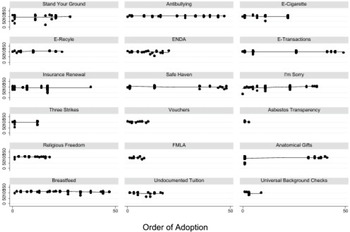
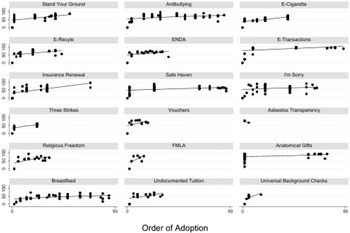
We first plot complexity by order of adoption for each policy area. This will help us assess whether as policies diffuse, they become more complex—an important leading indicator of whether there may be something to legislatures copying and adding complexity. What we find is that for very few policies does complexity increase as legislatures adopt. Most of the best-fit curves are flat; a few are negative, and even fewer are positive. These plots are depicted in Figure 5. Compare these plots to those in Figure 6, which shows the relationship between the order of adoption and similarity. For most policies, the relationship is positive—states’ policies are more similar to previous adopters’ policies as the diffusion process unfolds. We do not find this same pattern for complexity.
Order of adoption and complexity.

Order of adoption and similarity.

Discussion and conclusion
Our results add to the growing literature that argues that the resources available to a legislature are related to its capacity to act independently and innovatively. Previous scholarship shows that more professional legislatures are better able to check the executive branch (Squire Reference Squire1992) and produce innovative policies (Kousser Reference Kousser2005). We expected that legislatures with few staff resources would be hamstrung in their ability to reinvent complex policies. The results show instead that states with few staff resources take shortcuts on relatively simple policies, copying much of the language from previously adopting states. However, these states devote their limited staff resources to making changes to complex policies, doing so at about the same level as much more professionalised legislatures. Legislative salary and session length do not seem to play a role in this process. The results again point to the need to disaggregate measures of professionalism and think about which facet of professionalism is likely to affect the political process being studied (Bowen and Greene Reference Bowen and Greene2014). Although the third hypothesis was not supported, the results are informative. While still less innovative than professional legislatures, citizen legislatures retain some legislative capacity to research and innovate on complex policy solutions.
How should we view these results? The optimist might argue that rather than implementing quick fixes to complex problems, legislators in low resources legislatures exercise due diligence on complex policy in order to make good public policy. In this way, the results are normatively encouraging. However, it is also possible that devoting resources to complex policies comes not from a desire to create good policy, but because the staff is actually driving the allocation of resources towards tough policies in order to reduce error. Unfortunately, the data and analyses presented here cannot adjudicate which motivation is affecting how legislators and legislative staff in citizen legislatures decide to allocate their time and resources.
Still, the lesson to be taken from this study is not that legislative resources can be cut without affecting policymaking. Instead, the results show that a lack of robust staff resources means that legislators must ration resources, devoting staff to the most complex policies the state is considering while taking shortcuts elsewhere. In effect, this means that state residents are not getting as much specialised representation on relatively simple issues; legislators in citizen legislatures are merely implementing solutions developed elsewhere.
The results also show that states with legislative term limits exhibited significantly less tendency to reinvent policy, all else equal, and policies with interest group model legislation were much more likely to be copied than policies without model legislation. These trends could be exacerbated if the legislative staff is further cut, as under-resourced legislatures have shown more vulnerability to influence from interest groups (Drutman Reference Drutman2015). Limiting or reducing spending on legislatures and their staffs force legislators to ration and can compromise their ability to fully function as representative bodies. So far, however, legislators appear to remain focused on tailoring complex policies for their states while taking shortcuts elsewhere.
Acknowledgements
We thank Andrew Karch for helpful comments. All errors remain the responsibility of the authors. Previous versions of this paper were presented at the 2019 Midwest Political Science Association Conference and the 2019 State Politics and Policy Conference.
Supplementary material
To view supplementary material for this article, please visit https://doi.org/10.1017/S0143814X20000252.
Data Availability Statement
Replication materials are available in the Journal of Public Policy Dataverse at https://doi.org/10.7910/DVN/K4AJYW