Paradoxes of Liberal Democracy insightfully analyzes the motivations underlying tolerant or intolerant attitudes among the Danish public. Its key finding is that in the face of angry Muslim demands that their values take precedence over Danish emphasis on free speech, ordinary Danes remained steadfast in supporting Muslim rights. The authors argue that they did so because they were able to distinguish between a Muslim majority—who accept Danish society’s rules and therefore merit its rights—and Islamic fundamentalists, who do not. Consequently, there was no anti-Muslim backlash.
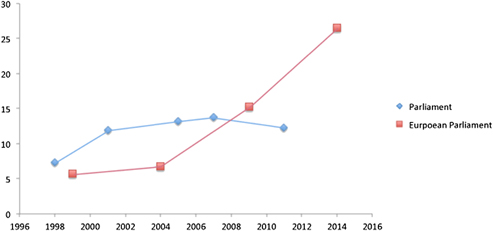
This interpretation is convincing but it has a problem. At the height of the cartoon crisis in 2005–6, there was no backlash. In 2014 there was. As Figure 1 demonstrates, the vote for the overtly anti-Muslim Danish People’s Party has risen dramatically in national elections. In 2004, before the crisis erupted, it won 7% of the vote in Danish elections to the European Parliament. In subsequent elections in 2005, 2007, 2009 and 2011, it won 13%, 14%, 15%, and 12%, respectively. In May 2014, it made a dramatic surge, winning 27% of the vote in elections to the European Parliament, making it Denmark’s largest party. This was not a passing fluke. A representative national survey in November 2014 showed that the Danish People’s Party still drew more support than any other party. Footnote 1
Percentage of the vote won by Danish People’s Party in national elections, 1998–2014
Note: The 1998, 2001, 2005, 2007, and 2011 elections were for the lower house of the Danish parliament; the 1999, 2004, 2009, and 2014 elections were for the European Parliament.
Source: “Danish People’s Party.” Wikipedia. <http://en.wikipedia.org/wiki/Danish_People%27s_Party> (January 28, 2015).

The book offers no explanation for this surge in support for a xenophobic party. It emphasizes the importance of values, but applies a static cognitive interpretation: The crucial point is that ordinary Danish citizens could distinguish between a deserving Muslim majority and undeserving Islamic fundamentalists. Consequently, they accorded Muslims the same rights as other Danes. At times, the authors suggest that the Danish public was responding to elite cues provided by the leaders of the major political parties; at other times, they emphasize the importance of Denmark’s enduring cultural heritage. Neither elite cues nor Denmark’s cultural heritage changed dramatically from 2006 to 2014—but the electorate’s behavior did.
Other authors emphasize the impact of dynamic factors on xenophobia, arguing that economic and physical insecurity is conducive to xenophobia, but that with rising levels of security, people become increasingly tolerant of outgroups. Footnote 2 This interpretation of value change suggests that the 2014 surge of xenophobia in Denmark and many other countries reflected the heightened insecurity of the Great Recession of 2007–12.
About 45 years ago, I argued that “a transformation may be taking place in the political culture of advanced industrial societies. This transformation seems to be altering the basic value priorities of given generations as a result of changing conditions influencing their basic socialization.” Footnote 3 Subsequent birth cohort analysis based on hundreds of surveys carried out from 1970 to 2008 suggests that the relatively high levels of economic and physical security experienced by postwar birth cohorts actually did bring an intergenerational shift from Materialist to Postmaterialist values, as younger cohorts gradually replaced older ones in the adult population. Footnote 4 But this analysis also reveals clear period effects, reflecting current economic conditions: The intergenerational difference persists, but in times of insecurity, all cohorts shift toward more Materialist views—and with economic recovery, they shift back toward their long-term baseline, so that across this 38-year span, given cohorts remain at least as Postmaterialist as they were at the start.
This theory of value change implies that relatively secure people will be more tolerant than less secure ones, and vice versa. I described this logic in 1997:
In an agrarian or hunting and gathering society in which the land supply is just sufficient to feed the existing population, the arrival of a foreign group poses a direct threat to survival: in such situations, xenophobia is realistic and almost certain to arise. In a technologically advanced society foreigners … do not pose a threat to survival, and may even enhance the standard of living. But in times of economic or political crisis, even advanced industrial societies are prone to xenophobia, as the rise of fascism during the Great Depression demonstrated, and as recent events in Western Europe and the U.S. continue to demonstrate… . Conversely, at the individual level, Postmaterialists—those who have grown up under conditions of relative economic and physical security—tend to be relatively tolerant of people with different ethnicity or sexual orientations and are relatively supportive of gender equality. (Inglehart Reference Inglehart1997, 81).
In other words, as one moves from extreme insecurity to conditions where survival is reasonably secure, one moves from xenophobia to tolerance; and moving still farther on the Survival/Self-expression dimension, Footnote 5 ethnic diversity is not merely tolerated but is seen as interesting and stimulating (consistent with the emphasis of Paradoxes on Inclusive Tolerance). People go out of their way to taste new cuisines and spend large sums to experience exotic cultures. Footnote 6
Confirming this interpretation, Pippa Norris, Christian Welzel, and I present evidence that economic development—together with declining vulnerability to starvation, disease, and violence—bring a shift from Survival values to Self-expression values, of which Postmateriaism is one component. Footnote 7
The emergence of these values gave rise to a New Politics dimension, cutting across the long-established economic Left–Right dimension based on polarization over economic redistribution, with communist and socialist parties on the Left and economically conservative parties on the Right. From the start, the rise of Green and other Postmaterialist movements stimulated an authoritarian/traditionalist reaction, with less secure segments of the working class abandoning their allegiance to the Left, shifting their support to authoritarian, antiforeign parties that defended traditional cultural values. Thus, the vertical dimension that the authors of Paradoxes label Authoritarian/Libertarian corresponds to my New Politics dimension, with Postmaterialist parties such as the Greens at one pole and Authoritarian/Xenophobic parties such as France’s National Front Party or Denmark’s Danish People’s Party at the opposite pole.
The findings of Paradoxes of Liberal Democracy map almost perfectly onto this dynamic interpretation of value change. It explains why Denmark—one of the world’s most secure societies—has long showed exceptionally high levels of tolerance. Footnote 8 And it also suggests why in 2014, a larger share of the Danish electorate voted for the Danish People’s Party than for any other party: The Great Recession of 2007–14, together with the euro crisis and growing tensions with Russia, had brought much less secure conditions than those of 2005–6.
This dynamic interpretation on value change also explains one of the book’s most intriguing findings: that those who are low on tolerance but favor economic redistribution—whom the book labels the “Traditionalist Left”—are much more likely to perceive a Muslim threat than are any other group. Paradoxes finds that this group shows very low levels of knowledge. Push the analysis farther, and one would almost certainly find that they also rank relatively low on education, income, and occupational status; this group corresponds to the less secure strata of the working class, who have been shifting their support to authoritarian and xenophobic parties on the New Politics dimension.
This book argues convincingly that the Danish public was able to distinguish between Muslims and Islamic Fundamentalists, and consequently there was no backlash against Muslims under the relatively secure conditions of 2005–6. But cognitive factors such as these are only part of the story. More recently, under the insecure conditions of the Great Recession, Denmark experienced a surge of xenophobia that made the Danish People’s Party the country’s strongest party. This is not the first time insecurity has led to rising xenophobia. Under the relatively secure conditions of 1928, the German electorate viewed the Nazis as a lunatic fringe party, giving them less than 3% of the vote in national elections. After the onset of the Great Depression, in 1933 the Nazis won 44% of the vote, becoming the strongest party in the Reichstag.
Paradoxes is a stimulating and interesting book that persuasively emphasizes the importance of cognitive factors. When its analysis is supplemented by a dynamic perspective on value change, its findings become even more convincing.