A particular linguistic skill that seems very challenging to acquire in a second language (L2) is the use of spatial terms, in particular spatial pre- or postpositions (e.g., Alonso, Cadierno, & Jarvis, Reference Alonso, Cadierno, Jarvis and Alonso2016; Bryant, Reference Bryant2012; Coventry & Garrod, Reference Coventry and Garrod2004; Coventry, Guijarro-Fuentes, & Valdés, Reference Coventry, Guijarro-Fuentes and Valdés2012; Grießhaber, Reference Grießhaber1999; Ijaz, Reference Ijaz1986; Lütke, Reference Lütke and Ahrenholz2008; Munnich & Landau, Reference Munnich and Landau2010). While the acquisition of syntax and the case system in the L2 is similar to first language (L1) acquisition, the acquisition of the genus system and prepositions differs between L1 and L2 (Kaltenbacher & Klages, Reference Kaltenbacher, Klages and Ahrenholz2006). Especially in the case of spatial prepositions, persistent learning difficulties are observable even for children with an early age of acquisition (AoA; Bryant, Reference Bryant2012). Children tend to use the wrong prepositions in different configurations, as for instance using the word auf (“on”) instead of über (“above”) as in the following expression from a 9-year-old Turkish child, who started learning German at the age of 4: “Die Teekanne ist auf dem Ofen” (“The teapot is on the oven”) in response to a picture showing a teapot on a shelf above an oven (Bryant, Reference Bryant2012). It is also important to note that the later the L2 is learned, the greater the differences between L1 and L2 acquisition of German become, and therefore, L2 learners experience greater difficulties in acquiring the L2 with increasing AoA (Hyltenstam & Abrahamson, Reference Hyltenstam, Abrahamsson, Doughty and Long2003; Long, Reference Long1990; Rösch, Reference Rösch2001).
Spatial pre- or postpositions are part of the fine-structural level of a language (Talmy, 1983), and they allow speakers to describe where objects are in space, and listeners to find objects based on simple locative descriptions in which one object is located in relation to a reference object (Coventry, Prat-Sala, & Richards, 2001). Communicating by means of these spatial terms can be seen as a basic skill of a competent speaker, as spatial descriptions pervade our lives and occur in a wide range of contexts, from locating objects, to reasoning about the world, to understanding the concept of place (Coventry & Garrod, Reference Coventry and Garrod2004). Although spatial pre- or postpositions originally exclusively encoded spatial relations between physical entities, over time these spatial terms have also developed a rich set of nonspatial meanings (Tyler & Evans, Reference Tyler and Evans2003) and are used in more abstract and metaphorical configurations, for instance, when talking about the temporal domain (e.g., the future lies before us, while the past is behind us), the quantitative domain (e.g., more is up, while less is down), or when talking about mood (e.g., happy is up, while sad is down; Coventry & Garrod, Reference Coventry and Garrod2004; Cuyckens & Zawada, Reference Cuyckens and Zawada2001; Tyler & Evans, Reference Tyler and Evans2003).
One possible reason for the learning difficulties of spatial pre- or postpositions may be that the source language and the target language differ with respect to the nature of spatial categorization, and learners therefore run into difficulties when trying to transfer aspects relating to spatial categorization from their L1 to the L2. This concept of transfer or cross-linguistic influence is seen as a multifaceted phenomenon (Jarvis & Pavlenko, Reference Jarvis and Pavlenko2008) accepted by the majority of linguists. However, some researchers (e.g., Krashen, Reference Krashen, Gass and Selinker1983; Newmark, Reference Newmark1966) claim that influences of L1 on L2 are merely temporary communicative strategies due to knowledge gaps in L1 and not due to interference. Accordingly, they declare this phenomenon to be of marginal interest for L2 acquisition. A main theory in transfer research is the contrastive analysis hypothesis developed by Fries (Reference Fries1945) and Lado (Reference Lado1957) stating that similar structures in L1 and L2 lead to a positive transfer with an easy acquisition, whereas structural differences cause acquisition difficulties (negative transfer). While a strong version of the contrastive analysis hypothesis could not be maintained because of a large amount of empirical counterevidence (e.g., Hernández-Chávez, Reference Hernández-Chávez1972; Hyltenstam, Reference Hyltenstam1977; Kleinmann, Reference Kleinmann1977), a weaker version of it is overall well received.
Phenomena of linguistic transfer have been observed in all language areas, including phonology (Leather, Reference Leather, Mayo and Lecumberri2003), morphology (Collins, Reference Collins2002), and syntax (Schwartz & Sprouse, Reference Schwartz and Sprouse1996; White, Reference White2003). The phenomenon we discuss in this paper relates to language-mediated concepts and belongs therefore to conceptual transfer. As Jarvis and Pavlenko (Reference Jarvis and Pavlenko2008, p. xii) point out, “Languages differ with respect to the aspects of reality that they give prominence to. These differences have implications for how speakers of different languages perform both verbal and nonverbal tasks in either their native or a later-learned language.”
Languages often differ in the way in which they map linguistic terms onto spatial relations (Coventry & Garrod, Reference Coventry and Garrod2004). Thus, the way the L2 carves up the world into spatial categories is often quite different from the way the L1 carves up the world (Becker & Carroll, Reference Becker and Carroll1997). According to the thinking-for-speaking hypothesis (Slobin, Reference Slobin, Gumperz and Levinson1996, p. 89), “[. . .] each native language has trained its speakers to pay different kinds of attention to events and experiences when talking about them.” The training of spatial categorization and its labeling begins during childhood: at the early age of 14 to 20 months children begin to talk about space, and they do so according to the conventions of the target language (Choi & Bowerman, Reference Choi and Bowerman1991). According to Slobin (Reference Slobin, Gumperz and Levinson1996), once a category is set, it shows a strong resistance to a posterior restructuring. As a consequence, acquiring L2 prepositions should be more difficult for learners whose L1 exhibits fewer or different spatial categories (Coventry et al., Reference Coventry, Guijarro-Fuentes and Valdés2012). Languages like German, English, or Russian, for instance, differ from languages like Turkish and Korean with respect to the upper subspace. German, English, and Russian distinguish between locations at the boundary between reference object and relatum (auf “on”) and locations in the upper subspace (über “above”). If a reference object has contact with the upper surface of the relatum, a boundary relation is used (Becker & Caroll, Reference Becker and Carroll1997). In contrast, a reference object in Turkish or Korean can be located in the upper subspace regardless of contact (Becker & Carroll, Reference Becker and Carroll1997; Munnich, Landau, & Dosher, Reference Munnich, Landau and Dosher2001). Therefore, with regard to the vertical axis, the feature “contact” in those languages is irrelevant. If categories are not set in L1, it is possible that the learners do not notice them in the L2 input. In line with this idea, Bryant (Reference Bryant2012) showed that learners of German as L2 with Turkish as L1 detected the frequent auf (“on”) as the sound string for their L1 concept of “upper subspace” and consequently used auf in “on” as well as in “above” configurations.
In research on the psychology of language, the theory of experiential traces (Zwaan & Madden, Reference Zwaan, Madden, Pecher and Zwaan2005) has received much attention during the last decade. According to this theory, bodily experiences are a crucial part of language comprehension. This account has gained a high degree of support in L1 research, and we now want to investigate whether it also applies to L2 processing. In particular, we believe that this account will contribute to a better understanding of the specific difficulties that L2 learners face when trying to acquire the meanings of German spatial prepositions. The theory of experiential traces (Zwaan & Madden, Reference Zwaan, Madden, Pecher and Zwaan2005) is part of the rather new framework of embodied cognition in which language is seen as tightly linked to perception and action (Barsalou, Reference Barsalou1999, Reference Barsalou2008). According to this theory, during every interaction with the world, a trace resembling the actions and perceptions of this experience is generated. These traces are later reactivated when accessing the same concept. In that sense, language comprehension is the reactivation of experiential traces. More specifically, when linguistic labels often co-occur with certain objects, situations, and events in early childhood, experiential traces stemming from hearing a word get associated with the experiential traces stemming from experiencing its referent. Thus, a word such as dog gets associated with experiential traces stemming from hearing, smelling, seeing, or touching a dog. Later on, when the word is processed, these traces become reactivated and presumably provide the basis for comprehension. Similar assumptions can be made for spatial prepositions. When a small child hears a spatial preposition such as on or under, this will often be in a situation where someone (possibly the child itself) places a reference object into a particular spatial location (e.g., Look, I am placing the plant on the table) or draws attention to a particular spatial relation in the context (e.g., Look, the cat is under the chair). Thus, with years of co-occurrences of this type, spatial prepositions will become associated with a rich set of experiential traces that stem from experiencing reference situations that can be described by means of these prepositions. These experiential traces then presumably become reactivated when the spatial prepositions are encountered again, and provide the basis for comprehension.
The theory of experiential traces has gained a lot of support in the field of L1 processing (e.g., Glenberg & Kaschak, Reference Glenberg and Kaschak2002; Richter, Zwaan, & Hoever, Reference Richter, Zwaan and Hoever2009; for an overview, see Jirak, Menz, Buccino, Borghi, & Binkofski, Reference Jirak, Menz, Buccino, Borghi and Binkofski2010, or the contributions in Coello & Fischer, Reference Coello and Fischer2016; Fischer & Coello, Reference Fischer and Coello2016). For example, Lachmair, Dudschig, De Filippis, de la Vega, and Kaup (Reference Lachmair, Dudschig, De Filippis, de la Vega and Kaup2011) investigated the activation of location information using words whose referents are typically found in the upper vertical space (e.g., airplane) or lower vertical space (e.g., worm). In one of their experiments, the original Stroop paradigm (Stroop, Reference Stroop1935) was adapted to investigate the processing of these words. In particular, the native German participants in this experiment responded to up and down words with upward or downward movements depending on the font color. Reading the words or accessing their meaning was not required by the experimental task. Nevertheless, a strong compatibility effect could be observed with shorter response times in compatible conditions (e.g., airplane and upward response) compared to incompatible conditions (e.g., airplane and downward response), suggesting that experiential traces became automatically activated when processing individual words. Spatial compatibility effects of this sort have proven to be extremely stable. They were observed no matter whether the task required lexical access and no matter whether participants noticed the manipulation. They were also observed for verbs (e.g., rising vs. falling) and for masked stimuli. Finally, these spatial compatibility effects were also observed in tasks focusing on attention shifts to the upper or lower space, as well as in tasks involving the planning of eye movements toward upper or lower locations (for an overview, see Kaup, de la Vega, Strozyk, & Dudschig, Reference Kaup, de la Vega, Strozyk, Dudschig, Fischer and Coello2016). In addition to the above-mentioned studies showing the automatic activation of sensorimotor processes in language comprehension, there are also studies showing that sensorimotor processes can foster comprehension skills. For instance, Glenberg, Brown, and Levin (Reference Glenberg, Brown and Levin2007) found that manipulating objects mentioned in a text could improve text comprehension in 6- to 8-year-old children. Compared to children who only reread the text, children who manipulated the relevant objects were able to answer questions about the text with higher accuracy and could even draw inferences. This supports the view that learning through different senses and connecting these learning experiences to linguistic expressions can foster learning and language comprehension abilities.
The results discussed so far focused on processing and acquiring an L1. While this research supports the view that a network of experiential traces is built during L1 acquisition, what happens when people learn and use an L2 remains unclear. However, whether the theory of experiential traces is transferrable to L2 comprehension certainly is an important question. Theoretically, one possibility would be that the terms of the L2 get integrated into the already existing network of experiential traces that was built up during L1 acquisition. Alternatively, the L2 might stay separated from the L1’s experiential network and gradually get connected to experiential traces obtained during the use of the L2. These two possibilities seem to fit well with considerations from the literature on L2 acquisition. Some models of L2 acquisition propose that the semantic representations of L1 and L2 are shared across languages (e.g., the revised hierarchical model; Kroll & Stewart, Reference Kroll and Stewart1994; the bilingual interactive activation plus model; Dijkstra & Van Heuven, Reference Dijkstra and Van Heuven2002). Applied to the experiential traces account, these models would predict that embodiment effects should be observed in both L1 and L2 processing. Other models argue that semantic representations in the L2 are partially overlapping with L1 representations but may be less detailed (see the sense model; Finkbeiner, Forster, Nicol, & Nakamura, Reference Finkbeiner, Forster, Nicol and Nakamura2004). This would lead to the prediction that embodiment effects in L2 speakers are reduced or absent, at least when language proficiency is still rather low and learners have little everyday experience with using the language (De Grauwe, Willems, Rueschemeyer, Lemhöfer, & Schriefers, Reference De Grauwe, Willems, Rueschemeyer, Lemhöfer and Schriefers2014).
There is a growing body of research investigating embodiment effects in L2 learners (e.g., Bergen, Lau, Narayan, Stojanovic, & Wheeler, Reference Bergen, Lau, Narayan, Stojanovic and Wheeler2010; De Grauwe et al., Reference De Grauwe, Willems, Rueschemeyer, Lemhöfer and Schriefers2014; Dudschig, de la Vega, & Kaup, Reference Dudschig, de la Vega and Kaup2014). De Grauwe et al. (Reference De Grauwe, Willems, Rueschemeyer, Lemhöfer and Schriefers2014) found evidence for embodiment for L1 as well as for L2 speakers on a neural basis. In their functional magnetic resonance imaging study, the participants, Dutch native speakers and German native speakers who learned Dutch as an L2, did a lexical decision task on visually presented Dutch motor and nonmotor verbs. The participants had to respond to pseudowords (i.e., pronounceable words that do not carry a meaning, e.g., ralmen) and withhold their responses to actual words allowing the authors to measure brain activity while the participants were passively reading the words. After the main experiment, the participants rated the words for motor-relatedness. Both L2 and L1 speakers showed similar increases of activation in the motor and sensory-motor brain areas for motor compared to nonmotor verbs, for both cognates (orthographically similar words depicting the same meaning in the two languages, e.g., nemen in Dutch and nehmen in German) and noncognates (orthographically dissimilar words depicting the same meaning in the two languages, e.g., gooien in Dutch and werfen in German). This result is interesting, as it shows the involvement of the motor cortex during motor word comprehension and thus embodiment of these words in L2 speakers and thereby supports the view of the revised hierarchical and bilingual interactive activation plus models. In addition, Dudschig et al. (Reference Dudschig, de la Vega and Kaup2014) were also able to find evidence for embodiment effects in L2 speakers of English with German as L1 in a behavioral paradigm. They used the Stroop paradigm from Lachmair et al. (Reference Lachmair, Dudschig, De Filippis, de la Vega and Kaup2011) to investigate whether L2 words, referring to objects typically located in the upper or lower vertical space, would automatically activate location-specific experiential traces and thus facilitate upward or downward responses, respectively. Their participants saw L2 English words like sun and root presented in different colors and got the instruction to respond only to the font color with the corresponding upward or downward movement. The results revealed a typical compatibility effect, with faster responses for compatible trials (e.g., upward response to sun) compared to incompatible trials (e.g., upward response to root). This study thereby showed that a reactivation of experiential traces also takes place in L2 processing.
The studies mentioned so far mainly focused on the processing of words that exist in both L1 and L2. However, many words do not have a direct equivalent in different languages (Bowerman, Reference Bowerman, Bloom, Peterson, Nadel and Garrett1996; Stringer, Reference Stringer, Han and Cadierno2010), as discussed above for the spatial prepositions auf and über. The question now arises whether words of the L2 that have no direct equivalent in the L1 are integrated into the already existing network of experiential traces of L1, and if so, how exactly this is accomplished. In the present study, we investigated how spatial prepositions are processed by learners of German as an L2 as well as by German native speakers. We were particularly interested in comparing embodiment effects related to the processing of spatial prepositions in German native speakers with the embodiment effects potentially observed in different groups of L2 learners. For that reason, we investigated German native speakers and compared them to L2 speakers whose native language uses similar spatial terms as German with respect to the upper part of space (English and Russian) and L2 speakers whose native language uses different spatial terms than German (Turkish and Korean). The English prepositions on and above,Footnote
1
and the Russian prepositions на (na) and над
Footnote
2
(nad) can be seen as near equivalents to auf and über. In contrast, Turkish uses either üstünde or üzerinde,Footnote
3
which are used interchangeably, and Korean uses only
 Footnote
4
(wi) for both spatial configurations plus or minus (±) contact in the upper subspace. One additional difference is that, while English and Russian use prepositions, the above-named terms in Turkish and Korean are handled as postpositions (Becker & Carroll, Reference Becker and Carroll1997; Munnich et al., Reference Munnich, Landau and Dosher2001).
Based on Bryant's (Reference Bryant2012) studies and on Slobin's (Reference Slobin, Gumperz and Levinson1996) statement about the rigidity of a category once it is set, our hypothesis was that newly learned words would be connected to the preexisting experiential traces of the L1, and that the nature of the embodiment effects found in the L2 would, therefore, depend on the specific L1 of the participants. More specifically, in our study we focused on the prepositions auf and über, as we predicted differences in the processing of these spatial terms in German native speakers and L2 learners of German depending on the nature of their L1. We presented these terms in an adaptation of the Stroop paradigm, similar to the one used by Lachmair et al. (Reference Lachmair, Dudschig, De Filippis, de la Vega and Kaup2011) and Dudschig et al. (Reference Dudschig, de la Vega and Kaup2014), in which participants were required to respond to the words by an upward or downward movement of the arm depending on the font color of the stimuli. This setup resulted in compatible (e.g., upward response to auf) and incompatible (e.g., upward response to unter) trials. For German native speakers, we expected larger compatibility effects for über compared to auf, because über implies a larger distance between theme and relatum on the vertical axis. In addition, while both auf and über can be used nonspatially in German, nonspatial usage is more common for auf (e.g., Ich freue mich auf die Party “I am looking forward to the party”; aufräumen “to tidy up”). For L2 speakers of German, we predicted different results depending on their particular L1. We expected the English and Russian L1 speakers to show a similar processing difference between auf and über as the German native speakers, because the split of the upper subspace into ± contact is also present in English and Russian. For the Turkish and Korean L1 speakers, we predicted a different pattern. These speakers should show stronger effects for auf in comparison to über. In their L1, the category split of the upper subspace into ± contact is not present, but as auf is much more frequent in the German input,Footnote 5 we expected them to transfer their experiential traces to this term. This prediction is in line with the above-mentioned finding that Turkish learners of German used auf for all instances in which they would have used üstünde or üzerinde in their native language (Bryant, Reference Bryant2012). If we observe different effects depending on the L1 of the participants, this would also fit well with coactivation accounts of bilingualism (e.g., Blumenfeld & Marian, Reference Blumenfeld and Marian2013; Kroll, Bobb, & Hoshino, Reference Kroll, Bobb and Hoshino2014), which assume that in bilinguals both languages, L1 and L2, are always active during language processing. The speaker needs to decide which language to use and then needs to suppress the not needed language. Applied to our hypothesis, this would mean that the experiential traces related to corresponding L1 terms always get coactivated when participants are processing L2 terms. As a result, different groups of participants with different L1s should show different results during L2 processing.
To summarize, we presented three groups of participants (German native speakers, German L2 speakers with Russian or English as their L1, and German L2 speakers with Korean or Turkish as their L1) with four German words, the three prepositions auf, über, and unter related to our hypotheses and the filler item ab. Participants responded to the font color of the words with an upward or downward arm movement, and we expected the compatibility effect to differ in dependence of the native language of the participants.
METHOD
Participants
Overall, 149 people participated in this study in exchange for course credit or financial reimbursement. All participants were students or employees of the University of Tübingen, had normal or corrected-to-normal vision, and gave informed consent prior to participation.
Forty-nine of these participants were German native speakers (38 female, 11 male; age: M = 22.9 years, SD = 4.4 years). Forty-eight participants had German as an L2 and an L1 with a similar split of the upper subspace into ± contact as German (similar-L1 group). Twenty-four of them had English as their L1 and 24 had Russian as their L1. Three participants of this group needed to be excluded, as they were German/English bilinguals. They had learned German from their parents or other family members before entering kindergarten. Of the remaining 45 participants in this group, 31 were female and 14 were male (age: M = 25.9 years, SD = 4.5 years). The last group of participants consisted of 52 people with German as an L2 and an L1 that does not split the upper subspace into ± contact (dissimilar-L1 group). Twenty-four of them were native Koreans and 28 had Turkish as their L1. Nine of the Turkish native speakers had to be excluded, as they were German/Turkish bilinguals. They had learned German from their parents or other family members before they entered kindergarten. Of the remaining 43 participants in this group, 35 were female and 8 were male (age: M = 24.7 years, SD = 5.8 years).
The similar-L1 group started learning German between 8 and 28 years of age (AoA: M = 16.0 years, SD = 5.7 years); the dissimilar-L1 group started learning German between 3 and 26 years of age (AoA: M = 14.5 years, SD = 6.7 years). The AoA did not differ significantly between the groups, t (85) = 1.08, p = .282.Footnote 6 Most of the L2 participants learned at least one additional language other than their native language and German. Except for one Russian-Ukrainian bilingual,Footnote 7 none of them started learning the additional languages before the age of 5 years. Therefore, we can safely assume that the system of experiential traces had already been established in the native language before the participants started learning another language.
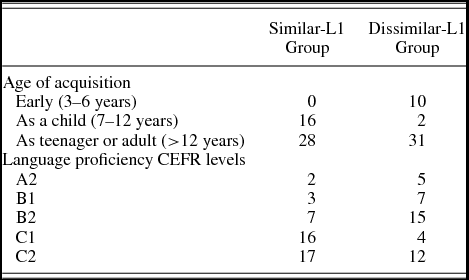
All participants reported to speak German at least at level A2 of the Common European Frame of Reference (CEFR; Verhelst, Van Avermaet, Takala, Figueras, & North, Reference Verhelst, Van Avermaet, Takala, Figueras and North2009; for a detailed description of the CEFR, see below). The similar-L1 group (proficiency: M = 4.9, SD = 1.1) had a higher proficiency than the dissimilar-L1 group (proficiency: M = 4.2, SD = 1.4), t (86) = 2.64, p = .010; however, on average both groups were categorized as independent language users (cf. description below). For an overview of how many participants fell into each AoA and proficiency category, see Table 1.
Distribution of age of acquisition and language proficiency (number of participants per category)

Note: L1, first language; CEFR, Common European Frame of Reference. The stages of language acquisition were adapted from Klein (Reference Klein1992); Language proficiency was measured on a 6-point scale referring to the CEFR levels (Verhelst et al., Reference Verhelst, Van Avermaet, Takala, Figueras and North2009). When participants judged themselves as being between two CEFR levels, we categorized them as the higher one.
Materials and apparatus
Three German words served as stimuli, namely, über, auf, and unter. Hereby, auf and über served as referents for the upper dimension, and unter served as referent for the lower dimension. The preposition unter often comes to mind as a counterpart for the preposition über (über und unter). For counterbalancing purposes, we wanted to have counterparts for both über and auf. We therefore included the word ab (“off/down”) as a filler word in our experimental task because this word often comes to mind as a counterpart for the preposition auf (auf und ab). It is important to note however that the particle ab is not a spatial preposition but mostly combines productively with verbs without expressing the meaning of “down.” Consider, for example, abwischen (“to wipe”), ablehnen (“to reject”), and abmachen (“to arrange”). Its only spatial usage is as part of the directional adverb abwärts (“downward”), which probably also explains why it comes to mind as a counterpart of auf. We thus do not include the word ab in our analyses.
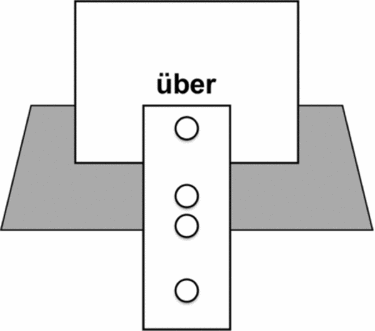
The four words were presented in four different font colors: blue (RGB 0, 0, 255), orange (RGB 255, 128, 0), lilac (RGB 150, 0, 255), and brown (RGB 140, 80, 20). Each word appeared equally often in each color. For each participant, two colors were associated with upward responses, and two were associated with downward responses. By using four colors instead of two, we made the task more complex, which results in overall slower response times. We decided to use this common practice for language experiments using adaptations of the Stroop paradigm (e.g., Lachmair et al., Reference Lachmair, Dudschig, De Filippis, de la Vega and Kaup2011; Dudschig, de la Vega, & Kaup, Reference Dudschig, de la Vega and Kaup2015) because we wanted to make sure that the participants had enough time to process the word before responding. When using only two colors, responses might have been initiated before the meaning of the word had been accessed (cf. the conflict monitoring theory; Botvinick, Braver, Barch, Carter, & Cohen, Reference Botvinick, Braver, Barch, Carter and Cohen2001). Responses were recorded using a PS/2 computer keyboard adapted with a locally constructed overlay (Figure 1).
Experimental setup. The keyboard was implemented under a vertical plane in front of the participants. At the beginning of each trial, the participant pressed the two middle keys, one with the left hand and the other with the right hand. A response was made by releasing the correct middle button (upper middle button for an upward response, lower middle button for a downward response), pressing the upper or lower button, and returning back to the released middle button, while the other hand rested on the respective middle button.

Participants other than German natives received a short questionnaire after the main experiment assessing their language background and proficiency. They were asked how they learned German (e.g., at school), at what age they started to learn, and to rate their language proficiency on a 6-point scale referring to the levels of the CEFR (Verhelst et al., Reference Verhelst, Van Avermaet, Takala, Figueras and North2009). According to the CEFR, language proficiency is divided into six categories: A1, A2, B1, B2, C1, and C2.Footnote 8 The two A levels refer to the learner as a basic user, who interacts with natives in a very simple way and can use basic expressions and later on phrases or describe routines. The B levels see the learner as an independent user who can understand main points of standard conversations and later on texts. At this stage, he becomes able to interact with natives in a more spontaneous and more fluent way. The C levels describe a proficient user, who can use the language flexibly and effectively for social, academic, and professional purposes. In the latest stage, the user virtually understands everything that is heard or read, and even is able to use idiomatic expressions (Verhelst et al., Reference Verhelst, Van Avermaet, Takala, Figueras and North2009). The CEFR is widely used in Germany, and language courses are usually categorized according to these levels. Therefore, we can safely assume that participants were able to make this judgement accurately.
Procedure and design
Each trial started with a fixation cross, displayed in the center position of the screen for 1000 ms. Afterward the stimulus was presented at the same position as the fixation cross until the participant responded by releasing one of the middle buttons. After button release, a blank screen was shown until the corresponding upper or lower button was pressed. Between trials, a white screen was shown for 1000 ms.
Participants were instructed to push down the two middle buttons of the response box (see Figure 1) at the beginning of each trial and to keep their hands in this position until responding. One half of the participants used the right hand for the upper middle button and the left hand for the lower middle button. For the other half of the participants, this mapping was reversed. All participants were instructed to respond to the font color of the stimuli, as quickly and accurately as possible, by means of an upward or downward arm movement. That is, participants had to release the respective middle button and press the upper or lower button, depending on the color of the presented word, before returning to the middle button. The upper and the lower buttons were each associated with two of the four possible colors. This mapping of colors to response direction was balanced across participants. All possible color pairs occurred equally often. Unlike in the traditional Stroop task, the response direction that the font colors indicated, and not the font color itself, was defining the compatibility conditions (compatible condition; e.g., upward response to über; incompatible condition: e.g., downward response to über). This is a common procedure in many Stroop-like experiments nowadays (for an overview, see MacLeod, Reference MacLeod1991).
The mapping of colors to response direction was explained to the participants in the beginning of the experiment and was practiced in a short block of 16 stimuli, each presented twice, which were not used during the experimental blocks. In contrast to the experimental blocks, the participants received feedback about response accuracy during this practice block. The instructions, including the information on color assignment, were only given at the beginning of the experiment and were not repeated throughout the experiment.
Following the practice block, participants completed 4 experimental blocks during which each of the words auf, über, unter, and ab was repeated 80 times, resulting in a total number of 320 trials. Since ab was used as a filler item (see above), this resulted in a 3 (stimulus: auf, über, unter) × 2 (response direction: upward vs. downward) × 3 (group: German natives, similar-L1 group, dissimilar-L1 group) mixed design with stimulus and response-direction as within-subjects factors and group as a between-subjects factor. The dependent variables were the accuracy rate and the release time of the middle button. To analyze the data, we performed mixed analyses of variance (ANOVAs) with repeated measures on the within-subjects factors. In addition, we analyzed the compatibility effect on reaction times for each stimulus and in each group separately.
RESULTS
Three participants, two German natives and one Korean native, were excluded from the analysis due to an error rateFootnote 9 above 15%. The remaining participants committed an error on 4.2% of the trials. These trials were excluded from the analysis of response times. Furthermore, release responses faster than 200 ms and slower than 3000 ms were excluded, as well as responses deviating by more than 3 SD from the mean of each cell (Participant × Stimulus × Response). This outlier elimination reduced the data set by 1.8%.
Accuracy rates
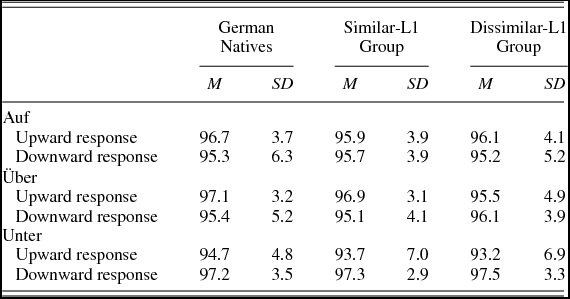
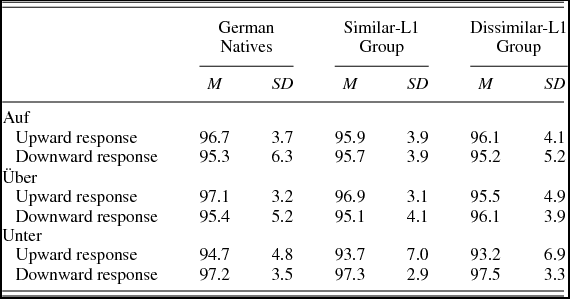
Upward responses were slightly more accurate (96.1%) than downward responses (95.6%). However, this effect failed to reach significance, F (1, 131) = 3.39, p = .068, ηp 2 = 0.025. There was a significant interaction between the stimulus and the response direction showing the expected compatibility effect, F (2, 262) = 31.46, p < .001, ηp 2 = 0.194. For the words auf and über, upward responses (auf: 96.3%, über: 96.5%) were more accurate than downward responses (auf: 95.4%, über: 95.5%), and for the word unter, upward responses were less accurate than downward responses (upward: 93.9%, downward: 97.3%). There was no significant three-way interaction, F (4, 262) = 1.04, p = .387, ηp 2 = 0.016, indicating that the compatibility effect did not differ across groups. All other effects did not reach significance (all ps > .10). For the average accuracy rates in each cell (Group × Stimulus × Response direction) see Table 2. We did not include the means for ab, since this word was only used as a filler item. However, as expected, accuracy rates for ab did not differ between upward (95.8%) and downward responses (96.1%), t (133) = –0.81, p = .419.
Average accuracy rates and corresponding standard deviations in percentages per group
Response times
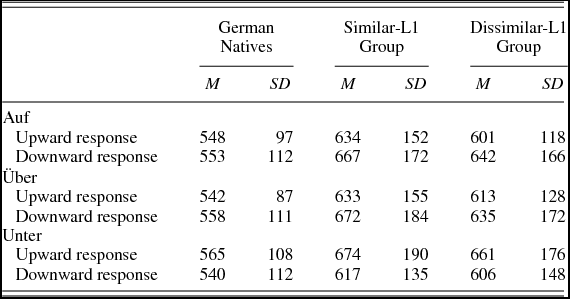
Table 3 shows the average response times for each group, stimulus, and response direction. Just as for the accuracy rate analysis, we did not include the means for ab, since it was only used as a filler item. However, as expected, the response times for downward responses (610 ms) and upward responses (617 ms) to ab did not differ significantly, t (133) = –1.27, p = .206.
Average response times and corresponding standard deviations in milliseconds per group

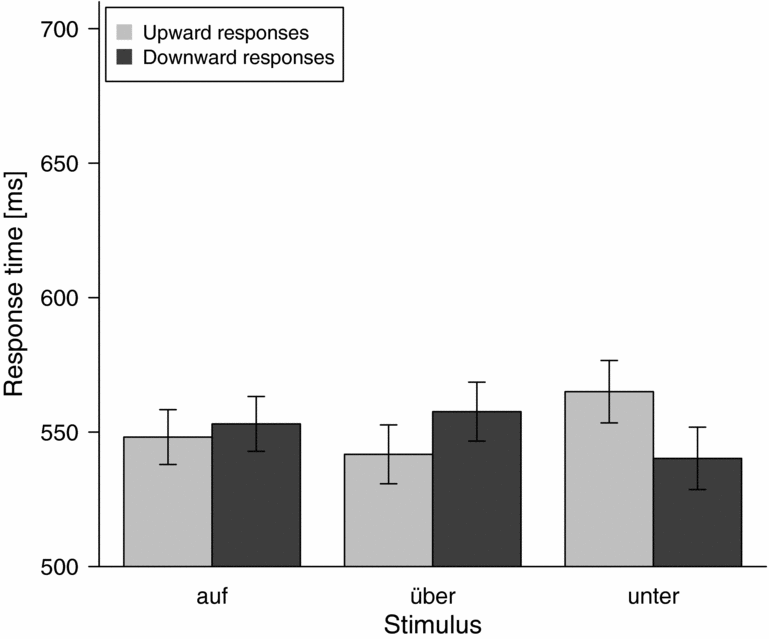
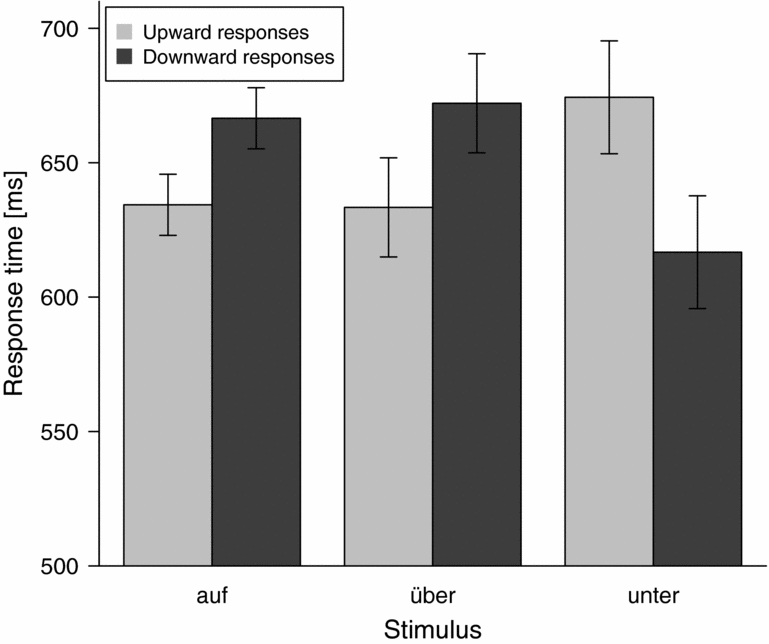
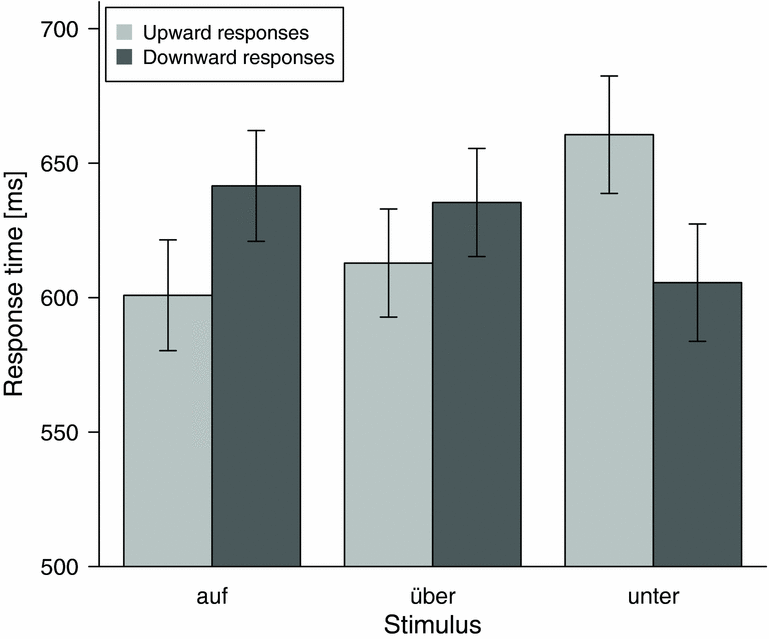
Our ANOVA showed that there was a significant main effect of group, F (2, 131) = 6.56, p = .002, ηp 2 = 0.091, due to overall faster response times for the German natives (551 ms) than for the other two groups: similar-L1 group, 650 ms, F (1, 90) = 12.68, p < .001, ηp 2 = 0.123; dissimilar-L1 group, 626 ms, F (1, 87) = 8.25, p = .005, ηp 2 = 0.087. The two groups with German as an L2 did not differ significantly from each other (F < 1). As expected, the interaction between stimulus and response direction was significant, F (2, 262) = 47.55, p < .001, ηp 2 = 0.266, showing the expected compatibility effect of faster response times for upward than downward responses for the words auf (upward: 594 ms, downward: 619 ms) and über (upward: 595 ms, downward: 620 ms) and the reverse effect for the word unter (upward: 632 ms, downward: 586 ms). Most important, and also as predicted, we obtained a significant three-way interaction between group, stimulus, and response direction, F (4, 262) = 3.84, p = .005, ηp 2 = 0.055, indicating that the compatibility effect differed across groups. Therefore, we will analyze this effect in more detail separately for the three groups below. The interaction between group and stimulus did approach but not reach significance, F (4, 262) = 2.23, p = .067, ηp 2 = 0.033. All other effects also did not reach significance (all Fs < 1).
German natives
The average response times for the German native participants are displayed in Figure 2. A separate ANOVA for just this group with stimulus and response direction as within-subjects factors showed that there was a significant compatibility effect, F (2, 92) = 14.38, p < .001, ηp 2 = 0.238. For the word über, upward responses were faster than downward responses, F (1, 46) = 4.23, p = .045, ηp 2 = 0.085; for the word unter, the reverse was true, F (1, 46) = 9.26, p = .004, ηp 2 = 0.168. There was, however, no significant difference between upward and downward responses for the word auf, F (1, 46) = 0.47, p = .496, ηp 2 = 0.010.
Mean response times of German natives for correct responses as a function of response direction and stimulus. Error bars represent 95% confidence intervals for the pairwise comparisons (according to Loftus & Masson, Reference Loftus and Masson1994).

Similar-L1 group
As can be seen in Figure 3, there was a significant compatibility effect in this group, too, represented by a significant interaction between stimulus and response direction, F (2, 88) = 18.71, p < .001, ηp 2 = 0.298. Separate analyses for the three stimuli revealed significant compatibility effects for all three words with shorter response times for upward compared to downward responses for auf, F (1, 44) = 16.28, p < .001, ηp 2 = 0.270, and über, F (1, 44) = 8.96, p = .005, ηp 2 = 0.169, and shorter response times for downward compared to upward responses for the word unter, F (1, 44) = 15.32, p < .001, ηp 2 = 0.258.Footnote 10
Mean response times of the similar-first language group as a function of response direction and stimulus. Error bars represent 95% confidence intervals for the pairwise comparisons (as per Loftus & Masson, Reference Loftus and Masson1994).

Dissimilar-L1 group
This group also showed a compatibility effect represented in a significant interaction between stimulus and response direction, F (2, 82) = 18.30, p < .001, ηp 2 = 0.309 (see Figure 4). There were significant compatibility effects for the word auf with shorter response times for upward compared to downward responses, F (1, 41) = 7.96, p = .007, ηp 2 = 0.163, and for the word unter, with shorter response times for downward compared to upward responses, F (1, 41) = 12.96, p < .001, ηp 2 = 0.240. No significant compatibility effect was obtained for über, F (1, 41) = 2.56, p = .117, ηp 2 = 0.059.
Mean response times the dissimilar-first language group as a function of response direction and stimulus. Error bars represent 95% confidence intervals for the pairwise comparisons (according to Loftus & Masson, Reference Loftus and Masson1994).

DISCUSSION
In this study, we investigated whether embodiment plays a role in L2 comprehension. In particular, we were interested in whether processing German spatial prepositions such as auf, über, and unter would influence subsequent upward or downward directed response movements not only for German native speakers but also for nonnative speakers learning German as an L2. If so, this would support the view that experiential traces (Zwaan & Madden, Reference Zwaan, Madden, Pecher and Zwaan2005) are not only built and reactivated in L1 processing but also play a role in L2 processing.
Three groups of participants (German native speakers, German L2 speakers with an L1 with a similar split of the upper subspace as German, and German L2 speakers with an L1 without that split of the upper subspace) processed German prepositions in an adaptation of the Stroop paradigm in which they responded with an upward or downward directed response movement depending on the font color. We found a significant compatibility effect, reflected in an interaction between the meaning of the spatial prepositions and the direction of the response movement, for all three groups. Overall, responses were faster and more accurate in conditions in which the meaning of the preposition was compatible to the response direction (e.g., upward movement for über; downward movement for unter) compared to conditions in which the two were incompatible (e.g., upward movement for unter; downward movement for über). This result shows that the Stroop paradigm is suitable for the investigation of spatial prepositions, as the observed compatibility effect is similar to the one obtained with nouns referring to entities with a typical location in vertical space (airplane vs. worm, e.g., Lachmair et al., Reference Lachmair, Dudschig, De Filippis, de la Vega and Kaup2011). In addition, this result implies that experiential traces already get activated when people read small units like prepositions, which can be considered further evidence for embodied theories of comprehension. This finding is also in line with previous research using subliminal presentations of spatial prepositions (Ansorge, Kiefer, Khalid, Grassl, & Koenig, Reference Ansorge, Kiefer, Khalid, Grassl and Koenig2010) and with research on the Simon effect in response to spatial words (Khalid & Ansorge, Reference Khalid and Ansorge2013). One might argue that these results could also be explained by assuming that participants internally verbalized the response direction when planning the response in the present paradigm (i.e., verbalizing “upward” when detecting a particular font color) and that this causes the compatibility effect with the meaning of the presented preposition. However, a recent study conducted in our lab indicated that language–space compatibility effects are observed even in a modified Stroop paradigm where there is no stable mapping of colors to response directions, and inner speech can therefore be ruled out as the main contributing factor (Dudschig & Kaup, Reference Dudschig and Kaup2016).Footnote 11 We therefore can be quite sure that the compatibility effect observed in this experiment (interaction of stimulus and response direction) constitutes an embodiment effect and reflects the automatic activation of experiential traces during word processing.
Furthermore, that we found compatibility effects not only for the German natives but also for the two groups of German L2 speakers supports the view that experiential traces are being reactivated during L2 processing. Even the dissimilar-L1 group showed a compatibility effect, even though the spatial terms of their L1 cannot be matched directly to the German system during L2 learning. This finding suggests that the reactivation of experiential traces plays an important role not only in L1 processing but also in the processing of an L2, even if this is quite dissimilar to the participants’ native language. A relevant question now is whether these experiential traces rely on the L1 or represent a new network of traces associated with the L2. More information with respect to this question can be obtained when comparing the observed pattern of results for the nonnative speakers with that observed for German native speakers.
As predicted, German native speakers processed auf and über differently, even though both words refer to the upper dimension. It seems that über is more strongly connected with spatial experiential traces than auf, since for auf the attributed spatial dimension neither interfered with nor facilitated the response. One possibility is that these differences reflect variations in the way these prepositions carve up the upper space. While über refers to objects that do not touch the relatum, auf refers to objects that are in direct contact with the relatum. Therefore, we can expect to find stronger compatibility effects for über than for auf. It is however surprising, that there was no compatibility effect for auf at all.
We had initially predicted that the pattern of results in the similar-L1 group should be the same as for German natives. This was not the case. Whereas German native speakers showed no effect for auf, the participants in the similar-L1 group did, suggesting that they processed auf spatially. One possible reason for this difference in comparison to German native speakers might be that German L1 speakers first learn auf as spatially related, but, as mentioned above, the word auf is also frequently used in various contexts in which the spatial meaning is no longer obvious (e.g., aufhören “to stop/terminate,” aufmachen “to open sth,” sich auf etwas freuen “to look forward to sth.”). It therefore appears possible that the spatial meaning fades away throughout the lifetime as people gain more nonspatial experiences with this word, which explains why there was no compatibility effect for auf in the German native speakers. However, this hypothesis needs further testing before definite conclusions can be drawn. One possibility would be to compare adult language processing with that of children who are just starting to learn these words and, therefore, have different linguistic experiences than adults. Another possibility would be a control study where the spatial meaning would be clearly triggered, for example, by using prepositional phrases. A possible reason why the L2 speakers with a Russian or English background showed compatibility effects for both auf and über is that the equivalent for auf in their native languages is used spatially to a stronger degree than auf in German. If they transferred the experiential traces of their L1 onto the respective German preposition, this might explain the significant compatibility effect for auf. This interpretation would also be in line with the coactivation account (Blumenfeld & Marian, Reference Blumenfeld and Marian2013; Kroll et al., Reference Kroll, Bobb and Hoshino2014) according to which bilinguals always activate both languages (see above). However, at least in English on also has multiple nonspatial usages. Thus, clearly more research is needed that investigates this post hoc explanation of the results before any definite conclusions can be drawn.
For the dissimilar-L1 group, we had expected a different processing pattern than for German L1 speakers, since their native languages, Korean and Turkish, do not distinguish between contact and noncontact along the vertical axis, and are therefore not directly connectable to German words when learned. We found clear processing differences between this group and the other two groups. As expected, Korean and Turkish native speakers did not show a larger effect for über compared to auf, which presumably reflects that their L1s do not distinguish between the two corresponding spatial relations, and they, therefore, do not retrace this distinction in the German input. These speakers not only did not show a larger effect for über compared to auf (as the German natives did), but quite the contrary was the case: they showed a significant compatibility effect for auf but not for über. We consider it likely that this difference is related to auf being much more frequent compared to über (Quasthoff, Fiedler, & Hallsteinsdóttir, Reference Quasthoff, Fiedler and Hallsteinsdóttir2011) and also acquired much earlier (Bryant, Reference Bryant2012; Grimm, Reference Grimm1975). Concerning the different word formation products with the respective morphemes, many more words with the prefix auf- (5,591 word form entries) exist than with the prefix über- (4,065 word form entries; see Quasthoff et al., Reference Quasthoff, Fiedler and Hallsteinsdóttir2011). These frequency differences might account for the reversal of the effect, as the L2 speakers search for the equivalent of their spatial terms related to the upper dimension and the first spatial term they learn is auf, which is then taken as the equivalent. Über, which is learned later, is then harder to connect, in particular because the category of spatial relations needs a split-up in this case. Korean and Turkish native speakers probably simply transferred all their experiential traces related to the upper vertical space to the more frequent term auf, which they learned first, and more or less ignored the less frequent über. In that case, über would not be processed in an embodied way, at least not at early stages of learning. If this assumption is actually true, one might expect to find differences between participants with higher and lower language proficiency in German. Possibly, über leads to compatibility effects only for highly proficient L2 speakers of German because they either transfer the experiential traces of their L1 also to über or with enough experiences they build new traces for their L2. To tentatively investigate this question, we included language proficiency as an additional factor in the analysis of this group. We categorized the participants into two groups according to their language proficiency. Speakers with a CERF level of A2, B1, or B2 were considered as mid- to low- proficient; speakers with a CERF level of C1 or C2 were considered highly proficient. The analysis revealed a significant interaction between stimulus, response direction, and language proficiency, F (2, 78) = 3.35, p = .040, ηp 2 = 0.077, indicating that a difference exists between the high and mid- to low-proficiency groups. In order to gain more information with respect to our hypotheses concerning the role of language proficiency, we analyzed the compatibility effects for the three stimuli and the two proficiency groups separately. For the mid- to low-proficiency group, auf showed a significant compatibility effect, t (26) = –2.26, p = .016, one-tailed, while for über no significant compatibility effect was obtained, t (26) = 1.06, p = .149, one-tailed. In the high-proficiency group, auf as well as über showed significant compatibility effects: auf, t (14) = –1.77, p = .049, one-tailed; über, t (14) = –1.91, p = .038, one-tailed. These findings fit with the assumption that über is acquired later than auf also in L2 acquisition. However, these results have to be interpreted with caution, since they were obtained with a small sample of low power leading only to significant results when tested one-tailed, and because this explanation is quite post hoc. More research is needed to investigate these points in detail.
Taken together, we found evidence for embodiment in L1 and in L2 processing. Experiential traces were reactivated in all tested groups. Furthermore, our results indicated that the observed processing differences between the groups depend on the learned native language, as hypothesized by Slobin (Reference Slobin, Gumperz and Levinson1996). In addition, our results can also be taken as evidence for and an extension of the coactivation account (Blumenfeld & Marian, Reference Blumenfeld and Marian2013; Kroll et al., Reference Kroll, Bobb and Hoshino2014), by showing that not only phonological or orthographical information relating to the L1 is activated during L2 processing but also the experiential knowledge related to the L1 as well.
Our study provides a good starting point for further investigations into the nature of embodiment effects during L2 processing. Future studies are needed to find out whether other factors besides the nature of the native language are relevant. We found first evidence that language proficiency might be important, as was also suggested by De Grauwe et al. (Reference De Grauwe, Willems, Rueschemeyer, Lemhöfer and Schriefers2014) and Vukovic (Reference Vukovic, Knauff, Pauen, Sebanz and Wachsmuth2013). Further variables that could be relevant but that were not tested in the current study are AoA, language contact, and conditions of language use. Furthermore, it would be interesting to investigate the effects of language proficiency using a more objective measure compared to the rather subjective indication of language proficiency that we used in the present study. Once we know more about how experiential traces are built and used during L2 acquisition and which moderating factors are at work, we might be able to gain a better understanding of the precise difficulties to learn spatial prepositions in an L2.
ACKNOWLEDGMENTS
This research was supported by the LEAD Graduate School, a project of the Excellence Initiative of the German federal and state governments under Grant GSC1028. This study was part of the doctoral dissertation of the first author conducted at the LEAD Graduate School.