Introduction
The European earwig Forficula auricularia Linnaeus (Dermaptera: Forficulidae) is a sub-social omnivore, feeding on both plant material and arthropod prey. Although it is regarded as a pest of some soft-fleshed fruits such as apricots (Prunus Linnaeus; Rosaceae), its pest-reducing benefits in hard fruit crops, e.g., apples (Malus Linnaeus; Rosaceae), outweigh the very limited damage to yield (Solomon et al. Reference Solomon, Cross, Fitzgerald, Campbell, Jolly and Olszak2000). Forficula auricularia is a generalist predator previously described as a regulator agent of many apple orchard pests (Carroll and Hoyt Reference Carroll and Hoyt1984; Solomon et al. Reference Solomon, Cross, Fitzgerald, Campbell, Jolly and Olszak2000; Nicholas et al. Reference Nicholas, Spooner-Hart and Vickers2005; Suckling et al. Reference Suckling, Burnip, Hackett and Daly2006). More specifically, F. auricularia is considered a potential predator of apple aphids (Carroll and Hoyt Reference Carroll and Hoyt1984; Nicholas et al. Reference Nicholas, Spooner-Hart and Vickers2005; Moerkens et al. Reference Moerkens, Leirs, Peusens and Gobin2009; Dib et al. Reference Dib, Sauphanor and Capowiez2010a, Reference Dib, Simon, Sauphanor and Capowiez2010b, Reference Dib, Jamont, Sauphanor and Capowiez2011, Reference Dib, Jamont, Sauphanor and Capowiez2016a), which comprise the majority of its diet when present in this crop (Mueller et al. Reference Mueller, Blommers and Mols1988). Several studies have shown its efficiency against the woolly apple aphid Eriosoma lanigerum (Hausmann) (Hemiptera: Aphididae) (Mueller et al. Reference Mueller, Blommers and Mols1988; Nicholas et al. Reference Nicholas, Spooner-Hart and Vickers2005), the green apple aphid Aphis pomi De Geer (Hemiptera: Aphididae) (Carroll and Hoyt Reference Carroll and Hoyt1984), and the rosy apple aphid Dysaphis plantaginea (Passerini) (Hemiptera: Aphididae) (Dib et al. Reference Dib, Sauphanor and Capowiez2010a, Reference Dib, Simon, Sauphanor and Capowiez2010b, Reference Dib, Jamont, Sauphanor and Capowiez2011, Reference Dib, Jamont, Sauphanor and Capowiez2016a). Dysaphis plantaginea is one of the most serious worldwide pests of apple orchards (Miñarro et al. Reference Miñarro, Hemptinne and Dapena2005; Brown and Mathews Reference Brown and Mathews2007). The rolled leaves caused by D. plantaginea infestation (Forrest and Dixon Reference Forrest and Dixon1975) can offer natural shelter to F. auricularia during the day as earwigs are nocturnal. Forficula auricularia possess a volatile aggregation pheromone (Sauphanor Reference Sauphanor1992; Walker et al. Reference Walker, Jones and Fell1993) and it readily hides during the day in shelters, preferably in those releasing this pheromone (Sauphanor et al. Reference Sauphanor, Chabrol, Faivre d’Arcier, Sureau and Lenfant1993; Burnip et al. Reference Burnip, Daly, Hackett and Suckling2002). Although winged, F. auricularia has only rarely been documented to fly (Lamb and Wellington Reference Lamb and Wellington1975). Artificial shelters are used (Lamb Reference Lamb1975) not only to manipulate the level of pest predation by earwigs in augmentative or conservative approaches but also to study the development of its field population (Sauphanor et al. Reference Sauphanor, Chabrol, Faivre d’Arcier, Sureau and Lenfant1993; Burnip et al. Reference Burnip, Daly, Hackett and Suckling2002; Suckling et al. Reference Suckling, Burnip, Hackett and Daly2006).
Life history, population structure, and dynamic studies of polyphagous insects such F. auricularia are of particular importance for developing strategies to manage their populations in orchards. Indeed these populations could cause economic loss and pose environmental risks especially to local or native arthropod communities (e.g., Simberloff and Stiling Reference Simberloff and Stiling1996; Thomas and Willis Reference Thomas and Willis1998) as found in the United States of America apple orchards invaded by the Asian ladybeetle Harmonia axyridis (Pallas) (Coleoptera: Coccinellidae) (Brown and Miller Reference Brown and Miller1998). Such studies may help to determine the attributes of population development, identifying the vulnerable life stages, and revealing the causes of mortality (e.g., Birch Reference Birch1948). In addition, they may give reliable information on the optimal timing of some management practices that negatively impact earwig populations such as soil tillage (Sharley et al. Reference Sharley, Hoffmann and Thomson2008) and pesticide application (Sauphanor et al. Reference Sauphanor, Chabrol, Faivre d’Arcier, Sureau and Lenfant1993). However, to get a better understanding of the natural history of F. auricularia under field conditions, it is preferable to carry out these studies in orchards under organic protection strategies, which exclude all usage of both synthetic fertilisers and pesticides. This is mainly because earwig abundance was found to be significantly higher in organic apple orchards than in those protected from pests using synthetic pesticides (e.g., Dib et al. Reference Dib, Sauphanor and Capowiez2016c).
One of the most interesting biological aspects of this sub-social insect is the maternal care shown for eggs laid in a burrow. The mother also protects the young nymphs against pathogens and predators and provides them with food, which improves nymph development and survival (Boos et al. Reference Boos, Meunier, Pichon and Kölliker2014; Koch and Meunier Reference Koch and Meunier2014). After this familial phase, the nymphs disperse from the nest and enter a free-foraging phase (Vancassel and Foraste Reference Vancassel and Foraste1980; Kölliker Reference Kölliker2007; Kölliker and Vancassel Reference Kölliker and Vancassel2007). The number of egg clutches and the duration of maternal care are variable, differentiating two sibling types of this monovoltine species (e.g., Wirth et al. Reference Wirth, Le Guellec, Vancassel and Veuille1998; Guillet et al. Reference Guillet, Guiller, Deunff and Vancassel2000). Type (A) has one nymphal cohort a year and a long period of maternal care (until the second nymphal moulting and the appearance of third nymphal (N3) instars) and so a late nymphal free-foraging phase. The eggs are laid at the beginning of winter before female overwintering. This type was found to live in cold and high altitude areas. In contrast, type (B) females produce two successive broods per year (rarely three (Worthington Reference Worthington1926)) and do not care for offspring as long (until the first nymphal moulting and N2 appearance) and so nymphs from the first cohort disperse earlier. The first egg clutch is laid at the end of winter after female diapause while the second clutch occurs in spring. This type tends to occur in more temperate and oceanic climates (Lamb and Wellington Reference Lamb and Wellington1975; Vancassel Reference Vancassel1984; Vancassel and Quris Reference Vancassel and Quris1994; Wirth et al. Reference Wirth, Le Guellec, Vancassel and Veuille1998; Guillet et al. Reference Guillet, Guiller, Deunff and Vancassel2000).
The natural history and ecology of F. auricularia, mainly of type (A), has been investigated and described in apple orchards in many countries, e.g., in Belgium (Moerkens et al. Reference Moerkens, Leirs, Peusens and Gobin2009), the Netherlands (Helsen et al. Reference Helsen, Vaal and Blommers1998), the United Kingdom (Phillips Reference Phillips1981), and New Zealand (Burnip et al. Reference Burnip, Daly, Hackett and Suckling2002). In France, many studies indicated that F. auricularia tends to be of type (A) in central regions (Wirth et al. Reference Wirth, Le Guellec, Vancassel and Veuille1998) and type (B) in western regions (Vancassel Reference Vancassel1984). To our knowledge, no information is available regarding the occurrence, life-history traits, and field population development of F. auricularia in apple orchards, especially organic, in southeastern France. Three types of studies were, thus, conducted: one study in an outside laboratory and two in orchards. Our objective in the laboratory study was to provide detailed data on the life cycle, such as female fecundity and survival, development time, and appearance date of each earwig life stage. This study was based on the survey of 50 earwig couples. Under field conditions, we conducted two (two-year) studies based on a weekly survey of the spring population structure and dynamics of the examined species in one insecticide-free and four organic apple orchards using artificial (rolls of corrugated cardboard) and natural (shoots infested by D. plantaginea) shelters.
Materials and methods
Laboratory study of life-history traits
To study F. auricularia life-history traits in southeastern France, the insects were reared from 50 couples trapped using corrugated cardboard strips removed in early autumn in two organic apple orchards located near Avignon, France. They were reared outdoors under a shelter, in an outside laboratory, in natural temperature, photoperiod, and humidity conditions. Each couple was isolated in an individual plastic cage (5-cm diameter and 2 cm high) with a 1.5-cm ventilation hole covered with an insect-proof net in the centre of each lid. Wet sand was put in each cage to provide an overwintering refuge and egg-laying site. The sand was re-humidified once a week. Insects were fed every week with ground pollen, which is known to be a satisfactory alternative food source for oviposition (Sauphanor et al. Reference Sauphanor, Blaisinger and Sureau1992, Reference Sauphanor, Chabrol, Faivre d’Arcier, Sureau and Lenfant1993). As the female naturally expels the male to prevent cannibalistic feeding on the eggs (Moerkens et al. Reference Moerkens, Leirs, Peusens and Gobin2009), males were removed from the cages as soon as females laid an egg clutch (first brood). After the first moulting, N2 found in each cage were transferred using soft forceps to a larger plastic cage (8-cm diameter and 8 cm high) with a 3-cm ventilation hole covered with an insect-proof net in the centre of each lid. The females were maintained in the small cages to lay the second egg clutch (second brood). After the first moulting of the second brood, the N2 were also transferred to a new larger plastic cage. The inner sides of the larger plastic cages were coated with liquid Teflon (Fluon, Whitford, Runcorn, UK) to prevent the insects from escaping. The nymphs were fed ad libitum on artificial medium following the method described by Sauphanor et al. (Reference Sauphanor, Blaisinger and Sureau1992). As F. auricularia is nocturnal and hides during the day (Sauphanor et al. Reference Sauphanor, Chabrol, Faivre d’Arcier, Sureau and Lenfant1993), small pieces of corrugated cardboard rolled into cylinders were added in the rearing boxes to provide suitable shelters. Forficula auricularia goes through four nymphal instars before reaching adulthood (Lamb and Wellington Reference Lamb and Wellington1975). From early November 2008 to late July 2009, the cages were checked every two days to record the number, developmental time, survival, and occurrence dates of each instar of both broods until adulthood. The sex ratio was then calculated.
Field study of spring earwig population dynamics
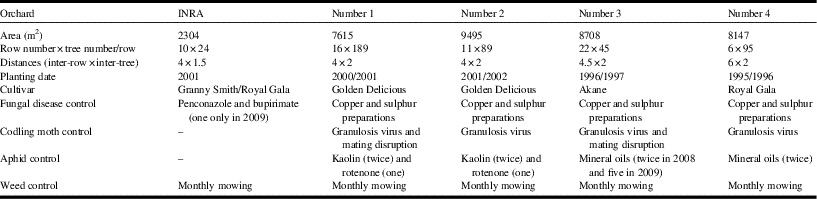
Earwig populations in apple trees were assessed throughout the 2008 and 2009 spring seasons in five orchards (Table 1): one INRA (Institut National de la Recherche Agronomique=French National Institute for Agricultural Research) experimental insecticide-free orchard located close to Avignon and four commercial organic orchards (number 1, 2, 3, and 4) located 10 to 20 km south of Avignon (coordinates in the WGS84 system from 43°46'27''N to 43°51'23''N and from 4°51'12''E to 4°57'34''E). The INRA experimental orchard was under a minimal pesticide management programme and the organic orchards were managed following organic production guidelines where no synthetic pesticides or fertilisers were used (Table 1).
Main characteristics of the five studied apple orchards and the principal control strategies applied during the study period in the 2008 and 2009 spring seasons.

Note: INRA, Institut National de la Recherche Agronomique (French National Institute for Agricultural Research).
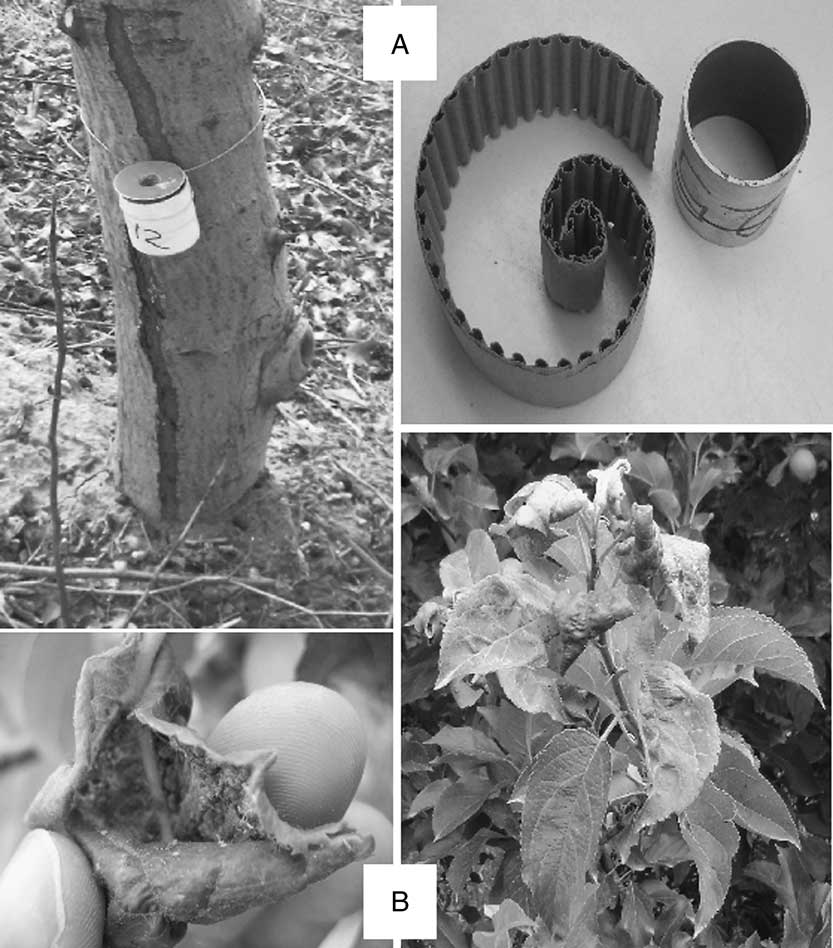
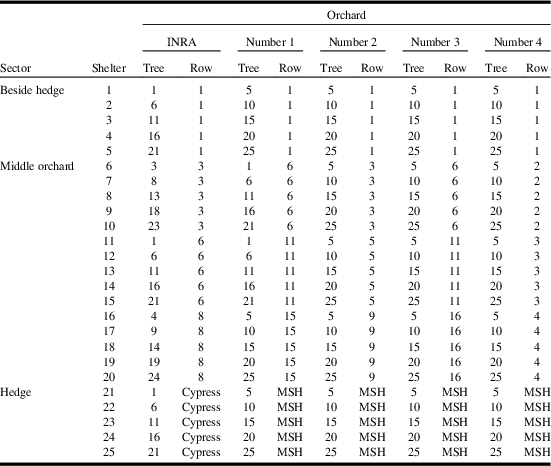
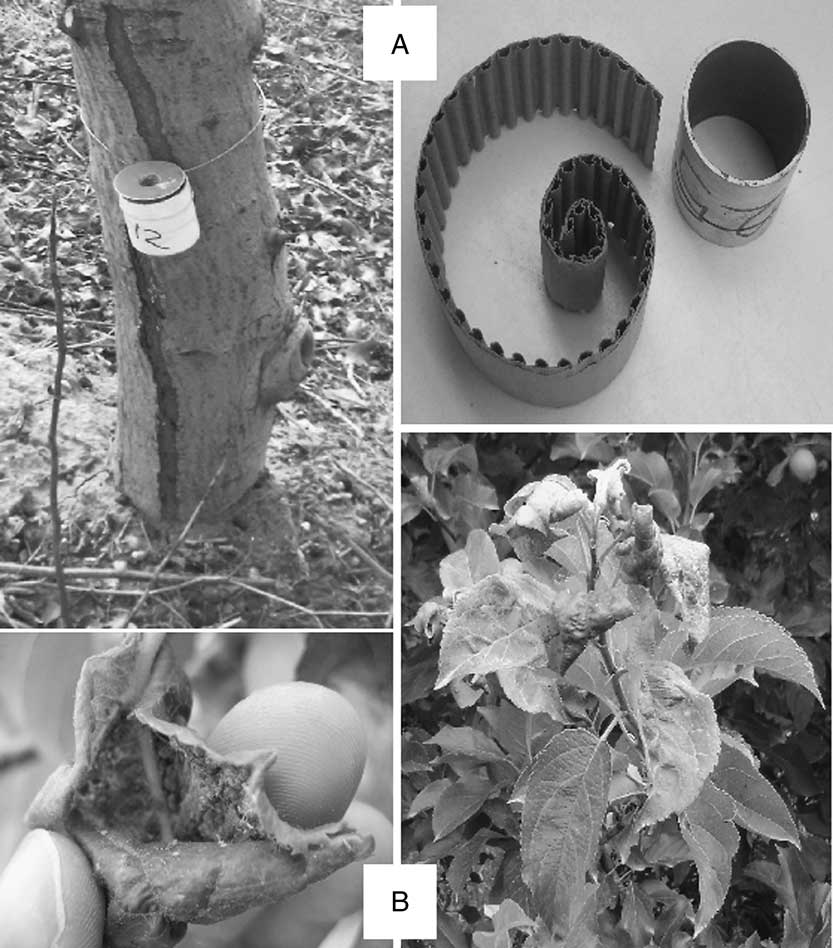
The earwigs were sampled using both artificial and natural refuges (Fig. 1). Artificial shelters consisted of corrugated cardboard (40 cm long×5 cm wide) rolled to form cylinders (5-cm diameter) and inserted in polyvinyl chloride (PVC) tubes (5 cm diameter, 5 cm high) for weather protection (Fig. 1). Shelters were attached horizontally with metal wire to tree trunks at 40–50 cm above the ground (Fig. 1). A total of 20 shelters per orchard were attached in four adjacent (number 4 orchard) or non-adjacent (other orchards) rows (three in the middle of the orchard and one close to the hedgerow) (Table 2). Five shelters were installed per row (one every five trees) (Table 2). The hedgerow consisted of mono-species (cypress) and multi-species plants in the INRA and organic orchards, respectively (Table 2). Five shelters were also installed in five non-adjacent locations in the hedgerow at approximately equal distances from each other as for the shelters in apple rows (Table 2). Every week, we removed all earwigs from the shelters by strongly blowing into them so that all the insects fell into a plastic box (25×25×10 cm3), the inner sides of which were coated with liquid Teflon (Fluon) to prevent escape. Earwig sampling started one week after the shelter installation. We sampled earwig populations weekly from 5 May and 9 March to 3 and 9 July, respectively, in 2008 and 2009 depending on orchard and spring development of D. plantaginea on apple trees in each orchard. Nymphal life stages were differentiated by size, antennomeres and the presence of the rise of the posterior wings and adult sex by the cerci form; strongly curved in males and approximately straight in females (Albouy and Caussanel Reference Albouy and Caussanel1990). Once counted, earwigs were released at the base of the sampled tree and the shelter was replaced at the same location.
Artificial (A) and natural (B) shelters used in the field study of spring earwig population dynamics. Artificial shelters consisted of corrugated cardboard rolled to form cylinders and inserted in polyvinyl chloride tubes. Natural shelters were apple shoots infested by Dysaphis plantaginea (the rolled leaves are a symptom of D. plantaginea infestation).
Installation places (trees and rows numbered) of the 25 artificial shelters in three sectors of each orchard (middle orchard, beside hedge, and hedge) throughout the 2008 and 2009 spring seasons in the five apple orchards studied in southeastern France.
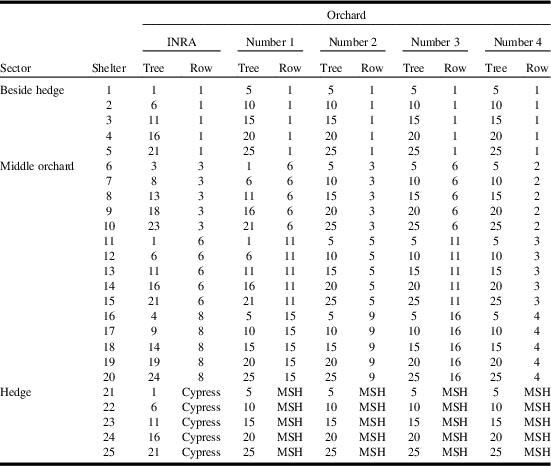
Note: INRA, Institut National de la Recherche Agronomique (French National Institute for Agricultural Research); MSH, multi-species hedgerow.
For earwig sampling in natural shelters, 50 terminal one-year old shoots per orchard were randomly selected early in spring among those infested with D. plantaginea (Fig. 1) and marked using coloured ribbons. The presence of earwig nymphs and adults was assessed visually weekly on these shoots, depending on the orchard, during the spring development period of D. plantaginea on apple trees from 7 and 8 April to 3 July and 19 June, respectively, in 2008 and 2009.
Field study of earwig species
To identify the earwig species in the studied orchards in the conditions of southeastern France, we sampled earwigs using two methods. First, in each orchard, artificial traps, made of bands of corrugated cardboard (50 cm long×10 cm wide), were attached with iron wire to the trunks of 10 random, non-adjacent trees (one band per tree) at 20–30 cm from the ground. Trees with artificial shelters being used for the dynamic study were excluded from this sampling. Two sampling series were carried out per year (in May and June). At the end of each sampling series, the bands were removed and transferred to the laboratory for further identification of the earwigs found. Second, 10 D. plantaginea colonies per orchard, as natural traps, containing different earwig life stages, were sampled weekly during the D. plantaginea development period. Previously marked shoots for the dynamic study were excluded from the sampling. In the two sampling methods and when nymphal specimens were present, they were reared in the laboratory until adult emergence. Each earwig adult was then individually stored in a numbered tube containing a small amount of 70% ethyl alcohol for further identification. Adults were identified to the species level in the laboratory under a dissecting microscope using the identification key of Albouy and Caussanel (Reference Albouy and Caussanel1990).
Statistical analysis
Data on the number and developmental time of each earwig life stage resulting from the laboratory study of life-history traits were computed and the differences between the two broods were analysed using a Mann–Whitney U test with a significance level of 5%. Mother mortality, survival of each earwig life stage and sex ratio were compared between the two broods using contingency tables and χ2 analysis with a 5% significance level.
In the field study of spring earwig population dynamics, the earwig abundance was pooled per artificial (n=20) or natural (n=50) shelter in each orchard across each season. The numbers of earwigs sampled in the artificial shelters installed in three sectors (centre of orchard (n=15), beside hedge (n=5), and hedge (n=5)) were also computed in each orchard across each season. Then the effect of orchard and year on these abundances was analysed. Data were log10(x+1)-transformed to reduce heteroscedasticity. Homogeneity of variance and normality were then checked using Bartlett’s and Shapiro–Wilk tests, respectively. We performed a two-factor analysis of variance (ANOVA) followed by post-hoc comparisons (Tukey’s honest significant difference) with a significance level of 5% when these requirements were met. Otherwise a Kruskal–Wallis followed by an adapted post-hoc comparison test (Zar Reference Zar1984) was used.
The correlation between the mean earwig abundance sampled in the artificial and natural shelters in each orchard across each season was computed and compared separately for significance using a Spearman correlation test with a significance level of 5%. All data were analysed using XLSTAT Version 2009/05/01.
Results
Laboratory study of life-history traits
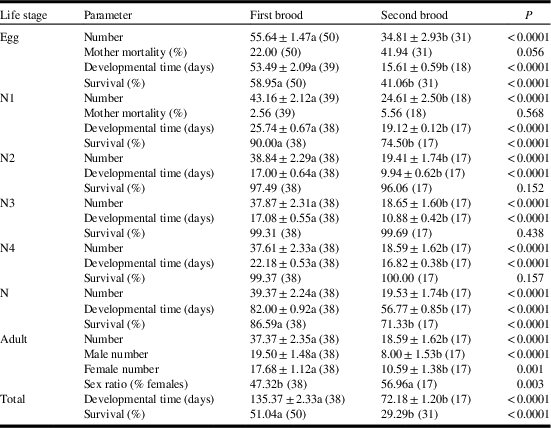
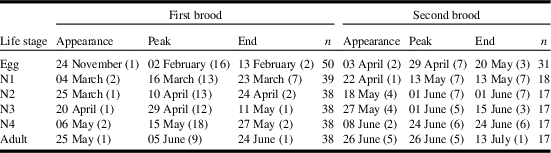
The parameters recorded for the life-history traits of the two broods of the studied earwig couples are listed in Table 3. The two broods (from egg-laying until adult appearance) occurred between 24 November 2008 and 24 June 2009 (213 days) for the first brood and between 3 April and 13 July 2009 (102 days) for the second one (Table 4). The laying of the first brood occurred between 24 November 2008 and 13 February 2009 (82 days) (Table 4). Only 31 earwig females survived long enough to oviposit the second brood (Table 3). The oviposition period of the second brood was shorter than that of the first one for which egg laying occurred steadily between 3 April and 20 May 2009 (48 days) and peaked slightly on 29 April (in 22.6% of the 31 cages) (Table 4). After egg-laying, 11 and 13 mothers died from the 50 and 31 mothers, respectively, who oviposited the first and the second brood but the difference in mother mortality was not significant between the two broods (χ2=3.647; df=1; P=0.056) (Table 3). After egg hatching and before the first moulting, one mother and their N1 of each brood period died and thus only 38 (first brood) and 17 (second brood) cages were observed in the rest of the study (Table 3). After the first moulting of the second brood, all 17 earwig mothers died during the period between 20 and 29 May 2009. Earwig females laid a mean (±SE) of 55.64±1.47 eggs in the first brood and significantly less, i.e., 34.81±2.93 eggs in the second one (Table 3). The development of earwig life stages lasted significantly longer in the first brood compared with the second one especially for egg hatching, which was 3.43-fold (53.49 versus 15.61 days) longer whereas the total nymphal life stage was only 1.44-fold (82.00 versus 56.77 days) longer (Table 3). The survival rate of the first brood from egg to adulthood was significantly higher (1.74-fold (51.04 versus 29.29%); χ2=148.706; df=1; P<0.0001) than that of the second brood (Table 3). The mortality was unevenly distributed over the different life stages. The egg hatch phase accounted for the highest mortality observed before the adult life stage (Table 3). However, the success of egg hatching (χ2=100.199; df=1; P<0.0001) and first moulting (χ2=72.752; df=1; P<0.0001) were significantly higher in the first brood compared with the second (Table 3). The mortality decreased after the first moulting, i.e., in N2, N3, and N4, with a survival rate higher than 96%. The differences in survival were not significant between the two broods (Table 3). Although the percentage of females was significantly lower in the first brood compared with the second (χ2=8.648; df=1; P=0.003) (Table 3), both sexes were almost equally distributed in the two broods (49.5% females of all individuals of the two broods pooled).
Life-history parameters, indicated by mean±SE and percentage, of the two broods from the 50 studied couples of Forficula auricularia from egg-laying to adulthood, including first (N1), second (N2), third (N3), fourth (N4), and total (N) nymphal life stages, in southeastern France.
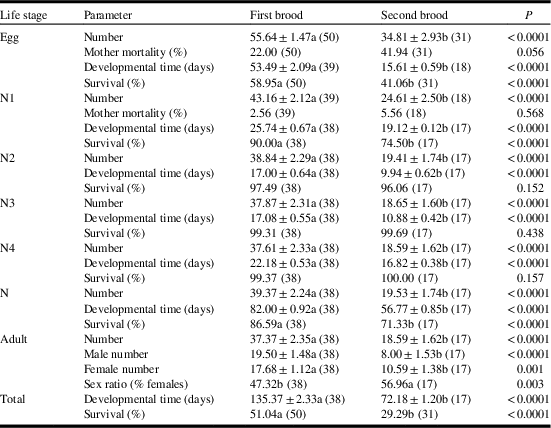
Notes: Number of test couples (with their offspring) is indicated in parentheses.
a,bValues followed by different letters within the same row were significantly different based on Mann–Whitney U tests (number and developmental time) and χ2 tests (mother mortality, survival, and sex ratio) at the 5% significance level.
Dates of appearance, peak, and end of each life stage of the two broods of the 50 studied Forficula auricularia couples from egg-laying to adulthood, including first (N1), second (N2), third (N3), and fourth (N4) nymphal life stages, in southeastern France.

Note: The numbers in parentheses indicate the couples number (from the number (n) of the initial test couples) with their corresponding offspring.
Field study of spring earwig population dynamics
Two earwig species belonging to the Forficulidae family (F. auricularia and F. pubescens Gené) were recorded during the field observation in both shelter types. But only the F. auricularia populations, which represented more than 95% and 98% (numbers pooled across five orchards and two years) of the earwig populations found, respectively, in artificial and natural shelters were considered in this study.
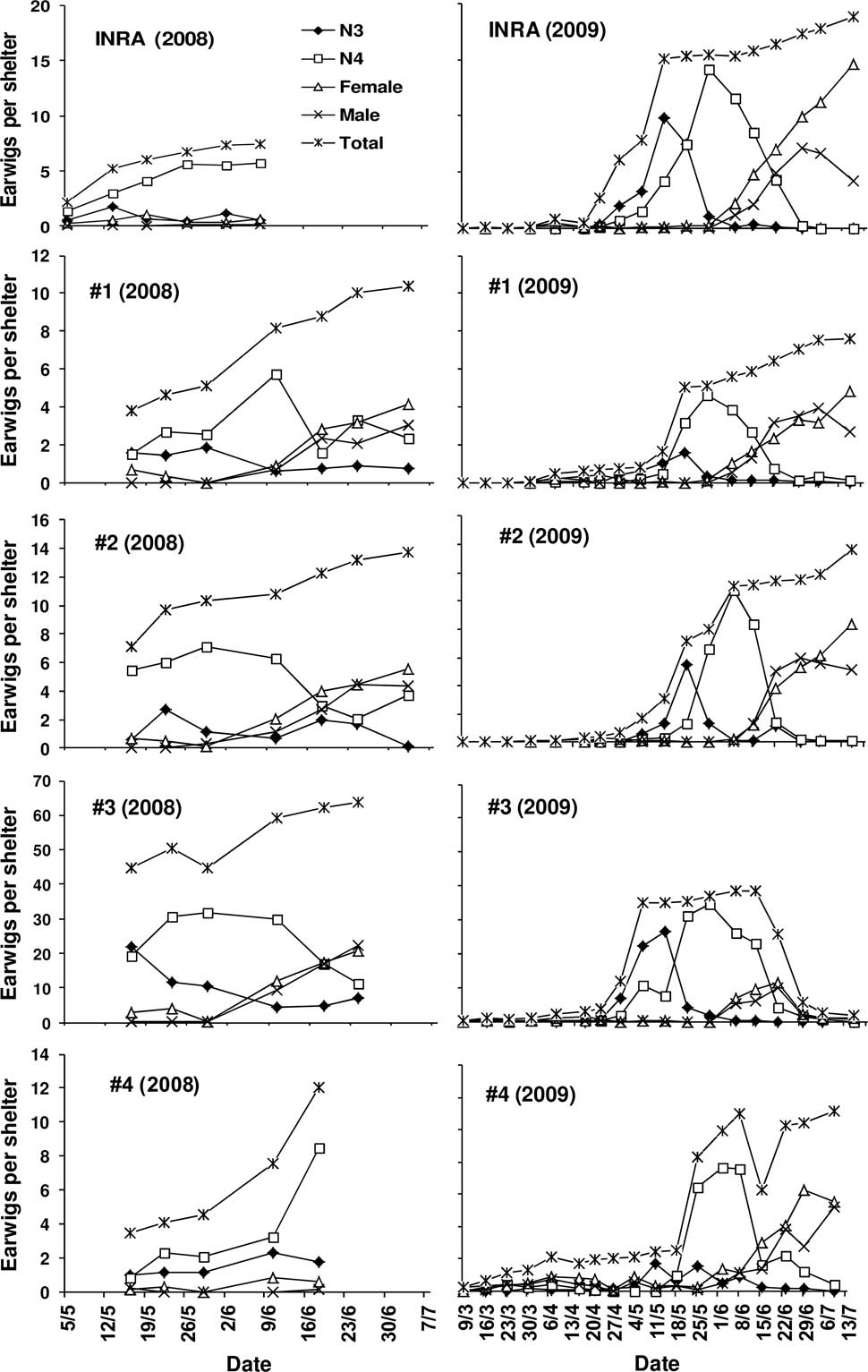
In 2008, field observations started when various life stages were already present together so the exact appearance date of each life stage in the artificial shelters could not be determined (Fig. 2). In contrast, the appearance date in the five orchards was well defined in 2009 when the population sampling started earlier from 9 March (Fig. 2). Total numbers of F. auricularia increased with time during the observation period in the five orchards and in the two years of study except in orchard number 3 in 2009 (Fig. 2). The abundance of the two younger earwig nymph instars was low (0.4% of all earwig life stages pooled across orchards and years for N1 and 2.3% for N2) from the observation beginning in early June (data not shown). Out of all earwig life stages observed, the N3, N4, females, and males varied respectively, depending on the orchard, between 11.3–23.1, 38.7–72.5, 5.8–23.4, and 0.9–16.7% in 2008 and between 8.0–23.4, 30.5–53.1, 13.6–33.0, and 9.9–28.8% in 2009. While the presence of N3, N4, and female earwigs was recorded on all sampling dates in 2008, the appearance of these life stages was sequential in 2009 (Fig. 2). The presence of N3 was generally steady during the observation period in 2008 but in 2009 it occurred generally from 21 April to 15 June with a maximum peak on 11 (INRA and number 3) and 18 May (number 1, 2, and 4) (Fig. 2). In 2009, N4 were present at all observation periods (as found in 2008 in all orchards) in orchards number 3 and 4 (except on two dates in number 3 and three in number 4) but not in other orchards (Fig. 2). N4 peaked, depending on the orchard, on 29 May, 10 and 18 June in 2008, and on 25 May and 2 June in 2009 (Fig. 2). The female presence was noted at almost all sampling dates in 2008 and from 16 (INRA and number 1) and 30 March (number 2, 3, and 4) onwards in 2009 (Fig. 2). However, the abundance of adults (male and female) was low before June (especially for males) and started gradually to increase in early June in the two years of study (Fig. 2).
Evolution of the average numbers of third (N3), fourth (N4) nymphal, adult (female and male), and all (total) life stages in the Forficula auricularia population sampled in the artificial (corrugated cardboard) shelters throughout the 2008 and 2009 spring seasons in five apple orchards in southeastern France. INRA, Institut National de la Recherche Agronomique (French National Institute for Agricultural Research); #, Orchard number.
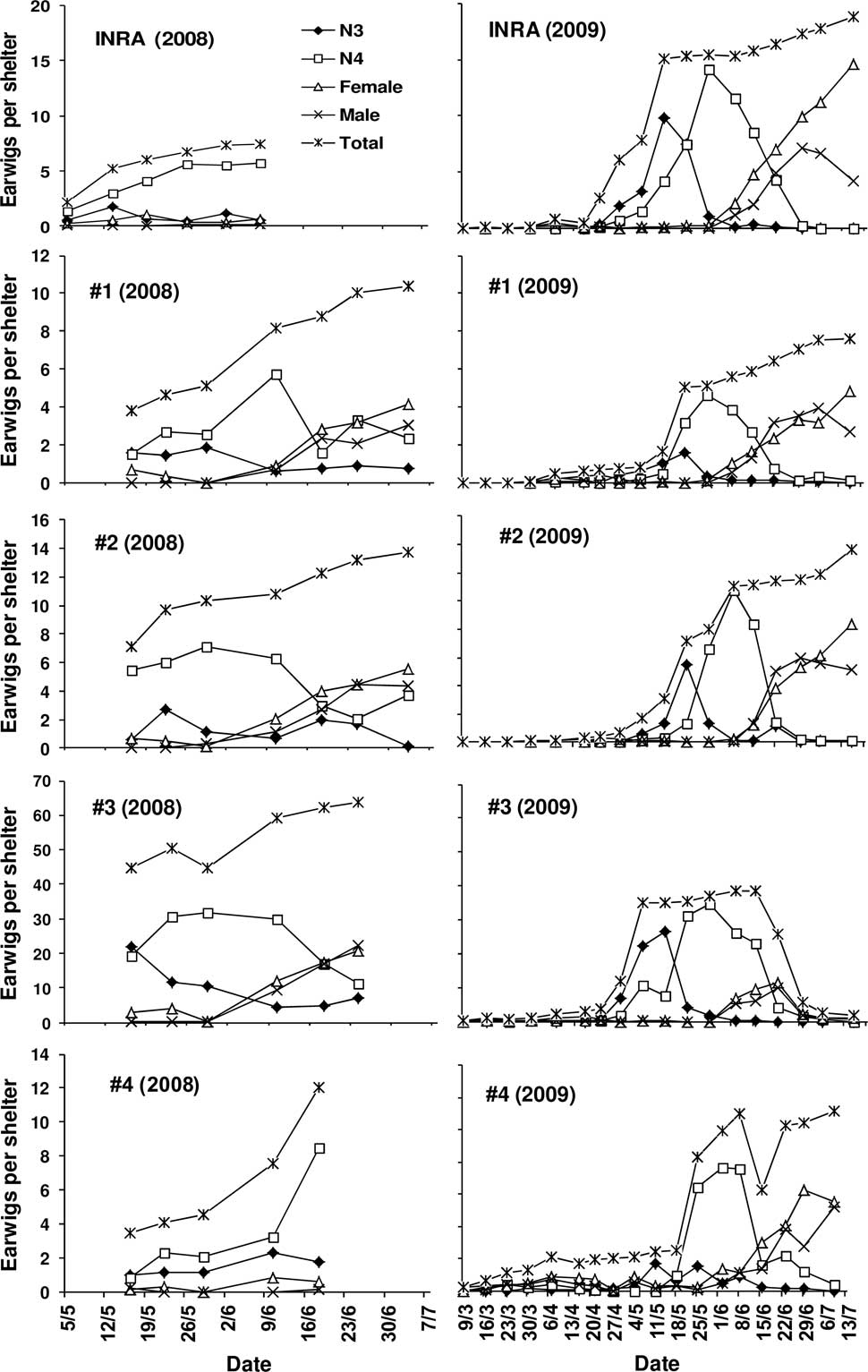
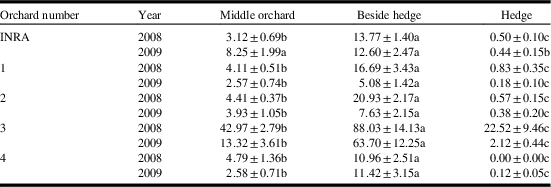
The total number of earwigs sampled in the artificial shelters installed in the row beside the hedgerow was significantly higher than those in the centre of the orchard and in the hedgerow in all orchards and in both years. The exception was in the INRA orchard in 2009 where the differences were not significant between the two sectors: beside the hedgerow and the middle of orchard (Table 5). In addition, the earwig densities recorded in the centre of the orchard were significantly higher than those in the hedgerow in all orchards and in both years (Table 5).
Forficula auricularia number (mean±SE per shelter) sampled in the artificial (corrugated cardboard) shelters installed in three sectors of each orchard (middle orchard, beside hedge, and hedge) throughout the 2008 and 2009 spring seasons in the five apple orchards studied in southeastern France.

Notes: INRA, Institut National de la Recherche Agronomique (French National Institute for Agricultural Research).
a,b,cValues followed by different letters within the same row were significantly different based on ANOVA or Kruskal–Wallis tests at the 5% significance level.
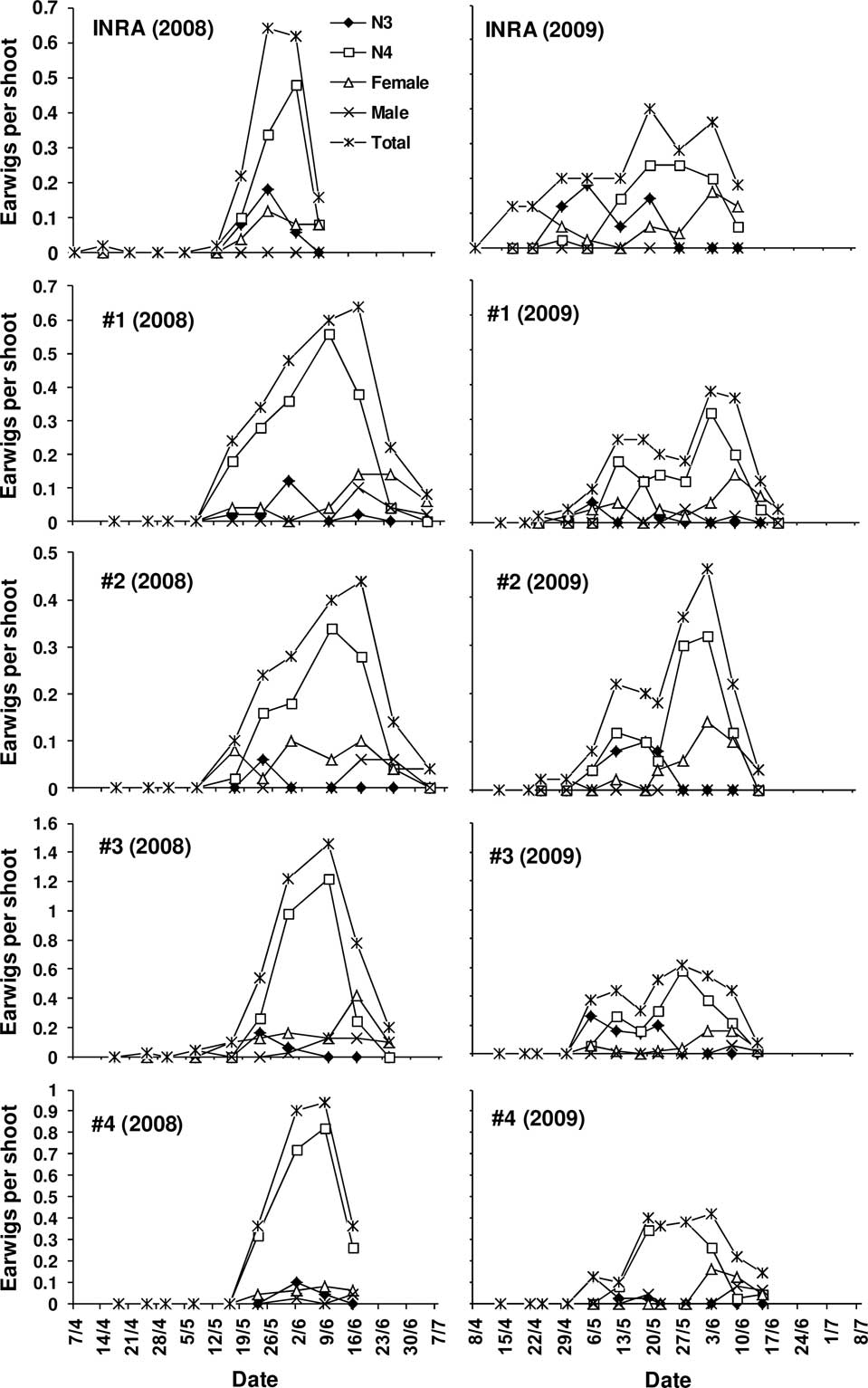
Regarding data obtained from natural shelters, the earwig nymphs appeared in the trees from 7 to 23 May in 2008 and from 29 April to 6 May in 2009 onwards, depending on the orchard (Fig. 3). Earwig appearance was late relative to the D. plantaginea infestation, which occurs generally from early April to mid-June (data not shown). Earwig abundance increased generally with time to a maximum peak followed by a steady decline following the decline of the D. plantaginea population until its complete extinction (Fig. 3). N1 and N2 were never observed in the D. plantaginea colonies. The N3 represented 3.7–24.3% of all earwig life stages recorded in the D. plantaginea colonies during the two years of study. Depending on the orchard, its presence was generally restricted to the two last weeks of May and the first week of June in 2008 and the two and three first weeks of May in 2009 (Fig. 3). N4 was the most abundant earwig life stage observed in the D. plantaginea colonies during the observation period with 60.7–82.8% (of the total number of earwigs observed at all life stages) in 2008 and 43.7–69.2% in 2009. N4 was present at almost all sampling dates from 25 April to 23 May in 2008 and from 29 April to 12 May in 2009, depending on the orchard. N4 reached its maximum peak on 2 and 9 June in 2008 and on 27 May and 3 June in 2009, depending on the orchard (Fig. 3). Earwig males were not observed in INRA (two years) and number 2 (2009) while they were rarely recorded and mainly in mid-June with an average of 4.0% in the other orchards. Earwig females were the second most recorded life stage after N4 with 9.4–26.8% in 2008 and 15.0–34.0% in 2009 during the D. plantaginea season on apple trees. Females were present mainly from mid-May onwards generally peaking in June (Fig. 3). In addition, few earwig females were observed from mid-April to early May in 2008 (INRA) and 2009 (INRA, number 1 and 2) (Fig. 3).
Evolution of the average numbers of third (N3), fourth (N4) nymphal, adult (female and male), and all (total) life stages in the Forficula auricularia population sampled in the natural (shoot infested by the rose apple aphid) shelters throughout the 2008 and 2009 spring seasons in five apple orchards in southeastern France. INRA, Institut National de la Recherche Agronomique (French National Institute for Agricultural Research); #, Orchard number.
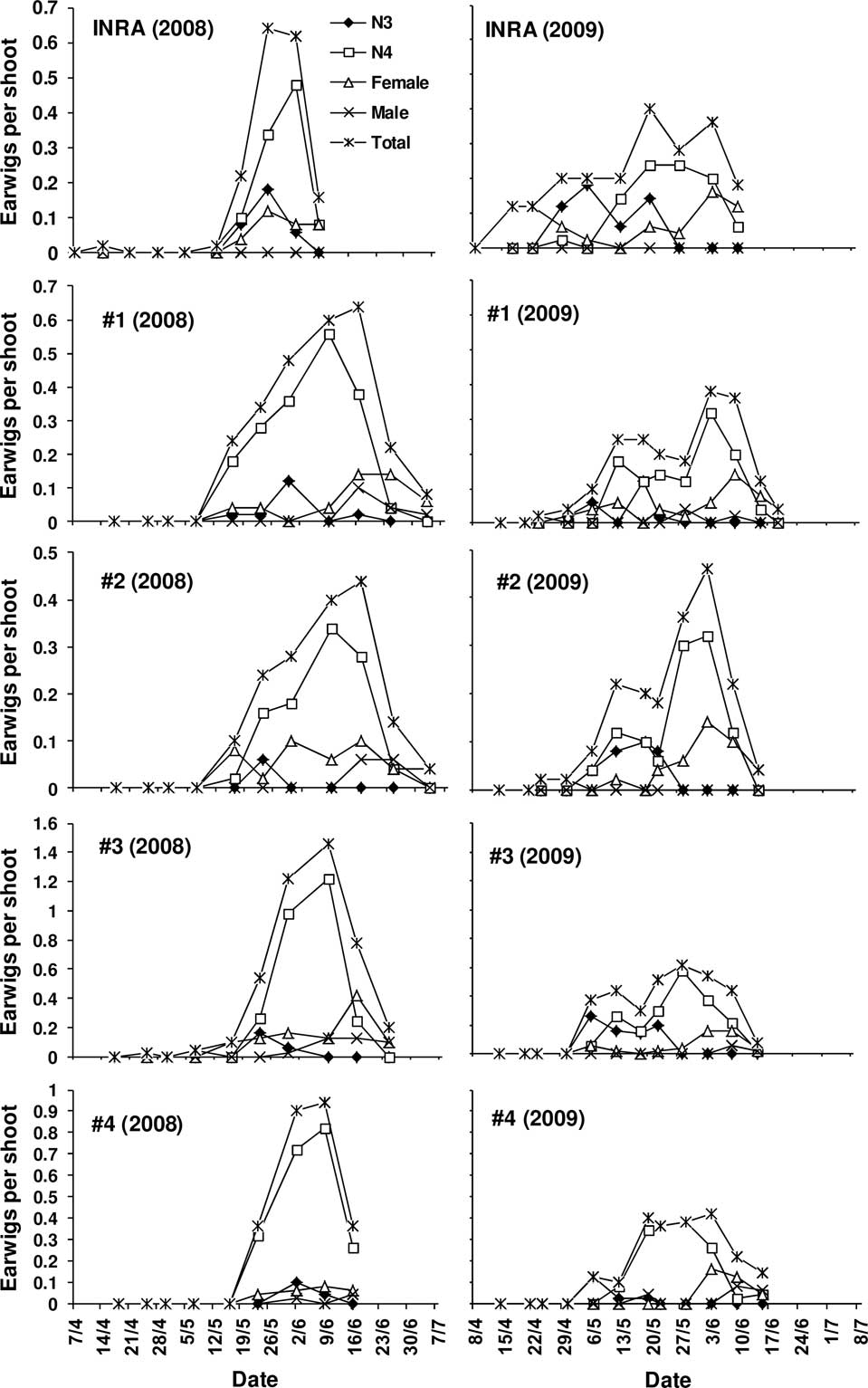
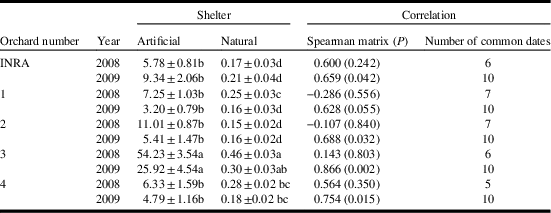
A significant difference in the total earwig densities sampled in the natural shelters was observed between the two study years (F=9.747; df=1; P=0.002) but not in the artificial shelters (F=0.193; df=1; P=0.661) (Table 6). No interaction between orchard and year was detected for either shelter type (in natural (F=1.681; df=4; P=0.153) and artificial shelters (F=1.925; df=4; P=0.108)) (Table 6). In contrast, the differences were highly significant among orchards (in natural (F=16.480; df=4; P<0.0001) and artificial shelters (F=40.876; df=4; P<0.0001)) (Table 6). The total earwig abundance observed in orchard number 3 was significantly higher than in the other orchards in the artificial shelters in both years and in the natural shelters in 2008 (Table 6).
Forficula auricularia number (mean±SE per shelter) sampled in the artificial (corrugated cardboard) and natural (shoot infested by the rose apple aphid) shelters throughout the 2008 and 2009 spring seasons in the five apple orchards studied in southeastern France and the correlation coefficients (Spearman’s correlation test) between the population dynamics of earwigs sampled using both shelter types.

Notes: INRA, Institut National de la Recherche Agronomique (French National Institute for Agricultural Research).
a,b,c,dValues followed by different letters within the same column were significantly different based on ANOVA or Kruskal–Wallis tests at the 5% significance level.
In general, there was a positive correlation between the earwig populations found in the artificial and natural shelters, with the exception of orchards number 1 and 2 in 2008 for which the correlation was slightly negative (Table 6). These correlations were not significant in 2008 but in 2009 they were significant with the exception of orchard number 1 (Table 6).
Field study of earwig species
A total of 258 and 1061 earwigs were collected from 740 D. plantaginea colonies (0.35 earwigs per colony on average) and 200 cardboard bands (5.31 earwigs per band on average), respectively during the two study years on the five orchards. Two earwig species belonging to the Forficulidae were recorded from the sampled colonies and bands: F. auricularia (87.2% and 88.9% of all earwigs recorded, respectively, in colonies and bands during the two years of study) and F. pubescens (12.8% and 10.7%). The sex ratio (% of females) was 66.2% and 62.1% for F. auricularia and 54.5% and 56.6% for F. pubescens in the earwig populations collected from colonies and bands, respectively. In addition, two other earwig species were recorded in 2008 from sampling bands: four individuals (one and three individuals in the INRA and number 3 orchards, respectively) of Euborellia moesta Gené (Dermaptera: Anisolabididae) and one individual Labidura riparia (Pallas) (Dermaptera: Labiduridae) in the number 3 orchard.
Discussion
Overall, two species (F. auricularia and F. pubescens) were mainly observed during the field survey in the studied apple orchards. The two other earwig species, E. moesta and L. riparia, recorded in our study represented only 0.47% of all earwigs collected. However, the sampling methods used in this study were not expected to capture these ground-dwelling species. The rate of F. pubescens captured in the artificial or natural shelters was just over 10% of the total, lower than observed in a previous study conducted in pear orchards in the same area (Debras et al. Reference Debras, Dussaud, Rieux and Dutoit2007). Forficula auricularia was clearly the predominant earwig species in apple orchards as has been found in other regions (e.g., Solomon et al. Reference Solomon, Cross, Fitzgerald, Campbell, Jolly and Olszak2000; Nicholas et al. Reference Nicholas, Spooner-Hart and Vickers2005; Suckling et al. Reference Suckling, Burnip, Hackett and Daly2006).
The laboratory study of life-history traits in the conditions of southeastern France confirmed that F. auricularia in this region is of type (B) and thus tends to have two separate nymph cohorts. The pre-adult development (time to reach adulthood) of the first brood was significantly longer than that of the second brood. This is due to the major and positive effect of temperature on the development of F. auricularia (Behura Reference Behura1956; Helsen et al. Reference Helsen, Vaal and Blommers1998; Moerkens et al. Reference Moerkens, Gobin, Peusens, Helsen, Hilton and Dib2011). The second brood happens later in the year, beginning in early April, which the weather is warmer and earwigs need, thus, less time to mature. Indeed adulthood is reached after about 880 degree-days above 6 °C (Helsen et al. Reference Helsen, Vaal and Blommers1998). Eggs and N1 were the most vulnerable earwig life stages in our rearing conditions and their mortality rate was significantly lower in the first brood compared with the second. This may be due to the higher mortality of females in the second brood compared with the first before eggs hatched, even if the difference in mother mortality was not significant between the two broods. However, this mortality of mothers was remarkably higher before egg hatch than after egg hatching. This resulted in a smaller percentage of eggs hatching in both broods which was the predominant factor accounting for the mortality throughout pre-adult development. These results show the importance of maternal care (protection, food provisioning, etc.) during this period of earwig development. If the mother abandons her clutch or dies, eggs or young nymphs have considerably less chance of surviving (Kölliker Reference Kölliker2007; Kölliker and Vancassel Reference Kölliker and Vancassel2007; Boos et al. Reference Boos, Meunier, Pichon and Kölliker2014; Koch and Meunier Reference Koch and Meunier2014). In our study, one third of females succeeded in nurturing its second brood until first moulting. Vancassel and Quris (Reference Vancassel and Quris1994) reported that only one fourth of females successfully raised its second egg clutch until hatching. After this familial phase, the survival percentage of nymphs, from N2 towards, in both broods was very high with values greater than 96%. Nymphs, from N2 in the earwig of type (B), disperse and can forage independently (e.g., Vancassel and Foraste Reference Vancassel and Foraste1980; Kölliker Reference Kölliker2007). The high survival rate of nymphs found after the familial phase suggests that the methodology used to study the life-history traits was successful, especially the artificial medium used as food as described by Sauphanor et al. (Reference Sauphanor, Blaisinger and Sureau1992). This method may thus be appropriate for successful commercial mass rearing of earwigs. However, the low nymph mortality recorded here is probably unrealistic for field conditions where the earwig populations can be affected by several regulating mechanisms such as orchard management, starvation, disease, parasitism, predation, or cannibalism (Moerkens et al. Reference Moerkens, Leirs, Peusens and Gobin2009).
The comparison of the appearance date, earwig life cycle and the peak of each life stage for our experiments did not show strong differences within a given orchard and year. Rather there was variation among orchards throughout the two years of study. These differences (a few days), when present, appeared to be mainly due to environmental variation and to the large variation in the expected numbers of earwig couples studied and thus their offspring among orchards. Their seasonal abundance was complex with the coexistence of mixed aged life stages, especially in the case of F. auricularia of type B with two egg broods.
Obviously, the presence of earwigs in D. plantaginea colonies (natural shelters) was associated with the presence of D. plantaginea and thus at the end of the D. plantaginea season on apple trees, only a few earwig individuals were found in these shelters. The use of these shelters is related not only to the role of an aggregation pheromone (Sauphanor Reference Sauphanor1992; Walker et al. Reference Walker, Jones and Fell1993) but also to the availability of food around the shelter. Lamb (Reference Lamb1975) demonstrated that earwigs did not return to the same shelter when the local food sources were exhausted. However, Dib et al. (Reference Dib, Simon, Sauphanor and Capowiez2010b) found that earwigs had an inverse density-dependent relationship with D. plantaginea abundance and showed a negative correlation with D. plantaginea populations. This is mainly due to the naturally late appearance of earwigs in the D. plantaginea lifecycle (Dib et al. Reference Dib, Simon, Sauphanor and Capowiez2010b).
Very few N1 and N2 were observed in the artificial shelters attached to tree trunks near the ground and they were never sampled in the natural shelters in tree canopies. The weak dispersal of these two life stages is attributed to the fact that for earwigs of type (B), N1 are dependent on maternal care in the subterranean nests and N2, when brood care ends, migrate and live on the ground (Lamb and Wellington Reference Lamb and Wellington1975; Helsen et al. Reference Helsen, Vaal and Blommers1998; Moerkens et al. Reference Moerkens, Leirs, Peusens and Gobin2009). The above-mentioned studies reported that earwig nymphs of type (B) disperse into the trees (arboreal phase) from N3, which is consistent with our findings. Indeed the N3 were generally observed in both shelter types from the last week of April to mid-June. N4 was the only life stage present at almost all sampling dates during our observation period in the artificial shelters and from early May onwards in the natural ones. In addition, it was the most abundant earwig life stage sampled, as previously reported from a study in Belgian orchards by Moerkens et al. (Reference Moerkens, Leirs, Peusens and Gobin2009). This finding and the high voracity of N3 and N4 against D. plantaginea at low temperatures (Dib et al. Reference Dib, Jamont, Sauphanor and Capowiez2011), suggest that in theory they would be effective for use in augmentation programmes against D. plantaginea in early spring when field D. plantaginea populations are beginning to build up (Dib et al. Reference Dib, Jamont, Sauphanor and Capowiez2016b). The potency of F. auricularia as an aphid predator was evaluated on citrus (Piñol et al. Reference Piñol, Espadaler, Pérez and Cañellas2009; Romeu-Dalmau et al. Reference Romeu-Dalmau, Piñol and Agustí2012a) and apples (Asgari Reference Asgari1966) and it appears to be more efficient than species in the Chrysopidae (Neuroptera) and Coccinellidae (Coleoptera) families or predatory Heteroptera (Hemiptera). In the laboratory, F. auricularia had a greater effect on the D. plantaginea colony when the initial infestation was low (Dib et al. Reference Dib, Jamont, Sauphanor and Capowiez2016a). The effectiveness of F. auricularia is mainly due to well-developed physical structures for preying and eating. F. auricularia is well fitted-out for capturing prey with strong mouthparts of the chewing type and claw-like forceps located at the end of the abdomen (Albouy and Caussanel Reference Albouy and Caussanel1990). The early presence of a few N4 (especially trapped in March in the artificial shelters) suggests that the nymphs survive the winter. This was previously mentioned by Worthington (Reference Worthington1926) concerning second brood nymphs. These nymphs could also result from a possible third brood in warm regions, which were then unable to mature before winter and moulted into adults the following summer. These types of nymphs are expected to be very small as they overwinter in trees, not in the soil (Worthington Reference Worthington1926), where they are much more exposed to harsh conditions. However, we did not observe a third brood in the life cycle study as all females died after the first moulting of the second brood nymphs before early June. As most males die early in the spring after being driven from the nests and the females have the mission of brood care during the daytime (e.g., Lamb and Wellington Reference Lamb and Wellington1975), they were rarely noted in both shelter types before early June. From early June onwards, new earwig adults that had moulted from N4 of a given year, gradually increased in the artificial shelter.
The suitability of the artificial shelters used in this study as a method of monitoring and studying earwig population dynamics is controversial (e.g., Burnip et al. Reference Burnip, Daly, Hackett and Suckling2002; Logan et al. Reference Logan, Maher, Connolly and Pettigrew2007). Thus, there are attempts to find new sampling methods, such as darkened diet tubes capable of sampling for the presence of frass (Suckling et al. Reference Suckling, Burnip, Hackett and Daly2006), which have been successfully used later in many studies (e.g., Romeu-Dalmau et al. Reference Romeu-Dalmau, Piñol and Espadaler2012b). However, the cardboard shelters remain to date one of the good sampling methods adapted to this kind of study concerning earwig predators. They offer the advantage of low cost of readily obtained materials and, additionally, the ability to shelter large numbers of earwigs for potential redistribution around the orchard. The importance of these shelters for earwigs was revealed in our study by a temporal increase in the total number found in all orchards and years except orchard number 3 where we remarked a sudden decline in the earwig population in artificial shelters from 8 June 2009 onwards.
Significantly lower numbers of earwigs were caught in the artificial shelters in the hedgerow than in the orchard. This is due to the greater complexity of the hedgerow, which offers numerous alternative hiding places. Indeed several authors have reported the competitive interaction between artificial shelters and the availability of surrounding natural shelters (e.g., Lamb Reference Lamb1975; Burnip et al. Reference Burnip, Daly, Hackett and Suckling2002; Debras et al. Reference Debras, Dussaud, Rieux and Dutoit2007). Interestingly, the earwig population sampled in the row beside the hedgerow was significantly larger than that in the centre of the orchard. This can be explained by the important role of the hedgerow in maintaining earwigs and their movement towards the orchards searching for prey. Each row parallel to the hedgerow would act as a barrier hindering earwig dispersal and thus its presence in the following rows. Many studies have demonstrated the importance of ecological infrastructure (e.g., hedgerows and floral strips) as a source of earwigs (e.g., Debras et al. Reference Debras, Dussaud, Rieux and Dutoit2007) and natural enemies in general (e.g., Rieux et al. Reference Rieux, Simon and Defrance1999; Dib et al. Reference Dib, Libourel and Warlop2012).
In conclusion, this descriptive study of the life history and spring population dynamics of F. auricularia demonstrated its important natural presence in the apple orchards in southeastern France. This is a first step for the development of phenological models (e.g., Moerkens et al. Reference Moerkens, Gobin, Peusens, Helsen, Hilton and Dib2011) to limit earwig mortality due to horticultural management (e.g., Dib et al. Reference Dib, Sauphanor and Capowiez2016c) in an inappropriate time of the earwig life cycle. These data may also be integrated with other information on its capacity to establish, ability to disperse, potency to regulate and have direct and indirect effects on non-target organisms. These data are crucial in order to significantly manipulate the predation level by earwigs in biological control programmes (e.g., Dib et al. Reference Dib, Jamont, Sauphanor and Capowiez2016b). Artificial shelters such as the corrugated cardboard and environmental modifications such as the hedgerows are fundamental elements that may serve to conserve and enhance earwig populations.
Acknowledgements
We would like to thank Odile Mascle for technical assistance. We are also grateful to members of the Ecologie de la Production Intégrée team for their assistance in collecting earwig adults.