Introduction
The thiobarbituric acid reactive substances (TBARS) assay measures malondialdehyde – along with a range of aldehydes, carbohydrates, amino acids, haem-containing and phenolic compounds – and is a common method used to estimate lipid peroxidation in both aged and recalcitrant seeds. While there are many caveats concerning the accuracy of the TBARS method (Halliwell and Gutteridge, Reference Halliwell and Gutteridge2007), particularly because rigorous cross-validation with other measures of lipid peroxidation have not been reported for seeds, the assay is commonly used to determine quickly whether or not substantial lipid peroxidation is present in a sample before more time-consuming and detailed analyses are conducted.
Increased lipid peroxidation has been proposed as a cause for viability loss when recalcitrant seeds are dried (reviewed in Leprince and Golovina, Reference Leprince, Golovina, Black and Pritchard2002), but results can be inconsistent from species to species. For example, when the TBARS content of tea (Camellia sinensis), cocoa (Theobroma cacao) and jackfruit (Artocarpus heterophyllus) (all recalcitrant) was measured in freshly harvested seeds and after 4 h of drying, only cocoa had slightly elevated TBARS content (c. 17% increase) (Chandel et al., Reference Chandel, Chaudhury, Radhamani and Malik1995). The tea and jackfruit seeds had a slight decline in TBARS amounts following desiccation, but the baseline amounts in recalcitrant seeds were higher than amounts observed in French bean (Phaseolus vulgaris) seeds, which were used as an orthodox control. In contrast, when Li and Sun (Reference Li and Sun1999) measured lipid peroxidation in cocoa, they observed c. 100% increase in TBARS as seeds reached the critical moisture content, which coincided with a rapid decline in per cent germination and a decline in the reactive oxygen species (ROS) scavenging enzymes, peroxidase and superoxide dismutase. For rapidly dried, isolated axes of Antiaris toxicaria (silica gel, 15°C), TBARS values initially declined and then increased as axis moisture was reduced below the critical moisture content at which seed death was first observed (Xin et al., Reference Xin, Jing, Liu and Song2010), while in more slowly dried (45% relative humidity, 15°C) seeds and axes, TBARS increased throughout the desiccation period (Cheng and Song, Reference Cheng and Song2008). Products of lipid peroxidation were also observed as recalcitrant Quercus robur was dried, where a slight increase in TBARS products was observed in the cotyledons and a much larger increase occurred in the axes (Hendry et al., Reference Hendry, Finch-Savage, Thorpe, Atherton, Buckland, Nilsson and Seel1992; Finch-Savage et al., Reference Finch-Savage, Blake and Clay1996). In addition, when recalcitrant Avicennia marina was dried, a slight decrease in TBARS was observed in the hypocotyl and root primordial tissues; however, a spike in TBARS was observed in the cotyledons (Greggains et al., Reference Greggains, Finch-Savage, Atherton and Berjak2001); suggesting that lipid peroxidation may be concentrated in specific areas of the seed. Therefore, while TBARS has been used with various recalcitrant species, the results have been vastly different, and it is still unclear what role, if any, lipid peroxidation plays in desiccation-induced death (Leprince and Golovina, Reference Leprince, Golovina, Black and Pritchard2002).
The TBARS assay has been the predominant method used to determine lipid peroxidation in recalcitrant seeds. However, the results must be viewed cautiously because carbohydrates and pigments, such as anthocyanins, can react with thiobarbituric acid (TBA) and cause lipid peroxidation values to be overestimated (Du and Bramlage, Reference Du and Bramlage1992; Hodges et al., Reference Hodges, DeLong, Forney and Prange1999).
In the present study, recalcitrant seeds from the salt-marsh grass Spartina alterniflora (smooth cordgrass) and orthodox seeds from Spartina pectinata (prairie cordgrass) were used to measure TBARS amounts during desiccation. The TBARS assay was conducted with the traditional method using extraction at 4°C and without corrections for interference (Heath and Packer, Reference Heath and Packer1968), and also with extraction at liquid nitrogen temperatures and the corrections proposed by Du and Bramlage (Reference Du and Bramlage1992) and Hodges et al. (Reference Hodges, DeLong, Forney and Prange1999).
Materials and methods
Plant material
S. alterniflora seeds were harvested at the natural time of shattering from the Ben-Hur Experimental Station (LSU AgCenter) in Baton Rouge, Louisiana (2004 harvest) or from wild-type plants in the marshes at Port Fourchon, Louisiana (2005, 2006, 2007 harvests). Subsequent to hand-shattering, the seeds were immediately placed in sealed plastic bags and transported to the laboratory for processing. Transport times from Ben-Hur Experimental Station and Port Fourchon were c. 15 min and 3 h, respectively. Once in the lab, the 10 g seed lots were immediately placed in Magenta culture vessels that contained 250 ml of deionized water and stored at 2°C.
S. pectinata seeds were purchased from Western Native Seeds in Coaldale, Colorado (WNS-03A, Lot # 6042), harvested in 2003. Upon arrival, the S. pectinata seeds had an average moisture content of 8.5 ± 1%. The seeds were either placed in sealed Ball™ jars and stored at 23°C, or immediately submerged in water and stored at 2°C. After several months of dry storage at 23°C, related studies indicated that S. pectinata seeds at low moisture contents could be safely stored at − 20°C; to minimize the effects of ageing, unimbibed seeds in the Ball™ jars were moved to − 20°C.
Prior to each experiment, seeds were screened with backlighting to ensure that only ‘full’ seeds were assayed. Full seeds were accumulated on moist towelling during screening, and were then lightly patted with tissue to remove excess external moisture prior to desiccation.
Seed desiccation
To dry the seeds rapidly, a ‘flash’ dryer, as described in Wesley-Smith et al. (Reference Wesley-Smith, Pammenter, Berjak and Walters2001), was used. The dryer consisted of a 500 ml Nalgene jar (Thermo Fisher Scientific, Rochester, USA) with a layer of fresh 8 mesh, CaSO4 desiccant (W.A. Hammond Drierite Company Ltd, Xenia, Ohio, USA) on the bottom (c. 75 g), a 12 V computer fan (a 12 V 1amp adapter was needed to run the fan from the wall current), and a Ball™ jar rim (Muncie, Indiana, USA) lined with mesh that was used as a stage to hold the seeds. The computer fan, supported by four 200 μl pipette tips, was placed c. 5 cm above the desiccant, and was oriented so it pulled dry air from the desiccant up and over the seeds. To obtain consistent dry-down rates, it was necessary to use fresh desiccant for each dry-down experiment (heat-regenerated desiccant yielded inconsistent dry-down patterns). The dryer was run for designated times at c. 23°C, drying the 90 seeds to a wide range of moisture contents.
Each drying run contained seeds used for a TBARS assay, moisture content determination and seed viability. So, each data point presented in the figures represents a matched set of data for that specific drying run.
Seed moisture content and viability determinations
After drying, seeds were tested for viability and per cent moisture content. Per cent seed water content was calculated on a dry weight basis, and dry weights were obtained by placing aliquots of 20 seeds at 105°C for 7 d to attain constant weight, followed by cooling over desiccant. Viability of Spartina seeds was determined by a cut test. The apical one-third of a seed was removed with a scalpel, clipping the coleoptile. Twenty seeds were placed in 9 × 9 × 1.5 cm plastic Petri dishes, containing two pieces of brown germination paper (Anchor Paper, St. Paul, Minnesota, USA) and 8 ml distilled water. A folded Kim-Wipe™ tissue was placed over the seeds. The covered Petri dishes were positioned at c. 45° angle in humidity boxes lined with moist paper towels and incubated at 27°C in the light. Radicle and shoot emergence were recorded after 14 d.
Thiobarbituric acid reactive substances (TBARS) assay
The TBARS method of Heath and Packer (Reference Heath and Packer1968), as modified by Hodges et al. (Reference Hodges, DeLong, Forney and Prange1999), was used to measure late products of lipid peroxidation as Spartina seeds were rapidly dried. Thiobarbituric acid reactive substances were quantified using 1,1,3,3-tetraethoxypropane as a standard.
Fifty seeds were flash-frozen in liquid nitrogen and ground to a powder in a mortar and pestle that were pre-chilled with liquid nitrogen and buried in solid carbon dioxide (dry ice). To ensure reproducibility, the seeds were ground to the same degree, and liquid nitrogen was added liberally to prevent thawing. The seed powder was transferred to a 15 ml Tenbroek homogenizer embedded in ice, and the seeds were homogenized in 3 ml of ice-cold 80:20 ethanol:water (v/v). Each sample was extracted with exactly 20 full strokes of the glass pestle to ensure complete and uniform homogenization. To maximize the transfer, an additional 2 ml of ice-cold 80:20 ethanol:water was used to rinse any tissue debris from the pestle and homogenizer (1 ml for each), bringing the total volume to 5 ml. The sample was then centrifuged (4°C) for 10 min at 12,000 g to remove cellular debris. A 1 ml aliquot of the supernatant was added to a test tube that contained 2 ml of 20% (w/v) trichloroacetic acid (TCA), 0.01% butylated hydroxytoluene (BHT; an antioxidant added to avoid malondialdehyde production during subsequent processing steps), and 1 ml of 0.67% thiobarbituric acid (TBA). A tissue blank was also used, where, in place of TBA, distilled water was added. Samples were then vortexed (c. 3 s) and heated in a 95°C water bath for 25 min, followed by 10 min on ice to remove proteins and then centrifuged (4°C) at 10,000 g for 5 min. The absorbance of the supernatant was then measured at 440, 532 and 600 nm. TBARS values were calculated according to Heath and Packer (Reference Heath and Packer1968) (uncorrected values), Du and Bramlage (Reference Du and Bramlage1992) (corrected for interfering sugars) and Hodges et al. (Reference Hodges, DeLong, Forney and Prange1999) (corrected for interfering sugars and pigments). The TBARS values (nmol ml− 1) were converted to nmol seed− 1.
TBARS were assayed for dormant and non-dormant seeds of S. alterniflora and S. pectinata seeds, to determine if there were differences in lipid peroxidation between recalcitrant and orthodox seeds, and between metabolically active (non-dormant) and inactive (dormant) seeds. Seeds of both Spartina species show physiological dormancy at dispersal. Submerged stratification of viable seeds for an average of 2 months at 2°C elicits 50% germination after 14 d at 27°C (Chappell, Reference Chappell2008; Chappell and Cohn, in preparation). For each harvest vintage, seeds were classified as dormant if they had been stored submerged for < 2 months. Seeds were classified as non-dormant and used in these experiments after the stratification requirement had been fulfilled, and seeds subsequently germinated 100% at 27°C.
Finally, to have a comparable method with past TBARS experiments with recalcitrant seeds (e.g. Greggains et al., Reference Greggains, Finch-Savage, Quick and Atherton2000), the same experiment as above was performed, with the exception that the seeds were initially ground with ice-cold extraction medium in a mortar at 4°C, rather than freeze-clamping in liquid nitrogen.
Results
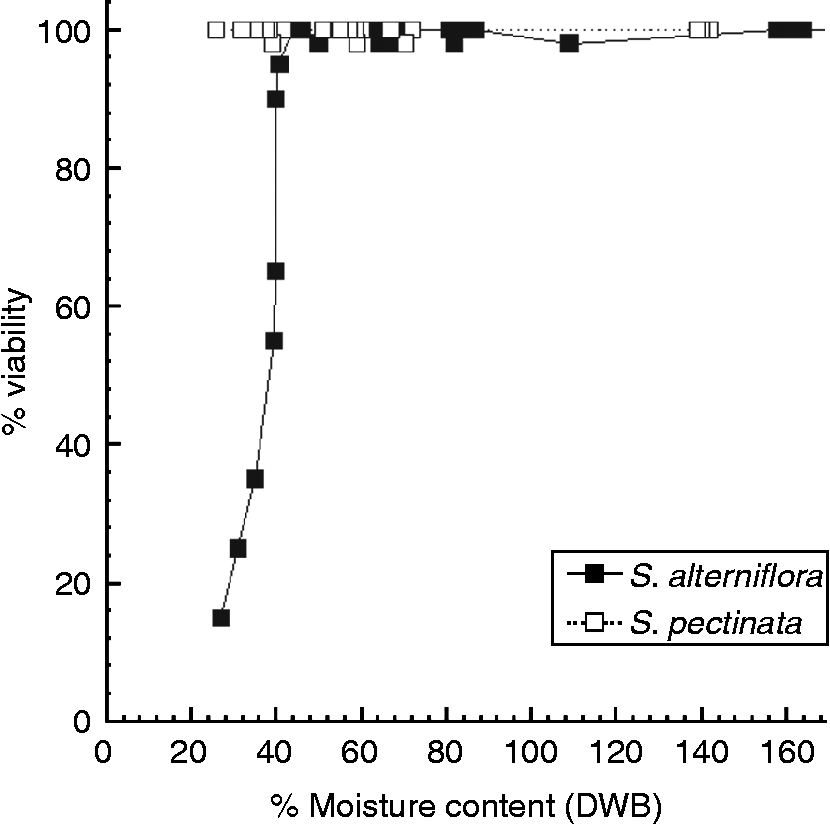
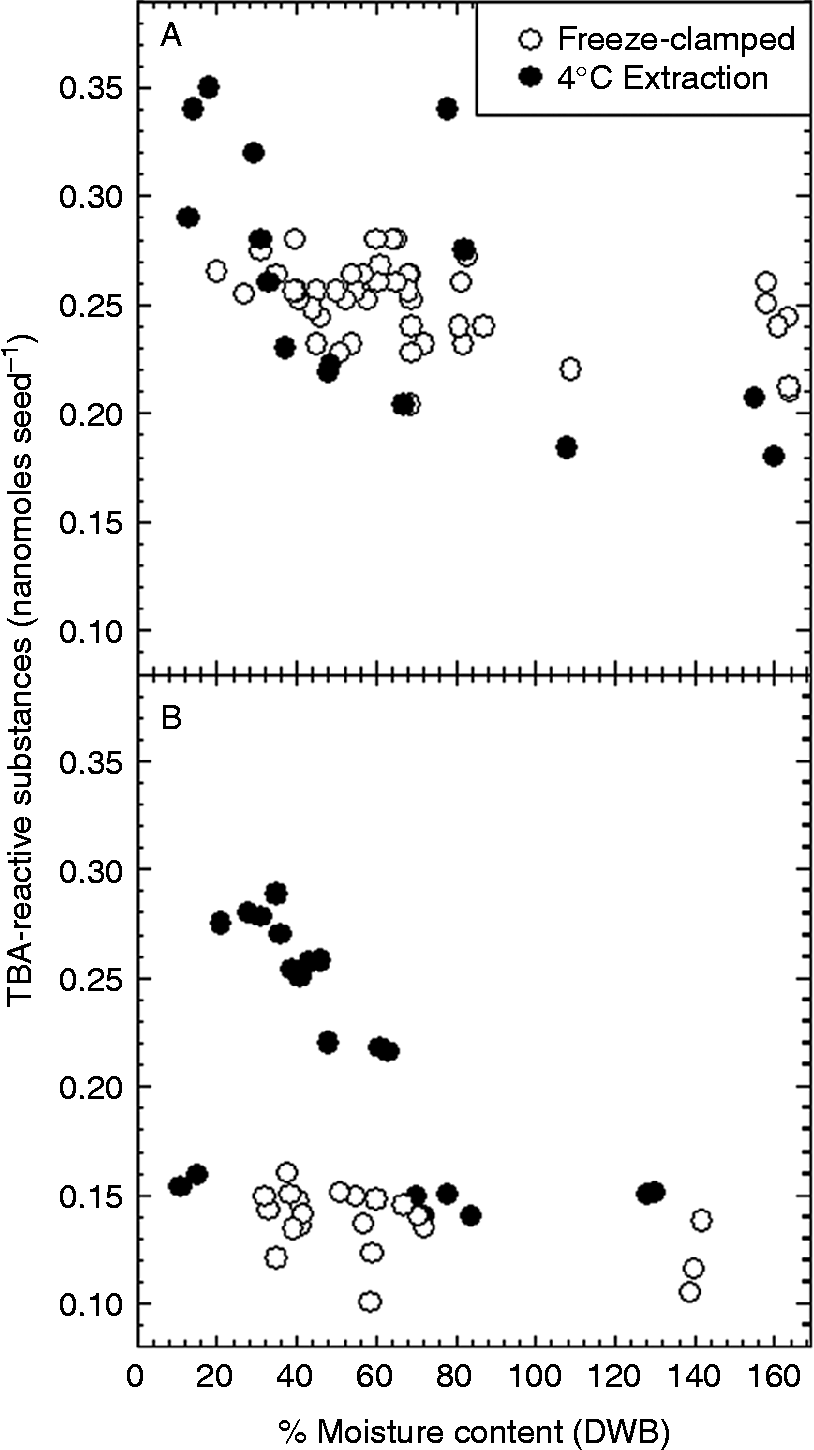
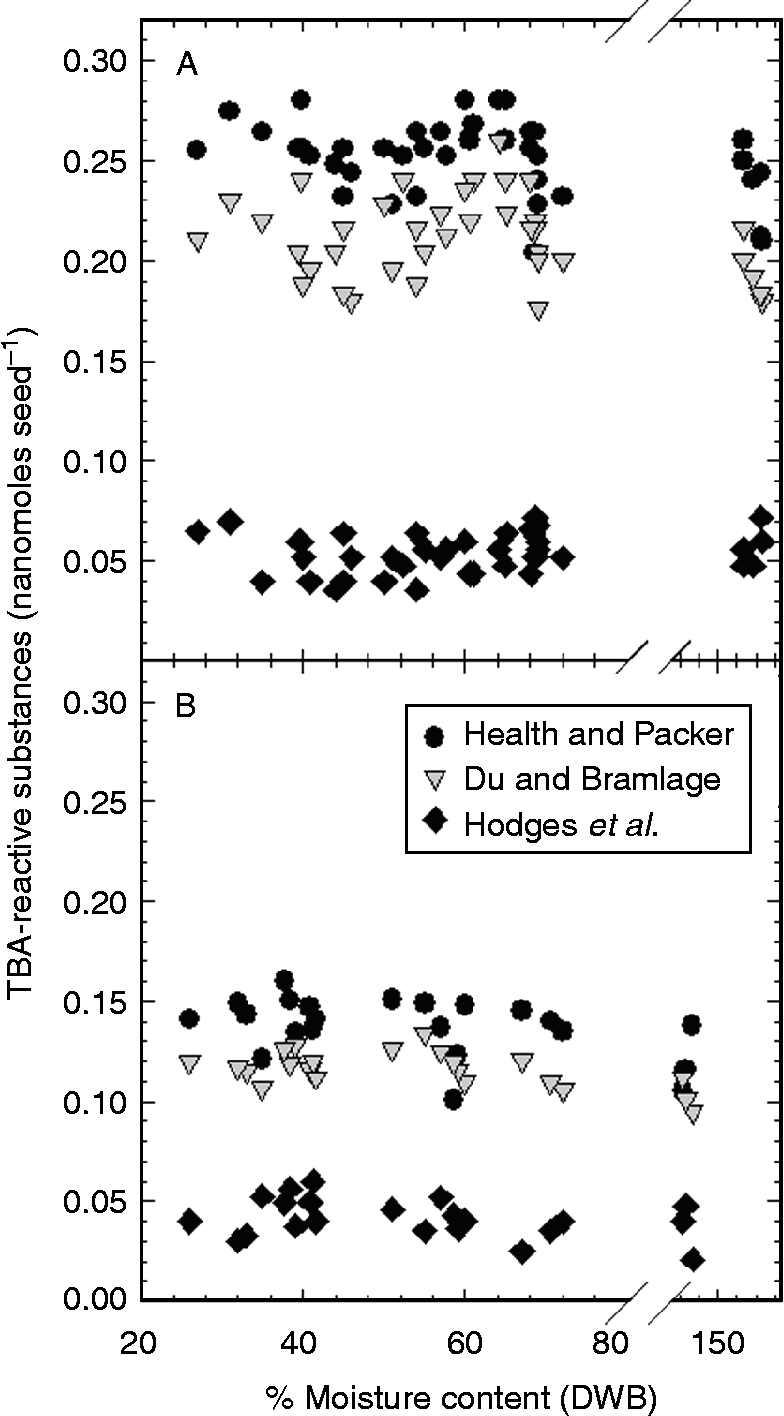
Recalcitrant S. alterniflora seeds had a critical moisture content of c. 40%, and desiccation-tolerant (orthodox) S. pectinata seed viability was unaltered by desiccation (Fig. 1). When the extraction for TBARS was carried out at 4°C (Heath and Packer, Reference Heath and Packer1968; standard published procedure), TBARS amounts increased in both Spartina species during desiccation (Fig. 2). However, when the seeds were freeze-clamped in liquid nitrogen before extraction, TBA-reactive substances were detected at constant, low amounts in both species (Figs 2 and 3). Using the Heath and Packer (Reference Heath and Packer1968) calculations or the Du and Bramlage (Reference Du and Bramlage1992) correction for sugars, average TBARS amounts were higher for freeze-clamped S. alterniflora than in S. pectinata. However, after application of the Hodges et al. (Reference Hodges, DeLong, Forney and Prange1999) correction factor, which accounts for interfering compounds such as anthocyanins and sugars, the TBARS values were not different between the Spartina species (Fig. 3). Dormant S. alterniflora ( = 0.0708 ± 0.0163) and S. pectinata seeds (
 = 0.0542 ± 0.0050) that were freeze-clamped prior to extraction had almost identical TBARS values to the non-dormant seeds with the Hodges et al. (Reference Hodges, DeLong, Forney and Prange1999) correction (data not shown).
Viability of S. alterniflora (recalcitrant) and S. pectinata (orthodox) seeds during desiccation.

TBARS amounts in (A) S. alterniflora and (B) S. pectinata seeds as a function of seed moisture content during desiccation and initial extraction conditions. After drying, seeds were freeze-clamped in liquid nitrogen prior to homogenization (○) or immediately homogenized at 4°C in extraction medium (●). TBARS values were calculated as described by Heath and Packer (Reference Heath and Packer1968).

TBARS amounts in (A) S. alterniflora and (B) S. pectinata seeds as a function of seed moisture content during desiccation. For all determinations, seeds were freeze-clamped in liquid nitrogen prior to homogenization. TBARS values were calculated according to Heath and Packer (Reference Heath and Packer1968) (●); Du and Bramlage (Reference Du and Bramlage1992), which corrects for interfering sugars ( ); or Hodges et al. (Reference Hodges, DeLong, Forney and Prange1999), which corrects for interfering sugars, phenolics and pigments (♦).

Discussion
The hypothesis that lipid peroxidation plays a role in desiccation-induced death is common, yet controversial. While some studies report increased TBARS amounts, it is still unclear if lipid peroxidation is associated with desiccation-induced death of all recalcitrant seeds. Very few studies have measured lipid peroxidation in closely related orthodox seeds (Greggains et al., Reference Greggains, Finch-Savage, Atherton and Berjak2001), so it is unclear if results found are common to all seeds, or are exclusive to recalcitrant seeds. Also, in many past studies, seed extraction for TBARS has been carried out at 4°C, as prescribed by the Heath and Packer (Reference Heath and Packer1968) protocol. At this temperature, free-radical reactions can still occur readily, and radicals can actually be created by the stress of processing the sample (Shuter et al., Reference Shuter, Davies, Garlick, Hearse and Slater1990). In the present study, extraction at 4°C caused increased TBARS in both Spartina species during drying (Fig. 2); however, when the seeds of either species were freeze-clamped in liquid nitrogen before extraction, there was no increase in TBARS (Fig. 3). This suggests that lipid peroxidation products we observed were artefacts of extraction on ice, were not produced within the seeds during drying and, therefore, are not an indicator of oxidative stress in recalcitrant Spartina seeds, nor a cause of their death. Also, it is known that several interfering substances can yield positive TBARS readings and inflate the values (Du and Bramlage, Reference Du and Bramlage1992; Hodges et al., Reference Hodges, DeLong, Forney and Prange1999). Corrections to the Heath and Packer method have been devised to eliminate these artefacts, but very few seed studies employ them. In both Spartina species, TBARS was overestimated when the corrections were not employed (Fig. 3). This indicates the need for appropriate correction of TBARS values to avoid counting sugars and phenolics as lipid peroxidation products.
From the TBARS data, the absorbance at 440 nm, which measures sugars (Du and Bramlage, Reference Du and Bramlage1992), suggests that S. alterniflora seeds have more sugars than orthodox S. pectinata seeds. While only an indirect indicator of overall sugar concentration, this result is intriguing, as it is often hypothesized that sugars may play a role in desiccation tolerance (e.g. Berjak and Pammenter, Reference Berjak and Pammenter2001). Sucrose and fructose reportedly have the highest absorbance in the presence of TBA (Du and Bramlage, Reference Du and Bramlage1992), and sucrose is often associated with tolerance whereas fructose, which does not have the protective attributes of sucrose, may be linked to intolerance (Kermode and Finch-Savage, Reference Kermode, Finch-Savage, Black and Pritchard2002). It would be surprising to find that sucrose amounts are higher in S. alterniflora; however, high fructose amounts could indicate that S. alterniflora is lacking key sugar protectants (e.g. sucrose).
In conclusion, from the results of the TBARS assay, lipid peroxidation does not appear to be the cause of death when recalcitrant S. alterniflora seeds are desiccated. When increased damage products were observed, they appeared to be artefacts of the method, rather than related to recalcitrant death. The results of this study suggest the importance of: (1) employing a taxonomically related, orthodox species control to determine if results are an indicator of recalcitrance or merely a general seed response to desiccation; (2) preparing tissues for all oxidative stress assays, including TBARS, at liquid nitrogen temperatures, to attempt to avoid artefacts created during homogenization; and (3) diligently using previously documented corrections (Du and Bramlage, Reference Du and Bramlage1992; Hodges et al., Reference Hodges, DeLong, Forney and Prange1999) for the TBARS assay to avoid overinflated values as a result of sugars, phenolics and pigments. Given the reservations concerning the TBARS method (Halliwell and Gutteridge, Reference Halliwell and Gutteridge2007), as well as the issues raised here, independent confirmation of the results obtained is suggested.
Acknowledgements
We thank Garret Thomassie, Gary Fine and Richard Neill from the Golden Meadow USDA-NRCS Plant Materials Center (Galliano, Louisiana, USA) and Alan Shadow (LSU AgCenter) for their cooperation and assistance with Spartina seed harvests. Supported by the USDA-CSREES Special Grants Program, the W-1168 Regional Project and Hatch funds. Approved for publication by the Director of the Louisiana Agricultural Experiment Station as manuscript number 2010-240-5207.