Introduction
Periods of interrupted food supply leading to increases in mortality have been a common feature of human history dating back at least 4000 years (Keys et al., Reference Keys, Brozek, Henschel, Michelson and Taylor1950; McCance, Reference McCance1975; Watkins & Menken, Reference Watkins and Menken1985; Elia, Reference Elia2000; Prentice, Reference Prentice2005). During such famines there are repeatable patterns of differential mortality with respect to both age and sex. In most famines it is observed that the largest increases in mortality occur among the very young, notably those aged less than 5 (Biellik & Henderson, Reference Biellik and Henderson1981; Watkins & Menken, Reference Watkins and Menken1985; Harrison, Reference Harrison1988; Kane, Reference Kane1988; Razzaque, Reference Razzaque1989; Menken & Campbell, Reference Menken and Campbell1992; Mammo, Reference Mammo1993; Moore et al., Reference Moore, Marfin, Quenenmoen, Gessner, Ayub and Miller1993; McCurdy, Reference McCurdy1994; Scott et al., Reference Scott, Duncan and Duncan1995), including elevated fetal mortality (Cai & Feng, Reference Cai and Feng2005). In addition, among adults famine mortality tends to increase as a function of age above 30 (Murray et al., Reference Murray, Murray, Murray and Murray1976; Watkins & Menken, Reference Watkins and Menken1985; Toole & Waldman, Reference Toole and Waldman1988; Harrison, Reference Harrison1988; Razzaque, Reference Razzaque1989; de Waal, Reference de Waal1989; Lindtjorn, Reference Lindtjorn1990; Menken & Campbell, Reference Menken and Campbell1992). Complementary to these age-related patterns it is also frequently observed that females are less prone to mortality than males (e.g. Boyle & O'Grada, Reference Boyle and O'Grada1986; Rivers, Reference Rivers and Harrison1988; Livi-Bacci, Reference Livi-Bacci1991, Reference Livi-Bacci1993; Hionidou, Reference Hionidou, Dyson and O'Grada2002a, Reference Hionidoub). Macintyre (Reference Macintyre, Dyson and O'Grada2002) reviewed the data for eighteen famines dating back to the mid-1800s, drawn from across several continents, where there were good demographic data, and found evidence of a female advantage in fourteen of these cases (78%). This female advantage appeared to occur despite the fact that outside the periods of famine females in developing countries often suffer greater mortality than males (Chen et al., Reference Chen, Huq and D'Souza1981; Krishnaji, Reference Krishnaji1987).
Although there may often be unique local factors that could cause a female advantage, the widespread nature of the phenomenon, both spatially and temporally, suggests a more global explanation is warranted (O'Grada & Dyson, Reference O'Grada, Dyson, Dyson and O'Grada2002). One such explanation may be biased recording of female or male mortality (Sen, Reference Sen1981), e.g. under-reporting of female deaths, or over-reporting of male deaths. This might, for example, occur because men are more likely to travel away from their homes to seek food, and their deaths may be reported both where they died and where they originated (Macintyre, Reference Macintyre, Dyson and O'Grada2002). However, a favoured explanation for the global nature of the female mortality advantage is that it is rooted somehow in the biological differences between the sexes and this effect transcends local cultural or social conditions when food supplies become scarce (Rivers, Reference Rivers1982, Reference Rivers and Harrison1988; McAlpin, Reference McAlpin1983; Henry, Reference Henry1990; Livi-Bacci, Reference Livi-Bacci1993; Collins, Reference Collins1995). A major biological difference between males and females is the levels of stored body fat (Durnin & Womersley, Reference Durnin and Womersley1974; Deurenberg et al., Reference Deurenberg, Westrate and Seidell1991; Ballor & Keesey, Reference Ballor and Keesey1991; Kuk et al., Reference Kuk, Lee, Heymsfield and Ross2005; Speakman & Westerterp, Reference Speakman and Westerterp2010). At a given body weight an adult woman contains substantially more fat and correspondingly less muscle (Janssen et al., Reference Janssen, Heymsfield, Wang and Ross2000) than a man does. This leads to some key effects as far as predicted survival during famine conditions are concerned. Stored body fat is the primary energy reserve that is drawn upon to make up the shortfall between food intake and energy demands during periods when intake is reduced. Having more body fat would mean females on average would be able to survive longer. However, this effect is amplified by the fact that the rate at which energy is utilized is dependent primarily on the lean tissue mass, hence females have lower energy expenditure than males of the same body weight (Ferraro et al., Reference Ferraro, Lillioja, Fontvielle, Rising, Bogardus and Ravussin1992; Nelson et al., Reference Nelson, Weinsier, Long and Schutz1992; Black et al., Reference Black, Coward, Cole and Prentice1996; Klausen et al., Reference Klausen, Toubro and Astrup1997; Johnstone et al., Reference Johnstone, Murison, Duncan, Rance and Speakman2005; Shetty, Reference Shetty2005; Westerterp & Speakman, Reference Westerterp and Speakman2008; Speakman & Westerterp, Reference Speakman and Westerterp2010). With their higher muscle-to-fat ratio, males are at a double disadvantage: they have less energy reserves to draw on, and they draw on what reserves they have at a greater rate.
This ‘body fat’ hypothesis for the female survival advantage in famines has been previously suggested by many authors (Rivers, Reference Rivers1982, Reference Rivers and Harrison1988; McAlpin, Reference McAlpin1983; Henry, Reference Henry1990; Livi-Bacci, Reference Livi-Bacci1993; Collins, Reference Collins1995). O'Grada & Dyson (Reference O'Grada, Dyson, Dyson and O'Grada2002), in their introduction to the book Famine Demography, concluded: ‘The very frequency of greater male to female mortality during famines suggests to us that ultimately it has a biological explanation … the fact that women have higher reserves of body fat is an attractive explanation.’ Although the age-related pattern of adult mortality during famine is at least as well established as the sex-biased pattern, it is surprising that similar arguments that this must therefore have an underlying biological explanation have not been made. Perhaps this pattern is less surprising because there is an age-related increase in mortality in the absence of famine, and during famines this pattern is simply exacerbated. Nevertheless, if utilization of energy reserves is a key factor that drives the differential mortality between the sexes, then it should also exert its effects in relation to age – as there are well known effects of age on levels of energy storage (Deurenberg et al., Reference Deurenberg, Westrate and Seidell1991), muscle mass (Janssen et al., Reference Janssen, Heymsfield, Wang and Ross2000; Gallagher et al., Reference Gallagher, Ruts, Visser, Heshka, Baumgartner and Wang2000) and the rate of energy utilization (Vaughan et al., Reference Vaughan, Zurlo and Ravussin1991; Goran & Poehlman, Reference Goran and Poehlman1992; Black et al., Reference Black, Coward, Cole and Prentice1996; Klausen et al., Reference Klausen, Toubro and Astrup1997; Piers et al., Reference Piers, Soares, McCormack and O'Dea1998; Shetty, Reference Shetty2005; Johnstone et al., Reference Johnstone, Murison, Duncan, Rance and Speakman2005; Speakman & Westerterp, Reference Speakman and Westerterp2010).
Although the female advantage effect has often been ‘explained’ in a qualitative way by the body fat hypothesis, as far as the author is aware no one has previously attempted to quantitatively compare the observed size of the female advantage with the expectation based on rates of fat utilization during starvation. In the current paper a previously published and validated mathematical model was used to predict the magnitude of sex- and age-related effects on survival duration in the absence of food. The body fat hypothesis was then evaluated by comparing actual observed mortality rates in famines with these quantitative expectations.
Methods
A previously published mathematical model (Speakman & Westerterp, Reference Speakman and Westerterp2012: Model 3), which predicts the pattern of resource utilization from the combined body energy stores (glycogen, fat and protein) during total starvation was used to model the survival durations of different individuals. The model uses the principles of energy balance (Hall et al., Reference Hall, Heymsfield, Kemnitz, Klein, Schoeller and Speakman2012) combined with empirical parameterization of the key variables to predict the rate at which total body weight (and the individual body compartments) is lost, and hence the time that individuals are able to survive in the absence of food. The model was previously validated against observations of people voluntarily engaged in ‘therapeutic’ total starvation experiments lasting between 5 and 382 days and provided a good approximation of actual weight loss with an error of about 15–20 g per day (Speakman & Westerterp, Reference Speakman and Westerterp2012) for starvations lasting up to 150 days, but tended to overestimate the mass loss, and therefore underestimated survival duration for longer duration fasts. This error was not related to sex of the individuals involved in the extremely long fasts.
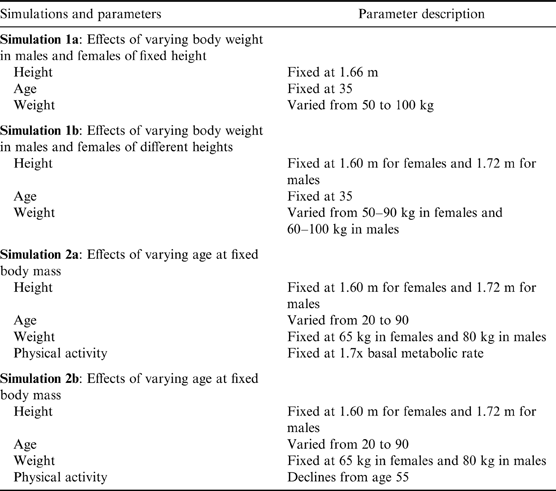
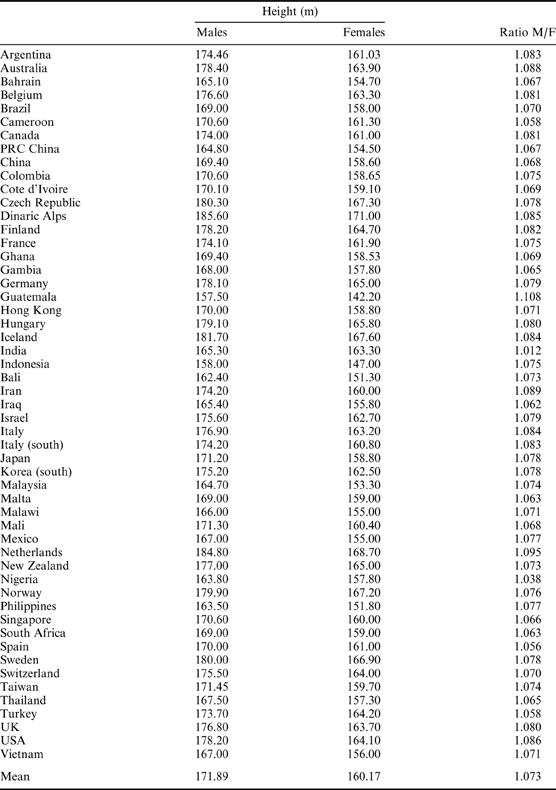
The model was used in two separate sets of simulations (summarized in Table 1). In the first set of simulations the subject age was fixed at 35 and the subject height fixed at 1.66 m (the global mean height across 53 countries and regions; Table 2). The effects on survival duration of male and female individuals weighing between 50 and 100 kg were then predicted. Survival duration was derived as a function of initial body weight and then also as a function of the initial body fatness, which was also predicted by the model from an established relationship between body fatness and body weight across 592 individuals (Speakman & Westerterp, Reference Speakman and Westerterp2010). Finally, women on average have shorter stature and are lighter than men. Using an average height for females of 1.60 m and for males of 1.72 m (Table 2) the simulations were repeated over the range of starting body weights from 50 to 90 kg in females (body mass index (BMI): 19.5 to 35.1) and from 60 to 100 kg in males (BMI 20.3 to 33.8) and the sex-specific survival durations as a function of the initial BMI were calculated. To explore the impact of these sex-specific survival relationships in relation to BMI, data on the average male and female BMI for 45 countries that might be considered as at the low end of the obesity spectrum (mean BMI<25) and which may characterize populations susceptible to famine, were used, in combination with the relationships between BMI and survival for each sex, to predict the average survival time of males and females for each of these populations.
A summary of the parameters used in the different model simulations

Heights (m) of adult males and females and the ratio between them (M/F) for 53 countries and regions
In the second set of simulations male body mass was set at 80 kg (BMI for an individual 1.72 m tall=27) and female body mass set at 65 kg (BMI for an individual 1.60 m tall=25.4). Age was then varied from 20 to 90 in 5-year increments. One parameter in the model is the baseline physical activity level expressed as a multiple of basal metabolic rate. This parameter is fixed in the model at 1.7 (Speakman & Westerterp, Reference Speakman and Westerterp2012). This parameter has been previously measured in a cohort of individuals ranging in age from 18 to 96 and it was noted that the level remains stable until about the age of 55 and thereafter declines (Westerterp & Speakman, Reference Westerterp and Speakman2008; Speakman & Westerterp, Reference Speakman and Westerterp2010), by about 0.1 per decade between 55 and 75 and then by 0.3 between 75 and 85. Black et al. (Reference Black, Coward, Cole and Prentice1996) reported a similar decline in daily energy expenditure with age. The second set of modelling was therefore repeated varying this parameter in line with the predicted age-related levels from these previous publications for individuals aged between 60 and 90.
Results
Effect of sex
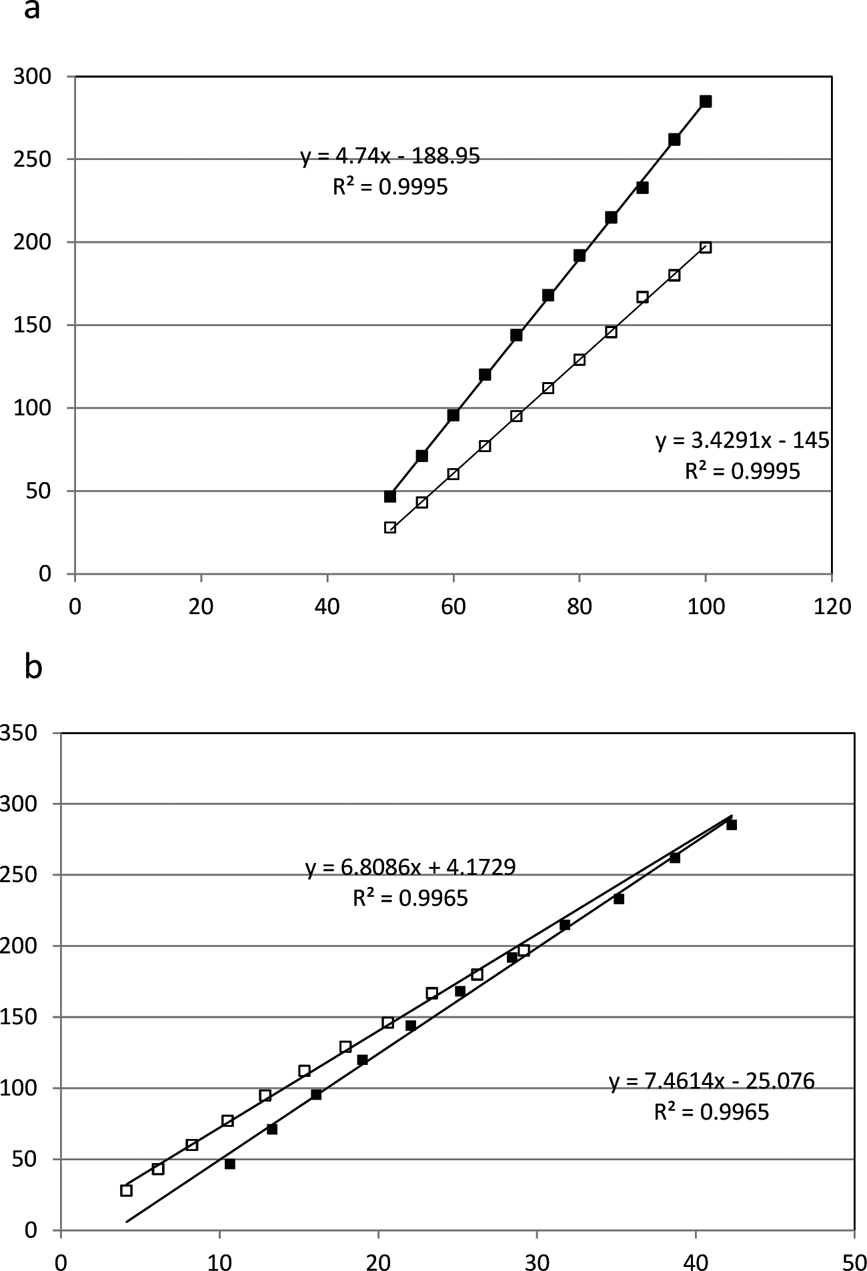
The effects of body weight and body fatness on the predicted survival time under total starvation for males and females are shown in Fig. 1. Survival time in days was linearly related to the initial body weight. The equation describing the patterns in relation to body weight for males was:
 $$Survival (days)=3.149\times BW(kg)-145 (r^2=0.999)$$
, and the equation for females was:
 $$Survival (days)=4.74\times BW(kg)-188.9 (r^2=0.999)$$
.
Predicted survival times of males (open squares) and females (closed squares) when completely starved in relation to their initial weight (a) or initial body fatness (b). Height (1.6 m) and age (35) were fixed.
The equation describing the patterns in relation to body fatness for males was:
 $$Survival (days)=6.81\times Fat mass(kg)+4.17 (r^2=0.996)$$
, and the equation for females was:
 $$Survival (days)=7.46\times Fat mass(kg)-25.08 (r^2=0.996)$$
.
At all body weights in the range considered, assuming equal heights (set at 1.66 m) and ages (set at 35), a female was predicted to survive longer in the complete absence of food than a male. For example, at a body weight of 70 kg a female would survive 144 days, compared with only 95 days for a male of the same weight and age. Unexpectedly, the pattern with respect to fat weight was the opposite: at a given level of body fatness males were actually predicted by the model to live longer than females (Fig. 1b). Hence with 19 kg of body fat a female would be predicted to live 120 days, but a male with this amount of fat would be predicted to live 133.5 days without food.
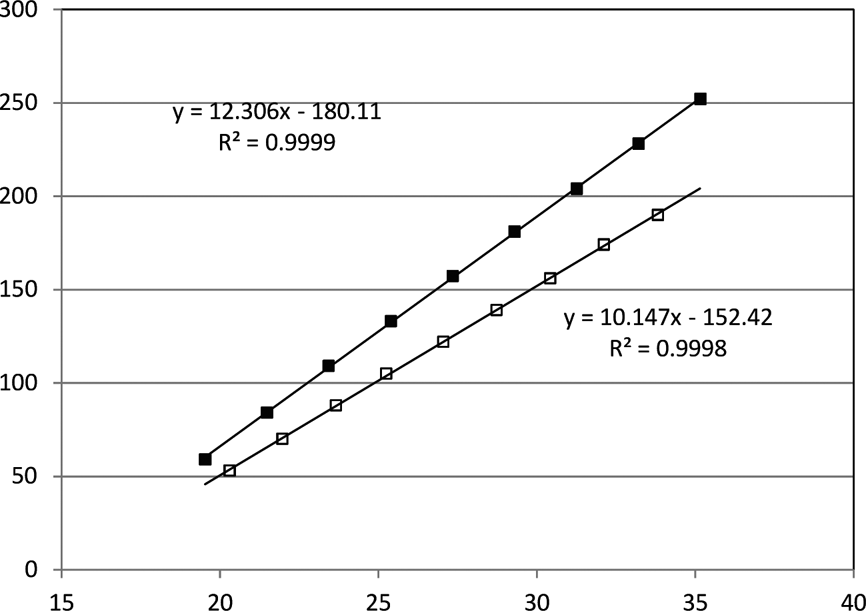
On average males are 7.3% taller than females, with the average height across 53 countries and regions where heights of both males and females are available being 1.72 m in males and 1.6 m in females (Table 1). The simulations were re-run including this difference in height, varying mass from 50 to 90 kg in females and 60 to 100 kg in males, keeping the age fixed at 35. Survival in relation to BMI derived from these simulations is shown in Fig. 2. The relationship between female survival and BMI was described by the relationship:
 $$Survival (days)=12.306\times BMI-80.1 (r^2=0.999)$$
, and for males the relationship was
 $$Survival (days)=10.147\times BMI-152.4 (r^2=0.999)$$
.
Predicted survival times of males (open squares) and females (closed squares) when completely starved in relation to their BMI. Age was fixed at 35 and height was set at 1.72 m for males and 1.6 m for females.
This simulation revealed that when height differences are accounted for, females still have a survival advantage over males in relation to BMI. For example, at a BMI of 23 a female would survive on average 102.9 days compared with 81 days for a male with the same BMI (about 27% longer). However, looking at this from the perspective of equivalence in survival times, the predicted survival time of a male with a BMI of 23 (81 days) is the same as for a female with a BMI of 21.2. Hence in this range of BMIs a relatively small increase in BMI in males (1.8 units) would be predicted to offset the female advantage.
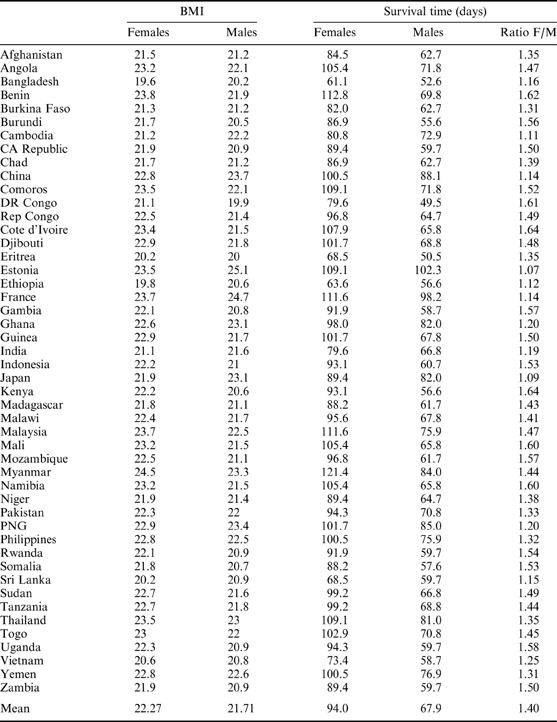
The population-level implications of this pattern were explored more closely by multiplying the published sex-specific BMI means by the relationships linking BMI to survival duration for 48 low-obesity populations (Table 3). This allowed an estimate for each country of the average anticipated male and female survival durations in the face of complete starvation. These data showed that when all factors are taken into consideration (i.e. the sex effects on metabolic rate, body fatness, stature and weight) the mean predicted survival time of females in low-obesity populations averaged 94 days, and that of males averaged 67.9 days. On average the female survival was predicted to be 39.7% longer. In all 48 populations for which data on BMI were available females had a predicted survival advantage, which ranged from a minimum of 7% (Estonia) to a maximum of 64.5% (Cote d'Ivoire).
Mean BMI (kg/m2) for males and females from 48 countries at the low end of the obesity spectrum (mean BMI<25) and calculated survival times during starvation of the average male and female derived from these figures using the model in the current paper (see Fig. 2) and the ratio between these survival times (F/M)
Effect of age
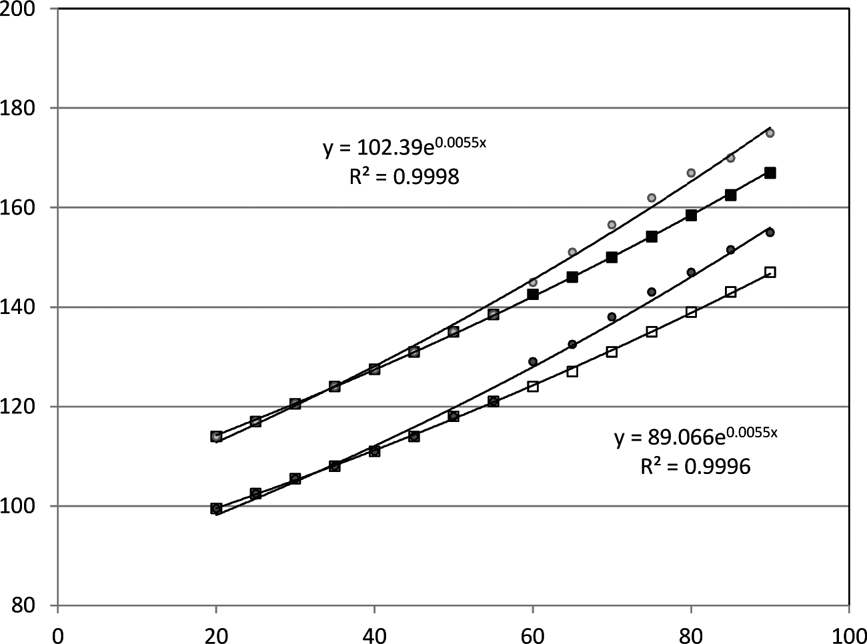
The effect of age on survival duration predicted from the model is shown in Fig. 3. The patterns for males and females were similar: there was a positive curvilinear effect of age on survival. For both males and females the effect was such that increasing age from 20 to 90 increased the predicted survival time by about 50% (from 100 to 147 days in males and from 110 to 165 days in females). There was no indication of an interaction effect between age and sex. This increasing predicted survival duration with age was contributed to by an age-related decline in metabolic rate that is more than expected from body composition changes alone, combined with a progressive loss of muscle when individuals are aged over 55, which has two effects: a further diminution of metabolic rate and a relative increase in fat stores. If the fact older individuals are on average less active is also taken into account the effects of age become even more pronounced, with the expected survival at age 20 being unchanged but that at age 90 increasing to 167 days in males and 175 days in females (both about 70% longer than the projected survival at age 20). Again, no strong interaction between age and sex was predicted.
Predicted survival times of males (open squares) and females (closed squares) when completely starved in relation to their age (years), with equations. These predictions do not account for the age-related decline in physical activity. The dark grey and light grey circles are the corresponding predictions for males and females, respectively, when this latter effect is also taken into account.
Discussion
The ‘body fat’ hypothesis has been widely suggested as a mechanism that might underpin the often observed female survival advantage during famines. The modelling performed here confirms that at a given body weight females do enjoy an increased expectation of lifespan in the complete absence of food relative to males, based on energy balance principles alone (Fig. 1a). This is contributed to by two factors: first females of a given weight carry more fat than males, and second they have a lower metabolic rate. Surprisingly, when the predicted survival was expressed in relation to body fat stores the opposite effect was found: males at a given level of body fat storage were predicted to live longer than females. The reason for this effect is that at a given level of body fat males carry much larger amounts of lean tissue. For example, a female carrying 10.5 kg of fat would on average weigh 49.5 kg, but a male carrying the same absolute amount of fat would weigh 65 kg, and therefore have 15.5 kg more lean tissue. Although this lean tissue gives the male a higher metabolic rate than the female and hence he would be expected to burn through his stores faster, the lean tissue can also be drawn on as an energy source in the latter stages of fasting, and this more than offsets the predicted metabolic rate difference.
Although females are predicted to survive substantially longer than males at a fixed body weight, females are on average shorter and lighter than males. When stature differences between males and females were taken into account, and predicted survival was expressed in relation to BMI, the female advantage was still present but much reduced relative to the effect expressed relative to body weight. When this prediction was combined with the known differences in BMI in typical pre-famine populations, the model indicated that the ‘female advantage’ based on fundamental energetic principles is a robust and significant effect. Using existing BMI estimates, females would be expected to survive on average 40% longer than males (range 6 to 64.5%), in the complete absence of food. The survival estimates may be affected by the fact that BMI is not related to adiposity in the same way for all populations. However, this is unlikely to create a strong sex-related effect because where populations differ they tend to do so for both sexes.
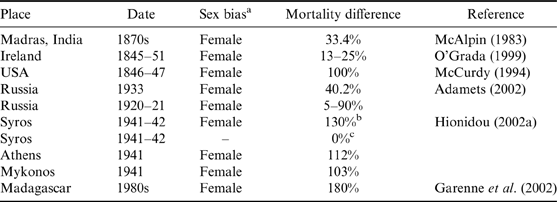
Several demographic studies of famine mortality have quantified the female bias in mortality that can be compared to this quantitative prediction (summarized in Table 4). Across these famines, with the exception of the latter part of the famine on Syros, there was a female advantage in terms of mortality which ranged between 5 and 180%. In addition to these data some studies have found interaction effects between sex and age on the patterns of mortality. Hionidou (Reference Hionidou, Dyson and O'Grada2002a) detected a substantial interaction between the effects of sex and age on the mortality advantage of females, with death rates of males in the age group 20–39 exceeding that of females by 140, 210, 140 and 160% in four different areas/times, while in the same areas for people aged over 60 the differences were ‘only’ 40%, 100%, 10% and 40%. Garenne et al. (Reference Garenne, Waltisperger, Cantelle, Ralijaona, Dyson and O'Grada2002) also observed lower male-biased mortality in individuals aged over 60 in the Madagascan famine, with males having 68% higher mortality in this age group. Pitkanen (Reference Pitkanen, Dyson and O'Grada2002) also detected a large sex-by-age interaction in mortality during the famines in Finland in 1832–3 and the 1857–8. The pattern here, however, was completely the opposite to that observed in Greece and Madagascar. In the age bracket 20–39 there was no age–sex bias in mortality, but in the people aged 60–70 male deaths exceeded female deaths by about 25%. Although some of the estimates of female advantage in mortality (Table 4) match the expectations based on the body fat hypothesis derived from the simple energy balance model derived here, it is clear that many others do not. This may suggest that in some famines body fatness is an important factor that drives the difference in sex-related mortality rates. However, in famines where the sex difference in mortality is 3–4 times greater than the model predictions, then clearly other factors must be playing a role. An alternative explanation might be that the hypothesis is correct and body fatness causes the sex differences in all famines, but it is the model predictions that are in error. It is important in this context to remember that the model used here is a validated model in the sense that it is able to accurately predict the changes in body weight and time taken to die during fasting, where we know the subjects are reliant only on their body reserves (therapeutic fasting in clinically controlled conditions and hunger strikers) (Speakman & Westerterp, Reference Speakman and Westerterp2012). It does not seem credible that it would be possible to formulate another model that would also accurately predict these aspects of fasting, but then also be able to generate predictions on sex-biased mortality due to differences in fat storage that were compatible with the empirical mortality data during actual fasts (Table 4). Moreover, the interaction of the sex bias with age was not predicted by the current model, but appears to have been a feature of at least three previous famines. In addition, the exact nature of this interaction varied between famines. The detailed patterns of mortality across multiple famines therefore are often inconsistent with the quantitative predictions based on energy balance modelling.
Estimates of the bias in adult mortality with respect to sex in some famines reported in the literature
a Sex bias indicates the sex that had the lower mortality.
b Early in the famine
c Later in the same famine.
The survey is not comprehensive.
With respect to age, the energetic principles predicted that older individuals should live considerably longer than younger adults during famines. This effect was predicted to be even larger than the sex-biased effect (around 70%). Yet, this predicted pattern is completely the opposite to what is generally observed (see references in the introduction on age-related mortality in famines). As far as the author is aware no one has suggested the observed pattern of famine mortality with age reflects a ‘body fatness’ effect. Nevertheless, if ‘fatness differences’ are a valid hypothesis explaining differential mortality by sex, they should also in theory contribute to differential mortality by age. Yet they do not appear to do so. Indeed, even where there is a rough qualitative correspondence between the theory and observation, as in the case of sex-biased mortality, the detailed predictions do not appear to fit the observations.
Why do the predictions of the body fat hypothesis in many cases not fit the empirical data? Clearly during some famines people do die of frank starvation (e.g. Hionidou, Reference Hionidou, Dyson and O'Grada2002a, Reference Hionidoub). More often, however, the key factor that causes elevated mortality in famine is that individuals are weakened by starvation and succumb to disease before they completely run out of fat reserves (Chen & Chowdhury, Reference Chen and Chowdhury1977; Toole & Waldman, Reference Toole and Waldman1988; Mokyr & O'Grada, Reference Mokyr and O'Grada1999). A possibility therefore is that the differential mortality between males and females is rooted in the responses of their immune systems to starvation. A key driver of the responsiveness of the immune system is the adipose tissue derived hormone leptin (Lord et al., Reference Lord, Matarese, Howard, Baker, Bloom and Lechler1998; Matarese, Reference Matarese2000; Faggioni et al., Reference Faggioni, Feingold and Grunfeld2001). During starvation leptin levels decline enormously and this may be a causal factor making starving individuals susceptible to disease (Lord et al., Reference Lord, Matarese, Howard, Baker, Bloom and Lechler1998; Matarese, Reference Matarese2000). Females have greater levels of circulating leptin by virtue of their greater fat stores, but also because there is an independent effect of sex on circulating leptin levels, which are on average 40% greater in females than in males at a given level of adiposity (Saad et al., Reference Saad, Damani, Gingericj, Riadgabriel, Khan and Boyadjian1997). Hence females may be far less prone to succumb to disease during famine than are males. The enormous variation in the magnitude of the female advantage between different famines might then be traced to variations in the importance of infectious diseases as a cause of death in different famines.
An additional factor, however, is that famines are seldom as simple as the complete lack of food availability, leading individuals to rely solely or predominantly on their fat reserves, which is the fundamental assumption underpinning the body fat idea. Individual variation in the capacity to acquire food may then be a more significant factor that underpins famine survival than differences in the sizes of fat reserves. Poverty in particular is a key factor influencing famine mortality via the ability to acquire food (Sen, Reference Sen1981; Razzaque, Reference Razzaque1989). Moreover, social relationships may be a critical element favouring survival. Among the Donner party, a group of emigrants who were stuck in the winter snows of the Sierra Nevada during the winter of 1846–47 with insufficient food, having another family member present on the trip halved the risk of death (McCurdy, Reference McCurdy1994). However, despite the importance of these two factors it is unclear why, during widespread famines, poverty and social relationships might generate the female survival advantage. In fact if anything the gender gap in poverty levels (Jackson, Reference Jackson1996) would place females at a disadvantage.
The female survival advantage may, however, still have a component that is attributable to differences in their capacity to acquire food relative to males, rather than differences in their internal energy reserves. It has been previously noted, for example, that females may be more adept at exploiting unusual food sources (so called ‘famine foods’), may exchange sex directly for food, or for money to acquire food (MacIntyre, Reference Macintyre, Dyson and O'Grada2002) and often because they are the person that does the family cooking they may have more access to whatever food is available (the ‘proximity to the pot’ phenomenon). Moreover because females are smaller their total demands for energy are lower (Black et al., Reference Black, Coward, Cole and Prentice1996; Speakman & Westerterp, Reference Speakman and Westerterp2010), thus on a fixed amount of food they satisfy more of their energy demands, needing to draw on their fat reserves less. For example, if a female weighing 50 kg obtained 10 MJ of energy each day she would cover all her energy requirements. A male weighing 80 kg, however, would only satisfy 60% of his energy needs on this level of intake. All of these effects may contribute to the greater survival of females relative to males. These food acquisition benefits may be combined with a reduction in fertility during famines (Razzaque, Reference Razzaque1988), which leads to fewer deaths of women during childbirth. In the Irish famine of 1845–7 it has been estimated that reduced fertility saved the lives of around 5000 women who failed to get pregnant because of reduced fertility and consequently didn't die in childbirth (Macintyre, Reference Macintyre, Dyson and O'Grada2002, calculated from data in Boyle & O'Grada, Reference Boyle and O'Grada1986).
The importance of other social factors is exemplified by the fact elderly people show completely the opposite trend to that predicted on the basis of energy balance principles alone. The reasons why older individuals do not on average survive longer in famine situations, despite their fundamental biological advantages in relation to energy storage and energy utilization, are probably similarly complex and multi-factorial. Older individuals may have weaker immune systems and hence be more susceptible to the diseases that kill the majority of people during famine situations (Chen & Chowdhury, Reference Chen and Chowdhury1977; Toole & Waldman, Reference Toole and Waldman1988; Mokyr & Grada, 2002). In addition, elderly individuals may lose out in any competitive situation for food because they are on average weaker than younger adults. However, there may also be an element of kin selection (Hamilton, Reference Hamilton1964) involved, in that older individuals might voluntarily give up food for their offspring, to ensure their offspring's survival rather than their own. This would be genetically advantageous because the future reproductive value is greater in younger adults, hence older individuals may promote their own genes in their children by sacrificing themselves to provide food for their offspring. On the other hand their greater mortality may be less altruistically driven and reflect the fact society or their kin do not share food equally with them because they are regarded as less ‘worthy’ (Hionidou, Reference Hionidou, Kreager and Schroeder-Butterfill2004).
Conclusion
Predictions based on fundamental energy balance principles predict a female advantage in famine survival averaging 40% and lying between 7 and 64.5%. Actual observations of the female survival advantage, where it is observed, span a much wider range from 5 to 210%, and indeed in some famines no female advantage is observed at all. Moreover, several studies have found an interaction of the mortality advantage with age, which is not predicted by the model. In addition the same models also predict a survival advantage among adults with advancing age. This pattern is the opposite to that generally observed. This contrast between prediction and observation suggests that famine mortality is a complex phenomenon, that may be contributed to by physiological factors related to energy storage and utilization such as the immune system, but is probably also driven by a range of social factors, which may reinforce or override these fundamental biological considerations in different circumstances. The current predictions were derived from a mathematical model built on the fundamental laws of thermodynamics and energy use, combined with our empirical knowledge of fat storage. A future goal may be to try and extend this analysis to predict levels of famine mortality combining biological and social factors. However, at present this goal is probably unrealistic because of the inability to encode mathematically the complexity of human social relationships from first principles.