Introduction
Reminiscence, the recall of personally experienced events from one's past, is a fundamental and ubiquitous process beginning in early childhood and continuing throughout the lifespan (Westerhof et al., Reference Westerhof, Bohlmeijer and Webster2010). Reminiscence plays a role in social connections, intergenerational communication, and vital psychological outcomes such as identity, problem-solving, and mental health. Indeed, reminiscence processes and outcomes are relevant to a large, interdisciplinary body of work, including personality, developmental, social, and clinical psychology.
Recent reviews (e.g. Cappeliez, Reference Cappeliez2013; Westerhof and Bohlmeijer, Reference Westerhof and Bohlmeijer2014) note several theoretical, conceptual, and measurement improvements in the field of reminiscence over the past two decades. For instance, the psychometric soundness of a frequently used measure, the RFS (Webster, Reference Webster1993) has regularly been supported (e.g. Robitaille et al., Reference Robitaille, Cappeliez, Coulombe and Webster2010). Additionally, important associations with mental health outcomes such as anxiety and depression have allowed practitioners of life review and reminiscence therapies to more precisely match clinical characteristics to specific therapeutic techniques (e.g. Serrano et al., Reference Serrano, Latorre, Gatz and Montañés2004). Moreover, important cross-cultural studies are beginning to identify both similarities and differences in reminiscence processes and outcomes (e.g. Shellman and Zhang, Reference Shellman and Zhang2014).
The definition of an empirical taxonomy of reminiscence functions is a major development in the field. Webster (Reference Webster1993) developed the RFS in order to quantitatively measure the frequency with which individuals use memory for different functions. The scale comprises 43 items distributed across eight factors: boredom reduction, identity, problem-solving, conversation, bitterness revival, teach/inform, death preparation, and intimacy maintenance. Internal consistency for the factors was adequate, ranging from 0.79 to 0.89. However, the factors of identity and problem-solving presented saturation values in one of their items. In 1997, Webster performed a further factorial validation for the scale by which he obtained the definitive eight-factor structure where identity and problem-solving appear as separate functions. The eight factors may be defined as follows: (1) identity refers to using memories to identify a pattern of coherence in one's life; (2) problem-solving involves remembering past experiences to solve present problems; (3) death preparation is the use of memories to come to terms with one's finitude;(4) bitterness revival refers to rehashing memories of difficult life circumstances; (5) boredom reduction refers to memories used to fill a void of stimulation or interest; (6) intimacy maintenance entails keeping alive the memory of a significant other from whom we are separated, principally on account of death; (7) conversation is the communicating of personal memories without evaluative or instructive intent; and (8) teach/inform refers to sharing and memories to transmit a lesson of life. It is worth noting that these factors are not mutually exclusive and that the act of remembering the past can have several uses at the same time. A number of studies have evaluated the psychometric properties of the scale, thus providing statistical validation of this typology of reminiscence functions (Cappeliez et al., Reference Cappeliez, O'Rourke and Chaudhury2005; Cappeliez and O'Rourke, Reference Cappeliez and O'Rourke2006).
Several authors suggest that reminiscence may have adaptive and positive effects in the mental health of older adults. Shellman and Zhang (Reference Shellman and Zhang2014), for example, report that the way people review and interpret their life histories and personal relationships is associated with mental health and well-being in later life. Cappeliez and O'Rourke (Reference Cappeliez and O'Rourke2006) outlined strategies that support reminiscence as a way to decrease depression and prevent major depression. Finally, Hallford and Mellor (Reference Hallford and Mellor2013) demonstrate that while some specific ways of remembering the past are associated with psychological disorders, others are associated with adjustment and well-being.
Several studies have focused on identifying which specific reminiscence functions relate more closely to mental health. For example, Cappeliez and O'Rourke (Reference Cappeliez and O'Rourke2006) reviewed clinical outcomes for the eight specific reminiscence functions measured by the RFS. Using structural equation modeling (SEM), they formulated a tripartite conceptual model which grouped specific functions into three latent variables: a self-positive variable (RFS functions of identity, problem-solving, and death preparation), a self-negative variable (RFS functions of bitterness revival, boredom reduction, intimacy maintenance), and a prosocial variable (RFS functions of teach/inform and conversation). These latent variables share some conceptual similarities with the self, social, and directive functions of autobiographical memory (e.g. Bluck et al., Reference Bluck, Alea, Habermas and Rubin2005). Cappeliez and O'Rourke (Reference Cappeliez and O'Rourke2006) demonstrated that the self-negative latent variable predicted high levels of psychological distress, whereas the self-positive latent variable predicted low levels of psychological distress, providing support for this part of their tripartite model. In contrast, the prosocial latent variable did not have a direct relationship to mental health outcomes. This latter finding seems somewhat counter-intuitive since prior research has shown that conversational reminiscence is often a positive experience (e.g. Pasupathi, Reference Pasupathi2003) and social functions such as teach/inform have been associated with happiness and other positive traits (McLean and Pals-Lilgendahl, Reference McLean and Pals-Lilgendahl2008). This could suggest that alternative models may be able to account for such anomalies.
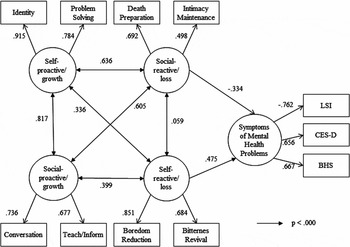
One alternative model was indeed suggested prior to Cappeliez and O'Rourke's (Reference Cappeliez and O'Rourke2006) conceptualization. In 2003, Webster used second-order factor analyses and multi-dimensional scaling of the RFS. Results suggested a tetradic model consisting of four higher-order factors, each comprising two of the eight RFS functions: self-reactive/loss (formed by the factors of bitterness revival and boredom reduction); self-proactive/growth (formed by identity and problem-solving); social-proactive/growth (formed by the factors of teach/inform and conversation); and social-reactive/loss (formed by intimacy maintenance and death preparation). As can be seen, the difference between this four-factor model and Cappeliez and O'Rourke's (Reference Cappeliez and O'Rourke2006) three-factor one is the removal of the intimacy maintenance factor from the self-negative latent variable, the removal of the death preparation factor from the self-positive latent variable, and then the combination of these two excised functions as a separate factor.
Other researchers have also described four-factor models of autobiographical memory. For example, Harris, Rasmussen, and Berntsen (Reference Harris, Rasmussen and Berntsen2014) studied the principal functions of autobiographical memory using the Thinking about Life Experiences questionnaire (TALE; Bluck et al., Reference Bluck, Alea, Habermas and Rubin2005) and the RFS scale. Similarly to Webster (Reference Webster2003), they identified four classes of general autobiographical memory functions: reflective (comprising the self-continuity and directing behavior factors from the TALE scale and the identity and problem-solving factors from the RFS), ruminative (comprising the factors of boredom reduction, bitterness revival, and intimacy maintenance from the RFS), social (comprising the social-bonding factor from the TALE scale and the conversation factor from the RFS), and generative (comprising the factors of teach/inform and death preparation from the RFS).
As suggested by Westerhof and colleagues (Reference Westerhof, Bohlmeijer and Webster2010), theoretical and empirical debate on reminiscence functions and mental health currently centers on two essential questions. The first question is whether there are actually seven or eight reminiscence factors. In other words, are identity and problem-solving factors different or similar functions? The second question is related to reminiscence and mental health: Which is the best predictor of mental health, a three-factor model or a four-factor model? This second questions relates to whether or not the reminiscence functions of death preparation and intimacy maintenance form a single factor in a predictive model of mental health.
This study has two main objectives, which aim to answer as clearly as possible the questions proposed by Westerhof and colleagues (Reference Westerhof, Bohlmeijer and Webster2010). To our knowledge, the RFS has not been validated in a Spanish population and given that, as suggested by Webster (Reference Webster2002), reminiscence functions may vary according to characteristics such as age and race, we consider it necessary to assess the factorial structure and psychometric properties of the RFS scale with a sample of Spanish older adults. Most studies directly assess an eight-function factorial structure of reminiscence while there are others which prefer a seven-factor structure where the identity and problem-solving factors are clustered together (e.g. Washington, Reference Washington2009). For this reason, we conduct two separate confirmatory factor analyses (CFAs) of the RFS (seven-factor structure vs. eight-factor structure) in order to find which model better fits our sample. Our second objective is to compare the three- and four-factor models of reminiscence and their abilities to predict mental health outcomes in our Spanish sample. We think this is important since, to our knowledge, neither Cappeliez and O'Rourke (Reference Cappeliez and O'Rourke2006), nor colleagues in subsequent studies (e.g. O'Rourke et al., Reference O'Rourke, Cappeliez and Claxton2011), actually tested a four-factor alternative model, and Webster's (Reference Webster2003) paper was conceptual and did not directly test the association of the four-factor model with mental health outcomes.
Methods
Participants
Participants were recruited from retirement communities for active older adults in Albacete and Valencia (Spain). Criteria for inclusion were as follows: (a) participants had to be over the age of 60; (b) they had to show no evidence of dementia as determined by a score of 28 or higher on the Spanish version of the Mini-Mental State Examination (Mini Examen Cognitivo; Lobo et al., Reference Lobo, Saz and Marcos2002); and (c) given that people with depression remember autobiographical memories differently from non-depressed people (for a review about the overgeneral memory phenomenon, see Williams et al., Reference Williams2007) and it would be expected that these differences also affect reminiscing, we decided to exclude from the study people with significant depressive symptoms as determined by a score greater or equal to 16 on the Centre for Epidemiologic Studies Depression (CES-D; Radloff, Reference Radloff1977). None of the participants present cognitive impairment or depressive symptomatology according to both scales.
Finally, 364 older adults (243 women and 121 men; ages 60–90 years; M = 69.30, SD = 6.99; educational level: 19.8% read and write, 36% completed elementary school, 18.4% completed secondary school, and 25.8% attended university) participated in the study. All participants live independently and can perform their activities of daily living. None of the participants present difficulties to read and understand the self-report measures.
Measures
Reminiscence functions scale (RFS; Reference Webster Webster, 1993 ). The RFS consists of 43 items pertaining to particular uses of reminiscence (see Appendix 1 and Appendix 2 for English and Spanish versions, respectively). Participants indicate how often they reminiscence for each item ranging from “never” (1) to “very frequently” (6). Items are grouped within eight categories: boredom reduction (items 3, 11, 16, 19, 21, 37); death preparation (items 2, 9, 29, 33, 35, 38); identity (items 8, 10, 24, 26, 32, 36); problem-solving (items 4, 12, 18, 31, 39, 42); conversation (items 6, 7, 22, 28, 34); intimacy maintenance (items 5, 14, 25, 41); bitterness revival (items 13, 15, 17, 40, 43); and teach/inform others (items 1, 20, 23, 27, 30). Internal consistency as measured by Cronbach's α ranges from 0.74 to 0.89 (Webster, Reference Webster1993, Reference Webster1997).
Centre for epidemiologic studies-depression (CES-D; Reference Radloff Radloff, 1977 ). The CES-D is a short self-report scale designed to measure depressive symptomatology in the general population. It consists of 20 items assessing symptoms of depression during the week before test performance. CES-D is widely used in research with adults of all ages with high reliability, internal consistency, and discriminant and construct validity (Radloff, Reference Radloff1977). A cut-off score of 16 is typically used to indicate clinically significant symptoms.
Beck hopelessness scale (BHS; Beck et al., Reference Beck, Weissman, Lester and Trexler1974). The BHS reflects an individual's negative expectancies of the probability of attaining important goals. Twenty items representing the types of pessimistic statements typically made by psychiatric patients are answered true or false. The scale is scored for pessimism with a score of 20 reflecting the highest degree of pessimism. BHS shows a good reliability and internal consistency (Beck et al., Reference Beck, Weissman, Lester and Trexler1974).
Life satisfaction index (LSI-A; Reference Adams Adams, 1969 ). The LSI-A consist of 18 items assessing life satisfaction. The scale assigns 2 points for positive answers, 0 for negative answers, and 1 for “don't know” answers, providing a range of 0 to 36, with the highest scores indicating the greatest satisfaction.
Procedure
After making contact with the retirement communities for older adults, participants who gave informed consent and who met the inclusion criteria were included in the study. All scales were administered by different evaluators blinded to the objectives of the study. The evaluators were previously trained in the administration of the scales by the authors of this study. Participants were tested individually in one session of 60 minutes.
All procedures followed were in accordance with the ethical standards of the responsible committee on human experimentation (institutional and national) and with the Helsinki Declaration of 1975, as revised in 2000.
Data analysis
Descriptive statistical analysis of the items and the internal consistency reliabilities of the subscales was performed using the IBM-SPSS 20.0 program. Confirmatory factor analysis (CFA) of the RFS scale and SEM analyses were conducted using IBM-SPSS AMOS-19. In CFA and SEMs, maximum likelihood was used to estimate all model parameters.
Results
Descriptive statistics
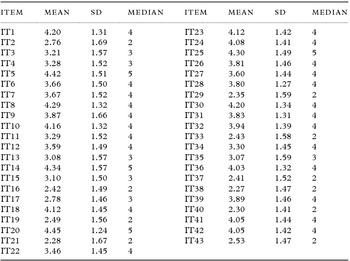
Descriptive statistics for the RFS items are presented in Table 1.
Descriptive statistics of RFS items

Confirmatory factor analysis (CFA)
In order to evaluate the model fit the comparative fit index (CFI), a root-mean-square error of approximation (RMSEA), and a standardized root mean square residual (SRMR) were used. According to Bentler (Reference Bentler1992), CFI values greater than 0.90 are indicative of an acceptable fit. As regards RMSEA, values that are less than 0.05 represent a good fit and values up to 0.08 represent a reasonable fit (Byrne, Reference Byrne2001). Regarding χ2 , as the significance of the χ2 statistic is influenced by the sample size, some authors suggest the use of χ2/d.f. ratio as a better measure of the goodness-of-fit of the overall model and it has been recommended an χ2 /d.f. ratio < 2 for well-fitting models (Byrne, Reference Byrne2001). For SRMR, Byrne (Reference Byrne2001) suggests a cut-off point of < 0.08. Potential model improvements were assessed by inspecting standardized residuals (> 2.58; Byrne, Reference Byrne2001).
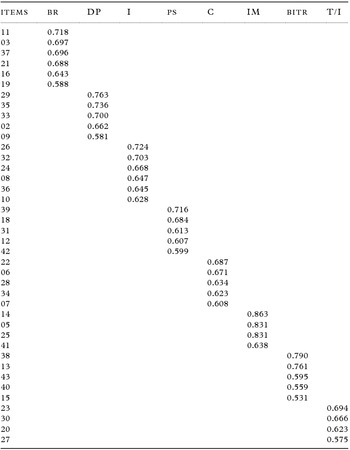
A CFA was performed with eight factors (Webster, Reference Webster1997) as well as with seven factors (Webster, Reference Webster1993). Initially, the eight-factor model did not show a good fit to the observed data (CFI = 0.88, RMSEA = 0.05, SRMR = 0.06, χ2 (833) = 1615.12, p = 0.000, and a χ2 /d.f. = 1.94). An exhaustive examination of the items indicated that items 1, 4, and 17 showed high standardized residuals (> 2.58). So these items were deleted in order to obtain a better-fitting model. The revised model provided an adequate fit to the observed data as indicated by CFI = 0.90, RMSEA = 0.049, SRMR = 0.05, χ2 (711) = 1333.12, p = 0.000, and a χ2 /d.f. = 1.88. The seven-factor model showed the same problems with items 1, 4, and 17 and these items were also deleted. This revised model also provided an adequate fit to the observed data as indicated by CFI = 0.89, RMSEA = 0.050, SRMR = 0.06, χ2 (718) = 1356.74, p = 0.000, and a χ2 /d.f. = 1.89. As the statistics of both models are similar, we computed the Akaike Information Criterion (AIC). The AIC allows to compare the fit of different models and the model with the lower AIC is selected as the one with the best fit. The AIC value for the eight-factor model was 1631.12 and the AIC value for the seven-factor model was 1640.74. According to this result, the eight-factor model shows the best fit to the observed data. Standardized factor loadings for this final model are shown in Table 2.
RFS factor loadings

Notes. BR = Boredom reduction; DP = Death preparation; I = Identity; PS = Problem-solving; C = Conversation; IM = Intimacy maintenance; BitR = Bitterness revival; T/I = Teach and inform.
Reliability
The internal consistency coefficients for the subscales of the final revised model were calculated. The coefficient alphas for each factor were 0.83 for boredom reduction, 0.85 for death preparation, 0.83 for identity, 0.78 for problem-solving, 0.78 for conversation, 0.87 for intimacy maintenance, 0.74 for bitterness revival, and 0.73 for teach and inform.
Reminiscence functions and mental health
SEM was used to assess to what extent the three-factor model (Cappeliez and O'Rourke, Reference Cappeliez and O'Rourke2006) and the four-factor model (Webster, Reference Webster2003) predict symptoms of mental health problems. Scores in LSI, CES-D, and BHS scales were used to form the latent variable of symptoms of mental health problems.
Estimation of the measurement models
We initially examined the proposed measurement models to determine whether the observed variables measure their respective latent constructs effectively. Obtaining adequate indices in this estimation prior to calculating the structural models allows to justify the conceptual relationship proposed by the two theoretical models between the domains of reminiscence and symptoms of mental health problems.
We computed the measurement model with each observed variable assumed to contribute significantly to the measurement of its respective latent construct, and significant covariance assumed between each pair of latent constructs. Acceptable fit indices were obtained for the three-factor model (χ2 (g.l.=38) = 120.12, p > 0.001; CFI = 0.942, RMSEA = 0.078) and for the four-factor one (χ2 (g.l.=33) = 90.77, p > 0.001; CFI = 0.960, RMSEA = 0.068). These results show that the observed variables on both models significantly contribute to the measure of their respective latent constructs with t-values >|2.57|.
Estimation of the structural model
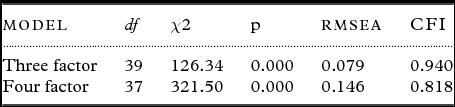
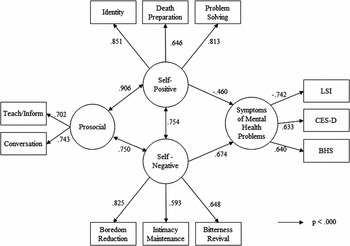
Given the viability of the measurement model, we next examined the hypothesized paths suggested by both models between latent constructs. The statistics of the best models for three- and four-factor models are given in Table 3, and the estimated parameters (presented as standardized) are shown in Figures 1 and 2 for three- and four-factor models, respectively. The four-factor model shows a bad adjustment to the observed data. Thus, according to the statistics, the three-factor model is the model with a good fit to the observed data and is, therefore, the best model to predict the symptoms of mental health problems. Specifically, self-negative and self-positive factors significantly predict the mental health problems symptomatology. The contribution of the self-negative factor is substantively greater than that provided by the self-positive factor (45.43% of the explained variance of the mental health factor vs. 21.16%, respectively). Nevertheless, there is no direct association between prosocial functions and symptoms of mental health problems.
Fit statistics for SEMs

Note. RMSEA = root-mean-square error of approximation; CFI = Comparative fit Index.
Three-factor model predicting mental health.

Four-factor model predicting mental health.

In the three-factor model, identity provides the greatest relative contribution to the self-positive factor. Boredom reduction provides the greatest contribution to the measurement of self-negative functions of reminiscence, and the contribution of conversation is greater than that of teach/inform others with respect to the prosocial latent construct.
Discussion
The main objectives of this study were, on one hand, to assess the factorial structure of the RFS in a sample of Spanish adults over 60 years of age, and on the other, to determine which model of reminiscence functions (three-factor model, Cappeliez and O'Rourke, Reference Cappeliez and O'Rourke2006, vs. four-factor model, Webster, Reference Webster2003) is more adequate to predict symptoms of mental health problems in the study sample.
Regarding the first objective, the CFAs demonstrate that both the seven- and eight-factor structure provide a good fit to the data of our sample. This result is in line with the findings of Shellman and Zhang (Reference Shellman and Zhang2014), who reported adequate fit statistics for both factor structures. Robitaille and colleagues (Reference Robitaille, Cappeliez, Coulombe and Webster2010), using both EFA and CFA, also report good fits for both structures, although in order to justify the final choice of the eight factor, they point to the fact that the existing taxonomies situate the identity and problem-solving factors in different categories at both theoretical and empirical level (e.g. Bluck and Alea, Reference Bluck, Alea and Sani2008). In our case, the use of a statistic which allows to compare the fit of both models, permits the choice of the eight-model factor rather than the seven-factor one. This supports the factor structure proposed by Webster (Reference Webster1997), comprising boredom reduction, death preparation, identity, problem-solving, conversation, intimacy maintenance, bitterness revival, and teach/inform. This factor structure is also corroborated by other studies (e.g. Webster, Reference Webster2003).
Our analysis also shows the existence of a number of problematic items in the study sample. In fact, we had to eliminate items 1 (from teach/inform factor), 4 (from problem-solving factor) and 17 (from bitternes revival factor) from the scale so as to obtain a better fit to the factor models. There are some previous studies about the factorial structure of the RFS that had also eliminated a few problematic items as a way to ameliorate the scale. For example, Robitaille et al. (Reference Robitaille, Cappeliez, Coulombe and Webster2010), using EFA and CFA, deleted 14 items from the scale obtaining an improved version of the RFS for older adults consisting of 29 items. In the same line, Washington (Reference Washington2009), using EFA, reduced the original RFS to a new version consisting of 39 items. Although participants in both studies were English speaking, participants in Robitaille et al.‘s study were mainly Canadian and participants in Washington's study were mainly from United States. In our study with Spanish participants, only three items were excluded from the RFS scale. It has to be noted that the deleted items differ between the studies. In fact, item 4 is the only one that was eliminated in the three studies. Perhaps, the exclusion of different items is related to cultural differences between participants. Additionally, our Spanish version of RFS scale could present subtle Spanish–English translation differences and this could influence in the deletion of specific items. In any case, eliminating these three items allowed us to obtain an improved version of the RFS for Spanish people. The good reliability scores obtained with this new version comprising only 40 items support its use in samples of Spanish older adults.
Regarding our second objective, the results show that the three-function model of reminiscence (self-positive, self-negative, and prosocial functions) proposed by Cappeliez and O'Rourke (Reference Cappeliez and O'Rourke2006) best explains the latent variable of symptoms of mental health problems measured using variables of life satisfaction, depressive symptomology, and despair. Similarly to these authors, we find that the self-positive and self-negative functions show respectively significant negative and positive relationships with symptoms of mental health problems. No significant relationship was found between the prosocial function and mental health problems symptomatology.
The self-positive function is formed by the factors of death preparation, identity, and problem-solving. Erikson (Reference Erikson1982) argues that the death preparation is a major adjustment characteristic in obtaining ego integrity in the final stages of the life cycle and is therefore related to satisfactory aging and both physical and mental health (Cappeliez and O'Rourke, Reference Cappeliez and O'Rourke2006). Problem-solving is a coping strategy highly related to the prediction of well-being (Tomás et al., Reference Tomás, Sancho, Meléndez and Mayordomo2012). Individuals using this type of strategy are more likely to maintain well-being in situations where control of the environment requires adaptation. Finally, in line with the results of Cappeliez and O'Rourke (Reference Cappeliez and O'Rourke2006) the factor which contributes most to the self-positive function is identity. This factor refers to the use of reminiscence to analyze patterns of coherence in one's life. It is thus an element which determines personal awareness and a sense of one's self, reinforcing the sense of one's life as lived. Several authors suggest that identity relates with well-being, life satisfaction, and self-esteem (e.g. McAdams et al., Reference McAdams, Reynolds, Lewis, Patten and Bowman2001). Thus, the self-positive function has a positive impact on aging, promoting adaptation, and well-being in older adults.
The second function is that of self-negative. This function is principally disadaptive and tends to be related to high rates of psychological disorder and low levels of psychological well-being (O'Rourke et al., Reference O'Rourke, Cappeliez and Claxton2011). It is formed by boredom reduction, intimacy maintenance, and bitterness revival. Regarding these factors, Cappeliez and colleagues (Reference Cappeliez, O'Rourke and Chaudhury2005) suggest that a reminiscence pattern based on reviving bitterness and reducing boredom tends to be related to lower life satisfaction and greater emotional disorder. As intimacy maintenance focuses on the loss of significant others, it entails recurrent processing of negative feelings (Cappeliez and O'Rourke, Reference Cappeliez and O'Rourke2006), which tend to generate depressive mood states and psychological disorders (Cappeliez et al., Reference Cappeliez, O'Rourke and Chaudhury2005).
Finally, the prosocial function comprises teach/inform others and conversation. Some authors suggest that this function may affect emotion management (Cappeliez et al., Reference Cappeliez, Guindon and Robitaille2008). The conversation factor maximizes opportunities to experience positive emotions in social encounters, optimizing well-being, and the teach/inform factor is related to the concept of generativity, referring to the concern for establishing and guiding the next generation (Erikson, Reference Erikson1982), which is regarded as a predictor of life satisfaction in older adults. However, no relationship is found between the prosocial function and lack of well-being. Cappeliez and O'Rourke (Reference Cappeliez and O'Rourke2006) suggest that this is due to the fact that this type of reminiscing tends to have a short-term impact on emotional and mood states and no long-term influence on physical and mental health. They further suggest that older adults have relatively fewer opportunities to use these reminiscence functions since they require the presence of others, in contrast to the other functions which can be used privately at any time of day. However, we cannot rule out that they might have an indirect impact on mental health through their association with the other functions, since the results show a strong correlation between the prosocial function and the self-negative and self-positive functions.
This suggests an important caveat regarding the prosocial function findings. Specifically, it may be that opportunities for social reminiscing serve as a moderator or mediator variable whereby persons who maintain strong and/or frequent social contacts with friends and family show a positive relationship between prosocial functions and mental health. As a further caution, our outcome variables were indicators of poor mental health and adjustment. Before we conclude with certainty that prosocial functions, and indeed the four-factor model, have little direct predictive power, it is important for future studies to include positive criterion variables as well as negative ones. For instance, studies might include variables such as generativity, ego-integrity, optimism, relationship satisfaction, and wisdom to counter-balance the exclusive use of negative outcomes. Perhaps then, prosocial functions will show direct and positive relationships.
This work presents two main limitations. The first is that our results are only generalizable to populations with similar characteristics to the participants in our study, especially with reference to the elimination of the problematic items. Further research is required to determine whether there exist differences in both the psychometric properties of the RFS and the use of reminiscence functions and their relationship with mental health in Spanish populations of different ages and/or different sociodemographic characteristics. In the same line, more research is needed about reminiscence in people with dementia. There are studies suggesting that a reminiscence therapy reduces depressive symptoms and improves psychological well-being in people with dementia (e.g. Gonzalez et al., Reference Gonzalez, Mayordomo, Torres, Sales and Melendez2015). Thus, validating the RFS scale in people with dementia would be beneficial as a useful measure to use in the reminiscence intervention.
A second limitation is that most of the instruments used in this study are self-report measures. Self-ratings can introduce many sources of bias in the psychological assessment. Nevertheless, Cuevas and Gonzalez (Reference Cuevas and Gonzalez1992) suggest that there is little reason to believe that self-ratings are less valid or reliable than standardized techniques.
In summary, after eliminating the three problematic items from the original scale, we find that the new version of the RFS is a reliable tool for assessing reminiscence functions in a population of Spanish adults over 60 years of age and that this version of the scale is better explained by a factor structure comprising the eight reminiscence functions initially proposed by Webster (Reference Webster1997). This work also supports the model proposed by Cappeliez and O'Rourke (Reference Cappeliez and O'Rourke2006) to predict mental health using three principal reminiscence functions (self-positive, self-negative, and prosocial), rather than the circumplex model postulated by Webster (Reference Webster2003).
Conflicts of interest
None.
Description of authors’ roles
L. Ros collected data, carried out the statistical analysis, and wrote the paper. J. C. Meléndez was responsible for the statistical design of the study and for carrying out the statistical analysis, and wrote the paper. J. Webster carried out the statistical analysis and wrote the paper. T. Mayordomo and A. Sales collected data and wrote the paper. J.M. Latorre and J.P. Serrano designed the study and supervised the data collection and wrote the paper.
Acknowledgments
This work was supported by the Regional Government of Castilla La Mancha [Consejería de Educación y Ciencia de Castilla La Mancha, grant PII1I09-0274-8863] and the Ministry of Science and Innovation [Ministerio de Ciencia e Innovación, grant PSI2010-20088].
Appendix 1.
Reminiscence functions scale
When I reminisce, it is:
-
1. To teach younger family member what life was like when I was young and living in a different time.
-
2. To help me “put my house in order” before I die.
-
3. Because it fills the gap when I find time “heavy on my hands”.
-
4. To help me plan for the future.
-
5. To keep alive the memory of a dead loved one.
-
6. Because it brings me closer to newer friends and acquaintances.
-
7. Because it promotes fellowship and a sense of belonging.
-
8. Because it helps me contrast the ways I have changed with the ways I have stayed the end of life.
-
9. Because it gives me a sense of personal completion or wholeness as I approach the end of life.
-
10. To see how my past fits in with my journey through life.
-
11. To pass the time during idle or restless hours.
-
12. To help resolve some current difficulty.
-
13. To keep painful memories alive.
-
14. Out of loyalty to keep alive the memory of someone close to me who has died.
-
15. To rehash lost opportunities.
-
16. To reduce boredom.
-
17. To remember an earlier time when I was treated unfairly by others.
-
18. To remind me that I have skills to cope with present problems.
-
19. To relieve depression.
-
20. To transmit knowledge that I have acquired to someone else.
-
21. For lack of any better mental stimulation.
-
22. To create a common bond between old and new friends.
-
23. In order to teach younger persons about cultural values.
-
24. Because it gives me a sense of self-identity.
-
25. To remember someone who has passed away.
-
26. Remembering my past helps me define who I am now.
-
27. As a way of bridging the “generation gap”.
-
28. As a “social lubricant” to get people talking.
-
29. Because it helps me prepare for my own death.
-
30. In order to leave a legacy of family history.
-
31. To put current problems in perspective.
-
32. To try to understand myself better.
-
33. Because I feel less fearful of death after I finish reminiscing.
-
34. To create an ease of conversation.
-
35. Because it helps me see that I have lived a full life and can therefore accept death more calmly.
-
36. As a means of self-exploration and growth.
-
37. For something to do.
-
38. Because it helps me cope with thoughts of my own mortality.
-
39. To see how my strengths can help me solve a current problem.
-
40. To rekindle bitter memories.
-
41. To remember people I was close to but who are no longer a part of my life.
-
42. To avoid repeating past mistakes at some later date.
-
43. To keep memories of old hurts fresh in my mind.
Appendix 2.
Escala de funciones de la reminiscencia
Cuando yo recuerdo el pasado lo hago:
-
1. Para enseñar a los jóvenes de mi familia cómo era la vida cuando yo era joven y vivía en otros tiempos.
-
2. Para ayudarme a “poner mi casa en orden” antes de morir.
-
3. Porque me ayuda a llenar el vacío que siento cuando tengo tiempo de sobra.
-
4. Porque me ayuda a planear el futuro.
-
5. Para mantener viva la memoria de un ser querido que murió.
-
6. Porque me ayuda a conocer nuevas personas y me hace sentir cerca de mis amigos.
-
7. Porque favorece el compañerismo y el sentimiento de pertenecer a un grupo o colectivo.
-
8. Porque me ayuda a comparar cómo he ido cambiando y, a pesar de ello, sigo siendo el mismo.
-
9. Porque acercándome al final de mi vida me da un sentimiento de plenitud personal.
-
10. Para ver cómo mi pasado señala el recorrido que he seguido a lo largo de mi vida.
-
11. Me ayuda a pasar el tiempo durante momentos de inquietud o de ocio.
-
12. Para solucionar dificultades del presente.
-
13. Para mantener vivos algunos recuerdos que son dolorosos para mí.
-
14. Por lealtad, para mantener viva la memoria de un ser querido que ha fallecido.
-
15. Para volver a pensar en las oportunidades perdidas.
-
16. Para reducir el aburrimiento.
-
17. Para recordar algún tiempo pasado en que fui tratado injustamente.
-
18. Para hacerme consciente de que aún tengo capacidad de luchar con problemas del presente.
-
19. Para aliviar la depresión.
-
20. Para transmitir los conocimientos aprendidos a otras personas.
-
21. Porque no tengo otra cosa en la que pensar.
-
22. Para crear lazos de unión entre viejos y nuevos amigos.
-
23. Para educar a los jóvenes sobre valores culturales.
-
24. Porque me da un sentido de identidad personal.
-
25. Para recordar a alguien que ha fallecido.
-
26. Para recordar el pasado y que ello me ayude a definir quién soy ahora.
-
27. Como forma de reducir las diferencias generacionales existentes.
-
28. Para estimular o dar lugar a una conversación.
-
29. Porque me ayuda a prepararme para mi propia muerte.
-
30. Para transmitir la historia y el patrimonio cultural familiar.
-
31. Para poder ver los problemas que me sucedieron desde una perspectiva diferente.
-
32. Para tratar de tener una mejor comprensión de mí mismo.
-
33. Porque tengo menos miedo a la muerte cuando he terminado de recordar.
-
34. Para iniciar de forma fácil una conversación.
-
35. Porque me ayuda a ver que he vivido una vida completa y, por lo tanto, puedo aceptar la muerte con más calma.
-
36. Como forma de autoconocimiento y crecimiento personal.
-
37. Por hacer algo.
-
38. Porque me ayuda a hacer frente a los pensamientos sobre mi propia muerte.
-
39. Para examinar cómo mis fortalezas pueden ayudarme a solucionar un problema actual.
-
40. Para revivir recuerdos amargos.
-
41. Para recordar seres con quien tenía una estrecha amistad y que ya no forman parte de mi vida
-
42. Para no repetir en el futuro los errores cometidos en el pasado.
-
43. Para mantener vivos en mi memoria recuerdos tristes del pasado.