




No CrossRef data available.
Examining the role of parental frightened/frightening subtypes in predicting disorganized attachment within a brief observational procedure
Published online by Cambridge University Press: 28 March 2006
Abstract
Following Main and Hesse's hypothesis, several investigators have affirmed that frightened/frightening (FR) as well as particular atypical maternal behaviors are associated with infant disorganized and adult unresolved attachment. Here, for the first time, FR behavior was observed in (a) middle-class father–infant (n = 25) and independent mother–infant dyads (n = 50) and (b) a brief laboratory play session. In addition, relations between disorganization, unresolved attachment, and the six FR system subscales were explored. Paternal and maternal overall FR behavior was related to infant disorganization (n = 75, φ = .61, p < .001), and for a subsample where Adult Attachment Interviews were available (n = 32), to unresolved adult attachment (φ = .59, p < .001). At the subscale level, disorganized-FR behaviors were related to infant disorganization, but only for mother–infant dyads. Across the whole sample, both dissociative-FR and threatening-FR subscales were associated with infant disorganization. The dissociative-FR subscale emerged as the central predictor of infant disorganization and was the only subscale significantly related to unresolved attachment. The appearance of FR behavior in this 18-min play procedure suggests that FR probably occurs more frequently than previously suspected. The possible role of dissociative processes in unresolved adult attachment, disorganized attachment, and FR parental behavior is discussed.
This article is based on a doctoral dissertation completed by the first author (K.A.) in January 2000, in the Department of Psychology at the University of California at Berkeley, supervised by Professor Mary Main, principle investigator of the Berkeley Social Development Project. The Berkeley Social Development Project is an ongoing longitudinal study supported by the William T. Grant Foundation; by a Bio-Medical Support Grant from HEW; by the Institute for Human Development, University of California at Berkeley; by The Harris Foundation; and by the Amini Foundation for the Study of Affects. Archived Adult Attachment Interview data were coded by Anitra DeMoss. The first author acknowledges Through the Looking Glass for their support and encouragement while this manuscript was being completed. We also especially thank Mary Main for providing valuable comments on earlier drafts of this article.
Information
- Type
- SPECIAL SECTION ARTICLE
- Information
- Copyright
- 2006 Cambridge University Press
The present study investigates the role of specific types of maternal and paternal frightened/frightening behaviors in predicting infant disorganized attachment. Given the wide interest in early intervention and the relations between disorganized/disoriented attachment (disorganized or D) and the development of psychopathology, the continuing examination of the precursors to D attachment is of critical import.
Infants are classified as D with a specific parent when they display odd, inexplicable, or conflicted behaviors in that parent's presence (Main & Solomon, 1990) during the Strange Situation (Ainsworth & Wittig, 1969). These behaviors are thought to represent an absence or breakdown of the organized strategies available to most infants for dealing with the stress of separation from the parent in the unfamiliar laboratory environment. Main and Hesse (1990; Hesse & Main, 1999, 2000; and see Main, 1981) have suggested that these infants may have been repeatedly frightened by their attachment figure, the person inevitably sought in times of distress, and hence, have experienced simultaneous propensities to both approach and flee from that individual. This irresolvable paradox should lead to repeated experiences of “fright without solution,” and therefore, to disorganization in behavioral (and possibly attentional) processes.
The above hypothesis received initial support when an average of 77% of maltreated infants in high-risk samples were found disorganized in the Strange Situation as compared to 20–40% for nonmaltreated, high-risk controls (e.g., Carlson, Cicchetti, Barnett, & Braunwald, 1989; Lyons-Ruth, Connell, Grunebaum, & Botein, 1990). In this context the parent had been, by definition, a direct source of fright for the infant. Surprisingly, however, in low-risk samples, a notable proportion of infants have been found disorganized (averaging 15%, ranging to 33%, van IJzendoorn, Schuengel, & Bakermans-Kranenburg, 1999). In low-risk samples, D has been associated with parental lapses in the monitoring of reasoning or discourse during the discussion of potentially traumatic events during the Adult Attachment Interview (AAI; van IJzendoorn, 1995). This latter finding led Main and Hesse to reason that intrusive and frightening thoughts or emotions surrounding traumatic experiences could account for these lapses by interfering with working memory (Main & Hesse, 1992; Hesse & Main, 1999). Such recurrent disruptions could then produce parental behaviors indicative of fright, as well as directly threatening behavior (FR behavior) in the infant's presence. These anomalous FR behaviors could, like direct maltreatment, lead to experiences of “fright without solution,” which is currently believed to constitute one of the most frequent origins of disorganized attachment (see Hesse & Main, 1999, 2000). The present study extends previous work on D attachment and parental FR behaviors of these kinds.
Background
In high-risk samples, a vulnerability to dissociative (e.g., Carlson, 1998), aggressive behavior (e.g., Lyons-Ruth, Alpern, & Repacholi, 1993) and other forms of psychopathology (van IJzendoorn et al., 1999) are associated with infant D attachment. Infant D attachment, however, has predicted unfavorable outcomes in low-risk samples as well (e.g., behavior problems, see Goldberg, Gotowiec, & Simmons, 1995). For example, D attachment predicts 6-year-olds' frightening representations of parent–child relationships evidenced in responses to pictured or doll-play parent–child separations (e.g., Kaplan, 1987; Solomon, George, & DeJong, 1995). In addition, in other middle-class samples, “D-controlling,” role-inverting (-reversing) behavior toward a given parent (clinically considered a sign of anxiety; Eells, 1995) has been found to be exhibited by children D with that same parent in infancy (e.g., Main & Cassidy, 1988; Main, Hesse, & Kaplan, 2005). Children judged D-controlling with their mothers in such samples also have more externalizing disorders than other children (van IJzendoorn et al., 1999). Finally, D-controlling children were noted to display odd and aggressive behaviors in a study of middle-class preschoolers (Wartner, Grossmann, Fremmer-Bombik, & Suess, 1994).
Mechanisms of Disorganized Attachment in Low-Risk Samples
Proportions of disorganization in low-risk samples (15–33%) seem unlikely to be fully explained by direct maltreatment or the fear associated with witnessing domestic violence.1
In a recent meta-analysis marital discord, which presumably includes loud, verbally abusive behavior if not at times also physical abuse, was not found unequivocally related to infant disorganization (van IJzendoorn et al., 1999). We note in addition that situations of spousal abuse might also reasonably be expected to include FR behavior on the part of one or both parents.
The first established correlate of D attachment other than direct maltreatment was, as mentioned, parental unresolved/disorganized status on the AAI (U/d). Unresolved attachment is notable even in nonclinical samples (20%; van IJzendoorn & Bakermans-Kranenburg, 1996) and has repeatedly predicted infant D attachment to the unresolved parent (even when assessed prior to birth; e.g., Benoit & Parker, 1994; Ward & Carlson, 1995). Although lapses in the monitoring of discourse or reasoning (i.e., cognitive/linguistic slips) used to identify U/d attachment would not in themselves affect the infant, any alterations in consciousness accompanying these slips could well disrupt parental behavior at other times, as during interactions with the infant (Hesse & Main, 1999; Main & Hesse, 1990). Thus, atypical fear could interrupt behavior in the same way it interrupts language, with parents who display cognitive/linguistic AAI lapses exhibiting behavioral lapses during caregiving. Unresolved parents, like maltreating parents, could then alarm and disorganize their infants via unpredictable, inexplicable frightened behavior (Main & Hesse, 1990; Main & Morgan, 1996).
FR Behavior
To test this hypothesis, Main and Hesse (1992–1998) developed an FR Coding System, comprising broad categories of potentially abnormal/frightening behaviors that parents (who are perhaps traumatized), but not necessarily maltreating, might display during interactions with their infants. Like D infant behavior and parental discourse-reasoning lapses, these behaviors were expected to ordinarily be subtle and brief. It was also reasoned that such behaviors would typically (a) appear to be unmonitored by the parent and (b) be inexplicable for the infant with respect to the surrounding environment.
Initial studies using the 1992 version of the FR system revealed significant relations between overall FR ratings from home observations and U/d attachment. In a report involving 85 middle-class mother–infant dyads, Schuengel, Bakermans-Kranenburg, and van IJzendoorn (1999)2
This study was originally designed by Bakermans-Kranenburg and van IJzendoorn (2004). The sample constituted mothers who had all experienced an important loss through death, who all had at least 12 years of education, and who all worked no more than 33 hr outside the home.
In addition, the 1992 FR system differentiated mothers of disorganized versus organized infants. Thus, in Schuengel et al.'s (1999) study, FR ratings (as assessed from 4 hr of videotaped naturalistic home observation) predicted infant D attachment. Moreover, among the Dogon group of Mali, West Africa, overall FR ratings (assessed across structured home and clinic settings) also predicted infant D in the Strange Situation (True, Pisani, & Oumar, 2001, 42 rural and urban mother–infant dyads).
Lyons-Ruth, Bronfman, and Parsons (1999) recently developed a system (FR+, more recently termed AMBIANCE) that includes an early version of the FR system together with a broader set of atypical behaviors. Within the Strange Situation, both FR behavior and disrupted maternal affective communication separately predicted infant D in a high-risk sample. Goldberg, Benoit, Blockland, and Madigan (2003) also found that maternal AMBIANCE ratings related to D attachment within the Strange Situation. In a later analysis these authors noted, however, that the AMBIANCE system failed to discriminate the behavior of mothers of D infants from that of mothers of insecure-resistant (C) infants (Benoit, Madigan, & Goldberg, 2003).
Global maternal FR ratings thus appear correlated with both infant D and adult U/d attachment. However, several questions remain: (a) What is the relation of FR behavior to disorganized father–infant dyads? (b) Will FR behavior be related to infant D and parental U/d attachment when assessed outside the home or Strange Situation? (c) Are different subtypes of FR behavior more predictive of D and U/d attachment than others?
First, we undertook an examination of FR behavior in father–infant dyads. Unlike most investigations of parenting behavior, the mothers and fathers in this sample were not married to each other, thereby eliminating the need to control for interdependence of behavior between husbands and wives. It was expected that the same behavioral correlates would be identified in fathers of D infants as had been in mothers. Second, unlike previous studies of low-risk samples that relied on extensive or structured observations, we used a brief, seminaturalistic laboratory procedure. We examined the association of parental FR and infant D and, for a subgroup of dyads, we addressed the question of whether U/d AAI status would also relate to FR. Third, to examine different subcategories of FR behavior, we utilized the most recent and detailed version of the FR system (Main & Hesse, 1998), which, unlike previous versions, specifies three primary and three exploratory (total = six) subscales of FR behavior. Categorizing FR behavior into subscales is critical to furthering our understanding of the precise ways in which it is manifested and relates to disorganized attachment.
Method
Participants
The parent–infant dyads in this study were part of the original longitudinal Berkeley Social Development Project sample (started in 1975), consisting of 189 predominantly Caucasian, middle- to upper middle-class San Francisco Bay Area families. Participants were recruited through local birth records. Families were contacted and offered a study description first by letter, and over 84% agreed to participate when followed-up by phone. Specific selection criteria included birth weight greater than 2500 g, no major birth complications, and no major separations (2 weeks or more) within 2 months of the study. Both first and later-born infants were accepted and had a range of zero to four siblings (M = .81, SD = 1.04) at the time of Strange Situation. Although the attachment distribution of the entire Berkeley sample (49% secure, 27% avoidant, 4% resistant, 20% disorganized) differs somewhat from that found in a meta-analysis of nonclinical mother–infant dyads (55% secure, 23% avoidant, 8% resistant, 15% disorganized; van IJzendoorn, Goldberg, Kroonenberg, & Frenkel, 1992), χ2 (3, N = 264)3
Videotape deterioration as well as the fact that some procedures were not conducted with the earliest participants in the study had left 264 available out of a possible 378.
The participants in the current study were primarily Caucasian mother–infant (n = 50) and father–infant dyads (n = 25),4
To preserve space and videotapes due to limited funds, a substantial portion of father–infant videotapes had been deliberately erased following the sixth-year follow-up of the larger sample (approximately a decade before the coding and analyses for the current study). Nevertheless, there were sufficient father–infant dyads remaining to maintain the proportion of disorganized versus not disorganized dyads found in the larger sample. A power analysis confirmed that a sample size of 75 dyads ensured greater than 80% power, that is, less than a 20% chance of type II error.
Procedural overview
This study is correlational and compares separate laboratory sessions. All dyads had participated in the Main and Weston (1981) Play and Clown Session and in the Strange Situation 1 week later. This assessment schedule was the same for all dyads, regardless of infant age. Parental behavior during the “play and clown” session was coded 20 years later from archival videos according to Main and Hesse's (1998) FR manual.
Because the U/d AAI category is theoretically (Main & Hesse, 1990) and empirically (Jacobvitz et al., 1997; Schuengel et al., 1999) expected to relate to FR behavior, we examined the association between FR behavior and archival AAI data collected when a subset of this sample (n = 38) had been seen 5 years following the Strange Situation (see Main, Kaplan, & Cassidy, 1985). For this study, 32 AAIs were appropriate for analyses with FR behavior.
Main and Weston's Play and Clown Session procedure
All dyads participated in a 30-min laboratory session consisting of 18 min of play followed by 12 min of a more structured parent–child interaction involving a stranger dressed as a clown. Parents and infants were first brought into a brightly decorated, toy-filled playroom. Parents were instructed not to let their infants touch certain toys in the far corner of the room, as well as a lamp and a basket of flowers. This helped ensure that the infants stayed within the range of the camera and allowed for observation of dyadic negotiations of compliance.
The parents filled out forms while their infants played. After 18 min, an adult actor in a clown costume invited both infant and parent to play ball and later pretended to cry for 1 min when asked to leave by a person outside of the room.
FR coding system
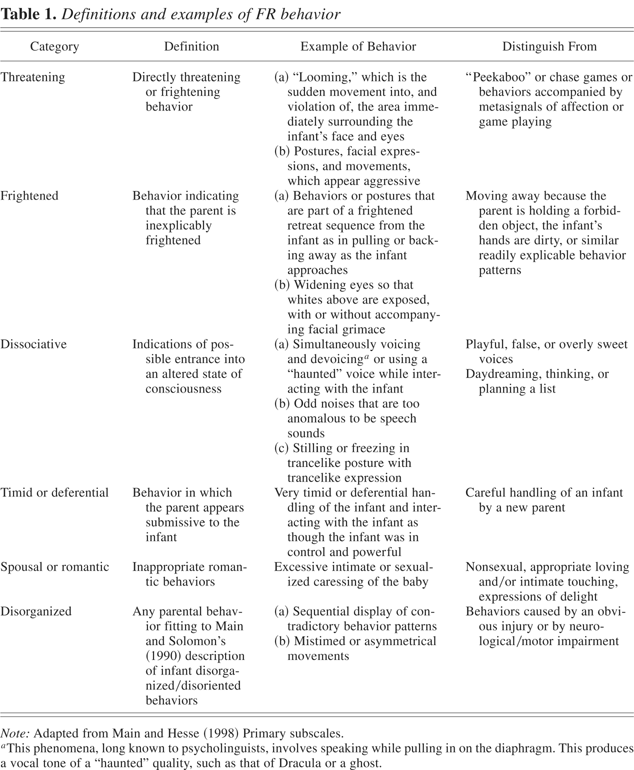
Mothers and fathers were coded on Main and Hesse's (1998) six FR subscales and were assigned an overall FR score (see Table 1 for definitions and examples) during the play and clown sessions. Coders determined the degree to which behaviors fit both Main and Hesse's (1998) “Primary” subscales (directly threatening, directly frightened, behaviors that appear to indicate entrance into an altered state of consciousness [dissociative]), and the recently added “Exploratory” subscales (timid/deferential, spousal/romantic, and disorganized, i.e., these latter being behaviors that fit the criteria of Main & Solomon's 1990 infant D system).
Definitions and examples of FR behavior

Subscales 1–3 have been hypothesized to be the primary predictors of U/d and D attachment. Parental response to frightening thoughts or memories (i.e., threat, fear, and dissociative behavior) were expected to parallel the three traditional mammalian fright responses (i.e., attack, flight, or freeze; e.g., Nijenhuis, Vanderlinden, & Spinhoven, 1998), and formed the basis of the Main and Hesse coding system.
Subscales 4–6 are expected to appear in low-risk samples only rarely and not necessarily to directly frighten the infant, but rather to mark an increased probability of observing threatening, dissociative, or frightened FR behavior in other contexts (see Hesse & Main, 1999).
The examples listed in Table 1 and in the coding manual itself are illustrative of moderate to strong behaviors and are not exhaustive. The FR coding system utilizes continuous 9-point rating scales (1.0 = no FR behavior, 3.0 = mild FR behavior, 5.0 = moderate FR behavior, 7.0 = intense behavior, 9.0 = extreme behavior). The FR system is categorical as well, and scores above a 5.0 qualify a parent for the FR category, whereas scores of 5.0 leave classification assignment to the coder's discretion. Parents may qualify for the FR category via one high score on any subscale or via multiple moderate scores.
The primary investigator (K.Y.A.) coded all 75 parent–infant play and clown sessions for FR behaviors. The second author (A.R.), who had no previous training in infant D and was therefore unlikely to be influenced by the infants' behaviors, classified and scored 30 subjects (40%). The interjudge categorical agreement for these cases was 83% (κ = .56, p < .01), with an FR score intraclass reliability of r = .80 (p < .001). Both coders were unaware of infant Strange Situation behavior and parental AAI status. The intraclass reliability for scores on Main and Hesse's (1998) three “primary” scales were r = .70 for threatening-FR; r = .70 for frightened-FR; and r = .75 for dissociative-FR. Because of low frequencies for most of the exploratory subscales, intraclass reliability is reported only for the disorganized-FR, r = .85. The p values for all were .001.
Strange Situation procedure
The Ainsworth Strange Situation is a 15- to 20-min procedure in which infants are twice separated from and twice reunited with the caregiver in an unfamiliar laboratory environment. The infant is first left with a friendly stranger and later left alone entirely. Following instructions described in Ainsworth et al. (1978), infant–parent attachment was classified as secure, avoidant, and resistant/ambivalent. Infants were classified as disorganized5
At the time of the original coding (1977–1985) classification of D attachment included three categories (not disorganized, alternate disorganized, and disorganized), and continuous scales had yet to be devised. The scoring directions have since evolved into the use of a less conservative bi-partite categorical system (i.e., not disorganized and disorganized), as well as a 9-point continuous scale (see Main & Solomon, 1990, footnote 3, pp. 134–135). Hence, current practice for the social development sample is to pool the alternate D and D categories.
Twenty-eight (37%) secure (B) parent–infant dyads were selected to take part in the current study, as were 21 (28%) insecure–avoidant (A) dyads; three (4%) insecure–resistant/ambivalent (C); and 23 (31%) disorganized dyads. Two unclassifiable (CC) infants are included in the D category as is common practice (e.g., Schuengel et al., 1999; Vondra, Shaw, & Kevenides, 1995), because the overall failure of CC infants to mobilize a consistent attachment strategy is conceptually similar to the temporary breakdown of strategy characteristic of D infants. The Strange Situation distribution did not differ for mothers and fathers, χ2 (3, n = 75) = 2.94, p = .40. There were no significant effects of infant age, χ2 (1, n = 75) = .006, p = .94, nor infant gender, χ2 (1, n = 75) = .05, p = .83, on infant disorganization.
AAI
The AAI is a semistructured 1-hr interview (George, Kaplan, & Main, 1984, 1985, 1996) that is transcribed verbatim and scored to assess a parent's state of mind with respect to attachment (Main & Goldwyn, 1984–1998; Main, Goldwyn, & Hesse, 1984–2003). In a series of 18 questions with specific follow-up probes, speakers are asked to provide an overall description and evaluation of attachment-related experiences during childhood and about loss or abuse experiences at any point during their lifetime. Whether an adult is judged secure–autonomous is assessed chiefly on the basis of production of a coherent, collaborative narrative.
Along a separate dimension, all loss, abuse, and other potentially traumatic experiences are evaluated for U/d responses. These may take the form of lapses in the monitoring of either reasoning or discourse. For example, the speaker may respond with excessive length or detail regarding aspects of a funeral, a lapse in the monitoring of discourse; or a deceased person may be described as simultaneously dead and alive in the physical sense, a lapse in the monitoring of reasoning. Each loss or trauma is scored on a 9-point scale, with scores of 5.5 or above leading to a U/d classification.
AAI transcripts were coded (by 1988) for U/d attachment by an undergraduate assistant not centrally involved with the laboratory's research. Reliability was established at that time with the third author (E.H.) for 57% of the sample (r = .87, p < .001; see Main & Hesse, 1990). Both AAI coders were unaware of Strange Situation, play, and clown session behavior.
Because FR behavior was expected to relate specifically to the unresolved–not unresolved dimension of the AAI, we limited inclusion of AAI data to those individuals who had experienced loss or trauma. In addition, only those individuals who indicated that loss (death of someone close, e.g., friend, relative, parent, or grandparent) or parental maltreatment had occurred prior to their participation in play and clown sessions were included. In total, 32 of the available 38 archival AAIs were, then, appropriate for examination in conjunction with FR behavior. The majority of these AAI texts were judged “not unresolved” secure–autonomous (F, 44%), dismissing (Ds, 34%), or preoccupied (E, 3%). Nineteen percent were unresolved (U/d) with respect to loss (n = 5) or abuse (n = 1), which is similar to the proportions found in a meta-analysis of nonclinical mothers and fathers (20% U/d, van IJzendoorn & Bakermans-Kranenburg, 1996).
Results
Results will be presented in three sections. First, we examine parent gender and FR behavior. Second, we present the intercorrelations of the six FR subscales, followed by the assessment of overall FR behavior both categorically and continuously. Here, we also address whether FR behavior observed exclusively in the play session is associated with infant D attachment. No parent was classified as FR based on observations made during the 12-min “clown” session alone, and thus no data will be presented for this procedure separately. Third, we present the FR subscales' relations to infant D and parental U/d attachment. An alpha level of .05 was used for all statistical tests, and all tests were two tailed.
FR behavior and parent gender
Parent gender was not significantly associated with FR behavior across the procedure, χ2 (1, n = 75) = .38, p = .54, or in the free-play session alone, χ2 (1, n = 75) = .45, p = .50, or with individual subscales (all six χ2 ns, p = .13–.85), or infant D, χ2 (1, n = 75) = .13, p = .72. Results of multiple moderated regressions indicated that parent's gender did not significantly interact with any of the predictor variables (i.e., FR score, FR classification, FR subscale scores, FR freeplay scores, and FR freeplay classifications) in predicting infant D. Results are therefore reported for the sample as a whole.6
Separate analyses for mother–infant dyads and father–infant dyads are available upon request.
Assessing FR Behavior in a brief laboratory session
The entire session (free play and clown combined)
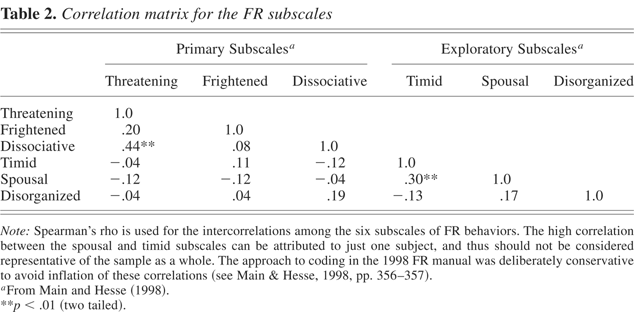
Coders assigned overall FR categories, overall FR scores, and FR subscale scores (see Table 2) to participants' behavior during the entire procedure. Neither infant age, χ2 (1, n = 75) = .43, p = .51, nor gender, χ2 (1, n = 75) = .22, p = .64, was related to parental FR behavior, and the FR subscale intercorrelations were comparable for mothers and fathers.7
Only two out of the possible 30 correlations differed in significance for mothers versus fathers. However, in both cases these correlations were accounted for by single outliers and, therefore, should not be considered meaningful.
Correlation matrix for the FR subscales

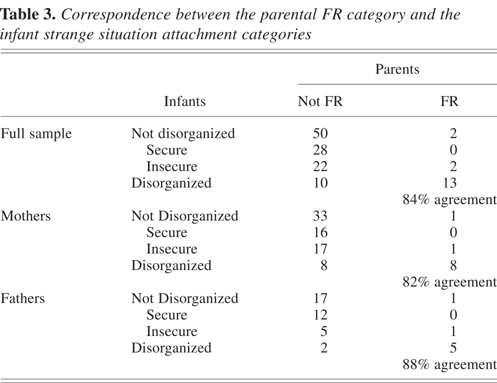
The FR category corresponded with infant D attachment in 63 out of the 75 dyads, 84% agreement (φ = .61, p < .001). Thirteen of the 23 mothers and fathers of D infants (including two CC infants8
The two parents of CC infants each received an FR score of 5.0 and were thus not outliers. Moreover, the relation between FR and infant D remains significant at the p < .001 level, even with these two dyads removed from analyses.
Correspondence between the parental FR category and the infant strange situation attachment categories

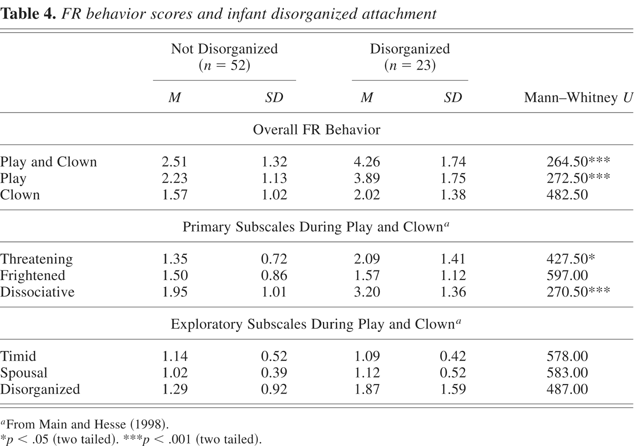
An omnibus Kruskall–Wallis test (nonparametric equivalent to analysis of variance) yielded significant mean differences between the parents of disorganized infants and other groups, χ2 (1, n = 75) = 14.9, p < .001. Planned comparisons revealed significant differences in the mean FR score for parents of D infants (n = 23, mean rank = 29.35) compared to parents of organized/insecure infants (n = 28, mean rank = 18.88), Mann–Whitney U = 153, p < .01. Parents of D infants also had higher FR scores than parents of secure (B) infants (n = 24, mean rank = 18.48), Mann–Whitney U = 111.5, p < .001 (see Table 4).
FR behavior scores and infant disorganized attachment

Analyses of available AAI data revealed that four of six parents judged U/d were also judged FR, while only 2 of 26 parents coded Not U/d were judged FR (88%, φ = .59, p < .001). Similarly, U/d parents had significantly higher FR scores (mean rank = 24.08) than Not U/d parents (mean rank = 14.75, Mann–Whitney U = 32.5, p < .05, two tailed). As in other samples (van IJzendoorn, 1995), U/d codes on the AAI were associated with infant disorganized attachment status (φ = .56, p < .001).
Parental FR behavior in the 18-min play session
FR behavior was observed mostly during the play session and was associated with D attachment (83% agreement between the FR and D categories, φ = .58, p < .001). A significant difference remained between the mean FR scores for parents of D infants (n = 23, mean rank = 52.15) and others (n = 52, mean rank = 31.74), Mann–Whitney U = 272.5, p < .001 (Table 4).
The six subscales of FR behavior
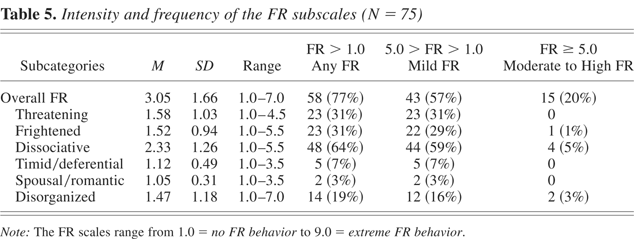
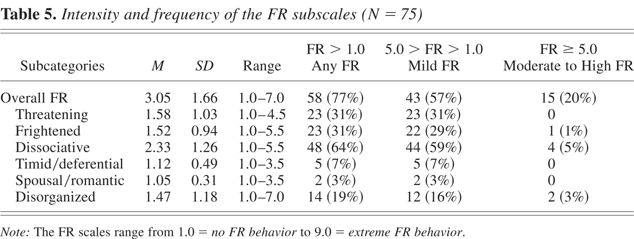
The mean, standard deviation, and range of the overall FR scale as well as the six FR subscales across the entire procedure are presented in Table 5. The number of parents displaying any, mild, and moderate to high FR (overall and by subscale) is also presented. Seventy-seven percent of the sample displayed at least some level (above a 1.0) of FR behavior.
Intensity and frequency of the FR subscales (N = 75)
Main and Hesse's primary subscales.
The threatening-FR subscale. Twenty-three parents (31%) showed at least some instance of behavior on the threatening-FR scale (M = 1.58, SD = 1.03, range = 1.0–4.5). No parent received a score above a 5.0 and was thus classified as FR on the basis of threatening-FR behavior alone. Four parents, however, received scores of a 4.5, just below the cutoff for the FR category. These included for example, brief nuzzling of baby with lip raised and teeth bared; and slowly approaching infant on all fours with stiff arms and legs, without game meta-signals. Parents of D infants received higher scores on the threatening-FR scale (n = 23, mean rank = 45.41) than the parents of organized infants (n = 52, mean rank = 34.72; Mann–Whitney U = 427.5, p < .05, see Table 4).
The frightened-FR subscale. Twenty-three parents (31%) showed at least some instance of frightened-FR behavior (M = 1.52, SD = .94, range = 1.0–5.5). Only one parent received a frightened-FR score above a 5.0: parent hunches shoulders and pulls back and away with a frightened facial expression as infant approaches. Frightened-FR behavior was not associated with infant D attachment (see Table 4).
The dissociative-FR subscale. Forty-eight parents (64%) showed at least some instance of behavior on the dissociative-FR scale (M = 2.33, SD = 1.26, range = 1.0–5.5). The majority (59%) of these parents scored less than 5.0. Higher rated dissociative-FR behavior was observed in four parents and included the following: parent whispers with simultaneous voicing and devoicing; the words were then repeated verbatim out loud to the infant; parent freezes all movement with a fixed gaze for 45 s, while the infant attempts to attract parent's attention; and parent utters unusual sounding nonspeech vocalizations such as grunts and growls, which are inexplicable in the context.
As can be seen in Table 4, a comparison of scores for dissociative-FR scale behaviors between parents of D infants (n = 23, mean rank = 52.24) and other parents (n = 52, mean rank = 31.70) yielded a significant difference (Mann–Whitney U = 270.5, p < .001, two tailed). These results are unlikely to be attributed to outliers, as even when the four parents with scores above 5.0 were removed from analyses the mean difference between parents of D infants and not D infants remained significant (Mann–Whitney U = 249.5, p < .001).
Finally, in analyses of AAIs (n = 32), the six U/d parents had higher dissociative-FR scores (mean rank = 23.42) than others (mean rank = 14.90, Mann–Whitney U = 36.50, p < .05, two tailed). Only the dissociative-FR subscale had a significant association with U/d.
Main and Hesse's exploratory subscales.
The timid/deferential-FR subscale. Five parents (7%) displayed any instance of behavior that fit to the timid/deferential-FR scale (M = 1.12, SD = .49, range = 1.0–3.5). No parent was classified as FR based solely on timid FR behavior. Timid FR was not associated with infant D attachment (see Table 4).
The spousal/romantic-FR subscale. Only two parents (3%) displayed behavior fitting to the spousal/romantic-FR scale (M = 1.05, SD = .31, range = 1.0–3.5). No parent was classified as FR based solely on spousal FR behavior. Spousal FR behavior was not associated with infant D attachment (see Table 4).
The disorganized-FR subscale. Fourteen parents (19%) displayed behavior fitting to the disorganized-FR scale (M = 1.47, SD = 1.18, range = 1.0–7.0). Two parents received disorganized-FR scores above a 5.0 such as: sudden appearance of asymmetrical leg movements while parent moved across room on knees; and a temporary “blind” look to the eyes where eyes previously appeared normal. No significant differences were found for disorganized-FR scale scores between parents of D and Not D infants overall (Table 4). However, the disorganized-FR subscale was significantly associated with infant D for mother–infant but not for father–infant dyads (Mann–Whitney U = 207, p < .05; see Abrams, 2000), although as noted, there was not a statistical difference in the strength of the association between mother–infant and father–infant dyads.
Overall prediction of disorganized attachment
Finally, infant D attachment was regressed upon the six subscales to determine which accounted for unique variance. A logistic multiple regression revealed the dissociative-FR subscale as the only remaining predictor of infant disorganization (n = 75, R2 = .22, χ2 = 6.43, p < .01) when all variables were entered simultaneously.
Discussion
This is the first study to report a relation between maternal and paternal FR behavior, especially dissociative-FR, and infant D attachment. Below we discuss our central findings and their implications: (a) the appearance of FR behavior in fathers of D infants, (b) the identification of parental FR behavior within a brief time period, (c) the relation of FR subscales to infant disorganization, and (d) the relation of the dissociative-FR subscale to disorganized and unresolved attachment. Finally, we consider the central role that dissociative processes may play in connecting unresolved AAI status, FR behavior, and D attachment.
FR behavior and infant disorganization in father–infant dyads
Fewer fathers than mothers are typically included in attachment research (van IJzendoorn & De Wolff, 1997), and it was unknown whether the mechanisms involved in D infant–father and infant–mother dyads would be the same. Here, FR behavior was not related to parent gender, and more fathers of D infants were classified as FR than were other fathers.
FR behavior during the play session
Our results are consistent with previous studies examining either overall maternal FR behavior in the home (Schuengel et al., 1999; True et al., 2001) or FR-like atypical maternal behavior occurring in the highly structured Strange Situation (Goldberg et al., 2003; Lyons-Ruth et al., 1999). In contrast to previous studies, ours took place during a brief, relatively unstructured laboratory setting where, being filmed, parents could have been especially attuned to monitoring their own behavior. Nevertheless, FR behaviors were identified within this nonclinical sample. This implies that FR behavior occurs more frequently than might have been expected. Most FR behavior occurred during the 18-min free play, in which there was (a) no third person to distract or guide the dyad's attention and (b) in the absence of structured activity. It is possible that these factors, in addition to mild demands for obedience, may have elevated stress and thereby contributed to the increased occurrence of FR behavior. The discovery of FR behavior in this play procedure suggests that not only home or Strange Situation, but also relatively unstructured laboratory observations may well provide practicable approaches to the study of parental FR behavior as well as to U/d and D attachment.
The FR subtypes
Only two (i.e., dissociative-FR and threatening-FR) of the six FR subscales were found to be interrelated and associated with infant disorganization, suggesting perhaps that these two subscales may tap a similar dimension of FR behavior in low-risk samples. In contrast to Main and Hesse's (1998) hypothesis, no significant relations were observed between the “primary” and “exploratory” subscales, nor was there a pattern of intercorrelations overall. However, it would be premature to draw firm conclusions regarding the subscales' relative dependence or independence. The lack of stronger interrelatedness may, in fact, be due to a requirement of the 1998 version of the coding system that each observed episode of FR behaviors be placed into a single best-fitting descriptive category (e.g., dissociative), rather than being considered in multiple subcategories. For example, a behavior that has a dissociative-FR component, but more clearly fits to the frightened-FR subscale, would only be scored on the latter scale. This strategy was employed in order to prevent inflation of overall FR scores and correlations among the subscales. Hence, future research with a variety of samples and procedures examining the presence or absence of simultaneous behaviors fitting to various subscales is needed. In addition, both the quantity and variety of FR behavior would most likely be more prevalent in a high-risk sample and/or via a more stressful and/or lengthy procedure.
FR subscales not related to infant disorganization
The frightened, timid, spousal, and disorganized-FR subscales were not in themselves significantly related to infant D attachment for the full sample. Frightened-FR behavior appeared with similar frequency and intensity as threatening-FR, but the former may be especially difficult to distinguish from normal parental behavior (e.g., pulling away from the infant because the parent is holding a sharp pencil; see Table 1). Thus, it may have been overcoded in parents of non-D infants. Investigators should continue to include frightened-FR behavior in their studies because within a high-risk sample Lyons-Ruth et al. (1999) found a similar dimension of “fearful and withdrawn” behaviors to specifically characterize mothers of disorganized/secure infants. In addition, in our low-risk, nonclinical sample very few parents displayed behavior fitting to the timid or spousal-FR scales, limiting our ability to test their reliability. This is in keeping with Main and Hesse's (1998; see also Hesse & Main, 1999) suggestion that the three “exploratory” FR subscales would occur rarely in low-risk samples. Nevertheless, these scales should continue to be utilized because of the conservative nature of Main and Hesse's coding instructions and the expectation that a wider variety of these behaviors may occur within high-risk contexts.
The parental disorganized-FR subscale was not found associated with infant D attachment for the sample as a whole. Although there were no statistical differences in the strength of the FR subscale relations to infant D for mother–infant and father–infant dyads, mothers (but not fathers) of D infants did have higher disorganized-FR scores than did other mothers (see Abrams, 2000). In addition, of the parental disorganized-FR behaviors observed, some took the form of behaviors previously seen only in infants (e.g., asymmetrical movements).
FR subscales related to infant disorganization
The threatening and dissociative-FR subscales were both found individually associated with infant disorganization. Given that parental maltreatment is known to be strongly associated with infant D attachment (van IJzendoorn et al., 1999), it is perhaps not surprising that parental FR resembling truly threatening or aggressive behavior would also relate to D attachment.
When the six FR subscales were considered simultaneously, dissociative-FR emerged as the sole predictor of infant disorganization. This finding is consistent with Schuengel (1997), who reported in a doctoral dissertation for which the FR coding was carried out by Bakermans-Kranenburg and van IJzendoorn9
In addition to coding the AAIs for this study, van IJzendoorn and Bakermans-Kranenburg utilized Main and Hesse's (1992) FR system, which comprised (a) a version of the current Dissociative Scale, (b) a version of the current Threatening Scale, and (c) a version of the current Frightened Scale.
The possible role of dissociative processes in unresolved adult attachment, disorganized infant attachment, and FR parental behavior
Traumatic events such as parental abuse are known to elicit major alterations in cognitive, emotional, and volitional processes (Horowitz, 1976), with dissociation being a common response to experiences of extreme fear and reminders of these events (e.g., Putnam, 1989). Depending on the circumstances, loss can also be highly frightening. As such, it has been suggested that unresolved attachment, which seemingly includes alterations in cognition and perhaps emotion and volition, may be one marker of dissociative processes. Thus, dissociative states may be “triggered” in response to questions invoking frightening memories within the AAI (Main & Hesse, 1992; Main & Morgan, 1996).
In our subsample, of the 32 parents who had experienced a loss or other trauma, those judged unresolved (n = 6) exhibited more FR behavior in general and significantly more dissociative-FR behavior than did others. Although our sample of AAI data was small, similar findings regarding U/d attachment and overall FR behavior were found in two larger samples (Jacobvitz et al., 1997; Schuengel et al., 1999). As explained further below, FR behavior may therefore often relate to dissociative processes.
Additional support for the hypothesized association between U/d attachment and other indices of dissociation comes from Hesse and van IJzendoorn (1999), who found that among college students, U/d attachment was related to a self-report inventory focusing on one aspect of dissociation, Tellegen's Absorption Scale (TAS; Tellegen & Atkinson, 1974). Although absorption is generally understood to be relatively prevalent, resulting in an altered sense of reality and/or self, high scores can suggest pathological processes (Hilgard, 1977/1986; Kihlstrom, Gilsky, & Angiulo, 1994; Tellegen, 1992, personal communication, April 13, 2002).
The results from these low-risk studies are consistent with evidence indicating that there exists both a pathological taxon as well as a continuum of nonpathological “normative” dissociative phenomena (Waller, Putnam, & Carlson, 1996; personal communication, F. Putnam, April 7, 2002). For instance, becoming deeply focused on a book and temporarily losing awareness of the environment was reported by a majority of respondents in two large samples, for example, 83% (Ross, Joshi, & Currie, 1990) and 79% (Vanderlinden, Van Dyck, Vandereycken, & Vertommen, 1991). Similarly, we observed a surprising prevalence of dissociative-FR behavior, the majority of which appeared to indicate low to moderate levels of absorption.
However, a few parents (chiefly those of disorganized infants) did display more marked dissociative-FR behavior. One, as noted earlier, froze all movement with a fixed gaze for 45 s while the infant very actively attempted to attract the parent's attention. On the AAI, this same parent was judged unresolved for initially responding to the query regarding the existence of any important family losses with “No. No. Never any losses in my family,” and then immediately describing a series of several major familial losses, without marking this contradiction. This lapse in the monitoring of reasoning could be conceived as indicating potentially “segregated” or dissociated memories of dead family members (as see Bowlby, 1980; Hilgard, 1977/1986). This parent also used eulogistic language to describe the multiple losses, a speech pattern interpreted as a lapse in the monitoring of discourse (as it is inappropriate to the immediate context) and thus indicative of a state of absorption (see Main & Hesse, 1992).
Marked dissociative-FR behaviors such as the above are inherently frightening to observe, and the behaviors seen in our sample (and others, see Jacobvitz et al., 1997; Schuengel, 1997) are similar to the unusual vocalization, unfocused or fixed gaze, and anomalous movements noted by Ng (2000) in his study of trance states in a psychiatric sample. It should be considered, however, that even lower level absorption, where the parent has temporarily lost awareness of the environment, may be frightening for an infant because in that moment the parent will be less available as a “haven of safety.” This is consistent with the fact that, in our study, a significant relation between dissociative-FR and infant disorganization remained even when all marked dissociative FR scores (i.e., above a 5.0) were removed from analysis.
In future explorations of the relation between FR behavior and dissociation, it would be heuristically valuable to determine if FR parents report high levels of absorption and/or dissociation using TAS (Tellegen & Atkinson, 1974) or the Dissociative Experiences Scale (DES; Bernstein & Putnam, 1986). Although Schuengel et al. (1999) found that FR behavior was not associated with the DES, it would be intriguing to continue testing these relations, perhaps utilizing observational measures of absorption and/or dissociation. Further, as infant D may be a diathesis for future dissociative behavior (Carlson, 1998; Liotti, 1992; Ogawa, Sroufe, Weinfield, Carlson, & Egeland, 1997), another important direction for future work would be investigating whether infants disorganized specifically with parents who primarily displayed dissociative, as opposed to other types of FR behaviors, are more likely to develop dissociative propensities themselves.
In conclusion, it appears that parental FR behavior may globally resemble infant disorganization in being indicative of a brief collapse in caregiving (as opposed to care seeking) strategies, perhaps particularly under mild to moderate, lab-induced stress. In addition, our study has revealed that some parents of D infants are vulnerable to displaying brief alterations in action suggestive of accompanying alterations in cognition, attention, emotion, or volition, in other words, dissociative processes. Therefore, we suggest that the role of potentially frightening experiences in a parent's history, and any resulting FR behavior and indices of dissociation, should be considered alongside direct trauma to an infant or child as a potentially salient factor in the development of psychopathology. Finally, the current study's expansion upon both the conceptualization and utility of assessing parental FR behavior suggests that it is a viable “port of entry” to intervention with parent–infant dyads.
References
REFERENCES
Abrams, K. Y.
(2000).
Pathways to disorganization: A study concerning varying types of
parental frightened and frightening behaviors as related to infant
disorganized attachment.
Doctoral dissertation,
University of California, Berkeley.
Ainsworth, M. D. S.,
Blehar, M.,
Waters, E., &
Wall, S.
(1978).
Patterns of attachment.
Hillsdale, NJ:
Erlbaum.
Ainsworth, M. D. S., &
Wittig, B. A.
(1969).
Attachment and the exploratory behavior of one-year-olds in a
strange situation. In
B. M Foss (Ed.),
Determinants of infant behavior (pp.
113–136).
London:
Methuen.
Bakermans-Kranenburg, M. J., &
van IJzendoorn, M. H.
(2004).
No association of the dopamine D4 receptor (DRD4) and -521 C/T
promoter polymorphisms with infant attachment disorganization.
Attachment and Human Development,
6,
211–218.CrossRefGoogle Scholar
Benoit, D.,
Madigan, S., &
Goldberg, S.
(2003).
Atypical maternal behaviors: Insensitive or disorganized?
Paper presented at the Biennial Meeting of the Society for
Research in Child Development, Tampa, FL.
Benoit, D., &
Parker, K. C. H.
(1994).
Stability and transmission of attachment across 3
generations.
Child Development,
65,
1444–1456.CrossRefGoogle Scholar
Bernstein, E. M., &
Putnam, F. W.
(1986).
Development, reliability, and validity of a dissociation
scale.
Journal of Nervous and Mental Disease,
174,
727–735.CrossRefGoogle Scholar
Bokhorst, C. L.,
Bakermans-Kranenburg, M. J.,
van IJzendoorn, M. H.,
Fonagy, P., &
Schuengel, C.
(2003).
The importance of shared environment in mother–infant
attachment security: A behavioral genetic study.
Child Development,
74,
1769–1782.CrossRefGoogle Scholar
Bowlby, J.
(1980).
Attachment and Loss: Vol. 3. Loss: Sadness and depression.
New York:
Basic Books.
Carlson, E. A.
(1998).
A prospective longitudinal study of disorganized/disoriented
attachment.
Child Development,
69,
1107–1128.CrossRefGoogle Scholar
Carlson, V.,
Cicchetti, D.,
Barnett, D., &
Braunwald, K.
(1989).
Disorganized/disoriented attachment relationships in maltreated
infants.
Developmental Psychology,
25,
525–531.CrossRefGoogle Scholar
Eells, T. D.
(1995).
Role reversal: A convergence of clinical and quantitative
evidence.
Psychotherapy Research,
5,
297–312.CrossRefGoogle Scholar
George, C.,
Kaplan, N., &
Main, M.
(1984, 1985, 1996).
Adult Attachment Interview.
Unpublished protocol (3rd ed.).
University of California, Berkeley, Department of Psychology.
Goldberg, S.,
Benoit, D.,
Blockland, K., &
Madigan, S.
(2003).
Atypical maternal behavior, maternal representations, and infant
disorganized attachment.
Development and Psychopathology,
15,
239–257.Google Scholar
Goldberg, S.,
Gotowiec, A., &
Simmons, R. J.,
(1995).
Development and Psychopathology,
7,
267–282.
Hesse, E., &
Main, M.
(1999).
Second-generation effects of unresolved trauma in non-maltreating
parents: Dissociative, frightened, and threatening parental
behavior.
Psychoanalytic Inquiry,
19,
481–540.CrossRefGoogle Scholar
Hesse, E., &
Main, M.
(2000).
Disorganization in infant and adult attachment: Description,
correlates, and implications for developmental psychopathology.
Journal of the American Psychoanalytic Association,
48,
1097–1127.CrossRefGoogle Scholar
Hesse, E., &
van IJzendoorn, M. H.
(1999).
Propensities towards absorption are related to lapses in the
monitoring of reasoning or discourse during the Adult Attachment
Interview: A preliminary investigation.
Attachment and Human Development,
1,
67–91.CrossRefGoogle Scholar
Hilgard, E. R.
(1986).
Divided consciousness: Multiple controls in human thought and
action.
New York:
Wiley.
(Original work published 1977)
Horowitz, M. J.
(1976).
Stress response syndromes.
New York:
Jason Aronson.
Jacobvitz, D.,
Hazen, N. L., &
Riggs, S.
(1997, April).
Disorganized mental processes in mothers, frightened/frightening
caregiving, and disoriented/disorganized behavior in infancy.
Paper presented at the Biennial Meeting of the Society for
Research in Child Development, Washington, DC.
Jacobvitz, D.,
Leon, K., &
Hazen, N.
(2006).
Does expectant mothers' unresolved trauma predict
frightened/frightening maternal behavior? Risk and protective
factors.
Development and Psychopathology,
18,
363–379.Google Scholar
Kaplan, N.
(1987).
Individual differences in six-year-oldapos;s thoughts about
separation: Predicted to actual experiences of separation.
Unpublished doctoral dissertation,
University of California, Berkeley.
Kihlstrom, J. F.,
Gilsky, M. L., &
Angiulo, M. J.
(1994).
Dissociative tendencies and dissociative disorders.
Journal of Abnormal Psychology,
103,
117–124.CrossRefGoogle Scholar
Lakatos, K.,
Nemoda, Z.,
Toth, I.,
Ronai, Z.,
Ney, K.,
Sasvari-Szekely, M.,
et al.
(2002).
Further evidence for the role of the dopamine D4 receptor
(DRD4) gene in attachment disorganization: Interaction of the
exon III 48-bp repeat and the -521 C/T promoter polymorphisms.
Molecular Psychiatry,
7,
27–31.CrossRefGoogle Scholar
Lakatos, K.,
Toth, I.,
Nemoda, Z.,
Ney, K.,
Sasvari-Szekely, M., &
Gervai, J.
(2000).
Dopamine D4 receptor (DRD4) polymorphism is associated with
attachment disorganization in infants.
Molecular Psychiatry,
5,
633–637.CrossRefGoogle Scholar
Liotti, G.
(1992).
Disorganized/disoriented attachment in the etiology of the
dissociative disorders.
Dissociation,
5,
196–204.Google Scholar
Lyons-Ruth, K.,
Alpern, L., &
Repacholi, B.
(1993).
Disorganized infant attachment classification and maternal
psychosocial problems as predictors of hostile–aggressive behavior
in the preschool classroom.
Child Development,
64,
572–585.CrossRefGoogle Scholar
Lyons-Ruth, K.,
Bronfman, E., &
Parsons, E.
(1999).
Maternal frightened, frightening, or atypical behavior and
disorganized infant attachment patterns.
Monographs of the Society for Research in Child Development,
64,
67–96.CrossRefGoogle Scholar
Lyons-Ruth, K.,
Connell, D.,
Grunebaum, H. U., &
Botein, S.
(1990).
Infants at social risk: Maternal depression and family support
services as mediators of infant development and security of
attachment.
Child Development,
61,
85–98.CrossRefGoogle Scholar
Main, M.
(1981).
Avoidance in the service of attachment: A working paper. In
K. Immelmann,
G. Barlow,
L. Petrinovitch, &
M. Main (Eds.),
Behavioral development: The Bielefeld interdisciplinary
project (pp.
651–693).
New York:
Cambridge University Press.
Main, M., &
Cassidy, J.
(1988).
Categories of response to reunion with the parent at age 6:
Predicted from infant attachment classifications and stable over a 1-month
period.
Developmental Psychology,
24,
415–426.CrossRefGoogle Scholar
Main, M., &
Goldwyn, R.
(1984–1998).
Adult Attachment Scoring and Classification Systems.
Unpublished manuscript.
University of California, Berkeley.
Main, M.,
Goldwyn, R., &
Hesse, E.
(1984–2003).
Adult Attachment Scoring and Classification System.
Unpublished manuscript,
University of California, Berkeley, Department of Psychology.
Main, M., &
Hesse, E.
(1990).
Parent's unresolved traumatic experiences are related to
infant disorganized/disoriented attachment status: Is frightened
and/or frightening parental behavior the linking mechanism? In
M. Greenberg,
D. Cicchetti, &
E. Mark Cummings (Eds.),
Attachment in the preschool years: Theory, research, and
intervention (pp.
161–182).
Chicago:
University of Chicago Press.
Main, M., &
Hesse, E.
(1992).
Frightening, frightened, timid/deferential, dissociated, or
disorganized behavior on the part of the parent: Coding system.
Unpublished manuscript,
University of California at Berkeley.
Main, M., &
Hesse, E.
(1998).
Frightening, frightened, dissociated, deferential, spousal and
disorganized parental behavior: A coding system for parent–infant
interactions
(6th ed.).
Unpublished manuscript,
University of California, Berkeley.
Main, M.,
Hesse, E., &
Kaplan, N.
(2005).
Predictability of behavior and representational processes related
to attachment in the Berkeley Londitudinal Study: Attachment at 1, 6, and
19 years of age. In
K. E. Grossmann,
K. Grossmann, &
E. Waters (Eds.),
The power of longitudinal studies in attachment.
New York:
Guilford Press.
Main, M.,
Kaplan, N., &
Cassidy, J.
(1985).
Security in infancy, childhood and adulthood: A move to the level of
representation.
Monographs of the Society for Research in Child Development,
50,
66–104.CrossRefGoogle Scholar
Main, M., &
Morgan, H.
(1996).
Disorganization and disorientation in infant strange situation
behavior: Phenotypic resemblance to dissociative states? In
L. Michelson &
W. Ray (Eds.),
Handbook of dissociation: Theoretical, empirical, and clinical
perspectives (pp.
107–138).
New York:
Plenum Press.
Main, M., &
Solomon, J.
(1986).
Discovery of a new, insecure–disorganized/disoriented
attachment pattern. In
T. B. Brazelton &
M. W. Yogman (Eds.),
Affective development in infancy (pp.
95–124).
Norwood, NJ:
Ablex.
Main, M., &
Solomon, J.
(1990).
Procedures for identifying infants as disorganized/disoriented
during the Ainsworth Strange Situation. In
M. T. Greenberg,
D. Cicchetti, &
E. M. Cummings (Eds.),
Attachment in the preschool years (pp.
121–160).
Chicago:
University of Chicago Press.
Main, M., &
Weston, D. R.
(1981).
The quality of the toddler's relationship to mother and to
father: Related to conflict behavior and the readiness to establish new
relationships.
Child Development,
52,
932–940.CrossRefGoogle Scholar
Ng, B. Y.
(2000).
Phenomenology of trance-states seen at a psychiatric hospital in
Singapore: A cross-cultural perspective.
Transcultural Psychiatry,
37,
560–579.CrossRefGoogle Scholar
Nijenhuis, E. R. S.,
Vanderlinden, J., &
Spinhoven, P.
(1998).
Animal defensive reactions as a model for trauma-induced
dissociative reactions.
Journal of Traumatic Stress,
11,
243–260.CrossRefGoogle Scholar
Ogawa, J. R.,
Sroufe, A. L.,
Weinfield, N. S.,
Carlson, E. A., &
Egeland, B.
(1997).
Development and the fragmented self: Longitudinal study of
dissociative symptomatology in a nonclinical sample.
Development and Psychopathology,
9,
855–879.CrossRefGoogle Scholar
Putnam, F. W.
(1989).
Diagnosis and treatment of multiple personality disorder.
New York:
Guilford Press.
Ross, C. A.,
Joshi, S., &
Currie, R.
(1990).
Dissociative experiences in the general population.
American Journal of Psychiatry,
147,
1547–1552.Google Scholar
Schuengel, C.
(1997).
Attachment, loss, and maternal behavior: A study on
intergenerational transmission.
Unpublished doctoral dissertation,
Leiden University.
Schuengel, C.,
Bakermans-Kranenburg, M., &
van IJzendoorn, M.
(1999).
Frightening, maternal behavior linking unresolved loss and
disorganized infant attachment.
Journal of Consulting and Clinical Psychology,
67,
54–63.CrossRefGoogle Scholar
Solomon, J.,
George, C.,
DeJong, A.
(1995).
Children classified as controlling at age six: Evidence of
disorganized representational strategies and aggression at home and at
school.
Development and Psychopathology,
7,
447–463.CrossRefGoogle Scholar
Tellegen, A.
(1992).
Note of structure and naming of the MPQ Absorption Scale.
Unpublished manuscript,
University of Minnesota.
Tellegen, A., &
Atkinson, G.
(1974).
Openness to absorbing and self-altering experiences
(“absorption”), a trait related to hypnotic
susceptibility.
Journal of Abnormal Psychology,
83,
268–277.CrossRefGoogle Scholar
True, M.,
Pisani, L., &
Oumar, F.
(2001).
Infant–mother attachment among the Dogon in Mali.
Child Development,
75,
1451–1466.CrossRefGoogle Scholar
Vanderlinden, J.,
Van Dyck, R.,
Vandereycken, W., &
Vertommen, H.
(1991).
Dissociative experiences in the general population in The
Netherlands and Belgium: A study with The Dissociative Questionnaire
(DIS-Q).
Dissociation,
4,
180–184.Google Scholar
van IJzendoorn, M. H.
(1995).
Adult attachment representations, parental responsiveness, and
infant attachment: A meta-analysis on the predictive validity of the Adult
Attachment Interview.
Psychological Bulletin,
117,
387–403.CrossRefGoogle Scholar
van IJzendoorn, M. H., &
Bakermans-Kranenburg, M. J.
(1996).
Attachment representations in mothers, fathers, adolescents, and
clinical groups: A meta-analytic search for normative data.
Journal of Consulting and Clinical Psychology,
64,
8–21.CrossRefGoogle Scholar
van IJzendoorn, M. H., &
De Wolff, M. S.
(1997).
In search of the absent father: Meta-analysis of infant–father
attachment. A rejoinder to our discussants.
Child Development,
68,
604–609.Google Scholar
van IJzendoorn, M. H.,
Goldberg, S.,
Kroonenberg, P. M., &
Frenkel, O. J.
(1992).
The relative effects of maternal and child problems on the quality
of attachment: A meta-analysis of attachment in clinical samples.
Child Development,
63,
840–858.CrossRefGoogle Scholar
van IJzendoorn, M. H.,
Schuengel, C., &
Bakermans-Kranenburg, M. J.
(1999).
Disorganized attachment in early childhood: Meta-analysis of
precursors, concomitants, and sequelae.
Development and Psychopathology,
11,
225–249.CrossRefGoogle Scholar
Vondra, J. I.,
Shaw, D. S., &
Kevenides, M. C.
(1995).
Predicting infant attachment classification from multiple,
contemporaneous measures of maternal care.
Infant Behavior and Development,
18,
415–425.CrossRefGoogle Scholar
Waller, N. G.,
Putnam, F. W., &
Carlson, E.
(1996).
Types of dissociation and dissociative types: A taxometric analysis
of dissociative experiences.
Psychological Methods,
1,
300–321.CrossRefGoogle Scholar
Ward, M. J., &
Carlson, E. A.
(1995).
The predictive validity of the Adult Attachment Interview for
adolescent mothers.
Child Development,
66,
69–79.CrossRefGoogle Scholar
Wartner, U. G.,
Grossmann, K.,
Fremmer-Bombik, E., &
Suess, G.
(1994).
Attachment patterns at age six in south Germany: Predictability from
infancy and implications for preschool behavior.
Child Development,
65,
1014–1027.CrossRefGoogle Scholar
Definitions and examples of FR behavior
Correlation matrix for the FR subscales
Correspondence between the parental FR category and the infant strange situation attachment categories
FR behavior scores and infant disorganized attachment
Intensity and frequency of the FR subscales (N = 75)
 You have
Access
- 85
- Cited by