INTRODUCTION
Some of the most challenging questions in ecology revolve around sets of co-occurring species (Sutherland et al., Reference Sutherland, Freckleton, Godfray, Beissinger, Benton, Cameron, Carmel, Coomes, Coulson, Emmerson, Hails, Hays, Hodgson, Hutchings, Johnson, Jones, Keeling, Kokko, Kunin, Lambin, Lewis, Malhi, Mieszkowska, Milner-Gulland, Norris, Phillimore, Purves, Reid, Reuman, Thompson, Travis, Turnbull, Wardle and Wiegand2013). Analysing diet composition helps ecologists assess the relationship between resource use and interactions between organisms as well as the impact of different species traits (e.g. sex, size-class) on the ecological network structure. Therefore, information on the diet of fishes is important to understand the basic functioning of fish assemblages and is widely used for ecological work and modelling to know the trophic status of species and is becoming an increasingly important component in ecologically based management (Pauly et al., Reference Pauly, Christensen, Dalsgaard and Froese1998; Kulbicki et al., Reference Kulbicki, Bozec, Labrosse, Letourneur, Mou-Tham and Wantiez2005).
Worldwide, sharks are considered apex predators, which help to maintain the population size of their prey (Castillo-Géniz, Reference Castillo-Géniz1992). In addition to their ecological importance, shark species support important fisheries worldwide, from large-scale industrial outfits to small-scale fisheries (Torres-Huerta, Reference Torres-Huerta2004; Suriano-Velázquez et al., Reference Suriano-Velázquez, Acal-Sánchez, Castillo-Geniz, Vázquez-Gómez and Ramírez-Santiago2006). In the Mexican Pacific and specifically in the Gulf of Tehuantepec, the silky shark (Carcharhinus falciformis) and the scalloped hammerhead shark (Sphyrna lewini) are the shark species most commonly caught as part of the commercial and small-scale pelagic fisheries. In recent years there has been a notable decline in the abundance of these two shark species. According to the Inter-American Tropical Tuna Commission, it is not yet clear whether these downward trends are due to fishing, changes in the environment, or other processes such as dietary shifts due to variation in the availability of different prey species (Duffy et al., Reference Duffy, Olson, Lennert-Cody, Galván-Magaña, Bocanegra-Castillo and Kuhnert2015).
Due to the decline in their abundance, C. falciformis and S. lewini have been classified as near-threatened and endangered, respectively, in the International Union for Conservation of Nature (IUCN) Red List of Threatened Species. Thus, it is imperative that we achieve a more detailed understanding of the biology of these two shark species inhabiting the eastern tropical Pacific Ocean. Carcharhinus falciformis is generally considered a pelagic shark feeding on epipelagic and mesopelagic fish and cephalopods (Compagno, Reference Compagno, Fischer and Nauen1984; Bonfil-Sanders, Reference Bonfil-Sanders1994). In contrast, S. lewini is a coastal and semi-oceanic hammerhead shark feeding mainly on demersal fish and crustaceans (Torres-Rojas et al., Reference Torres-Rojas, Páez-Osuna, Hernández-Herrera, Galván-Magaña, Aguiñiga-García, Villalobos-Ortiz and Sampson2013). As with other shark species, data on the trophic ecology (diet) of these two shark species is scarce and more information, particularly regarding trophic interactions between these sharks and their prey, is needed.
The lack of information regarding trophic interactions between species complicates attempts at predicting the effect of natural or anthropogenic alterations in the ecosystem (Kulbicki et al., Reference Kulbicki, Bozec, Labrosse, Letourneur, Mou-Tham and Wantiez2005). Diet comparison studies are useful in terms of understanding how two species utilize the same food resources, thus identifying connections between predators and their prey (trophic interactions). This, in turn, allows us to assess the degree of trophic overlap (i.e. what, how and when they feed) between two predators (Krebs, Reference Krebs1999). Thus, we can evaluate the degree of competition between species and the effect of removing them or any of the resources they use from the ecosystem network (Whittaker, Reference Whittaker1972; Pianka, Reference Pianka1978; Giller, Reference Giller1984).
Understanding the biological interactions between these two shark species and their interactions with different prey species will facilitate the effective management of the multispecies fishery in this ecosystem. Thus, the goal of this study is three-fold: (1) to identify the diet of C. falciformis and S. lewini based on stomach content analysis in order to detect possible intraspecific (sex and/or size-class) differences in diet, (2) to assess the trophic level and diet breadth for each species; and (3) to assess the dietary overlap between C. falciformis and S. lewini. Our results provide us with a better understanding of the complex trophic interactions between these two shark species in the marine food webs of the Gulf of Tehuantepec ecosystem.
MATERIALS AND METHODS
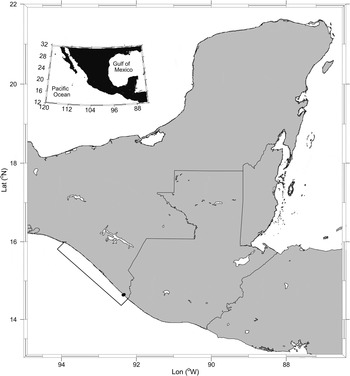
Sampling was conducted at fishing camps in Puerto Madero, Mexico (14°32′24″N 90°07′13″W) in the south-eastern Gulf of Tehuantepec (Figure 1). Samples were collected from the longline, small-scale fisheries (40 boats) during a single fishing season, June and July 2011. For each sample, the species was identified and the following data were recorded: total length in cm, sex and maturity stage (180 cm total length is the estimated size at maturity for both species) (Bejarano-Álvarez et al., Reference Bejarano-Álvarez, Galván-Magaña and Ochoa-Báez2011; Hoyos-Padilla et al., Reference Hoyos-Padilla, Ceballos-Vázquez and Galván-Magaña2012). The stomachs were removed and frozen (−20°C) until further analysis in the fish laboratory at the Centro Interdisciplinario de Ciencias Marinas del Instituto Politécnico Nacional (CICIMAR-IPN; Interdisciplinary Center for Marine Sciences at the National Polytechnic Institute) in La Paz, Baja California Sur, Mexico.
Studied area where Sphyrna lewini and Carcharhinus falciformis specimens were caught (south-western Gulf of Tehuantepec, Mexico). Black rectangle represents the fishing area; Black point represents the fishing camps in Puerto Madero, Mexico.

In the laboratory, stomachs were thawed and the percentage of stomach fullness was determined following Stillwell & Kohler (Reference Stillwell and Kohler1982), where 0 = empty, 1 = 1–25% full, 2 = 26–50% full, 3 = 51–75% full and 4 = 76–100% full. Prey items were identified to the lowest possible taxonomic level, and different identification keys were used for each digestion state. The four digestion states were identified following Galván-Magaña (Reference Galván-Magaña1988). Digestion state 1 included recently consumed items and guides by Allen & Robertson (Reference Allen and Robertson1994) and Fischer et al. (Reference Fischer, Krupp, Schneider, Sommer, Carpenter and Niem1995) were used for prey identification. Digestion state 2 included food items with muscle but no skin, while digestion state 3 included fish skeletons; for both states, we used taxonomic keys based on vertebrae characteristics (Clothier, Reference Clothier1950). We also compared diet items with the complete skeletons of organisms captured in the area. Digestion state 4 was characterized by hard structures, such as fish otoliths, crustacean remains, and cephalopod beaks; keys by Brusca (Reference Brusca1980), Wolff (Reference Wolff1984) and Clarke (Reference Clarke1986) were used for identification.
Once the stomach contents were identified, we determined whether the number of stomachs analysed was adequate to represent the trophic spectrum of S. lewini and C. falciformis. Cumulative prey curves (Ferry & Cailliet, Reference Ferry, Cailliet, MacKinlay and Shearer1996) were generated in the EstimateS program (Colwell, Reference Colwell2006). The coefficient of variation was calculated as an indicator of diet variability, with a CV < 0.05 indicating that the trophic spectrum was adequately represented (Steel & Torrie, Reference Steel and Torrie1992).
The index of relative importance (IRI) was calculated using the following formula, described by Pinkas et al. (Reference Pinkas, Oliphant and Iverson1971) and subsequently converted into a percentage by Cortés (Reference Cortés1997):
 $${\rm IRI} = (\% N + \% W) \times \left( {\% F} \right)$$
where, %N is the number and %W is the wet weight of each food item, expressed as the percentage of the total of each variable for all prey items in the stomach contents; and %F is the percentage frequency of occurrence of each food item (presence-absence) in all stomachs that contained food.
The Shannon–Wiener diversity index (Pielou, Reference Pielou1975), based on the abundance of all prey items, was used to calculate diversity and was plotted against the number of stomachs analysed. To evaluate the niche breadth of S. lewini and C. falciformis we used Levin's standardized index, ‘Bi’ (Krebs, Reference Krebs1999), which ranges from 0 to 1, with lower values (<0.6) reflecting a diet dominated by few prey items (specialist predator), and higher values (>0.6) indicating a generalist predator (Labropoulou & Eleftheriou, Reference Labropoulou and Eleftheriou1997). Also, the values of both indices (H’ and Bi) were compared to corroborate the feeding behaviour of S. lewini and C. falciformis (specialist, generalist or opportunist). For example: (1) high values of diversity and niche breadth correspond to generalist predator, (2) low values of diversity and niche breadth correspond to specialist predator, and (3) low values of niche breadth but high values of diversity correspond to opportunist predator.
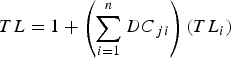
The Morisita-Horn index (Smith & Zaret, Reference Smith and Zaret1982) was used to evaluate dietary overlap between sexes, size-classes and shark species. This index ranges from 0 (different diets) to 1 (same diets). According to Langton (Reference Langton1982), values between 0 and 0.60 reflect lower overlap, while values that exceed 0.60 indicate greater overlap. We also used the stomach contents to calculate the trophic level (TL), using the following equation proposed by Christensen & Pauly (Reference Christensen and Pauly1992):
 $$TL = 1 + \left( {\sum\limits_{i = 1}^n {DC_{\,ji}}} \right)(TL_i )$$
Where DC ji is the diet composition in weight, in terms of the prey proportion (i) in the predator's diet (j); TL i is the trophic level of prey species i; and n is the number of prey groups in the diet. For this equation, trophic levels for fish species were obtained from FishBase (Froese & Pauly, Reference Froese, Pauly, Lozán, Rachor, Sundermann and von Westernhagen2003), while those for cephalopods and crustaceans were obtained from Cortés (Reference Cortés1999).
RESULTS
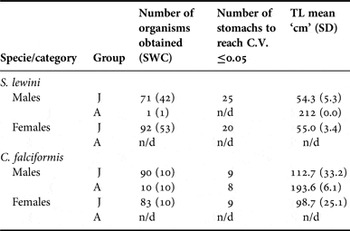
We sampled 164 S. lewini and 183 C. falciformis (Table 1). The total length of S. lewini ranged from 41 to 212 cm with a mean (±SD) of 59 ± 16 cm, whereas C. falciformis ranged from 70 to 203 cm with a mean of 122 ± 44 cm. For S. lewini, 51% of stomachs fell into fullness category 1; 26% were in category 2; 20% were in category 3; and 3% were in category 4. For C. falciformis, 65% of stomachs were in fullness category 1; 20% were in category 2; 10% were in category 3; and 5% were in category 4.
Summary description of Sphyrna lewini and Carcharhinus falciformis for stomach contents analysis. (Juvenile ‘J’, <180 cm total length (TL); Adult ‘A’ > 180 cm TL; Bejarano-Álvarez et al., Reference Bejarano-Álvarez, Galván-Magaña and Ochoa-Báez2011; Hoyos-Padilla et al., Reference Hoyos-Padilla, Ceballos-Vázquez and Galván-Magaña2012), C.V., Coefficient of Variation; SWC, stomachs with content; SD, standard deviation, n/d = no data.

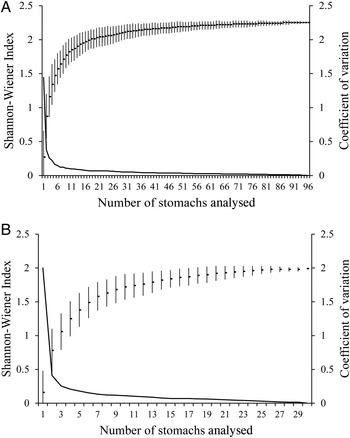
No prey items were in digestion state 1 for either shark species. For S. lewini, 28 prey items were in digestion state 2; 79 were in digestion state 3, and 26 were in digestion state 4. For C. falciformis, seven prey items were in digestion state 2; 11 were in digestion state 3, and eight were in digestion state 4. Prey species accumulation curves indicated that a sufficient number of stomachs were analysed in order to adequately characterize the diets of S. lewini (31 stomachs required to reach a CV ≤ 0.05) and C. falciformis (19 stomachs required to reach a CV ≤ 0.05), as well as among the different sex and size-classes (Figure 2; Table 1).
Randomized cumulative prey curves generated for each shark species. Black points = Shannon-Wiener diversity values for Sphyrna lewini (A) and Carcharhinus falciformis (B) (vertical lines = SD, and dotted line = coefficient of variation).

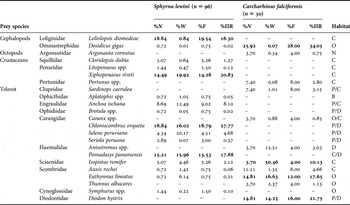
The trophic spectrum of S. lewini was composed of two cephalopod species belonging to two families, three crustacean species from two families, and 11 fish species from eight families. Based on the index of relative importance (%IRI), Chloroscombrus orqueta (27.7%), Xiphopenaeus riveti (20.8%), Pomadasys panamensis (17.8%) and Loliolopsis diomedeae (16.3%) were the most important components in the S. lewini diet. In contrast, the trophic spectrum of C. falciformis was composed of two cephalopod species belonging to two families, one crustacean species from one family, and eight fish species from six families. Based on the index of relative importance (%IRI), Dosidicus gigas (34.0%), Diodon hystrix (21.7%), Euthynnus lineatus (17.6%) and Isopistus remifer (10.1%) were the most important components in the C. falciformis diet (Table 2).
Summary of food categories in stomachs of Sphyrna lewini and Carcharhinus falciformis from the southern Gulf of Tehuantepec, Mexico, expressed as percentages by number (%N), weight (%W), frequency of occurrence (%F), and the index of relative importance (%IRI). Prey species habitats (C, coastal; O, Oceanic; P, Pelagic; B, Benthic; D, Dermersal; N, Neritic) (n = stomachs with contents).

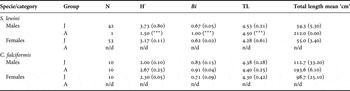
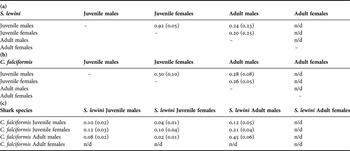
For S. lewini, diversity values (H′) were similar for juvenile males and females (H′ = 3.73 and 3.17, respectively), but higher in juvenile males than for their adult counterpart. Diet breadth values (Bi) were ≥0.6 for all S. lewini categories. All categories showed similar TL values (~4). Meanwhile for C. falciformis, diversity values (H′) for all categories were between 2.00 and 2.67. For all C. falciformis categories, diet breadth values (Bi) and TP values were >0.6 and ~4, respectively (Table 3). For S. lewini, the Morisita–Horn index (Cλ) indicated a high overlap between juveniles, but low overlap between adults vs. juveniles. For C. falciformis, the index indicated low overlap between all categories. Finally, the index indicated low overlap in all categories between shark species (Cλ < 0.5), but intermediate overlap (Cλ = 0.45) between C. falciformis adult males and S. lewini adult males (Table 4).
Diversity index values (H′), niche breadth values (Bi) and trophic level (TL) by sex, size class and season of Sphyrna lewini and Carcharhinus falciformis off the south-western coast of Mexico (n/d, no data; Juvenile, J; adult, A; *, one individual; N, number of organisms; standard deviation is given in parentheses).

Dietary overlap (Cλ) by sex and size class of Sphyrna lewini (a), Carcharhinus falciformis (b) and between shark species (c) off the south-western coast of Mexico (n/d, no data; standard deviation is given in parentheses).

DISCUSSION
The average sizes of S. lewini and C. falciformis recorded in this study correspond to juvenile males and females, based on previous studies indicating that both shark species reach maturity at 180 cm total length (Bejarano-Álvarez et al., Reference Bejarano-Álvarez, Galván-Magaña and Ochoa-Báez2011; Hoyos-Padilla et al., Reference Hoyos-Padilla, Ceballos-Vázquez and Galván-Magaña2012). Juveniles of both shark species have been reported in other regions of the Mexican Pacific; Torres-Rojas et al. (Reference Torres-Rojas, Páez-Osuna, Hernández-Herrera, Galván-Magaña, Aguiñiga-García, Villalobos-Ortiz and Sampson2013) highlight the presence of small juvenile S. lewini off the coast of Mazatlán, Sinaloa, while the small-scale fisheries on the west coast of Baja California Sur captures mostly large juvenile C. falciformis (Cabrera-Chávez-Costa et al., Reference Cabrera-Chávez-Costa, Galván-Magaña and Escobar-Sánchez2010). Both studies concluded the presence of feeding areas for juveniles, making them important for the management of the fisheries dedicated to both shark species.
In the present study, small and large juveniles dominate the catches; thus, the Puerto Madero coast may serve as an important feeding area, like the Gulf of California (Cabrera-Chávez-Costa et al., Reference Cabrera-Chávez-Costa, Galván-Magaña and Escobar-Sánchez2010; Torres-Rojas et al., Reference Torres-Rojas, Páez-Osuna, Hernández-Herrera, Galván-Magaña, Aguiñiga-García, Villalobos-Ortiz and Sampson2013). The dominance of juveniles in this study is likely related to the month during which sampling occurred. Alejo-Plata et al. (Reference Alejo-Plata, Gómez-Márquez, Ramos and Herrera2007) reported a high abundance of newborn and juvenile S. lewini and C. falciformis from June to September. Since all samples in this study were obtained in June and July, we expected to find a large number of juveniles in the Gulf of Tehuantepec, based on the pattern of size-class segregation reported elsewhere (Cabrera-Chávez-Costa et al., Reference Cabrera-Chávez-Costa, Galván-Magaña and Escobar-Sánchez2010; Alatorre-Ramírez et al., Reference Alatorre-Ramírez, Galván-Magaña and Torres-Rojas2013; Torres-Rojas et al., Reference Torres-Rojas, Páez-Osuna, Hernández-Herrera, Galván-Magaña, Aguiñiga-García, Villalobos-Ortiz and Sampson2013) where shark species use the coastal waters of south-west Mexico as nursery grounds (Ronquillo, Reference Ronquillo1999; Chong-Robles, Reference Chong-Robles2003; Hoyos-Padilla et al., Reference Hoyos-Padilla, Ceballos-Vázquez and Galván-Magaña2012). Newborn individuals and juveniles remain along the coastal to feed, while adults migrate to the north in the summer to feed and possibly to mate.
The large number of empty stomachs (specifically for C. falciformis) and of stomach fullness categories 1 and 2 (<50% full) may be related to the type of fishing gear used. In Puerto Madero, C. falciformis and S. lewini are captured using longlines and gillnets, respectively. Longlines cause high stress at the time of capture (Cortés, Reference Cortés1997; Alatorre-Ramirez et al., Reference Alatorre-Ramírez, Galván-Magaña and Torres-Rojas2013), often resulting in the regurgitation of stomach contents. This may partly explain the large number of empty stomachs. In contrast, S. lewini captured using gillnets die quickly, making it impossible for them to regurgitate their food (Torres-Rojas et al., Reference Torres-Rojas, Hernández-Herrera, Galván-Magaña and Alatorre-Ramírez2009), resulting in a greater proportion of stomachs with contents.
For both shark species, most fish were encountered in a state of intermediate or advanced digestion (digestion states 2 and 3), while cephalopods showed mostly a state of advanced digestion (digestion state 4). Both the stomach fullness and the degree of digestion of prey are related to the time of day in which the fish feed (Ovchivnnikov, Reference Ovchivnnikov1970). The states of prey digestion observed here suggest that both shark species feed constantly in the area. This behaviour has been observed among these species in other coastal regions of the Mexican Pacific (e.g. S. lewini, Torres-Rojas et al., Reference Torres-Rojas, Hernández-Herrera, Galván-Magaña and Alatorre-Ramírez2009; C. falciformis, Cabrera-Chávez-Costa et al., Reference Cabrera-Chávez-Costa, Galván-Magaña and Escobar-Sánchez2010) and in the equatorial, eastern and mid-eastern Pacific Ocean (Galván-Magaña et al., Reference Galván-Magaña, Polo-Silva, Hernández-Aguilar, Sandoval-Londoño, Ochoa-Díaz, Aguilar-Castro, Castañeda-Suárez, Cabrera-Chávez-Costa, Baigorrí-Santacruz, Torres-Rojas and Abitia-Cárdenas2013; Yunkai et al., Reference Yunkai, Gong, Chen, Dai and Zhu2014; Duffy et al., Reference Duffy, Olson, Lennert-Cody, Galván-Magaña, Bocanegra-Castillo and Kuhnert2015).
For S. lewini, fish were the most representative in terms of both abundance and richness, followed by crustaceans and cephalopods. South of the Gulf of California, Torres-Huerta (Reference Torres-Huerta2004) reports that this species’ diet is dominated by teleosts, but they also include some cephalopods and crustaceans. Moreover, Klimley et al. (Reference Klimley, Butler, Nelson and Stull1988) report that S. lewini feed on fish and consume cephalopods to a greater extent, which is supported by the present study. The prey consumed by S. lewini (16 species) were both epipelagic (e.g. C. orqueta) and demersal (e.g. Pomadasys panamensis), which are characterized by being distributed between 100 m depth (coastal habits), providing further evidence that S. lewini undertakes vertical migrations in the water column as reported elsewhere in the Pacific Ocean (Klimley, Reference Klimley1987; Klimley et al., Reference Klimley, Butler, Nelson and Stull1988; Bush, Reference Bush2002). In the Mexican Pacific, Torres-Rojas et al. (Reference Torres-Rojas, Hernández-Herrera, Galván-Magaña and Alatorre-Ramírez2009) mention that S. lewini feed primarily on Carangidae fish, followed by the cephalopod L. (Loliolopsis) diomedeae, a pattern that is similar to the results of the present study. We observed a similar order in the taxonomic groups and prey species in the trophic spectrum of S. lewini, confirming that this shark is a predator with coastal habits in the Mexican Pacific.
For C. falciformis, the prey consumed (11 species) were mostly epipelagic-oceanic (e.g. E. lineatus) and mesopelagic-oceanic (e.g. D. gigas). Carcharhinus falciformis have been observed feeding on oceanic prey, including members of the Scombridae family (Thunnus albacares), as well as oceanic cephalopods (D. gigas) on both of Mexico's coasts (Galván-Magaña et al., Reference Galván-Magaña, Nienhuis and Klimley1989; Marín, Reference Marín1992; Cabrera-Chávez-Costa et al., Reference Cabrera-Chávez-Costa, Galván-Magaña and Escobar-Sánchez2010). This is probably associated with the species’ active and aggressive swimming, which allows it to capture prey with high locomotion (Compagno, Reference Compagno, Fischer and Nauen1984). This largely coincides with the results of the present study, where C. falciformis has a preference for oceanic habitats, where it consumes cephalopods such as D. gigas but also migrates to the coastal zone where it consumes prey like Isopistus remifer and Diodon hystrix.
The Levin's index and the Shannon diversity index indicate that both shark species are generalist predators. Many researchers have classified S. lewini as a generalist predator because they consume a great number of prey species (Klimley, Reference Klimley1983; Bush, Reference Bush2003; Torres-Rojas et al., Reference Torres-Rojas, Hernández-Herrera, Galván-Magaña and Alatorre-Ramírez2009). However, Cabrera-Chávez-Costa et al. (Reference Cabrera-Chávez-Costa, Galván-Magaña and Escobar-Sánchez2010) suggests that C. falciformis is a specialist in the Gulf of Tehuantepec, due to their increased consumption of the pelagic crustacean Portunus xantusii affinis. The presence of crustaceans in the C. falciformis diet has also been reported elsewhere in Mexico (e.g. Pleuroncodes planipes) (Cabrera-Chávez-Costa et al., Reference Cabrera-Chávez-Costa, Galván-Magaña and Escobar-Sánchez2010), and may be related to high densities in those regions making crustaceans easier to catch. Therefore, the classification of C. falciformis as a specialist predator elsewhere is most likely due to the local abundance and availability of prey species (Duffy et al., Reference Duffy, Olson, Lennert-Cody, Galván-Magaña, Bocanegra-Castillo and Kuhnert2015) and suggests that C. falciformis indeed fulfil the role of generalist predators in the Gulf of Tehuantepec.
The presence of two generalist predators (S. lewini and C. falciformis) in the area means that the prey included in their diets will be a function of the prey availability in the area (Tytler & Calow, Reference Tytler and Calow1985; Alatorre-Ramirez et al., Reference Alatorre-Ramírez, Galván-Magaña and Torres-Rojas2013). However, although both predators are classified as generalists, their role in the ecosystem and the impact of their predation may differ. Giller (Reference Giller1984) mentions that each species’ niche is defined by a utilization function (distribution of species activity) along a resource gradient; thus, to evaluate their roles in the Gulf of Tehuantepec it is necessary to consider their trophic levels and the degree of trophic overlap.
No difference was found in the diet of S. lewini juveniles, suggesting that males and females of the same size feed on similar prey species in the same area. This pattern has been reported for the Gulf of California (Torres-Rojas et al., Reference Torres-Rojas, Hernández-Herrera and Galván-Magaña2006, Reference Torres-Rojas, Hernández-Herrera, Galván-Magaña and Alatorre-Ramírez2009, Reference Torres-Rojas, Páez-Osuna, Hernández-Herrera, Galván-Magaña, Aguiñiga-García, Villalobos-Ortiz and Sampson2013); however, we observed size-related differences in feeding strategies. Differences in the feeding behaviour of S. lewini of different sizes have been reported elsewhere, with juveniles feeding on small fish and crustaceans in benthic areas, while adults swim to pelagic areas to feed on larger prey like Scombrid fishes (Klimley, Reference Klimley1987; Galván-Magaña et al., Reference Galván-Magaña, Nienhuis and Klimley1989; Torres-Rojas et al., Reference Torres-Rojas, Páez-Osuna, Hernández-Herrera, Galván-Magaña, Aguiñiga-García, Villalobos-Ortiz and Sampson2013). This finding is in agreement with the present study, wherein most of the prey items consumed by juveniles were smaller species (e.g. Chloroscombrus orqueta, Lolliguncula (loliolopsis) diomedeae, Xiphopenaeus riveti), while adults consumed Scombrid fishes (e.g. Auxis rochei, Euthynnus lineatus).
Other authors have reported that diet varies with body size among sharks for several reasons: (a) larger sharks may feed on larger prey, (b) the efficiency of capturing larger prey species, and (c) segregation by size to avoid cannibalism (Lowe et al., Reference Lowe, Wetherbee, Crow and Tester1996; Bush, Reference Bush2002, Reference Bush2003). Klimley (Reference Klimley1983) reported gender segregation at night among adult S. lewini in the Gulf of California, likely associated with feeding behaviour and suggesting an ontogenic diet shift. A similar pattern may explain the variation in diet between juvenile and adult S. lewini.
For C. falciformis, differences in diet composition (low trophic overlap) were reported among all categories, suggesting ontogenic segregation. Cabrera-Chávez-Costa et al. (Reference Cabrera-Chávez-Costa, Galván-Magaña and Escobar-Sánchez2010) found differences in the main prey preferred by juveniles vs. adults, where juvenile sharks fed mainly on D. gigas and larger specimens consumed more Scomber japonicus. Segregation by gender and maturity stage is common in other Carcharinids (Klimley, Reference Klimley1983; Galván-Magaña et al., Reference Galván-Magaña, Nienhuis and Klimley1989; Lowe et al., Reference Lowe, Wetherbee, Crow and Tester1996; Torres-Rojas et al., Reference Torres-Rojas, Páez-Osuna, Hernández-Herrera, Galván-Magaña, Aguiñiga-García, Villalobos-Ortiz and Sampson2013), and is probably associated with reducing food competition.
Although Duffy et al. (Reference Duffy, Olson, Lennert-Cody, Galván-Magaña, Bocanegra-Castillo and Kuhnert2015) mention that the total length of C. falciformis was not an important variable for explaining diet trends, this may be because their C. falciformis sample did not span the entire range of the species’ total length, being limited to organisms 100–200 cm total length (Duffy et al., Reference Duffy, Olson, Lennert-Cody, Galván-Magaña, Bocanegra-Castillo and Kuhnert2015). In the present study, samples spanned a wider range (70–210 cm), permitting a more detailed assessment of ontogenetic changes. The niche variation hypothesis (Giller, Reference Giller1984) states that niche width tends to increase with intraspecific competition, either through an increase in the within-phenotype component of the niche (behavioural flexibility) or an increase in the between-phenotype component (differences between individuals). This is pertinent to the present study where the high niche width and low trophic overlap values observed for C. falciformis may reflect intraspecific competition where adult and juvenile males are found offshore but consume different main prey species (Euthynus lineatus for adult males, D. gigas for juvenile males) and juvenile females are found inshore where they feed on Diodon hystrix.
The results of our diet comparison between S. lewini and C. falciformis reflect low trophic overlap, likely as a result of spatial segregation. An increased separation of niches is predicted as species diversity increases, presumably with a related decrease in the size of the niches as a result of interspecific competition (Pianka, Reference Pianka1974; Giller, Reference Giller1984). Similar changes were detected in our study with high diversity values and low overlap, which could potentially result in a relatively constant level of interspecific inhibition.
A better understanding of the population dynamics of their prey would aid in determining the spatial distribution and feeding ecology of C. falciformis and S. lewini. Potier et al. (Reference Potier, Marsac, Cherel, Lucas, Sabatié, Maury and Ménard2007) found that the presence of epipelagic and mesopelagic prey species can be used to categorize predators as primarily shallow or deep feeders, respectively. In this study, we found that C. falciformis were predominantly epipelagic feeders preying on scombrid fishes (E. lineatus). Demersal prey, such as P. panamensis and C. orqueta, were more abundant in the S. lewini diet. Alejo-Plata et al. (Reference Alejo-Plata, Gómez-Márquez, Ramos and Herrera2007) report high catch rates of C. falciformis with pelagic fishing gear, while S. lewini are more commonly caught with demersal fishing gears. Thus, although both shark species were captured in the same feeding location, it is well known that C. falciformis benefit more from the pelagic food chain than S. lewini do (Torres-Rojas et al., Reference Torres-Rojas, Páez-Osuna, Hernández-Herrera, Galván-Magaña, Aguiñiga-García, Villalobos-Ortiz and Sampson2013; Yunkai et al., Reference Yunkai, Gong, Chen, Dai and Zhu2014; Duffy et al., Reference Duffy, Olson, Lennert-Cody, Galván-Magaña, Bocanegra-Castillo and Kuhnert2015; present study).
The trophic level values obtained in our study are in strong agreement with the values reported by Cortés (Reference Cortés1999) for C. falciformis (TL = 4.2) and S. lewini (TL = 4.1), making them tertiary carnivores. Moreover, this information coincides with previous studies carried out in other regions (Borrell et al., Reference Borrell, Cardona, Kumarran and Aguilar2011; Torres-Rojas et al., Reference Torres-Rojas, Páez-Osuna, Hernández-Herrera, Galván-Magaña, Aguiñiga-García, Villalobos-Ortiz and Sampson2013; Yunkai et al., Reference Yunkai, Gong, Chen, Dai and Zhu2014). Pauly (Reference Pauly1998) argues that considering their high trophic levels, shark yields from fisheries should be low and not sustainable at high exploitation levels, as has been seen for other fish with high trophic levels. Although top-down effects remain very poorly understood in the region, attempts to regulate fisheries in the Mexican Pacific should greatly aid the conservation of C. falciformis and S. lewini.
Several authors note that trophic levels may increase as fish grow (Cousins, Reference Cousins1980; Warren & Lawton, Reference Warren and Lawton1987; Cohen et al., Reference Cohen, Pimm, Yodzis and Saldana1993), this is because as fish size increases, the efficiency to capture prey also increases, as the senses are fully developed and they are able to capture larger and faster prey. However, this pattern was not evident in our study, probably related to the opportunistic feeding behaviour of sharks, which allows them to consume a variety of prey available in the ecosystem.
Although both shark species had similar TLs, it is critical to consider that these species are ecologically distinct in terms of habitat use patterns (Compagno, Reference Compagno, Fischer and Nauen1984; Bonfil-Sanders, Reference Bonfil-Sanders1994; Torres-Rojas et al., Reference Torres-Rojas, Páez-Osuna, Hernández-Herrera, Galván-Magaña, Aguiñiga-García, Villalobos-Ortiz and Sampson2013), probably related to character displacement (morphological or physiological characteristics) between these shark species. For example, subtle differences in size or morphological structures can lead to differences in the prey utilized, reducing competition (Giller, Reference Giller1984; Kiszka et al., Reference Kiszka, Charlot, Hussey, Heithaus, Simon-Bouhet, Humber, Caurant and Bustamante2014). Some studies have identified for other Carcharinids difference in habitat use depending on size (Galván-Magaña et al., Reference Galván-Magaña, Nienhuis and Klimley1989; Torres-Rojas et al., Reference Torres-Rojas, Páez-Osuna, Hernández-Herrera, Galván-Magaña, Aguiñiga-García, Villalobos-Ortiz and Sampson2013). This was also seen in the present study, as S. lewini is smaller and exhibits a morphological characteristic (hammerhead) that distinguishes it from C. falciformis, allowing it to feed on other prey species (demersal species) and occupy different habitats (benthic). Therefore, the trophic roles of S. lewini and C. falciformis can be considered different.
In conclusion, this study offers insight into the types of prey consumed by these shark species and the habitats where they are consumed, as well as the important role these species play in the area of Puerto Madero, Chiapas, Mexico. Based on the results of our diet comparison, we identified distinct trophic interactions and thus niche segregation between C. falciformis and S. lewini in the Gulf of Tehuantepec. Despite the similar trophic levels assigned to both shark species, their trophic roles are distinct because they consume different prey and use unique habitats. In light of the IUCN Red List identification of these species, this study provides the foundation for future research, including food web models designed to examine the long-term effects of the removal of trophically distinct species by small-scale fisheries and climate variation.
ACKNOWLEDGEMENTS
The authors thank the following organizations for academic support: Instituto de Ecología, Pesquerías y Oceanografía del Golfo de México (EPOMEX; Ecology, Fisheries, and Oceanography of the Gulf of Mexico Institute), Universidad Autónoma de Campeche (UAC; Autonomous University of Campeche), Centro de Biociencias (CenBio; Bioscience Center), Universidad Autónoma de Chiapas (UNACH; Autonomous University of Chiapas), Instituto Politécnico Nacional (IPN; National Polytechnic Institute). Thanks to Kristin Sullivan for editing the English version of this manuscript.
FINANCIAL SUPPORT
The authors thank the following organizations: Consejo Nacional de Ciencia y Tecnología (CONACYT; National Counsel of Science and Technology), Estímulos al Desempeño de los Investigadores (EDI; Performance Incentives) and Comisión de Operación y Fomento de Actividades Académicas del Instituto Politécnico Nacional (COFAA-IPN; Commission for the Advancement of Academic Activities of the National Polytechnic Institute).