Inadequate high-level disinfection or sterilization of bronchoscopes can result in contaminated bronchoalveolar lavage (BAL) fluids or transmission of opportunistic pathogens that cause colonization or infection of susceptible patients. Nontuberculous mycobacteria (NTM) are ubiquitous in the environment, prone to form biofilms, and resistant to most disinfectants including chlorine, which make them well suited to cause outbreaks.Reference Kovaleva, Peters, van der Mei and Degener 1 – Reference Collins 3 Bronchoscope-related NTM outbreaks have been attributed to contaminated automated endoscope reprocessors (AERs).Reference Wallace, Brown and Griffith 2
We identified an increase in positive Mycobacterium avium complex (MAC) BAL samples from an outpatient bronchoscopy suite in the fall of 2015. This report describes our investigation of what proved to be a pseudo-outbreak and the measures taken to mediate it.
Methods
The pseudo-outbreak took place at the Duke Clinic, an outpatient clinic operated by Duke University Hospital, a 957-bed tertiary-care hospital in Durham, North Carolina. Duke is a high-volume lung transplant center, and frequent routine post-transplant surveillance bronchoscopies are performed in this clinic. Prior to the outbreak, in October 2014, 2 endoscopy procedural areas were consolidated into a single area. Following the clinic merge, the monthly average volume of bronchoscopies performed in this single clinic increased from 105 to 143. The reprocessing area of the clinic houses 3 AERs; the water source and number of AERs were constant during the study.
Our epidemiologic investigation included (1) review of mycobacterial culture data, (2) inspection of the bronchoscopy clinical and reprocessing areas, and (3) environmental sampling in the bronchoscope reprocessing area. We determined the percentage of positive MAC BAL isolates from the outpatient bronchoscopy clinic from January 2014 through June 2017 and defined the baseline (January 1, 2014, through June 30, 2015), outbreak (July 1, 2015, through February 28, 2016), and postoutbreak (March 1, 2016, through June 30, 2017) periods. The prevalences of MAC-positive cultures were compared between periods using 2-sample t tests.
Infection preventionists reviewed reprocessing, endoscope handling and storage, and general cleanliness of the bronchoscopy reprocessing area and clinic environment. As part of the investigation, cultures of biofilm were obtained at the time of routine (quarterly) filter change from tubing distal to the 1-µm, 0.4-µm, and 0.1-µm filters serving one of the AERs. These swab samples were decontaminated with cetylpyridine chloride,Reference Falkinham 4 and streaked onto Mitchison and Middlebrook 7H11 agar plates. 5 MAC isolates were identified using standard methods, including a commercial molecular probe (AccuProbe, Hologic, Marlborough, MA).
As part of the investigation, a subset of 8 clinical MAC isolates suspected to be related to the pseudo-outbreak, 2 clinical MAC isolates from a different clinical area not suspected to be related to the pseudo-outbreak, and 2 MAC isolates recovered from the AER tubing were submitted for species identification using partial 16S r-RNA gene sequencing and molecular relatedness testing using variable-number tandem repeats (VNTR) typingReference Iakhiaeva, Howard and Elliott 6 and pulsed-field gel electrophoresis (PFGE).Reference Wallace, Zhang and Brown-Elliott 7 Subsequently, VNTR was performed on a convenience sample of archived MAC isolates from BAL specimens obtained in the clinic during the baseline (n = 6), outbreak (n = 4), and postoutbreak (n = 4) periods.
Medical records of patients with positive MAC BAL specimens from the outpatient bronchoscopy clinic during the study period were reviewed to determine whether MAC treatment was prescribed. The study was performed as part of standard hospital operating procedures and was exempted from review by the Institutional Review Boards of Duke University and the University of Texas Health Science Center at Tyler.
Results
In total 112 of 2,238 bronchoscopy procedures (5%) during the baseline period yielded positive MAC BAL cultures compared to 173 of 1133 (15%) bronchoscopies during the outbreak period (P<.0001). In addition, 34 (40%) unique patients with MAC-positive BAL specimens were started on therapy in the baseline period compared to 23 (13%) in the outbreak period (P<.0001). Follow-up of patients for at least 6 months identified no definite development of symptomatic MAC infection following the bronchoscopy procedure among patients with positive BAL cultures during the pseudo-outbreak period.
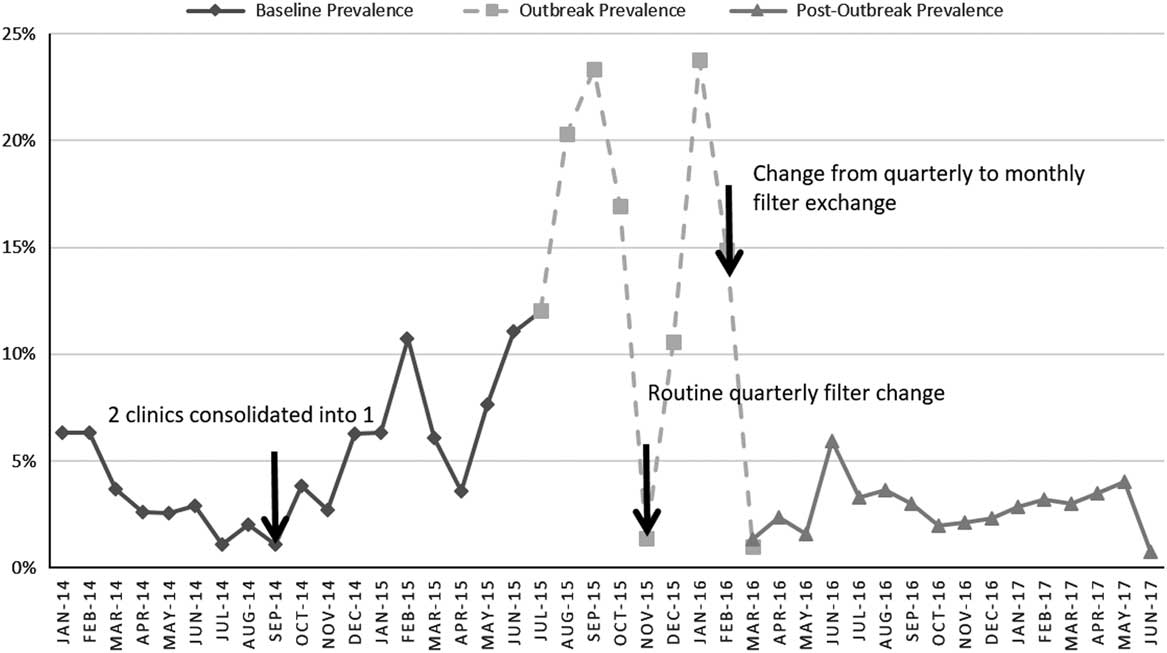
Multiple bronchoscopes and all 3 AERs were associated with MAC-positive BAL cultures. No major deficiencies in reprocessing, storage, or handling of bronchoscopes were identified. However, we determined that the prevalence of MAC BAL cultures declined abruptly following the routine change of the series of AER rinse water filters and then gradually increased over the next 2 months (Fig. 1). On February 15, 2016, the AER filter exchange frequency was increased to monthly from the AER manufacturer’s recommended quarterly exchange schedule. Following this change, the monthly prevalence of positive MAC BAL cultures decreased to below baseline (3%) (Fig. 1).
Monthly prevalence of MAC cultures in the bronchoscopy suite, January 2014 through June 2017.

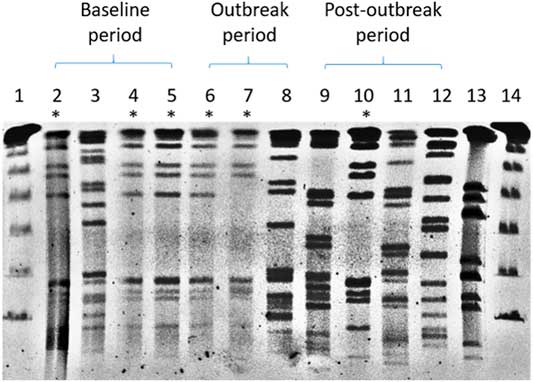
All 8 isolates from the bronchoscopy clinic and the 2 environmental isolates collected in January 2016 belonged to the same VNTR type no. 51 and were indistinguishable by PFGE, whereas the 2 BAL isolates that were obtained at a different clinical location belonged to a different VNTR type. In the subsequent retrospective analysis of a convenience sample of stored MAC BAL isolates from clinic patients, 5 of 6 (83%) from the baseline period, 3 of 4 (75%) from the outbreak period, and 1 of 4 (25%) from the postoutbreak period belonged to the VNTR type #51. The VNTR type no. 51 isolates were indistinguishable or were closely related by PFGE (Fig. 2).
Pulsed-field gel electrophoresis (PFGE) of AseI restriction enzyme digests of bronchoalveolar lavage (BAL) isolates of Mycobacterium avium from lung transplant patients collected between January 2015 and May 2017. Legend: *denotes VNTR type no. 51. The PFGE pattern for the isolates in lanes 2, 4, 5 (preoutbreak period), 6 (outbreak period), and 10 (postoutbreak period) are indistinguishable; lane 7 (outbreak period) is closely related to the dominant pattern.

Discussion
We report a pseudo-outbreak of clonally related M. avium isolates that terminated when the AER rinse water-filter change frequency was increased from quarterly to monthly. Prior pseudo-outbreaks from failure of AER water filters have been reported. One study described a pseudo-outbreak of Burkholderia cepacia from improper installation of an AER filter.Reference Rosengarten, Block and Hidalgo-Grass 8 Another study reported a pseudo-outbreak of M. chelonae due to contaminated incoming water, water filters, and the AER.Reference Chroneou, Zimmerman and Cook 9 We hypothesize that increased procedure volume at our clinic led to increased flow volume through the filters, which resulted in their early failure. We believe this filter failure resulted in contamination of the water used to rinse bronchoscopes during reprocessing and resultant contamination of the bronchoscopes themselves.
Bronchoscopy clinics, particularly those with high volume and/or that serve immunocompromised patients, should prospectively review BAL cultures to identify unexpected pathogen trends. Our pseudo-outbreak may have been recognized and terminated sooner had routine surveillance of culture results from the bronchoscopy clinic been performed. The molecular data suggests that the pseudo-outbreak likely began earlier than it was clinically recognized.
Endoscope-related pseudo-outbreaks, including those caused by NTM, continue to occur despite standardized procedures for high-level disinfection of endoscopes. Mycobacterium avium and other NTM species, including M. chimaera and M. abscessus, are known to colonize household and municipal water.Reference Wallace, Iakhiaeva and Williams 10 Based on our findings, we recommend that routine maintenance schedules for AERs and endoscopes be adjusted based on usage and local water quality rather than a fixed time schedule. Additionally, new technologies, such as disposable endoscopes or endoscopes that can be sterilized, are needed to improve the safety of these devices.
Our study had some limitations. First, differentiating MAC clinical infection from colonization is challenging, particularly in lung transplant patients. Therefore, we were not able to calculate incidence rate of MAC infection in the baseline and outbreak periods. However, the significantly lower proportion of patients who received treatment for MAC disease supports the hypothesis that this was a pseudo-outbreak rather than true outbreak. Second, the filter change frequency from quarterly to monthly was instituted for all 3 filter sizes. We did not experiment with varying the timing of only the terminal filter change, nor did we confirm the exact time at which the filters failed. Finally, molecular sequencing was performed on only a convenient sample of isolates from each study period; therefore, we did not determine the true prevalence of the pseudo-epidemic clone in BALs performed throughout the study period. The molecular data show a decrease in recovery of the M. avium pseudo-epidemic clone after the adoption of monthly filter changes. We are unable to determine whether the ongoing recovery of the pseudo-epidemic clone VNTR no. 51 represents ongoing low-level contamination of rinse water or simply indicates that VNTR no. 51 is present in the local municipal water supply and causes colonization or infection in patients when patients are exposed to municipal water via other routes.
In conclusion, we describe a pseudo-outbreak of a single clone of M. avium related to failure of the AER rinse water filtration system. Healthcare facilities performing high-volume endoscopy procedures should be aware that AER filters may require replacement based on frequency of use or water quality rather than manufacturers’ recommendations based on time in use.
Acknowledgments
None.
Financial support
No financial support was provided relevant to this article.
Conflicts of interest
All authors report no conflicts of interest relevant to this article.