Implications
Dietary lipid composition is an important determinant of poultry meat quality. Previous studies focused mainly on the fatty acid profile of meat rather than the mechanisms through which dietary manipulations change lipid deposition. This study shows that the increased intramuscular fat content in breast muscle of broilers fed Clostridium butyricum as described in Yang et al. (Reference Yang, Zhang, Guo, Jiao and Long2010) may be associated with enhanced fatty acid uptake.
Introduction
Consumers are becoming increasingly aware of the nutritional quality and health benefits of the foods they consume. The poultry industry has made significant efforts to decrease the total amount of abdominal fat deposited in broiler chickens through genetics, management and nutrition. Studies in poultry nutrition have shown that the fatty acid profile of poultry meat can be modulated by dietary outcome (Hulan et al., Reference Hulan, Ackman, Ratnayake and Proudfoot1989; Fébel et al., Reference Fébel, Mézes, Pálfy, Hermán, Gundel, Lugasi, Balogh, Kocsis and Blázovics2008; Ponte et al., Reference Ponte, Prates, Crespo, Crespo, Mourão, Alves, Bessa, Chaveiro-Soares, Gama, Ferreira and Fontes2008). Previous studies focused mainly on the fatty acid profile of meat (dietary outcome) rather than the mechanisms through which dietary manipulations change lipid deposition. Clostridium butyricum is a typical butyric acid-producing, spore-forming, gram-positive anaerobe, which is found in soil and in the intestines of healthy humans and animals. This C. butyricum is a probiotic bacteria used clinically to prevent disturbances of gastrointestinal microbiota, to treat diarrhea, to enhance humoral immune response and to promote digestion in humans (Ito et al., Reference Ito, Hayashi, Iguchi, Endo, Nakao, Kato, Nabeshima and Ogura1997; Seki et al., Reference Seki, Shiohara, Matsumura, Miyagawa, Tanaka, Komiyama and Kurata2003; Isono et al., Reference Isono, Katsuno, Sato, Nakagawa, Kato, Sato, Seo, Suzuki and Saito2007). Our previous experiments demonstrated that fish oil diets reduced abdominal fat in broiler chickens, whereas C. butyricum supplementation increased intramuscular fat content in breast muscle (Yang et al., Reference Yang, Zhang, Guo, Jiao and Long2010). However, the mechanisms for these effects remain unclear.
Liver is the main site of de novo fatty acid synthesis in avian species (O'Hea and Leveille, Reference O'Hea and Leveille1968). Hepatic lipogenesis and the export of lipid are crucial steps related to lipid metabolism in broilers (Hillgartner et al., Reference Hillgartner, Salati and Goodridge1995; Kersten, Reference Kersten2001). It has been reported that some lipogenic genes, such as fatty acid synthase (FAS), sterol regulatory element binding protein-1c (SREBP-1c) and peroxisome proliferator-activated receptors (PPARs), participated in the hepatic response to nutritional intervention (Daval et al., Reference Daval, Lagarrigue and Douaire2000). The development of adipose tissue depends on the availability of serum triglycerides (TG) that are hydrolyzed before their utilization by adipocytes. TG, total cholesterol (TC) and low-density lipoprotein cholesterol (LDL-C) are principal substrates in lipid metabolism.
There have been numerous reports on how fish oil affects fatty acid metabolism in mammals (Ribeiro et al., Reference Ribeiro, Mangeney, Cardot, Loriette, Rayssiguier, Chambaz and Bereziat1991; Kim et al., Reference Kim, Takahashi and Ezaki1999; Yu et al., Reference Yu, Wang, Cheng, Mersmann, Wu and Ding2010), but few have focused on birds. Moreover, the effects of dietary C. butyricum on the expression of genes linked to fatty acid metabolism have not been examined in chickens. This study was conducted to investigate the effects of fish oil and C. butyricum supplementation on the profile of circulating lipids and the transcription of selected genes involved in fat metabolism in adipose tissue, liver and breast muscle of broiler chickens. We monitored the relative mRNA levels of SREBP-1c, FAS, PPARs, lipoprotein lipase (LPL) and fatty acid binding protein (FABP) in selected tissues as well as the levels of TG, TC, LDL-C and high-density lipoprotein cholesterol (HDL-C) in serum.
Material and methods
Birds, livestock management and diets
A total of 160 day-old male chicks (Arbor Acres) with body weights (BWs) 42.4 ± 2.1 g were purchased from a commercial hatchery (Huadu Broiler Company, Beijing, China). Chicks were randomly divided into four treatment groups consisting of five replicates (cages) with eight birds per replicate. Each replicates were housed in wire mesh cages (90 cm × 70 cm × 45 cm) with individual feed-troughs and a common water-trough. All chickens had free access to water and feed. The temperature inside the poultry house was maintained at 35°C during the first 3 days, between 28°C and 30°C during the subsequent 2 weeks, and at 25°C during the last 3 weeks of the study. Throughout the experimental period, 24-hour constant light was provided. Experimental protocols were approved by the China Agricultural University Animal Care and Use Committee. The experimental period lasted 42 days. The four groups of birds were fed diets containing (a) soybean oil (Beijing Red Star Starch Co., Beijing, China) without C. butyricum supplementation (SO), (b) soybean oil with C. butyricum supplementation (SO + CB), (c) fish oil (menhaden fish oil, Fujian Gaolong Co., Fujian, China) without C. butyricum supplementation (FO) or (d) fish oil with C. butyricum supplementation (FO + CB). The amount of lipid added to the diet was 25 g/kg for 0 to 21 days and 300 g/kg for 22 to 42 days. The composition and analysis of fatty acid contents were as described by Yang et al. (Reference Yang, Zhang, Guo, Jiao and Long2010). The raw powder of the non-toxic bacterial strain C. butyricum was provided by Qingdao East Sea Pharmaceutical Co. Ltd, China. The product (bacterial spores) contained viable bacteria at 1.6 × 10¹⁰ cfu/g. The dried C. butyricum powder was diluted with glucose to a concentration of 2 × 10⁸ cfu/g before being mixed into broiler diets at 5 g/kg of diet. Diets SO + CB and FO + CB contained finally 1 × 10⁹ cfu of viable C. butyricum per kg.
Animal sacrifice and tissue sampling
At day 42, one chicken from each pen replicate was randomly selected and sacrificed by exsanguination under deep sodium pentobarbitone anesthesia (30 mg/kg BW, i.p.). Blood samples (one bird per pen) were collected from the wing vein and centrifuged (3000 × g for 15 min at 4°C) to separate sera. Serum samples were frozen at −30°C for further analysis. The abdominal fat, breast muscle and liver samples were removed and immediately frozen in liquid nitrogen and stored in a freezer at −80°C for future mRNA determination or enzyme activity analysis. Jejunal samples were cut longitudinally to expose mucosa and washed three times in ice-cold phosphate-buffered saline to remove the mucus and digesta. The jejunal mucosa was scraped gently, quickly frozen in liquid nitrogen and stored at −80°C until mRNA determination.
Biochemical assays
The serum concentrations of TC, TG, HDL-C and LDL-C were measured by colorimetric enzymatic methods using commercial kits purchased from Nanjing Jiancheng Bioengineering Institute (Nanjing, China).
LPL activity in abdominal fat and muscle tissue was determined by colorimetric enzymatic methods using a commercial diagnostic kit (Jiancheng Bioengineering Institute, Nanjing, China). One unit of enzyme activity was defined as 1 μmol of nonesterified fatty acid released from 1 mg of tissue protein per hour. FAS activity was determined as described by Moibi et al. (Reference Moibi, Ekpe and Christopherson2000). Frozen liver tissue samples were pulverized in liquid nitrogen and homogenized (30 s at 4°C) in three volumes of phosphate bicarbonate buffer (70 mM KHCO3, 85 mM K2HPO4, 1 mM DTT, pH 8). The homogenate was centrifuged at 10 000 × g for 10 min and the supernatant was centrifuged at 105 000 × g for 60 min at 4°C to obtain liver tissue cytosol. The protein content was assayed by the Bradford method (Bradford, Reference Bradford1976). The supernatant fraction was brought to saturation with ammonium sulfate solution (containing 3 mM EDTA and 1 mM β-mercaptoethanol) and stirred for 60 min on ice. The precipitate was collected by centrifugation at 10 500 × g for 60 min at 4°C. FAS activity was determined in duplicates by measuring the malonyl-CoA- and acetyl-CoA-dependent oxidation of NADPH using a UV-visible automated spectrophotometer equipped with a temperature controller set at 30°C. For each assay, reference (blank) and sample cuvettes were measured simultaneously and the decrease in absorbance at 340 nm was recorded over time. The change in concentration of NADPH during oxidation was calculated as described by Moibi et al. (Reference Moibi, Ekpe and Christopherson2000). FAS activity was expressed as nanomoles NADPH oxidized per minute per milligram of protein.
Real-time quantitative PCR analysis of gene expression
Total RNA of the abdominal fat, breast muscle, liver samples or jejunal mucosa was extracted using TRIzol reagent (Invitrogen Company, Carlsbad, CA, USA) according to the manufacturer's instructions. The yield and quality of the RNA were determined spectrophotometrically using A260 and A280 measurements and by electrophoresis on 1.5% agarose gels. Reverse transcription reactions (25 μl) consisted of 2 μg of total RNA, 100 U of Moloney-murine leukemia virus reverse transcriptase, 10 mmol of dNTP, 20 U of RNAsin ribonuclease inhibitor and 1 μg of random primers (all agents from MBI Fermentas, Canada) in distilled water and buffer supplied by the manufacturer. After incubation for 60 min at 42°C, the reverse transcriptase was inactivated at 70°C for 5 min.
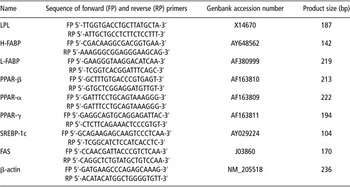
The cDNAs were amplified by real-time PCR using the Applied Biosystem ABI-PRISM 7700 sequence detection system (Applied Biosystems, Foster City, CA, USA). Each PCR reaction contained 2 μl of cDNA mixed with 1 μmol of each primer, 10 μl of SYBR Green PCR master Mix (ABI Company, Foster City, CA, USA) and 6 μl of sterile super-distilled water in a final volume of 20 μl. The thermocycle protocol consisted of 2 min at 55°C and 10 min at 94°C, followed by 40 cycles of 15 s denaturation at 95°C and 60 s annealing/extension at 60°C. The gene-specific primers for LPL, heart-type-FABP (H-FABP), liver-type-FABP (L-FABP), PPAR-β, PPAR-α, PPAR-γ, SREBP-1c, FAS and β-actin are listed in Table 1. The relative standard curve method was used to estimate mRNA abundance. Standard curves were derived from serial dilutions of untreated samples. β-actin was used as the internal reference gene and the mRNA expression of target genes was normalized to β-actin mRNA expression. All the samples were analyzed in triplicates and the mean values of these triplicate measurements were used for calculations of mRNA expression.
Primers used for the quantification of the mRNA expression by real-time PCR

LPL = lipoprotein lipase; H-FABP = heart-fatty acid binding protein; L-FABP = liver fatty acid binding protein; PPAR-β = peroxisome proliferator-activated receptors-β; PPAR-α = peroxisome proliferator-activated receptors-α; PPAR-γ = peroxisome proliferator-activated receptors-γ; SREBP-1c = sterol regulatory element binding protein-1c; FAS = fatty acid synthase.
Statistical analysis
All analyses were performed with SPSS 16.0 software. The data were analyzed by two-way analysis of variance with lipids and C. butyricum as the fixed factors. Differences were considered significant at P < 0.05, although probability values up to P < 0.10 are shown in the text if the data suggest a trend.
Results
Serum parameters
The effects of dietary lipids and C. butyricum supplements on the serum concentrations of TC, TG, HDL-C and LDL-C are listed in Table 2. The type of dietary lipid had a clear effect on serum concentrations of TC and LDL-C in broiler chickens. Serum concentrations of TC and LDL-C were lower for broilers fed diets containing fish oil than those fed diets containing soybean oil (P < 0.05). The addition of C. butyricum tended to reduce serum concentrations of TG (P = 0.056) and TC (P = 0.088). There was no significant interaction effects on serum concentrations of TC, TG, HDL-C and LDL-C (P > 0.05) between dietary lipid and C. butyricum.
Effects of dietary lipids and Clostridium butyricum on concentrations of TC, TG, HDL-C and LDL-C in serum of broiler chickensFootnote 1

1 n = 5 per treatment group.
TC = total cholesterol; TG = triglycerides; HDL-C = high-density lipoprotein cholesterol; LDL-C = low-density lipoprotein cholesterol; SO = dietary soybean oil without C. butyricum supplementation; SO + CB = dietary soybean oil with C. butyricum supplementation (1 × 10⁹ cfu/kg); FO = dietary fish oil without C. butyricum supplementation; FO + CB = dietary fish oil with C. butyricum supplementation (1 × 10⁹ cfu/kg); CB = C. butyricum; lipid × CB = interaction between lipids and C. butyricum treatment.
* P < 0.05; **P < 0.01; NS at P > 0.05.
Hepatic FAS activity and LPL activity
The effects of dietary lipids and C. butyricum addition on hepatic FAS activity and LPL activity in abdominal fat and breast muscle of broiler chickens are presented in Table 3. The dietary lipid type had a clear effect on hepatic FAS activity and LPL activity in abdominal fat and breast muscle. Fish oil reduced hepatic FAS activity and LPL activity in abdominal fat (P < 0.05), but increased LPL activity in breast muscle (P < 0.05). The addition of C. butyricum significantly increased LPL activity only in abdominal fat (P < 0.05). There was no significant interaction effect on these parameters (P > 0.05).
Effects of dietary lipids and Clostridium butyricum on liver FAS activity and LPL activity in abdominal fat and breast muscle of broiler chickensFootnote 1

1 n = 5 per treatment group.
FAS = fatty acid synthase; LPL = lipoprotein lipase; SO = dietary soybean oil without C. butyricum supplementation; SO + CB = dietary soybean oil with C. butyricum supplementation (1 × 10⁹ cfu/kg); FO = dietary fish oil without C. butyricum supplementation; FO + CB = dietary fish oil with C. butyricum supplementation (1 × 10⁹ cfu/kg); CB = C. butyricum; lipid × CB = interaction between lipids and C. butyricum treatment.
* P < 0.05; **P < 0.01; NS at P > 0.05.
Lipid metabolic gene expression
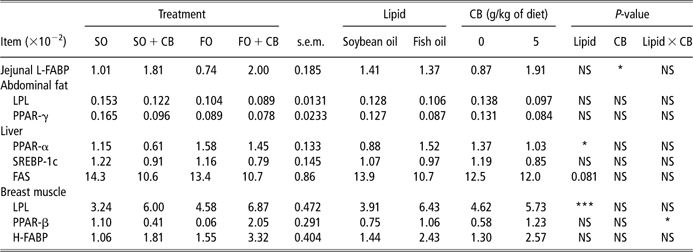
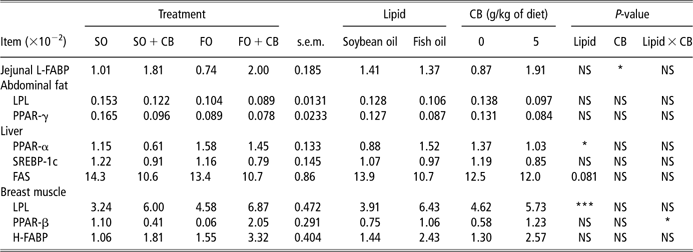
The effects of dietary lipids and C. butyricum addition on lipid metabolic gene expression in abdominal fat, breast muscle, liver and jejunal mucosa are shown in Table 4. The lipid type had a clear effect on hepatic PPAR-α and LPL gene expression in breast muscle tissue. Hepatic PPAR-α and LPL gene expression were higher in broilers fed diets containing fish oil than in those fed diets containing soybean oil (P < 0.05). Fish oil tended to reduce hepatic FAS gene expression (P = 0.081). The addition of C. butyricum significantly increased L-FABP gene expression only in jejunal mucosa (P < 0.05). There was a significant interaction effect on PPAR-β gene expression in breast muscle tissue. The mRNA levels of PPAR-β in breast muscle tissue were highest for broilers fed diets containing fish oil supplemented with 5 g of C. butyricum per kg diet (P < 0.05). Dietary lipids and C. butyricum did not significantly influence the expression of the other genes examined (Table 4).
Effects of dietary lipids and Clostridium butyricum on mRNA abundance of lipogenic genes in tissues of broiler chickensFootnote 1
1 n = 5 per treatment group.
SO = dietary soybean oil without C. butyricum supplementation; SO + CB = dietary soybean oil with C. butyricum supplementation (1 × 10⁹ cfu/kg); FO = dietary fish oil without C. butyricum supplementation; FO + CB = dietary fish oil with C. butyricum supplementation (1 × 10⁹ cfu/kg); CB = C. butyricum; Lipid × CB = interaction between lipids and C. butyricum treatment; L-FABP = liver-type fatty acid-binding protein; LPL = lipoprotein lipase; PPAR-γ = peroxisome proliferator-activated receptor-γ; PPAR-α = peroxisome proliferator-activated receptor-α; SREBP-1c = sterol regulatory element binding protein-1c; FAS = fatty acid synthase; H-FABP = heart-fatty acid binding protein.
* P < 0.05; **P < 0.01; NS at P > 0.05.
Discussion
Concentrations of serum lipids and lipoproteins are indicative of the metabolic regulations in a steady state and, especially, of the basal adjustment of fatty acid circulation between the adipose tissue and the liver (Mossab et al., Reference Mossab, Lessire, Guillaumin, Kouba, Mourot, Peiniau and Hermier2002). C. butyricum tended to reduce serum concentrations of TG and TC in the present study. Limited research focusing on the effect of probiotics on lipid metabolism of chicks indicated that the serum level of cholesterol was significantly decreased by adding a mixture of Bacillus, Lactobacillus, Streptococcus, Clostridium, Saccharomyces and Candida into the diet (Endo et al., Reference Endo, Nakano, Shimizu, Fukushima and Miyoshi1999). Previous studies reported that a fish oil diet significantly decreased serum levels of cholesterol and TG (An et al., Reference An, Banno, Xia, Tanaka and Ohtani1997; Castillo et al., Reference Castillo, Amalik, Linares and Garcia-Peregrin2000), while fish oil reduced serum TC levels, but not cholesterol, in our study. This discrepancy may be attributed to the difference in control diet. In our study, the control treatment was a soybean oil-based diet rather than the high-saturated-fat (palm oil) diet used in previous studies.
Fatty acid-binding protein plays a key role in transporting long-chain fatty acids (LCFA) in gut. There are two main FABPs in the small intestine, the intestinal type (I-FABP) and the liver-type (L-FABP). Previous reports indicated that I-FABP was not essential for fatty acid absorption (Vassileva et al., Reference Vassileva, Huwyler, Poirier, Agellon and Toth2000) and that L-FABP exhibited a higher affinity for unsaturated LCFA than I-FABP (Richieri et al., Reference Richieri, Ogata and Kleinfeld1994). In addition, L-FABP had the ability to increase fatty acid uptake (Prows et al., Reference Prows, Murphy and Schroeder1995), so we examined the changes in L-FABP mRNA expression in jejunum under changing dietary conditions. Indeed, this study represents the first examination of the effect of C. butyricum on fatty acid metabolism-linked gene expression in broiler chickens. The results indicated that C. butyricum increased L-FABP mRNA expression in jejunum. H-FABP has been shown to facilitate LCFA uptake and utilization in skeletal muscles (Corcoran et al., Reference Corcoran, Lamon-Fava and Fielding2007). In the present study, the transcription levels of H-FABP were not significantly affected by C. butyricum and dietary lipid type, indicating no effect on fatty acid transport into muscle cells.
In chickens, de novo lipogenesis occurs primarily in the liver, and most of the body's endogenous lipids are of hepatic origin (O'Hea and Leveille, Reference O'Hea and Leveille1968). FAS is a key enzyme involved in the de novo synthesis of LCFA (Back et al., Reference Back, Goldman and Fisch1986), so we examined FAS activity and FAS mRNA levels in liver. Although no significant difference in FAS expression was observed between dietary lipid groups, broilers fed fish oil diets showed a trend toward down-regulated FAS gene expression, further indicating that fish oil reduced hepatic synthesis of fatty acids. Previous study also demonstrated reduced lipogenesis with dietary fish oil (Wong et al., Reference Wong, Nestel and Trimble1984). Studies found that fish oil inhibited lipid synthesis by decreasing the expression of FAS genes in the liver of mice (Ren et al., Reference Ren, Thelen, Peters, Gonzalez and Jump1997; Kim et al., Reference Kim, Sarraf, Wright, Yao, Mueller, Solanes, Lowell and Spiegelman1998). The present results are consistent with these findings. C. butyricum did not influence FAS activity or FAS mRNA levels in liver, indicating no effect on liver fatty acid synthesis.
The SREBP-1c transcription factor acts as a key regulator of fatty acid synthesis by regulating multiple enzymes required for fatty acid biosynthesis (Brown and Goldstein, Reference Brown and Goldstein1997). The mRNA level of SREBP-1c was not significantly influenced by lipid type or C. butyricum addition. This contradicts previous studies demonstrating that polyunsaturated fatty acids (PUFA) inhibited lipogenic gene transcription by suppressing SREBP-1c expression (Kim et al., Reference Kim, Takahashi and Ezaki1999; Xu et al., Reference Xu, Nakamura, Cho and Clarke1999). Xu et al. (Reference Xu, Nakamura, Cho and Clarke1999) also indicated that the SREBP-1 mRNA content of cells was reduced by 20:4n-6 fatty acids in a dose-dependent manner, whereas 18:1n-9 had no effect. However, the exact amount of 20:4n-6 fatty acids was not determined by Yang et al. (Reference Yang, Zhang, Guo, Jiao and Long2010). The content of 20:4n-6 fatty acids was only about 1.6 g/kg of the total fatty acid in fish oil (He et al., Reference He, Yang and Guo2007). In our study, fish oil constituted 25 g/kg of the total diet, implying 20:4n-6 fatty acid levels of about 0.004 g/kg in the present diet. This small dose (about 0.004 g/kg) of 20:4n-6 fatty acids may be a cause for the lack of effect on SREBP-1c expression.
PPAR-α, PPAR-γ and PPAR-β belong to a family of nuclear hormone receptors that regulate the expression of genes involved in glucose and lipid metabolism. The PPAR-α isoform was highly expressed in liver, but not in chicken skeletal muscle (Meng et al., Reference Meng, Li, Zhao and Gu2005), whereas PPAR-γ was mainly localized to adipose tissue and immune cells and PPAR-β was ubiquitously expressed in all tissues. Activation of PPAR-α increases lipid oxidation, thus reducing tissue fatty acid contents (Corcoran et al., Reference Corcoran, Lamon-Fava and Fielding2007). It is known that fish oil can induce fatty acid oxidation by increasing the expression of PPAR-α (Nakatani et al., Reference Nakatani, Tsuboyama-Kasaoka, Takahashi, Miura and Ezaki2002). In the present study, the mRNA level of PPAR-α was significantly increased by the fish oil diet, thus possibly enhancing fatty acid oxidation in liver. The PPAR-β isoform increased fatty acid oxidation in skeletal muscle (Krämer et al., Reference Krämer, Al-Khalili, Guigas, Leng, Garcia-Roves and Krook2007). PUFAs are potential ligands for PPAR-β activation, and a recent study indicated that porcine PPAR-β mediated the lipolytic effects of dietary fish oil, resulting in reduced body fat deposition (Yu et al., Reference Yu, Wang, Cheng, Mersmann, Wu and Ding2010). However, fish oil did not influence expression of PPAR-β in breast muscle or PPAR-γ expression in abdominal fat of broiler chickens. The mRNA levels of PPAR-α in liver, PPAR-γ in abdominal fat and PPAR-β in breast muscle were also not affected by C. butyricum, again indicating that C. butyricum had little if any effect on fatty acid oxidation.
LPL is responsible for the hydrolysis of plasma lipoproteins, a rate-limiting step in lipid transport into peripheral tissues (Goldberg, Reference Goldberg1996). Overexpression of muscle LPL has been associated with increasing intramuscular triacylglycerol accumulation and fat deposition in mammals (Voshol et al., Reference Voshol, Jong, Dahlmans, Kratky, Levak-Frank, Zechner, Romijn and Havekes2001). Although no significant difference in LPL expression in breast muscle was found in broilers fed the diet supplemented with C. butyricum, a trend toward upregulated LPL gene expression was found, and LPL activity in muscle tissue was significantly increased by C. butyricum addition. This response may be the causation for the increased intramuscular fat in breast muscle of chicken feed supplementary C. butyricum in a previous report (Yang et al., Reference Yang, Zhang, Guo, Jiao and Long2010). LPL activity and mRNA expression in breast muscle were significantly increased by fish oil in the present work, but fish oil did not significantly influence the intramuscular fat in breast muscle as our previous study demonstrated (Yang et al., Reference Yang, Zhang, Guo, Jiao and Long2010). This may have been the result of the reduced synthesis of fatty acids in liver under the fish oil diet. Adipose expression of genes involved in adipogenesis (i.e. LPL) was decreased in transgenic mice fed fish oil (Yu et al., Reference Yu, Wang, Cheng, Mersmann, Wu and Ding2010). Fish oil reduced the activity of LPL, but did not influence the expression of LPL in abdominal fat in the present study.
Lipid accumulation is the net result of the balance between dietary absorbed fat, endogenous fat synthesis and fat catabolism via β-oxidation (Sanz et al., Reference Sanz, Lopez-Bote, Menoyo and Bautista2000). According to the present results, the reduced abdominal fat in broiler chicks fed the fish oil diet as described by Yang et al. (Reference Yang, Zhang, Guo, Jiao and Long2010) may be ascribed to augmented hepatic fat catabolism and lowered hepatic endogenous fat synthesis. In contrast, the increased intramuscular fat content in breast muscle evoked by C. butyricum supplementation as observed by Yang et al. (Reference Yang, Zhang, Guo, Jiao and Long2010) may be associated with enhanced fatty acid uptake.
In conclusion, fish oil reduced endogenous fat synthesis in liver by down-regulating FAS expression and activity, as well as by inducing fatty acid oxidation through increased expression of PPAR-α. The net result was a reduction in the abdominal fat of broiler chickens as observed by Yang et al. (Reference Yang, Zhang, Guo, Jiao and Long2010). C. butyricum enhanced fatty acid uptake by enhancing L-FABP expression in jejunum and by upregulating LPL expression and activity in breast muscle, resulting in increased intramuscular fat content as described by Yang et al. (Reference Yang, Zhang, Guo, Jiao and Long2010).
Acknowledgements
This work was supported by the Yangtz River Scholar and Innovation Research Team Development Program (Project No. IRT0945), the National Natural Science Foundation of China (Project No. 30901031) and the National Modern Agri-Industry Technology Research System.