I. INTRODUCTION
Antenna arrays are widely used in different wireless communications applications. To provide a very directive pattern, it is necessary that the fields from the array elements add constructively in some desired directions and add destructively in other directions. Thus, recently, the design of antenna arrays with minimum side lobes level (SLLs) has been a subject of much interest in the literature. Among the different types of antenna arrays, concentric circular antenna arrays (CCAAs) have become more popular in mobile and wireless communications [Reference Balanis1]. For the design of CCAAs, one has to adequately choose the total number of antennas in the array, their positions on the circles, the circles radii, and the feeding current (amplitudes and phases) of the antenna elements. In general, the circular array optimization problem is more complicated than the linear array optimization [Reference Mandal, Chandra, Ghoshal and Bhattacharjee2–Reference Mandal, Ghoshal and Bhattacharjee8]. Recently, different well-known evolutionary optimization techniques such as Particle Swarm Optimization (PSO), Genetic Algorithm (GA), Invasive Weed Optimization (IWO), Differential Evolution (DE), Evolutionary Programming (EP), Firefly Algorithm (FA), Bee Colony Algorithms, and Teaching–Learning-Based Optimization (TLBO), have been used in the synthesis of CCAAs [Reference Mandal, Chandra, Ghoshal and Bhattacharjee2–Reference Dib and Sharaqa15].
In this paper, the newly proposed global optimization method – the biogeography-based optimization (BBO) [Reference Simon16, Reference Simon, Ergezer, Du and Rarick17] is used to determine an optimum set of weights for non-uniform CCAAs that provide a radiation pattern with minimum SLL for a fixed major lobe beamwidth. Moreover, the Matlab function Fmincon, which is based on the sequential quadratic programming (SQP) method, is used to perform the same design. It is shown that the results obtained using Fmincon are generally better than those obtained using the BBO and other global evolutionary methods.
BBO is a new algorithm to solve an optimization problem [Reference Simon16, Reference Simon, Ergezer, Du and Rarick17]. BBO is based on the science of biogeography, which is the nature's way of distributing species. It is modeled after the immigration and emigration of species between islands in search of more friendly habitats. BBO has already proven itself as a valuable optimization technique compared to other already developed techniques. Recently, the BBO has been successfully applied in optimal power flow problems [Reference Roy, Ghoshal and Thakur18–Reference Herbadji, Slimani and Bouktir21]. In the electromagnetic area, BBO has been applied to the optimal design of Yagi–Uda antenna [Reference Singh, Singla and Kamal22], the calculation of the resonant frequencies of rectangular and circular microstrip patch antennas [Reference Lohokare, Pattnaik, Devi, Panigrahi, Bakwad and Joshi23, Reference Lohokare, Pattnaik, Devi, Panigrahi, Bakwad and Joshi24], antenna arrays synthesis [Reference Singh, Kumar and Kamal25–Reference Singh and Kamal30], and the design of multi-stub matching networks [Reference Dib, Sharaqa and Formato31]. Here, BBO is further applied to design CCAAs with minimum SLLs.
This paper is divided as follows: in Section II, the geometry and the array factor for the non-uniform CCAA are presented. In Section III, the fitness (or cost) function is given. In Section IV, the BBO algorithm is briefly described; the reader can consult the references cited above for full details of the BBO algorithm, and [32] to obtain the basic BBO Matlab codes, and finally, design examples are presented in Section V.
II. GEOMETRY AND ARRAY FACTOR
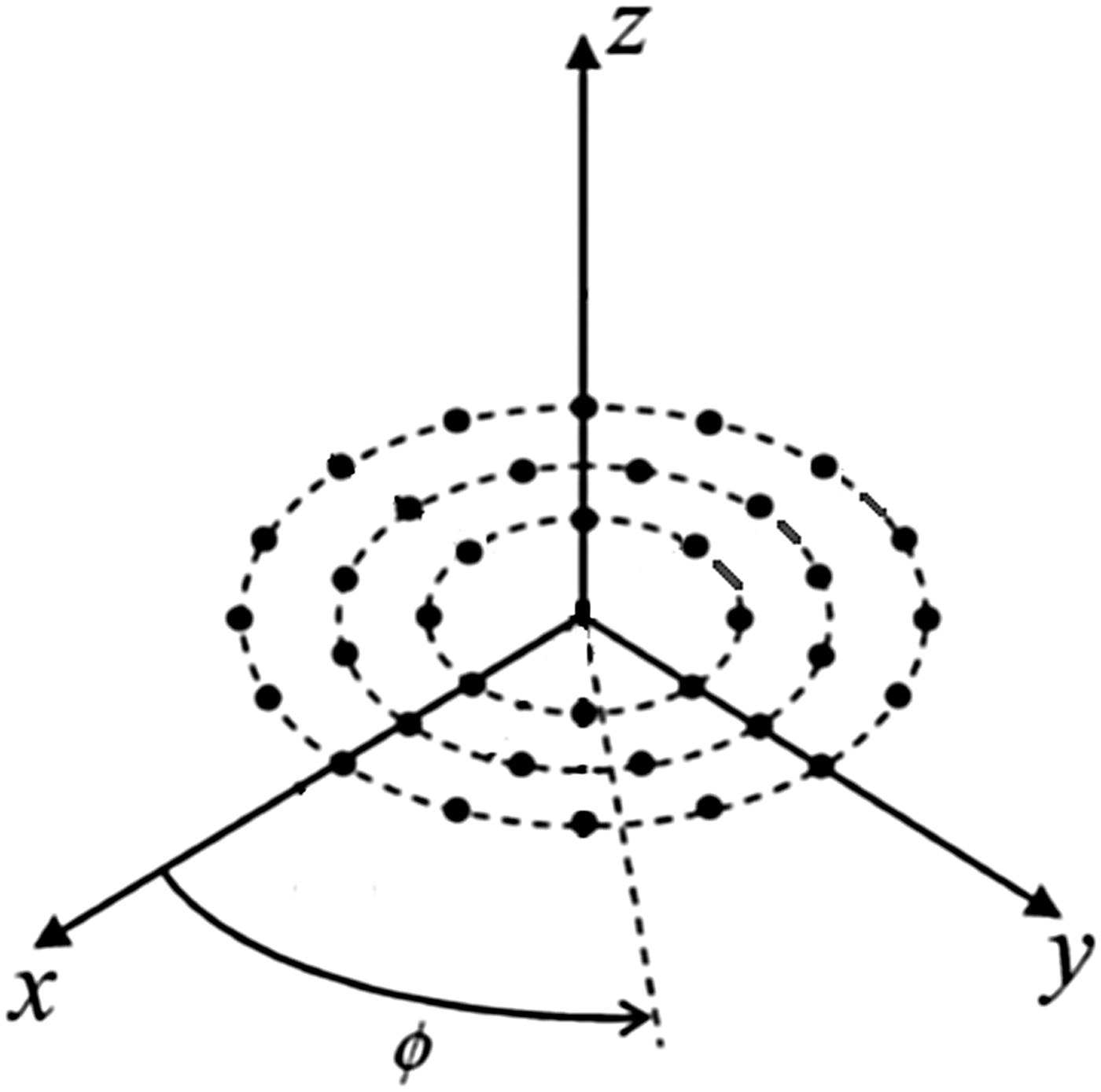
Figure 1 shows the geometry of a CCAA with isotropic antenna elements placed on M rings lying in the x–y plane. In the x–y plane, the array factor for this CCAA is given as follows [Reference Balanis1]:
 $$AF\lpar \phi \rpar ={I_{{\rm center}}}+\sum\limits_{m=1}^M {\sum\limits_{n=1}^{{N_m}} {{I_{mn}}} \exp \left\{{j\left[{k\, {r_m}\cos \left({\phi - {\phi _{mn}}} \right)+{\alpha _{mn}}} \right]} \right\}}\comma \;$$
where
 $$k=\displaystyle{{2\pi } \over \lambda }\comma \;$$
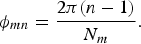 $${\phi _{mn}}=\displaystyle{{2\pi \lpar n - 1\rpar } \over {{N_m}}}.$$
In the above equations, I center is the excitation amplitude of the center element, if any, that exists at the origin, r m is the radius of the mth ring (where r 1 is the radius of the innermost ring), I mn and α mn represent the excitation amplitude and phase of the nth element in the mth ring, respectively; and N m represents the number of elements in the mth ring. Moreover, ϕ mn is the angular position of the nth element lying in the mth ring. It is clear from (3) that the antenna elements in each ring are assumed to be uniformly distributed. To direct the peak of the main beam in the ϕ 0 direction, the excitation phase is chosen to be [Reference Balanis1]:
 $${\alpha _{mn}}=- k\, {r_m}\cos \left({{\phi _0} - {\phi _{mn}}} \right).$$
In our design problems, ϕ 0 is chosen to be 0, i. e., the peak of the main beam is along the positive x direction.
Geometry of a CCAA with isotropic radiators.

III. FITNESS FUNCTION
In this paper, the goal is to design a CCAA with optimal SLLs reduction for a specific first null beamwidth (FNBW). Thus, the following fitness (objective) function is used [Reference Dib and Sharaqa29]:
 $$Fitness=\left({{W_1}{F_1}+{W_2}{F_2}} \right)/{\left\vert {A{F_{max}}} \right\vert ^2}\comma \;$$
 $${F_1}={\left\vert {AF\left({{\phi _{nu1}}} \right)} \right\vert ^2}+{\left\vert {AF\left({{\phi _{nu2}}} \right)} \right\vert ^2}\comma \;$$
 $${F_2}=Max\left\{{{{\left\vert {AF\left({{\phi _{ms1}}} \right)} \right\vert }^2}\comma \; {{\left\vert {AF\left({{\phi _{ms2}}} \right)} \right\vert }^2}} \right\}\comma \;$$
where
ϕ nu is the angle at a null. Here, the array factor is minimized at the two angles ϕ nu1 and ϕ nu2 defining the major lobe, i.e., the FNBW = ϕ nu2 − ϕ nu1 = 2ϕ nu2.
ϕ ms1 and ϕ ms2 are the angles where the maximum SLL is attained during the optimization process in the lower band (from −180° to ϕ nu1) and the upper band (from ϕ nu2 to 180°), respectively. An increment of 1° is used in the optimization process. Thus, the function F 2 minimizes the maximum SLL around the major lobe.
Moreover, AF max is the maximum value of the array factor, i.e., its value at ϕ 0. W 1 and W 2 are weighting factors which are chosen here to be 1 and 5, respectively. Thus, for the design of CCAA with minimum SLL, the optimization problem is to search for the current amplitudes (I mn and I center if a center element exists) that minimize the above fitness function.
IV. BIOGEOGRAPHY BASED OPTIMIZATION
Although the BBO algorithm is described elsewhere in the literature [Reference Simon16, Reference Simon, Ergezer, Du and Rarick17], for the sake of completeness, it is described here briefly. BBO is a new evolutionary algorithm developed by Simon [Reference Simon16, Reference Simon, Ergezer, Du and Rarick17]. BBO is a metaphor drawn from the science of biogeography which is specializing in studying the geographical distribution of living organisms. Mathematical biogeography models are based on the metaphor of extinction and migration of species between neighboring islands. An “island” is any habitat (area) that is geographically isolated from other habitats. Islands that are more suitable for habitation have a high “habitat suitability index” (HSI), which is treated as a dependent variable because it correlates with many factors such as rainfall, temperature, diversity of vegetation and topography, and so on. Another important BBO variable is the “suitability index variable” (SIV) which generally characterizes an island's habitability and is treated as an independent variable.
BBO algorithm can be summarized and described in the following three steps:
(1) Create a set of solutions (parameters characterizing an island's habitability, Habitat = [SIV 1, SIV 2, SIV 3, … …, SIV N]) to the problem, where they are randomly selected within the search bound, then calculate the value of the fitness function (suitability for habitation, fitness (Habitat) = HSI = f(SIV 1, SIV 2, SIV 3, … …, SIV N)) which is found by evaluating the fitness function.
(2) Applying migration process: in the migration step, the immigration rate λ = 1 − (S/S max) and the emigration rate μ = S/S max of each solution (where S is the number of species in the habitat; and S max is the maximum possible number of species), which are used to probabilistically share information between habitats with probability P mod (known as the habitat modification probability), are calculated and applied as summarized in the following migration flow chart:
For i = 1 to n (where n is the number of islands) Select H i with probability α λ i If H i is selected For j = 1 to n Select H j with probability α μ j If H j is selected Randomly select an SIV from H j Replace the SIV in H i with the selected SIV from H j End End End End(3) Applying mutation process: the mutation step tends to increase the diversity among the population and gives the solutions the chance to improve their selves to the best. Performing mutation on a solution is done by replacing it with a new solution that is randomly generated. The following flow chart summarizes the mutation process:
For i = 1 to n For j = 1 to N (where N is the number of variables) Select SIV H i(j) with probability α P m (Mutation Probability) If H i(j) is selected Replace H i(j) with a randomly generated SIV End End End
V. RESULTS
Several examples with different number of antenna elements have been optimized using the BBO and SQP methods. It should be noted that the SQP method is not a stochastic method, and its results depend mainly on the initial estimate. In our implementation, the initial estimate is set to be a random vector using the rand function in Matlab. In a series of papers [Reference Mandal, Chandra, Ghoshal and Bhattacharjee2–Reference Mandal, Ghoshal and Bhattacharjee8], Mandal et al applied several optimization methods (GA, EP and PSO and its variants) on the same problem studied here. In [Reference Mandal, Ghoshal and Bhattacharjee6], it was shown that the minimum SLL is obtained using EP. Thus, for comparison purposes, the BBO and SQP results presented here will be compared with the EP results presented in [Reference Mandal, Ghoshal and Bhattacharjee6]. In the design examples presented below, it is assumed that the CCAA is composed of 3 rings (M = 3). Moreover, in each ring, the inter-element spacing is assumed to be constant being 0.55λ, 0.606λ, and 0.75λ for the first, second, and third rings, respectively [Reference Mandal, Ghoshal and Bhattacharjee6]. CCAAs with and without the center element are investigated.
In the BBO implementation, the following parameters are used: population size = 150, number of generations = 500, habitat modification probability = 1, mutation probability = 0.01 and elitism parameter = 2. The minimum and maximum allowable values for the variables (i.e., the excitation amplitudes) are set to 0 and 1, respectively. The design examples are performed for a specific FNBW, which corresponds to a uniformly-fed CCAA with a uniform λ/2 element-spacing and the same number of elements. BBO and SQP codes are run for 20 independent times. Two examples are presented here:
Example 1: N 1 = 4, N 2 = 6, N 3 = 8.
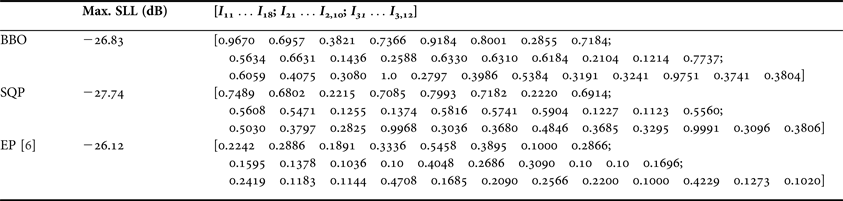
Tables 1 and 2 show the best results obtained using BBO and SQP for this CCAA with and without the central element, respectively. “Best results” are defined as the ones that give the smallest maximum SLL. The current amplitudes for the array elements are normalized such that max(I) = 1. As mentioned above, the same examples were considered in [Reference Mandal, Ghoshal and Bhattacharjee6] using the standard PSO (and its variant Particle Swarm Optimization with Constriction Factor and Inertia Weight Approach (PSOCFIWA)) and EP. It was found in [Reference Mandal, Ghoshal and Bhattacharjee6] that the EP gave a maximum SLL that is less than that obtained by PSO and PSOCFIWA. Thus, BBO and SQP results will be compared with EP results only.
Excitation weights of non-uniform CCAA with N 1 = 4, N 2 = 6, N 3 = 8 without central element.
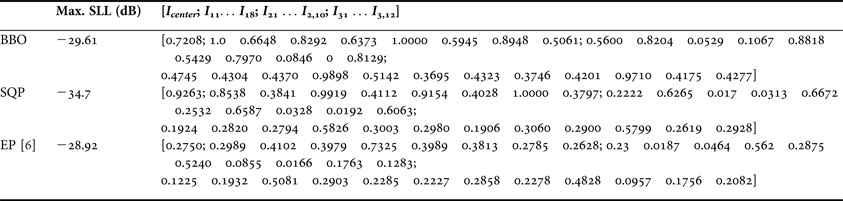
Excitation weights of non-uniform CCAA with N 1 = 4, N 2 = 6, N 3 = 8 with central element.
Figures 2 and 3 show the array factor obtained using the results in Tables 1 and 2, respectively. In Fig. 2, the maximum SLL obtained using the BBO and SQP are −30.6 and −33.16 dB, respectively. On the other hand, in Fig. 3, the maximum SLL obtained using the BBO and SQP are −38.2 and −45.72 dB, respectively. These values are compared to those obtained using EP [Reference Mandal, Ghoshal and Bhattacharjee6] in Tables 1 and 2. It can be seen that the maximum SLL values obtained using BBO are comparable to those obtained using EP. It should be also noted that the maximum SLL values obtained using BBO are better than those obtained using PSO and PSOCFIWA [Reference Mandal, Ghoshal and Bhattacharjee6]. From Tables 1 and 2, it is interesting to note that the maximum SLL obtained using SQP is better than BBO and EP results. Thus, for this CCAA design problem, not only global optimization methods might not really be needed, but also as mentioned in [Reference Bucci, D'Urso and Isernia33]: “the use of global optimization algorithms is not only a waste of computational resources, but can, indeed, prevent the attainment of the solution”. From Figs 2 and 3, it can be seen that the uniform circular arrays with the same number of elements and λ/2 element-to-element spacing have maximum SLLs of −11.23 and −12.31 dB, respectively.
Example 2: N 1 = 8, N 2 = 10, N 3 = 12.
Tables 3 and 4 show the best results obtained using BBO and SQP for this CCAA with and without the central element, respectively, along with the EP results from [Reference Mandal, Ghoshal and Bhattacharjee6].
Radiation pattern for Example 1 using the BBO, SQP, and EP results in Table 1 along with the radiation pattern of a uniform CCAA.
Radiation pattern for Example 1 using the BBO, SQP, and EP results in Table 2 along with the radiation pattern of a uniform CCAA.
Excitation weights of non-uniform CCAA with N 1 = 8, N 2 = 10, N 3 = 12 without central element.
Excitation weights of non-uniform CCAA with N 1 = 8, N 2 = 10, N 3 = 12 with central element.
Figures 4 and 5 show the array factor obtained using the results in Tables 3 and 4, respectively. Again, the BBO method proves to be an effective optimization technique with respect to designing non-uniform CCAAs with optimum SLL. Its results are as good as well-developed optimization techniques, like EP and PSO [Reference Mandal, Ghoshal and Bhattacharjee6], and GA [Reference Mandal, Chandra, Ghoshal and Bhattacharjee2]. From Tables 3 and 4, it is interesting to note that the maximum SLL obtained using SQP is better than BBO and EP results. This, again, indicates that global optimization methods might not really be needed in this CCAA design problem [Reference Bucci, D'Urso and Isernia33].
Radiation pattern for Example 2 using the BBO, SQP, and EP results in Table 3 along with the radiation pattern of a uniform CCAA.
Radiation pattern for Example 2 using the BBO, SQP, and EP results in Table 4 along with the radiation pattern of a uniform CCAA.
VI. CONCLUSIONS
In this paper, the BBO method was used to adjust the excitations of the antenna elements in a concentric circular array to obtain an optimum SLL. The obtained optimized array factor was compared to that obtained using other optimization techniques. Array factor patterns for the BBO-designed CCAAs are generally as good as those presented in the literature, which clearly shows the effectiveness of BBO. Moreover, the Matlab function Fmincon, which uses the SQP method, has been used to design the same arrays and has shown to give results that are better than those obtained using global stochastic optimization methods. This indicates that for the problem under consideration (i.e., the design of non-uniformly excited CCAA with optimum SLL), stochastic global optimization methods might not really be needed [Reference Bucci, D'Urso and Isernia33].
ACKNOWLEDGEMENT
This work was supported by the Deanship of Research at Jordan University of Science and Technology (JUST).
 Nihad I. Dib obtained his B.Sc. and M.Sc. in Electrical Engineering from Kuwait University in 1985 and 1987, respectively. He obtained his Ph.D. in EE (major in Electromagnetics) in 1992 from University of Michigan, Ann Arbor. Then, he worked as an assistant research scientist in the radiation laboratory at the same school. In September 1995, he joined the EE department at Jordan University of Science and Technology (JUST) as an assistant professor, and became a full professor in August. 2006. His research interests are in computational electromagnetics, antennas, and modeling of planar microwave circuits.
 Ashraf Hamdan Sharaqa received his B.Sc. in Electrical Engineering from Birzeit University (BZU), Birzeit, Palestine in 2009. In 2010, he joined the Master's program in the Electrical Engineering Department at Jordan University of Science and Technology (JUST) majoring in Wireless Communications, and worked as a teacher and research assistant at the same school. He received the M.Sc. degree in 2012. In October 2012, he joined the Communication and Security Projects Division at WorleyParsons Arabia Ltd, Saudi Arabia, as a radio engineer. His research interests include the analysis and design of antennas and microwave circuits, optimization algorithms and their application in electromagnetics, and wireless communications.