Six years ago, in the pages of this journal, Steven Englund announced that ‘the innovative research produced by a large group of international historians working on … those lands that Napoleonic France occupied, annexed and ran roughshod over’ amounted not so much to a ‘renaissance’ as a ‘naissance’ since the work in question ‘defined a field unmarked before’.Footnote 1 Commenting on the same development a year earlier, Annie Jourdan gave it a banner headline: ‘Napoleon is no longer the exclusive preserve of the French’.Footnote 2 This was a reference less to the fact that the historians concerned were for the most part ‘Anglo-Saxon’ than to the fact that their work broke with the narrowly Franco-centric approach to Napoleon's First Empire that had previously prevailed. It is true that the earliest – and still one of the best exemplars – of the transnational study of Napoleon's multi-ethnic empire, Stuart Woolf's contentiously entitled Napoleon's integration of Europe, appeared over twenty years ago.Footnote 3 However, it is only this century that historians have followed his lead in any numbers. That the trend has come to dominate the scholarship as a whole is evident from the number of large-scale international conferences held in recent years with the express aim of viewing the Napoleonic empire and its impact in a wider European perspective.Footnote 4
How far has all this scholarly attention altered our understanding of the nature, impact, and legacy of Napoleonic rule outside France and how was it experienced by subject populations? With the proceedings of key conferences continuing to roll off the press, any assessment is at best provisional. At first sight, despite all the interesting new research in the field, the terms of the debate on ‘Napoleon and Europe’ have not changed greatly since the days of Woolf. Were imperial policies towards occupied territories primarily motivated by a commitment to some kind of ‘civilizing mission’ or sheer opportunism? In terms of its impact, did French hegemony leave a clearly discernible, lasting legacy or did the enormous pre-existing differences between regions and countries that came under it survive, if anything strengthened by the experience? Overall, is the response of subject populations better characterized as collaboration or resistance?
On closer inspection, though, the debate has moved on in a number of ways. First, as Englund noted, with a few notable exceptions, historians – particularly those engaged in first-hand research on the subject – now tend to argue in less exclusive terms, acknowledging that French rule brought both reform and exploitation and that responses to it cannot be shoe-horned into two mutually exclusive categories: collaboration or resistance.Footnote 5 Second, and this tendency has also worked towards more nuanced conclusions, historians are now more conscious of the considerable variations over time and space of both the impact of Napoleonic rule across the empire as a whole and how it was received. In particular, there is widespread support for – one is tempted to say, obeisance to – Broers's contention that both can best be understood by distinguishing within the Grand Empire an ‘outer’ and an ‘inner’ empire, which, in his words, are ‘spheres defined less by the amount of time the French ruled them, than the degree to which they were pacified and, most importantly, than the degree to which their elites accepted French public institutions and acculturated to their public mores’.Footnote 6 Within the borders of the directly ruled Empire, the latter contained, along with much of ‘old France’, the Low Countries, the Rhineland, and northern Italy, while not only central and southern Italy, the former United Provinces and the Hanseatic territories but also western France and seemingly the Pyrenees belonged to the former zone.Footnote 7 Also attributable to Broers, the third and final development in the historiography consists of his conceptualization of Napoleonic rule as an early exercise in cultural imperialism of the sort associated with subsequent colonial empires.Footnote 8 On this issue, though, his fellow specialists are divided, with many preferring to see the opportunistic pursuit of French interests as more influential in shaping imperial policies and activities than an ethnocentric mission to civilize.Footnote 9
This article seeks to make a contribution to the debate by looking at the formal Napoleonic Empire from a previously unexplored angle, by examining the workings of the Napoleonic electoral system of 1802 in the annexed departments of the Empire from its inception to the fall of the regime. Arguably, the system has a claim to belong to that ‘viable, but also … interesting set of institutions’ which in the view of Woolf and doubtless Englund (whose phrase this is) enabled the Empire to continue functioning with comparatively little involvement on the part of the emperor himself.Footnote 10 Yet historians have shown precious little interest in how this system operated inside metropolitan France, let alone in other parts of the formal Empire.Footnote 11 In nearly all monographs on territories under direct French rule, elections are conspicuously absent.Footnote 12 So little is known of the operation of the electoral system outside France that one highly respected historian of the wider empire stated without qualification that ‘political participation was non-existent’.Footnote 13 Quite apart from any intrinsic importance Napoleonic elections may have had at the time, as a way into the debate on ‘Napoleon and Europe’ they present several distinct methodological advantages.
First, the fact that documentation on elections in all annexed as well as French departments is available in a single sub-series in the Archives nationales in Paris means that it is logistically feasible to study elections and voting across almost the entire, multi-national Empire.Footnote 14 This kind of transnational, cross-cultural, and comparative study is crucial because, as noted above, presumed regional differences across the empire have come to loom large in the scholarship. Second, viewing the formal Empire through the prism of elections may serve as a valuable corrective to the general preoccupation with its exploitation and coercion of subject populations, in particular, through conscription and taxation.Footnote 15 Third, elections offer a way of engaging with the various levels of the debate. Here, we are concerned with just two of them: first, the question of the intentions and practices of the imperial power and secondly how the Empire was experienced and viewed by populations that came under its sway.
Accordingly, the first half of this article examines how the electoral system was rolled out into non-French territories and asks why the imperial government attached such importance to holding elections in newly incorporated territories. The second explores how the electoral process operated in this context and asks what, among other things, the behaviour of voters tells us about the attitudes of subject populations to the imperial power.
I
Understandably, historians have seen the so-called Constitution of 1802, which, as well as instituting the Life Consulate, reintroduced electoral assemblies after the short-lived experiment with Sieyès's listes de confiance, as a staging post in Napoleon's increasing personalization of power.Footnote 16 For this reason, when considering its electoral provisions, they have focused almost exclusively on its all-too-obvious shortcomings from a modern-day liberal-democratic standpoint. What they tend to overlook is that, first, the new electoral system was a significant improvement on the sort of co-optation process it replaced, and, secondly, that its most regressive features were either directly inherited from the Constitution of 1799 or else modelled on it. In discussions leading up to the framing of the new system, Napoleon remarked that it would need to give the people a greater role in elections, and, to a limited degree, it did.Footnote 17 At the primary level, all resident adult males were eligible to vote in cantonal assemblies (based on the jurisdictions of the justices of the peace) in order to elect the membership of the secondary electoral colleges which were to meet in each arrondissement and departmental chef-lieu. The colleges' principal task was to put forward candidates for the bicameral legislature in Paris, the Corps législatif and Tribunate, and also for the Senate. Re-instituting territorial constituencies and assemblies of voters in this way, both of which had ceased to exist after the coup of Brumaire, went some way towards re-establishing the link between representation and communities.
However, if Jean-Louis Halperin is literally correct in remarking that the new electoral process increased the influence of voters, this influence was severely circumscribed.Footnote 18 As far as the cantonal assemblies were concerned, it was limited by the fact that the men they elected to the electoral colleges sat for life and so were unaccountable, and, in the case of the collèges de département, had to be chosen from the department's officially designated 600 highest taxpayers. In this way, the opening up of the cantonal assemblies to all male citizens was neutralized. In turn, the principal limitation on the influence of the life members of the colleges resulted from the fact that the Senate retained the role in the electoral process ascribed to it in the Constitution of 1799. Rather than elect members directly, the colleges simply presented candidates for places in the Corps législatif, Tribunate and Senate from whom the Senate made the final choice.Footnote 19 Ultimately, though, government accountability was undermined as much by Napoleon's increasing tendency to by-pass the Corps législatif through the use of decrees and senatus consulta as by in-built constraints on the powers of the electorate.Footnote 20
II
Prior to the appearance of Coppolani's work in 1980 it was thought that the electoral provisions of the Constitution of 1802 either remained a complete dead letter or else were only partially implemented. Coppolani, though, conclusively demonstrated that all metropolitan departments, with the exception of Corsica, held elections more or less in accordance with the official calendar until spring 1812.Footnote 21 By this time, all of them had experienced two full rounds of elections, which involved the convening of both primary, cantonal assemblies and the electoral colleges. For the inaugural round, the introduction of universal male suffrage at the primary level was postponed in favour of an interim electorate made up of the communal notables on one of Sieyès's listes de confiance. However, in the second round, in which roughly one fifth of all departments held elections each year from 1807 to 1812 inclusive, according to the electoral series in which they were placed, the cantonal assemblies were open to all (male) citizens as prescribed in the constitution.
Although Coppolani cited a number of instances of elections taking place in annexed departments (the so-called ‘départements réunis’), he wisely exempted such territories from his conclusion concerning ‘the normal application’ of the electoral system.Footnote 22 In part, this was because most of his research was confined to metropolitan France, but it was also true that in the course of his forays into recently annexed departments he found that some elections were subject to seemingly endless delays, in part owing to obstruction on the part of officials.Footnote 23 Could it be that the island of Corsica, which remained an election-free zone throughout the entire period, initially on account of endemic unrest and subsequently because of repeated boundary changes, was not so exceptional?Footnote 24
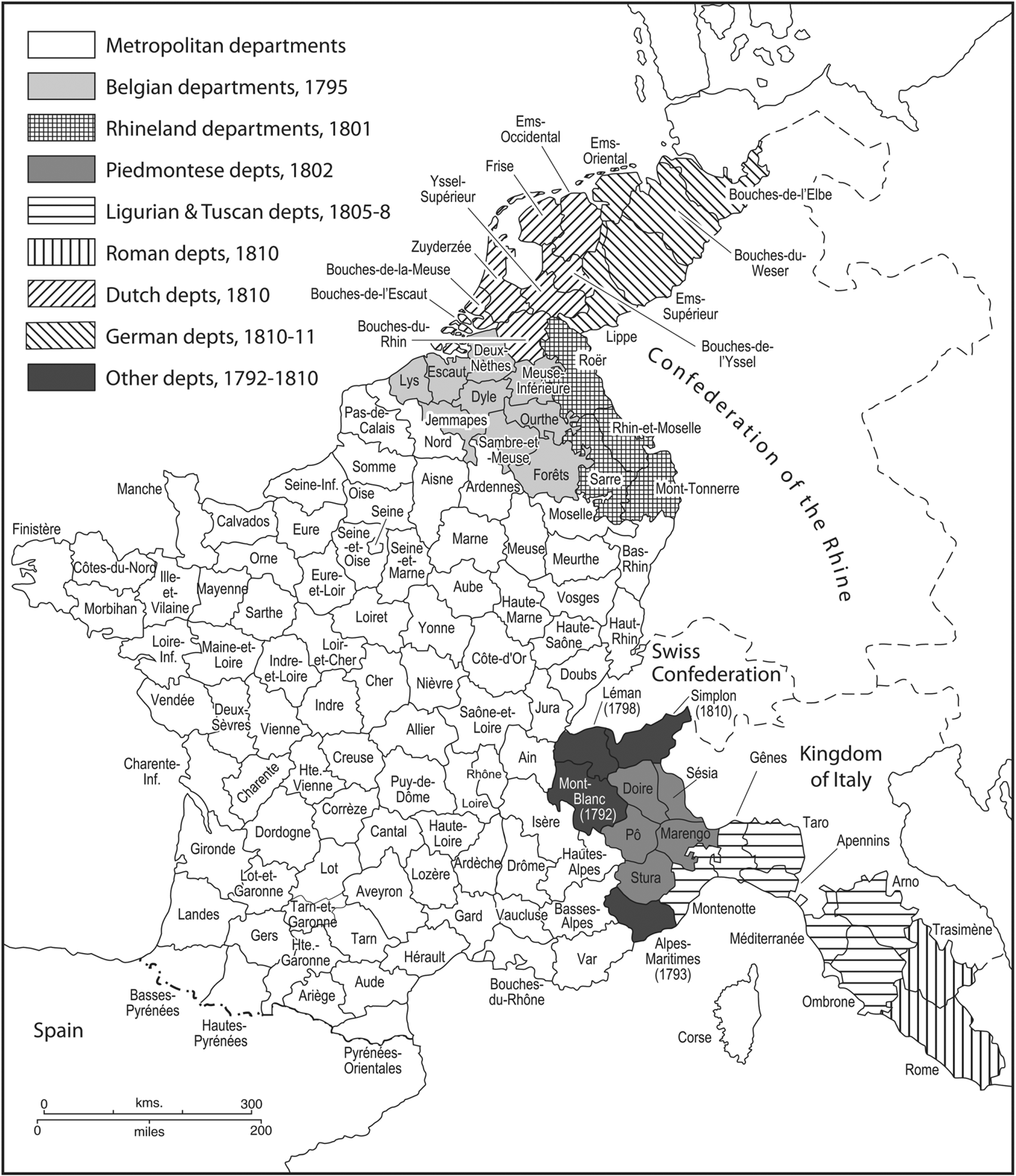
In fact, our research into the operation of the electoral system in the Empire outside France shows that the regime was every bit as concerned that its non-French subjects should have a chance to vote as metropolitan Frenchmen.Footnote 25 All twenty-two departments annexed in time to take part in the inaugural round of elections in 1802–3 actually did so, although not all under the same electoral regime (see Figure 1). The four Rhineland and six Piedmontese departments had not taken part in the drawing up of the listes de confiance from which, under the transitional regime in operation everywhere else, the primary electorate was drawn. The annexation of Piedmont had come too late for its departments to take part in this process while the Rhineland departments, which had been under de facto French rule since 1797, were not included, ostensibly because, having yet to swear allegiance formally to the French Republic, they remained outside the scope of its constitution.Footnote 26 Whatever the reason, when it came to the introduction of the Constitution of 1802, they, like the former Piedmontese territories, proceeded directly to the definitive electoral regime envisaged in the constitution, thereby anticipating the introduction of universal male suffrage in metropolitan France by at least four years. Thereafter, save Corsica, all existing departments, metropolitan or annexed, held elections in the same way and at the same time as others in the same electoral series. While two rounds of elections was the norm, a number of these departments experienced more. In the Marengo, the cantonal assemblies and colleges both met three times in the space of nine years, while in the Alpes-Maritimes, Doire, Sarre, and Stura, two full rounds of elections were followed by further cantonal ‘legislative’ elections.
The departments of the formal French Empire in 1811 (with dates of annexation).

Before its demise, another twenty-three departments were added to the French Empire in the course of three further waves of annexations occurring in 1805, 1808, and, the last and by far the largest, 1810–11. How the electoral system was to be introduced into these departments appeared to be settled at the moment of their admission into the Empire. Each new territorial acquisition was formalized by an organic senatus consultum pronouncing the resultant department or, more often, departments an ‘integral part of the French Empire’.Footnote 27 As well as specifying the number of deputies to represent each of these departments in the Corps législatif and attaching it to one of the five electoral series, these documents went on to state when its deputies were to be named – generally the following year – and that its deputation would then be ‘renewed’ at the same time as others in its series.Footnote 28 It is clear from the case of the Ligurian departments incorporated in 1805 that the original intention was for elections to be held prior to the first nominations, as had occurred in the case of the Piedmontese departments, and not just as part of the subsequent ‘renewal’. In the event, this did not happen and when their first representatives in the Corps législatif were appointed by the Senate, it was from a list of candidates drawn up by the departments' prefects. All subsequent initial nominations were made in the same way.
This did not mean, however, that government was losing interest in holding elections in newly annexed territories. The senatus consultum naming the Ligurian deputies explicitly stated that their mandate extended only until deputies could be ‘named in conformity with the constitutional texts’.Footnote 29 This duly occurred in October 1808 when the Senate voted on which of the candidates elected by the newly formed electoral colleges in these departments should sit in the Corps législatif.Footnote 30 In the case of the departments formed in May 1808 from the former duchies of Parma and Piacenza and the Grand Duchy of Tuscany, the interval between annexation and the holding of elections was much longer. While in the department of the Taro both the cantonal assemblies and electoral colleges had completed their business by early 1811, the first meeting of the cantonal assemblies did not take place in the Méditerranée until the end of 1812 and in the Arno and Ombrone until 1813.Footnote 31 In all three cases, their newly formed electoral colleges never met, as no colleges were convened anywhere in the Empire after April 1812. For the most part, though, the delays in holding cantonal elections were due to factors outside the control of the local authorities, principally changes in their department's borders with the Kingdom of Italy, which in turn necessitated the re-drawing of constituency boundaries.Footnote 32
Far from the interval between annexation and the holding of elections continuing to increase, most of the departments brought into the Empire in 1810–11, from parts of modern-day Italy, Germany, Holland, and Switzerland, saw some polling before the imperial authorities lost control of them in the face of the Allied advance following their victory at Leipzig in October 1813. Remarkably, in the department of Rome the cantonal assemblies did their business within a little over a year of annexation so that its electoral colleges were formed in time to be convoked with others in its electoral series early in 1812.Footnote 33 As a result, Rome was the only latecomer department to be represented ‘constitutionally’, as opposed to ‘provisionally’, in the Corps législatif when the regime fell.Footnote 34 Others, though, took a big step in this direction by holding cantonal elections. We know that these occurred in the departments of the Bouches-de l'Elbe, Bouches-du-Rhin, Bouches-de-l'Yssel, and Simplon in 1812 and in the Ems-Occidental, Trasimène, and Zuyderzée in the following year.Footnote 35 In the last-named, polling took place only a matter of weeks before the French garrison evacuated Amsterdam owing to the rapidly deteriorating military situation.Footnote 36 Cantonal assembles were due to meet at the same time in another Dutch department, the Ems-Oriental, but were postponed at the eleventh hour owing to an insurrection on its borders.Footnote 37 The absence of any reference to election results in the correspondence of the prefects of the other six departments with the Paris Ministry, conserved in the relevant sub-series of the Archives nationales, is not conclusive evidence that no elections took place: two of the electoral occurrences cited previously are only known to have happened, in one case, as a result of a foray into a different documentary sub-series and, in the other, thanks to the research of a local historian.Footnote 38 What is certain, though, is that in every one of these departments all or most of the necessary preliminaries for cantonal elections to take place had been completed before the French departed, and as late as January 1814 the minister of the interior was proposing to call cantonal elections in all departments in the fifth series.Footnote 39
The imperial regime went to great lengths not only to hold elections in annexed territories but also to make them as inclusive in reality as they were on paper. That, at least, is the obvious inference to be drawn from the time and effort that went into ensuring that all citizens throughout the Empire actually had the opportunity to exercise their constitutional right to vote in cantonal elections. Unlike many subsequent electoral systems, in which self-registration by voters has played a large part, it was the job of Napoleonic officials to produce comprehensive lists of all eligible voters in each electoral district or ‘section’. These were then lodged with the presiding officials at the sectional assembly, together with voting cards made out for each individual on the list. It is clear from the surviving documentation in the state archives in Geneva that, once universal male suffrage took effect, the district voting lists were compiled from ‘civic registers’, which in turn were created in each sub-prefecture by collating communal lists drawn up by all mayors within its jurisdiction.Footnote 40 New voting lists, as well as voting cards, had to be produced for each round of cantonal elections occurring over the period and, according to the prefect of one annexed department, as the records of the état civil were not fit for the purpose of updating the civic registers, these had to be drawn up anew.Footnote 41 These tasks were to be carried out in all departments of the Empire but they occasioned special difficulties in recently annexed ones. First, here election preparations were carried out alongside or immediately following the host of other administrative tasks involved in the passage from pays conquis to department of the French Empire via a provisional administration.Footnote 42 Secondly, in many, perhaps most, annexed territories there was no tradition of holding large-scale elections and so it was a case of instituting an electoral system entirely from scratch. Thirdly, except in the upper echelons of the prefectoral administration, the agents charged with this responsibility were generally new to their role and, according to most prefects, not up to the job. The prefect of Ombrone blamed his failure to produce civic registers on time on ‘the mayors [who] do not have for the most part any dedication to public service, no zeal, no activity, very little intelligence or wish to be educated’, adding plaintively ‘there is depressing apathy towards higher authority on the part of all those holding unpaid office’.Footnote 43 This did not prevent two of his sub-prefects being dismissed and the prefect himself being ‘named and shamed’ with the emperor.Footnote 44 Fourthly, as we have seen, particularly following the major expansion of the Empire in 1810–11, preparing and holding elections in new departments frequently occurred when and where Napoleonic rule was most precarious.
III
Why was the imperial power so insistent on holding elections in newly incorporated territories? The notion that this was simply a product of what Benjamin Constant referred to as Napoleon's ‘mania for uniformity’ or his insistence that they should, in this respect as in others, in the emperor's words, ‘be made to run just like France’, can be discounted.Footnote 45 Although in broad terms the French model of institutions was exported throughout the Empire, this was not done slavishly. The question of whether and how the laws against feudalism in force in the rest of the Empire should be modified before being introduced into later annexed territories gave rise to much discussion in the Council of State.Footnote 46 Similarly, if other administrative units à la française were unfailingly introduced into new departments, important adaptation to local circumstances took place at the grassroots level: in the Valais, Italy, and the Hanseatic territories, for example, the ‘small commune’ model which prevailed in metropolitan France was rejected in favour of larger territorial groupings.Footnote 47 Another example concerns the jury system: whereas juries operated in a (bare) majority of metropolitan departments, they were suspended in all, or virtually all, territories annexed after 1801.Footnote 48 If the electoral system did not suffer a similar fate in newly incorporated territories it was surely because, unlike trial by jury, it was held to facilitate the imperial project.
Undoubtedly, institutional integration as a whole was fundamental to Napoleon's ambitious programme of empire-state building, but we would argue that the electoral system had a special, as well as hitherto ignored, place within it. In the first place, electoral institutions may not have been the only ones to afford the opportunity for civic engagement – communal administration also did – but no others did so in such open-ended fashion (as far as the male citizenry were concerned).Footnote 49 Secondly, together with the rest of the representative system, elections allowed participation at different levels and in various capacities, each of which connoted a different relationship with the imperial state and regime. Rather than confronting ‘new Frenchmen’ with the stark choice of either collaboration or resistance, the electoral-representative system allowed them to ‘determine their intimacy with the regime’.Footnote 50 How far electoral participation indicated a degree of acceptance of the imperial regime will be explored in the following section, but not only were voters in cantonal elections in the annexed territories thereby publicly associating themselves in highly visible fashion with the affairs of the Empire but also, from 1804, they were required to swear an oath ‘of obedience to the Constitutions of the Empire and loyalty to the emperor’.Footnote 51 More important, though, was the way that the electoral colleges which emerged from the cantonal elections were intended to foster closer and more lasting relationships between elite elements, their clienteles and communities, and the regime.
Of course, the colleges were intended to serve as, in Napoleon's words, ‘intermediary bodies between the state and the individual’ in metropolitan as well as annexed departments. However, just as the loyalty oath took on a new significance when taken by the former subjects of foreign powers, so the colleges' job of institutionalizing local notables was commensurately more important in recently incorporated territories where, as Woolf has noted, ‘the dependence of the administration on their collaboration was the greater’.Footnote 52 If we are rather lacking in concrete examples of how, outside their formal electoral duties, members of the colleges in non-French departments acted as mediators, the same is less true of the men they proposed for seats in the departmental and arrondissement councils and, more especially, in the Corps législatif.Footnote 53
One deputy of an annexed department about whom we are particularly well informed, thanks to his published recollections of his time in office, is Charles-Emmanuel de Rivaz.Footnote 54 In Paris, as well as hobnobbing with the great and the good, he influenced appointments to various administrative and judicial positions in his native Simplon.Footnote 55 At the same time, he was regularly consulted by the prefect there, including over the distribution of the department's tax quota between communities.Footnote 56 Self-evidently, de Rivaz was a fount of local knowledge but, more importantly, he also wielded, as his dossier in the prefecture noted, ‘great influence over public opinion’.Footnote 57 Doubtless, it was for similar reasons that Napoleon singled out such deputies for special attention.Footnote 58 It was to ensure that they were equipped for their various mediating roles that the authorities gave priority to the possession of social capital over political compliance in the selection of deputies and members of departmental and arrondissement councils.Footnote 59
Although part of our initial justification for studying elections was as an antidote to the usual preoccupation with Napoleonic resource extraction in the form of conscription and tax-gathering, the phenomena should not be thought to be entirely unconnected. Hedwig Richter's observation in her study of nineteenth-century elections in Germany and the United States that ‘each election also became a census’ may apply to the Napoleonic Empire only more so.Footnote 60 Given that, unlike those with which she is primarily concerned, the electoral system of 1802 did not involve tax qualifications at the primary level, the Napoleonic civic registers were inevitably far more inclusive. The question here is whether, in the annexed departments, in addition to their ostensible purpose, these documents were also intended to assist the authorities in conscripting the local population and collecting taxes. Some of their inhabitants suspected that this was the case. The difficulties which the authorities encountered in obtaining information for the registers may well have resulted not only from the shortcomings of mayoral personnel but also the misgivings of local communities about their possible use. Indeed, these misgivings might extend to polling itself: in the countryside around Spoleto in the Trasimène, rumours circulated that the cantonal elections ‘were to do with wars, conscription and taxes’.Footnote 61
No such uncertainty surrounds the ideological link between voting rights on one hand and military service and the payment of taxes on the other. Even in current Western democracies some argue that a prime function of elections is to ‘allow the state to extract revenues’ and impose other obligations on the citizen ‘because they are more legitimate’.Footnote 62 In the case of Revolutionary France, the notion that, as well as political rights, the citizen had duties, including the performance of military service and payment of taxes, was not only clearly enunciated within official discourse on citizenship but also found its way into legislation.Footnote 63 For the Napoleonic period, the evidence connecting the electoral-representative system and resource extraction in this way is circumstantial but persuasive. In newly incorporated territories, as the senatus consultum covering the annexation of Parma and Tuscany stated, French laws were to come into force at the same time as ‘the constitutional regime’, which was deemed to have occurred once a department had definitive representation in the Corps législatif. Footnote 64 In this instance, it went without saying that French laws meant French-style taxes and conscription, but in the case of the newly incorporated Dutch departments of the Bouches-du-Rhin and Bouches-de-l'Escaut this was made explicit in the decree of 8 November 1810: its forty pages itemized all the separate French ‘laws, decrees and regulations’ on ‘Direct Taxes’, the ‘Droits-réunis’, and ‘Conscription’ which were to come into effect on 1 January 1811.Footnote 65 Twenty days later, the two departments, between them, were required to furnish 942 conscripts to the imperial army and 435 to the navy.Footnote 66
Arguably, though, the commitment to holding elections in all parts of the formal Empire was not based on any real analysis of their costs and benefits to the imperial power. Rather, if elections were part of the Napoleonic ‘imperial repertoire’ of rule it was surely as much a consequence of the mindset and political imagination of the imperialists at the centre as of their anticipated effects on subject populations on the periphery.Footnote 67 In particular at the level of ideology or political theory, elections and ‘the constitutional regime’ played an important part in the imperialists' own understanding of their Empire and their justification of their continuing presence in the annexed territories. In the first place, it is clear from the correspondence concerning delays in launching the electoral system in newly annexed territories that holding elections had particular significance as a marker of their full incorporation into the imperial polity. Elections were the final stage in the complicated process of turning occupied territories into departments of the Empire, and one that could only take place after all the others were accomplished; among them, the division of departments into arrondissements, cantons, and communes, and the appointment of all administrative officials, including the mayors without whom the civic registers could not be produced. Secondly, holding elections may be seen as providing a legal basis for the imperial claim to sovereignty over the territory in question. Whereas in the earliest annexations under the Revolution the subject people had ostensibly consented to union with France in plebiscites, the only such consultation in the Napoleonic period took place in the Ligurian Republic in 1805. In the absence of such direct mechanisms, the participation of the people in elections to the imperial parliament and the presence of its deputies in that body could be taken as tantamount to an expression of consent.
IV
How did the project of exporting the Napoleonic electoral system beyond metropolitan France into the rest of the Empire work out in practice? How did the inhabitants of recently incorporated annexed territories respond to the opportunity for limited political participation that came with annexation? On the first question, in a chapter on the operation of the electoral colleges in Napoleon and his parliaments, Irene Collins affirms that in ‘territories recently acquired by Napoleonic France the system encountered peculiar difficulties’.Footnote 68 She cites the fact that candidates nominated in the Marengo were subject to defamation, while in the Apennins Antonio Maghella (who incidentally was later suspected of murdering his former patron Saliceti, whom he succeeded as minister of police in Murat's Naples) was alleged to have got himself elected by means of ‘scandalous behaviour – orgies, seduction, corruption and all kinds of intrigue’.Footnote 69 Yet, these were the complaints of disappointed contenders and the irregularities they describe were not without parallel in the metropole; Collins herself relates similar efforts to gain election there, which involved ‘cabals’ in the Haut-Rhin and even the purchase of votes in the Calvados.Footnote 70 It is true that on several occasions getting sufficient attendance at college sessions proved a headache.Footnote 71 And Marengo seems to have been a particularly problematic department: in 1803 the ballot boxes of one canton were stolen during the night and in 1805 the proceedings of the electoral colleges of the department and the arrondissement of Casale were so flawed that the Council of State considered the unthinkable and prepared a decree annulling them in their entirety.Footnote 72 In the end, irrespective of any difficulties they encountered along the way, elections in the annexed departments, both at cantonal and college levels, broadly achieved their objective, ensuring their ‘new French’ inhabitants, like citizens of the metropole, had extensive formal representation both within their department and in the imperial parliament in Paris.
On the question of voting behaviour, we move into almost entirely uncharted territory. Few historians have investigated how voters in the metropolitan departments responded to the Napoleonic electoral system, let alone their counterparts in the départements réunis.Footnote 73 Despite making some wider references beyond the hexagon, Coppolani included among his dozen departmental case-studies only one from outside the borders of pre-Revolutionary France, the Alpes-Maritimes, which had been annexed as early as January 1793.Footnote 74 In fact, our own research into participation, at both primary and secondary level, in a range of departments annexed between 1793 and 1810–11 reveals that the electorate in départements réunis generally reacted in a relatively positive fashion to the opportunity to vote, with levels of turnout that were often higher than those recorded in the metropole. Before presenting any figures and exploring their meaning, however, a brief word of explanation about their derivation is required so as to set them in context and ensure they are properly understood.
Following the constitutional revision of 1802, primary and secondary polls were once again conducted in assemblies, where voters gathered to undertake a series of votes, following the model employed during the Revolution.Footnote 75 This system was far removed from the brief, individual registering of a vote at a polling station, with which we are conversant today. Under Napoleon, and the Revolution, several, fluctuating, figures were recorded at each assembly, primary or secondary, for there was nothing to stop voters dropping in and out for particular ballots, as many did. Attendance lists are not always available for the colleges and very rarely so in the cantons, so calculating how many different individuals participated in these elections is impracticable. The figure we have retained here is for the highest recorded single vote, regardless of when it took place in the course of a protracted process, which lasted for at least a whole day; it often occurred sooner rather than later, as interest waned the longer the assembly went on, but by no means invariably so. There can be no pretence at statistical precision, but the order of magnitude that emerges is nonetheless significant and entirely adequate for comparative purposes.
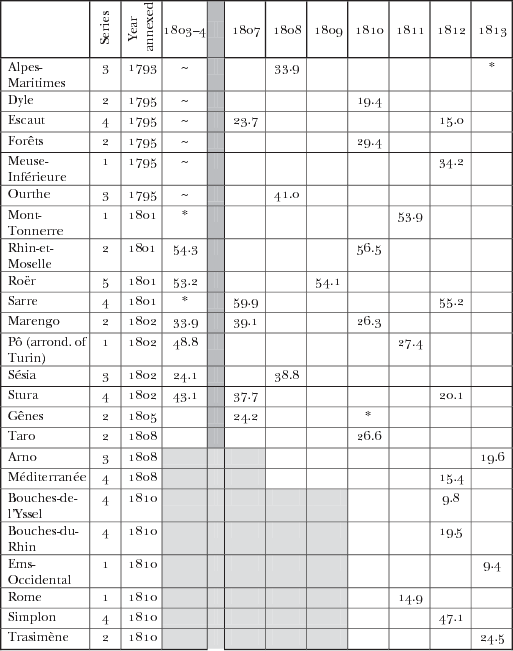
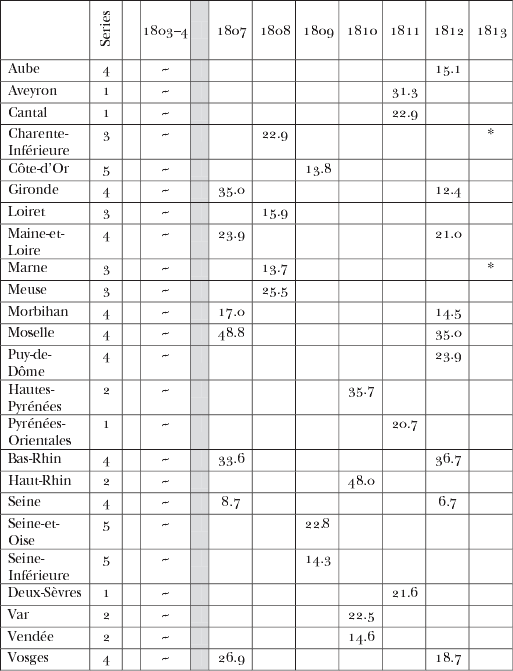
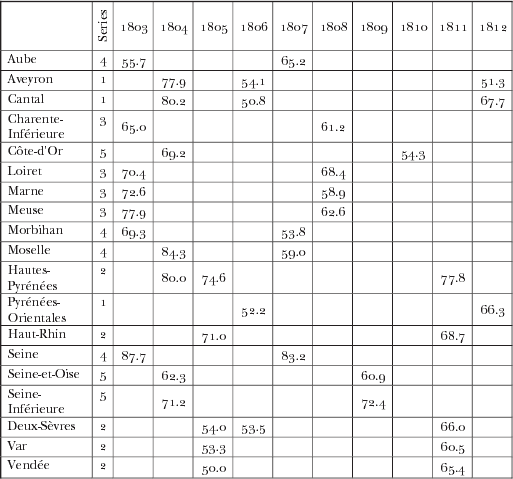
In cantonal elections, confining our attention to those held under universal male suffrage, the Belgian contingent in our sample of twenty-four départements réunis recorded turnouts of between 15 and 34 per cent from 1807 to 1812 (see Table 1a). Over a longer period, 1803 to 1813, owing largely to the early extension of the franchise in former Piedmontese territories, a handful of north and central Italian departments polled somewhat better, with turnout rates ranging from 15 to 49 per cent. Over a similar period, the Rhenish departments consistently exceeded the 50 per cent mark. Rowe considered turnout in one of the latter, the Roër, in both 1803 and 1810 to be disappointing.Footnote 76 Yet relative to Napoleonic elections as a whole, this represented an outstanding performance unsurpassed anywhere else, including the metropole (see Table 1b).Footnote 77 Clearly, the willingness of so many ordinary Rhinelanders to go to the polls played a disproportionate part in making participation rates in our sample so much higher in the annexed than the metropolitan departments: the median figure for the former is 39 per cent against 23 per cent for the latter.Footnote 78 But even if the Rhenish contingent is removed from the equation, the remaining annexed departments still polled marginally higher than their French counterparts. None of the twenty-four departments in our metropolitan sample recorded a turnout in excess of 50 per cent, though the Moselle and Bas-Rhin came close, and both were adjoining annexed Rhenish territories. Overall, turnout exceeded 25 per cent in only eight of these departments in the metropole, compared to fourteen annexed, and in Paris (the department of the Seine), it was below 10 per cent on both occasions cantonal assemblies met under the definitive constitutional regime.
Turnout in cantonal assemblies under the regime of universal male suffrage: sample annexed departments
∼ Elections held under transitional regime with restricted electorate.
* Elections held but data incomplete or missing.
Shaded area indicates department not yet annexed.
Sources: The above percentages have been calculated from figures in the relevant membership lists of the departmental colleges which contain the results of the preceding cantonal elections. These are contained in the following cartons of the sub-series AN, F1c iii: Alpes-Maritimes 2, Dyle 2, Escaut 2 and 3, Forêts 3, Meuse-Inférieure 2, Ourthe 2, Mont-Tonnerre 1, Rhin-et-Moselle 1, Roër 1 and 2, Sarre 1 and 2, Marengo 1 and 2, Pô 1, Sésia 1, Stura 1, Gênes 1, Taro 1, Arno 1, Méditerranée 1, Bouches-de-l'Yssel 1, Bouches-du-Rhin 1, Ems-Occidental 1, Rome 1, Simplon 1, and Trasimène 1.
Turnout in cantonal assemblies under the regime of universal male suffrage: sample metropolitan departments
∼ Elections held under transitional regime with restricted electorate.
* Elections held but data missing.
Sources: The above percentages have been calculated from figures in the relevant membership lists of the departmental colleges which contain the results of the preceding cantonal elections. These are contained in the following cartons of the sub-series AN, F1c iii: Aube 6, Aveyron 3, Cantal 3, Charente-Inférieure 5, Côte-d'Or 4, Gironde 3, Loiret 2, Maine-et-Loire 3, Marne 2, Meuse 4, Morbihan 2 and 4, Moselle 3 and 4, Puy-de-Dôme 3, Hautes-Pyrénées 3, Pyrénées-Orientales 2, Bas-Rhin 3, Haut-Rhin 3, Seine 4 and 5, Seine-et-Oise 6, Seine-Inférieure 3, Deux-Sèvres 2, Var 3, Vendée 2 and Vosges 5.
From a cursory glance at Tables 1a and 1b, it might appear that, though generally starting from a higher base, turnout in cantonal elections in annexed territories fell more markedly over time. The impression, though, is somewhat deceptive. The observation of the prefect of the Lys that ‘each time [the assemblies] are convoked the number of voters goes down’ may in fact have been more often the case with metropolitan departments.Footnote 79 Where we have figures for consecutive cantonal elections, polling was down on the final occasion in five out of the six of the latter against five out of eight of the annexed departments. Curiously, with its three neighbours all registering significant falls, polling in the Piedmontese department of the Sésia in 1808 was up almost 15 percentage points on 1804. Polling held up well in the Rhineland: the last time cantonal assemblies met in both the Roër and Rhin-et-Moselle attendance was very slightly up on the previous occasion while as late as 1812 the Sarre witnessed only a 5 per cent fall on its record-breaking turnout of 60 per cent in 1807.
In fact, the appearance of sharply falling turnout in Table 1a derives largely from the very low polls recorded in later acquisitions, where cantonal assemblies met for the first and only time in the Empire's final years. According to the prefect of the Trasimène, in the Italian Marche, rumours of the imminent restoration of the Papal States, and with it the department's demise, was one of the reasons why only a quarter of its electorate came to the polls in August 1813.Footnote 80 However, all but one of the other latecomer departments in the sample performed worse, with two Dutch departments, the Bouches-de-l'Yssel in 1812 and the Ems-Occidental in 1813, failing to hit the 10 per cent mark. Was this disappointing response on the part of inhabitants of latecomer departments due primarily to the sudden decline in the Empire's fortunes or to the fact that, beyond the limits of the ‘inner empire’, it found itself in an alien cultural environment where its initiatives would no longer be comprehended, let alone find acceptance?Footnote 81 From this evidence, it is not possible to say. It is worth noting, however, that the only latecomer department to stand out against the trend was to a large extent culturally as well geographically close to France: created in 1810 from a short-lived French client state, the Republic of the Valais, the department of the Simplon achieved a 47 per cent turnout at the cantonal assemblies which met just as Napoleon began his retreat from Moscow.Footnote 82
Why ‘new Frenchmen’ in the départements réunis, particularly in the Rhineland, were generally more willing than citizens of old France to take part in the Empire's official political process is not easy to explain. The surprise of its prefect at the Stura's 43 per cent turnout in 1803 is equally evident: ‘Despite the novelty of these elections I must give credit to those inhabitants who turned out in such good numbers to exercise their political rights, with an enthusiasm and a dignity that one can hardly have anticipated given the numbers of registered voters.’Footnote 83 In fact, it is possible that the novelty of the electoral experience initially proved a positive advantage in those areas annexed after Bonaparte came to power. In the first place, they were exempt from the sort of ‘voter fatigue’ which, some have suggested, was already apparent in the behaviour of French voters under the Directory.Footnote 84 This may also have been a factor in the lower polling of the Belgian departments compared to more recent annexations. Whereas the latter's first experience of French-style elections occurred under Napoleon, the Belgian departments had been holding local and parliamentary elections on the French model since 1797. Secondly, it might be argued that the relatively higher turnout rates in the first cantonal elections held under the extended franchise which some more recently annexed departments achieved were in part a product of their greater functional importance. Under the system of 1802, at the inaugural meeting of a cantonal assembly, voters had a full slate of college members to elect, whereas, given that college members were elected for life, the role of subsequent meetings in this respect was confined to filling vacancies. By contrast, in both metropolitan France and territories annexed before Napoleon came to power, the opening up of cantonal assemblies to ordinary citizens occurred only after these inaugural meetings had taken place, but the influence of any such factor could only be short-lived.
Ultimately, it seems unlikely that such practical considerations can account for the significant disparities we have observed in turnout in cantonal elections between annexed and metropolitan departments. A more plausible interpretation of differential electoral participation at this level follows from Josiane Bourguet-Rouveyre's unsubstantiated claim that ‘the popularity [of the Napoleonic regime] should be measured, not only through the plebiscites, but also by participation in the primary assemblies.’Footnote 85 Of course, unlike the plebiscites, in cantonal assemblies voters were not in effect offering a verdict on the regime, or its head, but simply choosing their allocation of representatives to the electoral colleges of their department, along with candidates for the post of justice of the peace of their canton. However, since voters had to swear an oath of allegiance to the government before they could proceed to vote, it might be assumed that those who did so were willing to recognize the legitimacy of the Empire. The converse certainly appears to be true: according to the prefect of the Trasimène, the oath provoked the particular hostility of priests, who discouraged their parishioners from voting, an obligation that proved even more of an impediment in the neighbouring department of Rome.Footnote 86 Admittedly, the conflict with the church was particularly acute in these departments, as former papal possessions, but in certain French departments known for their hostility to the Napoleonic regime on account of its revolutionary origins such as the Vendée and the Morbihan, polling throughout the period was so low as to amount to a virtual electoral boycott. Behind the collapse of turnout in the Gironde which fell from 35 per cent in 1807 to just 12 per cent five years later, it is possible to see voters' extreme disillusionment with a government that was held responsible for the devastating effect of the continental blockade on Bordeaux and its economic hinterland. Footnote 87
Needless to say, there were plenty of other reasons why people might not vote besides antipathy to the regime. The most commonly cited concerned the competing demands of the harvest when, as the prefect of the Taro put it in August 1813, ‘the wretched peasants had more pressing matters on their minds’.Footnote 88 Although the authorities were aware of the problem, and generally endeavoured to avoid scheduling elections during the summer months, this was not always feasible. Regardless of when they were called, voting in cantonal assemblies was always a time-consuming business, which undoubtedly deterred potential voters, especially since the proceedings often lasted beyond a single session. Though cantons, which could exceptionally contain as many as 6,000 registered voters, were divided into sections after 1806, voting did not take place at village level in the case of smaller communities.Footnote 89 Their participants were thus obliged to make a trip to the nearest polling station, before casting a series of hand-written votes, in order to elect individuals for different categories of office, in up to three rounds of voting for each one, in pursuit of absolute majorities. Should a third attempt be needed, then matters were decided by a run-off (ballottage) between leading contenders from the second round. However, there is no reason to suppose that the incidence of these practical issues might be more marked in the Empire's metropolitan heartland than in annexed territories.
If extremely low polling can be taken as a marker of the regime's unpopularity in some areas, does the converse apply? Do high levels of turnout in the cantons indicate widespread popular support, especially in view of the fact that such prominent local men of the regime as the sub-prefect and the presidents of the cantonal assemblies so often headed the poll? It is certainly tempting to view the high polling in the Rhineland as a reflection of that region's accommodation with Napoleonic rule. The touching scene that Baron Ladoucette, prefect of the Roër, describes in his memoirs of Rhinelanders weeping as he bade his farewells before abandoning the department in the face of the Allied advance doubtless owes something to poetic licence.Footnote 90 The testimony of Prussian officials involved in their country's takeover of the region, who lamented that a large part of its political class was infected with pro-French sympathies, is more persuasive.Footnote 91 So too is the fact that the four Rhenish departments performed so well in the league table of turnout in the plebiscites of 1802 and 1804, which did indeed approximate to votes of confidence in the regime.Footnote 92 Notwithstanding such evidence, however, the whole question of popular attitudes to the French in the wider Rhineland remains a subject of academic controversy.Footnote 93
More importantly, the idea that turnout was an index of the regime's popularity is difficult to square with what we know of what went on in and around the cantonal assemblies. Much of the extant evidence is consistent with the widely held view that voting, not only during this particular period but before the advent of ‘political modernity’ more generally, was not an act of individual political expression, whether on behalf of Napoleon's regime or any other political cause. Rather, it was an expression of communal solidarity or a response to mobilization by social superiors.
Formally, as the first level of a two-tier procedure, these elections were only concerned with the choice of which local residents would serve as representatives in the arrondissement and department colleges, and who would go on the list of candidates for the cantonal post of justice of the peace and his assistant (assesseur). The fact that, both in France and the annexed territories, polling for the latter positions often attracted a greater degree of interest, and controversy (even though the government made the final choice of personnel from the list of names presented to it), might seem to indicate limited electoral horizons. It could also be regarded as politically rational behaviour.Footnote 94 These minor judicial personnel, who had been introduced in France during the Revolution in order to deliver justice promptly and inexpensively through arbitration, were now established in the départements réunis. They would have a greater direct impact on the day-to-day lives of communities than members of the electoral colleges, which were only convened periodically. It was a testimony to the importance accorded to the choice of juges de paix that these particular elections have left traces of numerous disputes in annexed and metropolitan departments alike, ranging from allegations of cabals, to promises of money and favours and, sometimes, threats of violence.Footnote 95
Voting was an act of communal solidarity outside as well as inside the hexagon.Footnote 96 Voters at the cantonal assembly of Castellamonte, in the Doire, refused to proceed to one scheduled ballot in protest at a perceived ‘slight’ to their city from officialdom.Footnote 97 In the canton of Bracht, near Krefeld in the Roër, in 1803, the various mayors gathered together before the election in order to decide who should be elected in advance and thus avoid any unseemly wrangles at the assemblies.Footnote 98 In reality, as in the previous case, ‘le vote communautaire’ often shaded into what one of the leading critics of the model has labelled ‘le vote de soumission’, that is, voters voting at the behest of their superiors.Footnote 99 Legally, electoral officials were empowered to fill out voting slips on behalf of illiterate voters who presented themselves, and there was little to prevent them taking advantage of this facility. Though for others who were literate the vote was ostensibly ‘secret’, since ballot papers, or bulletins, were composed on separate tables before being folded and inserted into a ballot box, there was no polling booth to ensure their privacy.Footnote 100 Moreover, it was difficult to prevent the distribution of ballot papers prepared in advance of voting, since assembly officials simply handed out squares of blank paper for voters to write on. If this practice was detected, then pre-written papers would be annulled but, evidently, they were still widely employed.Footnote 101 For example, in the Forêts in the 1810 cantonal elections, a former juge de paix, disappointed not to be re-elected as a candidate, blamed a cabal, which allegedly, as well as suborning presidents of voting sections, circulated lists of names for election and distributed pre-prepared ballot papers.Footnote 102 Of course, much the same effect could be achieved without the use of fraudulent ballot papers: as the prefect of the Trasimène reported in 1813, ‘Lists were drawn up bearing the most distinguished names … and these were presented to voters to guide their choice.’Footnote 103
The influence that officials and notables exercised over electoral outcomes was not confined to directing voters who came to the polls of their own volition. Routinely, those who wished to be elected to arrondissement or departmental colleges, or as justices of the peace, or their respective patrons, made every effort to ensure that fellow citizens turned out to support them. Needless to say, in tight contests efforts to turn out the vote got progressively more intense as contenders sought additional support to break the deadlock of earlier ballots. Hence, an increase in turnout, as fresh voters arrived in order to swing the balance at the second, or ultimately the third, round of voting. Accordingly, Coppolani sees behind the increase in turnout in the second ballot for candidacy for justice of the peace of the canton of Villefranche, in the Alpes-Maritimes, the activities of ‘different opponents [who] touted for voters among ordinary folk who normally had little interest in these operations’.Footnote 104
Rural notables' ability to draw villagers to the polls was evidently greater than the pulling power of their urban counterparts. This helps to explain why in towns, where such pressure was more difficult to exert, the level of participation was usually lower. This was certainly the case in the Dyle, where the prefect, who was based in Brussels, expressed ‘surprise that the assemblies were better attended in the countryside than in the towns’.Footnote 105 Paris offers the classic case of urban abstention in the metropole, but the phenomenon was equally apparent in the annexed departments at Turin, as well as Brussels.
Mobilization by notables and communal solidarity were not, though, the only factors at play in the primary electoral process. Nor do they either, on their own, offer a satisfying explanation of high polling. In the first place, there is the question of whether, anywhere in the Empire, the social dominance of even big landowners was sufficient to generate participation on the scale that routinely occurred throughout the Rhineland. Secondly, as noted previously, voting – or, more precisely, turnout – at this level was strategic. In the absence of any quoracy rule, why mobilize support much beyond what was necessary to secure the prize? According to this logic, competition between influential members of the political class would seem to be an essential ingredient in the mix behind high polling, and in certain instances we know this to have been the case.
An extreme example consists of what Coppolani labels the ‘miracle monégasque’, when, in 1813, a massive turnout of 98 per cent in one section of the canton of Monaco (bringing the figure for the canton as a whole up to an unprecedented 60 per cent) occurred in a contest between two individuals who were vying for nomination as juge de paix.Footnote 106 Even though as respectively president and teller of the sectional assembly both were well placed to pressurize voters, one has to wonder whether a contest between two individuals motivated purely by personal rivalry and the prospect of individual gain could have had such wide reverberations as this one clearly did. In fact, there was another element in the conflict: the long-standing rivals were on opposite sides of the revolutionary divide: Voliver had been a member of Monaco's Société populaire while his opponent hankered after the ancien régime.Footnote 107 Probably, it was this dimension of the contest between the two place-seekers that accounted for its extraordinary resonance with local voters.
Despite the official Napoleonic narrative about the extinction of faction, we know from police reports that divisions such as this based on political differences inherited from the Revolution surfaced in cantonal elections on a number of occasions in various parts of France.Footnote 108 Was the same true in other annexed territories besides the Alpes-Maritimes, or were electoral contests here more commonly along patron–client or communitarian lines? Apparently, the cantonal elections of 1803 in the Belgian department of Jemmapes bore the imprint of the county's recent revolutionary past. According to the prefect, many members of the old nobility got themselves elected to the electoral colleges, some included a number ‘previously known for principles opposed not to the Consular government but to the Republican regime’, as he diplomatically put it.Footnote 109 Admittedly, this noble offensive took place under the transitional electoral arrangements and it is not known whether the movement continued once the cantonal assemblies were opened to ordinary citizens (thereby assuming the form with which we are primarily concerned here). Part of the legacy of the upheavals of the Revolutionary decade in many annexed territories was the existence of rival factions based on loyalty to different foreign dynasties or powers, most commonly either to the Habsburgs or France.Footnote 110 While we have no concrete evidence of these affecting primary electoral outcomes, the prefect of the Roër was sufficiently worried about the impact of the freelance activities of Austrian and Prussian irregulars on native Austrian supporters in his department to advise against the convening of the cantonal assemblies in October 1809 (which in the event, as we have seen, polled so heavily).Footnote 111
There are also grounds for believing that religion was one of the ingredients behind the exceptional polling in the Rhineland. Not only is there abundant evidence concerning the general importance of confessional differences in the region, principally but not exclusively between Catholics and Lutherans, but the latter in particular were an active and organized force at the second-degree level in metropolitan as well as annexed departments along the Rhine.Footnote 112
There are more substantial and pervasive signs of what one historian has referred to as ‘hostility towards the French’ on the part of voters in the départements réunis.Footnote 113 In the former Austrian Netherlands, where the sentiment seems to have been given the clearest expression at the ballot-box, it was more widespread during the elections of Year V under the Directory.Footnote 114 However, it continued to surface in elections after Napoleon came to power, at least in the departments of the Forêts and the Ourthe. At the time of the elections of Sieyes's notables in 1801, according to their respective prefects, in the former there was ‘a plot hatched some time ago to exclude Frenchmen’, and in the other the slogan was ‘No Frenchmen on the lists of notability’.Footnote 115 Apparently, such electoral manoeuvres continued to be carried out in these departments well into the Empire.
However, the term ‘Frenchmen’ should not be taken too literally. The same former juge de paix who protested against the elections of 1810 in the Forêts, while blaming his own failure at the polls on his French nationality, claimed that discrimination was exercised against ‘tous les Français d'origine ou d'opinion’ (our italics), that is not only French nationals but also those who supported the occupation.Footnote 116 In some cases, this was synonymous with the prefect's party. There is little doubt that the prefect of the Roër's displeasure at the results of the cantonal elections of Year XI was due to the fact that his protégés had been passed over, something he unsuccessfully attempted to remedy by asking the minister to make a number of ex officio nominations to the college.
While it is tempting to see the rejection of French or official candidates as an expression of nationalist feeling, it could instead be seen as a natural defensive reaction aiming at holding on to positions intended for local people and designed to act as conduits of local opinion. On at least one occasion, a cantonal assembly did cross the line into outright opposition: in the elections of Year XII, the interim electors of one Brussels canton refused to elect a candidate for the post of justice of the peace doubtless out of solidarity with the previous incumbent, elected two years before, who had been sacked and was currently imprisoned in the Temple in Paris for protesting against the arbitrary arrest of some of the city's inhabitants.Footnote 117
In the case of the cantonal elections held in October 1812 in the department of Simplon, soon to become the Swiss canton of the Valais, we are on unusually solid ground. This is thanks to the memoirs of two members of the de Rivaz family: Charles-Emmanuel, the department's provisional deputy in the Corps législatif, who as president of the canton of Saint-Maurice was a leading player in the elections, and his cousin, Canon Anne-Joseph, who writes as an observer. The department witnessed the sort of systematic attempt on the part of French officials to secure election to the electoral college (there was only one on account of its tiny population) that we have reason to believe occurred elsewhere. According to Charles-Emmanuel, both the prefect and the procureur-impérial were anxious to be elected to the college, the first to demonstrate that he enjoyed the wholehearted confidence of the local population, the second because he had designs on a seat in the legislature. Apparently, the two French-born functionaries had informal electoral agents canvassing for them in the localities, claiming it was ‘fitting to give them this mark of public confidence and that it would be in the interest of their communes not to disappoint them by overlooking them’.Footnote 118 Canon de Rivaz's account corroborates the broad thrust of his relative's, while differing on certain details. Although their motives were the same as those ascribed to the prefect in the other source, it was not a matter of just a couple of carpet-baggers seeking election to the college, but all ‘the most notable of the Frenchmen employed in this department’.Footnote 119 The electoral activities of these French officials met with the evident disapproval of our two authors but not, it seems, with resistance from indigenous voters.
The two accounts also establish for the first time a definite linkage between voting at the two stages of the electoral process. The canon attests to another contest being fought out in the sectional assemblies. It resulted from ‘a plot’ to replace his cousin as the department's deputy in the Corps législatif by ensuring that men known to support his candidature were not returned to the electoral college. However, in this version the intended beneficiary was not the French procureur-impérial but Baron Stockalper, de Rivaz's chief rival among the Valaisian patriciate. Their rivalry was not purely personal. Their respective power bases were in different and antagonistic parts of the department: Stockalper in the German-speaking Haut-Valais, de Rivaz in the Francophone lower Valais, which had traditionally been in thrall to its upland neighbour. Moreover, whereas de Rivaz stood for complete accommodation with the French, Stockalper, despite accepting office and a title from the French, was known to remain ‘devoted … to the old system’, and would go on to head the pro-Austrian provisional government set up in January 1814.Footnote 120 In this way, high politics may even have found their way into these plebeian elections.
V
If these primary assemblies have gone almost unnoticed in the historiography, the next stage in the Napoleonic process, the meetings of the arrondissement and departmental electoral colleges, has had an almost uniformly bad press. Historians are adamant that their proceedings were devoid of ‘any interest’ on account of their minimal remit and the subservience to power of their members, whose only concern in taking part was with their own material advancement or status.Footnote 121 However, such assessments owe more to the views of contemporary critics of the regime – notably, Benjamin Constant – than to first-hand archival research.Footnote 122 Yet, the Archives nationales are quite forthcoming on what went on in these colleges, thanks largely to the reports of prefects and sub-prefects who naturally kept a close eye on their activities. Supplemented with biographical information on the more prominent of their members and the candidates they presented for the Corps législatif, this material – at least insofar as it relates to the annexed departments – suggests that there was rather more life in the colleges than has previously been thought.Footnote 123
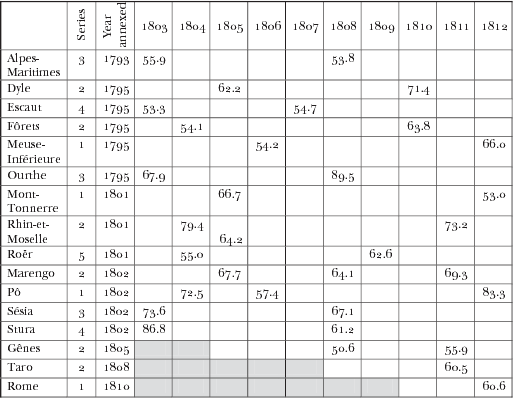
The colleges with their selective membership – especially in the case of the departmental colleges which demanded inscription as one of the department's officially designated 600 plus imposés – attracted higher levels of participation than the primary assemblies (see Table 2a).Footnote 124 This is hardly surprising given that the stakes were so much higher at this level where ‘candidates’ for arrondissement and departmental councils and, above all, for the Corps législatif and Senate were chosen. Even so, on occasions certain colleges struggled to achieve the quorum of 50 per cent that was required to validate each round of voting, unlike in the cantons where a similar requirement was dropped in 1806. At the first convocation of the departmental college of Gênes, its highest ballot only garnered one more vote than the minimum required for quoracy.Footnote 125 Officials in the neighbouring department of Montenotte experienced similar difficulties in assembling the requisite numbers for elections to go ahead.Footnote 126 These were exceptional cases: it was more common for colleges to fail to complete their electoral business when participants drifted away after the first few days (they could continue for up to ten). Such a failure on the part of the college of the arrondissement of Spire in Mont-Tonnerre was unusual only insofar as it occurred twice, on each occasion it met.Footnote 127
Turnout at departmental colleges: sample annexed departments
Shaded area indicates department not yet annexed.
Sources: The above percentages have been calculated from figures in the minutes of the relevant departmental colleges contained in the following cartons of the sub-series AN, F1c iii: Alpes-Maritimes 2, Dyle 2, Escaut 2 and 3, Forêts 3, Meuse-Inférieure 2, Ourthe 1 and 3, Mont-Tonnerre 1, Rhin-et-Moselle 1 and 2, Roër 1 and 2, Marengo 1 and 2, Pô 1 and 2, Sésia 1, Stura 1 and 2, Gênes 1, Taro 1, and Rome 1 and 2.
One German historian saw this apparent lack of interest on the part of Mont-Tonnerre's electors as ‘a sign of the alienation of [its] inhabitants … from the French regime’.Footnote 128 However, both in this instance and more generally, the argument lacks perspective. True, at this level annexed departments did not outperform metropolitan departments, as they did in respect of turnout in cantonal assemblies, but they did not do significantly worse (see Table 2b). Departmental colleges in the metropole achieved polls in excess of 80 per cent on five occasions against three in annexed territories (the Stura in 1803, the Ourthe in 1808, and the Pô in 1812). However, at the other end of the scale annexed departments accounted for fewer instances of turnouts of less than 60 per cent (11 against 13 in the metropole). Furthermore, turnout at this level seems to have held up remarkably well. Indeed, in nearly two-thirds of the departmental colleges in annexed departments which met more than once, attendance actually improved. In the metropolitan category it was less than half.
Turnout at departmental colleges: sample metropolitan departments
Sources: The above percentages have been calculated from figures in the minutes of the relevant departmental colleges contained in the following cartons of the sub-series AN, F1c iii: Aube 6, Aveyron 2 and 3, Cantal 2 and 3, Charente-Inférieure 4 and 5, Côte-d'Or 4, Loiret 1 and 2, Marne 1 and 2, Meuse 4, Morbihan 2, Moselle 2 and 3, Hautes-Pyrénées 2 and 3, Pyrénées-Orientales 2, Haut-Rhin 2 and 3, Seine 3, 4 and 5, Seine-et-Oise 6, Seine-Inférieure 2 and 3, Deux-Sèvres 2, Var 2 and Vendée 2.
The most puzzling feature of participation in the colleges is its lack of correlation with that at the primary level. Uniformly high polling in cantonal elections, the record of Rhenish departments in departmental college elections is uneven. While the departmental college of the Rhin-et-Moselle achieved ballots of over 70 per cent on two of the three occasions it was convoked, its counterparts in Mont-Tonnerre and the Roër hardly distinguished themselves on the two occasions each met. The disparity between the two levels could go in the other direction. There is no mystery concerning its two most conspicuous examples, though. In Rome, shortly after a turnout of only 15 per cent at its inaugural cantonal assemblies, over 60 per cent of the members they returned to its newly constituted departmental college took part in its highest ballot. However, with only half the cantons completing their business, the boycott of the primary elections had resulted in only a small proportion of seats in the college being filled – in many cases by men wishing to be part of the new establishment.Footnote 129 In the metropolitan context, the case of Paris is quite similar. The figure of 88 per cent its departmental college registered in 1803 is largely to be explained by its diminutive size: poor attendance in the cantonal assemblies of that year had truncated the electoral process, which delivered only a quarter of the intended membership.
Why, bearing in mind all that has been said about ‘the worthlessness of these institutions’, did so many notables elected to the colleges bother to take part in their proceedings? It is true that, in an effort to enforce compliance, penalties for non-attendance were introduced: any member who missed three sessions without presenting a valid excuse was to be disenfranchised and so lose the informal advantages that came with membership, such as the opportunity to socialize with influential figures and enjoy special consideration when it came to granting imperial titles.Footnote 130 Doubtless, though, the main reason many members attended college sessions was in the hope of influencing the outcome of the elections. As the prefect of the Escaut put it in 1805, bemoaning their selective attendance, ‘most electors only took part in sessions when they thought that their votes could be useful to someone they knew and served to support their desire to secure a position’.Footnote 131
As with the cantonal assemblies, much that went on before and during votes of the electoral colleges in the annexed departments conforms to our idea of the sort of clientelist politics associated with the age of notables. Just how much, depended in large measure on the progress in the area of what has been termed Napoleonic ‘normalization’. This implied a vision of an electoral politics based on social superiority – of course tempered with a measure of political conformity. How far it was realized in the various annexed territories affected by the upheavals of the Revolutionary period is difficult to say. The prefect of Jemmapes was the first of a number of administrators in Belgian departments to see signs of ‘ralliement’ in the electoral arena when, in 1803, he commented on the considerable presence of former nobles at the college sessions of 1803 and reported that ‘some turned up with the intention of getting the votes of the assembly and becoming candidates for some public office’.Footnote 132 The culmination of this trend was the departmental college's choice, in 1808, of the comte de Caraman, a former émigré and future peer, as one of its two candidates for the Corps législatif, to which he was then nominated by the Senate.Footnote 133 Individuals of roughly similar standing who attracted the votes of a college in other annexed departments, and went on to take their seats in the Corps législatif, included the prince Joseph de Salm-Dyck (for the Roër, 1804) and the comte de Seyssel, one of the empress's master of ceremonies (for the Pô, 1812).Footnote 134 Yet, many of the deputies of the annexed territories fell well short of Napoleon's ideal of men of substantial landed wealth.Footnote 135 Not surprisingly, this was especially true of the department of Rome's seven (indirectly) elected representatives, despite Prince Corsini's involvement in setting up the electoral colleges.Footnote 136
As well as declaring themselves dissatisfied with the ‘quality’ – meaning social status – of the men elected as candidates for the position of deputy or senator, prefects also complained about the practices which had led to their election. In a letter to the minister of the interior Jeanbon Saint-André, once a member of the Committee of Public Safety, now in charge of Mont-Tonnerre, referred to ‘the profound contempt’ in which the two candidates selected for the Senate in 1805 were held, having already, in an earlier report, condemned the ‘intrigue’ which had secured their and others' election. He would make similar complaints with regard to the meetings of 1806 and 1812.Footnote 137 Canvassing at the college elections of 1810 in the neighbouring department of the Roër was considered so disturbing as to merit the emperor's immediate attention.Footnote 138 Indeed, some official reports elaborate on the sort of electioneering tactics (quite acceptable today, but considered unseemly then) that went under the generic label of ‘intrigue’. For example, Jeanbon Saint-André attributed the election of the public prosecutor at the tribunal of first instance at Spire, in Mont-Tonnerre, to the leverage he was able to exercise over the justices of the peace and notaries of the arrrondissement.Footnote 139 A member of the gendarmerie was even more informative on the measures employed by opponents of the administration in the Forêts who ‘did the rounds of bars where electors gathered and through invectives against the prefect and all whom they call foreigners … succeeded in depriving them of all votes’.Footnote 140
On one level, it could be said that these various electoral conflicts were about obtaining official positions and salaries, thereby confirming the received view of Napoleonic elections as simply about place-hunting. The driving force behind such electioneering campaigns was usually the aspiring candidate or his campaign manager. Many of those who put themselves forward for a seat in the legislature were public servants; with prefects debarred from representing the department they administered, the prime beneficiaries seem to have been the sub-prefects.Footnote 141 For them, to be paid two and a half times their previous salary and freed from the burdens of an exacting post must have seemed a prize worth competing for. Former state employees, perhaps hoping to get back on the payroll, were held responsible for some of the worst electoral excesses. The ringleaders behind the openly oppositionist campaign in the Forêts in 1805 were sacked officials, while the beneficiaries – and probably prime movers – of the ‘intrigues’ perpetrated during the 1810 Roër elections, we are told, were two ‘defrocked judges’.Footnote 142
But if on the part of those standing self-interest, sometimes laced with ill will, was a staple ingredient in electoral contests, those voting for them might do so on more principled grounds. The sacked officials who took on the administration in the Forêts were able to draw on a certain amount of native republicanism surviving from the previous decade at least, which was even more pronounced in the adjoining department of the Ourthe. The two men elected by the departmental college of Mont-Tonnerre as candidates for the Senate in 1805 were prominent Rhenish republicans.Footnote 143 In his report on their election, though, the prefect preferred to put the accent on the way the Lutheran interest was mobilized on their behalf. He was even more vehement about similar developments occurring in 1812 at the meeting of the electoral college of the arrondissement of Spire, where, he said, ‘the Lutheran party has dominated’.Footnote 144 In the Roër, how the various confessional groups were represented on the departmental and arrondissement consultative councils, for which election by a college was a precondition of nomination, is known to have been a source of continuing conflict.Footnote 145
In certain regions, the most potent weapon indigenous place-hunters had at their disposal was the feeling of voters, already encountered at primary level, that ‘local’ men ought to represent them at Paris, rather than ‘external’ candidates imposed by the regime or its servants. The evidence of electoral particularism is especially strong at this level. With regard to the 1805 college elections in the Forêts, an officer of the gendarmerie suggested that ‘aspersions cast … on those referred to as foreigners’ led to them receiving fewer votes.Footnote 146 Similar sentiments were at work elsewhere. According to Philippe Sagnac, ‘Rhinelanders wanted indigenous representatives and no amount of administrative pressure was able to make them change their minds.’Footnote 147 However, in the Roër, where Bernadotte was excluded from nomination to the Senate and two local men were presented instead, a more likely explanation is that the general was held responsible for an earlier, and heavy-handed, military occupation of the area.Footnote 148 In fact, if imperial administrators on the spot sometimes had other ideas, central government welcomed the election of non-French candidates. Not only is this evident from the men Napoleon named to represent annexed territories on an interim basis pending the holding of elections, it was also explicit in the instruction to prefects to encourage ‘the choice of the electoral colleges to fall on indigènes rather than anciens Français’.Footnote 149 One striking consequence was that the Corps législatif became a ‘European’ parliament avant la lettre, though historians have been slow to recognize its remarkably diverse membership.Footnote 150
VI
In the end, despite all the difficulties encountered along the way, holding elections in the annexed departments, both at cantonal and college levels, achieved their avowed purpose and ensured that their ‘new French’ inhabitants, like citizens of the metropole, had a measure of representation both in their district and region and in the imperial parliament at Paris. This had evident propaganda benefits for the regime, even enabling electors of the Roër departmental college to refer to themselves as members of a ‘free people’.Footnote 151 More importantly, holding elections in former occupied territories performed untold services in terms of bringing them into the imperial fold. It is clear that most prefects would have liked to see their administrés attending the cantonal assemblies in larger numbers but, as it was, literally millions of Western Europeans took part in the electoral process. At the same, time they took an oath of loyalty to the regime, which, according to its prefect, the inhabitants of the Roër at least observed to the very end.Footnote 152 Equally, prefects often expressed disappointment at the quality of the life members of the colleges and the men they put forward for the imperial parliament. But if their end of term report often read ‘could do better’, it remains the case that through the institution of elections the regime did create or reinforce relations with an important section of the indigenous political class.
For their part, people in the annexed territories showed willingness, even ‘enthusiasm’ (to quote the prefect of the Stura again) to take part in the Empire's official political process to a degree that is surprising given all that has been said about its fraudulent character. Nor in so doing, did they always march to Napoleon's tune or that of his ‘little emperors’ in their neck of the woods. Instead, what Rowe tentatively suggests in the context of the Rhineland may be applied more widely: for all the very real limitations of the imperial electoral arena, members of the indigenous political class and even some ordinary citizens in various parts of the Empire beyond the hexagon saw it as a political space to be ‘colonized’ and to be used to gain whatever leverage over affairs they could exert. Until we have regional studies which seriously integrate Napoleonic elections into their analysis, an assessment of their longer-term legacy in the realm of political culture will have to wait. Demonstrating their use as a Europe-wide window on the Napoleonic Empire must suffice for now.
Finally, all this has an important bearing on how we view Napoleon's Empire more generally. As we have shown, holding elections in annexed territories was not simply the icing on the cake of Napoleonic imperial rule but was somehow fundamental to it. This fact alone raises questions about the validity of the widely held view of the nature of Napoleonic imperialism as essentially pragmatic. The very considerable, and continuing, investment in elections in these areas is surely symptomatic of an abiding commitment to some key organizing principle or vision of empire. The reluctance to suspend them in war-affected areas similarly indicates an almost perverse imperviousness to the sort of ‘short-term pragmatic considerations’ that most ‘Anglo-Saxon’ historians see as preponderant in imperial decision-making.Footnote 153 Far from the expansion of the formal French Empire amounting to a glorified smash and grab raid on occupied territories, the evidence from the electoral arena supports the notion that the imperial regime was self-consciously engaged in long-term empire-building, even if much of the impetus behind it had to do with resource mobilization. Nowhere is the imperial bureaucracy's preoccupation with long-term legitimization more graphically illustrated than in a schedule, drawn up in the interior ministry in Paris, of electoral assemblies to be held in all 130 departments – annexed and metropolitan alike – down to 1837.Footnote 154
As the debate on Napoleon's European empire currently stands, the main rival to the pragmatic interpretation revolves around the concept of cultural imperialism. Broer's argument is that Napoleonic imperialism, both in terms of the attitudes of its agents and its impact on those on the receiving end, was little different from that associated with the great European colonial empires later in the nineteenth century. The study of elections provides partial support for this idea of a French civilizing mission, which showed little respect for pre-existing institutional and cultural differences of subject peoples. However, the record of elections also points to a fundamental difference between Napoleon's continental Empire and most other empires. Whereas once the history of empires tended to be written in terms of exclusion and discrimination, increasingly now the accent is on the less value-laden ‘difference’. Not only nineteenth-century maritime empires – and some of their early modern forerunners – but also the land-based Ottoman and Russian empires have all been characterized as ‘empires of difference’.Footnote 155 Indeed, the list is so long that Burbank and Cooper seem to suggest it is all-encompassing: ‘The concept of empire presumes that different people within the polity will be governed differently’.Footnote 156 As we have seen, this was not true of Napoleon's land-based Empire in Europe.Footnote 157 Within its shifting borders, as its conduct of elections in its new acquisitions illustrates, Napoleon's formal Empire was that rare bird: an empire of citizens, even if, under Napoleon, political citizenship was not what it had been or would be in the future.