


We begin with a somewhat unconventional – but increasingly accepted – analysis of medical malpractice litigation, most specifically about the motivations of patients and patients’ families who bring medical malpractice claims. The picture that emerges is much richer than some economists’ view of lawsuits as investments in the search for money. The collective concept describing what motivates many (if not most) injured patients is the drive to extract ‘accountability’ from those whom they believe had caused them harm. Accountability is in turn a set of superficially disparate yet partially interchangeable drives, somewhat arbitrarily placed into four groups: Restoration, Sanction, Prevention, and Communication. These data and the picture they comprise were developed independently of any consideration of evolutionary or behavioural economics. Yet they might well have been predicted by it. They are in any case very well explained by it. To be specific, the traits we see among malpractice plaintiffs are consistent with the generalised behavioural suites that are both seen and postulated from theories about natural selection working on humans in primitive societies. Even more specifically, there is a very good fit between malpractice claiming and the theory of ‘strong negative reciprocity’.
I. Why people sue
Studies in three Anglophonic countries provide the baseline data about motivations for claims and complaints – the U.S. (Hickson et al., Reference Hickson1992), the U.K. (Vincent et al., Reference Vincent1994), and New Zealand (Bismark and Dauer, Reference Bismark and Dauer2006).
The American study employed in-depth telephone interviews among 127 families who had filed medical malpractice claims alleging perinatal injuries, ranging in seriousness from ‘permanent minor’ (non-disabling organ loss) to grave (quadriplegia, severe brain injury, and death). Responses to an open-ended question – ‘In your own words, what exactly prompted you to initiate a claim?’ – were coded into six general categories. Because the American group was interested in the factors that
Reasons for claiming (%)

‘prompted’ claims-making, the categories included both motivations and influences, or precipitating events. The results of immediate interest were these:
All of the respondents had made money claims. Yet less than a quarter reported ‘needed compensation’ among their reasons for suing. Among those whose baby died, the ‘needed compensation’ response was given only 10% of the time, while ‘Wanted revenge, or prevent it from happening again’ was mentioned by nearly half. Those whose baby had NICU care needed compensation more frequently, but wanted revenge or prevention even more frequently. Hickson summarised the findings with the cautious understatement that even among families who had suffered serious losses, money may not be the only motivation for filing suit.
Data from the U.K. are consistent with those from the U.S. Vincent and colleagues conducted written questionnaire surveys among 227 families who had sued their doctors. The claims, all of which were open (i.e. unresolved) at the time of the study, were drawn from the practices of five firms of solicitors. Of the plaintiffs represented, over 70% alleged having serious long-term effects from their medical care. The respondents in Vincent’s study – including patients, care-givers and bereaved family members – were asked to indicate their agreement or disagreement with 13 statements about their reasons for pursuing a legal claim. The following, from Vincent’s Table 4, shows the frequency of agreement with each statement:

Equally telling, claimants were asked what could have been done to make them feel they did not need to take legal action. The results, from Vincent’s Table 5:

The overall picture is similar to the U.S. data in its richness of motivations, and – though the studies’ presentations are not directly comparable – at least as compelling with respect to the relationship of money vis-à-vis other reasons for making money claims. The U.K. subjects agreed with ‘I wanted financial compensation’ about two-thirds of the time (though only 17% reported that receiving compensation would have prevented their making the claim); yet the frequency of response for compensation was well below ‘prevent it from happening to anyone else’, and about equal to ‘I was angry’. Indeed, over 90% of the respondents expressed feelings of anger; 80% expressed ‘bitterness’; and 55% betrayal. As we will see, these findings offer an interesting key to interpreting some of the other results. Note, finally, that among the actions that could have prevented the need for a claim, explanation and apology plus admission of negligence comprise over half.
Shortly after these data were published, Leonard Marcus and I engaged in a related effort, exploring the usefulness and acceptability of mediation as an alternative to litigation for doctors and their patients who were making malpractice claims (Dauer and Marcus, Reference Dauer and Marcus1997). Our own motivation for that inquiry was straightforward: the medical malpractice system is known to be grossly inefficient as a social compensation scheme (Studdert, 2000), ineffective as an injury-prevention device (Mello and Brennan, Reference Mello and Brennan2002; Conrad, 1998), and somewhere between inexplicable and grotesque in its personal and ethical consequences (Dauer, Reference Dauer and Sharpe2004; Charles, Reference Charles1984, Reference Charles1985, 1989). We questioned why such a system would persist, given that neither doctors nor patients found it satisfactory (Shapiro, Reference Shapiro1989).
To investigate that question we conducted focus group analyses among the major interests involved in malpractice litigation in three cities in the U.S. These analyses, reported fully elsewhere (Dauer et al., Reference Dauer, Marcus and Payne2000), led to a number of useful insights, one of which was captured best by a plaintiffs’ lawyer in one of the focus groups: ‘When someone is injured by a medical error, the legal system is the only place you can go to get accountability. That’s what this is all about. Accountability.’
The idea appeared throughout the focus group sessions. Although Vincent had used the same word in his coding of questionnaire responses, this seemed broader. As this paper suggests, ‘accountability’ turns out to be broad enough to encompass all of Vincent’s findings and Hickson’s as well.
II. Defining ‘accountability’
A quick romp through the literatures of psychology, philosophy and to a lesser extent political science showed the word to have a number of accepted meanings. In psychology, for example, ‘Accountability is the condition of being answerable for conducting oneself in a manner that is consistent with relevant prescriptions for how things should be’ (Gelfland, 1999). The person being held accountable must ‘explain their choices and actions’ after the deed has taken place, i.e. engage in the explicit telling of causes and reasons (Haines, Reference Haines1955). Discussions in the political sciences included both the obligation to explain and liability for sanction – viz. the power of norms, and the duty to accept the consequences for violating them:
‘Accountability is the duty to give account for one’s actions to some other person or body . . . . ‘a liability to reveal, to explain, and to justify what one does, how one discharges responsibilities, financial or other, whose several origins may be political, constitutional, hierarchical, or contractual.’
(Scott, Reference Scott2000; Shane, 1994)The net effect is functional as well as philosophical – accountability occurs when one person is obligated to recognise and respond to another’s needs or concerns. It is a technique by which transgressions from those expectations can be prevented or corrected. In healthcare in particular, accountability has been defined as both the performance of responsibilities, and a ‘commitment that is regularly and widely communicated’ (Beckham, Reference Beckham1997).
Examples like these from the professional literatures and from lay usage can be found by the score. Together they suggested not so much a diversity of views as a multitude of emphases within a collective concept. Lawyers are nothing, however, if they are not taxonomists, classifying (for better or worse) the richness of complex stuff into a smaller number of easily manageable categories. Stepping back from the examples drawn from usage and from the efforts at formal definition, I propose the meanings (or the dimensions) of accountability can be captured in four categories: Sanction, Correction, Restoration and Communication.
Sanction
People who do bad things should be punished. The reasons for sanction as accountability are in turn various. Punishment serves as vengeance, as expression of outrage personal or social, as moral desert, as restoration of the equilibrium of good and evil that was upset by the doing of the bad act. The effect of all of these is the same: punishment means inflicting harm on a wrongdoer even when its infliction does not in any direct and objective way necessarily benefit the victim. Victims of medical negligence articulate the value of sanction with some frequency: ‘I want that doctor’s licence revoked. His stupidity blinded my baby while he drives home in his Mercedes.’
Restoration
In contrast to Sanction, which imposes a loss on the wrongdoer without necessarily achieving a gain for the victim, Restoration as accountability focuses on compensation for the victim with a secondary concern for its impact on the wrongdoer. ‘He messed up and now I have to pay all these extra costs, and I’ve lost income to boot. It was his fault, and my loss, so he has to pay me back.’ Restoration includes, but is not limited to, financial compensation.
Correction
Wrongful behaviour results in social (or moral or personal) loss. To avoid those losses in the future requires preventing the wrongful behavior from happening again. Someone who did the bad deed once just might do it again, unless they can be trained otherwise. Meeting bad acts with swift punishment should do the trick. If the response is public it might deter similar actions by others as well. Behead one traitor in the public square and everyone might behave better in the future. Lawyers refer to this aspect of civil liability as deterrence.
Communication
This fourth dimension of accountability is at once the most difficult to define and the most interesting. It covers such familiar phrases as: ‘You owe me an explanation.’ and ‘Come clean’ and ‘You let me down; come forward and ’fess up’ and ‘take responsibility’. Common to all is the idea of disclosure and communication. The contexts in which this dimension arises are often those in which one person has trusted or depended upon another. Erring politicians are typically ‘held accountable’ in this way, as are employees and, notably, professionals who hold themselves out as caring as much for their clients as for themselves. The desire for accountability in the classic hit-and-run, or in a fraud committed by a total stranger, is seldom of this fourth type. But it is frequently this type of accountability that attends a breach of faith or an injury caused by the lack of care from one in whom we have placed our trust, or at least from one who welcomed our expectation of better things. Such a person is not allowed simply to provide restoration or to suffer a flogging stoically. Punishment does not quite do it. In these cases we demand something more – the perpetrator has to face those who have been let down and explain themselves. Apology is a frequent form of Communication, as is disclosure, and the two often go together.
Healthcare is not alone in seeing injured persons moved to achieve accountability. Nearly identical expressions have occurred in anecdotal reports from events as disparate as the UCLA Medical School’s profitable sale of body parts from donated cadavers, the scandal surrounding the United Way’s self-dealing fiasco, the U.S. ‘911 Commission’ report and the Secretary of State’s refusal to ‘take responsibility’, among many other widely reported scandals and gaffes. In the journalism surrounding all of these events there can be found each of the four dimensions of accountability: Sanction (punish the wrongdoer), Restoration (compensate or repair those injured by the wrong), Correction (prevent this from happening again), and Communication (make apology, confession, disclosure, or express recognition of the wrong and the harm it caused).
More to the point, these four facets or dimensions of the collective term neatly capture the picture of motivations drawn by both the U.S. and the U.K. malpractice claiming studies. An opportunity to test that idea came about when Dr. Marie Bismark, then working with the Health and Disability Commission of New Zealand, assembled a collection of complaints about doctors that had been brought to that Commission.
III. Accountability and the malpractice claiming data
The situation in New Zealand is quite unlike that of the U.S. and the U.K. In New Zealand, suing for negligently caused medical injuries is essentially impossible. Injured people have, instead, two paths they might pursue. One, which can deliver monetary compensation, is to make a money claim with New Zealand’s Accident Compensation Corporation (the ACC). The system is now formally no-fault and for years has been effectively so. While compensation awards are modest by American standards, the process typically requires no legal assistance, and payments are made within months rather than years. The system has been described as one of the world’s easiest processes to access and navigate (Paterson, Reference Paterson2002; Bismark and Dauer, Reference Bismark and Dauer2006).
A separate and completely alternative process is available for responding to non-monetary demands, or complaints. Injured patients and their families can make a complaint with the Health and Disability Commission (HDC), which may respond by mediation, by referral to the licensing division of the Ministry of Health, or by its own formal investigation. Unlike the situation with medical boards in the U.S., the HDC welcomes the active participation of both patients and providers in its investigations. Although action against a practitioner’s licence is a possible outcome, the central focus of the HDC process is re-establishing communication between the doctor and the patient, understanding how the adverse outcome occurred, and promoting learning from the event.
Bismark’s database was the letters written by patients to the HDC, from which were extracted the complaining patients’ own explanations of what they were seeking in making their claim. Bismark learned of the four-part accountability work and I learned of her HDC study serendipitously. We agreed to try coding the explanations into the four-part schema, without re-interpreting the complaints from which they had been excerpted. The advantage of doing this seemed threefold: in addition to testing how readily the scheme fit these new data, this analysis (or any like it) would add one more culture to what was already known about claims-making in the U.S. and the U.K. Perhaps more important, the New Zealand data could strengthen those earlier findings in several ways. For one, these were patients’ explanations given without prompting at the time, rather than survey responses or interview recollections after the fact. They were, as well, data from a country with a very different legal tradition. Moreover, they could be an effective counter to a methodological criticism sometimes laid against the Hickson and Vincent findings.
Survey research is notably prone to biases, one of which is the desire people have to seem proper, or to be seen as having acted out of good rather than base motivations. The high rate of reports that ‘I did it to prevent others from being hurt’, compared to the rate of reporting that ‘I did it because I had a chance to get some money’, could be attributable to this source of error. The New Zealand HDC cannot effect money compensation; and money compensation in proper cases is easily available from the ACC. Therefore, and apart from those few people who may have been confused or ignorant about both parts of New Zealand’s two-track system, the HDC complaints should be unaffected by this source of skewing – people write to the HDC saying what they want, knowing that money is not something they can get.
The New Zealand data satisfied each of these expectations. The four-part ‘accountability’ scheme worked well, resulting in a trivial number of inter-coder differences, all of which were easily resolved. The results are consistent (though due to methodological differences not statistically comparable) with Hickson’s and Vincent’s findings of a decade earlier. And but for a few complainers whose letters did mention the need for compensation, the largest majority seemed unalloyed with that motivation (Bismark et al, Reference Bismark2006). The findings are these – a pattern of motives by now familiar:

These, then, are three studies’ data and findings about motivations for claiming in the aftermath of medical error. The next question is what they mean.
IV. The weak, the strong and the very strong hypotheses
I propose three hypotheses. The first, offered as the ‘weak’ claim, is that these reported motivations are real. Although people in the U.S. and the U.K. bring claims against their doctors in which they demand only money, that may in many cases be due to the fact that, in the U.S. and the U.K., making a monetary claim is the only action that can produce a tangible response. The dollars nominally at issue are surrogates in some of those cases where the actual need is to work through anger, or to seek punishment or correction or communication or revenge. In other cases, claiming dollars is the only way to gain recognition of a legal claim whose intended endpoints are non-monetary, such as discovering the facts, or punishing the doctor, or seeking to prevent recurrences of similar errors. For lawyers this much alone is useful to know. If litigation is inefficient as a compensation device and questionable as a deterrence device, and if money compensation – the only thing it is able to deliver – is not what some claimants actually want, then the case for developing other avenues for relief is all the stronger.
The second hypothesis, which I will call the ‘strong’ claim, is that the four aspects of accountability are related in some very practical ways: specifically, that they are, under fairly common conditions, frequently substitutable for each other. Predating even the first of the studies described here, social psychologists had learned that some injured people experience, in the immediate aftermath of an injury, an inchoate realisation of loss and of having been wronged, without any clear definition of the nature of the wrong or of their own responses to it. Until a series of psychological processes occur, in a cascade known as ‘attribution’, multiple possibilities of action or non-action coexist as unrealised possibilities (Lloyd-Bostock, Reference Loyd-Bostock1991). An injured person, that is to say, may experience a disquiet that can be slaked by ‘holding someone accountable’ even without knowing ex ante exactly what that means. Attribution theory postulates that events occurring in the aftermath of the wrongful act shape the character of the response, often by reinforcing or selecting against one of its guises or another. To suggest what may be a useful metaphor from the world of quantum physics, the several dimensions of accountability may coexist as simultaneously possible futures created by distress at sensing a wrongful act. Not until a precipitating act occurs (the act of measurement, in quantum mechanics) does the inchoate state (the ‘wave function’) collapse from a distribution of probabilities into a single coherent reality.
The ‘attribution’ phenomena support the strong claim, that there are moments in the aftermath of a wrong when the inchoate thirst for accountability could be slaked by achieving any of its four dimensions. That is to say, that they are often effectively motivational substitutes. This is not always so – some claimants sue for money because they need money. The strong claim therefore goes only this far: that among a population of iatrogenically injured patients there will be a distribution of motivations for responding to the injury; that these motivations are well described by a simplified though non-arbitrary group of four main themes that can be simultaneous and overlapping as well as distinct; and that for a significant portion of that population any one or more of these four aspects of accountability can be satisfied, in at least substantial part, by an adequate response to any one or more of the other three. ‘Accountability’, that is to say, is not just a philological grouping, but also an underlying human need that can be shaped by circumstances into a variety of seemingly different behavioural motivators.
There is, finally, the ‘very strong’ claim, that the four aspects of accountability are substitutes not because they can be practical equivalents, but because they are linked together deeply in the human psyche, as parts of a more complex response to the perception of wrongful injury. These four are, in other words, much the same thing, or at the least they are intermediate goals in service of a common underlying force.
The substitutability of at least some of the four dimensions is suggested by Vincent’s data themselves, which report that claims for money (Restoration) could have been avoided had the implicated doctor apologised or recognised the harm (Communication); and by both Vincent’s and Hickson’s findings that the express purpose of a money claim, albeit framed of necessity in dollars, is often revenge (Sanction) or protection of others from the same kind of harm (Correction).
These interpretations are in turn supported by other recent findings from unrelated investigations which, when taken together, lend stout support to the strong claim, and some credence to the very strong claim as well. These later findings come from studies of the effectiveness of apology and disclosure. Both are instances of Communication. Each has been shown to be substitutable at least in part for Restoration (specifically, compensation), and for Sanction.
In what became almost instantly a classic study, Jennifer Robbennolt (Robbennolt, Reference Robbennolt2003) examined the effects of apologies on subjects’ demands for compensation following a simulated injury. Groups of people were asked to place themselves in a scenario in which they were injured through the fault of another. They were offered a cash settlement in lieu of a formal claim, and were asked if they would accept it. The first round gave a baseline. Comparison subjects were then given an apology, and asked whether they would accept the same cash settlement. The apologies were of two types – a partial apology (‘I am sorry this happened to you’) and a full apology (‘I am sorry I did this to you’). The effect of each type of apology on the acceptability of the same settlement amount was this:
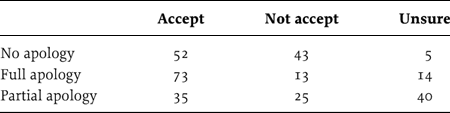
Having a full apology increased the acceptability of the same settlement offer from 52% to 73%, and reduced the rejection rate from 43% to 13%. Interestingly, the partial apology had the opposite effect – it made the prospect of settlement worse. A study of patients who were made to wait for excessive times in physicians’ offices found similar effects. An apology ‘with ownership’ (the same as Robbennolt’s ‘full’ apology) ranked highest in patient satisfaction scores. Explanations (‘some patients needed extra time’ and ‘I have had some problems today’) were intermediate; and an apology without ownership (the same as Robbennolt’s ‘partial’ apology) ranked the lowest (McCord, 2002).
Explanations for these unsurprising phenomena abound. One is the ‘equity theory’: when A injures B, A has created an inequity in their relative positions relative to where it was before the injurious act. By apologising, A lowers themself in B’s presence, thereby restoring some of the equity of the previous relationship. Another explanation is the restoration of trustworthiness: by apologising, a sincere A appears to be acting in a way that makes the cause of today’s harm appear unstable – the event, that is to say, is less likely to occur again by an A who explicitly recognises the norm and the departure from it, appreciates the injury, and expresses regret for its effects.
Because money may have been sought by patients in the U.K. and U.S. studies as a surrogate for punishment or impetus to correction to begin with, we cannot conclude from Hickson’s and Vincent’s studies alone that money sought after claiming is exchangeable with Communication (apology); but Robbennolt’s findings taken in the context of Vincent’s do support that proposition.
In addition to these findings on the effects of apology, other recent studies have shown similar effects for voluntary disclosure of medical errors, of which the patient may not initially have been aware. Disclosure, like apology, is an example of the Communication dimension of accountability. One private insurance company (COPIC) has found a very favourable effect from its programme of ‘3Rs’ – Recognise, Respond and Resolve – in which physicians are encouraged to initiate communication with patients immediately after an unexpected result rather than waiting for the patient to discover and press a claim. Modest compensation is offered in some cases for actual monetary needs and the physician, where appropriate, apologises and offers to continue to work with the patient. In over 930 instances of matters handled through the 3Rs programme during its first four years, there have been two formal claims (both now settled) and no lawsuits. The mean claim payment was an extremely modest $5,326 (compared to over $300,000 for the average paid claim outside the programme). (COPIC private correspondence, 2005). The equally well-known Lexington VA programme had similar results: a policy of voluntary disclosure accompanied with an offer of restoration had economic results favourable to the hospital, as well as some suggestion of therapeutic advantage (Kraman and Hamm, Reference Kraman and Hamm1999).
The experimental studies of disclosure are several, varying in their approach and consistent in their results: Mazor, for example, found that nondisclosure of an error increases patients’ propensity to sue by a minimum of 17% (for a simple monitoring error) to nearly 650% (for a missed allergy diagnosis with a non-serious outcome) (Mazor, 2004). Witman reported a near doubling of the probability of suit and more than a doubling of the probability of reporting the physician to a medical licensure board if an error were made but not voluntarily disclosed (Witman, 1996), suggesting again that Sanction (reporting) and Communication (disclosure) are exchangeable in at least that direction.
While none of these studies unequivocally confirms what I have called the ‘very strong claim’ – that the four dimensions of accountability are in significant part instantiations of the same underlying complex – that would be so simply because none of them were designed to test that hypothesis. What we can glean from them at a minimum, however, is a set of results that are not inconsistent with the hypothesis, and which without too much strain tend to support various aspects of it. The ‘weak claim’ is beyond much doubt. The ‘strong claim’ seems well supported. The ‘very strong’ claim is an inference that requires a theory.
V. Sociobiology
Theories are supported by data from which confirming statistical inferences can be drawn. Inferences from statistical data gain strength by having a sound theory that explains the data, and that makes additional empirically testable propositions about the theory. A theory that supports both the strong and the very strong claims is the theory of reciprocal behaviour, and most particularly the theory of the evolution of ‘strong negative reciprocity’. I want to suggest that the ‘substitutability’ of the four facets of accountability is consistent with recent developments in evolutionary biology and its cognates in biological economics and game theory (Jones, Reference Jones2001; Jones and Goldsmith, Reference Jones and Goldsmith2005; de Waal, Reference De Waal2005).
The central proposition of Sociobiology is that psychological dispositions and behavioural traits are selected for through evolutionary processes, just as long tails and good vision and webbed feet are. People whose genes propel behaviours that enhance their own survival tend to propagate those genes into the future, to the competitive disadvantage of other people not so fittingly endowed. As one wag put it, a gene-driven propensity toward eating nothing but stones would not likely make it into the behavioural repertoire of the next generation.
In reality, it is rather more complicated than that, because humans, for good and sufficient anatomical reasons, are highly social creatures (Rosenberg and Travathan, Reference Rosenberg and Travathan2001). We developed, long ago, as hunter-gatherers dependent for our individual survival on the functionality of our immediate small group. This sociality puts certain constraints on behaviours, otherwise ‘red in tooth and claw’, that might well serve another animal capable of making it as a loner: if any of us were to act so selfishly and at the expense of our neighbours that the group itself was endangered, we would individually go down along with it. On the other hand, if we all acted with selfless preoccupation only for our fellows, ‘cheaters’ who acted solely out of self-interest could free-load on the group, and the rest of the reciprocators would be the losers. The trick, then, has been to evolve a suite of traits that optimise the blend of individual survival within the group with more co-operative – if personally costly – behaviours that assure group survival within the environment (Ridley, Reference Ridley1997; Richerson, Reference Richerson and Hammerstein2003; Bowles et al., Reference Bowles and Hammerstein2003).
This environmental demand for optimising individual and group survival is supposed to have led, through the process of natural selection, to behaviours that are not fully selfish. In addition to those altruistic acts that benefit kin (hence those with genetic consanguinity), and those that can be explained by time-shifted, mutually beneficial exchange (termed ‘reciprocal altruism’), some others are simply not ‘rational’ for an individual behaving apart from the needs of the group. Humans co-operate and benefit each other even when there seems to be no obvious individual genetic advantage to doing so.
The adaptive problem can be illustrated with an example drawn from elementary game theory. Assume A and B are about to play a five-round game of exchanging favours. A goes first and, if A expected later reciprocation from B, A might consider helping B in round one even though doing so would have a cost for A – but a net gain for A if B in fact reciprocated. B might return the favour, helping A in round one, if B knew there would be future rounds coming in which exchanging favours can be equally beneficial. A and B, however, contemplate round five. How should each of them behave? In this common variation of the game of Prisoner’s Dilemma, A and B are both – if acting in no way but rationally – driven by self-interest to ‘defect’, or fail to co-operate in round five and, by reverse induction, in every round before. Consider B first. Whatever A does in the first half of round five, B is individually better off in the second half of round five by defecting, or ‘cheating’ – that is to say, by not returning the earlier favours. From a strictly ‘rational’ point of view, B maximises by failing to reciprocate when there is little probability of continuing the game with A. Which explains, of course, why people are impolite to each other on New York subways, yet openly friendly (though not necessarily to New Yorkers) in Montana. A, who goes first in round five, predicts this cheating by B and so retaliates in advance – by refusing to co-operate in the first half of the round. And so on back up the rounds with each suspicion of later cheating by the other resulting in a failure of co-operation in the half-round before. The result is that individuals maximising only their individual advantages in the short run would cause co-operation within the group to collapse in the long run.
Co-operation, however, is essential to human survival – and we do it all the time. But cheating by individuals is also very tempting. In a tribe made up entirely of co-operators, a migrant or mutant cheater would have a field day – no-one would suspect defection (a game theorist’s word for cheating) in round five, every co-operator in the group would be the loser, and the cheater would breed better than anyone else. A group made up of all cheaters, on the other hand, is a less advantageous environment for all as well as for each of its members. The advantages of having a bit of the cheater in the makeup are nonetheless so great to the individual that the possibility of being an occasional cheater is a trait unlikely ever to be fully extinguished (Maynard Smith, Reference Maynard Smith1978; Trivers, 1975). So how does the group survive having the cheaters in its midst?
VI. Strong negative reciprocity
As the previous example demonstrated, the equilibrium behaviour for wholly selfish individuals living in a group is what game theorists refer to as ‘defect-defect’. Skyrms put it most concretely: where hunting stag is of necessity a collaborative activity with significant advantages for the entire group, and hunting hare is something that can be done by one individual with some advantages to themself, the best solution for the individual and the clan is for everyone to co-operate in hunting stag. But if some people hunt stag while others defect and hunt hare, the group is less well off and the stag hunters may be very badly off. Absent explicit or implicit bargains, and while the assigned probabilities of success and failure and of others’ defection change the outcomes, under most plausible circumstances the best net payoff for each individual is to hunt hare – the results are modestly sustaining and the risk of a large loss is eliminated. The group and everyone in it, as a result of these individual calculations, would then suffer from an absence of co-operation (Skyrms, Reference Skyrms2004).
Humans nevertheless do hunt stag together. Such co-operative behaviour has a number of explanations – including kin-based altruism, as Wilson first described it (Wilson, Reference Wilson1975); or reciprocal altruism, in which my hunting stag with you today is repaid with your hunting stag with me tomorrow. Reciprocity has individual costs. Incurring those costs is worthwhile if there is a reasonable expectation that there will be returns to that investment in the future (Kaplan and Gurven, Reference Kaplan and Gurven2001), Humans, however, exhibit a more puzzling trait: ‘. . . a predisposition to cooperate with others, and to punish those who violate the norms of cooperation, at personal cost, even when it is implausible to expect that these costs will be repaid’ (Gintis, Reference Gintis2006), This trait has been termed ‘strong reciprocity’. It is ‘positive’ when the person engaging in it rewards another, and ‘negative’ when the person doing it punishes another, without expectation that they will individually reap any benefit from their act.
‘Road rage’ may be a modern example of strong reciprocity. Being cut off while driving on the highway moves some people to want to catch and punish (by cutting off in turn) the original transgressor, even though the risks of injury to oneself cannot be justified by any reasonable expectation that an improved behaviour by the transgressor will net any direct benefit. In other words, we are willing to incur personal costs in attempting to punish the cheaters even though we ourselves will likely never encounter them again.
From the group’s perspective, having some number of strong reciprocators in the population is an effective way to assure conformance to important social norms (Kaplan and Gurven, Reference Kaplan and Gurven2001). If a norm violator knows there are strong reciprocators out there, they are less likely to violate the norm. Taxicabs could hardly operate otherwise – any one of us could cheat on the fare after the ride (especially in the absence of an organised police force, or in an acephalous group of hunter-gatherers). But if we know that the driver will invest even more than the value of the fare to catch and punish us, we are less likely to cheat in the first place (Fehr, 2002).
There is experimental evidence for the existence of strong reciprocity. Of the various configurations the best known is the game of ‘Ultimatum’. In Ultimatum one party is provisionally given a sum of money, say $100. That person, the Proposer, can offer to give a share of it to a second party, the Recipient – say, $50. If the Recipient accepts the offer, the Recipient keeps what was offered and the Proposer keeps the difference. If the Recipient rejects the offer, neither party gets anything. A purely selfish Recipient, playing a game in which the probability of ever knowing the other player’s identity is zero, should accept any amount greater than zero, because if that is all that was offered then taking it is better than getting nothing. A Proposer who expects the Recipient to be purely selfish in this way would then offer nearly nothing. What happens, however, is not that. In numerous trials in over 30 different cultures Proposers tend to make offers that are more equal (the mode is 50%) and Recipients tend to reject offers that they feel are too low (typically anything less than 30%.) Rejecting an offer is like road rage – it inflicts a punishment on the Proposer at a significant cost to the other person, under conditions in which reciprocal altruism is not expected to occur.
The experimental data are robust. Rejection in Ultimatum occurs even when the stakes are high – ten weeks’ wages in Slovakia, for example (Gintis, Reference Gintis2006), and three months’ wages in Cameroon (Fehr, 2002). And while the modal offer changes from one culture to another, the frequency of rejection does not (Gintis, n.d.). In a variant called ‘Punish the Dictator’ there are three players. The Dictator is given a sum and allowed to share it with the Recipient except that here the Recipient has no option to reject, so that whatever the Dictator gives is the outcome of that part of the game. A third person, the Punisher, who observed what the Dictator did, is then allowed to punish the Dictator by spending their own funds – for each dollar the Punisher spends, the Dictator will lose $3.00. As the Dictator’s offers to the Recipients depart from 50%, the propensity of Punishers to spend their own money on punishing rises.
Despite the value that strong reciprocity has for a group whose survival may depend on individuals observing its norms of co-operation, the puzzle is how such a trait could have been selected for. Strong reciprocators incur costs in personal fitness. Should that not cause them eventually to become extinct, as they otherwise compete with those who do not incur those costs? That doubt leads some to argue that there is no such trait – that, for example, the experiments are not truly opaque, in the sense that the Recipients may indeed expect to be known or to interact in the future with those whom they punish (hence some possible payoff to punishing today) (Hagen and Hammerstein, Reference Hagen and Hammerstein2006). Moreover, this argument goes, conditions in pre-literate societies never really did have completely anonymous and isolated occasions for interaction. The behaviours described as strong reciprocity may therefore be the result of reputational investments (or ‘costly signalling.’) A more frequently heard argument is that strong reciprocity is just a ‘maladaptation’ of ordinary reciprocal altruism – namely, that the propensity to co-operate and to punish cheaters in contexts where repeat interactions are possible is exhibited when there is no possibility of future interactions, just because we humans ‘mistake’ the one-shot situation for the ‘repeat occasion’ situation (Fehr and Heinrich, Reference Fehr, Henrich and Hammerstein2003).
Fehr and Henrich, among others, counter this supposition in several ways. They point out that there is no evidence of strong reciprocity among non-human primates. If the maladaptation theory were correct, we should see such ‘mistakes’ among them too; but we do not. In addition, ethnographic data suggest that humans did have frequent one-shot encounters with non-group, non-kin strangers, and that the cost of not distinguishing between group-mates and strangers would be high. Laboratory experiments also show that humans can distinguish between one-shot and repeat interactions – changing their own co-operative behaviour to suit. For example, 80% of subjects tested reported stronger anger when cheated by a long-term partner than by a stranger. Fehr also argues (Fehr, 2002) that when a group faces a severe threat (and when defection may be most dangerous), the probability of a group future is too low to overcome the motivation for individual survival and so norm enforcement through ordinary reciprocity will fail.
Elaborate mathematical modelling has been applied to show how a population could be stable with both opportunists (free-riders) and reciprocators (punishing free-riding) among its numbers (Sethi and Somanthon, 2000). A group that includes strong reciprocators would have a positive fitness group trait, which in turn would help assure both the reproduction of reciprocators and the ostracising of cheaters (Bowles and Gintis, Reference Bowles and Gintis2000). As for the individuals involved, the trait would be net positive if the within-group costs of strongly reciprocating were less than the between-group advantages of having some individuals doing so (Bowles et al., Reference Bowles2003).
Kaplan and Gurven likewise conclude that strong reciprocity is one of a complex of behaviours conducive to the maintenance of social norms, and that the basis of the behaviours is genetic. Their list reads like a recipe for the optimisation of selfish and groupish advantage:
‘We . . . propose that . . . natural selection has shaped our psychology to possess the following traits:
1. Perceptual sensitivity to potential gains from cooperation.
2. Motivation to take advantage of those gains.
3. Perceptual sensitivity to opportunities for free-riding.
4. Motivation to avoid being free-rode upon.
5. Motivation to take advantage of opportunities for free-riding.
6. Perceptual sensitivity to . . . the personal costs and benefits of social norms . . .
7. Motivation to negotiate social norms so that own personal benefits from cooperation and free-riding are maximised.
8. Motivation to obey and enforce social norms so that punishment is avoided and those who disobey norms or fail to enforce them are punished.’
The recipe is probably unconscious. Much of our contemporary psychology is a mechanism for being able to solve complex social problems efficiently and without the need for elaborate conscious rationalisation (Cosmides, Reference Cosmides1989).
The evolutionary basis of strong reciprocity is not uncontroversial. Reflecting a debate that is at least as venerable as Lewontin’s critique of Wilson, some would challenge the need for any such biological mechanism, preferring under the principle of theoretical parsimony to find the origins of behaviour in environmental or cultural factors. These behaviours, that is to say, may be learned rather than genetic (Bohrer, Reference Bohrer2006.) While the neurochemical determinants of aggression in other vertebrates are well documented, and the brain structures involved are ‘phylogenetically old’ and therefore very likely a shared genetic heritage (Kruk, Reference Kruk2004), it must be said that no conclusive response is possible. This is a field of inquiry marked by inference rather than syllogism.
Among evolutionary theorists themselves strong reciprocity is a battleground for the ongoing debate about group selection – whether, in fact, group selection actually occurs; and if does, how it interacts with selection acting on individuals. Those details, however, are for the present purpose beside the point. As Fehr and Henrich note, it may not matter whether strong reciprocity is a distinct (and distinctly selected-for) trait, or a penumbra of repeat-occasion reciprocity in general. The fact is, the propensity exists and it seems to have the effect postulated for it.
While road rage and medical malpractice litigation are likely not behaviours seen in the Pleistocene, modern times are a tiny fraction of that period. With the exception of bacteria and fruit flies, evolution among the animals is pretty slow. Traits take a while to evolve; and once here they may require a while to be selected against even if they do become dysfunctional. Humans, so far as anthropology can tell, existed for about two million years as hunter gatherers; much of our modern social behaviour probably emerged during the last 100,000 years of that time. The post-Pleistocene era, during which there developed what we now think of as human society and culture, is only about ten thousand years old (Richerson, Reference Richerson and Hammerstein2003; Nelson and Greene, Reference Nelson and Greene2003). Cars and highways and courtrooms have been here for even less. Strong negative reciprocity may have evolved to solve the problem of the hunter-gatherer’s Prisoners’ Dilemma. Its use in promoting road rage may be vestigal, and a marginally dysfunctional exaptation at best.
Those are the basics. With that much said, and if the strong (or very strong) hypothesis is correct, it should be possible to match the sociobiological findings with the empirical data that describe the four facets of accountability and their interactions.
VII. Accountability and theories of social co-operation and norm enforcement
The four facets of accountability that fit the empirical data about malpractice claiming were, again, Restoration, Sanction, Correction and Communication.
Restoration
‘Pay me’ is the easiest of the four to fit within the pre-psychological understanding. In an environment marked by scarcity (of food, or water, or breeding opportunities) competition is inevitable and a propensity to compete is pro-adaptive. While some possibilities for positive-sum exchanges frequently exist, eventually zero-sum games are the only ones left: either Gorg will breed with Loana this year, or Tumak will. A genetic disposition against competition in this circumstance would pretty well ensure that any don’t-compete-for-breeding gene would disappear from succeeding generations. Therefore, while much of the recent work in evolutionary theory focuses on the emergence of co-operation, the underlying premise is that co-operation is useful only because direct competition does not always work. To put it more intuitively, the optimal strategy is a blend of competitive and co-operative capabilities and traits. When faced with what looks like an unadorned zero-sum event, Gorg’s genes will direct him to compete, or their lineage will end right there.
Money is a modern surrogate for food, water, breeding opportunities, and virtually everything else, simply because it can be exchanged for each and all of them. When Gorg injures Tumak and gets away with it, Gorg has made Tumak less fit. When A injures B and gets away with it, B has lost the surrogate for all of the resources necessary for B to compete. If there is a low-cost way for Tumak to ‘settle the score’ and return his competitive ability to where it was before Gorg ruined it, it makes sense for him to do so. What makes it possible for Tumak to achieve this restoration after the injury is attributable to the strong reciprocity of the rest of the troop – if out of the blue an uninjured Tumak steals Loana from Gorg, the propensity of others to police against cheating makes Tumak’s behaviors risky. But if the rest of the Shell People see that it was Gorg who cheated – Gorg having injured Tumak much to Tumak’s disadvantage – the troop as a whole is better off by facilitating Tumak’s efforts to compensate himself at the cheating Gorg’s expense. Today, that’s called litigation.
In the aftermath of an injury, group sentiment – the propensity of others to want cheaters punished – creates a low-cost way for the injured party to recapture an ‘unfairly’ lost ability to compete, from the cheater uniquely; and the competitive component of the optimal behavioural suite moves the uniquely injured party toward actions that will recapture whatever was taken from him. Today, that’s called Torts.
Sanction
Route 24 is the main east-west road through Teller County, Colorado. It is for most of its length two lanes. The towns it goes through are few and small; but to get from Colorado Springs to the skiing areas, this is the only way to go. For its location and width, Route 24 is a very busy road. The land on the sides of the road is forested, with a few homes scattered here and there. A few miles east of the village of Florissant there is a large sign. It is about 16 feet high and 20 feet wide, supported by telephone poles sunk into concrete footings; and it has been there for at least three years. The background is bright red; the letters are large and bright white. At night it is lit by a bank of flood lights. The sign reads, ‘We regret doing business with A.J. and Lenore Hotchkiss, who now own Prudential Realty’. The sign was put up by Jineen McWherter, who promises that ‘The sign will stand as long as we can make it stand’. Apparently, a business deal went badly, and Jineen blames A.J. and Lenore (Internet, 2005).
Measured in the dry specie of economics, this could not possibly be rational. The lawsuit between the McWherters and the Hotchkisses is long over; there seems no chance of any more money changing hands. What is Jineen getting out of this? Or, more in keeping with the themes of this paper, on what spandrel is this behaviour written?
Evolutionary biologists offer a couple of different rationales for aggression, which for this purpose is the biological equivalent of punishment, or Sanction. The earlier view was that aggression is a behaviour suited to reducing the fitness of another individual – either directly, or indirectly by physically barring them from a resource and thereby reducing their fecundity or potential to survive. When resources are scarce, or when others are encroaching on what there is, natural selection would favour the persistence of a tendency to use aggression as a competitive strategy (Durham, Reference Durham1974; Bell, Reference Bell1996; Kruk, Reference Kruk2004). (As a colleague once said about physician groups jockeying for position during the growth of managed care, ‘When the vittles get scarce, the table manners change’.)
The more recent development of the theory of strong reciprocity offers a compatible if not more cogent explanation.
The group as a whole benefits when its norms are enforced, yet enforcement imposes a cost on the enforcers, who may not be able to capture the benefits of their own actions. To an economist, this is a ‘free rider’ problem. Anger has been proposed as nature’s solution to the free rider problem. Anger has demonstrated cognitive effects. It results in exaggerating the magnitude of a perceived threat, and in reducing the apparent cost of a current response (McElreath, 2003). Because co-operation has been such an essential condition of human survival, in the course of time there has been a selection bias in favor of emotions – like fear, and anger, and shame, and what we now call moral outrage – which overcome time discounting and underestimation of deterrence, and generate behaviors that benefit the group and therefore its individual members despite the common goods or free rider dilemmas (Fessler and Haley, Reference Fessler, Haley and Hammerstein2003). Detecting a cheater produces anger, and the urge to punish. So pervasive is this that it has second- and third-order effects: people who observe other people who should punish a cheater but who do not are in turn the subjects of the observer’s anger, and so on. Thus anger, or ‘moralistic aggression’, served well under ancestral conditions when small acephalous bands of hunter-gatherers relied for their survival on conformance to the norms of co-operation. Emotions prevented the risk of short-term defection, of any useful order, enforcing norm adherence by punishing nonconformity (Fessler and Haley, Reference Fessler, Haley and Hammerstein2003).
One of the more interesting findings of Vincent’s study of malpractice claiming in the UK was the dominant emotional effects of the event. The single most frequently reported emotion was anger (90%) followed by ‘bitterness’ (80%). If the lawsuit is a punishment driven by strong negative reciprocity, this is just the finding one would expect.
After anger and bitterness in Vincent’s study came ‘betrayal’ (55%). There is a special amplification of strong reciprocity in cases of human friendship. Recall that in the Prisoner’s Dilemma the optimal outcome for both players occurs only when each believes the other will not be defecting. To make reliable predictions about co-operation in the future in a field of multiple players requires each to remember what every other person has done in the past. Measured reciprocity (or reciprocal altruism) has similar inefficiencies. So, in a world populated with many other people and the inevitable variety of types, where it is useful to be able to identify who has reciprocated in the past, shortcuts have an advantage. One of them is friendship. Friends are reliable reciprocators. Friends do not keep score, within limits, of whose turn it is to pick up the check. Stickleback fish learn whom they can trust to go out on predator inspection patrol with, where defection can be deadly to the cheated-on co-operator (Ridley, Reference Ridley1997).
Friendship, in effect, is a voluntarily assumed condition of dependency. I trust my friend will not let me down. If cheating on diffuse social norms results in anger and moral outrage, then cheating on friends can be expected to do that even more. And in fact it does. Moral aggression occurs with special intensity between friends, where the expectation of reciprocity is greatest and the harm – due to the assumed vulnerability – the most likely. The emotional power of ‘Et tu Brute?’ resonates still.
The relationship between a doctor and a patient is nothing if it is not a condition of dependency, identical in that one way with the expectation of one-way friendship. Patients assume a position of vulnerability by depending on their physician, to the point of entrusting their life to that analogue of friendship. A perception that the physician has somehow cheated on that expected reciprocation is prone to evoke a most strident form of aggression. Patients are emotional kin to chimps and sticklebacks, and beneficiaries of the spandrels of anger in service of social co-operation.
Correction
‘I want to make sure this never happens to anyone else again. That’s why I’m suing.’
The equivalence of punishment and correction may be obvious: the point of punishment is to prevent future departures from the social norm, to discourage cheating in the future. Punishment, however, is not costless. The subject may resist, creating a risk of physical harm to the enforcer. Thus, a reliable commitment never to defect again – a commitment to correction – can be an economical alternative. But not always. If forgiveness were fully and always an alternative to punishment there would be no protection against first-round defections. And since the point of punishment is not only to deter this one identified defector but, by punishing this one, to teach the audience as well, a known policy of amnesty-upon-repentence would be very largely self-defeating. Correction and Sanction should therefore be partly interchangeable, under conditions (such as the perpetrator’s investment in Correction) that maximise the blend of punishment cost with correction effect.
Injured patients report in empirical surveys both the desire to punish for its own sake (revenge) and because they want to cause correction, as if the two were distinct. In part at least, they may be. From the same general theory, of the evolution of co-operative traits, it follows that signalling one’s co-operativeness can be advantageous. For good game-theoretic reasons co-operators will seek out other co-operators and try to avoid dealing with cheaters. Reputation is a form of social capital; it can be earned by advocating or signalling a commitment to causes that are advantageous to the group, thereby allowing the group to benefit from the maximising behaviours of individuals. Describing post-cheating sanction as correction can therefore be an adaptive and beneficial trait (Nelson and Greene, Reference Nelson and Greene2003).
Why people think they are doing what they are doing, however, is not of much relevance to an evolutionary process. If there is a genetic tendency to punish acts of social defection, and if that tendency has survival value, the genetic basis for the tendency will be preferentially represented in future generations just because of its objective effect, no matter what the explanation feels like to the individual while the act is being done. Likewise, cultures should be expected to evolve in ways that foster the non-destructive expression of those tendencies. Thus the cultural norm may be one of encouraging correction, even if the genetic foundation is the cause of unalloyed anger. Mom may say, ‘I am doing this for your own good’ as she delivers the punishment. No matter that it just slakes her ire and makes her feel better. If it gets the result, it will tend to be selected for.
Communication
Not every Communication effects accountability. Apologising or voluntarily disclosing errors and their effects does. Anecdotal evidence suggests some others – expressions of responsibility, of concern, of validating the interests of the audience. What these have in common is an express recognition of an expectation or norm, its validity and applicability, and the happening of a transgression or deviation, addressed to one or more other people in a way that affirms their ‘right to know’. Findings about the effects of apologies, and particularly about the differential effects of ‘full’ versus ‘partial’ apologies, suggest the most important elements of an apology that works – by communicating it the transgressor affirms their recognition of the norm or right, recognises the harm caused to the other person, and expresses a personal regret sufficient (or sufficiently costly) to indicate a lesser probability that the act will be repeated. Voluntary disclosure is much the same.
These characteristics resonate well with the game-theory accounts of cheaters and co-operators in a society comprised of mutually dependent individualists. Co-operators need to be able to identify other co-operators, and to detect cheaters. Language is an inexpensive way by which to do this. Language as complex as ours is, so far as we know, unique to humans; and social co-operation as complex as ours may be as well. Language may therefore have been the mechanism by which our lavishly complex co-operation emerged (Richerson, Reference Richerson and Hammerstein2003). Communication – the use of language – can operate as a device for identifying the co-operators in a jumble of mixed types. When an apologiser expresses recognition that they have violated a norm, that act serves, among other things, to signal commitment to the norm and to represent an implied promise to abide by it – to co-operate – in the future (O’Hara and Yarn, Reference O’hara and Yarn2002; Smith, Reference Smith and Hammerstein2003).
It is in this sense that talk (Communication) is inexpensive, and may be exchangeable for punishment (Sanction). Punishment is one way to deal with cheaters, but it can be costly. As I have already mentioned, it requires an investment without a directly offsetting return. As O’Hara and Yarn suggested, a promise of forebearance and offer of repair can be attractive to both the transgressor and the victim, and avoid the costs of moralistic aggression. The apology induces the victim to risk believing that the transgressor will be a co-operator evermore. The Prisoner’s Dilemma is solved by saying ‘you can trust me’ in a convincing way. As Ridley put it, trust is a vital form of social capital (Ridley, Reference Ridley1997).
But talk is cheap as well as inexpensive. A Machiavellian defector might cheat, apologise, and cheat again. Thus the evolutionary arms race – deceit and the ability to detect and avoid deception co-evolve (Barton and Dunbar, Reference Barton, Dunbar, Whiten and Byrne1997). Humans seem to be remarkably good at detecting insincerity. A genuinely contrite co-operator might therefore make the act of communication appear expensive – an apology coupled with compensation, as O’Hara and Yarn suggest. In the same way, communications can be intrinsically costly. Statements about one’s reliability increase the cost of cheating, since later violation of the commitment brings down more ostracism and punishment – a second and independent violation of a norm. The economy of communication is compelling. Observers and victims of injury should be predisposed to demand it, or at the very least to accept it in satisfaction, even if in part, of the injury done to the need to identify co-operators and avoid defectors (Nelson and Greene, Reference Nelson and Greene2003). We value and respond to trustworthiness – evident commitments to reciprocate in the future (Ridley, Reference Ridley1997). Without it, the optimal solution is defect-defect; with communication that allows reliable identification, the optimal strategy is co-operate–co-operate. Negative experiences have a more powerful effect than positive ones and call for more extensive repair of the fabric. Demanding a convincing communication (and therefore being satisfied on receiving it) solves the dilemma, and lets everyone hunt stag rather than hare. Whether seen as the creation of trust, the communication of reliability, or simply reconciliation, effecting communication is so important that among our cousins the chimps, failure to allow reconciliation itself brings on punishment. Doctors and patients acting as litigants may be no different.
VII. Why it matters
The theory just elaborated, about the origins of co-operation in behavioural evolution, offers a reassuring coherence to the hypotheses about the four facets of accountability. To summarise, traits in humans that support behaviours, which in turn optimise the probability of individual success within the constraints of indispensable social living, have been selected for over eons of time. Game theory and its argot of cheaters and defectors provides cogent and robust explanations for behaviours that tend to keep others in line, at the same time solving the problems of common goods and free riders. The overall result is a suite of responses to perceived departures from expected behaviours that occasionally punish, with the result of repair; which exploit communication to support cultural norms and identify reliable co-operators; and which tend to restore relative fitness once it has been displaced by the actions of another. The theory not only explains the existence of each of the four dimensions of accountability, but goes further in supporting the idea that they exist as solutions to the same common dilemma; and that as such, we should expect to see that they are to at least some degree interchangeable.
From a lawyer’s point of view, the message for policy and practice is clear: if alternatives to the traditional adversarial system are made available, and if expectations about their use can make them appear as acceptable as litigation presently is, we may very well see injured ‘claimants’ sorting themselves in a more satisfying – and more efficient – way among those alternative doors. Whether that means contractual no-fault, first-party insurance, hospital-based full disclosure, external mediation, enhanced access by patients to boards of medical examiners, or any of many others, is a practical question that needs yet to be addressed. But if we merely let what we know about ‘accountability’ contrast with the confining characteristics of traditional legal claiming, it seems certain that these are practical questions that need to be addressed.
Lawyers have not always taken well to findings such as Vincent’s and Hickson’s and Bismark’s. For reasons that have been explored elsewhere (Dauer et al., Reference Dauer, Marcus and Payne2000), many of the lawyers and other agents who operate the present system resist efforts at change. Citing the non-monetary dimensions of accountability meets sometimes with dismissal: ‘When my clients come to me, they know that money is all I can get for them, so it’s money that makes them come to me.’ As data find succour in the fit with theory, confidence may rise that such resistance is simply wrong.
Conversely, to the extent that the data and the theory do fit at least somewhat comfortably, what we know about the richness of human mentation in the setting of malpractice litigation may be useful in providing confirmation, if not elaboration, of the sociobiological theories. Lawyers have taken much from that theory. It is hoped that this paper may be a small bit of reciprocity in return.


