Implications
The fundamental knowledge on bitter taste receptors in sheep resulting from this paper is novel for domestic ruminant research and will contribute to new lines of investigation in genetics and genomics (transcriptomics and proteomics), in the context of research on bitter taste perception and its evolution in ruminants, leading to new clues on the use of pastures and important phenomena such as seasonal weight loss. Therefore, it has important implications for animal production in Tropical and Mediterranean production systems.
Introduction
In mammals, taste perception occurs via taste receptor cells (TRCs), which are clustered into taste buds and distributed across different gustatory papillae (Chandrashekar et al., Reference Chandrashekar, Hoon, Ryba and Zuker2006). It is generally accepted that through TRCs animals perceive five basic tastes: sweet, sour, bitter, salty and umami. Bitter taste has been the most extensively studied basic taste. It is complex and possibly the most interesting in herbivores, as it is believed that bitter taste perception evolved to prevent the consumption of plant toxins (Garcia-Bailo et al., Reference Garcia-Bailo, Toguri, Eny and El-Sohemy2009). Taste perception of a species is indeed intimately related to its diet and environment (Shi and Zhang, Reference Shi and Zhang2006), and it is known that genetic variation in taste receptors may account for differences in food choices and dietary habits (Garcia-Bailo et al., Reference Garcia-Bailo, Toguri, Eny and El-Sohemy2009). Exploring the genetics of bitter taste receptors should thus lead to a better understanding of ingestive behavior in terms of food preferences and even adaptation to different dietary habits, and the variations of nutritional status in sheep along the year.
Bitter taste receptors (T2R) are G-protein-coupled receptors (GPCRs), containing seven conserved transmembrane regions; they are coded by the TAS2R gene family. T2Rs are located on the surface of TRCs within the taste buds. T2R genes contain an average of 300 codons, and are intronless. Such characteristic makes them easy to detect in whole-genome sequences (Dong et al., Reference Dong, Jones and Zhang2009).
T2R gene repertoires have been reported for several species (Jiang et al., Reference Jiang, Josue, Li, Glaser, Li, Brand, Margolskee, Reed and Beauchamp2012) and seem to diverge in numbers among different species from, for instance, 15 functional genes in dog, 18 in cattle, 19 in horse, to 26 in macaque, 37 in rat, 54 in the frog (Go, Reference Go2006; Shi and Zhang, Reference Shi and Zhang2006; Dong et al., Reference Dong, Jones and Zhang2009). The human and mouse T2R gene repertoires have been largely studied and are thought to be nearly completed (Behrens and Meyerhof, Reference Behrens and Meyerhof2009 and Reference Behrens and Meyerhof2011). They consist of 25 and 34 functional T2R genes, respectively (Conte et al., Reference Conte, Ebeling, Marcuz, Nef and Andres-Barquin2002 and Reference Conte, Ebeling, Marcuz, Nef and Andres-Barquin2003). These evolutionary patterns suggest a large variation in the number and type of bitter compounds detected by different species (Shi and Zhang, Reference Shi and Zhang2006). Presently, it has also been demonstrated the existence of intra-specific variation (polymorphisms) of T2R gene family in humans, chimpanzees and macaques, suggesting that genetic differences might as well have consequences on the ability to taste a broader range of substances within the same species (Ueda et al., Reference Ueda, Ugawa, Ishida, Shibata, Murakami and Shimada2001; Gilad et al., Reference Gilad, Bustamante, Lancet and Pääbo2003; Wang et al., Reference Wang, Thomas and Zhang2004; Kim et al., Reference Kim, Wooding, Ricci, Jorde and Drayna2005; Nozawa et al., Reference Nozawa, Kawahara and Nei2007; Sugawara et al., Reference Sugawara, Go, Udon, Morimura, Tomonaga, Hirai and Imai2011). In terms of chromosomal distribution, they cluster in a few specific genomic regions. In humans, they are mainly in chromosomes 7 and 12, in mice, in chromosomes 6 and 15 and in cattle, in chromosomes 4, 5 and 20 (Bachmanov and Beauchamp, Reference Bachmanov and Beauchamp2007; Dong et al., Reference Dong, Jones and Zhang2009). Data on T2R on other species have been growing over the past years mainly because of a greater availability of genomes. However, data for ruminants are scarce, and to the best of our knowledge, only cattle has been thoroughly studied (Go, Reference Go2006; Dong et al., Reference Dong, Jones and Zhang2009), being non-existent for sheep.
In this study, we searched for candidate genes for a T2R repertoire in sheep (Ovis aries) by comparing the described T2R genes in cattle with the recent available sheep genome sequence. Although in similar studies, humans and mice are generally more used for queries because of the vast publications and knowledge on their T2R, cattle was chosen for this study because of the higher similarity with sheep when considering all species, for which T2R sequences have been described. Both are ruminants and occupy similar niches in their ecosystem, being very important for animal production. Moreover, the availability of cattle genome and the existence of some studies already on T2R in this species make it a coherent source for the present TBlastN queries. Nevertheless, we address the chromosomal distribution, sequence conservation and compare in similarity and phylogenetic terms, the obtained genes with the known T2Rs in human, mouse (Mus musculus), dog (Canis familiaris), horse (Equus caballus) and pig (Sus scrofa), besides Bos taurus. Finally, we confirmed the sequences of the eight candidates by performing DNA sequencing of sheep DNA.
Material and methods
T2R gene identification
To identify intact T2R genes in sheep, TBlastN searches were conducted on sheep genome database available at http://www.livestockgenomics.csiro.au/blast/ (Oarv2.0 released March 2011 – draft sheep reference genome (International Sheep Genomics Consortium, Reference Archibald, Cockett, Dalrymple, Faraut, Kijas, Maddox, McEwan, Hutton Oddy, Raadsma, Wade, Wang, Wang and Xun2010)), by using known cattle T2R intact genes as queries. Sequences of T2R genes of cattle (B. taurus) were retrieved from three sources: (1) Ensembl database, release 61 – February 2011 (Btau_4.0); (2) Dong et al. (Reference Dong, Jones and Zhang2009); (3) Go (Reference Go2006). A total of 23 sequences were used. When only nucleotide sequences were available, these were translated to protein sequences previous to the TblastN search, using the online tool ‘DNA to protein sequence converter’ (available at http://bioinformatics.picr.man.ac.uk/research/software/tools/sequenceconverter.html) of The Paterson Institute for Cancer Research.
TBlastN results were narrowed to those hits with lowest E-values (<e-100), with more than 270 amino acid sequences and more than 100 amino acids aligned with the query. The corresponding nucleotide sequences were also checked for the presence of start and stop codons, and only the hits containing both codons were selected. The remainder results not respecting these criteria were immediately excluded from the study. These criteria allowed a strict selection of candidates to intact genes only, reducing the probability of obtaining pseudogenes or partial gene sequences instead (Go, Reference Go2006; Dong et al., Reference Dong, Jones and Zhang2009). The obtained putative protein sequences were then also examined by the TMHMM TransMembrane prediction using Hidden Markov Models method (Sonnhammer et al., Reference Sonnhammer, von Heijne and Krogh1998; Krogh et al., Reference Krogh, Larsson, von Heijne and Sonnhammer2001) for the presence of seven transmembrane domains (analysis at www.cbs.dtu.dk), as recommended (Shi and Zhang, Reference Shi and Zhang2006). Finally, obtained candidate sequences were introduced in BlastP searches against the NCBI databases to ensure that individually the best hit was to known T2R genes and that the conserved domains are of TAS2R family.
Chromosomal locations and similarities among identified sequences
Chromosomal locations for each candidate were obtained from the TBlastN results. The newly identified amino acid sequences were used to perform a T-COFFEE analysis (Notredame et al., Reference Notredame, Higgins and Heringa2000), version_8.93 (http://tcoffee.vital-it.ch/cgi-bin/Tcoffee/tcoffee_cgi/index.cgi?stage1=1&daction=TCOFFEE::Regular), to illustrate conserved and variable sites among the candidate bitter taste receptors.
Comparison with T2R of other species
Each candidate was used as query to NCBI BlastP (http://blast.ncbi.nlm.nih.gov/Blast.cgi) individually to each species (cattle, human, mouse, dog, horse and pig). The first hit of each analysis was taken as the best match to proceed with comparisons among species and phylogenetic trees. Amino acid identities were obtained from these BlastP resulting data.
Phylogenetic analysis
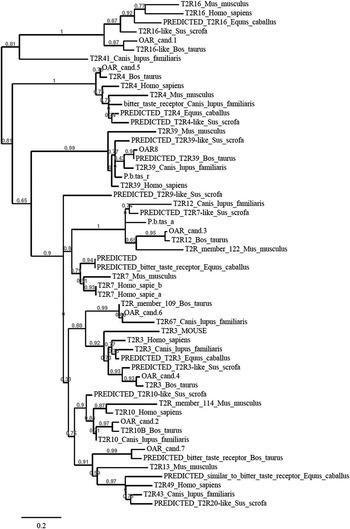
To investigate the evolutionary relationships among T2R genes, a phylogenetic tree was constructed for 56 amino acid sequences of T2R: the eight sheep candidates and the respective 48 best matches given by BlastP NCBI for each in the other species studied (human, mouse, cattle, dog, horse and pig).
Multiple alignments and a phylogenetic T2R gene tree (Figure 1) were built using Phylogeny.fr web service (Dereeper et al., Reference Dereeper, Guignon, Blanc, Audic, Buffet, Chevenet, Dufayard, Guindon, Lefort, Lescot, Claverie and Gascuel2008 and Reference Dereeper, Audic, Claverie and Blanc2010) available at www.phylogeny.fr. This software runs and connects various bioinformatics applications to construct the phylogenetic tree from a set of sequences. In this study, we followed the standard option of the analysis that uses: MUSCLE program (v3.7) for alignment, Gblocks (v0.91b) for curation, PhyML (v3.0 aLRT) for phylogeny using the maximum likelihood method and TreeDyn (v198.3) for tree rendering (Castresana, Reference Castresana2000; Guindon and Gascuel, Reference Guindon and Gascuel2003; Edgar, Reference Edgar2004; Anisimova and Gascuel, Reference Anisimova and Gascuel2006; Chevenet et al., Reference Chevenet, Brun, Banuls, Jacq and Chisten2006).
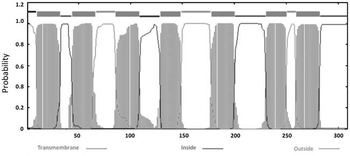
TMHMM analysis for sheep bitter taste receptor candidate 2. Seven transmembrane domains are predicted.

DNA extraction and PCR amplification of T2R candidates
Blood samples from 10 Portuguese White Merino ewes were obtained from ICAAM-University of Évora. The blood was collected by jugular venipuncture with heparinized vacutainer® (BD, Franklin Lakes, NJ, USA) tubes. Genomic DNA was isolated from blood using the Qiagen Animal DNeasy Blood and Tissue Kit (QIAGEN, Venlo, The Netherlands), according to the manufacturer's instructions. DNA quality and quantification were assessed by standard agarose gel visualization.
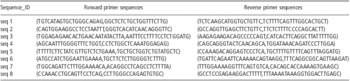
PCR primers (Table 1) were designed using the Primer3 software (version 0.4.0) (http://frodo.wi.mit.edu/). Primers were designed to have a size between 18 to 27 bp, GC content of 40% to 60% and melting temperature (Tm) of 58°C to 62°C. For each candidate gene, two pairs of primers (overlapping in the central part of the gene) were designed to amplify the predicted region of each T2R gene candidate. Predicted fragment size ranged between 400 and 600 bp. Oligonucleotides were synthesized by Stabvida (Stabvida, Caparica, Portugal).
Sequences of the forward and reverse primers used for PCR and sequencing of the eight T2R genes

T2R = taste receptors.
PCR reactions were carried out in a Bio-Rad C1000 Thermal Cycler (Bio-Rad Laboratories, Munich, Germany), by adding 1 μl of DNA, 12.5 pmol of each primer, 2 to 2.5 mM MgCl2, 10 mM dNTPs, 0.2 μl of Phusion® Hot Start High-Fidelity DNA polymerase (Finnzymes OY, Espoo, Finland) and water to a final volume of 20 μl. After one initial incubation step at 95°C for 5 min, amplifications were performed for 35 cycles with the following cycle profile: a denaturing step at 95°C for 45 s followed by an annealing step at 60°C for 30 s, and an extension step of 72°C for 1 min. Afterward, a step of 72°C for 6 min was performed. PCR products were run on a 1.5% agarose gel to confirm the existence of a unique band with the expected size.
The PCR products of one individual were purified using the QIAquick PCR Purification Kit (Qiagen, Venlo, The Netherlands), following the instructions of the manufacturer. The purified PCR products were then analyzed by direct sequencing (Sanger method) as a purchased service from Stabvida (Stabvida, Caparica, Portugal).
The resulting sequences were then compared with our predicted gene sequences of the candidates using ‘BLAST 2 sequences’ program from NCBI (Zhang et al., Reference Zhang, Schwartz, Wagner and and Miller2000). The confirmed sequences were deposited at GenBank, using BankIt software.
Results
Newly identified T2R in sheep
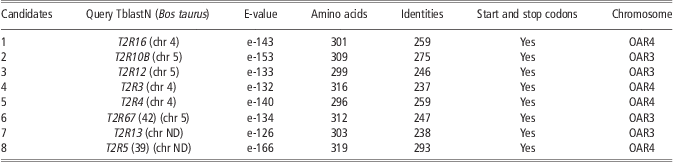
Using the previously identified T2R genes of cattle as queries for TBlastN, eight candidate intact genes were identified for sheep. Only these eight hits showed more than 100 amino acid identities with the respective cattle query, contained more than 270 amino acids and had start and stop codons in their corresponding nucleotide sequence (Table 2). Obtained sequences that did not respect these criteria were immediately excluded from the study. Nucleotide and amino acid sequences of the eight genes are shown in Supplementary Materials 1 and 2, respectively. The obtained amino acid sequences were examined by the TMHMM method, which revealed the presence of seven transmembrane domains as real T2R proteins must contain; an example of the outcome of the analysis is presented in Figure 1 and complete results for all the candidates are available as Supplementary Material 3. In addition, all eight proteins have a best hit to a known T2R gene when used as query to BlastP search in NCBI database, and show conserved domains typical of T2R protein family. All the candidates show a considerable degree of similarity among them, as shown by T-Coffee analysis (Supplementary Material 4) and, in terms of chromosomal distribution, all map to either chromosome 3 or chromosome 4 (Table 2).
Identified T2R candidates in sheep from the cattle T2R queries: properties and location
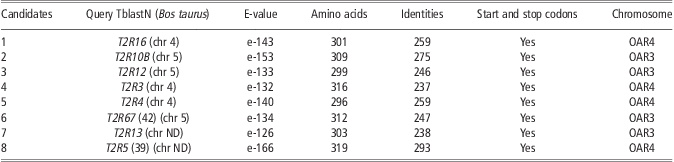
T2R = taste receptors.
Homologies with other species and phylogenetic tree
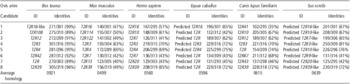
In order to study relationships with other species and possibly evolutionary clues on bitter taste, the eight identified T2R genes in sheep were compared with the best BlastP hit sequence given by NCBI database for cattle, human, mouse, dog, horse and pig. The best matches given by the program are shown in Table 3.
Comparison of amino acid sequences of T2R candidates in sheep with other mammals by BlastP analysis in NCBI web Blast application

T2R = taste receptors.
The sequences of these matches were then used to build the phylogenetic tree, depicted on Figure 2, which shows mainly clustering by receptor type rather than by species. The tree suggests a first outgroup of the T2R16 of the several species and corresponding candidate 1 in sheep from the rest of the candidates and respective matches. A divergence of candidate 5 and its T2R4 equivalents in other species is also clear. Finally, candidate 8 and respective T2R39 are separated from the rest of the candidates in sheep and their counterparts in the other species tested. Moreover, in this larger group, the clustering by receptor type is not as linear as in the ones previously mentioned. In all candidates with the exception of number 6, where the T2R67 of dog is the more related with the sheep candidate, the match in cattle is the closest to the sheep.
Phylogenetic tree of 56 T2R genes in sheep, cattle, human, mouse, dog, horse and pig. Numbers represent confidence index, an approximate likelihood ratio test for branches (Anisimova and Gascuel, Reference Anisimova and Gascuel2006).

Validation of predicted T2R gene sequences
The eight in silico predicted candidates (OA T2R16, T2R10B, T2R12, T2R3, T2R4, T2R67, T2R13 and T2R5) were then confirmed by PCR and sequencing on DNA from blood from one individual (Portuguese white merino breed), following a similar approach as reported by Van Poucke et al. (Reference Van Poucke, Vanhaesebrouck, Peelman and Van Ham2012) for experimental validation of in silico predicted genes. Using specific primers based on the sequences obtained for each candidate, we amplified DNA fragments with the expected size (Supplementary Material 5). All obtained sequences were deposited in GenBank (accession numbers JQ993463–JQ993470). Moreover, we performed PCR amplifications on the blood samples of additional nine individuals. For all tested genes, the existence of a unique band with identical size to the one that was sequenced was seen for all individuals (data not shown), confirming the reproducibility of the PCR approach and specificity of the primers designed for the eight candidates. The sequencing results confirmed our predicted sequences. The BLAST analysis of the two sequences, predicted (prev) and obtained by sequencing (seq), against each other for showed 99% to 100% match for all fragments of the genes amplified (see Supplementary Material 6).
Discussion
Understanding ingestive behavior of domestic ruminants is of major importance for animal production in the Mediterranean and Tropical regions. The genetics of taste sensitivity appears as an innovative field of research to enlarge current knowledge on the subject and it has not been studied so far in the domestic sheep, although relations between saliva proteome and taste sensitivity have already been pointed out (Lamy et al., Reference Lamy, da Costa, Santos, Capela e Silva, Potes, Pereira, Coelho and Sales Baptista2009). In this study, by comparison with the described T2R repertoire in cattle and using the recently available sheep genome, we conducted a data-mining search and identified for the first time eight genes for starting a T2R gene and protein repertoire in sheep.
We followed a comparative genomics strategy, using cross-species approach to identify putative genes and validate them by gene-specific PCR amplification using sheep DNA blood samples as template. This strategy is very useful when functionally conserved or structurally homologous genes responsible for the trait of interest are already described for other species, and has been widely used to identify genes related to many areas of research, including livestock or veterinary research (Zhu and Zhao, Reference Zhu and Zhao2007).
From the data-mining search, a strict selection was made in order to avoid partial sequences and pseudogenes. In fact, only the hits having more than 270 amino acids and more than 100 amino acids aligned with the query were selected, based on the studies by Go (Reference Go2006) and Dong et al. (Reference Dong, Jones and Zhang2009), considering that T2R have around 300 amino acids and selecting for high-similarity sequences with cattle T2R. This certainly might lead to the loss of candidates in sheep, but our main purpose of this study was to start an identification of highly expected candidates to T2R in sheep rather than full repertoire description itself. For such purposes, other species and a larger amount of T2R sequences should be used, with perhaps less strict criteria. We were also interested in identifying only intact genes, so the hits were selected for the presence of start and stop codons, to avoid obtaining pseudogenes or gene fragments. However, it is expected that other T2R exist in sheep genome. We believe that with future studies, the total number will rise to at least the 18 reported for cattle, considering that sheep and cattle present similarities of their ingestive behavior, both being herbivore ruminants (grazers), frequently having similar dietary habits, and phylogenetically and ecologically very close. Interestingly, they also show similar numbers of circumvallate (CV) papillae in their tongue, the type of papillae more linked to bitter taste perception in these animals: 15 or more in cattle (Kobayashi et al., Reference Kobayashi, Jackowiak, Frackowiak, Yoshimura and Kumakura2005), 16 to 20 in sheep (Brucher, Reference Brucher1884), which may emphasize their similarity in dietary habitat terms. It is noteworthy that other mammals have very different numbers of CV papillae: horse (herbivore monogastric ) has two to three; pig (omnivore) has one to two; man (omnivore) has seven to nine; and dog (carnivore) has four to six (Lamy et al., Reference Lamy, Capela e Silva, Ferreira and Sales Baptista2012). For these reasons, we expect high similarity in their mechanisms of bitter taste perception.
The eight in silico predicted candidates were validated by gene-specific PCR amplification using sheep DNA blood samples as template. The BLAST results of predicted versus obtained by sequencing matched between 99% and 100% for all the eight genes. The few bases differences found, could possibly be explained by the fact that the existent genome data, on which we based our predictions, were produced from two Texel individuals, whereas our sequencing data are from one Merino individual, and genetic variations in T2R could eventually occur with the same species as a consequence of breed. For these reasons, we kept the predicted DNA and protein sequence of each gene to the subsequent analyses. In addition, we cannot discard the presence of allelic variations between individuals of the same breed as those are common in sheep (Kijas et al., Reference Kijas, Lenstra, Hayes, Boitard, Porto Neto, San Cristobal, Servin, McCulloch, Whan, Gietzen, Paiva, Barendse, Ciani, Raadsma, McEwan and Dalrymple2012), but to explore this purpose, a significantly higher number of individuals would have to be sequenced. We have sequenced DNA from one individual, considering these are highly conserved genes and following a similar approach to those used for experimental validation of in silico predicted genes. For instance, Van Poucke et al. (Reference Van Poucke, Vanhaesebrouck, Peelman and Van Ham2012) have used cDNA from one dog in a comparative candidate gene approach to search for a genetic cause of a syndrome in dogs, based on data from a similar syndrome in humans. Although we did not study cDNA, T2R are for all species known as intronless, thus making these similar situations of experimental validation. The PCR amplification of T2R candidate genes on the blood samples of additional nine individuals produced DNA fragments with identical size as the one sequenced, confirming the reproducibility of the PCR approach and specificity of the primers designed for the eight candidates.
Interestingly, all eight candidates map to either sheep chromosome 3 or chromosome 4 and show a considerable degree of similarity among them, as shown by the average score of 78% for conservation in the T-Coffee analysis. However, these results are not surprising, as it has been reported that T2Rs contain high homologies among them, and that most of the T2R genes are clustered on specific chromosomes for several species already studied (Bachmanov and Beauchamp, Reference Bachmanov and Beauchamp2007; Dong et al., Reference Dong, Jones and Zhang2009). In fact, this gene clustering in few chromosomes is a common event for gene families. However, the observation that the genes in different chromosomes also show high homology, similar to the homology levels of family member in the same chromosome, points toward rather recent gene duplication events or the occurrence of considerable selection pressure to keep gene conservation in this gene family (Strachan and Read, Reference Strachan and Read2004).
In addition to the high homology among receptors within sheep genome, it was also observed in inter-species terms. Some of the receptors analyzed for phylogenetic tree were more similar between different species than with other T2R of the same species. We can speculate that these receptors are specifically responsible for detecting the same bitter molecules across animal species. Our results are in accordance with the observation of Go (Reference Go2006) who stated that mammals have both conserved orthologous gene groups, which might be important for detecting common bitter substances, and specialized ones, which could play a role for detecting species-specific bitter substances. Such high homology may also be explained by the fact that all species included were mammals. The average similarity of 92% between sheep and cattle is particularly very interesting, and it suggests that bitter taste sensitivity in ruminants tends to occur via similar mechanisms and molecules involved, and rather different from other herbivores non-ruminants and other trophic groups. It would be of great interest to conduct the data-mining search on other ruminant species if/when genome data would be available, in order to check whether these levels of homology are constant in the ruminant animal group, at least for the receptors known for the moment. This would once more confirm the hypothesis, as in Dong et al. (Reference Dong, Jones and Zhang2009), that T2R gene repertoires are closely related to the dietary habits of different species.
In conclusion, eight T2R genes were identified in sheep by in silico prediction and DNA sequencing confirmation. In addition to the high homology among the genes within sheep genome, high homology was also observed in inter-species terms, being the highest percentage between sheep and cattle, the two ruminants used for comparison. We believe that this knowledge on the T2R will contribute to new lines of investigation in genetic and proteomic research of taste and ingestive behavior in ruminants, and might lead to new clues on the use of pastures and important phenomena such as Seasonal Weight Loss in these animals and therefore have practical implications for animal production.
Acknowledgments
Authors acknowledge financial support from Fundação para a Ciência e a Tecnologia (Lisboa, Portugal) in the form of the grants SFRH/BPD/69655/2010 (A.M. Ferreira) and Research Contract by the Ciência 2007 and 2008 programs (respectively A.M. Almeida and S.S. Araújo). Authors finally thank Dr J. Paiva (IICT, Portugal) for most valued consulting on gene validation and Prof J.A. Lopes de Castro and Dr J. Fragoso for the blood samples from sheep (Universidade de Évora, Portugal).
Supplementary materials
For supplementary materials referred to in this article, please visit http://dx.doi.org/doi:10.1017/S1751731112002030