


The ideas that governments value the ability to make credible commitments, and that constitutions can confer this ability on them, have pervaded institutional economics, political economy, and political science since the 1980s.Footnote 1 Largely due to North and Weingast's seminal treatment, England after the Glorious Revolution is now the canonical example of a government enhancing its credibility via constitutional reform.Footnote 2
In this article, I reexamine North and Weingast's argument that improving the credibility of the Crown's debt contracts led to a higher volume of mutually beneficial financial trade (in this case, involving loans and loan repayments) between the Crown, Parliament, and the monied interest. I argue that enhancing the Crown's credibility would not have facilitated financial trade, except in the presence of an underlying moral hazard problem entailed in warfare.
The Stuart kings financed their wars largely with other people's money (for example, taxes and forced loans). If their wars went well, they repaid their debts out of the spoils of victory and pocketed the residual. Otherwise, they more often reneged. Thus, kings who could unilaterally launch wars faced a financial system that punished defeat too little and rewarded victory too richly. The Stuarts were accordingly too quick to make war—and too eager to gamble on resurrection, when wars went badly—at least from the perspective of their reluctant “insurers” (for example, citizens giving forced loans).
The problem of royal moral hazard in warfare was not confined to England. Philip Hoffman notes that major European monarchs generally “overspent on the military” because they “did not bear the full costs of warfare” and “victory…won them glory, enhanced reputations, and resources [while] losses never cost them their throne, at least for the major powers and as long as they faced no civil war.”Footnote 3
The central problem that the architects of the revolution settlement had to solve, I argue, was not the king's frequent reneging on financial commitments (a symptom), but the moral hazard generating the kings' malfeasance (the underlying cause). The central solution was not better holding kings to their commitments, but better holding royal advisors to account for all consequences of the Crown's policies. Once Parliament established a workable system to hold the king's advisors accountable—what we now call ministerial responsibility—the king was simultaneously denied over-insurance in defeat and overcompensation in victory.
Ministerial responsibility was instrumental in England's future military success in two ways. First, the country made more prudent decisions about what conflicts to enter. Second, because the Crown had essentially sold equity shares in the war business, a wider range of the talent and knowledge of England was brought to bear in any war undertaken. Thus, the English state was well-positioned to outcompete its competitors.
NORTH AND WEINGAST
As part of a broader analysis, North and Weingast spell out the following story regarding sovereign debt.Footnote 4 The Stuart kings recognized that reneging on loan agreements worsened their reputations and made securing new loans harder. Yet, these reputational considerations did not prevent them from reneging on debt contracts, especially when they were financially strapped. In order to make future sovereign default more difficult, and to deter the multifarious tactics by which the Stuarts had trampled their subjects' rights in the process of raising revenue, the winners of the revolution instituted a series of reforms that made it more difficult for the Crown to renege on its commitments. Perhaps the most basic reform was the decision in 1693 to have Parliament guarantee the repayment of loans, so that they became “national debts.” As P. G. M. Dickson noted, “both Englishmen and foreigners were quick to realize that this change from merely royal security was extremely important.”Footnote 5 In more modern parlance, this reform introduced an additional “veto player,” so that sovereign default was no longer a decision the Crown could make unilaterally. Combined with the creation of the Bank of England in 1694, and the extension of its privileges in 1697, the new debt-issuing procedures both increased the government's ability to borrow and lowered the interest rate it had to pay. The Crown-in-Parliament's newfound ability to borrow crucially enhanced its ability to win the long series of wars upon which it ventured.
At an abstract level, North and Weingast's argument has two steps. First, they argue that giving Parliament a veto over default decisions enhanced the credibility of government debt. Second, they argue that enhanced credibility facilitated financial exchange.
David Stasavage has amended the first step in the argument.Footnote 6 He notes that merely endowing Parliament with a veto over default decisions would not by itself have made debt repayments credible. For, if an anti-creditor majority emerged in Parliament, then it would be no bulwark against default.Footnote 7 He thus suspects—and shows—that interest rates on government debt fluctuated, depending on the balance of power in Parliament between the pro-creditor Whigs and anti-creditor Tories.
In the remainder of this article, I focus on the second step in the argument. My interest lies in the logic of credible commitment; in the particulars of the English case; and in what general lessons we might draw from that case about how limits on government affect war-making capacity.Footnote 8
LEVIATHAN'S LOANS
Vincent Crawford has noted that it is “not optimal to structure a loan agreement so that default…will not occur under any forseeable circumstance, because risk sharing is an important source of potential gain for both borrowers and lenders.”Footnote 9 Elaborating on this basic insight, I argue that kings who predictably defaulted on their loans are best viewed as entering debt-plus-insurance contracts, rather than conventional debt contracts (henceforth, I take a debt contract to entail a negligible amount of insurance). A financial system based on debt-plus-insurance contracts need not be less efficient than one based on debt contracts. Thus, enhancing the king's credibility, via constitutional reforms forcing him to repay his loans, need not improve the polity's ability to finance wars.
Michael Tomz provides a model that illustrates how a predictably defaulting king can continue to find new loans, even with rational financiers who observe his history of default.Footnote 10 In Tomz's model, there are two states of the world that the king might face: tough times and good times. There are also three types of king. Lemon kings will not repay their loans in either state of the world. Fair-weather kings will repay their loans only in good times. Finally, stalwart kings will repay their loans even in tough times. Financiers who view the king as a lemon obviously will not provide any loans, because they do not believe those loans would be repaid. However, suppose a particular king is widely viewed as a fair-weather borrower; that the probability of the bad state arising is known; and that the realized state of the world is publicly observable. In this case, all financiers expect the king to default in bad times and they charge him an interest rate that includes a risk premium covering this expected default. As long as he lives up to expectations (reneging only in bad times), the king's reputation will not worsen when he reneges. Thus, he can continue borrowing at a constant interest rate.
When a king borrows in the fashion just described, he essentially buys insurance (against bad times) at the same time that he borrows. An additional wrinkle is that the king pays no up-front premium for the insurance. Instead, in good times he makes a combined payment of principal, interest, and risk (insurance) premium, while in bad times he pays nothing.
The extant literature on early modern royal finance differs from the view I have just articulated and it is worth explaining the difference. Both Hilton Root and North and Weingast argue that kings who could more easily repudiate their debts should have faced either higher interest rates, poorer access to credit, or both.Footnote 11 Thus, when institutions such as the secrétaries du roi or the Bank of England made royal default less likely, one should expect the Crown to enjoy either lower interest rates, better access to credit, or both—and both Root and North and Weingast provide evidence consistent with these expectations.Footnote 12
What this account lacks is an explanation of what happened to the king's lost insurance. Especially if the king agreed to create new institutions; but even if he had new institutions forced upon him; the king should have looked for a way to replace the insurance that he was foregoing, by committing to repay his debts in bad times as well as good.Footnote 13 Was the king really better off in the new financial world? Was the new financial system really more efficient?
The last of these questions is central, as one of North and Weingast's most important claims is that England's financial revolution led directly to its success in warfare and hence its emergence as the world's preeminent power.Footnote 14 But, if the Glorious Revolution merely removed the Crown's ability to extract loans-cum-insurance, by constraining the king to repay his loans, would not the Crown suffer a financial loss? Was this then merely a redistribution in favor of the monied interest, rather than an efficiency gain that allowed the combined Crown-in-Parliament to better finance war? Until the case of the lost insurance is resolved, whether the institutional reforms of limited government that North and Weingast stress improved financial efficiency will not be so clear.Footnote 15
FINANCING LEVIATHAN'S WARS VIA VOLUNTARY TRANSACTIONS
At this point, it will help to recall what sort of insurance the kings of England needed. The answer is that they needed war insurance. They were engaged frequently in wars and, especially when those wars went badly, their finances were strained.
To clarify the financial challenges of warfare, I adopt the standard “lottery model” from the literature on international relations.Footnote 16 In this approach, a war is characterized by three parameters:π, the value of the assets at stake; c, the cost of waging the war; and q, the probability of losing the war. For simplicity, I assume the assets at stake are not currently in the king's possession. Thus, if the king wins the war (which I henceforth identify with the “good state” in Tomz's model), his net gain is π– c, while if he loses (the “bad state”), his net gain is –c.
Let the king's initial wealth, when the prospect of a war arises, be w. If he enters the war, the king may pay some of the costs from his initial wealth, financing the rest. For simplicity, I assume the king finances the entire cost of the war (for example, because his wealth is illiquid) and consider two different financing options: debt-only; and debt-plus-insurance. I focus on royal transactions (backed by the Crown alone), rather than national transactions (backed by the Crown-in-Parliament). Moreover, to avoid unnecessary clutter in the math, I assume the term of any financial contract matches the duration of the war: for example, the loan comes due just after the outcome of the war is realized.
My goal is to state conditions under which (a) the king will prefer debt-plus-insurance to debt-only contracts; and (b) constitutional reforms enhancing the king's credibility—so that he can induce financiers to accept debt-only contracts—will not improve the efficiency of the financial system. The first five conditions follow: (A1) the financiers are risk neutral; (A2) the king is not risk-acceptant; (A3) the king initially has a fair-weather reputation that he values highly enough to deter him from reneging on a debt-plus-insurance contract after he has won the war;Footnote 17 (A4) the state of the world (defeat or victory) is publicly observable; and (A5) there is no moral hazard problem in the conduct of the war. The last of these conditions means that the financier-insurers do not worry that the king might prosecute the war lazily or incompetently. Either they view him as strongly motivated and highly competent; or they can observe (and perhaps control) his war strategy.Footnote 18 Finally, assume that (A6) the king engages solely in voluntary financial transactions with his financiers, because the cost of extracting forced loans is prohibitive. Later, I return to the case in which the king can impose forced loans.
Given conditions A1–A6, let us first consider the case in which appropriate reforms have been instituted—such as requiring Parliament to cosign the loan—and the king can credibly enter into a debt-only contract. In such a contract, he borrows the costs of war, c, at an interest rate i 0 (which can be thought of as the interest rate the king's wealthy subjects must pay). The risk-neutral financier's expected end-of-year payoff (that is, his net increment to wealth) from the debt contract is ci 0. The king's expected utility at the end of the year will be qu[w – c(1 + i 0) + R fair] + (1 – q)u[w + π– c(1 + i 0) + R fair]. Here, the term R fair represents the value to the king of maintaining his fair-weather reputation. To simplify the discussion, I take this value as common knowledge and exogenously given.Footnote 19
Now suppose the king enters into a debt-plus-insurance contract (for the amount c) with interest rate i 1. The financier's end-of-year payoff from such a contract is as follows. If the king loses the war, the financier-insurer loses the loan amount, c. If the king wins the war, he will (given (A3)) then repay his loan, meaning the financier-insurer gains ci 1. All told, the financier's expected payoff is ci 1 – qc(1 + i 1).
I assume the financier could get ci 0, by loaning to private individuals rather than to the king. Thus, since transactions must be voluntary, the king must offer an interest rate i 1 such that ci 1– qc(1 + i 1) ≥ ci 0, in order to induce the financier to enter into the debt-plus-insurance contract. The lowest interest rate the king can offer is thus  . Note that i' > 0: the larger the risk of his defeat, the higher the interest rate the king must pay.
Now consider the king's payoff. If he loses the war, then he will have wealth w + R fair: he will have invested the loan, c, in a venture that returns nothing; he will not owe anything on his debt-plus-insurance contract in that case; and his reputation as a fair-weather will remain intact. If the king wins the war and then repays his loan, he will have wealth w + π– c(1 + i(q)) + R fair.Footnote 20 Thus, the king's expected end-of-year utility from a debt-plus-insurance contract is qu[w + R fair] + (1 – q)u[w + π – c(1 + i(q)) + R fair].
Now we can ask whether the king is better off when constitutional reforms ensure that he will repay his debts. He currently has a reputation as a fair-weather and can thus enter into a debt-plus-insurance contract at interest rate i(q). His payoff under a (credible) debt-only contract at interest rate i0 would be greater if and only if (1 – q)(u[w + π – c(1 + i 0) + R fair] – u[w + π – c(1 + i(q)) + R fair]) – q(u[w + R fair] – u[w – c(1 + i 0) + R fair]) > 0. However, this condition is never satisfied.Footnote 21
Thus, the king always weakly prefers a debt-plus-insurance contract to a debt-only contract, even if he is equally able to commit to either. This makes sense because the king is not risk-acceptant. If he is risk-neutral, then he weakly prefers debt-plus-insurance; while if he is risk-averse, he strictly prefers it (a specific example of Crawford's more general point cited at the outset of the section).
Is the overall financial system more efficient, when there are institutions that make the Crown's debt-only contracts credible? Were such institutions to exist, the Crown would never enter debt-only contracts, as it prefers debt-plus-insurance contracts. The financial community would be indifferent—because the financier-insurer's payoff is identical, regardless of which contract he enters into with the sovereign. So, under conditions A1–A6, an innovation that enables the king to credibly commit to repaying his loans will change nothing. In particular, the overall financial system will become no more efficient; and the volume and nature of financial trades between the king and his various war financiers will not change.
DEFINITIONAL AND MORAL HAZARDS
Of course, the “constitutional reforms to enhance credibility are worthless” conclusion just reached depends on two key assumptions: that everyone observes the state of the world (that is, whether the king faces “tough times”—identified with defeat in war—or not); and that no moral hazard problems exist. But these conditions are implausible.
First, who decides if tough times have arisen? If the insured party, the king, has discretion in identifying when tough times exist (in which he collects on his insurance), then the insurers have a problem. Call this definitional hazard, to distinguish it from moral hazard.
Second, the king's prosecution of the war may be lazy or incompetent. In this case, a conventional problem of moral hazard arises, when it is difficult to monitor the king's conduct of the war.Footnote 22
To see how definitional and moral hazards affect the value of credibility, first return to the world in which such hazards do not exist and note that, if the king is confined to voluntary transactions, he will not be able to finance some potentially profitable wars. The expected increment to national wealth from war is q(–c) + (1 – q)(π – c) = (1 – q)π – c. Thus, a national wealth-maximizing sovereign would go to war when the probability of defeat is sufficiently low:  . However, the cost of securing voluntary debt-plus-insurance financing, reflected in the interest rate i(q), is so high that the sovereign goes to war only when
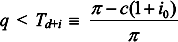 Footnote 23 Since Td+i < T, profitable wars exist that the sovereign cannot finance, if he can only use voluntary debt-plus-insurance contracts.
Things are even worse if the king must rely on debt contracts. In this case, his war payoff, qu[w – c(1 + i 0) + R fair] + (1 – q)u[w + π – c(1 + i 0) + R fair], exceeds his no-war payoff, u[w + R fair], if and only if  . But Td < Td +i.Footnote 24 Intuitively, the monarch is even less willing to make war, when constrained to use a strictly less-preferred method of finance.
Now consider how these calculations change in the presence of definitional and moral hazards. The “war threshold” when wars must be financed by credible and voluntary debt does not change; it remains Td. However, the interest rate in a voluntary debt-plus-insurance contract will increase to reflect the risks entailed by the definitional and moral hazards. Denoting the interest rate that reflects these additional risks by i +(q) > i(q), and the additional risk premium due to definitional and moral hazards by Δ = i +(q) –i (q) > 0, it can be shown that the “war threshold” when wars must be financed by voluntary debt-plus-insurance, Td +i(Δ), declines strictly with Δ.Footnote 25
If Δ becomes so high that c(1 + i(q) + Δ) > R fair – R lemon, then the king will face (an extreme form of) credit rationing. The financier will not be willing to enter a debt-plus-insurance contract at all, meaning that the king's only option to finance his war is to make his debt credible. Short of this extreme, if Δ becomes so high that Td +i(Δ) falls short of Td, then credibility will still be valuable to the king, as it will allow him to finance additional wars.
All told, then, we reach the following conclusion. In the presence of severe enough definitional and moral hazards, (a) the Crown will prefer voluntary debt to voluntary debt-plus-insurance contracts; and (b) innovations that permit credible debt-financing will allow the sovereign to engage in some nationally profitable wars that he would otherwise have to forego.
FINANCING LEVIATHAN'S WARS VIA COERCIVE TRANSACTIONS
Having examined voluntary financial transactions, let us now consider a situation in which the king can force financiers to loan him money on terms that he dictates. In particular, suppose that the king can costlessly force the financier to accept a debt-plus-insurance contract with an interest rate i such that π – c(1 + i) > 0. In this case, the king's payoff from going to war, qu[w + R fair] + (1 – q)u[w + π – c(1 + i) + R fair], exceeds his payoff from not going to war, u[w + R fair], for any q < 1. That is, the king will go to war as long as he has any positive chance of winning.
A king who could finance his wars via coercive transactions of the kind just described would enter too many wars, with too little chance of victory, in the process bankrupting his financiers, or driving them to increasingly elaborate schemes of hiding their wealth. Such a king would find that raising new forced loans was increasingly costly and, if he persisted further, prohibitively costly. Thus, the king's own grasping might eventually result in his being constrained to make all his financial transactions voluntary.
THE HISTORY OF ENGLISH WAR FINANCING
I suggest that English war financing in the seventeenth and early eighteenth centuries went through three stages that correspond roughly to the models presented above.Footnote 26 First, public finances were royal and largely coercive. The Stuarts seized new revenues via forced loans and various tactics that amounted to new taxes. This gave them too great an incentive to go to war.Footnote 27 The polity as a whole suffered the consequences.
Second, the Glorious Revolution abruptly removed the sovereign's ability to extract forced loans and de facto taxes, making it clear that he would have to live with voluntary financial transactions. However, relying on voluntary debt-plus-insurance contracts backed only by the Crown would, especially in the presence of definitional and moral hazards, leave the king unable to finance some profitable wars. Hence, the second period, in which public finances were royal and voluntary, was short-lived.
The king, constrained to engage in voluntary financial contracts, became eager to establish the credibility of government loans, so that he would not be restricted to short-term loans. Beginning in the Commonwealth period, the navy's treasurers had developed a workable system of short-term borrowing in anticipation of tax revenues, and this basic idea was extended thereafter.Footnote 28 Importantly, the new financial instruments were increasingly transferable and brisk secondary markets developed in navy bonds and other short-term debt.
Although these innovations in the management of short-term debt were important, they did not solve the Crown's financial problems. Simply put, William III could not finance war against France with no new taxes and only short-term loans.
He thus agreed inter alia to the establishment of “national debt” in 1693 (guaranteed by the Crown-in-Parliament, rather than merely by the Crown), the creation of the Bank of England in 1694, and the expansion of the bank's rights in 1697.Footnote 29 This led to a third stage, in which public finances were national and voluntary.
However, the emergence of national and voluntary public finances was not the end of the story. Establishing credible national debt contracts in 1693–1697 led to a new politics of debt repayment which pushed the Crown to take on Parliament as equity partners in the war business.
THE NEW POLITICS OF DEBT REPAYMENT
National debt was funded—that is, backed by specific earmarked taxes. However, revenues from earmarked taxes quite regularly proved insufficient to pay off their associated debts. Thus, when national debt payments in excess of available funds came due, the question arose of whether and how to pay them.
Under the old financial regime, debt was royal and the king could unilaterally choose: to repudiate or reschedule it; to pay it out of royal revenues; or to ask Parliament for new taxes to pay it. Under the new financial regime, debt was national. Although national debt could be paid by either the king or Parliament unilaterally, neither side would have an incentive to be so generous. Rather, the two would bargain over how to divide the cost and their negotiations would inevitably turn on each side's anticipations of how much they stood to gain from victory and lose in defeat.
Note that my view, in contrast to North and Weingast and the subsequent literature, is that Parliament did not gain a veto over default.Footnote 30 Such a veto right could logically exist only if earmarked taxes sufficed to pay all sovereign debts—but they never did. Instead, Parliament men gained a veto over entry into new national debt contracts, which is precisely what they had demanded. For example, in 1682 “the House of Commons resolved that anyone who lent to the Crown without parliamentary authority would be judged an enemy of Parliament.”Footnote 31
In the new politics of debt repayment, the king and Parliament each had to decide how much to contribute to retire or reschedule the nation's debts, out of the revenues they controlled. Neither could force the other to bear any specific share of costs. If each side decided to contribute nothing, that part of the loan not covered by earmarked taxes would be repudiated, the nation's ability to borrow in future damaged, and thus the nation's ability to win the current war (and future wars) damaged. In other words, in keeping with the increasingly accepted view of warfare as a matter of economic attrition, in which each side should seek to outspend the other over the long haul, honoring debt maintained or raised the probability of victory, while repudiating debt lowered it.Footnote 32
Because contemporaries recognized that the nation's reputation for creditworthiness directly affected its probability of winning at war, each side's cost of repudiating or rescheduling debt depended largely on how much it preferred winning rather than losing the current war. And this preference in turn depended on: (a) the total cost of losing and the share of that cost each side expected to bear; and (b) the total profit of winning and the share of that profit each side expected to enjoy.
In the English case, estimates of the cost of losing in the Nine Years' War were fairly balanced. Both William III and the Whigs understood that utter disaster awaited them, if they lost too badly to Louis XIV. The cost of losing was again fairly balanced (and large) during the War of Spanish Succession.
If the Crown and Parliament bargained over how to allocate the cost of debt repayment, knowing that greater repudiation would mean a higher chance of losing the war, and losing the war would be very painful, then we should expect them both to contribute substantially to debt repayment.Footnote 33 If the Crown were incapable of contributing its full share in cash, then Parliament should have demanded a higher share of profits, to compensate it for shouldering a higher share of costs. Thus, bargaining over debt repayment after 1693 should have led to a continual search for ways to increase and make more credible Parliament's share of war profits.
In other words, once the Crown had been deprived of its traditional coercive financing techniques (1689); and had agreed to reforms that deprived it of the ability unilaterally to enter new debt contracts (1693); it should continually have needed to bring in equity partners to finance its wars.Footnote 34 Because those partners were no fools, they would credit the Crown's promises to share profits, only if they anticipated that the Crown would not have means and motive to renege. Various constitutional reforms helped assure Parliament that the Crown would lack the means—for example, the ban on standing armies and the new practice of keeping the Crown on a short financial leash. Arguably, however, the most important and direct constitutional reform that deprived the Crown of the means of reneging on its equity promises, was ministerial responsibility. Once ministerial responsibility was in place, the Crown could not act except via ministers responsible to Parliament; and thus could not take whatever actions might be useful in clawing back war profits reluctantly promised at an earlier date. The remainder of the article describes the emergence and logic of ministerial responsibility.
MINISTERIAL RESPONSIBILITY
To explain the development of ministerial responsibility, note first that any attempt by Parliament to buy a share of war profits with grants of taxation would be fraught with peril.Footnote 35 Once taxes had been granted, how could Parliament ensure that the sovereign both declared his war profits honestly and paid parliamentary interests their agreed shares?Footnote 36 A group of parliamentarians could ensure themselves a share of war profits only if they could control (or sufficiently influence) the king's actions.
According to the dominant political analysis of the time, the key to controlling the Crown's actions was holding those through whom he took those actions accountable: “the king…is not punishable or blamable by our Constitution, but the ministry is… .”Footnote 37 The great constitutional puzzle, with which parliamentarians had struggled throughout the seventeenth century, concerned how to create a workable system whereby Parliament could hold the Crown's advisors accountable.
To hold the king's advisors accountable for their advice involved three distinct but related problems. First, one had to know who the advisors were. Second, one had to know when they had given bad advice (that is, advice that led to policies that Parliament wished to alter or reverse). Third, one had to be able to reward and punish.
As regards who the king's advisors were, there was a substantial and intellectually organized push to make the Privy Council the responsible body. Had this Clarendonian view of the polity triumphed, we might today talk of conciliar responsibility, rather than ministerial responsibility. Moreover, the conciliar focus dominated throughout the settlement period (1689–1701) and was clearly embodied in clause 4 of the Act of Settlement of 1701. Yet, as Clayton Roberts explains, public discourse shifted rapidly in the next few years, with repeated calls for the ministry (a term just then gaining wide currency) rather than the Privy Council to bear responsibility.Footnote 38
As regards when the king's advisors had given bad advice, a key issue was whether Parliament needed explicit evidence that advisor X had rendered advice that led to policy Y; or whether it only needed implicit evidence. This in turn connected to the mode of punishment. The dominant viewpoint earlier in the seventeenth century was that Parliament's primary weapon against evil councilors was impeachment. Impeachment, however, required legal proof of individual responsibility for bad advice. The new view, which developed rapidly in conjunction with the shift in focus from the council to the cabinet, was that Parliament's main weapons would not be legal but political: Parliament would seek to force bad ministers from office, by denying supply. This weapon was far more flexible and did not require any explicit proof of wrongdoing; Parliament could mount attacks on individual ministers or on the ministry as a whole, simply because it disagreed with the policies they were pursuing.Footnote 39
By the early 1700s an embryonic form of ministerial responsibility had emerged. The Crown's main advisors had been defined as the ministry; each of them was held responsible for anything done in their realm of competence, regardless of whether a trail of paper could be found linking them specifically to the objectionable acts; the cabinet as a whole was responsible for major policy decisions in any realm; and Parliament stood ready to deny supply, in order to force a change of policies or ministers.Footnote 40
In my view, ministerial responsibility made ministers the monopoly facilitators of trade between the Crown and Parliament; and this made it credible that the profits of war could be shared. In order to serve their vital role as intermediaries, however, ministers had to be credible to both sides. Thus, the main threats to the emerging system involved the Crown's and Parliament's beliefs about ministers, as explained in the next two sections.
MINISTERIAL RESPONSIBILITY FROM THE CROWN'S PERSPECTIVE
When ministers bargained with the Crown, the latter had to believe two things, in order to view the bargaining as necessary and worthwhile. First, the Crown had to believe that supply could only be secured with the cabinet's help. Second, the Crown had to believe that ministers could reliably deliver supply, at the price they demanded.
If the king doubted that his current ministers were the monopoly suppliers of new expenditures and taxation, then he might pursue other means to secure supply. In particular, he might seek to assemble an ad hoc parliamentary majority for each major new grant, buying as many votes in Parliament as needed to complete each new majority. Two elements of the settlement clearly aimed to prevent such royal influence in Parliament: the ban on sovereign “interference” with parliamentary elections (in the Bill of Rights of 1689); and the ban on MPs accepting places of profit from the Crown (in the Act of Settlement of 1701).Footnote 41
Another important institutional innovation came shortly after, in 1706/07, when the House of Commons adopted two rules, one dictating that the house would not receive any petition, or proceed upon any motion, for a grant or charge upon the public revenue, unless recommended from the Crown; and the other dictating that any such petitions or motions must be considered in Committee of the Whole. Historical accounts of the first rule view it as solidifying the ministry's position vis-à-vis backbench MPs. Alpheus Todd argues that the rule was brought in—first as a resolution (which had to be annually renewed) in 1706 and then as a standing order in 1713—to prevent private members from raiding unallocated funds.Footnote 42 John Brewer suggests that the new rule simply codified the ministry's success in securing control over financial legislation: in the 1690s private members had often significantly altered the Treasury's course with counterproposals; by the early 1700s the ministry had secured a de facto monopoly on fiscal proposals; the new rule created a de jure monopoly.Footnote 43
However, the new rules can also be construed as bolstering the ministry's position vis-à-vis the Crown. The first rule helped ensure—and make clear to all—that ministers would have monopoly proposal powers over charges upon the public revenue.Footnote 44 It thus reflected and reinforced the new consensus that ministers were the king's primary advisors.
More importantly, the new rules prevented the king from seeking to split or end run his own ministers in Parliament. No sovereign could (a) ask a friendly MP to propose a new expenditure and then (b) buy enough votes to pass it. Part (a) of such a strategy was blocked by the first rule. Part (b) was made more difficult by transferring the initial consideration to Committee of the Whole, which had been invented (under James I) precisely to insulate MPs from Crown influence. In combination, then, the rules had the following consequence: henceforth, the Crown's only constitutional route to new expenditures granted by Parliament lay through the ministry.
There is no evidence that contemporaries viewed the new rule as bolstering the ministry's bargaining position with the Crown. However, even if the relatively inactive Queen Anne did not seek to split or end run her ministers by having proxies make direct proposals to Parliament, future monarchs might have, if given the opportunity. Certainly, chief executives in other countries and times have exploited similar constitutional loopholes with alacrity, allowing them to dominate the budgetary process. From that perspective, ensuring the ministry's monopoly on expenditure was crucial, even absent a current threat.
The ministry's ability to bargain with the sovereign would have suffered greatly, had they not been able to deliver on their promises. If the price for a new expenditure was to be a particular set of new policies—perhaps crucial for sharing out the profits of war—then the ministry had to be able to muster enough votes in Parliament to deliver both the promised expenditure and the statutory authorization for the new policies.
The key innovation ensuring that the ministry could deliver on its promises was, of course, the political party. Very rapidly, Tories and Whigs organized for battle within Parliament and the electorate. Indeed, between the Triennial Act (1694) and the Septennial Act (1715) lies the first period of recognizably modern party competition in world history.
MINISTERIAL RESPONSIBILITY FROM PARLIAMENT'S PERSPECTIVE
When ministers bargained with their supporters in Parliament, the latter had to believe two things, in order to view the bargaining as necessary and worthwhile. First, supporters had to believe that grievances could be addressed, or some other benefit secured, only with the cabinet's help. Second, supporters had to believe that ministers could reliably deliver promised benefits, at the price (in supply) they demanded.
The ministry's monopoly on access to the Crown—and hence its position as the only group who could effectively bargain with the Crown for redress of grievances (or, more generally, changes of policy)— was ensured by Parliament's determination to force the Crown to dispense with secret and irresponsible advisors. Whether contemporaries recognized it or not, holding ministers responsible for all public acts necessarily meant that new coalitions within Parliament could approach the king only through the existing ministry, or by replacing the current ministry. Henceforth, the only constitutional route for parliamentarians to deal with the Crown lay through the ministry.
The ministry's ability to deliver on its promises to its parliamentary supporters depended on its ability to control all public acts. Here again political parties were the key. It was important that ministers were commonly known as the leaders of a solid majority, since that made their promises and threats—both to the Crown and to their supporters in Parliament—more credible. Moreover, by cultivating a party in Parliament, ministers made themselves more trustworthy bargaining agents in Parliament's view. When ministers first began seeking office from the Crown by promising that they would extract supply from Parliament, they were viewed with deep suspicion in Parliament. It was only after they more clearly became leaders of parliamentary parties that they could seek supply without attracting such suspicion.Footnote 45
MINISTERIAL RESPONSIBILITY AND CROWN-PARLIAMENT TRADE
The last three sections have explored how ministerial responsibility might have helped the Crown metaphorically sell equity shares in the war business to Parliament. However, note that ministerial responsibility would have been useful, not just in giving parliamentary interests a credible share of war profits, but also in giving them a credible share of all manner of policy benefits.
I have thus far taken a narrow view of what the most important policy benefits were—viz., war profits. But it is worth considering what happens to my argument if one takes a different view, in which the Crown cedes control over domestic public policy in exchange for new tax revenues. This conception of what Crown and Parliament exchanged appears prominently in the previous literature.Footnote 46 Embracing it does not affect my argument that credibility would have been valuable only in the presence of definitional and moral hazards; my periodization of English public finances; my contention that enhancing the credibility of sovereign debt would, as an isolated reform, have put too much of the financial risk of war upon the Crown; or my analysis of how ministerial responsibility created a credible broker for Crown-Parliament trade.
However, if one envisions Parliament granting new taxes in exchange for control over purely domestic public policy, then one has difficulty in explaining the logic of events. In particular, suppose that, under the terms of the exchange, Parliament cannot audit the expenditures and revenues of war but the king must finance his wars via voluntary transactions. In that case, the king will have no ability to coercively extract “war insurance,” will not have sold any equity shares, and will be restricted to credible debt contracts. So, the full financial risk of war will fall on the Crown, raising the question: Why would a risk-neutral or risk-averse king accept this situation?
From Parliament's perspective, trading taxes for purely domestic policy control would not address the underlying problem of moral hazard in war, as parliamentarians would neither control the king's conduct of war nor be able to investigate how he spent the money they granted. Parliamentary interests under such an exchange would have no greater stake in the outcome of war than in the pre-reform era and, thus, no greater incentives to invent efficient new ways to wage war. Warfare would remain a “royal sport” (Galileo's characterization), rather than the business of a fiscal-military state.Footnote 47
Thus, while a trade of taxes for purely domestic policy control could explain why the Crown received more revenues, it would explain neither how the king dealt with the increased financial risk that he logically would bear, nor England's enhanced efficiency in war. Accordingly, one of the maintained assumptions of this essay is that the fiscal control Parliament sought, in exchange for granting taxes, concerned not just domestic but also military expenditures.
EVIDENCE
If my argument—that ministerial responsibility enabled ministers to broker deals between Crown and Parliament, prominently including exchanges of taxation for “equity” in the war business—has merit, then two main predictions about post-revolution fiscal affairs follow. First, the amount of taxes that Parliament granted to the Crown should have increased. Second, in return, Parliament should have played a larger role in setting military budgets, determining key military personnel, and auditing military expenditures. In addition, my account of government borrowing predicts two important features of post-revolution debt: The credibility of government debt should have depended both on the partisan complexion of the ministry and on the probability of victory in war. The available evidence supports each of these predictions.
TAXES
During the Restoration, notwithstanding the many improvements in tax collection, tax receipts showed a shallow decline from 1665 to 1685, averaging £1.53 million.Footnote 48 After the Glorious Revolution, tax receipts more than doubled the Restoration average by 1695 and tripled it by 1700.Footnote 49 The main reason for this increase was simply that Parliament granted more new taxes, and more increases in existing taxes, than it had been willing to do before.Footnote 50
The new tax revenues, moreover, underpinned all the new experiments in debt financing. Long-term national debt was funded, meaning that the revenue from specific taxes was dedicated to paying off principal and interest on specific loans. Short-term debt was routinely issued in anticipation of tax revenues. Thus, one might well argue that increasing the state's tax receipts was the essential first step of the financial revolution.
Indeed, there is a line of argument, in opposition to North and Weingast, that argues the logical and historical priority of taxes over loans. Patrick O'Brien, for example, argues that the foundations of England's fiscal-military state were laid in the Civil War and the Restoration settlement, rather than the revolution settlement.Footnote 51 In particular, the key events were (1) a policy shift toward indirect taxation; and (2) an administrative revolution in the collection of indirect taxes. Once the path of indirect taxation had been embarked upon, O'Brien seems to argue, an upswing in tax revenues, followed by innovations in debt financing, was merely a matter of time—perhaps delayed by the religious conflict between a Catholic monarch and his mostly Protestant subjects.
While taxes did underpin loans; and crucial reforms in levying and collecting indirect taxes did occur in the Restoration period; the fact remains that actual tax receipts showed no increase. The revolution clearly sparked a new willingness by Parliament to unleash the reformed Treasury's tax collecting prowess on the population at large, thereby producing a sharp increase in tax revenues.
The reason for Parliament's newfound willingness to augment tax revenues was that post-revolution reforms enabled the ministry (and hence its supporters in Parliament) to secure a credible share of war profits. Because they (and their supporters) had a more secure share of the profits, ministers worked harder to raise the necessary financial support for wars.
FISCAL CONTROL OF THE MILITARY
North and Weingast do not highlight how the Glorious Revolution enhanced Parliament's fiscal control of the military. But here, too, the revolution was a watershed. As Brewer notes, “After the Glorious Revolution…Parliament established control of military funding and determined both the size of the army and the nature of its military law.”Footnote 52
Reflecting Parliament's new influence, those seeking military and naval careers after the revolution “needed to develop 'an interest' both with the Crown and with powerful political patrons if they were to achieve promotion.”Footnote 53 Even the highest commands in the navy could become parliamentary footballs—witness the Whigs' strenuous reaction to “the replacement of Russell in his sea command…by the joint command of three other admirals of whom two…were the leaders of the Tory faction in the navy.”Footnote 54 In the army, “152 of the 374 colonels of regiments between 1714 and 1763 sat in the House of Commons.”Footnote 55
On the expenditure side, Parliament's audits—prominently those conducted through a series of Commissions of Public Accounts—were in no way restricted to domestic affairs. As Brewer notes, “The price MPs extracted for supporting the [Nine Years War, the first post-revolution fight in which the reformed polity engaged,] was the opportunity to subject its operations to unparalleled surveillance.”Footnote 56
Parliament's newfound influence over army budgets, careers, and expenditures should have put war profits in the grasp of parliamentary interests, and indeed “the War of Spanish Succession produced a notable number of fortunes for soldiers, sailors, contractors, and remittance men… .”Footnote 57 Such wartime profits certainly do not prove that an explicit agreement existed between the king and his ministers, whereby specific “war profits” (for example, territorial acquisitions or trading rights) were earmarked as bait to snare parliamentary support, and then duly distributed. But, whether such an agreement was explicit or not, the practical consequence of Parliament's new budgetary control seems to have been that “war profits” sensu lato were distributed to a wide array of those with good parliamentary connections.
Loans
In the newly emerging system of ministerial responsibility, it was no longer the king—or his secret and irresponsible advisors—who decided whether to default on (or restructure) government debt. Instead, the Crown and Parliament repeatedly bargained over who would provide the additional funds—that is, those above and beyond the earmarked taxes—needed to repay debts as they came due. In this game, bargaining failure meant the two sides could not agree on who should pay for the shortfall, which necessarily entailed partial default. Thus, the bond market should have equated the risk of default with the risk of bargaining failure.
If party control of Parliament changed, the bond markets should have trembled in proportion to the chance that the bargain between the Crown and the new majority would fail. Bondholders should thus have begun to view the balance of power in Parliament as a key predictor of default, consistent with the findings of Stasavage.Footnote 58
In my model, a central element affecting any government's financial position was whether it had won or lost at war. Thus, my approach is consistent with the finding that interest rates on post-revolution government debt were systematically higher during wartime than in peacetime.Footnote 59
Finally, my approach is also consistent with North and Weingast's argument that the government's enhanced credibility after the revolution should have led both to a larger amount of debt and to a lower interest rate.Footnote 60 Nathan Sussman and Yishay Yafeh have shown that the interest rates on English government debt did not match those on Dutch debt until the late 1720s and concluded that English credibility must not have been as sharply enhanced by the revolution settlement as North and Weingast argue.Footnote 61 What this argument ignores is that the risk premium the English government had to pay declined despite a sharp increase in its total indebtedness. Given that enhanced credibility should have both relaxed credit rationing and lowered interest rates, the evidence seems strong.
PARLIAMENT AND THE JOINT STOCK COMPANIES
I have thus far talked of metaphorical shares in the war business but now it is time to consider the literal shares that the Crown had issued since Elizabethan times and why those shares were not credible. The earliest joint stock companies in England mostly concerned war and trade. Some companies financed privateering expeditions against the Spanish and Portuguese, with Sir Francis Drake's voyage in 1587 merely being the most famous and successful of a much larger group. Other companies, such as the Senegal Adventurers (1588) or the East India Company (1599), obtained trading monopolies in particular regions and conducted private wars to secure their claims, when necessary. Other companies, such as the Massachusetts Bay Company (1628) or the Adventurers for Lands in Ireland (1642), were colonial enterprises whose entrepreneurs were expected to quell any local opposition. In the latter case, the company suppressed the Irish Rebellion, confiscated the rebels' land, and doled it out to the shareholders according to their respective shares. Finally, several companies, such as the Mineral and Battery Works (1565), arose to provide matériel and services to the royal navy.
The creation of joint stock companies directly involved in war and trade meant that the Crown could in principle share the profits of war with those companies' sometimes numerous shareholders. If those shareholders were also MPs, or allied to MPs, then the Crown could quite literally sell equity shares in the war business to parliamentary interests.
However, royal moral hazard (under both Elizabeth and the Stuarts) threatened shareholders' profits persistently. The legal rights to all overseas commerce and territory were held by the Crown and adjudicated in the Crown's Admiralty Courts, not the common law courts. Thus, “those joint stock companies that…enjoyed temporary profits soon lost these profit sources through the assertion of the Crown's sovereignty rights—either through raising customs charges or the revocation [or “renegotiation”] of their charters.”Footnote 62 Would-be war profiteers were evidently distressed by the king's depredations: MPs in the Long Parliament who held shares in one of the joint stock companies of the day were substantially more likely to join the parliamentary side in the English Civil War.Footnote 63
After the Glorious Revolution, using shares in joint stock companies to spread the profits of war became more viable. Just as Parliament cosigned loans, so Parliament could also “cosign” companies' charters. Sometimes this was de jure, as when the Hudson's Bay Company obtained both a royal and a parliamentary charter.Footnote 64 In other cases, a company arranged de facto parliamentary protection of its rights, by cultivating support in the Commons and Lords. In any event, a company's claim on its profits became more secure, when (a) parliamentary approval was needed to “renegotiate” its charter and (b) it enjoyed substantial parliamentary support.
If Parliament could protect companies from state predation, one expects to find companies cultivating an interest in Parliament, just as bondholders and aspirants for high military office did. Consistent with this expectation, one finds that the “history of the major joint stock companies—the East India Company, the Royal Africa Company, the Bank of England and the South Sea Company—is a history of companies issuing new stock to accommodate new MPs in Parliament.”Footnote 65
One might also note that roughly 125 new joint stock companies began business in the period 1688–1695, this being by far the biggest jump in the number of joint stock companies to that date. Where the capitalization of such companies represented 1.3 percent of national wealth in 1695, that figure had doubled by 1702 and doubled again by 1717.Footnote 66
CONCLUSION
World history affords many episodes of governments accepting limits or having limits forced upon them.Footnote 67 Some of these episodes amount to democratization, others merely to a change from one form of non-democracy to another.
The literatures on the democratic peace and on European state formation suggest that greater limits—especially pertaining to how states finance war—should make them both more prudent in entering, and more powerful in prosecuting, wars.Footnote 68 In this article, I have reconsidered the case of England after the Glorious Revolution.
I argue that there were three pillars of England's vaunted new public finances: voluntary transactions, credible debt, and credible equity. The first pillar was erected by those elements of the settlement that established the rule of law and prevented the king from engaging in arbitrary confiscations of wealth. The second pillar (credible debt) was erected by having Parliament cosign government loans, creating national debt where merely royal debt had stood before, and by incorporating and strengthening the Bank of England. These two pillars have been previously highlighted by North and Weingast.Footnote 69 What I add to their account concerns partly the second pillar—for example, they envision Parliament gaining a veto over debt repudiation, whereas I envision Parliament gaining a veto over debt issuance, which leads to a new view of the politics of sovereign debt repayment—but mainly the third pillar—credible equity.
Establishing some flexible way by which Parliament could hold the Crown's advisors accountable was essential to solving the fundamental problems that the English state faced. Parliament's negative powers—such as its ability to hold the Crown to the rule of law and to veto requests for taxation—would not by themselves have greatly ameliorated the problems of definitional and moral hazard inherent in warfare. To solve those problems, Parliament needed to know much more about the conduct of war and to reliably influence the state's future actions. Ministerial responsibility was the key innovation that allowed parliamentary interests not simply to block royal initiatives but also to share control of the nation's ministers, who directly exercised executive powers.
Once the new system was in place, England became more successful at war largely because a much wider array of actors had substantial and credible stakes in the outcome, essentially possessing equity shares in the war business. Because of the broader distribution of credible stakes, wars were prosecuted more vigorously and competently.Footnote 70
One way to characterize what happened is to say that Parliament exchanged taxes for a specific list of rights—fiscal control of the military, a veto over debt initiation, and a veto over charter renegotiation—pertinent to preventing the worst excesses of royal moral hazard. However, the crucial innovation underpinning all of these more specific rights was ministerial responsibility. That is, ministerial responsibility was the general and global solution for royal moral hazard, while the more specific fiscal rights that Parliament gained were particular and local means to address its costliest manifestations.
 . If the king has profitable nonwar investments available, then he will be even less likely to go to war (that is, the threshold below which q must lie will be even lower).
 . Note that Td+i(0) = Td +i; and that, given π > c Δ,



