Introduction
Yams (Dioscorea spp.) are staples essential for food security in Africa, the Caribbean and in the Pacific. Five countries of West Africa (Benin, Côte d'Ivoire, Ghana, Nigeria and Togo) supply more than 90% of the world's production which totalizes 68 Mt of fresh tubers over 7.7 Mha (FAOSTAT, 2017). The major cultivated species are D. alata, D. bulbifera, D. cayenensis, D. esculenta, D. japonica, D. nummularia, D. opposita, D. pentaphylla, D. rotundata and D. trifida (Asiedu and Sartie, Reference Asiedu and Sartie2010). These yams have high yield potential (40–80 tons of fresh tubers per hectare in 8–10 months of growth cycle) and beside carbohydrates, they also contribute to the supply of proteins, vitamins C, D and carotenoids (Champagne et al., Reference Champagne, Bernillon, Moing, Rolin, Legendre and Lebot2010). The Dioscorea genus represents about 600 different species (Govaerts et al., Reference Govaerts, Wilkin and Saunders2007). Many Dioscorea spp. are also medicinal plants traded internationally in the form of dried/frozen chips or flours and used as secondary metabolites with bioactive properties from their tubers: allantoin, flavonoids, polyphenols and saponins (Chandrasekara and Kumar, Reference Chandrasekara and Kumar2016). Allantoin (an hydantoin) protects tissues in the stomach, inhibits tumour growth (Liu et al., Reference Liu, Li, Fan, Man, Liu, Gao and Wang2016), reduces plasma glucose and has anti-diabetic effect (Go et al., Reference Go, Rahman, Kim, Na, Song, Kim, Kim and Kang2015). Dioscin (a steroidal saponin) presents anticancer properties (Aumsuwan et al., Reference Aumsuwan, Khan, Khan, Ali, Avula, Walker, Shariat-Madar, Helferich, Katzenellenbogen and Dasmahapatra2016), is effective against hepatic fibrosis, has anti-fungal activities and is efficient to treat cerebral and renal injuries (Zhang et al., Reference Zhang, Xu, Qi, Xu, Song, Yin, Tao, Zhen, Han, Ma, Liu and Peng2017).
Consumers are looking for a compact and smooth yam tuber shape, a non-oxidizing white flesh, low or no sweetness, and no bitterness (Baah et al., Reference Baah, Maziya-Dixon, Asiedu, Oduro and Ellis2009). Starch and sugar contents play a major role in fresh tuber flesh quality. Starch and dry matter content determine the texture and elasticity in the mouth, while sugars are responsible for sweetness and the browning of the fried yam (Wireko-Manu et al., Reference Wireko-Manu, Ellis, Oduro, Asiedu and Maziya-Dixon2011). The reducing sugars content of a tuber also determines the formation of acrylamide during high-temperature cooking and is a concern in processed foods (Muttucumaru et al., Reference Muttucumaru, Powers, Elmor, Dodson, Briddon, Mottram and Halford2017). With the processing of yam into fried products, especially in the fast growing towns of West Africa, low reducing sugars content is another quality trait (Manjunatha et al., Reference Manjunatha, Ravi, Negi, Raju and Bawa2014). When the tubers are processed into flours, there is a tremendous variation between and within yam species with some being non-oxidizing while others turn brown in a few seconds after peeling and cutting the tuber.
In recent years, high-performance thin-layer chromatography (HP-TLC) has appeared as an attractive technique when compared with column chromatography, especially for low cost and rapid quantification of multiple samples (Agatonovic-Kustrin et al., Reference Agatonovic-Kustrin, Milojkovic-Opsenica, Morton and Ristivojevic2017). HP-TLC is known to be robust and accurate for the quantification of catechins (Spartzak et al., Reference Spartzak, Krauze-Baranowska and Poblocka-Olech2008), phenolic acids (Cretu et al., Reference Cretu, Morlock, Raluca-Miron and Nechifor2013) and sugars (Morlock and Gulnar, Reference Morlock and Gulnar2012). The objective of the present study was to develop an HP-TLC protocol for the rapid assessment of 522 accessions from eight Dioscorea spp., based on the quantification of individual sugars, allantoin, phenolic acids, catechins and saponins in hot-air dried flours. Their respective relationships with yam tuber quality are discussed.
Materials and methods
Plant materials
Yam accessions (landraces and hybrids obtained by controlled pollinations) maintained in the ex situ collection of the Vanuatu Agricultural Research and Technical Centre (VARTC) in Santo, Vanuatu (15°23′S and 166°51′E, ~80 m above sea level), were grown in a common field to minimize variation due to environmental factors. All accessions were planted together in August 2016 with seed tubers of 300–500 g per plant. Four clones per accession were planted at 1 × 1 m spacing and staked together. Overall, 522 accessions (acc.) belonging to eight Dioscorea species were analysed, including D. alata (216 acc. from Vanuatu, 40 acc. from India and 128 hybrids), D. bulbifera (26 acc., tubers and aerial bulbils were analysed separately), D. cayenensis (10 acc. and 12 hybrids), D. dumetorum (2 acc.), D. esculenta (46 acc.), D. nummularia (36 acc.), D. pentaphylla (2 acc.) and D. trifida (4 acc.) (see online Supplementary material: list of landraces analysed.xls). Accessions of D. alata from India resulted from true botanical seeds introduced to Vanuatu in 2002. Hybrids of D. alata resulted from controlled pollinations between Vanuatu and Indian genotypes. Hybrids of D. cayenensis resulted from controlled crosses between local accessions from Vanuatu and genotypes from the International Institute of Tropical Agriculture (IITA, Ibadan, Nigeria), introduced as in vitro plantlets.
Sample preparation
All samples were prepared at VARTC, Santo, following the protocol described as: a slice of ~200–300 g was cut through central section of the tuber and processed into French-fries of 1 × 1 cm section. For D. bulbilfera accessions, three to five bulbils were also collected, peeled and cut into French-fries. For each accession, the fresh weight was recorded and the sample was oven-dried at 60°C till constant weight to allow determination of the percentage of dry matter (%DM). Samples were then processed into fine flour using a coffee grinder (SEB, Prep'Line 850, Dijon, France). The colour of the flour was assessed visually and scored (1 = white, 2 = cream, 3 = beige, 4 = yellow, 5 = brown, 6 = dark brown). For each sample, 10 g of flour was transferred to a 50 ml polypropylene centrifuge tube (CellStar Tubes, Greiner Bio-One GmBH, Frickenhausen, Germany), and 20 ml of methanol were added. The tubes were then sonicated in a water bath (Lab Companion UC-02, Cole Parmer, Vernon Hills, IL, USA) for 10 min and centrifuged at 4500 rpm for 10 min in a Universal 32 centrifuge (Hettich Zentrifugen, Tuttlingen, Germany). The supernatant of each extract (~10 ml) was transferred to transparent test tubes (10 mm in diameter) and absorbance was measured using a WPA CO 7000 colorimeter (Biochrom Ltd., Cambridge, England) at five different wavelengths (400, 440, 470, 490 and 520 nm). Finally, part of the supernatant was transferred to 9 mm-wide opening screw thread vial of 2 ml in amber glass (Chromacol™, Thermo Fisher™, USA) and stored in a refrigerator at 4°C in the dark until analysis.
Standards and reagents
Maltose, sucrose, glucose, fructose and chlorogenic acid (CGA) HPLC grade standards (Sigma-Aldrich, St Quentin, France). Allantoin, dioscin and gallic acid standards were purchased from Chromadex (Irvine, CA, USA). Gracillin standard was purchased from CarboSynth (Compton, Berkshire, UK). Catechin, epicatechin, apigenin-7-O-glucoside, luteolin-4’-O-glucoside, luteolin-7-O-glucoside, luteolin-3’,7-di-O-glucoside, schaftoside, vitexin, isovitexin, homoorientin (isoorientin) and orientin standards were purchased from ExtraSynthèse (Genay, France). Standard stock solutions were prepared by dissolving the appropriate amount of each compound in distilled water or methanol (1.0 mg/ml) except allantoin at 20 mg/ml. Acetone, acetonitrile, benzene, chloroform, ethyl acetate, methanol, formic and acetic acids, sulphuric acid, anisaldehyde, NP (Natural Product, 2-aminoethyl diphenyl-borinate) and diphenylamine were also purchased from Sigma-Aldrich (St Quentin, France). Aniline (reagent grade ACS) was purchased from Scharlau (Scharlab S.L., 08181 Sentmemat, Spain). Ehrlich reagent (4-dimethylaminobenzaldehyde) was purchased from Santa Cruz Biotechnology (Dallas, Texas, USA). Derivatization after development was done using different reagents: aniline diphenylamine o-phosphoric acid reagent for sugars, anisaldehyde sulphuric reagent for catechins and saponins, NP reagent for phenolic acids and Ehlrich reagent for allantoin.
High-performance thin-layer chromatography
All analyses were performed on Merck (Darmstardt, Germany) silica gel 60 F 254 plates (glass plates 20 × 10 cm, reference 1.05642.0001), using a Camag (Muttenz, Switzerland) system. All machines were controlled online with winCATS™ software (Camag). Applications of pure standards on the plates allowed the determination of individual compounds Rf values (Fig. 1) and the record of their UV spectra with their λ max of absorption (Fig. 2). Twenty extracts were applied on a single plate. For sugars, the mobile phase was acetonitrile: water (8:2, v/v) (10 ml) for a maximum migration distance of 85 mm. After derivatization, the plates were scanned in absorbance mode at 520 nm. For phenolic acids, catechins and saponins, the mobile phase was toluene:ethyl acetate:formic acid (4:6:1, v/v) (10 ml) for a maximum distance of 80 mm. Phenolic acids were scanned at 350 nm without derivatization but visual inspection and record of Rf values was conducted at 366 nm after derivatization with NP reagent. Catechins were scanned after derivatization with anisaldehyde at 440 nm. Saponins were detected after derivatization with anisaldehyde but band separation was not sufficient to allow clear peak separation. Selected accessions presenting saponins were then applied on new plates with a different mobile phase:chloroform:methanol: water (26:8:1, v/v), with tank saturation to allow accurate peak quantitation at 200 nm.
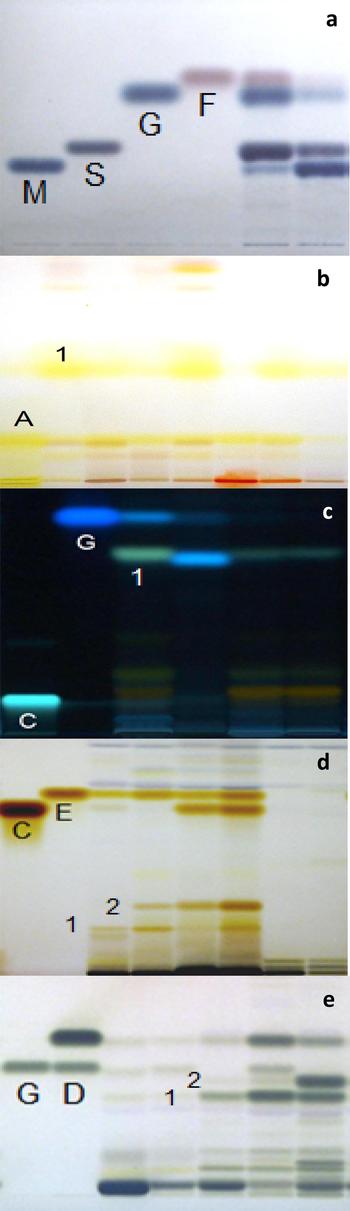
HP-TLC chromatograms (identified peaks are labelled with letters and unidentified peaks are labelled with figures): (a) pure standards for maltose (M), sucrose (S), glucose (G), fructose (F) and two acc. of D. esculenta showing variation in individual sugars content; (b) pure standard for allantoin (A), detection of a similar compound (probably allantoic acid) (1) presenting the same colour when exposed to white light and allantoin variation in three acc. of D. alata, two acc. of D. nummularia and one acc. of D. esculenta; (c) pure standards of chlorogenic acid (C), gallic acid (G) and unidentified compounds, with band 1 especially important in D. nummularia; (d) pure standards of catechin (C), epicatechin (E) and two other catechins (1 and 2) and three acc. of D. alata and two acc. of D. cayenensis; (e) pure standards of gracillin (G), dioscin (two bands) (D) and two other saponins (1 and 2) and their detection in three acc. of D. cayenensis.

UV spectra of pure standards used for identification of compounds in methanolic extracts of Dioscorea spp. acc.: (a) maltose, (b) sucrose, (c) glucose, (d) fructose, (e) chlorogenic acid, (f) unknown, (g) gallic acid, (h) catechin and (i) epicatechin. The compounds, (j) dioscin, (k) gracillin, (l) allantoin, show no spectra and absorbance above 200 nm.

Statistical analysis
Peak purity tests were done by comparing UV spectra and λ max absorption (nm) of the individual compounds in standard and sample tracks. For determination of the linearity curve, different amounts of stock solutions (0.1, 0.2, 0.3, 0.4, 0.5 µl) of each standard (maltose, sucrose, glucose, fructose, allantoin, dioscin, gracillin, catechin, epicatechin, CGA, gallic acid) were applied on HP-TLC plates that were developed with the same mobile phase as described above and scanned at 520 nm for sugars (after derivatization), 200 nm for allantoin and saponins (before derivatization), at 440 nm for catechins (after derivatization) and 350 nm for phenolic acids (before derivatization). Linear ranges were computed using the least-squares method. Repeatability was confirmed by applying five repetitions of each standard at five different concentration levels (0.1, 0.2, 0.3, 0.4, 0.5 µl) and the variance among repetitions was expressed as the repeatability standard deviation (%RSD) and repeatability was assessed during 3 d using the same standard solutions. Peak areas measurements (in area units, AU) were compared with individual standards and corresponding values were quantified in %DW (dry weight) for sugars and in mg/g DW for other compounds.
Raw data (peak areas and their transformation in %DW) were recorded using Excel™ (Microsoft Corporation) spreadsheet format. Statistical analyses (mean standard deviation and Spearman coefficient of correlation), and analysis of variance Fisher's test of Least Significant Difference (LSD at P < 0.05) were performed using XLStat™ software (Microsoft Corporation). A ratio (S/T) comparing sucrose versus the total reducing sugars content was computed (S/RS) to assess the proportion of reducing sugars (maltose, glucose, fructose).
Results
The calibration plots (peaks areas versus concentrations) were linear for all standards (R 2 > 0.99, P = 0.01) except allantoin. The %RSD values were low indicating that the HP-TLC measurements were accurate enough for the quantification of these compounds (Table 1). Allantoin was detected but not quantified because of the low R 2 (0.7787) and high %RSD (5.66) values (Table 1).
Linearity of HP-TLC measurements, accuracy and precision of repetitions (peak areas versus concentrations applied)

RSD, repeatability standard deviation (n = 5).
R 2, P < 0.01.
Composition of sugars
The dry matter contents (%DM) of the eight species studied are presented in Table 2. Dioscorea dumetorum and D. nummularia presented the highest %DM (respectively 44.25 and 37.49%) while D. pentaphylla was the lowest (18.75%). The mean qualitative scores recorded for the flour colours indicated that D. dumetorum, D. cayenensis and D. esculenta accessions presented light colour flours (mean qualitative scores of respectively 1.0, 1.77 and 2.54) while other species presented more colour variation, ranging from white (1) to dark brown (6). The extent of variation was remarkable in D. alata hybrids with a mean of 3.69 ± 2.29 (Table 2). However, the dataset was largely skewed towards this species. Absorbance of methanolic extracts was maximum at 440 nm and the values for this wavelength are presented in Table 2. Accessions presenting dark flour colours presented high absorption values of their methanolic extracts. Absorbance was highest for methanolic extracts of D. bulbifera aerial bulbils (0.87).
Dioscorea spp. flour colours, methanolic extracts absorption values and individual sugars contents

Species mean values are in %DW and correspond to peak areas converted into concentrations based on pure standards values (standard deviations are below means with ± ).
Means with different letters within each column are significantly different at P < 0.05.
a Mean qualitative assessment score.
b Measured at 440 nm.
c Total reducing sugars ( = maltose + glucose + fructose).
d Sucrose/total reducing sugars.
Four individual sugars (maltose, sucrose, glucose and fructose) (Fig. 1(a)) were quantified using the peak areas of the standards. Their respective UV spectra are presented in Fig. 2(a–d). The eight species mean sugars values are presented in Table 2. Maltose was detected and quantified only in D. esculenta accessions (1.75%DW). This species, also known as ‘sweet yam’, presented the highest mean fructose content (0.65%), a sugar perceived as sweeter than other sugars. The highest total sugars content was found in D. bulbifera aerial bulbils (7.28%). The tubers of D. esculenta presented the highest total sugars (5.04%) and the highest reducing sugars (RS = 3.15%). Interestingly, D. alata hybrids presented very low sugars values (1.33%) compared with D. alata landraces from Vanuatu (2.53%) or India (2.36%). These hybrids were selected on their tolerance to anthracnose disease (Colletotrichum gloeosporioides), yield and tuber shape but also on their taste after boiling. Although the present work does not involve consumers testing nor analysis of a diversity panel, these results confirm previous reports suggesting that consumers prefer yam tubers with low sweetness (Baah et al., Reference Baah, Maziya-Dixon, Asiedu, Oduro and Ellis2009; Wireko-Manu et al., Reference Wireko-Manu, Ellis, Oduro, Asiedu and Maziya-Dixon2011). A reducing sugars content of 0.1–0.5%DW has been reported as appropriate for acceptable flavour, browning and acrylamide content in potato (Solanum tuberosum) (Biedermann-Brem et al., Reference Biedermann-Brem, Noti, Grob, Imhof, Bazzocco and Pfefferle2003). Most of the yam species mean values presented in Table 2 are higher than this benchmark but some yam accessions presented very low reducing sugar content and are therefore appropriate for processing into fried products (chips or French-fries). The species mean values for total sugars contents quantified by HP-TLC in the present study are comparable to those obtained in a previous work (Lebot and Malapa, Reference Lebot and Malapa2012) using the colorimetric method of Luff–Schoorl with D. bulbifera (bulbils) and D. esculenta (tubers) presenting again the highest values. However, the comparative advantages of the present HP-TLC method rest with the quantification of individual sugars and the rapid analysis of numerous accessions.
Composition of secondary metabolites
When the plates were scanned at 200 nm, 13 peaks were detected in D. alata (including hybrids) and up to 17 peaks were detected in D. cayenensis while 11 peaks were detected in other Dioscorea spp. At this wavelength, the most important compounds (in peak AU) were allantoin, catechins and saponins. Allantoin peak was clearly detected at 200 nm but the R 2 was too low (0.7787, Table 1) to allow accurate quantification within and between species. The derivatization of allantoin (using the Ehlrich reagent) was challenging because of the poor absorbance of this molecule and bands were not sharp enough for accurate scanning (Fig. 1(b)). A second yellow band, probably allantoic acid (‘1’), was observed above the allantoin band and its peak area was easily scanned at 200 nm.
When the plates were scanned at 350 nm, 6–11 peaks were detected in Dioscorea spp. tubers while D. bulbifera bulbils samples presented up to 15 peaks. CGA and gallic acid were the major compounds detected in D. alata accessions from Vanuatu and India (and their hybrids), in D. bulbifera (tubers and bulbils) and in D. nummularia (Fig. 1(c)). A third major band (referred as ‘1’) was also quantified at 350 nm but was not identified. This compound was in high content in D. nummularia (5.67 mg/g). Its UV spectrum showed two small peaks at 210 and 250 nm and a major peak of absorption at 349 nm (Fig. 2(f)). Because this compound presented a bright yellow colour when exposed to white light, 11 pure standards of flavones, including luteolin, apigenin, apigenin-7-O-glucoside, luteolin-4′-O-glucoside, luteolin-7-O-glucoside, luteolin-3′,7-di-O-glucoside, schaftoside, vitexin, isovitexin, homoorientin (isoorientin) and orientin were tested on the same plate but none corresponded to this band. It was therefore decided to consider this band as an unknown phenolic acid for the present study. Phenolic acids UV spectra are presented in Fig. 2(e–g). Their quantification was done without derivatization at 350 nm and the corresponding values (in mg/g) are presented in Table 3. Dioscorea bulbifera bulbils and D. nummularia tubers presented the highest total phenolic acids concentrations (9.96 and 9.55 mg/g, respectively). Accessions of D. alata from Vanuatu presented values lower than Indian accessions and hybrids (respectively 4.87, 5.07 and 5.69 mg/g) but significant variation was observed within each species and group of accessions, as shown by the high standard deviations (Table 3).
Dioscorea spp. mean values for phenolic acids, catechins and saponins

P1, unknown phenolic acid; C1 and C2, unknown catechins; S1 and S2, unknown saponins.
Values are in mg/g DW and correspond to peak areas converted into concentrations based on pure standards values (standard deviations are below means with ± ).
Means with different letters within each column are significantly different at P < 0.05.
*Refer to bands indicated in Fig. 1(c–e).
Catechins were quantified at 440 nm after derivatization with anisaldehyde and four well-separated bands were detected (Fig. 1(d)) and quantified. Catechin and epicatechin were on the upper part of the plate and two other compounds presenting the same colour, and almost identical UV spectra (Fig. 2(h) and (i)) were also quantified in the lower part of the plate. Although these compounds were not identified, it is possible that they correspond to gallocatechin, epigallocatechin or catechin- and epicatechin-gallate as reported by Champagne et al. (Reference Champagne, Bernillon, Moing, Rolin, Legendre and Lebot2011) using HPLC. Catechins were in very high content in D. bulbifera bulbils (25.18 mg/g) and tubers (6.96 mg/g) and in lower content in D. alata accessions from India and hybrids (5.31, 3.11 mg/g) and D. nummularia (3.61 mg/g). Dioscorea alata accessions from Vanuatu presented lower values (0.66 mg/g), similar to D. cayenensis (0.65 mg/g), D. esculenta (0.32 mg/g) and D. pentaphylla (0.41 mg/g). Catechins were not detected in the few accessions of D. dumetorum and D. trifida analysed in this study (Table 3).
Derivatization of the plates with anisaldehyde revealed the presence of green bands but these were not separated enough to be identified and quantified. The use of a new mobile phase (chloroform:methanol:water, 26:8:1, v/v) produced well-separated bands of four saponins (gracillin, dioscin, 1, 2) and these were quantified (Fig. 1(e)). Unidentified bands, most likely saponins, were also detected at the bottom of the plate but were not quantified. These saponins were detected in only two species: D. cayenensis (total of 26.38 mg/g) and D. esculenta (total of 11.66 mg/g). Dioscin was high in D. cayenensis (5.94 mg/g) with significant variation within this species (SD ± 3.78) (Table 3) and with some accessions presenting very high values, especially hybrids.
Discussion
The yam germplasm analysed in the present study (522 acc.) is somewhat unbalanced as more than 73% (384 acc.) belong to the species D. alata. This is because the VARTC breeding programme is mainly focusing on this species of major economic importance. Genetic diversity and morphological variation exist for D. alata in Melanesia but most of the world production occurs in the ‘yam belt’ of West Africa (Asiedu and Sartie, Reference Asiedu and Sartie2010). Besides resistance to anthracnose, the VARTC improvement programme focuses on quality traits, mainly on a white flesh which is not susceptible to oxidation when exposed to air. In the present study, the qualitative assessment of the flour colour was converted into a simple scale (1–6) corresponding to increasing darkness but flour samples were not measured with a colorimeter. It is therefore possible that the scores are not accurate enough for correlation studies. The methalonic extract absorbance measured at 440 nm is, however, a reliable assessment of the variation between flours extracts (Table 2). The results obtained for hybrids indicate that breeding D. alata for improved chemical composition of the tubers is feasible. During the course of the present screening, it was observed that selected hybrids presented white and non-oxidizing tuber flesh, with very low absorbance of their methanolic extracts (0.04–0.08). In West Africa, D. alata is popular for producing boiled yam but local cultivars present a narrow genetic base and are unsuitable for pounded yam, the most appreciated preparation. Considering the genetic variation that exists, and therefore the potential for breeding, the improvement and selection of chemotypes adapted to West African consumers’ preferences is feasible. If new suitable D. alata genotypes could be released in West Africa, they would be evaluated by farmers and some might be adopted. Adoption rate of new improved varieties of yam is often low because consumers’ preferences are difficult to satisfy. However, the development of new methods allowing the high throughput screening of numerous accessions, such as the one presented here, might optimize the evaluation accuracy and could contribute to a more accurate selection process.
The limited number of accessions studied for the other seven species is inadequate for a good assessment of the variation existing within these species. The so-called Guinea yam, D. cayenensis, is endemic to West Africa where thousands of cultivars exist. Only a few selected landraces were introduced to Vanuatu and the Pacific and a more comprehensive evaluation of these species diversity should be done. The 22 genotypes (including hybrids created locally) analysed in the present study produced light colour flours after hot-air drying with no tuber flesh oxidation. In this study, D. rotundata accessions were not evaluated and further research is needed to assess this other major West African species. Dioscorea esculenta is also widely cultivated throughout the world but is not popular in West Africa because of the low dry matter and high sugar contents of the tubers, not adapted to African culinary processes and especially as pounded yam. The chemical variation within this species, however, indicates that selection for improved quality traits is feasible. The 46 accessions analysed in the present study are, unfortunately, not representative of the diversity existing within this species, especially in Asia where hundreds of landraces exist.
Spearman correlation coefficients between groups of compounds (sugars, phenolic acids, catechins and saponins) and flour characteristics (%DM, colour and absorbance of methanolic extract) are presented in Table 4. Dry matter content of the tuber is negatively correlated with all other compounds except total saponins (ns). The significant negative correlation between sugars content and %DM confirms the results obtained in a previous study with a smaller set of samples (265 acc.) (Lebot and Malapa, Reference Lebot and Malapa2012). Interestingly, total catechins values are significantly correlated with the flour colour and the absorbance of the methanolic extract, indicating that they most likely contribute to the browning of the yam flesh tuber, as suggested by Akissoe et al. (Reference Akissoe, Mestres, Hounhouigan and Nago2005). The colorimetric measurement of the methanolic extract absorbance at 440 nm appears as a simple test to estimate catechins content in yam flours as revealed by the coefficient of correlation (0.47). However, because of the fairly large set of samples analysed in the present study (522 acc.), the r value is rather low at P > 0.01 (0.11) and some authors have suggested that when analysing large germplasm collections, only correlation coefficient with absolute values higher than 0.71 should be considered biologically meaningful (Skinner et al., Reference Skinner, Bauchan, Auricht and Hughes1999).
Spearman coefficient of correlations for Dioscorea spp. accessions (n = 522) for %DM, flour colour, absorbance of methanolic extract, total sugars, total phenolic acids and total saponins

**Significant at P < 0.001 and n > 500, r value at 1% = 0.115.
Total phenolic content and cinnamic acids have shown to be involved with the browning of the tuber flesh. Browning intensity was found to correlate with the total phenol and DM of the tubers and is highest in the head than in the mid sections or tail of the tuber (Graham-Acquaah et al., Reference Graham-Acquaah, Ayernor, Bediako-Amoa, Saalia and Afoakwa2014). Yam flavonoids and phenolic acids have been evaluated for their antioxidant and antitumour activity and yam tubers and extracts are known in China to promote health and longevity (Zhang et al., Reference Zhang, Gao, Wang and Huang2014). Catechin has been identified as the main polyphenol and was suspected to be a potential substrate for polyphenol oxidase and a good candidate for explaining yam browning (Akissoe et al., Reference Akissoe, Mestres, Hounhouigan and Nago2005). Saponins are present in most Dioscorea spp. (Sautour et al., Reference Sautour, Mittaine-Offer and Lacaille-Dubois2007) and are often associated to bitter taste. Their abundance in some Dioscorea spp. and landraces is thought to contribute to poor tuber quality (Ezeocha and Ojimelukwe, Reference Ezeocha and Ojimelukwe2012). Some studies, however, suggest that saponins could offer opportunities for commercial exploitation and production of natural bioactive compounds (Güçlü-Üstündagḡ and Mazza, Reference Güçlü-Üstündagḡ and Mazza2007).
Yams are healthy foods shared by hundreds of millions of consumers (Asiedu and Sartie, Reference Asiedu and Sartie2010) and conventional plant breeding offers interesting avenues for biofortification. The D. alata and D. cayenensis hybrids (obtained by cross-pollination) appeared extremely variable and much diverse and richer than the best landraces of the same species, indicating that traditional selection by farmers focused on a particular chemical composition. This is remarkable for phenolic acids and catechins in D. alata hybrids and for saponins in D. cayenensis hybrids. Breeding for secondary metabolites content (especially for dioscin and steroidal saponins) could be another interesting objective considering the high yield of some accessions (above 5% DW for total saponins in D. cayenensis). The aglycone of dioscin, diosgenin, has hypoglycaemic, anti-oxidative, anti-inflammatory and antiproliferative activities and is industrially exploited as the starting material to produce steroids (Jesus et al., Reference Jesus, Martins, Gallardo and Silvestre2016). Unfortunately, the extraction process is often done from wild Dioscorea spp. and species rich in dioscin are now endangered (Bai et al., Reference Bai, Zhang, Jin, Wei, Zhou, Zheng, Niu, Nie, Zhang, Wang and Yu2015). Allantoin would be another interesting compound but the HP-TLC protocol used in the present study needs further modification and improvement before it can be used for accurate quantification.
Several studies have developed suitable HPLC protocols for the quantification of allantoin (Fu et al., Reference Fu, Ferng and Huang2006) dioscin (Kwon et al., Reference Kwon, Choi, Yoo, Choi, Lee and Park2013) and for catechin, CGA and gallic acid (Zhang et al., Reference Zhang, Gao, Wang and Huang2014). HPLC protocols are accurate but the technique is cumbersome for screening secondary metabolites in hundreds of samples. GC-MS has been used successfully to assess diversity across yam species but the analysis focused on the foliage (Price et al., Reference Price, Wilkin, Sarasan and Fraser2016) and on tuber carotenoids (Price et al., Reference Price, Bhattacharjee, Lopez-Montes and Fraser2018). A first attempt to predict the dioscin content in yam tubers using infrared spectroscopy concluded that the accuracy was average (R 2 value = 0.72) because of the low concentration of dioscin (Kwon et al., Reference Kwon, Jie, Sartie, Kim, Liu, Min and Kim2015).
Previous studies (Champagne et al., Reference Champagne, Bernillon, Moing, Rolin, Legendre and Lebot2010, Reference Champagne, Bernillon, Moing, Rolin, Legendre and Lebot2011) also detected carotenoids, flavonoids, catechins and phenolic acids using HPLC but a smaller number of species (6) and accessions (52 acc.) were analysed. Our data also confirmed the results obtained by Kwon et al. (Reference Kwon, Jie, Sartie, Kim, Liu, Min and Kim2015) who analysed accessions and breeding lines from IITA (International Institute of Tropical Agriculture), in Nigeria. They did not detect dioscin in D. alata, D. bulbifera or D. dumetorum accessions and found that D. cayenensis accessions had high dioscin contents. Diosgenin is obtained by acid hydrolysis of yam tubers containing steroid saponins, mainly dioscin. Diosgenin is industrially exploited as the starting material for the synthesis of steroids. Around 15 wild Dioscorea spp. are exploited with an estimated market value of US$500 million and the present world requirement of steroidal drugs for pharmaceuticals in terms of diosgenin is equivalent to about 10,000 tons of tubers per annum (Deshpande and Bhalsing, Reference Deshpande and Bhalsing2014). The present overexploitation of wild species is not sustainable and it would be more appropriate to cultivate species and accessions with short growth cycle and high dioscin content. HP-TLC offers interesting perspectives for the rapid screening of accessions rich in dioscin and other steroid saponins.
It has been shown that the replacement of the two-thirds of staple food with yam for 30 d improves the status of sex hormones, lipids and antioxidants in yam consumers and that these effects could reduce the risk of breast cancer and cardiovascular diseases in postmenopausal women (Wu et al., Reference Wu, Liu, Chung, Jou and Wang2005). As shown in the present study, edible yams are much more than just starchy foods. Yams have tremendous potential as functional foods in tropical megacities but more data could contribute to better product profiling and value addition. This study represents a first attempt to characterize the secondary metabolites found in edible yam tubers using HP-TLC but more research is needed to screen numerous accessions from distant geographical origins.
Conclusions
Reducing sugars content is highly variable within and between yam species as well as between improved hybrids. Catechins are present in significant amounts in D. alata accessions and hybrids, and in D. bulbifera and D. nummularia. They most likely contribute to the browning of yam tuber flesh but other compounds are probably involved as well. More research is therefore needed to clarify their relationships with yam tuber flour quality. In this study, dioscin and gracillin were detected only in D. cayenensis and D. esculenta with some accessions presenting high values. Cultivated yam species presenting short growth cycle and high yield could represent sustainable alternatives for the production of steroidal steroids-rich raw material for the production of diosgenin, offering new industrial opportunities for farmers. More research is, however, needed to characterize D. rotundata, another major species widely cultivated in West Africa. Conventional breeding appears as an interesting approach to reduce sugars levels and to increase secondary metabolites with bioactive properties in yam tubers. HP-TLC is a suitable and eco-friendly technique for the rapid quantification of individual sugars, phenolic acids, catechins and saponins in Dioscorea spp. The methanolic extraction procedure is simple and the volume of solvent used for the mobile phase (10 ml per plate for 20 samples) is very low compared with column chromatography.
Supplementary material
The supplementary material for this article can be found at https://doi.org/10.1017/S1479262118000333.
Acknowledgements
This work was financially supported by the ‘Agropolis Fondation’ under the reference ID 1403-023 through the ‘Investissements d'avenir’ programme (Labex Agro:ANR-10-LABX-0001-01). Special thanks are due to Rosanna Molisalé and Madeleine Shem for technical assistance and samples preparation.
Conflict of interest
The authors declare that there are no potential conflicts of interest.