This article has two goals. First, it explores whether the processes of transfer and calquing (commonly discussed in studies of language contact, and specifically creolization) can be discerned in patterns of variation. That is, does the process of calquing operate outside the canonical domains of morphology and syntax and in relation to speakers' mental organization of variables?
Second, it explores whether the increasingly common use of comparisons of constraint rankings for the same (or ostensibly the same) variables in different language varieties can be used as inferential evidence for (or against) the transfer of features in cases of long-term language contact.
This article will propose that the two goals can be linked methodologically, and that the analysis of variation:
a. can enrich our understanding of what happens in situations of language contact, and
b. enables us to particularize how we define replication, transfer, and calquing to inherently variable domains.
I begin with some general background comments on the two goals of the article, and then outline the general problem for creolistics in particular. I then present a variationist framework for systematizing the investigation of (a) and (b). I then review how such a framework deals with some data that relates to the problem I have outlined. Finally, I suggest some implications of this approach for the fields of variationist sociolinguistics and creolistics.
SOME COMMENTS ON REPLICATION, TRANSFER, AND CALQUING
Research on language contact recognizes that when speakers of different language varieties are in more than superficial contact with each other, there is the potential for transfer on all levels of linguistic structure. Some researchers propose that there are hierarchies governing how easily transfer takes place on different structural levels—hierarchies that make more or less reference to social and psychological factors as well as language-internal ones (Heine & Kuteva, Reference Heine and Kuteva2005; Matras, Reference Matras2000; Thomason & Kaufman, Reference Thomason and Kaufman1988; Winford, Reference Winford2003, all review this approach in the development of the field of language contact).
Among the effects of transfer over time in communities and within the repertoire of individuals, the calquing of linguistic features from one language to another is well-documented. A calque can be defined quite specifically in linguistic terms, and in the field of language contact, a calque is usually used to refer to the direct translation, morpheme by morpheme, or word for word, of concepts and syntactic structures that originated in one language and can be shown to be (or be argued to have been) a historical introduction into another. The realization of the morphemes in English skyscraper (sky + scraper) in German as Wolkenkratzer (Wolken ‘cloud’ + Kratzer ‘scratcher’) is often cited as an example (e.g., Winford, Reference Winford2003:44–45). Semantic equivalence also underlies the use of the term calque to describe cross-linguistic influences from one language to another on syntax and multiword constructions (e.g., Hock, Reference Hock1992; Turell, Reference Turell1998).
Heine & Kuteva (Reference Heine and Kuteva2005:ch. 2, especially) provided a host of examples of the more general process that they prefer to call replication, where there is a model language in which a pattern originates historically, and a replica language, which adopts the pattern as a result of contact with the model. This terminology is helpful, and I will follow them in their use of model and replica languages to identify which of the varieties in contact we are talking about with respect to a particular pattern. Describing the underlying process as replication (rather than as transfer or interference) has some advantages too, because replication suggests both copying and differentiation. Transfer, by contrast, suggests relocation of a feature or subsystem in toto, and interference suggests problems with respect to the target. In most of the cases Heine & Kuteva discussed, replication does involve some nativization or alteration of the model in the replica. The data I will introduce later illustrate this nicely.
Heine & Kuteva discussed examples of replication that include the development of a “whether” complementizer into a polar question marker in Finnish Swedish, apparently on the model of a Finnish pattern (Koptjevskaya-Tamm & Wälchli, Reference Koptjevskaya-Tamm, Wälchli, Dahl and Koptjevskaya-Tamm2001); the use of “do”-support in varieties of Pennsylvania German (Burridge, Reference Burridge and Andersen1995); and the conventions for use of cleft constructions in Irish English (which replicate the pragmatic constraints on clefting in Irish more closely than the pragmatic constraints on clefting in English [Cotter, Reference Cotter1994]). Similar morphosyntactic examples of transfer (e.g., what has been referred to as a calquing of back from English into Ontario French) are discussed by King (Reference King, Meyerhoff and Nagy2008) for French-English contact. In the field of creolistics, many claims have been made that structures in the emergent creoles are the result of calquing or morphosyntactic transfer (Camden, Reference Camden1979, and Keesing, Reference Keesing1988, being particularly radical proposals of this for Bislama and Solomon Islands Pijin, respectively). We will consider the case of language contact and creolization in more detail shortly.
In all these examples, it is worth noting the obvious. The process involves the transfer of semantics, with either the attendant transfer of form (phonetic realization) from one language to another, or the substitution or reallocation (cf. Britain & Trudgill, Reference Britain and Trudgill2005; Trudgill, Reference Trudgill1986) of a semantically equivalent (or related) form in the replicating language.
But notice that there is some indeterminacy in application of the definition in some case studies. For example, with Wolkenkratzer, the English morphemes are not directly translated (*Himmelschaber); instead suitable candidates within the wider semantic field of {sky} and {scrape} are selected.Footnote 1
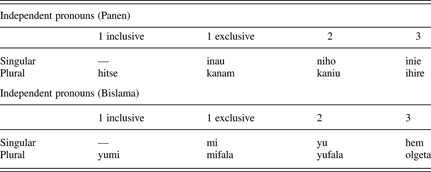
Even looser semantic mappings may emerge at the level of structure. This is perhaps particularly true when we consider the very profound language contact involved in the formation and development of creoles. For example, a distinction between first-person plural (1p) inclusive and 1p exclusive pronouns is found in all varieties of Melanesian English. This is said to be the result of the transfer or calquing of a semantic distinction that is found in the substrate languages. What is interesting about this case, is that the purported calque is realized in the replica with morphemes taken from the model language, even though the model has no direct analogue of the inclusive/exclusive distinction. This can be seen in Table 1, which compares the pronouns in Panen (a very typical Vanuatu language, spoken in Matantas in Big Bay [Meyerhoff, Reference Meyerhoff2008]) with the pronouns in Bislama (the creole, national language of Vanuatu). Consider particularly, the first- and second-person forms.
Independent pronouns in Panen (spoken in Matantas, Vanuatu) and in Bislama (national language creole)
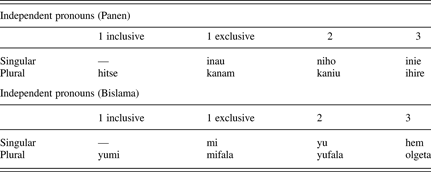
It is clear that whereas the Bislama 1p pronouns are (a) derived, and (b) semantically transparent, the same cannot be said of the Panen 1p pronouns (any historical compositionality in the Panen pronouns is synchronically opaque). In other words, the sense of the distinction (inclusive versus exclusive) may have transferred, but the mechanics for drawing that distinction are not what was transferred.
This sort of creative mapping in creoles (and its implications for genetic theories of creole evolution) is discussed at length in Mufwene (Reference Mufwene2001). Such loose mappings in the process of calquing may be particularly typical of the Pacific creoles, because, as we know now, they were all characterized by extensive communal and individual bi-/multilingualism in their history (this is uncontroversial for the Melanesian creoles—and continues to be the case for many speakers; Roberts' [Reference Roberts and McWhorter2000] work on Hawai‘i Pidgin convincingly makes the same case for extended periods of bilingualism there).
Clearly, it is uncontroversial to assert that there is a lot of variability in the mechanisms and hence the final outcomes of language contact. But what kind of place does inherent variability—the inter- and intraspeaker variation characteristic of all speech communities—have in the field of language contact? In the next section, I offer some remarks about this and move toward a proposal for a systematic framework under which variation can be linked to wider trends in the study of language contact.
SOME COMMENTS ON VARIATION, LANGUAGE CHANGE, AND LANGUAGE CONTACT
By and large, work on language contact acknowledges the relevance of differences in frequency and of variation (in either the input or the output). Heine & Kuteva discussed the shift from what they call “minor use patterns” to “major use patterns” (2005:44ff) and frequency changes with replication. Thomason & Kaufman (Reference Thomason and Kaufman1988), Trudgill (Reference Trudgill2004), and Siegel (Reference Siegel1999) all note that the interplay of different variants in the input may be crucial to the output in situations of radical intervariety contact and creolization. However, in general, work on creole (or mixed language) genesis acknowledges that differences in frequency and/or variable input and output are relevant, without making them the explicit focus of enquiry.
There are notable exceptions to this. Recent years have seen the increased use of variation itself as the focus of comparative historical work and in the exploration of cross-linguistic transfer. Pioneered by Shana Poplack and her associates, the comparison of significant linguistic constraints on the variation between the same forms in different varieties of English, or Romance languages (e.g., Poplack, Reference Poplack2000; Poplack & Malvar, Reference Poplack, Malvar and Hinskens2006; Poplack & Tagliamonte, Reference Poplack and Tagliamonte2001; Tagliamonte, Reference Tagliamonte, Chambers, Trudgill and Schilling-Estes2002) has been used to infer historical relatedness (where there are similar significant factors) or, conversely, a lack of historical relatedness of language varieties (where the significant linguistic factors constraining variation are different). Using these methods, Naro & Scherre (Reference Naro, Pereira and McWhorter2000) argued that some variables in Brazilian Portuguese reflect inherited traits from peninsular Portuguese.
Some quantitative studies of language contact have also explored variation as diagnostics of transfer and replication. G. Sankoff (Reference Sankoff, Byrne and Winford1993) examined the gradual change in preferred patterns of use of yet in Tok Pisin. She found that over time the pattern looks less and less like the English distribution of yet and more and more like the distribution of Tolai iat, eventually resulting in a synthetic pattern that (she argued) reflects the extended temporal contact between English and Tolai (and perhaps other vernacular languages). A more detailed use of the comparison of variation in cases of language contact is Blondeau & Nagy's (2008) work on subordinate clause marking in L1 and L2 Canadian French and English. Buchstaller (Reference Buchstaller2008) and Buchstaller & D'Arcy (Reference Buchstaller and D'Arcy2009) used the same methods for dialect contact. Meyerhoff & Walker (Reference Meyerhoff and Walker2007, Reference Meyerhoff and Walker2009) used the comparison of constraints on variation to argue that certain individuals in a community have not changed their grammars over time, despite superficial differences in the frequency with which they use “local” variants.
G. Sankoff's work remains (to my knowledge) the only example of the use of variation to address questions of the emergence of structure in creoles (but see Britain, Reference Britain2008; Kerswill & Williams, Reference Kerswill and Williams2005; and Trudgill, Reference Trudgill2004, on new dialect formation). However, this article will suggest that unless we seriously evaluate variation (which so many researchers agree is an important component in the overall picture of creole development), we may erroneously attribute inheritance, or mistakenly infer historically shared development, to varieties that are not in fact “sisters under the skin.”
Variationists are well-equipped to make a helpful contribution to this. In the next section, I briefly outline the case for focusing on variation in the genesis and development of creoles and other contact languages. I then offer a proposal for using quantitative methods—familiar to variationists—in the service of providing an objective and data-driven basis for discriminating between different kinds of contact-induced effects. Ultimately, this provides a basis for discriminating among replication, transfer, and a highly restrictive notion of calquing.
A CREOLIST'S PROBLEM: DOES VARIATION REPLICATE?
It is reasonably well-attested that, at least for the Melanesian creoles, some categorical features of the substrate languages appear as variable or stochastic features of the creole (Meyerhoff, Reference Meyerhoff2000, Reference Meyerhoff2003, for Bislama; G. Sankoff & Brown, Reference Sankoff and Brown1976; G. Sankoff & Mazzie, Reference Sankoff and Mazzie1991; Smith, Reference Smith2002, for Tok Pisin). In fact, if the competition between lexifier models and substrate models for any given construction is seen as a form of variation, then we can say it has long been recognized that variation in the input is a crucial aspect of how creoles develop. G. Sankoff (Reference Sankoff1994), Crowley (Reference Crowley1990), and Siegel (Reference Siegel1999) all argue that a synthetic process that resolves substrate, lexifier, and cognitive factors is central to the development of the Melanesian creoles (and Mufwene, Reference Mufwene2001, for creoles more generally). Meyerhoff (Reference Meyerhoff2000:224) suggested that “convergence between the lexifier and the substrate is the proximate cause of creole variation.” Mufwene (Reference Mufwene1996) proposed that the specific role of Universal Grammar in such linguistically dynamic situations is to predict which variants, out of the mix, will be focused (Le Page & Tabouret-Keller, Reference Le Page and Tabouret-Keller1985) in the resulting creole.
Other work has proposed even more direct links, suggesting that variable features of the substrate(s) may be the source of the variation observed in creole grammars. Meyerhoff (Reference Meyerhoff2000) noted that the typologically unusual pattern of pro-drop in Bislama (pro favored in third person, and pronouns favored in first and second) may have syntactic models in the substrate languages of Vanuatu, but that the necessary data on this kind of variation are usually unavailable in reference grammars.
Jauncey (Reference Jauncey1997) noted that in the Vanuatu language Tamambo some nouns can be treated as alienable or inalienable in different contexts, that is, alienability is a property that emerges in discourse, and she intimates that there may be inherent variability in possession marking, but that the contextual constraints on this are difficult to pin down. Following from Jauncey's observation, Meyerhoff (Reference Meyerhoff2003) suggested that the probabilistic marking of alienability in Bislama object NPs may be linked to its variability in (some) substrate languages. Crowley (Reference Crowley1990, Reference Crowley2004) argued that animacy, a probabilistically marked feature of substrate grammars, is the source of variation in the form of Bislama subject and object NPs (null versus overt) and that it also underlies the alternation between the agreement marker i and oli with third-person plural subjects (oli is canonical; i can be analyzed as the default agreement marker in Bislama [Meyerhoff, Reference Meyerhoff2001]).
There is no a priori reason why replication of variable features from the substrate into a creole might not occur, and as the preceding examples demonstrate, there have been consistent (if muted) claims to this effect among researchers studying creoles for some time. From a broader typological perspective, there is even less reason to suppose this might not be the case. Other work on language contact has demonstrated solid evidence for the transfer of variable features of one language or variety into another (e.g., Blondeau & Nagy, Reference Blondeau, Nagy, Meyerhoff and Nagy2008).
Despite this, until now, there has been limited direct quantitative comparison of variation in substrate languages and their related creoles. Drawing on some relevant data from Bislama (the creole spoken in Vanuatu, Southwest Pacific), this article proposes a way of typologizing different levels of replication or transfer within a variationist perspective.
A VARIATIONIST'S APPROACH TO SOLVING THIS PROBLEM
I draw on the comparative variationist approach established by Shana Poplack. This involves subjecting data from different groups of speakers to the same multivariate analysis. The factor groups and factors within groups are held constant across the different populations, and the resulting Goldvarb (Goldvarb X [D. Sankoff, Tagliamonte, & Smith, 2005]) weightings can be compared. Differences in which factor groups are returned as significant, and differences in the ranking of factors within those groups, are interpreted as diagnostics of fundamentally different underlying grammars of variation. (Poplack's approach advances a clear position with respect to the status of variation in the grammar, viz. variation is emphatically a property of human grammar, rather than being an artifact of pressures peripheral to the core grammar.)
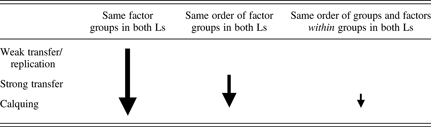
In Meyerhoff & Walker (Reference Meyerhoff and Walker2007), it became clear this method is well-suited to capture the gradient effects associated with contact-induced transfer. In particular, the basic components of a variationist analysis—identification of significant factor groups, identification of the most parsimonious analysis of factors within groups, and the different weighting of factors within groups—lend themselves to three distinctions. These are outlined in (1).Footnote 2
(1) Principles for incorporating variation into the study of language contact:
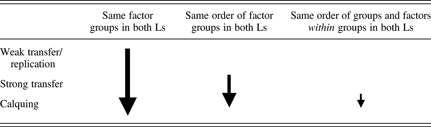
(i) Where the same factor groups are significant constraints on a variable in the model and in the replica varieties, let us call this weak transfer or replication;
(ii) Where the same factor groups are significant in both model and replica, and the ordering of these factor groups is the same in both model and replica, let us call this (strong) transfer;
(iii) Where the same factor groups are significant in both model and replica, and the ordering of these factor groups is the same in both model and replica, and the factors within groups have the same ranking in model and replica, let us call this calquing.
This typology considers similarities both of kind and of quality. In doing so, it allows us to ask linguistically and statistically meaningful questions about whether the same surface-level form found in two languages is in fact “the same.” It adopts well-established terms from the field of language contact and attempts to relativize them to the kind of phenomena that variationists study.
Table 2 summarizes these principles schematically, in the manner of Buchstaller & D'Arcy (Reference Buchstaller and D'Arcy2009). Because Buchstaller & D'Arcy are concerned with dialect contact, their focus is somewhat different. They include a category for replication of form only (with no associated sociolinguistic constraints)—dialects of the same language are not usually dealing with the problem of replicating an underlying semantics, so the option of form-only replication in fact amounts to form and (I assume, truth-conditional) semantics.
Operationalizing replication, transfer, and calquing with variables
In some respects, what we are trying to do is systematize the approximate quality of transfer and mapping between varieties that was exemplified earlier with the example of English skyscraper being calqued into German as Wolkenkratzer. However, it is important to note that the purpose of this article is not to provide a basis for classifying pairs such as skyscraper-Wolkenkratzer as calques or not. The typology proposed in (1) is clearly framed so that it is concerned with cases in which inherent variability is a feature of both the model and the replica language. Pairs such as skyscraper-Wolkenkratzer do not involve inherent variability.
In the next section, I demonstrate how the framework in (1) might be used in the study of a particular case of language contact, drawing on data from an indigenous language of Vanuatu, Tamambo, and Vanuatu's national language, the creole Bislama.
DATA SET AND METHODS
In this section, I revisit two of the Bislama variables already mentioned—phonetically null subjects and phonetically null objects—and I compare them directly to analogous variables in Tamambo, the language spoken on Malo island in northwest Vanuatu.
The motivation for selecting Tamambo is both principled and pragmatic. First, many of the speakers in my corpus of conversational Bislama were L1 speakers of Tamambo or of closely related languages from South Santo or Ambae. Hence, the corpus is a good candidate for testing the possible transfer of constraints into the Bislama of the corpus that is also available. Second, Dorothy Jauncey, who has done extensive work on Tamambo, kindly offered me access to a corpus of Tamambo texts she had collected in 1994–1995. This was coincidentally the same time I was collecting my Bislama corpus, however, none of the speakers in her Tamambo texts overlap with speakers in my Bislama corpus. This is important because it means any parallels we might identify cannot be attributed to the transfer of idiosyncratic norms or speaker preferences.
Jauncey (Reference Jauncey, Lynch, Ross and Crowley2002) provided a structural overview of Tamambo.Footnote 3 It is a very typical, rather conservative member of the North-Central Vanuatu family. From her corpus of texts, I selected the tandono (traditional, customary stories) for analysis. As narratives, these were closer in genre type to the narratives and free conversation of the Bislama corpus. The narratives were told aloud and subsequently transcribed with the help of (different) native speakers. The transcription seems to try and reproduce the spoken quality of the narratives, for example, often marking apocope. It is much smaller than the corpus of Bislama spoken by Malo speakers, but as we will see, it nonetheless allows us to pose and answer the question of whether variable properties of the substrate show up in the creole.
There are several constraints that are potential transfer candidates and which we would therefore like to investigate in both corpora. As noted, Crowley (Reference Crowley2004) proposed that animacy of the referent was a constraint on the variable occurrence of subjects and objects in the substrate languages of Vanuatu. He proposed that this was the source of the subject and object variation observed in Bislama. However, his quantitative work on this variable considered only third-person subjects (Crowley, Reference Crowley2004; see Meyerhoff, Reference Meyerhoff, Stanford and Preston2009, for details), a definition of the envelope of variation that is perhaps too narrow, as it will necessarily fail to reveal a continuum of internal differences between the way animate third-person referents are treated and the way inherently animate first- and second-person referents behave. Consequently, we will want to consider animacy in a broader sense—across all persons—in the Tamambo and Bislama corpora.
Other work on the distribution of overt and phonetically null subjects and objects in Bislama has identified two other factor groups that are likely to be relevant and helpful in evaluating possible transfer of variable components of the grammar. These are the form and grammatical role of the argument's referent in the immediate discourse (for both subjects and objects), and whether or not the referent would be considered a prototypical alienable or inalienable possession (e.g., in a possessive NP). Discourse factors are relevant for both subjects and objects (Meyerhoff, Reference Meyerhoff2000, Reference Meyerhoff2003), and (in)alienability has been found to be relevant for objects (Meyerhoff, Reference Meyerhoff2003). Both (in)alienability and form and grammatical role in the prior discourse will be compared in the Bislama and Tamambo corpora.
Bislama and Tamambo share many typological features, but their morphology and syntax diverge in some key ways. This requires us to take a catholic approach to the analysis of objects. In both Tamambo and Bislama, subject arguments allow the same alternations: phonetically null versus overt (pronoun or NP) realization of the subject. Both languages also have some overt subject agreement morphology associated with the verb (whether these morphemes are analyzed as agreement or as bound/clitic subjects is immaterial to this investigation), and this morphology is a potential source of identification of the referent when there is no phonetically overt subject. But in object position, Tamambo does not have the option of a zero variant as Bislama does. There is a phonetically reduced variant, but this is an object clitic that appears on the verb (it should not be compared with the Bislama transitive suffix, -Vm, which does not seem to identify any particular argument, e.g., third person [Meyerhoff, Reference Meyerhoff1996]).
Given that the independent pronoun–NP/clitic alternation in Tamambo fills the same kind of ecological niche that the pronoun/zero alternation fills in Bislama, it is reasonable to compare the distribution of these variants in the two languages (such concessions are required frequently when undertaking cross-linguistic comparisons of phenomena at the syntax-discourse interface. Gundel, Hedberg, & Zacharski [Reference Gundel, Hedberg and Zacharski1993] use similar equivalences as the basis for their comparison of the realization of given/new information in a variety of languages).
As noted, the corpora are not matched for size. The analysis of subjects in Bislama is based on the speech of 18 speakers from Malo island between the ages of 10 and early 40s. This corpus contains 1861 clauses with possible subjects (all nonfinite verb phrases were excluded, likewise finite verb phrases where a subject is not possible, i.e., existential, weather verbs, second verbs in serial verb constructions, see Meyerhoff [2000] for details). The corpus of Bislama objects is necessarily smaller, because not all verbs are transitive. The analysis of objects in Bislama is based on the speech of 13 speakers from Malo island and contains 869 clauses with possible objects.Footnote 4
The Tamambo corpus is tandono stories told to Dorothy Jauncey by two elders in West Malo, Vula Vutilolo and Vira Joseph, transcribed and translated into English with the assistance of Selina Vutilolo and Lucian Bani. The texts are not given morpheme by morpheme glosses; I have used my own knowledge of Tamambo and Jauncey's (1997) grammar. The corpus consists of 288 clauses, with 274 possible subjects and 147 possible objects.
The dependent and independent variables coded are summarized here.
Dependent variables:
• Bislama subjects: NP (2) and (3), free pronoun (2), no free pronoun or NP (3):

• Tamambo subjects: NP (5), free (independent) pronoun (4), no free pronoun or NP (4) and (5):
• Bislama objects: NP (6), free pronoun, no free pronoun or NP (6):
• Tamambo objects: NP or free pronoun, phonetically reduced/clitic object (NP and clitic shown in (7)):
Independent variables:
• Person and number of referent: first, second, third person; singular, plural
• Animacy: speaker and addressee, third-person human, third-person animate (nonhuman), third-person inanimate
• Grammatical role and form of the referent in immediately prior discourse: overt subject, null subject, overt other argument, null other argument, not present in prior clause.





Previous work on the Bislama corpus has indicated that perseverance of the referent across clauses operates very locally, so for this reason the coding refers strictly to the prior clause. Note that, defined like this, “not present in prior clause” includes subject reference-switching between clauses, as well as brand new referents in the discourse.
It is possible to make finer-grained distinctions for both animacy and grammatical role/form of referent in the Bislama corpus, but because the Tamambo corpus is smaller, this represents the optimal set of factors and factor groups for comparison. Person and number of the referent and animacy are not wholly independent variables, but we will see that it appears to be possible to identify independent effects.
For each dependent variable, the reduced variants (null subjects in Bislama and Tamambo; null objects in Bislama and clitic objects in Tamambo) were treated as the application value for a multivariate analysis using Goldvarb X (D. Sankoff et al., Reference Sankoff, Tagliamonte and Smith2005).
I turn now to a report of the results from that investigation. I then proceed to an evaluation of the findings in the light of the typology in (1).
THE SUBJECT VARIABLE IN TAMAMBO AND BISLAMA
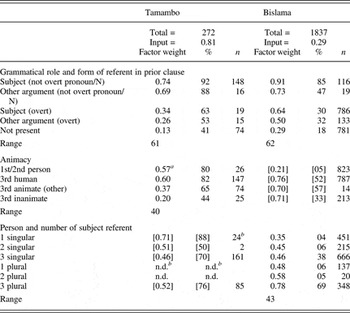
Table 3 compares the constraints on the form of the subject in both the Tamambo and Bislama corpora. In both languages, the principal constraint is one that essentially reflects information status of the referent: grammatical role and form of the referent in the prior clause. In both languages, argument referents that were not overt in the preceding clause favor a nonovert form as the subject of the current clause. In Tamambo, these are the only favoring factors. In Bislama, there is also a preference for continuing subjects (whether overt or nonovert in the prior clause) to be null in the current clause. At the other end of the scale, if the referent was not mentioned in the last clause, then this strongly favors some form of overt realization for the current subject. A constraint of discourse salience operates universally in some form or another on null or reduced/clitic subjects.
Comparison of constraints on absence of free N/pronoun subjects in Tamambo and Bislama

aRanking of factors within Animacy factor group suggests human versus nonhuman distinction in Tamambo; discourse participants versus nonparticipants distinction in Bislama. bFour (null) tokens of 1p referents were recoded with 1s tokens.
In Tamambo, the only other significant constraint on the form of the subject is animacy. Person and number of the subject is not significant (though some cells have very small numbers). In the majority of clauses, the agreement morphology that occurs with a finite verb in Tamambo uniquely identifies the subject in virtually all persons and numbers (this is true in realis clauses and nonfuture irrealis). The only allomorphy is between 1p inclusive and 1p exclusive, so this finding is a little unexpected (the full verb paradigm can be seen in the appendix). A common, long-held account for the distribution of null subjects is that they are favored cross-linguistically where the verb morphology provides reliable cues to the subject reference (Jaegli & Safir, Reference Jaegli and Safir1989).
Conversely, person and number of the subject referent is a significant constraint in Bislama and animacy is not significant. The ranking of different persons and numbers departs slightly from the pattern found in the larger Bislama corpus discussed in Meyerhoff (Reference Meyerhoff2000); however, when we look at percent null subjects, we see the same pattern discussed there, a clear preference for overt subjects in first and second person, and higher frequencies of nonovert subjects in third person.
It is interesting to consider the (nonsignificant) results for animacy in Bislama in a little more detail. The difference in factor weights for this group is quite large for the Bislama data, and as noted earlier, animacy and person/number of the subject are not wholly independent. It is possible that the reason animacy fails to emerge as a significant factor group for Bislama is related to the overlap between the highest animacy speaker-addressee and first- and second-person forms. We can see that the animacy split in Tamambo is essentially between human and nonhuman referents (human referents favoring null variants), whereas in Bislama, the split is between first- and second-person referents and all other referents, that is, discourse participants (which favor a free pronoun or NP realization) and nonparticipants (which favor null forms).Footnote 6
THE OBJECT VARIABLE IN TAMAMBO AND BISLAMA
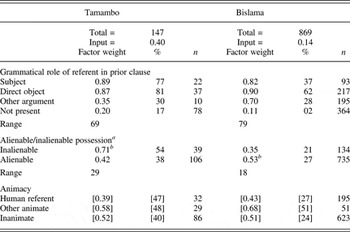
Table 4 compares the constraints on the form of the object in the Tamambo and Bislama corpora. As with subjects, the principal constraint in both languages is one of discourse continuity. In Tamambo, if the object's referent had been a thematic argument in the prior clause, this favored its realization as a clitic. In Bislama, the distinction is less subtle. If the object referent had been mentioned at all in the prior clause (regardless of its grammatical role), this favored a phonetically null realization in the current clause.
Comparison of constraints on absence of free N/pronoun objects in Tamambo and Bislama

aTwo tokens of 1s objects not coded for alienability. bReversal of effect of (in)alienable possession in Tamambo and Bislama.
Both languages also show a significant effect for whether or not the object refers to something that would be considered an alienable or inalienable possession. However, in the two languages, the direction of the effect differs. Inalienable direct object referents are more likely to be reduced (clitics) in Tamambo; in Bislama, alienable objects are more likely to be reduced (phonetically null).
Animacy of the referent is not a significant constraint on the presence or absence of a free pronoun/full NP in either language (and, indeed, the ranking of individual factors within this group does not look like any normal animacy hierarchy, except perhaps an incipient human/nonhuman distinction for Tamambo).Footnote 7
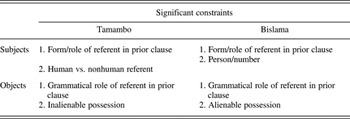
Table 5 summarizes the relative strength of the significant constraints for subjects and objects in the two languages. We can now explore to what extent the distinctions proposed in (1) can be usefully applied to these data.
Summary of significant constraints on the subject and object variables in Tamambo and Bislama

Note: Order reflects strength of the factor groups within each variable.
APPLICATION OF THE PRINCIPLES OF REPLICATION, TRANSFER, AND CALQUING
The proposed typology for incorporating variation directly into the discourses and traditions of language contact research draws on distinctions we can make about how similar a variable is in both the model and replica languages, where similarity can be measured in quality and quantity. For convenience, I reproduce (1) here.
(1) Principles for incorporating variation into the study of language contact:
(i) Where the same factor groups are significant constraints on a variable in the model and in the replica varieties, let us call this weak transfer or replication;
(ii) Where the same factor groups are significant in both model and replica, and the ordering of these factor groups is the same in both model and replica, let us call this (strong) transfer;
(iii) Where the same factor groups are significant in both model and replica, and the ordering of these factor groups is the same in both model and replica, and the factors within groups have the same ranking in model and replica, let us call this calquing.
Under this proposal, weak transfer or replication of variables (which in all likelihood is the most common) involves cases where a feature occurs variably (noncategorically) in both model and replica, and there is overlap in the inventory of linguistic factors that are significant constraints on the variable in both varieties.Footnote 8 However, what may be the strongest constraint on the variable in the model language may be the least strong constraint on the variable in the replica language.
We have seen a partial illustration of this replication, or weak transfer, in the data on subject deletion. The factor groups that significantly constrain absence of a free nominal or pronominal subject differ in Tamambo and Bislama. In Tamambo, the most significant factor is the referent's form and role in the prior clause, followed by animacy of the referent. In Bislama, the most significant factor is the referent's form and role in the prior clause, followed by person and number of the subject. If Bislama has replicated the model found in Tamambo patterns, the process only partly replicates the significant factor groups in the model.
In addition, we would not want to place too much emphasis on the congruence of the first factor group. As noted, it is cross-linguistically unremarkable for null subjects to be constrained by the discourse salience of the referent. This general fact about the distribution of null subjects should make us cautious about how much of the parallelism between Tamambo and Bislama we attribute to pattern replication. The point is that if we compared any two null subject languages, whether in contact or not, we would expect to find that they share a constraint on the distribution of the null variants that is discourse-pragmatic.
Within the factor group that describes the form and role of the referent in the prior clause, we see rankings of individual factors that are (again) unsurprising cross-linguistically, however, we did note an interesting difference in where the cut between favoring and disfavoring contexts occurs. In Bislama, the cut looks like a rather simple presence versus absence in the prior clause (not present in the prior clause being the only context in which a free pronoun or NP is strongly favored). In Tamambo, the cut is sensitive to a more subtle interplay between presence in the prior clause and continued presence in the prior clause. A nonovert argument (whether subject or object) in the prior clause is likely to have occurred in some form or another in the penultimate clause as well. So the fact that a subject referent is favored to be null when it was a nonovert argument in the prior clause suggests that in Tamambo speakers may use null subjects with referents that are persistent and continuing topics across multiple clauses. I think we should take this effect seriously, because it emerges in Tamambo despite the very small data set over which the analysis of variation is being undertaken.
Strong transfer in this proposal involves cases where a feature in the grammar occurs variably in both varieties, there is overlap in the linguistic factors that act as significant constraints on the variable in both varieties, and there are parallels in the ranking of different factor groups in both varieties. That is, the factor group that is the strongest constraint in the model language is also the factor group exerting the strongest constraint on variation in the replica, the second strongest constraint in the model is the second strongest constraint in the replica, and so forth.
The data on reduction of the form of direct objects seem to illustrate an instance of this. In both Tamambo and Bislama, the strongest constraint on the variable was the grammatical role of the referent in the prior clause, and the second strongest constraint was whether the referent would be considered an alienable or inalienable possession. There were no other significant factors on either language.
However, as with the constraints on subjects, the devil proves to be in the details. In Tamambo, only objects that had been core arguments in the prior clause favor appearing as a clitic object in the current clause; in Bislama, the same kind of presence/absence constraint seems to be operating for objects as we saw for subjects. The referent's presence in any grammatical role in the prior clause strongly favors realization as a null object.
More interestingly, with respect to (in)alienable possession, we observed a complete reversal of the most strongly favoring factor. Referents that would be considered inalienable possessions (e.g., close kin, body parts) strongly favor clitics in Tamambo; in Bislama, these referents equally strongly disfavor phonetic reduction and tend to occur as overt nouns or pronouns.
So, the differences between constraints within these factor groups mean that this variable fails to satisfy the criteria for a calque. Instead, it is an example of strong transfer. Under this very restrictive definition of a calque of a variable, calques will clearly be fairly rare. I would predict that they will only occur under conditions of lengthy or socially intense contact.
IMPLICATIONS OF THIS PROPOSAL
In previous work on the constraints on object deletion in Bislama, I suggested that there may be a very general principle of “transformation under transfer” (Meyerhoff, Reference Meyerhoff2003). That proposal suggested that the process of transferring—or replicating more generally—patterns from the model to the replica language may be sufficiently cognitively demanding that speakers cannot replicate (or perhaps do not care if they replicate) the linguistic details of the model in the replica language. In that paper, I noted that the distinction between alienable and inalienable possession is marked (obligatorily) in possessive NPs in Bislama's substrate languages, whereas in Bislama itself the distinction never shows up in possessive NPs, instead it only probabilistically shows up in the distribution of overt direct object NPs.
The data discussed here seem to add weight and detail to the notion that transformation under transfer is a fairly general principle. We can see analogies in some of the nonvariable examples of replication that were discussed in the first half of the article. There, I noted that the inclusive/exclusive distinction in Bislama pronouns emerged through the creative transformation of English constituents into a pronoun system that replicated the substrate norms. Similarly, I noted that even in the case of a lexical calque, speakers are not blindly translating across systems. From skyscraper to Wolkenkratzer there is also a degree of transformation. I believe that we also saw transformation under transfer in the reversal of the favoring conditions for phonetically reduced direct object arguments in Bislama and Tamambo. The principle seems to operate at all levels of linguistic structure, even those so far below speakers' possible conscious awareness—the ranking of factors within a significant factor group that constrains a variable—which suggests that it is indeed a fundamental principle.
CONCLUSIONS
In this article, I have proposed integrating the tradition of investigating variation in creole languages with more recent models of comparative variationist sociolinguistics. The vast majority of creolists accept that in order to understand the joint influence of substrate and lexifier languages it is necessary to proceed by comparing features with some semantic equivalence in the language varieties that were in contact and in the creole outcome. Creolists often acknowledge the relevance of variation, especially to the early stages of the languages that are the objects of their enquiry. The principles proposed here outline a means by which these two fundamentals in creolistics can be enriched through the use of variationist methods. It does this by proposing a way of particularizing how we define replication, transfer, and calquing to inherently variable domains of language.
In outlining a means for exploring the details of variation and for using this to inform fundamental questions in the field of language contact research, I have suggested that it is helpful to ask to what extent the variability in one language appears to be partially or fully replicated in another language. In doing so, we provide not only a basis for further enriching the long-standing connections between sociolinguistics and creolistics, but also provide a basis for linking research on creolistics and language contact to the growing field of comparative studies in variation.
APPENDIX
Paradigm of free and bound pronouns in Tamambo:

Independent and bound pronominal forms in Tamambo. Mo variant in 2p and 3p realis is archaic.
Source: Jauncey (Reference Jauncey1997).