


Introduction
Social anxiety is a condition in which fear of negative evaluation and rejection impairs the person's ability to relate to others (Alden and Taylor, Reference Alden and Taylor2004). Recent research has indicated that social anxiety is associated with diminished positive experiences and subsequent low positive affect (for a review see Kashdan, Reference Kashdan2007). However, the relationship between social anxiety and hedonic activity remains inadequately understood. In this paper we sought to further understand the link between social anxiety and low positive affect (PA) with reference to the role of biased interpretations of positive social events.
Research founded in information processing theories of social anxiety (e.g. Clark and Wells, Reference Clark, Wells, Heimberg, Liebowitz, Hope and Schneier1995; Rapee and Heimberg, Reference Rapee and Heimberg1997) has suggested that socially anxious individuals are prone to various interpretation biases. To examine interpretation biases in social anxiety, many researchers have developed questionnaires comprising ambiguous or mildly negative scenarios, followed by possible interpretations (e.g. Amir, Foa and Coles, Reference Amir, Foa and Coles1998; Constans, Penn, Ihen and Hope, Reference Constans, Penn, Ihen and Hope1999; Stopa and Clark, Reference Stopa and Clark2000; Vassilopoulos, Reference Vassilopoulos2006). These questionnaire studies have varied in materials used and participant characteristics, yet they all provide evidence suggesting that socially anxious individuals make less positive and/or more negative interpretations of ambiguous or mildly negative social events than socially confident individuals. Studies that have used different methods and a variety of stimuli, such as videos (Amir, Beard and Bower, Reference Amir, Beard and Bower2005), facial expressions (Campbell et al., Reference Campbell, Sareen, Stein, Kravetsky, Paulus, Hassard and Reiss2009), electroencephalogram recordings (Moser, Hajcak, Huppert, Foa and Simons, Reference Moser, Hajcak, Huppert, Foa and Simons2008) and reaction time indices (Hirsch and Mathews, Reference Hirsch and Mathews2000), have also revealed the presence of a negative bias and/or the lack of a positive bias in the context of interpreting ambiguous feedback.
The tendency to interpret interpersonal encounters in a more negative way may be relevant not just to threat-neutral or mildly negative events, but also to positive events. The importance of processing positive social information in social anxiety has only recently begun to be investigated adequately. For example, Gilboa-Schechtman, Franklin and Foa (Reference Gilboa-Schechtman, Franklin and Foa2000) showed that socially anxious individuals made more negative judgements about the likelihood and costs of positive social encounters. Along similar lines, Weeks and colleagues (Reference Weeks, Heimberg and Rodebaugh2008a, Reference Weeks, Heimberg, Rodebaugh and Nortonb) proposed that socially anxious individuals may fear evaluation in general, experiencing fear of both positive and negative evaluation. Their studies also provided psychometric evidence suggesting that fear of positive evaluation underpins an important cognitive feature of social anxiety.
Recently, Alden, Taylor, Mellings and Laposa (Reference Alden, Taylor, Mellings and Laposa2008) reported a psychometric study in which they developed and cross-validated a scale that measures the tendency to engage in threat-maintaining interpretations of positive social events. The factor analysis of their initial 13-item questionnaire revealed one robust component that comprised eight items and reflected general apprehension following positive social events, as well as negative predictions about the future. This component was labelled Interpretation of Positive Events (IPES). In addition, a small, less robust secondary factor emerged from the factor analysis of their initial questionnaire, which reflected the disinclination to accept positive reactions from others at face value (or the tendency to perceive that such reactions masked more negative evaluations or motives). This second component, which was labelled Face Value (FV), consisted of five items, but because it demonstrated relatively low internal consistency and only modest correlations with the other test variables, the authors did not pursue this variable in that study, calling instead for further research to evaluate this dimension in greater depth.
In Alden et al.'s (Reference Alden, Taylor, Mellings and Laposa2008) study, the IPES dimension was found to be related to greater social interaction anxiety, in studies using both unselected and clinical samples, and was also found to mediate the relationship between social interaction anxiety and low positive affect. We believe that existing research gives us good reason to expect that the second facet identified above – the tendency to “discount” positive reactions from other people by not taking them at face value – will independently contribute to this pathway. In fact, some preliminary evidence suggests that precisely this kind of discounting bias can be found in socially anxious individuals who are presented with hypothetical positive social encounters. Voncken, Bögels and de Vries (Reference Voncken, Bögels and de Vries2003) presented participants with brief scripts of social events (ranging from positive to extremely negative) and found that social phobic adults tend to interpret positive social events (e.g. “Someone makes a compliment about your looks”) as more negative. Similar results have been observed by Vassilopoulos (Reference Vassilopoulos2006) and Vassilopoulos and Banerjee (Reference Vassilopoulos and Banerjee2008) in studies using hypothetical vignettes with both adults and children.
Notwithstanding the findings described above, we do not know whether self-reported tendencies to discount positive social reactions are in fact empirically distinct from the kind of interpretation bias already studied by Alden et al. (Reference Alden, Taylor, Mellings and Laposa2008), nor if the discounting bias makes a further contribution to the low positive affect known to be associated with social anxiety. Using an undergraduate student sample, the present study provides a preliminary investigation of both of these issues, after first evaluating the factor structure, reliability, and validity of our revised self-report measure of interpretation bias following positive social events (named Discounting of Positive Events Scale, DPES).
Given that social anxiety symptoms are highly associated with depressive symptoms (Schneier, Johnson, Hornig, Liebowitz and Weissman, Reference Schneier, Johnson, Hornig, Liebowitz and Weissman1992) it is possible that biased interpretation of positive events and/or low PA arises from comorbid depression rather than social anxiety. Indeed, several studies have shown that depressive symptoms are associated with interpretation and judgmental biases (e.g. Voncken, Bögels and Peeters, Reference Voncken, Bögels and Peeters2007). The study by Alden et al. (Reference Alden, Taylor, Mellings and Laposa2008) explored this possibility and found that social interaction anxiety was associated with negative interpretations of positive events above and beyond depressive symptoms. Alden et al. (Reference Alden, Taylor, Mellings and Laposa2008) also found that the negative interpretation pattern remained a partial mediator of the social anxiety-low PA relationship even when variance explained by depressive symptoms was controlled. The authors suggested that there is an unique association between social interaction anxiety and low PA, and pointed to the need to identify all the factors that explain that relationship. Therefore, the present study tests the specific role that discounting tendencies may have in mediating the relationship between social interaction anxiety and low PA, and variance explained by comorbid depressive symptoms will be controlled in our main analyses.
The study addresses the following specific research questions: (a) Does the DPES demonstrate adequate internal consistency and test-retest reliability? (b) Utilizing exploratory factor analysis to examine responses to DPES and IPES, do DPES and IPES items load onto two distinct factors? (c) Does the DPES correlate more strongly with a measure of social interaction anxiety than with other cognitive variables known to accompany anxiety, such as the tendency to worry and anxiety sensitivity? (d) Do discounting tendencies (DPES) account for significant variance in scores on the social interaction anxiety scale (SIAS), above and beyond that already accounted by apprehension and perceived costs of positive events (IPES), general anxiety and depressive symptoms? (e) Do DPES scores independently mediate the link between the social interaction anxiety and low positive affect?
Method
Participants
Participants were 240 undergraduate students at the University of Patras, of whom 56 (23%) were male and 184 (77%) were female. On average, participants were 20.5 years old (SD = 2.03, range: 18–40), single (95%), Christian Orthodox (97.5%), and in their third (66.2%) or fourth (19.2%) year of university. All students were White Europeans, and completed Greek-language versions of all measures.
Measures
Interpretation of Positive Events Scale (IPES; Alden et al., Reference Alden, Taylor, Mellings and Laposa2008). The IPES is an 8-item self-report instrument for measuring negative interpretations of positive events and, in particular, more negative predictions and expectations regarding the future (e.g. “When a social event goes well, it means the next interaction will usually go less well”), as well as general apprehension (e.g. “Positive feedback from other people makes me apprehensive”). Each item is rated on a 7-point Likert-type scale. In the current sample, Cronbach's α = .80.
Social Interaction Anxiety Scale (SIAS; Mattick and Clarke, Reference Mattick and Clarke1998). The SIAS is a 20-item measure used to assess anxiety related to social interactions with various partners. Items are rated on a 5-point Likert-type scale. Past research has shown that the SIAS has good internal consistency and that it converges with other measures of social anxiety (Brown et al., Reference Brown, Turovsky, Heimberg, Juster, Brown and Barlow1997; Mattick and Clarke, Reference Mattick and Clarke1998). In the current sample, Cronbach's α = .89.
Beck Depression Inventory II (BDI-II; Beck, Steer and Brown, Reference Beck, Steer and Brown1996). The revised BDI is a 21-item self-report instrument for measuring the severity of depression in adults and adolescents aged 13 years and older during the preceding 2 weeks. Each item is responded to by selecting from a set of statements related to a particular depressive symptom, scored from 0 to 3. Research has shown that the BDI has good internal consistency, reliability and validity (Beck, Steer and Garbin, Reference Beck, Steer and Garbin1988). The questionnaire has been translated and validated for the Greek language (Mystakidou et al., Reference Mystakidou, Tsilika, Parpa, Smyrniotis, Galanos and Vlachos2007). In the current sample, Cronbach's α = .87.
State Trait Anxiety Inventory (STAI; Spielberger, Gorsuch, Lushene, Vagg and Jacobs, Reference Spielberger, Gorsuch, Lushene, Vagg and Jacobs1983). The STAI is a 40-item self-report questionnaire assessing both current (state) and general (trait) anxiety. The STAI has been shown to have good internal consistency and test-retest reliability, and to correlate with other trait measures of anxiety (Spielberger et al., Reference Spielberger, Gorsuch, Lushene, Vagg and Jacobs1983). In the present study only the 20 items pertaining to trait anxiety were used. Items are rated on a 4-point Likert scale. The questionnaire has been translated and validated for the Greek language (Liakos and Giannitsi, Reference Liakos and Giannitsi1984). In the current sample, Cronbach's α = .88.
The Penn State Worry Questionnaire (PSWQ; Meyer, Miller, Metzger and Borkovec, Reference Meyer, Miller, Metzger and Borkovec1990). The PSWQ is a 16-item self-report questionnaire commonly used to measure excessive worry. Each item is rated on a 5-point Likert type scale. The PSWQ has good internal consistency (α = .86–.93) and test–retest reliability, and converges with other measures of worry (Brown, Antony and Barlow, Reference Brown, Antony and Barlow1992; Meyer et al., Reference Meyer, Miller, Metzger and Borkovec1990). In the current sample, Cronbach's α = .90.
The Anxiety Sensitivity Index (ASI; Reiss, Peterson, Gursky and McNally, Reference Reiss, Peterson, Gursky and McNally1986). The ASI is a 16-item self-report scale designed to measure fear and worry about the physical, psychological, and interpersonal implications of anxiety-related symptoms. Each item is rated on a 5-point scale. Research supports the internal consistency (α = .82–.91), test–retest reliability, and construct validity of the ASI (e.g. Peterson and Heilbronner, Reference Peterson and Heilbronner1987). In the current sample, Cronbach's α = .86.
The Mood Anxiety Symptom Questionnaire-Anhedonic Depression scale (MASQ-AD; Watson et al., Reference Watson, Clark, Weber, Assenheimer, Strauss and McCormick1995). The MASQ-AD is a 22-item subscale of the MASQ that is designed to measure low positive affect (anhedonia). Each item is rated on a 5-point scale. In the current study only the negatively worded items were reverse-scored, so that higher scores indicate more positive affect. Research has shown that the AD subscale has good internal consistency and adequate discriminant validity (Watson et al., Reference Watson, Clark, Weber, Assenheimer, Strauss and McCormick1995). In the current sample, the internal consistency was excellent, α = .94.
All the measures described so far (apart from STAI and BDI-II) were translated into Greek by the first author and back-translated by two independent bi-lingual psychologists. The back-translated questionnaires were then compared to the originals, and a few minor modifications were applied.
Discounting of Positive Events Scale (DPES)
Our new 10-item DPES uses a 7-point Likert-type rating scale, ranging from 1 (disagree) to 7 (agree). In line with a scoring strategy recommended by Marsh (Reference Marsh1996), two additional filler items keyed in an opposite direction to the others were included for the purpose of reducing the response bias of acquiescence but were not utilized in calculating the DPES score.
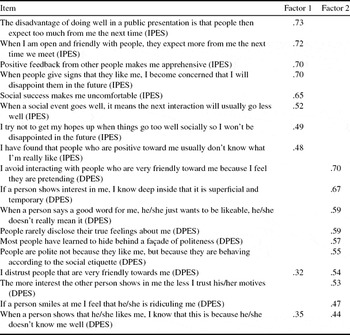
DPES items were rationally generated and designed to exclusively assess discounting of positive events such that an explicitly positive reaction from an interactant is discounted by a negative assumption about the situation or the interactant. For example, some items reflected the person's belief that the interacting partner was only friendly because he/she did not know them well, or that others disguised their personal negative reactions under a false face of friendliness. Other DPES items reflected the tendency to attribute positive reactions from others to social etiquette rather than to one's own positive attributes. All items reflected themes concerning positive information discounting that were identified in reports and comments of patients with social anxiety disorder (e.g. Alden et al., Reference Alden, Taylor, Mellings and Laposa2008). The 10 items are listed in Table 1.
Rotated factor loadings for DPES and IPES items

Note. Factor loadings < .30 are not listed.
Procedure
All participants were recruited through announcements in the psychology classes and university camp. Interested students were provided with questionnaire packets to complete at home and return. In order to assess test-retest reliability, the DPES was administered to a separate sample of undergraduate students (n = 50) twice over a 4-week period. Participation in the study was voluntary and participants were informed that all results were confidential.
Results
Scale structure and test-retest reliability of the DPES and IPES items
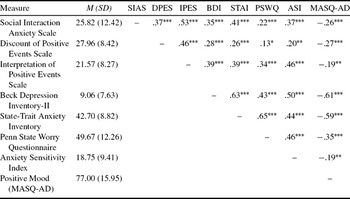
We used exploratory factor analysis to evaluate the factor structure of the DPES and IPES items. Preliminary analysis and examination of the scree plot pointed to two factors. A subsequent analysis extracting two factors and utilizing a varimax rotation showed that the DPES and IPES items loaded significantly and as expected (all loadings >.44) onto the two factors, with no cross-loadings above .35. The factor loadings are provided in Table 1. The internal consistency of the DPES and IPES items was found to be adequate for experimental instruments (Cronbach's alpha = .79 and .80, respectively; Streiner, Reference Streiner2003). All items appeared to function well within their respective scales (item-total correlations >.36 for IPES, and >.40 for DPES), and removing any of them did not increase the overall internal consistency. Finally, the new DPES scale demonstrated good 4-week test-retest reliability, with a Pearson correlation coefficient of .75 (p < .001). Table 2 shows descriptive statistics and intercorrelations of the study variables.
Means, standard deviations, and intercorrelations of study measures

*p ≤ .05 **p ≤ .01 ***p ≤ .001
Discriminant validity of the DPES
Supporting the discriminant validity of the DPES, Table 2 confirms that DPES scores are only modestly correlated with two other anxiety-related constructs, namely anxiety sensitivity (ASI) and worry (PSWQ). Furthermore, neither ASI nor PSWQ scores were significantly correlated with DPES after controlling for social interaction anxiety (partial rs < .07, ps > .10). In contrast, DPES remained significantly correlated with social interaction anxiety after controlling for ASI and PSWQ (partial r(238) = .32, p < .001).
Associations between discounting and social interaction anxiety
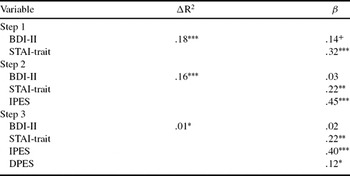
We conducted a hierarchical regression analysis on the social interaction anxiety (SIAS) scores to determine if discounting (DPES) was uniquely related to them after accounting for variance explained by depressive symptoms (BDI), general trait anxiety (STAI-trait), and Interpretation of Positive Events (IPES) scores. In the analysis, the BDI and STAI scores were entered into the regression equation in step one, IPES scores were entered in step two, and DPES scores were entered in the final step. As can be seen in Table 3, the DPES added significant value to the prediction of SIAS beyond the BDI, STAI, and IPES scores. It should be noted that virtually identical results were found when controlling for BDI alone, rather than both BDI and STAI.
Hierarchical multiple regression of the Social Interaction Anxiety Scale onto the Beck Depression Inventory-II, State-Trait Anxiety Inventory, Interpretation of Positive Events Scale, and the Discounting of Positive Events Scale

+ p ≤ .10, *p ≤ .05, **p ≤ .01, ***p ≤ .001
Mediated pathway from social interaction anxiety to positive mood
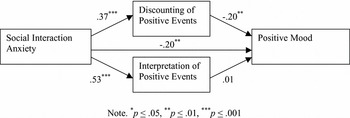
We next evaluated our hypothesis that DPES scores mediated the relation between the social interaction anxiety (SIAS) and positive mood (MASQ-AD) scales. First, following MacKinnon (Reference MacKinnon2008), we initially evaluated the viability of incorporating both IPES and DPES scores as multiple mediators of the relationship between social interaction anxiety and positive mood. Figure 1 shows the regression paths between social interaction anxiety, the IPES and DPES, and positive mood. This analysis revealed that although social interaction anxiety predicted both putative mediators, only DPES scores uniquely predicted positive mood.
Regression paths between Social Interaction Anxiety Scale, Discounting of Positive Events Scale, Interpretation of Positive Events Scale, and Positive Mood.

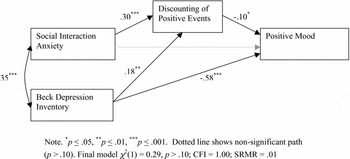
Following Lockwood and MacKinnon (Reference Lockwood and MacKinnon1998) and Preacher and Hayes (Reference Preacher and Hayes2008), we then used the recommended bootstrapping approach to derive an accurate test of the mediated effect of SIAS on MASQ-AD, with DPES as the mediator, and BDI as a control variable. Starting with a fully saturated structural equation model, we estimated this indirect effect using a sampling distribution created from 2000 repeated samples from the dataset. Crucially, the standardized indirect effect of social interaction anxiety on positive mood via the DPES mediator was significant (standardized estimate = −.03, p < .05; bias-corrected 95% confidence interval = −.07 to −.01). The direct (nonmediated) path from social interaction anxiety to positive mood was found to be nonsignificant (p > .10). Our final model is shown in Figure 2.
Final structural equation model of indirect effect of Social Interaction Anxiety Scale on Positive Mood, mediated by Discounting of Positive Events Scale, controlling for Beck Depression Inventory-II.

We also compared our theoretically-derived model against an alternative mediation model, testing whether the effect of social interaction anxiety on discounting was mediated by low positive mood. In line with our expectations, only the direct effect (β = .30, p < .001) was significant and no mediation by low positive mood was found (p > .10). Thus, our preferred mediation model in Figure 2, whereby discounting tendencies mediate the effect of social anxiety on low positive mood, appears to be the most plausible representation of the data.
Discussion
Previously, Alden et al. (Reference Alden, Taylor, Mellings and Laposa2008, p. 588) found that one of socially anxious individuals’ motives for warding off positive information is their tendency to “remain on guard after a positive event, cautioning themselves that positive events might lead to more social demands and future disappointment”. The present study has extended Alden et al.'s (Reference Alden, Taylor, Mellings and Laposa2008) important work by providing preliminary evidence that the tendency to discount positive social reactions is an empirically distinct form of interpretation bias that is likely to play a significant, independent role in the profile of individuals with high social anxiety. These initial results form an important foundation for future research on discounting that draws on larger and more varied samples.
First, our exploratory factor analysis showed that the original IPES items and the new items for discounting loaded neatly onto two distinct factors, with each item appearing to contribute well to its subscale. Furthermore, responses to the discounting measure were found to be internally consistent, stable over time, and appropriately differentiated from other relevant constructs. Importantly, the regression and multiple mediator analysis showed that the tendency to interpret positive social events in a discounting manner not only was uniquely associated with social interaction anxiety, but also served as an independent mediator of the link between social interaction anxiety and low positive affect. Our analysis confirmed that discounting tendencies appear to serve as an important bridge connecting high levels of social anxiety with low levels of positive mood.
The present study also suggests that, as far as positive social information processing is concerned, there are many different ways in which social anxiety can be maintained and amplified. Suppose that a socially anxious person has an interpersonal interaction and the interacting person is overtly friendly towards him/her then, according to the work of Alden and colleagues (Reference Alden, Taylor, Mellings and Laposa2008; Wallace and Alden, Reference Wallace and Alden1997), that individual may experience anxiety upon having performed well and received positive social feedback from the other because of his/her concern that initial positive appraisal may lead to future negative appraisal (“When a social event goes well, it means the next interaction will usually go less well”). According to the present study, the socially anxious individual may still register the interacting person's reaction as friendly but mistrust the validity of this response or develop explanations for the positive outcome that have little to do with his/her ability or personal quality (“People are polite not because they like me, but because they are behaving according to the social etiquette”). A third possibility, also emerging from the current study, is to perceive the other person's friendliness in a negative way (“If a person smiles at me I feel that he/she is ridiculing me”). In that case, an interaction that is positive in most people's eyes is actually interpreted as negative. A final possibility is to ignore the other person's positive social signals/feedback and direct the attention to the negative ones (Veljaca and Rapee, Reference Veljaca and Rapee1998). All these possibilities are likely to support or maintain the socially anxious individual's negative belief system (Clark and Wells, Reference Clark, Wells, Heimberg, Liebowitz, Hope and Schneier1995).
It should be noted that these pathways may often overlap and co-exist with each other. Indeed, the exploratory factor analysis indicated that the last item of the DPES (“When a person shows that he/she likes me, I know that this is because he/she doesn't know me well”), which is similar in content to the last item of the IPES (“I have found that people who are positive toward me usually don't know what I'm really like”), loaded onto both factors, although more so for the DPES than for the IPES. We believe that this is not surprising given that the meaning of this item implies both a discounting response on the part of the interactant (and as such is in line with the main underlying theme of the DPES) as well as the prospect of a less successful future interaction with this individual (and as such is in line with the main underlying theme of the IPES). In other words, as the factor analysis has showed, this particular item fits both scales, but for quite distinct reasons.
The present findings highlight the way in which social threat can be perceived by socially anxious individuals in any interpersonal experience in which the individual might receive either positive or negative social signals/feedback from the interacting person. The results are thus likely to have implications for the potential refinement of existing interventions in social anxiety. In particular, it is possible that the disinclination to accept others’ friendliness at face value accounts in part for the thinking error “disqualifying the positive” (Beck, Reference Beck1976), which involves the rejection of positive experiences. If so, simple exposure to positive social interaction without prior cognitive preparation, as a treatment intervention, probably will not be enough to increase positive affect. Socially anxious individuals need to realise that they are prone to view all social situations as negative, and must understand the possible consequences of this distorted thinking (for their level of anxiety, self-perception). Therefore, incorporating psychoeducational material pertaining to this threat-maintaining interpretation bias, implementing cognitive restructuring to address discounting automatic thoughts, and designing in vivo exposures (e.g. receiving compliments from the therapist or role-players) to address discounting responses to positive events may pave the way for treatment success.
It is important to acknowledge that the causal direction of the observed associations between cognition and emotion remains unclear. Although the present study demonstrates that there is an association between discounting of positive events and low positive affect, the critical question of whether this aspect of interpretation bias causally contributes to emotional experience is left unresolved. Indeed, it is plausible that frequent past experience of low positive affect could lead to the development of biases in the processing of positive information. However, the recent development of novel experimental techniques that proved to be effective in directly manipulating interpretation bias demonstrates that inducing cognitive biases serves to modify emotional experience and social anxiety symptoms (e.g. Murphy, Hirsch, Mathews, Smith and Clark, Reference Murphy, Hirsch, Mathews, Smith and Clark2007; Beard and Amir, Reference Beard and Amir2008; Vassilopoulos, Banerjee and Prantzalou, Reference Vassilopoulos, Banerjee and Prantzalou2009). Nonetheless, while these studies appear to provide convincing evidence for the idea that distorted cognition underlies anxiety and emotional problems, there remains the possibility of reciprocal relations between cognition and emotion.
Several further limitations to the present study exist. First, the present data were obtained from an undergraduate sample, which was also predominantly female and ethnically homogenous. Although the findings are encouraging and consistent with the study's hypotheses, examining the generalizability of these findings to clinical samples of men and women from a range of ethnic groups is an important next step in evaluating the psychometric properties of the DPES. In particular, the use of confirmatory factor analyses with larger and more varied samples would enhance our understanding of the distinctive latent variables underlying the IPES and DPES items. Also, there is a specific need to replicate the mediation analyses in clinical samples so that we can better understand the affective consequences of clinically-diagnosed social anxiety disorder. In doing so, it will be important to determine the clinical significance of the effect of discounting on positive affect; in the present study, this path was statistically significant but modest in size. Work with clinical samples would shed light on the real-life affective impact of significant discounting tendencies, as well as the potential ameliorative consequences of therapeutic approaches that reduce cognitive biases. More generally, future research should also examine the reliability and validity of the various measures from this study in a wide variety of cultural groups, in order to help us assess the applicability of our methodological approach and findings across different social milieus.
Second, the DPES addresses only one factor that might contribute to low positive affect and, as Alden et al. (Reference Alden, Taylor, Mellings and Laposa2008) suggested, there may be multiple motives for disqualifying positive social experiences (e.g. modesty, the belief that it is wrong or sinful to take pride in accomplishments, and so on). Further research is needed to identify all the factors that explain the social anxiety-low positive affect relationship. Finally, relationships between the DPES, additional anxiety-related measures, and measures of other cognitive constructs (e.g. rumination, perfectionism) must be examined in order to further test the convergent and discriminant validity of DPES, respectively. For example, given preliminary evidence suggesting that socially anxious individuals perceive positive (smiling) faces in a more negative way (e.g. Campbell et al., Reference Campbell, Sareen, Stein, Kravetsky, Paulus, Hassard and Reiss2009; Vassilopoulos, in press), future studies could further test the validity of the DPES by investigating its association with perception of emotional facial expressions.
In sum, the current study replicated previous research (e.g. Alden et al., Reference Alden, Taylor, Mellings and Laposa2008; Brown, Chorpita and Barlow, Reference Brown, Chorpita and Barlow1998; Kashdan, Reference Kashdan2004) that demonstrates that there is an association between social anxiety and low positive affect. Importantly, the present findings extend these previous results by identifying a cognitive factor that independently contributes to that relationship, namely the socially anxious individuals’ tendency to discount positive social events. Further work in this area seems promising, not only with regard to cognitive behavioural formulations of social anxiety, but also with regard to clinical applications based on cognitive models of social anxiety disorder.



Comments
No Comments have been published for this article.