The Nature OF VERBAL Memory Impairment in Multiple Sclerosis: A List-Learning and Meta-Analytic Study
Memory impairment is one of the most extensively studied cognitive effects of multiple sclerosis (MS), yet the specific nature of the deficit remains unclear despite dozens of individual studies and a few meta-analytic studies. Investigators have traditionally viewed such memory impairment as a retrieval deficit (Rao, Hammeke, McQuillen, Khatri, & Lloyd, Reference Rao, Hammeke, McQuillen, Khatri and Lloyd1984; Rao, Leo, & St Aubin-Faubert, 1989). Studies using verbal list-learning tasks provided evidence for the retrieval hypothesis by showing that while delayed free recall was significantly poorer in MS patients than in healthy controls, recognition was better than delayed free recall. Some researchers, however, speculated that MS patients also acquired less information during initial learning trials (DeLuca, Barbieri-Berger, & Johnson, Reference DeLuca, Barbieri-Berger and Johnson1994; DeLuca, Gaudino, Diamond, Christodoulou, & Engel, Reference DeLuca, Gaudino, Diamond, Christodoulou and Engel1998; Demaree, Gaudino, DeLuca, & Ricker, Reference Demaree, Gaudino, DeLuca and Ricker2000; van den Burg, van Zomeren, Minderhoud, Prange, & Meijer, Reference van den Burg, van Zomeren, Minderhoud, Prange and Meijer1987). The acquisition hypothesis proposes that MS patients recall less because they learn less initially, and previous studies of memory in MS do not control for group differences in initial learning (DeLuca et al., Reference DeLuca, Barbieri-Berger and Johnson1994).
In an attempt to control for initial learning differences, recent studies have used a modified version of the Selective Reminding Test (SRT; Buschke & Fuld, Reference Buschke and Fuld1974). On the modified SRT, referred to as the Open-Trial SRT (OT-SRT; Chiaravalloti, Balzano, Moore, & DeLuca, Reference Chiaravalloti, Balzano, Moore and DeLuca2008), a participant is allowed up to 15 trials to learn 10 semantically related words. Once the list is recalled on two consecutive trials, the learning phase of the test is discontinued. Studies using this method have demonstrated that MS patients require more trials to learn the list than controls (DeLuca et al., Reference DeLuca, Barbieri-Berger and Johnson1994, Reference DeLuca, Gaudino, Diamond, Christodoulou and Engel1998; Demaree et al., Reference Demaree, Gaudino, DeLuca and Ricker2000; Gaudino, Chiaravalloti, DeLuca, & Diamond, Reference Gaudino, Chiaravalloti, DeLuca and Diamond2001), but they perform as well as controls on delayed free recall and recognition once they acquire the information (DeLuca et al., Reference DeLuca, Barbieri-Berger and Johnson1994, Reference DeLuca, Gaudino, Diamond, Christodoulou and Engel1998). The learning measure in these studies, trials to criterion, refers to the number of trials one needs to recall the list two consecutive times. This measure has no equivalent on other list-learning tests, with a fixed number of learning trials, making it difficult to compare OT-SRT studies with those using traditional list-learning tests. However, normative data for the OT-SRT have recently been published (Chiaravalloti et al., Reference Chiaravalloti, Balzano, Moore and DeLuca2008).
In addition to list-learning studies using the OT-SRT, a meta-analytic study concluded that empirical support for a retrieval deficit in MS is weak (Thornton & Raz, Reference Thornton and Raz1997). While this meta-analysis provided evidence that delayed recall and recognition are both impaired in MS, it did not examine whether acquisition is impaired. In contrast, a subsequent meta-analysis concluded that retrieval deficits are the primary memory impairment in MS (Zakzanis, Reference Zakzanis2000) because delayed recall was more impaired than recognition. This second study, however, failed to address moderate to large effect sizes between MS and controls on verbal learning. A third meta-analysis (Wishart & Sharpe, Reference Wishart and Sharpe1997) found impaired verbal learning, delayed recall, and recognition. While learning showed the largest effect, the results are difficult to interpret because the effects for learning and delayed recall were limited to verbal measures while the recognition effect was based on verbal and nonverbal measures combined. A more recent meta-analysis (Prakash, Snook, Lewis, Motl, & Kramer, Reference Prakash, Snook, Lewis, Motl and Kramer2008) found a large effect size for verbal delayed recall, with MS patients performing worse than controls. However, medium effect sizes were also found for verbal learning and recognition.
All previous meta-analyses included studies that assessed verbal learning with a mixture of list learning, paragraph learning, and paired-associates tasks. While these tests share a degree of commonality, they do not assess acquisition, delayed recall, and recognition equally well. To support either the retrieval or acquisition hypothesis, an inclusive examination of acquisition, delayed recall and recognition is necessary, which seems best achieved with list-learning tasks. We identified fifty published studies that used standard administration of a list-learning task to evaluate memory in MS (see Appendix1). Of these, less than 40% reported data for all three variables of interest.
Several methodological issues may account for the unclear nature of memory impairment in MS. As mentioned earlier, it is difficult to compare studies that used fixed-trial tests with those that used variable-trial tests. It is also difficult to interpret study results that do not report data for learning, delayed recall, and recognition. Moreover, some studies report recognition scores corrected for false positives (Diamond, DeLuca, Johnson, & Kelley, Reference Diamond, DeLuca, Johnson and Kelley1997; Rao et al., Reference Rao, Hammeke, McQuillen, Khatri and Lloyd1984; Thornton, Raz, & Tucker, Reference Thornton, Raz and Tucker2002) while others do not (Caine, Bamford, Schiffer, Shoulson, & Levy, Reference Caine, Bamford, Schiffer, Shoulson and Levy1986; Coolidge, Middleton, & Griego, Reference Coolidge, Middleton and Griego1996; Maurelli et al., Reference Maurelli, Marchioni, Cerretano, Bosone, Bergamaschi, Citterio and Savoldi1992; Wallace & Holmes, Reference Wallace and Holmes1993).
Depression could also obscure the nature of memory impairment in MS. Depression has a negative effect on memory performance (King & Caine, Reference King and Caine1996), and depressive symptoms are frequently observed in MS patients (Diaz-Olavarrieta, Cummings, Velazquez, & Garcia de la Cadena, Reference Diaz-Olavarrieta, Cummings, Velazquez and Garcia de la Cadena1999). Without controlling for depression or excluding depressed participants, the effect of depression on scores is unclear. Many studies report elevated depression scores among MS patients but typically at mild to moderate levels (Minden, Moes, Orav, Kaplan, & Reich, Reference Minden, Moes, Orav, Kaplan and Reich1990), and not correlated with memory performance (Fisk & Archibald, Reference Fisk and Archibald2001; Rao et al., Reference Rao, Leo and St Aubin-Faubert1989). Other studies do not report whether clinically depressed patients were included (Caine et al., Reference Caine, Bamford, Schiffer, Shoulson and Levy1986; Coolidge et al., Reference Coolidge, Middleton and Griego1996; Diamond et al., Reference Diamond, DeLuca, Johnson and Kelley1997; Maurelli et al., Reference Maurelli, Marchioni, Cerretano, Bosone, Bergamaschi, Citterio and Savoldi1992; van den Burg et al., Reference van den Burg, van Zomeren, Minderhoud, Prange and Meijer1987; Wallace & Holmes, Reference Wallace and Holmes1993).
Another problem with many published studies is the tendency to study mixed groups of MS (e.g., relapsing-remitting cases with progressive cases) and then make global statements about memory performance. In one study (DeLuca et al., Reference DeLuca, Barbieri-Berger and Johnson1994) where relapsing-remitting (RR), primary progressive (PP) and secondary progressive (SP) patients were examined together, the MS group demonstrated much more variability than controls in learning and memory abilities, possibly as a function of using a mixed group of patients. In another study where subgroups were analyzed separately (Gaudino et al., Reference Gaudino, Chiaravalloti, DeLuca and Diamond2001), RR patients did not demonstrate impaired learning. Nevertheless, the authors concluded broadly that acquisition is impaired in MS, making no subtype distinction.
The purpose of this study is to determine whether memory deficits in MS are attributable to impairment in acquisition or retrieval. Here we leverage the strengths of two complementary research designs to address this issue comprehensively by using both a quasi-experimental study and a meta-analysis. Our quasi-experimental study examines verbal memory as measured by a standard list-learning test, considering performance on learning, delayed recall and recognition within a single subtype of MS while also accounting for the potential effect of depression. Our meta-analysis represents a significant advantage over previously-published meta-analyses because it is hypothesis-driven, which leads to more selective criteria about which studies to include and how to group the studies to more specifically address the question of whether memory impairment in MS reflects a deficit in acquisition or retrieval. In both studies, we hypothesize that acquisition will be more impaired than delayed recall.
Method
Participants
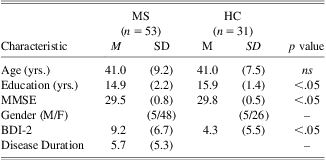
Fifty-three patients with clinically definite MS (Poser et al., Reference Poser, Paty, Scheinberg, McDonald, Davis, Ebers and Tourtellotte1983) were recruited from the Department of Neurology at the University of Colorado Health Sciences Center, with assistance from the Colorado Chapter of the National MS Society. All MS patients had the RR subtype (Poser et al., Reference Poser, Paty, Scheinberg, McDonald, Davis, Ebers and Tourtellotte1983), and had been diagnosed an average of 5.7 years. None were in a state of relapse. The MS patients had either never taken immunomodulatory medications or taken them for less than 1 year at testing. Thirty-one healthy controls (HC) were recruited from the Denver area. The study was approved by the Colorado Multiple Institutional Review Board. Participants were required to have at least a high school education. Demographic/clinical characteristics of the sample are shown in Table 1. Exclusionary criteria included neurological disorders other than MS, TBI with LOC, substance abuse, sensory deficits, or other conditions that may interfere with neuropsychological performance (e.g., depression, sedating medications).
Characteristics of the multiple sclerosis (MS) and healthy control (HC) groups
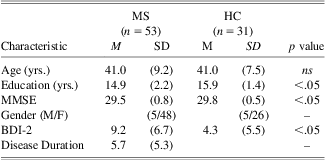
Note. Groups were significantly different on education, MMSE, and BDI-2.
MMSE = Mini-Mental State Examination, BDI-2 = Beck Depression Inventory-2.
Global cognitive functioning was assessed with the MMSE (Folstein, Folstein, & McHugh, Reference Folstein, Folstein and McHugh1975) and depressive symptoms were assessed with the BDI-2 (Beck, Steer, & Brown, 1987). Groups were equivalent in age and gender. Despite a difference of less than half a point, the HC group scored significantly higher on the MMSE than the MS group, t(82) = −2.45, p < .05. There was also a small but significant difference between groups on education, t(81) = −2.61, p < .05; however, education was not significantly correlated with the dependent variables (range = −0.02–0.20). As expected, the MS group endorsed significantly more depressive symptoms than the HC group, t(82) = −3.46, p < .01. However, the average BDI-2 scores for both groups fell in the “minimal depression” category (Beck et al., Reference Beck, Steer and Brown1996) and were not significantly correlated with the dependent variables (range = −0.22–0.14). We did not collect EDSS scores on our patient population, although EDSS scores do not correlate strongly with cognitive functioning (Randolph et al., Reference Randolph, Wishart, Saykin, McDonald, Schuschu, MacDonald and Kasper2005; Ruggieri et al., Reference Ruggieri, Palermo, Vitello, Gennuso, Settipani and Piccoli2003).
Memory Testing
Approximately 55% of participants took the CVLT (Delis, Kramer, Kaplan, & Ober, Reference Delis, Kramer, Kaplan and Ober1987) and 45% took the CVLT-II (Delis, Kramer, Kaplan, & Ober, Reference Delis, Kramer, Kaplan and Ober2000). A comparison study of healthy adults who completed both tests found that raw scores for many variables, including trials 1–5 total and long-delay free recall (LDFR), were nearly identical and highly correlated, indicating that both versions are of equivalent difficulty (Delis et al., Reference Delis, Kramer, Kaplan and Ober2000). In addition, unpublished raw scores for recognition hits were nearly identical on the CVLT (M = 15.44; SD = .90) and CVLT-II (M = 15.29; SD = 1.46) (Psychological Corporation, personal communication, July 8, 2003). The discriminability measure is computed differently for each version, however, so it is not directly comparable between versions.
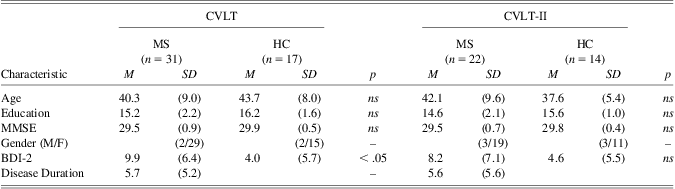
Characteristics of the groups are shown in Table 2. MS patients who completed CVLT-II did not significantly differ from those who completed CVLT on age t(51) = −0.70, education t(51) = 0.95, MMSE t(51) = 0.07, BDI-2 t(51) = 0.88, or disease duration since diagnosis, t(51) = 0.06 (all ps = ns). Similarly, HC participants were demographically equivalent regardless of CVLT version on education, t(29) = 1.40, MMSE, t(29) = 0.58, or BDI-2, t(20) = −0.32 (all ps = ns). Given the equivalency of the variables of interest from both test versions, we aggregated CVLT and CVLT-II data by converting raw scores of participants who took the CVLT to CVLT-II standard scores, thereby increasing statistical power.
Characteristics of the multiple sclerosis (MS) and healthy control (HC) groups by CVLT version completed
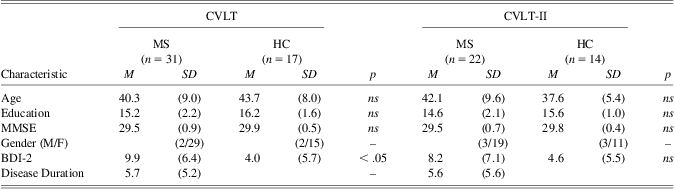
Note. CVLT = California Verbal Learning Test, CVLT-II = California Verbal Learning Test, 2nd Edition, MMSE = Mini-Mental State Examination, BDI-2 = Beck Depression Inventory-2.
Four primary indices were examined: trials 1–5 total, LDFR, recognition hits and discriminability. Trials 1–5 total is expressed as a T-score (M = 50; SD = 10) and the remaining variables are expressed as a standard score (M = 0; SD = 1), based on CVLT-II normative data stratified by age and gender. Secondary analyses were performed on the following indices to explore the influence of learning strategies: semantic clustering, bi-directional serial clustering, and across trial consistency.
A t-test was used to compare groups on trials 1–5 total. Wilcoxon rank-sum tests were used for analyses involving the remaining ordinal scale variables; however, mean values are reported because these measures are familiar to neuropsychologists. The Wilcoxon statistic is expressed as a Z-score when N > 25.
Meta-analysis of List-Learning and Memory
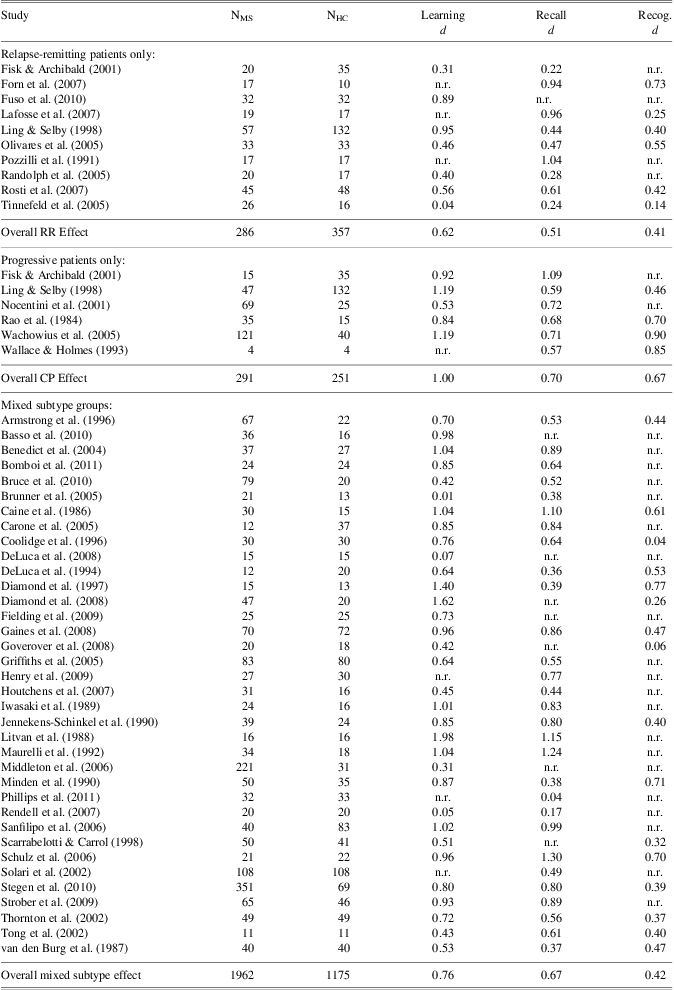
The purpose of the meta-analysis was to examine MS patients’ memory on fixed-trial list-learning tasks. We followed meta-analysis guidelines outlined in Hedges & Olkin (Reference Hedges and Olkin1985), Lipsey & Wilson (Reference Lipsey and Wilson2000), and Onwuegbuzie & Leech (Reference Onwuegbuzie and Leech2012). Studies for inclusion were restricted to those published in English after 1983 that compared MS patients to healthy controls on list-learning tests with minimum 10 words. Selected studies provided data to compute at least one effect size on a measure of acquisition, delayed recall or recognition. An extensive literature search of the PubMed (1983-5/2012) and PsycINFO (1983-5/2012) databases was performed using keywords “multiple sclerosis” combined with “memory,” “neuropsychology,” or “cognitive.” In addition, we reviewed the reference sections in pertinent review and meta-analysis articles. Fifty studies met inclusion criteria.
Cohen's d (Cohen, Reference Cohen1988) was chosen as the effect size because it uses a pooled standard deviation that does not assume homogeneity of variance between patient and control groups (Zakzanis, Reference Zakzanis2001). Effect size magnitudes are defined as small, d = 0.20, medium, d = 0.50, and large, d = 0.80 (Cohen, Reference Cohen1988). To create an independent set of effect sizes (Lipsey & Wilson, Reference Lipsey and Wilson2000), no more than one data point was used for each memory construct (e.g., acquisition, delayed recall, recognition) in a given study. For acquisition, total words across learning trials was the preferred variable. When total acquisition was not reported, the last learning trial was used. For recall, delayed free recall was always used. For recognition, total hits corrected for false positives was always the preferred variable; when discriminability data were not provided, total hits was used (k = 11). If the MS group was artificially divided for analysis (e.g., impaired vs. preserved groups), pooled means and standard deviations were used to compute an overall effect size for the memory constructs. When studies reported only t values without means and standard deviations, conversions to d were made (Wolf, Reference Wolf1986). When more than one study was published using the same patient group, the one with most participants was selected to prevent any sample of patients from overly influencing the results. Finally, effect sizes have been shown to be upwardly biased, especially when based on small sample sizes (n < 20), so it was necessary to compute an unbiased estimate of d (Hedges & Olkin, Reference Hedges and Olkin1985) that was used in subsequent analyses. See Appendix1 for a complete list of studies and unbiased effect sizes included in the analyses.
Because effect sizes based on larger samples are considered more reliable, each unbiased effect size was weighted by its sample size. This prevents the effect size of a small study from having the same influence on the overall mean effect size as a larger study. Once each effect size was weighted an overall mean effect size was computed for each memory variable, as well as the 95% confidence interval. Since we were interested in subtype differences, effect sizes were analyzed separately for RR and progressive forms of MS, although most studies used mixed patient samples. Effect sizes from studies with data from mixed groups or that did not report subtype data were analyzed separately. A fail-safe N (Orwin, Reference Orwin1983) was also calculated to determine the number of additional studies with contradictory findings necessary to reduce the overall mean effect size to 0.20.
Analysis of homogeneity assesses whether variance in individual effect sizes is significantly different from chance (Cooper & Hedges, Reference Cooper and Hedges1994; Lipsey & Wilson, Reference Lipsey and Wilson2000; Onwuegbuzie & Leech, Reference Onwuegbuzie and Leech2012). In a homogeneous distribution, effect size variance is no greater than that expected from sampling error alone. If the homogeneity analysis results in a significant finding, variability is likely due to something other than pure sampling error. A heterogeneous distribution suggests that the overall mean effect size is based on two or more distinct sub-populations of studies. Homogeneity of effect sizes is assessed with the Q statistic, represented as a chi-square distribution with k–1 degrees of freedom (Hedges & Olkin, Reference Hedges and Olkin1985). The Q statistic is often presented with the I2 statistic, which describes the percentage of variation across studies due to heterogeneity rather than chance (Higgins & Thompson, Reference Higgins and Thompson2002; Higgins, Thompson, Deeks, & Altman, Reference Higgins, Thompson, Deeks and Altman2003).
Results
Memory Testing Using CVLT-II Norms
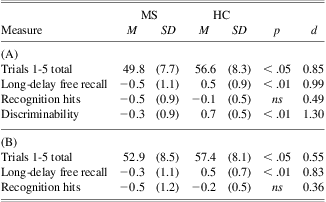
Twenty-two MS patients and 14 HC participants completed the CVLT-II. Examining only these, as shown in Table 3(A), the MS group acquired significantly fewer words than the HC group on trials 1–5 total, t(38) = −2.50, p < .05, and recalled fewer words on LDFR, Z = −2.63, p < .01. No difference on recognition hits was observed, Z = −1.12, p > .05. However, the MS group performed significantly worse on discriminability, Z = −3.36, p < .01; this difference is attributable to the MS group endorsing significantly more false positives (M = .30; SD = .92) than the HC group (M = −.50; SD = .39), Z = −2.94, p < .01.
(A) Participants who completed the CVLT-II; (B) participants who completed the CVLT or CVLT-II combined, with scores normed to the CVLT-II
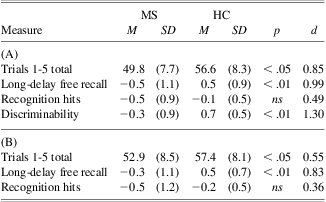
Note. (A) CVLT-II only: n = 22 for the MS group and n = 14 for the HC group. (B) CVLT and CVLT-II combined: n = 53 for the MS group and n = 31 for the HC group.
In addition, 31 MS patients and 17 HC participants completed the original CVLT. When all 84 participants’ scores were standardized according to CVLT-II norms, the MS group acquired fewer words, t(82) = −2.42, p < .05, and recalled fewer words, Z = −3.49, p < .01 than the HC group, as shown in Table 3(B). There was no significant difference, however, in the number of recognition hits, Z = −0.43, p > .05. Discriminability could not be compared between groups, as previously described. The pattern of results in Table 3(B) indicates that the difference between the MS and HC groups on delayed recall, which was of large magnitude, was greater than the differences on acquisition and recognition hits, which were of moderate and small-to-moderate magnitude, respectively.
Post hoc Analysis of Learning Characteristics
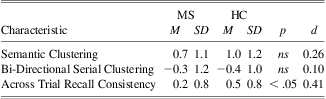
Since the results indicated that the MS group acquired fewer words than the HC group, we inspected their learning strategies. Several studies have examined semantic clustering (Jennekens-Schinkel, van der Velde, Sanders, & Lanser, Reference Jennekens-Schinkel, van der Velde, Sanders and Lanser1990; Scarrabelotti & Carroll, Reference Scarrabelotti and Carroll1999), serial clustering (Armstrong et al., Reference Armstrong, Onishi, Robinson, D'Esposito, Thompson, Rostami and Grossman1996; DeLuca et al., Reference DeLuca, Barbieri-Berger and Johnson1994; Litvan, Grafman, Vendrell, & Martinez, Reference Litvan, Grafman, Vendrell and Martinez1988) and recall consistency (DeLuca et al., Reference DeLuca, Gaudino, Diamond, Christodoulou and Engel1998; Rao et al., Reference Rao, Leo and St Aubin-Faubert1989) as possible explanations for deficient learning, but with mixed results. We analyzed semantic clustering, bi-directional serial clustering, and across trial recall consistency (ATRC) scores. As shown in Table 4, the MS group demonstrated significantly lower ATRC than the HC group, Z = −2.22, p < .05; there were no significant differences on semantic clustering, Z = −1.11, p > .05, or bi-directional serial clustering, Z = −0.46, p > .05.
Learning characteristics of MS and HC groups
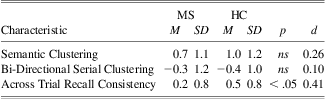
Note. n = 52 for the MS group and n = 31 for the HC group.
To check for differences in learning strategies within the MS group, we divided the combined MS group into “better recallers” and “worse recallers” based on their LDFR performance. Better recallers (n = 36) were defined by a standard score of −0.5 or higher, and worse recallers (n = 17) were defined by a standard score of -1 or lower. As shown in Table 5, better recallers used a semantic clustering strategy more frequently, Z = −3.14, p < .01, and demonstrated more recall consistency across learning trials, Z = −3.05, p < .01, than worse recallers. There was no significant difference between groups on bi-directional serial clustering.
Learning characteristics of better and worse recaller groups

Note. n = 36 for the better recallers and n = 16 for the worse recallers.
Meta-analysis
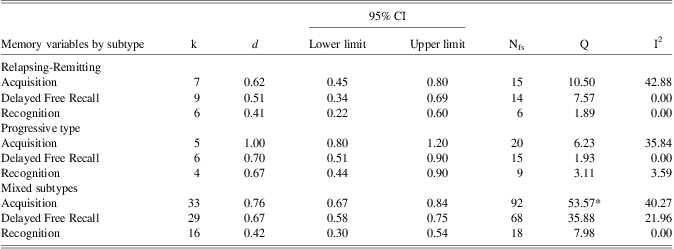
The overall mean effect sizes for acquisition, delayed free recall and recognition are shown in Table 6. Data were analyzed by disease subtype whenever possible; however, most study samples were comprised of mixed groups. Overall, MS patients performed worse on the three memory measures than healthy controls, regardless of disease subtype. Acquisition scores demonstrated the largest effect, with MS patients ranging approximately two-thirds to a full standard deviation below controls. In addition, the patient groups’ delayed free recall and recognition demonstrated moderate effects. Within each subgroup, however, the 95% confidence intervals associated with acquisition and delayed recall overlapped each other.
Meta-snalysis results
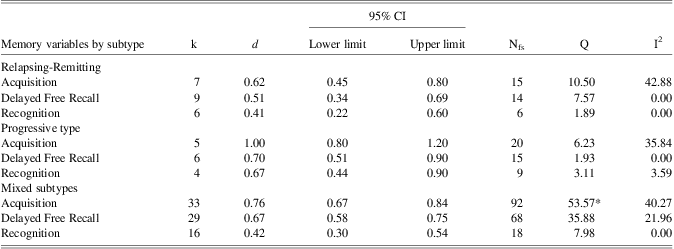
Note. k = number of studies; d = unbiased effect size; C. I. = confidence interval; Nfs = fail-safe N; Q = test of homogeneity, * = p < .05.
The RR group demonstrated moderate effects for acquisition, delayed free recall and recognition. The acquisition effect size (d = .62) corresponds to an approximately 61% overlap in the distribution of scores between RR MS patients and controls (Zakzanis, Reference Zakzanis2001). This means 39% of the RR MS patients obtained scores lower than those of the healthy controls.
Studies of patients with progressive forms of MS produced the largest effects for each of the three measures. The large effect on acquisition (d = 1.00) had a corresponding overlap of roughly 45%, which means more than half of the patients with progressive MS subtypes obtained scores lower than those of the controls. While the RR and progressive groups both demonstrated a similar pattern of effects, the progressive group effect sizes were of higher magnitude than those of the RR group, with non-overlapping 95% confidence intervals on acquisition (see Figure 1). Nevertheless, any interpretation of results of the RR and progressive groups should be made with caution given that k = 9 and k = 6, respectively, and not all memory measures are equally represented within and between studies.
Meta-analysis results: acquisition, delayed recall, and recognition by subtype. Error bars represent 95% confidence intervals. RR = relapsing-remitting.

The third group consisted of mixed MS subtypes and MS patients with unreported subtype. Once again, the measure with the largest effect size was acquisition (d = 0.76), with a corresponding overlap of approximately 54% with the control distribution. This means that 46% of the mixed MS patients obtained scores lower than obtained by the controls. It should be noted that the homogeneity analysis was only significant for acquisition (Q = 53.57). The mixed group's pattern of results fell between that of the RR and progressive groups.
A potential source of bias in our meta-analysis is the differential reporting rates for the three variables of interest. To address this, we conducted a post hoc meta-analysis in which we only included studies that reported all three measures. This resulted in 4 RR group studies, 3 progressive group studies, and 13 mixed group studies. The test of homogeneity (Q) was not significant for any of the measures across the patient groups. For all three groups, the effect sizes were very similar to those found in the larger meta-analysis (RR: d = 0.62, 0.51. 0.41; Progressive: d = 1.00, 0.70, 0.67; Mixed: d = 0.76, 0.67, 0.42) for acquisition, delayed free recall, and recognition, respectively.
Discussion
The data from our quasi-experimental study revealed significantly lower performance on verbal learning in RR MS patients relative to controls, despite the fact that acquisition has traditionally been assumed to be relatively intact in MS. Furthermore, these differences were of moderate effect size. Our study supports recent findings that suggest deficient acquisition contributes to the delayed recall impairment often seen in MS (DeLuca et al., Reference DeLuca, Barbieri-Berger and Johnson1994, Reference DeLuca, Gaudino, Diamond, Christodoulou and Engel1998; Diamond et al., Reference Diamond, DeLuca, Johnson and Kelley1997; Minden et al., Reference Minden, Moes, Orav, Kaplan and Reich1990). Yet although the MS group had significantly lower acquisition scores than the HC group, their mean score did not fall in the “impaired” range relative to the CVLT-II normative sample but, rather, in the “average” range clinically. Previous findings of deficient acquisition in MS based on the OT-SRT (DeLuca et al., Reference DeLuca, Gaudino, Diamond, Christodoulou and Engel1998, Demaree et al., Reference Demaree, Gaudino, DeLuca and Ricker2000; Gaudino et al., Reference Gaudino, Chiaravalloti, DeLuca and Diamond2001) were only been able to report that MS patients do not learn “as well as” controls, but were unable to comment on degree of impairment because OT-SRT normative data were not available. Our data help us understand deficient acquisition in a larger normative context.
Our data also revealed significant differences on delayed free recall performance, with the MS group scoring lower than the HC group. Moreover, the effect size for recall was larger than the effect size for acquisition. The MS group, however, was also not “impaired” on recall relative to the CVLT-II normative sample; average performance was approximately half a standard deviation below the mean. There was no significant difference between groups on recognition, with the MS group mean falling within the “average” range normatively. While it would be common for this non-significant finding to be equated with “normal” performance, the corresponding small to moderate effect size, related to the MS group's tendency to endorse more false positives on the discriminability measure, indicates that recognition among MS patients is less than ideal. It also supports the finding that learning is deficient in MS since the recognition effect size would be negligible if MS and HC groups exhibited equally normal acquisition. Of note, the premise for a retrieval-based account of memory impairment in MS is based largely on findings of significant differences between MS patients and healthy controls on recall but not recognition (Thornton & Raz, Reference Thornton and Raz1997). Upon more thorough analysis, we see that differences on recognition are of notable magnitude, even if not statistically significant. Overall, our data argue against a simple retrieval deficit explanation for verbal memory impairment in MS.
Despite findings that the MS group's performance on acquisition, delayed recall and recognition did not fall in the impaired range, this does not necessarily mean that MS patients’ memory is “normal” (i.e., unaffected) or that it does not impact their daily lives. Rather, we interpret our data to mean that RR MS patients likely show relatively mild memory deficiency, and previous studies have shown that even mild memory disturbance can negatively impact daily functioning and lead to premature retirement from the workforce (Beatty, Blanco, Wilbanks, Paul, & Hames, Reference Beatty, Blanco, Wilbanks, Paul and Hames1995). Our findings have clinical implications for neuropsychologists who evaluate MS patients: they should not too readily interpret normatively average memory scores as evidence of unaffected memory, particularly acquisition-related scores, in light of effect sizes on acquisition and recognition obtained in this investigation.
Our meta-analysis was partitioned by subtype because we were interested in verbal memory differences that might be subtype-specific and because previous meta-analytic studies, which only looked at combined subtypes (Thornton & Raz, Reference Thornton and Raz1997; Wishart & Sharpe, Reference Wishart and Sharpe1997), had failed to produce clearly interpretable homogenous effect sizes. Studies that exclusively examined progressive forms of MS (n = 6) revealed the largest effects across all memory domains, with a large effect on acquisition, a moderate to large effect on delayed recall and a moderate effect on recognition. In contrast, studies of RR MS (n = 9) found the same pattern but with smaller effects. This is consistent with the findings in our own data, although other published studies using the CVLT do not provide normatively corrected scores to allow for direct statistical comparison. While it appears that verbal memory deficits are more pronounced in progressive forms of MS than in RR MS, the majority of studies report data from mixed MS groups that are not broken down by subtype or do not report the subtype makeup of their samples (n = 33).
The pattern of results for studies that used mixed subtype groups or did not report subtype was similar to that seen in RR and progressive subtypes of MS, with the effect sizes falling between those observed in RR and progressive groups. The magnitude differences between studies that used either RR, progressive or mixed MS patient samples may be attributable to true subtype differences in severity or may be a function of the small number of studies that used exclusively RR or progressive MS patients. Unfortunately, the tendency of investigators to use mixed groups makes this issue difficult to resolve, as further evidenced by a heterogeneous distribution of acquisition effect sizes in the mixed subtype group. Future studies can shed light on the issue by reporting results according to disease subtype to help ensure that mild yet potentially important differences between subtypes not be obscured by reporting pooled results.
Some additional conclusions can be drawn from the results of the meta-analysis. Despite the fact that acquisition effect sizes are consistently larger than the delayed recall effect sizes within subtype, the effect sizes are not significantly different from each other because their confidence intervals overlap (Durlak, Reference Durlak1998). Yet although the effect sizes are similar, this does not mean that these memory domains are similarly impaired. At the very least, it affirms that reduced learning is an important aspect of verbal memory functioning in MS. Because deficient acquisition is observed, one would expect that delayed recall would be subsequently affected. However, it is not possible from our data to determine whether recall is (a) deficient merely as a secondary consequence of deficient acquisition, (b) independently affected above and beyond the effect attributable to deficient acquisition, or (c) some combination of both. In addition, none of the confidence intervals include zero, indicating that the effect sizes are significantly different from zero at the .05 level, including those associated with recognition. Moreover, all the effect sizes associated with recognition are at least d = 0.41, consistent with the findings in our own data. Taken together, the integrated findings from our list learning study and meta-analysis make a consistent case for the position that deficient acquisition plays an important, notable role in the memory functioning of MS patients, which can secondarily lead to performance decrements on recall measures, and that acquisition is affected to a relatively mild degree on a purely normative basis.
We hypothesize that reduced encoding efficiency accounts for deficient acquisition in MS. One obvious explanation for the hypothesized reduction in encoding efficiency is reduced information processing speed secondary to demyelination. The primary pathological process in MS involves demyelination seen as hyperintensities on T2 or FLAIR magnetic resonance imaging (MRI), and in theory leads to disruption of cortical-subcortical circuits (Filley, Reference Filley1998, Reference Filley2012; Mesulam, Reference Mesulam1990). Many studies support the notion that reduced verbal memory functioning in MS is associated with reduced processing speed (Arnett, Reference Arnett2004; DeLuca et al., Reference DeLuca, Barbieri-Berger and Johnson1994; Litvan et al., Reference Litvan, Grafman, Vendrell and Martinez1988), although a few do not (DeLuca et al., Reference DeLuca, Gaudino, Diamond, Christodoulou and Engel1998; Thornton & Raz, Reference Thornton and Raz1997). One study that did not find significant correlations between verbal memory and processing speed used a processing speed variable that likely had reduced sensitivity because it was adjusted to keep initial performance constant (DeLuca et al., Reference DeLuca, Gaudino, Diamond, Christodoulou and Engel1998), while another study with a similar finding used an index that does not adequately assess processing speed (Thornton & Raz, Reference Thornton and Raz1997). Other studies have reported the more general finding that MS patients have impaired information processing speed (Archibald & Fisk, Reference Archibald and Fisk2000; DeLuca, Chelune, Tulsky, Lengenfelder, & Chiaravolloti, Reference DeLuca, Chelune, Tulsky, Lengenfelder and Chiaravolloti2004; Demaree, DeLuca, Gaudino, & Diamond, Reference Demaree, DeLuca, Gaudino and Diamond1999; Litvan et al., Reference Litvan, Grafman, Vendrell and Martinez1988). Demyelination has also been associated with executive dysfunction in MS (Foong et al., Reference Foong, Rozewicz, Quaghebeur, Davie, Kartsounis, Thompson and Ron1997). Furthermore, encoding deficits on list-learning tests have also been associated with executive dysfunction (Brooks, Weaver, & Scialfa, Reference Brooks, Weaver and Scialfa2006) and poor learning strategies during acquisition (Longenecker, et al., 2010). In summary, the hypothesis that verbal encoding is less efficient due to demyelination-related reduced information processing speed in MS and other diseases that affect primarily white matter remains plausible and can be tested in future research by varying the presentation rate of words on fixed-trial list-learning tests. Some support for this idea can be found in a study that demonstrated that speed of presentation significantly influences performance on a story recall test (Arnett, Reference Arnett2004). Moreover, impaired processing speed may be more likely to affect encoding in progressive forms of MS than in RR MS, given that processing speed is more impaired in SP than in RR MS (DeLuca et al., Reference DeLuca, Chelune, Tulsky, Lengenfelder and Chiaravolloti2004). This hypothesis is consistent with the finding from our meta-analysis that verbal memory deficits are more pronounced in progressive forms of MS than RR MS, which may reflect increasing levels of demyelination.
Our meta-analysis took a different approach than those published previously. First, we limited our analyses to studies that used list-learning measures. While other kinds of verbal memory tests (e.g., story memory, paired associates) provide valuable information, they tap a variety of encoding strategies and levels of processing that influence learning (Macartney-Filgate & Vriezen, Reference Macartney-Filgate and Vriezen1988; Randolph et al., Reference Randolph, Gold, Kozora, Cullum, Hermann and Wyler1994). We limited the studies in our meta-analysis to list memory tasks to minimize such influences. Second, we systematically examined the primary variables that would lend support to the acquisition and retrieval hypotheses: learning, delayed free recall, and recognition. Finally, data were grouped by subtype to examine patterns associated with disease course. This approach resulted in a homogeneous distribution of effect sizes for the groups (except for the mixed subtype group, not surprisingly), indicating that our model for grouping by subtype provides a good fit for the data. Two previous meta-analytic studies (Thornton & Raz, Reference Thornton and Raz1997; Wishart & Sharpe, Reference Wishart and Sharpe1997) reported heterogeneity of effect sizes, suggesting that their overall effect sizes are actually based on two or more distinct sub-populations of studies and do not represent a single underlying effect. We believe that the heterogeneity in the distribution of their effect sizes is likely due to the fact that they combined different subtypes of MS, as well as different types of memory tests. Another meta-analytic study (Zakzanis, Reference Zakzanis2000) did not report an analysis of effect size homogeneity because it was not a true meta-analysis in that it did not provide overall effects for different neuropsychological constructs, only simple average raw effect sizes for individual dependent variables. A final meta-analytic study reported heterogeneity of memory-related effect sizes likely due to a combination of different types of memory tests, as well as the influence of certain moderator variables that were examined (Prakash et al., Reference Prakash, Snook, Lewis, Motl and Kramer2008).
Given that our own data and those contained in the meta-analysis indicate the presence of verbal learning deficits in MS, we performed post hoc analyses to identify differences in learning characteristics of the MS and HC groups. We found a significant difference on recall consistency across learning trials, with no significant differences between MS and HC groups on semantic or serial clustering. The magnitude of differences between groups on recall consistency and semantic clustering was small-to-moderate, which hinted at a possible underlying effect. When we looked only at the MS patients and compared the better and worse recallers, those with lower recall failed to use semantic clustering as effectively as patients with better recall. The MS patients with lower recall also demonstrated less consistent recall across learning trials, suggesting that patients either have difficulty formulating a learning plan or abandon one strategy for another during the test. Regardless, patients with worse delayed free recall also had worse overall learning. These findings provide further support for the hypothesis that acquisition affects delayed recall in MS and suggest other mechanisms by which acquisition may be impacted other than, or perhaps in conjunction with, reduced processing speed-related encoding efficiency. Perhaps executive dysfunction due to demeyelination interferes with one's ability to consistently organize information to facilitate retrieval during both acquisition and delayed recall. These findings also have implications for clinicians working in rehabilitation settings, who may use this information to help MS patients formulate effective learning strategies. Preliminary evidence already suggests that MS patients use a less efficient learning strategy during the acquisition of verbal information (Diamond et al., Reference Diamond, DeLuca, Johnson and Kelley1997).
Our results also bear upon the concept of white matter dementia (Filley et al., Reference Filley, Franklin, Heaton and Rosenberg1988; Filley, Reference Filley2012). A recent study by Lafosse, Corboy, Leehey, Seeberger, and Filley (Reference Lafosse, Corboy, Leehey, Seeberger and Filley2007) compared the neuropsychological performance of patients with MS or Huntington's disease. Lafosse et al. (Reference Lafosse, Corboy, Leehey, Seeberger and Filley2007) found that white matter dementia is associated with normal perceptual-motor integration learning and normal sequence learning on procedural memory tasks, while subcortical gray matter dementia is associated with normal perceptual-motor integration learning but impaired sequence learning. Speed of information processing was significantly reduced in both groups. As previously stated, we hypothesize that the quality of encoding is compromised in that it becomes less efficient and perhaps less organized due to demyelination of white matter tracts. Nevertheless, the considerable redundancy of white matter tracts ensures that, at least in the early stages, the impairment is subtle enough to appear normatively average, in marked contrast to the severe encoding deficits seen in neurological disorders that affect medial temporal lobes such as Alzheimer's disease. Even when white matter damage becomes more extensive, inefficient encoding is likely to remain qualitatively distinct from the severely impaired encoding associated with medial temporal lobe involvement.
Another possibility as an explanation for deficient memory acquisition is cortical MS (Lucchinetti et al., Reference Lucchinetti, Popescu, Bunyan, Moll, Roemer, Lassmann and Ransohoff2011). Recent studies have confirmed cortical demyelination in MS (Lucchinetti et al., Reference Lucchinetti, Popescu, Bunyan, Moll, Roemer, Lassmann and Ransohoff2011), raising the possibility that medial temporal damage may produce impaired acquisition that is commingled with a memory retrieval deficit associated with demyelination. Indeed, a recent MRI study found hippocampal atrophy in MS patients correlated with worse performance on a word-pair learning task (Sicotte et al., Reference Sicotte, Kern, Giesser, Arshanapalli, Schultz, Montag and Bookheimer2008). An fMRI study found increased activation in the hippocampal system and cingulate gyrus in MS patients that preceded cognitive impairment and structural MRI changes (Hulst et al., Reference Hulst, Schoonheim, Roosendaal, Popescu, Schweren, van der Werf and Geurts2012). Cortical demyelination in MS, however, is generally considered to develop later in the disease than tract demyelination (Filley, Reference Filley2012), and biopsy data identified cortical demyelination in only 38% of early MS patients, all of whom by definition had white matter lesions (Lucchinetti et al., 2011). Still, myelinated fascicles exist within cortical regions including the hippocampus, and it is possible that demyelination of these structures affects adjacent cortical neurons and the clinical expression of memory dysfunction. Without neuroimaging or neuropathological data, we can only speculate about the contribution of cortical lesions to the memory dysfunction of MS, but our data suggest a more nuanced view of memory acquisition and retrieval in MS that, at least early in the disease, seems primarily to involve tract demyelination.
A few limitations should be considered. First, neuroimaging data were not obtained uniformly in our patient sample. Determining the location and extent of white matter involvement, and correlating white matter lesion burden with neuropsychological measures, would have added an interesting dimension. The present study nevertheless contributes to the neuropsychological understanding of verbal memory in MS.
Our own patient sample included only RR MS patients, so these results may not generalize to other forms of MS. However, the meta-analysis provides a larger context that takes MS subtype into account insofar as the extant literature allows. Moreover, our sample's data may be providing us with a glimpse into the emergence of memory impairment in MS that can then be studied longitudinally.
Another consideration has to do with the potential risk of over interpreting the degree of difference when comparing the effect sizes of different measures. For example, trials 1–5 total and LDFR differ in the shapes of their distribution, range, variance and consequent susceptibility to ceiling effects. Because these psychometric characteristics can impact the magnitude of the effect size, caution should be taken when comparing the effect sizes of different measures in both individual studies and meta-analytic studies.
Finally, this study only evaluated verbal memory in MS patients with list-learning measures. Other types of verbal memory tests may produce different patterns of results by tapping different cognitive functions (e.g., the inherent structure in story tasks reduces organizational demands) and, by extension, different white matter pathways. Studies that compare memory performance on different types of verbal and non-verbal memory tests are needed. An additional area for future research concerns the method of acquisition in verbal memory tests. Traditional standardized tests with a relatively quick stimulus presentation rate and fixed number of learning trials are not designed to ensure a minimal normative or criterion level of acquisition so that recall can be unambiguously studied. However, tests that account for initial level of acquisition, such as the OT-SRT used by some investigators (DeLuca et al., Reference DeLuca, Barbieri-Berger and Johnson1994, Reference DeLuca, Gaudino, Diamond, Christodoulou and Engel1998; Demaree et al., Reference Demaree, Gaudino, DeLuca and Ricker2000), can be advantageously used for clinical purposes with the recent publication of initial normative data (Chiaravalloti et al., Reference Chiaravalloti, Balzano, Moore and DeLuca2008).
Our study has several unique advantages over previous studies of verbal memory impairment in MS. First, our prospective data had a relatively large sample size compared to other studies of exclusively RR MS patients. Second, we performed a comprehensive analysis of verbal memory functioning by examining measures of learning, delayed recall, and recognition. Third, we were able to rule out depression as an explanatory factor in our results. Fourth, it is unlikely that the medication regimens of our patients affected their memory performance given that prior research has shown that immunomodulatory medications can significantly reduce cognitive decline in MS patients within two years of treatment (Fischer et al., Reference Fischer, Priore, Jacobs, Cookfair, Rudick, Herndon and Kooijmans-Coutinho2000; Pliskin et al., Reference Pliskin, Hamer, Goldstein, Towle, Reder, Noronha and Arnason1996). Fifth, our meta-analysis examined MS subtypes separately, overcoming the problem of heterogeneous effect sizes in previous meta-analytic studies. Sixth, the unique combination of two complementary research designs in this study provides for a more comprehensive examination of the nature of verbal memory impairment in MS. Finally, our study also contributes to a greater refinement of the concept of white matter dementia (Filley, Reference Filley2012; Filley et al., Reference Filley, Franklin, Heaton and Rosenberg1988; Lafosse et al., Reference Lafosse, Corboy, Leehey, Seeberger and Filley2007).
The purpose of this study was to determine whether memory deficits observed in MS could be attributed to acquisition or retrieval deficits. While there has been considerable debate about the specific nature of memory impairment in MS, our results demonstrate that deficient acquisition plays an important, notable role in the memory functioning of MS patients, which can secondarily lead to performance decrements on recall measures. Nevertheless, additional research that takes into account disease subtype, between-group differences in initial learning, and the influence of reduced information processing speed and executive dysfunction on effective encoding is needed to further clarify the nature of memory impairment in MS.
Acknowledgments
None of the authors have any conflict of interest to report. This research received no specific grant from any funding agency, commercial or not-for-profit sectors, but was supported by a sabbatical leave to Dr. Lafosse from Regis University. We thank Nancy L. Leech, Ph.D. for her assistance with meta-analytic techniques, Ted Krmpotich for his assistance with data collection, and the Regis University students enrolled in Neuropsychology during spring 2013 for their helpful reviews of the manuscript.
Studies Included in Meta-analysis