1 Introduction
Speakers of English have a number of options at their disposal for marking how they view the connection between two linguistic units (whether words, phrases, clauses, sentences, or even larger units). Prominent among these resources are conjuncts, in the terminology of Quirk et al. (Reference Quirk, Greenbaum, Leech and Svartvik1985: 631–47), also known as linking adverbials (Biber et al. Reference Biber, Johansson, Leech, Conrad and Finegan1999: 875), adverbial connectors (Lenker Reference Lenker2010, Reference Lenker2011) and connective adjuncts (Mittwoch, Huddleston & Collins Reference Huddleston and Pullum2002: 775). Such adverbials usually appear in the shape of adverbs (e.g. therefore, however) and prepositional phrases (e.g. on the other hand, in the first place), and they signal a range of semantic relations including result, addition and contrast. An example in context is provided in (1), where moreover marks the statement as providing an additional (and perhaps stressed) point in the list of perceived qualities of the ‘Mahratta’.
(1) Joining their sports, sharing their hospitality, mingling with them in the smoking-room and at the billiard-table, this Mahratta had won the confidence of British officers. He was a man, moreover, in whom it seemed generous to confide.
(History, Walpole, 1870–1900, p. VI.305)
A number of studies have been devoted to the use of conjuncts because of their importance as organizational features in English writing and speech. However, while research into the present-day situation has outlined the inventory and parameters of usage in some detail, the historical development of conjuncts has only recently received systematic attention.
The aim of our article is to contribute to this historical picture by exploring the use of conjuncts in nineteenth-century British English, based on data from A Corpus of Nineteenth-Century English (CONCE). We are particularly concerned with charting their frequency over the century and across different genres and semantic categories, but we also pay attention to the distribution of individual conjuncts and to author-specific styles. The impetus for our study comes from Lenker's (Reference Lenker2010) monograph on connectives in English. Lenker (Reference Lenker2010: 9) singles out Late Modern English as a period of special interest in terms of changes in the conjunctive system. Our study expands on Lenker's (Reference Lenker2010) findings by investigating the more fine-grained development of conjuncts within the Late Modern English period, and by considering in particular what influence the genre parameter, which has been shown to have a substantial impact on present-day patterns, may have had historically. More generally, our study contributes to the description of Late Modern English syntax, an area of increasing scholarly interest (see Kytö et al. Reference Kytö, Rydén and Smitterberg2006; Tieken-Boon van Ostade & van der Wurff Reference Tieken-Boon van Ostade and van der Wurff2009; Hickey Reference Hickey2010).
2 Previous research
Conjuncts have received considerable attention in previous research, from a number of different perspectives, including primarily quantitative, descriptive approaches (e.g. Altenberg Reference Altenberg1984, Reference Altenberg1986; Markus Reference Markus2000; Rissanen Reference Rissanen2004; Lenker Reference Lenker2010; Meurman-Solin Reference Meurman-Solin2011); second/foreign language investigations or approaches to learner vs professional writer proficiency (e.g. Gardezi & Nesi Reference Gardezi and Nesi2009; Shaw Reference Shaw2009; Yeung Reference Yeung2009); and more discourse-analytical, pragmatic studies (e.g. Williams Reference Williams1996; Barth-Weingarten & Couper-Kuhlen Reference Barth-Weingarten and Couper-Kuhlen2002; Bell Reference Bell2004, Reference Bell2010; Haselow Reference Haselow2011, Reference Haselow2012). A major distinction can be made between studies that provide a comprehensive treatment of conjuncts as a group and investigations that deal with a subgroup of conjuncts or individual items. Studies that belong to the former category are relatively few, covering the major descriptive grammars of English (Quirk et al. Reference Quirk, Greenbaum, Leech and Svartvik1985; Biber et al. Reference Biber, Johansson, Leech, Conrad and Finegan1999; Huddleston & Pullum et al. Reference Huddleston and Pullum2002) and a few monographs or article-length studies that deal with conjuncts exclusively or as part of a broader framework (e.g. Greenbaum Reference Greenbaum1969; Halliday & Hasan Reference Halliday and Hasan1976; Warner Reference Warner1985; Ungerer Reference Ungerer1988; Lindquist Reference Lindquist1989; Halliday Reference Halliday1994; Altenberg Reference Altenberg1999; Hyland Reference Hyland2005; Lenker Reference Lenker2010). The latter category, on the other hand, attests to the substantial interest in different semantic categories of conjuncts, including expressions of concession or contrast such as however, nevertheless and on the other hand (e.g. Borkin Reference Borkin1979, Reference Borkin1980; Altenberg Reference Altenberg1986; Barth-Weingarten & Couper-Kuhlen Reference Barth-Weingarten and Couper-Kuhlen2002; Bell Reference Bell2004, Reference Bell2010); cause, inference, or result markers such as therefore, thus and then (e.g. Altenberg Reference Altenberg1984; Vandepitte Reference Vandepitte1993; Markus Reference Markus2000; Haselow Reference Haselow2011, Reference Haselow2012); and transition signals such as now (e.g. Defour Reference Defour2008).
Variation is evident among conjuncts in terms of their frequency and their occurrence in a variety of genres, as has been shown in a number of investigations (e.g. Greenbaum Reference Greenbaum1969; Altenberg Reference Altenberg1984, Reference Altenberg1986, Reference Altenberg1999; Morrow Reference Morrow1989; Biber et al. Reference Biber, Johansson, Leech, Conrad and Finegan1999; Markus Reference Markus2000; Bell Reference Bell2004, Reference Bell2010; Peterson Reference Peterson2009; Yeung Reference Yeung2009; Lenker Reference Lenker2010). A consensus finding of earlier studies is that conjuncts are as a rule more common in academic, informative, learned or formal written genres than in more informal, less specialized writing (see esp. Greenbaum Reference Greenbaum1969: 80; Altenberg Reference Altenberg1984: 39–45; Morrow Reference Morrow1989; Biber et al. Reference Biber, Johansson, Leech, Conrad and Finegan1999: 880). A prominent division has also been observed between expository or argumentative texts and narrative texts, such as novels and news texts, conjuncts being relatively rare in narratives (Greenbaum Reference Greenbaum1969: 80; Biber et al. Reference Biber, Johansson, Leech, Conrad and Finegan1999: 880).
Another notable finding in previous research is that conversation reveals conjunct frequencies that rival those of learned, informative written texts (Greenbaum Reference Greenbaum1969: 80; Biber et al. Reference Biber, Johansson, Leech, Conrad and Finegan1999: 880). The difference between the two domains of usage lies primarily in the specific conjuncts used: then, now, so, anyway and though, for example, tend to be much more common in speech than in writing, while others such as however, thus, therefore and for example are characteristic of written language (Altenberg Reference Altenberg1984: 40–1; Reference Altenberg1986: 16; Biber et al. Reference Biber, Johansson, Leech, Conrad and Finegan1999: 887).
Historical studies of conjuncts are relatively few, and they mostly treat individual conjuncts or subgroups rather than the system of conjuncts (e.g. Finell Reference Finell1992; Markus Reference Markus2000; Dorgeloh Reference Dorgeloh2004; Rissanen Reference Rissanen2004; Defour Reference Defour2008; Lenker Reference Lenker2011; Meurman-Solin Reference Meurman-Solin2011; Haselow Reference Haselow2012). The only comprehensive historical treatment of conjuncts to date is Lenker's (Reference Lenker2010) monograph, which traces the development of conjuncts from Old English up to the present day. Among many revelatory findings, Lenker (Reference Lenker2010: 9, 238–41) emphasizes the Late Modern English period as crucial regarding the formation of individual conjuncts, changes in sentence position, and the development of the system of conjuncts. Our results indicate that the nineteenth century was indeed a watershed in the development of, among other things, the conjunct-heavy style that characterizes present-day academic writing.
3 Material and data
3.1 Material
The present study is based on CONCE, a one-million-word corpus of British English (for further details, including information on texts included in each period/genre sample, see Smitterberg Reference Smitterberg2005; Kytö, Rydén & Smitterberg Reference Kytö, Rydén and Smitterberg2006). The texts in CONCE are stratified into three period samples, thus enabling diachronic analyses: 1800–30 (period 1), 1850–70 (period 2) and 1870–1900 (period 3). As the manual scrutiny required to identify and analyse conjuncts reliably is time-consuming (see section 3.2.2), it was necessary to limit the scope of the study to a subset of CONCE in order to allow us to carry out in-depth analyses of the data. By including periods 1 and 3 only, we could study the full range of genre variation in the corpus while still being able to chart change in the use of conjuncts over the course of the nineteenth century based on quantitatively robust data.
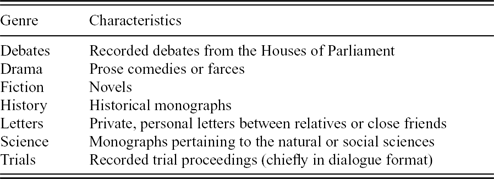
CONCE includes seven genres: Debates, Drama, Fiction, History, Letters, Science and Trials. The genres are described briefly in table 1. Besides including both narrative and non-narrative language, CONCE covers informal genres like Letters as well as formal, literate genres such as History and Science. In addition, formal speech written down (Debates and Trials) and informal, constructed speech (Drama, dialogue in Fiction) are both represented in the corpus. The genre setup of CONCE thus provides a good opportunity to study possible variation across a number of genres, and to see whether some of the genre characteristics reported by Greenbaum (Reference Greenbaum1969: 80) and Biber et al. (Reference Biber, Johansson, Leech, Conrad and Finegan1999) for twentieth-century English are present in the nineteenth century as well. Word counts for the period, genre and period/genre samples included are given in table 2.
Description of the genres in CONCE (based on Kytö, Rudanko & Smitterberg Reference Kytö, Rudanko and Smitterberg2000: 88)

Word counts by period and genre in CONCE (periods 1 and 3)
The limited number of source texts used for CONCE (for most genres, three texts per period/genre sample) means that characteristics of individual texts may influence the quantitative picture. This potential limitation notwithstanding, CONCE has been shown to provide reliable evidence of genre variation and development in previous research (e.g. Geisler Reference Geisler2002; Kytö, Rydén & Smitterberg Reference Kytö, Rydén and Smitterberg2006; Smitterberg Reference Smitterberg2005, Reference Smitterberg2012). Moreover, given that identifying and classifying conjuncts requires a great deal of manual work, using a larger corpus was not feasible, and the care that has gone into the selection and transcription of source texts for CONCE outweighs any sampling-related drawbacks.
3.2 Data
3.2.1 Conjuncts versus other adverbials, other connectors, and discourse markers
The adverbials that we refer to as conjuncts have been defined in a number of different, though related ways in previous research (see e.g. Greenbaum Reference Greenbaum1969; Altenberg Reference Altenberg1984: 24; Reference Altenberg1999: 251; Quirk et al. Reference Quirk, Greenbaum, Leech and Svartvik1985; Biber et al. Reference Biber, Johansson, Leech, Conrad and Finegan1999; Markus Reference Markus2000: 216–7; Mittwoch, Huddleston & Collins Reference Mittwoch, Huddleston and Collins2002: 775–7; Yeung Reference Yeung2009: 330; Hasselgård Reference Hasselgård2010: 19–23, 301–2; Lenker Reference Lenker2010: 23–8). In the present study, we rely chiefly on the criteria for conjunct status presented in Quirk et al. (Reference Quirk, Greenbaum, Leech and Svartvik1985). We define conjuncts as non-adjunctive adverbials whose main function is to express the relationship between two linguistic units (or, in some cases, between a linguistic unit and the extralinguistic context – see e.g. Quirk et al. Reference Quirk, Greenbaum, Leech and Svartvik1985: 633). We use the syntactic tests outlined in Quirk et al. (Reference Quirk, Greenbaum, Leech and Svartvik1985: 504–5, 921–8) to distinguish conjuncts from other structures with a potentially connective function, such as conjunctions and certain adjuncts; for instance, an adjunct can be the focus of a cleft sentence, while other adverbials cannot (Quirk et al. Reference Quirk, Greenbaum, Leech and Svartvik1985: 504; for the use of a combination of syntactic and semantic criteria, see also Hasselgård Reference Hasselgård2010: 302).Footnote 1
It is also important to consider how conjuncts relate to discourse markers since, depending on which definition of discourse markers we adopt among those that have been proposed, all, some, or none of our conjuncts would appear to qualify as discourse markers (for the wide range of definitions, see Schiffrin Reference Schiffrin1987; Brinton Reference Brinton1996: 29–38; Jucker & Ziv Reference Jucker and Ziv1998: 1–4; Lenk Reference Lenk1998: 49–52; Fraser Reference Fraser1999; Aijmer Reference Aijmer2002: 6–7). We chose to follow Biber et al. (Reference Biber, Johansson, Leech, Conrad and Finegan1999: 1086–8), who see discourse markers as a separate category from adverbials, including conjuncts, although they admit that differentiating between them is not always easy (see e.g. Biber et al. Reference Biber, Johansson, Leech, Conrad and Finegan1999: 880, 889, 1086). They emphasize the conversational and interactive nature of discourse markers. In their discussion of so, they also suggest that discourse markers have little or no semantic content (Biber et al. Reference Biber, Johansson, Leech, Conrad and Finegan1999: 878). For our purposes, the distinction between conjunctive and discourse-marker functions proved particularly useful in the treatment of so, as in (2).
(2) By way of a coarse analogy, consider a parallel-sided piece of glass through which light passes. It forms no picture. Shape it so as to be bi-convex, and a picture appears in its focus.
Is not the formation of the picture a “function” of the piece of glass thus shaped?
So, from your own point of view, suppose a mind-stuff – λόγοϛ – a noumenal cosmic light such as is shadowed in the fourth gospel. The brain of a dog will convert it into one set of phenomenal pictures, and the brain of a man into another. But in both cases the result is the consequence of the way in which the respective brains perform their “functions”.
(Letters, Huxley, 1870–1900, p. 299)
In (2), the main function of so seems to be to mark the return to the main strand of the author's argument after the intervening yes/no question (a conversational function). This example appears to fit similar uses of so as a discourse marker recorded by Biber et al. (Reference Biber, Johansson, Leech, Conrad and Finegan1999: 878). We thus exclude such instances and include only those cases where so clearly carries inferential/resultive meaning, as in (3).
(3) [$Tyke.$] Why, you know, before you were a Lord, your name was Mr. Philip; so I got some gunpowder and marked an F on his neck, because F stands for Philip – yes yes – it struck me as proper.
(Drama, Morton, 1800–30, p. 70)
3.2.2 Data selection
As conjuncts do not have any morphological features in common, it would technically be necessary to scrutinize the entire corpus manually to ensure complete recall. However, such an approach would be unfeasible considering the amount of material. As the vast majority of conjuncts consist of adverbs (Biber et al. Reference Biber, Johansson, Leech, Conrad and Finegan1999: 768–9), and as most of these adverbs form a closed class (Quirk et al. Reference Quirk, Greenbaum, Leech and Svartvik1985: 634),Footnote 2 we opted for a semi-automatic retrieval process where potential conjuncts were retrieved by a concordancer and then inspected manually so that only actual conjuncts would be included in the counts. We used the list of conjuncts given in Quirk et al. (Reference Quirk, Greenbaum, Leech and Svartvik1985: 634–6) as a starting point. This list is claimed to include ‘all adverb realizations . . . as well as some frequently occurring prepositional phrases and noun phrases’ (Quirk et al. Reference Quirk, Greenbaum, Leech and Svartvik1985: 634). This list was then checked against inventories of conjuncts provided by Mittwoch, Huddleston & Collins (Reference Mittwoch, Huddleston and Collins2002), Biber et al. (Reference Biber, Johansson, Leech, Conrad and Finegan1999) and Lenker (Reference Lenker2010), to ensure comprehensive coverage.Footnote 3
However, some items that have been included as conjuncts by some scholars but not by others were excluded from our searches. Most importantly, we excluded members of Lenker's (Reference Lenker2010) source domain truth/fact such as truly and surely. Lenker (Reference Lenker2010: 114–30) argues that adverbs from this domain can mark contrastive/concessive and transitional relationships in texts. However, we consider such adverbials disjuncts rather than conjuncts, as they are mainly concerned with ‘the speaker's “authority” for (or the speaker's comment on) the accompanying clause’ rather than with the speaker's ‘assessment of how he views the connection between two linguistic units’ (Quirk et al. Reference Quirk, Greenbaum, Leech and Svartvik1985: 631–2; cf. Meurman-Solin Reference Meurman-Solin2011: section 2).Footnote 4 We could not find examples where a clear conjunctive meaning was present without considerable disjunctive colouring. In terms of other, variably treated items, such as well, for, here, indeed, either, neither and nor, we either did not find any conjunctive uses after analysing randomly selected samples (here and indeed), or adopted the analysis suggested by studies that excluded the items (for for, see Quirk et al. Reference Quirk, Greenbaum, Leech and Svartvik1985: 920–8; for well, see Greenbaum Reference Greenbaum1969: 27–8; Biber et al. Reference Biber, Johansson, Leech, Conrad and Finegan1999: 1086–7; for either, see Quirk et al. Reference Quirk, Greenbaum, Leech and Svartvik1985: 604; for neither and nor, see the list in Greenbaum Reference Greenbaum1969: 35–7).
A full list of the conjunct forms searched for is given in appendix 1. Every instance of the forms was retrieved with the aid of the concordancer program in the WordSmith Tools software suite. Both authors went through all concordances independently, and the final database (in Microsoft Access) included only instances that both authors agreed were conjuncts. We restricted the scope of the study to conjuncts that linked linguistic material above the phrase level; the same strategy was followed by Lenker (Reference Lenker2010: 4). For instance, in (4), the linguistic material linked by above all comprises noun phrases, whereas above all in example (5) links two main clauses.
(4) . . . let me observe that the yellow leather flesh of old men, the ill drawn & ugly young women, &, above all, the dawbed black & yellow shadows that are found in most fine, ay, & the finest pictures, I altogether reject as ruinous to Effect, tho’ Connoisseurs may think otherwise.
(Letters, Blake, 1800–30, p. 41)
(5) Have you yet received a copy of Shelley's poem he has ordered one to be sent – and above all have you read Mandeville & what do you think of it.
(Letters, Shelley, 1800–30, p. 46)
Only example (5) was thus entered into the database.Footnote 5
A few examples of the classification process are provided below in order to increase the replicability of our selection of data; we focus on an item that has both conjunctive and non-conjunctive functions, viz. then (for the potential ambiguity and overlapping meanings of adverbials, see Hasselgård Reference Hasselgård2010: 302–3). In most cases, deciding whether an item was a conjunct or not was relatively straightforward. For instance, in (6), then clearly has the conjunctive function of providing an inferential link between the preceding and following discourse; the presence of the temporal adverbial when Roger Tichborne came of age makes it highly unlikely that then would also refer to a point in time. By contrast, in (7), a temporal and thus adjunctive reading is highly likely, given the preceding linguistic context.
(6) Did you leave in the summer or the winter? – In the summer.
Leaving Miss Braine still there? – Yes.
That is the summer of the year in which the ball was? – Yes.
Then you were there when Roger Tichborne came of age, were not you? – No.
(Trials, Tichborne, 1870–1900, p. 2,405)
(7) [$Q.$] I believe you came to his house again in the afternoon of the same day? – [$A.$] I did, Sir.
[$Q.$] About what time was that?
[$A.$] I think it must have been betwen two and three.
[$Q.$] And what room was he in then?
[$A.$] In the same room in which I had left him.
(Trials, Angus, 1800–30, p. 92)
However, there were also cases where the linguistic context was not sufficient to resolve the ambiguity. Consider (8).
(8) . . . and William says that he thinks it folly for them both to go to Wales together (a hunting) they had best take two different roads (as the Kings sons used to do when they went to seek their Fortunes) and then they will travel over twice as much ground with the same expence.
(Letters, Hutchinson, 1800–30, p. 9)
Although a conjunctive, inferential reading where then means ‘if they take two different roads’ is perfectly plausible, an adjunctive, temporal interpretation ‘after they have taken two different roads’ cannot be ruled out. As both of these subordinate-clause readings are compatible with will + infinitive in the matrix clause, tense choice does not disambiguate the example. Such cases were ultimately left out of the counts.
The analysis and selection process resulted in 2,318 instances of conjuncts being included in the counts. The raw frequencies of conjuncts by period and genre are given in table 3.
Conjuncts by period and genre in CONCE (periods 1 and 3)
4 Results
4.1 Distribution according to time and genre
To enable comparison between text samples of different sizes, raw frequencies of the conjuncts that resulted from our CONCE searches have been normalized to a text length of 1,000 words. The results are given in table 4. If only the period totals are considered, there appears to be little change in diachrony: the difference between periods 1 and 3 is a mere 0.16 occurrences per 1,000 words. However, as table 4 reveals, this apparent stability hides considerable differences among genres and changes within individual genres.
Conjuncts per 1,000 words by period and genre in CONCE (periods 1 and 3)
It is clear that texts belonging to genres with narrative concerns contain fewer conjuncts than do texts from other genres. The three genres with the lowest frequency of conjuncts are Trials, History and Fiction. Of these, Trials and Fiction were characterized by ‘markedly narrative’ concerns in Geisler's (Reference Geisler2002: 259) factor score analysis of CONCE (History was not statistically distinct from Debates, Letters and Drama). As Biber et al. (Reference Biber, Johansson, Leech, Conrad and Finegan1999: 882–3) show, this correlation is connected to textual organization: narrative genres are often structured so that the textual order of presentation parallels the chronological order of events, which reduces the need for other overt markers of cohesion, such as conjuncts (cf. Greenbaum Reference Greenbaum1969: 80; Lenker Reference Lenker2010: 13–15). While History texts are not as clearly narrative as those from Trials and Fiction, they too are characterized by a chronological structure. The resulting low frequency of conjuncts in these genres is perhaps especially striking as regards causal relationships: the default assumption is that a preceding event causes the next one, and this relationship can then be left unmarked (cf. Lenker Reference Lenker2010: 13; see also section 4.2.2). In (9), for instance, the witness presumably opens the door because Mrs Bartlett knocks on it and identifies herself, and gets up in response to her message, but there are no overt signals in the text that express these causal relationships.
(9) [$Q.$] What attracted your attention? Did somebody knock at the door? – [$A.$] Yes, I heard a knock at the door.
[$Q.$] Did you find that Mrs. Bartlett was at the door? – [$A.$] Yes.
[$Q.$] Did you open the door? – [$A.$] Yes.
[$Q.$] What did she say? – [$A.$] She asked me to come down.
[$Q.$] As if she was speaking to you now? – [$A.$] She said, “Come down; I think Mr. Bartlett is dead.”
[$Q.$] Had you ever spoken to her before? – [$A.$] Never.
[$Q.$] Did you at once get up? – [$A.$] Yes.
(Trials, Bartlett, 1870–1900, p. 43)
As regards the other genres, Debates, Drama and Letters exhibit similar overall frequencies, while Science stands out with a markedly higher frequency of conjuncts than any other genre. Interestingly, this difference between Science and the other genres in CONCE appears to be the result of a development taking place within the nineteenth century. In period 1, the frequency of conjuncts in Science is not substantially different from that of Debates, Drama and Letters; but whereas the three latter genres, as well as Fiction,Footnote 6 display decreases in frequency of between 11 and 33 per cent, the incidence of conjuncts in Science increases by as much as 57 per cent. This may indicate that scientific writing underwent genre development in this regard over the 1800s.Footnote 7 Biber & Finegan (Reference Biber and Finegan1997: 268–72) show that scientific texts have become more abstract and less narrative since the mid seventeenth century; as conjuncts load as an abstract feature on Dimension 5 of their analysis and are rarer in narrative than in non-narrative writing, both developments would tally with an increase in the frequency of conjuncts across the nineteenth century.Footnote 8 The frequent use of conjuncts in Science (especially at the end of the century) also fits with findings for twentieth-century English. In Greenbaum's (Reference Greenbaum1969: 80) study, science is one of two text categories with the highest frequency of conjuncts per 1,000 words at 6.9 instances, and Biber et al. (Reference Biber, Johansson, Leech, Conrad and Finegan1999: 880–1) show that conjuncts are most frequent in academic texts. Biber et al. (Reference Biber, Johansson, Leech, Conrad and Finegan1999: 880) attribute this tendency to the importance of presenting clear, explicitly linked arguments in this text category. What we may be seeing in the frequency development of conjuncts in Science, then, is perhaps an increased importance of argumentation in scientific writing over the nineteenth century.
It is also worth noting that the only other genre in CONCE that exhibits a considerable growth in conjunct frequency (23 per cent) between periods 1 and 3 is History, the other written expository genre in the corpus. This change may indicate that increased reliance on conjuncts as cohesive markers characterizes expository writing in general during this time. In other words, History writing takes up an intermediate position regarding conjunct frequency in period 3 because it is affected by two opposing genre norms: a tendency for chronologically structured genres not to employ many conjuncts and a tendency for written expository genres to do so.
Biber & Gray's (Reference Biber and Gray2010: 15–16) diachronic study of linking adverbials (i.e. our conjuncts) in academic writing presents results that are partly at odds with the above account. According to their data, conjuncts have become less frequent in academic prose since the early eighteenth century (except for a period of stability in the 1800s). This is difficult to reconcile with our finding that both genres which comprise academic prose (Science and History) display clear increases in frequency over the nineteenth century. It is possible that differences between the corpora used, especially in terms of the subgenres within academic prose included, account for this discrepancy. Some support for this assumption comes from the results in Biber et al. (Reference Biber, Johansson, Leech, Conrad and Finegan1999: 880–1). Using a different corpus, they report higher frequencies of conjuncts in late-twentieth-century academic prose (>7 per 1,000 words) than Biber & Gray (Reference Biber and Gray2010) do (between 4.5 and 5.5 per 1,000 words). Another possibility is that different methods were used to retrieve conjuncts from the material. Biber & Gray (Reference Biber and Gray2010) do not account for how their data were selected, which makes comparison difficult. If the algorithms devised by Biber (Reference Biber1988) were used to select conjuncts in their texts, that method would not lead to the same dataset that our combination of semi-automatic retrieval and manual post-processing would identify (see below).
Some of the developments in the frequency of conjuncts shown in our study tally with the results of Geisler's (Reference Geisler2002) factor score analysis of CONCE. In this framework, conjuncts load as a feature marking abstract style on Dimension 5 of the analysis (the other features involved are passives and adverbial subordinators). We might thus expect an increase in the incidence of conjuncts to correlate with a change towards a more abstract style, while a decrease would indicate that the genre becomes less marked for abstractness. The decreases in conjunct frequency noted in Drama, Fiction and Letters are indeed matched by these genres becoming significantly less marked for abstractness in Geisler (Reference Geisler2002). The remaining four genres in CONCE do not change statistically in Geisler's analysis, however; even Science is stable on Dimension 5, the huge increase in the frequency of conjuncts notwithstanding. It is possible that this discrepancy is due to stability in the frequency of other features that load on that dimension; as Gustafsson (Reference Gustafsson2006: 114) shows, the frequency of be-passives in Science is stable in diachrony, which would make a change on Dimension 5 less likely. In addition, the algorithms used in Geisler (Reference Geisler2002), which were originally formulated by Biber (Reference Biber1988: 239–40), would not select the same dataset that we have arrived at. For example, in Science, at least 37 per cent of conjuncts in period 1 and 47 per cent of conjuncts in period 3 would not be selected by Biber's algorithms, which exclude several ambiguous forms such as then and yet. On the other hand, most of Biber's (Reference Biber1988) algorithms do not distinguish between clause-level and phrase-level conjuncts, and would thus include examples that we have excluded. Comparisons between Geisler's (Reference Geisler2002) results and those of the present study should therefore be treated with some caution.
Another important consequence of the changes in conjunct frequency between periods 1 and 3 is that cross-genre differences in the incidence of conjuncts grow. In period 1, the difference in frequency between the genres with the highest (Science) and the lowest (Trials) frequency of conjuncts is 2.58 occurrences per 1,000 words. By contrast, the corresponding difference in period 3, when Science displays the highest and Fiction the lowest frequency of conjuncts, is 5.13 occurrences per 1,000 words, an increase of 98 per cent. Conjuncts thus fit into a general pattern of increasing linguistic genre differentiation during the nineteenth century that has previously been noted both for individual linguistic features (see, for instance, Smitterberg Reference Smitterberg2005: 67 for the progressive and Smitterberg Reference Smitterberg2012: 201 for not-contraction) and in multi-feature/multi-dimensional analyses such as Biber & Finegan (Reference Biber and Finegan1997).
While several of these changes can be explained in terms of a colloquialization of popular writing, in which the incidence of features characteristic of spoken discourse increases, there are also cases where specialized expository writing is innovative; an increased use of conjuncts appears to be one such case. This agrees with Biber & Gray's (Reference Biber and Gray2011) findings about developments in noun phrase structure over the past few centuries, where academic writing appears to be in the forefront of change. However, as Biber et al. (Reference Biber, Johansson, Leech, Conrad and Finegan1999: 880) show for Present-Day English, both conversation and academic writing in fact contain a large number of conjuncts. Greenbaum (Reference Greenbaum1969: 80) even records 6.9 instances of conjuncts per 1,000 words for both conversation and science. If conjuncts were frequently employed in conversation in nineteenth-century English, we do not see a clear reflection of such patterns in speech-related genres in CONCE such as Drama, Trials, Fiction (dialogue) and, to some extent, Letters. We will return to some differences between speech-related genres and other genres in the next section.
4.2 Semantic types, individual conjuncts and author styles
In the following sections, we consider the distribution of different semantic categories of conjuncts. Quirk et al. (Reference Quirk, Greenbaum, Leech and Svartvik1985: 634–40) and Biber et al. (Reference Biber, Johansson, Leech, Conrad and Finegan1999: 875–83) both discuss the different types into which conjuncts can be grouped based on the kind of relationship they express between stretches of text (see also Halliday & Hasan Reference Halliday and Hasan1976: 238–71; Halliday Reference Halliday1994: 324; Lenker Reference Lenker2010: 40). As we will show, the genres in CONCE exhibit strikingly different profiles with regard to the proportions of semantic types. Given that Science displayed such a dramatic change in conjunct frequency, we also discuss the incidence of types from a diachronic perspective in this genre. We will comment on the use of individual conjuncts and discuss the stylistic preferences of individual authors, where relevant.
As regards frequency, our conjuncts fall into two distinct groups. Six conjuncts reveal triple-digit frequencies: however (323), then (314), so (283), therefore (213), yet (211) and now (186).Footnote 9 The remaining conjuncts (c. 85) range in frequency between one (e.g. similarly) and 44 (thus). These patterns to some extent mirror trends in Present-Day English, where so, then, however and therefore are also among the most common in Biber et al.'s (Reference Biber, Johansson, Leech, Conrad and Finegan1999: 887) study of conversation and academic prose. However, differences are also evident, as yet is relatively rare in their material, and though, thus and for example are relatively frequent. As we outline patterns for individual conjuncts, we will concentrate on the first category, where the numbers are robust across time and text categories, but we will also provide some limited remarks on the less common conjuncts when relevant.
4.2.1 Semantic classification and individual conjuncts
Our categorization of semantic types is largely based on Quirk et al.'s (Reference Quirk, Greenbaum, Leech and Svartvik1985) and Biber et al.'s (Reference Biber, Johansson, Leech, Conrad and Finegan1999) groupings, but for the purposes of the present quantitative study, we chose to work with relatively few types in order to reach statistically solid results and avoid having to classify individual instances as indeterminate between subtypes. We recognize five categories in our set-up: Apposition, Contrast, List/Summary, Result/Inference and Transition.
Conjuncts marking Apposition, such as that is and for example, signal that ‘the second unit of text is to be treated either as equivalent to or as included in the preceding unit’ (Biber et al. Reference Biber, Johansson, Leech, Conrad and Finegan1999: 876). The most frequent conjunct expressing Apposition in the corpus is for instance, as in (10), with 30 occurrences.Footnote 10
(10) Though in extra legs parts may be deficient or malformed, structures which in the normal leg are central to the point of origin of the extra legs are not repeated in them. For instance, if the extra legs spring from the trochanter they do not contain parts of the coxa, if from the second tarsal joint, the first tarsal joint is not represented in them, and so on.
(Science, Bateson, 1870–1900, p. 476)
The Contrast category includes conjuncts which indicate that the second unit of text is a reformulation of or replacement for the first unit (e.g. rather), that the second unit contrasts with the first unit (e.g. on the contrary), or that the second unit is unexpected in the light of the first unit. The most frequent conjunct in this category, however (323 instances), which is found in all genres, tends to signal the last, concessive, type of relationship, as in (11). This is also the most common contrastive conjunct in Altenberg's (Reference Altenberg1986: 16) study based on the London–Lund Corpus and LOB. Interestingly, in Biber et al.'s (Reference Biber, Johansson, Leech, Conrad and Finegan1999: 887) comparison of conjuncts in Present-Day English conversation and academic writing, however is clearly characteristic of the latter genre, while though is a frequent marker of contrast in conversation. This division may not have been present in the nineteenth century. As shown in, for instance, Geisler (Reference Geisler2002), the division of the genres in CONCE into an expository group (Debates, History and Science) and a non-expository group (Drama, Fiction, Letters and Trials) is of particular importance as regards the distribution of linguistic features across the corpus texts: formal linguistic features occur chiefly in expository genres. Although the non-expository genres Drama and Trials reveal the lowest frequency per 1,000 words of however (0.22 and 0.15 respectively), Letters, another non-expository genre, exhibits the highest normalized frequency of all genres in CONCE (at 0.70). Though, on the other hand, is only attested once as a conjunct in Letters (and once in Fiction and four times in Drama). It is thus likely that however was not as marked for formality in the 1800s as it is today.
(11) “There appeared such a perfectly good understanding among them all –” he began rather quickly, but checking himself, added, “however, it is impossible for me to say on what terms they really were – how it might all be behind the scenes. I can only say that there was smoothness outwardly.”
(Fiction, Austen, 1800–30, p. II.109)
Although the use of however in CONCE does not suggest a clear line between expository and non-expository texts, other conjuncts are indicative of such a distinction; for example, the conjunct only (33 occurrences) appears only in the non-expository genres Drama, Fiction, Letters and Trials.
Conjuncts in the List/Summary category may structure a list by ordering the items using forms such as first(ly), second(ly), then and finally. The most frequent conjunct with an enumerating function is then (23 instances). Other functions that belong to this category are the expression of an additional point which is presented as compatible with one previously made (using conjuncts such as equally, likewise and similarly) and the expression of a summary of several preceding items (e.g. to sum up); clear instances of the latter two functions are very rare in our material, however, amounting to only one instance of each conjunct given above. More common is the combination of similarity and reinforcement. The most frequent conjunct in this category is moreover (22 occurrences), as in (12), which is attested in all genres.
(12) A British officer declared that men were wanted whose policy would be just, not inhuman, “whose manners are not haughty but conciliatory, whose language and views are those of English statesmen, not of revolutionary tribunals.” The military arrangements were, moreover, defective.
(History, Walpole, 1870–1900, pp. VI.302–3)
In the Result/Inference category, by far the most frequent conjuncts are inferential then, as in (13), so and therefore, with 274, 271 and 213 occurrences, respectively.
(13) The hon. gent. had said, that if lord Wellington had closed a long life of service by a brilliant victory, as other officers had done, then he would have merited the same reward.
(Debates, 1800–30, p. XV.449)
Some generic patterns emerge in the use of these conjuncts. The frequency of therefore is far higher in the expository genres Science and Debates (0.92 and 0.70 per 1,000 words, respectively) than in the remaining genres, where it ranges from 0.07 in Drama to 0.36 in Letters. The low frequency in History (0.20), another expository genre, can perhaps be accounted for by the fact that signalling cause and effect or inference is overall relatively rare in this genre, probably owing to its primarily chronological organization (see section 4.2.2). So, on the other hand, which is given as characteristic of conversation in Present-Day English by Biber et al. (Reference Biber, Johansson, Leech, Conrad and Finegan1999: 887), is frequent chiefly in texts that are characterized by neither narrative concerns (which would keep down the incidence of resultive markers) nor formal production circumstances (which would favour other items, like therefore): Drama (0.68), dialogue in Fiction (0.51) and Letters (0.92). This distribution suggests that the use of so was characteristic of speech in the nineteenth century as well.
Conjuncts that signal Transition, finally, mark the second unit of discourse as only tangentially related or as unrelated to preceding units. By far the most frequent conjunct marking Transition is now, with 186 occurrences, as in (14).
(14) [$Q.$] Who was there at the Breakfast?
[$A.$] The Master.
[$Q.$] The master – that is Mr. Angus?
[$A.$] Yes, Mr. Angus and herself, and the three children.
[$Q.$] Now, after breakfast, did Miss Burns ask you for any thing?
[$A.$] Yes, about an hour and a half after breakfast.
(Trials, Angus, 1800–30, p. 30)
Now is predominantly used in Trials (109 out of 186 instances), while it is rare to non-existent in the rest of the genres, except for Drama (32 instances). This overall pattern is undoubtedly tied in with the function of now and other conjuncts belonging to this category. In Trials, now appears to be used by lawyers to signal a shift of topic or a transition to a new topic, and to draw the witness's attention to the coming question. Other conjuncts that mark Transition in the material include by the bye and meanwhile.
4.2.2 Semantic types and genre
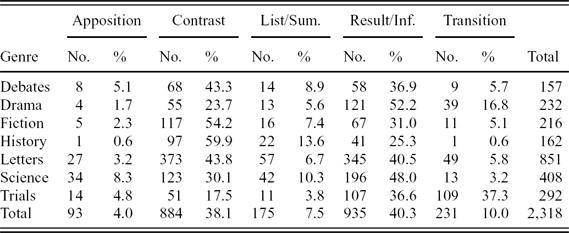
The distribution of semantic types according to genre is given in table 5. In CONCE as a whole, the distribution of conjuncts is dominated by two types, viz. Contrast and Result/Inference, which together account for almost four-fifths of the data. This is similar to the results shown by Biber et al. (Reference Biber, Johansson, Leech, Conrad and Finegan1999: 880) for Present-Day English (see also Morrow Reference Morrow1989: 245). However, table 5 also shows that there is considerable variation across genres with regard to the proportions of types. These cross-genre differences, which are statistically significant,Footnote 11 indicate that some of the genres have specific ties with individual semantic fields. We will therefore consider genre-specific distributions in detail below.
Conjuncts by genre and semantic type
The Debates genre is fairly close to the results for all text categories taken together. However, the relatively high percentage of List/Summary conjuncts is noteworthy, as Debates is the only speech-related genre with a proportion above the corpus mean. In Debates, such conjuncts help to structure each speaker's long turns of extended argumentation, as in (15).
(15) . . . Lastly, the system under which counties have been divided into one-membered districts, and London has been divided into twenty-seven different boroughs, has greatly increased the number of plural votes. In the first place, a man may have as many votes for different county districts as he has freehold qualifications in them. Secondly, he may have as many occupation votes as he has bona fide residences in different constituencies.
(Debates, 1870–1900, p. IV.1,184)
In (15), lastly marks the speaker's arrival at the last major point he wishes to make. However, that point is then further subdivided by in the first place and secondly. List/Summary conjuncts are important for listeners to be able to understand – and respond to – spoken arguments of such complexity.
Drama clearly favours Result/Inference and, to a lesser extent, Transition conjuncts, while Contrast is comparatively poorly represented. These tendencies are remarkably consistent across the Drama texts included in CONCE. The proportion of Result/Inference conjuncts is the highest for any genre in the corpus. The commonest conjuncts in that category are then (68 occurrences), as in (16), and so (41 instances; see also section 4.2.1).
(16) [$HANNAH.$]
Master, is what you've told me your only chance of getting off unknown?
[$THE DEAN.$]
It is the sole remaining chance of averting a calamity of almost national importance.
[$HANNAH.$]
Then you're as done as that joint in my oven!
(Drama, Pinero, 1870–1900, pp. 112–13)
Then often marks Result/Inference in contexts like that in (16): a character uses turn-initial then in the sense ‘in that case’ to express an inference based on another character's previous utterance. These instances of then have the double function of clarifying the relationship between turns to the characters within the play as well as to the audience.
Fiction displays almost the opposite pattern, with the second lowest proportion of Result/Inference conjuncts and the second highest percentage of Contrast conjuncts. This distribution tallies with Biber et al.'s (Reference Biber, Johansson, Leech, Conrad and Finegan1999: 880) results for Present-Day English, which show that Contrast conjuncts are more frequent than Result/Inference conjuncts in this genre. As in the corpus as a whole, however (44 occurrences) and yet (27 instances) account for the majority of Contrast conjuncts in Fiction. However, these results are chiefly due to the distribution of conjuncts in narrative passages. The proportions of the Contrast and Result/Inference types in fictional narration are quite close to those of History (60.3% and 28.4%, respectively), and it is likely that the chronological sequencing of events makes the overt expression of Result/Inference less necessary (see below). The proportions in fictional dialogue (47.0% and 34.0%) are closer to those found in Debates; in addition, as in Drama, the most frequent conjunct in fictional dialogue is then expressing Result/Inference. Dialogue in Fiction thus shows affinities with other speech-related genres in these respects. Although Contrast conjuncts outnumber Result/Inference conjuncts in all fiction texts in CONCE, Mary Shelley stands out in her preference for marking contrastive relationships in this way: 18 of the 22 conjuncts in her text (The Last Man) are of the Contrast type, and 10 of those 18 are instances of yet, as in (17).
(17) A variety of feelings urged Perdita to shed double magnificence over the scene; yet, as she arrayed herself for the evening gala, she wondered herself at the pains she took, to render sumptuous the celebration of an event which appeared to her the beginning of her sufferings.
(Fiction, Shelley, 1800–30, p. I.277–8)
In History, which, like Fiction, is characterized by chronologically structured text, more than half of all conjuncts express Contrast.Footnote 12 Concessive however (38 occurrences) and yet (33 instances) are the most frequent conjuncts in this field, but History writing is also characterized by a fairly large number of contrastive relationships being expressed by on the other hand, as in (18).
(18) The university of Oxford was tainted to the core with jacobite prejudices; but it must be added that it never stood so low in respectability as a place of education. The government, on the other hand, was studious to promote distinguished men; and doubtless the hierarchy in the first sixty years of the eighteenth century might very advantageously be compared, in point of conspicuous ability, with that of an equal period that ensued.
(History, Hallam, 1800–30, pp. III.334–5)
In History, on the other hand typically signals an antithetic relationship between two entities, which are compared in a more or less evaluative manner, as in (18). All History texts evince a preference for Contrast conjuncts over items belonging to other semantic fields. In contrast, the occurrence of Apposition and Transition conjuncts is negligible in History (1 occurrence each of for instance and meanwhile), and Result/Inference conjuncts account for a smaller proportion of the conjuncts than in any other genre in the corpus. To a certain extent, the dearth of Result/Inference and Transition conjuncts – and the resulting high proportion of Contrast conjuncts – can be explained with reference to the style of History texts: as chronological order frequently helps to structure the texts in terms of both cause and effect and transitions between subjects, there is less need for explicit markers such as conjuncts.
The Letters genre is similar to Debates in lying quite close to the corpus mean for the various types, and it is difficult to see genre-specific patterns of usage.Footnote 13 Although Contrast conjuncts are more frequent than Result/Inference conjuncts in the genre as a whole, there is some variation among the individual letter-writers regarding which semantic relationship is most often marked by conjuncts: William Blake, Sara Hutchinson, Robert Southey, Mary Wordsworth, May Butler and Christina Rossetti make greater use of Result/Inference conjuncts, while Contrast is favoured by the eleven remaining letter-writers. The most frequent Contrast conjunct by far is however (148 instances; see also section 4.2.1), as in (19).
(19) He intended spending Friday Sat: & part of Sunday, at Mr Cookson's as Mrs C had invited him so often he thought it was proper altho’ I believe he had rather have remained at his books – however he took one in his pocket which he would ply when he was there, as he said James was always in the Warehouse which was no amusement to him – He has not written yet – but perhaps my Letter may not be sent off before next Wednesday.
(Letters, Hutchinson, 1800–30, p. 186)
Science exhibits a high proportion of Result/Inference conjuncts. However, this tendency is to some extent dependent on one text from period 1, viz. David Ricardo's On the Principles of Political Economy, and Taxation, with 77 Result/Inference conjuncts, the most common of which are then and therefore. The preference for these two conjuncts is also visible in the results for the genre as a whole. Then (68 occurrences) is the most frequent Result/Inference conjunct in Science, as was the case in Drama, the other genre with a high proportion of Result/Inference conjuncts. In addition, Apposition conjuncts account for a bigger share of the conjuncts in Science than in any other genre in CONCE, and the percentage of List/Summary conjuncts is second only to that in History. The most frequent type of Apposition marked by conjuncts is exemplification, using for instance (11 instances), as in (10) above, or for example (9 instances). Among List/Summary conjuncts, the most frequent item is again (11 occurrences), as in (20). This conjunct is by and large limited to Science.
(20) An outsider would think that if any one of these elementary bodies were taken as a standard, the weight of an equal volume of vapour of another substance under equal conditions would bear some relationship of a definite character to the atomic weight. This however is not the case. Again, among the questions to be considered as determining the atomic weights taken, is an assumed limitation of combination power, a so-called atomicity, according to which one substance is a monad, because it will combine with that same relative proportion of hydrogen which exists in half a water-molecule.
(Science, Lockyer, 1870–1900, p. 268)
Again typically marks the writer's returning to an item of information that has been mentioned previously, and the conjunct serves both to indicate this relationship with the previous discourse and to reinforce the point. As Result/Inference, Apposition and List/Summary conjuncts can all be used to emphasize relationships such as inclusion, exemplification, and cause and effect between phenomena in the natural world, it is not surprising that they occur frequently in Science texts. The Transition category, in contrast, is very rare in Science as well as in History, the other written expository genre in CONCE; this sets written exposition clearly apart from dialogic genres such as Drama and Trials.
The Trials genre stands out from all other genres in its high proportion of Transition conjuncts; now, exemplified in (14) above, accounts for all 109 conjuncts marking Transition in Trials. On the other hand, the proportions of Contrast and List/Summary conjuncts are the lowest in CONCE. In all three cases, the genre closest to Trials in terms of type distribution is Drama; it thus seems that a comparatively high percentage of Transition markers and low proportions of Contrast and List/Summary conjuncts together characterize dialogic texts. As Biber et al. (Reference Biber, Johansson, Leech, Conrad and Finegan1999: 880) found that Transition conjuncts were rare in all four Present-Day English genres that they investigated, including Conversation, the distribution of conjuncts marking Transition in various types of speech-based and speech-related texts deserves further investigation. The preference for now is fairly widespread in Trials: four of the six texts contain more than ten instances of this Transition marker, which is the only conjunct except then signalling Result/Inference that reaches double digits in any Trials text.
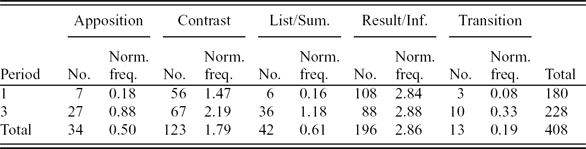
As Science stood out from the other genres in terms of frequency development over time, we also consider period-specific figures for this genre. The results are given in table 6. As the frequency of conjuncts in Science changes dramatically between periods 1 and 3, we present normalized frequencies rather than percentages in order to show developments within individual semantic types clearly.
Conjuncts by period and semantic type in Science: raw frequencies and frequencies per 1,000 words
Although the period differences in raw frequencies are statistically significant,Footnote 14table 6 shows that the increase in conjunct frequency in Science is not due to one or a few semantic types; rather, all types except Result/Inference display clear increases in frequency over time. However, as mentioned above, the high frequency of Result/Inference conjuncts in period 1 is mainly due to one single text; the apparent stability in the frequency of this type may thus be an effect of the sampling. Overall, the results for Science indicate that marking relationships between stretches of text became more important in general in academic writing during the nineteenth century, and our results are clear signs of large-scale genre development in this respect.
5 Summary and conclusions
Our study of conjuncts in nineteenth-century English has shown that significant changes took place over the course of the century. Our results support Lenker's (Reference Lenker2010) claim that Late Modern English is a crucial period in the development of the conjunctive system, and they add further insights into the details of this development. We point to increasing genre differentiation over the century. While Trials evidences relative stability, the frequency declines in Debates, Drama, Fiction and Letters, and increases in History and Science. Most striking among these changes is the development in Science: the frequency of conjuncts per 1,000 words, 7.45, is almost double that of the closest genre, Letters (3.73), by the end of the century, and the change is visible in nearly all semantic categories of conjuncts in Science. Our results thus suggest that the characteristic use of conjuncts in scientific and academic writing that has been attested in studies of twentieth-century English (Greenbaum Reference Greenbaum1969; Biber et al. Reference Biber, Johansson, Leech, Conrad and Finegan1999) began in the 1800s. This finding also underlines the importance of considering formal, learned genres when charting language change, as they can be in the forefront of the formation of new linguistic patterns, especially in terms of written language (Biber & Gray Reference Biber and Gray2011). At the same time, our study did not find evidence of frequent use of conjuncts in conversation, which has also been recorded in the twentieth century. This discrepancy may be due to differences in genre characteristics between genuine conversation and the speech-related genres in CONCE.
Behind these general trends are also more fine-grained patterns in semantic categories, in individual conjuncts and, to some extent, in stylistic preferences by individual authors. The different genres exhibit distinct profiles in terms of semantic categories of conjuncts. These profiles are clearly often tied in with the communicative purposes of the text categories. The relatively high percentages of Apposition, List/Summary and Result/Inference in Science are probably a reflection of the importance of argumentation, exemplification and drawing conclusions in this genre. On the other hand, the predominance of Transition conjuncts in Drama and Trials points to the importance of highlighting shifts of topic in these dialogic genres. In terms of individual conjuncts, CONCE revealed a split between a set of six highly frequent items (however, then, so, therefore, yet and now) and a larger group of less common conjuncts. While some conjuncts in the former category exhibit clear connections with a particular genre (e.g. now in Trials), the use of others was characteristic of groups of genres, such as so in informal, non-narrative genres, which again suggested that patterns evident in Present-Day English were also present in nineteenth-century English.
Many aspects of the usage of conjuncts in the nineteenth century remain to be explored, such as the variable sentential position of conjuncts and the relationship between conjunctive and non-conjunctive functions of multi-functional items such as then (see section 3.2.2; cf. Hasselgård Reference Hasselgård2010: 302–3). We will return to these issues in our future research. The results of the present study clearly indicate that conjuncts constitute an important area of Late Modern English syntax, which remains understudied despite a recent upsurge in scholarly interest.
Appendix 1
The list below includes all forms that were searched for using the Concordancer program in the WordSmith Tools software suite. The forms that actually occurred as conjuncts in the material are given in italics in the list. As regards the items here and indeed, 100 randomly selected instances of each form were examined, but when this search did not yield any conjunctive instances, they were not included in the full searches. Note that the forms are given with what is assumed to be the most frequent present-day spelling, which is intended to subsume spelling variants; for instance, anyway actually occurs in the corpus only with the spelling any way.
1), 1., i), i., I), I., 2., II., 3., III., 4., IV., 5., V., 6., VI., VII., VIII., IX., X., XI.
A.), A., a), a., above all, accordingly, admittedly, after all, again, alias, all in all, all the same, also, alternatively, altogether, anyhow, anyway, anyways, as a consequence, as a result, at all events, at any rate, at (the) last, at least, at the same time
besides, better, by comparison, by contrast, by the bye, by the same token, by the way, by way of comparison, by way of contrast
consequently, contrarily, contrariwise, conversely, correspondingly
e.g., else, equally
finally, first (of all), firstly, for a start, for all that, for another (thing), for example, for instance, for one (thing), fourthly, further, furthermore
hence, here, however
i.e., in addition, in all (events), in any case, in any event, in comparison, in conclusion, in consequence, in contrast, in fine, in other words, in particular, in spite of it all, in spite of that, in sum, in that case, in the first instance, in the first place, in the meantime, in the meanwhile, in the same way, in the second place, in the third place, incidentally, indeed, instead
last (of all), lastly, likeways, likewise
meantime, meanwhile, more (than this), more accurately, more precisely, moreover
namely, nevertheless, next, nonetheless, notwithstanding, now
of course, on the contrary, on the one hand, on the other hand, on the other side, on top of it all, one, only, oppositely, otherways, otherwise, over and above, overall
parenthetically, plus
rather, right
second, second of all, secondly, similarly, so, somehow, specifically, still, still and all
that is (to say), that said, then, therefore, third, thirdly, though, thus, to begin with, to cap it (all), to conclude, to start with, to sum up, to summarize, to top it (all), too
viz.
what is more, what is more important, whence, wherefore, which is to say, why then, worse, worse than all this
yet