INTRODUCTION
The Spionidae is one of the largest taxonomic groups of polychaetes (Rouse & Pleijel, Reference Rouse and Pleijel2001). The genus Streblospio includes small tube-dwelling worms (<2 cm) that are distributed in the West (Pearse et al., Reference Pearse, Pearse, Buchsbaum and Buchsbaum1987) and East Atlantic Ocean and the Mediterranean Sea (Sarda & Martin, Reference Sarda and Martin1993). They are suspension and surface deposit feeders that live in the upper layer (2–3 cm) of muddy sediments (Dauer, Reference Dauer1984). Their life spans are shorter than one year (Sarda & Martin, Reference Sarda and Martin1993). The reproductive cycle in temperate waters is short while in tropical regions it extends throughout the year (Lardicii et al., Reference Lardicii, Ceccherelli and Rossi1997).
Streblospio gynobranchiata has recently been described from Florida and the Gulf of Mexico (Rice & Levin, Reference Rice and Levin1998) and it has been reported as an invader in Izmir Bay (Mediterranean Sea) in 2003 where it was concluded that its arrival was through ballast water (Cinar et al., Reference Cinar, Ergen, Dagli and Petersen2005).
In autumn 2004, we found S. gynobranchiata on the Noor coast (Iran) of the southern Caspian Sea for the first time; there had been no earlier reports on its existence in this sea (Birshten et al., Reference Birshten, Vinogradova, Kondakov, Koon, Astakhova and Romanova1968; Kasimov, Reference Kasymov1989, Reference Kasimov1994; Grigrovich et al., Reference Grigrovich, Therriault and MacIsaac2003). Some specimens of this worm have been deposited in the Zoological Museum Universitetsparken (Copenhagen) with identification code ZMUCPOL-1807. It was probably transported with ballast water from the Mediterranean Sea into the Volga–Don canal and, finally, into the southern reaches of the Caspian Sea. The present study aims at providing preliminary descriptions of population changes and the reproduction cycle of this species at the Noor coast (south Caspian Sea).
MATERIALS AND METHODS
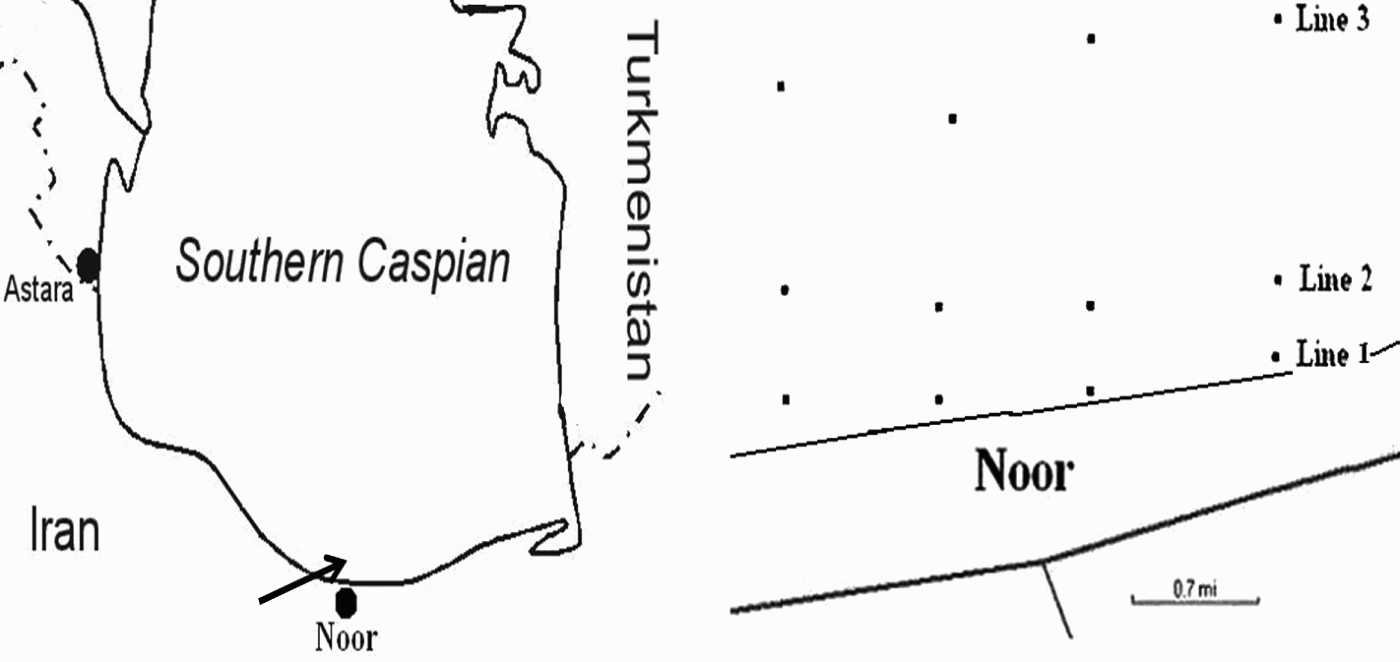
Noor is located in the southern reaches of the Caspian Sea along the Mazandaran Province, Iran. The gradient and structure of the seabed in the area are uniform. Tidal currents are almost lacking and the surface salinity to 30 metres depth varies negligibly (Hadjizadeh Zaker & Ghaffari, Reference Hadjizadeh Zaker and Ghafari2005). No major rivers or embayment exist in the vicinity of the sampling sites. Sampling was conducted off Noor in an area defined by coordinates (51°59′35″ & 52°02′31″E and 36°35′25″ & 36°36′29″ N) (Figure 1).
Map of the Noor coast in Mazandaran Province (left) and locations of sampling stations (right).

For the population study, samplings were carried out seasonally along three different depths (5, 15 and 30 m) in four transects (12 stations in total) during 2005. Samples from each station were taken in three replicates using a 250 cm2 Van Veen grab (Mistri et al., Reference Mistri, Fano, Ghion and Rossi2002). The contents of grab were gently sieved in the field using a 500-μm mesh and the retained material was placed in separate jars containing 4% formaldehyde-seawater solution and stained with rose Bengal (Abrantes et al., Reference Abrantes, Pinto and Moreira1999). Samples were stored in the laboratory and were identified and counted. Wet-weight of specimens was determined by a 0.0001 g sensitive balance (Cinar et al., Reference Cinar, Ergen, Dagli and Petersen2005).
The reproduction study was based on the observation of animals collected during the monthly samplings carried out at 15 m depth (February to December 2004). In each month the percentage of mature females was counted using three replicates (Kevrekidis, Reference Kevrekidis2005). The surface water temperature was also recorded.
Separate sediment samples were also taken from each station with a 250 cm2 Van Veen grab in three replicates for estimation of total organic matter (TOM) and sediment grain size. Sediment from the surface layer (≈4 cm) was sub-sampled and stored in clean plastic containers (Macleod et al., Reference Macleod, Crawford and Moltschaniwskyj2004). Sediment TOM was determined by loss of weight on ignition (4 h at 550 °C) after drying (48 h at 70 °C) to constant weight a homogenized portion of about 100 g (Aberantes et al., 1999). To determine sediment particle size, approximately 150 g of each grab sample was submitted to standard dry-sieve through a series of mesh sizes (from 63 μm to 2 mm) and mechanically shaken for 10 min. The sediments retained on each sieve were weighed and the percentage of each grain size category was determined (Diaz-Castaneda & Harris, Reference Diaz-Castaneda and Harris2004). The percentage of sand was used to express sediment texture.
Differences over time in density and biomass data were analysed using Mann–Whitney U-test and Kruskall–Wallis one way analysis of variance. The relationship between the density and biomass with TOM and sand percentage was estimated using a Spearman's rank correlation coefficient (P < 0.01). The density and biomass data from the four stations at each depth (three replicates, totalling 12 sediment samples from each depth) was considered as a line and the lines from different seasons were compared (Figure 1).
RESULTS
Sediments
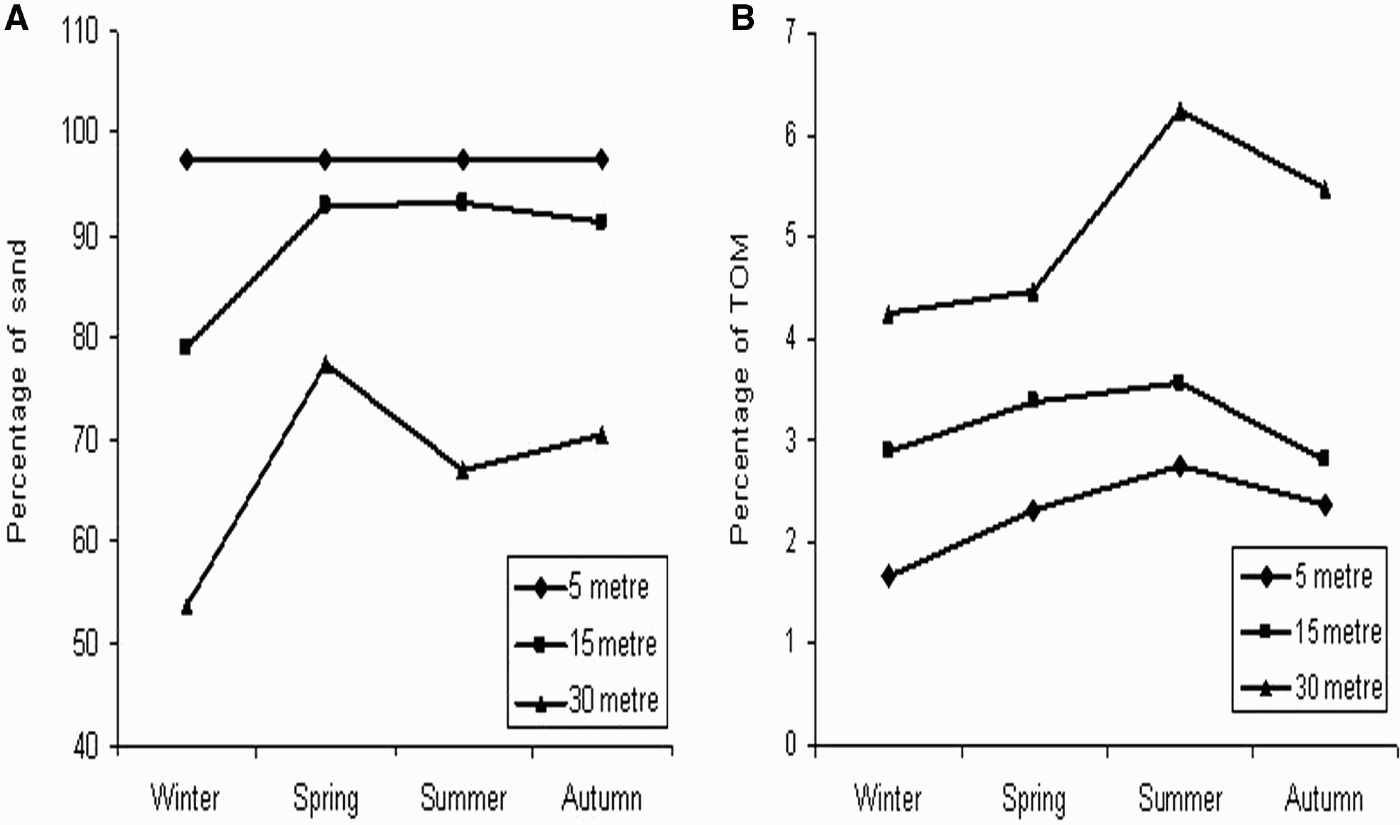
The per cent of TOM and sand showed significant differences among different depths and seasons; the per cent of TOM and sand varied with depth, the fomer increased while the latter decreased in deeper waters (Figure 2).
Seasonal changes in total organic matter (TOM) and percentage of sand during sampling period.

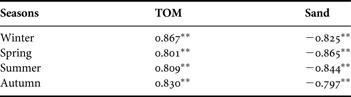
There were significant correlations between the density of Streblospio gynobranchiata with per cent of TOM and sand (Table 1), so that positive and negative correlations were found between density and TOM and sand per cent, respectively.
Spearman's rank correlation coefficient between density of Streblospio gynobranchiata with total organic matter and percentage of sand.

**, P < 0.01
Population density and biomass
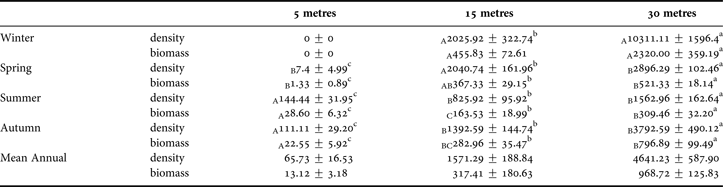
Population density and biomass showed significant differences among depths and seasons. In all seasons, density and biomass increased with increasing depths so that 30 m depth showed maximum density and biomass. The annual mean (±SE) density and biomass of S. gynobranchiata in different depths are shown in Table 2. Also in seasonal study, maximum and minimum density and biomass was observed in winter and summer, respectively.
Density and biomass (mean ± SE) of Streblospio gynobranchiata during the sampling period.

Upper case letter (subscripted): seasonal variation; lower case letter (superscripted): depth variation
Reproductive biology
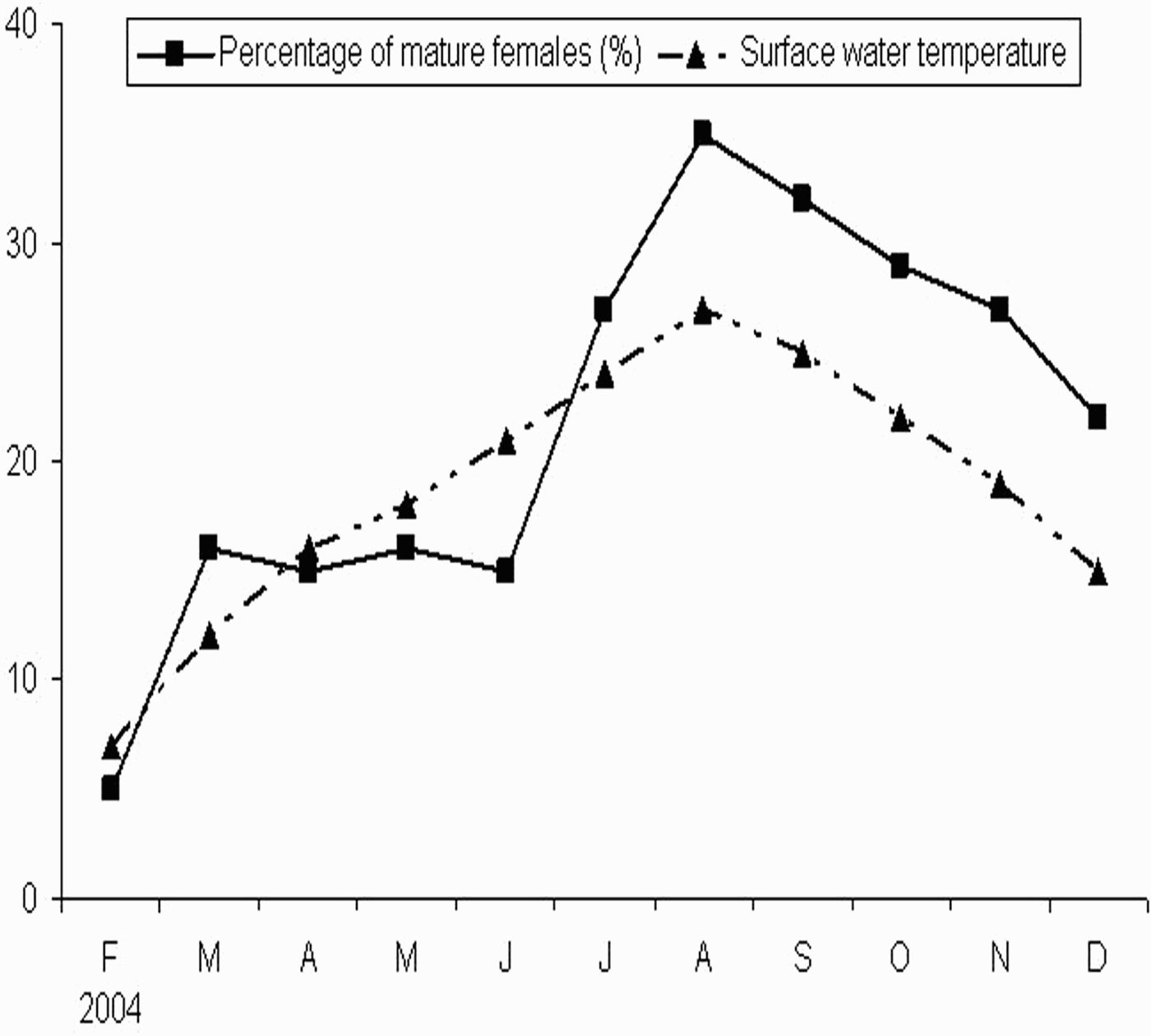
The monthly percentage variation of S. gynobranchiata mature females out of the total individuals is shown in Figure 3. Females showed reproductive activity from February to December 2004. Reproductive activity sharply increased in June and peaked in August while from August to December it decreased. It is necessary to mention that the eggs were in the coelom cavity from February to April and in the other months we observed mature females with strap-like brooding structures.
Monthly variation in the percentage of mature females and surface water temperature.

DISCUSSION
The polychaete Streblospio gynobranchiata was originally described from the Gulf of Mexico and the Florida coast (Rice & Levin, Reference Rice and Levin1998); it was later regarded as an invader in Izmir Bay, Mediterranean Sea (Cinar et al., Reference Cinar, Ergen, Dagli and Petersen2005). This species had not been reported from the Caspian Sea before 2004. We suggest that it was transported in ballast water from the Mediterranean Sea into the Volga–Don canal and, finally, into the Caspian Sea.
In this study, we observed that density and biomass of S. gynobranchiata increased with increasing depths at all seasons. Mean annual density and biomass at 5 m depth were 65.73 ± 16.53 ind m−2 and 13.12 ± 3.18 mg m−2, respectively. At 15 and 30 m depths, densities were 1571.29 ± 188.84 ind m−2 and 4641.23 ± 587.90 ind m−2 whereas biomasses were 317.41 ± 180.63 mg m−2 and 968.72 ± 125.83 mg m−2, respectively. The maximum density and biomass (WW) of S. gynobranchiata in Izmir Bay were 34,270 ind m−2 and 9.4 mg m−2, respectively, (Cinar et al., Reference Cinar, Ergen, Dagli and Petersen2005) which were higher than the respective data recorded in the present study from the Caspian Sea. The maximum densities of S. benedictii and S. shrubsolii were reported to be 24,086 and 65,668 ind m−2, respectively whereas their maximum biomasses (DW) were 2.1 and 5.9, respectively (Sarda & Martin, Reference Sarda and Martin1993). In another study, the maximum density and biomass (DW) of S. benedictii were 11,889 ind m−2 and 1.38 mg m−2, respectively (Garcia-Arberas & Rallo, Reference Garcia-Arberas and Rallo2004). Comparing the data recorded in the present study with those of the above-mentioned studies, it seems that the maximum density and biomass recorded in the present study is not only lower than the respective data for the same species from Izmir Bay but also lower than other species of Streblospio.
With increasing depth, the percentage of TOM increased while percentage of sand decreased (Figure 2). In addition, the density of S. gynobranchiata appeared to be positively correlated with the percentage of TOM whereas negatively correlated with the sand percentage (Table 1). For the same reason, probably, the minimum density and biomass of the worm among the sampled depths was observed in 5 m depth where the lowest level of TOM was recorded (Table 2). Being a deposit feeder, S. gynobranchiata has a higher density in soft bottoms (Cinar et al., Reference Cinar, Ergen, Dagli and Petersen2005). Higher densities of S. shrubsolii and S. benedictii with increase in TOM have also been reported (Rossi & Lardicii, Reference Rossi and Lardiccii2002; Garcia-Arberas & Rallo, Reference Garcia-Arberas and Rallo2004).
Although no significant seasonal variation between density and biomass of S. gynobranchiata was observed at 5 m depth, maximum and minimum density and biomass were observed in summer and spring, respectively (Table 2). At 15 m depth the highest density and biomass of the worm was observed in spring and winter while the lowest was recorded in summer; at 30 m depth maximum density and biomass was observed in winter while no significant variation in other seasons was evident (Table 2). Reproduction activity and predator pressure are two main factors affecting the seasonal variation in population dynamics (Mistri et al., Reference Mistri, Fano, Ghion and Rossi2002; Kevrekidis, Reference Kevrekidis2005). Reproduction activity of S. gynobranchiata in our study peaked in mid-summer to autumn. Higher density and biomass of S. gynobranchiata at 15 and 30 m depths in winter could, therefore, be related to the high number of gravid females in autumn (Figure 2) on the one hand and to reduced predation on the other. The lowest density and biomass of the worm in all the sampled depths was recorded in summer, which is in line with the results of Sarda & Martin (Reference Sarda and Martin1993) and Mistri et al. (Reference Mistri, Fano, Ghion and Rossi2002). This could be related to: (i) the higher predation rate, as the reproductive season for many benthivore fish species in the Caspian Sea starts from late winter to late spring (Abdoli, Reference Abdoli1999); and (ii) higher metabolic rate, due to increase in temperature, associated with higher feeding intensity of predators.
Although mature S. gynobranchiata females were observed throughout the year, the maximum and minimum reproductive activities were observed in summer and winter, respectively (Figure 2). The extended reproductive period for the same species in Izmir Bay (Cinar et al., Reference Cinar, Ergen, Dagli and Petersen2005), and other species of Streblospio (Sarda & Martin, Reference Sarda and Martin1993; Lardicci et al., 1997; Kevrekidis, Reference Kevrekidis2005) has also been reported, however with differing reproductive peaks. The reasons for that could be the difference between the salinity (13 ppt) and the temperature of the Caspian Sea compared to the other mentioned areas.
Temperature has a great influence on the reproduction activity of Streblospio species. The reproduction activity of S. gynobranchiata in this study was observed within the range of 7–27°C but peaked at 19–27°C (Figure 3). The highest level of reproduction activity in S. benedicti under laboratory conditions was observed at 16–21°C (Levin & Creed, Reference Levin and Creed1986). Kevrekidis (Reference Kevrekidis2005) suggested that temperatures less than 6°C deterred the reproductive activity and above 26.5°C negatively affected reproduction. Also, another study showed that reproductive activity of Streblospio ended when the temperature fell below 10°C (Sarda & Martin, Reference Sarda and Martin1993).
ACKNOWLEDGEMENTS
This work was financially supported by the Tarbiat Modares University. The authors are thankful to Dr D. Eibye-Jacobsen for identification of the species and to S. Bour and M. Kamali for their assistance.