Introduction
Hypocalcaemia is the most frequent complication seen after thyroid surgery.Reference Bhattacharyya and Fried1,2 The risk is related to parathyroid gland injury and is highest when there is intervention to both thyroid lobes. Patients therefore require routine monitoring after total or completion thyroidectomy and may require treatment with oral or intravenous calcium, which can prolong the in-patient stay. Furthermore, a proportion of those with initial post-operative hypocalcaemia will develop permanent hypocalcaemia, which requires lifelong monitoring and supplementation. Therefore, many researchers have sought to identify the predictors of post-thyroidectomy hypocalcaemia in order to prevent this complication and mitigate its effects.
The literature available on this topic has been the source of a previous comprehensive and high-quality systematic review by Edafe et al.Reference Edafe, Antakia, Laskar, Uttley and Balasubramanian3 However, a considerable amount of research has been produced in the years since, and the importance of early identification and prevention of post-thyroidectomy hypocalcaemia has increased with the growth of thyroid cancer and surgery rates worldwide.Reference Pellegriti, Frasca, Regalbuto, Squatrito and Vigneri4,Reference James, Mitchell, Jeon, Vasilottos, Grogan and Aschebrook-Kilfoy5 Furthermore, the group of patients receiving total thyroidectomy for thyroid cancer has changed since the publication of the British Thyroid Association Guidelines for the Management of Thyroid Cancer in 2014.Reference Perros, Boelaert, Colley, Evans, Evans and Gerrard Ba6 These guidelines advocated total thyroidectomy for patients with larger tumours (more than 4 cm) or with additional risk factors such as multifocal disease, bilateral disease, extra-thyroidal spread or lymph node involvement. This group is likely to require more extensive and complex thyroid surgery and will therefore potentially experience a greater risk to the function of the parathyroid glands and an increased risk of post-operative hypocalcaemia.
The purpose of this review is not to challenge the previous findings published by Edafe et al..,Reference Edafe, Antakia, Laskar, Uttley and Balasubramanian3 but to create a narrative synthesis of the updated evidence to augment the existing knowledge of the predictive factors of hypocalcaemia post-thyroidectomy. Furthermore, we intend to add new information regarding the specific issue of symptomatic hypocalcaemia, which was not covered separately in the previous review.
Materials and methods
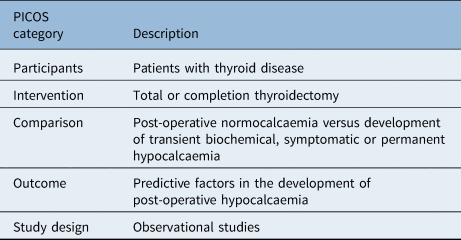
A comprehensive literature search was conducted using the databases Medline, Embase (Ovid), Cinahl (‘Cumulated Index to Nursing and Allied Health Care’; Ebsco collections) and the Cochrane Library, with results limited to papers published from January 2012 to August 2019. This was done in order to update the evidence presented previously in the systematic review by Edafe et al.,Reference Edafe, Antakia, Laskar, Uttley and Balasubramanian3 where the literature was reviewed up to 30 July 2012, in order to address our research question with reference to the participant, intervention, comparison, outcome, study design (‘PICOS’) system (Table 1).
PICOS research question

PICOS = participant, intervention, comparison, outcome, study design
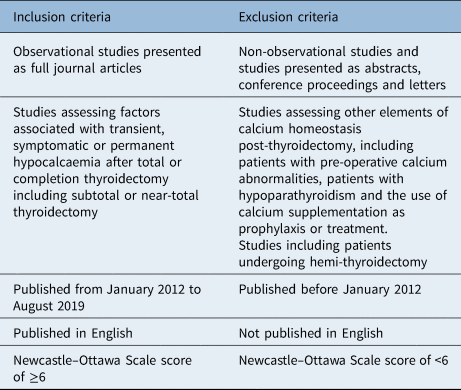
The search terms used were ‘low calcium’ OR ‘hypocalcaemia’ AND ‘thyroidectomy’. The final search was carried out on 31 August 2019. Inclusion and exclusion criteria were set to identify observational studies looking at predictive factors for the development of transient, symptomatic or permanent hypocalcaemia after total (including subtotal and near-total) or completion thyroidectomy. Full inclusion and exclusion criteria are shown in Table 2.
Inclusion and exclusion criteria

All titles and abstracts for the studies identified by the initial literature search were scrutinised for their relevance by two authors (AELM and RB). The full texts of all available relevant studies were reviewed independently by at least two authors (AELM, RB and VK). Data were independently extracted from papers that met the inclusion criteria using a piloted proforma. Any differences of opinion between authors regarding study eligibility or data extraction were discussed, and if dispute remained this was resolved by the primary author. Extracted data included study type, sample size, patient characteristics, definition(s) of hypocalcaemia (including transient biochemical hypocalcaemia, symptomatic hypocalcaemia and permanent hypocalcaemia) and evidence regarding predictive factors for post-thyroidectomy hypocalcaemia. Specifically, a record was made of every association between a predictive factor and any type of hypocalcaemia and the corresponding p-value, in order to identify which predictive factors had been studied and where the evidence was statistically significant. This information was then combined to produce a narrative review of the effects of different predictors across the recent literature.
The papers were assessed for methodological quality during data collection. They were rated according to a modified version of the Newcastle–Ottawa Scale score,7 which is a validated assessment tool for quality features in non-randomised studies. This version was modified to assess these papers specifically, including the requirement for a specific definition for separate types of hypocalcaemia and information on the incidence of permanent hypocalcaemia, as was previously used in the systematic review by Edafe et al. Reference Edafe, Antakia, Laskar, Uttley and Balasubramanian3 Studies of poor methodological quality, signified by a modified Newcastle–Ottawa Scale score of less than six starsReference Tan, Lewis, Adams and Martin8 out of a total of nine were excluded from the analysis.
This systematic review was registered with International Prospective Register of Systematic Reviews (‘PROSPERO’; registration number: CRD42018099510) and reported in accordance with the Preferred Reporting Items for Systematic Reviews and Meta-Analyses (‘PRISMA’) guidelines.Reference Liberati, Altman, Tetzlaff, Mulrow, Gøtzsche and Ioannidis9
Results
Literature search
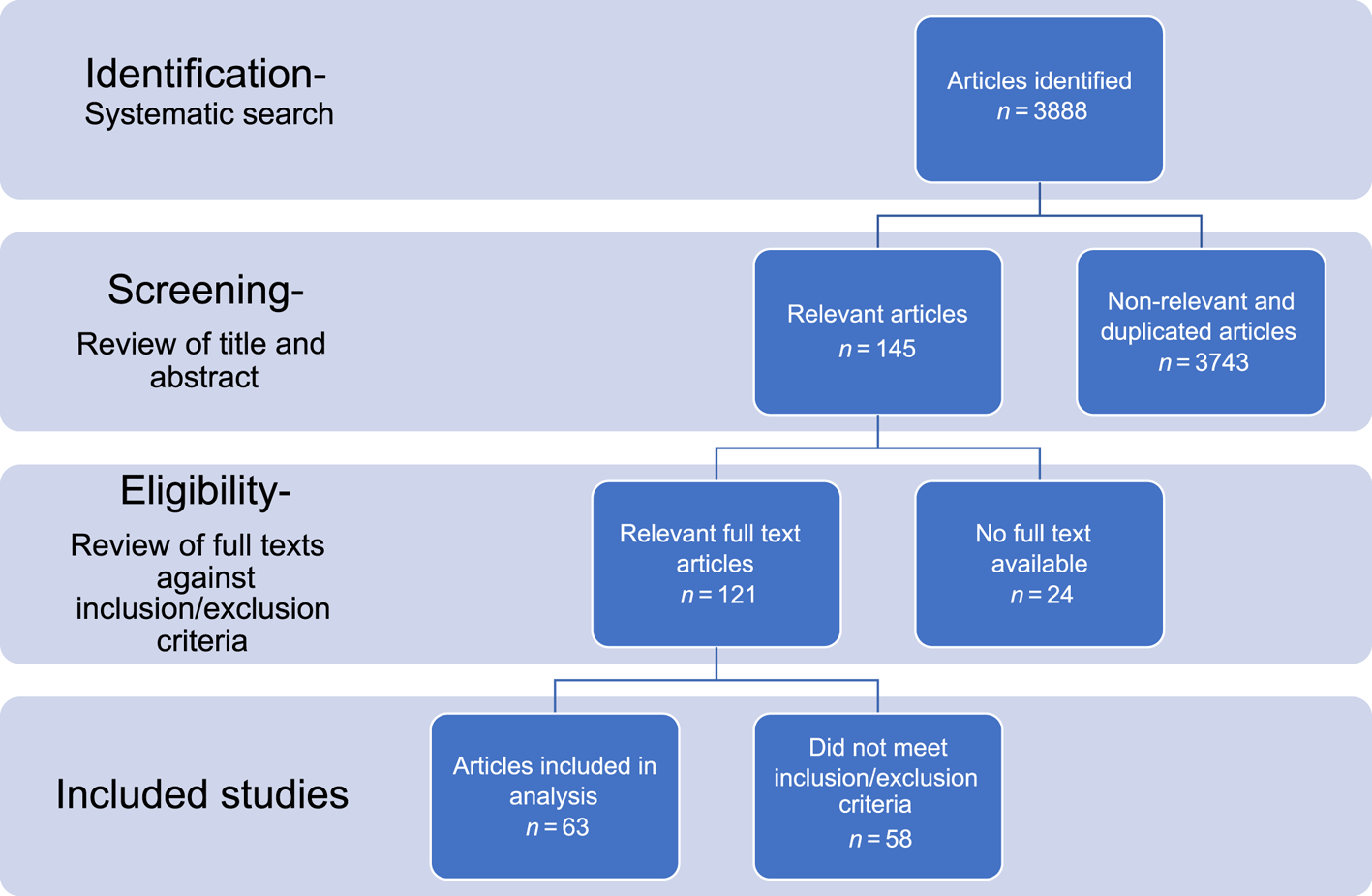
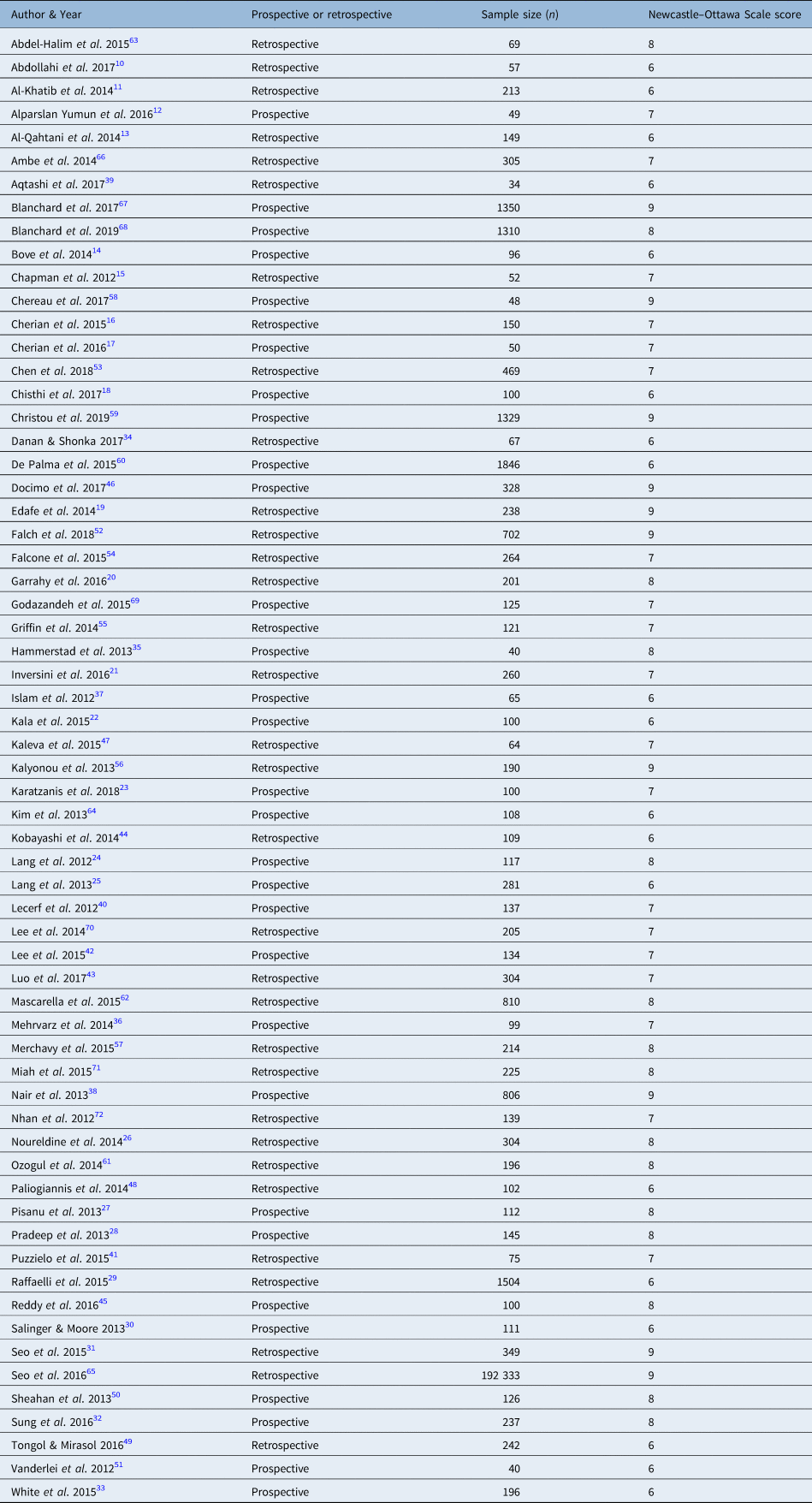
An initial keyword search of the listed databases yielded 3888 articles in total. Duplicates were removed, and titles and abstracts were assessed for relevance, excluding 3743 articles. Of the remaining 145 relevant articles, 121 were available as full texts. The 24 literature search results excluded at this time included published abstracts, editorials or letters, rather than full article texts. As shown in the Preferred Reporting Items for Systematic Reviews and Meta-Analyses flow diagram (Figure 1), 63 of the full-text studies met inclusion and exclusion criteria and were analysed in full. A full list of included studies and their characteristics is found in Table 3.
Preferred Reporting Items for Systematic Reviews and Meta-Analyses (‘PRISMA’) flow chart showing the literature search strategy for this study.

Characteristics of included studies

The reasons for exclusion of the other 58 articles were: 18 included hemi-thyroidectomy, 12 studied post-thyroidectomy hypocalcaemia but made no assessment of predictive factors, 10 assessed management options for post-thyroidectomy hypocalcaemia, 7 were of poor methodological quality with a modified Newcastle–Ottawa Scale score of less than 6 stars, 6 looked at pre-operative calcium supplementation regimes and 5 were not in English.
Included study characteristics
The 63 included observational studies comprised 30 prospective and 33 retrospective studies with a total of 210 401 subjects. The sample size ranged from 34 patients to 192 333 patients. Study participants were predominantly female (173 690 female participants: 82.6 per cent). The mean age of study participants was 49.2 years, although the overall range in participants’ ages was broad (range, 10–90 years). The majority of patients underwent total thyroidectomy (99.4%) with neck dissection in 67.3 per cent. Thyroid malignancy was the indication for surgery in 94.2 per cent of cases.
Quality features of included studies
There was a variety of methodological quality seen in this review, with a mean Newcastle–Ottawa Scale score of 7.3 stars (out of a total of 9 stars) across all 63 studies. Many studies received lower scores because they did not include assessment of the incidence of permanent hypocalcaemia post-thyroidectomy or because there was no attempt to control for confounding factors such as the extent of thyroidectomy or concomitant neck dissection.
Definition and incidence of hypocalcaemia
Three separate types of post-thyroidectomy hypocalcaemia were described across the studies: these were transient biochemical hypocalcaemia, symptomatic hypocalcaemia and permanent hypocalcaemia. There was considerable variation in the definitions given for these subtypes of hypocalcaemia, particularly with the laboratory values considered to represent biochemical hypocalcaemia and the timing applied to the definition of permanent hypocalcaemia. The diagnosis of symptomatic hypocalcaemia was either based on the presence of symptoms alone or diagnosed in patients who had both symptoms and biochemical evidence of hypocalcaemia.
In the UK, the British Association of Endocrine and Thyroid Surgeons define post-thyroidectomy biochemical hypocalcaemia as a corrected calcium level of less than 2.10 mmol/l or ionised calcium of 1.2 mmol/l on day 1 post-operatively2 to give a standard for comparison to use in their national audit report. In comparison, the studies included in this review defined biochemical hypocalcaemia variably as: serum total calcium of less than 7.5–8.5 mg/dl or less than 1.0–2.15 mmol/l; corrected calcium of less than 8.0–8.6 mg/dl or less than 1.90–2.10 mmol/l; or ionised calcium levels of less than 4.4 mg/dl or less than 1.0–1.18 mmol/l. In order to diagnose biochemical hypocalcaemia these measurements could be taken at a range of points from immediately post-operatively to 2 days post-operatively. However, the most frequently used definition was a corrected calcium level of less than 2.0 mmol/l or less than 8.0 mg/dl on day 1 post-operatively, which differs from the above definition given by the British Association of Endocrine and Thyroid Surgeons.
Generally, in this study we have accepted the definitions of hypocalcaemia given in each paper as valid in those populations, rather than trying to apply the British Association of Endocrine and Thyroid Surgeons definition retrospectively. Although we do recognise that these variations in hypocalcaemia definitions will have an effect on the reported incidence of post-thyroidectomy hypocalcaemia and therefore also the validity of any assessment of predictive factors, the standards given are roughly similar across the 57 studies. If anything, these standards represent stricter criteria for serum total, corrected or ionised calcium than those described in the definition from the British Association of Endocrine and Thyroid Surgeons.
There is a similar issue with the given definitions for permanent hypocalcaemia. Although some studies relate permanent hypocalcaemia to the need for ongoing calcium with or without vitamin D supplementation at six months as described by British Association of Endocrine and Thyroid Surgeons,2 others have set three months or one year as the time limit. We acknowledge that this too will affect the reliability of the results, but in general the definitions used do all give an impression of longer term post-operative hypocalcaemia, and we have therefore compared these across the board according to the local standards set.
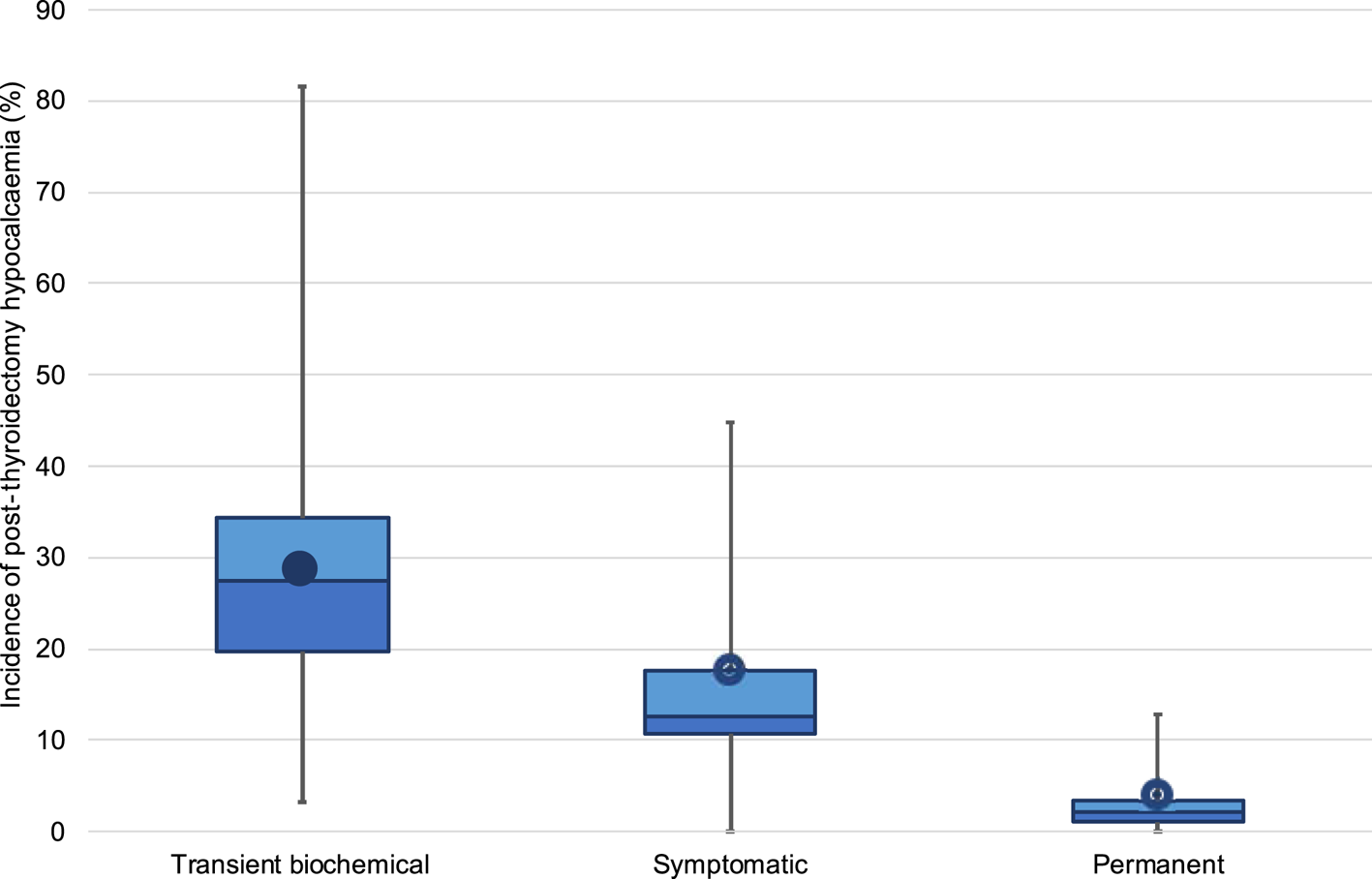
A wide range was also seen in the incidence of each subtype of hypocalcaemia described across the studies. Transient biochemical hypocalcaemia was found in a median of 27.5 per cent of 16 410 patients across 52 studies, but there is a range of incidence from 3.2 to 82.6 per cent. Symptomatic hypocalcaemia is found in a median of 12.5 per cent of 4706 patients across 26 studies, with a range of incidence from 0 to 50 per cent. Permanent hypocalcaemia was seen in a median of 2.2 per cent of 199 165 patients over 27 studies, with a range of 0 to 14.5 per cent (Figure 2).
A box and whisker chart showing incidence of hypocalcaemia post-thyroidectomy. This demonstrates the values for minimum and maximum (whiskers), interquartile ranges (boxes), median (line dividing boxes) and mean (circular data marker) regarding the incidence of post-thyroidectomy hypocalcaemia for each subtype of hypocalcaemia, across the included studies.

Predictors of post-thyroidectomy hypocalcaemia
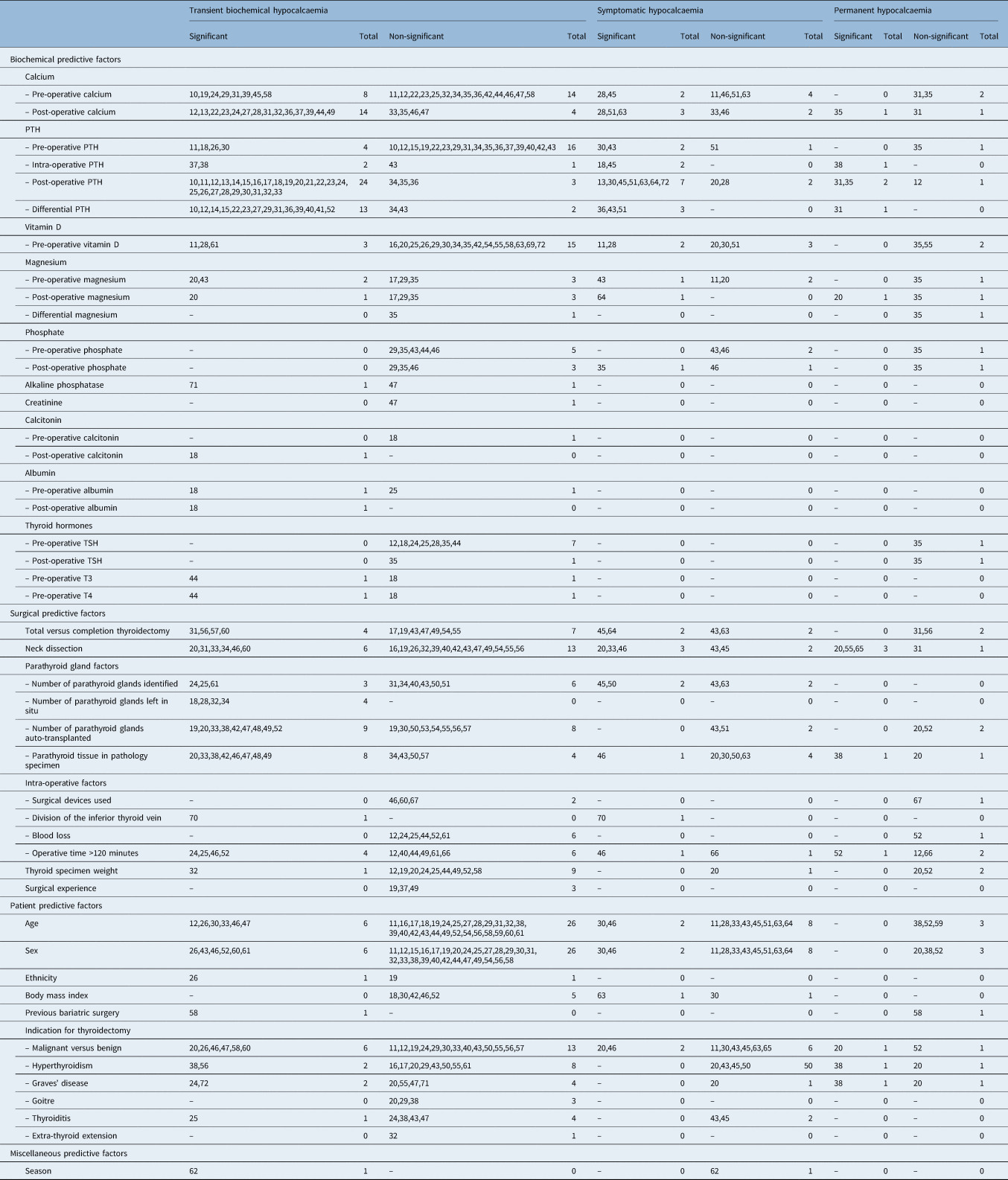
In total, the 63 studies included in the analysis assessed the association between transient biochemical, symptomatic and permanent post-thyroidectomy hypocalcaemia and 45 separate predictors. These predictors may be grouped as follows: biochemical factors (e.g. post-operative parathyroid hormone (PTH) level); surgical factors (e.g. total thyroidectomy versus completion thyroidectomy); patient factors (e.g. sex); and miscellaneous factors (e.g. season). Overall, 30 of these predictors showed a statistically significant association with post-thyroidectomy and hypocalcaemia in at least one study. Table 4 lists the studies where the association between a predictive factor and hypocalcaemia was studied, based on type of predictive factor.
Predictive factors in the development of post-thyroidectomy hypocalcaemia

This table lists the reference number of each paper where the association between the named predictive factor and hypocalcaemia is studied, according to whether the result was statistically significant or not statistically significant. For ease of understanding, the total number of either significant or non-significant associations among the included studies is listed for each predictive factor. PTH = parathyroid hormone; TSH = thyroid stimulating hormone
Predictors of transient biochemical hypocalcaemia
Transient biochemical hypocalcaemia was the most frequently studied outcome in the included studies. The most frequently reported predictive factors were biochemical, with most specifically relating to PTH levels. Low post-operative PTH was found to have a statistically significant association with transient biochemical hypocalcaemia in 24 studies,Reference Abdollahi, Nakhjavani, Alibakhshi and Mohammadifard10–Reference White, James, Nocon, Nagar, Kaplan and Angelos33 compared with 3 studies where there was not a statistically significant resultReference Danan and Shonka34–Reference Mehrvarz, Mohebbi, Kalantar Motamedi, Khatami, Rezaie and Rasouli36. Low intra-operative PTH levels and a larger differential PTH from the pre-operative to post-operative stage were also seen to have statistically significant associations in 2 studiesReference Islam, Sultana, Paul, Huq, Chowdhury and Ferdous37,Reference Nair, Babu, Menon and Jacob38 and 13 studiesReference Abdollahi, Nakhjavani, Alibakhshi and Mohammadifard10,Reference Alparslan Yumun, Erol and Guler12,Reference Bove, Di Renzo, Palone, D'Addetta, Percario and Panaccio14,Reference Chapman, French, Leng, Browne, Waltonen and Sullivan15,Reference Kala, Sarici, Ulutas, Sevim, Dogu and Sarigoz22,Reference Karatzanis, Ierodiakonou, Fountakis, Velegrakis, Doulaptsi and Prokopakis23,Reference Pisanu, Saba, Coghe and Uccheddu27,Reference Raffaelli, De Crea, D'Amato, Moscato, Bellantone and Carrozza29,Reference Seo, Chang, Jin, Lim, Rha and Koo31,Reference Mehrvarz, Mohebbi, Kalantar Motamedi, Khatami, Rezaie and Rasouli36,Reference Aqtashi, Ahmad, Frotzler, Bähler, Linder and Müller39–Reference Puzziello, Gervasi, Orlando, Innaro, Vitale and Sacco41 , respectively. Pre-operative PTH showed a non-significant association with transient biochemical hypocalcaemia in the majority of studies.Reference Abdollahi, Nakhjavani, Alibakhshi and Mohammadifard10,Reference Alparslan Yumun, Erol and Guler12,Reference Chapman, French, Leng, Browne, Waltonen and Sullivan15,Reference Edafe, Prasad, Harrison and Balasubramanian19,Reference Kala, Sarici, Ulutas, Sevim, Dogu and Sarigoz22,Reference Karatzanis, Ierodiakonou, Fountakis, Velegrakis, Doulaptsi and Prokopakis23,Reference Raffaelli, De Crea, D'Amato, Moscato, Bellantone and Carrozza29,Reference Seo, Chang, Jin, Lim, Rha and Koo31,Reference Danan and Shonka34–Reference Islam, Sultana, Paul, Huq, Chowdhury and Ferdous37,Reference Aqtashi, Ahmad, Frotzler, Bähler, Linder and Müller39,Reference Lecerf, Orry, Perrodeau, Lhommet, Charretier and Mor40,Reference Lee, Ku, Kim, Lee and Kim42,Reference Luo, Yang, Zhao, Wei, Su and Wang43
Low post-operative calcium was the only other commonly assessed biochemical factor that showed a statistically significant positive association with transient biochemical hypocalcaemia in the majority of studies.Reference Alparslan Yumun, Erol and Guler12,Reference Al-Qahtani, Parsyan, Payne and Tabah13,Reference Kala, Sarici, Ulutas, Sevim, Dogu and Sarigoz22–Reference Lang, Yih and Ng24,Reference Pisanu, Saba, Coghe and Uccheddu27,Reference Pradeep, Ramalingam and Jayashree28,Reference Seo, Chang, Jin, Lim, Rha and Koo31,Reference Sung, Lee, Yoon, Chung and Hong32,Reference Mehrvarz, Mohebbi, Kalantar Motamedi, Khatami, Rezaie and Rasouli36,Reference Islam, Sultana, Paul, Huq, Chowdhury and Ferdous37,Reference Aqtashi, Ahmad, Frotzler, Bähler, Linder and Müller39,Reference Kobayashi, Minami, Yamanouchi, Hayashida, Sakimura and Eguchi44,Reference Reddy, Chand, Sabaretnam, Mishra, Agarwal and Agarwal45 Positive associations were shown with post-operative calcitonin and post-operative albumin but in only one study.Reference Chisthi, Nair, Kuttanchettiyar and Yadev18 Pre-operative vitamin D, magnesium, phosphate, creatinine, calcitonin and thyroid-stimulating hormone levels showed non-significant associations in the majority of studies where investigated. Alkaline phosphatase, albumin and T3 and T4 levels showed equivocal results from a limited number of studies.
Two surgical factors related to the parathyroid glands showed repeated significant associations with transient biochemical hypocalcaemia. These included an increasing number of parathyroid glands left in situ at the time of surgery (significant results in four of four studiesReference Chisthi, Nair, Kuttanchettiyar and Yadev18,Reference Pradeep, Ramalingam and Jayashree28,Reference Sung, Lee, Yoon, Chung and Hong32,Reference Danan and Shonka34 ), and evidence of parathyroid glands in the pathology specimen (8 significant results from 12 studies)Reference Garrahy, Murphy and Sheahan20,Reference White, James, Nocon, Nagar, Kaplan and Angelos33,Reference Nair, Babu, Menon and Jacob38,Reference Lee, Ku, Kim, Lee and Kim42,Reference Docimo, Ruggiero, Casalino, Del Genio, Docimo and Tolone46–Reference Tongol and Mirasol49 . However, other surgical factors related to the parathyroid glands do not demonstrate the same connection; a higher number of parathyroid glands identified during the procedure was more frequently not statistically significant (six of nine results were not significantReference Seo, Chang, Jin, Lim, Rha and Koo31,Reference Danan and Shonka34,Reference Lecerf, Orry, Perrodeau, Lhommet, Charretier and Mor40,Reference Luo, Yang, Zhao, Wei, Su and Wang43,Reference Sheahan, Mehanna, Basheeth and Murphy50,Reference Vanderlei, Vieira, Hojaij, Cervantes, Kunii and Ohe51 ) and equivocal results were seen when parathyroid glands are auto-transplanted (nine results significantReference Edafe, Prasad, Harrison and Balasubramanian19,Reference Garrahy, Murphy and Sheahan20,Reference White, James, Nocon, Nagar, Kaplan and Angelos33,Reference Nair, Babu, Menon and Jacob38,Reference Lee, Ku, Kim, Lee and Kim42,Reference Kaleva, Hone, Tikka, Al-Lami, Balfour and Nixon47–Reference Tongol and Mirasol49,Reference Falch, Hornig, Senne, Braun, Konigsrainer and Kirschniak52 , eight non-significantReference Edafe, Prasad, Harrison and Balasubramanian19,Reference Salinger and Moore30,Reference Sheahan, Mehanna, Basheeth and Murphy50,Reference Chew, Li, Ng, Chan and Fleming53–Reference Merchavy, Marom, Forest, Hier, Mlynarek and McHugh57 ). Similarly, the majority of studies which addressed the connection between transient biochemical hypocalcaemia and the extent of thyroidectomy and with neck dissection did not find a statistically significant association.
Patient factors including sex, age and indication for surgery showed generally non-significant results across the board. Age specifically gave a number of conflicting results. In six studies, age was found to have a statistically significant association with transient biochemical hypocalcaemia,Reference Alparslan Yumun, Erol and Guler12,Reference Noureldine, Genther, Lopez, Agrawal and Tufano26,Reference Salinger and Moore30,Reference White, James, Nocon, Nagar, Kaplan and Angelos33,Reference Docimo, Ruggiero, Casalino, Del Genio, Docimo and Tolone46,Reference Kaleva, Hone, Tikka, Al-Lami, Balfour and Nixon47 with four papers reporting this only in younger patientsReference Alparslan Yumun, Erol and Guler12,Reference Noureldine, Genther, Lopez, Agrawal and Tufano26,Reference Salinger and Moore30,Reference White, James, Nocon, Nagar, Kaplan and Angelos33 and two papers reporting significance in older patients.Reference Docimo, Ruggiero, Casalino, Del Genio, Docimo and Tolone46,Reference Kaleva, Hone, Tikka, Al-Lami, Balfour and Nixon47 This is in comparison to 26 studiesReference Al-Khatib, Althubaiti, Althubaiti, Mosli, Alwasiah and Badawood11,Reference Cherian, Ponraj, Gowri, Ramakant, Paul and Abraham16–Reference Edafe, Prasad, Harrison and Balasubramanian19,Reference Lang, Yih and Ng24,Reference Lang, Wong, Cowling, Fong, Chan and Hung25,Reference Pisanu, Saba, Coghe and Uccheddu27–Reference Raffaelli, De Crea, D'Amato, Moscato, Bellantone and Carrozza29,Reference Seo, Chang, Jin, Lim, Rha and Koo31,Reference Sung, Lee, Yoon, Chung and Hong32,Reference Nair, Babu, Menon and Jacob38–Reference Lecerf, Orry, Perrodeau, Lhommet, Charretier and Mor40,Reference Lee, Ku, Kim, Lee and Kim42–Reference Kobayashi, Minami, Yamanouchi, Hayashida, Sakimura and Eguchi44,Reference Tongol and Mirasol49,Reference Falch, Hornig, Senne, Braun, Konigsrainer and Kirschniak52,Reference Falcone, Stein, Jumaily, Pearce, Holick and McAneny54,Reference Kalyoncu, Gonullu, Gedik, Er, Kuroglu and Igdem56,Reference Chereau, Vuillermet, Tilly, Buffet, Trésallet and du Montcel58–Reference Ozogul, Akcay, Akcay and Bulut61 that found no significant association to age.
Interestingly, several patient factors that were not frequently studied showed significant results, including one study highlighting the association between transient biochemical hypocalcaemia post-thyroidectomy and previous bariatric surgery, particularly Roux-en-Y surgery.Reference Chereau, Vuillermet, Tilly, Buffet, Trésallet and du Montcel58 However, it should be noted that five studiesReference Chisthi, Nair, Kuttanchettiyar and Yadev18,Reference Salinger and Moore30,Reference Aqtashi, Ahmad, Frotzler, Bähler, Linder and Müller39,Reference Lee, Ku, Kim, Lee and Kim42,Reference Docimo, Ruggiero, Casalino, Del Genio, Docimo and Tolone46 showed no significant relationship between having a higher body mass index and post-thyroidectomy hypocalcaemia. Another single paper assessed the connection with season and found that patients who underwent thyroidectomy in winter developed biochemical hypocalcaemia more frequently than those who had their operation in the summer months.Reference Mascarella, Forest, Nhan, Leboeuf, Tamilia and Mlynarek62
Post-thyroidectomy symptomatic hypocalcaemia predictors
Symptomatic hypocalcaemia was investigated in 13 of the 63 studies. Biochemical predictors most frequently showed a statistically significant association, though in comparison with transient biochemical hypocalcaemia, there was now an association seen at pre-operativeReference Salinger and Moore30,Reference Luo, Yang, Zhao, Wei, Su and Wang43 , intra-operativeReference Chisthi, Nair, Kuttanchettiyar and Yadev18,Reference Reddy, Chand, Sabaretnam, Mishra, Agarwal and Agarwal45 , post-operativeReference Al-Khatib, Althubaiti, Althubaiti, Mosli, Alwasiah and Badawood11,Reference Salinger and Moore30,Reference White, James, Nocon, Nagar, Kaplan and Angelos33,Reference Reddy, Chand, Sabaretnam, Mishra, Agarwal and Agarwal45,Reference Vanderlei, Vieira, Hojaij, Cervantes, Kunii and Ohe51,Reference Abdel-Halim, Rejnmark and Nielsen63,Reference Kim, Park, Son, Kim, Kim and Woo64 stages and differential PTH levels.Reference Mehrvarz, Mohebbi, Kalantar Motamedi, Khatami, Rezaie and Rasouli36,Reference Luo, Yang, Zhao, Wei, Su and Wang43,Reference Vanderlei, Vieira, Hojaij, Cervantes, Kunii and Ohe51 Post-operative calcium also presented a significant association in the majority of studies.Reference Pradeep, Ramalingam and Jayashree28,Reference Vanderlei, Vieira, Hojaij, Cervantes, Kunii and Ohe51,Reference Abdel-Halim, Rejnmark and Nielsen63 The majority of studies assessing other biochemical factors (vitamin D, pre-operative magnesium and pre-operative phosphate) showed non-significant results.
Total thyroidectomy is seen to have an equivocal association with symptomatic hypocalcaemia. However, neck dissection demonstrates a significant association in three studies.Reference Garrahy, Murphy and Sheahan20,Reference White, James, Nocon, Nagar, Kaplan and Angelos33,Reference Docimo, Ruggiero, Casalino, Del Genio, Docimo and Tolone46 Parathyroid gland factors are not seen to be as closely associated with symptomatic hypocalcaemia as with transient biochemical hypocalcaemia. Parathyroid gland auto-transplantation and parathyroid tissue found in the specimen were more frequently associated with non-significant results, and the issue of how many parathyroid glands are left in situ was not studied in relation to symptomatic hypocalcaemia. Patient factors including age, sex and indication for surgery continue to show a majority of non-significant results.
Permanent hypocalcaemia predictors
Out of the 63 studies, 9 included assessed predictors of permanent hypocalcaemia. Biochemical factors showed the most frequent significant associations, including intra-operative factors, post-operative factors and differential PTH. Pre-operative PTH levels and post-operative calcium levels did not follow this pattern.Reference Hammerstad, Norheim, Paulsen, Amlie and Eriksen35
Neck dissection was the only clear statistically significant surgical predictor of permanent hypocalcaemia.Reference Garrahy, Murphy and Sheahan20,Reference Griffin, Murphy and Sheahan55,Reference Seo, Chai, Choi and Lee65 Parathyroid gland factors were generally not studied in relation to permanent hypocalcaemia. Furthermore, there remains no evidence for a statistically significant association with either age or sex.
Discussion
Summary of main results
This systematic review highlights the large number of factors that have been studied in relation to the development of post-thyroidectomy hypocalcaemia in the recent literature. Specifically, it corroborates the evidence presented by the previous review by Edafe et al., which shows biochemical factors represent the most reliable predictors for both transient biochemical and permanent post-thyroidectomy hypocalcaemia.Reference Edafe, Antakia, Laskar, Uttley and Balasubramanian3 However, this review also presents the evidence on symptomatic hypocalcaemia, which has more clinical relevance for patients and clinicians.
Narrative review of biochemical factors
Parathyroid hormone levels were the most frequently examined biochemical factors in the development of post-thyroidectomy hypocalcaemia. A significant association was shown between PTH and transient biochemical hypocalcaemia in 38 studies, between PTH and symptomatic hypocalcaemia in 14 studies, and between PTH and permanent hypocalcaemia in 4 studies. Generally, the intra-operative, post-operative and differential measures of PTH, but not pre-operative PTH levels, were frequently shown to have this association to all forms of post-operative hypocalcaemia.
It is difficult to comment on the most useful predictive cut-off point for post-operative PTH levels because these were expressed in several different measurements at different time points including PTH levels less than 17 ng/ml at skin closure,Reference Lang, Yih and Ng24 less than 1.15 pmol/l at 1 hour post-operativelyReference Al-Qahtani, Parsyan, Payne and Tabah13 or less than 12.1 pg/ml at 6 hours post-operatively.Reference Pisanu, Saba, Coghe and Uccheddu27 However, measurement of PTH levels at skin closure or immediately post-operatively creates logistical issues in many settings, and it is valuable to note that generally any low post-operative PTH result is associated with post-thyroidectomy hypocalcaemia. For example, where post-operative PTH levels are less than 8 pg/ml, a patient is 5.08 times more likely to develop transient biochemical hypocalcaemia than if the levels are more than 8 pg/ml.Reference Cherian, Ponraj, Gowri, Ramakant, Paul and Abraham16 To overcome the issues with measurement differences across studies, one can look at the ratio of pre-operative to post-operative PTH levels, where there is evidence showing that a ratio of less than 0.253Reference Alparslan Yumun, Erol and Guler12 or a reduction in PTH of more than 44 per centReference Chapman, French, Leng, Browne, Waltonen and Sullivan15 or more than 61 per centReference Mehrvarz, Mohebbi, Kalantar Motamedi, Khatami, Rezaie and Rasouli36 is predictive of transient biochemical hypocalcaemia. Furthermore, a reduction in PTH levels by more than 62 per cent can give a sensitivity and specificity of 100 per cent for the development of transient biochemical hypocalcaemia at day 2.Reference Puzziello, Gervasi, Orlando, Innaro, Vitale and Sacco41
Pre-operative calcium levels have not been shown to accurately predict post-operative hypocalcaemia in the majority of these reviewed studies, in contrast to the findings of Edafe et al.Reference Edafe, Antakia, Laskar, Uttley and Balasubramanian3 In comparison, low post-operative calcium levels are shown to have a significant association with transient biochemical and symptomatic hypocalcaemia but not permanent hypocalcaemia. It may be difficult to see how low post-operative calcium levels may be used to predict low post-operative calcium levels, though generally the studies analysed showed how an early fall in the post-operative calcium (i.e. the first 12 hoursReference Pradeep, Ramalingam and Jayashree28) predicted ongoing hypocalcaemia in the post-operative periodReference Alparslan Yumun, Erol and Guler12,Reference Al-Qahtani, Parsyan, Payne and Tabah13,Reference Kala, Sarici, Ulutas, Sevim, Dogu and Sarigoz22,Reference Lang, Yih and Ng24,Reference Pisanu, Saba, Coghe and Uccheddu27,Reference Pradeep, Ramalingam and Jayashree28,Reference Seo, Chang, Jin, Lim, Rha and Koo31,Reference Sung, Lee, Yoon, Chung and Hong32,Reference Mehrvarz, Mohebbi, Kalantar Motamedi, Khatami, Rezaie and Rasouli36,Reference Islam, Sultana, Paul, Huq, Chowdhury and Ferdous37,Reference Tongol and Mirasol49 and the severity of hypocalcaemia, in terms of the need for treatment.Reference Pradeep, Ramalingam and Jayashree28,Reference Vanderlei, Vieira, Hojaij, Cervantes, Kunii and Ohe51,Reference Abdel-Halim, Rejnmark and Nielsen63
This review presents further evidence that other biochemical factors including vitamin D, peri-operative magnesium, post-operative phosphate, alkaline phosphatase, creatinine, calcitonin, albumin and thyroid hormone levels do not show statistically significant associations with post-operative hypocalcaemia in the majority of studies reviewed. These predictive factors are less frequently studied and therefore it is difficult to draw firm conclusions from the scant evidence available. Meta-analysis techniques could have been applied to make these conclusions, but as a result of the great heterogeneity of definitions for hypocalcaemia and each predictive factor examined in these non-randomised studies, it would be hard to interpret the validity of the result.
Narrative review of surgical factors
One might assume that total thyroidectomy would have an association with post-operative hypocalcaemia because any temporary damage to parathyroid glands happens in the same operation, in comparison to damage caused by an initial hemithyroidectomy and a later completion thyroidectomy. However, this review presents evidence that the extent of thyroid surgery has only an equivocal effect on the incidence of symptomatic hypocalcaemia, with little evidence for an association with either transient or permanent hypocalcaemia.
Similarly, neck dissection could reasonably be assumed to affect the parathyroid glands more than no dissection. However, in the studies analysed the addition of neck dissection to thyroid surgery shows an association with symptomatic and permanent hypocalcaemia only and not with transient biochemical hypocalcaemia.
This then leads to the complex information presented in relation to parathyroid gland surgical factors. Although there is clear evidence that parathyroid gland tissue found in the pathology specimen confers a higher risk of post-operative transient hypocalcaemia, the risk is also increased when a larger number of parathyroid glands are left in situ. This situation may be explained by noting that parathyroid glands left in situ potentially have a compromised blood supply as a result of their dissection. However, when the number of parathyroid glands identified was considered separately there were more non-significant associations with transient biochemical hypocalcaemia. Therefore, we can see that parathyroid gland factors are clearly closely associated with transient biochemical hypocalcaemia post-thyroidectomy, but not in an easily understood, or preventable way.
Parathyroid gland factors were studied less frequently in relation to symptomatic hypocalcaemia and permanent hypocalcaemia. Equivocal results are seen linking symptomatic hypocalcaemia to the number of parathyroid glands identified and also linking permanent hypocalcaemia to cases where parathyroid tissue was present in the specimen. This is surprising given the weight of evidence that links these factors to transient biochemical hypocalcaemia and because parathyroid gland damage or hypofunction is considered to be the main underlying pathogenesis of post-thyroidectomy hypocalcaemia as a whole.
Further surgical factors offer little to explain the difference, with prolonged operating times (more than 120 minutes)Reference Alparslan Yumun, Erol and Guler12,Reference Lang, Yih and Ng24,Reference Lang, Wong, Cowling, Fong, Chan and Hung25,Reference Lecerf, Orry, Perrodeau, Lhommet, Charretier and Mor40,Reference Kobayashi, Minami, Yamanouchi, Hayashida, Sakimura and Eguchi44,Reference Docimo, Ruggiero, Casalino, Del Genio, Docimo and Tolone46,Reference Tongol and Mirasol49,Reference Falch, Hornig, Senne, Braun, Konigsrainer and Kirschniak52,Reference Ozogul, Akcay, Akcay and Bulut61,Reference Ambe, Bromling, Knoefel and Rehders66 , the experience of the surgeonReference Edafe, Prasad, Harrison and Balasubramanian19,Reference Vanderlei, Vieira, Hojaij, Cervantes, Kunii and Ohe51,Reference Ozogul, Akcay, Akcay and Bulut61 and the surgical devices usedReference Docimo, Ruggiero, Casalino, Del Genio, Docimo and Tolone46,Reference De Palma, Rosato, Zingone, Orlando, Antonino and Vitale60,Reference Blanchard, Pattou, Brunaud, Hamy, Dahan and Mathonnet67 showing no overall association with post-thyroidectomy hypocalcaemia.
Narrative review of patient factors
Throughout the studies analysed, there is repeated evidence that patient age and sex are not reliably associated with post-thyroidectomy hypocalcaemia. Similarly, there are mostly non-significant associations with the indication for thyroidectomy, including malignancy, hyperthyroidism and Graves’ disease. These indications may be more predictive of permanent hypocalcaemia.
Narrative review of miscellaneous factors
This review highlights several areas of novel research regarding the predictive factors for post-thyroidectomy hypocalcaemia. This includes the statistically significant associations between patients who have their surgery in the winter months, and those with a past medical history of bariatric surgery, which allows clinicians to recognise the potential increased risk in their patient population.
Evidence quality and potential biases
This review is based solely on non-randomised studies published in the English language; however, their Newcastle–Ottawa Scale scores of more than six stars show that these studies are of good methodological quality and therefore the evidence presented has reasonable quality and reliability. Literature in other languages was excluded due to the practical issues of managing the large number of results generated by the research question. This does introduce bias in the results, though we believe this is limited by the large number of included studies, combining results from over 200 000 patients. Publication bias may also play a role; however, the evidence from Table 4 would suggest that most studies reported information on predictors with no statistically significant association, meaning that this evidence was not lost.
The issues associated with the definition of hypocalcaemia have been discussed, and this limited the assessment of specific predictive factors by preventing useful application of meta-analysis techniques. Furthermore, although the inclusion criteria allow for data from all patients undergoing total or completion thyroidectomy, the indication for the majority of surgical procedures was malignancy. Specifically, this leads to an increased number of patients undergoing concurrent neck dissection, which is an important predictor of symptomatic and permanent hypocalcaemia. However, thyroid malignancy is the most frequent indication for total and completion thyroidectomy generally, and this bias applies to the population as a whole.
The quality of information presented is also poorer where very few papers assess a specific predictive factor. Here the difference of a few patients developing non-clinically relevant biochemical hypocalcaemia may be considered as important as factors that are shown to have significant associations in multiple studies. However, to prevent such misunderstandings we have presented the information on all the predictors assessed in the reviewed studies in Table 4. The information in Table 3 details each study's sample size and Newcastle–Ottawa Scale rating, so that readers can understand where the evidence is strongest.
Implications for clinical practice
This review highlights several factors clearly linked to post-thyroidectomy hypocalcaemia; however, it is disappointing that although these factors may be assessed to predict hypocalcaemia they cannot necessarily be manipulated in order to prevent it. However, it is hoped that this evidence will highlight the issue of post-thyroidectomy hypocalcaemia and its effect on patients in both the short and long term therefore reinforcing the importance of routine monitoring of calcium levels after total and completion thyroidectomy. The authors also note the growing practice of pre-operative vitamin D administration to patients considered to be at high risk of post-thyroidectomy hypocalcaemia and hope that this review may offer further evidence about the patients most likely to be affected. This study also offers further evidence that PTH levels are perhaps one of the most reliable predictors of all forms of post-thyroidectomy hypocalcaemia. The authors recommend that PTH levels are evaluated in the routine blood tests after total and completion thyroidectomy in order to identify patients who are likely to have an ongoing issue with hypocalcaemia.
Implications for research
This systematic review demonstrates the large amount of evidence available on transient biochemical hypocalcaemia post-thyroidectomy, but it is not able to show the same level of research into symptomatic or permanent hypocalcaemia, which are arguably more important to patients and clinicians alike. We would therefore suggest that further research should focus more on the reasons why patients develop symptomatic or permanent hypocalcaemia post-thyroidectomy.
• Many factors have been studied in the evaluation of post-thyroidectomy hypocalcaemia
• This review summarises the evidence published in the literature from 2012 to 2019
• Biochemical factors, such as post-operative parathyroid hormones, offer the best means of predicting transient biochemical hypocalcaemia, symptomatic hypocalcaemia and permanent hypocalcaemia
• Surgical factors involving the identification and preservation of the parathyroid glands also demonstrate a relationship to transient biochemical post-thyroidectomy hypocalcaemia, but in a less predictable manner
• Concomitant neck dissection is found to be a repeated predictor for symptomatic and permanent hypocalcaemia
Conclusion
This updated systematic and narrative review offers further evidence on the incidence and predictors of post-thyroidectomy hypocalcaemia. It shows a large variety in the incidence of hypocalcaemia in the international literature. In keeping with the previous review, it shows that the measurement of biochemical factors such as PTH offers the best means of identifying patients who will develop transient biochemical hypocalcaemia. Issues surrounding the identification and preservation of parathyroid glands intra-operatively also affect the development of this post-operative complication, but in a less predictable way.
This review has also separately assessed the evidence available on symptomatic hypocalcaemia, showing that this too may be predicted by biochemical factors like PTH and post-operative calcium level, but that there is a closer relationship to surgical factors including neck dissection and parathyroid gland factors than is seen with transient biochemical hypocalcaemia.
The evidence relating to the development of permanent hypocalcaemia post-thyroidectomy has shown fewer clear predictors. PTH again is seen to have a close connection, but otherwise only neck dissection shows a statistically significant association in the majority of studies.
Acknowledgements
The authors would like to thank the NHS Tayside Library team for their help with the literature search.
Competing interests
None declared