Introduction
The design of care environments can improve or worsen quality of life for people with dementia in terms of activities of daily living, physical wellbeing, cognitive function and social function (Smith et al., Reference Smith, Fleming, Chenoweth, Jeon, Stein-Parbury and Brodaty2012; Alzheimer's Disease International, 2020). Dementia-friendly design aims to maximise personhood, independence and quality of life by compensating for physical and mental impairments (Kelly et al., Reference Kelly, Innes and Dincarslan2011; O'Malley et al., Reference O'Malley, Innes and Wiener2015). Personhood and person-centred care are grounded in Kitwood's (Reference Kitwood1990, Reference Kitwood1997) observations of how care environments and negative staff attitudes can prohibit the full expression of people with dementia in residential care. Effective dementia-friendly design facilitates expression of identity, autonomy and agency of a person with dementia and therefore aligns with ideals of person-centred care (Kitwood, Reference Kitwood1997). There are further intersections with theories of social citizenship that promote engagement, relationships and rights; and authenticity which is about being true to yourself (Hughes, Reference Hughes2019). Whilst it is not obligatory for care environments to be ‘dementia-friendly’ in their design, designing environments for people with dementia will result in well-designed environments also for others who live, work and visit them (Marshall, Reference Marshall2001). The number of care home residents living with dementia in the United Kingdom (UK) is currently 280,000 (approximately 70%) and rising (Alzheimer's Society, 2016; National Institute for Health Research, 2016). Many care home organisations are therefore trying to adopt dementia-friendly designs that increase wellbeing for the resident, reduce workload for the carer and meet (or beat) the standards of competing care homes.
Good design is regarded as a therapeutic (prosthetic) resource to promote wellbeing, functionality and improve behavioural symptoms among people with dementia (Day et al., Reference Day, Carreon and Stump2000; Zeisel et al., Reference Zeisel, Silverstein, Hyde, Levkoff, Powell Lawton and Holmes2003; Kelly et al., Reference Kelly, Innes and Dincarslan2011). Chaudhury et al. Reference Chaudhury, Cooke, Cowie and Razaghi2018) recently explored how physical environments influence the behaviour and wellbeing of residents with dementia in long-term care settings, highlighting the importance of unit size, spatial layout, home-like character, sensory stimulation and environmental characteristics of social spaces. This review stressed the importance of designing physical environments that are responsive to the residents’ cognitive abilities and functioning.
Current evidence suggests the most appropriate design for residents with dementia is a small, local and domestic setting, where residents can see communal areas from their bedroom doors (Marshall, Reference Marshall1992; Rabig et al., Reference Rabig, Thomas, Kane, Cutler and McAlilly2006; Caspi, Reference Caspi2014). When care home size exceeds 50 beds, the design often becomes more complex, allowing for fewer opportunities to talk to staff and leading to declining satisfaction amongst residents (Kellaher, Reference Kellaher, Judge and Sinclair1986). However, many UK care homes are housed in older buildings, with limited opportunities for making structural changes in order to improve design. Moreover, the majority of care homes in the UK are private businesses (Macdonald and Cooper, Reference Macdonald and Cooper2007), and limited space and financial considerations may require them to maximise the number of residents. Such structural and financial restrictions can result in designs that can cause confusion and disorientation in residents with dementia.
Why spatial and reality orientation should be considered in care home design
Living with dementia can adversely affect people's spatial and reality orientation, which in turn can detrimentally impact on their sense of social inclusion, wellbeing and personhood. For example, opportunities for social interaction may be reduced if residents are unable to find their way around a care environment easily. This could result in feelings of distress which undermine a person's sense of identity and ways of expressing themselves, and ultimately impact on their ability to be themselves. As such, it is essential that these facets are considered when designing dementia-friendly care home environments.
Intact spatial orientation and wayfinding skills enable people to determine and navigate routes between an origin to a destination (Golledge, Reference Golledge, Stokols and Altman1987). Spatial orientation refers to a person's ability to identify the position or direction of objects or points in space (Benton and Tranel, Reference Benton, Tranel, Heilman and Valenstein1993), whereas wayfinding is a problem-solving ability that enables people to reach the places that they need to get to (Barnes, Reference Barnes2002). Both these skills enable people to adapt to new environments and are a crucial part of an individual's sense of independence. Declines in spatial orientation and navigation skills are amongst the first symptoms of dementia and are widespread in people with the most common form of the condition, Alzheimer's disease (Pai and Jacobs, Reference Pai and Jacobs2004; Alzheimer's Association, Reference Alzheimer's Association2020). Being disorientated (spatial disorientation) can make it difficult to learn unfamiliar environments, resulting in devastating effects on people's independence, wellbeing and quality of life (O'Malley et al., Reference O'Malley, Innes and Wiener2015) and challenges during the transitional period from home to care home environment. Although people with Alzheimer's disease may develop strategies to support their wayfinding abilities, these can be difficult to sustain over time (Olsson et al., Reference Olsson, Skovdahl and Engstromin press), meaning they will often require assistance from environmental cues or other people (Passini, Reference Passini, Pigot, Rainville and Tetreault2000; Seetharaman et al., Reference Seetharaman, Shepley and Cheairs2020).
Reality orientation refers to the cognitive abilities required by people to orientate themselves to their time, place and others around them, thereby providing them with a greater understanding of their surroundings (Taulbee and Folsom, Reference Taulbee and Folsom1966). As a person's dementia deteriorates over time, it can detrimentally impact on their capabilities to orientate themselves to reality, which in turn can reduce their sense of control, self-esteem and overall quality of life. Supporting reality orientation in people with dementia is a key component of many psycho-social interventions that are used to treat cognitive decline through ‘cognitive stimulation’ (Aguirre et al., Reference Aguirre, Woods, Spector and Orrell2013). Such approaches have been used in hospital wards and care homes with boards displayed prominently in communal areas listing the day, date, weather and current events (Woods et al., Reference Woods, Aguirre, Spector and Orrell2012). These interventions are recommended for people with mild-to-moderate dementia (National Institute for Health and Care Excellence, 2018). There is some indication that these interventions may help to alleviate symptoms of depression and support activities of daily living. Furthermore, in other studies, people with dementia have reported that they have found the cues patronising and child-like (MacDonald and Settin, Reference MacDonald and Settin1978; Voelkel, Reference Voelkel1978). As such, issued guidelines have suggested caution in using a reality orientation approach (American Psychiatric Association, 1997). Reality orientation is therefore important to consider when supporting the wellbeing and personhood of people with dementia in care environments, yet criticisms of the approach signify a need for more evidence of the best way to achieve this. Dementia-friendly design guidelines provide an alternative approach to improve environments in order to support people with dementia, and therefore should include aspects of supporting reality orientation. Understanding whether care home managers (henceforth managers) acknowledge this as an issue and whether they use any successful strategies to combat this challenge will help to inform the guidelines. There is also a need to evaluate strategies from the perspective of the person with dementia as advocated by person-centred approaches.
Advantages of designing care environments to facilitate spatial and reality orientation and wayfinding
The majority of existing dementia-friendly design guidelines focus on ways to enhance personhood, visual appearance and ways to aid memory, as these factors have been found to increase wellbeing amongst residents (Lynch, Reference Lynch1960; Kitwood, Reference Kitwood1997). Many research papers and guidelines outline dementia-friendly design principles that advocate enabling (rather than disabling) care environments (Fleming et al., Reference Fleming, Forbes and Bennett2003; Dementia Service Design Centre, 2011; Fleming, Reference Fleming2011; King's Fund, 2012; Yates-Bolton et al., Reference Yates-Bolton, Yates, Williamson, Newton and Codinhoto2012; Alzheimer's Disease International, 2020). Such principles include:
(1) Maximising safety and security whilst avoiding obtrusive layouts.
(2) Minimising feelings of intimidation, confusion and stress by addressing the scale of the environment, level of visual access and exposure to unhelpful stimuli.
(3) Improving familiarity by optimising stimulation cues.
(4) Personalising spatial layouts.
(5) Minimising complex decision points and avoiding unnecessary obstacles to help support movement and engagement within the environment.
(6) Creating a range of spaces to address various needs (being alone, socialising, visitation) and providing a home-like environment to promote freedom of choice and independence (Fleming et al., Reference Fleming, Forbes and Bennett2003).
A few research papers and design guidelines specifically address spatial orientation but not in detail (see Mitchell and Burton, Reference Mitchell and Burton2004; Lewis et al., Reference Lewis, Torrington, Barnes, Darton, Holder, McKee, Netten and Orrell2010; Dementia Service Design Centre, 2011; Fleming, Reference Fleming2011; King's Fund, 2012). Some of these very successful tools, often cited and used in practice, are readily available but few, if any, take into account neuropsychological theories of orientation and navigation or empirical evidence on impairments (O'Malley et al., Reference O'Malley, Innes and Wiener2015). If care environments were designed to compensate for declining orientation and navigation abilities, people with dementia would find the often difficult and stressful transition into new residencies easier (Sury et al., Reference Sury, Burns and Brodaty2013; O'Malley et al., Reference O'Malley, Innes and Wiener2015). Yet research to date has mainly focused on evaluating audit tools based on existing design guidelines and principles (Day et al., Reference Day, Carreon and Stump2000; Fleming, Reference Fleming2011; Kelly et al., Reference Kelly, Innes and Dincarslan2011; Hadjri et al., Reference Hadjri, Faith and McManus2012), rather than examining the application of design principles, guidelines and audit tools by practitioners in practice. Despite the potential benefits for residents, family carers and staff, research exploring current understanding and practice in care home environments to improve orientation and navigation is lacking. In order to determine if there is a knowledge–practice gap, understanding if managers’ practices are in line with existing dementia-friendly design principles and guidelines is vital. Assessing managers’ awareness of dementia-friendly design principles and guidelines is therefore a key part of evaluating dementia-friendliness in care homes and adds value to existing evaluation techniques (i.e. audit tools) which presently do not address spatial orientation adequately.
Study objectives and rationale
Given the vital role that managers will take in creating dementia-friendly care environments for residents with dementia, it is remiss that to date their experiences within this area have not been elicited. The objective of this exploratory study was to contribute to this knowledge gap by examining managers’ understanding of the orientation and navigation abilities of residents with dementia, their current practice in terms of supporting residents with dementia to minimise disorientation, as well as their knowledge of dementia-friendly design principles, guidelines and audit tools. Managers are responsible for the leadership and day-to-day running of care homes. Managers’ roles are varied and include responsibilities such as: monitoring business performance, budgets, legal requirements, and health and safety; recruiting and training staff; developing policies and practices; liaising with residents, families and staff; and promoting the rights of residents. Managers have some autonomy in decision-making that impacts on the daily functioning of residents. As a group they are therefore uniquely placed in the decision-making processes as compared to staff working in care environments and are key in enacting the orientation and navigation agenda within such environments. Yet a paucity of literature explores their understanding and experiences of this issue.
The research question central for this study is: What are care home managers’ perceptions and experiences of supporting the orientation and navigation of residents living with dementia?
The specific research questions were:
• What are care home managers’ perceptions of the orientation and navigation abilities of residents with dementia?
• How do care home managers support resident orientation and navigation of care environments?
• Do care home managers draw upon existing design guidelines and audit tools or evidence-based practice in order to support resident orientation and navigation?
The findings will contribute to the growing evidence base of research being used to inform the development of improved design guidelines based on neuropsychological theories of orientation and navigation (Marquardt and Schmieg, Reference Marquardt and Schmieg2009; Marquardt, Reference Marquardt2011; O'Malley et al., Reference O'Malley, Innes and Wiener2015, Reference O'Malley, Innes, Muir and Wiener2018) and support the development of dementia-friendly care environments.
Research approach
This study used a descriptive qualitative approach with semi-structured interviews to elicit insights from managers on their experiences of supporting orientation and navigation in care home residents living with dementia.
Participant recruitment
Participants were recruited from 12 different care organisations across the UK, between July and October 2018. Participants were identified through purposive sampling methods, using an existing database of local care homes located in the southern region of the UK (N = 23). These participants had previously taken part in research projects at Bournemouth University, and were happy to be contacted further. They were initially contacted via email, and followed up only in the absence of a response, via telephone. Once the database had been exhausted (the point at which all participants had been contacted twice), a website of care homes nationally across the UK (https://www.carehome.co.uk/) was accessed to recruit additional participants.
In order to obtain views from a wider sample, we also contacted care homes located in the northern region of the UK. During this process, it became evident that managers of larger company-owned care homes were much more restricted in the changes they could make to the physical environment, as such decisions were made by a higher authority (such as the owners or managers of the company), so we excluded them from the study. It should be noted that this exclusion criterion was only applied following unsuccessful telephone calls made to company-owned care homes. When initially contacted, they advised that we contact privately owned care homes in which managers were less restricted in making changes. Subsequently, we only invited privately owned care homes to take part. These were contacted directly via telephone, and interviews were scheduled for a convenient time. Recruitment continued until data saturation was achieved. After 12 telephone interviews, participants had identified similar enablers, barriers and training needs, at which point a sufficient amount of data had been collected.
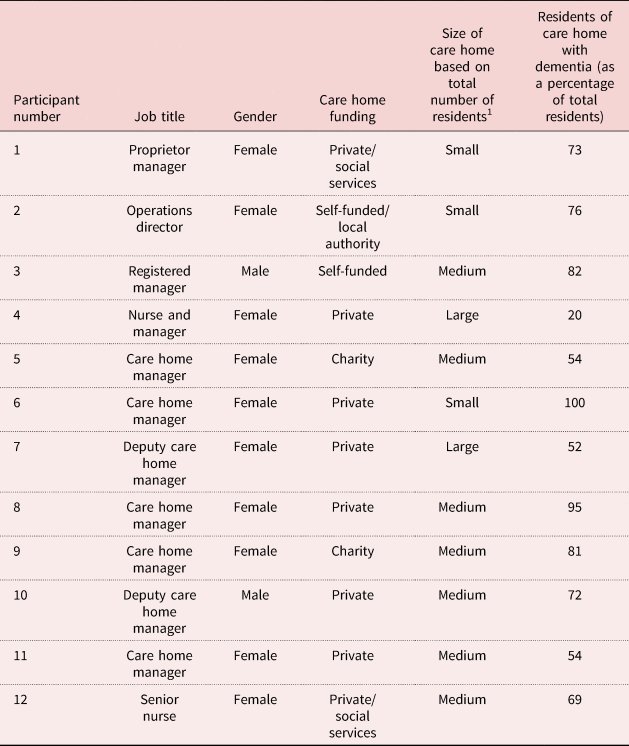
Twelve participants took part in the study, 83 per cent were female (N = 10) and 17 per cent male (N = 2) (Table 1). Their roles varied from senior nursing staff through to area manager but all were experienced staff (i.e. none were new in the care sector or a management role) currently responsible for managing one (N = 11) or two (N = 1) care homes. The care homes (N = 13) varied in size from 15 to 71 residents – three were small (<25 residents), seven were medium (26–50 residents) and two were large (>51 residents) – and 20–100 per cent of the residents in each care home were living with dementia. Fifty per cent (N = 6) of the care homes were privately funded, 17 per cent (N = 2) charity funded, 8 per cent (N = 1) self-funded and the remaining 25 per cent (N = 3) were funded through a mix of private, social services, local authority and self-funding.
Characteristics of participants and their related care organisation

Note: 1. Small <25; medium 26–50; large >51.
Method
Semi-structured telephone interviews were conducted to ascertain the required qualitative data. The interviews were conducted by one of the authors (AA) and ranged from eight to 19 minutes, excluding the consent processes. The type of care home that managers were employed in (privately funded or not) and their level of knowledge and expertise, particularly in terms of their awareness of dementia-friendly design principles, guidelines and audit tools, varied significantly. This, coupled with the amount of time managers were able to set aside to undertake the interview during their working day, impacted on the length of time it took to complete each interview.
The interview questions were divided into four parts. The first explored managers’ experiences and perceptions of whether residents exhibited disorientation within the care environment, and how they then went on to support this. The second part focused on how managers gained information to implement any potential/suitable design changes within the care home. Within this part we specifically explored managers’ level of awareness of dementia-friendly design principles, guidelines and audit tools. The third section explored what level of training managers had received, in terms of dementia-friendly environments, and if there were any gaps they felt needed to be addressed. This informed the level of support required to apply these guidelines successfully within care homes. The final part was used to gather details about the care home itself, the role of the manager, funding bodies and resident information.
Ethics and consent
Ethical approval was obtained from the University Research Ethics Committee prior to the start of data collection. Principles of informed consent, voluntary participation, the right to withdraw, confidentiality and anonymity were adhered to. Managers participating in telephone interviews were emailed a participant information sheet and asked for their written or verbal agreement to participate prior to the start of the interview. Responses to telephone interview questions were audio recorded to capture the data more effectively (Jamshed, Reference Jamshed2014). All interviews were transcribed verbatim by an approved external organisation. Audio files and transcripts were securely sent and received via the university's internal electronic transfer system. All identifiers were removed from transcripts prior to analysis.
Data analysis
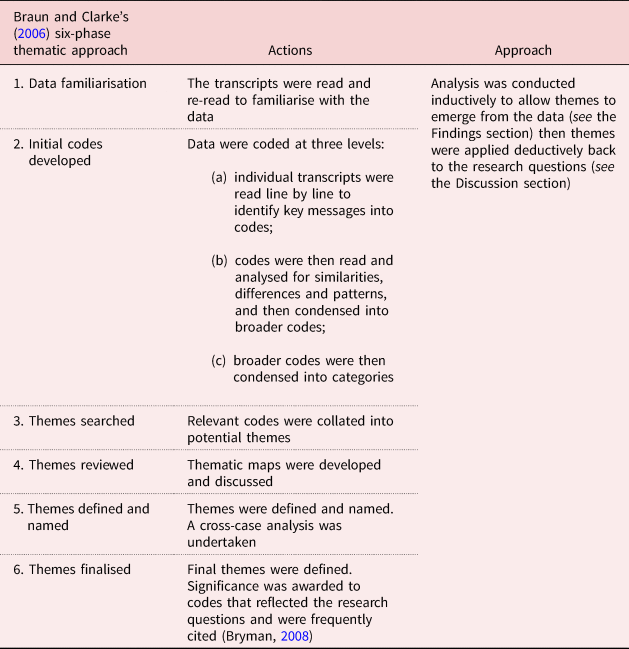
Data were analysed using an inductive six-phase thematic approach, as outlined by Braun and Clarke (Reference Braun and Clarke2006) (Table 2). The initial stages of analysis were conducted by two researchers (AA and BH) and the emerging themes were then reviewed and discussed by the whole research team until a consensus was reached. Detailed discussions were undertaken throughout this process to provide rigour to the analysis. A cross-case analysis, to elicit any differences between care homes, was undertaken after identifying the themes. Analysis was written up using key quotations to support the themes in the managers’ own words.
Data analysis process

Findings
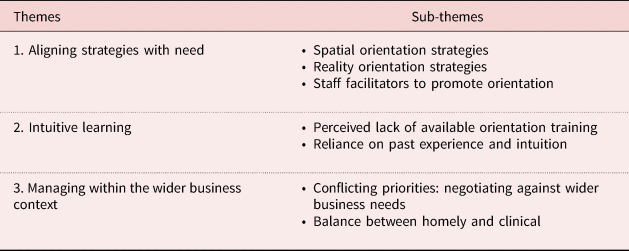
Three higher-order themes were constructed from the data: aligning strategies with needs (Theme 1), intuitive learning (Theme 2) and managing within the wider business context (Theme 3) (Table 3). The findings portray a multifaceted manager who drew on varied skills and knowledge to support the orientation and navigation of residents with dementia, whilst working within the confines of their environment. Each theme is discussed in turn.
Higher-order themes and sub-themes

Theme 1: Aligning strategies with needs
When invited to discuss their perceptions of residents’ orientation and navigation skills and their experiences of handling these in the care home, managers offered two different conceptualisations of ‘orientation’ and this influenced their chosen strategies. These fell either into ‘spatial’ orientation and/or ‘reality’ orientation, and were used interchangeably by the managers.
Spatial orientation strategies
Managers used this conceptualisation of orientation when describing residents’ abilities to navigate their physical environment and move between their rooms and other communal areas such as the living or dining rooms: ‘but they will get disorientated, they will come out of their room and forget where they are going’ (Participant 6). They felt that all residents with dementia experienced difficulties with their spatial orientation to some extent. Whilst for new residents with mild dementia, managers suggested these challenges could be overcome in time as they became accustomed to the layout of the care home, for others with more severe dementia these issues became more pronounced and persistent over time:
…that's unfortunately what happens with people with dementia, they can't find their way around so they forget things, then they just wander around. (Participant 6)
The most commonly cited strategy for supporting residents to navigate communal areas that managers discussed was to provide easily seen and ‘obvious’ (Participant 6) signage around the care home. Furthermore, some managers felt that it helped to include recognisable images alongside wording on signage, to aid spatial orientation of shared spaces further; this was particularly the case in care homes with a dementia-specific wing, ‘so it's a bathroom there's a picture of a bath or a picture of toilet and pictures to demonstrate what's behind the door’ (Participant 7). Interestingly, the use of signage was only mentioned in relation to communal or shared spaces, rather than the entirety of the home. This suggests that when implementing spatial orientation strategies, managers prefer to focus on the areas that are used most often by all residents, staff and visitors.
In some care homes, managers went further than providing signage and made physical changes to the internal environment including altering or using unique room furnishings, to help residents distinguish rooms with more ease:
…so it's not just signage it's actually the carpeting and the actual furniture we are changing for each area so they can see they are in a different area. (Participant 6)
Managers described how they used personalisation and person-centred approaches, particularly within more private spaces such as residents’ bedrooms.
…in their rooms they've got like personal photographs, a lot of the families they update their friends when they were growing up and then they put the children's pictures in there. (Participant 12)
Managers discussed how they were able to create a sense of personalisation by encouraging family members to provide details of the people with dementia so that they could identify and develop appropriate ‘memory triggers’ for individual residents:
…they've got their picture on their door and their name so they can kind of hopefully wayfind back to their room. (Participant 5)
To support resident spatial orientation, some care homes used individual memory boxes placed directly outside resident's bedrooms. These contained personalised items similar to those placed within each bedroom. In one care home, some of the residents were encouraged to participate in creative activities to personalise the strategies that managers were suggesting for reducing their spatial disorientation, including designing signage for their own rooms:
…they've got memory books … outside which has got pictures of them or something that triggers that it's their room … they have created a sign maybe themselves with their names on and things like that. (Participant 7)
Note that we found few examples of residents’ autonomy within the strategies that managers used.
Using colour was an integral part of the strategies adopted to support spatial orientation and navigation. It facilitated the personalisation of residents’ spaces (e.g. bedrooms) as well as enabled them to distinguish between spaces and floors of the care home. One manager felt that using colour would help to create associations between aspects of their original home, enabling them to navigate more easily to their own bedrooms:
…each bedroom door it has different colours … so they actually look like a front door of your own house with the letterbox as well … people associate colour with their bedroom. (Participant 6)
Within communal areas colour was used on doors and handrails, for example, to distinguish between spaces and the floor levels of the care home, the latter more for the benefit of staff and visitors navigating the environment:
…on the nursing floor it's quite lilacy, on the residential it's bluish and then there's nice greens for dementia and yellow. We use a lot of yellow on the dementias like the toilets and things. (Participant 7)
Managers felt that colour also had a secondary benefit of improving safety for residents, as well as spatial orientation:
…the hand rails are bright red and like toilet doors are bright yellow … you actually find they are holding on to the rails, whereas if they were of a similar colour to the wall or you know you don't even have them it could be an issue for them. (Participant 2)
Interestingly, this same manager described how making changes to support residents with dementia with their orientation and navigation had also benefited those without dementia, highlighting the importance these strategies can have for everyone and not just people living with dementia:
I think yeah it has helped even the residents that haven't [got dementia] … to be able to at least find where the toilet is and even with prompting they are able to do that … like with the colours you actually find they are holding on to the rails. (Participant 2)
Within larger care homes, the use of spatial orientation tools (landmarks such as unique room furnishings, signage, personalisation and colour) appeared to be a standard aspect implemented in the design of the building to aid navigation, perhaps due to the need to support navigation of these larger environments. This was also more prominent in care homes that mentioned they had a specific dementia wing.
Reality orientation strategies
Managers also recognised the need to facilitate residents’ sense of reality orientation by implementing strategies that provided them with an understanding of time and place. For instance, managers discussed the importance of calendars and clocks being visible around the care home as well as offering residents routinely scheduled daily/weekly activities to create a sense of familiarity and ground residents in their awareness of day and time. In establishing or maintaining a sense of routine, managers felt that residents were able to become more orientated and familiar with the layout of the care home by understanding which activities were taking place, on what day and in which room.
This concept of familiarity was identified by managers as important for reducing residents’ anxiety and supporting their wellbeing. For instance, some managers, particularly those in larger more-affluent care homes, discussed experiential activity areas within the care home such as creating an ice-cream parlour, sweet shop or cinema. Interestingly, this generated a reminiscent sense of familiarity for the residents that enhanced their psychological wellbeing. On occasions, for some residents, it would skew their sense of reality orientation and encourage them to perceive they were in a different place. In these instances, it was clear that managers were choosing against grounding the residents in actual reality in favour of offering them a false yet more familiar and so comforting alternative reality. For instance, one manager discussed creating a bus stop in the care home garden to reduce a resident's distress when they were moving to the care home, as catching a bus had been a regular part of their routine for many years:
…a lady who about 4 o'clock she gets very restless … she'll come to me and say ‘I've missed my bus’ … and I [thought] … maybe we should get a bus stop in the garden … and a bench and then they can sit there waiting for the bus. (Participant 1)
Staff facilitators to promote orientation and navigation
Across both small and large care homes, managers discussed the integral role that care staff played in supporting residents’ spatial and reality orientation. For instance, staff would offer residents support if they were walking in the wrong direction or seemed disorientated:
…if [staff] saw a resident walking towards the front door … [they] would say ‘oh can I help you’ and then ‘do you want to come this way’. (Participant 8)
Managers felt this guidance was particularly required by residents when they first moved into the care home and were unaccustomed to its layout, or when their dementia symptoms progressed to the point they became disorientated and confused. Managers highlighted that staff with experience and training in working with people with dementia often had better interpersonal skills to engage disorientated residents, and provide them with a sense of comfort and inclusion; whilst inexperienced staff frequently lacked this understanding and therefore were less likely to be able to support residents’ needs in this area:
…staff that have never had experience of people with dementia … they'll just tell them to sit down, when they stand up and walk about and stretch their legs, they feel they've got to keep them to a room or sit down … because they don't want them to fall. It's staff training isn't it? Getting them to know about the residents. (Participant 4)
Managers felt that over time, and once staff had developed these interpersonal skills such as patience, reassurance, empathy and trust, it enabled them to understand each resident better so they could tailor their strategies for supporting orientation accordingly. This is in accordance with the ideals of person-centred care:
…people who first come in … don't know the environment … they are basically lost … it's getting their trust and finally when you gain their trust you get to know more about their history and then you can understand why they do the things they do. (Participant 11)
Managers from smaller care homes suggested that this approach was likely to be more fruitful in their care setting as they have fewer residents than larger care homes, making it easier for staff to get to know the residents, and understand their personal histories and preferences.
Theme 2: Intuitive learning
This theme discusses managers’ lack of time and knowledge in accessing orientation-specific guidance, thereby resulting in their over-reliance on intuition and past experiences in the care sector when implementing and evaluating strategies to support residents’ spatial and reality orientation. Managers appeared to draw their knowledge about strategies from previous experience, networking, literature, marketing and their own intuition. On rare occasions managers did look for training and drew on that for some strategies.
Perceived lack of available orientation training
All managers discussed various dementia training they had been required to participate in as a mandatory requirement of their job role such as the ‘care certificate’ (Participant 9). This was particularly the case when care homes were experiencing a greater influx of residents with dementia:
…more training organised because we've got more people living with dementia now … even if it's for respite … looking at how [we can meet] residents’ needs. (Participant 4)
However, these courses were often focused more broadly around dementia awareness, with little consideration for supporting residents’ orientation and navigation through the management of their living environment. One manager described learning about reality orientation in their dementia training:
You do your dementia training and you learn all about disorientation to time and place. (Participant 3)
Furthermore, whilst some managers acknowledged the need for more specialist, orientation-specific dementia training, they felt they lacked the time and knowledge to access these resources. Collectively, these factors resulted in a low uptake and knowledge of dementia-friendly design principles and orientation-specific guidelines and audit tools in practice. For instance, only two managers reflected on their use of design guidelines (‘I use the King's Fund which I found very useful’, Participant 6) and audit tools (‘…we do audit's on our environment regularly to look at where we're at and what we need to change’, Participant 5) when implementing and evaluating orientation strategies in their practice.
Reliance on past experience and intuition
Unsurprisingly, therefore, irrespective of the length of time that they had worked within the care sector, the majority of managers interviewed outlined that primarily they relied on their own intuition and past experiences when deciding upon strategies to introduce in the care home to support residents’ orientation. One manager reflected on a negative past experience in a care home in which they had previously worked:
…they would go to a resident ‘turn left’ … wonder why they're disorientated because they are just going left and left and left … bad practice by the home. (Participant 3)
Whilst another described how intuition peppered with marketing emails from product companies influenced their choice of strategies:
Partly its common sense … I get bombarded with emails all day every day I can't keep on top of them … some of it's like dementia products, so it will be like signage … if I like the look of something I'll click on the link and go to the website. (Participant 8)
This appeared to result in a stronger inclination to support residents through strategies that reinforced reality rather than spatial orientation, particularly in terms of maintaining and developing familiarity amongst residents and care staff. Through their experiences within the care sector, the managers had developed an informal social network of colleagues that they predominantly drew upon when seeking out appropriate orientation strategies:
It's just what you hear … from experience … exchange of the words … lots of people they said to me: ‘Oh, I heard this’, you know, and then I just try to find and Google it. (Participant 6)
Only on a few occasions did managers allude to consulting directly with care home residents on potential orientation strategies, and when this did occur it was often with residents who were perceived to be at an ‘earlier stage’ of dementia:
My clientele are probably earlier stages on that side so they've got more orientation … [we] discuss with them how do they want their room personalised and things like that. (Participant 3)
No managers interviewed suggested that they had consulted with residents in the later stages of dementia, although in some instances managers discussed speaking with family members to elicit personal information about the residents that could be used to tailor the orientation strategies better to their interests and needs:
I mean y'know we liaise with families respectively to get their input to find out everything about the individual that we're caring for. (Participant 10)
Furthermore, managers rarely referred to any evaluation work they had undertaken to explore the success of the strategies they had implemented or seek further guidance on how to improve them. Again, they appeared to draw on their own intuition and a sense of feeling that the measures they had adopted were successful:
…in regards to the navigating around the [care] home, I feel that the things that we've got are more than sufficient in order to promote their independence and self-navigation. (Participant 10, emphasis added)
As one manager commented though, this intuitive approach was not always a success, underpinning the importance of involving residents in the process before making changes:
We did a reminiscence room um thinking that that would orientate people and be dementia-friendly and it backfired … nobody liked it. They hated it! So that's now the cinema room. (Participant 9)
Theme 3: Managing within the wider business context
This theme discusses the complex care environment that managers were working within and the conflicting priorities they were managing between the wider business objectives and the orientation requirements and wellbeing of the residents.
Conflicting priorities: negotiating against wider business needs
Some of the managers had been working in the care sector for many years. They discussed the changing nature of residential care in line with the increasing number of people with dementia requiring full-time care. In the past, people with dementia may have been living in specialised nursing care, whereas now care culture has changed and they are living in residential care:
…up until recently we didn't take people with dementia … so we [residential care] keep people as long as we can whereas … years ago people would … go somewhere more specialised. (Participant 4)
This has had an impact and means that the profile of residents in care homes is changing, yet many environments have not changed in response and so may not be supporting residents appropriately. Moreover, some managers, and particularly those in larger care homes, felt that they were restricted in their ability to implement dementia-friendly design principles, due to a lack of autonomy. This demonstrates a dichotomy between servicing the needs of the business and improving the provision of care:
Yeah I've heard of them [dementia-friendly design principles]. I don't know why we are not implemented them … you would have to ask the company, it's very much governed by the company … what we do and don't do. (Participant 7)
Within the current environment, with increasing numbers of people living with dementia, some managers discussed how their business owners had sought to expand the care homes to accommodate increasing intakes of residents. Whilst this was beneficial for the business needs, the creation of new ‘dementia-specialist’ wings and the expansion of the care home site could be detrimental to the orientation capabilities of residents with dementia and subsequently their sense of wellbeing. It emerged that the development of these new wings was rather challenging for people with dementia in terms of orientation:
Probably is the logistics of the home because in a big home it's 70 beds over three floors and we've got an older part with a large extension … I think perhaps in the older part of the house, that is a harder place for them to orientate themselves and they can get stuck down one end. (Participant 2)
This was because residents with dementia were being moved from a (somewhat) familiar environment to one that was unfamiliar, which had an impact on their spatial orientation:
…because we're a new build, we started everyone on one floor … having to move them from one floor to another, that has become quite challenging because it does give them some disorientation, but as a new build, from a staffing point of view you have to go with the business side of things as well. (Participant 7)
In the same care home they had created a ‘dementia wing’ to move residents with dementia once their dementia progressed and they had more complex needs:
…we try to minimise it [disorientation] as much as we can. However, when we're opening new wings and some people's dementia are getting worse, if they're on residential and their dementia is quite challenging, we can't keep them there, so we tend to move them up to Dementia Wing. (Participant 7)
Balance between homely and clinical
For some managers there was a perception that orientation strategies and dementia-friendly design principles were primarily for care homes that were specialist ‘dementia’ homes:
…I mean I know there's different things that you can do in terms of like um coloured doors … but we're not a registered dementia home so we don't want to go down that route as we want to cater for people who don't have dementia as well. (Participant 8)
Consequently, they were anxious about introducing some of these strategies for fear that the business would be perceived incorrectly and a clinical rather than homely feeling would be created throughout the environment that would be at the detriment to people who were not living with dementia:
We don't at the moment, we don't want a big dementia sign saying toilet because we don't want to look too clinical. Does that make sense? So we keep it homely rather than clinical and hospitally. (Participant 8)
Others discussed how the individuality of dementia often led them to feel unsure about making changes to the design of the care environment, as what may be appropriate for one resident may not be appropriate for another, or could change over time as the residents’ needs changed. They reported the need for a flexible approach with residents with dementia, as there is no ‘one-size-fits-all approach’ and so they had to work around this as best they could:
…they don't address all aspects of it … but you're never gonna do that … ’cos not one cap fits all. (Participant 7)
Discussion
Being disorientated within care environments can negatively impact upon independence, wellbeing and quality of life for residents, particularly those living with dementia (O'Malley et al., Reference O'Malley, Innes and Wiener2015). Managers have a key role to play in creating dementia-friendly environments that are inclusive of people with dementia, so it is important to understand their experiences within this area. This exploratory study aimed to determine managers’ experiences of supporting the orientation and navigation of care home residents living with dementia and explore their use of dementia-friendly design principles. The findings demonstrated the integral and multifaceted role that the managers played in implementing strategies to support the orientation and navigation of residents with dementia, whilst working within the confines of their wider environment. However, they also demonstrated the challenges that managers encountered as well as areas for further support to enable them to draw on evidence-based practice. This discussion will address each initial research question in turn.
What are care home managers’ perceptions of the orientation and navigation abilities of residents with dementia?
We found that all the care managers interviewed, regardless of the care home they managed or their length of time within the job, were able to highlight the numerous difficulties concerning spatial and reality orientation that their residents with dementia encountered. Therefore, this was something within their role that they were accustomed to addressing and so could discuss it confidently and competently. However, it was noteworthy that they often conflated ‘spatial’ and ‘reality’ (dis)orientation rather than viewing them as two separate cognitive abilities. Therefore, whilst this finding supports the call for the development of dementia-friendly care environments that compensate for declining navigation abilities (Marquardt and Schmieg, Reference Marquardt and Schmieg2009; Marquardt, Reference Marquardt2011; O'Malley et al., Reference O'Malley, Innes and Wiener2015, Reference O'Malley, Innes, Muir and Wiener2018), it highlights the need for further orientation-specific guidance and training that also includes ‘reality’ orientation and distinguishes it as something separate from ‘spatial’ orientation. This will ensure care home managers have a better grasp of both of these concepts and how dementia can adversely impact on them, so they can implement strategies to mitigate against each one, which will enable residents living with the condition to have the best possible support to feel socially included within their care environment.
How do care home managers support residents’ orientation and navigation of care environments?
Despite conflating the concepts, managers were able to discuss a range of strategies that they had implemented to provide reality and spatial orientation support for their residents with dementia. To counter challenges with spatial disorientation, managers had incorporated landmarks such as unique room furnishings, signage, personalisation and colour within the care home to help residents distinguish better between communal areas and their own bedroom, as outlined in existing guidance and research (Passini et al., Reference Passini, Pigot, Rainville and Tetreault2000; Health Facilities Scotland, 2007a; Marquardt and Schmieg, Reference Marquardt and Schmieg2009; Lewis et al., Reference Lewis, Torrington, Barnes, Darton, Holder, McKee, Netten and Orrell2010; King's Fund, 2012; Alzheimer's Disease International, 2020). The contribution of neuropsychological research and theories in further developing this application of landmarks in practice has been outlined previously (O'Malley et al., Reference O'Malley, Innes and Wiener2015). For reality orientation, managers sought to create a sense of routine and familiarity for residents through regularly scheduled activities, as well as provide prompts such as calendars and clocks that were prominently displayed around the care home. Interestingly, managers discussed introducing experiential activities such as a sweet shop, bus stop or ice-cream parlour to generate a sense of familiarity and reminiscence and so improve wellbeing as advocated in existing guidance (Day et al., Reference Day, Carreon and Stump2000; Health Facilities Scotland, 2007b). In doing so, they actively sought to deceive some people into thinking they were in an alternative reality, which was both familiar and comforting to them. This adds further evidence to the current academic debate on the topic of deception and truth-telling within dementia care (Elvish et al., Reference Elvish, James and Milne2010). Whilst ethically this practice may be dubious, in accordance with other research (Cunningham, Reference Cunningham2005; James et al., Reference James, Wood-Mitchell, Waterworth, Mackenzie and Cunningham2006; Elvish et al., Reference Elvish, James and Milne2010; Day et al., Reference Day, James, Meyer and Lee2011) it suggests that when managing care home residents with dementia, purposely removing them from reality in order to evoke a sense of comfort and wellbeing may be in the person's best interest and is a useful strategy that can be employed by care home managers when others have been unsuccessful. Further research within this area would be useful to examine how and when it is most appropriate to employ these reality-disorientating strategies and so offer more guidance to care home managers.
Regardless of the size or wealth of the care home, all care home managers recognised the importance of care staff for supporting the reality and spatial orientation of residents with dementia through the delivery of person-centred care approaches that acknowledged residents’ preferences and life histories. As such, it is important that the integral role care staff play is not forgotten or overlooked during the implementation of any orientation strategies. In fact, as others have suggested (Garcia et al., Reference Garcia, Hebert, Kozak, Senecal, Slaughter, Aminzadeh, Dalziel, Charles and Eliasziw2012), our findings demonstrate the interactive roles of physical environmental interventions and staff assistance that work together in partnership to support the orientation and navigation of residents in care environments. Providing ongoing support and training to enhance care practitioners’ knowledge of the challenges of spatial and reality orientation that can be encountered by residents with dementia, as well as guidance on providing best practice support, should be at the heart of any strategies that are adopted within care homes. Within smaller, potentially less-affluent care homes with fewer residents with dementia, person-centred strategies are likely to be easier to enact as care staff will have more opportunity to develop a knowledge of their residents and so understand their preferences (Dowling et al., Reference Dowling, Manthorpe and Cowley2006). Consequently, care managers may not need to employ other, potentially more expensive strategies to support residents’ orientation abilities. Although it is important to note that despite the care sector operating within considerable fiscal restraints (Office for Budget Responsibility, 2019), none of the managers suggested that cost-efficiency of orientation and navigation strategies was a barrier to implementation. Although, a manager from a smaller care home did suggest that arts and crafts with the residents was a normal experiential activity, rather than some of the more expensive technological items available on the market which the home could not afford. Conversely, whilst larger more-affluent care homes may be able to incorporate a range of orientation strategies into the care environment, it is vital that they do not forget the basics of person-centred care and ensure their staff are well trained and encouraged to develop relationships with the residents so they can understand the best way to support them in alleviating some of the challenges with orientation that they may encounter.
It is important to acknowledge that when trying to implement changes within the care home, managers were operating within a wider business environment with multiple stakeholders that had differing and potentially incompatible objectives. Consequently, this could lead to a number of difficulties when managers were attempting to support residents with orientation challenges, particularly if they were part of a larger care home and so had potentially less autonomy in their job role. For instance, managers discussed business decisions that were being made without their input to expand care homes to cater for the growing numbers of people with dementia. Adding new areas to a care home can make it difficult for residents who face challenges learning new environments. Furthermore, rather than applying a consistent design approach during these developments that may help to ameliorate some of the challenges that residents with dementia encounter, some of the managers reported the use of different approaches in various wings of their care home. This can result in residents, family members and staff feeling confused as they move between the different wings of these buildings, and therefore does not constitute good design that supports the wellbeing and quality of life of people with dementia (Day et al., Reference Day, Carreon and Stump2000; Marshall, Reference Marshall2001; Kelly et al., Reference Kelly, Innes and Dincarslan2011; Smith et al., Reference Smith, Fleming, Chenoweth, Jeon, Stein-Parbury and Brodaty2012). These additional levels of bureaucracy could result in an unwillingness or lack of motivation to implement strategies that may support orientation in residents with dementia. It was evident that the strategic business needs were not always underpinned by principles of person-centred care or dementia-friendly design. This demonstrates the importance of providing training and guidance to the multiple stakeholders within care homes so they are better aware of the orientation challenges faced by residents with dementia and can recognise the impact that their business decisions may have on the wellbeing of these residents; as well as encouraging such stakeholders to collaborate closely with care home managers during any business decisions to ensure dementia-friendly design principles and the residents’ needs remain on the agenda.
Do care home managers draw upon existing design guidelines and audit tools or evidence-based practice in order to support resident orientation and navigation?
It was evident that managers had completed different types and levels of dementia training; however, all training appeared to lack any content about orientation and navigation. The strategies that were implemented to support resident orientation and navigation of care environments were therefore based on the manager's past experiences and suggestions through informal networks and their intuition, rather than formal training. In addition, some care managers were unaware of the need to learn about dementia-friendly design principles, guidelines and audit tools, and felt that they did not have the time or available resources to attend external training courses anyway. This may be detrimental to the residential care sector as a whole as, without consulting the evidence base, practice will not develop and the field will not move forward. It was also interesting to note that some managers who were not working in specialist dementia homes, although they were aware of some dementia-friendly design principles and orientation strategies, were reluctant to implement them, viewing them negatively, fearing it would detract from the ‘homely’ environment they were aiming to create and make it appear more clinical. This is in accordance with other research that identifies the importance of creating care environments that look and feel homely rather than clinical, thereby providing a much more comforting space for residents (Verbeek et al., Reference Verbeek, van Rossum, Zwakhalen, Kempen and Hamers2009; Molony, Reference Molony2010). These findings highlight the need to develop accessible guidelines identifying best practice design-led orientation strategies – both in terms of the content and the way it is delivered – that are engaging and appealing to managers. To support managers’ ability to apply such guidelines in practice, appropriate training is also required.
Furthermore, there is a need to ensure that the views of people with dementia are not replaced by proxy accounts from family member (Heward et al., Reference Heward, Innes, Cutler and Hambidge2017). It was evident from our findings that although some managers did consult the families of people with dementia, the majority of managers rarely consulted with their residents with dementia during the implementation or evaluation of the strategies they adopted within the care home, resulting in a lack of resident autonomy. As such, it was unclear whether any of the strategies were successful or indeed wanted by their residents with dementia, a finding that demonstrates practice in opposition to ideals of personhood and person-centred care which emphasise choice and personalisation (Kitwood, Reference Kitwood1997). This is an important area to address as, for example, other research has suggested signage may be less suitable in care home environments (O'Malley et al., Reference O'Malley, Innes, Muir and Wiener2018) or environmental cues may be perceived as patronising and child-like (MacDonald and Settin, Reference MacDonald and Settin1978; Voelkel, Reference Voelkel1978). Consequently, without robust evaluation, care home managers could inadvertently be introducing strategies that are creating an environment that is not welcomed and that adversely impacts on the personhood and wellbeing of the residents. This would go against the notions of citizenship (engagement, relationships and rights), authenticity (being true to yourself) or person-centred dementia care (Hughes, Reference Hughes2014, Reference Hughes2019). There is a need to ensure that managers view residents with dementia as socially active citizens capable of informing their own care, rather than passive recipients (Bartlett and O'Connell, Reference Bartlett and O'Connor2010; Lin, Reference Lin2017), and so consult them and their families regularly during the implementation and evaluation of any interventions designed to enhance their wellbeing. As posited by other research, this participatory approach is not only essential for people's social citizenship rights, it is also beneficial for the final intervention, ensuring it is fit for purpose and successful in addressing the needs of the intended audience (Hicks and Innes, Reference Hicks, Innes, Innes A and Farmer J2020).
Moving forwards: implications for practice
Collectively, these findings highlight a crucial gap between theory and practice, signifying the need for (a) inclusive design guidelines that identify best practice design-led orientation strategies that identify a balance between function (i.e. accessibility, orientation and navigation support) and aesthetics (i.e. homeliness and avoiding an institutional character) and (b) training to promote the application of these inclusive design guidelines into practice and improve wider knowledge of dementia-friendly design principles, guidelines and audit tools amongst those working in care environments. To maximise resident orientation, guidelines and training should:
(1) Refer to inclusive design guidelines (rather than dementia-specific guidelines), regardless of whether the care home caters for people with dementia specifically; a well-designed environment that supports the social inclusion of people with dementia will also result in a well-designed environment for others who also live, work and visit, as suggested by Marshall (Reference Marshall2001).
(2) Be informed by neuropsychological theories of orientation, navigation and dementia to compensate for declining navigation abilities (O'Malley et al., Reference O'Malley, Innes and Wiener2015).
(3) Distinguish between the challenges of ‘reality’ and ‘spatial’ orientation that can be encountered by people with dementia.
(4) Highlight the importance of considering the lived experiences of people with dementia during the design, implementation and continued evaluation of any strategies employed to support their spatial and reality orientation (Davis et al., Reference Davis, Byers, Nay and Koch2009), and provide guidance on the multiple ways that can be used to seek to hear the voices of residents with dementia.
To create accessible and engaging guidelines for care home managers it will be important to collaborate with them at all stages during their development, delivery and evaluation. There is potential that e-learning training may be one avenue to explore given the heavy workloads and time restrictions placed on managers, as this would enable them to work through the materials at their own pace. Evaluation of the training measuring the impact on practice would further support the case for managers to complete it, given their competing responsibilities. Furthermore, this guidance and training must also be made accessible to the multiple stakeholders responsible for care home design and management. This could be achieved easily if dementia training or Continued Professional Development training incorporated a specific section around orientation that outlines concepts such as reality and spatial orientation. This will acknowledge the wider business context and varied parties that might be involved in designing, building and running care homes, including managers, care staff, business owners, architects and designers. Referring to guidelines as ‘inclusive’ rather than ‘dementia-friendly’ may be one way to encourage managers to begin implementing such guidelines to promote inclusion for all residents, regardless of whether the care home caters for people with dementia specifically or not (Marshall, Reference Marshall2001).
Finally, consulting residents with dementia during the design, implementation and continued evaluation of any strategies employed to support their spatial and reality orientation (Davis et al., Reference Davis, Byers, Nay and Koch2009) will ensure that care homes can maintain a homely feel that is comforting to all residents whilst still providing enough support to enable those living with dementia to feel orientated and socially included. This is in accordance with other research that consulted with older adults with memory difficulties living in a retirement development and found that they wished for a reduction in the use of signage in favour of memorable and meaningful spaces and environmental cues to aid orientation, to create a homelier feel whilst still offering the required navigational support (O'Malley et al., Reference O'Malley, Innes, Muir and Wiener2018).
Study strengths and limitations
This study draws upon the experiences of managers working within privately owned care homes across the UK. The qualitative approach gives voice to managers, enabling them to share their experiences of supporting resident orientation and navigation and applying dementia-friendly design principles, guidelines and audit tools in their practice. To our knowledge, this is the first study to develop an understanding of current practice in care environments to minimise resident disorientation; complementing a growing body of research that draws insights through qualitative methods to understand the orientation and navigation experiences of people with dementia in the community and care settings, with care home manager perspectives (O'Malley et al., Reference O'Malley, Innes, Muir and Wiener2018; Olsson et al., Reference Olsson, Skovdahl and Engstromin press; Seetharaman et al., Reference Seetharaman, Shepley and Cheairsin press). The findings contribute to the wider dementia-friendly communities’ agenda and debates about involvement of people living with dementia in decision-making (Department of Health, 2009, 2015; Williamson, Reference Williamson2012; Dementia Friendly Community, 2015; Lin, Reference Lin2017). However, given the relatively small sample size and the decision to exclude managers of larger care homes, our findings may not be representative of all care home managers within the UK. The interviews ranged from eight to 19 minutes, excluding consent processes, and we acknowledge that these were relatively short for a qualitative study. We were conscious not to overburden care home managers and therefore decided to use the same semi-structured format of questions for each interview; those with shorter interviews merely had less to say about their experiences. Moreover, we did not consider the experiences of managers working in sheltered housing and extra-care schemes, which is a further limitation of this study.
Conclusions
To the best of the authors’ knowledge this is the first study to explore care home managers’ experiences of supporting care home residents’ orientation and navigation alongside their knowledge of dementia-friendly design principles, guidelines and audit tools. This is an important area to address given the prominence of spatial and reality orientation challenges in people with dementia, and the integral role that care home managers have in creating and supporting dementia-friendly care homes. Our findings suggest that care home managers are aware of these difficulties encountered by their residents with dementia and to some extent have sought to address them. Managers’ strategies did reflect what is known to work for orientation and navigation in existing dementia-friendly design guidelines; yet managers themselves rarely drew upon best practice design principles, guidelines and audit tools when implementing these strategies. While this suggests there is value in this intuitive approach, there remains a lack of systematic evidence-based approaches that support residents’ orientation and navigation in care environments and limited cross-reference to underpinning neuropsychological research and theories. There was limited evidence that managers sought to evaluate any of the strategies in practice. We argue for the need to provide managers with further training and guidance in terms of making design changes to care environments and evaluating them through seeking the feedback of residents as well as their family members and other care staff. Our findings contribute to the wider dementia-friendly communities agenda and a growing evidence base of research that recommends the development of dementia-friendly care environments that can compensate for the declining navigation and orientation abilities of residents living with dementia.
Acknowledgements
The authors would like to thank the care home managers who participated in this study for sharing their valuable experiences and taking the time to be involved in this study. Thanks also to Bournemouth University for funding this research through Early Career Researcher Network Acorn Funding awarded to MH. This paper reflects the findings of this study conducted by Bournemouth University Ageing and Dementia Research Centre; the views expressed are those of the authors and not necessarily the organisations listed.
Author contributions
All authors critically reviewed this paper and approved the final manuscript. MH developed the study protocol, obtained funding and ethical approval, provided review and feedback on data collection and analysis, and contributed to drafting of the manuscript. AA conducted the telephone interviews, and contributed to data analysis and drafting of the manuscript. BH co-ordinated data analysis and contributed to drafting of the manuscript. JW provided review and feedback on the study protocol, funding and ethics applications, data collection and analysis, and the draft of the manuscript.
Financial support
This work was supported by Bournemouth University (MH, Early Career Researcher Network Acorn Funding). The financial sponsors played no role in the design, execution, analysis and interpretation of data, or writing of the study.
Conflict of interest
The authors declare no conflicts of interest.
Ethical standards
Ethical approval was obtained from the University Research Ethics Committee prior to the start of data collection (identification number 19982). Principles of informed consent, voluntary participation, the right to withdraw, confidentiality and anonymity were adhered to.