Introduction
Monogenean ectoparasites cause serious problems in aquaculture worldwide (Whittington, Reference Whittington and Rohde2005). These parasites include dactylogyrids, which are common in snappers (Lutjanidae). Dactylogyrid monogeneans, such as Haliotrematoides spp. and Euryhaliotrema spp., are frequently detected on the gills of the wild and farmed spotted rose snapper Lutjanus guttatus (Steindachner) (Fajer-Ávila et al., Reference Fajer-Ávila, Velásquez-Medina and Betancourt-Lozano2007), an important fish for both aquaculture and fisheries in Mexico and several Latin American countries, such as Panama, Costa Rica and Honduras (Madrid et al., Reference Madrid, Sanchez and Ruiz1997; Álvarez-Lajonchere et al., Reference Álvarez-Lajonchere, Reina-Cáñez, Camacho-Hernández and Kraul2007; Vargas-Machuca et al., Reference Vargas-Machuca, Ponce-Palafox, Arredondo-Figueroa, Chávez-Ortiz and Vernon-Carter2008). Dactylogyrids have a direct life cycle and can easily multiply and disperse under aquaculture conditions (Whittington, Reference Whittington and Rohde2005; Soler-Jiménez et al., Reference Soler-Jiménez, Morales-Serna and Fajer-Ávila2015); thus, infections can result in population explosions of the parasite on the farmed host. Therefore, these monogeneans have been associated with major losses in fish farms (Whittington & Chisholm, Reference Whittington, Chisholm, Eiras, Segner, Wahli and Kapoor2008). High levels of dactylogyrids (above 200 parasites per fish) in the spotted red snapper can cause harmful effects on the host (Del Río-Zaragoza et al., Reference Del Río-Zaragoza, Fajer-Ávila and Almazán-Rueda2010).
The taxonomy of dactylogyrid monogeneans depends upon accurate descriptions of small differences in the hard parts of the parasite haptor and the reproductive organs of the isolated organism (Kritsky et al., Reference Kritsky, Tingbao and Yuan2009). Therefore, the identification and quantification of closely related dactylogyrid species are difficult using traditional techniques, making these methods impractical in epidemiological and diagnostic studies, which require the review of a large number of samples in a short period of time. There are no standardized protocols to monitor the infection status of dactylogyrids from farmed fish, and the results are variable. Considering these limitations, the development of a standardized method for dactylogyrid quantification is important.
Real-time polymerase chain reaction (qPCR) is increasingly used in diagnostic assays (Cavender et al., Reference Cavender, Wood, Powell, Overturf and Cain2004; Corbeil et al., Reference Corbeil, Arzul, Diggles, Heasman, Chollet, Berthe and Crane2006; Snow et al., Reference Snow, McKay, McBeath, Black, Doig, Kerr, Cunningham, Nylund and Devold2006; Jansson et al., Reference Jansson, Lindberg, Saker and Aspan2008; Collins et al., Reference Collins, Kerr, McIntosh and Snow2010) and has been demonstrated to be useful for the quantitative analysis of micro-organisms from a wide variety of environmental samples (Roe et al., Reference Roe, Haugland, Vesper and Wymer2001; Brinkman et al., Reference Brinkman, Haugland, Wymer, Byappanahalli, Whitman and Vesper2003; Hallett & Bartholomew, Reference Hallett and Bartholomew2006; Griffin et al., Reference Griffin, Pote, Camus, Mauel, Greenway and Wise2009). Thus, a qPCR assay for the quantification of dactylogyrids is considered a useful tool for early routine monitoring, particularly in the event of an outbreak, when knowledge of the infection levels of these parasites is required.
To improve the diagnosis of ‘dactylogyriasis’, we developed an alternative qPCR method to quantify dactylogyrids on the gills of the spotted rose snapper L. guttatus.
Materials and methods
Generation of calibration curves
Parasite collection
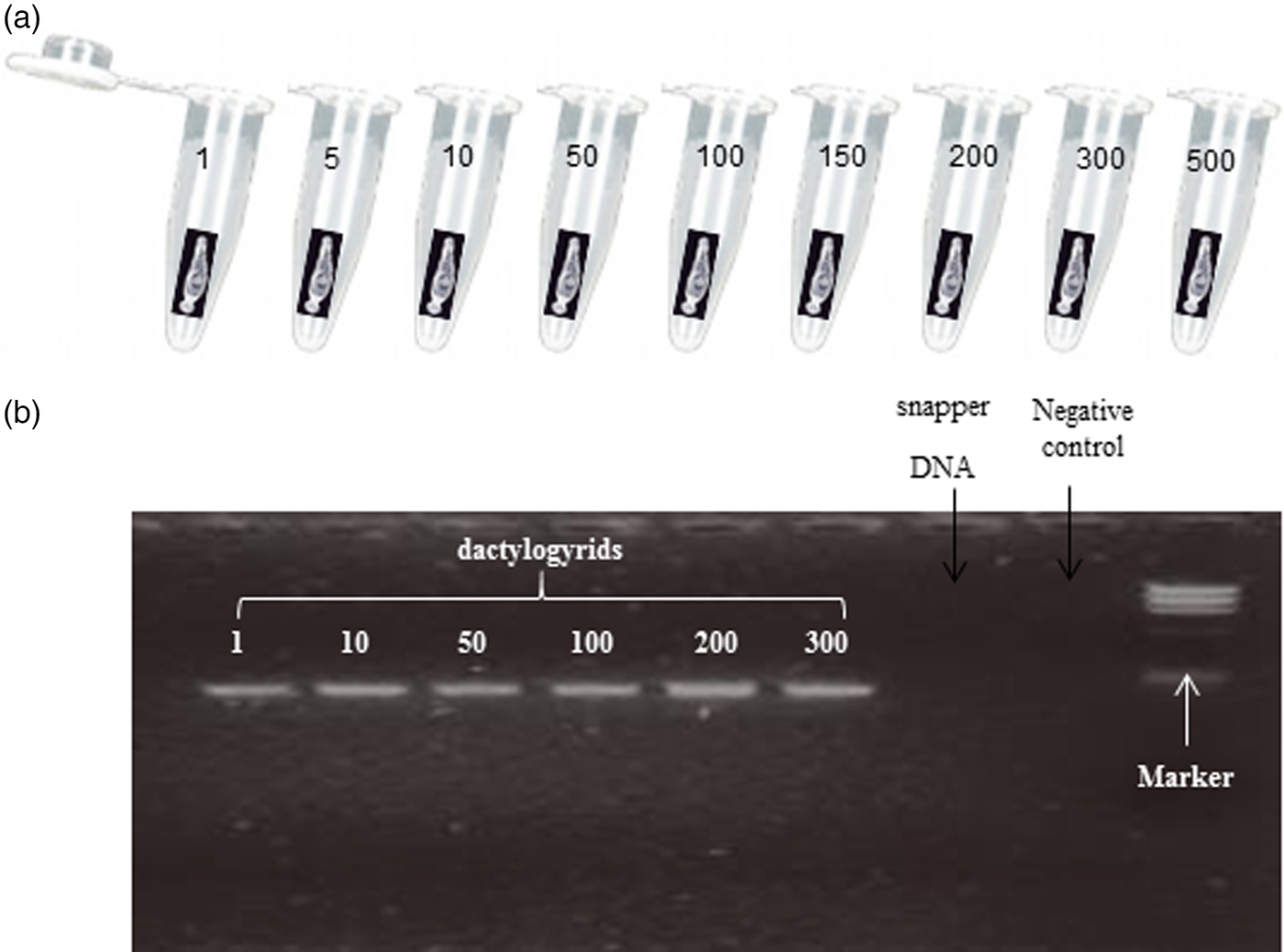
Wild spotted rose snappers were collected during routine sampling and transported to the Parasitology Laboratory at Centro de Investigación en Alimentación y Desarrollo (CIAD) for subsequent dissection. The gills were removed from each individual fish and preserved in 96% ethanol. Gill tissue was observed under a dissecting stereomicroscope (Leica Microsystems, Wetzlar, Germany) at 40× magnification. The dactylogyrids were isolated, identified under an Olympus BX-51 microscope (Olympus, Tokyo, Japan) and stored in a 2-ml Eppendorf tube containing 96% ethanol. Each specimen was identified morphologically based on the characters of the sclerotized parts (haptor and male copulatory organs) (García-Vargas et al., Reference García-Vargas, Fajer-Ávila and Lamothe-Argumedo2008; Kritsky et al., Reference Kritsky, Tingbao and Yuan2009; Soler-Jiménez et al., Reference Soler-Jiménez, García-Gasca and Fajer-Ávila2012). Specimens from each species (Euryhaliotrema perezponcei García-Vargas, Fajer-Ávila & Lamothe-Argumedo 2008; Euryhaliotrema mehen Soler-Jiménez, García-Gasca & Fajer-Ávila 2012 and Haliotrematoides guttati García-Vargas, Fajer-Ávila & Lamothe-Argumedo 2008) were collected in serial numbers: 1, 5, 10, 50, 100, 150, 200, 250, 300 and 500 individuals (see fig. 1a).
Serial increase in the number of each dactylogyrid species (Euryhaliotrema perezponcei, E. mehen and Haliotrematoides guttati). DNA was extracted from isolated specimens (a). The PCR products were separated on a 2% agarose gel (b). The lanes represent amplification of genomic DNA samples with a known number of dactylogyrids. Sample DNA from the host (snapper DNA) was used to confirm the specificity for target DNA. A negative control without DNA was also included.

DNA extraction
DNA was extracted using the DNeasy Tissue kit (Qiagen, Hilden, Germany) according to the manufacturer's instructions. All DNA samples were electrophoresed on a 2% agarose gel in the presence of Redgel, visualized under ultraviolet light and stored at −20°C.
Primer design
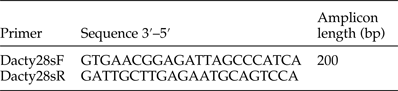
The partial sequence of the 28S rRNA gene from the dactylogyrid species identified in wild spotted rose snappers (H. guttati, E. perezponcei and E. mehen) was amplified and sequenced using the following primers: Ancy55 F (5′-GAG ATT AGC CCA TCA CCG AAG-3′) (Plaisance et al., Reference Plaisance, Littelewood, Olson and Morand2005) and LSU1200R (5′-GCA TAG TTC ACC ATC TTT CGG-3′) (Littlewood et al., Reference Littlewood, Curini-Galletti and Herniou2000). From the three sequences, new primers were designed from a conserved region to amplify DNA from the three species, obtaining a fragment of 200 bp. Details of the primers are shown in table 1. These primers were also used to amplify DNA from the host to confirm the specificity for target DNA.
Primers for qPCR based on partial 28S rRNA sequences.

Amplification
qPCR was performed in a final reaction volume of 5 μl comprising 2.5 μl of EvaGreen® Master Mix (Qiagen), 0.1 μl (final concentration 0.4 μm) of each primer and 1.8 μl of distilled water (dH2O), using 0.5 μl of original template DNA of each species, corresponding to the same number of individuals (e.g. 1 μl template of DNA E. perezponcei (one individual) + 1 μl template of DNA E. mehen (one individual) + 1 μl template of DNA H. guttati (one individual)). Cycling conditions involved an initial step of 95°C for 3 min; followed by 34 cycles of 95°C for 40 s, 60°C for 50 s and 72°C for 50 s using a CFX96™ Real-Time PCR Detection System (BioRad, Veenendaal, The Netherlands). For all assays, a negative control was included, in which dH2O was used instead of the DNA template. qPCR amplification reactions were performed in triplicate for each DNA sample. Melt-curve analysis was also conducted for all samples to ensure specificity of amplified products.
Calibration curves
Log10 transformations of the number of dactylogyrids ranging from 1 to 500 individuals were plotted against quantification cycle (Cq) values obtained in the qPCR assay for each extraction/number of dactylogyrids. The slopes, intercepts and R 2 of the curves were generated using linear regression analysis. An overall calibration curve for all species was generated based on the mixture of DNA extracted from same number of organisms of the three species. Each Cq value was replaced in the obtained equation, and the result was calculated as anti-Log10 to achieve a calculated value of the number of dactylogyrids (CD). A failsafe test was performed to confirm linearity.
Assay precision
Triplicate Cq values obtained from serial (from 1 to 500) individuals were used to measure the intra-assay coefficient of variation. Three separate reactions were tested independently. The mean, standard deviation and variation coefficient were calculated separately for each sample in order to evaluate inter-assay variation.
qPCR to estimate dactylogyrid infestation levels (molecular methods)
Field sampling
From May to November 2012, a total of 85 spotted rose snappers from a cage aquaculture system located off the Isla de la Piedra (23°11′10.15″N and 106°24′47.95″W), Mazatlan Bay in the Mexican Pacific, were analysed for dactylogyrids.
The preference of dactylogyrids for the second gill arch of L. guttatus has been reported previously (Soler-Jiménez and Fajer-Ávila, Reference Soler-Jiménez and Fajer-Ávila2012). Therefore, the left second gill arch of each fish was removed and stored in 96% ethanol for further processing using qPCR. The gill arches were also observed under a dissecting microscope (Olympus) using the 2× objective (total magnification 20×), and the dactylogyrids were isolated, identified, counted (OD, observed data) and stored in 2-ml Eppendorf tubes containing 96% ethanol.
DNA extraction and amplification
Genomic DNA extractions of previously counted dactylogyrids were performed using the salting-out method (Miller et al., Reference Miller, Dykes and Polesky1988). This extraction method is simple and cost-effective, therefore adequate to extract DNA from a large number of samples. The reactions and cycling conditions for qPCR reactions were the same as described above for standard curves.
Quantification of dactylogyrids
The estimated quantification of dactylogyrids was calculated using an overall standard curve. Each Cq value of unknown samples was replaced in the equation, and the result was calculated as the anti-Log10 value to calculate the number of dactylogyrids (CD, calculated data).
Statistical analysis
To confirm whether the CD values were similar to OD values, a linear regression analysis was performed. Additionally, a multiple regression analysis was applied, and an analysis of variance (ANOVA) (P < 0.05) was performed to determine the differences between groups (observed vs. calculated) using SigmaPlot 11.0 software (Systat Software, Inc., San Jose, California, USA).
Results
Specificity and sensitivity of the qPCR assay for the detection of dactylogyrids
Detection limit
In this study, the qPCR assay using specific primers was able to detect and quantify DNA from a single individual (0.98 ng/μl) (Cq = 25.3), considering it as the minimum unit of quantification. Triplicate reactions and experiments yielded similar Cq values, demonstrating a reasonable level of accuracy.
Specificity
The primers designed for the detection of dactylogirids showed 50–60% similarity to 28S sequences from other parasites (trematodes, cestodes and nematodes). The melting and annealing temperature of both primers were 63.5 and 60°C, respectively. This annealing temperature may reduce non-specific hybridizations; however, DNA samples from different fish ectoparasites should be analysed in order to discard false positives. No amplification was obtained from the host genomic DNA (L. guttatus) (fig. 1b). A unique melting peak at 87.7°C was observed from genomic DNA extracted from isolated parasites; the same melting peak was obtained from DNA samples extracted from gills of infected fish.
Assay precision
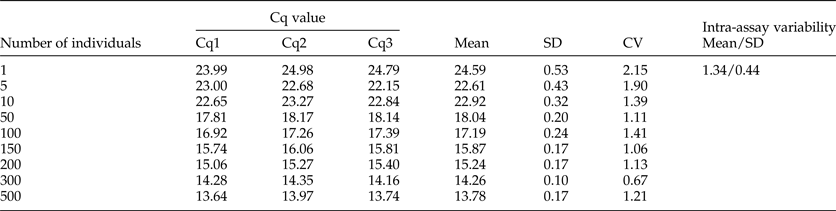
PCR assays were performed in triplicate, showing low variability (table 2). The mean intra-assay coefficient of variation calculated from triplicate Cq values was 1.34 ± 0.44%.
Intra-assay variability calculated from triplicate (Cq1, Cq2 and Cq3) of a same-sample DNA on the same plate. SD, standard deviation; CV, coefficient of variation.

Assay validation
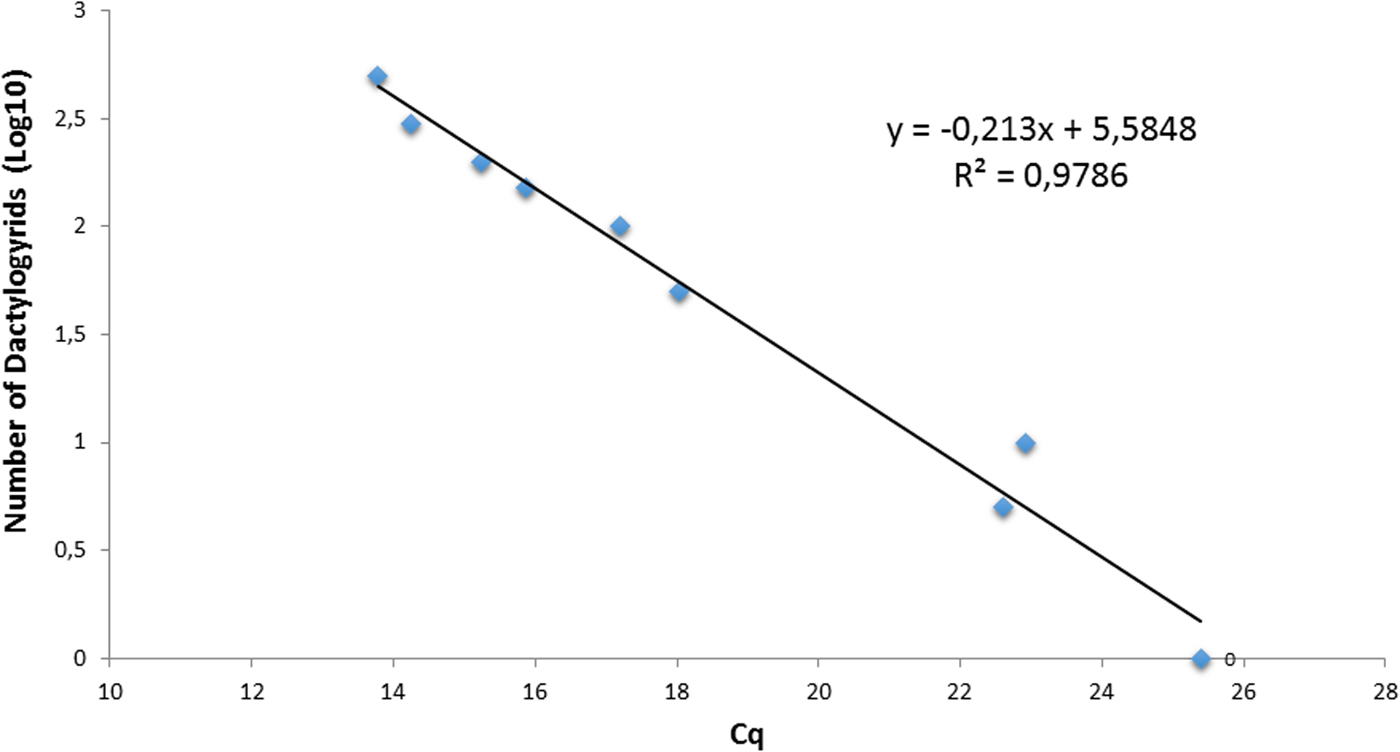
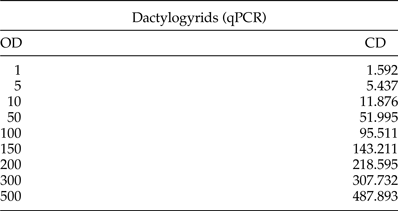
Standard curves were used to calculate the approximate number of individuals in unknown samples. The standard curve involved individuals of three species (E. perezponcei, E. mehen and H. guttati) using EvaGreen® and specific primers (fig. 2). In the analysis, an increase in the Cq value was associated with a decrease in the number of individuals, demonstrating a strong linear relationship between the fluorescence intensity and the number of dactylogyrids (R 2 = 0.97, P < 0.001). The Cq value of each unknown sample was used and replaced in the corresponding equation to generate a data set of calculated values (CD) (table 3). No significant differences between the calculated and observed values (known number, initial count) (P > 0.05) were detected.
Standard curves generated from the dactylogyrid species mixture from known quantities of dactylogyrids. The reactions were performed in triplicate at three separate times.

Comparison of observed data (OD: number of known dactylogyrids) and calculated data (CD: estimated using qPCR). The number of individuals was calculated using the standard curves established for each assay.

Application of qPCR to estimate the number of dactylogyrids in field samples
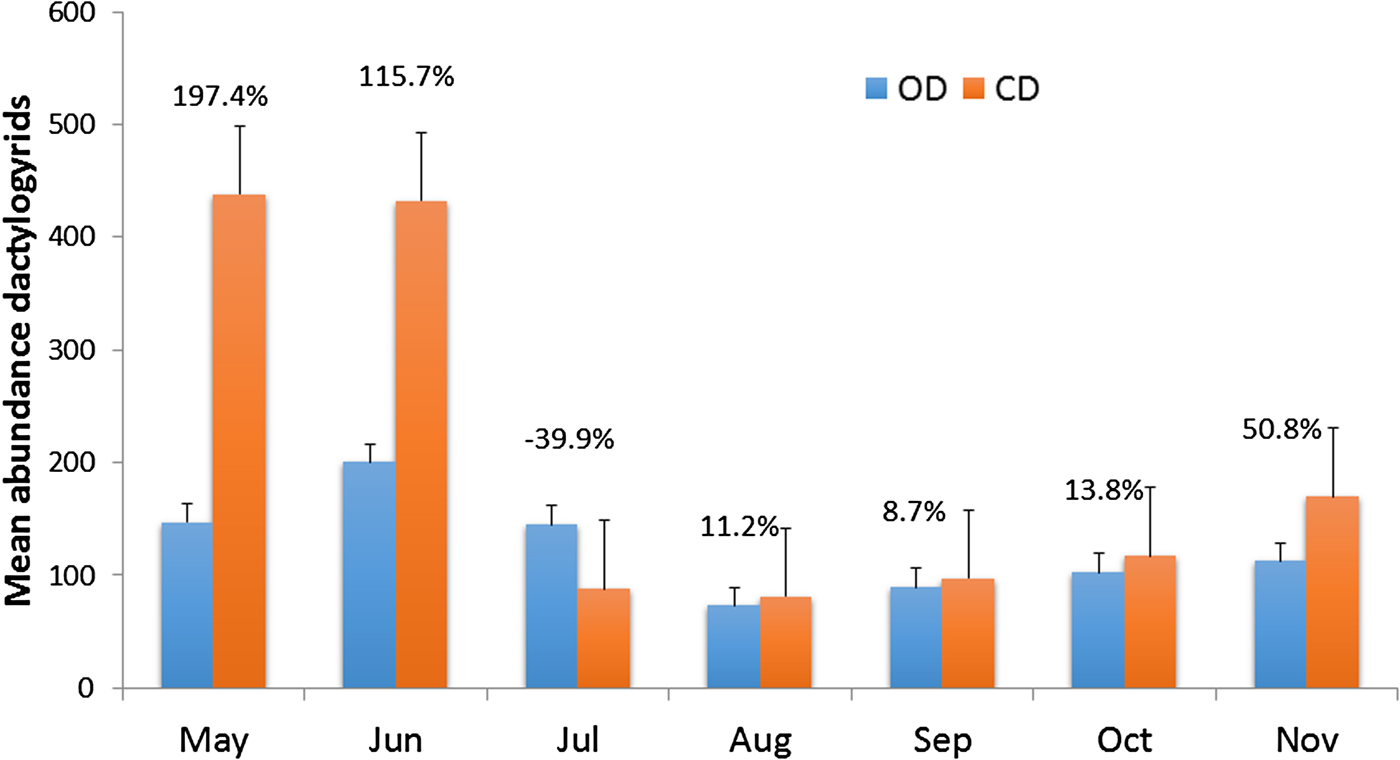
Figure 3 shows the average values of the observed and estimated dactylogyrids for the samples collected from May to November, where an overestimation of parasites using the molecular method is shown. The overestimation observed in the May and June samples was significant (P < 0.05) in both cases. However, for the samples collected from July, August, September, October and November, no significant differences between OD and CD (P > 0.05) were observed. The linear regression analysis indicated that the prediction level of the testing technique is acceptable (R 2 = 0.63, P < 0.05).
Average number of observed data (OD) and calculated data (CD) using qPCR for the number of dactylogyrids. The percentage values represent the differences between the molecular method (CD) and observed data (OD).

Discussion
In the present study, we developed a qPCR method to quantify dactylogyrid monogenean species using EvaGreen®. This method was effective, reliable and applicable to quantification of dactylogyrid species (E. perezponcei, E. mehen and H. guttati) present on gill tissue of spotted rose snappers grown in cages. Similar results were achieved for the detection of Cichlidogyrus spp. in the gill mucus of the Nile tilapia Oreochromis niloticus (Ek-Huchim et al., Reference Ek-Huchim, Jimenez-García, Pérez-Vega and Rodríguez-Canul2012). The presence of low levels of dactylogyrids in spotted rose snapper has not been associated with disease or mortality, but high levels of infection lead to anorexia (Fajer-Ávila et al., Reference Fajer-Ávila, Velásquez-Medina and Betancourt-Lozano2007) and alterations of blood parameters and gill tissue, reflecting a sublethal condition with a potential health risk to farmed fish (Del Río-Zaragoza et al., Reference Del Río-Zaragoza, Fajer-Ávila and Almazán-Rueda2010). Thus, the standardized qPCR method can be used to detect and quantify dactylogyrids, and could be considered a first step in early diagnosis for the adequate control of dactylogyriasis.
To generate the standard curves, we used adult dactylogyrids in serial numbers of individuals, where the minimum unit of quantification was one individual. Nevertheless, the estimation of low levels of dactylogyrids (<10 individuals) was not accurate, and the Cq values obtained from samples containing 1–9 individuals showed no significant differences. Yet, the relationship between the number of parasites and Cq values was significant: a larger amount of DNA (more individuals) was inversely proportional to the Cq value. Studies concerning the development and application of qPCR for the diagnosis of surra in water buffaloes showed that samples with less than 25 trypanosomes/ml of blood were not sufficient to generate a value in the standard curve. The lowest level of trypanosomes detected using the standard curve method was 102 parasites/ml of blood (Taylor et al., Reference Taylor, Boyle and Bingham2008; Konnai et al., Reference Konnai, Mekata, Mingala, Abes, Gutiérrez, Herrera, Dargantes, Witola, Cruz, Inoue, Onumaa and Ohashi2009). Moreover, the limit of sensitivity of the end-point PCR technique to detect Cichlydogyrus spp. was 1.2 ng/μl of purified parasite DNA (Ek-Huchim et al., Reference Ek-Huchim, Jimenez-García, Pérez-Vega and Rodríguez-Canul2012), comparable to the detection of 0.98 ng/μl of DNA from a single dactylogyrid of a spotted rose snapper quantified in the present study.
Although qPCR for dactylogyrids did not differentiate between 1–9 parasites, this method is considered adequate, as fewer than 10 parasites is a low infection level and poses no danger to the fish. Infections with dactylogyrids above 20 per fish in spotted rose snappers damage the gill filaments, and up to 100 parasites per fish can cause disorders in respiratory exchange (Del Río-Zaragoza et al., Reference Del Río-Zaragoza, Fajer-Ávila and Almazán-Rueda2010). Therefore, the estimation of qPCR for infection levels above 10 dactylogyrids can be applied as a diagnostic tool for the early detection of parasites and in monitoring the health and risk status of snappers from floating-cage systems.
Overall, the standard curve method properly estimated the number of dactylogyrids in each host. The estimation of the number of dactylogyrids using the molecular method was closely approximated to the manual count (table 3). However, the May and June samples showed an overestimation (>150%), which may be associated with parasite biology. Studies on the egg production of dactylogyrids illustrated a tendency to produce more eggs with increasing temperature, but outside of the optimal range, both egg production and hatching are reduced (Paperna, Reference Paperna1963; Kearn, Reference Kearn1986). Recent studies have suggested that the largest and most prevalent and abundant dactylogyrid species (E. perezponcei) detected on spotted rose snappers can produce eggs when the temperature increases from 22 to 29°C (Soler-Jiménez et al., Reference Soler-Jiménez, Morales-Serna and Fajer-Ávila2015). Thus, the overestimation of the number of dactylogyrids detected in May and June could reflect the increase in water temperature (from 26 to 29°C). This effect could favour the production of eggs not quantified under the dissecting microscope, representing an increase in the amount of DNA present in the samples.
In conclusion, the assay reports the use of a specific sequence from the 28S rDNA gene of dactylogyrid species for molecular detection. qPCR assays detected and quantified the DNA obtained directly from the isolated parasite and from the parasite DNA present in the gill tissues of snappers, thus improving the quantification of these parasites in farmed fish as an alternative method for the standardized diagnosis of dactylogyriosis and epidemiological surveys However, further studies to evaluate the specificity of the assay must be carried out to refine the detection test.
Acknowledgements
The authors would like to thank R.M. Medina-Guerrero, L.F. Sauma-Castillo and R. Hernández-Cornejo (CIAD-Mazatlán) for technical assistance during field and laboratory work.
Financial support
This study was financially supported partly through a grant from the Fondo Institucional de Fomento Regional para el Desarrollo Científico, Tecnológico y de Innovación (FORDECYT) project no. 147325: ‘Development of technology for on-growing snapper in floating cages: A productive alternative to the shores of the Mexican northwest’. L.C.S-J. was supported through funding from a PhD Scholarship from the National Research Council of Mexico (CONACyT No. 240853).
Conflict of interest
None.
Ethical standards
The authors assert that all procedures contributing to this work comply with the ethical standards of the relevant national and institutional guides on the care and use of laboratory animals.