The central question addressed in this study is as follows: Among youth in upper-middle class communities, might dimensions of negative and positive peer reputation, measured through peer nominations in middle school, be significantly related to adjustment at the end of high school? In view of the strong influence of peers during adolescence, we aimed to investigate long-term associations of peer reputation in middle school with academic outcomes (both grade point average [GPA] and standardized Scholastic Aptitude Test [SAT] scores), internalizing and externalizing symptoms, and substance use (alcohol, cigarette, and marijuana use) in late adolescence in a sample of relatively affluent youth. Peer reputation was characterized on 4 dimensions: popular, prosocial, aggressive, and isolated. Specific positive versus negative associations, characterized in the following section, were expected between individual dimensions assessed in middle school and outcomes fully 6 years later.
Our focus on this group stems from the perception that “privileged” youth attending high-achieving schools should generally be well adjusted; greater social support, more material resources, and high-quality education associated with higher socioeconomic status would place them on a positive developmental path (Bradley & Corwyn, Reference Bradley and Corwyn2002); however, by adolescence, this demographic of teens exhibits elevated rates of serious symptoms and substance use compared with national norms (for reviews, see Luthar, Barkin, & Crossman, Reference Luthar, Barkin and Crossman2013; Luthar & Kumar, Reference Luthar, Kumar, Leschied, Saklofske and Flettin press). The quality of their peer reputations may relate to adjustment over time, including academic achievement, psychopathology, and substance use.
Peer Relationships and Reputation
Peer influence on adolescents’ behavior may occur through both interaction with and observation of other youth. Through social learning, teens develop beliefs about normative peer behavior and adjust their conduct to align with age group members (Gardner & Steinberg, Reference Gardner and Steinberg2005). In smaller peer sets, youth take on specific in-group norms, and, as part of group membership, are labeled by their peers with certain reputations (Rubin, Coplan, Chen, Buskirk, & Wojslawowicz, Reference Rubin, Coplan, Chen, Bowker, McDonald, Bornstein and Lamb2005). Youth also self-select into groups based on reputation, reinforcing their beliefs and behaviors through shared group norms (Chung-Hall & Chen, Reference Chung-Hall and Chen2010). Regardless of selection or socialization, social identity theory states that group membership plays a role in identity development and subsequent behaviors (Barber, Stone, Hunt, & Eccles, Reference Barber, Stone, Hunt, Eccles, Mahoney, Larson and Eccles2005), with far-reaching effects on adjustment. Thus, peer reputation merits examination in terms of future functioning.
Middle school peer reputation
The impact of peer reputation may be particularly important in middle school, a time when youth begin to place more importance on the evaluations of peers rather than parents (Rosenberg, Reference Rosenberg1979). As part of this process, youth invest in earning and maintaining a positive peer reputation, often desiring to be seen as popular (Cillessen, Schwartz, & Mayeux, Reference Cillessen, Schwartz and Mayeux2011). The acquisition of particular types of peer reputation may in turn have significant ramifications for adjustment over time.
For youth in high-achieving schools, reputation may be especially influential given increased social competition. Adolescents with parents of relatively high socioeconomic status have been found to have greater competitiveness and peer envy than adolescents with parents of middle or low socioeconomic status (Buunk, Stulp, & Ormel, Reference Buunk, Stulp and Ormel2014; Luthar & Kumar, in press). One possibility is that adults with high socioeconomic status may pass on to their children an emphasis on extrinsic values such as status (Ciciolla, Curlee, Karageorge, & Luthar, Reference Ciciolla, Curlee, Karageorge and Luthar2017) that could increase their children's pressure to succeed socially.
Measuring peer reputation
Peer reputation, based on classmate nominations along multiple dimensions (e.g., aggressiveness, isolation), reflects a young person's social behaviors, characteristics, and influence among peers (Gest, Sesma, Masten, & Tellegen, Reference Gest, Sesma, Masten and Tellegen2006). Peer reputation is distinct from sociometric status (i.e., whether the child is liked or disliked) assessed by nominations from classmates for “liked most” and “liked least” (Prinstein & La Greca, Reference Prinstein and La Greca2004). Put another way, peer reputation consists of the major behavioral profiles, both negative and positive, that tend to define an individual in the eyes of peers (Prinstein, Reference Prinstein2007). Behavioral profiles as peer reputations are useful in capturing peer concepts such as perceived popularity (Rubin et al., Reference Rubin, Coplan, Chen, Bowker, McDonald, Bornstein and Lamb2005).
Peer reputation has commonly been measured by the Revised Class Play (RCP; Masten, Morison, & Pellegrini, Reference Masten, Morison and Pellegrini1985), wherein students place their classmates into different roles for a play they are directing. The roles map onto specific attributes that underlie dimensions of peer reputation. Peer nominations for the RCP roles have revealed 4 dimensions: popular, prosocial, aggressive, and isolated. The first two are sometimes combined into one positive reputation labeled sociability-leader (Gest et al., Reference Gest, Sesma, Masten and Tellegen2006; Masten et al., Reference Masten, Morison and Pellegrini1985; Obradović, Burt, & Masten, Reference Obradović, Burt and Masten2009). Zeller, Vannatta, Schafer, and Noll (Reference Zeller, Vannatta, Schafer and Noll2003) explored the psychometric properties of the RCP across elementary, middle, and high school students, finding a 4-factor model to be a reliable and valid way to evaluate behavioral reputation across all age ranges (see also Luthar & McMahon, Reference Luthar and McMahon1996).
Popular reputation describes youth who are socially central and prominent among their peers, reflected in RCP roles “everyone likes to be with” and “makes new friends easily.” In contrast, a prosocial reputation is characterized by friendliness, trustworthiness, and helpfulness as reflected in roles “helps others when they need it” and “polite” (Zeller et al., Reference Zeller, Vannatta, Schafer and Noll2003). The aggressive, or aggressive-disruptive, reputation encompasses hostile and antisocial behavior exemplified in roles “gets into a lot of fights” and “teases other children too much.” Last, an isolated reputation represents youth who rarely interact with peers, as illustrated by the roles “has trouble making friends” and “often left out” (Gest et al. Reference Gest, Sesma, Masten and Tellegen2006; Masten et al., Reference Masten, Morison and Pellegrini1985).
Each peer reputation relates to personal and behavioral adjustment concurrently and over time among low- and middle-socioeconomic status youth, including academic achievement, internalizing and externalizing symptoms, and, more rarely studied, substance use. Both person-oriented and variable-oriented approaches have been used to establish reputation-outcome linkages (Luthar & McMahon, Reference Luthar and McMahon1996). The variable-oriented strategy predominates in studies linking the RCP to outcomes considered here. Finally, we note that with 2 exceptions (Becker & Luthar, Reference Becker and Luthar2007; Luthar & D'Avanzo, Reference Luthar and D'Avanzo1999), the literature reviewed here is based on samples of students in low and middle-socioeconomic status communities.
Prosocial peer reputation and adjustment
Prosocial is the least understood peer reputation, partly because prosocial reputation is separated from popular reputation in only some research. On its own, high prosocial reputation is associated with positive adjustment indices such as relatively low externalizing symptoms (Gest et al., Reference Gest, Sesma, Masten and Tellegen2006; Luthar, Reference Luthar1995). High prosocial reputation longitudinally predicts the highest teacher ratings of adaptive functioning among the 4 common RCP peer reputations (Realmuto, August, & Hektner, Reference Realmuto, August and Hektner2000), as well as better academic and romantic outcomes later in life (Gest et al., Reference Gest, Sesma, Masten and Tellegen2006). The scant research linking prosocial reputation to substance use shows a negative relationship (Carlo, Crockett, Wilkinson, & Beal, Reference Carlo, Crockett, Wilkinson and Beal2011).
In this sample, we predicted that youth with higher prosocial scores would exhibit positive outcomes in high school. These outcomes included low levels of internalizing and externalizing symptoms, high academic achievement, and infrequent substance use over time.
Popular peer reputation and adjustment
Popular reputation, or perceived popularity as distinct from likeability, has gained recent attention. Beyond RCP popular reputation, popularity is measured by peer nominations of “most popular” and “least popular” (e.g., Mayeux, Sandstrom, & Cillessen, Reference Mayeux, Sandstrom and Cillessen2008). Unlike likeability, popularity is associated with both positive and negative traits (Cillessen & Mayeux, Reference Cillessen and Mayeux2004). On the one hand, youth with popular reputations thrive as well-adjusted individuals, manifesting relatively high social and romantic competence in longitudinal research (Gest et al., Reference Gest, Sesma, Masten and Tellegen2006). Similarly, popular reputation among Grade 9 students predicted lower internalizing symptoms over time (Luthar, Reference Luthar1995). On the other hand, popular reputation has been linked to negative outcomes. Among elementary and middle school children, popular reputation was positively associated with externalizing symptoms (Gest et al., Reference Gest, Sesma, Masten and Tellegen2006); a sociable reputation among high school youth was associated with academic declines over a 6-month period (Luthar, Reference Luthar1995). Moreover, youth who use substances in middle school are more likely to be rated as popular by their peers (Killeya-Jones, Nakajima, & Costanzo, Reference Killeya-Jones, Nakajima and Costanzo2007), and peer-perceived popularity positively predicts alcohol use (Guyll, Madon, Spoth, & Lannin, Reference Guyll, Madon, Spoth and Lannin2014; Mayeux et al., 2008).
Further distinguishing popularity from likability are positive associations between popularity and both aggression and deviant behavior (López-Romero & Romero, Reference López-Romero and Romero2010; Sandstrom & Cillessen, Reference Sandstrom and Cillessen2006). Perceived popularity in high school has been linked to high-risk behaviors in emerging adulthood, including drug use and sexual behavior (Sandstrom & Cillessen, Reference Sandstrom and Cillessen2010). Popularity also exhibits positive longitudinal bidirectional relationships with both physical and relational aggression (Cillessen & Borch, Reference Cillessen and Borch2006; Cillessen & Mayeux, Reference Cillessen and Mayeux2004). For popular youth, aggressive behaviors may be useful during adolescence with decreased effectiveness as they age (Cillessen & Rose, Reference Cillessen and Rose2005).
In affluent communities, popular youth tend to be particularly prone to high substance use, reporting higher rates of alcohol, marijuana, and illicit drug use compared with national norms and with inner-city youth (Luthar & D'Avanzo, Reference Luthar and D'Avanzo1999). Elevated rates of use have been replicated across several samples from relatively affluent schools (Coley, Sims, Dearing, & Spielvogel, Reference Coley, Sims, Dearing and Spielvogel2017; Lund, Dearing, & Zachrisson, Reference Lund, Dearing and Zachrisson2017; Luthar & Barkin, Reference Luthar and Barkin2012). Within the context of affluence, these elevated rates may be connected to a desire for peer approval. Indeed, peer-perceived popularity has been associated with substance use in boys in affluent, suburban communities (Becker & Luthar, Reference Becker and Luthar2007; Luthar & D'Avanzo, Reference Luthar and D'Avanzo1999).
In this study, we predicted negative associations of popular reputation with academic success and internalizing symptoms. Conversely, we predicted positive associations of popular reputation with substance use and externalizing symptoms.
Aggressive peer reputation and adjustment
Not surprisingly, most studies positively link aggressive reputations with elevated maladjustment, given that aggression is an externalizing behavior (Reef, Diamantopoulou, van Meurs, Verhulst, & van der Ende, Reference Reef, Diamantopoulou, van Meurs, Verhulst and van der Ende2011). Peer-nominated aggressive reputation predicted teacher-rated low competence (Yang, Chen, & Wang, Reference Yang, Chen and Wang2014), as well as teacher-reported elevated externalizing symptoms 4 years later (Realmuto et al., Reference Realmuto, August and Hektner2000). Childhood aggressive reputation predicted externalizing symptoms, worse academic achievement, and lower job competence 10 years later (Gest et al., Reference Gest, Sesma, Masten and Tellegen2006; Morison & Masten, Reference Morison and Masten1991).
Few studies have explored the relationship between aggressive reputation and substance use. Peer-reported aggressive reputation in preadolescent girls predicted cigarette use, heavy episodic drinking, and marijuana use in late adolescence (Prinstein & La Greca, Reference Prinstein and La Greca2004). This is consistent with evidence that teacher-, parent-, and self-reported childhood aggression is each linked with later substance use (Fite, Colder, Lochman, & Wells, Reference Fite, Colder, Lochman and Wells2007; Jester, Nigg, Buu, Puttler, Glass, et al., Reference Jester, Nigg, Buu, Puttler, Glass, Heitzeg and Zucker2008).
Despite these associations with negative outcomes, aggressive reputation has also shown positive links with social competence and higher status among peers (Becker & Luthar, Reference Becker and Luthar2007; Prinstein & Cillessen, Reference Prinstein and Cillessen2003). Unlike youth viewed as isolated, youth seen as aggressive have many peer interactions (Bagwell, Coie, Terry, & Lochman, Reference Bagwell, Coie, Terry and Lochman2000), which may be associated with social feedback and higher social status; this is supported by the previously discussed association between popularity and aggression (Cillessen & Borch, Reference Cillessen and Borch2006; Gest et al. Reference Gest, Sesma, Masten and Tellegen2006). More specifically, there is a strong link between popularity and relational aggression, a means to achieve high peer status (Cillessen & Mayeux, Reference Cillessen and Mayeux2004).
In this study, we expected that associations between aggressive reputation and outcome measures would resemble those for popular reputation. These included positive links with externalizing symptoms and substance use and negative links with internalizing symptoms and academic achievement.
Isolated peer reputation and adjustment
Prior work is inconclusive on the relationship between isolated peer reputation and internalizing symptoms (Morison & Masten, Reference Morison and Masten1991; Oh, Rubin, Bowker, Booth-LaForce, Rose-Krasnor, & Laursen, Reference Oh, Rubin, Bowker, Booth-LaForce, Rose-Krasnor and Laursen2008; Realmuto et al., Reference Realmuto, August and Hektner2000). Gest et al. (Reference Gest, Sesma, Masten and Tellegen2006) found that when the isolated reputation is divided into three facets (peer exclusion, withdrawn, sad-sensitive), only high scores on the sad-sensitive facet were related to higher risk for internalizing symptoms. Research focused on self-reported social isolation suggests that peer isolation puts children at risk for later internalizing symptoms. Moreover, children isolated from peers show higher odds of suicide attempts, elevated depressive symptoms, and lower self-esteem (Hall-Lande, Eisenberg, Christenson, & Neumark-Sztainer, Reference Hall-Lande, Eisenberg, Christenson and Neumark-Sztainer2007).
Encouragingly, isolated reputation is positively linked to higher concurrently assessed academic achievement (Chen, Wang, & Cao, Reference Chen, Wang and Cao2011; Luthar & McMahon, Reference Luthar and McMahon1996). Further, high academic achievement appears to be protective over time, mitigating the longitudinal relationship of isolated reputation to internalizing symptoms (Chen, Yang, & Wang, Reference Chen, Yang and Wang2013). In addition to academic benefits, a higher score on sensitive-isolated reputation predicted fewer externalizing problems 4 years later (Realmuto et al., Reference Realmuto, August and Hektner2000).
Evidence on isolation from peers and substance use is mixed. Some research connects peer isolation to a greater risk of substance use (Prinstein, Rancourt, Guerry, & Browne, Reference Prinstein, Rancourt, Guerry, Browne, Rubin, Bukowski and Laursen2009); other studies indicate a lower risk, particularly for alcohol use (Kramer & Vaquera, Reference Kramer and Vaquera2011). It is conceivable that an isolated reputation may be protective from negative outcomes such as drug use because these children remain sheltered from the deviant influences of their peers.
In this study, we predicted a positive relationship between scores on isolated reputation and both internalizing symptoms and academic outcomes. In contrast, we predicted a negative relationship between isolated reputation scores and both externalizing symptoms and substance use.
Summary of Goals: Illuminating the Long-term Implications of Peer Reputation
Given mixed evidence on links between peer reputation and outcomes, coupled with powerful peer influences during middle school and elevated social competitiveness among youth in relatively affluent communities, our goals were to investigate the long-term associations of peer reputation in middle school and multiple outcomes in late adolescence. Adjustment indices examined included academic performance (both GPA and standardized SAT scores), symptoms of both internalizing and externalizing, and substance use (alcohol, cigarette, and marijuana use). Hypotheses were that (a) both popular and aggressive reputations in middle school would be positively associated with substance use and externalizing symptoms and negatively associated with internalizing symptoms and academic outcomes in late adolescence; (b) prosocial reputation in middle school would be negatively associated with substance use, internalizing symptoms, and externalizing symptoms, and positively associated with academic outcomes in late adolescence; and (c) isolated reputation in middle school would be negatively associated with substance use and externalizing symptoms and positively associated with academic outcomes and internalizing symptoms in late adolescence.
Methods
Sample
Data for this study from Grades 6, 7, and 12 (obtained in Spring 1999, 2000, and 2005 respectively) came from a larger longitudinal study, the New England Study of Suburban Youth (Luthar & Barkin, Reference Luthar and Barkin2012), in which data were collected annually in middle and high schools. At the beginning of the study, of the eligible 346 Grade 6 students in the two middle schools in the town, 319 participated (152 females and 167 males), producing a 92% initial participation rate. Another 37 students joined the study in Grade 7. When long-term outcome data were collected in 2005 at the end of Grade 12, 209 of the original participants completed the questionnaires, generating a 59% retention rate across the 6 years (Luthar & Barkin, Reference Luthar and Barkin2012).
Most students in the sample were Caucasian (92% white non-Hispanic). The average age of the 319 participants at Wave 1 (Grade 6) of the study was 11.57 (SD = .54) years for boys and 11.56 (SD = .50) years for girls. According to the US Census Bureau (2000), the approximate mean and median annual family incomes at the first wave of the study were $188,000 and $152,000, respectively, classifying this community as affluent. More recent state data from 2014 show mean and median family income at approximately $255,000 and $152,000 (Department of Economic and Community Development, 2016).
Procedure
Participants were recruited for the study through passive consent, with letters mailed home to parents with study information and a form to request that their child not participate. All survey materials were stored by subject number and, to date, data have been presented in aggregate form to protect participants’ confidentiality in accordance with approved institutional review board protocols.
Data collection in Grades 6 and 7 occurred during school hours over a 2-day period in classrooms of 20–25 students, with questions read aloud to students. Classroom teachers were gifted $1 per participating student toward a pizza party, a recommendation from the school administration, and teachers were compensated $5 for each student they rated. With permission from parents and the school administration, class grades were collected for all participating students. In Grade 12, data were collected with students seated at tables in the cafeteria. Again, class grades were collected with permission from parents and school administration, as were SAT scores.
Predictors
RCP nominations in Grades 6 and 7
To measure social reputation, the RCP (Masten, et al., Reference Masten, Morison and Pellegrini1985) was used. We selected, a priori, 4 items to represent each of the 4 RCP dimensions in this study. These were items that have high face validity as measures of the construct and have consistently shown high factor loadings on the dimension in past research (Luthar & McMahon, Reference Luthar and McMahon1996; Zeller et al., Reference Zeller, Vannatta, Schafer and Noll2003).
Students chose classmates who best fit roles for an imaginary play they were directing. Each student received a list of participating classmates from their English class; in reminding children of all available classmates, using such a list decreased the likelihood that some students (e.g., those absent from class that day) would be overlooked in nominations. Students could nominate up to 3 peers in all, including boys and girls, for each role and could nominate the same peer for more than one role. Students were not allowed to self-nominate. This procedure produces a sum of counts of peer nominations for children within a given class, generated by a group who knows them well, because they have interacted with them for several months as classmates. In short, what we obtained were nominations on children's observed behaviors by a group of others who interacted with them regularly.
Roles in the play included both positive (“is a good leader”) and negative (“can't get others to listen”) attributes. The same 16 items from the RCP in Grades 6 and 7 were analyzed. The observed score on each item was the number of nominations a student received, standardized within classroom and gender to control for variation in overall class size and gender mix within classrooms (Luthar & McMahon, Reference Luthar and McMahon1996; Realmuto et al., Reference Realmuto, August and Hektner2000).
Good psychometric properties of the RCP have been documented with middle school children, including high factor structure reliability across 6 months with the 4-factor model (Luthar & McMahon, Reference Luthar and McMahon1996) and across 17 months with the 3-factor model (Masten et al., Reference Masten, Morison and Pellegrini1985). High internal consistency of RCP scale scores measured by coefficient alpha using a 4-factor model have been documented across genders (Luthar & McMahon, Reference Luthar and McMahon1996), cross-culturally (Casiglia, LoCoco, & Zappulla, Reference Casiglia, LoCoco and Zappulla1998), and across school levels (Zeller et al., Reference Zeller, Vannatta, Schafer and Noll2003), including elementary, middle, and high schools. Construct validity has been supported through comparison to related adjustment indices (Casiglia et al. Reference Casiglia, LoCoco and Zappulla1998; Luthar & McMahon, Reference Luthar and McMahon1996). When measured in middle school, the RCP was found to have predictive validity for psychosocial adjustment during adolescence and early adulthood (Gest et al., Reference Gest, Sesma, Masten and Tellegen2006; Morison & Masten, Reference Morison and Masten1991). As reported in the following section, we found adequate internal consistency of the RCP scales in both Grades 6 and 7 in the present data.
Grade 12 outcome variables
Substance use
To measure substance use, the frequency of drug use grid from the Monitoring the Future study was used (Bachman, O'Malley, & Johnston, Reference Bachman, O'Malley and Johnston1984). This measure asks participants to endorse how often a substance was used over the preceding year and the preceding month. Responses were on a 7-point Likert scale ranging from “never” to “40 + times.” Self-report has been previously documented as a valid method of measuring drug use, showing construct validity, external validity, and internal validity (O'Malley, Bachman, & Johnston, Reference O'Malley, Bachman and Johnston1983). In this study, use of alcohol, cigarettes, and marijuana over the past year served as outcome measures of drug use, given that these 3 substances have the highest rates of use among high school students (Johnston, O'Malley, & Bachman, Reference Johnston, O'Malley and Bachman2005).
Internalizing and externalizing symptoms
The internalizing and externalizing scales of the Youth Self Report (YSR), a 112-item measure (Achenbach & Rescorla, Reference Achenbach and Rescorla2001), were used to determine symptom severity. The 3 alternative responses to each item were as follows: 0 = not true; 1 = somewhat or sometimes true, and 2 = very true or often true. Internalizing symptoms were computed using the YSR subscales Anxious-Depressed, Withdrawn-Depressed, and Somatic, whereas externalizing symptoms consisted of Rule Breaking and Aggressive Behavior subscales. This widely used measure has been shown to be reliable and valid (Achenbach & Rescorla, Reference Achenbach and Rescorla2001). In this study, Cronbach's alpha coefficients for girls and boys, respectively, were as follows: Anxious-Depressed .78 and .86, Withdrawn-Depressed .72 and .76, Somatic .70 and .85, Rule Breaking .68 and .77, and Aggressive Behavior .82 and .82. For the combined internalizing subscale, there was good internal consistency, as measured by coefficient alpha .85 for girls and .92 for boys; the same was true for the combined externalizing subscale, with coefficient alpha of .84 for girls and .88 for boys.
Academic outcomes
Academic achievement was measured with two variables.
GPA
GPA was calculated for each student using grades from 4 classes (English, math, science, and social studies) from the previous 3 school-year quarters. It was used as an indicator of academic achievement. Letter grades were coded such that an A+ received a score of 13 and an F received a score of 1.
SAT
SAT scores assess a high school student's academic college readiness. It is a standardized test taken by high school students in the United States and is a widely used criterion for college admissions. When SAT data were collected in this study, tests were scored on a scale from 400 to 1,600, with higher scores indicating higher college readiness.
Statistical analyses
Mplus 7.11 (Muthén & Muthén, Reference Muthén and Muthén2011) was used to evaluate the extent to which the models fit the data within a structural equation model framework. Two classes of analyses were performed. The first was a series of CFAs examining the factor structure of the RCP. The second was a series of structural models predicting Grade 12 outcomes from middle school peer reputations (i.e., from the 4 RCP dimensions). Variance–covariance matrices were analyzed to estimate parameters for both measurement and structural models. Goodness of fit was assessed by χ 2 tests as well as root mean square error of approximation (RMSEA), comparative fit index (CFI), and standardized root mean square residual (SRMR). Adequate fit was based on the following cutoff scores: RMSEA < .08, CFI > .95, and SRMR < .05 (Hu & Bentler, Reference Hu and Bentler1999; Yu & Muthén, Reference Yu and Muthén2002).
All analyses of Grade 12 outcomes controlled for Grade 6 status on the same or closely related measures. Specifically, GPA at Grade 6 served as the covariate for Grade 12 GPA; Grade 6 GPA also served as the covariate for SAT, which is measured in Grade 12 only. As covariates for Grade 12 internalizing, we used Grade 6 depression and anxiety measured by the Children's Depression Inventory (CDI; Kovacs, Reference Kovacs1992) and the Revised Children's Manifest Anxiety Scale (R–CMAS; Reynolds & Richmond, Reference Reynolds and Richmond1985). Delinquency at Grade 6 served as the covariate for Grade 12 externalizing. Grade 6 alcohol use, cigarette use, and marijuana use served as covariates for Grade 12 alcohol use, cigarette use, and marijuana use, respectively.
Results
Missing data
Of the original 356 participants with data from Grades 6, 7, or both, 147 cases (41%) were eliminated because the child was not available in Grade 12 to collect data. On 6 of 8 study variables, there were nonsignificant differences between retained and attrited Grade 6 students: GPA ([retained – attrited], t (317) = 1.37, p = .17, d = .16), depression symptoms (t (313) = .91, p = .37, d = .10), anxiety symptoms (t (310) = .36, p = .72, d = .04), delinquency (t (308) = –.28, p = .78, d = .04), prosocial reputation t (317) = 1.37, p = .17, d = .16, and isolated reputation t (317) = –.33, p = .74, d = .04. However, children who attrited had higher aggressive and popularity scores [retained – attrited] t (317) = –3.42, p < .01, d = .38, t (317) = –2.35, p = .02, d = .26, respectively. In all, 14% of attrited students had aggression scores at least 2 SD above the mean in Grade 7 as opposed to 7% of retained students. For popularity, these values were 11% versus 5%, respectively. Substance use was almost nonexistent in Grade 6 and so was not used in attrition analyses.
Missing data were handled in all analyses with full information maximum likelihood estimation in Mplus 7.11 (Muthén & Muthén, Reference Muthén and Muthén2011). Twenty-three students lacked Grade 6 RCP reputation scores and 10 lacked only Grade 7 RCP scores. All peer reputation data from students measured at a particular grade were complete. RCP measures are based on peer report; therefore, students with permission to participate in the study did not have to be present to be nominated by their peers for roles in the RCP. One participant did not respond to Grade 12 alcohol, cigarette, and marijuana use. Five GPA and 14 SAT scores were missing, and 1 participant was lacking YSR data.
Measurement model
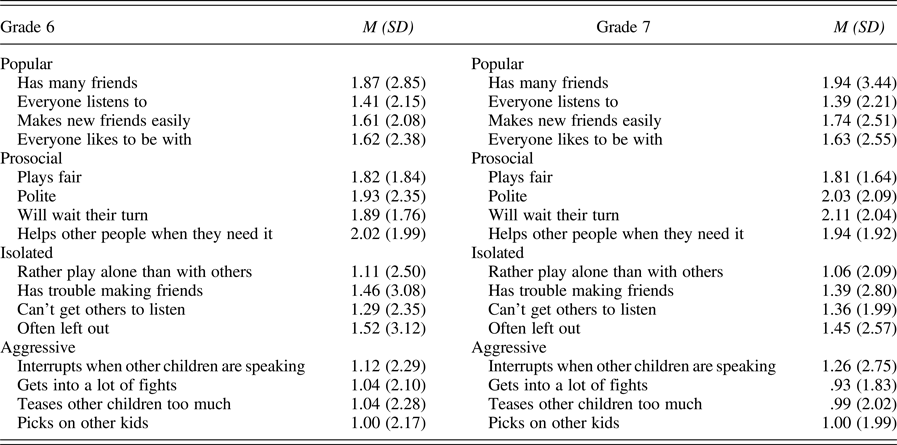
The measurement model for the RCP predicted a 4-factor structure previously reported by Luthar and McMahon (Reference Luthar and McMahon1996) and Zeller et al. (Reference Zeller, Vannatta, Schafer and Noll2003). Table 1 shows the items hypothesized to compose each reputation along with the mean count and SD of nominations received by students. The relatively low skew and kurtosis of the items were within the cutoffs provided by West, Finch, and Curran (Reference West, Finch, Curran and Hoyle1995) for use of maximum likelihood estimation.
Distribution of items from the RCPa

Note: RCP, Revised Class Play.
a Based on counts of number of nominations received by students on RCP items.
Initial confirmatory factor analysis
The model for the CFA contained the 4 RCP dimensions as latent factors, with the 16 individual items permitted to load on their specific latent factors only. The 4 RCP latent factors were permitted to covary because the RCP measure permitted nominations of a student on multiple scales. The initial CFAs were estimated on Grades 6 and 7 separately; identical models were estimated in the 2 grades. Initial modeling of the 4-factor, 16-item model in each grade revealed 2 extremely highly correlated items on the aggression factor: “picks on other kids” and “teases other children too much,” r = .73 in Grade 6 and r = .71 in Grade 7. The “picks on other kids” item was deleted both because of this high correlation and its high skew and kurtosis in Grade 6. The prosocial item “will wait their turn” was also deleted because of its strong cross loadings on popularity and aggressive factors in Grade 6 and popularity, aggressive, and isolated factors in Grade 7.
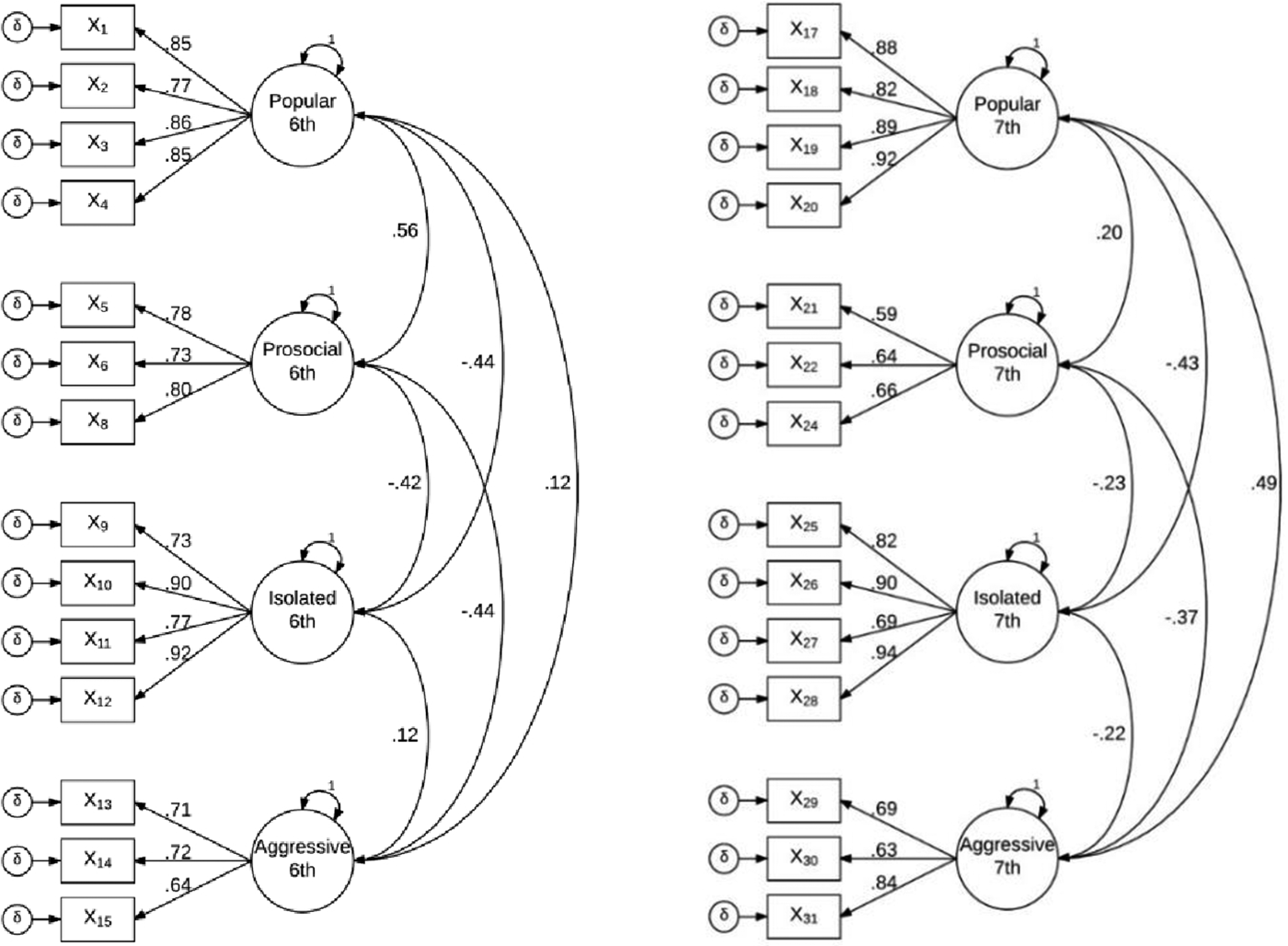
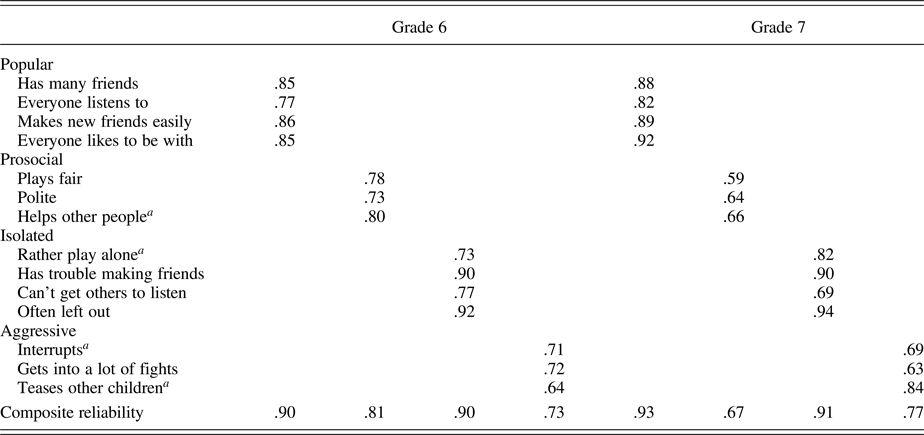
The CFA models at each grade were re-estimated with the 14 items listed in Table 2 (i.e., 4 popular, 3 prosocial, 3 aggressive, 4 isolated). Models are presented in Figure 1. Fit was acceptable, based on fit indices in both grades: Grade 6 (χ 2 (71, N = 186) = 116.04, p < .01; CFI = .97; RMSEA = .06 [90% CI = .04, .08]; SRMR = .05) and Grade 7 (χ 2 (71, N = 199) = 87.24, p = .09; CFI = .99; RMSEA = .03 [90% CI = .00, .06]; SRMR = .04). All items loaded on their respective factors, with item loadings ranging from .64 to .92 and .59 to .94 in Grades 6 and 7, respectively (Table 2). Composite reliabilities, reported in Table 2, ranged between .67 and .93 and were calculated by dividing the sum of the squared standardized factor loadings by the sum of squared standardized factor loadings plus the sum of the residual error variances following Raykov (Reference Raykov1997).
Respecified Grade 6 and 7 CFA models excluding 2 items of the RCP with standardized loadings.

Standardized factor loadings on peer reputation latent constructs for respecified model

Note: Composite reliability calculated as suggested by Raykov (Reference Raykov1997). Two RCP items removed: “will wait turn” and “picks on other kids.” Latent variables allowed to covary and variances equal to 1.
aItem name shortened.
Specification of combined-grades model
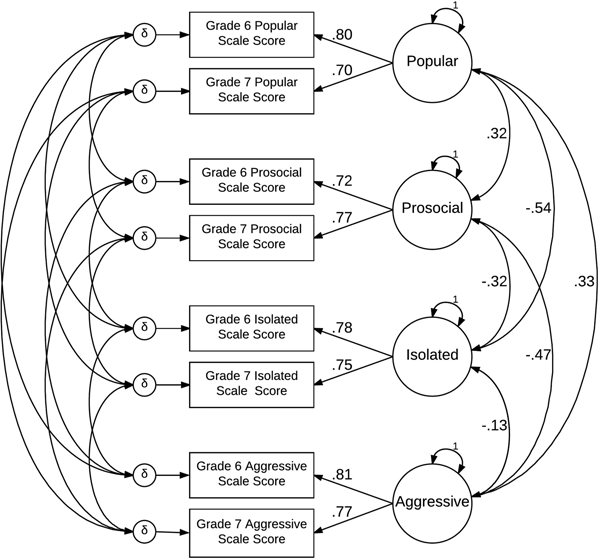
Within each grade, the 3 or 4 indicators of each reputation were summed to create 4 reputation scale scores per grade level. As shown in Figure 2, the measured reputation scale scores in Grades 6 and 7 served as indicators of the latent RCP dimensions; for model identification, unstandardized loadings of the 2 indicators per reputation scale were constrained equal. RCP dimensions were permitted to correlate. Within each grade, all indicators were permitted to correlate to account for shared time of measurement.
Combined-grades model with reputation scale scores in Grades 6 and 7 as indicators of each latent factor with standardized loadings.

The combined-grades model fit the data well (χ 2 (6, N = 209) = 8.42, p = .21; CFI = .99; RMSEA = .04 [90% CI = .00, .11]; SRMR = .04) without further adjustments to the model. Correlations among latent factors are given in Figure 2, as are standardized loadings of all indicators on their respective factors. All indicators loaded significantly on their respective factors (p < .01 in all cases), and all peer reputation latent factors were significantly correlated (p < .01 in all cases) with the exception of isolated and aggressive.
Structural equation models
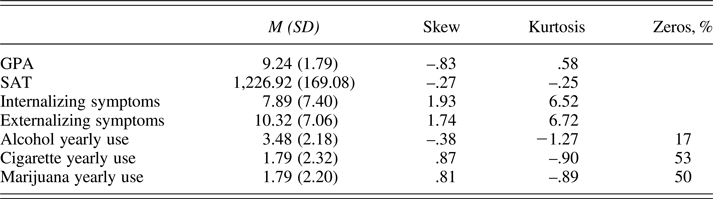
A total of 7 path models were used to predict adjustment outcomes at Grade 12 from the 4 RCP scores and appropriate covariates. Continuous outcomes included academic achievement (GPA and SAT scores) and psychopathology (internalizing and externalizing); ordered categorical outcomes included alcohol, cigarette, and marijuana use. The latent variable structure of the RCP from the combined-grades model served as predictors of each outcome in a series of structural equation models. Appropriate Grade 6 covariates were included in the models (e.g., Grade 6 GPA in the model predicting Grade 12 GPA). Descriptive statistics of the adjustment outcome variables are reported in Table 3.
Descriptive data on adjustment outcomes in Grade 12

Note: grade point average range (1 = F – 13 = A+); Scholastic Aptitude Test (400–1,600); internalizing symptoms, youth self-report (0–62); externalizing symptoms, youth self-report (0–64); substance use (0 = never to 6 = 40 + times).
Correlations of latent RCP variables
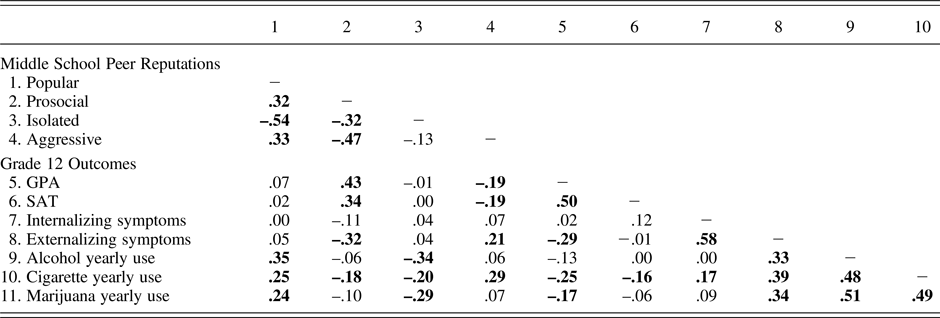
Table 4 contains the correlations estimated in the structural equation models among the RCP latent dimensions and of the RCP dimensions with the 7 outcome variables. There were substantial correlations among the RCP latent variables, notably between popular and isolated (latent correlation = –.54) and between prosocial and aggressive (latent correlation = –.47). Prosocial was positively correlated with GPA and SAT, whereas aggression was negatively correlated. Popular exhibited positive correlations with all substance use variables, whereas the opposite was true for isolated reputation. Aggression was only slightly (nonsignificantly) positively correlated with alcohol and marijuana use, but more strongly with cigarette use. No RCP dimension correlated with internalizing, whereas prosocial correlated negatively, and aggressive positively, with externalizing.
Correlations between measured outcome variables and peer reputation latent constructs

Note. GPA, grade point average; SAT, Scholastic Aptitude Test. Bolded correlations are significant at the .05 level.
Academic outcomes (GPA, SAT)
Model fit was adequate for structural models predicting academic outcomes: GPA (χ 2 (18, N = 209) = 20.12, p = .33; CFI = .99; RMSEA = .03 [90% CI = .00, .07]; SRMR = .05) and SAT (χ 2 (18, N = 209) = 18.22, p = .44; CFI = 1.00; RMSEA = .01 [90% CI = .00, .07]; SRMR = .05).
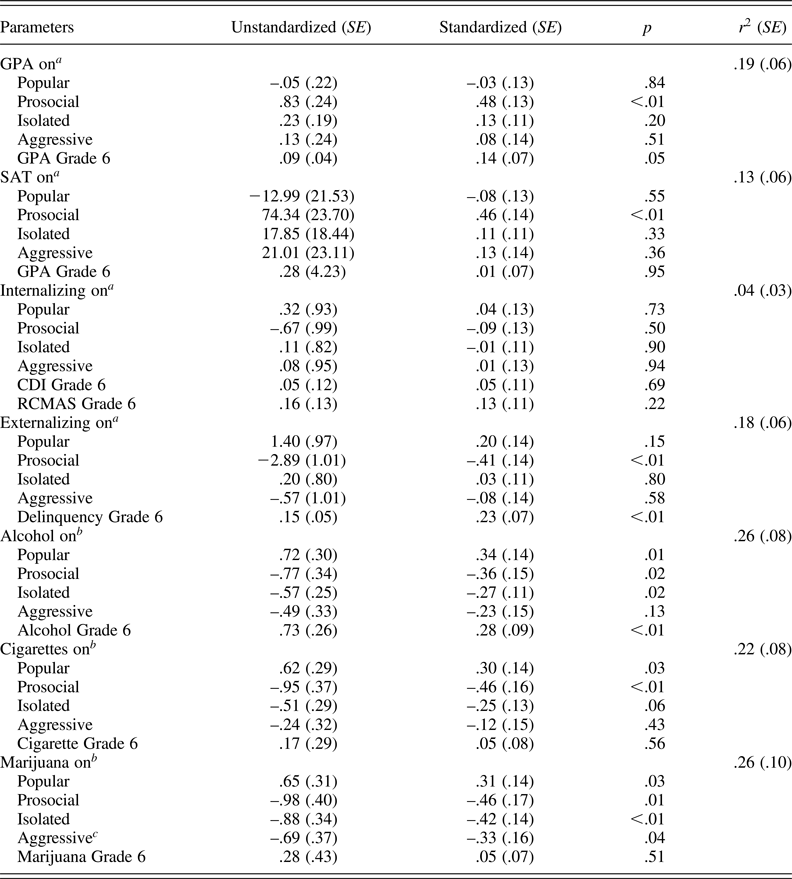
Table 5 reports the path coefficients for the prediction of Grade 12 GPA, with the 4 RCP reputations and corresponding outcome covariate as predictors in the GPA structural model. In this model with simultaneous prediction from the 4 RCP reputations, only prosocial but not aggressive reputation was a significant predictor, attributable to the strong negative correlation between the prosocial and aggressive reputations. The same result was found for prediction of SAT scores (Table 5). In addition, the covariate Grade 6 GPA was a significant predictor of Grade 12 GPA but did not predict Grade 12 SAT scores.
Path coefficients for prediction of Grade 12 outcomes from peer reputation latent constructs and covariates

Note: CDI, Children's Depression Inventory; GPA, grade point average; R–CMAS, Revised Children's Manifest Anxiety Scale; SAT, Scholastic Aptitude Test.
aSEM with outcome variable treated as continuous.
bSEM with outcome variable treated as ordered categorical.
cSuppression effect.
Psychological symptoms outcomes (internalizing, externalizing)
Fit statistics suggested acceptable model fit for psychopathology: internalizing symptoms (χ 2 (18, N = 209) = 27.15, p = .08; CFI = .98; RMSEA = .05 [90% CI = .0, .08]; SRMR = .04) and externalizing symptoms (χ 2 (18, N = 209) = 23.61, p = .17; CFI = .99; RMSEA = .04 [90% CI = .00, .08]; SRMR = .05). In the structural models in which each outcome was predicted simultaneously from the 4 reputation latent variables plus corresponding covariates, prosocial reputation negatively predicted externalizing, with no RCP dimensions predicting internalizing symptoms (Table 5). Regarding covariates, measures of internalizing at Grade 6 (depression and anxiety) did not predict Grade 12 internalizing, whereas delinquency at Grade 6 positively predicted Grade 12 externalizing. Finally, given the positive skew and kurtosis of both internalizing and externalizing, we re-estimated models with robust maximum likelihood; results were consistent with maximum likelihood.
Substance use outcomes (alcohol, cigarettes, marijuana)
Substance use was measured on ordered categorical scales of use frequency (e.g., never, 1–2 times, 3–5 times, 40 + times). The structural models specified an ordered categorical-dependent variable and were estimated with weighted least squares means and variances adjusted estimator (Yu & Muthén, Reference Yu and Muthén2002). Fit statistics from the weighted least squares means and variances models suggested that the models fit the data adequately: alcohol (χ 2 (18, N = 209) = 26.54, p = .09; CFI = .98; RMSEA = .05 [90% CI = .00, .09]), cigarettes (χ 2 (18, N = 209) = 21.89, p = .24; CFI = .99; RMSEA = .03 [90% CI = .00, .08]), and marijuana (χ 2 (18, N = 209) = 19.51, p = .36; CFI = .99; RMSEA = .02 [90% CI = .00, .07]). As shown in Table 5, with all 4 reputations and corresponding Grade 6 covariate as predictors, popular reputation positively predicted all 3 substance use outcomes, whereas prosocial and isolated reputations negatively predicted all 3 substance use outcomes (p = .06 in one case).
Aggressive reputation has a positive correlation with cigarette use, yet did not predict cigarette use in the path model. This is attributable to prediction of cigarette use by popular and prosocial reputations in the model and strong correlation between the aggressive reputation and both popular and prosocial reputations.
An anomalous negative path coefficient was noted for aggressive reputation predicting marijuana use (p = .04). This negative coefficient is directly attributable to statistical suppression, with aggressive reputation serving as a suppressor variable. As shown in Table 4, aggressive reputation manifested a small, nonsignificant model estimated positive correlation with marijuana use (r = .07) while being substantially correlated with popular and prosocial reputation (r = .33 and r = –.47, respectively). When aggressive reputation was included as a predictor of marijuana use in the model containing all reputation latent variables, the standardized path coefficient for popular (path coefficient = 31) exceeded its correlation with marijuana use (r = 24). In turn, aggressive reputation manifested a negative path (path coefficient = –.33) that exceeded its correlation with marijuana use (r = .07) and was of reversed sign of this close to zero correlation coefficient. This pattern well represents the general pattern of statistical suppression (Tzelgov & Henik, Reference Tzelgov and Henik1991). The suppression effect can be interpreted to mean that aggressive reputation is partialed out of the popular reputation, and that this partialed measure of popular reputation unconfounded with aggressiveness predicts marijuana use.
Covariates of substance use at Grade 6 were included in the models. Although Grade 6 cigarette use did not predict Grade 12 cigarette use and Grade 6 marijuana use did not predict Grade 12 marijuana use, Grade 6 alcohol use positively predicted Grade 12 alcohol use.
Discussion
In the first long-term, prospective study to explore dimensions of middle school peer reputation in the context of relative affluence, findings revealed that these were significantly related to multiple adjustment outcomes several years later at the end of high school, ranging from performance on a major standardized test (SAT) to frequency of substance use. The findings on substance use are of particular significance because this is a problem that has been repeatedly documented among teens in relatively affluent schools (Coley et al., Reference Coley, Sims, Dearing and Spielvogel2017; Lund et al, Reference Lund, Dearing and Zachrisson2017; Luthar et al., Reference Luthar, Barkin and Crossman2013) with potentially serious long-term sequelae, including markedly elevated rates of addiction to drugs and alcohol, relative to norms (Luthar, Small & Ciciolla, Reference Luthar, Small and Ciciolla2018).
More generally, our findings on peer relationships provide critical insights that further illuminate the bigger picture of an academically and socially competitive environment in which many upper-middle class children may struggle (Luthar et al., Reference Luthar, Barkin and Crossman2013). Peer reputation, as an aspect of peer environment, affects the behaviors and beliefs of youth and may be particularly salient for teens whose peer environment may be highly competitive and prone to envy, which in turn presages maladjustment (Luthar & Kumar, in press; Luthar et al., Reference Luthar, Barkin and Crossman2013).
Prosocial reputation
A prosocial reputation in middle school was associated with healthy adjustment outcomes in later years. These included relatively high academic grades and SAT scores, low psychopathology symptoms, and the novel finding of low substance use (alcohol, cigarettes, and marijuana use in Grade 12 according to model path coefficients) by late adolescence.
One reason that a prosocial reputation may be associated with positive future outcomes is because prosocial behaviors are associated with positive adjustment; for example, prosocial spending has been linked to positive well-being in both rich and poor countries (Aknin, Barrington-Leigh, Dunn, Helliwell, Burns et al., Reference Aknin, Barrington-Leigh, Dunn, Helliwell, Burns, Biswas-Diener and Norton2013). Moreover, helping others is associated with better mental health (Schwartz, Meisenhelder, Yusheng, & Reed, Reference Schwartz, Meisenhelder, Yusheng and Reed2003), greater life satisfaction, and higher self-esteem (Weinstein & Ryan, Reference Weinstein and Ryan2010). Additionally, a positive relationship exists between prosocial behavior and academic endeavors (Caprara, Kanacri, Gerbino, Zuffiano, Alessandri et al., Reference Caprara, Kanacri, Gerbino, Zuffianò, Alessandri, Vecchio and Bridglall2014).
Not only prosocial behaviors, but also the values underlying the behaviors of young people with prosocial reputations may foster well-being. In an environment in which competition is rife and getting ahead is highly emphasized (Luthar et al., Reference Luthar, Barkin and Crossman2013), youth who value helping others and showing kindness, rather than personal gain and status, may in some way be protected from the subcultural risk of high competitiveness (Ciciolla et al., Reference Ciciolla, Curlee, Karageorge and Luthar2017). For instance, prosocial values have been linked to lower rates of delinquency, drug use, and risky sexual behavior among diverse groups of adolescents (Ludwig & Pittman, Reference Ludwig and Pittman1999), suggesting that valuing prosocial activities decreases the likelihood of risk-taking behavior. Furthermore, prosocial values have been tied to intrinsic values such as friendship, community, and personal growth, which are thought to fulfill basic psychological needs, unlike extrinsic values such as status and wealth (Sheldon, Ryan, Deci, & Kasser, Reference Sheldon, Ryan, Deci and Kasser2004). In the United States, where youth place great importance on extrinsic goals such as attaining money and fame (Twenge & Kasser, Reference Twenge and Kasser2013), a greater focus on intrinsic goals promoted by prosocial values may be a key part in improving the well-being of adolescents.
Popular reputation
Although the outcomes of both prosocial and popular reputations may appear beneficial, many middle school children do not actively strive for a prosocial reputation, but instead endeavor to be viewed as popular (Cillessen et al., Reference Cillessen, Schwartz and Mayeux2011). Popular reputation was distinct from prosocial reputation among youth in this study, showing positive relationships with all 3 substance use outcomes, corroborating prior findings that separate prosocial and popular as distinct reputations (Gest et al., Reference Gest, Sesma, Masten and Tellegen2006; Luthar & McMahon, Reference Luthar and McMahon1996; Realmuto et al., Reference Realmuto, August and Hektner2000; Zeller et al., Reference Zeller, Vannatta, Schafer and Noll2003).
The relationship between substance use at Grade 12 and preadolescent popularity may derive from third variables that assist youth in gaining a popular reputation as well as increase risk for drug use or delinquent behavior. For instance, children in Grades 6 and 7 who have low parental monitoring or who spend much time with older children may be viewed as popular by peers and may be at greater risk for drug use concurrently and in the future (Dishion, Nelson, & Kavanagh, Reference Dishion, Nelson and Kavanagh2003; Luthar et al., Reference Luthar, Barkin and Crossman2013, 2017). Alternatively, according to Reputation Enhancement Theory, as youth develop a reputation among their peers, their behavior is influenced by their emerging identities and by the desire to maintain that identity (Emler & Reicher, Reference Emler and Reicher1995). In accordance with this theory, children with a popular reputation may behave in ways that meet with peer approval, and in relatively affluent communities, substance use has been linked with peer acceptance (Becker & Luthar, Reference Becker and Luthar2007; Luthar & D'Avanzo, Reference Luthar and D'Avanzo1999). Indirectly, popular children seeking to maintain their social standing may behave in ways that put them at greater risk for substance use, including disregarding social rules and seeking peer attention (de Bruyn & Cillessen, Reference de Bruyn and Cillessen2006; López-Romero & Romero, Reference López-Romero and Romero2011).
Isolated reputation
In this study, isolated peer reputation appeared protective against experimentation with substances, supporting work by Kramer and Vaquera (Reference Kramer and Vaquera2011) who examined friend nominations and substance use. Limited interactions with peers may be one explanation for this relationship: specifically, less opportunity for contagion of high-risk behaviors and less time unmonitored by adults (Dishion et al., Reference Dishion, Nelson and Kavanagh2003; Kramer & Vaquera, Reference Kramer and Vaquera2011). These low levels of high school substance use could benefit isolated youth given that the younger the age of substance use initiation, the greater the risk of a substance use disorder as an adult (Grant & Dawson, Reference Grant and Dawson1998; Pitkänen, Lyyra, & Pulkkinen, Reference Pitkänen, Lyyra and Pulkkinen2005).
Evidence was not found for a relationship between isolated peer reputations in middle school and elevated internalizing problems at the end of high school, contrary to the positive association between these constructs in previous work (Hall-Lande, Eisenberg, Christenson, & Neumark-Sztainer, Reference Hall-Lande, Eisenberg, Christenson and Neumark-Sztainer2007; Gest et al., Reference Gest, Sesma, Masten and Tellegen2006; Realmuto et al., Reference Realmuto, August and Hektner2000). It is possible that the reason that children are isolated may be more important than the peer reputation of isolated. As noted at the outset of this paper, Gest et al. (Reference Gest, Sesma, Masten and Tellegen2006) identified three facets of isolated peer reputation (sad-sensitive, shy-withdrawn, and peer isolated) and showed that the different facets predicted different relations with adjustment outcomes. An isolated peer reputation resulting from voluntary withdrawal from social interactions had different implications for internalizing symptoms than an isolated reputation resulting from active rejection by peers. Thus, although our findings suggest no significant relationship between an isolated peer reputation and internalizing problems, this does not preclude the possibility that more complex relationships do exist between different types of isolated students and internalizing symptoms.
Aggressive reputation
Consistent with prior findings, aggressive peer reputation was negatively correlated with academic outcomes (GPA and SAT scores) and was positively correlated with externalizing symptoms and cigarette use. However, apart from cigarette use, observed correlations of outcomes with aggression were smaller in absolute value than those of the other three reputations. This is most likely attributable to the loss of children with high aggression scores in the sample by Grade 12. Additionally, the lower correlations of aggression than of other RCP dimensions with outcomes resulted in a failure of aggression to show statistical significance as a predictor in models that included all 4 RCP dimensions. Finally, the one anomalous negative path coefficient that was found from aggression to marijuana use was attributable to statistical suppression. In all, the weak predictive contribution of aggression to outcomes should be treated with caution because of selective attrition of children with higher aggressive reputation scores.
Limitations, Implications, and Future Directions
Our findings may be somewhat limited because of the moderate retention rate of the original sample of Grades 6 and 7 children at Grade 12. There was no evidence of selective attrition on 6 of the 8 study variables in Grade 6 (GPA, depression symptoms, anxiety symptoms, delinquency, prosocial reputation, and isolated reputation); however, there was evidence of selective loss of popular and aggressive children. Even with the selective loss of popular students, we did obtain significant findings for predicted relationships of popularity with academic outcomes and substance use, but, as noted previously, expected findings for aggression appear to have been obscured by attrition.
Behavioral trait nominations in this study were constrained to 3 peers, as in other recent research (Becker & Luthar, Reference Becker and Luthar2007; Chung-Hall & Chen, Reference Chung-Hall and Chen2010; Farmer, Estell, Bishop, O'Neal, & Cairns, Reference Farmer, Estell, Bishop, O'Neal and Cairns2003; Lease, Musgrove, Axelrod, Reference Lease, Musgrove and Axelrod2002; Prinstein & La Greca, Reference Prinstein and La Greca2004; Rodkin, Farmer, Pearl, & Acker, Reference Rodkin, Farmer, Pearl and Acker2006), whereas some studies have set higher limitations (e.g., 10 nominations; Kwon, Lease, & Hoffman, Reference Kwon, Lease and Hoffman2012), unlimited nominations (Sandstrom & Cillessen, Reference Sandstrom and Cillessen2010), or, in contrast, have limited nominations to 1 per gender (Gest et al., Reference Gest, Sesma, Masten and Tellegen2006). Acknowledging that our use of 3 nominations may limit generalizability of findings (Becker & Luthar, Reference Becker and Luthar2007), we note that the relationships documented between RCP dimensions and outcomes do converge with findings from studies that use different peer nomination strategies. Further, our scales based on 3 nominations showed good psychometric properties, replicating previous findings on the dimensionality of the RCP.
Offsetting these weaknesses are several strengths of the study. The measurement approach used both Grades 6 and 7 peer nomination scores as indicators of reputation. Thus, we have more than a single snapshot of children to characterize how they are viewed by their peers, strengthening the measurement of reputation. Adjustment indicators spanned subjectively experienced distress, self-reported substance use, and official school records of both GPA and scores on the SAT. The longitudinal design encompassed the developmentally critical years from preadolescence to late adolescence. In terms of substantively extending the literature on peer reputation, our findings corroborated some associations previously noted in the literature and demonstrated several new associations, which are important from both a conceptual and practical perspective.
Perhaps most important are the findings on the long-term ramifications of prosocial behavior. In operationalizing “wellness” among children and adolescents, resilience researchers have exhorted greater consideration of behaviors that reflect kindness, altruism, and doing for the greater good (Luthar, Reference Luthar2017; Luthar, Lyman, & Crossman, Reference Luthar, Lyman, Crossman, Lewis and Rudolph2014). The present findings show that such prosocial behaviors, as judged by peers in their everyday environments, can have salutary effects for the children over the course of several years. These beneficial effects include relatively high GPA and SAT score, a critically important finding in this highly competitive, upwardly mobile setting.
Also noteworthy in this regard are associations showing that what is sometimes a “positive” peer reputation, popularity, in fact connotes risk for frequent substance use several years later, whereas what is thought of as negative, isolated reputation, can mitigate risk for frequent substance use. This finding was consistent across all 3 substance use variables. Future research should replicate our findings given the known high risk for substance use among teens in high achieving contexts (Luthar et al., Reference Luthar2017; Luthar & D'Avanzo, Reference Luthar and D'Avanzo1999).
Future studies should also address the issue of generalizability of findings among students from ethnic minority families as well as different socioeconomic backgrounds. Additionally, evaluating the impact of middle school peer reputation on participants who have entered adulthood would add to the literature on long-term effects of reputation. It is possible that significant long-term benefits exist for preteens able to maintain everyday prosocial behaviors even when this may not be “cool” in the eyes of the wider peer group.
In summary, results of this study indicate that there can, in fact, be benefits to a deliberate focus on kindness, integrity, and compassion in settings where personal achievement and getting ahead are disproportionately emphasized (Luthar, Reference Luthar2017). From an applied perspective, it may be useful to disseminate findings on prosocial behaviors among adults, specifically within high-achieving school communities. Youth tend to benefit when they see significant adults as valuing their decency and kindness as much as their grades and achievements (Ciciolla et al., Reference Ciciolla, Curlee, Karageorge and Luthar2017; Luthar & Kumar, in press). Moreover, parents and educators might be motivated to promote prosociality if the benefits for the children were not only for their psychological adjustment but also for what is so highly prized in such communities: high academic grades and SAT scores. Thus, encouraging adults to model prosocial behaviors could improve their children's chances of adaptive functioning and even their personal accomplishments over time.