1. Introduction
The petrographic features of volcano-derived detritus have been clearly defined in previous studies relating sandstone composition to tectonic setting (e.g. Dickinson & Suczek, Reference Dickinson and Suczek1979; Critelli et al. Reference Critelli, De Rosa, Sonnino and Zuffa1990; Marsaglia & Ingersoll, Reference Marsaglia and Ingersoll1992; Critelli & Ingersoll, Reference Critelli and Ingersoll1995; Critelli, Marsaglia & Busby, Reference Critelli, Marsaglia and Busby2002). Both petrographic and geochemical investigations of volcanic sand and sandstone have distinguished between volcanogenic lithic fragments and monocrystalline grains of different provenances elucidating magmatic evolution of source areas (e.g. McCoy & Cornell, Reference McCoy, Cornell, Kastens and Mascle1990; Cawood, Reference Cawood, Morton, Todd and Haughton1991) and/or have focused on complex factors that control volcanic grain composition, including geomorphic processes, climate, depositional environment and particular source rocks (e.g. Jackson & Keller, Reference Jackson and Keller1970; Zuffa, Reference Zuffa and Zuffa1985, Reference Zuffa, Leggett and Zuffa1987; Mack & Jerzykiewicz, Reference Mack and Jerzykiewicz1989; Johnsson, Ellen & McKittrick, Reference Johnsson, Ellen, McKittrick, Johnsson and Basu1993; Smith & Lotosky, Reference Smith and Lotosky1995; King, Reference King2003; White & Houghton, Reference White and Houghton2006). In this study we look beyond tectonic setting and examine aspects of other pre-depositional and pre-burial parameters that affect the composition of volcaniclastic detritus.
Lipari is an active volcanic island in the Aeolian magmatic arc located in the southern Mediterranean Sea. It provides a good opportunity for a detailed examination of the effects of multiple source lithology, climate, weathering, transport and depositional environment on epiclastic sand composition (Ingersoll, Kretchmer & Valles, Reference Ingersoll, Kretchmer and Valles1993). To our knowledge, this is the first such study of the subaerial epiclastic signature of an active island arc volcano, bridging non-marine to marine (beach) environments.
We show that there is great diversity in the types and abundances of modern volcaniclastic detritus produced on Lipari island, and that this detritus exhibits considerable diversity with regard to glass and mineral populations and textures of constituent volcanic components as seen in ancient equivalents (Mack & Jerzykiewicz Reference Mack and Jerzykiewicz1989; Cather & Folk, Reference Cather, Folk, Fisher and Smith1991; Critelli & Ingersoll, Reference Critelli and Ingersoll1995; Critelli, Marsaglia & Busby, Reference Critelli, Marsaglia and Busby2002). The difference between epiclastic, pyroclastic and autoclastic sand particles within volcanogenic debris is rarely obvious, especially after they are affected by sedimentary processes (e.g. Smith & Lotosky, Reference Smith and Lotosky1995). In the case of Lipari beach sand, we have the opportunity to document the variability in composition and texture before the particles are buried by later pyroclastic events or reworked into the marine record.
2. Tectonic setting, geology and petrology of Lipari island
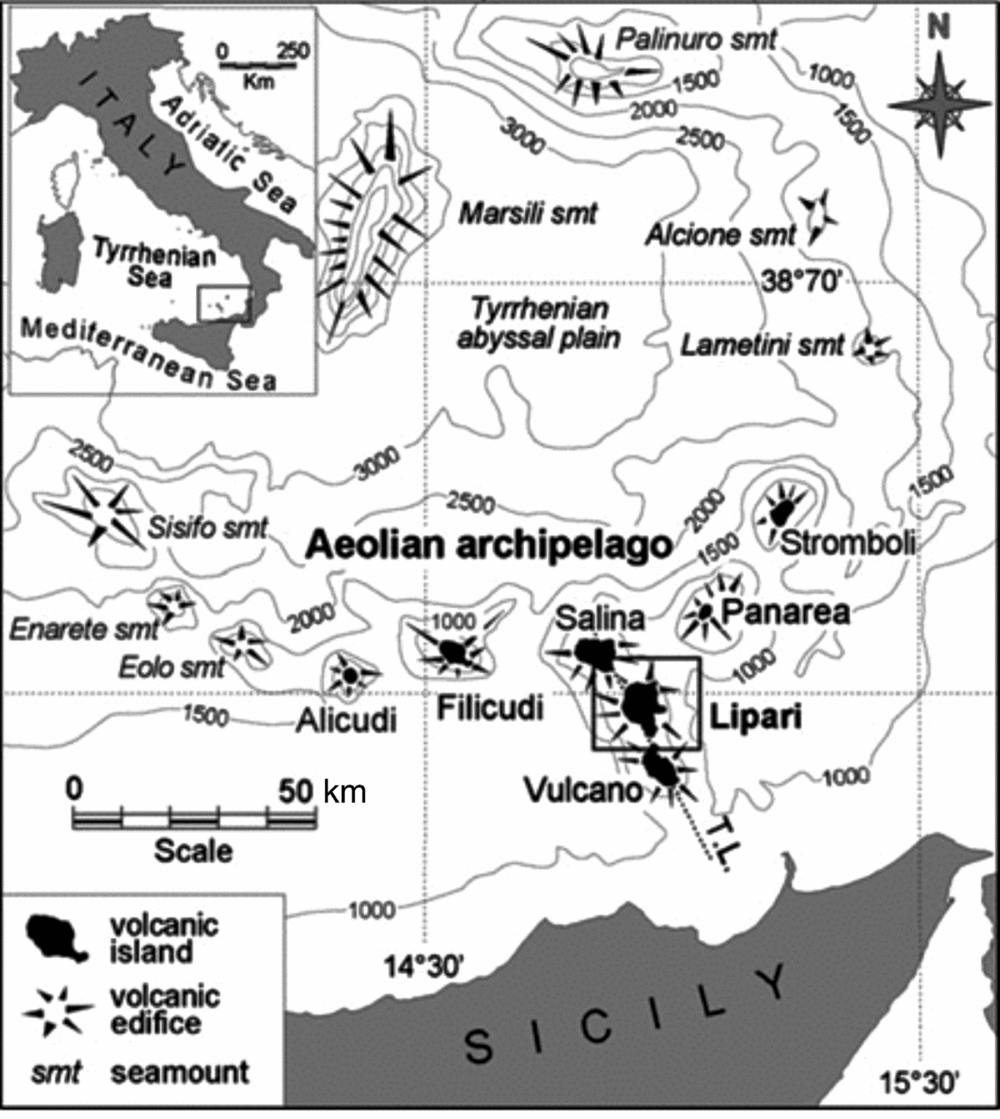
The Aeolian archipelago, located between the Southern Tyrrhenian Sea backarc basin (Marsili oceanic basin) and the Calabrian Arc forearc region, is composed of seven islands and submerged seamounts arranged approximately in a ring-like structure (Fig. 1). The Aeolian Islands were emplaced on thinned ~ 20 km continental crust and so are considered examples of continental-arc volcanism (Barberi et al. Reference Barberi, Innocenti, Ferrara, Keller and Villari1973; Keller, Reference Keller and Thorpe1982; Ventura et al. Reference Ventura, Giuseppe, Milano and Pino1999). The volcanic products, whose age ranges from 1.03 Ma to the present (Tranne et al. Reference Tranne, Lucchi, Calanchi, Lanzafame and Rossi2002; De Rosa et al. Reference De Rosa, Donato, Gioncada, Masetti and Santacroce2003; Lucchi et al. Reference Lucchi, Tranne, Calanchi, Pirazzoli, Romagnoli, Radtke, Reyss and Rossi2004; Lucchi, Tranne & Rossi, Reference Lucchi, Tranne, Rossi, Groppelli and Viereck-Goette2010), belong to the calc-alkaline, high-K calc-alkaline, shoshonitic and alkaline potassic associations (Barberi et al. Reference Barberi, Innocenti, Ferrara, Keller and Villari1973; Keller, Reference Keller and Thorpe1982). The geochemical affinity of these rocks and the occurrence of deep seismicity (up to 550 km) below the Southern Tyrrhenian Sea has led many authors to relate the Aeolian volcanic arc to the SE rollback of the Ionian slab below the Calabrian Arc (e.g. Patacca & Scandone, Reference Patacca, Scandone, Boriani, Bonafede, Piccardo and Vai1989; Faccenna et al. Reference Faccenna, Becker, Lucente, Jolivet and Rossetti2001; Gvirtzman & Nur, Reference Gvirtzman and Nur2001; Chiarabba, De Gori & Speranza, Reference Chiarabba, De Gori and Speranza2008).
Sketch bathymetry of the Southern Tyrrhenian Sea and location of the Aeolian archipelago (from Beccaluva et al. Reference Beccaluva, Gabbianelli, Lucchini, Rossi and Savelli1985, modified).

Lipari, the largest of the Aeolian Islands, is the emergent part of a large volcanic edifice forming, together with the islands of Salina and Vulcano, a NNW–SSE-oriented volcanic belt that intersects the Aeolian Archipelago in its central sector. The structural setting of Lipari is controlled by the main NNW–SSE-oriented tectonic trend, which is considered to represent the expression of the strike-slip Tindari–Letojanni structural system (Mazzuoli, Tortorici & Ventura, Reference Mazzuoli, Tortorici and Ventura1995; Ventura, Reference Ventura, Lucchi, Peccerillo, Keller, Tranne and Rossi2013). The corresponding fault pattern is dominated by NNW–SSE-trending strike-slip faults and the associated N–S to NE–SW-oriented extensional structures (Mazzuoli, Tortorici & Ventura, Reference Mazzuoli, Tortorici and Ventura1995; Tranne et al. Reference Tranne, Lucchi, Calanchi, Lanzafame and Rossi2002).
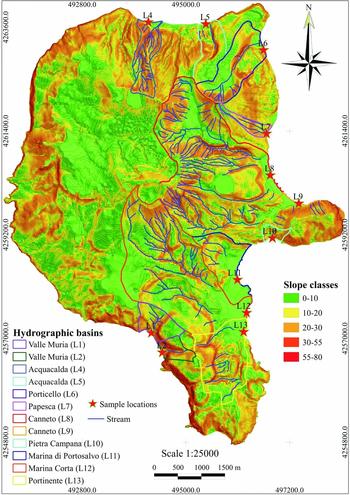
In the Aeolian archipelago both constructional and destructional landforms are important in shaping the physiography of each island (Critelli, Sorriso-Valvo & Ventura, Reference Critelli, Sorriso-Valvo and Ventura1993; Favalli et al. Reference Favalli, Karátson, Mazzuoli, Pareschi and Ventura2005), and sedimentation is strongly controlled by the geomorphic and climatic features (Gamberi, Reference Gamberi2001). Lipari island has a contrasting morphology, with the western sector being dominated by steeper escarpments than the eastern one (Favalli et al. Reference Favalli, Karátson, Mazzuoli, Pareschi and Ventura2005). Major (e.g. western slopes of Lipari) or minor (e.g. eastern slopes of Lipari) escarpments (Fig. 2), responsible for mass-wasting, collapse and dissection of the volcano, seem to control the degree of evolution of beach and near-shore volcaniclastic sedimentation as the majority of beaches occur on the eastern side of Lipari island (C.N.R., 1985). Marine erosion is most pronounced on the west coast of Lipari island, as a function of prevailing winds from NW and W (Cataldo, Reference Cataldo1981) that control wave energy conditions.
Digital elevation map of Lipari island showing the different classes of slope.

The climate of Lipari is Mediterranean, with mean annual temperatures varying between 16°C and 22°C and mean annual precipitations of 600 mm a−1 (ISPRA, 2011). Surface runoff of Lipari island is enhanced by ephemeral stream channels, with seasonal activity, developing coarse-grained alluvial and coastal sedimentation (Lucchi, Tranne & Rossi, Reference Lucchi, Tranne, Rossi, Groppelli and Viereck-Goette2010).
Extensive fieldwork, combined with age determinations, detailed unconformity-bounded stratigraphy and chemical compositional data, provides the basis for reconstructing the eruptive history of the island, showing it to be the result of the interaction of volcanic activity of local and external provenance, volcano tectonics, sea-level fluctuations and regional tectonics (Crisci et al. Reference Crisci, De Rosa, Lanzafame, Mazzuoli, Sheridan and Zuffa1981, Reference Crisci, Delibrias, De Rosa, Mazzuoli and Sheridan1983, Reference Crisci, De Rosa, Esperanqa, Mazzuoli and Sonnino1991; Gillot, Reference Gillot1987; Tranne et al. Reference Tranne, Lucchi, Calanchi, Lanzafame and Rossi2002; De Rosa et al. Reference De Rosa, Donato, Gioncada, Masetti and Santacroce2003; Lucchi et al. Reference Lucchi, Tranne, Calanchi, Pirazzoli, Romagnoli, Radtke, Reyss and Rossi2004; Lucchi, Tranne & Rossi, Reference Lucchi, Tranne, Rossi, Groppelli and Viereck-Goette2010; Forni et al. Reference Forni, Lucchi, Peccerillo, Tranne, Rossi, Frezzotti, Lucchi, Peccerillo, Keller, Tranne and Rossi2013). Three marine palaeo-shorelines formed during marine isotope stage 5 (MIS 5, 130 ka). MIS 5 marine deposits (and corresponding unconformities) provide a means of stratigraphic correlation, not only for the island of Lipari, but also on a regional scale (Lucchi, Tranne & Rossi, Reference Lucchi, Tranne, Rossi, Groppelli and Viereck-Goette2010).
According to Forni et al. (Reference Forni, Lucchi, Peccerillo, Tranne, Rossi, Frezzotti, Lucchi, Peccerillo, Keller, Tranne and Rossi2013), the development of Lipari between 270 ka bp and historical times is the result of nine successive Eruptive Epochs separated by variable intervals of quiescence, when subaerial and marine erosion processes became dominant.
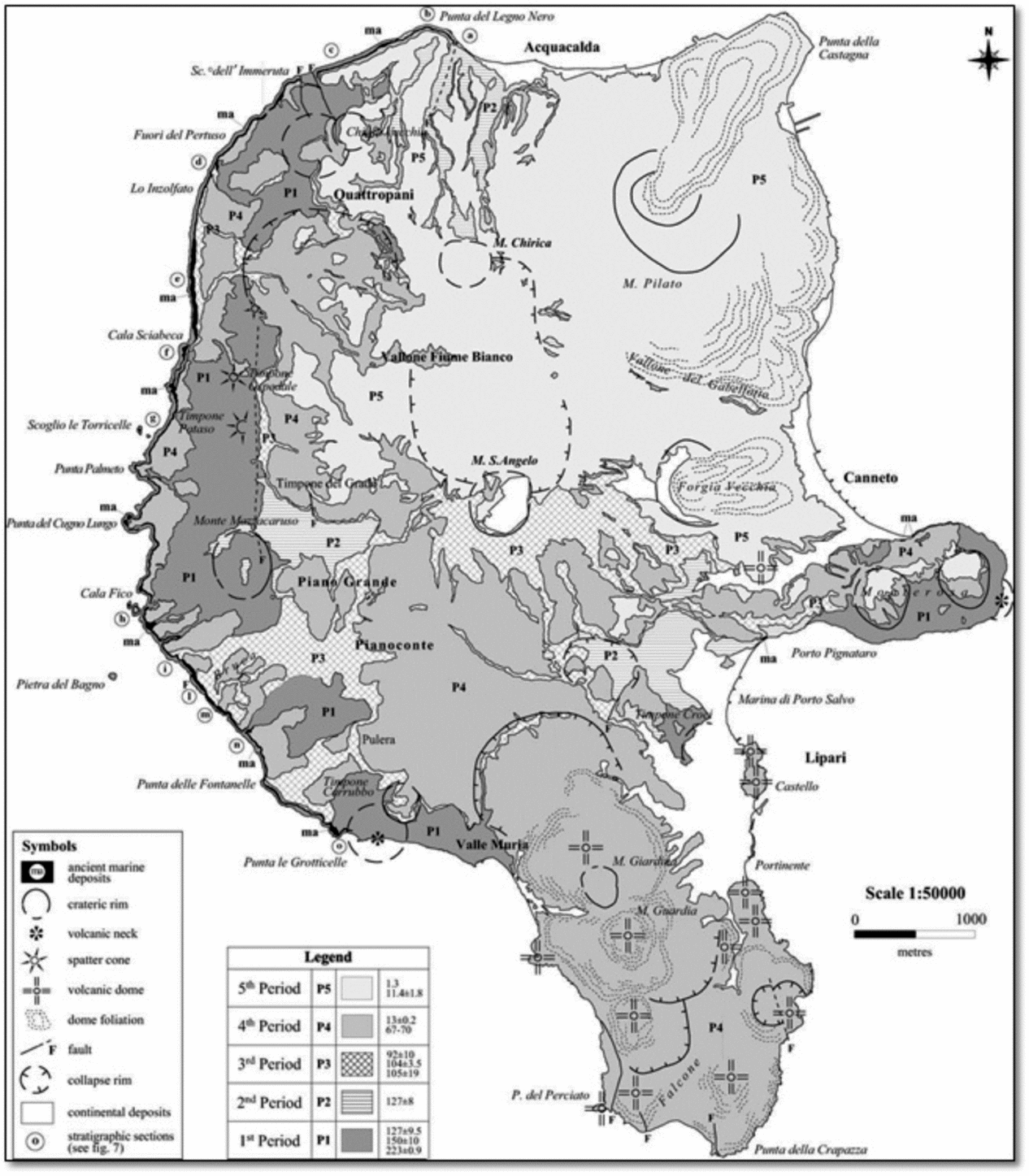
Eruptive Epochs 1, 2 and 3 (271–188 ka bp), are mostly characterized by subaerial central-type, hydromagmatic to Strombolian-effusive activity and fissural-type Strombolian activity (Chiesa Vecchia, M. Mazzacaruso volcano, Timpone Ospedale cones, Timpone Carrubo, M. Chirica stratocone; Fig. 3). The erupted products are basaltic andesite to andesite. Eruptive Epochs 4, 5 and 6 (119–81 ka bp) comprising the MIS 5c terraces (100 ka bp; Forni et al. Reference Forni, Lucchi, Peccerillo, Tranne, Rossi, Frezzotti, Lucchi, Peccerillo, Keller, Tranne and Rossi2013) led to the building-up of M. Rosa scoria cones and the construction of M. S. Angelo and M. Chirica volcanoes. Strombolian–Hawaiian (fissural-type) eruptions and lavas of basaltic andesite composition built the M. Rosa scoria cones, whereas central-type hydromagmatic explosive eruptions and emission of viscous lava flows of andesitic to high-potassium andesites characterized the main activity of M. S. Angelo and M. Chirica.
Geological sketch map of Lipari (from Tranne et al. Reference Tranne, Lucchi, Calanchi, Lanzafame and Rossi2002, modified).

Starting from the end of MIS 5 (<81 ka bp) there was a long period of volcanic inactivity. Rhyolitic explosive eruptions and lava domes characterized the renewal of volcanism younger than 42 ka belonging to Eruptive Epochs 7 and 8. The rhyolitic products are subaphyric and characterized by macroscopic and microscopic evidence of magma mixing and mingling between rhyolites and latites (Forni et al. Reference Forni, Lucchi, Peccerillo, Tranne, Rossi, Frezzotti, Lucchi, Peccerillo, Keller, Tranne and Rossi2013). Between 42 and 13 ka bp, products of recurrent external explosive volcanic activity are recorded on Lipari (Lucchi et al. Reference Lucchi, Tranne, Calanchi, Pirazzoli, Romagnoli, Radtke, Reyss and Rossi2004; Lucchi, Tranne & Rossi, Reference Lucchi, Tranne, Rossi, Groppelli and Viereck-Goette2010) as distinct stratigraphic intervals of widespread pyroclastic products of exotic provenance interbedded within the rhyolitic sequence (De Rosa & Sheridan, Reference De Rosa and Sheridan1983; Lucchi et al. Reference Lucchi, Tranne, De Astis, Keller, Losito and Morche2008). Epoch 9, the last Eruptive epoch, ranges in age from 8 ka to historical times; it saw the construction of the NE sector of Lipari island through the pyroclastic surges and obsidian lava flows of the Vallone del Gabellotto Formation, and the unusual Strombolian-type explosive activity formed the Monte Pilato pumice cone, followed, in ad 1230, by the Rocche Rosse eruption. Mafic enclaves with shoshonitic affinity were found in the rhyolitic lava flows of Rocche Rosse, similar in composition to the neighbouring Vulcano post-15 ka products, suggesting that a common plumbing system composed of small, vertically developed magma bodies was active in historical time involving both Lipari and Vulcano islands (Davì et al. Reference Davì, De Rosa, Donato, Vetere, Barca and Cavallo2009, Reference Davì, De Rosa, Donato and Sulpizio2010).
3. Sample locations and associated drainage basin geology
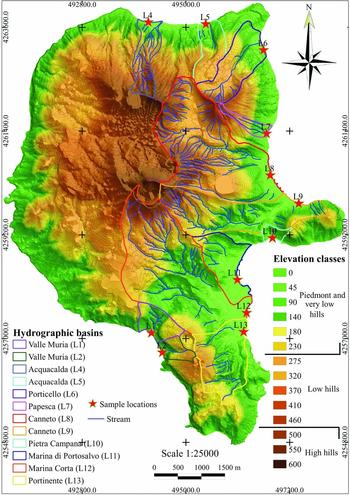
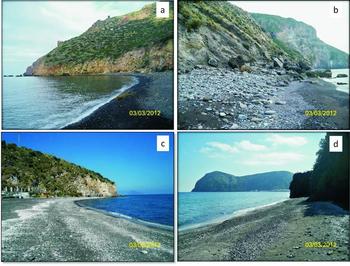
Twelve coastal drainage basins were identified and the corresponding beach sands were collected from high-tide berms spaced along Lipari's accessible coastal perimeter, from Acquacalda to Valle Muria (Figs 4, 5, 6, 7). Based upon tectonic and morphologic criteria, the coast of Lipari belongs to the category of mountainous coasts (e.g. Inman & Nordstrom, Reference Inman and Nordstrom1971). The NE coast between Acquacalda and Valle Muria is formed predominantly by coarse sandy and cobbly pocket beaches, alternating with high rocky cliffs and headlands. No samples were taken in the NW coastal domain of Lipari, from Punta del Legno Nero to Punta le Grotticelle, where the coast is straight, with high rocky cliffs and headlands, coastal sedimentation is represented only by rockfalls and there are no developed beaches (Figs 2, 3).
TIN (triangular irregular network) of Lipari island and sample locations.

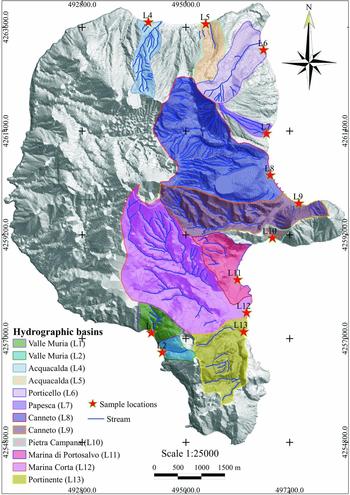
Digital elevation map of Lipari island showing the boundaries of the drainage basins with respect to samples (watershed).

(a) Valle Muria beach (sample L1). (b) Valle Muria beach (sample L2). (c) Acquacalda beach (sample L4). (d) Acquacalda beach (sample L5).

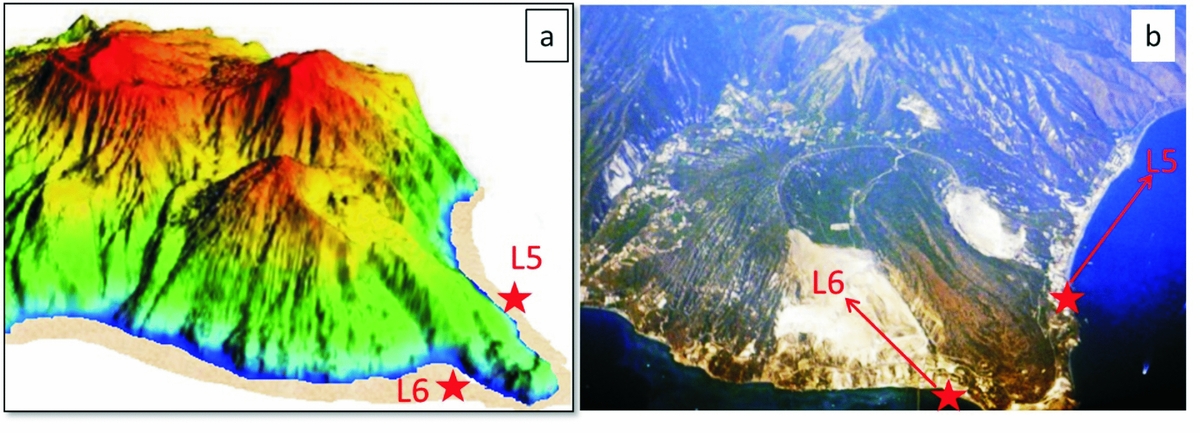
(a) 3D model of the obsidian lava flow of Monte Pilato (Rocche Rosse, ad 580) the youngest volcano of Lipari, in the NE of the island. (b) Aerial photo of Monte Pilato (from ingv.it).

In order to evaluate the relationships among source rocks, areal distribution and type of volcanic detritus, in this section the lithologies cropping out in each studied drainage basin are briefly described.
Rhyolitic pyroclastic deposits and lava domes formed between 42 and 22 ka ago are the lithotypes outcropping in the drainage basins of samples L1, L2 and L13 (Epochs 7 and 8; Forni et al. Reference Forni, Lucchi, Peccerillo, Tranne, Rossi, Frezzotti, Lucchi, Peccerillo, Keller, Tranne and Rossi2013). The pyroclastic deposits are made up of loose beds of lapilli and ash. Their juvenile fragments show different shape and colour, with macroscopic evidence of mingling and disequilibrium textures of phenocrysts. The most abundant component is a crystal-poor (3–5 vol.%) white pumice with phenocrysts of K-feldspar, oxyhornblende and sporadic biotite. Grey non-vesiculated juvenile clasts with a higher crystal content (15–20 vol.%) and phenocrysts of clinopyroxene, plagioclase and minor olivine are also present as individual grains. In the pyroclastic sequence, the lithic component varies from 10 to 40 vol.% and is represented by fragments of older microcrystalline lavas and rare clasts of igneous and metamorphic rocks of the basement. The dome has the same mineral assemblage as the white pumice. The L4 drainage basin is characterized by a narrow elongate shape (Figs 4, 5), and source rocks consist of Strombolian–Hawaiian pyroclastic deposits and tabular lava flows of basaltic andesite composition formed during the oldest stages of the M. Chirica volcano (Epoch 2; Forni et al. Reference Forni, Lucchi, Peccerillo, Tranne, Rossi, Frezzotti, Lucchi, Peccerillo, Keller, Tranne and Rossi2013). The deposits are homogeneous calc-alkaline basaltic andesites. Lavas and scoriae are porphyritic (20–40 vol.%), with micro- or cryptocrystalline groundmass and phenocrysts of plagioclase and clinopyroxene, minor olivine, Fe–Ti oxides and orthopyroxene.
Sampled sediments at the L5, L6 and L7 sites (Fig. 4) are beach deposits derived from the M. Pilato pumice cone and the Rocche Rosse obsidian lava flow, which together constitute the most recent volcanic activity on Lipari island (ad 1230; Tanguy et al. Reference Tanguy, Le Goff, Principe, Arrighi, Chillemi, Paliotti, La Delfa and Patanè2003; Eruptive Epoch 9 of Forni et al. Reference Forni, Lucchi, Peccerillo, Tranne, Rossi, Frezzotti, Lucchi, Peccerillo, Keller, Tranne and Rossi2013). Both the pumice and obsidian are aphyric rhyolites with few mafic enclaves (<1 vol.%) of latitic and trachitic compositions (Davì et al. Reference Davì, De Rosa, Donato, Vetere, Barca and Cavallo2009, Reference Davì, De Rosa, Donato and Sulpizio2010). In the pumice cone, rare blocks and lapilli of porphyritic older lavas of basaltic–andesite compositions are also present as lithics (<5 vol.%).
The L8 sample was collected along the beach of Canneto (Figs 3, 4, 5) where the associated drainage basin includes rhyolitic pumice and obsidian of Vallone Gabellotto–M. Pilato, obsidian lava associated with the Forgia Vecchia lava flow (Eruptive Epoch 9; Forni et al. Reference Forni, Lucchi, Peccerillo, Tranne, Rossi, Frezzotti, Lucchi, Peccerillo, Keller, Tranne and Rossi2013), and high-potassium andesites (pyroclasts and lavas, Eruptive Epochs 5 and 6; Forni et al. Reference Forni, Lucchi, Peccerillo, Tranne, Rossi, Frezzotti, Lucchi, Peccerillo, Keller, Tranne and Rossi2013) of M. S. Angelo (Fig. 3). The rhyolitic lava flows are all aphyric.
The andesites and high-potassium andesites of M. S. Angelo are variably porphyritic (20–40%), with phenocrysts of plagioclase and clinopyroxene, minor orthopyroxene, Ti-magnetite and olivine invariably altered to iddingsite. The drainage basin feeding sand to the beach where samples L9 and L10 were collected consists of high-potassium andesites of M. S. Angelo (pyroclasts and lavas, Epochs 5 and 6) and basaltic andesites and andesites of Monte Rosa volcanoes (Eruptive Epoch 4).
A few outcrops of distal rhyolitic pumiceous deposits belonging to Eruptive Epochs 7 and 8 are also present (Forni et al. Reference Forni, Lucchi, Peccerillo, Tranne, Rossi, Frezzotti, Lucchi, Peccerillo, Keller, Tranne and Rossi2013). Sample L11 was collected along the beach of Lipari town, in the Porto Pignataro area. The drainage basin includes pyroclasts and lavas of M. S. Angelo volcanoes which are commonly strongly altered. The lava flows are basaltic andesites and andesites containing mostly plagioclase, pyroxene and Ti-magnetite phenocrysts.
Sample L12 was collected in the Marina Corta area, where source rocks are represented by both mafic and felsic source lithotypes. The mafic lithotypes are pyroclastic rocks and lavas of M. S. Angelo (andesites and high-potassium andesites of Eruptive Epochs 4 and 5) whereas felsic source lithotypes are rhyolites of Eruptive Epochs 7 and 8.
4. Methods
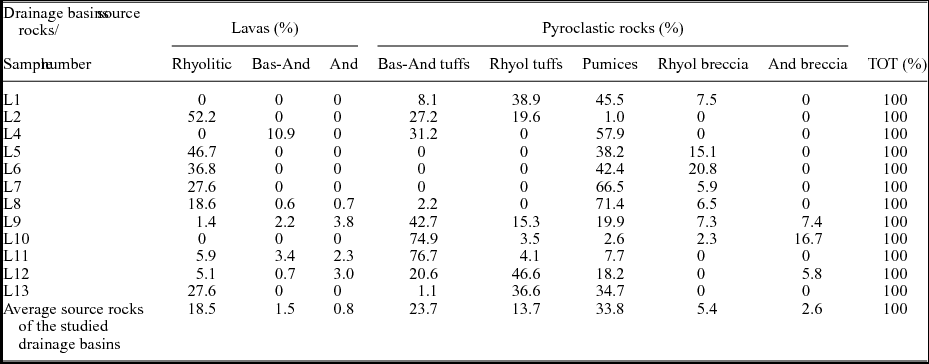
For each of the 12 drainage basins the percentage of the type of source rock was assessed using GIS (Table 1). GIS analysis and its cartographic output were produced by Quantum GIS 1.8.0 extracting data from the geologic map of Tranne et al. (Reference Tranne, Lucchi, Calanchi, Lanzafame and Rossi2002) (Figs 2, 4, 5). This enabled quantification of the area occupied by each type of lithology in the drainage basin, together with the topography. Relative proportions have been quantified according to bedrock lithology at the source (Table 2).
Outcrop areas of each source rock concerning drainage systems

Bas-And: basaltic andesitic; And: andesitic; Rhyol: rhyolitic.
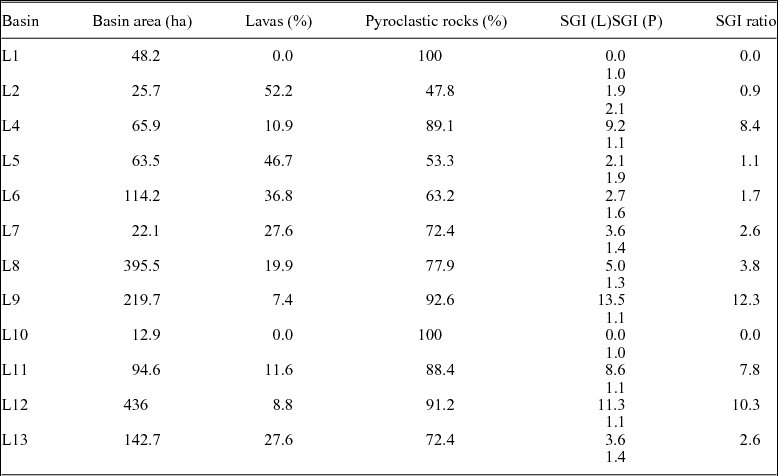
Basin areas, bedrock associations and Sand Generation Index for lavas and pyroclastic rocks

SGI: Sand Generation Index (e.g. Palomares & Arribas, Reference Palomares, Arribas, Johnsson and Basu1993); L: lavas; P: pyroclastic rocks.
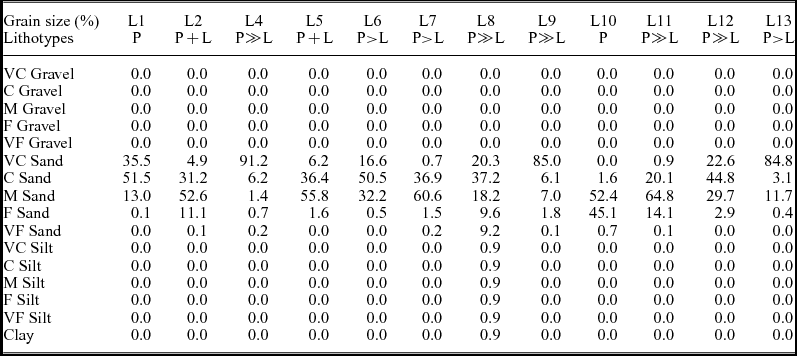
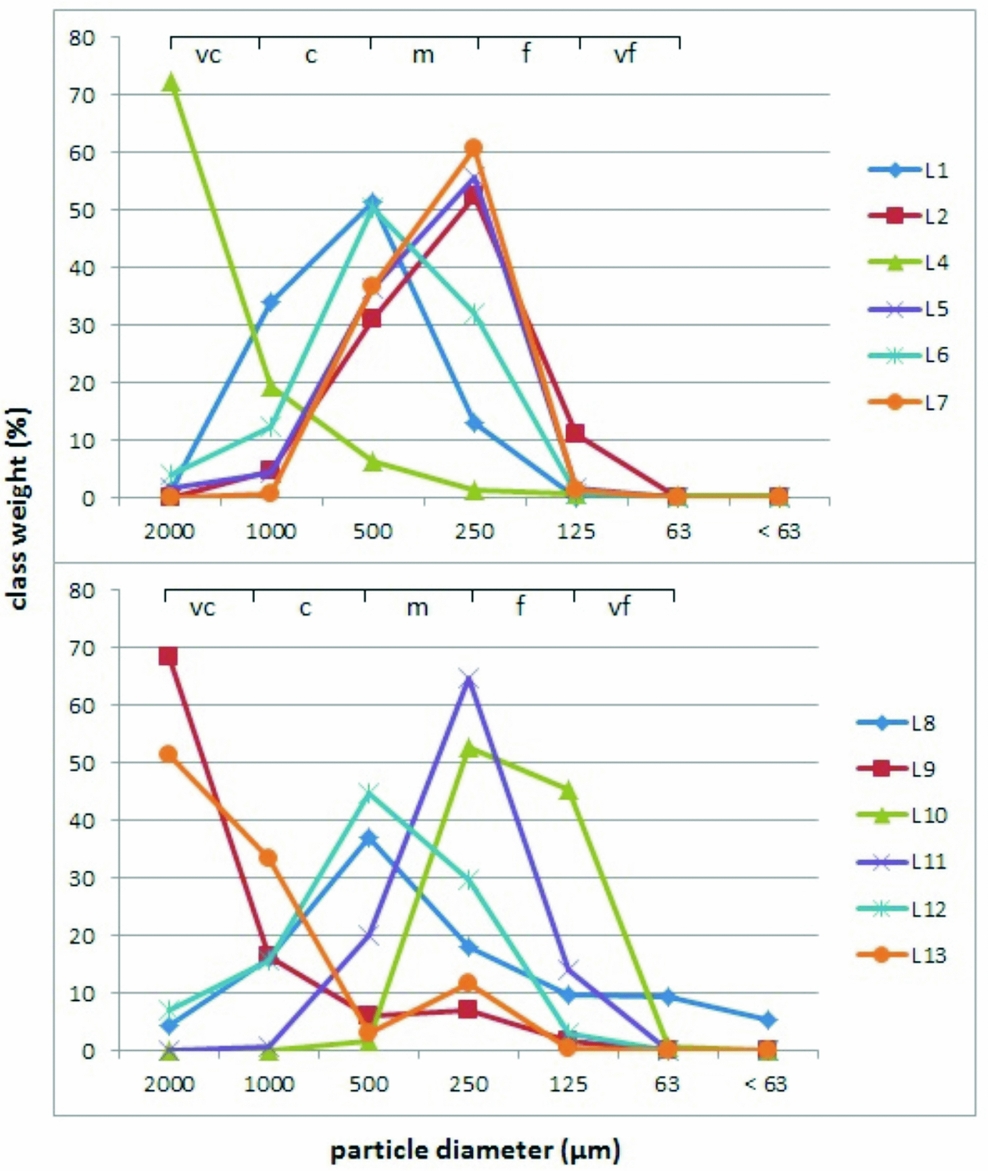
The 12 sand samples were subsampled using a splitter, then washed using H2O2 to remove clay minerals and organic matter, air-dried and mechanically sieved using 1Φ intervals. Their grain-size distribution is shown in Table 3 and Figure 8. Two size fractions (0.50–0.25 mm and 0.25–0.125 mm), impregnated with epoxy, were then used to prepare 24 thin sections: 12 of the samples are representative of medium sand (e.g. named L4-m), and 12 samples are representative of fine sand (e.g. named L4-f). These size fractions were chosen because they are the most likely to be transported into adjacent marine basins, the settings where most workers on island arc sediments have concentrated their efforts (e.g. Marsaglia, Reference Marsaglia, Johnsson and Basu1993; Garzanti & Andò, Reference Garzanti and Andò2007).
Grain-size distribution of Lipari beach sediment samples

VC: very coarse; C: coarse; M: medium; F: fine; VF: very fine; P: pyroclastic rocks; L: lavas; P+L: similar areal proportion of a dual source.
Granulometric distribution. The diameter of the particles is shown on the x-axis, and the class weight on the y-axis. vc: very coarse sand; c: coarse sand; m: medium sand; f: fine sand; vf: very fine sand.

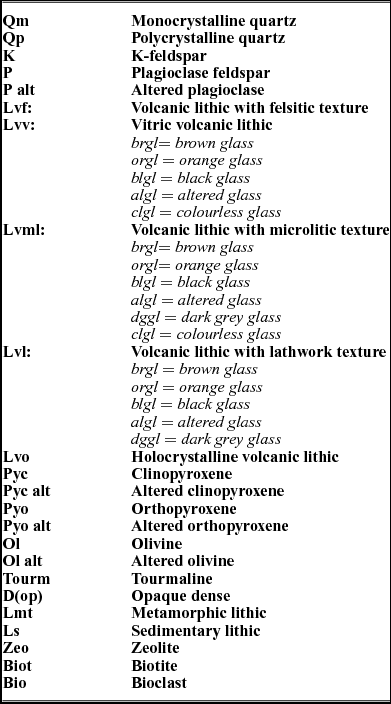
Thin sections were subsequently stained for both calcium-rich and potassium-rich feldspar grains according to the method outlined in Marsaglia & Tazaki (Reference Marsaglia, Tazaki, Taylor and Fujioka1992). Four hundred points were counted on each thin section of the medium (0.50–0.25 mm) and corresponding fine (0.25–0.125 mm) sand fractions, using the Gazzi–Dickinson method (Ingersoll et al. Reference Ingersoll, Bullard, Ford, Grimm, Pickle and Sares1984; Zuffa, Reference Zuffa and Zuffa1985). Counted grains were assigned to the monomineralic and polymineralic compositional categories listed in Table 4.
Key to counted parameters (modified from Marsaglia, Reference Marsaglia1992, Reference Marsaglia, Johnsson and Basu1993)

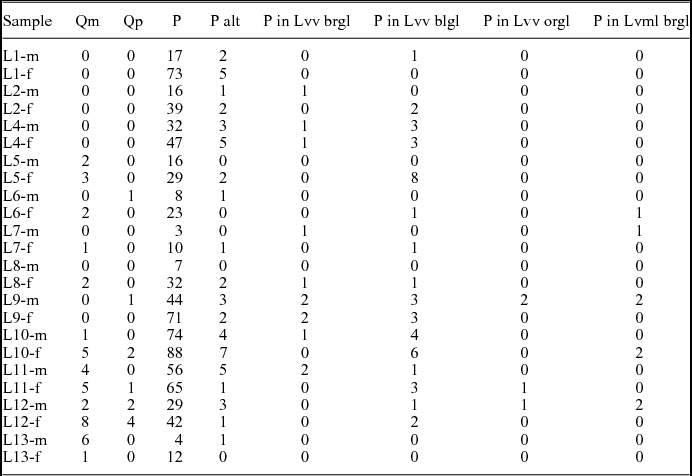
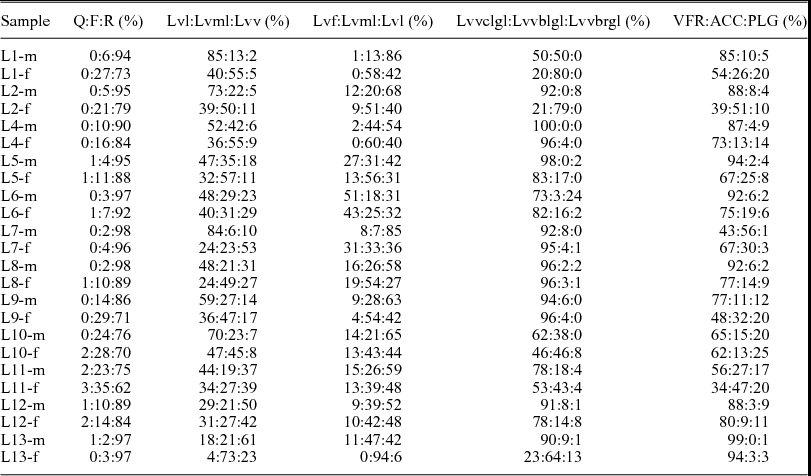
The mineralogy and texture classification of volcanic fragments in the sand samples were determined according to the classification scheme of Marsaglia (Reference Marsaglia1992, Reference Marsaglia, Johnsson and Basu1993). Raw data and recalculated petrographic parameters are shown in Appendices 1 and 2, respectively.
5. Results
5.a. Characteristics of the drainage basins
GIS regional mapping shows that, based upon topography, Lipari island is characterized by three major landforms: piedmonts and very low hills (0–230 m above sea level (asl)), low hills (275–460 m asl), and high hills (>500 m asl) (Fig. 5). Geomorphologic mapping followed the approach where drainage basins are considered as discrete units with differentiated source rocks (Tables 1, 2) supplying clastic detritus to the beach environment through stream erosion and mass-failure processes. Each drainage basin can be subdivided into three parts (upstream, downstream and alluvial system), each part having distinctive morphological characteristics (Figs 2, 5).
The uppermost parts of the watersheds, corresponding to the ‘high hills’, are steeply sloping, and the morphology is rugged and controlled by high-rate mass-wasting processes (Favalli et al. Reference Favalli, Karátson, Mazzuoli, Pareschi and Ventura2005). The mid-courses of the watersheds, corresponding to the ‘low hills’, are gently sloping. A sharp decrease in overall topographic slope marks the transition from the ‘low hills’ to the piedmont and very low hills area. In these lower reaches the drainage system presents a wide alluvial plain, and sedimentation, in the form of gravelly sand, is widespread throughout the coastal plain.
Local drainages of Lipari island are predominantly developed on pyroclastic rocks (fall and surge deposits of andesitic to rhyolitic compositions), and subordinately on lavas (rhyolite, basaltic andesite and andesite) (Tables 1, 2). For each sand sample, the basin is defined here as comprising part of the drainage basin that is upslope of the sample site: ten sand samples derive from a dual volcanic source (pyroclastic rocks+lavas) whereas two sand samples are generated from a simple source (pyroclastic rocks) (Tables 1, 2). In Table 2 the concept of Sand Generation Index (i.e. SGI of Palomares & Arribas, Reference Palomares, Arribas, Johnsson and Basu1993) is introduced; this is a relative measure of the capacity of one bedrock type to generate sand with respect to another in a compound source area. It is referred to the SGI of the lavas and of the pyroclastic source rocks. Thus,
 $$\begin{equation*}
{\rm{SG}}{{\rm{I}}_{\rm{L}}}_{({\rm{L}} + {\rm{P}})} = \frac{{{S_{\rm{L}}} + {S_{\rm{P}}}}}{{{S_{\rm{L}}}}};\quad{\rm{SG}}{{\rm{I}}_{{\rm{P}}({\rm{P}} + {\rm{L}})}} = \frac{{{S_{\rm{P}}} + {S_{\rm{L}}}}}{{{S_{\rm{P}}}}};
\end{equation*}$$
where SGIL(L+P) indicates the SGI of the lavas referred to a dual source constituted by the association lavas+pyroclastic rocks (SL+SP); and SGIP(P+L) denotes the SGI of the pyroclastic rocks. S L is the percentage of lava (source rock) outcropping in the basin; S P is the percentage of pyroclastic rock (source rock) outcropping in the basin.
5.b. Grain-size
All beach sediment samples exhibit unimodal grain-size distributions, dominated by the sand fraction (Table 3; Fig. 8). Most are medium (L2, L5, L7, L10, L11), or coarse (L12, L6, L8, L1) sand, while a few are very coarse sand (L4, L9, L13). As a result of their unimodality, samples are moderately to well sorted (Table 3).
Grain-size distributions of the sediments delivered to Lipari's beaches seem to be mainly controlled by the texture and composition of their source rocks: in fact, the very coarse and coarse sand beaches are supplied by drainages underlain by pyroclastic source rocks, both lapilli and ash beds, whereas the medium sand is mainly linked to a provenance from lavas, mainly rhyolitic and, to a lesser extent, basaltic andesitic and andesitic in composition (Table 1).
5.c. Grain types
The major components of Lipari's beach sands are monomineralic grains and volcanic lithic fragments with trace amounts of calcareous bioclasts (Appendix 1). Monomineralic grains are predominantly pyroxene and plagioclase with lesser olivine, opaque minerals, quartz and K-feldspar. Volcanic lithic fragments range in texture from lathwork to microlitic to vitric and felsitic varieties, whereas holocrystalline lithic volcanic grains are minor constituents (Appendix 1; Figs 9, 10, 11).
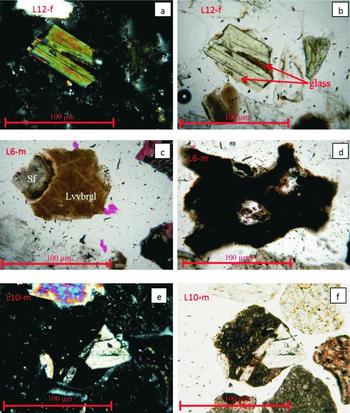
Euhedral monocrystalline clinopyroxene with glassy rim and intracrystalline glass; (a) NX; (b) N//. (c) Lvvbrgl: Vitric volcanic lithic with brown glass; Sf: Devitrification with spherulitic texture (N//). (d) Vesiculated vitric lithic with black glass (Lvvblgl, N//). (e, f) Volcanic lithic with lathwork texture with brown glass (Lvlbrgl). Clearly visible are some phenocrysts of plagioclase (e: NX, f: N//).

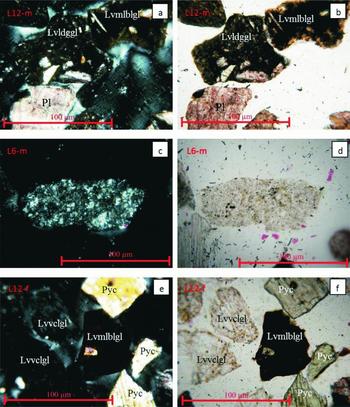
(a, b) Pl: grain of monocrystalline plagioclase; Lvldggl: volcanic lithic fragment with lathwork texture and dark grey glass; Lvmlblgl: volcanic lithic fragment with microlitic texture and black glass (a: NX, b: N//). (c, d) Volcanic lithic fragment with felsitic texture (Lvf; c: NX, d: N//). (e, f) Lvmlblgl: volcanic lithic fragment with microlitic texture with black glass; Pyc: angular monocrystalline clinopyroxene grains; Lvvclgl: vitric volcanic lithic colourless glass (e: NX, f: N//).

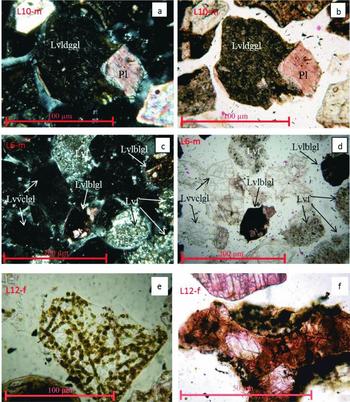
(a, b) Lvldggl: volcanic lithic fragment with lathwork texture with dark grey glass; Pl: plagioclase (a: NX, b: N//). (c, d) Lvvclgl: vitric volcanic lithic with colourless glass; Lvf: volcanic lithic fragment with felsitic texture; Lvlblgl: volcanic lithic fragment with lathwork texture with black glass (c: NX, d: N//). (e) Potassic fragment of a vitric volcanic lithic colourless glass (Lvvclgl) stained with sodium cobaltinitrite (N//). (f) Volcanic lithic fragment with microlitic texture with orange glass (Lvmlorgl, N//).

5.c.1. Monomineralic components
Quartz, K-feldspar and especially plagioclase (10–20% higher) are much more abundant in the fine sand fractions than in the medium sand fractions (Appendix 1). Quartz and K-feldspar occur mainly as sand-sized phenocrystals set in lithic grains exhibiting felsitic textures (Figs 10c, d, 11c, d). However, they occur, to a lesser extent, as monocrystalline quartz, and individual monocrystalline grains of angular to sub-rounded sanidine (Appendix 1).
Plagioclase grains range from unaltered to slightly altered to sericite, and very few grains show argillification processes such as grain coatings (James, Mack & Suttner, Reference James, Mack and Suttner1981). Individual monocrystalline plagioclase grains are poorly or not rounded, and commonly they are euhedral and zoned, which is consistent with a provenance from a volcanic lithotype or source rock (e.g. Dickinson, Reference Dickinson1970; Pittman, Reference Pittman1970; Zuffa, Reference Zuffa, Leggett and Zuffa1987). Albite twinning is more evident in medium sand grains, whereas for fine plagioclase grains these features are lost probably because of mechanical breakage along cleavage or twin planes (Pittman, Reference Pittman1969; Garzanti, Reference Garzanti1986; Caracciolo et al. Reference Caracciolo, Tolosana-Delgado, Le Pera, von Eynatten, Arribas and Tarquini2012).
Monomineralic pyroxene grains, and/or sand-sized pyroxene crystals in volcanic lithic grains, are generally preserved unaltered in the sandy detritus (Figs 9a, b, 10e, f). Despite their occurrence as detrital grains, the individual monocrystalline grains of pyroxene and olivine retain a crystalline morphology, or habit, inherited from the volcanic source rock.
In the Lipari sands, opaque mineral grains are not significant detrital components: they occur as local concentrations in only a few beach samples. Opaque dense minerals were grouped into one category (Appendix 1) rather than subdivided, because reflected light microscopy is not sufficient to discriminate among magnetite, ilmenite, pyrite and hematite, and among their intergrown phases and textures. Microprobe analysis or Raman spectroscopy techniques aimed at geochemical discrimination could be used (i.e. Basu & Molinaroli, Reference Basu and Molinaroli1989, Reference Basu and Molinaroli1991; Andò & Garzanti, Reference Andò, Garzanti, Scott, Smyth, Morton and Richardson2013) but these are beyond the scope of this paper.
5.c.2. Volcanic lithic fragments
Varieties of volcanic lithic fragments in Lipari's beach sand include, in order of decreasing abundance, lathwork, microlitic, vitric, felsitic and holocrystalline categories. In addition, the first three categories were divided according to glass colour and texture of their glassy groundmass as observed in plane-polarized light (Appendix 1). Glassy groundmass of the lithic fragments was divided into brown, black, colourless, altered, orange and dark-grey varieties (Appendix 1; Figs 9, 10, 11). These subdivisions of detrital volcanic glass provide a direct means of assessing magmatic affinities of the source terrane (e.g. Cawood, Reference Cawood, Morton, Todd and Haughton1991), and also glass colour is thought to be a function of composition and cooling rate (e.g. Schmincke, Reference Schmincke, Hussong and Uyeda1981; Marsaglia, Reference Marsaglia1992, Reference Marsaglia, Johnsson and Basu1993).
Vitric (Lvv) lithic fragments are characterized by their lack of microlites. They exhibit variable morphologies and different glass colours from brown (Lvvbrgl), to black (Lvvblgl), to orange (Lvvorgl), to dark grey (Lvvdggl), to colourless (Lvvclgl) (Appendix 1; Figs 9c, d, 10e, f, 11c, d, e).
Microlitic (Lvml) volcanic lithic fragments contain variable amounts of microlites of feldspar and ferromagnesian minerals visible at high magnification. These microlites are primarily silt-sized plagioclase or pyroxene crystals (Appendix 1; Figs 10a, b, e, f, 11f).
Lathwork (Lvl) volcanic lithic fragments are glassy fragments that contain variable amounts of plagioclase feldspar, pyroxene, olivine and opaque minerals as sand-sized microlites/phenocrysts (Appendix 1; Figs 9e, f, 10a, b, 11a, b, c, d).
Felsitic (Lvf) volcanic lithic fragments contain dominantly feldspars and quartz and include two types: granular felsitic and seriate felsitic (Appendix 1; Figs 10c, d, 11c, d).
Clasts in the ‘other volcanic lithic category’ (Lvo; Appendix 1), as in other arc systems (e.g. Marsaglia, Reference Marsaglia, Johnsson and Basu1993), constitute only a few per cent of the grains in the sand of Lipari beaches. They include holocrystalline aggregates of (1) plagioclase and opaque minerals, (2) opaque minerals and pyroxene, (3) pyroxene and plagioclase, and (4) pyroxene, plagioclase and opaque minerals.
5.c.3. Minor constituents
Minor constituent grains (Table 4) found in some samples include (1) argillite-shale sedimentary lithic fragments; (2) bioclasts, predominantly carbonate bioclastic debris, which may include some micritic beach-rock cement; (3) metamorphic lithic fragments; (4) unweathered biotite flakes exhibiting brown to green pleochroism; (5) grains of zeolite that could be hydrothermal alteration phases (e.g. those associated with the M. Guardia eruption; De Rosa & Sheridan, Reference De Rosa and Sheridan1983); and (6) grains of tourmaline.
5.d. Modal compositions
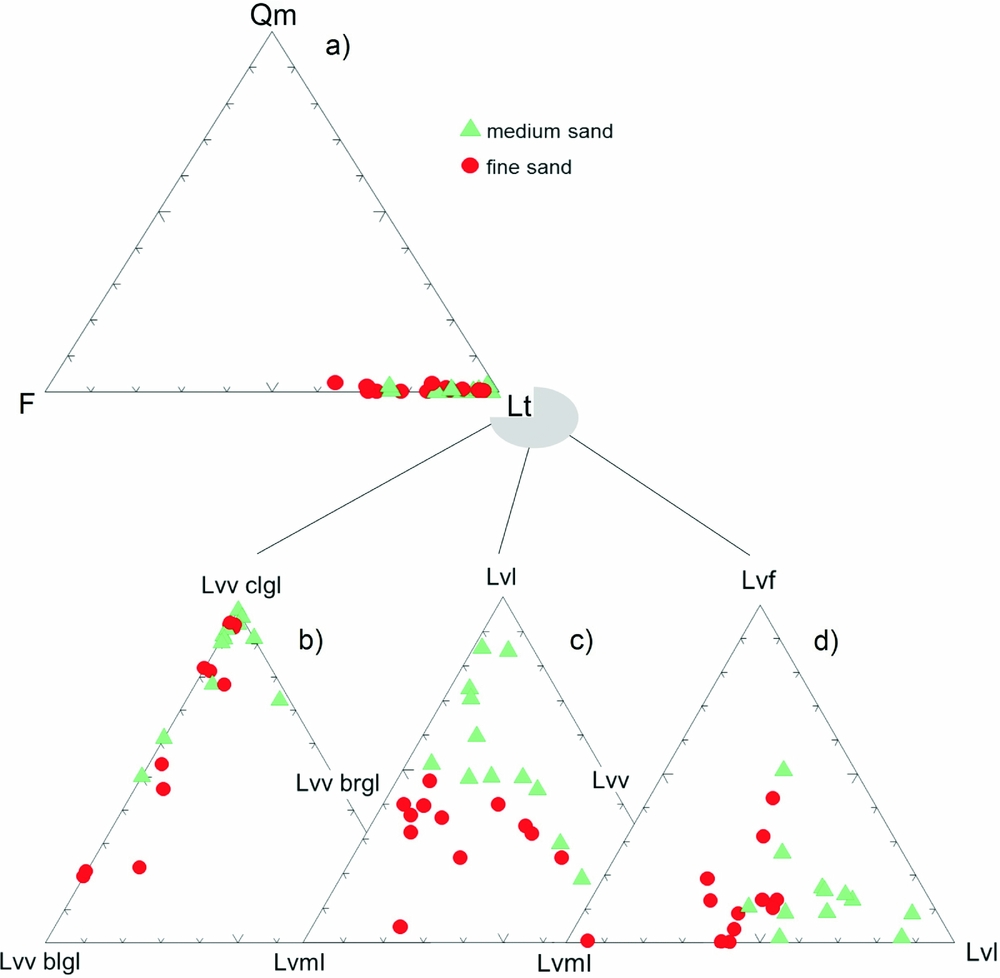
From the data presented in Appendix 1, and the formulae for recalculated parameters in Table 4, Qm:F:Lt, Lvl:Lvml:Lvv, Lvf:Lvml:Lvl, Lvvclgl:Lvvblgl:Lvvbrgl, and VFR:ACC:PLG percentages for both medium and fine sand samples were calculated (Appendix 2). Besides differences in the source rocks, modal analysis of Lipari beach sands shows a uniform composition characterized by trace amounts of quartz, moderate to low feldspar, mainly plagioclase, and dominant volcanic rock fragments, as emphasized on a Qm:F:Lt plot (Fig. 12a), where all Lipari beach sand samples plot along the Lt–F tie, toward the Lt apex.
(a) Qm:F:Lt diagram. Qm: monocrystalline quarz; F: feldspars; Lt: total lithics. (b) Lvvclgl (colourless glass):Lvvblgl (black glass):Lvvbrgl (brown glass). (c) Lvl (lathwork):Lvml (microlitic):Lvv (vitric). (d) Lvf (felsitic):Lvml (microlitic):Lvl (lathwork).

Although the Gazzi–Dickinson method of point counting was used in this study to minimize the effects of grain-size, there appears to be an inherent relationship between grain-size and the considered detrital modes (Fig. 12b, c, d). The medium sand samples of Lipari beaches are more lithic-rich than the fine sand samples, and there is a slight shift toward more feldspathic compositions with decreasing grain-size (Fig. 12a). Lipari sand is distinguished by its higher proportion of crystal-rich (Lvl and Lvml) lithic fragments with respect to vitric ones (Fig. 12c). However, as might be expected, medium sand is enriched in lathwork texture whereas the fine sand is richer in lithics with microlitic texture. Lithics with vitric (Fig. 12c) and felsitic (Fig. 12d) textures seems to be equally distributed between the two sand size fractions. In terms of vitric components, Lipari beach sand lacks or has very few brown glassy fragments, and contains a larger proportion of colourless and black glassy fragments. Fine sand contains a higher proportion of black glassy particles, and medium sand is almost completely dominated by colourless glass, with few exceptions (Fig. 12b).
6. Discussion
Erosion on the island of Lipari can be viewed in terms of a weathering-limited denudation regime (e.g. Carson & Kirkby, Reference Carson and Kirkby1972). Under this condition, transport rates exceed the rate at which chemical weathering can generate loose and leached material (Johnsson, Ellen & McKittrick, Reference Johnsson, Ellen, McKittrick, Johnsson and Basu1993), and thus sandy detritus consists of a varied association of less durable mineral phases, the proportion of which, reflects the composition of the bedrock (e.g. Nesbitt & Young, Reference Nesbitt and Young1996; Girty et al. Reference Girty, Marsh, Meltzner, McConnell, Nygren, Nygren, Prince, Randall, Johnson, Heitman and Nielsen2003). High relief in Lipari's drainage basins results in rapid sediment transport and short to no temporary sediment storage and pedogenesis. Thus, chemical weathering appears to be negligible.
The composition of Lipari beach sand defines, on average, a lithic petrofacies: the medium-grained sands are lithic-rich, whereas from medium to fine sand there is a progressive increase in feldspar content, especially of plagioclase grains (Fig. 12a, b, c, d). The sand detrital modes of Lipari island are immature, are rich in unweathered mafic minerals, glass and bedrock-derived feldspar grains and, moreover, lack pedogenetic particles (e.g. Cleary & Connolly, Reference Cleary and Connolly1971; Johnsson, Ellen & McKittrick, Reference Johnsson, Ellen, McKittrick, Johnsson and Basu1993). The immaturity, both compositional and textural, of Lipari beach sand testifies to the rapidity with which sediment is isolated from soil horizons and pedogenetic processes on the island's steep slopes, because of the high mean annual precipitation of 600 mm a−1 (ISPRA, 2011) and Mediterranean climate (Arribas et al. Reference Arribas, Critelli, Le Pera and Tortosa2000; Le Pera et al. Reference Le Pera, Arribas, Critelli and Tortosa2001; Critelli et al. Reference Critelli, Arribas, Le Pera, Tortosa, Marsaglia and Latter2003; Scarciglia et al. Reference Scarciglia, Saporito, La Russa, Le Pera, Macchione, Puntillo, Crisci and Pezzino2012). Thus there is evidence that, on Lipari, sand composition does accurately reflect bedrock composition except in the case of source areas dominated by subaphyric rhyolites.
Moreover, there are no significant differences in roundness of both lithic and monocrystalline grains from beaches of different-sized drainage basins, which indicates that there is no perceptible rounding of grains during the transit from stream to beach environments, with rounding presumably a product of wave abrasion processes. In fact, high-energy-transport processes on Lipari beaches result in well-sorted beach sediment (Table 3; Fig. 8), but are not highly destructive to labile grains, such as pyroxene. The latter, in particular, is very angular and with sharp edges, sometimes preserving glassy rims (Fig. 9a, b). In general, the roundness and relevant textural changes for all grain types in first-cycle sand samples are related to mineral interfaces (e.g. Caracciolo et al. Reference Caracciolo, Tolosana-Delgado, Le Pera, von Eynatten, Arribas and Tarquini2012). Thus, siliclastic supply from each studied drainage basin to beach environments cannot be considered as ‘masked’ by chemical and mechanical weathering during transport.
The provenance lithotype assemblages (e.g. Heins & Kairo, Reference Heins, Kairo, Arribas, Critelli and Johnsson2007), quantified on Lipari with GIS (Figs 2, 3, 4), have been discriminated as reflecting the relative abundances of lavas and pyroclastic rocks (Table 1). The Sand Generation Index (Table 2) of each lithotype, i.e. the propensity of each source rock or rock assemblage to create sand-sized detritus (SGI of Palomares & Arribas, Reference Palomares, Arribas, Johnsson and Basu1993), has been determined. The lithotypes that generate sand (Heins & Kairo, Reference Heins, Kairo, Arribas, Critelli and Johnsson2007) can be considered as a dual source with a clear dominance of outcrop areas of pyroclastic rocks and minor part of source rocks of various lava types (Tables 1, 2). Microlitic, felsitic and vitric particles are mainly supplied from rhyolitic source rocks, whereas volcanic lithics with lathwork texture are supplied from basaltic andesite source rocks, like those described by Marsaglia (Reference Marsaglia1992, Reference Marsaglia, Johnsson and Basu1993) and Critelli & Ingersoll (Reference Critelli and Ingersoll1995). The lathwork fragments are probably released as medium and fine sandy particles by weathering of lavas which are characterized by a higher SGI than that of pyroclastic rocks (Table 2). Although the pumice provenance lithotypes have a very large areal outcrop distribution (Tables 1, 2), they do not generate as much medium and fine sand of colourless vesiculated glass as might be expected when compared to submarine pumice-rich arc environments (e.g. Marsaglia, Reference Marsaglia1992). This is probably because of the unusual hydrodynamic properties of subaerially erupted pumice which tends to produce coarser detrital particles, namely gravel clasts (Fig. 6), varying from −2 to −1Ф (4–2 mm) (e.g. Manville, Segschneider & White, Reference Manville, Segschneider and White2002), a size grade that was not considered in this study. The vitric lithic components, when subdivided by colour (Fig. 12a), support a distinct Lipari provenance (e.g. Marsaglia, Reference Marsaglia1992, Reference Marsaglia, Johnsson and Basu1993; De Rosa, Reference De Rosa1999). Lipari sands are more enriched in colourless vitric fragments, shed dominantly by the rhyolite lithotype, with lesser black and brown vitric fragments, primarily linked to a basaltic andesite provenance (Marsaglia, Reference Marsaglia1992). It is likely that in a dual rhyolite+basaltic andesite source (Tables 1, 2), rhyolitic outcrops have the highest potential to produce medium and fine vitric sand particles. Moreover, our results show that mixed lavas (rhyolitic+basaltic andesite+andesite composition) provide primarily medium-grained sand and subordinate fine sand, whereas pyroclastic rocks deliver coarse- and very coarse-grained sand, probably because of mechanical behaviour of granular material constituting pyroclastic tuff breccias, lapilli beds and ash deposits (e.g. Sparks, Reference Sparks1976; De Rosa, Reference De Rosa1999).
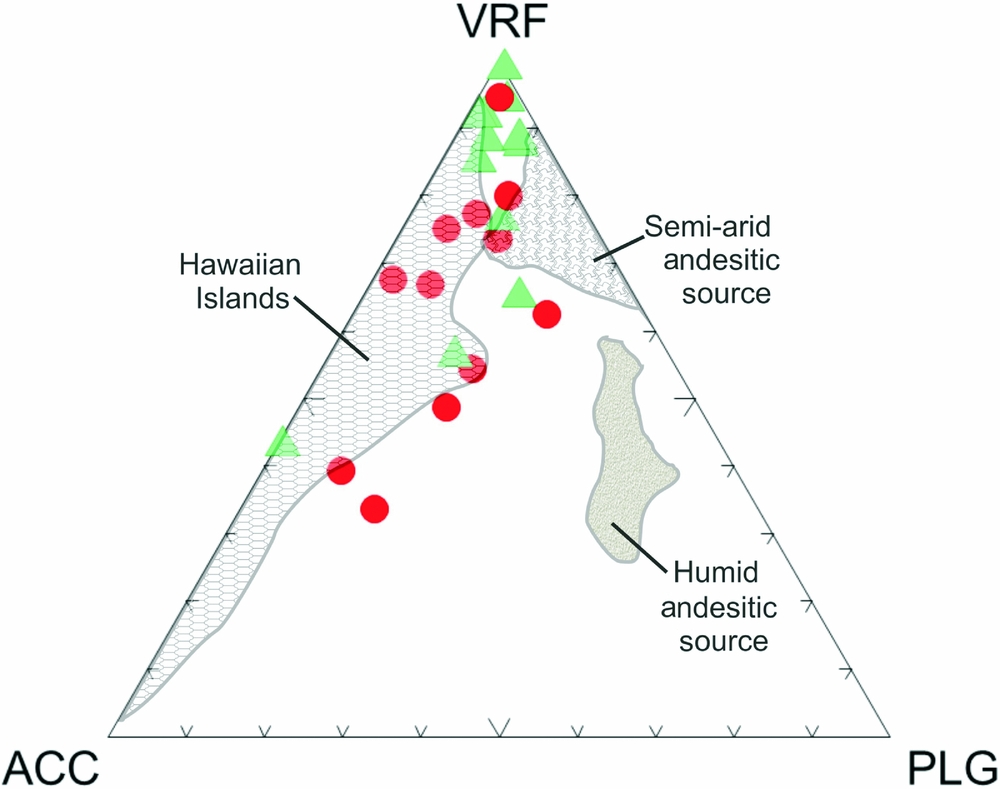
Furthermore, in a study of andesitic stream sand from humid and semi-arid climate, Mack & Jerzykiewicz (Reference Mack and Jerzykiewicz1989) showed that epiclastic–andesitic sands are feldspatholitic, with total feldspar controlled by weathering environment. The plot in Figure 13 clearly shows the considerable variation in VFR:ACC:PLG (e.g. Mack & Jerzykiewicz, Reference Mack and Jerzykiewicz1989) percentages versus grain-size as also obtained using more routinely used diagrams such as Q:F:L (e.g. Ingersoll et al., Reference Ingersoll, Bullard, Ford, Grimm, Pickle and Sares1984) and Lm:Lv:Ls (e.g. Ingersoll, Reference Ingersoll1990). Specifically, the conversion from medium- to fine-sand grain-size led to a decrease in polymineralic rock fragments (VFR) and to enrichment into the monomineralic component of the sandy particles, represented by olivine, pyroxene and opaque (ACC) and plagioclase crystals (PLG). Under the weathering-limited erosion regime of Lipari island, it is likely that only mechanical breakage of composite rock fragments occurs. For these lithic-rich volcaniclastic sands, boundaries between phenocrysts and glassy groundmass, considered as non-isomineralic interfaces (Heins, Reference Heins1995), could represent sites of preferential disaggregation, and as the degree of this process intensifies, it controls the conversion from a polymineralic or composite grain to a monomineralic one. Lipari beach sands are most similar to the semi-arid examples of Mack & Jerzykiewicz (Reference Mack and Jerzykiewicz1989); however, Lipari sand samples, especially in the fine fraction (Appendix 1), are enriched in accessory dense minerals (e.g. opaques, pyroxene and olivine) as shown in Figure 6 and are more similar to the basaltic Hawaiian beach sand studied by Marsaglia (Reference Marsaglia, Johnsson and Basu1993) (Fig. 13). This may reflect the more mafic, basaltic andesite sources on Lipari, or just that the Lipari (e.g. Garzanti & Andò, Reference Garzanti and Andò2007 b) and Hawaii (e.g. Marsaglia, Reference Marsaglia, Johnsson and Basu1993) samples are beach environments where dense minerals tend to be concentrated by hydraulic sorting effects (Flores & Shideler, Reference Flores and Shideler1978; Komar & Wang, Reference Komar and Wang1984; Frihy, Lotfy & Komar, Reference Frihy, Lotfy and Komar1995; Dye & Dickinson, Reference Dye and Dickinson1996; Garzandi & Andò Reference Garzanti and Andò2007 a; Garzanti, Andò & Vezzoli, Reference Garzanti, Andò and Vezzoli2008, Reference Garzanti, Andò and Vezzoli2009). They have a subhedral or euhedral texture without any significant reduction in angularity due to beach environment abrasion processes (e.g. Critelli, Le Pera & Ingersoll, Reference Critelli, Le Pera and Ingersoll1997; Le Pera et al. Reference Le Pera, Mongelli, Morelli and Critelli2000, Reference Le Pera, Arribas, Critelli and Tortosa2001; Critelli et al. Reference Critelli, Arribas, Le Pera, Tortosa, Marsaglia and Latter2003; Garzanti & Andò, Reference Garzanti and Andò2007 a, b; Andò et al. Reference Andò, Garzanti, Padoan and Mara Limonta2012). Furthermore, some euhedral pyroxene grains show perfectly retained glassy rims, providing evidence of provenance as pyroclastic airfall particles later reworked in the beach environment (e.g. De Rosa, Reference De Rosa1999; Fig. 9a, b).
Ternary plot of relative proportions of volcanic rock fragments with all texture typologies (VFR), accessory minerals (ACC – single grains of olivine, pyroxene, opaque) and plagioclase (PLG). Shadow areas for andesitic source are from Mack & Jerzykiewicz (Reference Mack and Jerzykiewicz1989); shadow areas from Hawaiian Islands are from Marsaglia (Reference Marsaglia, Johnsson and Basu1993). Circles – Lipari fine sand samples; triangles – Lipari medium sand samples.

Hydraulic-sorting effects, including selective entrainment of lighter pumice grains and pebbles, and darker dense mineral grains (olivine, pyroxene, opaques), are in fact displayed by most beaches of Lipari island. This grain-size-dependent fractionation between denser and lighter grains results from sea-wave energy (e.g. Marsaglia, Reference Marsaglia, Johnsson and Basu1993; Dye & Dickinson, Reference Dye and Dickinson1996; Ramalho et al. Reference Ramalho, Quartau, Trenhaile, Mitchell, Woodroffe and Ávila2013). The winnowing related to big waves is thus important in a first-cycle modern depositional environment to explain anomalies in the observed suite of minerals and rock fragments. The amount of dense minerals in modern sediments is normally greater than expected from a volcanic source rock (e.g. Morton, Reference Morton and Zuffa1985; Frihy, Lotfy & Komar, Reference Frihy, Lotfy and Komar1995; Dye & Dickinson, Reference Dye and Dickinson1996; Garzanti et al. Reference Garzanti, Canclini, Moretti Foggia and Petrella2002; Garzanti & Andò Reference Garzanti and Andò2007 a, b). Wave abrasion may serve to concentrate the trace, and heretofore unrecognized amounts of quartz phenocrystals in the source rocks thus explain the discrepancy between the absence of quartz as primary mineral in Lipari source rocks and its occurrence, in trace amounts, in the sand.
Other provenance options include: contamination from human activities (e.g. ship ballast, import of materials disaggregated during storms); crystals liberated from pumice clasts that floated in from nearby island or submarine eruptions; and, for fine grains, windblown transport processes affecting the Mediterranean area (e.g. Molinaroli, Guerzoni & Rampazzo, Reference Molinaroli, Guerzoni, Rampazzo, Johnsson and Basu1993).
Thus, we cannot rule out potential ‘exotic contamination’ of the Lipari system by fallout ash derived from other volcanoes in the region, such as M. Etna. The differentiation of this material would require more detailed geochemical, mineralogical analyses and theoretical models (e.g. Carey & Sparks, Reference Carey and Sparks1986).
7. Conclusions
The main factors controlling the chemical and mineralogical composition of siliciclastic sedimentary rocks are the provenance lithotypes (Heins Reference Heins1995; Arribas & Tortosa, Reference Arribas and Tortosa2003; Heins & Kairo, Reference Heins, Kairo, Arribas, Critelli and Johnsson2007), climate through chemical weathering (Johnsson et al. Reference Johnsson, Stallard and Meade1988), abrasion and sorting during transportation (Nesbitt & Young, Reference Nesbitt and Young1996), and the tectonic setting (Dickinson and Valloni, Reference Dickinson and Valloni1980). Analysis of petrological data derived from beach sands of Lipari island yields the following conclusions with regard to volcaniclastic sand-generation processes:
The grain-size distribution within beach sediment shows a tendency towards coarse (1000–500 µm) and medium (500–250 µm) modes, indicating a varied physical disintegration of the source rocks. Rhyolitic, basaltic andesitic and andesitic lavas deliver, on average, medium to fine sand to the beaches, whereas pyroclastic rocks yield coarser fractions of sand sediment, from very coarse to coarse particles.
The studied drainage basins, characterized by outcrops of lavas and pyroclastic rocks with rhyolitic, basaltic andesitic and andesitic compositions, are multiple sources for beach sand throughout the island. Evaluation of these beach sand samples using composite volcanic lithic grain type plots (Lvl:Lvml:Lvv; Lvf:Lvml:Lvl; Lvvclgl:Lvvblgl: Lvvbrgl; VRF:ACC:PLG) demonstrates that these plots are efficient tools for discriminating among rhyolitic, basaltic andesitic and andesitic clastic supplies to the sandy beach environments of Lipari.
Applying the concept of Sand Generation Index (SGI, first defined by Palomares & Arribas, Reference Palomares, Arribas, Johnsson and Basu1993) to this felsic to intermediate bedrock association of lavas+pyroclastic rock shows that these lithotypes have different propensities to create detritus, in terms of both grain-size and composition. The SGI of lavas is 0.9–12.3 times higher than that of pyroclastic rocks, even if they constitute a minor outcrop area of the island. In this regard, we suggest a modified SGI, detailing the Sand (S) in terms of grain-size classes: in a weathering-limited erosion regime, under a Mediterranean climate, in the case of felsic to intermediate lavas the SGI is characterized by a medium (m) to fine (f) sand generation (mfSGI), whereas in the case of pyroclastic rocks the grain-size of sand is in the range of very coarse (vc) to coarse (c) sand (vccSGI). Clastic contribution from pyroclastic rock outcrops such as pumice is not found in the size ranges studied (medium and fine sand), suggesting that these pumiceous source rocks probably only produce gravel or very fine sand and silt (and potentially clay when weathered). This finding has implications for the stratigraphic record because pumice clasts, ranging from medium to fine grain-size, could be underrepresented in older volcaniclastic deposits and overrepresented in other size fractions. This factor, which we relate in this case history to a hydrodynamic sorting control in the beach environment, or to a lower SGI of the source rocks, in ancient volcaniclastic rocks, has often been attributed to the loss of these clastic particles during diagenetic processes. Instead, our study suggests also for other factors responsible for its earlier loss, in continental areas, before its entering into burial processes and diagenetic history. Thus, in the future, studies of the conversion from ‘pumice source rock to pumiceous detritus’ could more thoroughly document and evaluate the propensity to create gravel or silt, if texture and composition of this source rock could be characterized by a Gravel Generation Index (GGI) or a Silt Generation Index (SiGI).
Acknowledgements
The manuscript benefited from careful reviews by S. Andò and R. V. Ingersoll. Funding by Italian MURST (Ministry of University Research Science and Technology, ex 60% year 2015) to E. Le Pera and (ex 60% year 2015) to R. De Rosa.
Raw data


Recalculated parameters