Introduction
Tavares et al. (Reference Tavares, Pessôa and Gonçalves2011) described a new species of rodent of the family Cricetidae, Cerradomys goytaca Tavares, Pessôa & Gonçalves, 2011 from south-eastern Brazil. This species lives on sand-plains areas of the northern coast of Rio de Janeiro State and the south of Espírito Santo State. The differentiation of the new species was based on its skull morphology, coat and chromosomal differences (Tavares et al., Reference Tavares, Pessôa and Gonçalves2011). According to these authors, this new taxon has a restricted distribution to the sand-plains area, forming an open mosaic on the coast of the states of Rio de Janeiro and Espírito Santo.
The cestodes of the genus Raillietina Fuhrmann, 1920 (Cyclophyllidea, Davaineidae) are divided into four subgenera by Fuhrmann (Reference Fuhrmann1920), i.e. R. (Raillietina) Fuhrmann, Reference Fuhrmann1920, R. (Fuhrmannetta) Stiles & Orleman, 1926, R. (Skrjabinia) Fuhrmann, Reference Fuhrmann1920 and R. (Paroniella) Fuhrmann, 1920. Movsesyan (Reference Movsesyan1966) elevated these subgenera to the generic rank and this concept has been accepted in the latest taxonomic revision of the family Davaineidae Braun, 1900 (Jones & Bray, Reference Jones, Bray, Khalil, Jones and Bray1994). The main diagnostic characteristics of the genera Raillietina, Fuhrmannetta, Skrjabinia and Paroniella are the number of eggs per uterine capsule and the position of the genital pore, e.g. unilateral or irregularly alternating.
According to Jones & Bray (Reference Jones, Bray, Khalil, Jones and Bray1994), the genus Fuhrmannetta is characterized by the presence of irregularly alternating genital pores and uterine capsules containing 3–5 eggs. Species of this genus have been reported parasitizing birds and some mammals, with a cosmopolitan distribution (Sawada, Reference Sawada1965; Rolas, Reference Rolas1976; Olsen & Kuntz, Reference Olsen and Kuntz1979; Schmidt, Reference Schmidt1986; Movsesyan, Reference Movsesyan and Beer2003a, Reference Movsesyan and Beerb).
During studies on the helminth parasites of the cricetid rodent C. goytaca from the Jurubatiba Natural Reserve, in the city of Quissamã, State of Rio de Janeiro, Brazil, we found cestode specimens belonging to the family Davaineidae. Our observations revealed that they belong to a new species of the genus Fuhrmannetta. This study aimed to describe this new species from C. goytaca from Brazil.
Materials and methods
A total of 16 rodents C. goytaca were collected between April and December 2015, in sand-plains areas of Quissamã city, in the northern region of Rio de Janeiro State, using livetraps and lures made of fruits, seeds and peanut butter. Rodents were euthanized in a carbon dioxide (CO2) chamber, necropsied and the gastrointestinal tracts were analysed under a stereomicroscope for the presence of parasites. Cestodes were washed in 0.65% saline solution and fixed in hot AFA (70°GL ethanol, 93%; formaldehyde, 5%; glacial acetic acid, 2%) (70°C) overnight, conserved in 70% ethanol and stained by the regressive process with Grenacher's borax carmine, dehydrated in an increasing series of alcohol, according to Amato et al. (Reference Amato, Boeger and Amato1991), with modifications as follows. Specimens were cleared in clove oil and mounted in Dammar gum. The scolices were mounted in Hoyer's medium for counting and measurement of the hooks, according to Ganzorig et al. (Reference Ganzorig, Sumiya, Batsaikhan, Schuster, Oku and Kamiya1999). Two scolices were macerated in a tiny mortar and pestle with a little distilled water for better visualization of the morphology of the spines. The macerate was placed between a slide and cover slip and observed on a light microscope. Mature proglottids were embedded in paraffin and serial cross-sections were cut at a thickness of 5 μm. Sections were stained with haematoxylin and eosin and mounted in Canada balsam. The morphometric measurements were taken from the stained cestode specimens. All measurements are given in micrometres unless otherwise stated. Measurements were taken with an Axioplan Zeiss light microscope (Carl Zeiss, Jena, Germany) equipped with a Canon Power-Shot A640 digital camera (Canon, Beijing, China) and Zeiss AxioVision Sample Images Software for image analysis. The drawings were made using a camera lucida. The illustrations were drawn with Intuos4 Wacon® pen tablet (Wacom, Beijing, China) using Adobe Photoshop Elements 8.0.
For scanning electron microscopy, cestodes were fixed for 2 h in 2.5% glutaraldehyde, 4% freshly prepared paraformaldehyde, 5 mm calcium chloride in 0.1 m cacodylate buffer, pH 7.2 and post-fixed in 2% osmium tetroxide in 0.1 m cacodylate buffer, according to Ederli et al. (Reference Ederli, de Oliveira and de Azevedo Rodrigues2008). The samples were dehydrated in an acetone series, critical-point dried with CO2, sputter-coated with gold and examined in a Zeiss EVO 40 scanning electron microscope (SEM) operating at 15 kV.
Slides deposited at the Helminthological Collection of the Oswaldo Cruz Institute (CHIOC), Fundação Oswaldo Cruz (FIOCRUZ), Rio de Janeiro, Brazil, under the registration numbers CHIOC 33.043 A–C, CHIOC 33.043 D–F and CHIOC 33.044, collected from Oryzomys ratticeps from Paraná State, Brazil and identified as (Raillietina) Raillietina guaricana, were used for comparison.
Results
Fuhrmannetta jurubatensis n. sp.
Taxonomic summary
Type host. Cerradomys goytaca (Tavares, Pessôa & Gonçalves, 2011) (Rodentia, Cricetidae).
Type locality. Reserva de Jurubatiba, Quissamã, Rio de Janeiro, Brazil (22°10′36.5″S, 41°25′42.0″W).
Dates of collection. Between April and December 2015.
Site in host. Small intestine.
Prevalence. 62.5% (10 out of 16 specimens examined).
Mean intensity. 3 (1–6 worms per host).
Type material. Holotype in CHIOC (CHIOC 38869 a–h); paratypes in CHIOC (CHIOC 38869 i–l).
Etymology. The specific name ‘jurubatensis’ derives from Reserva de Jurubatiba where the sampling was carried out.
Description
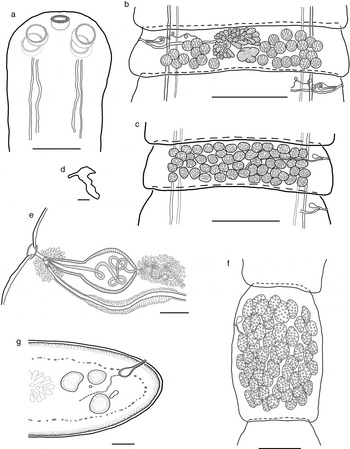
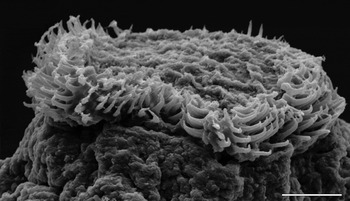
Based on nine mature specimens. Slender cestodes with 273–288 (n = 2) craspedote proglottids. Strobila measuring 25.2 ± 4.5 cm (17.4–32.1, n = 8) long, with maximum width 2754 ± 140.9 (2419–2960, n = 5) at level of gravid proglottids. Scolex rounded, wider than long, 386 ± 95.51 (256–547, n = 6) wide by 334 ± 67.79 (254–454, n = 6) long, not clearly distinct from neck (fig. 1a). Retracted rostellum, measuring 23 ± 3.58 (17–29, n = 6) long by 64 ± 8.17 (53–78, n = 6) wide; with rounded apex, armed with double crown of hammer-shaped hooks (fig. 1d), similar in length. Hooks 102 ± 15.8 (89–128, n = 6) in number, measuring 10 ± 0.89 (9–13, n = 15) long. Four rounded muscular suckers, 80 ± 6.94 (63–92, n = 14) of greatest diameter by 63 ± 7.33 (48–73, n = 14) of smaller diameter, armed with four rows of hooks (figs 1a, 2).
Fuhrmannetta jurubatensis n. sp. from Cerradomys goytaca Tavares, Pessôa & Gonçalves, 2011 from Brazil. (a) Scolex, scale bar 200 μm; (b) mature hermaphroditic proglottid, scale bar 500 μm; (c) pregravid proglottid, scale bar 1 mm; (d) hammer-shaped rostellar hook, scale bar 5 μm; (e) terminal genitalia details, scale bar 50 μm; (f) gravid proglottid, scale bar 500 μm; (g) cross-section showing vas deferens passing between dorsal and ventral osmoregulatory canals, scale bar 200 μm.

Scanning electron microscopy (SEM) of an armed sucker of Fuhrmannetta jurubatensis n. sp., showing four rows of hooklets. Scale bar: 10 μm.

Neck unclearly distinct from scolex, 275 ± 68.22 (205–399, n = 6) wide. First evidence of segmentation 4094 ± 751.8 (3032–5347, n = 6) from scolex apex. Mature proglottids (fig. 1b) measuring 348 ± 33.0 (295–381, n = 8) long by 1459 ± 66.6 (1373–1552, n = 8) wide. Genital pores irregularly alternating, open at anterior third of lateral proglottid margin (fig. 1b, c). Genital atrium shallow (fig. 1e), 29 ± 8.3 (16–40, n = 12) in diameter.
Testes approximately spherical, measuring 53 ± 6.30 (32–59, n = 30) at greatest diameter by 46 ± 6.45 (27–57, n = 30) at smaller diameter. Number of testes per proglottid about 28 ± 3.18 (22–32, n = 12), arranged in two groups 12 ± 1.1 (10–13, n = 12) on the poral side and 17 ± 3 (12–21, n = 12) on the aporal side, distributed between the osmoregulatory canals (fig. 1b). Cirrus pouch pear-shaped, 146 ± 12.3 (123–170, n = 11) long and 76 ± 4.6 (65–79, n = 12) wide. Short internal seminal vesicle, slightly coiled (fig. 1e). Vas deferens narrow and coiled, passing between dorsal and ventral osmoregulatory canals, extending to the base of cirrus pouch (fig. 1b, g).
Female genital complex median (fig. 1b). Ovary multilobed, bi-alate, with length 245 ± 39.5 (172–297, n = 12) and maximum width 404 ± 42.4 (313–446, n = 12). Vitellarium compact, posterior to ovary, disposed slightly antiporally to ovary; measuring 184 ± 19.4 (156–226, n = 12) long by 159 ± 9.1 (146–180, n = 12) wide (fig. 1b). Vagina opening and passing ventrally and posteriorly to cirrus pouch.
Gravid proglottids wider than long, measuring 753 ± 66.6 (649–895, n = 28) long by 2754 ± 141 (2419–2960, n = 28) wide, containing 56 ± 4.2 (50–69, n = 28) uterine egg capsules, 141 ± 6.4 (131–154, n = 14) long by 168 ± 10 (154–187, n = 14) wide, situated between ventral osmoregulatory canals (fig. 1c). Terminal gravid proglottids longer than wide, measuring 1575 ± 101.3 (1366–1689, n = 15) long by 1139 ± 162 (930–1364, n = 15) wide, containing 64 ± 6.5 (53–76, n = 15) uterine egg capsules, 209 ± 18.6 (173–243, n = 14) long by 174 ± 23.1 (116–202, n = 14) wide; each capsule containing 15 ± 3.8 (10–19, n = 6) eggs. Diameter of eggs 25 ± 1.9 (22–27, n = 20). Uterine egg capsules fill almost whole gravid proglottid (fig. 1f).
Discussion
The generic identification of the four genera, formerly considered sub-genera of Raillietina, is based on two main distinguishing characteristics, i.e. position of the genital pores and the number of eggs per uterine capsule (Movsesyan, Reference Movsesyan1966; Jones & Bray, Reference Jones, Bray, Khalil, Jones and Bray1994). The genera Raillietina and Paroniella possess unilateral genital pores. The other two genera, Fuhrmannetta and Skrjabinia, although both having irregularly alternating genital pores, can be distinguished by the number of eggs per uterine capsule, i.e. Fuhrmannetta has more than three eggs while Skrjabinia has a single egg per uterine capsule (Stiles & Orleman, Reference Stiles and Orleman1926; Jones & Bray, Reference Jones, Bray, Khalil, Jones and Bray1994; Movsesyan, Reference Movsesyan and Beer2003a, Reference Movsesyan and Beerb).
Although Jones & Bray (Reference Jones, Bray, Khalil, Jones and Bray1994) characterized the genus Fuhrmannetta as having uterine capsules with 3–5 eggs, our study revealed a variation ranging from 10 to 19 eggs per uterine capsule. This has also been observed in other species from the same genus, i.e. F. elongata (Fuhrmann, 1909) Stiles & Orleman, 1926 (8–12), F. laticanalis (Skrjabin, 1914) (3–10) and F. bandicotensis Olsen & Kuntz, 1979 (4–12) (Sawada, Reference Sawada1965; Olsen & Kuntz, Reference Olsen and Kuntz1979).
In Brazil, there has been a single report of cestodes parasitizing rodents of the family Cricetidae. César & Luz (Reference César and Luz1993) described a new species of the genus Raillietina in rodents of the genus Oryzomys Baird in Paraná State, Brazil. These samples, deposited in the CHIOC, were analysed for comparative purposes, displaying unilateral genital pores, characteristic of the genera Raillietina and Paroniella.
From the species of the genus Fuhrmannetta, 16 species have been described parasitizing birds: F. elongata (Tynamiformes); F. birmanica (Meggitt, 1926) (Galliformes), F. crassula (Rud, 1819) (Galliformes, Columbiformes), F. globocaudata (Cohn, 1900) (Galliformes), F. laticanalis (Galliformes), F. malakartis (Mahon, 1958) (Galliformes), F. pluriuncinata (Crety, 1890) (Galliformes), F. pseudoechinobothrida (Meggitt, 1926) (Galliformes), F. srbuhiae Akhumian, 1967 (Galliformes), F. talourensis (Srivastava & Srivastav, 1988) (Galliformes); F. leptotrachela (Hungerbuhler, 1910) (Pterocletiformes, Passeriformes), F. nepalis (Sharma, 1943) (Passeriformes); F. hertwigi (Mola, 1907) (Falconiformes); F. vandenbrandeni (Baylis, 1940) (Psittaciformes); F. lophoceri (Ortlepp, 1964) (Upupiformes); and F. bucerotidarum (Joyeux & Baer, 1928) (Piciformes) (Movsesyan, Reference Movsesyan2010). Two species have been described and recorded from mammals, i.e. F. bandicotensis (Rodentia) and F. salmoni (Stiles & Orleman, 1926) (Lagomorpha).
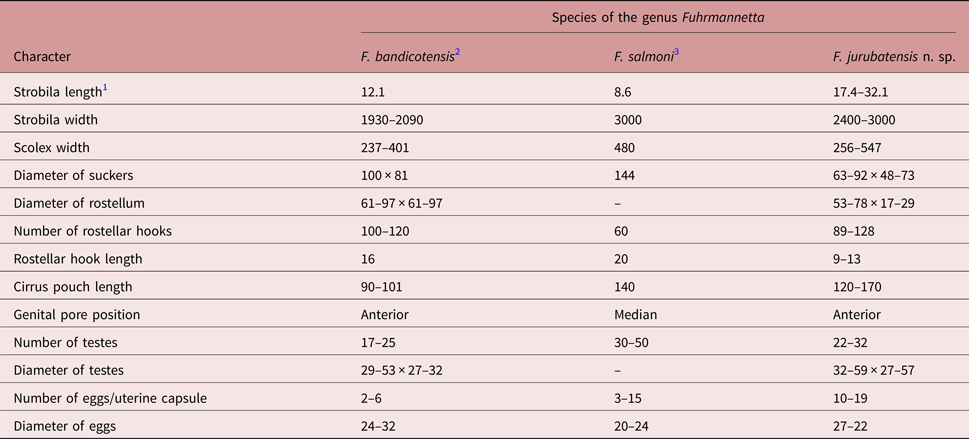
Fuhrmannetta jurubatensis n. sp. can be distinguished from the species reported from mammals. This new species can be differentiated from F. bandicotensis by the number of eggs per uterine capsule: in F. jurubatensis n. sp. we observed 10–19 eggs, while F. bandicotensis has a lower number of eggs (2–6) (Olsen & Kuntz, Reference Olsen and Kuntz1979). The other species that occurs in mammals, F. salmoni, can be distinguished from the new species by the total length of strobila (17–32.1 cm in F. jurubatensis n. sp. in contrast to approximately 8.6 cm in F. salmoni) (table 1); number of hooks (60 in F. salmoni and 102 in the new species); length of hooks (20 in F. salmoni and 10 in F. jurubatensis n. sp.); and position of the genital pore, where in F. salmoni it is located medially (Stiles, Reference Stiles1897) and in F. jurubatensis n. sp. it is located in the anterior third of proglottids (table 1).
Comparisons of measurements in μm (unless stated otherwise) of the genus Fuhrmannetta (Stiles & Orleman, 1926) Movsesyan, 1966, parasites of mammals.

1 Measurements in cm.
2 Olsen & Kuntz (Reference Olsen and Kuntz1979).
3 Stiles (Reference Stiles1897).
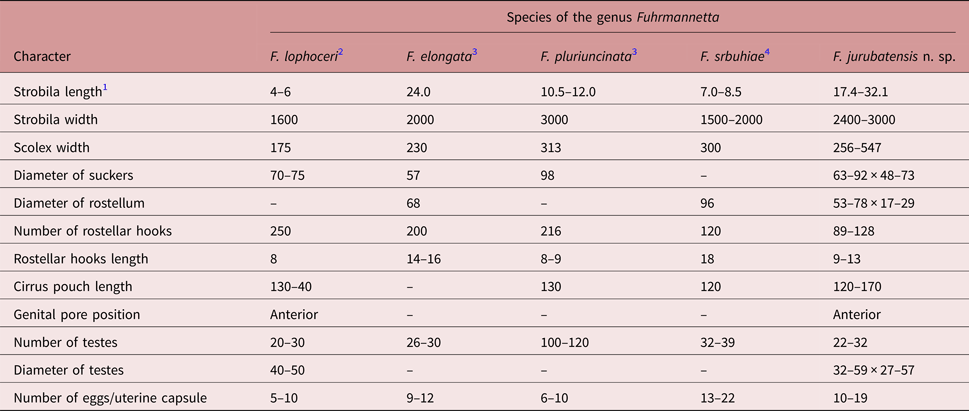
The new species described herein and F. srbuhiae, F. elongata, F. lophoceri and F. pluriuncinata possess a higher number of eggs per uterine capsule (table 2), when compared with other species of the genus Fuhrmannetta that occur in birds, such as F. leptotrachela (3–4), F. crassula (3–4), F. laticanalis (3–10), F. pseudoechinobothrida (3–5), F. hertwigi (1–3), F. nepalis (3–5), F. vandenbrandeni (1–4) and F. malakartis (6). In the descriptions of F. birmanica, F. globocaudata and F. bucerotidarum, the authors do not describe the number of eggs per uterine capsule. However, F. jurubatensis n. sp. can be distinguished from these species by the strobila total length (17–32.1 cm): in F. birmanica, the strobila length varies from 0.8 to 1.0 cm, and in F. globocaudata and F. bucerotidarum it does not exceed 3.0 cm (Sawada, Reference Sawada1965).
Comparisons of measurements in μm (unless stated otherwise) of the genus Fuhrmannetta (Stiles & Orleman, 1926) Movsesyan, 1966, parasites of birds.

1 Measurements in cm.
2 Ortlepp (Reference Ortlepp1964).
3 Sawada (Reference Sawada1965).
4 Akhumian (Reference Akhumian1967).
Among the species that possess a similar number of eggs per uterine capsule, F. jurubatensis n. sp. can be distinguished from F. lophoceri, F. pluriuncinata and F. srbuhiae by its higher strobila total length (table 2). However, F. jurubatensis n. sp. and F. elongata possess a similar strobila total length, but differ in the number of rostellar hooks (table 2). Moreover, the total number of testes observed in F. pluriuncinata (100–120) (Sawada, Reference Sawada1965) is higher than has been observed in F. jurubatensis n. sp. (22–32).
This is the first report of cestodes of the genus Fuhrmannetta parasitizing cricetid rodents. There are few parasitological studies in the rodent C. goytaca, with their results published in proceedings of scientific meetings (Moraes et al., Reference Moraes, Gonçalves, Gonçalves and Oliveira2015); however, these authors reported cestodes in C. goytaca from the same locality, and they identified them as Taeniidae. These specimens are not available for analysis. Probably, these specimens are from the new species described herein. These rodents are common in sandy plains of the northern littoral of Rio de Janeiro State and the southern littoral of Espírito Santo State, south-eastern region of Brazil, and cohabit in the same territory with another species of the genus, C. subflavus (Wagner) (Tavares et al., Reference Tavares, Pessôa and Gonçalves2011). There are no records of Fuhrmannetta spp. from the latter rodent species. There is a report of Raillietina guaricana César & Luz, 1993, parasitizing a Cricetidae rodent, Sooretamys angouya (Fischer) [ = syn. Oryzomys ratticeps (Hensel)] (César & Luz, Reference César and Luz1993). According to Jones & Bray (Reference Jones, Bray, Khalil, Jones and Bray1994), cestodes of the genus Raillietina are morphologically similar to those of the genus Fuhrmannetta, distinguishing between them by the position of the genital pores and the number of eggs per uterine capsule. The observations on the voucher specimens deposited in CHIOC revealed a unilateral location of the genital pores in these specimens, as well as the presence of 4–12 eggs per uterine capsule, thus confirming their identification as a species of Raillietina.
On the basis of the above-mentioned diagnostic morphological and morphometric characteristics, we consider the davaineid specimens from C. goytaca as belonging to a new species, Fuhrmannetta jurubatensis n. sp. This is the first report of helminth parasites in C. goytaca and additional studies on the parasitic fauna of the sympatric rodent, C. subflavus, are required to check the host specificity of the new cestode species.
Financial support
This research received no specific grant from any funding agency, commercial or not-for-profit sectors.
Conflict of interest
None.