Statement of research significance
Research Question: People with human immunodeficiency virus (HIV) have disproportionately high rates of neurocognitive impairment and depression that affect their independence on everyday activities, such as driving, cooking, medication management, and their overall quality of life (QoL). The current study
investigates the relationship between neurocognitive impairment and depression, and whether having both conditions leads to worse functioning in a large sample of 1,973 people with HIV.
Main Findings: Over half of the depressed people with HIV also had neurocognitive impairment. Both neurocognitive impairment and depression were associated with poor functioning and QoL, and having both conditions was worse than having either alone.
Study Contributions: Our results show the high degree of comorbidity between neurocognitive impairment and depression, and their negative impact on the day-to-day lives of people with HIV. This work can inform future intervention studies to reduce neurocognitive impairment and depression, and thus improve the well-being of at-risk people with HIV.
Introduction
Despite the advent of effective antiretroviral therapy (ART) contributing to widespread viral suppression and subsequent declines in HIV-related mortality, persons with HIV (PWH) have disproportionately worse everyday functioning than persons without HIV (PWoH; Delle Donne et al., Reference Delle Donne, Ciccarelli, Massaroni, Borghetti, Dusina, Farinacci, Visconti, Tamburrini, Fabbiani and Di Giambenedetto2020). Approximately 60% of PWH report experiencing disruptions to everyday functioning (Heaton et al., Reference Heaton, Clifford, Franklin, Woods, Ake, Vaida, Ellis, Letendre, Marcotte, Atkinson, Rivera-Mindt, Vigil, Taylor, Collier, Marra, Gelman, McArthur and Morgello2010; Scott et al., Reference Scott, Ceremony, Marcotte, Marcotte, Schmitter-Edgecombe and Grant2022), including dependency in instrumental activities of daily living (IADL; e.g., meal preparation, impairments in medication management, vocational functioning, and driving; Marquine et al., Reference Marquine, Flores, Kamat, Johnson, Umlauf, Letendre, Jeste, Grant, Moore and Heaton2018; Morgan et al., Reference Morgan, Iudicello, Weber, Duarte, Riggs, Delano-Wood, Ellis, Grant and Woods2012), as well as poorer physical and mental health-related QoL (Maiese et al., Reference Maiese, Johnson, Bancroft, Goolsby Hunter and Wu2016). Neurocognitive impairment (NCI) and depression have been identified as two key contributors to poor everyday functioning in PWH (Goodkin et al., Reference Goodkin, Evering, Anderson, Ragin, Monaco, Gavegnano, Avery, Rourke, Cysique and Brew2023) though the effects of their intersection has been largely understudied.
Associations between NCI and everyday functioning in PWH are well-established in the literature (Ripamonti & Clerici, Reference Ripamonti and Clerici2021). Although HIV-associated dementia (HAD) has become increasingly rare with the availability of modern ART, milder forms of HIV-related NCI are still prominent (Heaton et al., Reference Heaton, Clifford, Franklin, Woods, Ake, Vaida, Ellis, Letendre, Marcotte, Atkinson, Rivera-Mindt, Vigil, Taylor, Collier, Marra, Gelman, McArthur and Morgello2010; McIntosh et al., Reference McIntosh, Clark, Cherner, Cysique, Heaton, Levin, Remien, Thames, Moore and Rubin2023) and strongly associated with functional impairment (Gorman et al., Reference Gorman, Foley, Ettenhofer, Hinkin and van Gorp2009; Sheppard et al., Reference Sheppard, Iudicello, Bondi, Doyle, Morgan, Massman, Gilbert and Woods2015). NCI, particularly in the domains of learning, delayed recall, and executive functioning, has been found to occur in anywhere from 25% to over 50% of PWH (Goodkin et al., Reference Goodkin, Evering, Anderson, Ragin, Monaco, Gavegnano, Avery, Rourke, Cysique and Brew2023; Heaton et al., Reference Heaton, Clifford, Franklin, Woods, Ake, Vaida, Ellis, Letendre, Marcotte, Atkinson, Rivera-Mindt, Vigil, Taylor, Collier, Marra, Gelman, McArthur and Morgello2010, Reference Heaton, Franklin, Ellis, McCutchan, Letendre, Leblanc, Corkran, Duarte, Clifford, Woods, Collier, Marra, Morgello, Mindt, Taylor, Marcotte, Atkinson, Wolfson and Gelman2011) and has been consistently associated with IADL dependency, higher rates of unemployment, and worse driving outcomes (Benedict et al., Reference Benedict, Mezhir, Walsh and Hewitt2000; Casaletto et al., Reference Casaletto, Weber, Iudicello, Woods, Chiaravalloti and Goverover2017; Heaton et al., Reference Heaton, Marcotte, Mindt, Sadek, Moore, Bentley, McCutchan, Reicks and Grant2004; Marcotte et al., Reference Marcotte, Scott, Hinkin, Heaton, Everall, Gendelman, Grant, Everall, Fox, Gelbard, Lipton and Swindells2011). Longitudinal studies have also found negative effects of HIV-associated NCI on health-related QoL, and have linked NCI to poorer ART adherence, worse clinical health outcomes, and more risky behaviors that can further exacerbate problems in everyday functioning (Anand et al., Reference Anand, Springer, Copenhaver and Altice2010; Casaletto et al., Reference Casaletto, Weber, Iudicello, Woods, Chiaravalloti and Goverover2017).
Depression has been implicated as another major contributing factor to poor everyday functioning in PWH. It is estimated that approximately 20–40% of PWH across the globe meet criteria for current depression, which is five times greater than current depression rates in the general population (Pence et al., Reference Pence, Mills, Bengtson, Gaynes, Breger, Cook, Moore, Grelotti, O’Cleirigh and Mugavero2018; Rezaei et al., Reference Rezaei, Ahmadi, Rahmati, Hosseinifard, Dehnad, Aryankhesal, Shabaninejad, Ghasemyani, Alihosseini, Bragazzi, Raoofi, Kiaee and Ghashghaee2019). Considerable literature has found associations between depression and declines in everyday functioning, including higher IADL dependency (Lawler et al., Reference Lawler, Mosepele, Seloilwe, Ratcliffe, Steele, Nthobatsang and Steenhoff2011), poorer health-related QoL (Tate et al., Reference Tate, Paul, Flanigan, Tashima, Nash, Adair, Boland and Cohen2003; Tozzi et al., Reference Tozzi, Balestra, Murri, Galgani, Bellagamba, Narciso, Antinori, Giulianelli, Tosi, Fantoni, Sampaolesi, Noto, Ippolito and Wu2004), and more self-reported cognitive difficulties (Ertle et al., Reference Ertle, Simon, Vogt, Mast and Barve2022). One study found worse health-related QoL in depressed PWH only, whereas there were no differences between non-depressed PWH and PWoH (Rooney et al., Reference Rooney, Moore, Paolillo, Gouaux, Umlauf, Letendre, Jeste and Moore2019), highlighting the profound effects of depression on everyday functioning in PWH. Associations between depression and everyday functioning have been established with depression measured both categorically (e.g., clinical diagnosis of major depressive disorder) as well as dimensionally (e.g., severity of current depressive symptoms; Bryant et al., Reference Bryant, Shortell, DeFelice, Huxhold, Cook, Porges and Cohen2023; Tate et al., Reference Tate, Paul, Flanigan, Tashima, Nash, Adair, Boland and Cohen2003).
Although the independent effects of NCI and depression have been well-documented in the literature, research on the common comorbidity between the two disorders and their potential synergy in PWH has been relatively sparse (Goodkin et al., Reference Goodkin, Evering, Anderson, Ragin, Monaco, Gavegnano, Avery, Rourke, Cysique and Brew2023). Most studies in the field have focused on investigating the negative effects of depression on NCI, rather than their combined effects, and have found strong cross-sectional and causal relationships (Cysique et al., Reference Cysique, Dermody, Carr, Brew and Teesson2016; Ellis et al., Reference Ellis, Heaton, Tang, Collier, Marra, Gelman, Morgello, Clifford, Sacktor, Cookson and Letendre2022; Paolillo et al., Reference Paolillo, Pasipanodya, Moore, Pence, Atkinson, Grelotti, Grant, Heaton and Moore2020; Rubin & Maki, Reference Rubin and Maki2019; Saloner et al., Reference Saloner, Paolillo, Heaton, Grelotti, Stein, Miller, Atkinson, Letendre, Ellis, Grant, Iudicello and Moore2021). Another recent study has found a distinct biopsychosocial phenotype of co-occuring NCI, depression, and functional deficits in PWH (Tang et al., Reference Tang, Ellis, Vaida, Umlauf, Franklin, Dastgheyb, Rubin, Riggs, Iudicello, Clifford, Moore, Heaton and Letendre2024). However, the combined effects of co-occurring NCI and depression on clinical outcomes, including everyday functioning, are less well understood. To our knowledge, only one prior study formally investigated the effects of comorbid NCI and depression on everyday functioning in PWH and found significant interactive effects of NCI and depression on physical health-related QoL (Trépanier et al., Reference Trépanier, Rourke, Bayoumi, Halman, Krzyzanowski and Power2005). However, the authors did not assess other functional outcomes, and were limited by small sample sizes (e.g., comorbid group N = 40).
Given the high prevalence of NCI (e.g., 25–50%) and current depression (e.g., 20-40%) in PWH, and evidence for their independent debilitating effects on everyday functioning (Goodkin et al., Reference Goodkin, Evering, Anderson, Ragin, Monaco, Gavegnano, Avery, Rourke, Cysique and Brew2023; Morgan et al., Reference Morgan, Iudicello, Weber, Duarte, Riggs, Delano-Wood, Ellis, Grant and Woods2012; Rubin & Maki, Reference Rubin and Maki2019), it is imperative to understand whether the co-occurrence of these conditions exacerbates outcomes. Thus, the present study aimed to test the independent and combined effects of NCI and current depression on various forms of everyday functioning with a large sample of community-dwelling PWH (N = 1,973). We hypothesized that both conditions would be independently associated with poor everyday functioning and that the comorbid disorders would be worse for functioning than either one alone. Given recent efforts by the NIMH to shift from a diagnostic to a dimensional conceptualization of psychopathology (e.g., Cuthbert, Reference Cuthbert2022), and discrepancies in depression measurement methods across studies (Rezaei et al., Reference Rezaei, Ahmadi, Rahmati, Hosseinifard, Dehnad, Aryankhesal, Shabaninejad, Ghasemyani, Alihosseini, Bragazzi, Raoofi, Kiaee and Ghashghaee2019), we also aimed to compare the value of a major depressive disorder (MDD) diagnosis vs. depressive symptoms in predicting functional outcomes, and hypothesized that current depressive symptoms would provide better insight on functioning than current or historical MDD. If true, the results of our study would have important implications for the screening of depression as well as future treatment interventions for vulnerable PWH with co-occurring NCI and depression.
Method
Participants
Participants were 1,973 PWH enrolled in NIH-funded cohort studies conducted at the University of California, San Diego (UCSD) HIV Neurobehavioral Research Program, with study visits completed between 2003 and 2023. All data included for each participant was collected from a single visit. The research was completed in accordance with Helsinke Declaration and the University of California, San Diego Institutional Review Board approved all procedures. Each participant provided informed consent for participation in these cohort studies and consented to the use of their data for future research. Consistent with the HNRC parent study guidelines, inclusion criteria were (1) ability to provide informed consent, (2) age 18 or older, (3) HIV positive test by enzyme-linked immunosorbent assay and Western Blot confirmation, or the MedMira Rapid test; exclusion criteria were (1) inability to provide informed consent, and (2) having conditions that confound interpretation of data (e.g., history of significant neurological, psychiatric with current psychotic features, or ongoing substance use conditions). The selection of participants for the present analyses included being HIV + and having completed a study visit with valid neuropsychiatric data.
Measures
Psychiatric history and depressive symptoms (CIDI, BDI-II)
The Composite International Diagnostic Interview (CIDI) was used to classify current (within the past 30 days) and lifetime (LT) diagnoses of mood and substance use disorders based on DSM-IV criteria (Kessler & Ustün, Reference Kessler and Ustün2004). For the present study, current and lifetime diagnoses of major depressive disorder (MDD) were used. The Beck Depression Inventory (BDI-II, Beck et al., Reference Beck, Steer and Brown1996) was used as a self-reported measure of the severity of current depressive symptoms. The BDI-II comprises 21 items, each representing a specific symptom of depression for which participants rate the severity of their experience over the past two weeks on a 4-point scale (0 to 3). The total score (ranges from 0 to 63) is determined by summing the individual item ratings, with higher scores indicating greater depressive symptom severity. The BDI has demonstrated strong psychometric properties, including internal consistency (around 0.9) and retest reliability (0.73 to 0.96; Wang & Gorenstein, Reference Wang and Gorenstein2013). The BDI-II has also been psychometrically validated among PWH (Hobkirk et al., Reference Hobkirk, Starosta, De Leo, Marra, Heaton and Earleywine2015). For the current study, we utilized BDI-II cutoff scores for depressive severity of none to minimal (range: 0–13), mild (range: 14–19), moderate (range: 20–28) and severe depression (range: 29–60). Our primary measures of depression were LT MDD, and current depressive severity as measured by BDI-II.
Neurocognitive impairment (NCI)
Participants completed a comprehensive neurocognitive test battery spanning seven ability domains (i.e., verbal fluency, executive functioning, processing speed, learning, working memory, delayed recall, and motor speed) affected by HIV (Heaton et al., Reference Heaton, Clifford, Franklin, Woods, Ake, Vaida, Ellis, Letendre, Marcotte, Atkinson, Rivera-Mindt, Vigil, Taylor, Collier, Marra, Gelman, McArthur and Morgello2010). Test scores were demographically adjusted using the most comprehensive normative standards considering race/ethnicity, education, sex, and age, as appropriate (Heaton et al., Reference Heaton, Taylor and Manly2003; Heaton et al., Reference Heaton, Marcotte, Mindt, Sadek, Moore, Bentley, McCutchan, Reicks and Grant2004; Norman et al., Reference Norman, Moore, Taylor, Franklin, Cysique, Ake, Lazarretto, Vaida and Heaton2011). Deficit scores ranging from 0 (no impairment) to 5 (severe impairment) were calculated for each individual test, then averaged for a Global Deficit Score (GDS; Blackstone et al., Reference Blackstone, Moore, Franklin, Clifford, Collier, Marra, Gelman, McArthur, Morgello, Simpson, Ellis, Atkinson, Grant and Heaton2012; Carey et al., Reference Carey, Woods, Gonzalez, Conover, Marcotte, Grant and Heaton2004; Heaton, Reference Heaton2004). We operationalized NCI dichotomously as having a GDS equal or above 0.5 (i.e., NCI) or a GDS less than 0.5 (i.e., NC-normal). A GDS cutoff score of 0.5 optimizes the balance between sensitivity and specificity for detecting NCI in PWH (Carey et al., Reference Carey, Woods, Gonzalez, Conover, Marcotte, Grant and Heaton2004; Heaton et al., Reference Heaton, Marcotte, Mindt, Sadek, Moore, Bentley, McCutchan, Reicks and Grant2004). Approximately 95% of our participants also completed performance validity testing using the Hiscock Digit Memory Test (HDMT), which is designed to detect invalid memory performance or poor effort (Hiscock & Hiscock, Reference Hiscock and Hiscock1989). Virtually all of the participants who completed the HDMT passed the test (e.g., 97% scored 17/18 or 18/18), suggesting good effort and the validity of their neurocognitive test scores.
Neuromedical evaluation
The comprehensive neuromedical evaluation included a clinical interview for medical history, a physical exam, and a blood draw. HIV serostatus was determined by ELISA with Western blot confirmation, or the MedMira rapid test. HIV disease characteristics obtained via self-report included estimated duration of HIV disease, AIDS status, nadir CD4 count, and current ART use. Plasma HIV RNA were quantified through a blood sample, and undetectable HIV viral load was classified as less than or equal to 50 copies/mL. Current CD4 was measured via flow cytometry.
Instrumental activities of daily living (IADLs)
Participants were administered a self-report Likert scale evaluating any decreased independence in performing activities of daily living (ADLs). A modified version of the Activities of Daily Living Scale (Lawton & Brody, Reference Lawton and Brody1969) assessed 10 IADLs: housekeeping, managing finances, buying groceries, cooking, transportation, using the telephone, home repairs, shopping for non-food goods, laundry, and managing medications. For each IADL, the participant separately rates their current level of independence and their highest level of independence. The total score (continuous IADL measure) is the total number of IADLs for which there is a decline in functioning (i.e., a need for increased assistance), with a range of zero (no changes across IADLs) to 10 (decline from previous level of functioning in all 10 IADLs). Participants were “IADL dependent” if they reported a decline in 2 or more IADLs which aligns with established recommendations for identifying functional impairment in HIV-associated neurocognitive disorders (Antinori et al., Reference Antinori, Arendt, Becker, Brew, Byrd, Cherner, Clifford, Cinque, Epstein, Goodkin, Gisslen, Grant, Heaton, Joseph, Marder, Marra, McArthur, Nunn, Price and Wojna2007; Heaton et al., Reference Heaton, Marcotte, Mindt, Sadek, Moore, Bentley, McCutchan, Reicks and Grant2004; Woods et al., Reference Woods, Rippeth, Frol, Levy, Ryan, Soukup, Hinkin, Lazzaretto, Cherner, Marcotte, Gelman, Morgello, Singer, Grant and Heaton2004).
Subjective cognitive difficulties
Participants completed the Patient’s Assessment of Own Functioning Inventory (PAOFI), a self-report measure capturing subjective cognitive difficulties (Chelune et al., Reference Chelune, Heaton, Lehman, Goldstein and Tarter1986). The PAOFI comprises 34 items for which participants rate their frequency of difficulties in memory, language and communication, use of hands, sensory perception, and higher-level cognitive and intellectual functions on a scale from 1 (almost never) to 6 (almost always). A total score was computed for the PAOFI by summing the items that were rated as at least “fairly often” (i.e., score of 3 or lower; range = 0–34), and reverse coding such that higher scores indicating a greater extent of reported cognitive difficulties.
Quality of life (MOS-HIV)
The 36-item Medical Outcomes HIV Health Survey (MOS-HIV) was used as a reliable and valid assessment of self-reported, health-related QoL, including dimensions for mental and physical health (Revicki et al., Reference Revicki, Chan and Gevirtz1998). The physical and mental health summary scores of the MOS-HIV are scored as summary percentile scales that range from 0 to 100, such that higher scores indicate better physical and mental health-related QoL.
Statistical analyses
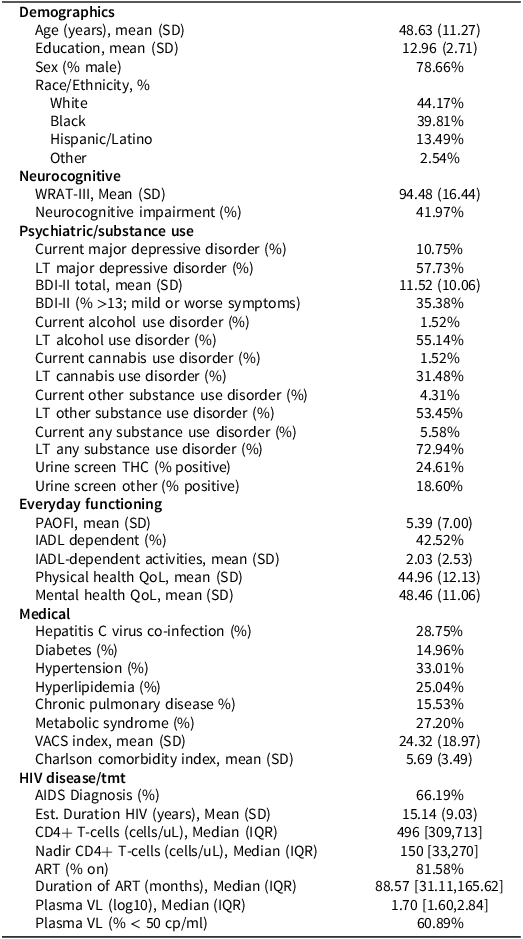
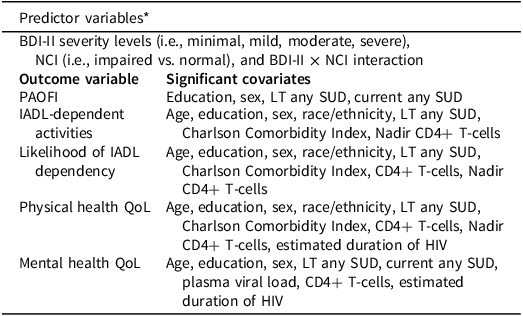
All analyses were conducted using R (version 4.3.2). Candidate covariates for the models included demographic, psychiatric, substance use, medical, and HIV disease characteristics from Table 1. Covariates for each outcome were selected via univariate analyses, with the candidate covariates entered in the models as the independent variables and outcomes as dependent variables, at a significance value of p < .05 and were included in all subsequent models. Table 2 shows the final selected covariates for each outcome measure.
Participant demographics and clinical characteristics (N = 1,973)

Note: WRAT = Wide Range Achievement Test (WRAT)-3rd edition; BDI-II = Beck Depression Inventory-II; PAOFI = Patient’’s Assessment of Own Functioning Inventory; IADL = Instrumental Activities of Daily Living; QoL = Quality of Life.
Selected covariates for each outcome of interest
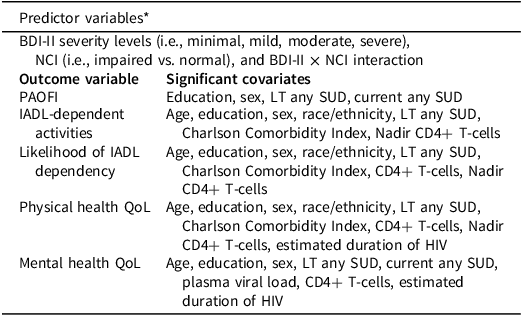
Note: Covariates selected via univariate analyses at significance value of p < .05. BDI-II = Beck’s Depression Inventory-II; NCI = Neurocognitive Impairment; PAOFI = Patient’s Assessment of Own Functioning Inventory; IADL = Instrumental Activities of Daily Living; SUD = Substance Use Disorder; QoL = Quality of life; LT any SUD = Lifetime any substance use disorder.
* Four models were run for each outcome variable (i.e., model with only BDI-II, model with only NCI, model with BDI-II and NCI, and model with BDI-II × NCI interaction term).
To compare the predictive value of lifetime major depressive disorder (LT MDD) vs. current BDI-II scores, three sets of multivariate models were run for each outcome measure (i.e., PAOFI scores, IADL-dependent activities, likelihood of IADL dependency, physical health QoL, and mental health QoL). The first models included LT MDD and significant covariates. The second models included current BDI-II and significant covariates. For the third and final set of models, both LT MDD and BDI-II were included in addition to significant covariates. Across all models, Akaike Information Criterion (AIC) values were compared, with lower AIC values indicating greater parsimony of predictor and thus better model fit (Cavanaugh & Neath, Reference Cavanaugh and Neath2019). The depression variable (LT MDD vs. BDI-II) with a better model fit was then selected and used as a predictor for all subsequent analyses.
As for main analyses, independent one-way analysis of covariance (ANCOVA) models were conducted with NCI and relevant covariates included as predictor variables, and the continuous outcomes (i.e., PAOFI scores, degree of IADL dependence, physical health QoL, mental health QoL) as the outcome variable. Logistic regressions were used for the binary outcome variable (i.e., likelihood of IADL dependency). Separate ANCOVAs and logistic regressions were run for depression (either LT MDD or BDI-II; dependent on model fit comparisons), controlling for relevant covariates. If selected as the primary depression predictor over LT MDD, BDI-II would be measured both continuously and categorically (i.e., BDI severity: minimal, mild, moderate, or severe).
To test the additive effects of NCI and depression (i.e., LT MDD or BDI-II outcomes for their respective models), NCI and depression were added as predictors in the same model. If both NCI and depression remained significant in the combined models, AIC values were then compared between models with both NCI and depression, NCI only, or depression only. Better AIC values on the combined model indicated additive effects of NCI and depression, whereas the same or better model fit on the models with NCI or depression only indicated independent effects only. Finally, to test interactive effects of NCI and depression, two-way ANCOVAs for continuous outcomes and a logistic regression for the binary outcome were conducted with an NCI X depression interaction term added to all models. To facilitate interpretability of results, only categorical BDI-II severity levels were considered for the additive and interaction models. These categories help define severity cutoff that are frequently used in clinical settings. In the case of significant interactions, posthoc tests were conducted using the R function “emmeans” to assess the significance of all possible contrasts. Overall, for each of the 5 outcome variables, 4 models were conducted (i.e., model with depression only, model with NCI only, model with depression and NCI, and model with BDIxNCI interaction term) including covariates (see Table 1) for a total of 20 models. The Benjamin-Hochberg procedure to control for the false discovery rate was used for all main analyses, and the Bonferroni p-value adjustment methods were used for posthoc analyses.
Some researchers have recommended against the use of depression instruments that assess somatic symptoms, given the high overlap between somatic depression and symptoms of HIV infection (Kalichman et al., Reference Kalichman, Sikkema and Somlai1995). To account for this, we removed the somatic subscale of the BDI-II and reran all models as additional sensitivity analyses.
Results
Participant characteristics
Participants were 1,973 persons with HIV (PWH). The sample was predominantly male (79%), diverse in racial/ethnic background (44% White, 40% Black, 14% Hispanic/Latino), and were an average of 48.6 (SD = 11.3) years of age, with an average of 13.0 (SD = 2.7) years of education. Mean WRAT-III reading score (considered an indicator of premorbid verbal intelligence) were in the average range (94.5, SD = 16.4), and approximately 42% of participants had neurocognitive impairment by GDS criteria. Current MDD (11%) and substance use disorders (SUD; 6%) were uncommon, but the majority of participants had previously met criteria for one or more of these conditions (LT MDD: 58%; LT SUD: 73%). Average depressive symptoms were at the high end of the “minimal” range of 0–13 (BDI-II: M = 11.5, SD = 10.1), but 35% of participants endorsed at least mild current depression symptoms (i.e., BDI-II>13), and 27% endorsed clinically elevated levels of depression (BDI-II>16; Hobkirk et al., Reference Hobkirk, Starosta, De Leo, Marra, Heaton and Earleywine2015). As for comorbidity between NCI and depression, approximately 18% of participants met criteria for both NCI and at least mild current depression symptoms. Of the participants with at least mild current depression symptoms, over half (i.e., 51.4%) had NCI.
Hypertension (33%), hepatitis C co-infection (29%), and hyperlipidemia (25%) were the most common medical comorbidities, and 28% of participants met the criteria for metabolic syndrome. Average Charlson Comorbidity Index scores were in the severe range (M = 5.69, SD = 3.49; Huang et al., Reference Huang, Gou, Diao, Yin, Fan, Liang, Chen, Wu, Zang, Li, Zang, Cheng, Fu and Liu2014). In terms of HIV disease characteristics, the majority of participants were virally suppressed (61%) and on antiretroviral therapies (82%). The average estimated duration of HIV infection was 15.1 years (SD = 9.0), and 66% of participants had historic AIDS. Participants’ median current CD4+ and Nadir CD4+ T-cell counts were 496 (IQR= [309,713]) and 150 (IQR= [33,270]), respectively. See Table 1 for additional sample sociodemographic, medical, and HIV disease characteristics and psychiatric and substance use comorbidities. Supplementary Table 1 also shows participant characteristics by NCI and depression status.
Model fit evaluation of models with LT MDD vs. BDI-II predictors
As described in the Statistical Analysis section, Table 2 provides a summary of the models and covariates included in each model.
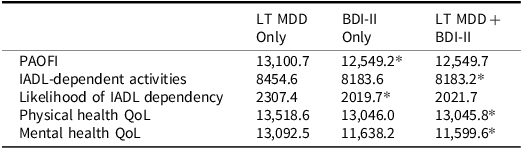
Table 3 summarizes model fit comparisons, with NCI and all relevant covariates controlled for in the models. For PAOFI, IADL-dependent activities, likelihood of IADL dependence, and physical and health QoL, models with only BDI-II yielded lower (better) AIC values than models with only LT MDD. The AIC values for PAOFI and likelihood of IADL dependence did not improve from models with both BDI-II and LT MDD, suggesting that LT MDD did not add to the effect of current mood. Overall, model fit for all outcome variables was better in models with only BDI-II than models with only LT MDD, with little to no improvement in models with both BDI-II and LT MDD. Thus, for further analyses, BDI-II was selected as the primary depression variable over LT MDD.
Model fit of lifetime MDD vs. continuous BDI-II
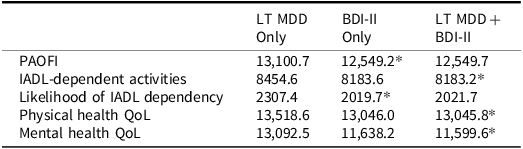
Note: *Represents the best model fit. LT MDD = Lifetime MDD; BDI-II = Beck Depression Inventory-II; PAOFI = Patient’s Assessment of Own Functioning Inventory; IADL = Instrumental Activities of Daily Living; QoL=Quality of Life. All models included neurocognitive impairment and relevant covariates that were significantly associated with outcome at p < .05 via univariate analyses. Model fit was assessed via Akaike Information Criteria (AIC) for all outcomes. Lower AIC values indicated better model fit.
Independent effects of NCI and depression
When controlling for significant covariates, the dichotomous NCI variable (i.e., normal vs. impaired) was significantly associated with all outcome variables, including PAOFI scores (F[1,1964] = 99.88, p < .0001), IADL-dependent activities (F[1,1802] = 39.78, p < .0001), physical health QoL (F[1,1739] = 50.39, p < .0001), and mental health QoL, (F[1,1739] = 40.37, p < .0001). Specifically, NCI was associated with higher PAOFI scores (worse perceived everyday cognitive difficulties), more IADL dependencies, and worse physical health and mental health QoL. As for the binary IADL variable, the likelihood of having IADL dependency was greater for participants with NCI than for neurocognitively (NC)-normal participants (OR = 1.77, CI95%[1.45,2.17], p < .0001). Supplementary Figure 1 shows the main effect of NCI on everyday functioning outcomes.
Current depression, as measured by continuous BDI-II, also was significantly associated with higher PAOFI scores (estimate = .37, SE = .01, p < .0001), number of IADL-dependent activities (estimate = .10, SE = .01, p < .0001), greater likelihood of IADL dependency (OR = 1.11, CI95%[1.10,1.12], p < .0001), and worse physical health QoL (estimate = −.62, SE = .24, p < .0001), and mental health QoL (estimate = −.86, SE = .02, p < .0001). Consistent with those findings, BDI-II severity categories (i.e., minimal, mild, moderate, and severe) were significantly associated with PAOFI scores (F[3,1964] = 223.75, p < .0001), IADL-dependent activities (F[3,1802] = 93.31, p < .0001), physical health QoL (F[3,1739] = 158.46, p < .0001), and mental health QoL (F[3,1737] = 680.17, p < .0001). Posthoc tests with Bonferrori p-value adjustments found significant PAOFI differences between minimal (M = 3.52, SE = .36), mild (M = 6.80, SE = 4.53), moderate (mean = 9.87, SE = .48), and severe depression groups (M = 14.35, SE = .56), such that higher depression severity was associated with greater PAOFI scores. Similar patterns of results were found for IADL-dependent activities (minimal depression M = 1.41, SE = .24; mild depression M = 2.52, SE = .27; moderate depression M = 3.26, SE = .28; severe depression M = 4.11, SE = .31), as well as physical health QoL (minimal depression M = 49.30, SE = 1.04; mild depression M = 40.9, SE = 1.19, moderate depression M = 38.5, SE = 1.22; severe depression M = 34.1, SE = 1.36), and mental health QoL (minimal depression M = 53.20, SE = .48; mild depression M = 42.20, SE = .61; moderate depression M = 36.90, SE = .64; severe depression M = 30.10, SE = .74). For the aforementioned outcome measures, all contrasts between severity groups were significantly different. Finally, the likelihood of IADL dependency was significantly greater for mild than for minimal depression (OR = 2.95, CI95%[2.21,3.93], p < .0001), moderate than for mild depression (OR = 1.90, CI95%[1.30,2.79], p = .0001), and severe than for moderate depression (OR = 1.78, CI95%[1.04,3.03], p = .03). Supplementary Figure 2 shows the main effect of depression on everyday functioning outcomes.
Additive effects of NCI and depression
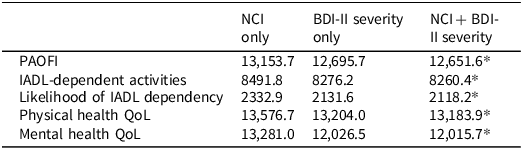
NCI and current depression (assessed by BDI severity groups) were then added to the same models as predictors when controlling for relevant covariates. Across all outcomes, both NCI and current depression remained significant in these combined models. Model fit parameters (i.e., AIC values) were compared between models with the following predictors: NCI only, current depression only, or both NCI and current depression. For all outcome variables, the model with both NCI and current depression had the best model fit values, providing evidence for additive effects of NCI and current depression on all everyday functioning variables, including PAOFI scores (AIC = 12,651.6), number of IADL-dependent activities (AIC = 8260.4), likelihood of IADL dependency (AIC = 2118.2), physical health QoL (AIC = 13,183.9), and mental health QoL (AIC = 12,015.7). See Table 4 for a summary of the additive effects testing. Supplemental validation analyses were conducted with continuous BDI-II, and yielded similar results (i.e., better AIC values for models with both NCI and current depression).
Model fit of NCI vs. BDI-II severity
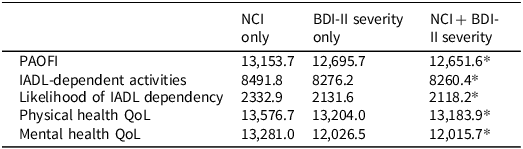
Note. *Represents the best model fit. NCI = Neurocognitive impairment; BDI-II = Beck Depression Inventory-II; BDI-II Severity Groups=Minimal, Mild, Moderate, Severe; PAOFI = Patient’s Assessment of Own Functioning Inventory; IADL = Instrumental Activities of Daily Living; QoL=Quality of Life. All models included relevant covariates that were significantly associated with outcome at p < .05 via univariate analyses. Model fit was assessed via Akaike Information Criteria (AIC) for all outcomes. Lower AIC values indicated better model fit.
Interactive effects of NCI and depression
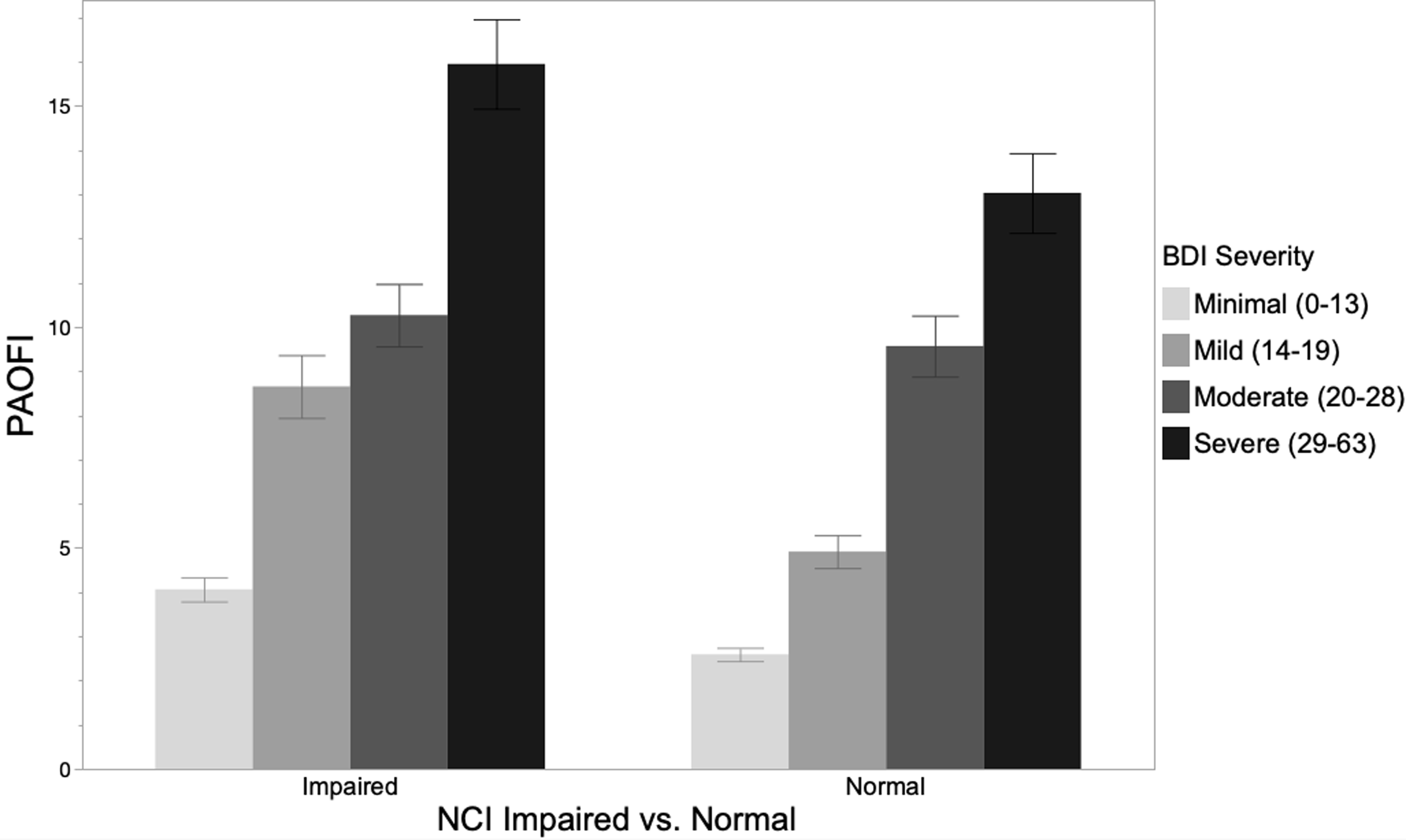
A two-way ANCOVA model controlling for relevant covariates showed a significant interaction between NCI and current BDI-II for PAOFI scores (F[3,1961] = 4.03, p = .007; Figure 1). Supplementary Table 2 shows the results of post hoc tests with Bonferroni corrections for all 28 possible contrasts. Of note, mild depression was associated with significantly higher (worse) PAOFI scores in the NCI group than the NC-normal group (estimate = 3.80, SE = .69, p < .0001), whereas there were no significant differences in PAOFI scores between NCI and NC-normal groups for moderate or severe depression. There were no significant NCI X depression interactions for IADL-dependent activities, likelihood of IADL dependency, mental health Qol, or physical health QoL. Validation analyses conducted with continuous BDI-II yielded similar results, such that there was only a significant NCI X depression interaction for PAOFI, but no other outcomes.
NCI X BDI-II severity interaction on PAOFI scores. Note. Error bars reflect 1 SE from the mean. NCI = Neurocognitive impairment; BDI-II = Beck Depression Inventory-II; PAOFI = Patient’s Assessment of Own Functioning Inventory. See Supplemental Table 2 for the results of significance testing of all 28 possible contrasts.

Sensitivity analyses
When the somatic subscale of the BDI-II was removed, and all analyses rerun with the remaining items, findings remained consistent. Specifically, the BDI-II excluding somatic items was significantly associated with all outcome variables (i.e., PAOFI, IADL-dependent activities, likelihood of IADL dependency, physical and mental health QoL), and the interaction with NCI for PAOFI scores remained significant.
Discussion
The present study aimed to address gaps in the literature by assessing the degree of comorbidity between neurocognitive impairment and current depression in PWH, as well as their independent and combined effects on everyday functioning. In the present sample of 1,973 PWH, we found high levels of NCI (42%) and current depression (35%) within ranges established by previous studies (Goodkin et al., Reference Goodkin, Evering, Anderson, Ragin, Monaco, Gavegnano, Avery, Rourke, Cysique and Brew2023; Rezaei et al., Reference Rezaei, Ahmadi, Rahmati, Hosseinifard, Dehnad, Aryankhesal, Shabaninejad, Ghasemyani, Alihosseini, Bragazzi, Raoofi, Kiaee and Ghashghaee2019; Robbins et al., Reference Robbins, Scott, Gouse, Marcotte, Rourke, Cysique and Rourke2021). Consistent with prior literature, we also found significant independent effects of neurocognitive impairment and current depression on all everyday functioning outcomes, including subjective cognitive difficulties, dependence in IADLs, and physical and mental aspects of health-related QoL. Specifically, the presence of neurocognitive impairment and more severe depression were associated with poorer functioning across all variables. While our finding is consistent with other publications in PWH (Aung et al., Reference Aung, Gates, Mao, Brew, Rourke and Cysique2022; Blackstone et al., Reference Blackstone, Moore, Franklin, Clifford, Collier, Marra, Gelman, McArthur, Morgello, Simpson, Ellis, Atkinson, Grant and Heaton2012; Heaton et al., Reference Heaton, Marcotte, Mindt, Sadek, Moore, Bentley, McCutchan, Reicks and Grant2004), the strength of this finding may depend on sample characteristics and/or assessment measures used, as some studies have not found consistent associations (e.g., Janssen et al., Reference Janssen, Meulenbroek, Steens, Góraj, Bosch, Koopmans and Kessels2015). Unlike past studies (e.g., Vaughn McCall & Dunn, Reference Vaughn McCall and Dunn2003), we used graded depression symptom categories (e.g., minimal, mild, moderate, severe) as the primary measure of current depression, rather than binary diagnostic categories (e.g., MDD diagnosis), and found that the severity of depression was significantly associated with functional deficits in a stepwise fashion (see Supplementary Figure 2).
Furthermore, this study is one of the first to consider comorbid NCI and depression, two highly prevalent conditions in PWH (Goodkin et al., Reference Goodkin, Evering, Anderson, Ragin, Monaco, Gavegnano, Avery, Rourke, Cysique and Brew2023), and their combined effects on everyday functioning in PWH. Utilizing a large, representative sample of diverse PWH, we found that 18% of participants met criteria for both NCI and current depression, suggesting high comorbidity rates, such that over half (i.e., 51.4%) of PWH with current depression in the sample also had NCI. To our knowledge, only one prior study has explicitly examined the NCI-depression comorbidity in PWH, and found similar rates of NCI in their sample of depressed PWH (∼50%; Trépanier et al., Reference Trépanier, Rourke, Bayoumi, Halman, Krzyzanowski and Power2005). As for the effects of comorbid NCI and depression on functioning, our results showed additive effects of NCI and depression for all functional outcomes, indicating that these conditions independently contribute to poor functional outcomes. For example, it is possible that cognitive dysfunction may simply be a symptom of MDD (or vice versa), but our results provide evidence towards the two conditions as separate. In addition, we found no interaction between NCI and depression for IADLs and health-related QoL, suggesting that the harmful effects of their comorbidity were not exacerbating, but only additive for these variables. Interestingly, there was a significant NCI × depression interaction for subjective cognitive difficulties, and in addition to the stair-step effects observed, we found that PWH reporting mild levels of current depression symptoms (i.e., BDI-II 14–19) and who were also NC-impaired reported worse complaints of everyday cognitive difficulties relative to PWH reporting mild depression symptoms who were NC-normal. Thus, even mild levels of depression may be especially impactful on impaired PWH’s subjective assessment of their own cognitive functioning. This was not seen at higher levels of depression, however, suggesting that for this outcome, more severe depression overshadows the effects of NCI on subjective estimates of everyday functioning.
The results of the present study have implications for understanding the etiology of everyday functioning deficits in PWH and informing strategies for intervention. Given the high NCI-depression comorbidity and their combined effects on functioning in PWH demonstrated in this study, as well as existing work finding shared mechanisms of action, treatment targeting both conditions may lead to the greatest improvements for functional outcomes. Although NCI and depression are distinct clinical conditions with independent effects on functioning, there is evidence for shared pathophysiological pathways (e.g., inflammation; Cassol et al., Reference Cassol, Misra, Morgello and Gabuzda2013; Ellis et al., Reference Ellis, Heaton, Tang, Collier, Marra, Gelman, Morgello, Clifford, Sacktor, Cookson and Letendre2022; Saloner et al., Reference Saloner, Paolillo, Heaton, Grelotti, Stein, Miller, Atkinson, Letendre, Ellis, Grant, Iudicello and Moore2021), that have also been observed in other comorbid neurological disorders (e.g., multiple sclerosis, Parkinson’s disease; Chitnis et al., Reference Chitnis, Qureshi, Gehman, Becich, Bove, Cree, Gomez, Hauser, Henry, Katrib, Lokhande, Paul, Caillier, Santaniello, Sattarnezhad, Saxena, Weiner, Yano and Baranzini2024; Rocha et al., Reference Rocha, Teixeira, Scalzo, Barbosa, de Sousa, Morato, Vieira, Christo, Palotás and Reis2014). For instance, even in the context of viral suppression, chronic systemic inflammation is prevalent in PWH and implicated as a significant mechanism underlying neurocognitive impairment and depressive outcomes (Cassol et al., Reference Cassol, Misra, Morgello and Gabuzda2013; Ellis et al., Reference Ellis, Heaton, Tang, Collier, Marra, Gelman, Morgello, Clifford, Sacktor, Cookson and Letendre2022; Marcotte et al., Reference Marcotte, Deutsch, Michael, Franklin, Cookson, Bharti, Grant and Letendre2013; Saloner et al., Reference Saloner, Paolillo, Heaton, Grelotti, Stein, Miller, Atkinson, Letendre, Ellis, Grant, Iudicello and Moore2021). There is also evidence that vascular depression (e.g., depression that may be caused or exacerbated by high rates of vascular or inflammatory diseases) may be especially common in PWH and associated with poor aging outcomes (Mustafa et al., Reference Mustafa, Beltran-Najera, Evans, Bartlett, Dotson and Woods2024).
Although the precise mechanism of action by which inflammation affects NCI and depression in PWH was not tested in this study and not been confirmed in the literature, potential mechanisms highlighted in previous research include cytokine dysregulation (Enache et al., Reference Enache, Pariante and Mondelli2019), impaired blood-brain barrier integrity (Persidsky et al., Reference Persidsky, Hill, Zhang, Dykstra, Winfield, Reichenbach, Potula, Mukherjee, Ramirez and Rom2016), neuro-axonal injury (Gisslen et al., Reference Gisslen, Keating, Spudich, Arechiga, Stephenson, Zetterberg, Di Germanio, Blennow, Fuchs, Hagberg, Norris, Peterson, Shacklett, Yiannoutsos and Price2021), and microbial dysbiosis (Dong et al., Reference Dong, Lin, Chen, Shi, Yuan, Li, Zhu, Xu, Shen, Wang, Shu, Ding and He2021; Taylor et al., Reference Taylor, Sheikh Andalibi, Wandro, Weldon, Sepich-Poore, Carpenter, Fraraccio, Franklin, Iudicello, Letendre, Gianella, Grant, Ellis, Heaton, Knight and Swafford2023). Moreover, inflammation has been identified as among the best potential treatment targets for comorbid NCI and depression, and may be reduced through pharmaceutical intervention (e.g., anti-inflammatory medication, ART use, antidepressants), diet and physical exercise (Botros et al., Reference Botros, Somarriba, Neri and Miller2012; Goodkin et al., Reference Goodkin, Evering, Anderson, Ragin, Monaco, Gavegnano, Avery, Rourke, Cysique and Brew2023). Further work is needed to assess inflammation as a mechanism underlying comorbid NCI and depression in PWH, and the efficacy of the aforementioned anti-inflammation interventions for improving functional outcomes.
Of note, our study found that continuous or graded (categorized) depression symptoms to have superior predictive abilities for functional outcomes than a binary MDD diagnosis, which is typically used in the literature, and by clinicians in healthcare settings. Furthermore, the use of both depression symptoms and an MDD diagnosis did not lead to much improvement in the model’s predictive value, and in some cases, slightly worsened it. Thus, we recommend that clinicians administer both neurocognitive testing and depression severity questionnaires, such as the BDI-II, rather than only relying on established binary diagnoses when working with at-risk PWH.
Several limitations of this study should be noted. First, our study was cross-sectional, which limits our ability to interpret the directionality of the findings. Although previous studies primarily illustrate effects of NCI or depression on functioning, it is plausible that functional deficits may instead cause or contribute to depression in PWH. Furthermore, the potential causal relationship between NCI and depression in PWH is unclear; longitudinal methods are needed to test the cause-and-effect relationship between the two conditions and their effects on everyday functioning. Second, by design, our sample consisted of only PWH and did not include a comparison group of people without HIV (PWoH). As a result, it is unclear whether our results are unique to PWH, or whether differences would emerge by HIV serostatus. Third, we did not investigate the influence of past or current treatment for NCI (e.g., cholinesterase inhibitors, cognitive rehabilitation) or depression (e.g., antidepressant medications, psychotherapy) on outcomes. Fourth, we did not have clinician-rated measures of depression available in our dataset. Although the BDI-II has excellent psychometric properties (Hobkirk et al., Reference Hobkirk, Starosta, De Leo, Marra, Heaton and Earleywine2015), it might have been beneficial to assess its correlation to clinician ratings. Finally, we did not differentiate between subtypes of depressive symptoms, number of past depressive episodes, or examine specific domain-related profiles/patterns of NCI. This is an important avenue for future research as there is evidence that specific depressive symptoms (e.g., anhedonia, somatic symptoms) may be differentially associated with cognition (Hobkirk et al., Reference Hobkirk, Starosta, De Leo, Marra, Heaton and Earleywine2015; Paolillo et al., Reference Paolillo, Pasipanodya, Moore, Pence, Atkinson, Grelotti, Grant, Heaton and Moore2020). Moreover, recent evidence found evidence of varying profiles of NCI and depression symptomatology that differentially related to clinical and demographic correlates (Kohli et al., Reference Kohli, Ham, Saloner, Dung, Iudicello, Ellis and Moore2024). Some researchers have also recently advocated for revisiting HAD diagnostic criteria (Nightingale et al., Reference Nightingale, Ances, Cinque, Dravid, Dreyer, Gisslén, Joska, Kwasa, Meyer, Mpongo, Nakasujja, Pebody, Pozniak, Price, Sandford, Saylor, Thomas, Underwood, Vera and Winston2023); nonetheless, it remains the standard. Future studies should thus assess past treatment and depressive subtypes, include a control sample of PWoH for comparison, and utilize longitudinal methods to clarify causal relationships between NCI, depression, and everyday functioning in PWH. The effects of other neuropsychiatric variables (e.g., anxiety, apathy, fatigue, chronic pain) on functioning in PWH, and how they may differ from depression, should also be explored in future studies.
In conclusion, the current study contributes significantly to the field by addressing concerns by a recent call to action paper on gaps in the literature regarding the comorbidity between NCI and depression in PWH (Goodkin et al., Reference Goodkin, Evering, Anderson, Ragin, Monaco, Gavegnano, Avery, Rourke, Cysique and Brew2023). Strengths of our study include a large sample of 1,973 diverse PWH, which allowed for more generalizable findings and well-powered statistical analyses, dimensional measurement of depression instead of traditional binary diagnoses, and multiple everyday functioning measures that allowed us to assess NCI and depression effects on different aspects of functioning. The most profound implications of our study lies in the potential for informing clinical screening and integrated treatment of comorbid NCI and depression in at-risk PWH. Clinicians working with PWH should administer questionnaires assessing dimensional depression symptomatology, and take into consideration how approximately half of depressed PWH also have NCI. As for treatment, future clinical trials should test the efficacy of traditional pharmacological or psychotherapeutic interventions on comorbid NCI and depression, as well as novel treatments targeting shared pathopathological pathways in NCI and depression (e.g., chronic inflammation). This work may help shift the way we understand and treat the neuropsychiatric aspects of HIV, with the ultimate goal of bridging HIV-related health disparities.
Supplementary material
The supplementary material for this article can be found at https://doi.org/10.1017/S1355617725000153
Acknowledgements
Funding statement
This work was supported by the National Institute on Drug Abuse (grant number T32DA031098); and National Institute of Mental Health (grant number P30MH062512).
Competing interests
The authors declare no known conflicts of interest.