

Americans are increasingly likely to hold individual retirement accounts such as IRAs or 401(k) plans, have expensive mortgages, and take on personal debt; these factors imply that they will need to become financially sophisticated to be able to manage assets and debt sensibly over their lifetimes. Moreover, older individuals are also being asked to manage their money sensibly during retirement to ensure that their resources last a lifetime. Nevertheless, only half of those over the age of 50 in the USA surveyed in a special module of the 2004 Health and Retirement Study (HRS) could correctly answer two simple questions regarding inflation and compound interest. Only one-third correctly answered these two questions as well as a third question about risk diversification (Lusardi and Mitchell, Reference Lusardi and Mitchell2008, Reference Lusardi, Mitchell, Mitchell and Lusardi2011b). Low levels of financial sophistication are also evident for younger respondents in surveys including the Rand American Life Panel (ALP) and the Survey of Consumers (Hilgert et al., Reference Hilgert, Hogarth and Beverly2003; Lusardi and Mitchell, Reference Lusardi and Mitchell2009; Lusardi et al., Reference Lusardi, Mitchell and Curto2010). Moreover, financial illiteracy is especially marked for specific subgroups including minorities and those with low income and education (Lusardi and Mitchell, Reference Lusardi and Mitchell2007, Reference Lusardi and Mitchell2008; Seligman, Reference Seligman2012). Such illiteracy can also have important financial consequences: for instance, those who are less financially literate are much less likely to plan for retirement (Lusardi and Mitchell, Reference Lusardi and Mitchell2007, Reference Lusardi and Mitchell2009, Reference Lusardi, Mitchell, Mitchell and Lusardi2011a, Reference Lusardi, Mitchell, Mitchell and Lusardib); less likely to invest in stocks (Kimball and Shumway, Reference Kimball and Shumway2006; van Rooij et al., Reference van Rooij, Lusardi and Alessie2011; Yoong, Reference Yoong, Mitchell and Lusardi2011); use high-cost borrowing channels (Lusardi and Tufano, Reference Lusardi and Tufano2009a); default on risky mortgages (Gerardi et al., Reference Gerardi, Goette and Meier2013); and end up with little wealth close to retirement (Lusardi and Mitchell, Reference Lusardi and Mitchell2007). Moreover, more financially sophisticated individuals are better able to determine which mutual funds have lower fees (Hastings and Tejeda-Ashton, Reference Hastings and Tejeda-Ashton2008; Hastings and Mitchell, Reference Hastings and Mitchell2011), implying they will be better able to build up pension accumulations.
This paper analyzes new data from the HRS on financial sophistication among the older American population, focusing specifically on persons over the age of 50.Footnote 1 While prior studies have examined simple measures of financial literacy, relatively little attention has been devoted to financial sophistication among pre-retirees and their older counterparts. Our research study is informative in three important ways. First, our findings can be used to help design financial education programs that can be more effective in fostering saving and informing investment choice. By examining knowledge about the behavior of the stock market, investment fees, and asset prices, explicit suggestions can be offered regarding topics that can usefully be covered in financial education programs. Second, our paper identifies which older population subgroups are most likely to be financially unsophisticated and thus potentially most prone to poor financial decision-making. Third, we make a methodological contribution by examining alternative ways to combine answers to financial literacy questions into an overall index in order to help identify which particular questions are best at capturing financial sophistication. While some are starting to ask how to combine different financial literacy questions into a single index, our method offers a rigorous way to account for different levels of financial sophistication and weight questions according to their level of difficulty and informativeness.Footnote 2
Prior research
Much previous empirical research on older Americans’ financial literacy has found quite widespread knowledge shortfalls, drawing on evidence from a short 2004 HRS experimental module by Lusardi and Mitchell (Reference Lusardi, Mitchell, Mitchell and Lusardi2011b). These results were replicated among Early Baby Boomers who were also found to have low levels of numeracy and lack of knowledge of fundamental economic concepts such as interest compounding (Lusardi and Mitchell, Reference Lusardi and Mitchell2007). In addition, particular sub-groups of the population labor under even greater financial literacy deficits. For instance, women tend to score more poorly on financial literacy questions than men (Lusardi and Mitchell, Reference Lusardi and Mitchell2008, Reference Lusardi and Mitchell2011d; Seligman, Reference Seligman2012), and the least educated and low income are also less financially knowledgeable (Lusardi and Mitchell, Reference Lusardi and Mitchell2007; Smith and Stewart, Reference Smith, Stewart and Lusardi2008; Seligman, Reference Seligman2012).
These results are troublesome given the increasing complexity of financial instruments and the many transactions older households must undertake that require sound economic understanding. For instance, Moore (Reference Moore2003) reported that mortgage borrowers in Washington State knew little about compound interest and were confused about the terms of their mortgages. Campbell (Reference Campbell2006) found that many households failed to refinance their mortgages over the 2001–2003 period when interest rates fell. Furthermore, financial illiteracy can have significant long-term financial consequences. For example, those who underestimate the power of interest compounding are more likely to end up with excessive debt (Lusardi, Reference Lusardi, Foote, Goette and Meier2009; Lusardi and Tufano, Reference Lusardi and Tufano2009a). Homeowners who fail to refinance or to correctly estimate the amount by which interest rates might change will pay significantly more in mortgage interest (Campbell, Reference Campbell2006).Footnote 3
The ‘3 big’ HRS experimental module questions we asked in 2004 have now been used very successfully to explore the links between financial literacy and retirement planning as well as retirement wealth accumulation (Lusardi and Mitchell, Reference Lusardi, Mitchell, Mitchell and Lusardi2011b, Reference Lusardi and Mitchelld). These questions have also been included in related surveys around the world, including Australia, France, Switzerland, Romania, Germany, Italy, the Netherlands, Sweden, Russia, New Zealand, and Japan; the results reveal similar patterns of widespread illiteracy (Lusardi and Mitchell, Reference Lusardi and Mitchell2011c, Reference Lusardi and Mitchell2014). Nevertheless, those three questions were designed to elicit basic knowledge of three economic concepts, namely interest compounding, inflation, and risk diversification. For this reason, we have recently expanded our investigation into financial knowledge among the older population by asking additional questions which have also been added to other surveys. For instance, we developed questions on financial knowledge for the ALP Panel, which we first piloted in the Dutch DNB Household Survey (Lusardi and Mitchell, Reference Lusardi and Mitchell2009; van Rooij et al., Reference van Rooij, Lusardi and Alessie2011). These new measures evaluate more sophisticated financial knowledge, eliciting what people know about the difference between bonds and stocks, how the stock market works, and basic asset pricing. This additional evidence on financial knowledge influenced the wording of a new HRS module fielded in 2008, described in more detail below. Using this more extensive information, we can now better classify respondents in terms of financial sophistication and address the specific knowledge lacunae.Footnote 4
It is also important, when measuring financial sophistication, to present the respondents with alternative question wordings to assess whether people actually understand the questions posed. For our recent HRS module, we tested this by randomly assigning respondents to one of two sets of alternative question wordings. As an example, the first set of respondents was asked whether the following statement is true or false: ‘If you invest for the long run, the annual fees of mutual funds are important’; whereas the second group was asked: ‘If you invest for the long run, the annual fees of mutual funds are unimportant.’Footnote 5 This procedure allows us to evaluate whether respondents understood the questions posed to them, which is important when measuring financial sophistication and knowledge of advanced financial concepts. In what follows, we describe our empirical approach, followed by a discussion of key findings. A final section offers conclusions and policy implications.
Data and methodology
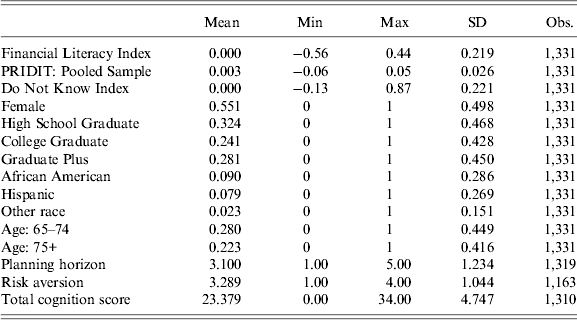
In 2008, we queried about 1,300 randomly selected HRS respondents using a special module assessing knowledge of the stock market and asset prices, investment strategies, risk diversification, the importance of fees, and related topics. Respondents’ average age was 67, and about half (55%) were female. About 15% had less than a high school education, 32% had completed high school, 24% had some college education, and 28% had college or advanced degrees. Most (81%) of the respondents were White, with 9% African–American, and 8% Hispanic (see the Appendix for summary statistics).Footnote 6
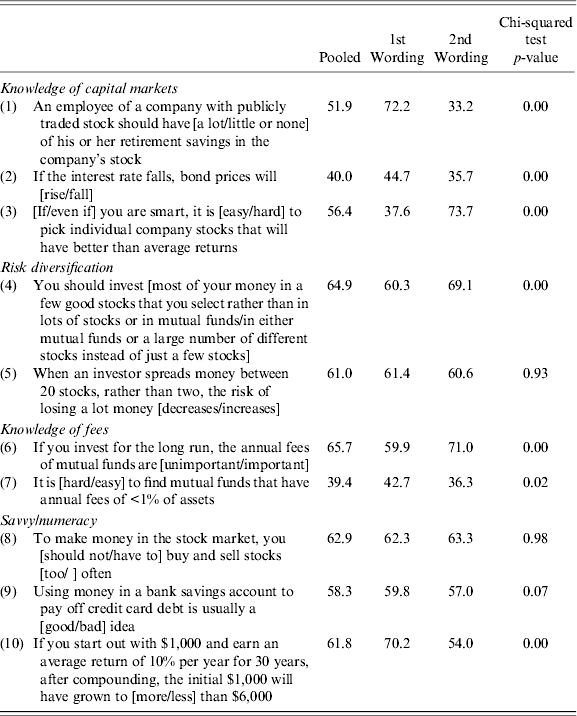
We group the ten financial knowledge questions of key interest here into four categories according to the topics they cover: knowledge of capital markets, risk diversification, knowledge of fees, and savvy/numeracy. Table 1 reports the specific language used in each question employed for the analysis; in each case with the answer which a sophisticated individual would provide indicated in bold:
Financial sophistication questions: percent correct

Source: Authors' computations; see text.
Knowledge of capital markets
(1) An employee of a company with publicly traded stock should have (a lot/little or none) of his or her retirement savings in the company's stock.
Little or none
(2) (Please indicate whether you think each statement is true or false. If you are not sure, give your best guess.) If the interest rate falls, bond prices will [rise/fall].
Rise
(3) (Please indicate whether you think each statement is true or false. If you are not sure, give your best guess.) [If/even if] you are smart, it is [easy/hard] to pick individual company stocks that will have better than average returns.
Even if/hard
Results in Table 1 show that older Americans lack understanding about key concepts related to risk diversification, bond prices, and portfolio choice. For instance, many respondents expressed support for holding own-employer company stock, despite the fact that, from a risk diversification viewpoint, it is unlikely to be wise to hold much own-employer stock.Footnote 7 We also find it of interest that answers are sensitive to how the questions are phrased. Respondents given the first wordingFootnote 8 of this question (an employee of a company with publicly traded stock should have a lot of his retirement savings in the company's stock) state that holding a lot of company stock is not a good idea. However, when presented with the reverse wording, most reject the proposal to hold little or no money in company stock. This discrepancy suggests that the question was not fully understood.Footnote 9 Recalling that this module was fielded in the midst of 2008, it is particularly interesting to see how little respondents knew about key financial concepts.
A large majority of respondents (60%) also did not know about asset pricing, which we evaluated by asking whether people knew about the inverse relationship between bond prices and interest rates. This is a particularly useful question for assessing financial sophistication because it is difficult (if not impossible) to know or infer the correct answer to this question without having some knowledge of finance. When we piloted this question in both the ALP and the Dutch DNB, we found that a few (always less than half) of respondents knew about bond pricing; there the wording order of the question influenced answers. Both conclusions are also true for the older US population. When presented with the statement ‘If the interest rate falls, bond prices will fall’ (second wording), only about one-third (35.7%) of respondents answered correctly; when the wording was reversed (first wording: ‘If the interest rate falls, bond prices will rise’), more answered correctly (44.7%) and this difference is statistically significant. The low fraction of financially sophisticated respondents is consistent with the US 2009 Financial Capability Study where knowledge about asset pricing was low for both older and younger respondents (Lusardi, Reference Lusardi2011).
Many respondents were aware that ‘Even if you are smart, it is hard to pick individual company stocks that will have better than average returns.’ However here, too, responses varied depending on how the question was asked: in one case 73.7% got the correct answer, but only 37.6% got it correct using the reverse ordering. In other words, few know much about investment in this regard.
Risk diversification
(4) (Please indicate whether you think each statement is true or false. If you are not sure, give your best guess.) You should invest [most of your money in a few good stocks that you select rather than in lots of stocks or in mutual funds/in either mutual funds or a large number of different stocks instead of just a few stocks].
Most of your money in either mutual funds or a large number of different stocks instead of just a few stocks
(5) When an investor spreads money between 20 stocks, rather than two, the risk of losing a lot of money [decreases/increases].
Decreases
Knowledge of risk diversification is important when considering what to invest in. Table 1 indicates that almost two-thirds of respondents knew that it is not a good idea ‘to invest most of your money in a few good stocks that you select rather than in lots of stocks or in mutual funds,’ which might be thought to imply some sophistication about risk. However, this question jointly tests knowledge of risk diversification and awareness of mutual funds, which is confirmed by respondent sensitivity to reversing the question wording. The second risk question attempted to avoid this by simplifying the question and using less financial terminology; now, we find that most knew that spreading money across 20 stocks rather than two decreased the risk of losing money (and here, word order did not matter). We hypothesize that some of the sensitivity regarding question wording may be due to the use of financial jargon or terminology. For instance, many respondents might not know what a mutual fund is or the fact that mutual funds invest in pools of stocks.
Knowledge of fees
(6) If you invest for the long run, the annual fees of mutual funds are [unimportant/important].
Important
(7) It is [hard/easy] to find mutual funds that have annual fees of less than one percent of assets.
Easy
Two of the module questions sought to assess people's knowledge of investment fees, an important topic since higher fees erode retirement saving and wealth. Several prior studies have reported that investors often overlook fees when deciding how to invest (e.g., Mitchell et al., Reference Mitchell, Todd, Bravo and Lusardi2008; Choi et al., Reference Choi, Laibson and Madrian2010). In our sample of older Americans, around two-thirds seemed to know that mutual fund fees are important when investing for the long run. Nonetheless, responses were again sensitive to question wording, perhaps due to the fact that respondents needed to know both about mutual funds and investing for the long run. Additionally, a majority of respondents reported that it would be difficult to locate mutual funds charging annual fees of less than 1% of assets, suggesting that many respondents may not know about low-cost mutual funds. The fact that there is again some sensitivity to question wording confirms that, here too, respondents have difficulty with financial terminology (fees, mutual funds, etc.).
Savvy/numeracy
(8) To make money in the stock market, you [should not/have to] buy and sell stocks [too/ ] often.
Should not/too
(9) Using money in a bank savings account to pay off credit card debt is usually a [good/bad] idea.
Good
(10) If you start out with $1,000 and earn an average return of 10% per year for 30 years, after compounding, the initial $1,000 will have grown to [more/less] than $6,000.
Sophisticated investor: moreFootnote 10
Not only it is important to evaluate whether people understand fees associated with investing; it is also important to know whether people understand they can do something to reduce these fees. Table 1 indicates what our HRS respondents knew. Most (over 60%) were savvy regarding stock churning, and there was little sensitivity to wording order for this question. We also explored other financial behaviors along with day-to-day financial management such as dealing with credit cards. Most respondents knew that using money in a bank account to pay off credit card debt is usually a good idea, and responses were not particularly sensitive to question wording, probably due to the simplicity of the question. By contrast, the questions assessing whether people knew about interest compounding and whether they could do complex calculations involving interest rates were far more difficult. Some 60% could figure out that an initial investment of $1,000 would grow more than sixfold when invested at an interest rate of 10% for 30 years, but the alternative wording generated different answers, so at least some respondents were guessing.
Constructing a Financial Literacy Index
While the questions just described do measure knowledge required for financial decision-making, analysts often construct summary measures or indexes of responses to all questions to help categorize respondents as relatively more or less sophisticated. One approach would be to simply sum the number of questions answered correctly, which we do, subtract it from the mean, and divide by ten: the result is centered on zero (with a standard deviation of 0.2; see the Appendix). However, a disadvantage of such a measure is that it weights each question equally, despite the fact that in Table 1 it is clear that some questions are much harder than others for people to answer correctly.
For this reason, we also develop a second, more sophisticated, index that relies on a weighting scheme that takes into consideration the relative difficulty of each question. Specifically, we employ a weighted scoring mechanism called PRIDIT designed to deal with difficult-to-observe outcomes with indicator variables that proxy for a dependent variable that is binary or categorical.Footnote 11 Moreover, as a scoring mechanism, the PRIDIT index weights questions according to how difficult and how informative they are. This index is constructed in two steps. First, each individual's response to a given question is rescaled according to how many people answered that question correctly. That is, PRIDIT applies a negative penalty for a question answered incorrectly, and the penalty is greater when a larger proportion of the sample answered the question correctly. Conversely, the procedure gives more credit for a correct response to a question that a few people answered correctly. Next, the principal components analysis is used to analyze the rescaled responses, a process that takes into account the amount of correlation across questions.Footnote 12 Weights are computed from principal components analysis, so that questions that are less correlated with a linear combination of the other questions are given more weight because they are more informative. The mean of the resulting PRIDIT variable is also zero (with a standard deviation of 0.03; see the Appendix).
In our dataset, the resulting PRIDIT measure and the simple index discussed previously prove to be highly correlated, at 0.977. This suggest that one would expect both measures to do a reasonably good job of capturing the variation in financial literacy measured with our questions. However, the PRIDIT model tells us more, namely which questions are most informative about overall financial sophistication levels. Interestingly, as shown in Figure 1, Questions 4, 5, 8, and 10 are the most informative. These are the items related to knowledge of risk diversification, financial savvy, and numeracy. We interpret this to mean that if one were to design a survey aimed at measuring financial literacy, it would be most useful to ask questions assessing knowledge of those specific topics. Interestingly, studies that have used alternative indicators or indexes for financial literacy report the similar results. For example, among the 20 questions used by Knoll and Houts (Reference Knoll and Houts2012) to measure financial literacy, knowledge of risk diversification proved to be particularly important. That is consistent with our finding that Question 5, which measures knowledge of risk diversification, has the highest PRIDIT weight. Similarly, Schmeiser and Seligman (Reference Schmeiser and Seligman2013) report that knowing about interest compounding is a particularly useful measure of financial knowledge: indeed not only was it the most difficult question for people to answer in their own survey, but also it was the only question consistently associated with wealth changes. Similarly, in our module, Question 10, which measures the knowledge of interest compounding, has the second-highest PRIDIT weight.
(colour online) Question weights used to generate the PRIDIT index of financial sophistication.
The distribution of financial sophistication in the older population
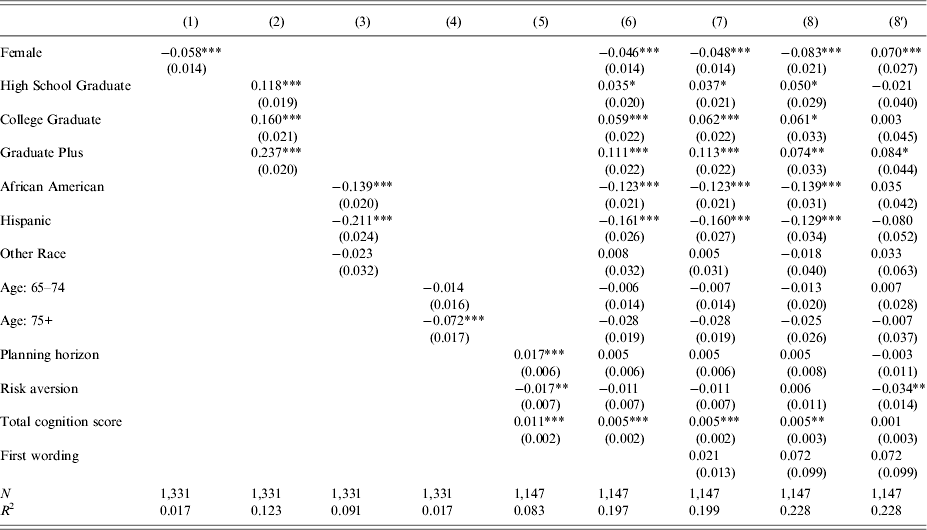
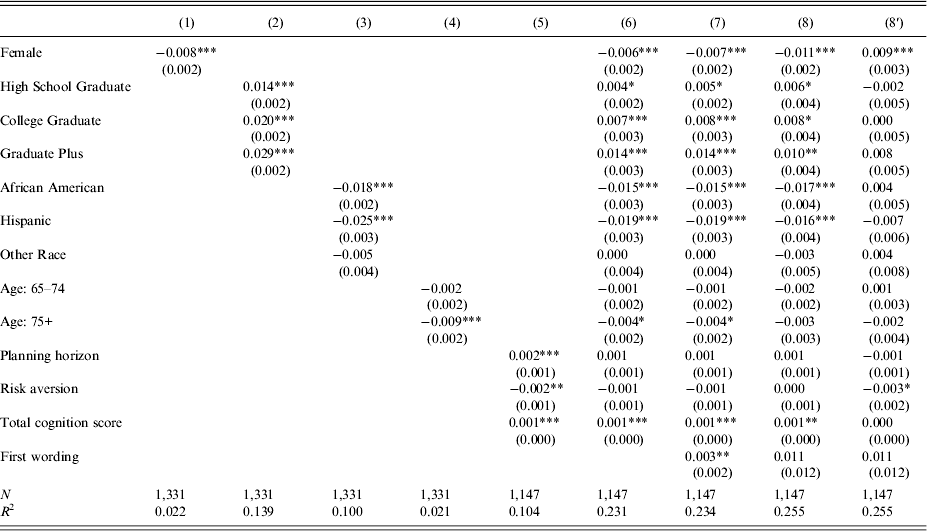
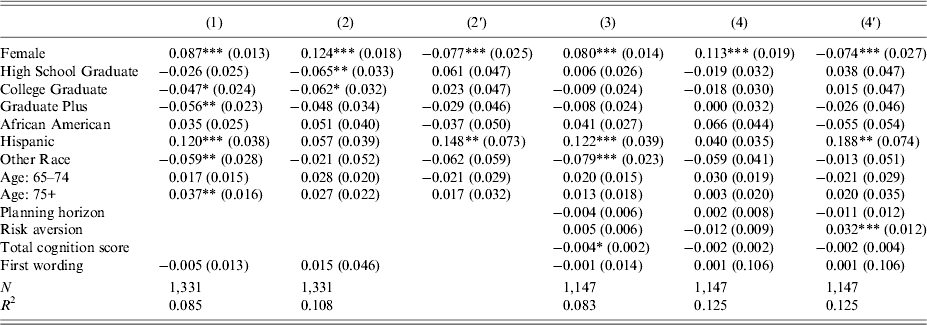
Next we look more closely at how financial sophistication is distributed across the older population. Table 2 reports multivariate regression results using the simple financial literacy index as the dependent variable, whereas Table 3 uses the PRIDIT index. We focus first on columns 1–6, where the vector of control variables encompasses those now standard in this literature including age, sex, education, and race/ethnicity. We also include measures of respondents’ self-reported planning horizon, attitudes toward risk aversion, and cognitive function intended to capture mental acumen.Footnote 13
Multivariate regression models using the simple financial sophistication index
Note: Columns with ′ have interaction variables with First wording. *, **, ***: coefficient significant at the 10%, 5%, and 1% level, respectively. Source: Author's computations; see the text.
Multivariate regression models using the PRIDIT sophistication index
Note: Columns with ′ have interaction variables with First wording. *, **, ***: coefficient significant at the 10%, 5%, and 1% level, respectively. Source: Author's computations; see the text.
Both tables confirm the importance of sex differences in financial sophistication. That is, irrespective of which index and which particular set of controls are used, women are consistently less financially savvy than men (column 1) and this result persists after controlling for many demographic characteristics (column 6). This result extends findings using only the simple financial literacy index in Lusardi and Mitchell (Reference Lusardi and Mitchell2007, Reference Lusardi, Mitchell, Mitchell and Lusardi2011b) and is supportive of similar evidence in a wide range of countries.Footnote 14 The magnitudes for the sex differences are not large in column 6 of both Tables 2 and 3. However, women answer between a quarter to a half of a standard deviation fewer questions correctly.
The better-educated are also found to be more financially sophisticated in both tables, with those having a college degree or more having the greatest advantage compared to the reference case, a high school dropout. With the simple index, those with graduate degrees are about a third of a standard deviation more likely to respond correctly, while using the PRIDIT index the magnitude is a bit larger, at half a standard deviation. Race/ethnicity factors also play a role. Specifically, African–American and Hispanic respondents have lower measured levels of financial sophistication than do their White counterparts (the reference group in columns 3 and 6–8 of both tables). Relatively speaking, Hispanic respondents are at the greatest disadvantage, underscoring about a third to a half a standard deviation across tables. This corroborates our findings from prior waves of the HRS that measured only basic financial knowledge (Hilgert et al., Reference Hilgert, Hogarth and Beverly2003; Moore, Reference Moore2003; Lusardi and Tufano, Reference Lusardi and Tufano2009a, Reference Lusardi and Tufanob; Lusardi and Mitchell, Reference Lusardi, Mitchell, Mitchell and Lusardi2011b). African–Americans' shortfalls are statistically significant, although quantitatively smaller.
In this older population of Americans, there is only weak evidence that age is related to financial literacy scores. That is, once we include our full set of controls in column 6 (Tables 2 and 3), only very weak age effects remain differentiating other groups from the reference category (age 55–64). This is due to the fact that age is correlated with cognition, risk aversion, and planning controls, as is evident from a comparison of columns 4 and 5. Since we have a single HRS cross-section with which we can examine the key outcomes of interest, naturally we cannot disentangle age and cohort effects (Lusardi and Mitchell, Reference Lusardi, Mitchell, Mitchell and Lusardi2011b). Interestingly, only the cognition score retains its statistical significance in column 6 of both tables when all other controls are included, although in both cases the estimated magnitudes are quite small. Nevertheless, in other work (Behrman et al., Reference Behrman, Mitchell, Soo and Bravo2012) we have shown that even small increases in the PRIDIT index is associated with almost 6% more net wealth.
Another contribution of this paper is to examine whether and how responses varied according to the order of question wording. Tables 2 and 3 offer additional information on this point in two ways. First, column 7 adds a simple control variable to the set of regressors indicating which wording each respondent received first. Here we see that the patterns of financial sophistication documented earlier are not attenuated with this control, which is statistically significant when using the PRIDIT index (Table 3). Nor are controls on risk aversion and financial planning horizon influential for the financial literacy outcomes we examine here. Second, to check for differential sensitivity by group, columns 8 and 8′ in both tables offer a fully saturated model where the first wording dummy is interacted with all other variables. One key subgroup stands out as influenced by the order of the question, namely women. Thus when women were shown the first wording, they were more likely to score better on both simple and PRIDIT sophistication indexes, holding other factors constant.Footnote 15
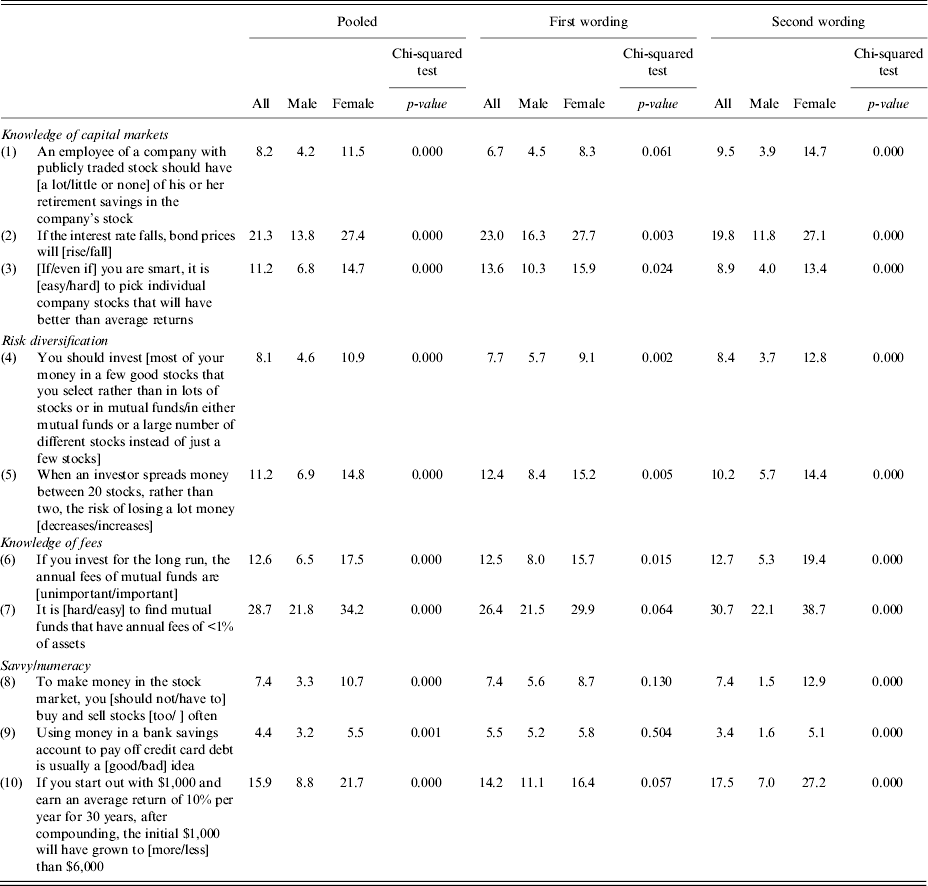
To explore this in more detail, Table 4 illustrates exactly which wording induced HRS women to be more likely to answer questions correctly. Table 4A examines differences by sex in the mean percentage of ‘Do not know’ responses for each of the survey questions where we report p-values for the statistical significance of mean differences. Panel 4B instead uses a tally of each person's total number of ‘Do not know’ responses as the dependent variable (we have also subtracted the mean and divided by 10 as before). We then show three specifications identical to columns 6 and 8–8′ in Tables 2 and 3.
Financial sophistication: summary measures of ‘Do Not Know’ responses by sex
Source: Authors' computations; see the text.
Multivariate regression models of financial sophistication: Do Not Know responses by sex
Note: Columns with ′ have interaction variables with First wording. *, **, ***: coefficient significant at the 10%, 5%, and 1% level, respectively. Source: Author's computations; see the text.
Two important conclusions emerge from this analysis. First, older women are far more likely to answer ‘do not know’, and in many cases, around twice as likely as men. Second, the rate of ‘do not know’ responses among women is lower when the first wording order was used. This is evident both from the lower significance levels of the chi-squared tests performed on the First Wording group in Table 4A, as well as from the strongly negative coefficient on the female and first wording interaction term in Table 4B. From these two facts, we conclude that women are susceptible to framing effects and are also much more likely to respond ‘do not know’ when such confusion arises. This is somewhat puzzling but it confirms with evidence from other countries. For instance, Lusardi and Mitchell (Reference Lusardi and Mitchell2011c, Reference Lusardi and Mitchell2014) show that women respond similarly in countries as different as Sweden, Italy, Germany, New Zealand, Australia, and Russia; i.e., they were disproportionately more likely to indicate that they did not know the answers to financial literacy questions. Because of a lack of confidence or perhaps due to lack of knowledge, women are sensitive to how these question were framed.
Other studies have also suggested that the context also matters for financial literacy questions. For example, Schmeiser and Seligman (Reference Schmeiser and Seligman2013) report that the proportion of correct answers changed if a question was posed in the context of math, medicine, or consumer decisions. They also show that the proportion of correct answers to the same HRS financial literacy questions changed in ways consistent with lack of knowledge and/or guessing, as reported here.
Conclusion and discussion
This paper documents a quite striking dearth of financial sophistication among the older American population. Our special-purpose HRS module has permitted us to quantify just how little respondents know regarding the capital markets, risk diversification, fees, financial savvy, and investing. Furthermore, we have exploited differences in question wording to show that people are likely guessing and are often influenced by the way in which survey questions are framed. Finally, we make a methodological contribution by examining alternative ways to combine answers to financial literacy questions into an overall index. This helps to identify which particular questions are most valuable in measuring financial literacy at older ages.
To sum up, in our HRS sample of older respondents, people lacked a good grasp of asset pricing, risk diversification, portfolio choice, and investment fees, despite having made many financial decisions over their lifetimes including having taken out mortgages and loans, saved and invested, and made retirement accumulation/decumulation decisions. Moreover, we showed that the PRIDIT index we used is highly correlated with an alternative measure that simply sums correct answers, indicating for the older population that both approaches do a reasonably good job in capturing observed variation in financial sophistication. However, the PRIDIT approach has the advantage of telling us which questions are most informative about overall financial sophistication levels. In our module, the questions related to knowledge of risk diversification, financial savvy, and numeracy were most informative. For this reason, those seeking to measure financial literacy and sophistication will find it helpful in measuring knowledge of these specific topics.
We also conclude that some subgroups of the population are significantly less sophisticated about financial matters, and these include the least educated, women, those age 75+, African–Americans, and Hispanics. Women are particularly sensitive to question framing when financial terminology is being used. This suggests that it would be fruitful to study how financial sophistication questions are framed, so as to determine whether and how people develop a fuller understanding of retirement saving and investment. Moreover, the analyst must bear in mind that some questions are not effectively gender neutral.
Our findings will be of interest to those seeking to enhance retirement security in the older population. As employees and retirees are increasingly being asked to take on tasks requiring financial sophistication including saving, investment, and dissaving pre- and post-retirement, they are likely to do better if they are equipped with more and better financial decision-making capacity. One way to do this is to build human capital via educational and retirement planning programs, particularly starting young (Lusardi et al., Reference Lusardi, Mitchell and Curto2010). And a one-size-fits-all approach is unlikely to address saving shortfalls for all the elderly, in view of the very different patterns discerned by sex, age, educational levels, and race/ethnicity. Instead, targeted programs are likely to better serve people who differ in terms of financial sophistication.
Appendix
Descriptive statistics for the HRS analysis sample