The first part of this final chapter outlines some modern scholarship on the ways in which ancient poems and poetic traditions developed around one another and interacted with each other. The second part of the chapter is more to do with ancient textual transmission and presents a catalogue of evidence for ancient editorial manipulation of the boundaries between poems, here described as ‘cropping’ and ‘splicing’.
1. Modern scholarship: neoanalysis and other ‘systemic’ interpretations
Modern scholarship on ‘epic interactions’ has to tread a fine line between pure literary exegesis and strong claims about historical actualities. Of these, exegesis is relatively theoretical, and is to some extent the creation of modern literary critics; claims about actualities relate more to source criticism and to testable models of the development of Archaic poetry.
Neoanalysis, the study of the Homeric epics’ adaptation of non-Homeric material, tends towards the latter. (Here ‘non-Homeric’ means especially Cyclic legend and poetry.) The scholarship is extensive, so for more in-depth coverage the reader should refer to one of the core works of neoanalytic scholarship; many of these are in German but several serviceable surveys in English exist.Footnote 1
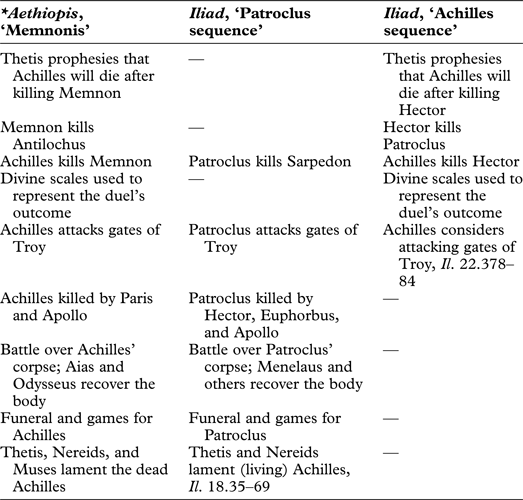
The classic paradigm of the neoanalytic approach is the ‘Memnon theory’, according to which the Iliadic story of Achilles, Patroclus, and Hector draws on the story of Achilles, Antilochus, and Memnon that we find attested for the *Aethiopis.Footnote 2 The asterisk on *Aethiopis indicates a conjectural pre-Homeric form of the Aethiopis legend, so as to avoid equating Arctinus’ Aethiopis with the legend, and to avoid the unnecessary assumption that it was specifically Arctinus’ poem that the Iliad used as a model.
Table 1 shows some of the main parallels. It follows Burgess in distinguishing two distinct sequences of motifs in the Iliadic story: in each sequence, characters act out parts of a single story pattern.Footnote 3 Since the point of this story pattern is that Achilles dies at the end, it appears that the *Aethiopis version is primary: Achilles can only die once, so in the Iliad several elements relating to his death are transferred to Patroclus, creating a ‘Patroclus sequence’. The parallels are not exact, of course, and the theory has weathered criticism from many different angles.
Adaptation of the *Aethiopis in some major plot-lines of the Iliad

Recent studies have defined neoanalysis as the study of ‘motif-transference’ from pre-Homeric epic to Homer.Footnote 4 In its most orthodox form, neoanalysis is based around specific texts and specific poems, and aims to analyse the chain of dependencies between them. In this sense it is a successor to the older, analytic school of Homeric scholarship: analysis aimed to establish which variant of a repeated element within Homer was the original and which the copy; neoanalysis works with whole poems and tries ‘to establish which poem was the donor and which the recipient’ of a given story element.Footnote 5 However, few now doubt that Homeric epic drew on precursors of the Cyclic epics, whether written or purely oral, and not on the specific poems known to Hellenistic scholars. In other words, to use the terminology outlined in Chapter III, modern neoanalysis is the study of motif-borrowing between strands of oral epos legend. Still looser forms of neoanalysis also allow for the possibility of non-poetic legend as source material; however, it then becomes hard to tell the difference between neoanalysis and the study of traditional tropes in the most general sense.
Neoanalysis traditionally focuses on the Iliad, where Kullmann's opus Die Quellen der Ilias (The Sources of the Iliad, 1960) analyses numerous episodes as Cyclic borrowings: the omen of the sparrows at Aulis (Il. 2.301–30), foreshadowings of Astyanax's death in the sack of Troy (24.727–38), and so on. But the Odyssey provides plenty of grist for the mill too. There, Danek's Epos und Zitat (Epic and Citation, 1998) has had an especially great impact on the study of Odysseus’ wanderings (Od. 9–12). Danek sees traces of an *Argonautica in some of the fantastic elements (Circe, the Laestrygonians, etc.), existing alongside an older *Odyssey.Footnote 6 The *Argonautica provided the monsters and magic; the older *Odyssey offered the more mundane aspects of the homecoming. Some further Cyclic elements include the stories that Nestor, Menelaus, and others tell about events at Troy; the returns of Menelaus and Agamemnon (Od. 3.262–312, 4.351–586, 11.405–34); and many more. But Danek often considers the evidence for borrowing too thin to conclude that a specific poem was the source material. In many cases he judges (rightly) that it is extravagant to postulate specific texts as sources; oral epos legend and non-poetic legend are more likely candidates.Footnote 7 Most interesting are occasions when the Odyssey outlines possible alternatives for how the story will develop, only for one alternative to be rejected and suppressed. Danek sees these not as allusions to other poems but as traces of alternate versions of the Odyssey itself: an *Odyssey where Telemachus visits Crete, an *Odyssey where Odysseus is reunited with Laertes at an early stage, and so on. The Odyssey is not just played against a Cyclic backdrop: there is a whole landscape of potential *Odysseys in the background.
There are various bastions of resistance to neoanalysis. One form of resistance is to distance Homer from the Cyclic epics. An influential study by Griffin argues that, unlike the Cyclic poems, Homeric epic conscientiously avoids fantastic elements and morally base elements.Footnote 8 However, even if this is right, it does not impugn neoanalysis as a purely analytic tool (as Griffin himself points out).
A second avenue of resistance is to reverse the relationship: the Cyclic epics plunder Homer, not the other way round. According to this view, the Cyclic epics were composed with an agenda of filling in the gaps around Homer. To this end, each epic took isolated Homeric references to minor events and built larger poetic edifices out of these titbits.Footnote 9 In cases such as the Memnon theory where the parallels are very extensive, this is simply the wrong objection (the Cyclic poets are supposed to have focused on minor points). But the argument still pops up every now and then: for example, in scholarly discussions of Eugammon's Telegony.
Eugammon himself is certainly post-Homeric – he can have lived no earlier than 631 bce, when his home city of Cyrene was founded – and it is sometimes inferred that his story of Telegonus’ wondrous spear, made from a poisonous ray's sting, is derived from a distorted interpretation of Teiresias’ prophecy of Odysseus’ death ‘from the sea’ (Od. 11.134). But as we saw in Chapter III and in Danek's analysis, to postulate that a given story belongs to a specific poem and had no previous existence is nearly always the extravagant alternative, not the parsimonious one. It is also an argument from silence: new evidence can disprove it. And, as it happens, robust evidence for a pre-Homeric *Telegony legend does exist. The basic story of Odysseus’ confrontation with Telegonus is a variant of a very old Indo-European folktale, the ‘mortal combat of the father and son’ (also known as the ‘Sohrāb and Rostam’ type), which has several extremely close parallels in Indian, Persian, Irish, German, and Russian epic and folktales.Footnote 10 There is no doubt that it is very old and very traditional. A sceptic – someone who dislikes the idea that the Telegonus legend informed the Homeric Odyssey – might take refuge in claiming that, even if the story-type is old, still Telegonus himself was Eugammon's invention; or, if Telegonus should be proven to be old, still his magic spear is late. These cannot be ruled out (in fact, the last suggestion may be true: the one surviving image of Telegonus shows him armed with a bow, not a spearFootnote 11 ). But they are still arguments from silence. The notion that the Cyclic poets created their material by reworking hints given in Homer may well be true in some cases, but is indefensible as a default presumption.
But a third objection to neoanalysis, and by far the most serious one, is that it is catastrophically vulnerable to confirmation bias. Any story is a complex set of data; when you look for parallels and patterns in two complex datasets, you will invariably find them. It is therefore dangerously easy for neoanalysis to rely on arguments from similarity and coherence. For example: one criterion that has been used to detect neoanalytic borrowings is ‘fissures in a narrative’ – that is, inconsistencies or apparent failures of logic.Footnote 12 Eurycleia's recognition of Odysseus in Odyssey 19 has no lasting impact on the epic's plot; this supposed ‘fissure’, therefore, could possibly be a result of ‘motif transference’ from an older poem – in this case, an older *Odyssey.Footnote 13 But a possibility in principle is a far cry from evidence.
The underlying epistemological question is whether a given parallel is a case of systematic adaptation of a prior narrative or merely a trope, a conventional stock element or an echo with no broader significance.Footnote 14 The table above omits one *Aethiopis episode which is especially liable to this criticism. In Iliad 8.80–115 Nestor, trapped with a disabled chariot and threatened by Hector, is rescued by Diomedes. Ostensibly this episode draws on a moment in the *Aethiopis where Antilochus rescues Nestor from Memnon (leading to Antilochus’ death at Memnon's hands).Footnote 15 But, in the Iliad, the parts of the poem where adaptation is beyond doubt – the ‘Achilles sequence’ and the ‘Patroclus sequence’ in the table above – have no connection to the Nestor episode in Book 8. That episode is isolated from other parts of the *Aethiopis narrative: it might as well be a stock scene. By contrast, the Achilles and Patroclus sequences feature extensive borrowings and both sequences revolve around a tightly focused cluster of three characters (Achilles, Patroclus, and Hector): these clearly represent systematic exploitation of older material.
Some recent studies have been taking these methodological problems very seriously, and have pondered the standard of evidence required for demonstrating a neoanalytic link between poems, as opposed to a vaguer kind of echo.Footnote 16 But the Memnon theory remains a rara avis: other cases where echoes can be corroborated are few indeed. So it is hard to see prospects for a reliable, universally applicable, methodology whereby neoanalysis can attain any degree of certainty about adaptations, other than in exceptionally well-established cases.
Let us turn from neoanalysis to a more purely literary kind of criticism on the interplay between poems. As with neoanalysis, the scholarship often takes Homer as its departure point.
Many critics, led especially by Nagy's book The Best of the Achaeans, see the Iliad and Odyssey as complementary: the Homeric epics developed around one another, responding to each other and resonating in unique ways. Together they form a complete system, in terms of their mutual evaluation of one another and their celebration of two complementary ideals of heroism: Iliad vs. Odyssey; kleos (‘fame’) vs. nostos (‘homecoming’); Achilles vs. Odysseus; biē (‘might’) vs. mētis (‘artifice’).Footnote 17
This vision makes Homer a walled garden. His poetry ends up being ‘special’ in ways not shared by Hesiod, the Cycle, or any other hexameter poems.Footnote 18 That is all very well for a type of criticism designed to celebrate the Homeric epics’ pre-eminence after the fact. But if this form of criticism also makes claims about the historical development of hexameter poetry, in terms of cause and effect, then its dependence on teleology becomes a problem.
The problem is that it pre-emptively excludes all hexameter poetry other than the Iliad and Odyssey from consideration.Footnote 19 There is no doubt that the Homeric epics stand out from the crowd: they are uniquely long, uniquely elevated, uniquely excellent. No-one seriously believes that the Aethiopis was as pre-eminent as the Iliad. But a walled garden? The idea that Arctinus was somehow forbidden from drawing on the epic tradition in the same ways that Homer did is surely wishful thinking. The reverse is also true: as neoanalysis shows, the Iliad plays far more heavily on an *Aethiopis tradition than it does on the Odyssey; and the Odyssey depends much more on an *Oresteia tradition than it does on the Iliad.Footnote 20
Finkelberg tries to shore up the garden wall by distinguishing different kinds of intertextual play. For her, the Homeric epics possess reciprocity: they do not presuppose each other specifically but only a common inherited tradition, so their interplay is relatively subtle. Where one poem plays specifically on another, by contrast, the relationship is asymmetrical and much more obvious: the Iliad plays on an *Aethiopis, but Arctinus’ Aethiopis did not play on the Iliad (so far as we know).
This allows the Iliad and the Odyssey not only to distance themselves from the Cycle poems but also to turn these poems into raw material, as it were, for creating something completely new. …Homer uses his tradition in a highly idiosyncratic way.Footnote 21
Even this form of the ‘walled garden’ approach has problems, though. If the Iliad is playing specifically on an *Aethiopis, then it is playing on a form of the *Aethiopis that is in some sense canonical. That is: we have to presuppose more solidity in this hypothetical *Aethiopis than in the Homeric Odyssey! So this interpretation involves a strong historical claim: that prior to the Iliad the *Aethiopis had reached a canonical form, while the Odyssey was still fluid.
Opposing the ‘walled garden’ approach is a trend of interpreting all hexameter as a coherent whole, with systemic organization on a large scale. Thalmann sees hexameter as unified by a single world-view, defined by symmetry and antitheses, and geared towards making the cosmos intelligible rather than a mere jumble of events.Footnote 22 Slatkin develops this view by interpreting each sub-genre of hexameter as ‘a classification of cultural phenomena’: heroic poetry is complementary to wisdom literature, Homer to Hesiod, but they all ‘exist within, and serve to complete, a conception about the way the world is ordered’.Footnote 23 For Ford, epic is a chronological continuum stretching from Hesiod's Chaos all the way to Eugammon's Telegonus without a break: poems anticipate or reflect other parts of the continuum, creating resonances and an overall unity.Footnote 24
The most complete statement of this ‘systemic’ reading is Clay's influential interpretations of the Homeric Hymns and the Hesiodic poems. For Clay, not only is the Odyssey a response to the Iliad, but the Works and Days is a response to the Theogony; the Catalogue forms a triptych with them both;Footnote 25 the Hymns, too, pursue a well-defined agenda that links the divine realm to the mortal world. Hexameter is thus a much larger system than just Homer, but it is still a system. So the Hymns describe mythological moments: stories that change the cosmos, and authorize individual gods’ roles and the relationship between gods and mortals. The Theogony and Works and Days ‘form a unified whole embracing the divine and human cosmos’ respectively. And heroic epic describes a time when the mortal and divine spheres were more closely linked than in the present.Footnote 26 As Clay writes: ‘one might argue that the Homeric Hymns were created in order to fill the perceived gap between Hesiod and Homer and thus to provide accounts of the major events in the evolution of Olympus’.Footnote 27
This picture of hexameter as a larger unity has a certain appeal – but only until one inquires about the origin of the system. Who devised and enforced this division of labour? Where does it leave the dozens of other hexameter poems that are attested: the Thebaids, the Heracleas, the Descents to Hades? Clay's tightly knit top-down organization can hardly have been a code of unbreakable rules followed unquestioningly by the Cyclic poets, Eumelus, Musaeus, and others.
A more careful approach is to think about the poems’ complementary character in terms of later reception, rather than in terms of their historical composition. This is the tactic followed by Graziosi and Haubold.Footnote 28 One reason is simply that our selection of extant texts is pre-determined and out of our control. For us, the extant poems constitute a ‘found’ canon, with literally no existence other than as a coherent system, and this illusory coherence has guided a lot of modern interpretation. But in antiquity, too, by the fifth and fourth centuries bce the Hesiodic and Homeric poems were already read as complementary. Plato and Aristotle saw Hesiod and Homer as systemic canons, in much the same way that Ford and Clay do.
And comparable principles may have operated in other corpuses too. It would be unsurprising if new evidence emerged one day that showed similar kinds of relationships between the Derveni Theogony and the Orphic Hymns, for example; or between the Epimenidean Theogony, the Birth of the Kouretes and Korybantes, and the Genealogies. If ancient readers perceived these poems as complementary and resonating with one another, as they did the Homeric and Hesiodic canons, it could help explain how the Orphic and Epimenidean poems gravitated into their own groups and created their own canons.
2. Ancient transmission: cropping and splicing
In the centuries after their composition, some poems were combined or edited by either ‘splicing’ or ‘cropping’. Here ‘splicing’ refers to the editorial practice of joining two originally separate poems and publishing them together as a single continuous text. ‘Cropping’ describes situations where poems were abbreviated after composition, either to avoid overlaps with other poems or to publish an extract as a separate poem.Footnote 29 The remainder of this chapter is a catalogue of the evidence for ‘cropping’ and ‘splicing’ at the boundaries between poems.Footnote 30
Individual cases of editing cannot in general be dated. In one case, the Hymn to Apollo, if the poem we have is a result of splicing, it is most likely that it dates to the Archaic period.Footnote 31 If Burgess’ ‘cropping hypothesis’ about the Epic Cycle is correct, that should probably be dated to the fourth century, on the supposition that compilation of the Cycle post-dates the literary sense of ‘cyclic’.Footnote 32 No substantial splicing or cropping would have taken place after the Hellenistic period.
(a) The Hesiodic Theogony and Catalogue(s) of Women
Th. 1021–2 = Cat. fr. 1.1–2. In one ancient papyrus and two medieval copies the Theogony ends at line 1020; 1021–2 appear in some manuscripts added in a second hand; in only one are they an integral part of the text.Footnote 33 This indicates that at some point the Theogony and Catalogue were spliced together in some, but not all, editions.
West argues that the splice extends much further into the Theogony.Footnote 34 The authenticity of the last section of the poem, from line 901 (or 930 or 965) onwards, has often been doubted.Footnote 35 Since this section is largely devoted to a ‘little catalogue’ of goddesses who had sex with mortal men (965–1020) – an inversion of the Catalogue's theme of women who had sex with male gods – the whole thing could be a large splice designed to join a shorter proto-Theogony to the Catalogue. West's suggestion that 1021–2 was intended to point readers to a subsequent scroll on the shelf is also possible; that would be a milder form of splicing (the doing of a librarian rather than an editor).Footnote 36
Cat. fr. 2 poses a related problem. The source of the fragment, John Lydus, discusses Latinus and Graecus as eponymous ancestors of the Latins and Greeks. Lydus elliptically mentions ‘brothers’; then, naming Hesiod's ‘catalogues’ as his source, quotes Theog. 1013 (‘Agrius and Latinus’ [=Cat. fr. 2.1]) and Cat. fr. 2.2 (on Hellen's children). The reference to ‘brothers’ is puzzling, for fr. 2.2 makes it clear that Graecus is Pandora's son, and not related to Latinus or his mother, Circe. Various emendations and transpositions have been proposed,Footnote 37 but it is fairly clear that Lydus is quoting from two separate sources.
If the last section of the Theogony, the ‘little catalogue’, is indeed a splice between a proto-Theogony and the Catalogue, an ancient reader might well refer to both of them jointly as ‘Hesiod's catalogues’. On this reading, then, Lydus combines Theog. 1013 and Cat. fr. 2.2 because they do indeed both come from ‘Hesiod's catalogues’, plural: one from the ‘little catalogue’ in the Theogony, the other from the Catalogue of Women.
(b) The Catalogue of Women and the Shield
Shield 1–56 = Cat. fr. 138.8–63, the story of Heracles’ birth. Shield argument a (=Cat. fr. 139 = Hes. test. 52) informs us that the passage comes from Cat. Book 4; its testimony is confirmed by two overlapping papyri containing Cat. fr. 138.1–7 and Shield 1–18.Footnote 38 The simplest inference is that the Shield poet himself took the passage from the Catalogue and used it for the opening of his poem.Footnote 39
West and Most, by contrast, argue that the passage was interpolated into the Shield after both poems were composed.Footnote 40 They do so for contradictory reasons: West, because the passage is too similar to Shield 78–88, where Heracles refers to the birth story again (but without repetition); Most, because the passage is too dissimilar to the rest of the poem (but this is not a poem known for its structural or thematic perfection). Neither position is very compelling.
(c) The Catalogue of Women and the Cypria
We do not have the end of the Catalogue, but in the last major fragment, fr. 155.94–180, the marriage of Helen is followed by Zeus planning a major war to destroy the races of mortals and demigods (99 ἀϊστῶσαι…ὀλέσθαι).Footnote 41 This plan has often been linked to a fragment of the Cypria describing Zeus's plan for the Trojan War (Cypria fr. 1.4–7):Footnote 42
…[Zeus] resolved to relieve the all-nurturing earth of mankind's weight by fanning the great conflict of the Trojan War, to void the burden through death. So the warriors at Troy kept being killed, and Zeus’ plan was being fulfilled.
It would seem that a similar Dios boulē (‘Zeus's plan’) lies behind the passage near the end of the Catalogue. The Catalogue follows up its Dios boulē passage with a digression, whose relevance is uncertain, about the passing of seasons and a snake's life cycle (124–44 and probably as far as 147).Footnote 43
There is no indication that the end of the Catalogue and the start of the Cypria were ever actually spliced together. However, on a mythological level (rather than textual), Clay has insisted that Cat. fr. 155 is designed to embed the Trojan War in a ‘a continuum with the cosmogonic background and the dynamics of the succession myth’ – a continuum that stretches from the Theogony to the fall of Troy and the returns.Footnote 44
From Cat. fr. 155.95 onwards there are several abrupt shifts in topic and in tone. The less than organic character of the passage may result from an attempt to forge a link between ‘Hesiodic’ and ‘Homeric’ forms, between the Catalogue and heroic epic, by combining echoes of both types of poetry. Hesiodic echoes: the end of the heroes (Cat. fr.155.96–c.106) evokes the Hesiodic Myth of the Races (WD 156–73);Footnote 45 and the passage where trees bow before Boreas, and a snake gives birth and retires underground in winter (‘the hairless one’; Cat. fr. 155.124–43), closely echoes the Hesiodic description of Boreas bending trees and an octopus gnawing its foot in hidden places (‘the boneless one’; WD 504–28). Homeric echoes: the catalogue of Helen's suitors (Cat. frs. 154, 155.1–75, 156) resonates with the catalogues in the Cypria and the Iliad; and lines 118–19 (καὶ π]ολλ̣ὰς Ἀΐδηι κεϕαλὰς ἀπὸ χαλκὸν ἰάψ̣[ει]ν / ἀν]δ̣ρ̣ῶν ἡ̣ρ̣ώων, ‘and] the bronze was going to send to Hades many heads of heroic men’) evoke Il. 1.3–4 (πολλὰς δ’ ἰϕθίμους ψυχὰς Ἄϊδι προΐαψεν / ἡρώων, ‘[Achilles’ wrath] sent to Hades many strong souls of heroes’).
(d) The Works and Days and the Bird Omens (or Ornithomancy)
The Works and Days ends (826–8):
Happy and blessed is he who knows all these things and does his work without giving offense to the immortals, distinguishing the birds and avoiding trespasses.
A scholion on line 828 (=Hes. test. 80) reports: ‘At this point some people add the Bird Omens, which Apollonius Rhodius…marks as spurious.’ Apollonius’ testimony, then, would make this a case of splicing.Footnote 46
Some argue instead that WD 828 ‘distinguishing the birds’ is programmatic for a subsequent episode, the Bird Omens, which has been cropped.Footnote 47 The question hinges on a phrase in Pausanias’ overview of the Hesiodic corpus:
Βοιωτῶν δὲ οἱ περὶ τὸν Ἑλικῶνα οἰκοῦντες παρειλημμένα δόξῃ λέγουσιν ὡς ἄλλο Ἡσίοδος ποιήσειεν οὐδὲν ἢ τὰ Ἔργα·…ἔστι δὲ καὶ ἑτέρα κεχωρισμένη τῆς προτέρας, ὡς πολύν τινα ἐπῶν ὁ Ἡσίοδος ἀριθμὸν ποιήσειεν, ἐς γυναῖκάς τε ᾀδόμενα καὶ ἃς μεγάλας ἐπονομάζουσιν Ἠοίας,…καὶ ὅσα ἐπὶ Ἔργοις τε καὶ Ἡμέραις.
The Boeotians who live around Helicon say that of the poems commonly ascribed to him Hesiod composed nothing but the Works.…But there is another opinion, different from the first one, according to which Hesiod composed a very great number of hexameter poems: the poem about women; and what they call the Great Ehoiai;…and everything ἐπί the Works and Days.Footnote 48
The cropping interpretation takes ἐπί in the scholastic sense of ‘after’: thus ‘everything after WD 828’, referring to the Bird Omens.
However, the non-specialist meaning ‘in addition to, besides’ is a much better fit for Pausanias’ non-academic register, and also for his flow of logic: he is specifically discussing whether Hesiod wrote anything other than the Works and Days. Therefore ‘everything ἐπί the Works and Days’ means simply the entire Hesiodic corpus. The passage has no implications for the Bird Omens.
This more conservative interpretation of ἐπί removes the challenge to Apollonius’ testimony. The Bird Omens and Works and Days, in that case, were composed independently, and one was later spliced onto the other.
(e) The Hymn(s) to Apollo
Of all cases of splicing and cropping, this is the most problematic. As we saw in chapter I, it is often supposed that this Hymn was compiled from a ‘hymn to Delian Apollo’ (1–178) and a ‘hymn to Pythian Apollo’ (179ff.). The former ends with a fairly standard ‘farewell’:
And myself, I shall not cease from hymning the far-shooter Apollo of the silver bow, whom lovely-haired Leto bore.
The niceties of formal hymnic structure suggest that the subsequent passage is the start of a new hymn: a bridge passage beginning at 179 (‘O Lord, Lycia too is yours, and lovely Lydia…’) leads into the ‘Pythian’ hymn, with a new attributive section, and by 207 (‘How shall I hymn you, fit subject as you are in every respect?’) we are clearly at the start of a new hymnic narrative.Footnote 49 The question is whether this structural shift is also a case of splicing. Richardson's recent commentary has complicated the question further, arguing for a single hymn with a three-part structure.Footnote 50 There is little prospect of resolving the matter to everyone's satisfaction.
(f) The Thebaid and the Epigoni
We have only the barest hint of a splice between these two lost poems. The first line of the Epigoni is preserved as follows (fr. 1):
The word ‘younger’ looks like it must mean: in comparison to the heroes of the previous Theban war, the Seven against Thebes. If it refers to a poem on that subject (which is by no means certain), the line could be either a splice that postdates both poems or, alternatively, a sign that the Epigoni was composed as a sequel to the Thebaid;Footnote 51 Alcidamas and Herodotus regarded both poems as Homeric (Epigoni test. 1, 5).
(g) The Epic Cycle
Proclus’ summaries of the Trojan epics form a single continuous narrative without overlaps. However, other evidence makes it clear that some poems originally covered more ground and overlapped with one another: for example, the Little Iliad contained episodes that are also attested for the Aethiopis and the Sack of Ilion. There are at least three ways of interpreting these discrepancies.
(1) Bethe believed that the Cypria, Aethiopis, Little Iliad, and Sack of Ilion were originally a single poem;Footnote 52 this thesis could explain confusion in the attribution of individual fragments. However, it requires ignoring almost all the attribution evidence that we do have, and should not be taken seriously.
(2) Davies argues that not just the epics but also Proclus’ summaries originally extended further, and that the overlaps in the summaries were excised by a Byzantine epitomizer.Footnote 53 This thesis addresses a textual question in Proclus, albeit perhaps not conclusively.Footnote 54 But it does not account for places where there is evidence of interference with a poem's actual text: specifically, at the interfaces between the Cypria and Iliad, Iliad and Aethiopis, and Odyssey and Telegony.
(3) Burgess, following Monro, prefers a ‘cropping hypothesis’: an editorial process trimmed the poems themselves, excising overlaps and inconsistencies, and deleting episodes at the beginnings and ends so as to create a continuous streamlined ‘cycle’.Footnote 55
Burgess’ cropping hypothesis has the most explanatory power. It is also the most drastic: it requires the premises that ancient editors were willing to do great violence to their texts (even if only in a special Cyclic edition), and that uncropped editions must have continued to exist alongside the cropped Cycle, or no evidence of discrepancies would survive. But we have good evidence of extreme violence in at least one case (the start of the Aethiopis); and persuasive evidence, to my mind, in another (the end of the Odyssey). Furthermore, the evidence outlined above for cropping and splicing in non-Cyclic poems adds to its plausibility in the case of the Cycle. As things stand, Burgess’ cropping hypothesis is the one to beat.
Cypria
Beginning. Not generally disputed in terms of where the plot begins. See above on a thematic link to the end of the Catalogue of Women.
End. Proclus’ summary has the poem end with the Greeks awarding Briseis and Chryseis to Agamemnon and Achilles; the death of Palamedes; Zeus's plan to remove Achilles from combat; and a catalogue of Trojan allies. This would appear to lead directly into the Iliad.
However, Cypria fr. 31 appears to refer to the death of Astyanax in the sack of Troy; fr. 34 Bernabé (om. West) explicitly refers to Polyxena's death. Tabula Iliaca 3C Sadurska groups together three scenes, of which the first two belong in the Cypria and the third in the Iliad.Footnote 56 The argument that the Cypria originally extended beyond the end of Proclus’ summary has been put most forcefully by Burgess, who contends that the Cypria originally covered the entire Trojan War; he sees this corroborated by a Hellenistic reference to Cyprias as the author of a poem named as Iliaca.Footnote 57
Iliad
Beginning. Not disputed in terms of plot. An alternate proem is recorded which Bethe thought served to provide a bridge between the Cypria and the Iliad (=Cyclic Iliad test. Bernabé; om. West), but there are competing interpretations.Footnote 58
End. Not disputed in terms of plot content. A couplet is recorded that appears to replace the Iliad's final line with two lines that link directly to the arrival of Penthesileia (Aeth. fr. 1); this could in principle be a splice but is better interpreted as an internal fragment from within the Aethiopis (see below).
Aethiopis
Beginning. Proclus has the plot begin with Penthesileia's arrival at Troy. Fr. 1 consists of two lines that link Hector's funeral to Penthesileia's arrival (see also Iliad, end, above). It is obvious that the lines are not part of a proem: there is no sense of a beginning, no Muse invocation, and the lines refer to Hector's funeral as an event that has only just been narrated.Footnote 59 Hence, either the lines are an attempt to splice the Aethiopis onto the Iliad Footnote 60 or they are taken from within the Aethiopis.Footnote 61
Pictorial evidence from the Hellenistic and Roman eras suggests that Proclus’ summary is a cropped form of the original Aethiopis. Four third-century-bce Homer cups, MB 23–26 Sinn (=Aeth. test. 11 Bernabé), show three scenes as though linked: Priam's ransom of Hector's corpse; Priam and Penthesileia at Hector's grave; and Achilleus and Penthesileia in battle. This would indicate that the ransom of Hector appeared in the original Aethiopis, as well as in the Iliad.Footnote 62 Tabula Iliaca 9D Sadurska contains the same grouping, along with several further scenes from the Aethiopis. Weitzmann has independently interpreted a second-century-ce sarcophagus lid from the Villa Borghese as further evidence that the Aethiopis included Hector's funeral.Footnote 63 Images from the late Archaic and classical eras provide no guidance, unfortunately.Footnote 64
In chapter V we saw mythographic evidence from Ptolemy the Quail, Dictys of Crete, and Philostratus, which suggested a version of the story where Penthesileia's arrival was interleaved with Hector's death, ransom, and burial, and where Andromache was present at Hector's ransom.Footnote 65 The reconstructed story goes as follows: Penthesileia arrives outside Troy; Hector goes to greet her, but Achilles ambushes and kills him on the way; Priam and Andromache ransom Hector's body; Penthesileia enters Troy during the funeral and makes a compact with Priam at Hector's grave.Footnote 66 Sources such as Ptolemy the Quail and Dictys must be treated very cautiously, of course. But, though Dictys by himself does not provide clear evidence, he does provide good corroboration for the pictorial evidence. The text of Aethiopis fr. 1 also sits well with this reconstruction.
When we take the mythographic reconstruction in conjunction with the pictorial evidence, it appears that the Aethiopis itself originally contained an account of Hector's death and funeral. These events may have framed Penthesileia's arrival at Troy along roughly the same lines as the Dictys narrative. If so, (1) Aethiopis fr. 1 was not originally the start of the poem, but part of its internal narrative; (2) these opening episodes of the Aethiopis were cropped so as to avoid overlap with the Iliad.
End. Proclus has the poem end with the quarrel over Achilles’ arms. Two sources put subsequent events in the Aethiopis too: test. 8 Bernabé (om. West; pictorial, Tabula Iliaca 1A Sadurska), Aias’ madness; fr. 6 West (sch. Pind. Isth. 4.58b), Aias’ suicide.
Little Iliad
Beginning. Proclus has the plot begin with the award of Achilleus’ arms to Odysseus. However, test. 7 Bernabé (Arist. Poet. 1459a–b) reliably puts the judgment of the arms in the Little Iliad; fr. 2 depicts Greek spies eavesdropping on Trojan women debating whether Aias or Odysseus was braver, an incident that is the deciding factor in the judgment of the arms.Footnote 67 (Tabula Iliaca 7Ti Sadurska can be disregarded: it depicts several Aethiopis scenes in its border, and an inscription reads Little Iliad, but it is clear that the inscription refers only to the central panel.)
End. Proclus has the plot end with the wooden horse being taken into Troy and the Trojans celebrating their supposed victory. However, three witnesses put events from the sack of Troy in the Little Iliad as well: fr. 16.I Bernabé (‘Homer cup’ MB 27 Sinn) associates Priam's death with the Little Iliad; fr. 28 (sch. Ar. Lys. 155) describes Menelaus’ encounter with Helen during the sack of Troy; and fr. 29 (Tzetzes, sch. Lycoph. Alex. 1268) quotes the poem's description of Neoptolemos’ acts in the sack of Troy (including the killing of Astyanax, contra Sack of Ilion arg. 4, where Odysseus is the killer). This testimony implies that parts, at least, of the sack of Troy were narrated in the original Little Iliad and were cropped.
Sack of Ilion
Beginning. Not disputed.
End. Not disputed.
Returns
Beginning. Not disputed.
End. Not disputed. However, the Returns contained a catalogue of dead heroes (frs. 3–9, omitted by Proclus), apparently following a pattern similar to that of Odyssey 11. This may imply one of the following: (1) (least likely) the Returns overlapped with the Odyssey; (2) the Odyssey borrowed from an earlier *Returns; (3) the Returns borrowed from the Odyssey; or (4) (most likely) independent duplication: that is, a visitation to the Underworld was a traditional set piece, one that we also see in the fragments of the Minyas.
Athenaeus refers to the Returns as the Return of the Atreidai (Returns frs. 3, 12). This could conceivably be a separate poem, but it is more likely that Agamemnon's and Menelaus’ homecomings were excerpted and disseminated separately; or, more likely still, that that part of the Returns was known under an informal title, as is the case with various episodes in Homer.
Odyssey
Beginning. Not disputed.
End. After the reunion of Odysseus and Penelope, the transmitted text ends with a second underworld scene; a reunion with Laertes; and an abortive confrontation with the Suitors’ families. However, the Odyssey scholia report that the Alexandrian scholars Aristarchus and Aristophanes placed the ‘end’ of the Odyssey at 23.296. (Two Roman-era copies have the text continue beyond that point.Footnote 68 )
These scholia are extraordinarily controversial.Footnote 69 One school of thought takes them to mean that all of Odyssey 23.297–24.548 (the ‘Epilogue’) is a post-Homeric interpolation, added in the late Archaic period. In the opposite camp, some dismiss the Alexandrians as simply too eager to delete; others treat their use of the word ‘end’ (peras or telos) as metaphorical, referring to the climax of the plot rather than the end of the text. A third point of view sees the Epilogue as somehow related to the Cyclic Telegony. Merkelbach, following Schwartz, argues that much of the Epilogue was copied from the Telegony (supposedly by the ‘B poet’, a hypothetical reviser of the original Odyssey); Huxley considers that the Telegony took Odyssey 23.296 as its starting point, leaving an overlap between the two epics.Footnote 70
A still more elegant explanation is that the Cyclic Odyssey Footnote 71 was a cropped form of the original Odyssey, designed to lead continuously into the Telegony, and that the cropping took place at 23.296. When the Cycle was compiled into a single, streamlined narrative, the burial of the Suitors appeared in both epics (Od. 24.412–19, Teleg. arg. 1); therefore, one of the two had to be removed. The editor(s) chose to crop the Odyssey rather than the Telegony. It seems likely that the Odyssey fell victim because some ancient readers, like some modern critics, were dissatisfied with the closing scenes of the Odyssey.
This interpretation has the merit of taking literally the scholiasts’ use of the word ‘end’; it accommodates many of Merkelbach's observations; it explains why a shorter Odyssey, ending at 23.296, would break off with an unanswered μέν (‘on the one hand’, answered in the transmitted text by 23.297 αὐτάρ (‘then’); in the Cyclic Odyssey, the response would presumably come in the subsequent Telegony passage); and it fully explains not only Aristarchus’ and Aristophanes’ interference but also their continued emendations to the Odyssey text after 23.296. It does not imply, however, that Aristarchus and Aristophanes were responsible for Cyclic cropping: it implies only that they were aware of the Cyclic form of the text.
Telegony
Beginning. Proclus has the plot begin with the burial of the Suitors. Alternative witnesses claim otherwise, but they also contradict one another:
(1) Pseudo-Apollodorus epit. 7.33–4 groups together the reunions of Odysseus, Penelope, and Laertes as one set of episodes, and creates a second group from Odysseus’ sacrifices to Hades, Persephone, and Teiresias, and the Telegony narrative. These groupings are consistent with Odyssey 23–24 but inconsistent with Proclus’ Telegony summary.
(2) Clement of Alexandria claims that Eugammon ‘took the whole book about the Thesprotians from Musaeus’.Footnote 72 This could indicate either that the Thesprotis was a separate poem which covered much of the same ground as the first part of the Telegony or that ‘Thesprotis’ was an informal reference to a part of the Telegony.Footnote 73 Clement tells us in the same passage that Panyassis took his account of the sack of Oichalia from Creophylus: there we can be certain that he is referring to two entirely separate poems. So the first option looks more likely.
(3) Scholia on Od. 23.296 state that Aristophanes and Aristarchus made that line the end of the Odyssey. This suggests cropping of the Cyclic Odyssey (see Odyssey, end, above).
(4) Alternatively, Od. 23.297–24.548 could be a late splice between the Odyssey and the Telegony (an alternative to Merkelbach's thesis; see Odyssey, end, above).
End. Not disputed. However, an interpolated line in Theogony 1014 that refers to Telegonus suggests some cross-editing between the two poems. This could account for the confusing fact that Theogony 1015–16 has two further children of Odysseus and Circe, Agrius and Latinus, living in the ‘holy islands’ while at the same time ruling over the Etruscans. The Theogony passage is a mess. Mythographic accounts support different parts of it: in pseudo-Apollodorus epit. 7.37 Circe sends Telegonus and Penelope to live in the Isles of the Blessed; in pseudo-Hyginus Fabulae 127 Latinus is the son of Circe and Telemachus, and they all live in Italy near Etruscan lands. It seems that the fates of all these characters have become muddled in Theogony 1011–16, perhaps as a result of a scrambled quotation from the Telegony.