Women in the Aztec (or, more properly, Mexica)Footnote 1 world are an elusive force, occupying a position which may at times seem paradoxical. Narratives about the Aztec capital of Tenochtitlan, which flourished on the site of modern-day Mexico City from c. 1325 until the Spanish conquest of 1521, originate overwhelmingly from male points of view and tend to be dominated by the archetypally masculine characters of warriors and priests.Footnote 2 And yet, in the varied alphabetic, archaeological, and pictorial sources, women appear as formidable goddesses, influential queens, workers, mothers, tradespeople, doctors, and officials. But despite the power, prominence, and esteem which these numerous roles suggest, women are persistently associated with disorder in the records. Female figures are influential, and respected, but they are also frequently disruptive or threatening: leaders of rebellion, inciters of disunity, what scholars have sometimes dubbed ‘Women of Discord’, evoking a provocative sacrifice from the Aztec past. Such troublesome yet important women are a recurring theme, epitomizing the complex associations of femininity in Aztec thought.
This article traces the metaphorical and historical associations between women and disorder in Aztec culture, as well as exploring the ways in which beliefs about the female capacity for disruption reflected and shaped reality. After establishing the historical and historiographical context, and tracing the origins of ‘Women of Discord’, I will discuss their structural significance in Aztec thought, before examining the ways in which beliefs about disorderly women translated into reality, influencing ideals for male and male behaviour, and prompting gender-specific fears about their problematic potential. Scholars have previously emphasized the contentious influence of divine and mytho-historical female figures, but I argue that such issues can also be detected in the lives of ‘real’ women, affecting their behaviour and originating in their experiences. Although it can be difficult, from a modern perspective, to reconcile the fear of female power with women's everyday agency, it is impossible to extricate the terrestrial and spiritual in Aztec thought; these realms were profoundly entangled in the pre-Columbian world. During childbirth, it was believed that a woman's body was physically saturated with the being of the earth goddess, Cihuacoatl (Woman Snake), and women's ability to access such awesome power for both creation and destruction made them a formidable and ominous presence.Footnote 3 Access to the chaotic energy of the earth transformed every female into a potential ‘Woman of Discord’, permitting them to be both a disruptive and a stabilizing force.
Female power is a familiar theme: scholars have spent the past half century illuminating women's agency, influence, and authority.Footnote 4 Inevitably, women's fertility and role in reproduction often lie at the heart of both historic and modern discourses, and belief in the troublesome potential of women's procreative capacity is not unique to Aztec culture.Footnote 5 Sally Shuttleworth, writing of Victorian Britain, could have been referring to almost any point in the last thousand years of European history when she asked: ‘Why, at this specific historical period, should women have been perceived as being in possession of a disruptive sexuality that needed to be disciplined and controlled?’Footnote 6 Throughout most of Western history, such ideas have led to the suppression of female sexuality, the control of reproduction, and the criminalization of ‘unacceptable’ forms of desire, but in Tenochtitlan we see instead a society in which femininity and female sexuality were celebrated, at least in moderation.Footnote 7 While Christian Europe punished women's sinful nature through the pain of childbirth, indigenous Mexicans valued female fertility as a direct link to nature and the earth, forces which were powerful, although sometimes terrifying. The polytheistic Aztec world allowed for more complex understandings of intention and morality than the God/Devil binary which was central to Judaeo-Christian belief. Rather than viewing negative behaviours in terms of ‘sin’, the Nahua thought in terms of tlazolli (‘filth’ or ‘trash’): the concept that something is bad when it is out of place or there is too much of it. Aztec wisdom privileged balance and moderation – a degree of tlazolli was necessary (for procreation for example) but too much could be dangerous.Footnote 8 So, rather than seeing women's fertility as purely a resource to be controlled and civilized – a primal force to be suppressed – the Aztecs recognized the strength of women's connection to nature, while also treating it with caution.
In Tenochtitlan, ideas about women's ‘disruptive’ nature do not seem to have translated into their practical subordination or devaluation and, in a society without primogeniture, where divorce was permissible and could be initiated by either party, there is little evidence for the patriarchal ‘policing’ of female bodies which happened in Europe. Far from being oppressed, many women in Aztec culture were respected and influential. Partially freed from the ubiquitous and unequal constraints of childcare by a system in which fathers held primary responsibility for raising their sons after weaning, women held tangible authority within their communities as individuals of economic and administrative importance, and were valued as both workers and mothers, possessing the same inheritance rights and recourse to the law as men.Footnote 9 In this society of collective ownership and activity, women's participation was recognized, and they played prominent roles within their communities, most notably as marketplace overseers (who provisioned the army), priestesses, craftswomen, healers, midwives, and matchmakers.Footnote 10 Women certainly appear in the histories playing traditional (albeit not necessarily voluntary) roles of importance, as royal wives and mothers, but in mytho-historical terms they often exceeded their male counterparts in importance. It is in this context that we should attempt to trace indigenous understandings of female power and the critical importance of the Women of Discord.Footnote 11 The Aztec case offers a distinctive perspective on the ways in which women's power can be constructed and this article seeks, in part, to disrupt the bundle of Western historical assumptions which often accompany discussions of female power.Footnote 12
I
Vital to the origins of female power in Aztec culture was the way in which narratives were layered, cycles of history, myth, and meaning giving individuals multiple significance. The Aztecs understood the world in cyclical terms in which past, present, and future were integrally linked by recurring themes and episodes, and ‘history’ was continuously reinterpreted and revised in order to preserve order and explain events. In 1431, the tlatoani (ruler, literally ‘speaker’) of Tenochtitlan, Itzcoatl, took this to the extreme when he purged the archives, replacing them with an official history which legitimated the state and emphasized links to mythical and traditional sources of power.Footnote 13 This explicit invention of tradition can be frustrating for historians,Footnote 14 but the ways in which this ‘mythical history’ was constructed allows us to draw conclusions about the ideals and objectives of the Tenochca authorities.Footnote 15 It is important to remember, however, that this history has now been filtered not only through the indigenous priorities of the fifteenth century, but also the colonial context of the sixteenth century when these narratives were recorded. Most of the sophisticated pictographic writings were destroyed by early missionaries in an excess of zeal and so we are dependent largely on post-conquest documents, all of which are affected to a greater or lesser degree by their production under Spanish influence, when attitudes were suffused with patriarchal, Judaeo-Christian perspectives. Tenochtitlan was a political focal point both before and after the conquest, so many of our sources relate to people of this city, and their ancestors, whose culture increasingly dominated their tribute empire during the fifteenth century. Thus, in this article, based principally on the colonial alphabetic texts, Tenochca narratives are often to the fore. But, while acknowledging the existence of regional differences, the broader, shared, ‘Aztec’ attitudes of the Nahuatl-speakers (Nahua) of Central Mexico are also relevant. The use of pictographic writings can help to balance the colonial focus on the imperial capital, and I have taken care to highlight city-specific identities where they are relevant. Experienced in producing documents, and possessing an exceptional oral tradition, the Aztecs proved extraordinary collaborators in the production of alphabetic histories, many of which originated from what has been called the ‘golden age’ of Nahuatl literacy, c. 1580–1610.Footnote 16
Created at a time when Aztec survivors sought to justify and explain their heritage to a foreign force, as well as to their own descendants, the surviving records tend to present a normative ideal of society, in which collective identities dominate and individuals are rarely identified. ‘Official’ narratives pervade these documents, and society is idealized, with dissenting voices and actions minimized. Many of the early codices were created by Spanish missionaries and their indigenous collaborators who, despite their conscientious methods, inevitably allowed their ideals and preconceptions to bleed into their work. These sources are, therefore, the products of a blended perspective which must be carefully and sensitively handled.Footnote 17 At times, the intervention of Spanish perspectives is obvious: the sixteenth-century Franciscan friar Bernardino de Sahagún, the ‘father of anthropology in the New World’, wrote that the goddesses Tonantzin and Cihuacoatl, the ‘mujer de la culebra’ (woman of the snake), were indigenous versions of ‘our mother Eve’.Footnote 18 More difficult to detect are the subtle shifts which result from misunderstanding or disconnection between indigenous and Spanish worldviews. Christian morality with its binary sense of good and evil found it difficult to reconcile the manifold aspects of indigenous deities, leading to the simplification or fragmentation of their complex identities. Thus, the multiple incarnations of the earth mother – Toci, Teteo innan, Cihuacoatl, Tlazolteol – were imperfectly divided into separate goddesses, in an attempt to resolve what missionaries saw as incompatible traits. Many negative aspects of femininity eventually coalesced in colonial records into the ‘savage beast’ of Cihuacoatl, obscuring her original ambivalent nature, which was both nurturing and violent.Footnote 19
For the historian of gender, the picture is further complicated by the fact that the vast majority of writers and informants were men. This inevitably makes it easier to trace ideas about women than ideas by women, and there is a risk that the unruly nature of female power was exaggerated in the colonial sources by Spanish patriarchal preconceptions about women's innately disruptive potential, a common trope in early modern European literature.Footnote 20 Depictions of ‘dangerous’ women hint enticingly at parallels with Judaeo-Christian understandings of the corrupting nature of female sexuality and the sin of Eve, ‘the primordial, biblical woman of discord’.Footnote 21 Such superficial similarities tempt us to universalize Western attitudes to women, or to assume that the Women of Discord are a product of Spanish mediation. But although the similarities to Christian narratives are certainly striking at times, the underlying model of gender relationships which emerges from the sources is distinctively different. Both the overlap and the disjuncture between Aztec and European attitudes to disruptive femininity are evident in the way that the goddess Cihuacoatl was transformed into the Wild Women and witches of European lore after the conquest.Footnote 22 Where Christian authors saw an evil ‘other’, the Aztecs saw a formidable mother goddess. Rather than regarding women as debased or ‘primitive’ because of their association with threatening forces and beings, the Aztecs saw them as influential, independent, and effective. The Women of Discord exemplify the ways in which female power can be seen as disruptive without necessarily debasing women or depriving them of individual agency.
II
The concept of the ‘Woman of Discord’ has been used fairly broadly by scholars but, strictly speaking, the phrase ‘la mujer de la Discordia’ refers to only one woman – Avenci, a foundational figure in the Aztec migration histories – and appears in just two sources, both believed to originate from the tradition of the early, lost, Crónica X and composed in the latter part of the sixteenth century with the aid of indigenous collaborators.Footnote 23 The first, and most detailed, reference to the Woman of Discord appears in the work of the Dominican friar Diego Durán. His Historia recounts how, during their migration, the Aztecs were contentedly settled at Tizaapan when they were visited by their patron god, Huitzilopochtli, the god of war.
Seeing the few benefits he received from this tranquillity, he said to his priests and the elders: ‘It is necessary that we search for a woman who shall be called “The Woman of Discord”. She will be known as “Our Grandmother” [Toci] or “Our Mother” [Tonantzin] in the place where she shall dwell. This is not the land where we are to make our permanent home, this is not yet the site I have promised you, it is still to be found.’
Urging the Aztecs to take up arms and find an appropriately warlike way to resume their migration, Huitzilopochtli ordered them to ask Achitometl, tlatoani of nearby Culhuacan, to give them his daughter to become the ‘bride of their god’: ‘the Woman of Discord’ he had ordained.Footnote 24 Convinced to hand over his daughter, Avenci,Footnote 25 by promises she would be ‘mistress of the Aztecs’, Achitometl came in state to Tizaapan, and was distraught to discover that his daughter had been sacrificed and flayed as an ixiptlatl (impersonator) of Toci, the awe-inspiring earth goddess. Avenci had indeed become a Woman of Discord; her horrified father led his city to war against the Aztecs, driving them away from Tizaapan towards the eventual site of their capital city, Tenochtitlan.Footnote 26
This critical episode also appears in other accounts of the Tenochca foundation, but these later Nahuatl (indigenous-language) sources from the turn of the seventeenth century do not use the term ‘Woman of Discord’. Instead, Avenci is identified as Yaocihuatl (literally ‘war woman’ or ‘enemy woman’), another identity of the earth mother, who is often embodied as Toci (a deity largely inextricable from Teteo innan, ‘Mother of the Gods’), or Cihuacoatl (Woman Snake).Footnote 27 Thus, although Avenci is the only figure who bears the name ‘Woman of Discord’ in the sources, a complex bundle of associations ties the earth goddess, particularly in her aspect of Yaocihuatl, to the ‘Woman of Discord’.
Despite these problematic origins, the phrase ‘Woman of Discord’ is used quite regularly by scholars (who sometimes gloss it directly for Yaocihuatl),Footnote 28 but so far as I am aware only Susan Gillespie has deployed the concept to any significant analytical purpose: she used the term ‘Women of Discord’ collectively to describe a group of royal females who played an important structural role in Aztec genealogy. Wayne Elzey has an insightful section on the concept in his study of prophetic histories, but his understanding essentially follows Gillespie's, albeit with less focus on transition between cycles.Footnote 29 Gillespie, in deconstructing Tenochca dynastic histories, identified three ‘founding queens’, Illancueitl, Atotoztli, and Tecuichpo, who were married to the first, middle, and last of the nine rulers of Tenochtitlan. Standing at the intersection of narrative, temporal, and mythical cycles, these women appeared at critical junctures to provide the dynamism to move history and the Tenochca dynasty forward.Footnote 30 For Gillespie, such women:
performed a crucial function in the royal genealogy…With the commencement of each cycle, a woman endowed the succeeding kings with the right to rule, a woman who thereby merged with her counterparts before and after her, to whom she was structurally identical. She was one woman and many women at once, a means of achieving union but representative of opposition, a source of power yet also of chaos, a threat to the orderly progression of the world but absolutely necessary to its maintenance; in short, a woman of discord.Footnote 31
Gillespie's analysis focuses on specific noble women, but the same richly layered prism of meaning which gave royal figures such as Avenci and the founding queens structural importance also imbued every Aztec woman with the primal potential to become a ‘Woman of Discord’, potentially transformative but also terrifying.
III
As I have already hinted, individual women's cosmological and dynastic authority was established and reinforced by patterning them onto various female deities and mytho-historical figures, and such layering of narrative and meaning is vital in explaining the significance of female power. Woven throughout the migration histories which were so central to Aztec tradition is a strong thread concerning key female characters who we might identify as Women of Discord. Making decisive interventions at moments of conflict, much like Gillespie's ‘founding queens’, these women played critical, though frequently disruptive, roles at pivotal moments. Where men tend to appear as a stabilizing force in foundation narratives, women's entrenched potential to engender disorder is seen as key to their significance; feminine influence is frequently seen as a threat to the secure establishment of the Aztec state. Two figures in particular stand out: Coyolxauhqui and Malinalxoch, the sisters of Huitzilopochtli.
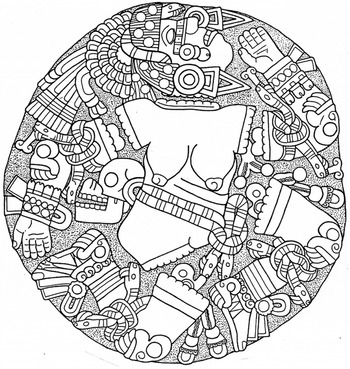
According to the histories, Coatlicue (Snake Skirt, a principal aspect of the earth goddess) was miraculously pregnant with Huitzilopochtli when her daughter, Coyolxauhqui, filled with rage at the dishonourable extramarital pregnancy, attacked her mother with the support of her brothers: the Centzonuitznaua, ‘the Four Hundred’ gods of the southern stars. Leaping fully matured from Coatlicue's womb, Huitzilpochtli routed his siblings, dismembering his sister and casting her from the mountain of Coatepec (Figure 1). Thus, the Aztecs’ patron god triumphed over the first threat to his pre-eminence in highly symbolic fashion.Footnote 32 As the mythical founder of Tenochtitlan, Huitzilopochtli was synonymous with the success of the state, and its very existence, and his first action, having been born of a disruptive mother, was to decapitate a turbulent woman. A more explicitly nationalistic version of the story appears in the work of Diego Durán, who sought to reconstruct a linear dynastic ‘history’ with the aim of demonstrating that the Aztecs were a ‘true’ civilization. In his account, the Aztecs had paused their migration at Tula, when a group of troublemakers led by Coyolxauhqui appealed to Huitzilopochtli, urging that he should ‘bring an end to the pilgrimage in search of even more peace than we enjoy here’. Infuriated by this disobedience, the god swore vengeance against those who dared oppose his divine plan and the next morning Coyolxauhqui (the only rebel identified by name) and the other troublemakers were found dead in the ball court (Figure 1). ‘All the breasts had been torn open and the hearts removed.’Footnote 33 Coatlicue and Coyolxauhqui were both given agency by their capacity to ‘disrupt’ the Aztec timeline, precipitating the birth of the warrior state (or at least its divine alter ego).
Drawing by Emily Umberger of the 3·25m diameter Coyolxauhqui Stone, showing the dismembered goddess, now in the Museo del Templo Mayor, Mexico. Reproduced with permission of Emily Umberger.

Malinalxoch, Huitzilopochtli's elder sister, intriguingly mirrors Coyolxauhqui: both provoked confrontations which moved the Mexica migration forward.Footnote 34 Malinalxoch's troubled relationship with her brother is vividly evoked by the mestizo author Chimalpahin (1579–1660), one of those who connected Avenci with Yaocihuatl.Footnote 35 Malinalxoch supposedly wielded mysterious and dangerous powers: ‘she was evil, was responsible for great wickedness, was one who sucked people's blood, made them lose their footing, deceived them, made them lose their way, put them to sleep, made them eat snakes, made them eat owls…And she became a sorceress; she was exceedingly perverse.’Footnote 36 Malinalxoch exercised a dreadful, but plainly formidable, influence. Despite her sinister reputation, she commanded the loyalty of a significant minority during the migration, but the histories expose a clear sense of unease that such influence was wielded by a female hand and her ‘cunning and evil dealings…caused much harm among the people’. Depending on the source, Huitzilopochtli either resolved to abandon his sister due to her malevolent influence, or was urged to do so by the Mexica, who had put up with Malinalxoch ‘because she was the sister of Huitzilopochtli, but finally they asked the god to get rid of her’. Malinalxoch and her followers were deserted while they slept. Later, Malinalxoch's son Copil swore vengeance and pledged to destroy those who abandoned his mother. Eventually, besieged after a punishing campaign, the heavily outnumbered Aztecs ‘hacked their way through the enemy ranks’ and escaped, guided by Huitzilopochtli, to their settlement at Tizaapan. Here, a Woman of Discord was not only a corrupting influence over her own son and followers, but also a threat to the very Aztec nation, which they aimed to ‘annihilate…not leaving one person alive’.Footnote 37
The capacity to incite dissent is frequently associated with women, in both the divine and human realms. Malinalxoch's influence was destructive, but also critical to building the nation; her abandonment by Huitzilpochtli initiated a historically important division in the tribe, allowing the fledgling Aztec state to assert its authority and military prowess. The political triumph of one faction over another provided the opportunity to ‘raise the Aztec nation to the heavens’.Footnote 38 These details of this narrative differ in some incarnations, but in every case the antagonist is female.Footnote 39 Fascinatingly, Copil is the only male figure named as a threat to the Aztecs in any migration narrative, and even he was acting under his mother's influence and of inferior strength: although a ‘great nahualli [sorcereror]…Copil was not the equal of his mother’.Footnote 40
The opposition between the ‘male’ state and a ‘female’ opponent regularly appears in stories associated with the establishment of Aztec authority and is underscored by the frequent interpretation of the Coyolxauhqui myth as a battle between the Sun (Huitzilopochtli) and the Moon (Coyolxauhqui). In this ‘astronomical allegory’,Footnote 41 Huitzilopochtli's mother, Coatlicue, represents the earth. Just as Huitzilopochtli leapt gloriously from his mother's womb, so the Sun emerges daily at dawn, scattering the Moon, and the Stars (the Four Hundred). Like Huitzilopochtli, its patron god, the Sun was closely associated with the state itself; the threat of eclipse or permanent darkness loomed large in the imagination, and the Aztecs lived in constant fear that the Sun might fail to arise victorious from its nightly battle under the disk of the earth. Warriors who had died in battle or as a sacrifice accompanied the Sun in its progress across the sky, which was fuelled by the streams of human blood offered daily in sacrificial ritual. By reading the Coyolxauhqui myth as a confrontation between the masculine Sun and the feminine Moon, the implication which emerges from other interpretations is strongly emphasized: the assertion of state supremacy was linked to the symbolic defeat of a female adversary.Footnote 42
IV
It is neither coincidence nor misogyny that opponents of the state are personified as female,Footnote 43 but a compelling reflection of the perilous nature of feminine power in Aztec thought. Such ‘Women of Discord’ were not merely a metaphorical way to frame a threat, they also reflected political and social realities; there are parallels between the significance of mytho-historical women and the genealogical importance of royal women. Although it is hard to get a complete picture of elite women's roles in the intricate inter-city networks of the Valley of Mexico, it is clear that they were capable of exercising considerable socio-political influence. Royal women were the building blocks of inter-dynastic diplomacy, capable of ennobling families, cementing alliances, or making a political statement. There are occasional accounts of cihuatlatoque (woman rulers) and female regents, and power and nobility often passed through the female line.Footnote 44 It is pointless to rehearse here the historically ubiquitous use of noble women to make ‘marriage alliances’, but the specific nuances of the Mexican model of ‘interdynastic hypogamy’ – superordinate rulers giving their daughters as wives to the tlatoani of subordinate cities – allowed considerable scope for manipulating women (both in reality and in the historical record) to send political signals and engage in strategic diplomacy.Footnote 45
According to an incident depicted in the Codex Xolotl, an early colonial cartographic history fleshed out some decades later by a Nahua historian of noble descent, the Tepanec War which saw the Aztecs’ rise to prominence was heralded by the rejection of a woman.Footnote 46 In the early fifteenth century, the ruler of Azcapotzalco sent his daughter Tecpaxochitl to the subordinate city of Texcoco, to become the wife of its future tlatoani Ixtlilxochitl. Signalling his intention to switch political alliances, Ixtlilxochitl insulted Azcapotzalco by taking Tecpaxochitl as a concubine and instead marrying a senior royal from Tenochtitlan. In the recorded histories of this incident, manufactured to increase Texcocan prestige, these women stood as a bridge between political cycles; they are the pivotal figures Gillespie identifies as standing at the juncture of dynastic histories. But although Tecpaxochitl may have possessed symbolic power as a ‘Woman of Discord’, she was the real victim of the metaphorical slap in the face intended for her father Tezozomoc.Footnote 47 Just because Aztec women were powerful and often respected does not mean that they could not suffer personal indignities, injustice, or oppression.
Similar manoeuvrings may have been at play in a marriage described by a later Ixtlilxochitl, who describes how one of his ancestors, the Texcocan tlatoani Nezahualcoyotl, fell in love at first sight with Huitxilxochitzin, the Tenochca fiancée or wife of the tlatoani of Tepechpan, a subject city of Texcoco in the 1440s. After having her husband killed, Nezahualcoyotl took Huitzilxochitzin as his wife. Typically, this story, which also appears in the pictorial Tira de Tepechpan annals, is presented as a romance, but it is possible that these events mask a punishment of Tepechpan for its ruler's failure to take a Texcocan bride. In this reading, the taking of a Tenochca queen indicated Tepechpan's ambition, connecting the city to the new imperial capital of Tenochtitlan, and Huitzilxochitzin's remarriage marked the reaffirmation of Texcocan authority over Tepechpan.Footnote 48 The next Texcocan tlatoani was married to a far more obviously disruptive female: Chalchiuhnenetzin, daughter of the Tenochca ruler. This young woman allegedly took multiple lovers, before murdering them and using their skeletons to make statues. Whether this is true or not, Chalchiuhnenetzin was certainly executed by her husband, forcing a rift between Tenochtitlan and the Texcocans, at a time when the latter aimed to assert their independence.Footnote 49
Exogamy was a vital diplomatic tool, but it carried an element of risk: a foreign wife might be a powerful ally, or a clandestine enemy. The symbolic role of the Women of Discord resonates with the reality of royal women married to foreign elites: caught between loyalty to their home city and family and their new husband, who would these women favour? The female potential for trouble was no mere metaphor: a wife who betrayed either her father or her husband possessed serious disruptive power, which could become a dynamic force given the right circumstances. Such intrigues are exemplified by accounts of Tenochtitlan's victory in 1473 over its twinned city of Tlatelolco in a ‘civil war’; the chronicles firmly establish Chalchiuhnenetzin, wife of the Tlatelolcan ruler Moquihuix and sister of the Tenochca tlatoani Axayacatl, as a ‘Woman of Discord’. The subject of a very richly layered metaphorical history, which I have unpicked at greater length elsewhere,Footnote 50 Chalchiuhnenetzin incited ‘discord’ both actively and passively. She not only enflamed an already tense situation between the cities by warning her brother that Moquihuix was preparing for war, as revenge for the abuse she suffered at the hands of her scandalous and unfaithful husband, but her vulva also ‘spoke out’, delivering a powerful prophecy of Tlatelolco's fall which shaped her husband's actions, leading to his ignominious defeat.Footnote 51 Noble wives occupied an ambiguous middle ground which gave them the scope to become one of two different types of Women of Discord in the narratives: the ‘domestic’ or ‘internal’ woman who split, or was severed, from the group and became a force for disruption from the outside; and the ‘foreign’ or ‘external’ woman who entered the group and whose treatment or behaviour caused discord.Footnote 52 Typically, Malinalxoch and Coyolxauhqui and the murderous Chalchiuhnenetzin were of the first type; Avenci, Tecpaxochitl, and Huitzilxochitzin of the second. Moquihuix's wife, Chalchiuhnenetzin, manages to play both roles, partly because storytellers often cast their characters differently.
V
Women were thus both literally and symbolically important, but even when reading what appear to be simple genealogies we must remain constantly alert to the ways in which metaphorical structures have overlaid the form and detail of accounts. The fact that two women who stirred up enmity both bear the name Chalchiuhnenetzin, for example, must rouse our suspicions: might this be a symbolic designation? Or a later cyclical imposition? Partly due to such symbolic structuring, there is little point trying to draw the empirical ‘truth’ from these narratives, but it is possible that some of the Women of Discord originated in ‘real’ events. There are certainly parallels between mythical tradition and the events depicted in annals. It seems very likely, for example, that the tradition of conflict between Huitzilopochtli and a female antagonist reflects one or more historic contests between Aztec factions. The Codex Telleriano-Remensis, one of the finest surviving examples of an indigenous pictographic chronicle, shows Huitzilopochtli (or his priest) walking away from four warriors led by a woman labelled ‘Tonanicaca’ (a variant of Tonantzin).Footnote 53
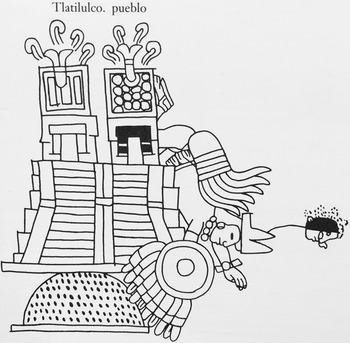
The highlighting of the Women of Discord at particular moments also suggests that these traditions were used for specific strategic purposes. The installation of the ‘Coyolxauhqui Stone’ monument (Figure 1) during the period of the 1473 civil war suggests an increased focus on this narrative of Huitzilopochtli's triumph at a time when his followers were facing political threat; Coyolxauhqui was a reminder of Huitzilpochtli's dominance and would have sent a very clear message to those who dared to challenge his ‘chosen’ city. Using archaeological evidence, Emily Umberger has even made the case that the monumental figure of Coyolxauhqui was intended to serve as a direct likeness of the defeated Moquihuix; the manner of his death, tumbling from the summit of Tlatelolco's main pyramid, was certainly framed to mirror Coyolxauhqui's dramatic fall (Figure 2).Footnote 54 Thus, myth and history were blended together, humans and gods blurring, and this cyclicality, reflected in the recurring appearance of the Women of Discord and their counterparts at critical moments of transition, was emphasized by the ritual reiteration of the death of the Woman of Discord in sacrificial ritual.
The defeated Moquihuix falls from the temple at Tlatelolco, from Frances F. Berdan and Patricia Rieff Anawalt, The Codex Mendoza (Berkeley, CA, 1992), fo. 10r. Reproduced with permission of Frances F. Berdan.

Weighing more than eight tons, the colossal Coyolxauhqui Stone exemplifies the prominence of the Woman of Discord, not only in official narratives, but also everyday practice. Lying at the base of the Templo Mayor (Great Temple), at the heart of the ritual centre of Tenochtitlan, the sculpture was a constant reminder of the fate of those who defied Huitzilopochtli and his people.Footnote 55 This message must have been keenly felt by the sacrificial victims who trudged past this huge monument, the long walk to their death at the summit of the pyramid giving them time to reflect, before their own bodies were thrown down the steps to rest with the goddess: united in defeat. In this ritual reiteration of Coyolxauhqui's death, there is a sense in which every sacrificial victim was transformed into the Woman of Discord, the ultimate enemy of the state. But it was during the harvest feast of Ochpaniztli (sweeping of the roads) when the ritual cycle passed closest to history, and we see Avenci's original sacrifice repeated, as another young girl was decapitated and flayed as an ixiptlatl of Toci.
Women and warriors were both central to Ochpaniztli, emphasizing its twin concerns of fertility and threat: the dual associations of femininity. Displaying the social and sexual power drawn from their connection to Toci, midwives, women physicians, and courtesans skirmished for four days before accompanying the supposedly ‘unaware’ victim to the temple. In a tangible sense, this ixiptlatl stood as a representative of all women, and was brought to the temple by those who most explicitly displayed female influence and sexuality. Following the girl's decapitation, a priest dressed in her skin was met by nobles and warriors, striking their shields and fighting with straw brooms in mock battles which sometimes took on bloody seriousness. Both in its central ritual – the killing of impersonator of Toci – and in its links to fertility, femininity, and state stability, Ochpaniztli powerfully evokes the death of the original Woman of Discord, Avenci.Footnote 56 One early source makes the parallel explicit, claiming that the victim at Ochpaniztli was called Yaocihuatl.Footnote 57
Ochpaniztli's unusual form of sacrifice deepens the links between the different incarnations of the Women of Discord, connecting Coyolxauhqui directly to Avenci via her identity as Toci/Yaocihuatl. Toci's ixiptlal was the victim of a rare mode of sacrifice called tepotzoa: decapitation while laid on the back of a priest. Although post-mortem decapitation was a common element of Aztec ritual, a tiny minority of victims, all female, were killed by beheading.Footnote 58 Only women were permitted to truly share Coyolxauhqui's fate and be dismembered by/for Huitzilopochtli, and tepotzoa sacrifices occurred on only two occasions: Ochpaniztli and the summer festival of Uey tecuilhuitl (great feast of the lords), another fertility festival dedicated to Cihuacoatl.Footnote 59 The discovery of female skulls in the offering chamber below the Coyolxauhqui Stone strongly suggests that the dedication of the stone involved tepotzoa (and likely took place during either Ochpaniztli or Uey tecuilhuitl), further connecting the human avatars of the Woman of Discord to their mytho-historical alter ego.Footnote 60 Thus, the practice of decapitation connects Coyolxauhqui – so famously the subject of graphic dismemberment – with the women who shared her fate, women who embodied the great goddesses of the earth: the Women of Discord.
VI
The constant ritual reminders of the Women of Discord – decapitated over and over again in sacrifice and at the Coyolxauhqui Stone – sent a forceful message about the profound but dangerous nature of female power. It may seem counterintuitive to regard ritual execution as empowering, but through this ceremony ixiptla were given privileged access to the sacred, their ‘essence…cosmo-magically transformed into gods’.Footnote 61 Being female certainly did not equate to ‘weakness’, but the threatening associations of metaphysical femininity fit awkwardly for the Western observer with a society in which ‘real’ women held concrete markers of esteem and influence. Cihuacoatl featured at the highest level of government, her male representative ruling jointly with the tlatoani, and women held political, economic, legal, and social rights; our sources are full of active, articulate, influential individuals whose energy and co-operation were essential for communal prosperity.Footnote 62 But respect was combined with apprehension, and so human women – avatars of Cihuacoatl during childbirth – were touched by their close connection to the disturbing powers of the earth. The corpse of a woman who died in childbirth was closely protected by her husband, lest young warriors attempt to steal her fingers or forearm: talismans infused with divine energy.Footnote 63 Power originated in dangerous places and so although (or perhaps because) femininity was threatening, even terrifying, women remained objects of respect. The procreative power which allowed women to become great mothers of warriors also imbued them with troubling potential. And, importantly, female influence was particularly associated with subversion, duplicity, and disruption: with the capacity to cause ‘discord’.
The male dominance of sources and the tendency to normalize social groups makes it particularly difficult to trace the experiences of ‘ordinary’ women in Aztec culture, but the twelve-book Florentine codex offers us a distinctive insight into social attitudes. This mammoth ethnographic corpus, compiled by Bernardino de Sahagún with the assistance of scores of indigenous informants and assistants, contains a voluminous directory of The People, defined by characteristics such as gender, age, occupation, disposition, and family status. Here, the ‘old woman’ rubs shoulders with the ‘noble man of middle age’ and professionals such as the merchant, physician, scribe, and tomato seller meet the buffoon, highwayman, and thief. And, most importantly for our purposes, gendered ideals are revealed in the enumeration of ‘virtues and vices which were of the body and of the soul’.Footnote 64
The ‘bad mother’ is one of the first women described in The People: ‘evil, dull, stupid, sleepy, lazy’, she is deceitful, unreliable, and inconsiderate. More significantly, however, she is censured not only for her own poor conduct, but also for her capacity to lead others astray: ‘She causes disregard of conventions, she shows the way – leads the way – to disobedience; she expounds nonconformity.’ This emphasis on the bad mother's propensity to incite others to disobedience is in striking contrast to the ‘bad father’. Although also ‘lazy, incompassionate, negligent, unreliable’, and unfeeling, the bad father was ‘a shirker, a loafer, a sullen worker’; here, the emphasis is strongly laid on the husband's negligence and inattention to his duties. Far from prompting misbehaviour amongst others, a bad father seems unlikely to do anything at all.Footnote 65
Reiterating the idea that troublesome women could be a corrupting influence, the description of the ‘bad grandmother’ also exposes deep-seated concerns about women's ability to lead others into evil; the sole concern expressed about her behaviour is a tendency for disruption. ‘The bad grandmother [is] a stupid old woman, a leader of others into darkness, a bad example. She misleads, she deludes one; she places one in danger, she leads one into difficult places.’Footnote 66 Just as Malinalxoch deceived people and ‘made them lose their way’, and Coyolxauhqui was an ‘instigator of rebellion’, so the bad mother and grandmother reveal women's potential for deceit and disorderly influence.Footnote 67 Fascinatingly, in this first chapter on relatives, there is no suggestion that men could become a model for disobedience. The father, grandfather, great-grandfather, uncle, and nephew were all obliged to set a good example, and the ideal father was ‘exemplary; he leads a model life’, but these men apparently lacked women's distinctive ability to corrupt. The disruptive potential of speech in women's mouths seems of particular concern. Criticisms of male speech focus almost exclusively on arrogance: ‘bad’ noblemen are mocking, vain, prideful, braggarts, but these are not entirely negative qualities in a society of ostentatious warrior manhood.Footnote 68 By contrast, the twenty characters in the ‘thirteenth chapter, which telleth of the noblewomen’ are criticized throughout for their capacity to cause discord. The ‘bad noblewoman…wishes to cause worry…incites riots…causes havoc…leads one into danger; she leads, she introduces one into error’.Footnote 69 But although these depictions are unflattering, they are hardly disempowering; all of these women possess considerable force.
VII
Amongst the great rote-learned orations of the huehuetlahtolli, the ‘ancient word’ or ‘speeches of the elders’, the advice of a mother to her daughter,Footnote 70 emphasizing matters of communication and propriety in personal interaction, intriguingly hints at parental concerns about young women's potential for conflict.Footnote 71 Aztec norms emphasised politeness and etiquette but, in a society of soldiers, while strength and anger were potentially disruptive, they were also positive qualities provided they were warranted, and expressed in an appropriate way.
As thou art to go, thou art not to look here and there, not to look from side to side, not constantly to look upward, nor art thou to be a hypocrite. Nor art thou to put hatred in thine eyes; thou art not to put hatred in thy face. Look joyously at everyone. And also, that no one will have occasion to despise thee, put anger in the spirit at the proper time. And behold, never concern thyself with words; let what is said be said. Do not speak with others; pretend that thou dost not hear it. With thee will the words end.Footnote 72
This dense passage of advice provides a complex picture of the way in which young women were expected to interact with others. Beyond the rather cursory encouragements always to look upon everyone with joy and to set hatred aside, the mother's words also carry more subtle implications. Young women seem to have been urged to remain aloof and impartial when they were goaded or tempted to anger. A perceived tendency for girls to gossip and quarrel was apparently a significant concern, and one to be cautioned against. But although the mother urges her daughter to avoid enmity, appear pleasant, and pass through the world in a dignified fashion, amiability was only suited to certain circumstances; passivity and indifference were not always appropriate. Women with ‘anger in the spirit’, Women of Discord, were welcome, but only at the proper time.
It is significant that the young woman was not urged to silence, but to reticence in the face of negative speech. She was not counselled to guard against all words, only damaging ones. This advice to practice reserve and discretion is consistent with Aztec concerns to preserve communal peace and co-operation, but it also reflects concerns about women's disruptive potential, anxieties which are cast into sharp relief by the parallel advice of a father to his son. Men's relationship to language was different from women's. Although boys were admonished to equal vigilance in their interactions, the father's words reveal detectable differences between male and female communication:
Guard, take care of thy ears, of that which thou hearest. Do not gossip; let what is said remain as said. Ignore it. Pretend not to understand the words. If thou canst not ignore it, respond not. And speak not; only listen; let what is said remain as said. And when something is said, if something evil is told there, that which meriteth imprisonment, that which meriteth death, and on thee – if thou dost withdraw with others, if thou actest foolishly with others, especially if thou lendest a word, if thou speakest among others – on thee it will be laid; [then] thou wilt expiate the words of others, thou wilt atone for others, and thou wilt be taken, thou wilt be seized. And furthermore, thou wilt be imprisoned. It is said, because of thee words will be denied, there will be defending, there will be excusing. And he whose words they are, perhaps he is there, perhaps he remaineth thereby virtuous, and perhaps he is content. But thereabouts thou art made a fool.Footnote 73
This advice, given by a father to his son, appears at first glance to be very similar to the mother/daughter discussion, but a clear distinction emerges if we look more closely at the consequences of incautious speech for men and women. While the woman was urged to reticence for apparently altruistic reasons, for the good of society, the possible effects of injudicious speech for a man had considerably more personal implications. The father exhorted his son to take care in his words, not because of the potential disruption he could cause, but because of the damage he might bring upon himself. In the competitive world of warriors, an Aztec youth must remain constantly vigilant to the possibility that he might be ‘made a fool’. There is no suggestion that this hypothetical group of gossips might become shared partners in conspiracy; the repeated assumption is that individual concerns will prevail and, just as warriors were expected to act independently, even selfishly, on the battlefield, so they should protect themselves and their personal interests in any social conflict.Footnote 74 This emphasis on the individual concerns of men by comparison with women's selflessness is reflected in the speeches made to young men and women when they reached the age of maturity. Young men were promised the public rewards of military success, while women were expected to promote the welfare of family and community for entirely unselfish reasons, and left in no doubt that their world was ‘not a place of joy, it is not a place of contentment…it is a place of joy with fatigue, of joy with pain on earth’.Footnote 75 Responsible for the ultimate altruistic act of giving life to others, women were critical to maintaining the social networks which bound the community together and so were expected selflessly to keep the peace. For men, focused on asserting their supremacy in battle, personal and selfish desires possessed less potential for dangerous disruption. In Aztec culture, where cause of death (not behaviour in life) determined your afterlife,Footnote 76 actions were judged by their consequences for the community, rather than by individual morality. While women were censured for nonconformity, it was impotence and sheer ineffectiveness which were most offensive to Aztec expectations of masculine vigour.
Thus, despite urgings to cautious speech, men appear to have been excused significantly more than women in matters of public expression. People born under the nineteenth day sign, One Eagle,Footnote 77 were destined to a life of vociferous volubility, but the way in which this was manifested, and its acceptability, depended on gender. On this ‘evil day sign…he who was born then was boastful, and brave, daring, fearing nothing and no one. And it was said that the women also were daring, of ill fame, of evil tongue, shameless, and immodest.’Footnote 78 The following description explains that men born under this sign were dishonest and presumptuous, but although they were ‘vainglorious’ and ‘boastful’, warrior culture allowed them to benefit from this lack of modesty. Despite being condemned as scornful and even ‘perverted’, these men could advance through their prideful recklessness in battle. Because, if ‘a man, he became a chieftain, a man-at-arms, debauched, evil and daring…And sometimes, if he became neglectful, he was captured and imprisoned, or died in battle.’Footnote 79 Although the Florentine codex makes clear that these men were wicked and depraved, they were nonetheless capable of prospering and achieving social success, attaining military rank, and even achieving the ideal, enviable, warrior death in battle.Footnote 80
For women born on One Eagle, no such positive prospects existed to mitigate their fate, and they were afflicted with unpleasant, almost animalistic, qualities.
She was truly of evil tongue, vile-mouthed, inhuman in speech – big-mouthed, of biting words. Her great joy, her great pleasure, was evil speaking. She was one who vituperated others, who insulted and affronted them. Like a dog, [she let] no one head her off or trap her. If someone approached her, at once she quickly sprang on and clung to her. She gripped her, and scratched, clawed, tore, and hacked her face…she pricked, beat, smashed, and struck it.Footnote 81
This brutal description continues relentlessly, the ‘big-mouthed’ woman pulling out her victim's hair, breaking her nose, and ripping her clothes to shreds, leaving her naked and in tatters. Debased and bestial, this frightening female stood outside of human convention, apparently acting instinctively and brutishly. Such warnings were almost certainly rooted in fears of the destructive potential of women. While merely a negative quality for men, loose and biting speech in women could be a devastating force. The connection between femininity and speech is also explicit in stories of the fall of Tlatelolco, when Chalchiuhnenetzin's vulva became the mouthpiece of prophecy.
A highly expressive people with a vibrant oral culture, the Aztecs recognized the power of words to wound, and women's words carried particular power, for good or for ill. In the spring of each year, the Aztecs celebrated the festival of Uey Tozoztli, the ‘Great Vigil’, honouring the maize gods. With red feathers adorning their arms and legs and faces glimmering with iron pyrites, adolescent girls carried decorated bundles of cobs on their backs to the temple of Chicomecoatl through a reverently hushed city, for ‘no one might look at them…no one joked with them’. At times, however, the respectful quiet was shattered by the inevitable teasing of young warriors, and it was the girls’ responsibility to reprimand these irritating upstarts. Turning on a rebellious youth, the young women rebuked him, doubting his military prowess, and rejecting his manhood, saying: ‘Art thou not just a woman like me?’ And although the victim of this scolding might curse his tormentors, wishing them ill and hoping they would end up as old maids, his ‘weak’ words were useless in the face of the female attack.
For verily thus the women could torment [young men] into war; thus they moved them; thus the women could prod them into battle.
Indeed we men said:
‘Bloody, painful are the words of the women; bloody, penetrating are the women's words. Indeed we have gone; we have said that we shall not live. Perhaps we shall merit something, O our friend.’Footnote 82
Teasing between peers is hardly unusual, but it is the force of the girls’ speech which is remarkable. Confidently articulate, the young women defended their sacred duty and censured the audacious youths for their insolence. Although preferring to honour the god with silence, the girls showed no reticence in exchanging insults with those disrespectful few who deserved them. The painful, penetrating words of the women goaded the youthful warriors into battle by threatening their masculinity, driving them towards the honourable death which they hoped one day to ‘merit’. Although women were often urged to modesty and reserve in Aztec society, they were also expected to be articulate and forceful when the occasion demanded it.
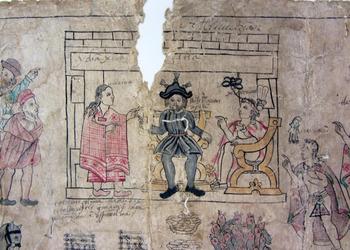
The power of women's words can be traced in the figure of Malintzin (also known as Doña Marina, or La Malinche), the Nahua woman who served as Cortés's translator during the conquest of the Aztecs. In some ways, she might be seen as the ultimate ‘Woman of Discord’, accused of betraying her people, but standing astride a historical rift, ushering in a new cycle, like Gillespie's founding queens. Although often elided in Spanish accounts, Malintzin is central to indigenous images of the conquest, which show her at the heart of events, a woman engaging prominently in political negotiation (Figure 3). In her ambiguous position as an indigenous ‘collaborator’, Malintzin epitomizes the complexity of women's power: disruptive, but also productive.Footnote 83 Sometimes seen as the ultimate traitor to her people (malinchista is an insult reserved for people who prefer foreign things), Malintzin managed to be seen as ‘one of us people here’,Footnote 84 while at the same time representing a dangerous, alien, force. Today, in the traditional Mexican danzas, ‘Malinche’ still plays a dual role, as both Toci, the earth mother, and Cortés's mistress, a ‘boundary figure’ (blurred with Moctezuma's daughter, Isabel) who passes legitimacy from the Aztecs to the Spanish.Footnote 85 Her influence was essential, but also destructive. It goes too far to say that indigenous people would have regarded Malintzin, in their retrospective refashioning of events, as a direct counterpart to mytho-historical figures, but the images of her certainly take on a new resonance when they are read in the light of Aztec understandings of the Women of Discord.Footnote 86 Thus, the layering of beliefs about women's power continues; the Malinche of today is both traitor and ancestor, intermediary and deity.
Malintzin with Cortés and Xicotencatl of Tlaxcala, from the Lienzo de Tlaxcala fragment in the Nettie Lee Benson Collection, University of Texas Library. Photograph by Stephanie Wood (30 May 2014), and reproduced with her permission.

VIII
The ambiguous nature of power in the Aztec world produced a diverse cast of female characters, from malevolent goddesses to mothers of the nation. The powerful personalities of Malinalxoch and Coyolxauhqui in particular stand out as crucial characters in the Aztec migration stories; embodying the female potential for discord, they exemplify women's disruptive power, and may be one root of the Aztecs’ apparent anxiety of feminine influence. Nonetheless, women also appear alongside men as players in the foundation of the Aztec state. Although far from ideal partners at times, the Women of Discord shaped the history of the Aztec people, and their influence, while ambivalent, was always significant. Ordinary women also played vital roles in Aztec society, but they were tainted by the dark shade of their sacred sisters, with whom they were inextricably linked through childbirth, and the disharmony embodied in the Women of Discord was reflected in detectable fears of women's potential for disruption. Women's power was primordial, but also needed to be restrained. As the mother said to her daughter upon coming of age: ‘we travel along a mountain peak. Over here there is an abyss, over there is an abyss. If thou goest over here, or if thou goest over there, thou wilt fall in. Only in the middle doth one go, doth one live.’Footnote 87 Women teetered constantly on a precipice, struggling to control the awesome power of the earth.
Recognizing the intricate identity of the Women of Discord, and its origins in the female bond with the earth mother, is vital to closing the circle and understanding the relationship between mytho-historical figures and the lives of Aztec women. Although discord was frequently associated with femininity in Aztec thought, this does not seem to have resulted in any particular animosity towards women as individuals. Nonetheless, women's connection to the chaotic energy of the earth, overlaid by narrative and reinforced by ritual, not only invested the Women of Discord with mythical power, but also imbued all women with the inherent potential for disruption. Goddesses of the earth, enemies of the chosen people, mothers of the nation, bridges between histories: all women were potentially Women of Discord, but what that meant to individuals is very hard to tell.