Introduction
State-funded school education in the United Kingdom has been devolved to the “home” nations—England, Northern Ireland, Scotland and Wales—for some time. Up until the late 1990s this devolution had been largely administrative in character; that is, education policies and legislation were essentially drawn up by the central UK government (largely London-based), and these would then be administered in the non-English home nations with a certain amount of local adaptation. Historically it would be accurate to say that the Scottish education system has been perceived to have developed a distinctive and independent character from the other British home nations. For example, until quite recently “England and Wales” were taken for granted as a unit in public discussions on education because both nations tended to follow very similar policies and policy interpretations, whereas this conjunctive relationship was not generally extended to include Scotland. However, the accelerated momentum of political devolution since the late 1990s has decentered policymaking in education from London in quite radical ways.
In this article we will look at a central issue in the major educational reforms in the United Kingdom since the later 1980s—assessment—and discuss the divergent developments in the past few years against the backdrop of increasing autonomy in educational matters in Scotland and Wales. Schooling policies are almost always publicly justified on grounds of educational merit and/or effectiveness. The main purpose of this discussion is to explore the ways in which major policy decisions regarding a key educational issue are subject to complex political and administrative influences and shifts, many of which may be associated with wider ideological considerations. The developments in Scotland and Wales will be discussed in turn. The changes that have taken place in Welsh assessment regime since 2001 will be discussed first; after that, we will turn our attention to the developments in the Scottish system. Our discussion will be linked to a concern for the assessment of English as an additional/second language (EAL), an important language education issue in all parts of the United Kingdom because of the accelerating linguistic and ethnic diversity experienced in the past ten years due to internal migration within the European Union. Both Scotland and Wales have put in place policies to promote or strengthen their respective indigenous national languages, Scottish Gaelic and Welsh. For reasons of scope and space, we will not be addressing the educational and multilingualism issues associated with the promotion of national languages. Suffice it to say that there is a heightened sense of awareness of language issues in Welsh and Scottish education debates.
Wales
Before we turn our attention to Wales, it is necessary to provide a brief background of the radical reforms that were introduced into the English and Welsh school systems since the late1980s. Throughout the 1970s and 1980s there had been simmering debates on the “failing” school education in Britain. This debate was largely fueled by the perceived low levels of basic educational attainments of school leavers (see, e.g., Philips & Harper-Jones, Reference Philips and Harper-Jones2002). In 1988 the central government introduced legislation that led to the establishment of a compulsory national curriculum for England and Wales. This was the first time in England and Wales that the government sought to impose a centrally designed curriculum on schools. One of the distinguishing features of the national curriculum, which was implemented in 1991, was its reliance on assessment to ensure public accountability and to raise levels of student attainment, particularly in the form of standardized testing (for a discussion, see Leung & Rea-Dickins, Reference Leung and Rea-Dickins2007).
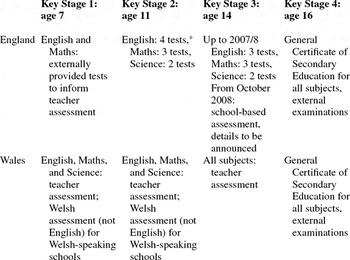
For the better part of the ensuing decade, England and Wales followed broadly the same statutory assessment requirements. The establishment of the Welsh Assembly Government in 1999 was a significant moment in the institutionalization of political devolution; it also marked the beginnings of a shift of power and responsibility for public education from London to Cardiff. In the past few years the Welsh Assembly Government has taken some very decisive steps in developing distinctively Welsh education policies. This distinctiveness can be seen in relation to statutory school assessments in the two systems. Table 1 provides a glimpse of some of the key differences:
Key Differences in Current Statutory Assessment for School Education in England and Wales

Thus it can be seen that standardized testing is still very much part of the assessment regime in England. In Wales it has all but disappeared until the exit point for secondary schooling. Teacher assessment, against the attainment criteria set out in the national curriculum, is the mainstay of the statutory assessment arrangements for students up to the age of 14. Given the long history of nationalist struggle in Wales to achieve some form of autonomy, perhaps one should not be too surprised to find the formation of independent-minded policies when the opportunities become available (for a language related account of nationalist politics, see Williams, Reference Williams2000). The interesting question for us here is what accounted for this particular policy shift toward much greater teacher involvement in assessment in a few short years. We will restrict ourselves to making some observations on two aspects of policy formation. The first is concerned with the ideological environment in which assessment policy decisions were made. The second concerns the way knowledge, in particular research-based knowledge, was taken up in the complex political processes involved in policymaking.
We mentioned earlier that the debates surrounding educational failure in Britain in the 1970s and 1980s triggered the radical educational reforms in the 1990s. Much of the critique of the failing educational practices was premised on the idea that the education system as a whole was far too cosseted by the state and should be managed by open market principles. Parents should be given a choice as to what kind of school they would send their children, the quality of education offered by individual schools should be made public to enable parental choice to be made, school and student achievements should be measured quantitatively so that evaluation (and ranking) could be carried out, and so on. The state would play an “enforcer” role to make sure that elements of the markets were introduced into the education system. This “neo-liberal” agenda resonated with much of the educational and social reforms that were taking place in many parts of the world (see Broadfoot, Reference Broadfoot1996, Reference Broadfoot, Phillips and Furlong2001). Phillips and Harper-Jones (Reference Phillips and Harper-Jones2002) pointed out that this ideological commitment to the market in fact was not as well received in Wales as some politicians in London might have thought. As Paterson (Reference Paterson2003) observed, even when England and Wales were conjoined as a policy singularity, there were differences in practice. For example, fewer children attended private schools in Wales (2% of the school population) than in England (8%); and when state-funded schools were offered an opportunity to gain great administrative and financial autonomy, few Welsh schools took up the offer. In 2001, as the English school system continued toward greater differentiation and competition, the Welsh Assembly Government (2006) published The Learning Country, a policy document that set forth a vision of improving the quality education by building a partnership among the Welsh central authorities, local education authorities, and schools. Unlike the English system of relying on market-inspired mechanisms to reward success and penalize failure through financial and public accountability mechanisms, the Welsh policy opted for closer relationship between the government school inspectorate and schools to help improve teaching quality. In many ways the public political arenas in England in the 1990s supported a primarily middle-class promarket ideas and values; schooling education was commodified like many other public services such as transport. Wales, in contrast, continued to show a commitment to universal, free, community-based schools. Rees provided an ideological overview of these recent educational policy moves in Wales by suggesting that they can be seen as a reflection of deep-seated social democratic values that have underpinned the following policy principles:
Equality of opportunity through universal provision; the necessity of the state's role in ensuring this; the rights and obligations of citizenship, expressed through the notion of the “entitlement” of children and young people; partnership between the central state, local education authorities and professional groups. Rees (Reference Rees2007, p. 10)
The policymaking processes involved in the formation of the Welsh assessment policy also helped shape the direction of its outcome. Daugherty (Reference Daugherty2007, Reference Daugherty2008), who chaired the review committee that made the key recommendations, provided interesting insights into the complexities of policymaking. For some time now policymakers in Britain have been very fond of the idea of evidence-based policy. This catchphrase was picked up by Welsh politicians. The committee that was charged with the responsibility of reviewing relevant evidence for policymaking, however, had interpreted evidence liberally. It has been argued that the evidence-based approach is backward-looking, that is, evidence is gathered from what has happened. So it is generally incapable of foretelling the future, especially where policy contexts are different. The review committee in fact interpreted evidence as comprising not just information about “what has worked somewhere else,” but also what knowledge and expertise was available in the relevant fields. This included academic and research-derived knowledge. As it happened, the committee took notice of a good deal of the research in different forms of assessment. In particular, the (re)emerging literature on formative assessment spearheaded by the work of Black and Wiliam (Reference Black and Wiliam1998a, Reference Black and Wiliam1998b, Reference Black, Wiliam and Davies2003) made an impact on the work of the committee.
It is quite clear that the newly promulgated policy on assessment of student achievement is in an early stage of implementation. In the next period it would be interesting to see how far day-to-day assessment practices in schools realize the policy aspirations, and what further policy issues, if any, the reliance on teacher assessment to improve quality of learning and to raise the level educational achievement may throw up.
Scotland
Historically the approach to education and to assessment in Scotland has differed from England and Wales, and the development of curriculum and assessment policy in Scotland is well documented (see, e.g., Hayward, Reference Hayward2007; Hayward & Hedge, Reference Hayward and Hedge2005; Hayward, Priestley, & Young, Reference Hayward, Priestley and Young2004; Hutchinson & Hayward, Reference Hutchinson and Hayward2005). Perhaps most notably the National Curriculum in Scotland, first introduced in 1991 for pupils ages 5–14 and later extended to 3–14, takes the form of guidelines rather than having legal force, although most schools tend to follow them (Hayward, Reference Hayward2007). The same is true of the assessment guidelines introduced simultaneously, Assessment 5–14: Improving the Quality of Learning and Teaching (SOED, 1991). Also, in the early 1990s the introduction of a system of national testing of all pupils at Primary 4, Primary 7, and Secondary 2, as in force in England, Wales, and Northern Ireland, was rejected in favor of a lower-stakes system of assessment—testimony to the power of teachers and parents as key stakeholders in Scotland, who, supported by some of the media, opposed national testing (Hutchinson & Hayward, Reference Hutchinson and Hayward2005). This was the closest Scotland came to an intentional system of high-stakes testing: Ideologically, teachers and policymakers have long been adherents of the principles of assessment for learning. However, during the 1990s, despite the formative classroom-based orientation of the assessment guidelines, with national tests providing a means of teachers moderating their own assessments when they deemed their pupils were ready, Hayward (Reference Hayward2007) noted that
Attainment targets dominated thinking in schools and classrooms and National Tests were used to decide whether or not a child had achieved a level of attainment in English and mathematics. Rather than being used to confirm or to challenge teachers' professional judgement, National Tests were replacing it. (pp. 255–256)
Thus, although teachers endorsed the principles of assessment for learning, these were not being implemented. There were a number of possible reasons for this, as reviewed by Hutchinson and Hayward (Reference Hutchinson and Hayward2005): the reliance on a “cascade model” of dissemination of policy and an overly simplistic view of the relationship between policy and practice, the separate publication of curriculum guidelines and assessment guidelines, lack of teacher understanding of the processes of formative assessment and lack of awareness of guidance on the subject, the emphasis of school inspections on test results as an indication of school performance, the increasing emphasis on accountability, which led teachers to use tests to provide “‘hard,’ reliable data” (p. 230), and the introduction of the National 5–14 Survey of Attainment by the Scottish Office Education and Industry Department (SOEID) in 1998, which required test results in English and mathematics to provide aggregate attainment information at local authority level. Ideologically, Scotland was far removed from educational policy in England and Wales: Practically, they were facing many of the same predicaments in terms of the effects of the drive to meet accountability demands and to raise standards.
Since the late 1990s, assessment for children ages 3–14 in Scotland has undergone a sea change. Evidence from school inspectors that the assessment guidelines were not having the desired impact on teaching practice mounted, and it appeared that assessment, which varied considerably in different local authorities, was not meeting the range of aims and purposes for which it was intended. The government response was to commission a review of the assessment system and to consult a wide range of stakeholders: practitioners, parents, and researchers (Hayward, Kane, & Cogan, Reference Hayward, Kane and Cogan2000). This review found that there was widespread agreement with the principles of Assessment 5–14: Improving the Quality of Learning and Teaching (SOED, 1991):
[A]ll felt that assessment must be integral to the processes of learning and teaching. The prime purpose of assessment should be to support learning and teaching, principally to inform future learning and to provide feedback to pupils, parents and other teachers. A second main purpose identified was the use of assessment evidence for wider purposes of accountability. Respondents stressed the importance of assessment decisions being made on the basis of teachers' professional judgments and, although it was argued that the same assessment principles should apply throughout school education, responses indicated that assessment strategies should vary according to the stage of education and different areas of the curriculum. (Hayward & Hedge, Reference Hayward and Hedge2005, p. 61)
The official response was that the Scottish Parliament would take action aimed at accomplishing the following:
• Providing guidance on good annual reporting for every child to meet parents' rights to sound information on their children's learning and based on an effective process of personal learning planning
• Replacing the current provision of national tests with a national bank of assessment resources
• Reporting annually on a new Scottish Survey of Achievement to replace the annual survey of 5–14 attainment levels provided by schools
(Scottish Executive Education Department, 2004, p. 4)
The key issues then were how to reconcile the requirements for assessment for learning and assessment for accountability and how to implement the policy so that it had the desired impact. This gave rise to a new program, Assessment is for Learning (AifL), coordinated by the Assessment Action Group (AAG), which comprised representatives from a very wide range of stakeholders, providing “a forum for collaboration across research, policy, parental and practice communities” (Hutchinson & Hayward, Reference Hutchinson and Hayward2005, p. 233). The resulting new assessment policy, although largely consistent with the intentions of the guidelines already in place, is described in a framework showing the relationship between different types of assessment in terms of whether they are (1) formative or summative, and (2) internal or external, which can be summarized as follows:
Formative/external:
• Local authority collection and analysis of information to inform provision and improvement
• Her Majesty's Inspectorate of Education (HMIE) inspection feedback and subject/quality/improving reports
• Follow-through inspection activities
Summative/external:
• Scottish Survey of Achievement
• P3, P5, P7, S2
• National Qualifications Scottish Qualifications Authority (SQA)
• International studies
• HMIE inspections and reports on authorities and schools
Summative/internal:
• Teachers' judgments and reports, with local moderation and National Assessments as part of understanding and sharing standards
Formative/internal:
• Formative assessment
• Personal learning planning
• Involving learners, and parents and other adults, in the learning process
(Scottish Executive Education Department, 2005, p. 2)
This assessment framework bears a relationship to recent developments in Wales, although its antecedents are earlier, and is far removed from the centrally driven testing regime in England. It has its roots in a political and ethical orientation that is historically different from both England and Wales—particularly in terms of a long-standing agenda of social inclusion—but has latterly been reinforced by much of the same research that informed the Daugherty Assessment Review Group (Welsh Assembly Government, 2004). This initiative came at a time when the new Scottish Parliament gave local authorities the power to provide the best possible learning opportunities for each and every pupil under the Standards in Scotland's Schools Act (Scottish Parliament, 2000): In fact, they were now statutorily required to do so as a public duty. The same Act introduced five national priorities “to define high-level outcomes for school education and to provide a coherent framework for improvement” (Hutchinson & Hayward, Reference Hutchinson and Hayward2005, p. 234):
• Achievement and attainment
• Framework for learning
• Inclusion and equality
• Values and citizenship
• Learning for life
Local authorities had the responsibility for planning and evaluating the provision of education using a set of quality indicators and performance measures (Hutchinson & Hayward, Reference Hutchinson and Hayward2005). As to how they did so, there was local autonomy, consistent with the decentralized approach in Scotland, devolving decision making to local authorities. An interesting exception to this is baseline assessment, introduced in Scotland in 1998: This is a national scheme (for a survey, see MacKay, Reference MacKay1999), but is consistent with the overall 3–14 approach to assessment, taking a “professional observation approach,” rather than “quasi-psychometric” testing (Wilkinson, Johnson, Watt, Napuk, & Normand, Reference Wilkinson, Johnson, Watt, Napuk and Normand2001, p. 172). In terms of 3–14 assessment, in response to a National Debate on Education in 2001,
respondents indicated that they would like more emphasis on the learner and learning; better feedback to pupils about their progress; more celebration of success; less emphasis on passing tests and exams; and better partnership between teachers and parents. These ideas were wholly consistent with the principles of AifL. (Hutchinson & Hayward, Reference Hutchinson and Hayward2005, p. 234)
In line with this, the Scottish Executive Education Department circulated the following advice in 2005:
The children's results on National Assessments should be only part of a range of evidence teachers consider to arrive at judgments about levels of attainment. No decision about a child's attainment or future learning should be made or reported on the basis of a single assessment or test score, as it will not, on its own, be sufficiently reliable for that purpose. All assessments and tests used to monitor children's progress and attainment should be demonstrably fit for their purpose. It is unlikely that widespread reliance upon standardized tests will be a common feature within the new arrangements. (p. 4)
The political climate was therefore favorable to a change in assessment. The major difference between the AifL program and the policy initiatives that had gone before was that it not only drew on evidence relating to formative assessment (Assessment Reform Group, 2001; Black, Reference Black2001; Black, Harrison, Lee, Marshall, & Wiliam, Reference Black, Harrison, Lee, Marshall and Wiliam2003; Black & Wiliam, Reference Black and Wiliam1998a; Harlen & Deakin Crick, Reference Harlen and Deakin Crick2002, Reference Harlen and Deakin Crick2003) but also research on implementing change (e.g., Fullan, Reference Fullan1993, Reference Fullan2003; Senge & Scharmer, Reference Senge, Scharmer, Reason and Bradbury2001).
Reviews of the program and its implementation suggest that it has met with considerable success, for example, greater understanding of and commitment to formative assessment practices, increased motivation among teachers and learners, provision of detailed feedback to learners, developments in peer- and self-assessment (see, e.g., Hayward & Hedge, Reference Hayward and Hedge2005; Hayward, Reference Hayward2007). What has contributed to this? Evaluations of the program (Hayward, Reference Hayward2007) suggest a number of factors. First, the stakeholders (particularly teachers) made it clear that the program needed to build on what had gone before, rather than starting with the pretence of a clean slate—sweeping changes would be disruptive and place an unreasonable load on teachers and on local authorities. Second, the program took advantage of the fact that Scotland is a small country and introduced three sets of projects involving collaborative teams of stakeholders, each working on a particular aspect of assessment, for example, how to encourage learners to reflect on learning and how they might progress, and these projects then reported on successes and challenges through case studies. The first set of projects focused on formative assessment: content and management of personal learning planning, working with and reporting to parents, and including learners with additional needs. The second set focused on effective monitoring of learning and achievement, ensuring validity and reliability, but avoiding overtesting and negative washback. The third set focused on national monitoring and the collection of data, whilst avoiding negative washback in the classroom (Hutchinson & Hayward, Reference Hutchinson and Hayward2005). Third, the involvement of different stakeholders in the teams helped to narrow the gaps among researchers, policymakers, and teachers, and in most cases, to reduce practitioners' skepticism regarding political will for change and the value of it (Hayward & Hedge, Reference Hayward and Hedge2005). In particular, it may impact positively on the transition phase from primary to secondary: Previously, secondary schools were disinclined to trust primary teachers' judgments of pupil attainment (Hayward & Hedge).
There is a cautionary aspect to this apparent tale of success in Scotland. First, the innovation in assessment is not across the board, but applies only to education for those ages 3–14. Those in the later stages of secondary schooling are still subject to a high-stakes testing regime and the drive toward assessment for learning has been criticized for the lack of application and integration throughout the different phases of education. In post-14 education, the Standard Grade assessment system for 14- to 16-year-olds, dating back to the 1980s, is supposed to be formative in nature and criterion-referenced, giving primacy to internal assessment, moderated by external assessment of student folios of coursework. Post-16, there is a system of New National Qualifications (NNQ) introduced in the late 1990s. Again, teachers are expected to determine whether pupils have passed or failed according to criteria for each course, with the option of using tasks from the National Assessment Bank, and there is also an external examination. A review of the examination system (Hayward et al., Reference Hayward, Kane and Cogan2000) revealed a number of problems, not least that teachers felt obliged to give their students practice tests prior to the external examination and that the summative internal assessments constrain time for learning. Furthermore, many teachers reported using the tasks from the National Assessment Bank as “mini examinations” (Hayward, Reference Hayward2007, p. 257).
In addition, there is concern that, unless very carefully managed, the positive changes experienced thus far in years 3–14 could unravel in a reversion to a process of “rolling out” nationwide, undoing all the benefits of local engagement with the initiative (Hayward et al., Reference Hayward, Priestley and Young2004). Currently, anecdotal evidence is that many schools (perhaps those not involved in the projects mentioned above) still undertake a regime of testing at P3, P7, and S2. This may be linked to the fact that, as Hayward and Hedge (Reference Hayward and Hedge2005) argued, the exclusion of some local authorities from the initial program of change increased manageability, but potentially increased the risk to its success in later phases, although the greater risk might still be in the post-14 stages of education.
Since the late 1990s, 3–14 assessment in Scotland has taken a route impelled not by a standards-driven political agenda, although there is concern to maintain and improve standards, but by the views of key stakeholders. The fact that there is agreement between those involved in policy, practice, and research on the key principles of 3–14 assessment has helped: there is not the same agreement for post-14 education where there have been fewer demands for a classroom-based approach (Hayward & Hedge, Reference Hayward and Hedge2005). However, while Scotland has perhaps learned from experience, the education system—particularly in relation to assessment—is still in a state of flux and remains at risk of being undermined by the difficulties of meeting the twin demands of assessment for learning and assessment for accountability (Hayward et al., Reference Hayward, Priestley and Young2004), so this is a time of intense debate on assessment of all learners in mainstream education. The implications for EAL learners are taken up in the next section.
English as an Additional Language
EAL has seen relatively little curriculum development in the United Kingdom since the mid-1980s. In terms of assessment, all linguistic minority students in England participate in statutory assessment, that is, subject-based standardized tests and school-based assessment designed for the general school population. EAL is not a subject in its own right; there is no separate EAL assessment framework (for a discussion, see Leung, Reference Leung, Cummins and Davison2007). So EAL learners are assessed, or more precisely tested, against a common set of attainment targets in all subjects, including English (as a school subject with built-in first language norms). The situation in Wales, as this discussion has shown, is evolving. Teacher assessment as the main mode of assessment could provide local schools and teachers a good deal more room to develop practices and systems to suit the needs of their students. An educational environment that puts a good deal of premium on teacher assessment is likely to be sensitive to student needs.
Similarly, current policy in Scotland would seem to be favorable to EAL learners: The proformative assessment 3–14 agenda is potentially sensitive to language development. While local authorities have different policies regarding the support of EAL learners, some are considerably more detailed than others (see, e.g., http://www.westlothian.gove.uk/sitecontent/documentlist/educationpolicy/englishasanaddlanguage http://www.dumgal.gov.uk/dumgal/xdocuments/5721.pdf.ashx). The assessment guidance in Learning in 2(+) Languages (accompanying document to Languages for Life: Across the 3–18 Curriculum (Learning and Teaching Scotland, 2006) states that:
Teachers working with bilingual learners often become aware that they do not perform as well as they would expect in assessments such as class tests and national assessments/qualifications. There can be a number of reasons for this:
• The language of the test prevents the pupil from demonstrating what they know about the subject matter.
• The pupil does not have sufficient experience of language for academic purposes to engage with the test.
• The assessment may be culturally biased.
• The purpose of the assessment and the setting in which it takes place may be unfamiliar to the pupil.
• The test does not take account of any disparity between a pupil's cognitive ability and their English language development.
In order to succeed in tests and assessments, pupils require to have well-developed skills in language for academic purposes. This can take from five to 11 years to develop in bilingual learners. It is therefore important to take account of the pupil's English language development when interpreting test results. This is particularly important when grades are used to make decisions about setting, grouping and programme planning (Learning & Teaching Scotland, 2005, p. 21) (http://www.ltscotland.org.uk/Images/LearningInTwoPlusLanguages_tcm4–306089.pdf).
This document and its companion, Languages for Life Across the 3–14 Curriculum (Learning and Teaching Scotland, 2006), draw explicitly on research on EAL (e.g., Cameron, Reference Cameron2003; Cameron & Besser, Reference Cameron and Besser2004; Gibbons, Reference Gibbons2002; Gregory, Reference Gregory1996), bilingualism (e.g., Baker, Reference Baker2006; Cummins, Reference Cummins1981; Thomas & Collier, Reference Thomas and Collier2001) and second language learning (Ellis, Reference Ellis1994). The recommended approach to assessment is to develop a profile of the pupil and to sample broadly across subjects, collating information from different staff, the pupil, and the parents. Thus, assessment of EAL learners is embedded in the classroom, consistent with the AifL agenda.
The situation post-14 is perhaps less favorable: EAL learners are subject to the same examination and testing regime as their monolingual peers, although there are accommodations (the use of a bilingual dictionary, with the option of additional time). The fact remains that testing in the high-stakes secondary arena has not yet been addressed in the AifL reform, and the impact of current assessment practice in the EAL context has not been explored through research. There are anecdotal reports from teachers in Scotland that they consider EAL learners disadvantaged by tests in both the primary and secondary sectors, but there is a dearth of research into the effects of the relationship between the language of tests and test outcomes, and of high-stakes testing on teaching and learning in the EAL context throughout the United Kingdom (although for case studies in the primary sector in England, see Scott, Reference Scott2005), and particularly in secondary education.
The national curriculum in Wales, just like the one in England, has not so far developed a distinctive assessment framework for EAL. In Scotland, Learning in 2(+) Languages does provide a basic framework, although at the same time there is a deliberate and long-standing history of allowing local authorities to develop their own approaches to suit their particular constituencies. But in both Wales and Scotland, a more teacher assessment-based regime, together with the likelihood in Wales of a higher degree of linguistic awareness in an official bilingual national policy, there are clearly possibilities of innovation and development. This somewhat guarded and low-key optimism on our part reflects a recognition that EAL issues in general has not occupied center stage in education policy arenas in the United Kingdom thus far, even in moments of nation (re)building when there is a heightened level of consciousness of language matters. For EAL to be tied in with the currents of change and development in assessment, EAL educators will need to find ways of creating a space to present their case in a competitive and crowded reform agenda.