Introduction
One of the major concerns of social policy is the issue of ‘politics against markets’ (Esping-Andersen, Reference Esping-Andersen1985), in terms of public versus private or the state versus market. This can be seen in terms of residual and institutional welfare states (Titmuss, Reference Titmuss1958), de-commodification (Esping-Andersen, Reference Esping-Andersen1990), the privatisation of risk (Hacker, Reference Hacker2004; cf Esping-Andersen, Reference Esping-Andersen1999), the cash nexus and the purchased versus the provided good or service (Marshall, Reference Marshall1963; Crosland, Reference Crosland1964).
However, there are different meanings of ‘public’ (Marquand, Reference Marquand2004; Newman and Clarke, Reference Newman and Clarke2009) and crude dichotomies may be problematic (Maarse, Reference Maarse2006; Newman and Clarke, Reference Newman and Clarke2009; Edmiston, Reference Edmiston2011). The Commission on Private–Public Partnerships (2001) rejects the blind alleys of the ‘privatisers’ – ‘private good, public bad’ – and the ‘monopolists’– public good, private bad.
Commentators point to the global rise of markets in the context of the World Trade Organisation's General Agreement on Trade in Services (GATS) aim of private providers bidding to run public services (Pollock, Reference Pollock2005: 64–65; Lister, Reference Lister2008: 307–309; Mohan, Reference Mohan, Gabe and Calnan2009: 88; Newman and Clarke, Reference Newman and Clarke2009: 76). As in other public services, ‘privatisation’ appears to be part of an international trend in recent years in health care (e.g., Maarse, Reference Maarse2006), with some commentators pointing to the British National Health Service (NHS) as an international ‘leader’ (e.g., Pollock, Reference Pollock2005: 18). Recent governments’ vision of an increasingly diverse range of providers of health care services have led to accusations of ‘privatising the NHS’ (e.g., Pollock, Reference Pollock2005; Lister, Reference Lister2008, Reference Lister2012, Reference Lister2013; Leys and Player, Reference Leys and Player2011; Davis and Tallis, Reference Davis and Tallis2013; but see Ham, Reference Ham2012; Klein, Reference Klein2013).
This debate (or non-debate) tends to generate more heat than light as definitions and operationalisations of ‘privatisation’ are often implicit, unclear and conflicting, with unclear academic and stakeholder definitions resulting in a ‘Tower of Babel’ (Powell and Miller, Reference Powell and Miller2013).
This paper aims to provide some clarity on the topic by exploring the extent of privatisation in the NHS through three different frames or lenses: the Mixed Economy of Welfare (MEW) (Powell, Reference Powell2007, Reference Powell and Seeleib-Kaiser2008), ‘Wheels of Welfare’ (WoW) (Burchardt, Reference Burchardt1997) and Publicness (e.g., Bozeman, Reference Bozeman1987). It discusses perspectives on privatisation in general before examining the three approaches in more detail. It then explores application of the approaches to the NHS, before moving to a broader discussion comparing the approaches.
Privatisation
Much of the literature makes empirical claims about privatisation on the basis of absent at worst, or rather shaky at best, definitions, perhaps believing its meaning to be clear. However, Starr (Reference Starr1988) points to the complexity of its definition, with privatisation having varied and at times unclear meanings. According to Drakeford (Reference Drakeford2000), privatisation is an overloaded term with limited analytical power. Maarse (Reference Maarse2006) argues that the study of privatisation in health care requires a conceptual framework to unravel its complexity and multidimensionality. Klein (Reference Klein2013: 123, 299) writes that the concept of ‘privatisation’ is more complex than political stereotypes or rhetoric would suggest, and is a ‘malleable term’ (see also Klein, Reference Klein and Johnson1988; Powell, Reference Powell and Seeleib-Kaiser2008).
Some accounts tend to conflate privatisation with cognate terms such as marketisation or commercialisation. However, Starr (Reference Starr1988) considers privatisation as shifts from the public to the private sector, not shifts within sectors such as the conversion of a state agency into an autonomous public authority or state-owned enterprise, or the conversion of a private non-profit organisation into a profit-making firm. He considers that both of these intrasectoral changes might be described as commercialisation, but this is sometimes a preliminary stage to privatisation. Within the NHS a number of commentators broadly argue that the NHS was ‘marketised’ rather than ‘privatised’ (in the narrow sense of asset transfer as in other areas such as state housing and national utilities) (e.g., Timmins, Reference Timmins2001; Marquand, Reference Marquand2004). However, others have pointed to marketisation, commercialisation and corporatisation (provider autonomy) as possible preludes or first steps to privatisation (e.g., Mohan, Reference Mohan, Gabe and Calnan2009; Gingrich, Reference Gingrich2011: 60; Lister, Reference Lister2013: 184, 200–201).
Different commentators tend to define privatisation in different ways. At one end of the spectrum, there are narrow, minimalist or ‘one-dimensional’ definitions (see below) that focus on the transfer of assets. Dictionary definitions tend to be narrow. Mathieson (Reference Mathieson2012) points out that ‘Collins’ defines privatise as ‘to transfer (the production of goods and services) from the public sector of an economy into private ownership and operation’, while the Oxford English Dictionary defines it as a transfer ‘from public to private ownership and control’. In terms of academic definitions, Crouch (Reference Crouch2003: 15) argues that privatisation occurs when ownership of a previous public resource is transferred to private firms, while under contracting out ownership remains with the public sector. In his view, Labour reforms in health involve partnerships and sub-contracting rather than privatisation. Similarly, Dunleavy (Reference Dunleavy1986: 13) defines ‘privatisation’ strictly as the permanent transferring of services or goods production activities, previously carried out by public service bureaucracies, to private firms or to other forms of non-public organisation, such as voluntary groups. He writes that
I see no analytic point whatsoever in fitting the label ‘privatision’ to a range of other changes – such as cutting down the scope of public policy responsibilities, selling state-held equities in corporations, selling off public capital assets to finance revenue spending, or encouraging new private sector initiatives – which have no theoretical or empirical inter-connection with each other or with contracting-out, but which are customarily grouped together for ideological reasons. (p. 32, n)
Other commentators take a broader perspective. Savas (Reference Savas1989) defines privatisation as ‘the act of reducing the role of government, or increasing the role of the private sector, in an activity or in the ownership of assets’. Starr (Reference Starr1988) writes that privatisation has come primarily to mean any shift of activities or functions from the state to the private sector, with the spectrum of alternatives running from total privatisation (as in government disengagement from some policy domain) to partial privatisation (as in contracting-out or vouchers). According to Le Grand and Robinson (Reference Le Grand and Robinson1984), privatisation involves a reduction in state activity in one of the areas of provision, subsidy and regulation. Drakeford (Reference Drakeford and Powell2008: 161) states that private welfare is understood in three main ways: ownership of assets, provision of services and the allocation of responsibilities between the state and the individual (see also Johnson, Reference Johnson1989; Drakeford, Reference Drakeford2000). Maarse (Reference Maarse2006) sets out four types: privatisation of provision, finance, management and operations and investment.
Young (Reference Young1986) presents a wide concept of privatisation, arguing that policies contain one or more of the following elements: current balance (size, scope, role); balance in the longer term by creating opportunities for the private sector to grow (e.g., by changing regulations); private resources to solve government problems (e.g., use of business practices); and increased market pressures to bear on the use of assets staying inside the public sector (e.g., internal and external competition). Using these four elements, Young argues that seven different forms of privatisation are identifiable in Conservative policy since 1979 (although he gives few NHS examples):
(a) selling off public assets
(b) relaxing state monopolies
(c) contracting
(d) private provision of services
(e) investment projects
(f) extending private sector practices into the public sector
(g) reduced subsidies and increased charges
Similarly, Savas (Reference Savas1989) sets out a taxonomy of privatisation strategies:
• divestiture or outright sale of public sector assets in which the state divests itself of public assets to private owners;
• franchising or contracting out to private, for-profit or not-for-profit providers;
• self management, wherein providers are given autonomy to generate and spend resources;
• market liberalisation or deregulation to actively promote growth of the private health sector through various incentive mechanisms; and
• withdrawal from state provision, wherein the private sector grows rapidly as a result of the failure on the part of the government to meet the healthcare demands of the people.
None of these competing frameworks appears to command widespread acceptance. Peedell (Reference Peedell2011) argues that the government's health reforms fulfil ‘commonly accepted’ criteria for privatisation as they will result in increasing privatisation of the English NHS according to all of Savas’ (1989) five criteria. However, there are no ‘commonly accepted’ criteria for privatisation. It can equally be argued that according to ‘dictionary’ definitions, the government is not privatising the NHS (Mathieson, Reference Mathieson2012). According to Health Minister, Simon Burns (Reference Burns2012), opposition to change is part of the NHS's history, and there is ‘a weary familiarity to the rhetoric’. He sets out accusations of ‘privatisation’ from earlier years, such as 1988 and 1992, and states that if you look for ‘creeping privatisation’ and ‘NHS’ in the Hansard search engine, you will find over twenty-five years’ worth of parliamentary invective. Almost without exception, every major change to the NHS has been caricatured as a relentless march towards the end of free healthcare. He concludes that accusations of ‘privatisation’ and the ‘spectre of a US-style insurance system’ have become political grenades carelessly and indiscriminately lobbed at anything that looks like change. The NHS's history is peppered by their deployment, and to be frank, they’ve been so overused over the past few decades they’ve become rather meaningless.
At a very broad level, politicians tend to use the dictionary ‘minimalist’ definition of asset transfer in denying they are privatising the NHS, while critics tend to use a ‘maximalist’ definition in regarding any move from public to private as privatisation (see Powell and Miller, Reference Powell and Miller2013) (despite the fact that the NHS has contained some private elements since its inception). We now present three different frames or lenses that may increase understanding on the contested nature of privatisation.
Mixed economy of welfare perspectives
Narrow and broad definitions of privatisation can be seen in terms of the Mixed Economy of Welfare (MEW) literature. A one-dimensional analysis, focused on ownership, assumes that this is the only aspect that matters. A two-dimensional analysis focuses on ownership and finance. A 2×2 ownership/finance matrix appears in Keen et al. (Reference Keen, Light and Mays2001), Salter (Reference Salter2004) and Klein (Reference Klein and Maynard2005). A three-dimensional MEW examines provision, finance and regulation (cf. Le Grand and Robinson, Reference Le Grand and Robinson1984; Ascoli and Ranci, Reference Ascoli and Ranci2002). This broadly fits with studies of health care systems that focus on the dimensions of provision, finance and regulation (e.g., Scott, Reference Scott2001; Wendt, Reference Wendt2009; but see Maarse, Reference Maarse2006).
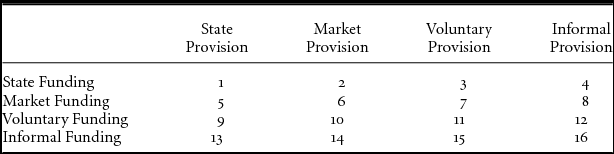
The three-dimensional model (Powell, Reference Powell and Seeleib-Kaiser2008: 18–19) differentiates between provision and finance across state, market, and voluntary and informal sectors. The third dimension, of state regulation, is indicated by inclusion of an H (high) and L (low) regulation. It can be used to explore movement between origin and destination cells to point to different types of privatisation (Table 1). For example, ‘full’ privatisation would entail movement across all three dimensions from Cell 1H (i.e., state funding and provision) with high regulation (through hierarchical power as there would only be public sector provision) to that of Cell 6L (i.e., market funding and provision) with low regulation. However, privatisation can involve any shift from the first (state) column, from the first (state) row, or towards less regulation (H to L). In principle, it can differentiate ‘privatisation’ (e.g., to private for-profit provision, cell 2), ‘voluntarisation’ (e.g., to voluntary, third sector or non-profit provision, cell 3) and ‘informalisation’ (e.g., to informal provision, cell 4). This is important if it is considered that for-profit provision is different to voluntary provision. For example, Mohan (Reference Mohan, Gabe and Calnan2009) differentiates ‘two visions of privatisation’ of markets and a ‘much more benign version’ or ‘progressive privatisation’ of mutual, social enterprises and cooperatives. However, the House of Commons Public Administration Select Committee (2008: 104) were unable to corroborate ‘the central claim made by the government, and by advocates of a greater role for the sector in service delivery’ that ‘third sector organisations can deliver services in distinctive ways which will improve outcomes for service users’. Moreover, it can be specific regarding ‘contracting out’ to a for-profit provider as ‘de-provided privatisation’, but precision may come at the cost of ugly terms.
Types of privatisation according to the MEW
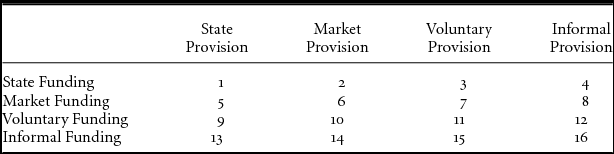
The MEW literature has been little used to explore the privatisation debate, and tends to focus on social care rather than health care (e.g., Daly and Lewis, Reference Daly and Lewis2000; Ascoli and Ranci, Reference Ascoli and Ranci2002; Evers and Svetlik, Reference Evers and Svetlik1993). It is not clear if the informal dimension is applicable to health care, although it is a major feature of ‘caring’ within social care, particularly caring for children and for (elderly) adults (e.g., Harris, Reference Harris2002; Daly and Lewis, Reference Daly and Lewis2000). Moreover, public and private have other meanings in the sense of men's paid work in the public domain and women's unpaid work (including caring) in the private sphere (e.g., Harris, Reference Harris2002). For example, Daly and Lewis (Reference Daly and Lewis2000) focus on the way in which social care lies at the intersection of public and private (in the sense of both state/family and state/market provision).
The major disadvantage is that while the MEW provides a clear heuristic picture, it is difficult to provide clear measures as there is no obvious common metric. Privatisation can be seen as less state provision, finance or regulation, but while it is possible to measure provision or finance, regulation is more problematic (see below).
‘Wheels of Welfare’ (WoW) perspectives
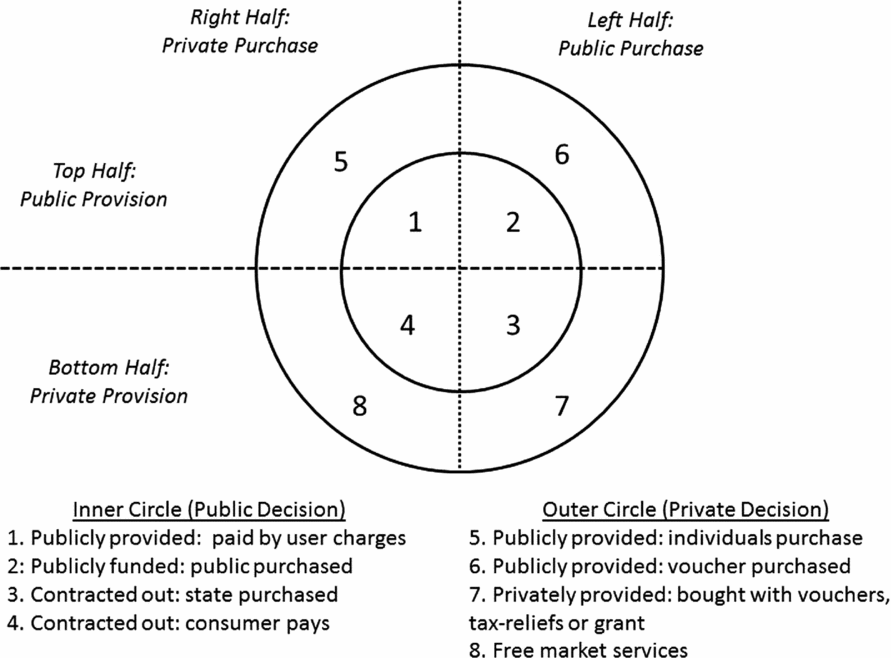
A different three-dimensional view was set out by Burchardt (Reference Burchardt1997), and developed in subsequent publications (e.g., Smithies, Reference Smithies2005; Edmiston, Reference Edmiston2011; Burchardt, Reference Burchardt2013). She develops a typology of welfare services based on ‘wheels of welfare’ and attempts to illustrate its use by clarifying discussions about the privatisation of welfare and by analysing changes in expenditure. It identifies three dimensions of ‘private welfare’ – provision, finance and decision – each of which may operate independently of the others. The degree of decision-making power which consumers have is determined firstly by how directly they choose the service, and, secondly on the extent to which there are viable alternatives. Burchardt (Reference Burchardt2013) explains ‘decision’ as an element of ‘purchase’ which has two components: the funding of the service and the decision about which provider or how much of the service to buy. Burchardt (Reference Burchardt1997, Reference Burchardt2013) refers to the third dimension as ‘decision’, but Edmiston (Reference Edmiston2011) terms it control, which appears to bring the typology closer to publicness terminology. Burchardt (Reference Burchardt1997) discusses, but ultimately rejects, the dimension of regulation as it is not clear that regulation constitutes a dimension which is independent of provision and finance as all welfare providers are subject to regulation to a greater or lesser extent. She differentiates the ‘pure public’ category (i.e., tax-financed, publicly provided services under public decision-making) from the ‘other end of the spectrum’ of the ‘pure private’ (free-market) category, but also points to ‘contracting out’ (private provision, public finance and decision) and ‘voucher-type schemes’ (public finance, private decision and either public or private provision). A service can be ‘privatised; through “decision”: handed to the consumer, whilst the state retains responsibility for finance and possibly also for provision’ (p. 3).
Wheels of welfare

Burchardt (Reference Burchardt2013) revisits the framework, discussing regulation as a candidate for a fourth dimension. She concludes that rather than adding a new dimension to the framework altogether, it would be interesting to look at the degree of regulation to which the privately provided, privately decided subsector is subject and how this has changed over time (pp. 10–11).
Burchardt (Reference Burchardt1997) uses the typology to analyse changes in expenditure on welfare by comparing spending in five main areas – education, health, housing, social security and personal social services – in 1979/80 and 1995/96. She notes the different mechanisms which are used to deliver welfare, with her ‘wheels of welfare’ differentiating between ‘outright privatisation’, contracting out, marketing public services, user charges and vouchers. Across all services, it is broadly agreed that shifts in the composition of welfare activity have been relatively small and gradual. (Burchardt, Reference Burchardt1997; Smithies, Reference Smithies2005; Edmiston, Reference Edmiston2011). Burchardt (Reference Burchardt2013) sums up that overall the picture is one of considerably greater stability than one might have expected given the rate of reforms in public services and plethora of initiatives in welfare under successive administrations.
In terms of health care, the figures for ‘pure public’ moved from 71 per cent in 1979/80 to 64 per cent by 2007/8, while the ‘pure private’ category increased from 9 per cent to 13 per cent. According to Edmiston (Reference Edmiston2011), the most notable changes are the increasing role of the pure private and public decision: contracted out categories of welfare activity. The rise in pure private activity is primarily due to the increase in consumer spending on over-the-counter medicines and private medical, dental, optical and nursing fees. The rise in ‘Public decision: contracted out’ is due to an increase in the number and scale of private finance initiatives, and the level of hospital care that is contracted out. Having said that, the proportionate change in these two categories still appears slight and gradual.
This approach appears to suggest two ways to examine change. First, a crude measure might examine whether change occurs in one, two or three dimensions. However, it is not clear if ‘third order change’ is inevitably more significant than ‘first order change’. Second, change can be measured in terms of expenditure. However, it is important to note critiques of expenditure as a ‘dependent variable’ (e.g., Esping-Andersen, Reference Esping-Andersen1990: 19–21). Edmiston (Reference Edmiston2011) notes that expenditure does not necessarily always capture the extent of activity within a given domain. For example, the extent of purely private welfare activity within personal social services does not capture the extent of unpaid care and support provided through informal kinship and support networks (cf. Powell, Reference Powell and Seeleib-Kaiser2008: 29).
Publicness perspectives
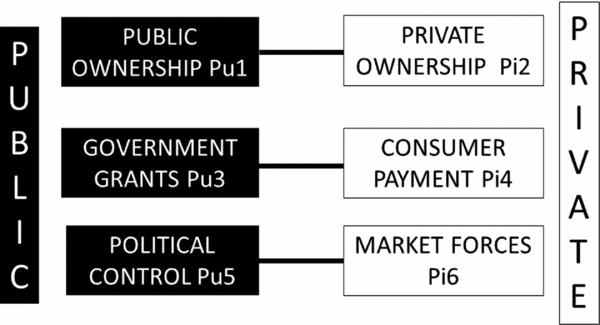
Publicness is largely absent from social policy literature. For example, Newman and Clarke (Reference Newman and Clarke2009: 4) explore ‘public services as mediums of publicness’ without referring to the ‘publicness’ literature. There are ‘many faces of publicness’ (Pesch, Reference Pesch2005: 108), but it is often divided into core and dimensional approaches (e.g., Anderson, Reference Anderson2012; Andrews et al., Reference Andrews, Boyne and Walker2011). The traditional core definition is similar to a one-dimensional MEW focus on ownership (Pesch, Reference Pesch2005). A two-dimensional account focuses on economic and political authority (e.g., Pesch, Reference Pesch2005: 112). Bozeman (Reference Bozeman1987: 17) and argues that political control is the essence of publicness: ‘all organizations are public because political authority affects some of the behavior and processes of all organizations’. This has now developed into a ‘dimensional’ model of publicness that combines ownership (public, private or non-profit), funding, (government grants versus consumer payments) and control (by political or market forces). The model is dimensional in the sense that all three variables should be viewed as continuous rather than categorical. Thus, organisations can be more or less public on each of the three dimensions. This raises the question of which aspect of publicness is most important for organisational performance, and whether each one has separate or interactive effects (Andrews et al., Reference Andrews, Boyne and Walker2011). Anderson (Reference Anderson2012) has produced a two-dimensional grid for healthcare organisations. He argues that a distinction can be made between hospitals with Foundation Trust (FT) status, having increased economic authority but reduced political authority, and those under direct NHS control, and subject to high levels of both economic and political authority. This suggests some decline in publicness as FTs are less public than non-FT hospitals.
Dimensional model of publicness
According to Andrews et al. (Reference Andrews, Boyne and Walker2011) the number of studies that directly compare public and private effects on performance in the same industry and over the same time period is not great. Furthermore, most studies focus only on ownership while neglecting the funding and control dimensions of publicness, and examine effects on efficiency and effectiveness without paying much attention to equity. They conclude that the existing evidence suggests that publicness makes little difference to performance. However, such results should be treated cautiously as the consequence of substantive and methodological problems is that it is impossible to conclude with any confidence that publicness makes a positive or negative difference to organisational performance or to judge which of the three dimensions of publicness is most important and for which aspects of organisational performance.
Privatisation and the NHS
It is clear that the NHS has never been solely ‘purely public’ (e.g., GPs as independent contractors; ‘pay beds’ within NHS hospitals; ‘out of pocket’ expenses or charges for prescriptions, and ‘high street’ pharmacy, dental and optical care [Salter, Reference Salter1998; Keen et al., Reference Keen, Light and Mays2001]). However, most commentators date privatisation from the Conservative (1979–1997) government (e.g., Pollock, Reference Pollock2005). Subsequent discussion focuses on this period onwards (although later periods focus on the English NHS after political devolution: see e.g., Lister, Reference Lister2008: chapter 8). For reasons of space, the focus is on health care rather than ‘continuing care’ at the health/ social care boundary which has been termed ‘the biggest area of privatisation’ (Lister, Reference Lister2008: 66; but see Timmins, Reference Timmins2001; Klein, Reference Klein2013), In this chronological section, we examine privatisation in terms of the original debates (i.e., with explanations – or no explanations – from the original authors). It is noticeable that few authors give a clear or explicit definition of privatisation or draw on the extant privatisation frameworks (above). We then apply our three perspectives in the ‘Discussion’ section.
Conservative (1979–1997)
Ranade and Haywood (Reference Ranade and Haywood1989: 26–27) argue that most examples in this period fall within Young's (Reference Young1986) categories of c (contracting) and f (extending private sector practice into the public sector). Lister (Reference Lister2008: 56–59) writes of the ‘initial flurry of privatisations in 1984’ associated with contracting out of ancillary services (compulsory competitive tendering). Ranade and Haywood (Reference Ranade and Haywood1989) claim that the distinctive contribution of the Conservative government lay in the efforts to recast management structures, systems, norms and values in line with the perceived virtues of the private sector. They concluded that a form of privatisation was introduced by defining a new private sector general management model for NHS managers to follow which increased upward accountability. According to Klein (Reference Klein2013: 129), the government's enthusiasm for privatisation turns out to be heavily qualified in the case of ‘privatising’ health care costs by charging patients, which has been termed ‘backdoor privatisation’ (e.g., Birch, Reference Birch1986).
According to Salter (Reference Salter1998: 206–207), it was the Private Finance Initiative (PFI) (also known as ‘Profits From Illness’, Lister, Reference Lister2008: 124; and ‘Pure Financial Incompetence’, Davis and Tallis, Reference Davis and Tallis2013: 32) which represented the most significant sea-change. Under PFI a private firm builds and operates a facility, which is leased back to the NHS for a period of some twenty-five to thirty-five years (Shaw, Reference Shaw2007: chapter 5; Lister, Reference Lister2013: chapter 7). Although the public sector does not ‘own’ the asset for the contract period, it typically returns to the public sector at the end of the contract (Shaw, Reference Shaw2007: 82). Salter (Reference Salter1998: 201–205) argues that while PFI made little progress under the Conservatives in the NHS, it ‘has the potential to rearrange the private–public mix in health care into a qualitatively new form and balance.’
New Labour (1997–2010)
For Pollock (Reference Pollock2005) privatisation was the common theme that underpinned the New Labour reforms. Similarly, Lister (Reference Lister2008: chapter 9) explores ‘new dimensions in privatisation’, particularly the contracting out of clinical services which increased tenfold the NHS spend on private sector health care. He writes that by about 2006 privatisation was ‘galloping not creeping privatisation’, and ‘floodgates of privatisation’ had opened (p. 185).
Lister (Reference Lister2008: chapter 9) charts Labour's changing views on PFI from being ‘totally unacceptable’ and ‘the thin edge of the wedge of privatisation’ in 1995 and ‘privatisation by another name’ in 1996 (Craig with Brooks, Reference Craig and Brooks2006: 135) to acceptance later in 1996, and forming in government the basis for ‘the biggest hospital building programme in the history of the NHS’. However, critics within the Labour Party regarded it as creeping privatisation, while the Guardian likened it to ‘paying for a mortgage through Barclaycard’ (Shaw, Reference Shaw2007: chapter 4). Lister (Reference Lister2013: 193) argues that while PFI maintains the appearance of a publicly funded, publicly provided service, an increasing share of NHS property assets has been privatised. Maarse (Reference Maarse2006) regards PFI as a notable step to privatisation in investments. However, Mathieson (Reference Mathieson2012) argues that PFI involves building new publicly owned NHS hospitals, not private ones, presumably due to the time-limited lease.
The Labour 1997 Manifesto made it clear that it was opposed to the use of the private sector in the supply of clinical services (Shaw, Reference Shaw2007: 108–110). Initially Labour was hostile to the use of the private sector, with Health Minister Alan Milburn telling a group of NHS managers that he would come down ‘like a ton of bricks’ on managers who used it (in Timmins, Reference Timmins2001: 598). However, in 1998 Milburn replaced Frank Dobson as Secretary of State for Health, and is said to have written the NHS Plan (DH, 2000) over one weekend. The only significant reference to the private sector in the NHS Plan was the ‘concordat’ between the NHS and the private sector (Leys and Player, Reference Leys and Player2011: 107–108). However, the plan saw Labour ‘cross the Rubicon’ in its relations with the private sector (Timmins, Reference Timmins2001: 598).
Increasingly, choice and diversity became the watchwords (Mays et al., Reference Mays2011). The cornerstone principles were collective funding and equal access free at the point of delivery: as Milburn put it, whether treatment takes place in a private sector hospital or an NHS hospital is ‘frankly, a secondary consideration’ (Shaw, Reference Shaw2007: 119). This fits with the view of the Commission on Private Public Partnerships (2001) which discusses means and ends, arguing that the case for public services needs to be made in terms of values and outcomes rather than particular forms of delivery. The founding principles of the NHS were that it should be free, universal and comprehensive, not that it should be provided through a particular structure, process or set of employees.
Foundation Trusts (FTs) were given greater autonomy. They were said to be a ‘new model of public ownership’ of ‘public benefit corporations’, firmly rooted in the cooperative and mutual tradition and ‘wholly part of the NHS’ (Shaw, Reference Shaw2007: 104–106). According to Milburn, in no way could FT be reasonably described as privatisation, or a step in that direction (Leys and Player, Reference Leys and Player2011: 22–23). According to Klein (Reference Klein and Maynard2005: 59), FT are within the public sector, and are a ‘long way from privatisation’. However, critics argued that they resembled private businesses (e.g., Pollock, Reference Pollock2005: 75–78, 130)
Critics focus on the ‘forced’ privatisation associated with Independent Sector Treatment Centres (ISTC) in that the commissioners (Primary Care Trusts, PCTs) were ‘persuaded’ by government to set them up, with this ‘preferential treatment’ resulting in a ‘unlevel playing field’ associated with cream skimming and market rigging (Pollock, Reference Pollock2005: 242–247; Shaw, Reference Shaw2007: chapter 5; Lister, Reference Lister2008: chapter 9). Similarly, the ‘Choose and Book’ Initiative means that the ‘choice menu’ has to include a private sector provider (Pollock, Reference Pollock2005: 241–242). Lister (Reference Lister2013: chapter 7) regards the ‘watershed’ as when the NHS was excluded from competing for contracts (p. 180). ‘Our Health, Our Say’ (DH, 2006) forced PCTs to put their provider services, which included most community health services, out to tender (Leys and Player, Reference Leys and Player2011: 108). According to Lister (Reference Lister2008: 188), the document was a significant new element driving PCTs towards further and faster privatisation associated with third sector and social enterprise provision. ‘Any Willing Provider’ opened up services to tender (Lister, Reference Lister2013: 179). The ‘Transforming Community Services’ programme required PCTs to divest themselves of all direct provision by April 2010. As part of this programme, the Department of Health (DH) introduced the Right to Request (RtR) scheme which enabled and supported healthcare staff to spin their community services out of the NHS and into social enterprises (Miller et al., Reference Miller, Millar and Hall2012). All PCTs were instructed to set up at least one ‘polyclinic’ (Darzi Centre), with about a third run by private companies (Leys and Player, Reference Leys and Player2011: 46–47). The ‘NHS Improvement Plan’ (DH, 2004) was ‘relatively forthright about privatisation’ stating that by 2008 independent providers would carry out up to 15 per cent of scheduled procedures (Leys and Player, Reference Leys and Player2011: 107–108).
Some critics regard Personal Health Budgets (PHB) as privatisation (e.g., Leys and Player, Reference Leys and Player2011: 64–66). On the other hand, it has been seen as giving people much more control over how their needs are met, what services they receive and who delivers them (Alekeson and Rumbold, Reference Alekeson and Rumbold2013). They argue that the risks of individual choice are minimised as all care plans must be clinically and financially sound in order to be signed off by commissioners.
There were concerns over ‘franchising out NHS Trust management’. The ‘most notorious failure’ was at Good Hope Hospital Trust in Birmingham which was handed over on a three year contract to Secta that was terminated after eight months. The FT regulator, Monitor, was ‘largely privatised’ with two-thirds of its first year budget spent on management consultants. By 2006, the NHS was spending more on consultancy than the whole of UK manufacturing industry (Lister, Reference Lister2008: 236–239). The management of the Hinchingbrooke hospital was taken over by ‘Circle’ (Leys and Player, Reference Leys and Player2011: 49–50). This privatisation saw a hospital run by a company registered in the Virgin Islands (Davis and Tallis, Reference Davis and Tallis2013: 195–196). However, Mathieson (Reference Mathieson2012) argues that Hinchingbrooke represents ‘management outsourcing’ or ‘operating franchise’ rather than privatisation as it is time-limited.
While critics (e.g., Pollock, Reference Pollock2005; Leys and Player, Reference Leys and Player2011; Lister, Reference Lister2008, Reference Lister2013) see significant privatisation, other commentators (e.g., Ham, Reference Ham2012; Klein, Reference Klein2013) see the New Labour reforms not as privatisation per se but rather on the basis of developing a market in which patients choose providers from any sector, and point to the limited degree of provision by private providers.
Conservative/Liberal-Democrat Coalition (2010–)
There are many aspects of the coalition's reforms that can be seen as a continuation and extension of the New Labour period (Leys and Player, Reference Leys and Player2011; Millar et al., Reference Millar, Snelling and Brown2011; Timmins, Reference Timmins2012; Davis and Tallis, Reference Davis and Tallis2013). The Health and Social Care Bill contained many controversial measures (see Davis and Tallis, Reference Davis and Tallis2013; Klein, Reference Klein2013; Timmins, Reference Timmins2012), but Mathieson (Reference Mathieson2012) claims that it was ‘not privatisation’. For Ham (Reference Ham2012) the ‘greatest threat is inertia rather than privatisation’. The government claims ‘no privatisation’ on narrow criteria (NHS services will remain publicly funded and free at the point of delivery), with its definition of ‘privatisation’ given by Health Minister, Anne Milton, who stated that the government is not pursuing a policy of privatisation of health care providers whereby national health service organisations would be transferred from public to private ownership and control (NHS Privatisation 20 October 2011, HC Deb, c1081W).
At the Labour Party Conference in 2012, Shadow Secretary of State for Health Andy Burnham claimed that recently signed contracts for almost 400 NHS services, worth a quarter of a billion pounds, resulted in the ‘biggest ever act of privatisation ever seen in the NHS’ (Ramesh, Reference Ramesh2012). The Coalition ‘cranked up the pace’ of ‘Any Willing Provider’ which was renamed as ‘Any Qualified Provider’, extending to a wider range of community and mental health services (Lister, Reference Lister2013: 179). All NHS Trusts are required to try to move to FT status leading to the claim that the NHS would become ‘the largest and most vibrant social enterprise sector in the world’ (DH, 2010: 36; see Miller et al., Reference Miller, Millar and Hall2012). Lister (Reference Lister2012) writes that this plan for all NHS trusts to become autonomous FTs leads to a longer-term goal of getting FT ‘off the NHS balance sheet’, floating them off as non-profit ‘social enterprises’. He continues that ‘this experimental policy would, if carried through, effectively privatise virtually all the provision of health services in England by 2014 (p. 146).
Lister (Reference Lister2012) points to the raising of the cap on the amount of income NHS FTs are allowed to make from private medicine, which may lead them to prioritise generating income from their new, private, paying customers, leaving a two-tier system in which NHS patients are less attractive prospects – reduced to second-class citizens even in NHS hospitals.
Klein (Reference Klein2013: 318) states that England has so far been immune to the ‘passive privatisation’ involved in making consumers pay more of the costs of health care, with out-of-pocket payments representing a low and falling proportion of total health care expenditure. However, Lister (Reference Lister2012) points out that PCTs drew up lists of treatments that would no longer be available on the NHS, which he considers will expand as Clinical Commissioning Groups (the successors to PCTs) experience greater financial austerity. This effectively confronts local patients who can afford to do so with the stark choice of seeking private treatment or going without. It has been claimed that there are major potential conflicts of interest in placing GPs in charge of spending decisions, as over a third of those on the boards of the new Clinical Commissioning Groups had financial interests in private health care providers, meaning that ‘things are looking good for Dr Fat Cat’ (Davis and Tallis, Reference Davis and Tallis2013: 6). Lister (Reference Lister2013: 155) expresses concerns that ‘Personal Health Budgets’ or the possible introduction of ‘person based resource accounting’ may leave individuals to ‘top up’ from their own pockets or from health insurance. According to Shadow Health Secretary, Andy Burnham, there has been a significant increase in hospitals generating income from ‘self-funding’ procedures, through a ‘premier service’, that were no longer available free at the point of delivery on the NHS (McTague, Reference McTague2013). At the Labour Party Conference in 2013, Burnham stated that the Coalition's health policies placed the NHS on a ‘fast-track’ to privatisation, and promised that a future Labour government would repeal the legislation (McTague, Reference McTague2013).
Discussion
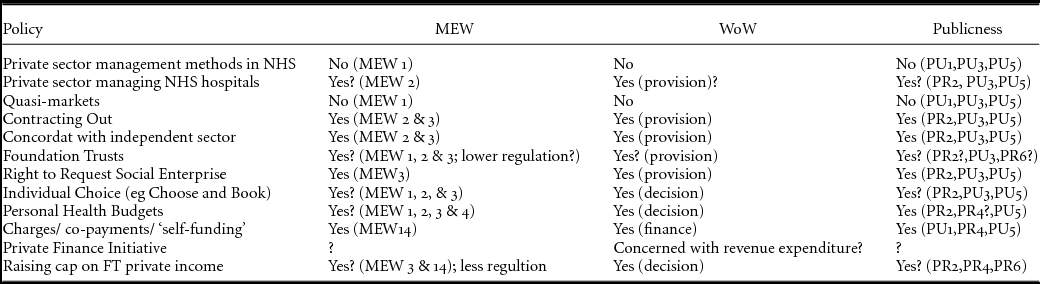
The chronological sections show that there are different views regarding privatisation in the NHS, which are often based on implicit or unclear definitions of the term. Table 2 provides a summary of their perspectives on the major policy initiatives outlined above. There are some similarities within these largely ‘silo’ based literatures. All agree on a ‘wide’ or dimensional definition of privatisation, that the internal market constituted marketisation rather than privatisation, and that private sector management methods do not appear to fit any dimension. They also agree that increased charges, contracting out/ CCT (for non-clinical services), the Right to Request and the Concordat (for clinical services), and allowing FTs to raise more private income, constitute different types of privatisation. Higher charges are a form of ‘commodification’ that privatise finance. Contracting out privatises provision to either the for-profit or non-for-profit sectors.
A comparison of privatisation perspectives
Whilst the frameworks can be argued to provide a degree of clarity, it is a matter of interpretation whether some policies are seen as privatisation. FT can be argued to remain within the state, or be seen as private or ‘social enterprise’ provision. Moreover, it can be argued that FTs are subject to less regulation (more autonomy from the Secretary of State) or more regulation (from the ‘quality industry’). Similarly, it can be argued that PFI and private management of hospitals (e.g., Hinchingbrooke) can be regarded as privatisation, but also representing a time-limited (albeit long term) out-sourcing or leasing rather than a permanent transfer of assets. Raising the cap on FT income is more problematic, but may reduce regulation, and may lead to a greater focus on ‘paying customers’ rather than NHS patients.
The main conceptual difference is that MEW and publicness stress regulation while WoW stresses decision. Burchardt (Reference Burchardt2013) notes that we need a common metric across services in order to analyse welfare activity overall. For her, this metric is spending, but this neglects regulation. While the transfer of assets can be measured in financial terms at one point in time (e.g., the value of privatised utilities or housing: cf. wealth) and state finance can be measured in financial terms in annual contract value (income), it is difficult to see how regulation can be measured in a common currency. From a MEW perspective, Johnson (Reference Johnson1989) discusses regulation associated with standards, quantity and cost. Publicness perspectives examine forms of political control in the public sector, including audit, inspection, performance reports, the submission of plans and limits on budgetary autonomy. On the one hand, it can be argued that regulation has decreased as the aim of creating FT was to give them more autonomy from the Secretary of State (e.g., Klein, Reference Klein2013; Mays et al., Reference Mays2011; Shaw, Reference Shaw2007). On the other hand, it is possible to argue that there has been increased regulation (e.g., National Institute for Health and Clinical Care Excellence, Monitor, Care Quality Commission) which should prevent any negative impact of privatisation. In terms of input, New Labour saw more regulators and more regulation, but measuring regulation in terms of outcome or success is more difficult, with some commentators pointing to regulatory failure (e.g., Mays et al., Reference Mays2011). The scandal at the Mid Staffordshire NHS FT was not prevented by the ‘quality industry’ (Klein, Reference Klein2013: 295–298). As Klein (Reference Klein2013: 296) puts it, why were 290 recommendations (of the Francis Report on the Mid Staffordshire FT) for change needed to make the NHS safe when successive governments had made the pursuit of ‘quality’ one of their main policy goals for the previous two decades?
The decision dimension of WoW may be linked with the ‘privatisation of risk without privatisation of the welfare state’ (Hacker, Reference Hacker2004) that differentiates between the degree to which potent threats to income are spread across citizens of varied circumstances (risk socialisation) or left to individuals or families to cope with at their own (risk privatisation). The boundaries of collective risk pools can be changed in three ways: explicit alterations of rules governing eligibility or benefits; changes in those rules’ implementation; and shifts in the constellation of risks itself. Hacker gives the example of moves from ‘defined-benefit’ to ‘defined-contribution’ plans in pensions, which increases risk. Similarly, there may be risks associated with ‘poor choices’ in PHB. It follows that WoW would consider increased choice (e.g., Choose and Book) and PHB as privatisation as they privatise decision, but the other approaches would consider these as privatisation only if the result of that choice leads to an increase in private provision. However, it is arguable that a ‘loaded dice’ (a menu that necessarily includes a private provider) will lead to an increased probability of privatisation.
Conclusions
Definitions and operationalisations of ‘privatisation’ are often implicit, unclear and conflicting, resulting in conflicting accounts of the occurrence, chronology and degree of privatisation in the NHS. This paper has explored three approaches to privatisation: MEW, WOW and publicness. It has suggested that while all three approaches agree that some policies constitute privatisation, there is some disagreement largely stemming from the differential stress on regulation or decision. It is important to introduce greater transparency into claims that allow the terms of engagement for a debate, and these frameworks do provide some necessary rationale about the criteria on which policies are said to privatise the NHS. However, all approaches require further development on two key issues: measurement of the degree of privatisation, and the important but neglected point of how different types of privatisation (above) lead to different impacts on patients. First, the degree of privatisation has been disputed, although clear concepts and measures are often not stated (cf. e.g., Ham, Reference Ham2012; Klein, Reference Klein2013 with Leys and Player, Reference Leys and Player2011; Lister, Reference Lister2012, Reference Lister2013). Second, under what assumptions and conditions do changes on criteria such as provision, finance, regulation or decision lead to effects on different groups of patients? Anderson's (Reference Anderson2012: 321) conclusions on publicness are equally applicable to other approaches: in healthcare organisations a wide range of questions remain unanswered. Is giving organisations greater economic authority more important than giving them greater political authority for improving their performance? What elements of political or economic authority contribute most to better or worse performance ? In short, we need to answer the question of Edwards and Lewis (Reference Edwards and Lewis2008): who owns and operates healthcare providers, and does it matter? The three frameworks considered here provide a foothold in this mountainous debate, but there is still a considerable and treacherous climb ahead before we can come out of the clouds and get a clear and panoramic perspective.