The prevalence of multidrug-resistant microorganisms (MDROs) continues to increase in healthcare settings in the United States. For instance, methicillin-resistant Staphylococcus aureus (MRSA) and vancomycin-resistant Enterococcus (VRE) colonization among intensive care unit (ICU) patients have been reported as high as 16% and 25% respectively in US hospitals.Reference Blanco, Perencevich and Li1 Likewise, multidrug-resistant Acinetobacter baumannii and carbapenem-resistant Enterobacteriacea (CRE) colonization rates have been reported to be as high as 41%Reference Corbella, Pujol and Ayats2 and 45%Reference Bratu, Landman and Haag3 in hospitalized patients. On average, 21 VRE or MRSA new acquisitions per 1,000 patient days at risk have been observed in ICU settings across the United States.Reference Harris, Pineles and Belton4
The continuing emergence of MDROs and their spread across healthcare settings are believed to be due to multiple causal factors, including antibiotic use and transmission due to gaps in infection control.5 Although low or moderate levels of health care worker (HCW) carriage of MDRO have been observed,Reference Visalachy, Palraj, Kopula and Sekar6, Reference Eveillard, Martin, Hidri, Boussougant and Joly-Guillou7 HCW hands, gloves, and gown contamination have been consistently reported.Reference Morgan, Rogawski and Thom8–Reference Duckro, Blom, Lyle, Weinstein and Hayden10 Moreover, HCW apparel (ie, scrubs, and white coats) and the hospital environment have been shown to carry a high burden of MDROs.Reference Visalachy, Palraj, Kopula and Sekar6, Reference Munoz-Price, Namias and Cleary11, Reference Thom, Johnson, Lee and Harris12, Reference Mitchell, Spencer and Edmiston13 Therefore, HCWs and the healthcare environment can function as intermediate transmission vectors of MDROs among patients.
Although hospital settings are commonly considered hot spots for MDRO transmission, the complete transmission process is still not well understood. Furthermore, the relative importance of each potential transmission pathway in the overall patient-to-patient transmission process in healthcare settings is still controversial. The design and implementation of a single research study to appropriately investigate all potential pathways simultaneously and their intercorrelations is largely infeasible due to cost and logistics. Nevertheless, the lack of clear evidence and understanding of the complexity and multifaceted nature of MDRO transmission in hospitals has resulted in disagreements regarding the most appropriate infection prevention measures needed to prevent transmission of these organisms in healthcare settings. For example, this leads to large discussions about the pros and cons of contact precautions.
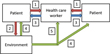
This scoping review aims to fill this research gap by synthesizing the existing evidence on MDRO hospital transmission. We have summarized the best evidence on each of the 5 following potential transmission routes: (1) patient to HCW, (2) patient to environment, (3) HCW to patient, (4) environment to patient, and (5) environment to HCW (Fig. 1). Additionally, we have synthesized findings from high-quality manuscripts that demonstrate the overall contribution of patient-to-patient transmission in hospitals irrespective of the transmission routes.
Main transmission pathways involved in hospital transmission of multidrug-resistant organisms (MDROs).

Methods
We performed a scoping review, which is a widespread methodology to systematically search, select, and summarize existing evidence on a specific subject to identify research gaps.Reference Pham, Rajić, Greig, Sargeant, Papadopoulos and McEwen14, Reference Colquhoun, Levac and O’Brien15 We chose this methodology instead of a traditional systematic review because it provided the flexibility to perform a general preliminary assessment of the existing literature on the complex and multifaceted topic of transmission of MDROs in the hospital setting.
Study identification and selection
We performed 2 separate searches in PubMed, EMBASE, and Cochrane Central Register of Controlled Trials (CENTRAL). The first search focused on MDRO transmission via the HCW or the environment to identify research studying specific transmission pathways (patient to HCW, patient to environment, HCW to patient, environment to patient, or environment to HCW). We used the following search terms: multidrug-resistant organism AND healthcare personnel OR environment OR equipment AND disease transmission OR cross-transmission OR nosocomial transmission. The second search focused on overall patient-to-patient transmission regardless of whether the study specifically evaluated the transmission pathway. The following search terms were included: multidrug-resistant organism AND disease transmission OR cross-transmission OR nosocomial transmission OR patient-to-patient transmission. Both searches identified terms in the title, abstract, and keywords fields. A medical librarian developed each search strategy.
Only original research manuscripts written in English and published during the last decade (2007–2017) were eligible for inclusion. Letters to the editor, guidelines, mathematical models, case studies, or outbreak investigations were excluded. Additionally, only research studies conducted in the acute-care setting among adult populations focusing on the following MDROs were considered: CRE, MRSA, VRE, and/or multidrug-resistant A. baumannii. Finally, to ensure that manuscripts satisfactorily demonstrated the transmission of the same multidrug-resistant strain across individuals, only manuscripts using modern molecular laboratory techniques such as whole-genome sequence (WGS) or pulsed-field gel electrophoresis (PFGE) were included. When studying the transmission pathways, manuscripts able to establish directionality of transmission (ie, patient to HCW vs HCW to patient) were preferred.
One researcher (N.B.) screened all titles and abstracts for eligibility. After abstract screening, the remaining papers were independently reviewed and rated by 3 researchers (N.B., A.D.H., and L.O.) using predefined objective criteria to identify the highest-quality manuscripts. The following main criteria used for manuscript evaluation were extracted: type of study design, sample size, and discriminatory power of the molecular technique used to demonstrate relatedness between strains. Disagreements were resolved by consensus. The best manuscripts from each search were summarized using a standardized template to synthesize the existing evidence on hospital transmission of MDROs. Additionally, the evidence level of consistency across each transmission route was categorized as either high, moderate, or low based on the level of agreement across studies.
Results
Potential transmission routes
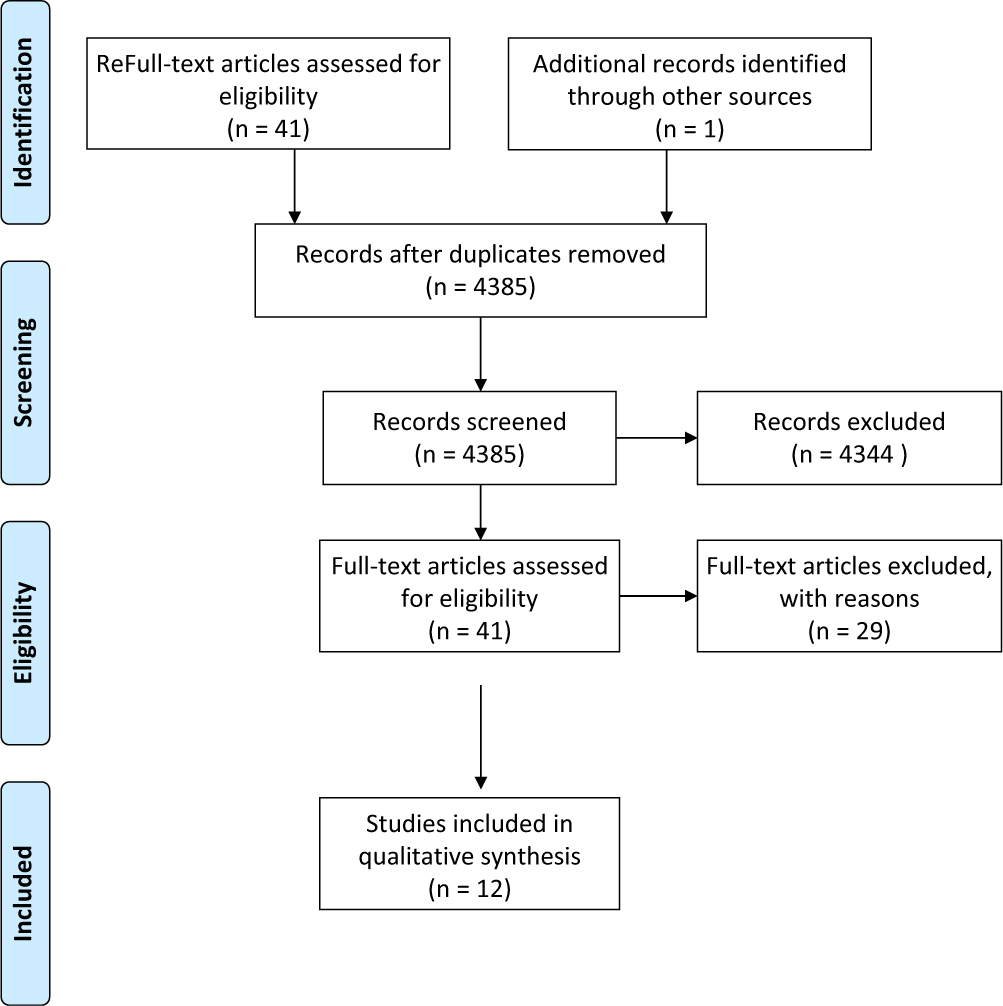
After searching 3 databases, 4,596 manuscripts were identified and one additional record was added by hand searching references of included articles. After removal of duplicates and elimination of articles based on title and abstract review, 41 full-text articles were reviewed. Finally, 12 articles were selected for inclusion in this scoping review (Fig. 2). These were the most common reasons for exclusion: (1) the study was not based in an acute-care setting; (2) the study did not include at least 1 of our selected MDROs; (3) the study took place during an epidemic or outbreak; (4) the study did not incorporate modern molecular techniques to assure same-strain transmission; (5) the article did not present original research; and (6) the type of manuscript/analysis was defined as part of the exclusion criteria (ie, letter to the editor, mathematical models, and case reports).
PRISMA flow diagram for literature review on transmission routes.

Transmission from patient to HCW. The probable primary source of the MDRO is the colonized or infected patient, and the patient may contaminate the HCW. Several high-quality papers have shown the transmission of MDROs from patients to HCWs, and in this review, we highlight 4 such prospective studies (Table 1). All of these studies demonstrated transmission of the same strain from the patient to HCW hands, gloves, and/or gowns using PFGE.Reference Morgan, Rogawski and Thom8, Reference Morgan, Liang and Smith9, Reference Hayden, Blom, Lyle, Moore and Weinstein16, Reference Schweizer, Ward and Cobb17 The main limitation of these studies is their ability to separate the effect of patient transmission to HCW from the effect of environmental transmission to HCW. However, the study published by Morgan et al in 2012 directly connected patient strains (instead of environmental strains) to the isolated strains in gowns and gloves in 82% of the analyzed cases.Reference Morgan, Rogawski and Thom8 In summary, based on the studies identified in our review, existing evidence demonstrating transmission from patient to HCW is highly consistent across available research even though variability in the amount of transmission was observed across microorganisms as expected.
Summary of Best Quality Evidence by transmission Pathway

Note. G&G, gowns and gloves; HCW, healthcare worker; ICU, intensive care unit; MDR, multidrug resistant; MDRO, multidrug-resistant organisms; MICU, medical intensive care unit; MRSA, methicillin-resistant S. aureus; MSSA, methicillin-susceptible S. aureus; PFGE, Pulse-field gel electrophoresis; P-HCW, patient to HCW; spa, Staphylococcus protein A; TICU, trauma intensive care unit; VRE, vancomycin-resistant Enterococcus.
Transmission from patient to environment. In addition to transmitting the MDRO to HCW, a colonized or infected patient may contaminate the surrounding hospital environment. This review highlights 4 studies providing strong evidence to support this pathway (Table 1). Yakupogullari et alReference Yakupogullari, Otlu and Ersoy18 described a positive correlation between levels of MDR A. baumannii isolated in air samples and proximity to an MDRO-positive patient. Thom et alReference Thom, Johnson, Lee and Harris12 and Munoz-Price et alReference Munoz-Price, Namias and Cleary11 reported that among rooms of patients with recent or current A. baumannii infection, the environmental strain was identical to the patient’s isolate ~85% of the time. Likewise, Wilson et alReference Wilson, Hayman and Whitehouse19 reported that 65% of patients recently colonized with MRSA had subsequently similar strains of MRSA isolated from their environment. In summary, based on the studies identified in our review, existing evidence demonstrating transmission from patient to the environment is highly consistent across MDRO.
Transmission from HCW to patient. Transmission from HCWs to patients is more common under epidemic conditions,Reference Danzmann, Gastmeier, Schwab and Vonberg24 which we purposely excluded from this review. Nevertheless, this review highlights 3 prospective studies supporting this transmission route even under endemic conditions. In 2 included studies, the same MRSA clones were isolated from patients and HCWs, which were different from the clones isolated from the environment.Reference Wilson, Hayman and Whitehouse19, Reference Ben-David, Mermel and Parenteau20 Furthermore, Loftus et alReference Loftus, Koff and Brown21 described HCW hands as the primary route of patient-to-patient S. aureus transmission across 3 major US academic medical centers. Consequently, decontamination of HCWs was also associated with a sustained reduction in transmission.Reference Ben-David, Mermel and Parenteau20 In summary, based on the studies identified in our review, existing evidence demonstrating transmission from HCW to patient is highly consistent for MRSA. However, we were unable to identify eligible high-quality papers providing evidence for this step of transmission for other MDROs included in this review, which demonstrates the complexity of studying this transmission route in real-life hospital settings.
Transmission from environment to patient. Another critical factor of MDRO transmission is the hospital environment. We identified 4 studies providing evidence supporting this transmission route. Yakupogullari et alReference Yakupogullari, Otlu and Ersoy18 demonstrated the presence of A. baumannii strains from previously infected patients in hospital air that subsequently infected hospitalized patients 3 months later. Other studies concluded that MRSA patient acquisition from the hospital environment occurred between 2% and 66% of the time.Reference Wilson, Hayman and Whitehouse19, Reference Loftus, Koff and Brown21, Reference Creamer, Shore and Rossney22 In summary, based on the studies identified in our review, existing evidence demonstrating transmission from environment to patient is moderately consistent; however, most of the available data are focused on MRSA.
Transmission from environment to HCW. The available evidence also suggests that the hospital environment plays a role in transmission by contaminating the HCW, who may later contaminate another patient as highlighted by 3 prospective studies that utilized PFGE to link MDRO strains. Morgan et alReference Morgan, Rogawski and Thom8 showed that 91% of the time when the HCW gowns or gloves are contaminated after interacting with a patient and his/her surrounding environment, the isolated strain is related to the environment. Similarly, Hayden et alReference Hayden, Blom, Lyle, Moore and Weinstein16 reported the same phenomenon 52% of the time. Based on the studies identified in our review, existing evidence demonstrating transmission from the environment to the HCW is moderately consistent across different studies and different MDRO.
Overall patient-to-patient transmission
The overall impact of MDRO transmission regardless of its transmission pathway is the transfer of these organisms from colonized or infected patients to other susceptible noncolonized or uninfected hospitalized patients. In this section, we summarize the existing evidence demonstrating the overall end result of hospital transmission of MDROs.
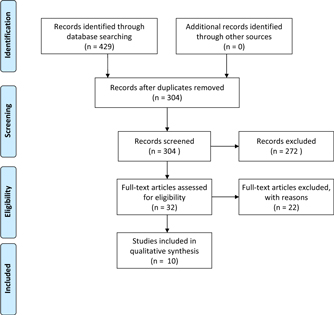
After searching 3 databases, 429 records were identified. After removal of duplicates and elimination of articles based on title and abstract review, 32 full-text articles were reviewed. Ten articles were selected for inclusion (Fig. 3). Exclusion criteria from the previous section were applied. All of the included manuscripts satisfactorily demonstrated the transmission of the same multidrug-resistant strain across patients using modern molecular laboratory techniques.
PRISMA flow diagram for literature review on overall patient-to-patient transmission regardless of transmission route.

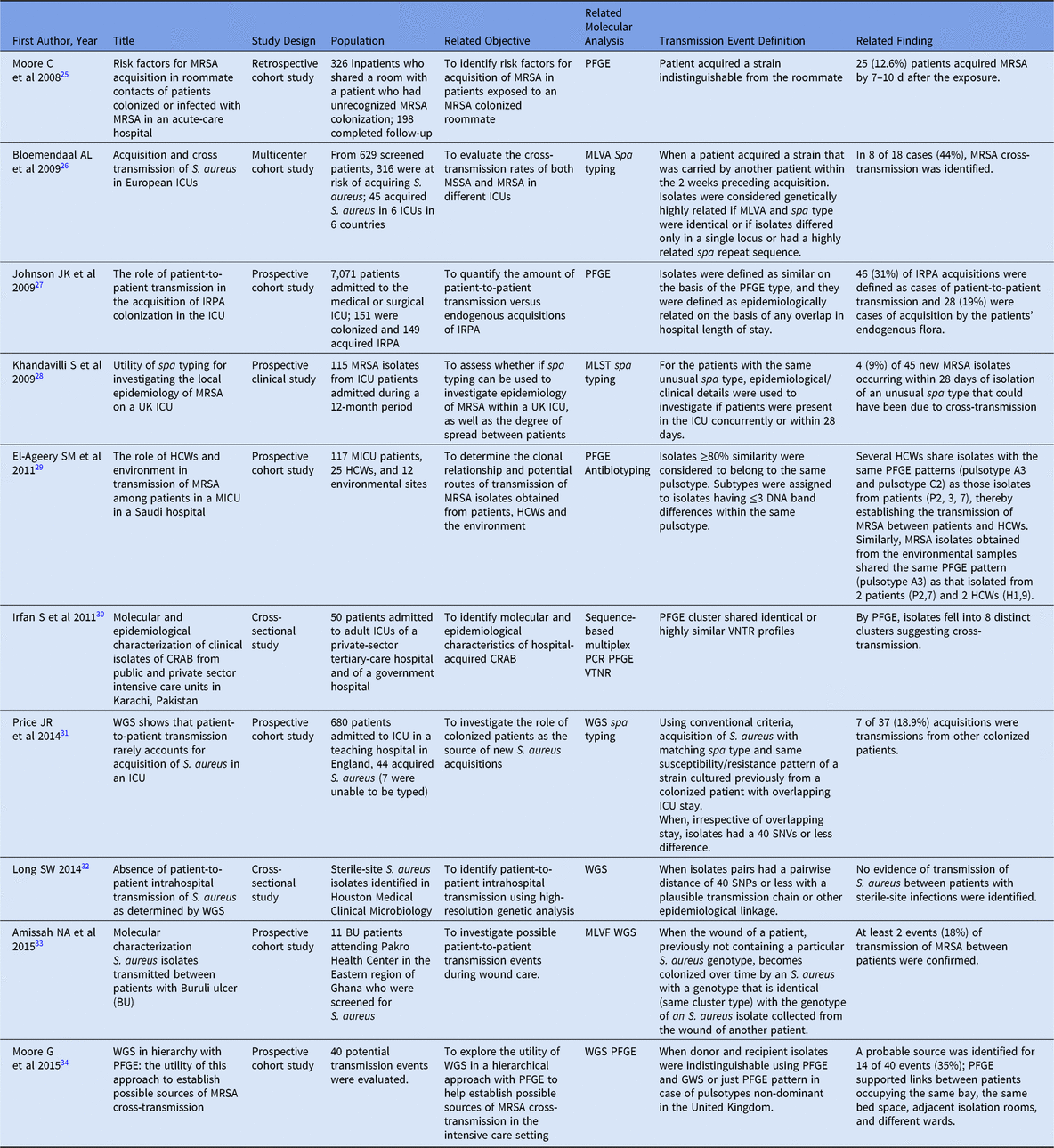
Table 2 lists summaries of 8 cohort studies and 2 cross-sectional studies. Most of the 8 studies focused on MRSA transmission, whereas the rest investigated carbapenem-resistant A. baumannii (n = 1) and imipenem-resistant P. aeruginosa (IRPA; n = 1). The included studies specifically linked the strains isolated between patients using WGS (n = 4), PFGE (n = 4), multiple-locus variable-number tandem repeat analysis (MLVA; n = 1), and multilocus sequence typing (MLST; n = 1).
Summary of Best Quality Evidence of Overall Patient-to-Patient Transmission Regardless of Transmission Pathway in Acute-Care Settings

Note. CRAB, carbapenem-resistant Acinetobacter baumannii, ICU, intensive care unit; IRPA, imipenem-resistant Pseudomonas aeruginosa; MICU, medical intensive care unit; MLVA, multilocus variable number of tandem repeats analysis; MLVF, multilocus variable number (MLVN) tandem repeat fingerprinting; MRSA, methicillin-resistant S. aureus; MSSA, methicillin-susceptible S. aureus; PFGE, pulse-field gel electrophoresis; SNP, single-nucleotide polymorphism; spa, Staphylococcus protein A; VREfm, Enterococcus faecium; VTNR, variable number tandem repeat; WG, whole-genome sequence.
The overall impact of patient-to-patient transmission reported by these studies varied. For MRSA, the most studied MDRO included in our review, the overall impact of cross-transmission was highly variable (0–44%).
Discussion
Although it would be logistically burdensome to follow the whole transmission process of MDRO from colonized or infected patients to other susceptible patients in real-life healthcare settings, we have illustrated that existing high-quality studies demonstrate each of the 5 components of the complete transmission pathway.
Nevertheless, the published and eligible evidence demonstrating transmission of MDRO from contaminated patients to the environment or to the HCW is more available and consistent than the evidence demonstrating the transmission in the contrary direction (from environment to patient or HCW to patient). However, if we had loosen our eligibility criteria (ie, removing the molecular technique requirement), additional evidence supporting the transmission route from the environment to a subsequent patient could have been identified. Prior room occupancy studies have demonstrated that admission to a room previously occupied by an MRSA-positive patient or a VRE-positive patient significantly increases the odds of the newly admitted patient to acquire these MDROs.Reference Huang, Datta and Platt35, Reference Mitchell, Digney and Ferguson36 Studying these 2 transmission routes in real-life healthcare settings is indeed even more complicated and burdensome than studying the rest of the potential transmission routes. Nevertheless, more research directly focused on the importance and impact of these 2 specific routes of transmission would greatly inform infection prevention efforts in the acute-care setting. Furthermore, most manuscripts we identified through this scoping review focused on MRSA. More studies are needed on the transmission pathways of other MDROs, particularly recently emergent ones such as CRE.
Additionally, the intercorrelation between transmission routes complicated our ability to measure the individual contributions from each vector of transmission (ie, HCW or healthcare environment). Likewise, the tendency of infection prevention and control efforts to bundle multiple interventions (eg, environmental cleaning plus contact precautions) restricted our ability to separate their effectiveness to prevent patient-to-patient MDRO transmission in hospitals. We need to incorporate new methods in our epidemiological toolkit such as mathematical modeling or benign surrogate markers to segregate these effects and identify interactions between them. For example, Barnes et alReference Barnes, Morgan, Harris, Carling and Thom37 developed an agent-based model of patient-to-patient transmission to better understand the relative importance of hand hygiene and environmental cleaning. Likewise, Donskey et alReference Alhmidi, John and Mana38 explored the use of cauliflower mosaic virus DNA as a surrogate marker for study pathogen dissemination, which exemplifies how multiple unique markers can be introduced and followed. New tools such as these could allow us to better inform infection control measures and bundles to focus our efforts only on those measures that are highly effective. However, for these tools to be useful, these models must use parameters and data from high-quality field research based in real-life healthcare settings.
Finally, this scoping review emphasizes the meaningful impact of MDRO patient-to-patient transmission in healthcare settings. For MRSA, the most studied microorganism included in our review, patient-to-patient transmission was observed as much as 44% of the time. Moreover, a large study across multiple ICUs in the United States demonstrated that on average, 21 VRE or MRSA new acquisitions per 1,000 patient days occurred.Reference Harris, Pineles and Belton4 Furthermore, our review is limited only to acute-care settings. Post-acute care and long-term settings may potentially present even higher rates of MDRO transmission. These high levels of transmission are concerning; ~20% of patients who acquire an MDRO go on to develop an infection with this organism post acquisition.Reference Johnson, Smith and Lee27, Reference Harris, Furuno and Roghmann39, Reference Huang and Platt40 Efforts to minimize MDRO acquisition events are critical and should be prioritized. It is essential to further strengthen infection prevention and control efforts in healthcare settings to assure that all patients receive the highest possible quality of care.
Author ORCIDs
Natalia Blanco, 0000-0002-3157-1119
Financial support
This study was supported by the National Institutes of Health (NIH grant no. K24AI079040 to A. D. Harris) and by the Banting Postdoctoral Fellowship Program administered by the Government of Canada (L. O’Hara).
Conflict of interest
All authors report no conflicts of interest relevant to this article.