Introduction
Gender poses a risk factor for the development of certain mental disorders. Boys are more likely to develop early-onset ‘neurodevelopmental’ disorders like autism and attention deficit hyperactivity disorder (Rutter et al. Reference Rutter, Caspi and Moffitt2003, Reference Rutter, Bishop, Pine, Scott, Stevenson, Taylor and Thapar2008), not to mention conduct and oppositional disorders (Loeber et al. Reference Loeber, Burke, Lahey, Winters and Zera2000; Rutter et al. Reference Rutter, Bishop, Pine, Scott, Stevenson, Taylor and Thapar2008). By contrast, females are observed to be in the majority in adolescent and adult depressive disorders (Wade et al. Reference Wade, Cairney and Pevalin2002; Marcus et al. Reference Marcus, Young, Kerber, Kornstein, Farabaugh, Mitchell, Wisniewski, Balasubramani, Trivedi and Rush2005; Roberts et al. Reference Roberts, Roberts and Chan2009; Costello et al. Reference Costello, Copeland and Angold2011; Thapar et al. Reference Thapar, Collishaw, Pine and Thapar2012; Vicente et al. Reference Vicente, Saldivia, de la Barra, Kohn, Pihan, Valdivia, Rioseco and Melipillan2012) and anxiety disorders (Merikangas & Pine, Reference Merikangas and Pine2002; Costello et al. Reference Costello, Egger and Angold2005; Kessler et al. Reference Kessler, Ruscio, Shear and Wittchen2010). Although it is a robust finding that gender is associated with these psychiatric disorders, the causal pathways are largely unknown. The preponderance of females in depressive disorders in adolescence and adulthood seems to be related to pubertal status rather than age (Angold et al. Reference Angold, Costello and Worthman1998; Patton et al. Reference Patton, Olsson, Bond, Toumbourou, Carlin, Hemphill and Catalano2008), and some studies find an association with the timing of onset of puberty (Essau et al. Reference Essau, Lewinsohn, Seeley and Sasagawa2010; Joinson et al. Reference Joinson, Heron, Lewis, Croudace and Araya2011). However, it remains unclear whether the causal pathways of female gender act through biological, psychological, environmental or relational pubertal changes. One thing is evident though: emotional disorders are frequent and painful, with unipolar depression being the third largest contributor to the global burden of disease (WHO, 2008). Certainly we cannot eliminate the risk factor that gender poses for emotional disorders, but we may be able to intervene and treat mental disorders more efficiently if we know more about the aetiological pathways of gender.
In order to explore gender as one such possible etiological factor in emotional disorder, the gender-specific occurrence of emotional disorders needs to be evident before and after puberty. The gender ratios for adolescents, adults and the elderly are widely examined, but studies identifying pre-pubertal gender ratios are few, and their results are diverging. In addition, there is a paucity of studies investigating incidence rates for emotional disorder that are free of bias due to possible gender-associated differences in their duration.
Reviews and studies exploring depressive disorders, either state that the pre-pubertal gender distribution is 1:1 (Alyahri & Goodman, Reference Alyahri and Goodman2008; Hyde et al. Reference Hyde, Mezulis and Abramson2008; Anderson & Mayes, Reference Anderson and Mayes2010; Merikangas et al. Reference Merikangas, He, Brody, Fisher, Bourdon and Koretz2010; Naninck et al. Reference Naninck, Lucassen and Bakker2011; Bufferd et al. Reference Bufferd, Dougherty, Carlson, Rose and Klein2012; Vicente et al. Reference Vicente, Saldivia, de la Barra, Kohn, Pihan, Valdivia, Rioseco and Melipillan2012), or that it is either equal or slightly higher for boys (McGee et al. Reference McGee, Feehan, Williams and Anderson1992; Angold et al. Reference Angold, Costello and Worthman1998; Almqvist et al. Reference Almqvist, Puura, Kumpulainen, Tuompo-Johansson, Henttonen, Huikko, Linna, Ikaheimo, Aronen, Katainen, Piha, Moilanen, Rasanen and Tamminen1999; Cyranowski et al. Reference Cyranowski, Frank, Young and Shear2000; Rutter et al. Reference Rutter, Caspi and Moffitt2003; Steiner, Reference Steiner2003; Zahn-Waxler et al. Reference Zahn-Waxler, Shirtcliff and Marceau2008; Carballo et al. Reference Carballo, Munoz-Lorenzo, Blasco-Fontecilla, Lopez-Castroman, Garcia-Nieto, Dervic, Oquendo and Baca-Garcia2011; Wichstrom et al. Reference Wichstrom, Berg-Nielsen, Angold, Egger, Solheim and Sveen2012). Some studies exploring anxiety disorders before puberty find a female preponderance (Almqvist et al. Reference Almqvist, Puura, Kumpulainen, Tuompo-Johansson, Henttonen, Huikko, Linna, Ikaheimo, Aronen, Katainen, Piha, Moilanen, Rasanen and Tamminen1999; Kroes et al. Reference Kroes, Kalff, Kessels, Steyaert, Feron, van Someren, Hurks, Hendriksen, van Zeben, Rozendaal, Crolla, Troost, Jolles and Vles2001), while others find equal gender distributions (Vicente et al. Reference Vicente, Saldivia, de la Barra, Kohn, Pihan, Valdivia, Rioseco and Melipillan2012; Wichstrom et al. Reference Wichstrom, Berg-Nielsen, Angold, Egger, Solheim and Sveen2012). Still, there have been fewer studies of associations between gender and the onset of anxiety disorders than between gender and depressive disorders, partly due to uncertainty regarding diagnostic boundaries (Costello et al. Reference Costello, Egger and Angold2005).
The aim of our study was to present gender-specific incidence rates for emotional disorders throughout childhood and adolescence based on data from the Danish national registers. To our knowledge this is the first large-scale population-based study exploring gender-specific incidence rates across childhood.
Based on studies supporting the theory of an affective-anxious spectrum, where anxiety disorders and depressive disorders show a genetic and phenotypic overlap (Hudson et al. Reference Hudson, Mangweth, Pope, De Col, Hausmann, Gutweniger, Laird, Biebl and Tsuang2003; Middeldorp et al. Reference Middeldorp, Cath, Van Dyck and Boomsma2005; Weissman et al. Reference Weissman, Wickramaratne, Nomura, Warner, Verdeli, Pilowsky, Grillon and Bruder2005; Hettema, Reference Hettema2008; Gardner & Boles, Reference Gardner and Boles2011), we expected that the gender patterns would be similar for these diagnostic groups. We hypothesized that the gender-specific incidence rates would be equal for pre-pubertal boys and girls and that a female preponderance would be present after puberty.
Method
Study design
This was a population-based cohort study of Danish children and adolescents in which those who had received a diagnosis of clinical emotional disorder were identified.
The study population included all children born in Denmark between 1 January 1992 and 31 December 2008 of parents also born in Denmark (N = 907 806). Data was collected by linkage of existing national registers. The Danish Civil Registration System (Pedersen et al. Reference Pedersen, Gotzsche, Moller and Mortensen2006), in which all people alive and living in Denmark are registered, was established in 1968. Among other variables, it includes information on personal identification number, gender, date of birth, and continuously updated information on vital status. The personal identification number is used in all national registers enabling accurate linkage between registers.
Assessment of emotional disorder
The study population was linked with the Danish Psychiatric Central Research Register (Mors et al. Reference Mors, Perto and Mortensen2011) to obtain information about mental illness. The Danish Psychiatric Central Register was computerized in 1969 and contains data on all admissions to Danish psychiatric in-patient facilities, and, from 1995, data on out-patient visits to psychiatric departments. From 1994 the diagnostic system used was the Danish modification of International Classification of Diseases, 10th revision, Diagnostic Criteria for Research (ICD-10-DCR; WHO, 1993). Cohort members were classified with an ICD-10 diagnosis if they had been admitted to a psychiatric hospital or had received outpatient care. The three diagnostic categories considered were; (1) unipolar depressive disorder [depressive episode (F32), recurrent depressive disorder (F33)], (2) anxiety disorders [phobic anxiety disorders (F40), other anxiety disorders (F41), obsessive compulsive disorder (F42)], and (3) emotional disorders with onset specific to childhood (F93).
The age of onset was defined as the first day of the first contact (in-patient or out-patient) given the diagnosis of interest. Multiple disorders were recorded if developed by the study participants, meaning that a child could appear in more than one diagnostic category.
Cohort members were followed from their 3rd birthday until onset of the disorder, death, emigration from Denmark, 19th birthday, or 31 December 2011 (whichever came first). Given the study period from 1 January 1995 to 31 December 2011, diagnoses were classified by ICD-10, and data included in- and out-patient data, as well as data from psychiatric emergency care units.
Data analyses
We estimated incidence rates and cumulative incidences of each emotional disorder. The incidence rate measures the number of new cases that emerge per time period, and the cumulative incidence measures the percentage of people in the population who develop the disorder in question before a given age (Andersen, Reference Andersen1993; Rosthoj et al. Reference Rosthoj, Andersen and Abildstrom2004). Incidence rates and cumulative incidence were calculated for each gender and emotional disorder separately and were estimated using competing risk survival analyses to account for the fact that persons are simultaneously at risk for an emotional disorder, death, or emigration from Denmark. Ignoring such censoring will bias the estimated incidence rates downwards and the estimated cumulative incidences upwards (Andersen, Reference Andersen1993; Andersen et al. Reference Andersen, Geskus, de Witte and Putter2012).
Puberty onset is observed at mean age 10 years for Danish girls (defined as Tanner breast stage 2+) (Aksglaede et al. Reference Aksglaede, Sorensen, Petersen, Skakkebaek and Juul2009), and at mean age 11.5 years for Danish boys (defined as testicular volume above 3 ml) (Sorensen et al. Reference Sorensen, Aksglaede, Petersen and Juul2010). In our study, we therefore examined the cumulative incidence rates before the 11th birthday, as an indicator of acquiring an emotional disorder diagnosis before puberty.
Ethics statement
This study was approved by the Danish Data Protection Agency.
Results
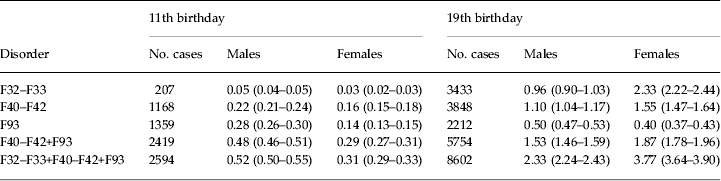
A total of 907 806 children and adolescents born 1992–2008 were included in the study. A total of 3433 subjects were identified with onset of unipolar depressive disorder (F32–F33) (207 subjects before the 11th birthday), and 5754 subjects were identified with onset of anxiety disorder (F40–F42, F93) (2419 subjects before the 11th birthday) (Table 1). In total, 8602 subjects were identified with any emotional disorder.
Cumulative incidencea at 11th and 19th birthdays

a The cumulative incidence measures the probability in percent to have developed the disorder before a certain age taking into account that persons may emigrate or die. The numbers in parentheses indicate 95% confidence intervals. Disorders are not mutually exclusive.
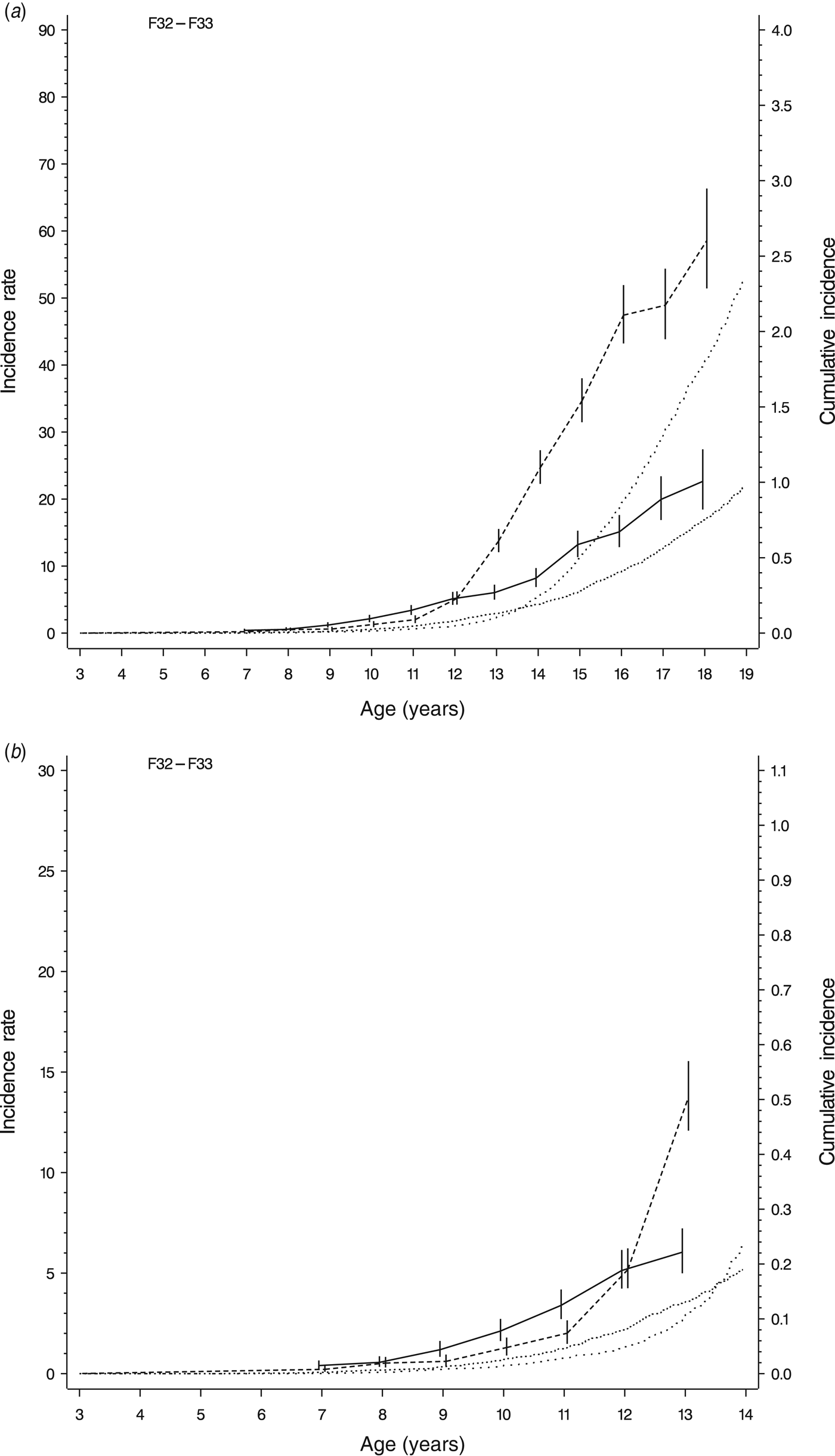
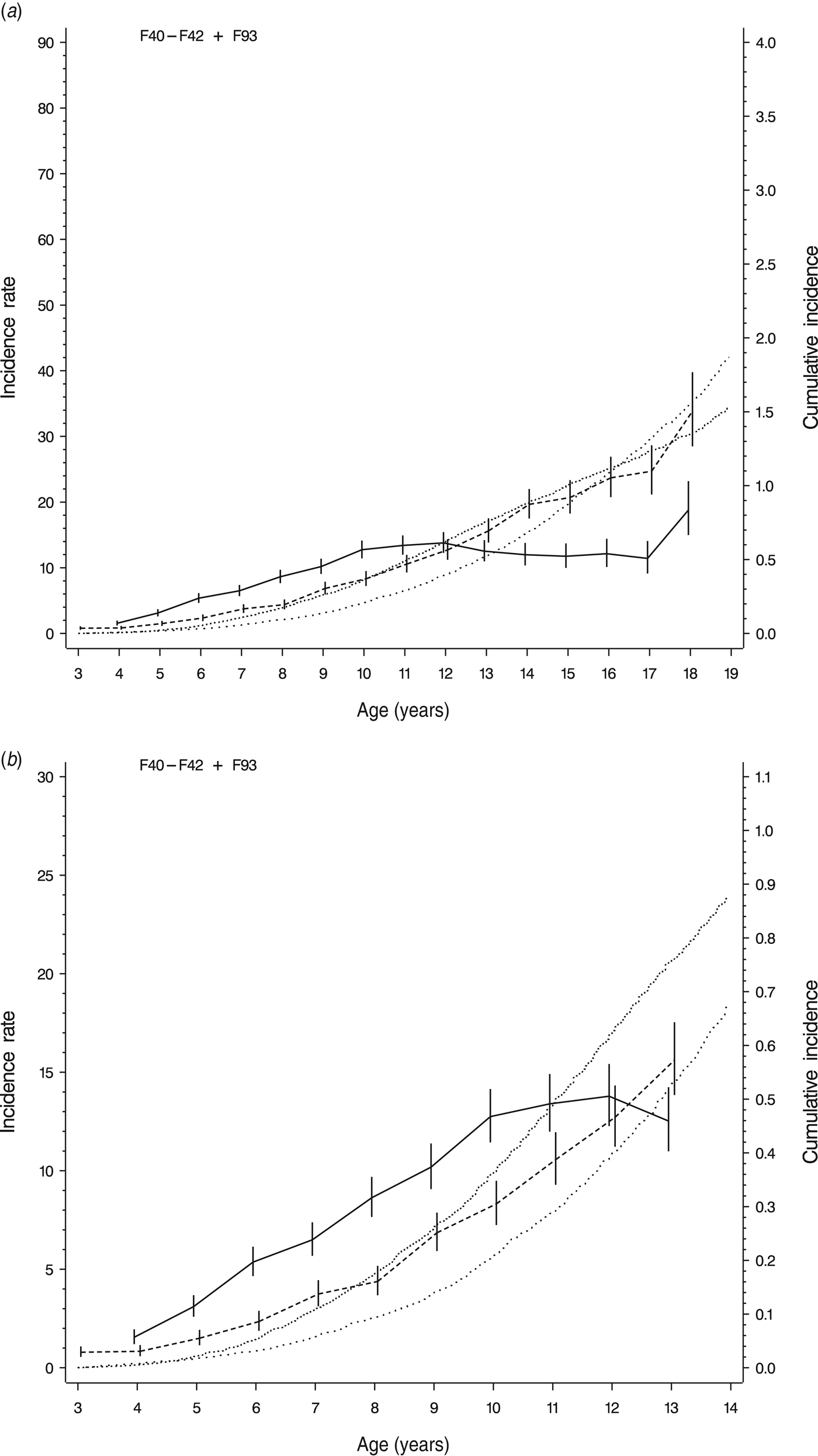
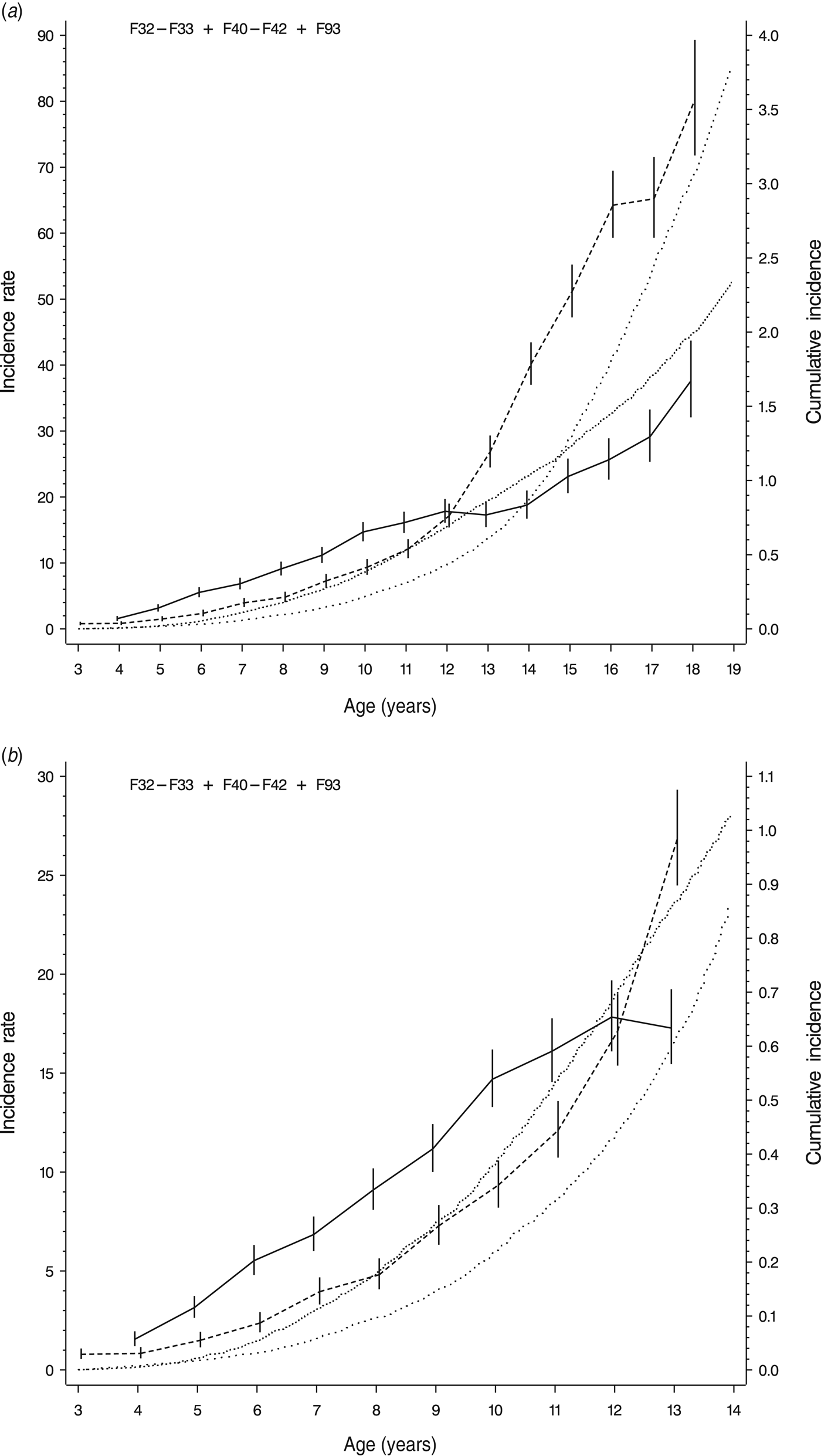
The incidence rates for emotional disorders are listed in Figs 1–3. The solid and dashed lines show the age-specific incidence rates for boys and girls, respectively, and the dotted lines show the age-specific cumulative incidence. The cumulative incidence measures the probability of having been diagnosed before a given age. Since the cumulative incidence is estimated continuously with respect to age and the incidence rates are estimated in age intervals, the x-axis for the cumulative incidence measures the exact age, whereas the x-axis for the incidence rate measures the lowest cut-point for the age interval. In Fig. 1, for example, the incidence rate for females aged 10.00–10.99 years is 1.30 (95% CI 0.92–1.83) per 10 000 person-years at risk, and the cumulative incidence for females on their 11th birthday is 0.03% (95% CI 0.02–0.03).
(a) Incidence rate for emotional disorders (ICD-10: F32–F33); (b) zoomed data. Solid and dashed lines show the age-specific incidence (for boys and girls respectively) with the left-hand vertical axis denoting the incidence rate per 10 000 person-years. The dotted lines show the age-specific cumulative incidence with the right-hand vertical axis denoting the cumulative incidence in percent (·····, males; · · · ·, females). Solid vertical lines indicate 95% confidence intervals.

As expected, incidence rates for depressive disorders, anxiety disorders and emotional disorders with onset specific to childhood were highest for girls after the onset of puberty. However, before puberty, males had the highest incidence rates. At age 12 years, the incidence rates were equal for boys and girls.
The cumulative incidence for any emotional disorder (F32–F33, F40–F42, F93) on the 11th birthday was 0.52% (95% CI 0.50–0.55) for boys and 0.31% (95% CI 0.29–0.33) for girls (Table 1). This pattern had reversed by the 19th birthday; cumulative incidence at this point was 2.33% (95% CI 2.24–2.43) for boys and 3.77% (95% CI 3.64–3.90) for girls.
We tested our null hypothesis that the age-specific incidence rates for emotional disorders were identical for boys and girls before puberty, defined as before the 11th birthday. Our null hypothesis was rejected due to a significant association between the age-specific incidence rates and gender for both depressive disorders (F32–F33, p = 0.00144), anxiety disorders (F40–F42, F93, p < 0.00001), and any emotional disorder (p < 0.00001).
Our results show a gender–age interaction with a male preponderance before the 11th birthday, and a female preponderance thereafter. This pattern was found for both depressive disorders and anxiety disorders, supporting the theories of an anxious-affective spectrum (Hudson et al. Reference Hudson, Mangweth, Pope, De Col, Hausmann, Gutweniger, Laird, Biebl and Tsuang2003; Middeldorp et al. Reference Middeldorp, Cath, Van Dyck and Boomsma2005; Hettema, Reference Hettema2008; Gardner & Boles, Reference Gardner and Boles2011).
Discussion
Our cohort study of 907 806 children and adolescents linked data from the national registers and comprised a clinical sub-cohort of 3433 subjects with unipolar depressive disorder (F32–F33) and 5754 subjects with anxiety disorder (F40–F42, F93). A total of 8602 subjects acquired any of the emotional disorders, and 2594 of these had a pre-pubertal onset. Our comprehensive data show that male gender is associated with pre-pubertal emotional disorder, while female gender is associated with post-pubertal emotional disorder.
This is to our knowledge the first nationwide study, examining the incidence rate of emotional disorders before and after puberty in a population-based sample. The sample includes all Danish children whose parents were born in Denmark. Furthermore, by describing incidence rather than prevalence rates, our study is better suited for aetiological assumptions, since prevalence reflects both the incidence and the duration of a disease and ignores bias due to migration and death.
Recent (Merikangas et al. Reference Merikangas, He, Brody, Fisher, Bourdon and Koretz2010; Bufferd et al. Reference Bufferd, Dougherty, Carlson, Rose and Klein2012; Sarkar et al. Reference Sarkar, Sinha and Praharaj2012; Vicente et al. Reference Vicente, Saldivia, de la Barra, Kohn, Pihan, Valdivia, Rioseco and Melipillan2012) as well as earlier (Costello et al. Reference Costello, Mustillo, Erkanli, Keeler and Angold2003; Ford et al. Reference Ford, Goodman and Meltzer2003) prevalence studies of depressive disorder are in favour of our null hypothesis that the two genders show identical age-specific pre-pubertal rates. The studies represent community samples from different cultural settings. However, other community studies are in favour of our findings of a male pre-pubertal preponderance of depressive disorder, both within the Nordic countries (Almqvist et al. Reference Almqvist, Puura, Kumpulainen, Tuompo-Johansson, Henttonen, Huikko, Linna, Ikaheimo, Aronen, Katainen, Piha, Moilanen, Rasanen and Tamminen1999; Petersen et al. Reference Petersen, Bilenberg, Hoerder and Gillberg2006; Wichstrom et al. Reference Wichstrom, Berg-Nielsen, Angold, Egger, Solheim and Sveen2012) and outside (Verhulst et al. Reference Verhulst, Berden and Sanders-Woudstra1985; Anderson et al. Reference Anderson, Williams, McGee and Silva1987; McGee et al. Reference McGee, Feehan, Williams and Anderson1992; Gomez-Beneyto et al. Reference Gomez-Beneyto, Bonet, Catala, Puche and Vila1994; Angold et al. Reference Angold, Costello and Worthman1998). Additionally, three studies have shown tendencies towards a male preponderance (Cohen et al. Reference Cohen, Cohen, Kasen, Velez, Hartmark, Johnson, Rojas, Brook and Streuning1993; Kroes et al. Reference Kroes, Kalff, Kessels, Steyaert, Feron, van Someren, Hurks, Hendriksen, van Zeben, Rozendaal, Crolla, Troost, Jolles and Vles2001; Steinhausen & Winkler Metzke, Reference Steinhausen and Winkler Metzke2003). We only identified one study using register data of incidence rates, and it supported our findings with significantly more males (62.4%) than females (37.6%) acquiring pre-pubertal depressive disorder (Carballo et al. Reference Carballo, Munoz-Lorenzo, Blasco-Fontecilla, Lopez-Castroman, Garcia-Nieto, Dervic, Oquendo and Baca-Garcia2011). We have found few studies examining the gender distribution of anxiety disorder before puberty (Verhulst et al. Reference Verhulst, Berden and Sanders-Woudstra1985; Almqvist et al. Reference Almqvist, Puura, Kumpulainen, Tuompo-Johansson, Henttonen, Huikko, Linna, Ikaheimo, Aronen, Katainen, Piha, Moilanen, Rasanen and Tamminen1999; Kroes et al. Reference Kroes, Kalff, Kessels, Steyaert, Feron, van Someren, Hurks, Hendriksen, van Zeben, Rozendaal, Crolla, Troost, Jolles and Vles2001; Vicente et al. Reference Vicente, Saldivia, de la Barra, Kohn, Pihan, Valdivia, Rioseco and Melipillan2012; Wichstrom et al. Reference Wichstrom, Berg-Nielsen, Angold, Egger, Solheim and Sveen2012), and only one corroborated our findings (Verhulst et al. Reference Verhulst, Berden and Sanders-Woudstra1985).
Compared to our study, existing prevalence and incidence studies are characterized by using smaller samples, only one study, for example, included more than 10 000 participants (approximately 200 were designated as subjects with pre-pubertal emotional disorders; Ford et al. Reference Ford, Goodman and Meltzer2003). Moreover, the affected samples in general are markedly smaller, with only one study (the register study by Carballo et al. N = 528) (Carballo et al. Reference Carballo, Munoz-Lorenzo, Blasco-Fontecilla, Lopez-Castroman, Garcia-Nieto, Dervic, Oquendo and Baca-Garcia2011) including more than 500 subjects with depressive disorder. None of the studies we identified included more than 500 subjects with anxiety disorders, and none included nearly as many pre-pubertal affected subjects as were included in this study (N = 2594).
The discrepancies regarding gender distribution that emerge from some prevalence studies compared to our incidence study could reflect the fact that incidence rates are not biased by a possible association between gender and disorder duration. So, if female gender is associated with longer duration of emotional disorders, as has been demonstrated (Essau et al. Reference Essau, Lewinsohn, Seeley and Sasagawa2010), it could produce higher female prevalence rates, even if males are more often affected. The discrepancies could also be due to different diagnostic classification systems, since the prevalence studies that we identified were all based on the DSM-IV classification.
Another important difference is that our results are based on a thorough clinical assessment, which in Denmark is likely to include medical examination, cognitive testing, family interviews and diagnostic assessment. Even though the validity of the registered clinical diagnoses could be questioned, the data reported to the Danish Psychiatric Central Research Register are electronically validated (Mors et al. Reference Mors, Perto and Mortensen2011), and the validity of depressive disorder diagnoses in adults is found to be sufficient (Bock et al. Reference Bock, Bukh, Vinberg, Gether and Kessing2009). The coverage is considered to be almost complete (Mors et al. Reference Mors, Perto and Mortensen2011), although child and adolescent psychiatrists in private practice and private out-patient units do not report to the Danish Psychiatric Central Research Register.
Regardless of their internal validity, the use of clinical in-patient and out-patient diagnoses impairs external validity. Hence, our results are not necessarily representative of a non-clinical depressed sample. A non-clinical depressed sample could display a different gender pattern, if male gender is associated with a more severe depressive pre-pubertal phenotype, leading to more frequent referral to psychiatric clinics. This is partly demonstrated by Kroes et al. who showed that girls aged 6–8 years have more depressive symptoms than boys but that, taking into account parent-rated need for help, boys predominate (Kroes et al. Reference Kroes, Kalff, Kessels, Steyaert, Feron, van Someren, Hurks, Hendriksen, van Zeben, Rozendaal, Crolla, Troost, Jolles and Vles2001). Still, if this explains the male predominance in our study, it confirms an association of male gender with severe pre-pubertal depression that needs to be explored further. It is also possible that boys are more frequently referred to treatment due to a more externalizing clinical presentation of depressive and anxiety disorders compared to girls. Our study is, however, based on ICD-10 diagnoses and omits irritability as a depressive symptom, and no gender differences were found for depressive symptoms in a Danish clinical sample aged 8–13 years (Sorensen et al. Reference Sorensen, Nissen, Mors and Thomsen2005).
Some studies divide groups into children and adolescents by pubertal status (Copeland et al. Reference Copeland, Shanahan, Miller, Costello, Angold and Maughan2010). Unfortunately, this was not possible here due to the register study design. In our tests of the null-hypothesis, we defined puberty onset as the 11th birthday. This chronological cut-off in both girls and boys may have affected our results slightly, while boys go into puberty later than girls. Still, irrespectively of the cut-off chosen to define puberty, the two genders show different age-specific incidence rates from birth to early adulthood. In addition, we defined disorder onset as the first day of the first contact. However, subjects with a pre-pubertal disorder onset might have experienced latency in referral and subsequently, some of them might have been included in the post-pubertal onset group. This would lead to an underestimation of our results.
Our findings of an increased onset of emotional disorder in pre-pubertal boys could reflect an increased referral of boys to mental healthcare, due to more externalizing co-morbid disorders. We did not explore the amount of co-morbid disorders, while the aim of our study was to present gender- and age-specific incidence rates and cumulative incidence in accordance with the Danish national registers.
A decreased referral of girls with emotional disorders to mental healthcare, due to a possible gender-related difference in referral threshold, could also influence our results. While a discrepancy in referral thresholds could explain the male preponderance before puberty, it would, however, not explain later the female preponderance. We do not suspect that hesitancy in referring girls with depression would change markedly after puberty, unless it was related to an actual worsening of the symptoms.
If our findings were mainly a result of referral bias due to increased referral of boys or a higher referral threshold for girls before puberty, we would not expect several studies of non-clinical samples to show the same pattern (Verhulst et al. Reference Verhulst, Berden and Sanders-Woudstra1985; Anderson et al. Reference Anderson, Williams, McGee and Silva1987; McGee et al. Reference McGee, Feehan, Williams and Anderson1992; Gomez-Beneyto et al. Reference Gomez-Beneyto, Bonet, Catala, Puche and Vila1994; Angold et al. Reference Angold, Costello and Worthman1998; Almqvist et al. Reference Almqvist, Puura, Kumpulainen, Tuompo-Johansson, Henttonen, Huikko, Linna, Ikaheimo, Aronen, Katainen, Piha, Moilanen, Rasanen and Tamminen1999; Petersen et al. Reference Petersen, Bilenberg, Hoerder and Gillberg2006; Wichstrom et al. Reference Wichstrom, Berg-Nielsen, Angold, Egger, Solheim and Sveen2012). Neither, would we expect this referral pattern to reverse at puberty. Still, our findings need to be replicated in large-scale non-clinical samples and in other cultural settings.
Our results suggest that boys are more vulnerable to emotional disorders before puberty than girls. This questions the general assumption that a male pre-pubertal preponderance only accounts for neurodevelopmental disorders. It is possible that males have a generalized pre-pubertal vulnerability towards a broader spectrum of mental disorders. A pre-pubertal male vulnerability towards mental disorders could be explained by a gender-associated genetic vulnerability. If this is the case, it would probably be better viewed as a genetic susceptibility that is highly sensitive to both risk factors and resilience factors (Belsky et al. Reference Belsky, Jonassaint, Pluess, Stanton, Brummett and Williams2009). Thus, a male pre-pubertal susceptibility could indicate a potential for prevention and intervention, if risk and resilience factors can be identified.
While it seems as though boys’ vulnerability to developing emotional disorder is fairly stable over time, girls appear to be more resilient to emotional disorders before puberty and markedly more vulnerable after puberty than boys. If pre-pubertal resilience factors associated with female gender can be identified, they would also be obvious targets for prevention and intervention programmes.
Based on our study design, we can only speculate what the causal mechanisms for gender and emotional disorders might be. Rutter et al. point both to gender-specific genetic differences and their biological consequences, and to diverse exposure and vulnerability towards stressful or protective environments as possible causal mechanisms (Rutter et al. Reference Rutter, Caspi and Moffitt2003). Supporting this, studies imply that the types of life event that cause distress differ for boys and girls, as does their sensitivity towards them (Zahn-Waxler et al. Reference Zahn-Waxler, Shirtcliff and Marceau2008; Oldehinkel & Bouma, Reference Oldehinkel and Bouma2011; Thapar et al. Reference Thapar, Collishaw, Pine and Thapar2012). This gender difference in stressors is also found in adults (Angst et al. Reference Angst, Gamma, Gastpar, Lepine, Mendlewicz and Tylee2002). Regardless, of whether the causality of gender works primarily through genetic or environmental pathways, identification of early gender-specific risk and resilience factors is important in preventing development of emotional disorders. Early prevention is indicated, not least because pre-pubertal anxiety and depressive disorders have a poor outcome in later adulthood, with high rates of attempted suicide, high utilization of psychiatric treatment and extensive social impairment (Weissman et al. Reference Weissman, Wolk, Wickramaratne, Goldstein, Adams, Greenwald, Ryan, Dahl and Steinberg1999). Furthermore, childhood-onset depressive disorder is associated with higher recurrence, longer episode duration and increased suicidality compared to adult-onset disorders (Kovacs, Reference Kovacs1996; Korczak & Goldstein, Reference Korczak and Goldstein2009). Similarly, anxiety disorders display a chronic course, usually occurring in childhood and persisting into adulthood (Merikangas, Reference Merikangas2005).
The gender ratio of emotional disorders before puberty has so far been unclear. We present robust findings of a gender–age interaction with a male preponderance before puberty and a female preponderance after. The gender–age interaction is present for both depressive disorders and anxiety disorders, supporting existing theories of an affective-anxious spectrum (Hudson et al. Reference Hudson, Mangweth, Pope, De Col, Hausmann, Gutweniger, Laird, Biebl and Tsuang2003; Middeldorp et al. Reference Middeldorp, Cath, Van Dyck and Boomsma2005; Weissman et al. Reference Weissman, Wickramaratne, Nomura, Warner, Verdeli, Pilowsky, Grillon and Bruder2005; Hettema, Reference Hettema2008; Gardner & Boles, Reference Gardner and Boles2011).
We hypothesize that males have a generalized pre-pubertal vulnerability towards a broader spectrum of mental disorders, rather than just neurodevelopmental disorders. This, however, needs to be replicated in other large-scale studies of clinical and non-clinical samples. Causal studies exploring this gender–age interaction are needed, and we recommend that more attention is paid to identifying gender-associated risk and resilience factors in childhood.
(a) Incidence rate for emotional disorders (ICD-10: F40–F42; F93); (b) zoomed data. Solid and dashed lines show the age-specific incidence (for boys and girls respectively) with the left-hand vertical axis denoting the incidence rate per 10 000 person-years. The dotted lines show the age-specific cumulative incidence with the right-hand vertical axis denoting the cumulative incidence in percent (·····, males; · · · ·, females). Solid vertical lines indicate 95% confidence intervals.

(a) Incidence rate for emotional disorders (ICD-10: F32–F33; F40–F42; F93); (b) zoomed data. Solid and dashed lines show the age-specific incidence (for boys and girls respectively) with the left-hand vertical axis denoting the incidence rate per 10 000 person-years. The dotted lines show the age-specific cumulative incidence with the right-hand vertical axis denoting the cumulative incidence in percent (·····, males; · · · ·, females). Solid vertical lines indicate 95% confidence intervals.

Acknowledgements
This study was funded by grants from the Psychiatric Research Fund of the Region of Southern Denmark and the Lundbeck Foundation, Copenhagen. The funders had no involvement in any aspect of the study.
Declaration of Interest
Niels Bilenberg has received honoraria for lectures from Bristol-Myers and Eli Lilly.