Suicide is a significant global public health issue, responsible for approximately 800 000 deaths annually and having a profound impact on individuals, families and society. Suicidal ideation, characterised by persistent thoughts or plans regarding suicide, acts as a warning signal for potential suicidal behaviour(Reference Hoopsick and Yockey1). Global studies have suggested that the lifetime prevalence of suicidal ideation exhibits considerable variability across countries and regions, typically ranging from 3 % to 9 %(Reference Nock, Borges and Bromet2). Suicidal ideation is not merely a manifestation of psychological distress but also serves as a robust predictor of future suicide attempts and behaviour. Research has demonstrated that individuals who experience suicidal ideation are more likely to engage in suicidal behaviour than those without such thoughts(Reference Nock, Hwang and Sampson3). Additionally, early identification and targeted intervention for suicidal ideation are critical to preventing suicidal behaviour, necessitating comprehensive mental health services, robust social support and effective psychotherapies, such as cognitive-behavioural therapy and dialectical behaviour therapy(Reference Mann, Apter and Bertolote4). Social and economic factors, including food security, can also potentially impact suicidal ideation(Reference Davison, Marshall-Fabien and Tecson5).
Access to enough safe, nourishing food that satisfies dietary requirements and preferences for an active and healthy life at all times is a prerequisite for food security(Reference Shiratori, Tobita and Sawadogo-Compaoré6). However, food security remains a significant global issue, particularly in low- and middle-income countries. In 2019, approximately 690 million people were afflicted with hunger, and nearly 2·49 billion lacked regular access to safe, nutritious and sufficient food(7). Although absolute hunger is uncommon in developed countries, food insecurity persists among low-income households. Food insecurity contributes to malnutrition, an increased risk of chronic diseases and mental health issues(Reference Zhao, Andreyeva and Sun8,Reference Cook, Black and Chilton9) . Consequently, food security transcends a mere nutritional issue and constitutes a comprehensive public health concern.
Extensive research has shown that food insecurity raises levels of psychological stress and anxiety, which in turn elevates the incidence of suicidal ideation(Reference McIntyre, Williams and Lavorato10–Reference Chung, Kim and Kwak12). Interventions aimed at addressing food insecurity may reduce the incidence and mortality linked to suicide(Reference Roy, Aktarujjaman and Siddiky13). Studies have revealed that adults experiencing food insecurity exhibit a significantly higher proportion of suicidal ideation than those who are food-secure(Reference Davison, Gondara and Kaplan14). Food insecurity among veterans was linked to an increase in depressive symptoms and suicidal tendencies, with the correlation becoming more pronounced as the level of food insecurity worsened(Reference Kamdar, Horning and Geraci15). Nonetheless, a recent systematic review has found that suicide attempts are less frequently reported among individuals facing food insecurity(Reference Kaggwa, Akatussasira and Al-Mamun16), highlighting the complexity and multifactorial nature of the issue.
In light of these findings, the study aimed to further explore the relationship between food insecurity and suicidal ideation, seeking to clarify this connection through extensive data analysis. It was anticipated that the study would furnish policymakers and public health professionals with novel insights and robust evidence to inform the implementation of more effective measures for preventing suicidal behaviour and enhancing the mental health of the population.
Methods
Study design and study population
The National Health and Nutrition Examination Survey (NHANES) constitutes a comprehensive nationwide survey that assesses both the health and nutritional status of children and adults across the USA. The NHANES employs a complex multistage probability sampling design to ensure that the selected sample is representative of the US population. This design process randomly selects geographic areas nationwide, followed by the random selection of households and individuals within each area. This method ensures the randomness and diversity of the sample, allowing the research results to reflect the health status of different communities and populations more accurately. The NHANES questionnaire incorporates demographic, dietary, examination, laboratory and questionnaire data. The Centers for Disease Control and Prevention (CDC) website, https://www.cdc.gov/nchs/nhanes, has all of the statistics that are accessible to the general public. Every participant gave their informed consent, and the National Center for Health Statistics (NCHS) Institutional Review Board authorised the study.
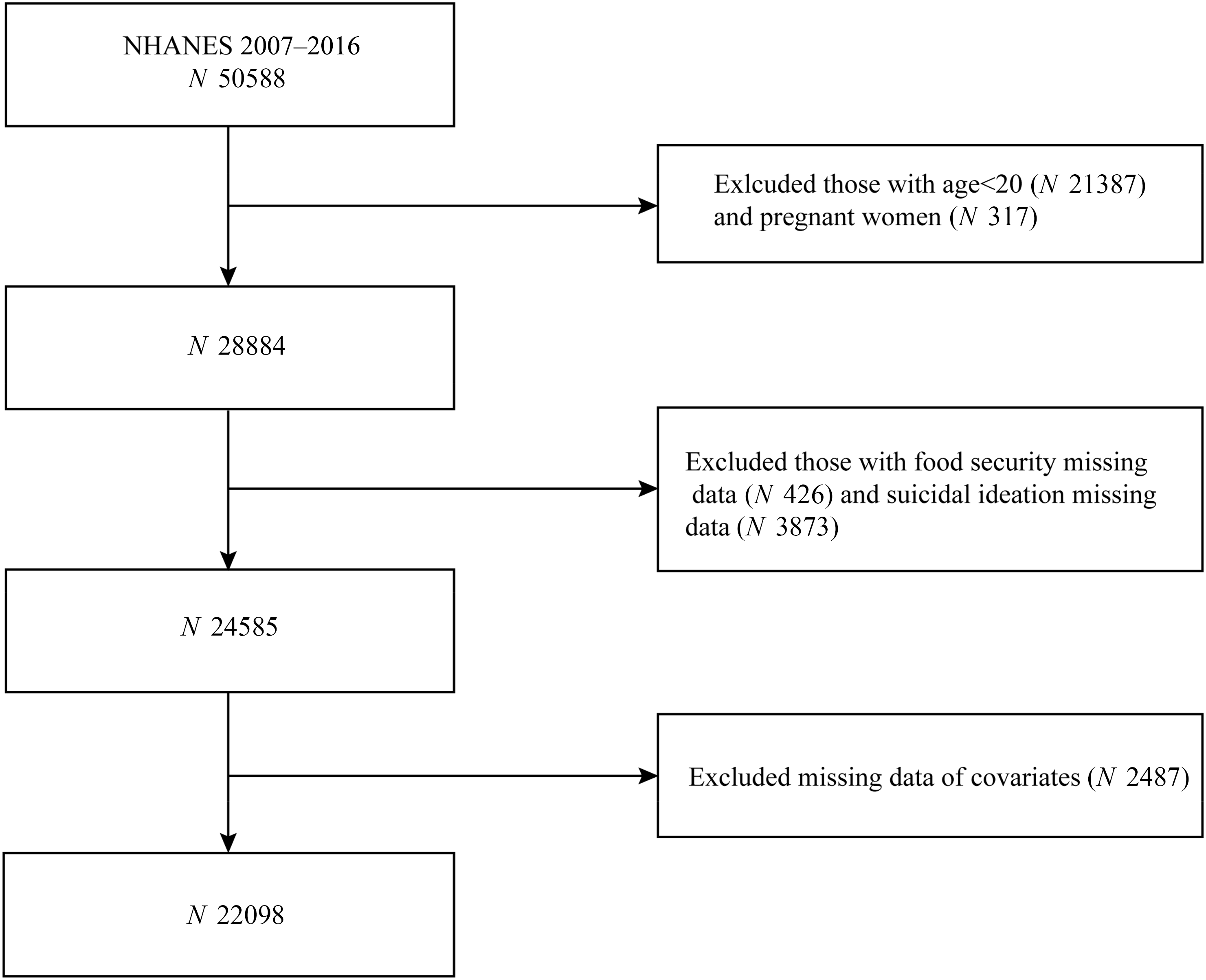
As shown in Figure 1, the initial dataset consisted of 50 588 participants who participated in five NHANES cycles conducted between 2007 and 2016. To refine the analytic sample, we used a series of exclusion criteria. Participants under the age of 20 years were excluded. Additionally, those who were pregnant were excluded due to the potential impact of pregnancy on food safety and mental health outcomes that could confound results. Participants who lacked complete information on food security status or suicidal ideation were also excluded. Finally, participants with missing data on covariates, including key demographic, socio-economic and health-related factors, were also excluded. After these exclusions, 22 098 participants were included in the final analysis.
The flow chart of participants. This study utilised data from NHANES 2007–2016, initially including 50 588 participants. First, individuals younger than 20 years (21 387 individuals) and pregnant individuals (317 individuals) were excluded. Next, participants without information on food security (426 individuals) and those lacking data on suicidal ideation (3873 individuals) were removed. Additionally, 2487 individuals were excluded due to incomplete data on covariates. Ultimately, a total of 22 098 adults with complete data were included in the analysis. NHANES, National Health and Nutrition Examination Survey.

Figure 1 Long description
The flowchart begins with NHANES 2007-2016 data, including 50,588 participants. The first exclusion step removes individuals younger than 20 years (21,387) and pregnant individuals (317), resulting in 28,884 participants. The next step excludes those with missing food security data (426) and missing suicidal ideation data (3,873), leaving 24,585 participants. Finally, participants with missing data on covariates (2,487) are excluded, resulting in a final sample of 22,098 adults with complete data for analysis.
Assessment of suicidal ideation
The Patient Health Questionnaire-9 (PHQ-9) is a nine-item instrument used to assess depressive symptoms experienced over the past two weeks and is recognised as an effective screening tool for depression(Reference Kroenke, Spitzer and Williams17). The presence of suicidal ideation was evaluated through the ninth item of the PHQ-9, which posed the question: ‘Over the last 2 weeks, how often have you been bothered by the following problem: thoughts that you would be better off dead, or of hurting yourself in some way?’ Participants responded on a scale ranging from 0 (not at all) to 3 (nearly every day), with intermediate scores of 1 (several days) and 2 (more than half the days). In the context of this study, a response of 0 indicated the absence of suicidal ideation, whereas responses of 1–3 suggested the presence of suicidal ideation(Reference Wang, Wang and Jia18,Reference Qing, Deng and Zhou19) .
Food security
During household interviews, an adult participant responded to the questions posed by the US Food Security Survey Module (US FSSM). Households with children under 18 completed eighteen items, while households without children addressed ten items. These questions were pertinent to all household members, not solely to the NHANES participants. In this study, the adult food security survey module, which consists of ten items, was utilised as the criterion for assessing food security in households without children, resulting in four categories of food security status: adults with full food security (no affirmative responses), adults with moderate food security (one or two affirmative responses), adults with low food security (three to five affirmative responses) and adults with very low food security (six to ten affirmative responses)(Reference Kim-Tenser, Ovbiagele and Markovic20,Reference Lynch, Petersen and Van Dongen21) .
Covariates
Based on prior research, the subsequent covariates were included in our analysis. Demographic variables comprised sex, age, race, education level, marital status and the poverty income ratio (PIR). Sex was classified as either female or male; race as Mexican American, non-Hispanic Black, non-Hispanic White, other Hispanic or other; education level as less than high school, high school or equivalent, or college and above; and marital status as married/living with partner, widowed/divorced/separated or never married. PIR levels were divided into three categories: ‘Low’ (< 1), ‘Medium’ (1–2·99) and ‘High’ (≥ 3).
BMI was derived from examination data and categorised into three levels: ‘Underweight/Normal’ (≤ 24·99), ‘Overweight’ (25–29·99) and ‘Obese’ (≥ 30). Smoking status was determined based on whether an individual had smoked at least 100 cigarettes in their lifetime, alcohol consumption was quantified by the consumption of twelve or more drinks in any given year and diagnosed chronic somatic diseases (including hypertension, diabetes, arthritis, congestive heart failure, CHD, heart attack, stroke and cancer)(Reference Huang, Zhong and Yan22) were ascertained from questionnaire responses. Having smoked at least 100 cigarettes during one’s lifetime was considered smoking, and alcohol consumption was defined as having had twelve or more drinks in any year. Depression was determined by a PHQ-9 score of 10 or above(Reference Levis, Benedetti and Thombs23,Reference Spitzer, Kroenke and Williams24) . Sleep parameters included average duration and reported sleep disorders. Physical activity was characterised by a minimum of 10 min of continuous moderate to vigorous activity, excluding work or commuting, and classified as either active or inactive(Reference Qi, Wang and Huang25).
Statistical analysis
The mean and standard deviation was used to represent continuous variables with a normal distribution, while the median (interquartile range) was used to represent continuous variables with a non-normal distribution. Frequency and percentage were used to express categorical variables. To compare differences in continuous variables between groups, we used independent sample t tests and Mann–Whitney U tests and employed χ 2 tests for differences in categorical variables.
Using individuals with ‘full food security’ as the reference category, we employed multivariable logistic regression to examine the association between levels of food security and suicidal ideation. The regression models estimated OR with corresponding 95 % CI. An unadjusted model (crude model) was first developed to provide a baseline association without considering confounders. In model 1, adjustments were made for basic demographic factors, including age, sex and race. Model 2 further incorporated additional covariates to account for potential confounding effects, including education level, marital status, PIR, BMI, smoking, alcohol consumption, chronic somatic disease, depression, sleep duration, sleep disorder, health insurance and physical activity.
To better understand the robustness of our findings, we conducted subgroup analyses by stratifying participants according to key factors, including sex, age, race, educational level, marital status, PIR, BMI, smoking, alcohol consumption, chronic somatic disease, depression, sleep duration, sleep disorder, health insurance and physical activity levels. This approach allowed us to assess whether the relationship between food security and suicidal ideation differed across these strata.
In addition, sensitivity analyses were performed to test the consistency of our results. Specifically, we redefined the reference category by combining ‘full food security’ and ‘marginal food security’ into one group and compared it against the ‘low/very low food security’ category.
All statistical analyses were performed using SPSS 25.0 and R 4.3.2, with P < 0·05 considered statistically significant. Based on a power analysis conducted using SPSS, with an effect size of 0·5, an α level of 0·05 and a desired power of 0·80, a minimum sample size of 4632 participants was determined to be required. Our study includes 22 098 participants, which exceeds this minimum requirement, ensuring sufficient power to detect meaningful effects.
Results
Baseline characteristics of the study populations
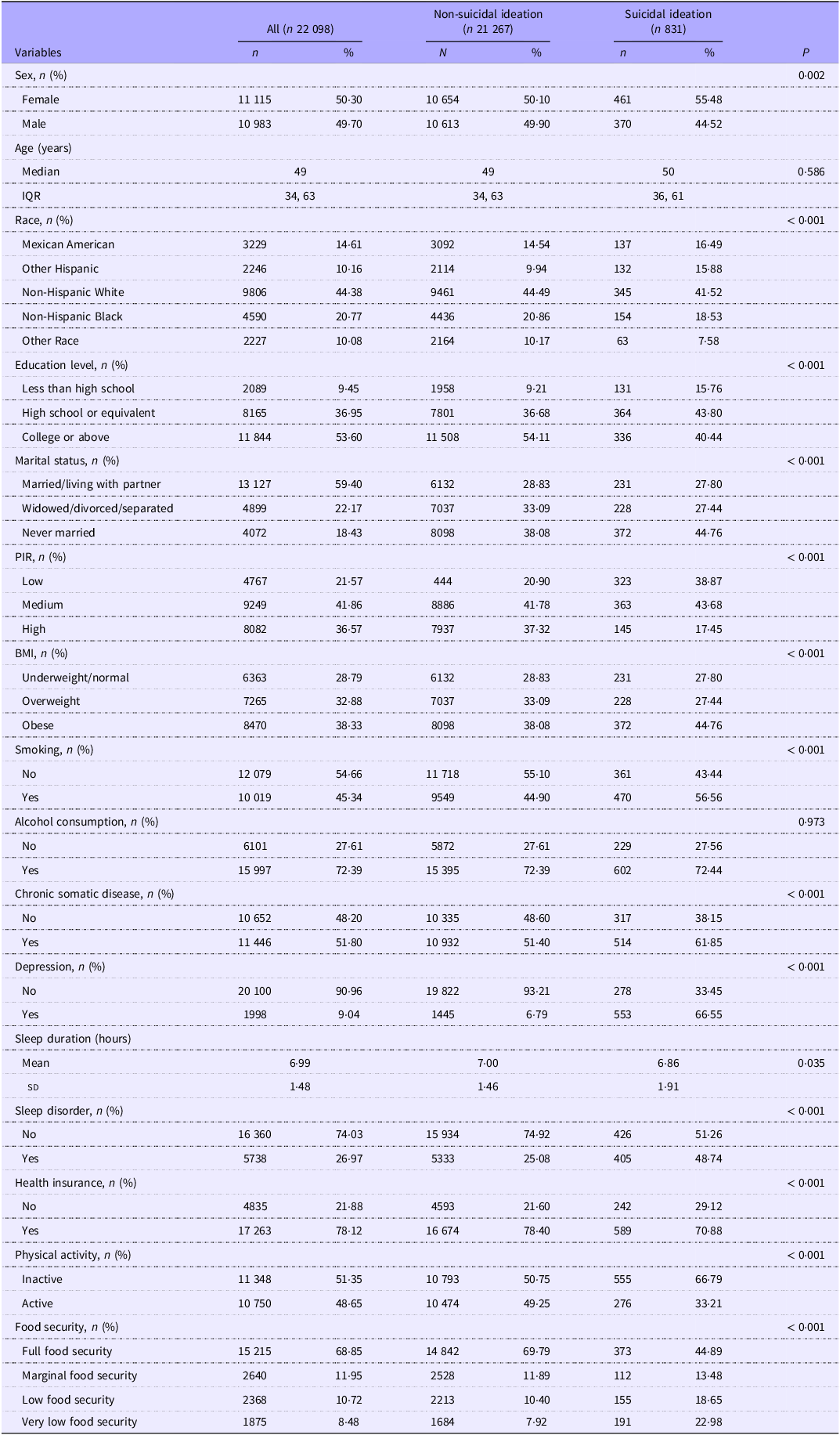
Table 1 illustrates that our study included 22 098 participants, comprising 50·30 % females and 49·70 % males, with a median age of 49 years. Of these, 21 267 participants were without suicidal ideation, while 831 were identified with suicidal ideation. Significant differences were noted between participants with and without suicidal ideation across variables including sex, age, race, education level, marital status, PIR, BMI, smoking status, chronic diseases, depression, sleep patterns, insurance status, physical activity and food security (P < 0·05). Participants with suicidal ideation tended to be female, identify as other Hispanic, be unmarried, have obesity, smoke, lack health insurance, and have diagnoses of chronic somatic disease, depression and sleep disorders. Additionally, they typically had lower education levels, lower PIR, shorter sleep durations, less physical activity and lower levels of food security.
Characteristics of study participants (Numbers and percentages; median values and interquartile ranges; mean values and standard deviations)

Table 1 Long description
The table presents data on 22,098 study participants, divided into those with and without suicidal ideation. It includes variables such as sex, age, race, education level, marital status, PIR, BMI, smoking status, chronic somatic diseases, depression, sleep duration, health insurance, physical activity, and food security. Participants with suicidal ideation are more likely to be female, Hispanic, unmarried, obese, smokers, uninsured, and have chronic diseases, depression, and sleep disorders. They also tend to have lower education levels, lower PIR, shorter sleep durations, less physical activity, and lower food security. The table highlights significant differences between the two groups across these variables.
IQR, interquartile range; PIR, poverty income ratio.
Continuous variables are presented as mean (sd) or median (IQR), while categorical variables are expressed as n (%).
P < 0·05 is statistically significant.
Relationship between food security and suicidal ideation
Table 2 indicates that in the unadjusted model, participants with marginal, low and very low food security had significantly higher odds of suicidal ideation compared with those with full food security, with OR of 1·76 (95 % CI 1·42, 2·18), 2·78 (95 % CI 2·29, 3·37) and 4·51 (95 % CI 3·76, 5·41), respectively. In the fully adjusted model 2, the OR for suicidal ideation were 1·14 (95 % CI 0·89, 1·46) for marginal food security, 1·40 (95 % CI 1·12, 1·76) for low food security and 1·59 (95 % CI 1·27, 1·99) for very low food security, compared with full food security. These results highlight the importance of food security as a potential factor associated with mental health outcomes, particularly for individuals experiencing low or very low food security.
Association between food security and suicidal ideation (Odds ratios and 95 % confidence intervals)

Table 2 Long description
The table presents data on the association between food security and suicidal ideation, showing odds ratios and 95 percent confidence intervals for different levels of food security. The table has five rows and eight columns. The rows are labeled as Full food security, Marginal food security, Low food security, and Very low food security. The columns are labeled as Participants, Crude model OR, Crude model 95 percent CI, Crude model P, Model 1 OR, Model 1 95 percent CI, Model 1 P, Model 2 OR, Model 2 95 percent CI, and Model 2 P. Row 1: Full food security, Participants 15215, Crude model OR 1.00, Crude model 95 percent CI (Ref.), Crude model P, Model 1 OR 1.00, Model 1 95 percent CI (Ref.), Model 1 P, Model 2 OR 1.00, Model 2 95 percent CI (Ref.), Model 2 P. Row 2: Marginal food security, Participants 2640, Crude model OR 1.76, Crude model 95 percent CI 1.42, 2.18, Crude model P less than 0.001, Model 1 OR 1.78, Model 1 95 percent CI 1.43, 2.22, Model 1 P less than 0.001, Model 2 OR 1.14, Model 2 95 percent CI 0.89, 1.46, Model 2 P 0.275. Row 3: Low food security, Participants 2368, Crude model OR 2.78, Crude model 95 percent CI 2.29, 3.37, Crude model P less than 0.001, Model 1 OR 2.77, Model 1 95 percent CI 2.27, 3.38, Model 1 P less than 0.001, Model 2 OR 1.40, Model 2 95 percent CI 1.12, 1.76, Model 2 P 0.003. Row 4: Very low food security, Participants 1875, Crude model OR 4.51, Crude model 95 percent CI 3.76, 5.41, Crude model P less than 0.001, Model 1 OR 4.58, Model 1 95 percent CI 3.80, 5.52, Model 1 P less than 0.001, Model 2 OR 1.59, Model 2 95 percent CI 1.27, 1.99, Model 2 P less than 0.001. The table indicates that participants with marginal, low, and very low food security have significantly higher odds of suicidal ideation compared to those with full food security in the unadjusted model. In the fully adjusted model, the odds ratios for suicidal ideation are 1.14 for marginal food security, 1.40 for low food security, and 1.59 for very low food security, highlighting the importance of food security as a potential factor associated with mental health outcomes.
PIR, poverty income ratio.
The crude model did not adjust for any potential confounders.
Model 1 adjusted for age, sex and race.
Model 2 further adjusted for education level, marital status, PIR, BMI, smoking, alcohol consumption, chronic somatic disease, depression, sleep duration, sleep disorder, health insurance and physical activity.
Bold numbers indicate statistical significance (P < 0·05).
Subgroup and sensitivity analyses
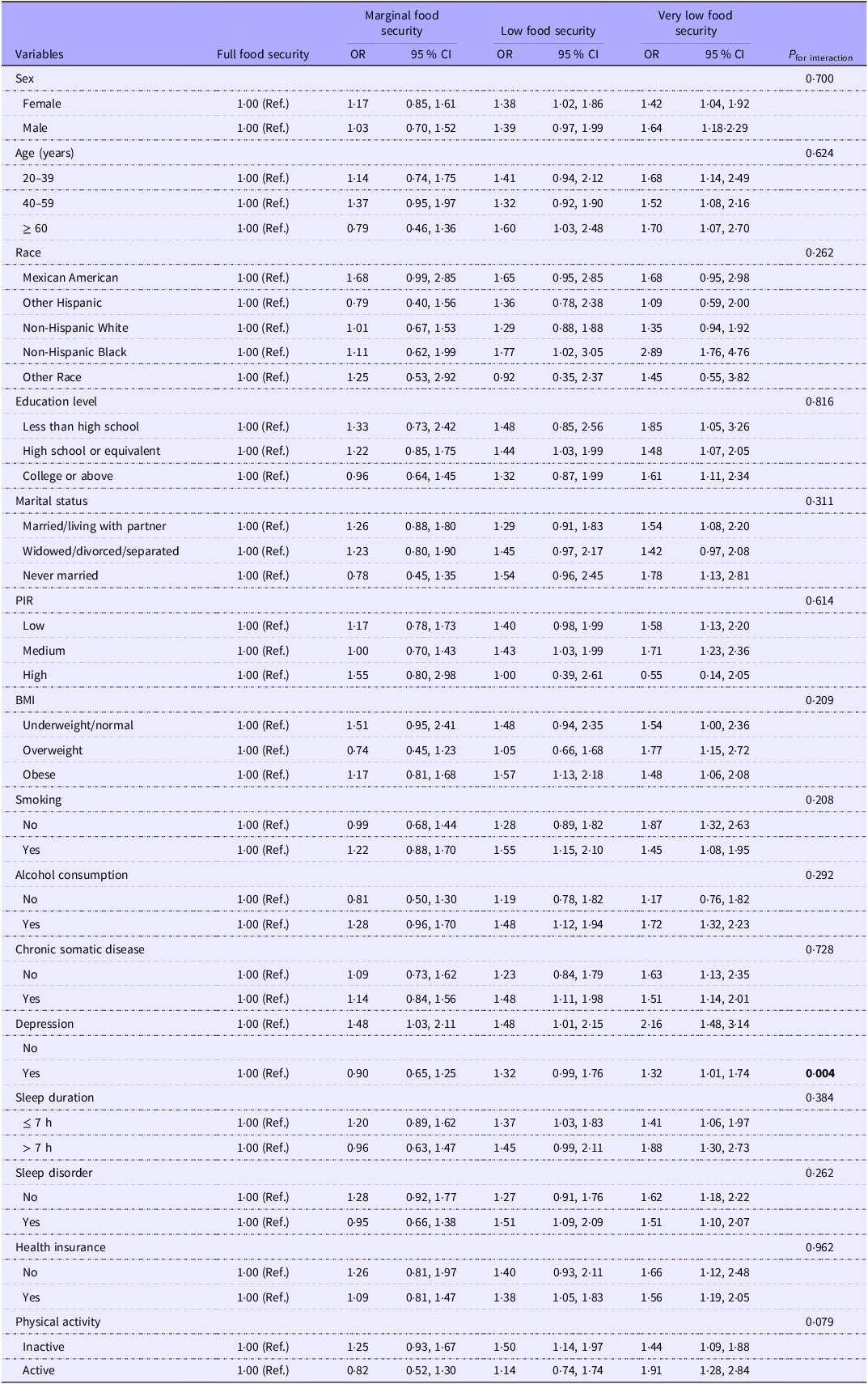
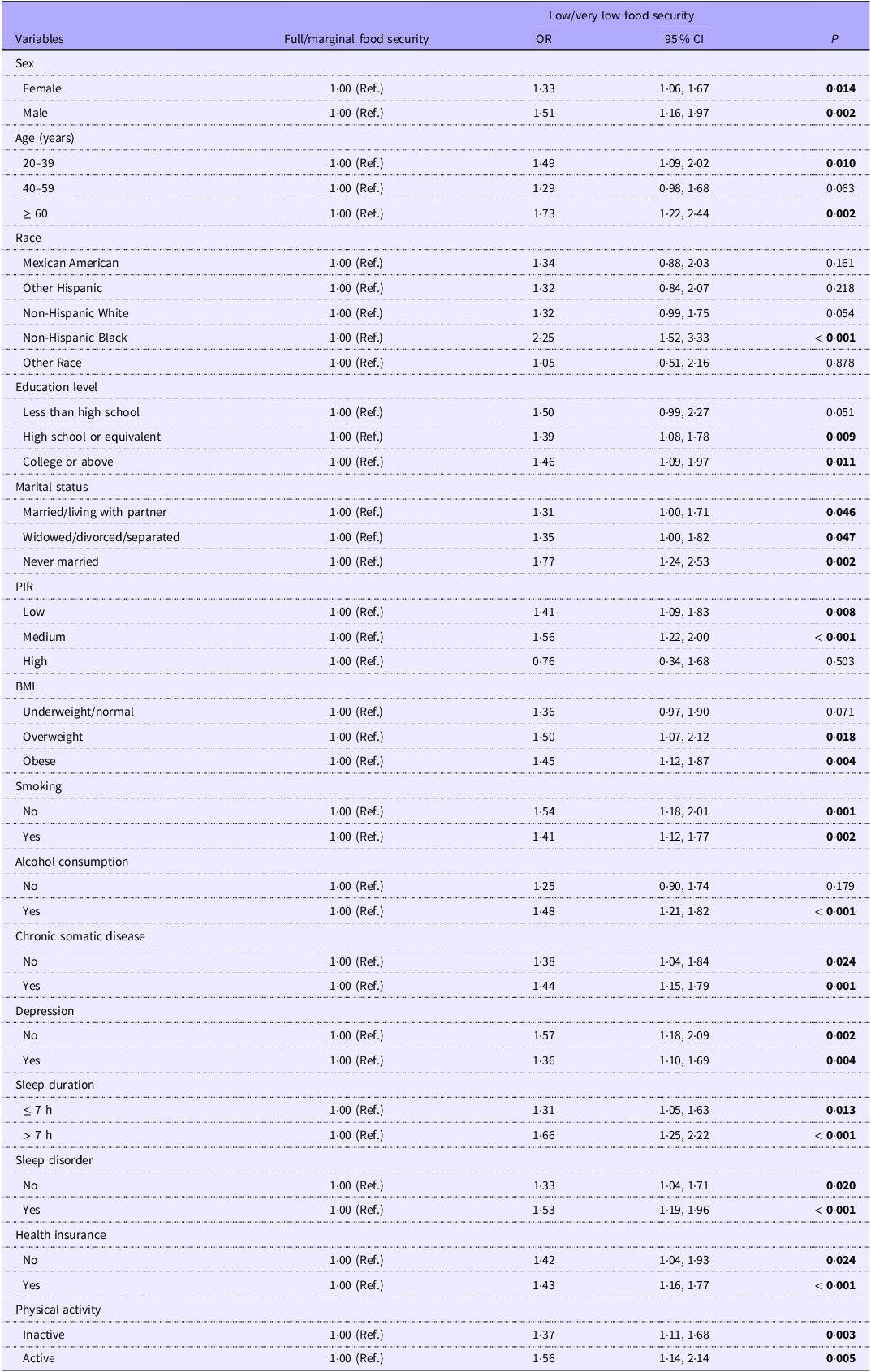
Table 3 presents the findings from subgroup analyses and interaction tests. Subgroup analyses, stratified by various demographic and health factors, consistently demonstrated a significant association between food security and suicidal ideation. Notably, a significant interaction between food security and depression was identified (P = 0·004). In the sensitivity analysis, which compared full and marginal food security as reference groups, the stratified analysis results were consistent with those using full food security alone (Table 4).
Subgroup analysis of the association between food security and suicidal ideation (Odds ratios and 95 % confidence intervals)

Table 3 Long description
The table presents a subgroup analysis of the association between food security and suicidal ideation, displaying odds ratios and ninety-five percentage confidence intervals. The analysis is stratified by various demographic and health factors, including sex, age, race, education level, marital status, poverty-income ratio, body mass index, smoking status, alcohol consumption, chronic somatic disease, depression, sleep duration, sleep disorder, health insurance, and physical activity. The table includes data for full food security, marginal food security, low food security, and very low food security across these factors. Notable trends and interactions are highlighted, such as the significant interaction between food security and depression.
PIR, poverty income ratio.
Bold numbers indicate statistical significance (P < 0·05).
Sensitivity analysis of food security and suicidal ideation (Odds ratios and 95 % confidence intervals)

Table 4 Long description
The table presents a sensitivity analysis of food security and suicidal ideation, displaying odds ratios and 95 percent confidence intervals. It includes variables such as sex, age, race, education level, marital status, PIR, BMI, smoking, alcohol consumption, chronic somatic disease, depression, sleep duration, sleep disorder, health insurance, and physical activity. Each variable is analyzed for its association with low or very low food security. The table has 19 rows and 5 columns, with column headers including Variables, Full/marginal food security, OR, 95 percent CI, and P. Notable trends include higher odds ratios for males, older age groups, non-Hispanic Blacks, and individuals with depression or chronic somatic diseases. The analysis highlights significant interactions, particularly between food security and depression.
PIR, poverty income ratio.
Bold numbers indicate statistical significance (P < 0·05).
Discussion
In our cross-sectional study, we explored the link between food security and suicidal ideation. Our research indicated that people who were food-insecure were more likely to have suicidal ideation. This relationship persisted across various demographic and health-related subgroups. The robustness of these findings was further validated through sensitivity analysis, emphasising the reliability of our observations.
Food insecurity’s link to an increased likelihood of suicidal ideation can be attributed to various factors. First, chronic psychological stress and life difficulties brought on by food insecurity act as significant triggers for such ideation(Reference Arenas, Thomas and Wang26). Notably, when psychological symptoms are most severe, they are typically accompanied by the most severe food shortages(Reference Pourmotabbed, Moradi and Babaei27), indicating that there may be a bidirectional relationship between the two. Elevated levels of individual psychological stress and anxiety due to food insecurity can lead to heightened feelings of depression and hopelessness, which may, in turn, lead to suicidal ideation(Reference Brown, Seligman and Sliwa28). Second, food insecurity often goes hand in hand with low socio-economic status, which can exacerbate mental health struggles(Reference Park and Berkowitz29). The difficulty in acquiring sufficient food due to low income and economic instability may also contribute to feelings of social isolation and a perceived lack of support, both of which are substantial risk factors for suicidal ideation(Reference Melchior, Caspi and Howard30–Reference Scardera, Perret and Ouellet-Morin32). Furthermore, negative impacts on physical health due to food insecurity, such as malnutrition and chronic health issues, which are more common among those experiencing food insecurity, are closely linked with depression and suicidal ideation(Reference Leung, Epel and Willett33). Food insecurity negatively affects health, while deteriorating health conditions increase medical costs and economic burdens, further impacting food insecurity. Our study revealed that individuals with low food security were at a 1·40 times higher risk of suicidal ideation compared with those with adequate food security, and this risk increased to 1·59 times for individuals with very low food security, emphasising the substantial impact of food security on mental health. However, studies presented conflicting evidence, such as one that reported a negative correlation between food insecurity and suicide attempts (OR = 0·622, 95 % CI 0·617, 0·627)(Reference Kaggwa, Akatussasira and Al-Mamun16), suggesting that the characteristics of the study sample and methodological approaches could significantly influence outcomes. This highlights the importance of further research to gain a more comprehensive understanding of the impact of food insecurity on mental health.
Our findings suggested a co-morbidity of suicidal ideation and food insecurity, with the risk of suicidal ideation escalating in parallel with the severity of food insecurity. These findings corroborated similar conclusions from other studies, suggesting a dose–response relationship between food insecurity and suicidal ideation. A study utilising NHANES data demonstrated that, compared with veterans who were food-secure, those with low food security exhibited a 115 % increased likelihood of experiencing suicidal thoughts, while those with very low food security displayed a 384 % increased likelihood(Reference Kamdar, Horning and Geraci15). Poor food security was strongly correlated with the occurrence of suicidal ideation in a nationally representative sample of adult Americans (prevalence ratios = 2·21, 95 % CI 1·32, 3·70), and very low food security had an even stronger association (prevalence ratios = 6·99, 95 % CI 2·71, 10·83)(Reference Olsen, Dodd and Crow34). The dose–response relationship between food insecurity and suicidal ideation was further confirmed by another study that demonstrated a 32 % and 77 % increase in the risk of moderate food insecurity and severe food insecurity, respectively(Reference Davison, Marshall-Fabien and Tecson5).
Previous research has established that the severity of depression correlates with suicidal ideation(Reference Keilp, Grunebaum and Gorlyn35), and individuals with mental disorders exhibit a higher risk of suicide(Reference Turecki and Brent36). In our subgroup analysis, we identified a significant interaction between depression and food security influencing suicidal ideation. Specifically, the influence of food security on suicidal ideation was more pronounced among individuals without depression. Although low food security still heightened the risk of suicidal ideation among individuals with depression, this elevation was not statistically significant. This might be explained by the fact that these people already have a great deal of psychological stress; subsequently, the extra weight of food insecurity has no effect. However, this does not imply that food security issues should be ignored, as they still adversely affect overall health and quality of life. In contrast, the correlation between low food security and suicidal ideation was more robust among non-depressed individuals. This may be due to non-depressed individuals lacking the coping mechanisms and experience to manage the stress of food insecurity, rendering them more vulnerable to suicidal ideation.
This study has several limitations. First, being a cross-sectional study, it precludes the determination of a causal relationship between food security and suicidal ideation. Second, despite adjusting for potential confounders, the presence of unknown covariates may still impact the validity of the results. Lastly, considering that the study’s data came from the American public, the results might not apply to other nations or areas.
Conclusions
Our findings suggest that individuals experiencing food insecurity are at an elevated risk of developing suicidal ideation, reinforcing the critical role of food security as a social determinant of mental health and behaviour. Public policies should therefore prioritise food security as an integral component of mental health strategies. Specific policy recommendations include expanding access to the Supplemental Nutrition Assistance Program (SNAP), implementing food voucher programmes and providing nutritional subsidies, particularly for vulnerable populations. These measures should be integrated into existing mental health services to ensure access to adequate nutrition as part of a comprehensive approach to care. To address the intertwined challenges of food insecurity and mental health, it is essential to increase public awareness through media outreach and community-based activities. Advocates and non-governmental organisations can play a vital role in driving policy change and fostering public discourse on this issue. Moreover, community-based support systems that combine food assistance with mental health resources may help mitigate the psychological impacts of food insecurity. Future research should involve larger and more diverse populations across countries and regions to further validate and generalise our findings.
Acknowledgements
The authors thank all the staff in the NHANES for sharing data publicly.
The authors have no funding to report.
The authors’ responsibilities were as follows – W. W. Z. involved in data cleaning, statistical analysis and interpretation, and writing the manuscript; X. L. Y. took primary responsibility for the final content and was involved in assisting and guiding the interpretation of the study data and revising the manuscript; all authors read and approved the final manuscript.
The authors declare that there are no conflicts of interest related to this study. The authors have no direct or indirect financial, personal or professional relationships that could be perceived to influence the validity of their findings.
The data in our study are publicly available online from the NHANES (https://www.cdc.gov/nchs/nhanes/index.htm).
The study was conducted according to the guidelines of the Declaration of Helsinki. All study participants gave informed consent following the Institutional Review Board and study ethics guidelines at the Centers for Disease Control and Prevention.