





Introduction
Dangerous heat-related illnesses range from heat exhaustion (HE) to heat stroke (HS) Reference Sorensen and Hess1 and represent a growing global health concern. Reference Mora, Dousset and Caldwell2–Reference Bouchama, Abuyassin and Lehe4 These conditions cause approximately 1,220 deaths annually in the United States. 5 Heat stroke, the most severe form, occurs when excessive heat accumulation overwhelms the body’s thermoregulatory capacity; this heat accumulation leads to core body temperatures exceeding 40°C and central nervous system dysfunction. Reference Roberts, Armstrong, Sawka, Yeargin, Heled and O’Connor6–Reference Glazer9 Vulnerable populations include young, active individuals such as athletes, outdoor workers, and military personnel who are at heightened risk due to prolonged exposure to heat and strenuous physical activity. 10–Reference Clowes and O’Donnell12
Sustained hyperthermia can rapidly progress to cellular injury, multi-organ dysfunction, and death, making prompt cooling essential to prevent irreversible injury. Reference Bouchama, Abuyassin and Lehe4,Reference Clowes and O’Donnell12–Reference Sandor and Howe20
Mortality rates from HS range from four percent to 85% and are influenced by factors such as the duration and severity of heat exposure, the chosen cooling method, and pre-existing medical conditions. Reference DeGroot, Henderson and O’Connor21,Reference Tustin, Cannon, Arbury, Thomas and Hodgson22 McDermott, et al identified cooling rates of ≥0.155°C/minute as ideal, 0.078-0.154°C/minute as acceptable, and ≤0.078°C/minute as insufficient. Reference McDermott, Casa and Ganio23 Despite advances in cooling techniques, challenges remain in implementing effective treatments. This is particularly true in prehospital or remote settings where resources may be limited.
Cooling is classified as conductive or evaporative. Reference DeGroot, O’Connor and Roberts13 Conductive methods, such as the gold standard treatment of whole-body immersion in cold or ice water, Reference Roberts, Armstrong, Sawka, Yeargin, Heled and O’Connor6,Reference Casa, McDermott, Lee, Yeargin, Armstrong and Maresh24 achieve rapid cooling by maximizing the temperature gradient between the core and skin. Reference Bouchama and Knochel7,Reference Bouchama, Dehbi and Chaves-Carballo25,Reference Wyndham, Strydom and Cooke26 Evaporative methods rely on wetting the body or applying damp gauze coupled with continuous airflow to promote heat loss through evaporation. Reference DeGroot, O’Connor and Roberts13 However, the practical application of these methods in field settings is often constrained by the availability of water, power, and transportable equipment.
Cold-water immersion is considered the gold-standard treatment for exertional HS because it provides rapid whole-body conductive cooling. Reference Roberts, Armstrong, Sawka, Yeargin, Heled and O’Connor6,Reference McDermott, Casa and Ganio23–Reference Bouchama, Dehbi and Chaves-Carballo25 However, its implementation may be difficult in prehospital and remote environments because it requires a suitable immersion container, substantial quantities of cold water or ice, adequate space, and personnel to position and monitor the patient. Reference DeGroot, Henderson and O’Connor21,Reference Luhring, Butts and Smith27 These requirements may limit rapid deployment in austere settings or during transport. Alternative cooling devices are therefore needed when conventional immersion cannot be implemented, particularly devices that can provide effective cooling while minimizing weight, setup time, and dependence on water, ice, electrical power, or other external resources.
Over the past several years, prehospital and emergency protocols have evolved to improve early cooling, Reference Comp, Pugsley and Sklar28,Reference Young, Everitt, Fine and Miramontes29 but they remain dependent on substantial volumes of water or ice.
While previous reviews have examined selective cooling treatments and techniques, focused analyses of marketable cooling devices for treating heat stroke and heat exhaustion (HS/HE) patients remain scarce. To address this gap, this systematic review evaluated cooling devices using parameters critical for their effective use in prehospital and disaster medicine. Data were collected on portability to assess each device’s practicality for transport and deployment. Key metrics included device weight and maximum dimensions. Reference Johnson, Lauby, Hood, De Lorenzo and Schauer30 The working principle of each device was analyzed to assess its cooling mechanism and alignment with operational requirements. Cooling rate was evaluated as a key indicator of effectiveness. This metric reflects a device’s ability to rapidly reduce core body temperature and mitigate risks. Dependencies on external resources such as water and power were reviewed to identify potential limitations in resource-constrained settings. Finally, reusability was assessed to determine cost-effectiveness and practicality for repeated use in high-demand scenarios.
The objective of this review was to systematically identify and evaluate commercially available cooling devices for the treatment of heat-related illnesses with a focus on their feasibility, effectiveness, and suitability for deployment in prehospital and remote care settings. This is not a clinical effectiveness review and does not evaluate patient outcomes. By synthesizing available information across devices, this study aims to guide future device development, to highlight gaps in independent performance validation, and to support the need for rigorous real-world and clinical evaluation of emerging cooling technologies.
Methods
Ethics
No human subjects or animals were involved in this systematic review. Therefore, institutional regulatory oversight was not required per institutional policy.
Literature Search Strategy
A systematic review was conducted using both academic database searches and gray literature searches to identify cooling devices for the treatment of HS/HE. The review adhered to the 2020 PRISMA guidelines.
In collaboration with a health sciences librarian, a systematic literature search was conducted in October 2024. The search was performed in PubMed (National Center for Biotechnology Information, National Institutes of Health; Bethesda, Maryland USA), Scopus (Elsevier; Amsterdam, Netherlands), and Cochrane Library (Wiley; Hoboken, New Jersey USA) using a combination of keywords and Medical Subject Headings (MeSH) related to hyperthermia and portable cooling devices. To maintain currency prior to submission, the academic database search was repeated on August 31, 2025 using the same search terms and database parameters as the original search.
The search strategy was structured around two primary concepts: hyperthermia and portable devices, which were then combined:
-
Hyperthermia Concept:
-
○ Keywords: heat-collapse, heat-cramps, heat-exhaustion, heat illness, heat-prostration, heat-rash, heat-stress disorders, heat-stroke, heat-syncope, hyperpyrexia, hyperthermia, malignant-hyperthermia, drug-induced hyperthermia, hot-temperature, and heat-stress disorders.
-
○ MeSH Terms: “heat exhaustion”[MeSH], “heat stress disorders”[MeSH], “heat stroke”[MeSH], “hyperthermia”[MeSH], “malignant hyperthermia”[MeSH].
-
○ Additional Keywords Combined with Hyperthermia: (body temperature regulation) OR (therapeutic hypothermia) OR (whole-body hypothermia) OR (total-body cooling) OR (body-cooling) OR (hot temperature regulation).
-
-
Portable Devices Concept:
-
○ Keywords: wearable-device, portable-device, cooling-device, cryotherapy, immersion, “hypothermic-device”[tiab:∼1], and (equipment and supplies [MeSH]).
-
○ Title/Abstract Search Terms: (clothing OR vest OR tube OR wrap OR fan OR wearable OR towel OR shirt OR patch OR pack OR blanket OR bed OR headwear OR hat).
-
The two concepts were combined using Boolean operators and the results were limited to English-language articles and human studies.
Additional independent peer-reviewed cooling rate data were identified through targeted Google Scholar (Google Inc.; Mountain View, California USA) searches using device names and were restricted to studies involving HS or HE. To capture additional relevant literature from the engineering and technical fields, the search strategy was replicated and adapted for Compendex (Elsevier; Amsterdam, Netherlands), Engineering Village (Elsevier; Amsterdam, Netherlands), and IEEE Xplore (IEEE; Piscataway, New Jersey USA). Since these databases do not utilize MeSH terms, only keywords were used to search for relevant studies on portable cooling devices and thermoregulation technologies. The search results were also limited to English-language articles and human studies to maintain consistency across databases.
After de-duplication, all identified records from the academic databases and engineering sources were exported for screening.
A gray literature search was also performed in October 2024 and updated in October 2025 using Google Advanced Search (Google Inc.) to capture additional relevant materials not indexed in traditional academic databases. This includes manufacturers” websites and product descriptions. To minimize search history bias, a new browser was created specifically for this gray search to reduce personalization influence on results. The search strategy used a combination of keywords, including “portable cooling device,” “cooling device,” “heat stroke,” “heat-illness,” and “portable cooling device.” To reduce irrelevant results, the search excluded entries containing the specific terms “air conditioner” and “AC.”
To support systematic screening, a custom HTML scraper developed in Python (Python Software Foundation; Wilmington, Delaware USA) was used to extract links and webpage titles from search results. The HTML files were saved as a practical means of preserving time snapshots of the content, ensuring traceability even if pages were later modified or removed. Additionally, scraper outputs were manually verified with browser-displayed results to ensure accuracy.
Unique URLs, page titles, and source domains were extracted and recorded in a spreadsheet.
Study Selection and Data Extraction
Records were categorized into two groups: academic database searches and gray literature searches. Rayyan software (Rayyan Systems Inc.; Cambridge, Massachusetts USA) was used to screen records identified through academic databases, while Microsoft Excel (Microsoft Corp.; Redmond, Washington USA) was used to review records from gray literature searches.
Three authors (MJL, NG, and AF) independently screened academic titles and abstracts, with records evenly divided among them. Inclusion criteria required that the report: (1) focused on adult treatment; (2) mentioned a specific product or device (not general modalities); (3) described a device designed for human use; and (4) addressed a hyperthermic ill-state, specifically HS or HE. Records without abstracts were excluded. Full-text articles were then reviewed using additional criteria: (1) mention of a specific device name; (2) classification as a medical device per United States Food and Drug Administration (FDA; Silver Spring, Maryland USA) definition; (3) clear intent to treat HS or HE; and (4) design for adult human use. No exclusions were made based on intended care setting (prehospital or in-hospital). To reduce bias, full-texts were randomly divided and screened independently by the same three reviewers, with a final consistency check conducted by MJL.
For gray literature, one reviewer (IA) conducted de-duplication and screened entries for relevance, removing sources such as news articles, blogs, e-commerce listings, and academic prototypes not intended for commercial use. Eligible entries were then assessed using the same inclusion framework applied to academic records.
Following the final selection of eligible records from both sources, the authors extracted the names of the identified devices and collected additional information, including company owner of the product, weight, dimensions, working principle, cooling rate, resource needs, power requirements, and reusability.
Two authors (IA and NF) supplemented these data. For consistency, external resource needs were recorded based on the primary consumable required for device operation, most commonly water. Optional accessories such as additional pads, wraps, or blankets were not included unless explicitly required for device functionality. Reusability was defined based on available documentation and classified as fully reusable, partially reusable, or non-reusable. A third author (MJL) reviewed all extracted entries to ensure consistency between gray and academic sources.
Any missing or unclear information was marked as “--” in the summary table and excluded from parameter-level analysis. All quantitative values extracted for this review were converted to the International System of Units for consistency.
Risk of Bias Assessment
Two authors (MJL and AF) independently assessed the academic sources. Publications used only for device identification were evaluated using a five-item verification framework, while the three studies contributing clinical cooling data were appraised using Joanna Briggs Institute (JBI; North Adelaide, Australia) tools appropriate to study design: the Randomized Controlled Trials checklist for Tan, et al Reference Tan, Teo and Ali31 and Adams, et al Reference Adams, Butke, Lee and Zaplatosch32 and the Case Series checklist for Kido, et al. Reference Kido, Tagami and Otake33 All judgments were resolved by consensus. The full source-level assessment is provided in Appendix A.
Because this review did not synthesize comparative treatment effects or pooled clinical outcomes, a certainty-of-evidence assessment was not performed.
Results
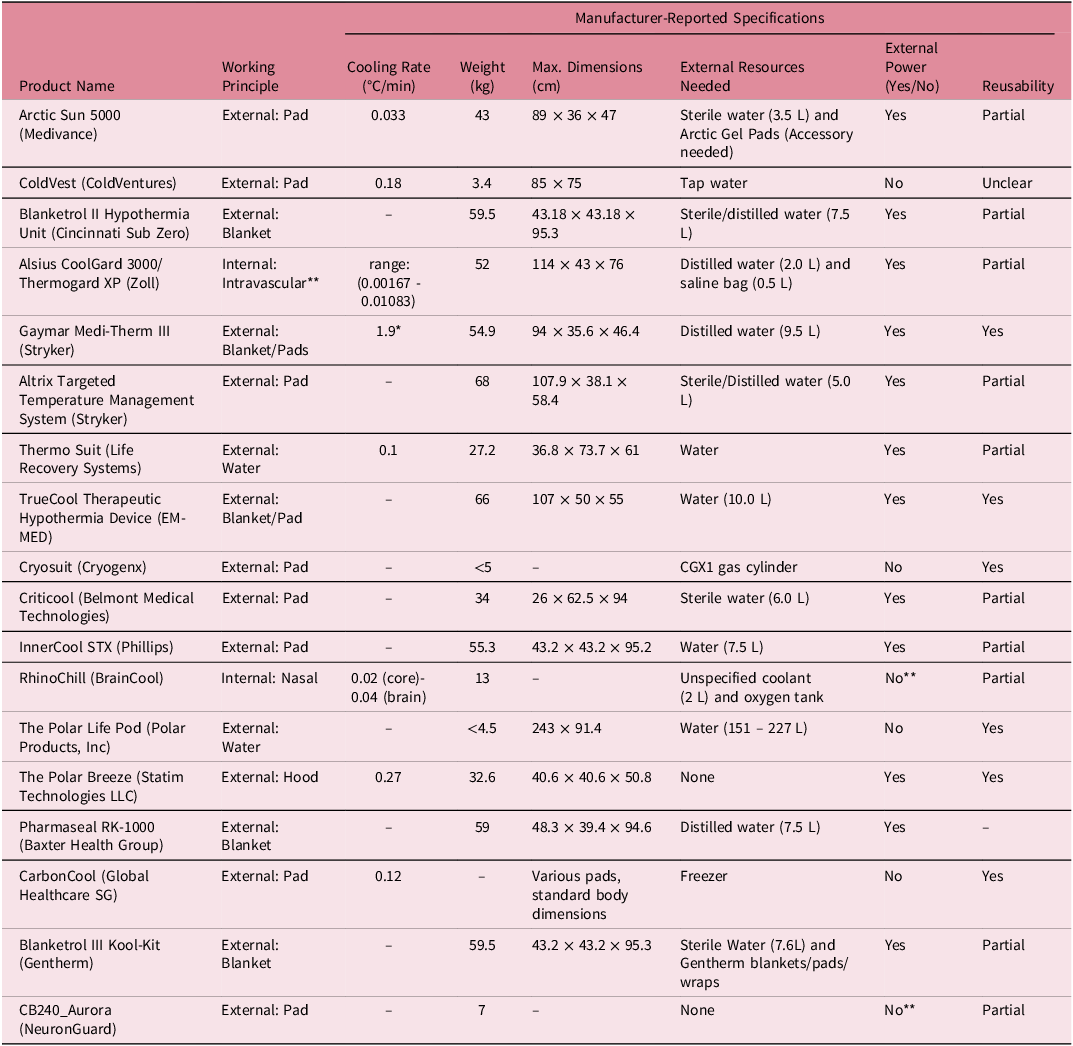
The initial academic database search identified 1,803 records. After removing 469 duplicates, the remaining records were screened for eligibility. A total of 1,264 records were excluded following the review of titles and abstracts. Of the remaining 70 articles, 48 were determined to be outside the scope of the review. The remaining 22 publications were examined for mentions of specific products or devices, and from these, 14 commercially available products were included, listed in Table 1.
Summary of Commercially Available Cooling Devices to Treat Heat Stroke and Heat Exhaustion, As Identified through Academic and Gray Literature Searches

Table 1. Long description
The table lists 18 commercially available cooling devices, detailing their working principle, cooling rate, weight, maximum dimensions, external resources needed, external power requirement, and reusability. The devices include Arctic Sun 5000, ColdVest, Blanketrol II Hypothermia Unit, Alsius CoolGard 3000/Thermogard XP, Gaymar Medi-Therm III, Altrix Targeted Temperature Management System, Thermo Suit, TrueCool Therapeutic Hypothermia Device, Cryosuit, Criticool, InnerCool STX, RhinoChill, The Polar Life Pod, The Polar Breeze, Pharmaseal RK-1000, CarbonCool, Blanketrol III Kool-Kit, and CB240_Aurora. Each row provides specific details for each device, such as whether they use external pads, blankets, or water, their cooling rates, weights, dimensions, and other relevant specifications.
Note: Relevant prehospital and emergency characteristics for the products have been added: working principle, cooling rate, weight, maximum dimensions, needs for external resources and external power, and reusability. A complete and detailed version of this table can be found in Appendix B.
* The value in the table represents the cooling rate for the circulating water, not specifically the body core cooling rate.
** These devices do not require external power connections during use, but are battery-operated; this may affect runtime or recharge logistics.
All device-specific academic extractions identified the commercial device, while three sources additionally contributed clinical cooling data. Reference Tan, Teo and Ali31–Reference Kido, Tagami and Otake33 The JBI appraisal of these three studies identified generally reliable outcome measurement with methodological concerns related primarily to randomization and blinding, crossover analysis, and case selection. Full assessment results are provided in Appendix A.
The gray literature search yielded 282 entries. The entries were screened for relevance, resulting in the exclusion of 197 sources due to non-applicability, specifically government or news articles and blogs (n = 148), e-commerce listings (n = 25), and custom or prototype devices not intended for market use (n = 24). This screening step resulted in 85 sources being retained for further review. In these, 54 products were identified. Sixty-one devices were duplicated and removed, 12 were excluded for not meeting the inclusion criteria, and three were excluded for no longer being available on the market. The final 10 products were included for specification analysis and are summarized in Table 1. The details of the full screening process are described in Figure 1.
Adapted PRISMA 2020 Flow Diagram for New Systematic Reviews, Which Included Searches of Academic Databases to the Left and Gray Searches to the Right.

Discussion
Summary of Key Findings
This systematic review identified 18 commercially available cooling devices designed to treat patients suffering from HS/HE. Despite the availability of commercially marketed cooling devices, there remains a notable lack of independently validated clinical trials and real-world performance data evaluating their use in the treatment of HS/HE. For many devices, available performance metrics are only reported by manufacturers. This introduces bias and limits direct comparison of clinical effectiveness; however, manufacturer data are often reported to regulators (eg, FDA) and so are subject to potential oversight.
Cooling Rates—The identified devices operated primarily through conductive and convective cooling mechanisms. Among the various parameters assessed, cooling rate emerged as the most critical. Based on established benchmarks, Reference McDermott, Casa and Ganio23 only three devices—ColdVest [ColdVentures LLC; Conshohocken, Pennsylvania USA], Gaymar Medi-Therm III [Gaymar Industries, Inc.; Orchard Park, New York USA], and The Polar Breeze [Statim Technologies, LLC; Clearwater, Florida USA]—achieve the ideal cooling rate of >0.155°C/minute. In contrast, only two others—CarbonCool [Global Healthcare SG; Singapore] and Thermo Suit [Life Recovery Systems HD, LLC; Alexandria, Louisiana USA]—fall within the acceptable range of 0.078-0.154°C/minute. An outlier in this category is The Polar Life Pod [Polar Products Inc.; Stow, Ohio USA], which is essentially a cadaver bag that needs to be filled with water. This specific product does not specify a cooling rate, but cold-water immersion rates are likely applicable, as the treatment performed using this device is similar to placing a patient in a tub with enough ice and water. Notably, other products with reported cooling rates still fail to meet these minimum performance thresholds; such failures raise concerns about their clinical utility.
Of the products marketed for the treatment of HS/HE, 11 out of 18 do not report cooling rate data. These omissions may reflect a combination of selective manufacturer disclosure and limitations in the current regulatory framework. Regulatory summaries indicate that cooling rate is not consistently required as a performance criterion for FDA’s device clearance, which may contribute to limited reporting of this clinically relevant parameter.
In addition to manufacturer data, independent peer-reviewed cooling rate data were identified for only three of the included devices across three studies. These studies varied substantially in clinical indication, patient population, and study design. Studies of Thermo Suit reported a cooling rate of 0.16°C/minute during exercise-induced hyperthermia in healthy individuals. Reference Tan, Teo and Ali31 Studies of Polar Breeze reported a cooling rate of 0.03°C/minute in a similar exercise-induced hyperthermia model involving healthy subjects. Reference Adams, Butke, Lee and Zaplatosch32 Studies of CarbonCool reported cooling rates of 0.103°C/minute in a 90-year-old patient with classic HS and 0.02°C/minute in a 70-year-old comatose patient. Reference Kido, Tagami and Otake33 This variability highlights the challenge of extrapolating device performance across heterogeneous clinical contexts and underscores the absence of standardized, independently validated cooling rate assessments for HS treatment.
Weight—Devices intended for prehospital use must meet established thresholds for portability. Military ergonomics standards are outlined in MIL-STD-1472H, section 5.20.2.3.5.1.2. 36 These standards set a maximum equipment weight of 16kg for individual carriage. 36 The limit applies when the individual is expected to maintain the pace of infantry movement, defined as approximately 6.5 kilometers per hour or four miles per hour. 36 It represents the upper operational threshold for single-person equipment loads in dynamic military field environments. Devices designed for prehospital or remote use should therefore aim to fall below this limit to ensure practical deployability, especially when no vehicle or team support is available.
Among the 18 identified devices, five—ColdVest, Cryosuit [The Cryo Suit; London, Ontario, Canada], The Polar Life Pod, CB240_Aurora [Neuron Guard SRL; Modena, Italy], and RhinoChill [BrainCool AB; Lund, Sweden]—fall under the 16kg threshold and may be considered reasonably portable under these standards. Of these, four weigh under 10kg, which places them in a more favorable range for unassisted use by a single responder. The remaining devices all exceed 27kg, limiting their usability in prehospital settings. For example, the Criticool device [Belmont Medical Technologies; Billerica, Massachusetts USA] weighs 34kg, yet is described in its FDA 510(k) submission as “essentially portable” despite its weight and dependence on a standard 120/230 VAC power supply. This reflects the subjective nature of portability claims in marketing and regulatory documentation.
Cold-Water Immersion as the Clinical Standard—Cold-water immersion remains the gold-standard cooling treatment for exertional HS and commonly achieves cooling rates that meet or exceed the ideal threshold of 0.155°C/minute. Reference McDermott, Casa and Ganio23,Reference Casa, McDermott, Lee, Yeargin, Armstrong and Maresh24 However, cold-water immersion is a treatment modality rather than a single device. Its implementation requires a container or system that permits near-whole-body immersion, together with a substantial volume of cold water and adequate personnel to position and monitor the patient. For example, the Polar Life Pod, a commercially available device that facilitates cold-water immersion, requires approximately 151-227L of water. 34 Although cold-water immersion is highly effective, these logistical requirements may limit its practicality in remote, austere, or resource-constrained environments. Previous reviews have evaluated and compared cooling modalities, Reference Hadad, Rav-Acha, Heled, Epstein and Moran15,Reference McDermott, Casa and Ganio23,Reference Bouchama, Dehbi and Chaves-Carballo25,Reference Filep, Murata, Endres, Kim, Stearns and Casa35 whereas the present review focuses specifically on the commercially available devices used to deliver or approximate these modalities. Therefore, the devices included in this review should not be interpreted as directly comparable substitutes for cold-water immersion itself, but as tools that incorporate or facilitate conductive, convective, or evaporative cooling. This distinction highlights the need for devices that preserve rapid cooling performance while reducing water, transport, personnel, and infrastructure requirements.
Dependence on External Resources—Among the lightweight devices, dependence on external resources limits field suitability. While ColdVest requires only 3L of water, a relatively feasible demand even in austere environments, Cryosuit relies on a specialized CGX1 gas cylinder, and The Polar Life Pod requires 151-227L of water; such requirements make both devices less practical for many prehospital contexts. In contrast, the CB240_Aurora operates without the need for any external resources, which enhances its applicability in resource-limited settings.
Dependence on External Power—Dependence not only on external resources, but also on external power sources, further limits device portability. Only five devices can operate independently of a power supply; this makes them potentially suitable for use in remote settings where electricity is unavailable. While CarbonCool claims to require no external power during use, the system relies on pre-frozen pads; this requirement necessitates access to a freezer or cooler. The other three devices that do not depend on external power—ColdVest, Cryosuit, and The Polar Life Pod—are also the only ones classified as lightweight, reinforcing a likely link between power independence and portability. On the same note, while CB240_Aurora does not require connection to an external power supply, it does operate on batteries. Depending on mission duration, it may require recharge accessibility or be dependent on replacement availability.
Reusability—While portability, performance, weight, and dependence on external resources are interrelated factors, reusability is not. Devices classified as reusable or partially reusable made up 13 of 18 products in the set. Ideally, full reusability is preferred, as it minimizes reliance on consumables and enhances the practicality of repeated use in high-demand or resource-limited settings. However, partial reusability can still offer meaningful logistical advantages by reducing waste and simplifying restocking requirements.
Feasibility in Field and Remote Environments
Despite the availability of various cooling technologies on the market, very few devices meet the combined criteria necessary for effective field deployment. Management of HS/HE in prehospital and remote environments demands rapid cooling, portability, autonomy from infrastructure, and reusability, a combination that is rarely achieved in currently marketed products.
When evaluated independently, several devices satisfy individual elements of the pre-defined criteria, but no single solution fulfills all requirements. Using an integrated assessment of study parameters, one device was identified as aligning with most criteria, including cooling rate, portability, and limited dependence on external infrastructure, although this was offset by reduced reusability. Another device demonstrated favorable characteristics with respect to weight and infrastructure independence, but it could not be included in the final feasibility comparison because manufacturer cooling rate data were not publicly available.
Devices that achieve higher cooling rates often rely on design features that limit their applicability in prehospital or emergency contexts, including substantial weight, electrical power requirements, or the need for large volumes of cold water or freezing capacity. While such systems may be effective in hospital or other resource-rich environments, these constraints place them outside the scope of prehospital and emergency care.
For Emergency Medical Services (EMS) systems, these findings suggest that device selection should consider not only cooling performance, but also whether the required water, power, consumables, weight, and setup requirements are compatible with the resources available in the intended prehospital environment.
The findings highlight a critical gap between marketed solutions and real-world prehospital needs. Emergency responders, military medics, and humanitarian teams operating in austere environments require cooling devices to be compact and reliable, criteria that are currently unmet by most available technologies. Researchers have identified similar tradeoffs between portability and performance in other areas of prehospital and emergency medicine, which suggests a systemic challenge. Reference Londono, Peri and Hasan37–Reference Wiatrek, Londono, Peri, Evans, De Lorenzo and Hood40
Regulatory pathways may further contribute to this evidence gap, as device requirements vary according to classification and intended use, and clinically relevant performance metrics such as cooling rate are not consistently required for clearance.
Although this review focused exclusively on devices marketed for the treatment of heat-related illness, the issues and gaps identified are likely to be generalizable to other domains. These areas were not included in the systematic search or analysis; however, related fields, such as trauma rewarming, prolonged field care, occupational heat-stress programs, personal protective equipment for fire and first responders, sports medicine, and veterinary heat-illness care, may face similar challenges. These fields could likewise benefit from patient- and caregiver-centered design approaches that prioritize usability in real-world deployment settings.
This review highlights the need for regulatory reform and issues a call to action for manufacturers and regulators to prioritize clinically relevant performance metrics for devices intended to treat time-sensitive conditions such as HS/HE. In particular, cooling performance should be transparently reported and independently validated to better inform clinical and field-based use.
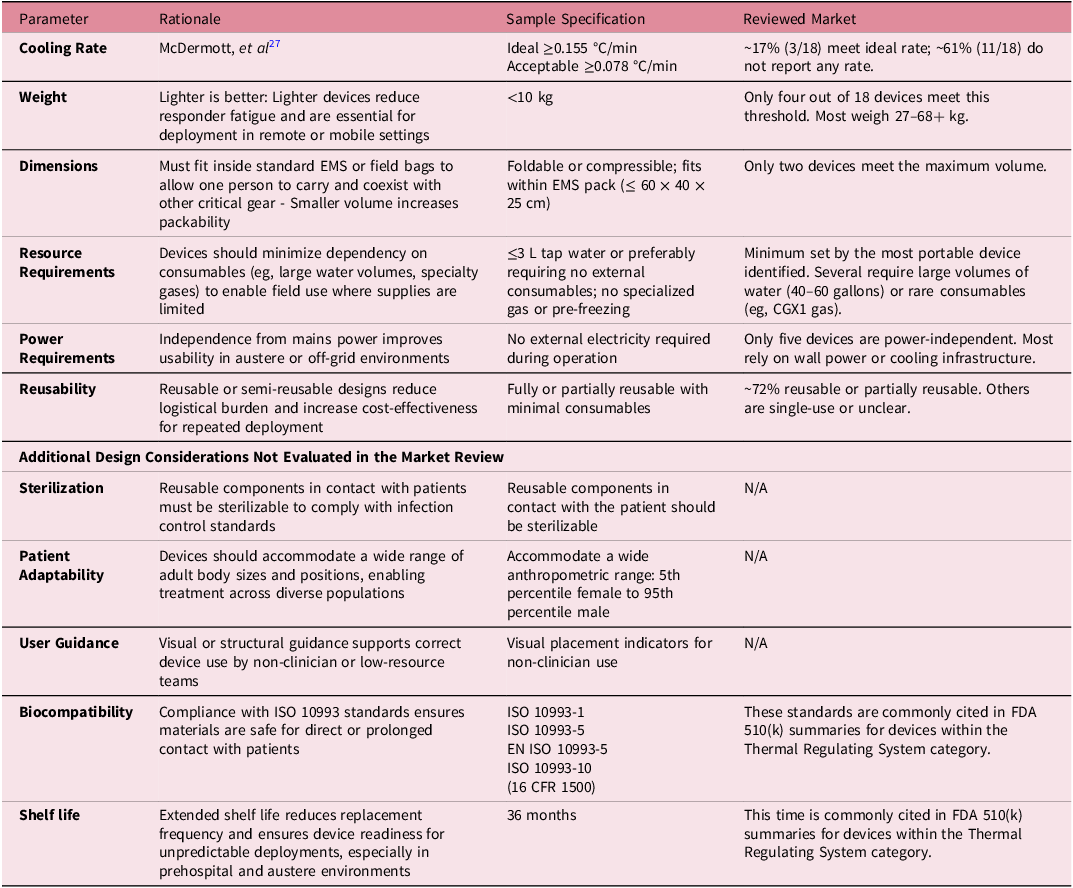
Future innovation and regulations must prioritize not only cooling effectiveness, but also deployment feasibility. This is particularly key for devices designed for prehospital or remote use, where rapid intervention can mean the difference between life and death. Table 2 presents a gap analysis comparing current device performance to sample specifications grounded in the authors’ informed assessment of practical field needs. These specifications are not proposed as definitive standards, but rather reflect reasonable, experience-based expectations for what a prehospital practitioner may require in austere or emergency settings.
Sample Specification for Cooling Devices to Treat Heat Stroke in Prehospital Environments versus Current Performance, Specifications, and Standards of Reviewed Devices

Table 2. Long description
A table with 11 rows and 4 columns comparing sample specifications for cooling devices to reviewed market devices. The columns are Parameter, Rationale, Sample Specification, and Reviewed Market. Parameters include Cooling Rate, Weight, Dimensions, Resource Requirements, Power Requirements, Reusability, Sterilization, Patient Adaptability, User Guidance, Biocompatibility, and Shelf life. Sample specifications detail ideal and acceptable rates or thresholds, while the Reviewed Market column provides performance data of existing devices. Notable trends include that only a small percentage of devices meet ideal rates or thresholds for parameters like Weight and Power Requirements.
Note: The top section compares ideal field-use specifications with current market performance. The lower section highlights additional design considerations not included in the market review but deemed essential for future development and regulatory readiness.
Abbreviations: EMS, Emergency Medical Services; ISO, International Organization for Standardization; FDA, US Food and Drug Administration.
Future Directions
The findings of this review have important implications for clinical care, medical device development, and regulatory policy related to prehospital HS/HE management. Future research should validate the performance of promising devices under realistic field conditions, using clinically meaningful metrics, such as cooling rate, and cross-device comparison trials. Development efforts should prioritize lightweight, power-independent, and resource-efficient technologies that align with field care requirements and can be deployed by non-medical personnel in austere environments, particularly in military, athletic, and disaster response contexts. Regulatory bodies should consider updating clearance criteria to reflect these needs by incorporating metrics that align with clinical effectiveness and operational feasibility. Cross-disciplinary collaboration across biomedical engineering, emergency medicine, regulatory science, and military health will be essential to accelerate innovation, as novel approaches Reference Namisnak, Khoshnevis and Diller41 hold promise for delivering effective cooling using minimal consumables and infrastructure, making them suited to austere and prehospital settings. Stakeholder-informed testing paradigms, including field simulations and end-user feedback, should be integrated into the evaluation process to ensure real-world usability. As global temperatures rise and the need for emergency interventions expands, the development of reliable, field-ready cooling devices may be increasingly critical. A high-level synthesis of these findings and implications is presented in Figure 2.
Infographic Summarizing the State of the Art, Gap Analysis, and Recommended Specifications for Future Developments.

Limitations
Despite efforts to reduce personalization bias within the gray literature search process, search results remained influenced by the geographic location of the IP address, which may have affected the visibility of region-specific products or content.
Although regulatory documents such as 510(k) summaries were used to assess FDA classification and approval pathways, these summaries do not consistently include performance testing data or detailed device functionality; such documents are often written to meet minimum compliance rather than clinical relevance. Furthermore, this review did not evaluate devices cleared under international regulatory bodies, which may limit the generalizability of findings outside the United States.
Available evidence for many cooling devices is predominantly derived from manufacturer-generated or gray literature, with relatively few peer-reviewed studies reporting standardized performance metrics. In several cases, independently verified data on key operational parameters such as cooling rate, reusability, and deployment requirements were not available. Rather than excluding these devices, this review documents these gaps to provide a transparent overview of the current state of evidence and to highlight priorities for future independent evaluation.
Life-threatening elevations of core body temperature also occur in malignant hyperthermia, serotonin syndrome, neuroleptic malignant syndrome, thyroid storm, pheochromocytoma, and drug-induced hyperthermia (eg, methamphetamine). While not the focus of this systematic review, these conditions share some pathophysiology with HS and are aligned in terms of the necessity for urgent cooling. Finally, this study did not include user evaluations or clinical testing of the devices and was limited to adult applications. Pediatric devices, prevention-focused products, and non-HS/HE-related cooling systems were excluded, which may have omitted devices adaptable to HS/HE care under field conditions. While this review provides a comprehensive snapshot of currently marketed solutions, it does not replace the need for controlled testing, combat-relevant validation, or clinician-informed usability studies.
Conclusions
This systematic review identified 18 commercially available cooling devices intended for the treatment of HS/HE. Most products lacked definitive information derived from independent literature, including validated performance data, with over one-half failing to report cooling rates and only a few meeting established effectiveness thresholds. Portability varied widely, with only a subset of devices falling below weight limits suitable for field deployment. Similarly, many devices require external resources or power, limiting their feasibility for prehospital use. While partial or full reusability was reported in most cases, consistent definitions and supporting data were often absent. These results reveal a persistent gap between marketed device capabilities and the operational needs of emergency responders, particularly in austere or resource-limited settings. For EMS systems, device selection should therefore consider not only cooling performance, but also portability and dependence on water, power, and consumable resources within the intended operational environment. Taken individually, manufacturer-provided information, regulatory documentation, and the available clinical evidence are insufficient to fully support purchasing and implementation decisions; these decisions therefore require independent judgment in the context of local operational needs.
Supplementary Materials
To view supplementary material for this article, please visit https://doi.org/10.1017/S1049023X26109169
Acknowledgements
The authors would like to thank Matt Hayward, librarian at the Dolph Briscoe Jr. Library, The University of Texas at San Antonio, for his assistance in conducting part of the literature search in engineering-related databases.
Author Contributions
MJL: Study conception and design, systematic review coordination, title and abstract screening, full-text review, data verification, manuscript drafting and revision. IA: Conception and design, gray literature search, data extraction, manuscript drafting and revision. AF and NG: Conception and design, title and abstract screening, full-text review, manuscript revision. NF: Conception and design, data extraction, data verification, manuscript revision. CG: Conception and design, literature search strategy development, database searching, manuscript drafting and revision. CJE: Conception and design, manuscript revision. RLH: Conception and design, methodological interpretation, technical interpretation, manuscript revision. RADL: Study conception and design, senior oversight, methodological and technical interpretation, manuscript revision.
All authors approved the final manuscript and are accountable for all aspects of the work.
Competing Interests
MJL, IA, AF, NG, NF, CG, and CJE declare that they have no competing interests. RADL and RLH disclose a conflict of interest as principals of EmergenceMed, LLC, a company involved in the development of new airway management technologies. Of note, EmergenceMed, LLC, does not have any cooling devices for HS/HE on the market or in development.
Use of AI Technology
During the preparation of this work, the author(s) used ChatGPT (OpenAI; San Francisco, California USA) to assist with language and readability. After using this tool/service, the author(s) reviewed and edited the content as needed. The author(s) take full responsibility for the content of this publication.



 Open access

