Did the Reformation cripple the visual arts, bringing the artistic innovations of the Northern Renaissance to a premature end? The judgment is easy enough to pass in those areas where iconoclasm, fueled by popular agitation or magisterial policy, resulted in the destruction of ecclesiastical art and the restriction of church decoration henceforth.Footnote 2 But even in those parts of northern Europe that followed Luther rather than Karlstadt, Zwingli, or Calvin, it has been argued that the Reformation was deadly for the arts, removing the medieval theological legitimation for artistic commissions by taking away the prospect of heavenly reward for religious good works, thus deflating the established economy of artistic production and creating a crisis of employment for artists who would previously have been involved in the production of altarpieces and other works of devotion.Footnote 3
A more subtle but far-reaching argument, however, traces the decline of Northern Renaissance art not simply to the open challenge of iconoclasm nor to the economic side effects of Protestant soteriology but to the insidious influence of Lutheran theology itself on the art conceived and executed under its influence.Footnote 4 Erwin Panofsky, in his classic study of Albrecht Dürer, saw the artist retreat from his earlier, bold, classically inspired ideas of artistic inspiration and genius, in part under the supposed influence of a “conversion from a humanistic and therefore more or less anthropocentric point of view to the uncompromisingly theocentric convictions of Luther.”Footnote 5 This analysis of the effects of Luther's theology on art has been extended and deepened by Joseph Leo Koerner, who argues that the shift from Dürer to the elder Lucas Cranach manifests “the end of an aesthetics that celebrates the power of images as the product of an individual personal talent.”Footnote 6 In Koerner's appraisal, although Luther and his followers permitted and even defended art, their theology demanded that it be defined by narrowly didactic ends. In order to discourage idolatry, artists were expected to limit their creativity and craftsmanship, reproducing stereotyped images that were intentionally coarse and unimpressive.Footnote 7
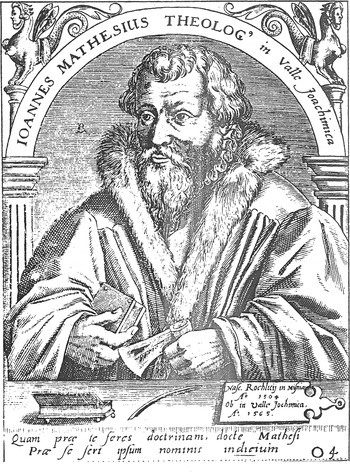
And yet, as recent scholarship has emphasized, visual art—not merely didactic but even “magnificent”—occupied a central and enduring place in the Lutheran Reformation.Footnote 8 The present essay seeks to explore this connection between Lutheranism and art through a new appraisal of early Lutheran attitudes toward art and the artist. Central to this study are Luther's student Johann Mathesius (1504–1565) and the Bohemian mining town of Joachimsthal (Jáchymov) where he served as preacher and pastor for twenty years (fig. 1).Footnote 9 Mathesius embodied the union of Evangelical doctrine with humanist erudition and pastoral application that the Wittenberg reformers sought to cultivate. His sermons demonstrate the ways in which a mid-sixteenth-century Lutheran pastor saw and explained images—both medieval and Lutheran—to his congregation. Mathesius also offers a distinctly Lutheran interpretation of the vocation of the Christian artist and articulates an understanding of art as a means both of proclaiming the Gospel and of adorning the estates ordained by God: the household, the government, and the church. Yet beyond such didactic or pragmatic characterizations of art, Mathesius presents a bold conception of the artist as a divinely inspired, creative inventor whose gifts of technique and creativity were to be used—in obedience to God's will—in the faithful service of his neighbor.Footnote 10
Johann Mathesius (1504–1565). From Jean Jacques Boissard, Icones, vol. 3 (Frankfurt am Main: M. Becker, 1598), 272.

Mathesius's career had taken him through some of the key centers of Reformation art. He had been in Nuremberg as a young student during the period of Dürer's last prolific artistic productivity in the early 1520s, and he maintained a lifelong friendship with Dürer's first biographer, the Nuremberg humanist Joachim Camerarius.Footnote 11 Mathesius's first stay in Wittenberg, in 1529, coincided with Luther's formulation of a definitive defense of the Evangelical use of art in the preface to the Passional, newly appended to his prayer book,Footnote 12 as well as with the development of the distinctly Lutheran cycle of images contrasting the Law and the Gospel, which Cranach was beginning to paint at the time.Footnote 13 By the time of Mathesius's return in 1540, the Cranach workshop was producing Lutheran images in full swing.Footnote 14 As Mathesius perceived it, Nuremberg's Dürer and Wittenberg's Cranach exemplified between them the best of the art of his age.
I. Pre-Reformation Art in Lutheran Joachimsthal
In the more than 1,500 sermons of his preserved preaching, Mathesius had frequent occasion to refer to the artwork of his age as well as more specifically to the works of art present before his congregation in Joachimsthal.Footnote 15 Though many of the local works existing in Mathesius's day have now vanished—removed over the course of the town's shift to Roman Catholicism after the Thirty Years’ War or destroyed, especially by the fire of 1873 that gutted the large town church—Mathesius's sermons, alongside other surviving records from the town, bear witness to the presence of art in the Lutheran churches and homes of the town.Footnote 16 Though allusions to visual art are not so frequent in Mathesius's sermons as, for example, references to hymns,Footnote 17 they attest the substantial role of art in Lutheran preaching—both pre-Reformation art, which Mathesius sometimes criticizes but more often interprets in an Evangelical sense, and the new Lutheran art that flourished in the town.
Though Joachimsthal was a young town, having been founded in 1516, it had a number of pieces of pre-Reformation artwork. The small, oldest church, built the year of the founding, held a silver bust of Saint Joachim, the town's patron, as well as a painting of Saint Christopher, both of which Mathesius repeatedly identified as examples of the false old piety that had expected divine help from images.Footnote 18 From the Lutheran perspective of the 1550s, however, these images seemed to have lost their power either to aid or to deceive: “our silver Joachim” (eventually stripped of its added adornment) was regarded more as a fond souvenir of a misguided, but now definitely outlived, youth than as a present temptation.Footnote 19 Though Joachimsthal had been an object of Andreas Bodenstein von Karlstadt's attention in the first half of the 1520s, his iconoclasm seems to have found an indifferent reception in the town;Footnote 20 instead, pre-Reformation art was dismissed, reinterpreted, or even claimed triumphantly as a witness to the Gospel.
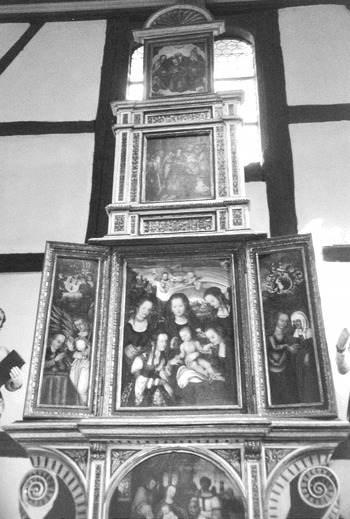
The most impressive monument of the pre-Reformation years of the town, an altarpiece of Saint Catharine from the Cranach workshop installed in about 1519, remained in place and survives to the present day (fig. 2). Despite its dubiously Lutheran subject matter—the engagement of Saint Catharine to the Christ-child, signifying her commitment to a life of vowed celibacy—this piece was not simply dismissed but re-explained in an Evangelical sense.Footnote 21 The Lutheran cantor Nicolaus Herman wrote a song for the girls’ school, which later used the church as a chapel, interpreting Jesus's giving of a ring as a symbol not of monastic life but of baptism.Footnote 22
Lucas Cranach the Elder (workshop), St. Catharine Altarpiece (ca. 1516), Jáchymov, Czech Republic. Photograph by the author.

This hermeneutic of evangelical appropriation of pre-Reformation art was typical of Mathesius's preaching.Footnote 23 Though he was aware not only of the idolatrous possibilities of medieval images but also of their potential to mislead—he refers, for example, to elements in the legend of Saints Joachim and Anna as found in “the apocrypha and questionable [verdechtigen] books, writings, and paintings”Footnote 24 —he was more likely to identify medieval works of art, even certain of the stock images of medieval piety, as witnesses to evangelical faith in Christ before the Reformation.Footnote 25 Mathesius praises the “beautiful painting in which the dear angels catch in their chalice the blood of Christ flowing from His wounds and pour it out in the holy Sacrament,” as witness that Christians “are sprinkled with [Christ's blood] in the Word and Sacraments through true faith.”Footnote 26 The “old paintings” of the Annunciation, showing Mary reading Isaiah 7 as the angel Gabriel appears to her, become witnesses attesting lay Bible reading, especially by women.Footnote 27 Another typical image of late medieval piety, the so-called arma Christi, in which angels display the instruments of the crucifixion, becomes a testimony of faith in Christ's expiatory work as well:Footnote 28
I recall a beautiful old painting in which the Lord Christ is depicted standing before his Father and showing him his wounds. The dear angels stand around him, one holding the crown of thorns, another the spear, a third the scourge and rod, a fourth the cross, and so on: all the implements the soldiers used when they crucified Christ. Without a doubt, the master of this painting understood this article: that Christ our Reconciler holds his Passion before the Father.Footnote 29
Such images were, as Mathesius understood them, not idols or abominations, not simply fortuitous opportunities to illustrate the new Lutheran theology for his congregation, but an authentic testament of the old painters’ faith, a true confession of the Gospel, which had persisted even under the papacy. As such, they could retain an honored place.
II. Art and Patronage in Lutheran Joachimsthal
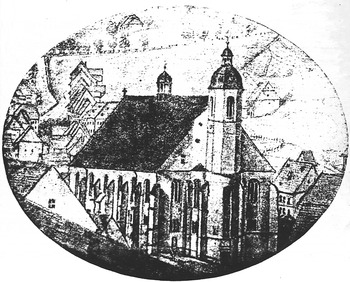
The town of Joachimsthal, with its mint and the wealth of the mines, was home to a variety of artists and craftsmen active during the period of the town's adherence to Lutheranism. Their work is described in observant detail in Mathesius's preaching, especially the Sarepta, a published series of annual Carnival sermons based on biblical texts mentioning various ores and mining activities.Footnote 30 The production and commissioning of ecclesiastical art in the town continued and, indeed, expanded in the wake of the Reformation. The main church in Joachimsthal, for example, was built from 1534 to 1537, and deserves to be recognized as the first newly constructed Protestant church building (fig. 3).Footnote 31 Though its design as an open hall church with a single altar and prominent pulpit was not unprecedented, it was distinctly suited for Lutheran worship.
Joachimsthal Town Church (1534–1537), Jáchymov, Czech Republic. Sketch made before the fire of 1873, from Richard Schmidt, Topographie der historischen und Kunst-Denkmale: Der politische Bezirk Skt. Joachimsthal, 46.

The Lutherans of the town quickly saw to using their divinely bestowed prosperity to equip the interior of the new church with appropriate art and ornament, including work by the two most celebrated artists of the Reformation: small paintings and engravings attributed to Dürer; and in 1545, the installation of a Cranach retable altarpiece (commissioned by the counts Schlick in honor of their brother Stephan who had fallen at the battle of Mohacs in 1526), along with paraments for the altar, a pulpit with biblical scenes carved around it, and silver vessels for the celebration of the Lord's Supper.Footnote 32 All of these, according to Mathesius in his description of “Ceremonies” in the Joachimsthal church order, served as “a fitting reminder to the youth and the common man of the foremost articles of our faith”:
For two new churches have been built, and beautiful panels with Christian paintings from scripture have been arranged in them. Good-hearted persons have commissioned precious tapestries with stories from the Gospels, with which the pulpit, font, and altar are adorned on high festivals.Footnote 33
The artistic cultivation of the church continued over the decades after Mathesius's death as well, with the installation of a richly carved new pulpit, the painting of cycles of biblical episodes around the galleries of the church, a cast cover for the baptismal font, and numerous memorials mounted on the walls of the hospital church situated next to the cemetery (itself equipped with a sandstone crucifixion).Footnote 34 Unfortunately, nearly everything in the main church that had survived the Catholicization of the town and shifting artistic tastes—the Cranach altarpiece, for example, was moved to the side and replaced with a Baroque altar in the eighteenth century—was destroyed in the 1873 fire.
The patrons of art in Joachimsthal's church in the age of the Reformation were the leaders of the town government as well as those who had made their fortunes from the mines.Footnote 35 After the Schlicks were deprived of their rights in the town in 1545 in favor of the Bohemian crown (the Hapsburg Ferdinand), the captains appointed to oversee the mines were Roman Catholic and hence unlikely patrons of the church. Their wives, however, were in some cases Lutheran. In particular, Margaretha von Hassenstein, wife of the captain Bohleslau Felix von Hassenstein, was a generous patroness of the church and of its arts. Mathesius mentioned her frequently in his preaching and writing, for her gifts to the library and the hospital, but especially for her donation of a chalice to the church:
Here I must call to mind our large chalice, for which the noble lady, Lady Margaretha von Hassenstein and Litzko, Burgravin in Meissen, etc., secretly gave fifty thalers, and which was made by the famous artist Cuntz Wels for this church as [her] valediction and memorial. On the base, he very artfully worked Christ on the cross, and [his] Baptism, the Absolution from Matthew 9, and the Lord's Supper. On the knob he carved the four Evangelists freehand in the form of beasts, and covered and decorated the cup where it meets the body of the chalice with enameled and molded faces and ornaments, so that, together with the paten, upon which the Savior is engraved, it is a delight to behold.Footnote 36
Mathesius was aware of the spiritual abuses—from the Lutheran perspective—of artistic patronage as a meritorious, salvific work. He derisively recounts a story in which Emperor Henry II (r. 1002–1024) was supposed to have been saved in God's judgment when his sins were outweighed by a golden chalice that he had donated to the church.Footnote 37 But if Lutheran patrons of art could not look to an eternal reward for the merit of their donations, they could nonetheless expect to be remembered publicly by their community for their contributions to the preaching of the Gospel by material means. In Joachimsthal, the donors of ecclesiastical art were memorialized not only in the inscriptions accompanying the funerary monumentsFootnote 38 that, over the second half of the sixteenth century, came to cover the walls of the old Spitalkirche Footnote 39 but also in the town chronicle, published by Mathesius in 1564 and updated and reissued by his successors,Footnote 40 and especially from the pulpit in Mathesius's preaching.
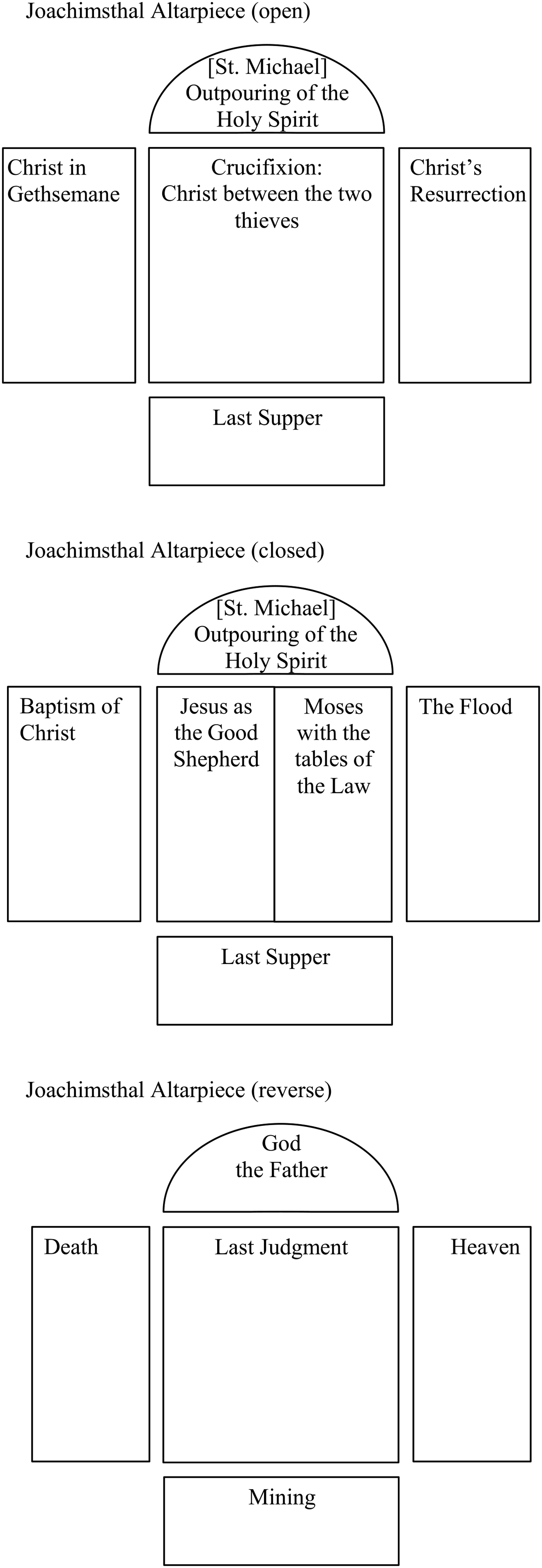
The 1545 Cranach altarpiece in the new Joachimsthal church was also a memorial that perpetuated the Schlicks’ presence in the town as Evangelical rulers even after they had been supplanted by the Hapsburgs.Footnote 41 The arrangement of the altarpiece can be reconstructed, with reasonable confidence, from Mathesius's description combined with reminiscences from the generation after the 1873 fire (fig. 4).Footnote 42 The Joachimsthal altarpiece was a Law-Gospel composition similar to—though not identical with—the surviving altarpiece at Schneeberg.Footnote 43 It was distinctive in making the figure of Christ as the “Good Shepherd” the central image of the Gospel side, standing against Moses with the tables of the Law.Footnote 44 Mathesius described it in the course of his sermons on the Lord's Supper, as a part of the adornment with which the supper was honored by the church in Joachimsthal:
We have an altar covered with linens and hung with beautiful embroidery. Upon it is an altarpiece with pure paintings of the Last Supper and of Christ's anguish and prayer on the Mount of Olives, of his passion, death, and resurrection, of the Last Day, and of the sending of the Holy Spirit. And on the outer wings there are the Baptism of the Lord Christ and how he carries the lost sheep on his shoulders. Opposite him is Moses with his two tablets and the Flood. Behind, a mine is painted, with beautiful verses showing that mining is also a godly livelihood and reminding the miners to be faithful and industrious.Footnote 45
Cranach workshop, Joachimsthal Altarpiece (1545). Based on descriptions in Schmidt, Topographie, 59–60 and Mathesius, Bekantnuß Vom Heyligen Abendmahl unsers lieben Herren Jesu Christi, jetzt in dieser gefehrlichen zeit, allen frommen Christen zur lehr unnd trost, in sechtzehn Predigt getheylet, fol. 163r.

III. Interpreting Art in Lutheran Joachimsthal
Mathesius's interpretive comments suggest the framework within which sixteenth-century Lutherans saw and understood the art around them. Typical of Mathesius's description of such Lutheran works of art (as with the chalice above) is that he sees them first as cycles of biblical narratives. Yet Mathesius also assumed that the specific biblical episodes depicted were associated with particular doctrinal loci, as his description of the scene from Matthew 9 on the chalice—the healing and forgiveness of the paralytic—as “the Absolution” suggests. Mathesius's listeners would have been familiar with the association of illustrations drawn from scripture with the topics of theological instruction: since its earliest editions, Luther's Small Catechism had featured woodcuts, predominantly of biblical scenes, paired with the Catechism's questions and answers.Footnote 46
Notable, also, is Mathesius's relative silence about any textual components of the paintings he describes. If, like the Schneeberg altarpiece and many other executions of the Law-Gospel theme, the Joachimsthal altarpiece included biblical verses beneath each panel, there is no record of them in Mathesius's description.Footnote 47 Instead, he mentions only verses about mining that surrounded the depiction of miners’ work in the less prominent position on the reverse of the altarpiece.Footnote 48 It may be that the Law-Gospel altarpiece required little special comment not because the paintings were covered with words, but because all the words spoken or sung around it in Lutheran worship and preaching articulated its themes.Footnote 49
The exception that proves the rule—that Mathesius regarded Evangelical images as being theologically clear enough to require little additional explicit explanation—is provided by an entire sermon which Mathesius seems to have devoted to explaining one peripheral piece of iconography on the 1545 altarpiece: an image of Saint Michael the Archangel with a set of scales in the pinnacle. The image is not mentioned in Mathesius's summary of the images on the altar, but later descriptions note it.Footnote 50 In some pre-Reformation art (such as Rogier van der Weyden's Beaune Altarpiece), Michael is shown weighing one soul against another, as if judging human merits.Footnote 51 In Cranach's surviving treatments of the subject, however, even before the Reformation, a human soul is shown being balanced against a weight placed by demons in the opposite pan.Footnote 52 It was likely such an image that Mathesius encouraged his congregation to interpret in Lutheran terms as contrasting the “pan of the strict and earnest justice and wrath of God, or the pan of Law,” into which the devil piles sins to terrify the sinner, and the “pan of grace and mercy, or the pan of the Gospel,” into which Christ places his own intercession and power on behalf of the sinner.Footnote 53 Thus understood, the image could be thoroughly Evangelical.
Lutheran art present in Joachimsthal was not only in public spaces but also in private and domestic ones. Mathesius, in describing the conviviality of an honorable banquet among friends, catalogued the sort of objects on hand for conversation: “Something rare, lovely, beautiful—one of our beautiful stones, a good new book, the paintings of Dürer or master Lucas.”Footnote 54 The estate inventories of Joachimsthal's burghers, as well as Mathesius's sermons, reveal private collections of small works of decorative art,Footnote 55 some of which presented biblical stories or symbols. In particular, the artisans employed in the Joachimsthal mint also occupied themselves in casting medallions (Schaugroschen) depicting biblical scenes that were collected and displayed in homes in Joachimsthal and across Europe.Footnote 56
Mathesius exemplified domestic engagement with art in the memorial sermons for his wife that he preached at home to their children. In one place, he discusses three images—the arma Christi, the angels collecting Christ's blood from the cross, and Dürer's engraving of himself and his wife before the cross—in immediate succession.Footnote 57 Elsewhere, he devotes extended attention to his wedding ring, explaining it as “a beautiful picture of the doctrine” of sin and justification. A gift to Mathesius and his deceased wife from a local goldsmith, the ring was engraved with an image of Adam and Eve and the serpent, and set with a ruby and an emerald. The depiction of Adam and Eve with wings shows their terror in fleeing before God's wrath, the ruby recalls Christ's blood, and the emerald a living and true faith. The delicate proportions of the ring signify that Christ's kingdom appears to be small in the world though it is in fact a treasure above all treasures. Mathesius completes the circle of church teaching and domestic practice, connecting the liturgical reception of biblical imagery to its artistic reproduction in an object for personal use. He attributes his interpretation of the ring to the intentions of the artist himself, who applies the lessons of Evangelical teaching in his work as one who had “taken note of such things as a diligent auditor of the preaching.”Footnote 58
IV. Mathesius on the Inspiration and Vocation of the Artist
Following Luther, who was fond of cataloguing the visual arts among the different ways in which the Gospel was “preached,”Footnote 59 Mathesius understood Christian art to be a form of the Gospel from which believers could draw instruction and comfort, just as they did from the preaching or hymns of the church.Footnote 60 But Mathesius went further to praise not only the content and use of such works of art but also the Christian artists who produced them. In the Sarepta, he insisted that “the Holy Spirit in his book mentions all sorts of artists with honor, and is not ashamed to speak of God's gifts even in artisans.”Footnote 61 “God,” he wrote, “causes his Word to be set forth for everyone in pretty plays and songs; and painters, carvers, goldsmiths, and those who make medallions help to bear witness to God and his Word.”Footnote 62
Mathesius's most extensive and important discussion of the vocation of the artist appeared in a wedding sermon on Exodus 31:11, “On the ancient goldsmith and stone-carver Bezaleel,” published in the 1563 collection Vom Ehestandt und Haußwesen.Footnote 63 As with the other sermons in the printed collection, the identities of the bride and groom for whom the sermon was originally preached are omitted; the groom, however, may have been the glassworker whom Mathesius credits in the sermon as “our artist” with a niello Resurrection engraved in a piece of natural glass.Footnote 64 The date on which the sermon was preached is also not indicated; it must have been between 1553 (when Lucas Cranach the Elder died) and 1562.Footnote 65
Mathesius begins by explaining his divergence from the usual contents of wedding sermons preached at the customary hour. Just as he usually speaks in honor of the estate of marriage, so on this occasion he wants to teach from the scriptures that “the art and skill of great artists and craftsmen are also good and special gifts of God” and that such an artist has his place in the kingdom of God, “if he abides in faith and a good conscience, and in his workshop helps to advance and uphold the kingdom of Jesus Christ with his art and what he earns by it, and faithfully serves the authorities and his neighbors, in Christian love and obedience.”Footnote 66
Mathesius's use of a wedding sermon to speak about a particular vocation rather than about the estate of marriage in general was somewhat unusual, but not unparalleled. In the larger, posthumous collection of Mathesius's wedding sermons, for example, he preached a sermon on the divine gift of medicine (from Ecclesiasticus 38) at the wedding of the town apothecary, on poetry (from Titus 1:12) at the wedding of the humanist Johannes Major, and often worked in discussions of the dignity of pedagogy at the weddings of teachers.Footnote 67 The groom on this occasion was thus almost certainly an artist, whether or not the glassworker mentioned in the text. Mathesius's homiletical purpose is not simply to offer a theological definition of art and the artist for a congregation of Christian observers of art, but to provide guidance to Christian artists in understanding their work as a calling of service, pleasing to God.Footnote 68
Mathesius's text, from Exodus 31, describes God's command to Moses to commit the making of the tabernacle and its furnishings to the artist Bezaleel and his assistant Oholiab, to whom God had given his Spirit. The text's discussion of the gift of the Spirit to artists had attracted passing notice among the church fathers, figuring in a minor way in the debates over Christian iconoclasm.Footnote 69 Elsewhere, however, especially in the West, theologians tended to find the text problematic when taken literally.Footnote 70 Augustine's framing of the problem, incorporated into the Glossa Ordinaria, reflected this uneasiness: “Are even such works as seem to pertain to craftsmanship [opificium] to be attributed to the Holy Spirit? Or is this said symbolically [significative]?”Footnote 71 The predominant interpretation of the text among Western theologians rejected the literal application to craftsmen for an allegorical reading, taking the tabernacle as an allegory for the church and Bezaleel and Oholiab as signifying preachers,Footnote 72 or, in the case of Richard of Saint Victor, as models for the middle level of contemplation (since Bezaleel, unlike Moses, had not seen the pattern for the tabernacle on Mount Sinai).Footnote 73 Despite the example set by Charlemagne's famous application of the name to his own architect and biographer Einhard and the continuing appearance of Bezaleel in medieval images of craftsmen, the literal application of the text to present-day artists was comparatively scarce, and generally confined itself to identifying the arts as the “gift of God.”Footnote 74
Luther's own brief exposition of Exodus 31 in the course of his 1524–1527 serial preaching on Exodus was not printed in the sixteenth century, and Mathesius was probably not acquainted with any of the manuscript sets of notes in which it is preserved.Footnote 75 There, though Luther briefly remarks that in this text “carpenters and craftsmen are not only called and appointed, but the Spirit is given into their hearts,”Footnote 76 he is chiefly concerned to make a general application about the necessity of vocation, insisting that Bezaleel took up his work on the tabernacle on the basis of a vocation from God—unlike the Schwärmer, who run to teach and write without any call. At table around the year 1540, Luther may have drawn a parallel between Bezaleel and the composer Josquin Desprez in the possession of a “good Spirit.” The sole report of this, however, comes from Mathesius himself in his sermons on Luther's life, and it is impossible to be certain whether the remark served as inspiration for Mathesius's broader interpretation of Exodus 31 or whether he adumbrated his account of Luther's words in accord with his own understanding.Footnote 77 Mathesius's interpretation of Exodus 31 as a divine endorsement of art and his application of the text to Christian artists is, if not unprecedented, nonetheless far from the dominant approach in the preceding tradition.
In his exposition of the chapter, Mathesius identifies the divine speaker in the text as the Son of God, and points out the careful attention that he gives to the artistic arrangements of the tabernacle and the priestly vestments as “shadows, images, sketches, or representations of things to come, that were to be fulfilled in Christ and his Church”Footnote 78 —for Mathesius this serves to attest the theological importance of the artwork rather than its provisional character. God not only reveals a plan for the work, but names the artist whom he has chosen to carry it out. This shows, Mathesius says, that God is not concerned only with great kings and emperors, to whom he gives grace and ability to rule, but also with artists, whom he raises up and endows with gifts. Such “faithful and believing craftsmen” do not brag of their artistic skill and scorn others, as heathen artists do, but trust in the Son as mediator.Footnote 79
That Bezaleel is identified in the text as a descendant of Judah serves Mathesius as a testimony that the Son of God called forth from his own line of ancestry not only great prophets and kings but also skilled artists of all sorts.Footnote 80 The Hebrew word choreschim, which Luther's German Bible translated as Zimmerleute, “carpenters,” in fact, like the Latin faber, embraces “all sorts of artists and craftsmen.”Footnote 81 Mathesius invokes various biblical texts to mention coppersmiths and casters (Rotgiesser), goldsmiths and lapidaries, sculptors (Schnitzer und Bildhawer) as well as farriers and blacksmiths (huff und senssenschmide). Joseph, the husband of the Virgin Mary, was a descendant of Judah as well as a carpenter and cabinetmaker (zimmern und schreinerwerck). 1 Chronicles 4:21 mentions weavers among the tribe of Judah—the sort, Mathesius says, that worked with precious materials to make fine cloth, like workers in scarlet cloth of his own day.Footnote 82 All of these artists and craftsmen were among the ancestors of the Son of God according to the flesh.
In the Exodus 31 text, God says of Bezaleel, “I have filled him with the Spirit of God.” Mathesius insists on the basis of these words that Bezaleel as well as other great artists are indeed inspired by the Holy Spirit. But he makes a distinction between two kinds of work of the Holy Spirit (zweyerley wirckung oder gaben des einigen heyligen Geystes).Footnote 83 One (the second described) is the work of the Holy Spirit for salvation, as he cleanses hearts and “kindles in us new light and life, peace, comfort, and joy” through the Gospel and Baptism, or through the laying on of hands in the ordination of ministers.Footnote 84 But the first work of the Holy Spirit is his work in creation, in which he not only “gives life to all creatures and sustains them,” but also “awakens great people for the government and for the schools, as well as other artists, so that the government, peace, discipline, and liberal arts may be preserved.”Footnote 85 The Holy Spirit gives “gifts of art or of office” as well as “gifts of goodwill or of grace through Christ.”Footnote 86
Thus, Mathesius insists, the abilities and accomplishments of such pagan men as Alexander, Scipio, Pythagoras, and Ovid, are due to the Holy Spirit, who stirs up “exceptional heroic courage and miraculous understanding even among the heathen.” Mathesius cites classical authorities on the “inspiration,” the “enthusiasm,” even the “divinization” of the artist and great man,Footnote 87 placing Ovid's verse, “this spirit comes from heavenly realms,”Footnote 88 in parallel to John 3:27: “A man can receive nothing unless it be given him from above, or from heaven.”
This theology of artistic inspiration based on the twofold working of the Spirit was no isolated rhetorical flourish but a recurrent theme in Mathesius's preaching,Footnote 89 though it receives its most thorough development in the wedding sermon. Bezaleel, he says, possessed both kinds of gifts of the Spirit, having received the Spirit for salvation and eternal life at his circumcision and through meditation on God's Word and promise of the Messiah. But the gifts of the Spirit, that God speaks of giving Bezaleel in Exodus 31, are gifts of the Spirit as Creator.Footnote 90 Likewise, some “great heroes and extraordinary men” (grosse Helden unnd wunderleute), like David, who believed in the promised Christ, had both kinds of gifts of the Spirit; others, like the pagan Alexander, had only the gifts of the Spirit as Creator. So too with great artists: Pythagoras, Archimedes, Ovid, Ptolemy, Apelles, and Phidias all received their skill from God, as they themselves acknowledged by invoking and making sacrifice to Minerva, the muses, and Vulcan. But a skilled artist who also believes in Christ has both kinds of gifts of the Holy Spirit.Footnote 91
As examples of such Christian artists, Mathesius mentions the musicians Josquin Desprez (circa 1440–1521) and Ludwig Senfl (circa 1486–circa 1543) as well as the painters and engravers Dürer and Cranach the Elder—restricting himself to those already deceased. In addition to the gifts of the Spirit received through the Word, the Holy Spirit also conferred upon them “special gifts of art. . . . [He] sharpens their mind and heart, and teaches their hands to draw, to shape, to sketch, to engrave, and to carve, just as he taught David and Scipio to make war.”Footnote 92
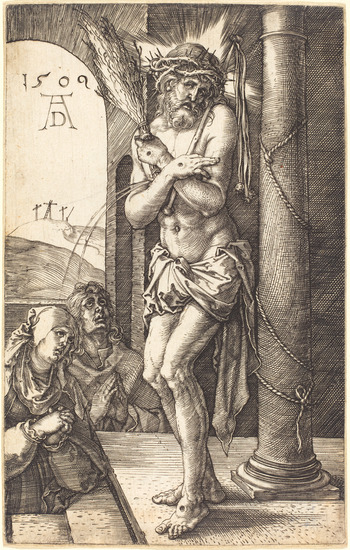
Josquin and Senfl not only created unprecedented harmonies but also set scriptural texts to them, declaring “that amid the pains of hell and the peril of death, there is no other comfort than trust in the one Redeemer.”Footnote 93 Dürer, Mathesius writes, confessed his faith by depicting the blood of Christ falling upon his own head and that of his wife.Footnote 94 Mathesius's interpretation of the frontispiece to Dürer's 1509 Engraved Passion (fig. 5) as a spiritual self-portrait runs contrary to modern readings, which take the kneeling figures as the Virgin Mary and Saint John the Evangelist, and the scene as a whole, to be drawn from the visions of Saint Bridget.Footnote 95 Yet Mathesius's provocative identification of the figures is not impossible. They do not strongly resemble the figures of Mary and John elsewhere in the Engraved Passion, and indeed bear at least a passing resemblance to Dürer's other portraits of himself and his wife.Footnote 96
Albrecht Dürer, Man of Sorrows Standing by the Column (1509), Rosenwald Collection, 1943.3.3501, National Gallery of Art, Washington, D.C., http://www.nga.gov/Collection/art-object-page.6619.html. Courtesy of the National Gallery of Art, Washington.

In Mathesius's understanding, the engraving shows Dürer's Evangelical faith, a precedent (though Mathesius does not make the direct connection) for Cranach's own self-depiction as the sinner saved by Christ's blood in the explicitly Lutheran Weimar Altarpiece.Footnote 97 Thus, like David or Bezaleel, Mathesius argues, Dürer was endowed by Christ the Mediator not only with extraordinary gifts of art (kunstgaben) but with the gifts of grace (gunstgaben). Though the gifts of skill with which the Spirit of God endows even the heathen, great artists as well as great rulers, do not justify or save anyone, whoever believes in Christ, no matter whether such faith comes “through scripture, preaching, or holy images,” receives the Spirit as a pledge of salvation.Footnote 98
Mathesius's vigorous endorsement of the divine inspiration of the artist is a synthesis from very different sources. He mentions explicitly the classical encomium of the artist as inspired, but takes epithets that were originally restricted to poets as applying broadly to “artists” (künstler) of all sorts.Footnote 99 The exceptional broader reference among these classical sources is Cicero's dictum from the De Natura Deorum that: “There has never been any great man apart from some divine inspiration” (sine aliquo afflatu divino). Though in its original context Cicero had in mind military and political “great men,” the unrestrictive terms of the expression served to bridge between political and poetic ideas of “inspiration” and may have pointed to a wider artistic conception.Footnote 100
Mathesius can be seen in at least distant relation to a developing Italian tradition that regarded artistic genius as divineFootnote 101 —though he probably knew it only as mediated by CamerariusFootnote 102 and perhaps from the 1540 edition of Leon Battista Alberti's Della Pictura, published in Thomas Venatorius's Latin translation at Nuremberg in 1540.Footnote 103 Vasari's Lives of the Artists had been published (in Italian) in 1550, with a second edition in 1563, but Mathesius was almost certainly unaware of it.
Yet Mathesius's theological description of artistic genius is in its own way as bold as anything coming from these Italian Renaissance sources. He can use approvingly (albeit in reporting classical opinions) such provocative words as “divinization” and “enthusiasm” (that is, divine possession), which were anathema for Lutheran theologians in other contexts.Footnote 104 And yet, Mathesius's ultimate theological guide for insisting on the inspiration of the artist by the Holy Spirit was none other than Luther himself.
The theological fulcrum of Mathesius's description of inspiration on the basis of “twofold activity or gifts of the one Holy Spirit” is taken from Luther's theological explanation of the “extraordinary men” (Wunderleute) and “sound heroes” (gesunden Helden) of world history,Footnote 105 developed in his 1534–1535 Commentary on Psalm 101 and in the 1543 Disputation on Justifying Faith and Miracle-Working Faith.Footnote 106 In the Commentary, Luther describes those, both among the people of God and among the heathen, to whom God has given special, heroic gifts:
Some have a special star before God; these He teaches Himself and raises them up as He would have them. They are also the ones who have smooth sailing on earth and so-called good luck and success. . . . For God, who puts it into their heart and stimulates their intelligence and courage, also puts it into their hands that it must come to pass and must be carried out; that was the case with Samson, David, Jehoiada, and others. He occasionally provides such men not only among His own people but also among the godless and the heathen.Footnote 107
As examples among the “heathen,” Luther mentions Naaman (2 Kings 5:1), the kings of the Medes (Jeremiah 51:11), Cyrus (2 Chronicles 36:22), Themistocles, Alexander, Hannibal, Augustus, and Vespasian.Footnote 108 But though Luther, in commenting on a Psalm that he understood as “David's mirror for princes,”Footnote 109 is concerned chiefly with divinely inspired heroes among the rulers, he does occasionally suggest a broader application of the principle. He insists that God awakens such heroic men “in all walks of life . . . not only in the ranks of the nobility but also among the middle classes, farmers, and laborers.”Footnote 110 In one place, he expands the heroic category to include not only rulers among the pagans but also “their prophets, apostles, and theologians or preachers for the secular government,” mentioning the Magi of Matthew 2:1, poets such as Epimenides (Titus 1:12), and writers such as “Homer, Plato, Aristotle, Cicero, Ulpian, and others,” together with rulers like Alexander and Augustus.Footnote 111 The poets Virgil and Homer stand alongside such rulers as heroic men whose extraordinary accomplishments were “a miraculous deed of God among [the heathen], not a result of their wisdom, but altogether a gift of God.”Footnote 112 For pagan witness to the dependence of heroic work on divine inspiration, Luther quotes from Horace's Ars poetica (slightly altered)—“You will neither do nor attempt anything if Minerva is unwillingFootnote 113 —as well as repeatedly citing Cicero's maxim from the De Natura Deorum: “The very wisest among them, like Cicero, say it is a divine inspiration; and they conclude that no one has ever become a great man through his own powers but only by a special secret inbreathing or imparting of the gods.”Footnote 114 “There never has been a man of great deeds or an extraordinary man sine afflatu, that is, without a special inspiration from God.”Footnote 115 Despite Luther's preoccupation both here and elsewhere with political heroes,Footnote 116 he leaves the way open to an application of heroic divine inspiration to artists other than poets as well.
Luther further developed this idea of heroic inspiration with a distinction between the creative and salvific work of the Holy Spirit. In the Wittenberg public disputation of April 24, 1543, on the distinction between justifying faith and miracle-working faith,Footnote 117 Luther's student Friedrich Bachofen responded with Luther's approval to the objection that “it is absurd to say that the Holy Spirit is given to the godless.” Bachofen answered: “The Holy Spirit is present in human beings in a twofold way. First, by a general activity through which he preserves them and the other creatures of God. Then the Holy Spirit is also given to the pious by Christ, since he has merited the Spirit for them.”Footnote 118 Luther had spoken in a similar way in a piece of Table Talk from the 1540s: “The Spirit whom God gives to human beings is twofold: animating and sanctifying. Men of talent, prudence, erudition, bravery, magnanimity, etc., have been inspired by the animating Spirit of God, as were Gaius Caesar, Pomponius Atticus, etc. Only Christians and the pious have the sanctifying Holy Spirit.”Footnote 119 When Mathesius describes artistic inspiration and the faith of the artist in terms of the “twofold activity” of the Holy Spirit and distinguishes between “gifts of art or office” and “gifts of goodwill or grace,” he is clearly drawing upon Luther's distinction articulated here, transferred from the political to the artistic sphere
Having identified artistic talent as a gift of the Holy Spirit, Mathesius goes on to discuss the special character of that gift, described in Exodus 31:3 as “wisdom, understanding, and knowledge to carry out artful work of all sorts.”Footnote 120 Far from seeing human creativity as an affront to God, Mathesius insists that God imparts such gifts to human beings as an image of his own creativity: “For God is the Father, fount, and origin of all arts: he has drawn all things forth from a single point and made circles and angles in good proportion.” Adam, when created, possessed an innate understanding of all these things: “Accurate and perfect perspective and all proportions . . . so that Adam had a living Euclid and Vitruvius in his own head.”Footnote 121
Though this “mirror of art” in the human heart was obscured by the Fall, God has preserved the innate knowledge of geometry, and the mirror is “polished” again “with [God's] gifts, good guides, and diligent practice.” Beyond this, God often raises up people “with special artistic gifts” who are the marvel of all others. This is the distinctive “wisdom” that God gives to artists: “That by means of God's gifts they are able, without human guidance, to invent and produce something out of their own thoughts.”
“Understanding” (Verstand), for an artist, means skill in carrying out the arrangement and composition of an artist's ideas “so that one thing flows from another and harmonizes together as in the interior of a church.”Footnote 122 “Art” or “knowledge,” Mathesius says, refers to techniques (Practiken) that allow the artist to bring his well-arranged ideas to clean and clear execution, “so that it appears to have mass and life.”Footnote 123 Such a divinely gifted artist is able to complete such work effortlessly while another without such gifts is still fumbling for his brush.Footnote 124 The “wise and artful God” wishes to be recognized and praised in the skill of such “extraordinary men and artists.”Footnote 125
Without such divine gifts, a craftsman may struggle even to copy one of Dürer's works set in front of him, and be ashamed to show the result of so much effort in public. And although the ability to copy the work of others is a gift as well, the ability “to arrange a composition harmoniously out of one's own head” and then to execute it “free hand . . . according to the image fixed in one's mind,” in whatever medium, that requires “God's wondrous Spirit, gift, and example.”Footnote 126 Thus, “every work praises its master.”
As a further example of such extraordinary artistic skill, Mathesius describes a niello image of the Resurrection (perhaps by the artist who stood as groom before Mathesius's pulpit)Footnote 127 etched into a piece of glass, which, when it was turned to show the risen Christ, seemed to change color from black to white—“a piece of art indeed, whose special qualities are to be attributed to God.”Footnote 128
Such an artist was Bezaleel, able to produce work from his own head without any model or human master. But because he recognized his skill as divinely given, he was willing to follow the pattern that God had shown Moses for the tabernacle. Mathesius says that such willingness in a great artist is perilously rare: “For great minds, exceptional minds, are not always able to follow others or to take instruction.” Just as in the government or in universities, those who consider themselves most clever often stumble and reveal themselves to be utter fools, so “great artists, too, become fanatics and beggars if they trust in their art and skill, scorn other people, and do not acknowledge the gift of God.”Footnote 129 Mathesius likely has in mind the “godless painters” George Pencz and Barthel and Sebald Beham, who were expelled from Nuremberg for their radical views in 1525.Footnote 130 But Bezaleel, “though he was enlightened with his art and highly graced by God beyond others,” nonetheless yielded his skill in obedience to God and to Moses: “For he acknowledges God as his master, and knows that God is wiser and more artful than all the wise.”
What it means for a faithful artist to have “God as his master” is Mathesius's next topic in the sermon. After a brief excursus on the responsibilities of masters and apprentices to each other, based on the biblical text's naming of Oholiab as assistant to Bezaleel,Footnote 131 Mathesius thus returns to the question of what the example of Bezaleel's submission to God's design for the tabernacle means for other divinely gifted artists. He repeats the premise that the Son of God alone “is the father of all art and the supreme master from whom all art proceeds” and that an artist must receive the gifts of wisdom and skill from the Spirit; accordingly, not everyone is suited by inborn nature or infused gifts to be an artist: “If God does not polish, shape, and adorn the heart, and whisper artful thoughts therein, and guide the hand himself, nothing special will be accomplished.”Footnote 132 But those who have received such gifts, and a faithful master who provides instruction, and are diligent in practicing their skill should learn to thank God with daily prayer for the gifts of art.Footnote 133 The text in which Bezaleel is instructed to “make everything that I have commanded you” is thus a lesson for Christian artists in Mathesius's congregation, teaching “what he should make and how or why he should practice his art or craft.” Artists should not only regulate themselves according to God's word in their dealings with apprentices and the conduct of their business, but embrace God's word as “the ordinance, rule, and measure for all artists, so that they do not make what is contrary to my word and will.”Footnote 134
The conformity of a believing artist to the divine plan thus means, first of all, to recognize that art is a calling to be undertaken in faith under God's blessing. Quoting from Psalms 127 and 128, Mathesius promises that “if a master takes in hand his hammer or tool in the name of God and on the basis of his word, with a shining faith in the Lord Jesus Christ,” God will pronounce his blessing upon it. If an artist pursues his art in the trust and fear of God, he may support his family and prosper “with God and a good conscience.”Footnote 135
The peril is that “extraordinary minds” often pursue their own eccentric inclinations, and the devil abuses the skill of great artists for his own purposes, against God and decency. Therefore, God “circumscribes” Bezaleel's gifts of art with his word—not to force him to produce crude images, but to guide the application of his skill. To make only what God has “commanded and designed” means that an artist should use his gifts “to help promote, adorn, and advance God's honor, the estates instituted by God, as well as decency and virtue.”Footnote 136
In the first place, an artist must keep God's word prohibiting idolatry. Following Luther, Mathesius defines “idolatry” primarily as having “false gods or false trust in God in one's heart,”Footnote 137 rather than by the outward act of image making. But idolatry nevertheless includes not only “heretics and idolators” but also those who “with their art and craftsmanship help promote the making and worship of idols [Götzenwerk und Abgotterey] for the sake of their own profit.”Footnote 138 The prohibition on making images in the Ten Commandments (Exodus 20:4–5) forbids the making of any image “to worship in the place of God or to call upon it as the heathen do.”Footnote 139 But it does not prohibit artists from making images in general; otherwise, Moses would not have commanded the making of images of the cherubim (Exodus 25:18–19, and so on), nor would the Israelites have built an altar at the Jordan as a memorial (Joshua 22:10), nor would Christ have handled the coin with the emperor's likeness (Luke 20:24). The commandment did not restrain Bezaleel from practicing his art under Moses, much less did it apply to those living under the New Testament.Footnote 140
Rather, the commandment was directed against images to which God's name and power is attached, are invoked, or which are made objects of worship.Footnote 141 As sixteenth-century examples, Mathesius mentions the cult of the “black crucifix” (schwarzer Herrgott) at Dresden and of the “beautiful Mary” at Regensburg.Footnote 142 As biblical examples of idolatrous images and their sinful makers, Mathesius cites Aaron (Exodus 32) and Jeroboam (1 Kings 12:28) and their golden calves; the craftsmen condemned by Isaiah (Isaiah 40:19, 44:9–20), who made images and, Mathesius says, instituted sacrificial masses and choirs in their honor; the golden mice and emerods made by the Philistines to atone for taking the ark (1 Samuel 6); and Demetrius the silversmith who provoked rioting against the apostles in Acts 19:24–41.Footnote 143
Such sins of idolatry, Mathesius says, had been prevalent during the “time of ignorance” under the Roman church. But now that God had called all people to repentance through his word, it was inexcusable for Christian artists to help make “monstrances, capsules [for relics], Gregory-patens [Gregorius scheyben], ciboria, and cases or golden images for relics, or votive offerings for Saint Liborius,” things “before which people kneel and which they set up as mediators and intercessors.”Footnote 144 All these would be violations of the commandment given to Bezaleel.
Mathesius appends to his discussion the provisio that artists must not make anything “indecent” (unzüchtigs). As a negative example, he mentions the “Italian masters” who engrave sample books (mödel unnd Patronbücher) for the pope and cardinals or cast and carve “shameful images.”Footnote 145 Such abuses are on a par with idolatry, a particularly diabolical deception since it is God who “poured out his beautiful arts into Adam's heart” and “raises up great masters through his artful Spirit (kunstgeyst)”—but not so that they should apply their gifts to spreading “shame or indecency.”Footnote 146
On the other hand, there is no commandment against making images “for remembrance and memorial.”Footnote 147 Mathesius's list of legitimate forms of Christian art is as long as his catalog of idols. As examples, Mathesius mentions “making a chalice, paten, or beautiful and artful flagon upon the altar for the distribution of the true body and blood of our Lord Christ; engraving or chasing a crucifix and beautiful stories, or stamping them on a medallion, or carving them artfully by hand in a pure piece of natural glass.” He recalls the many medallions (schawgroschen) with biblical scenes that were struck in Joachimsthal and carved in ore.Footnote 148 Among the “many beautiful” works of such art in Joachimsthal that Mathesius says he could mention—works that display not only “remarkable artistic skill” but also “many beautiful articles of the true religion”—he describes here the large chased chalice used for the communion in the Joachimsthal church.Footnote 149
In all these cases, the artists are beyond reproach, for through their art they have carried out the duty incumbent on each Christian “to help promote God's honor with preaching, writing, casting, and painting.” Dürer and Cranach, for example, not only benefited other young artists with the example of their art but with the content of their Passions and other works.Footnote 150 There is no hint in Mathesius of an idea that art that is too skillfully executed and visually appealing is especially conducive to idolatry; it is the use of the object and the trust directed to it that make an idol and not the qualities of the object itself.
The work of a Christian artist in accord with God's commandment is not, however, confined to narrowly religious work or to the service of the church. Rather, Mathesius says, artists should “help to adorn and decorate the dear authorities [Oberkeit] and the holy estate of marriage with their work.” Not only Solomon, but also the Holy Roman Emperor wear the adornments of office, the Reichskleinodien: “crowns, scepter, chains, pendant, tokens of brotherhood, armlet, along with the [golden] fleece.”Footnote 151 It is honorable work for an artist to make portraits of the nobility or to enhance them with symbols of authority, as when he “paints their arms, or engraves their seals or sets precious stones.”Footnote 152 Likewise, artists should apply their skills in honor of the estate of marriage. Mathesius cites the biblical examples of Rebecca and her jewelry (Genesis 24), God's symbolic adornment of Jerusalem as a bride in Ezekiel 16:8–14, and the catalog of adornments in Isaiah 3:18–23.Footnote 153 Thus artists among God's people have always worked to adorn the estates that God ordained. Mathesius identifies Saint Paul himself as a maker of tapestries (Acts 18:3, Teppichmacher in Luther's translation) and Saint Mark (probably in error for the traditional identification of Saint Luke) as a painter.Footnote 154
In a philological excursus in honor of the craftsmen in his congregation, Mathesius identifies the German word “smith” (Schmid) as being derived from the Hebrew Tsmidim, used in the Bible to describe Rebecca's gold bracelets (Genesis 24:22). In all, the example of Rebecca's bridal adornment shows that “a goldsmith, a pearl-stitcher, an embroiderer of silk,” and their like do well and honor God when they help adorn bride and groom and the governing authorities.Footnote 155
For God has not given gold and silver solely to be used as money, “but also for medicine and for the adornment of princes and maidens.” Pious and faithful magistrates, chaste brides, and honorable wives, are indeed worthy to be adorned with “pearls, gold, and silver.” Provided only, Mathesius says, that due moderation be observed, according to one's station and resources. It is ridiculous “when rich peasants and old women drape themselves with gold and satin,” or for someone to go into debt to buy a piece of work. “Silver upon the purse but none inside; a ring on the hand but not a single ready penny in the fist.”Footnote 156 Mathesius holds both artisans and their customers responsible for such sinful abuses.
Mathesius concludes his instruction for artists with a summary:
I have considered this at length here so that I might offer artists instruction from God's word about what they are able to make for other people in good conscience. For just as Bezaleel was able to work on the adornment of the Tabernacle, in accord with God's command, and Solomon's goldsmiths were able to make crown, scepter, throne, and shield out of silver, so may every pious artist help to adorn our churches [Predigtheuser] with beautiful panels, paintings, carvings, chalices, etc., as well as adorning the authorities [Maiesteten unnd hochzeytleut] and brides and grooms.Footnote 157
“Art is art, abides art still / And merits honor and goodwill,” Mathesius says, providing that “God is praised with it, virtue is promoted, and others are served thereby.”Footnote 158 Thus, though Mathesius highly praises divinely gifted artists and their work, he has no place for art purely for its own sake: “What good is art that benefits no one?” As examples of such useless though manifestly skillful art, he mentions “carving three hundred faces into a single cherrystone” or making a cart so delicate that it can be drawn by a fly, or charging so much for work that the artist's wages exceed the value of the gold.Footnote 159
Thus, even the famous “subtle lines” of Apelles, praised in Pliny's Natural History Footnote 160 are, in themselves, only an ancient curiosity and not the supreme example of artistic skill. Rather, Mathesius praises “masters who produce something useful, enduring, and flawless [saubers], and receive their payment for it in full.” Such artists will pass down both their livelihood and a good name to their children.Footnote 161 As an example of “useful” art, Mathesius mentions Peter Schöffer, often remembered in the sixteenth century instead of Gutenberg as the inventor of printing.Footnote 162 God should be praised for giving him such an insight (einfall), which has served to advance the Gospel and the liberal arts.Footnote 163
It is to this “eternal and artful God” that “all learned men and artists should give thanks for every art,” and pray to him for increase in skill and wisdom. Neither the pagan god Vulcan nor the patron saint Eligius, who was invoked by smiths under the papacy, is able to impart such gifts, but only the Son of God, who can give not only skill and success, but “through true faith, he will also bestow on them eternal life.” Bezaleel's example serves not only for goldmiths but for all who use the “hammer, brush, plane, stone chisel, and press,” and constitutes a blessing particularly for “the bride and groom, and all those who will pursue this livelihood honorably in faith.”Footnote 164
V. Conclusion: The Lutheran Artist
Mathesius's encomium of art and the artist defies modern assumptions about the theological limitations within which Lutherans are supposed to have understood art. So far from regarding a Renaissance conception of the divine inspiration of the artist as blasphemous or at least as an unsettling blurring of the line between God and humanity,Footnote 165 Mathesius fully embraces it, insisting that great artists—even unbelieving ones—are inspired by the Holy Spirit. Within the context of Luther's distinction between the two kingdoms, Lutherans could affirm God's deep cooperation with human agents—including artists—through his “left hand” without imperiling the exclusivity of divine agency in salvation through God's “right hand.” The work of the Holy Spirit in the inspiration of artists and great men on the “left hand,” unlike the claims of the enthusiasts, did not threaten the uniqueness of the salvific work of the Holy Spirit through the Word.Footnote 166 Set free from the Platonizing assumption that all values must be placed on a single metaphysical scale ascending up to the divine, Lutherans were free to ascribe divine qualities such as creativity to the artist without risking confusion with God.Footnote 167
Mathesius's account of artistic inspiration thus diverges from the predominant Renaissance accounts in drawing on Nominalist, rather than Platonic, influences, and in his refusal to associate artistic genius with melancholy.Footnote 168 While insisting on the artist's inspiration, he places the artist not in melancholic isolation but in the midst of familial and social connections. Though Mathesius usually speaks of “the artist” in the singular, the overarching presupposition of his wedding sermon is that the artist is part of a household, and the artist's creative activity is the shared calling and livelihood of that household. The wedding sermon is preached to mark the creation of a new family, and to provide counsel for the bride and groom in the conduct of their mutual life, within the larger context of the extended family, church, and local community which will support them in their life together. The artist's special gift stands within a network of obligations to God and the neighbor. Mathesius holds up the inspired artist as one deserving of honor, but also demands that the artist's gifts should be employed not in willful idiosyncracy or useless display of craft but in service of others. The responsibilities of the artist to God are rooted not in the imitative and derivative character of art (which Mathesius rejects) but rather in the artist's use of his art to honor the three estates that God has ordained to govern the community: the church, the government, and marriage (the household).
Mathesius identifies the supreme gift that God gives the artist as that of independent creative invention as well as extraordinary technical skill. Originality—the ability to imagine and depict what has never been seen or produced—is the touchstone of artistic inspiration. The ability to imitate the work of others is a valuable, but decidedly secondary, gift. Rather than a “routinization of painting,”Footnote 169 the copying over and over of established models, Mathesius prizes the artist's ability to imagine and execute what is radically new and original. The artist's skill in creating art is not for Mathesius a temptation to idolatry, but a mark of God's blessing.Footnote 170 In strict accord with Luther's own theology, it is not the quality of the image or its potential neo-Platonic participation in the holy person or things represented,Footnote 171 but the misplaced faith of the heart that makes an idol. So, far from demanding that the artist deliberately restrain his own skill and craft in order to discourage idolatry, Mathesius insists that the artist's full skill is to be used in God's service.Footnote 172
The artist himself, in Mathesius's conception, is not, therefore, an idol-maker manqué, deprived of his previous cultural power, but a heroic figure, whose individuality is neither obliterated by the divine inspiration that gives the artist his skill nor demurely concealed behind the artist's works themselves. Mathesius is eager to name artists where he knows them—not only Dürer or Cranach, but also artists of local or regional reputation whose careers have been lost to or ignored by modern scholarship. The work of the Christian artist is not simply a testament to his skill but a personal confession of his faith. Mathesius understands self-portraiture within such Christian art not as presumption but as a key element in the artist's confession that he is personally involved by faith in what he depicts.Footnote 173
The Christian artist's service to God includes the making of explicitly religious or theological art illustrating the Gospel, as the artist's special exercise of the duty incumbent upon all Christians to proclaim the Word. But it also includes art made for the sake of ornament. Skillful, beautiful art serves God when it is used to honor the estates that God has instituted for human life in this world. Decorative art is not “didactic” except insofar as it serves to point out the places and stations that God himself honors. The fanciful adornment on Cranach's painting of the Wittenberg pulpit, for example, is comprehensible on Mathesius's account, not as an ironic or rebellious disruption of the “rigid grammatical structures” of Lutheran art,Footnote 174 but as an application of Lutheran theology, in celebration both of the artist's own God-given gifts and of the divinely ordained estate in whose honor the artist is called to exercise them.
In Mathesius's Lutheran theological understanding, art is valuable and significant not only for what it depicts and teaches but also for the extraordinary skill it displays, and finally also for the sake of the inspired artist who produced it—characteristics for which Mathesius finds distinctly Lutheran theological legitimation. An exhaustive evaluation of the wider influence of Mathesius's theological interpretation of art and the vocation of the artist—whether on Lutheran interpreters of art or on the artists themselves—is a project beyond the scope of this essay. Certainly the sermon on Exodus 31 was published repeatedly as part of his collection of wedding sermons.Footnote 175 It deserves to be recognized as a challenge to narrowly drawn modern conclusions about the implications of early Lutheran theology for the understanding of art, and as one of the most thorough and innovative discussions of the theology of art and the artist to emerge from the Northern Renaissance.