1. Introduction
The description of the exact, cartographic (in the widest sense) structure of German, with particular reference to the position of the finite verb and its external argument (or dislocated object or adverbial), has been the object of a number of studies at least since the 1960's, when Bierwisch (Reference Bierwisch1963) and later Thiersch (Reference Thiersch1978) on the one hand and Drach (Reference Drach1963) on the other hand proposed a precise representation of the German clause.Footnote 1 Bierwisch and Thiersch, within the generative model, were among the first to achieve an accurate depiction of the syntax of verb movement in German. Adapting their observations to modern terminology, one may conclude that both authors argue that surface V2 is to be seen as an IP phenomenon, the verb targeting the I° node. The two analyses differ as follows: Bierwisch treats the constituent occurring before the verb as remaining in the inflectional layer. In contrast, Thiersch assumes a further transformational operation that dislocates the element in preverbal position to the left periphery of the clause, namely, to Spec, CP, in a pre-Rizzi 1997 framework. Later research (in particular, Den Besten Reference Den Besten and Abraham1983) has substantially modified this pattern by arguing that the landing site of the finite verb is the head of CP and that the preverbal element occupies its Spec-position. Thus, a generally agreed-upon representation of V2 in German looks like 1.
(1)

The derivation in 1 only holds for main clauses, since Standard German, together with Dutch, exhibits quite a particular word order as compared to other Germanic languages (see Pysz & Wiland Reference Pysz, Wiland, Ackema, Alcorn, Heycock, Jaspers, van Craenenbroeck and Wyngaerd2012:340–341). Notably, the syntax of German is defined in terms of a distributional asymmetry between independent (or matrix) and dependent (or embedded) clauses, when the latter are introduced by an overt complementizer or a relative pronoun. In particular, main clauses display a V2 word order, in which the inflected (lexical or auxiliary) verb appears in clause-second position, irrespective of the syntactic or semantic role of the element in first position (for example, topic/focus, complement/adjunct, subject/object, agent/theme/patient, etc.).
In contrast, subordinate structures introduced by a complementizer, for instance, that-clauses, or relative constructions—that is, virtually any clause that is not syntactically independent—has a consistent Vfin arrangement retained since Old High German (see Hinterhölzl Reference Hinterhölzl, Hinterhölzl and Petrova2009 and Hinterhölzl Reference Hinterhölzl2014 for a discussion of mixed word orders in older stages of German).Footnote 2 The underlying OV word order of Standard German implies that the finite verb always occurs to the right of the object (or to the right of the lexical verb in the case of analytical forms) within embedded clauses; it also implies that an overt C head is always in complementary distribution with V-to-C movement of the verb.Footnote 3 Given this pattern, Den Besten (Reference Den Besten and Abraham1983) associates the V2 parameter of German with three fundamental structural features: (i) Subject-Verb Inversion in questions or clauses with a topicalized or focused element (for example, the internal object); (ii) the obligatory second position of the finite verb in the matrix clause; (iii) the exclusive occurrence of V2 in main clauses (this word order is ruled out in embedded contexts).
Since Rizzi's (Reference Rizzi1997) influential Split-CP Hypothesis, it has been assumed—at least for non-V2 languages—that the left periphery of the clause (what is generally called the CP) is in fact made up of a number of projections whose roles and linear distribution are still under debate. The structure in 2 exemplifies Rizzi's (Reference Rizzi1997) seminal proposal.
(2)
Such a precise differentiation would not be necessary for German. However, the assumption that the basic structure of all languages is the same is convenient. It enables one to describe in a more accurate fashion what kind of element appears before the inflected verb, for example, a Topic (in one of the two positions specified in the structure, depending on the language system) or a Focus (focused DPs, wh-phrases, etc.).Footnote 4 This assumption also enables one to identify the exact position where the clause type is specified (ForceP) and finiteness is marked (FinP). In any case, only one element may precede the inflected verb. This element is generally assumed to target the Fin°-position in declarative clauses. In the case of embedded structures introduced by a complementizer, the latter resides in Force°, while the movement of the subject is limited to the specifier of the first available IP-projection (TP, in Pollock's Reference Pollock1989 sense). No other element is allowed to appear in the extended CP. Such a representation is of course supposed to be universally valid.
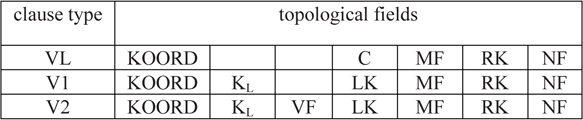
The Topological Field Model counterpart, first formulated by Drach (Reference Drach1963) and refined by Höhle (Reference Höhle and Schöne1986), makes similar assumptions on the clause structure of German, but represents it in a linear way. This model does not graphically signal the matrix or embedded status of a syntactic string in terms of higher and lower position in the tree. In Höhle Reference Höhle and Schöne1986, one finds the following descriptive model (slightly simplified here for the sake of convenience):
Höhle's (Reference Höhle and Schöne1986) Topological Field Model.

In Vfin (VL=Verb-Letzt) or embedded constructions, which may be preceded by a coordinating conjunction (KOORD), a complementizer (C) introduces the clause. The elements of the clause (subject, objects, adjuncts, etc.) occupy the middle field (MF=Mittelfeld) and the finite verb is hosted in the right bracket position (RK=rechte Klammer). Other elements such as question tags, extraposed adjuncts, relative clauses, the second element of a comparative clause, etc. are in the final field (NF=Nachfeld). In V1 clauses, typically questions and imperative forms, the finite verb may be preceded, apart from a paratactic conjunction, by a left-dislocated element, that is, a topicalized object or adverbial. V2 clauses have the most complex internal structure. Two scenarios are possible in the preverbal layer. First, this position may be filled by a subject, a direct or indirect object, an adverbial, or a topicalized clause (in KL, or pre-prefield=Vorvorfeld, or in K, or prefield=Vorfeld) immediately followed by the verb. Second, any of these elements may be resumed by a reduced form (a pronoun, or a prepositional object). In V1 and V2 clauses, the right bracket may host the verb particle of the inflected form that appears in the left bracket. The functions described here are exemplified in 3.
(3)
The generative (in particular, the GB/P&P-based) approach and the Topological Field Model are similar in many respects: The projections assumed in the old standard generative framework have their counterparts in the topological one. However, they differ in that the latter (as well as other theories, such as HPSG, Simpler Syntax, and Categorial Grammar) does not employ transformational movement and derivations to explain word order and grammaticality; instead it limits itself to a more or less detailed description of the clause architecture of German.
The structure of this article is as follows: In section 2, three cases of apparent multiple filling of the German left periphery are discussed, based on the type of elements simultaneously occupying the CP: two full XPs (section 2.1), an XP and a focus particle (section 2.2), and an XP and a topic particle (section 2.3). In section 3, I propose a derivation within the generative framework that accounts for the data in section 2 and relies on the distributional interaction between the categories addressed in this paper, thereby challenging the analyses put forth in the literature so far. I conclude that the internal structure of the German clause, despite being subject to the V2 parameter, allows for exceptions in the CP that may be elucidated by means of Rizzi's (Reference Rizzi1997) proposal on the fine structure of the left periphery.
2. Can the German Prefield Be Multiply-Filled?
Although Rizzi's Reference Rizzi1997 cartographic mapping and Höhle's (Reference Höhle and Schöne1986) Topological Field Model differ in some points not discussed here, they both provide quite a rigid representation of clause structure. However, a number of main- and embedded-clause phenomena have been observed that seem to contradict and complicate the story, most notably the so-called multiply-filled prefield (Haider Reference Haider1982; Fanselow Reference Fanselow1987; Müller Reference Müller2005, Reference Métrich, Courdier, Métrich and Vuillaume2013; Speyer Reference Speyer2008; Bildhauer Reference Bildhauer2011; Jensen Reference Jensen2012). This term is generally used with reference to three types of constellations: (i) two constituents apparently occupying the preverbal position(s) in the left periphery; (ii) a constituent (generally a DP) followed by a focus particle, both linearized before the finite verb; (iii) a constituent followed by a topicalizing connector, such as aber ‘however’, nämlich ‘namely’, schließlich ‘finally’. In this section, the three phenomena are addressed by presenting their most relevant features and reviewing the structural analyses that have been proposed in the literature. I address the following question: Is it reasonable to assume a doubly-filled prefield in an otherwise strictly V2 language like German, or is this phenomenon to be considered as an exception to the rule?
2.1. The “Two-Constituent” Prefield Structure
In fact, despite the generalization mentioned above, German allows for more than one constituent in the prefield. This possibility is not limited to spoken or specific dialectal varieties (which would not be a good reason to underestimate the issue anyway), but constitutes a well-formed structure in Standard German. As noted by Speyer (Reference Speyer2008:455), the phenomenon was more common in earlier stages of German, notably in Early New High German, but is not even considered by more recent formalizations. Consider the examples in 4.
(4)
The examples in 4 show that the elements found in the doubly-filled prefield do not seem to be subject to any particular class restrictions. In 4a, a PP and a DP co-occur; in 4b, an adverbial PP and a temporal clause; in 4c, an adjective and an adjunct. Of course, such cases are not to be confused with phenomena such as left dislocation and hanging topic (see Altmann Reference Altmann1981, Cardinaletti Reference Cardinaletti1989, Nolda Reference Nolda2004):
(5)
The examples in 5 illustrate the former phenomenon whereby the object DP is left-dislocated to the specifier of TopP and resumed by a demonstrative pronoun in [Spec, FinP] (in the Topological Field Model, den Hans appears in KL and the pronoun in the prefield). Both XPs display accusative case. This marks the difference with the hanging topic in 5b, which does not exhibit the same case as the demonstrative DP in the prefield. For this reason, the clauses in 4 are assumed to exemplify two distinct constructions, which are contemplated both by the generative and the Topological models.
At this point, the question arises as to how the problem may be solved by means of the existing models. Haider (Reference Haider1982), Fanselow (Reference Fanselow1987), and later Müller (Reference Müller2003, Reference Müller2005) note that the XP types that may appear in that position seem to display a particular connection with the VP. They build, inter alia, on Fanselow's observation that one of the two elements is obligatorily either a PP or a directional phrase. In the analysis developed based on this hypothesis, the two XPs in the prefield are interpreted as one because the surface word order is the result of the topicalization of the whole VP into the left periphery, the VP being headless. This would solve the problem due to the elegant assumption that it is all about a seeming double filling of the prefield area. Haider (Reference Haider1982), Fanselow (Reference Fanselow1987), and Müller (Reference Müller2003, Reference Müller2005) propose, therefore, an ad-hoc solution that may explain some of the possible cases. However, it is not satisfactory because it does not capture all features of the phenomenon. For instance, it neglects the possibility illustrated in 4b that a PP and an embedded clause may appear in the prefield, which is a very common structure both in spoken and written Modern German. If the derivation were obtained by means of a remnant VP topicalization, as proposed by Müller (Reference Müller2003, Reference Müller2005), two facts would remain unexplained: First, as admitted by Müller (Reference Müller2005) himself, structures such as 6a are ungrammatical, even though clauses of this type, with two objects in preverbal position, seem to be allowed, as shown in 6b.
(6)
A possible hypothesis could be that the unacceptability of 6a arises from the grammatical relations not being visible in the surface structure, due to the fact that proper names in Standard German do not require a definite article, as would be the case, for example, in Bavarian or Swabian-Alemannic. However, the acceptability of the sentence does not improve even if case relations are made explicit: ⋆Der Maria den Peter stellt der Max vor. It is to be said, however, that even 6b is questionable for many speakers (see also Bildhauer Reference Bildhauer2011), although the order of the constituents in the prefield (dat»acc) mirrors the syntactic arrangement within the VP, and case relations are overt: The DP Bonbons ‘candies’, as a loan word, bears no overt case morpheme, but the DP in clause-initial position is clearly marked for dative, and the personal pronoun man in the middle field can only be nominative. The grammaticality of the structure may, perhaps, improve if one of the two DPs bears focus stress. This, however, would definitively prevent them from being processed as a single topic. Moreover, it would be difficult to explain clauses with two elements in the prefield, such as a DP and a temporal clause, and a further adjunct CP that remains attached to the VP.
Consider the examples in 7.
(7)
In 7a, the verb of the main structure is negated to force the interpretation of the causal clause as a central adverbial construction in the spirit of Haegeman Reference Haegeman2004. As for 7b, I assume that both the temporal and the final clause are adjoined to VP. Central adverbial clauses (which, roughly speaking, include temporal, conditional, causal, and final subordinates) are, of course, adjoined to the VP. This makes it hard to argue for the movement of a headless VP, which has mein Vater ‘my father’ as its external argument and als er dahinter kam ‘when he found out’ as an adjunct, but which does not contain the other adjunct CP.
The same goes for 7b, in which two adjunct CPs remain in the middle field. In particular, it would be bizarre that only one of the adjunct CPs is topicalized, while the other(s) remain adjoined to the (trace of the) VP, irrespective of whether the lexical verb has left the verbal shell (as is the case of synthetic forms) or not (as in analytic forms). In other words, it is unclear what exactly remains in the canonical VP position.
It seems, therefore, that the prefield of the German clause can host more than one element, and that its surface word order in the examples discussed here is not necessarily the result of a remnant VP movement. In the next section, the co-occurrence of an XP and a focus/topic particle or adverbial connector in preverbal position is addressed in order to establish if a similar conclusion may be drawn.
2.2. The “XP+Focus Particle” Prefield Structure: The Case of Sogar
Jacobs (Reference Jacobs, Abraham and de Meij1986) considers nominal expressions occurring in the prefield that are modified by prenominals like sogar ‘even’ and auch ‘also’ as a double filling of [Spec, CP]. He argues that a structure of the type [NP [AdvP] N] is ruled out for the German nominal expressions, and that, hence, there must be two distinct elements occupying the prefield, as shown in 8.
(8)
Jacobs’ argument is valid insofar as in the internal cartography of the German DP, the string AdvP>NE is not the preferred one. However, Jacobs’ observation does not exclude this possibility: Focus particles clearly have a particular relation to the nominal expression that they modify, which led authors such as Reis (Reference Reis2005) and Sudhoff (Reference Sudhoff, Harden and Hentschel2010) to postulate an independent projection for such elements, although the question is still debated. The assumption of a DP-internal position for focus particles is, in fact, not a mere speculation: Focus particles, unlike other types of particles, are prosodically integrated into the nominal expression they are associated with (when they are adjacent to it on either right or left), which seems to indicate that they are merged in a position internal to the DP. Moreover, focus particles certainly do not have the same status as full adverbials and DP-internal particles of various kinds that have been discussed for a number of languages, including Japanese (Watanabe Reference Watanabe2006), English (Anderson Reference Anderson, Kohlberger, Bellamy and Dutton2014), West Flemish (Haegeman Reference Haegeman2013) and even German (Kleemann Reference Kleemann2007). In German, the particle can occur not only in prenominal (see 8), but also in postnominal (see 9a, b) position. It can also appear in clause-final position, clearly taking long-distance scope over the DP, which may bear nominative or accusative case, as in 9c and 9d, respectively. In addition, focus particles located in the prefield can also take long-distance scope, the focus itself being in the TP in a position lower than that of the finite verb, as in 9e.
(9)
Examples 9c, e are admittedly controversial due to the position of the focus particle. In both cases, the context makes it clear that the focused element is not the whole clause but meine 10-jährige Tochter and mein Ehemann, respectively. This is because the content of the two clauses, excluding the focused DP, is thematic and not rhematic, that is, neither the VP nor the internal argument alone are in the scope of the particle. Indeed, both meine 10-jährige Tocher and mein Ehemann must bear focus accent.
In their analysis of focus particle placement in German, Bühring & Hartmann (Reference Bühring and Hartmann2001) conclude that particles such as sogar can only be adjoined to nonargument XPs; they must be maximally close to the nominal expression they take scope over; they can adjoin to CPs, thereby allowing unexpected V3 word orders. Nevertheless, as noted by Reis (Reference Reis2005) in her critical review, the adverb-only theory proposed by Bühring & Hartmann is defective. For example, it does not account for all possible word orders, and the clauses in 9 exemplify this deficiency. The relative mobility of these particles observed in 9—contra Bühring & Hartmann's “maximal closeness”—as well as the still unsolved question of focus particle adjunction lead to the conclusion that in cases such as 8a and 9, the prefield must be doubly-filled.Footnote 5
In any case, all doubt on the (im)possibility for the prefield to be multiply-filled is removed if one considers the examples in 10.
(10)
Irrespective of how DPs modified by focus particles are treated—that is, whether the particle is analyzed as DP-internal or not—one must admit that the syntactic material residing in the prefield in 10 contains more than one element. More specifically, it includes—minimally—the adverb vielleicht ‘maybe’ and the complex nominal expression.Footnote 6 The possible objection that the adverb modifies the focus particle, which is itself an adverb, is obviated by the simple observation that the clause can be reformulated as follows:
(11)
In 11a, the focus particle is omitted and the focus reading of meine Frau ‘my wife’ is lost, but the structure is grammatical and still entails a double filling of the prefield. In the other two cases, 11b, c, the particle and the irrealis mood adverb are linearized separately, which shows that no dependency relation exists between the two elements. In section 2.3, the syntactic properties of postinitial aber ‘but’ are discussed as an umbrella case for connectors that may appear in the prefield together with an XP. This discussion puts into question the one-position-one-element constraint generally assumed for the [Spec, CP] position in German.
2.3. The “XP+Connector” Prefield Structure: The Case of Aber
The German element aber may appear in a number of syntactic environments and, depending on the context, perform different textual or pragmatic roles. Besides its original function as a paratactic connective with adversative value connecting two XPs (clauses, DPs, APs, etc.), aber has developed further pragmatic functions. First, it functions as a modal particle that is base-generated in a low, pre-VP position (MoodP, according to Coniglio Reference Coniglio2006) and then moves to a higher functional projection. It also functions as a topic particle with a general denial of expectation reading including a contrastive and a concessive interpretation (Blakemore Reference Blakemore2000, Sæbø 2002), whose specific implications are still under debate. In this latter function, aber may appear to the right of an XP located in the prefield, that is, in the so-called postinitial position (Nacherstposition, see Pasch et al. Reference Pasch, Brauße, Breindl and Waßner2003, Onea & von Heusinger Reference Onea, Heusinger, Jacob and Dufter2009, Volodina & Weiß Reference Volodina and Weiß2010), as illustrated in 12a. The same position is available for other adverbial connectors, for example, nämlich ‘namely’, nun ‘now’, schließlich ‘finally’.
(12)
As the examples show, the postinitial element always occurs after the XP in clause-initial position but before the inflected verb, just like focus particles. What crucially differentiates between the elements in 12 and focus particles such as sogar is, inter alia, that the former otherwise function as so-called adverbial connectors, while the latter only perform a focusing function. The term (adverbial) connector is generally used in the literature to refer to these items (see, among others, Pasch et al. Reference Pasch, Brauße, Breindl and Waßner2003, Ferraresi Reference Ferraresi, Chlosta, Leder and Krischer2008, Volodina & Weiß Reference Volodina and Weiß2010, Blühdorn Reference Blühdorn, Gunkel and Zifonun2012, Karagjosova Reference Karagjosova2012) However, it seems to me that defining them as connectors when they perform this specific function is misleading, as they do not connect anything, either within the prefield or between two layers (for example, two different CPs or DPs, as a logical connective does). Moreover, in contexts such as 12 they are only homonymous with the corresponding conjunction (aber) and nonconjunctional clause-introducing adverbs (nämlich, nun, schließlich)Footnote 7. I therefore use the term (postinitial) particle to indicate the elements in 12 and in particular aber, which is the focus of the present investigation.
The phenomenon, with reference to all or some of the particles observed in 12, has been variously formalized in the literature, starting from the seminal work by Métrich & Courdier (Reference Métrich, Courdier, Métrich and Vuillaume1995). The authors point out that there seem to be no constraints whatsoever on the type and syntactic function of the XP appearing in conjunction with aber in the prefield, the most frequent being DPs, followed by PPs, adverbs, infinite verbal forms, verb complexes, connectors, modal adverbs, and negation particles. The syntactic-textual function of postinitial aber is reduced to three basic roles: contrast, resumption, and turning point, exemplified in 13–14 below.
Métrich & Courdier make a clear-cut distinction between contrast and resumption. The former holds when the element in the prefield is semantically similar to an XP in the preceding clause with which an opposition is established. However, the two XPs do not refer to the same entity. The latter holds when the XP occurring with aber resumes the XP (or the information expressed by it) in the preceding clause. For example, that XP can be repeated, replaced by a pronoun, or paraphrased. Contrast and resumption, as defined by Métrich & Courdier (Reference Métrich, Courdier, Métrich and Vuillaume1995), are exemplified in 13a, b and 13c, d, respectively.
(13)
The third function of postinitial aber in Métrich & Courdier Reference Métrich, Courdier, Métrich and Vuillaume1995 is a turning point. It consists in introducing an XP in the prefield into the discourse (that is, an XP that has not been used before or whose reference cannot be inferred from the information provided in the preceding clauses). The role of this XP is to signal a change in perspective and construct a mental contrast between a previous state of affairs and the new situation introduced by the XP+aber clause. Typically, therefore, the XPs occurring before aber have the meaning now, then, etc., as shown in 14.
(14)
The functional role that Métrich & Courdier (Reference Métrich, Courdier, Métrich and Vuillaume1995) assign to postinitial aber is, hence, purely pragmatic. The speaker signals what may be generally defined as a contrast not clearly expressed in the context, that is, he/she disambiguates information that should otherwise be inferred.
Breindl (Reference Breindl, Breindl and Thurmair2008, Reference Breindl and Ferraresi2011), who takes into consideration not only aber but also the other postinitial particles, puts forth a slightly different, somewhat more general, analysis. She suggests that postinitial elements indicate a topic shift, that is, they are placed after a topic XP which is different from the topic XP of the previous clause. The eligible topic categories for an XP+aber construction in the prefield are, according to this analysis, shifting, contrastive, and frame-setting topics, while so-called constant topics are not good candidates. Breindl (Reference Breindl, Breindl and Thurmair2008:38–39) investigates the nature of these good candidates with respect to a number of specific features. Shifting topics, the first category identified by the author, represent a linear theme progression, whereby the topic of a clause is the comment of the preceding clause or is derived from it:
(15)
In 15, the topic of the second clause, which is followed by aber, resumes the comment of the previous clause, a pattern very similar to the one found with Métrich & Courdier's (Reference Métrich, Courdier, Métrich and Vuillaume1995) resumptive function of aber (see 13c, d).
The second possible constellation is given by contrastive topics. They may be explicit or open to the hearer's implicit mental contrast and correspond quite precisely to the notion of contrast found in Métrich & Courdier Reference Métrich, Courdier, Métrich and Vuillaume1995 and exemplified by the original data in 13a, b.Footnote 9
(16)
With reference to frame-setting topics, Breindl (Reference Breindl, Breindl and Thurmair2008:41) observes that one of the main functions of the prefield is to establish a background for the content of the clause or sentence, which may be performed by temporal, local, or other adverbials (defined as “frame adverbials”). Such adverbials act as topics, and their role, following Chafe Reference Chafe and Li1976:50, consists of limiting “the applicability of the main predication to a certain restricted domain.” This is illustrated in 17.
(17)
As can be seen, both Métrich & Courdier (Reference Métrich, Courdier, Métrich and Vuillaume1995) and Breindl (Reference Breindl, Breindl and Thurmair2008) mainly focus on the pragmatic features of postinitial aber, without really providing a formal analysis that accounts for its syntactic distribution, bar some preliminary considerations on the possible XP types that allow their combination with a postinitial particle. A formalization of the phenomenon is sketched by Volodina & Weiß (Reference Volodina and Weiß2010) with reference to nämlich ‘namely’ (see 12b), who basically consider two possible analyses. One hypothesis, based on Pasch et al. Reference Pasch, Brauße, Breindl and Waßner2003, assumes the availability of an additional projection in the Split CP, where the particle is base-generated. The second, more conservative, hypothesis is that the XP in the prefield followed by the particle is to be interpreted as one complex: The particle is base-generated in the middle field, projecting its own phrase; the XP moves into the specifier position of this phrase, and the whole PrtP is then moved into the left periphery.
Note that each of the two analyses bears important consequences for the general understanding of the clause structure of German. On the one hand, if the particle were base-generated in the CP, then one should assume that in such cases the prefield is doubly-filled, just as in cases discussed so far. On the other hand, if the PrtP moved to the prefield with the XP in its specifier, the multiple filling of the prefield would only be apparent. An adaptation of Volodina & Weiß’ (Reference Volodina and Weiß2010) structural represen-tation for the latter analysis is given in 18 (representation of XP+aber derivation).
(18)
Volodina & Weiß (Reference Volodina and Weiß2010) bring new data into the discussion exemplified in 19a: An XP in the prefield is modified by a focus particle and followed by a postinitial particle (Volodina & Weiß focus on nämlich replaced in 19a by aber). They conclude that the second option (that is, 18) is the more plausible of the two and propose a derivation in 19b, in which the finite verb occupies the head of TopP in the surface structure:
(19)
This analysis would provide a somewhat more elegant solution than the admission that the prefield of a strictly V2 language like German may host more than one element. However, another point must be taken into consideration that makes Volodina & Weiß’ proposal problematic. Consider the examples in 20.
(20)
In 20, a DP that takes a that-clause (20a) or a (restrictive) relative clause (20b) as its complement may appear in the prefield followed by aber and is syntactically detached from its own complement, which is linearized after the particle. If the analysis proposed by Volodina & Weiß (see 18) were correct, such a structure would definitely be ruled out, since the complex DP, including the dass- or relative clausal complement, should move to the specifier of PrtP already in the middle field and then to a position of the extended left periphery. This, in turn, would raise the question of why the matrix DP appears separate from its complement.
The structure is also possible if the complement of the DP is a nonrestrictive relative clause (as in 21a) or an infinitive clause (as in 21b). Apparently, at least in earlier stages of the language, it was common to have the same structure, but with a DP complement in the form of a PP, as in 21c, or of a genitive phrase, as in 21d, whereas in Modern German the structure is still present, but less attested.
(21)
A concrete formalization of the structural features and of the positions available in the left periphery of the German clause that would capture the phenomena described in this section seems to be very difficult. In the next section, I bring these facts down to a common denominator by proposing an alternative analysis that is able to derive all the possible word orders found in the prefield.
3. Discussion and Analysis
The puzzling facts discussed in section 2—namely, the presence of multiple XPs in combination with focus and topic particles in the prefield of the German clause—clearly challenge the classical formal analyses proposed in the literature for a general description of the word order possibilities in this language. I have shown that the empirical evidence militates against—or makes difficult the description of—a unified syntactic analysis consistent with the V2 parameter. The question becomes even more complicated if one considers that the three scenarios presented so far may interact with each other in the German prefield, that is, they can occur simultaneously. Consider the examples in 22.
(22)
In 22, one observes a combination of the phenomena mentioned so far, for which different analyses were proposed. In 22a, the DP die Tatsache ‘the fact’ is preceded by a focus particle and followed by the postinitial particle aber. The DP is split in the linearization, since its clausal complement appears after the particle. In 22b, the temporal adverbial gestern ‘yesterday’ appears in first position, followed by aber, and another adjunct, a temporal clause in turn complemented by an infinitival clause, follows the particle.
Merging Müller's (Reference Müller2003, Reference Müller2005) and Volodina & Weiß’ (Reference Volodina and Weiß2010) analyses into a joint model for the representation of 22 would create the same structural problem as the one posed by the single phenomenon, only complicated by the combination of the elements in the same clausal area. For example, for 22a three preliminary principles can be formu-lated. First, given that the focus particle may also appear in a lower position following the topic particle (see 23a below), it is impossible (contra, for example, Bühring & Hartmann Reference Bühring and Hartmann2001) for the DP die Tatsache and the focus particle sogar to be processed as one unit, irrespective of the exact word order. Second, even if the nonadjacent DP and the focus particle could be processed as one unit, it would be difficult to explain why the DP is detached from its complement.
Third, the position and derivation of aber, as assumed in Volodina & Weiß Reference Volodina and Weiß2010, creates further confusion. Let us suppose that in 22a the phrase that aber follows moves into [Spec, PrtP] in the middlefield. This gives rise to the double problem: One has to explain how the focus particle reaches that position (that is, whether in the middle field or at some other point in the derivation), and what determines the position of the complement that-clause in the prefield. The same applies to 22b: It is impossible to adopt Müller's (Reference Müller2003, Reference Müller2005) remnant VP solution in light of the nature and position of the adjunct CP, a fortiori because the two adjuncts are divided by the particle aber, a possibility which is not taken into consideration by Müller.
(23)
The relative order of the focus particle and the postinitial particle reveals something about the internal structure of the prefield: While the focus particle is mobile, the postinitial topic particle aber always occupies the same position. In light of the data discussed here, it does not seem possible to derive a V2 word order by assuming that a certain number of VP-internal movements result in a single big movement into the CP, whereby giving the impression that the prefield is occupied by more than one element. Therefore, I adopt the tentative hypothesis that under certain particular pragmatic circumstances and without putting into question the validity of the V2 parameter for German, the prefield in this language may host multiple elements.
In what follows, I propose a derivation for all the word orders observed. I begin by considering two parallel perspectives. On the one hand, under the original and largely uninvestigated proposal, focus particles and postinitial particles (which, as we have seen, only affect topical elements) may be base-generated in the head of FocP and TopP, respectively, two positions which otherwise remain empty. On the other hand, under the widely accepted view, the general architecture of the left periphery looks like Rizzi's (Reference Rizzi1997) formalization (see the structure in 2), also taking the two TopP projections to be present in German.Footnote 10
Let me start from the suggestion that the prefield may host two different XPs base-generated in a non-CP position, as shown in 24.
(24)
Given that the DP and the CP are both topics, a possibility to consider would be the analysis in 25: The DP mein Vater moves into the higher [Spec, TopP] and the temporal adjunct clause als er dahinterkam into the lower [Spec, TopP], from the VP-internal position in which they are generated.
(25)
As Volodina & Weiß (Reference Volodina and Weiß2010) note, this is not a particularly problematic issue in the cartographic approach, which predicts that all language systems have the same basic levels of representation. The left periphery of the clause establishes a connection between the content of the inflectional layer and the discourse context or the previous clause/utterance. Therefore, the simultaneous topicalization of two elements—when the speaker needs to push two different elements into the background of the information contained in the IP layer—is not surprising as it is present in a number of languages. Most importantly, one can dispose of a universal set of functional projections to describe the phenomenon. Perhaps the multiple filling of the Split CP is not the best option in German; yet it is attested not only in spoken, but also in written language. Moreover, as I have shown, multiple filling was always present in the system.
I propose to combine the hypothesis that in German, the prefield may host multiple elements with the two empirical observations about aber: First, it always occupies the same position in the prefield, that is, it is not mobile (see 23a, b). Second, it may not appear after the second element in the preverbal layer, ergo, after the temporal clause, as in 26a. Then it is possible that aber is base-generated in the head of TopP, the first of the two XPs occupying its specifier, as in 26b.
(26)
As for unstressed personal pronouns, which are generally argued to be located in [Spec, FinP], one can expect them to move further to [Spec, TopP], as in 27b: As shown in 27c, when more than one XP is present in the pre-Fin area, no other word order is possible. In 27c, aber is, of course, intended in its topicalizing, not in its conjunctional function, in which the particle cannot precede the pronoun.
(27)
In section 2.2, I showed that the position of the focus particle is not fixed. I assume, on the basis of this simple observation, that focus particles are DP-internal and therefore move to the CP area together with the nominal expression they are associated with. I also assume that topic particles, which are not mobile, are base-generated in the head of the TopP, whose Spec is targeted by the DP. Given these assumptions, the (partial) derivation of the structure in 28a is given in 28b. To explain the apparent mobility of the focus particle, I hypothesize that the DP-internal particle (base-generated in a very high DP-internal Spec position) can move to the higher Top position together with its nominal expression, as shown in 28b; alternatively, it can remain in a lower position, to which the DP itself (optionally) moves before reaching its surface projection, as shown in 28c. This point is addressed in 32 more thoroughly.
(28)
At this point, the question arises as to how the facts presented in 22 may be analyzed. Specifically, how split complex DPs with clausal complements (relative, infinitival, or that-clauses), or genitive phrases or PPs can be structurally justified, given that none of the current analyses take this possibility into account. In 29a, the example in 22a is reproduced for the reader's convenience. A similar example, in which the complement of the DP is a GenP, is given in 29b.
(29)
Apart from the complement type, an obvious difference between 29a and 29b consists in the position of the focus particle. As one can see, even when the XP in clause-initial position is detached from its complement because of the presence of the postinitial particle, the focus particle may intervene after aber. This is particularly interesting, because it shows that the focus particle can only occur in the structural position of the Split CP in which FocP is located. In fact, the placement of the focus particle elsewhere, for example, after the clausal/genitive complement, would lead to ungrammaticality:
(30)
This strongly supports an analysis such as 28b, in which the phrase moving into the higher TopP optionally reaches the lower TopP. From the position in the lower TopP, the XP die Tatsache ‘the fact’ in 29 moves to the higher TopP. In 29a, the focus particle nur ‘only’ moves up higher together with the DP it resides in. In 29b, the particle remains in the DP, while its N, together with the genitive DP complement, moves out of the lower Top projection. The postinitial particle aber, which is base-generated in Top° and does not move, follows the DP die Tatsache. Indeed, in such cases the lower TopP projection is unavailable for further topics raising to the left periphery from their base position in the middle field, as shows the ungrammaticality of the examples in 31.
(31)
In any case, Volodina & Weiß’ (Reference Volodina and Weiß2010) idea that the particle surfacing in postinitial position may be base-generated in the middle field is not confirmed in an obvious way by empirical evidence. Indeed, it does not matter what specific derivation the authors assign structures of the type XP+postinitial particle in the prefield (that is, the movement of the XP into [Spec, PrtP] and the subsequent raising of the complex phrase into the left periphery). Such particles as aber cannot appear in the middle field with the same function, since in a lower position they are always associated with the predicate and not the XP with which they move to TopP. The structural representation assumed here for the “extreme” case of a DP—that is, a DP that occurs in the prefield in combination with a focus particle (in both pre- and postnominal position) and a postinitial particle, whose complement appears after the particle itself—is given in 32. The derivation of the word order in 22a and 22b is given in 32a and 32b, respectively.
(32)
It goes without saying that separating the head from its complement is not obligatory: When they surface in adjoined positions, the word order within the prefield is the same. Consider the example in 33.
(33) Die Tatsache {OKder Krebsentwicklung} aber allein {OKder Krebsentwicklung} mahnt zur Vorsicht.
Of course, more research is needed to derive a comprehensive and evidence-based picture of the phenomenon. However, this analysis may contribute to further studies, given that it seems to be, mutatis mutandis, unproblematic from a technical point of view. The relevant—and clearly somewhat controversial—implication of such an analysis is that, contrary to the common assumption (excluding the intuitions tested and formalized in Jacobs Reference Jacobs, Abraham and de Meij1986), the prefield of the German clause is only apparently simple. In fact, the impossibility of finding an elegant account for the bizarre crowding of the preverbal area in such cases—as well as the unjustified assumption that topic and focus particles are base-generated in the middle field—amounts to the admission that in some cases, the extended CP may host more than one element besides the finite verb and, occasionally, a resumptive pronoun in [Spec, FinP] (that is, the case of left dislocation).
4. Summary and Conclusions
In the present paper, I considered three cases of apparent multiple filling of the prefield in German, namely, structures in which the preverbal area of the clause seems to be occupied by (i) two full XPs that are clearly base-generated VP-internally (for example, a DP and an adjunct CP, an AP and a PP, etc.); (ii) an XP base-generated in the middle field and a focus particle (I concentrated on the case of sogar ‘even’), with the focus particle appearing either to the right or to the left of the XP; (iii) an XP base-generated in the VP and a motionless postinitial (topic) particle, the latter exemplified by the umbrella case of aber ‘however’. Given that German is classified as a strictly V2 language, in which the finite verb always occurs in second position in matrix clauses, in the literature such phenomena are generally treated as cases of apparent multiple filling of the prefield. Although there are some exceptions (see Jacobs Reference Jacobs, Abraham and de Meij1986), no formal analysis has been proposed.
It was shown that Müller's (Reference Müller2003) remnant VP solution to (i) does not capture all possible scenarios. For example, it does not account for cases where a DP and an adjunct CP are topicalized. The same goes for the interaction of focus particles and postinitial particles, for which a solution has been suggested. Volodina & Weiß (Reference Volodina and Weiß2010) propose that the linear surface order before the inflected verb in the prefield results from a complex derivation starting in the middle field: The postinitial particle is base-generated in a dedicated projection within the TP, and the XP moves into its specifier. Then the whole PrtP moves higher into the left periphery. Volodina & Weiß, however, have admittedly not found any solution to structures in which not only a postinitial particle such as aber, but also a focus particle occurs. Furthermore, there seems to be no empirical evidence for the hypothesis that such particles are generated in the middle field.
In any case, none of the analyses available take into consideration complex XPs that move into the prefield and co-occur with a focus particle and a postinitial particle. The latter optionally separates the head of the XP from a complement, which can be a that-clause, a relative clause, a genitive phrase, or a PP. Unlike the topic particle, the focus particle may appear in two positions, namely, either after the topicalized constituent (and the topic particle, if present) or to the left of the XP. For this maximally complex construction, an analysis has been suggested in the present paper that accounts for all possible word orders. It has been proposed that the XP (composed, for instance, of a FocPrt-modified DP and its clausal or phrasal complement) optionally moves to the specifier of the lower TopP projection prior to raising to its landing site in the higher [Spec, TopP]. From there, the DP moves to the higher topical projection, its complement remaining in the specifier position of the lower TopP. The postinitial particle, which is base-generated in the head of the higher TopP, may not move and follows, in linear terms, the topicalized XP residing in its specifier. In contrast, the focus particle may either remain in the partially emptied DP in the lower Top position or optionally move to the higher TopP together with its DP.
In cases in which two constituents (for example, a DP and a CP) raise to the prefield, irrespective of whether a focus or topic particle intervenes between them, they are linearized as targeting the higher and the lower TopPs. Such a derivation is able to account for all possible word orders (and also exclude the ungrammatical strings) without violating any constraint on extraction and, crucially, is motivated by the distribution of focus versus postinitial particles.
This analysis shows that the CP area may be occupied by up to two nonverbal items, irrespective of their nature.Footnote 11 Yet by no means does it intend to put into question the validity of the V2 parameter in German, which is clearly active and visible in a number of ways. It suggests instead a more flexible approach to the internal structure of the German clause. Under this approach, so-called exceptions may be accounted for in terms of the cartographic structure we dispose of at least since Rizzi's (Reference Rizzi1997) seminal formalization of the fine design of the pre-IP layer. According to Rizzi's analysis, the pre-IP layer contains as many FPs (and corresponding grammatical functions) as are needed to satisfactorily explain the presence of multiple constituents in the left periphery.