1. Introduction
Burlingia Walcott, Reference Walcott1908 is a proparian, poorly mineralized trilobite belonging to the Family Burlingiidae Walcott, Reference Walcott1908. Whittington (Reference Whittington1994) described and discussed the systematic position of this family as well as their life habits. It is probably monophyletic and contains the genera Burlingia and Schmalenseeia, but its relationship with other trilobite groups is unclear (Ebbestad & Budd, Reference Ebbestad and Budd2002).
This work is focused on Burlingia, which, because it is cosmopolitan, was probably planktonic (Jago, Reference Jago1972; Whittington, Reference Whittington1994), mainly occurring in marginal platform or outer shelf facies from Canada (Walcott, Reference Walcott1908; Rasetti, Reference Rasetti1951), the USA (Robison & Babcock, Reference Robison and Babcock2011), Sweden (Westergård, Reference Westergård1936; Whittington, Reference Whittington1994), Siberia (Soloviev, Reference Soloviev1969), South China (Zhang et al. Reference Zhang, Lu, Zhu, Qian, Lin, Zhou, Zhang and Yuan1980; Yuan et al. Reference Yuan, Zhao, Li and Huang2002) and Norway (Ebbestad & Budd, Reference Ebbestad and Budd2002). It has a stratigraphical range from the upper part of the Cambrian Series 2, Stage 4 to the Cambrian Series 3, Drumian Stage, thus crossing an important geological interval (i.e. the lower–middle Cambrian boundary). The aim of this paper is to describe a new species of Burlingia from the traditional lower Cambrian of Guizhou Province (South China) and review the stratigraphical, palaeogeographical and biostratigraphical significance of this genus.
2. Geological setting
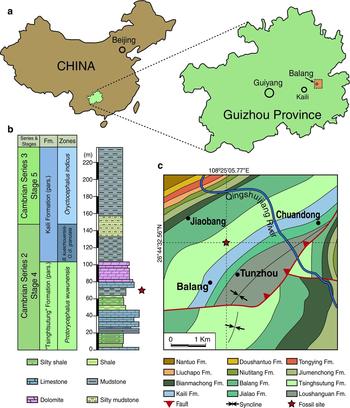
The described specimens of Burlingia balangensis sp. nov. are from the Cambrian of SE Guizhou Province, South China (Fig. 1a) where rocks are well exposed and documented (Yin & Lee, Reference Yin and Lee1978; Lin et al. Reference Lin, Yuan, Wang, Zhao, Peng, Babcock and Zhu2005; Zhao et al. Reference Zhao, Yuan, Zhu, Babcock, Peng, Wang, Yang, Guo, Yang, Tai, Peng and Babcock2005a , Reference Zhao, Peng, Yuan, Babcock, Guo, Yin, Yang, Tai, Wang, Lin, Gaines, Sun and Yang2012; Yang et al. Reference Yang, Zhao, Peng, Yang and Yang2010; Yuan et al. Reference Yuan, Lin, Zhao, Peng, Hollingsworth, Sundberg and Foster2011) as representing (1) the shallow-water Yangtze Platform, (2) deeper water Jiangnan Basin and (3) transitional Jiangnan Slope Belt.
(a–c) Geological setting. (a) Map of China showing Guizhou Province and the Balang locality. (b) Stratigraphic column of the upper part of the ‘Tsinghsutung’ Formation and the lower part of the Kaili Formation of the Malipo section showing the location of Burlingia balangensis sp. nov. (c) Geological map of the Balang area indicating the location where the specimens were collected.

The specimens were collected from the transitional Jiangnan Slope Belt near the locality of Balang in the east of Guizhou Province. Here, the following formations in ascending order are the Tsinghsutung and Wuxun formations (both c. 123 to 250 m thick) of the Cambrian Series 2 and the Kaili Formation, which crosses the Cambrian Series 2 – Series 3 boundary (Zhao et al. Reference Zhao, Yuan, Zhu, Babcock, Peng, Wang, Yang, Guo, Yang and Tai2005b , Reference Zhao, Peng, Yuan, Babcock, Guo, Yin, Yang, Tai, Wang, Lin, Gaines, Sun and Yang2012; Yang et al. Reference Yang, Zhao, Peng, Yang and Yang2010). Our specimens came from a level 30 m below the Kaili Formation (Fig. 1b), although the lithology here is unlike that of the Tsinghsutung or Wuxun formations studied previously in the transitional Jiangnan Slope Belt (see Yang et al. Reference Yang, Zhao, Peng, Yang and Yang2010). The Tsinghsutung Formation is mainly developed in the Yangtze Platform, although the facies may be found also in the transitional Jiangnan Slope Belt (Yang et al. Reference Yang, Zhao, Peng, Yang and Yang2010), where the Wuxun Formation is mainly developed. The type section of the Tsinghsutung Formation is located near Tsinghsutung village, Meitan County, northern Guizhou Province. This formation is about 208 m thick and is mainly composed of grey to dark grey thick-bedded to massive limestone, grey thick-bedded dolomitic limestone, calcareous dolomite and grey thin- to thick-bedded dolomite and argillaceous dolomite. The endemic benthic trilobite fauna contains the genera Redlichia, Hoffetella, Antagmus, Kunmingaspis, Paraperiomma, Eoptychoparia and Poulsenia (Zhang et al. Reference Zhang, Lu, Zhu, Qian, Lin, Zhou, Zhang and Yuan1980). The type section of the Wuxun Formation is at Wuxun village, Nangao town, Danzhai County, southwestern Kaili City, southern Guizhou Province. This formation is 122 m thick and is mainly composed of green-grey to yellow-green sandy shale, calcareous shale intercalated with thin-bedded argillaceous limestone, dark grey thin- to medium-bedded limestone and dolomitic limestone in the upper part. The formation contains pelagic or planktonic trilobite forms such as Protoryctocephalus and Arthricocephalus (Zhang et al. Reference Zhang, Yuan, Zhou, Qian and Wang1979). At Balang, rocks containing Burlingia balangensis sp. nov. are mainly composed of grey to dark grey thin-bedded limestone, intercalated with grey-yellowish silty shale and mudstone, grey thin-bedded argillaceous limestone and grey thin- to medium-bedded dolomite in the upper part. These may belong to the Tsinghsutung Formation but further work is necessary before we can confirm this and we use the preliminary term ‘Tsinghsutung’ Formation for this facies. What does seem clear is that the Balang rocks do not belong to the Wuxun Formation.
The trilobite assemblage of the ‘Tsinghsutung’ Formation contains a mixed fauna belonging to the Arthricocephalus jishouensis – Changaspis plana Zone in the lower part and the Protoryctocephalus wuxunensis Zone in the upper part containing Ovatoryctocara sp., O. aff. angusta Tchernysheva, Reference Tchernysheva and Shvedov1962, Protoryctocephalus wuxunensis Zhou in Lu et al. Reference Lu, Zhang, Qian, Zhu, Lin, Zhou, Qian, Zhang and Wu1974, P. arcticus Geyer & Peel, Reference Geyer and Peel2011, Feilongshania sp., Duyunaspis sp., Changaspis sp., Nangaops danzhaiensis (Zhou in Lu et al. Reference Lu, Zhang, Qian, Zhu, Lin, Zhou, Qian, Zhang and Wu1974), Redlichia takooensis Lu, Reference Lu1950, Olenoides sp., Dinesus sp. and Burlingia balangensis sp. nov.
3. Material and methods
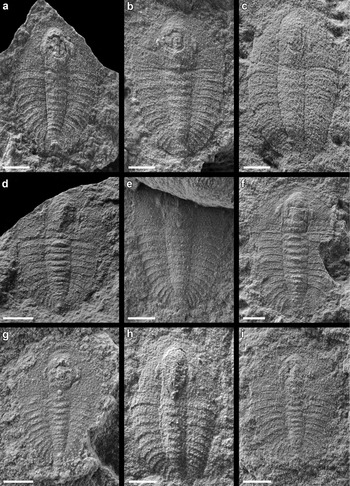
Our material of Burlingia balangensis sp. nov. consists of 14 variously articulated (i.e. nearly complete) specimens (NIGP147820–NIGP147833) preserved as internal and external moulds. The internal moulds and latex casts were examined directly under a Leica M165C stereomicroscope and were coated with ammonium chloride sublimate prior to being photographed with a Nikon D300 camera. Length, width and angular measurements of the specimens were made using ImageJ (Abràmoff, Margalhães & Ram, Reference Abràmoff, Margalhães and Ram2004).
4. Systematic palaeontology
We follow the morphological terminology of Whittington & Kelly (Reference Whittington, Kelley and Kaesler1997). The burlingiid specimens are housed in the Palaeontological Collections, Nanjing Institute of Geology and Palaeontology, Chinese Academy of Sciences, Nanjing, China (NIGP).
Order Uncertain Family Burlingiidae Walcott, Reference Walcott1908 Genus Burlingia Walcott, Reference Walcott1908
Type species. Burlingia hectori Walcott, Reference Walcott1908 from the Stephen Formation, Bathyuriscus–Elrathina Zone (Cambrian Series 3), Mt Stephen in British Columbia, Canada.
Occurrence. From Cambrian Series 2 (Stage 4) to Cambrian Series 3 (Drumian Stage), British Columbia, (Canada), USA, Sweden, Norway, northern Siberia (Russia) and Guizhou Province (South China).
Remarks. Whittington (Reference Whittington1994) revised the family Burlingiidae and provided new diagnoses for its two contained genera Burlingia and Schmalenseeia. Ebbestad & Budd (Reference Ebbestad and Budd2002) assigned the species Schmalenseeia jagoi Whittington, Reference Whittington1994 to Burlingia without the need to emend Whittington's diagnosis and we agree with this. However, our new material indicates reasons for emending the diagnosis (e.g. shorter palpebral lobe or thorax with 10 or 12 thoracic segments).
Diagnosis (emended). Glabella tapering slightly forward, rounded anteriorly, with or without median occipital node; occipital and glabellar furrows either absent, or in rare specimens SO, S1 and S2 present as shallow lateral depressions. Palpebral lobe more than 23% of glabellar length. Thorax between 10 and 16 segments, which has the short axis poorly defined.
Burlingia balangensis sp. nov. Figures 2, 3
Material, locality and horizon. The holotype is a complete exoskeleton, NIGP147820 (Fig. 2b); in addition there are 13 paratypes (specimens, NIGP147821–NIGP147833). This new species belongs to the Protoryctocephalus wuxunensis Zone of the upper part of the ‘Tsinghsutung’ Formation at the Malipo section, about 250 m northwest of the Miaobanpo section, near Balang village, Jianhe County, Guizhou (Zhao et al. Reference Zhao, Peng, Yuan, Babcock, Guo, Yin, Yang, Tai, Wang, Lin, Gaines, Sun and Yang2012) (Fig. 1b, c).
Burlingia balangensis sp. nov. Protoryctocephalus wuxunensis Zone of the upper part of the ‘Tsinghsutung’ Formation at the Malipo section, Balang village, Jianhe County, Guizhou. (Scale bar = 1 mm). (a) NIGP147821, internal mould showing the small posteromedian invagination in the pygidium; the glabella is broken and remains of the hypostome are visible. (b) NIGP147820, holotype, internal mould showing the small node in the glabella and wide posterolateral projection of the cranidium; the glabella is broken showing a small hypostome and a small posteromedian invagination in the pygidium. (c) NIGP147822, latex cast of and articulated specimen without pygidium. (d) NIGP147823, latex cast of and articulated specimen without pygidium. (e) NIGP147824, latex cast showing the small posteromedian invagination in the pygidium. (f) NIGP147825, latex cast of and articulated specimen showing the occipital node. (g) NIGP147826, internal mould. (g) NIGP147827, internal mould.

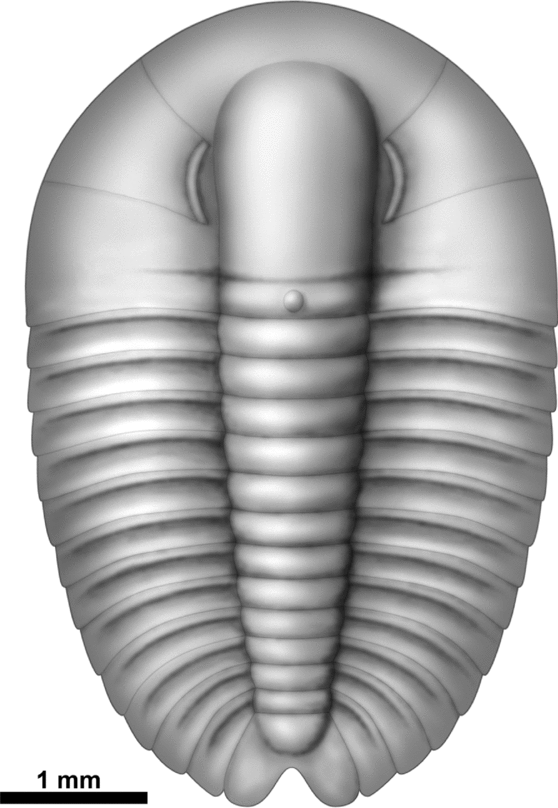
Reconstruction of Burlingia balangensis sp. nov. Protoryctocephalus wuxunensis Zone of the upper part of the ‘Tsinghsutung’ Formation at the Malipo section, Balang village, Jianhe County, Guizhou.

Etymology. The new species takes the name from the village of Balang (Jianhe County, Guizhou Province), where the specimens were collected.
Diagnosis. A species of Burlingia with a short preglabellar field (c. 20% of cephalon length), pyriform glabella, short occipital ring (c. 15% of cephalon length), short palpebral lobe (c. 20% of glabellar length) and small posteromedian invagination in the pygidium.
Description. Exoskeleton broadly oval to elongated oval in outline, well rounded anteriorly. Size small, average length 4.7 mm, the holotype being 5.7 mm. Axial furrow very shallow. Cephalon semicircular, moderately long (c. 42% of total length), three times wider than long; posterior margin nearly straight. Glabella wide (c. 22% of cephalon length and c. 30% of cranidial width) and long (c. 80% of cephalon length, included occipital ring), slightly pyriform in shape, rounded anteriorly, with glabellar furrows absent. Occipital ring short (c. 15% of cephalon length), some specimens with a small occipital node, occipital furrow shallow. Anterior border very narrow (sag.), slightly convex; shallow and narrow anterior border furrow. Preglabellar field relatively short (c. 20% of the cephalic length) and flat. Lack of fixigenae field; posterolateral projection very wide (c. 50% of cephalic length, c. 95% glabella width). Palpebral lobe moderately short (c. 23% of glabellar length), crescent-shaped in outline, in contact with the glabella at about cephalic mid-length bounded by the proparian facial sutures. Anterior branch of suture divergent from palpebral lobes at an angle of about 49 degrees to sagittal line; posterior branches divergent at an angle of about 76 degrees to sagittal line. Two specimens (NIGP147820 and NIGP147821) show a broken glabella and a small hypostome (c. 0.5 mm long, c. 0.4 mm wide). Thorax with 10 to 12 segments, wide pleural furrow, well-defined anterior and posterior pleural band, pleural segments slightly curving progressively backwards, and last two to three segments narrowing and curved more strongly backwards. Pleural segments gently curved backwards, with a very short pointed pleural spine. Pygidium small, semi-trapezoidal in outline, with a small posteromedian invagination.
Remarks. In general outline of the exoskeleton the new species is very similar to Burlingia multisegmenta Zhao et al. in Yuan et al. Reference Yuan, Zhao, Li and Huang2002 from the Kaili Formation (see Yuan et al. Reference Yuan, Zhao, Li and Huang2002, pp. 131, 255, pl. 39, figs 5, 6). It differs from the latter in having a narrower glabella and axis of the thoracic region (tr.), a shorter preglabellar field (sag.), the anterior branch of the facial sutures less divergent, 10 to 12 thoracic segments rather than 16 thoracic segments in the latter and a semi-trapezoidal pygidium. The new species is also very similar to Burlingia obscura Soloviev, Reference Soloviev1969 from northern Siberia (Soloviev, Reference Soloviev1969, pp. 10, 11, pl. 1, figs 1–7; pl. 2, fig. 3), but the latter has a narrower glabella (tr.), narrower occipital ring (sag.) as well as narrower axial rings in the thoracic region (tr.), a wider pleural region and the posterior branch of the facial sutures almost horizontal with an angle of about 90 degrees to the sagittal line. B. balangensis sp. nov. is also similar to B jagoi, but the latter differs in the shape of the glabella, the lack of invagination of the posterior border of the pygidium, a wider preglabellar area and a shorter occipital ring (sag.).
5. Stratigraphical distribution of the Burlingia species
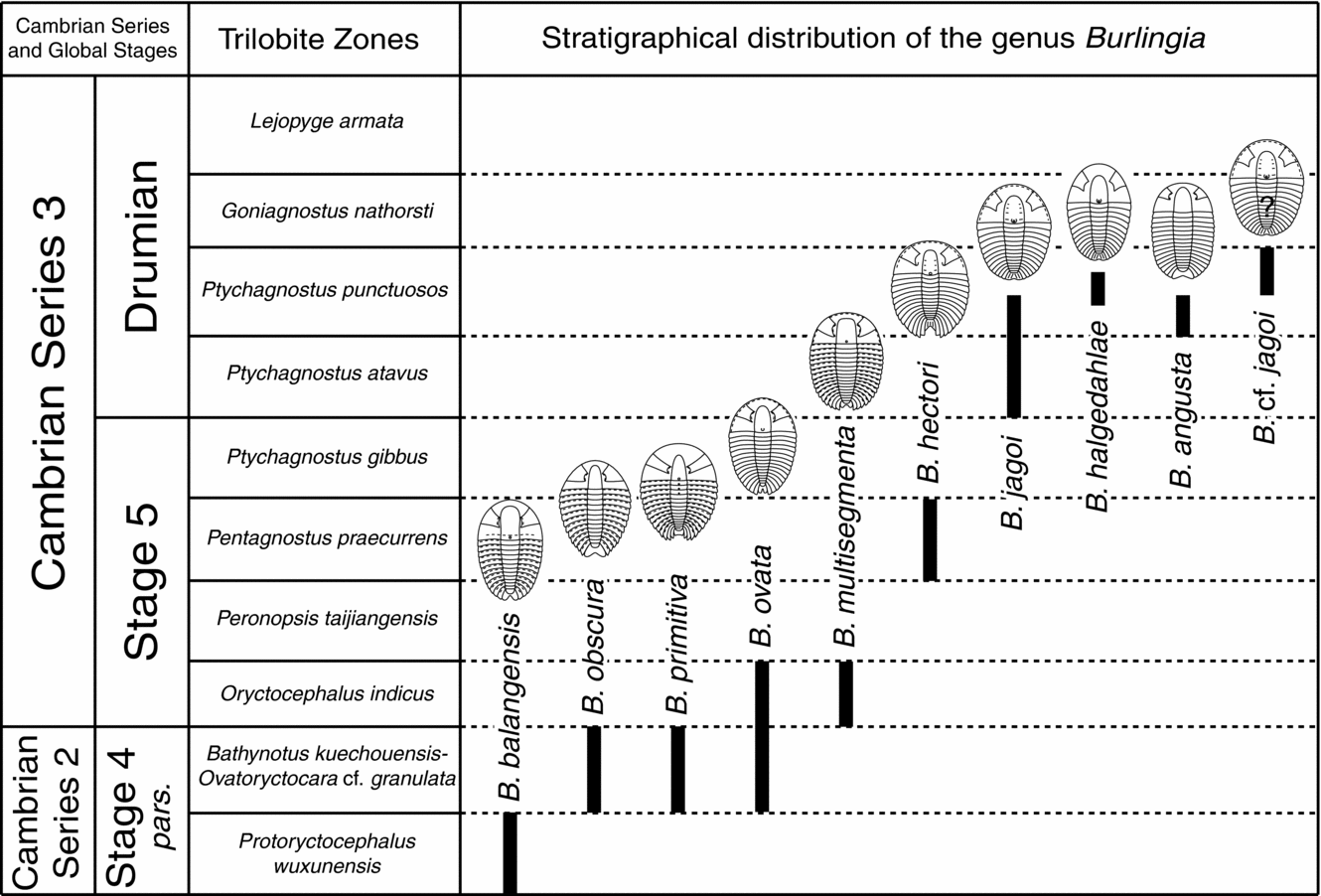
Together with the present new species, nine are now known belonging to Burlingia for which the stratigraphical occurrence in ascending order is shown in Figure 4 and discussed below.
Stratigraphical distribution of species of Burlingia (see text for explanation).

-
(1) Burlingia balangensis sp. nov. comes from the Protoryctocephalus wuxunensis Zone (Cambrian Series 2, Stage 4) of southern China.
-
(2) Burlingia obscura Soloviev, Reference Soloviev1969 comes from the Oryctocephalops frischenfeldi – Schistocephalus Zone of northern Siberia, Russia. Ebbestad & Budd (Reference Ebbestad and Budd2002) correlated this species to the Eccaparadoxides pinus Zone, which corresponds to the early Cambrian Series 3, Stage 5. However, Oryctocephalops frischenfeldi Lermontova, Reference Lermontova and Vologdin1940 is found in the Bathynotus kueichouensis – Ovatoryctocara cf. granulata Zone of South China (see Yuan et al. Reference Yuan, Zhao, Li and Huang2002; Sundberg et al. Reference Sundberg, Zhao, Yuan and Lin2011), suggesting to us that the Oryctocephalops frischenfeldi – Schistocephalus Zone should be correlated with the Bathynotus kueichouensis – Ovatoryctocara cf. granulata Zone. This is late Cambrian Series 2, Stage 4 (Zhao & Yuan in Yuan et al. Reference Yuan, Zhao, Li and Huang2002).
-
(3) Burlingia primitiva Zhao et al. in Yuan et al. Reference Yuan, Zhao, Li and Huang2002 occurs in the Bathynotus kueichouensis – Ovatoryctocara cf. granulata Zone of southeastern Guizhou, South China. This is late Cambrian Series 2, Stage 4 (Zhao & Yuan in Yuan et al. Reference Yuan, Zhao, Li and Huang2002).
-
(4) Burlingia ovata Zhou & Yuan in Zhang et al. Reference Zhang, Lu, Zhu, Qian, Lin, Zhou, Zhang and Yuan1980 has been reported in the Bathynotus kueichouensis – Ovatoryctocara cf. granulata Zone of the Wiliu–Zangjiayan section. This is late Cambrian Series 2, Stage 4 (Sundberg et al. Reference Sundberg, Zhao, Yuan and Lin2011).
-
(5) B. multisegmenta Zhao et al. in Yuan et al. Reference Yuan, Zhao, Li and Huang2002 and also B. ovata come from the Oryctocephalus indicus Zone of southeastern Guizhou Province, South China. Ebbestad & Budd (Reference Ebbestad and Budd2002) assigned B. ovata to the Eccaparadoxides pinus Zone, which corresponds to the late Stage 5 below the Ptychagnostus gibbus Zone. But this is mistaken and B. ovata is slightly older and should be assigned to the early Stage 5 within the O. indicus Zone.
-
(6) Burlingia hectori Walcott, Reference Walcott1908 comes from the Bathyuriscus–Elrathina Zone of Mt Stephen in British Columbia, Canada, which is correlated with the Pentagnostus praecurrens Zone (see Sundberg, Reference Sundberg1994, p. 11). This is Cambrian Series 3, Stage 5 (Peng, Babcock & Cooper, Reference Peng, Babcock, Cooper, Gradstein, Ogg, Schmitz and Ogg2012).
-
(7) Burlingia halgedahlae Robison & Babcock, Reference Robison and Babcock2011 has been found from the middle Bolaspidella Zone of the House Range (USA), which is correlated to the Ptychagnostus punctuosus Zone (Robison & Babcock, Reference Robison and Babcock2011). This is Cambrian Series 3, Drumian Stage (Geyer & Shergold, Reference Geyer and Shergold2000; Peng, Babcock & Cooper, Reference Peng, Babcock, Cooper, Gradstein, Ogg, Schmitz and Ogg2012).
-
(8) Burlingia jagoi (Whittington, Reference Whittington1994) comes from the Tomagnostus fissus and Ptychagnostus atavus zones to the lower part of the Ptychagnostus punctuosus Zone of Sweden and Norway. In addition, the species B. cf. jagoi (Whittington, Reference Whittington1994) was described from the upper part of the Ptychagnostus punctuosus Zone of Norway. Both are within the Cambrian Series 3, Drumian Stage (Geyer & Shergold, Reference Geyer and Shergold2000; Peng, Babcock & Cooper, Reference Peng, Babcock, Cooper, Gradstein, Ogg, Schmitz and Ogg2012).
-
(9) Burlingia angusta Ebbestad & Budd, Reference Ebbestad and Budd2002 comes from the lower part of the Ptychagnostus punctuosus Zone of Norway. This is Cambrian Series 3, Drumian Stage.
6. Biostratigraphical and palaeobiogeographical significance
Burlingia balangensis sp. nov. is the earliest species of the genus and arose at a critical time when there was a faunal change from typical redlichiid assemblages in the late Stage 4 to typical oryctocephalid assemblages in the early Stage 5. B. balangensis sp. nov. is associated with other trilobites such as Feilongshania sp., Changaspis sp., Duyunaspis sp., Redlichia sp., Dinesus sp., Olenoides sp. and abundant early oryctocephalid trilobites such as Protoryctocephalus arcticus Geyer & Peel, Reference Geyer and Peel2011, Ovatoryctocara sp. and O. aff. angusta Tchernysheva, Reference Tchernysheva and Shvedov1962. The occurrence of B. balangensis sp. nov. in the Cambrian Series 2, Stage 4, thus likely represents the origin of this family on the east margin of Gondwana. Two other Chinese species, B. primitiva and B. obscura, also occur in the upper Cambrian Series 2, but these became extinct just before the first appearance datum (FAD) of Oryctocephalus indicus (Reed, Reference Reed1910). Therefore, the last appearance datums (LADs) of these older burlingiids can be used to help constrain the proposed GSSP interval in sections where Oryctocephalus indicus is absent.
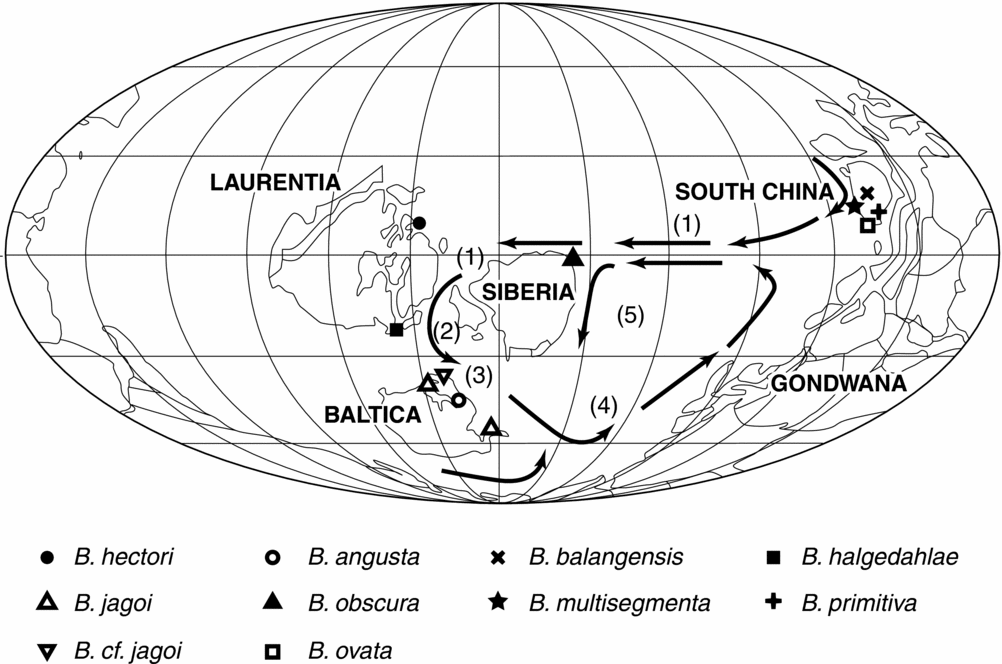
The global biostratigraphy and palaeobiogeography of the Cambrian Series 2 and 3 suffer both from a relatively low diversity of trilobites and pronounced endemism (Álvaro et al. Reference Álvaro, Elicki, Geyer, Ruston and Shergold2003). Moreover, the distribution of trilobites is, from the earliest times, strongly controlled by facies, so that even an accurate interregional correlation is complicated. Burlingia has a wide geographical distribution, which helps the interregional correlation and tests the various palaeogeographical models. As a consequence of the orientation of the western margin of Gondwana, being oriented approximately SW–NE in a position on the northern and southern hemispheres (McKerrow, Scotese & Brasier, Reference McKerrow, Scotese and Brasier1992; Scotese, Reference Scotese2004; Álvaro et al. Reference Álvaro, Ahlberg, Babcock, Bordonaro, Choi, Cooper, Ergaliev, Gapp, Ghobadi Pour, Hughes, Jago, Korovnikov, Laurie, Lieberman, Paterson, Pegel, Popov, Rushton, Sukhov, Tortello, Zhou, Żylińska, Harper and Servais2013; Torsvik & Cocks, Reference Torsvik, Cocks, Harper and Servais2013), the tropical zones were affected by the course of major ocean currents transporting cool waters towards the tropics (Fig. 5). South China exhibits the highest diversity of Burlingia with four species (B. balangensis, B. primitiva, B. ovata and B. multisegmenta) from the upper Stage 4 and lower Stage 5. Therefore, these early Burlingia species from South China were in an incomparable geographical situation allowing efficient migrations to areas in the southwest. According to the reconstructions by Scotese (Reference Scotese2004), Torsvik & Cocks (Reference Torsvik, Cocks, Harper and Servais2013) and Álvaro et al. (Reference Álvaro, Ahlberg, Babcock, Bordonaro, Choi, Cooper, Ergaliev, Gapp, Ghobadi Pour, Hughes, Jago, Korovnikov, Laurie, Lieberman, Paterson, Pegel, Popov, Rushton, Sukhov, Tortello, Zhou, Żylińska, Harper and Servais2013), other palaeocontinents show a different distribution. Thus, Siberia was at lower latitudes just below the equator and between Gondwana and Laurentia allowing equatorial currents to pass towards palaeocontinents in the west (Fig. 5). Laurentia was also in an equatorial position but acting as a barrier that displaced the equatorial currents towards the south. Álvaro et al. (Reference Álvaro, Elicki, Geyer, Ruston and Shergold2003) suggested different cool and warm water currents associated with the same palaeocontinent distribution. Wilde & Quinby-Hunt (Reference Wilde, Quinby-Hunt, Barnes and Williams1991) and recently Servais et al. (Reference Servais, Danelian, Harper and Munnecke2014) argued that this geographical distribution in connection with the Coriolis effect of winds also influenced and affected the palaeocurrents. The major currents generated by these factors can also be identified with climatic zones, although the currents are connected at zonal boundaries (Wilde & Quinby-Hunt, Reference Wilde, Quinby-Hunt, Barnes and Williams1991). Thus, we suggest that this system could allow five major currents: (1) the North Equatorial current, (2) the East Laurentian current, (3) the East Baltica current, (4) the Western Gondwana current and (5) the South Equatorial current, which were affected by the position of the continents and could change slightly during the Cambrian owing to continental drift. Cambrian palaeomagnetic data show that Siberia and Laurentia were closer to Gondwana in the Cambrian Series 2 and moved away towards northern latitudes in the Cambrian Series 3 (Lottes & Rowley, Reference Lottes, Rowley, McKerrow and Scotese1990; Torsvik & Renström, Reference Torsvik and Reström2001). On the other hand, Baltica was closer to Laurentia and away from Gondwana in the Cambrian Series 2 but approached the latter in the Cambrian Series 3 (Torsvik & Renström, Reference Torsvik and Reström2001; Cocks & Torsvik, Reference Cocks and Torsvik2005). Obviously, all these factors affected faunal migrations during Cambrian times and the Burlingia clade is a good example of this. It is noteworthy to observe that the stratigraphical distributions of taxa belonging to Burlingia extend from Stage 4 in South China to Stage 5 in Siberia and Laurentia (Canada) and from the Drumian Stage in Laurentia (USA) to the Drumian Stage in Baltica (Norway and Sweden), and this trend is consistent with the major currents suggested above (Fig. 5).
Palaeogeographic reconstruction of the early Cambrian Series 3 after Scotese (Reference Scotese2004) with distribution of species of Burlingia (see text for explanation).

The available data suggests that Burlingia originated in South China during the late Stage 4. Protaspid as well as meraspid larvae and holaspid specimens of different taxa belonging to this genus could migrate to north of Siberia via the North Equatorial current from South China where B. obscura evolved and gave rise to B. primitiva, B. ovata and B. multisegmenta in the Cambrian Series 2 and Series 3 in South China to North Siberia. Further migration following the East Laurentian current from Siberia to British Columbia in Canada in Stage 5 gave rise to B. hectori followed by B halgedahlae in the Drumian Stage, while the East Baltica current afforded migration of additional species in the early Drumian of Baltica. This is in accordance with the model by Scotese (Reference Scotese2004) and Álvaro et al. (Reference Álvaro, Ahlberg, Babcock, Bordonaro, Choi, Cooper, Ergaliev, Gapp, Ghobadi Pour, Hughes, Jago, Korovnikov, Laurie, Lieberman, Paterson, Pegel, Popov, Rushton, Sukhov, Tortello, Zhou, Żylińska, Harper and Servais2013) and the currents involved with additional factors such as open platforms, muddy shelf facies and low temperature gradients.
7. Discussion and conclusions
The present new species Burlingia balangensis sp. nov. is the oldest representative of the Family Burlingiidae Walcott, Reference Walcott1908 (Cambrian Series 2, Stage 4). The LAD of B. primitiva and B. obscura is useful for recognizing the boundary between the Cambrian Series 2 and 3. The geographical distribution of Burlingia throughout the late Cambrian Series 2 and early Cambrian Series 3 seems to be controlled by the patterns of major currents suggested by Wilde & Quinby-Hunt (Reference Wilde, Quinby-Hunt, Barnes and Williams1991), Álvaro et al. (Reference Álvaro, Elicki, Geyer, Ruston and Shergold2003) and Servais et al. (Reference Servais, Danelian, Harper and Munnecke2014). On the palaeo-reconstruction used, Siberia was closer to east Gondwana in the Cambrian Series 2 affording better connection between both palaeocontinents (Lottes & Rowley, Reference Lottes, Rowley, McKerrow and Scotese1990; Torsvik & Renström, Reference Torsvik and Reström2001). Members of the Burlingia clade could migrate by using the North Equatorial and East Laurentian currents from China in the Stages 4 and 5 and the East Baltica current to Baltica during the Drumian Stage. This hypothesis shows an allopatric speciation of the Burlingia clade, which took around 7 million years from South China to Baltica. Nevertheless, so far Burlingia has not been found in Avalonia and the west margin of Gondwana. Other burlingiids such as Schmalenseeia amphionura Moberg, Reference Moberg1903 and S. cf. spinulosa Lazarenko, Reference Lazarenko and Markovsky1960 have been reported in the lower Guzhangian Stage of Avalonia (Rusthon, Reference Rusthon1978), just above the Erratojincella brachymetopa Zone. In the absence of records, whether or not Burlingia reached the Avalonia palaeocontinent is unclear, but it is not recorded in Avalonia yet. Accordingly, it seems likely that the same niche was taken up by species of Schmalenseeia during the early Guzhangian Stage. Alternatively, the lack of Burlingia on the marginal platform or in outer shelf facies of the Mediterranean area and Central Europe on the west margin of Gondwana could be explained by two facts: (i) the presence of numerous barren stratigraphical intervals and unconformities (Alvaro et al. Reference Álvaro, Elicki, Geyer, Ruston and Shergold2003) and (ii) these areas suffered a widespread coarse-grained terrigenous input associated with a well-documented regressive trend during Stage 5 and the Drumian Stage (see Álvaro & Vizcaïno Reference Álvaro and Vizcaïno1998; Álvaro, Vizcaïno & Vennin, Reference Álvaro, Vizcaïno and Vennin1999; Álvaro & Vennin, Reference Álvaro and Vennin2001; Álvaro et al. Reference Álvaro, Elicki, Geyer, Ruston and Shergold2003) causing loss of the habitat favoured by Burlingia and thus its absence in the Mediterranean area and Central Europe.
Acknowledgements
Jin-Liang Yuan is supported by the National key basic Research Program of China (2013CB835000) and the National Natural Science Foundation of China (41362002; 40930211). Jorge Esteve is supported by European Social fund and Ministry of Education Youth and Sport, Czech Republic (Ref. CZ. 1.07/2.3.00/30.0013). This is a contribution to the project CGL2011-24516 from Ministerio de Educación y Ciencia-FEDER-EU (Spain). We are grateful to Isabel Pérez (MEC-FSE, Universidad de Zaragoza, Spain) for her technical support with the figures. Thanks to Javier Álvaro (Centro de Astrobiología, Torrejón de Ardoz, Spain) for his helpful comments in the early stage of this manuscript. We are grateful to two anonymous reviewers for their review and helpful suggestions, which improved this manuscript. David L. Bruton (University of Oslo) kindly corrected the English.